Archive for the ‘Fred Anson’ Category

by Fred W. Anson
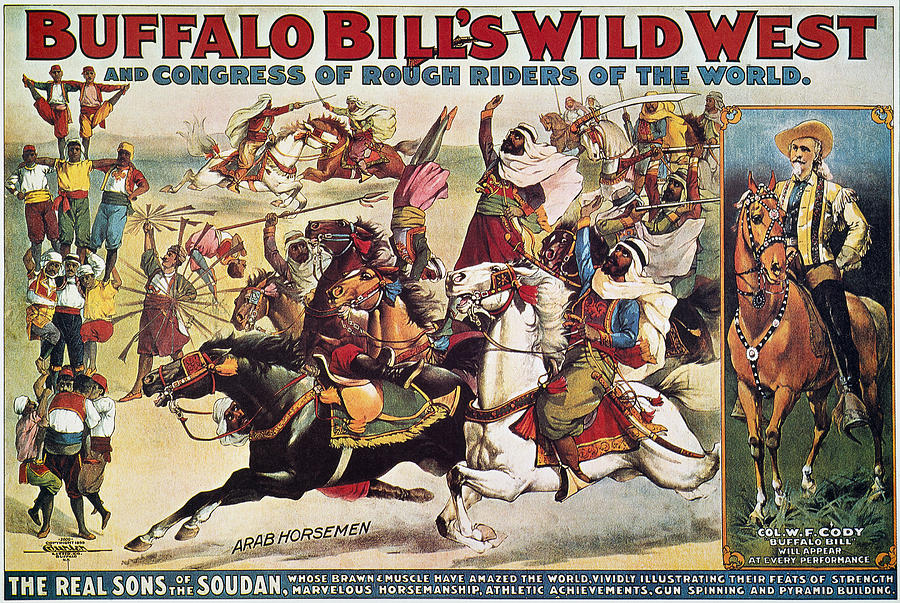
Dime Novels are as American as baseball, apple pie, and Chevrolet. They are so entrenched in the American psyche and culture that most consumers of American Pop Culture have been exposed to the Dime Novel genre even if they have never actually seen or read a Dime Novel. As Wikipedia explains: 

“The dime novel is a form of late 19th-century and early 20th-century U.S. popular fiction issued in series of inexpensive paperbound editions. The term dime novel has been used as a catchall term for several different but related forms, referring to story papers, five- and ten-cent weeklies, “thick book” reprints, and sometimes early pulp magazines. The term was used as a title as late as 1940, in the short-lived pulp magazine Western Dime Novels. In the modern age, the term dime novel has been used to refer to quickly written, lurid potboilers, usually as a pejorative to describe a sensationalized but superficial literary work.”
(Wikipedia, “Dime Novel”

If you have ever seen an early 20th Century Western, or Mystery that was produced in America you have been exposed to Dime Novel fiction. American Television, Radio, Movies, popular literature, and plays all followed the Dime Novel formula which was as follows: 

“[Western] Protagonists would often come into conflict with Native Americans, which would become a recurring feature of the genre and lend it a reputation for racism and jingoism. These stories are occasionally fictional accounts of real historical figures, such as Davy Crockett and Daniel Boone, but more often the characters are completely fictional, like Nick Whiffles. It wasn’t long before the setting of these novels shifted to the contemporary Western frontier, especially mining camps in the Dakotas and California. At first, outlaws, gamblers, and other anti-heroes were especially popular, such as Edward L. Wheeler’s Deadwood Dick or real-life gang leader Jesse James. These characters were almost always driven to a life of crime by their circumstances, but often had basically good intentions. With growing concerns about the moral appropriateness of dime novels for children, however, stories about cowboys and plainsmen came to replace outlaws…

At the dawn of the dime novel era, historical fiction was almost as popular as Western stories, with tales about the American Revolutionary War and the War of 1812 predominating. In many ways, America’s popular conception of its early history can be attributed to these novels, which often focused on the exploits of self-reliant patriots, either spies or privateers, who would heroically stand up against English and Tory oppression…

Real historical figures sometimes featured in these novels, like George Washington or Ulysses S. Grant, but more often these stories deal with few real historical events or characters, even sometimes leaving the date unspecified (e.g. 187-). When historical figures do appear, their character is often based on their popular conception, with seldom any relation to reality.”
(North Illinois University, “Nickels and Dimes: Genre”)

For those of us who have read through the Book of Mormon at least once is this all beginning to sound eerily familiar: 

      • Morality Plays
      • War Rhetoric
      • Battlefield Narratives
      • Racism
      • Jingoism
      • Patriotism
      • Cardboard, Two-Dimensional characters
      • Heroes (the “White Hats”) 
      • Outlaws (the “Black Hats”) 
      • Self Reliant Patriots (fighting to defend their religion, freedom, peace, and families)
      • Spies 
      • Privateers
      • Real Historical Figures inserted into fictional settings

Interesting, isn’t it? Now consider all the above in light of the following excerpts from the Book of Mormon: 

Mosiah 19:4-7
And now there was a man among them whose name was Gideon, and he being a strong man and an enemy to the king, therefore he drew his sword, and swore in his wrath that he would slay the king.

And it came to pass that he fought with the king; and when the king saw that he was about to overpower him, he fled and ran and got upon the tower which was near the temple.

And Gideon pursued after him and was about to get upon the tower to slay the king, and the king cast his eyes round about towards the land of Shemlon, and behold, the army of the Lamanites were within the borders of the land.

And now the king cried out in the anguish of his soul, saying: Gideon, spare me, for the Lamanites are upon us, and they will destroy us; yea, they will destroy my people.

Now just recontextualize that for the Old West with guns, Sheriffs and Desperados and you have a great Western story, don’t you? 

Helaman 6:16-20
And in the commencement of the sixty and seventh year the people began to grow exceedingly wicked again.

For behold, the Lord had blessed them so long with the riches of the world that they had not been stirred up to anger, to wars, nor to bloodshed; therefore they began to set their hearts upon their riches; yea, they began to seek to get gain that they might be lifted up one above another; therefore they began to commit secret murders, and to rob and to plunder, that they might get gain.

And now behold, those murderers and plunderers were a band who had been formed by Kishkumen and Gadianton. And now it had come to pass that there were many, even among the Nephites, of Gadianton’s band. But behold, they were more numerous among the more wicked part of the Lamanites. And they were called Gadianton’s robbers and murderers.

And it was they who did murder the chief judge Cezoram, and his son, while in the judgment-seat; and behold, they were not found.

And now it came to pass that when the Lamanites found that there were robbers among them they were exceedingly sorrowful; and they did use every means in their power to destroy them off the face of the earth.

And there it is, another otherwise good territory has privateering outlaws running amuck. So the good guys have to hunt down them and clear them out. Several exciting armed conflicts ensue. Sound familiar?

Alma 46:19-24, 34-36
And when Moroni had said these words, he went forth among the people, waving the rent part of his garment in the air, that all might see the writing which he had written upon the rent part, and crying with a loud voice, saying:

Behold, whosoever will maintain this title upon the land, let them come forth in the strength of the Lord, and enter into a covenant that they will maintain their rights, and their religion, that the Lord God may bless them.

And it came to pass that when Moroni had proclaimed these words, behold, the people came running together with their armor girded about their loins, rending their garments in token, or as a covenant, that they would not forsake the Lord their God; or, in other words, if they should transgress the commandments of God, or fall into transgression, and be ashamed to take upon them the name of Christ, the Lord should rend them even as they had rent their garments.

Now this was the covenant which they made, and they cast their garments at the feet of Moroni, saying: We covenant with our God, that we shall be destroyed, even as our brethren in the land northward, if we shall fall into transgression; yea, he may cast us at the feet of our enemies, even as we have cast our garments at thy feet to be trodden under foot, if we shall fall into transgression.

Moroni said unto them: Behold, we are a remnant of the seed of Jacob; yea, we are a remnant of the seed of Joseph, whose coat was rent by his brethren into many pieces; yea, and now behold, let us remember to keep the commandments of God, or our garments shall be rent by our brethren, and we be cast into prison, or be sold, or be slain.

Yea, let us preserve our liberty as a remnant of Joseph; yea, let us remember the words of Jacob, before his death, for behold, he saw that a part of the remnant of the coat of Joseph was preserved and had not decayed. And he said—Even as this remnant of garment of my son hath been preserved, so shall a remnant of the seed of my son be preserved by the hand of God, and be taken unto himself, while the remainder of the seed of Joseph shall perish, even as the remnant of his garment…

Now, Moroni being a man who was appointed by the chief judges and the voice of the people, therefore he had power according to his will with the armies of the Nephites, to establish and to exercise authority over them.

And it came to pass that whomsoever of the Amalickiahites that would not enter into a covenant to support the cause of freedom, that they might maintain a free government, he caused to be put to death; and there were but few who denied the covenant of freedom.

And it came to pass also, that he caused the title of liberty to be hoisted upon every tower which was in all the land, which was possessed by the Nephites; and thus Moroni planted the standard of liberty among the Nephites.

I can almost feel the flag fluttering in the air while Moroni proudly hugs his scripture to his chest, can’t you? Haven’t we all seen this scene before somewhere… 

The Jay Ward cartoon characters Dudley Do-Right and his nemesis Snidely Whiplash were satirical takes on Dime Novel heroes and villains as they manifested themselves in the American Silent Film era.

1 Nephi 4:6-27
And I was led by the Spirit, not knowing beforehand the things which I should do.

Nevertheless I went forth, and as I came near unto the house of Laban I beheld a man, and he had fallen to the earth before me, for he was drunken with wine.

And when I came to him I found that it was Laban.

And I beheld his sword, and I drew it forth from the sheath thereof; and the hilt thereof was of pure gold, and the workmanship thereof was exceedingly fine, and I saw that the blade thereof was of the most precious steel.

And it came to pass that I was constrained by the Spirit that I should kill Laban; but I said in my heart: Never at any time have I shed the blood of man. And I shrunk and would that I might not slay him.

And the Spirit said unto me again: Behold the Lord hath delivered him into thy hands. Yea, and I also knew that he had sought to take away mine own life; yea, and he would not hearken unto the commandments of the Lord; and he also had taken away our property.

And it came to pass that the Spirit said unto me again: Slay him, for the Lord hath delivered him into thy hands;

Behold the Lord slayeth the wicked to bring forth his righteous purposes. It is better that one man should perish than that a nation should dwindle and perish in unbelief.

And now, when I, Nephi, had heard these words, I remembered the words of the Lord which he spake unto me in the wilderness, saying that: Inasmuch as thy seed shall keep my commandments, they shall prosper in the land of promise.

Yea, and I also thought that they could not keep the commandments of the Lord according to the law of Moses, save they should have the law.

And I also knew that the law was engraven upon the plates of brass.

And again, I knew that the Lord had delivered Laban into my hands for this cause—that I might obtain the records according to his commandments.

Therefore I did obey the voice of the Spirit, and took Laban by the hair of the head, and I smote off his head with his own sword.

And after I had smitten off his head with his own sword, I took the garments of Laban and put them upon mine own body; yea, even every whit; and I did gird on his armor about my loins.

And after I had done this, I went forth unto the treasury of Laban. And as I went forth towards the treasury of Laban, behold, I saw the servant of Laban who had the keys of the treasury. And I commanded him in the voice of Laban, that he should go with me into the treasury.

And he supposed me to be his master, Laban, for he beheld the garments and also the sword girded about my loins.

And he spake unto me concerning the elders of the Jews, he knowing that his master, Laban, had been out by night among them.

And I spake unto him as if it had been Laban.

And I also spake unto him that I should carry the engravings, which were upon the plates of brass, to my elder brethren, who were without the walls.

And I also bade him that he should follow me.

And he, supposing that I spake of the brethren of the church, and that I was truly that Laban whom I had slain, wherefore he did follow me.

And he spake unto me many times concerning the elders of the Jews, as I went forth unto my brethren, who were without the walls.

And there you have it, a good and righteous man is forced to slay an evil villain for the sake of the greater good due to circumstances beyond his control. Surely this is one that we’ve never heard before, well, except for in just about every Dime Novel Western Hero story ever, that is, of course.

I think you get the idea, here. I would encourage you to read (or reread) the Book of Mormon in light of these Dime Novel genre formulations and consider how they just pop out at you. 

Consider, for example, The “Dudley Do-Rightism” of the courageous and righteous Nephi against the constant malice and murmurings of the scheming and the conniving “Snidely Whiplash” characters of Laman and Lemuel in the opening books of the Book of Mormon. 

Then compare and contrast those simplistic protagonists and antagonists against the deep, complex, characters in the Bible. The biblical characters are never cardboard, they’re deep and conflicted. Case in point, King David was a man after God’s whole heart due to his devotion and passion for God, but he was also a murderer and an adulterer. This isn’t a superficial, shallow, easily understood, literary figure, is it? 

Ditto for Noah who God calls just and perfect (see Genesis 6:9) but who still manages to get crazy, drunk, and naked in the midst of God’s calling on his life. Furthermore, the Noah narrative in the Bible, it has been noted, has strong parallels to the Sumerian and Babylonian flood narratives (see Wikipedia, “Gilgamesh Flood Myth”)And let’s not forget the book of Job for which there are similar “lamentation songs” and stories from the ancient Mesopotamian basin (see, for example, Morris Jastrow, Jr., “A Babylonian Parallel to the Story of Job”)Thus, regardless of whether you believe that it’s divinely inspired or not, the body of evidence is clear that the Bible is indeed ancient, Middle Eastern literature.

On the other hand, The Book of Mormon claims to be an ancient work of Middle Eastern origin but is actually more reflective of a uniquely American literary genre from the 19th Century – which would suggest that it is neither. Rather, it is strongly suggestive of American culture in general and 19th Century American culture in particular. Couple that with the fact that as of a decade ago, 150-Million copies of The Book of Mormon had been published (see LdS Newsroom, “Book of Mormon Reaches 150-Million Copies”) and you will understand why my assertion is that based on the body of evidence, The Book of Mormon is, quite simply, the most successful 19th Century Dime Novel in history. 
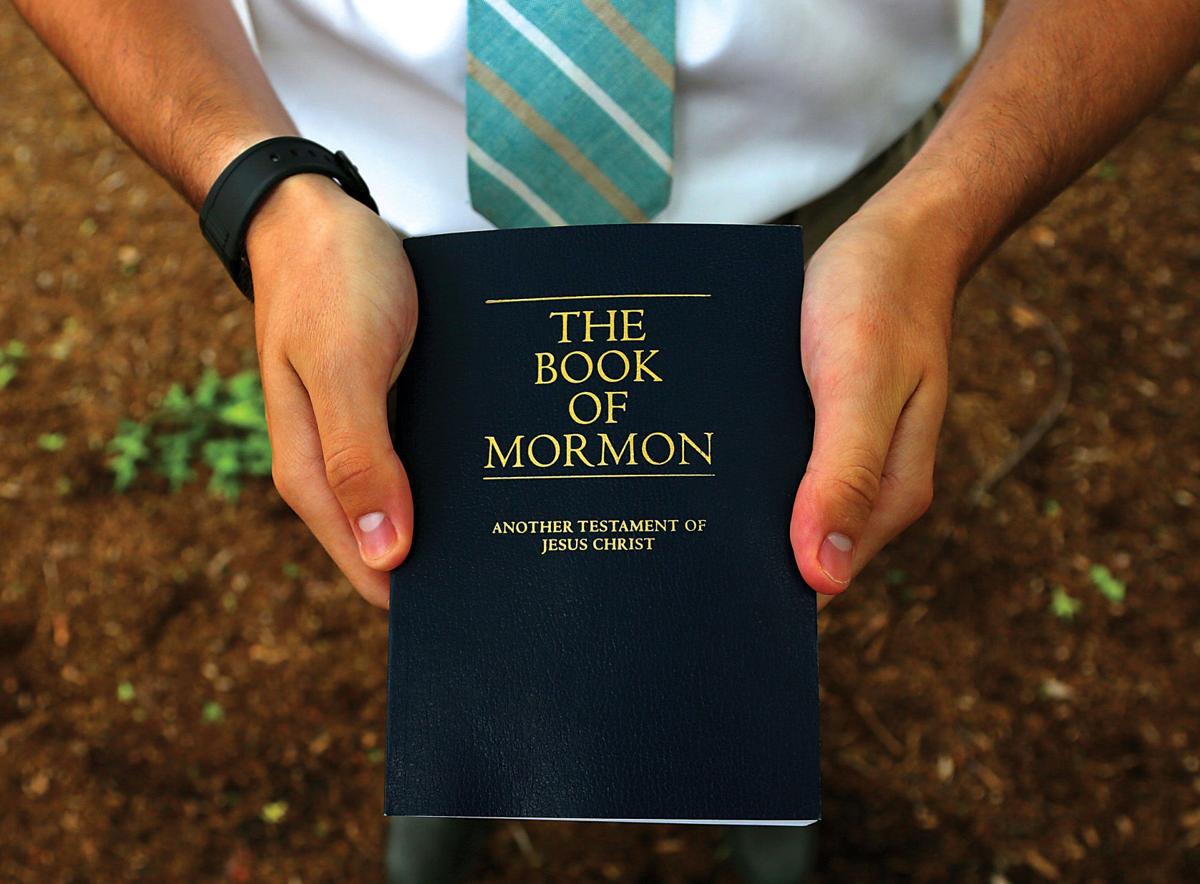
Presenting the Most Successful 19th Century Dime Novel in History.
compiled by Fred W. Anson
A common refrain from the LdS Church and other Latter Day Saint sources is that founding Prophet, Joseph Smith, Jr. wasn’t motivated by money in the founding and perpetuation of Mormonism in general and in his role as the Great Prophet of the Restoration in particular. If this is the case then why does the historical record clearly indicate that he benefited financially from both? Please consider the following two summations of the body of evidence.

First, from renowned Mormon Historian, D. Michael Quinn’s last book:

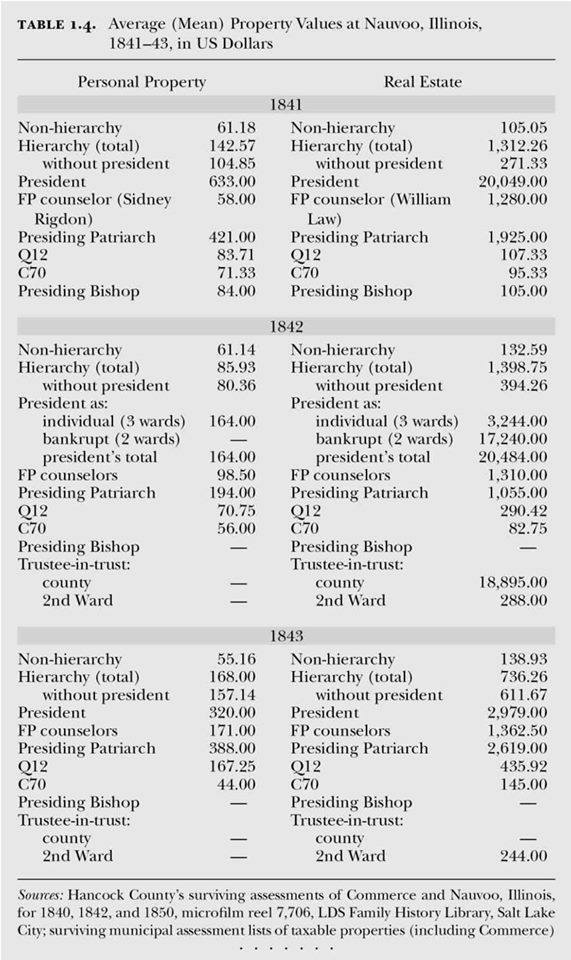
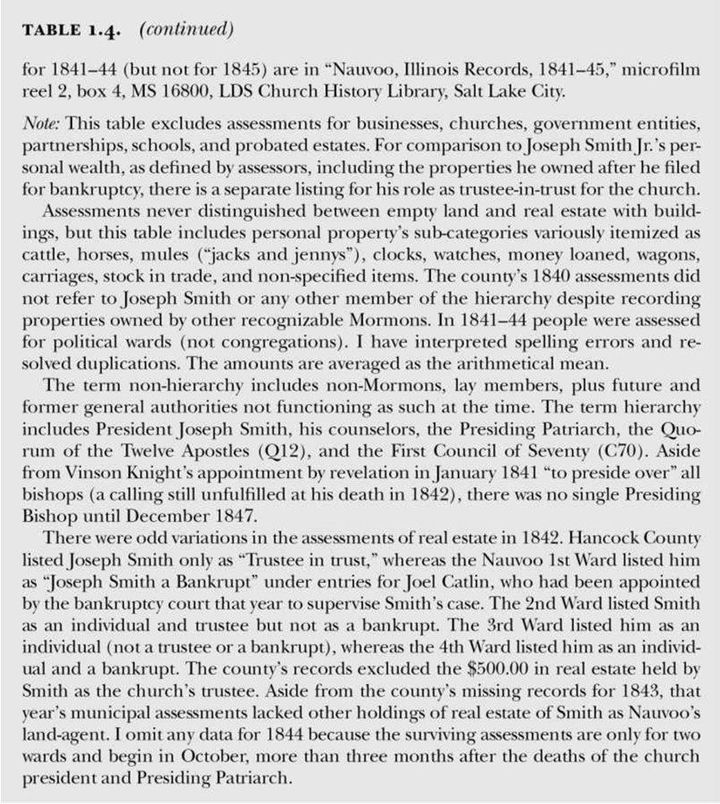
“The municipal assessment rolls for taxation from 1841 to 1843 show an unprecedented divergence between the church president’s assessed wealth and everyone else’s (table 1.4). This was not simply due to Joseph Smith’s role as trustee-in-trust after 1841, because LDS assessors itemized his personal real estate as distinct from each parcel of land he owned as the church’s trustee. . . . in 1842 and 1843, Smith’s personal ownership of land remained at least twenty-one times higher than for Nauvoo’s average resident. His personal property (non-land wealth) remained at least 2.7 times greater than for Nauvoo’s non-hierarchy. During those years, he also owned at least twice as much personal property than the average general authority, and his personal ownership of land remained at least 4.9 times their average.”
(D. Michael Quinn, “The Mormon Hierarchy: Wealth and Corporate Power”, Kindle Locations 507-516. Signature Books. Kindle Edition)

D. Michael Quinn, “The Mormon Hierarchy: Wealth and Corporate Power” Table 1.4 (part one)

D. Michael Quinn, “The Mormon Hierarchy: Wealth and Corporate Power” Table 1.4 (part two)

Second, from the RfM (Recovery from Mormonism) website archives:

1. Joseph Smith cleared over $73,000 in debt by filing for bankruptcy in 1842 (his brothers Hyrum and Samuel, along with other LDS dignitaries took advantage of a brief window where Congress enacted a lenient bankruptcy law only to rescind it months later when $440 million in liabilities in the country were wiped clean for $44 million in assets). Joseph’s $73k debt represented nearly $2 million in 2010 dollars. [see Dallin H. Oaks & Joseph I. Bentley, “Joseph Smith and Legal Process: In the Wake of the Steamboat Nauvoo”, pp.767-782; https://digitalcommons.law.byu.edu/cgi/viewcontent.cgi?article=1087&context=lawreview]

2. By Joseph’s own account, he owed approximately $70,000 again by the time he was killed just 2 years later in 1844 (over $1.84 million in 2010 dollars). [see Dallin H. Oaks & Joseph I. Bentley, “Joseph Smith and Legal Process: In the Wake of the Steamboat Nauvoo”, pp.767-782; https://digitalcommons.law.byu.edu/cgi/viewcontent.cgi?article=1087&context=lawreview]

3. LAND SPECULATION. Nauvoo land purchased for $2 per acre, lots sold for average price of $500 per acre (minimum $200 per acre | maximum $800 per acre) multiply by factor of 25 to 28 for value in 2010 dollars—this is how frontier land speculation works when masses of people are gathered by revelation.

SPIRITUAL BLACKMAIL TO PROMOTE SALES.
February 13, 1843: I spent the evening at Elder Orson Hyde’s. In the course of conversation I remarked that those brethren who came here having money, and purchased without the Church and without counsel, must be cut off. This, with other observations, aroused the feelings of Brother Dixon, from Salem, Massachusetts, who was present, and he appeared in great wrath. [“History of the Church”, vol 5., ch.14, p.272; https://byustudies.byu.edu/content/volume-5-chapter-14]

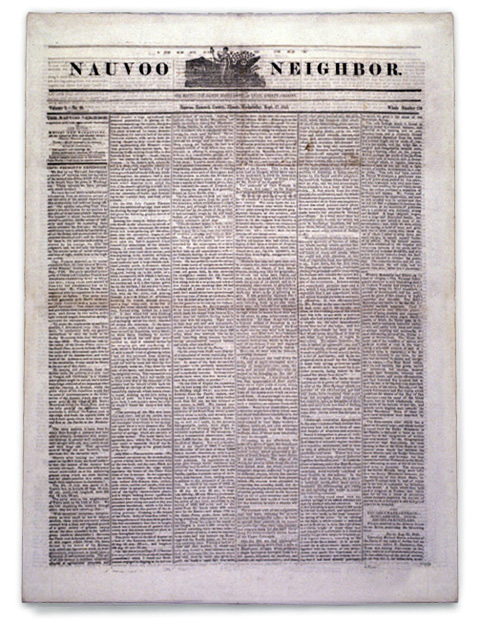
The Front Page of the Nauvoo Neighbor.

SPIRITUAL COERCION TO PROMOTE SALES.
[NOTE: “ The Nauvoo Neighbor was a weekly newspaper edited and published by Latter Day Saint Apostle John Taylor in Nauvoo, Illinois from 1843 to 1845. While it was not an official publication of the Church of Jesus Christ of Latter Day Saints, the Neighbor was consistently pro-Mormon and its primary target audience was the Latter Day Saint residents of Nauvoo. When The Wasp ceased publication in April 1843, the Neighbor replaced it as Nauvoo’s premier secular newspaper.” (Wikipedia, “Nauvoo Neighbor”; https://en.wikipedia.org/wiki/Nauvoo_Neighbor )]

———-BEGIN NAUVOO NEIGHBOR EXCERPT ———-

20 December 1843, Nauvoo Neighbor 37: To Emigrants and Latter-Day Saints Generally: I feel it my duty to say … that there is in the hands of the trustee in trust, a large quantity of lands, both in the city and adjoining townships in this county, which is for sale, some of which belongs to the Church and is designed for the benefit of the poor, and also to liquidate debts owing to the Church, for which the trustee in trust is responsible. Some, also, is land which has been consecrated for the building of the Temple and the Nauvoo House.If the brethern who move in here and want an inheritance, will buy their lands of the trustee in trust, they will thereby benefit the poor, the Temple, and the Nauvoo House, and even then only will be doing that which is their duty, and which I know, by considerable experience, will be vastly for their benefit and satisfaction in days to come. Let all the brethern, therefore, whey they move into Nauvoo, consult President Joseph Smith, the trustee in trust, and purchase their lands of him; and I am bold to say that God will bless them. …We hold ourselves ready at any time to wait upon the brethern and show them the lands … and can be found any day, either at President Joseph Smith’s bar-room, or the Temple Recorder’s office at the Temple.

———- END NAUVOO NEIGHBOR EXCERPT ———-

4. ABUSE OF POWER.
Nauvoo city council awarded Joseph Smith sole right to sell liquor in city limits. He established bar in Mansion House/Hotel for that purpose, but Emma forced him to remove it by threatening to take the kids and move back to the Homestead house.

5. ASSETS OWNED BY JOSEPH/EMMA:
• Joseph Smith Mansion House (http://en.wikipedia.org/wiki/Joseph_Smith_Mansion_House)
• Nauvoo House built by order of revelation at the Church’s expense (http://en.wikipedia.org/wiki/Nauvoo_House)
• Homestead house in Nauvoo (http://cofchrist.org/js/homestead/default.asp)
• Brigham Young claimed that Emma owned $50,000 in *city property* when they finished settling the assets with Emma ($1.4 million in 2010 dollars). This apparently referred to the Hugh White purchase which Joseph had deeded to her before his death (http://www.dialoguejournal.com/wp-content/uploads/sbi/articles/Dialogue_V17N03_89.pdf).
• Quincy property (aka Cleveland farm)
• One or more additional farms (Brigham Young twice used the plural when referring to farms given to Emma, saying that “besides these farms she owned city property worth fifty thousand dollars”).
• Owned at least two steamships: the Maid of Iowa and the Nauvoo (Joseph Smith owed a debt on the latter at the time of his death that was settled for over $5,000 (over $140,000 in 2010 dollars). [see Dallin H. Oaks & Joseph I. Bentley, “Joseph Smith and Legal Process: In the Wake of the Steamboat Nauvoo”, pp.767-782; https://digitalcommons.law.byu.edu/cgi/viewcontent.cgi?article=1087&context=lawreview]
• Steamship docks (ownership was under dispute—still looking for more info on this one).
• Egyptian papyrus and mummies purchased by friends of Joseph Smith for $2,400 in 1835 ($60,000 in 2010 dollars).
• Mother Smith would charge admission (25 cents or around $7 in 2010 dollars) to see the Egyptian mummies and papyrus. Lying, Joseph reportedly told visitors that his mother had purchased them herself for $6,000 ($150,000 in 2010 dollars).
• They remained in the Smith family until Emma sold them shortly after Lucy Mack Smith’s death in 1855.
(source = http://exmormon.org/phorum/read.php?2,1190844,1220856 )

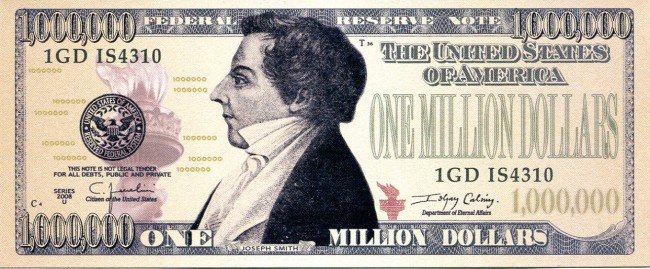
Banner Art: A fictional Million-Dollar Bill featuring Joseph Smith’s profile that was produced by Mormonism Research Mormonism (MRM) a few years ago.

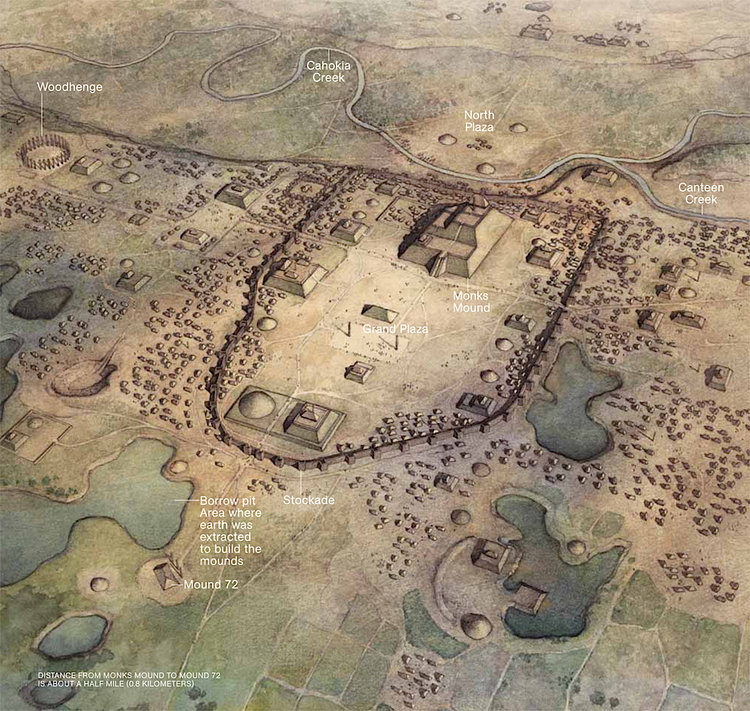
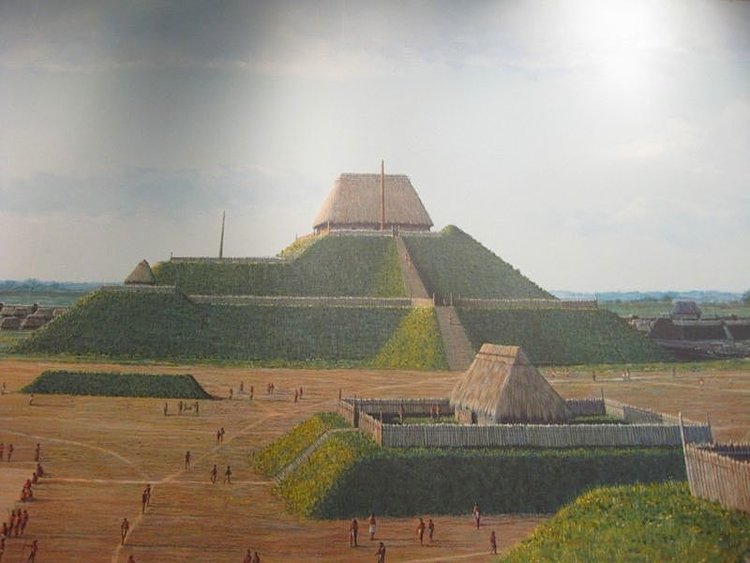
An artist’s interpretation of what downtown Cahokia would have looked like in the late Sterling period after the palisade wall had been built around Monk’s Mound and the Grand Plaza. credit: National Geographic (click to zoom)

compiled by Fred W. Anson
A common body of evidence that’s often presented by some Mormon faithful as the best evidence for The Book of Mormon is the Hopewell Mound Builder culture in general and the mount builder complex of Cahokia in particular. A well-known case in point is Rock Waterman’s article in which he attempts to make that very case, starting his lengthy treatise like this:

“What struck me when I first arrived in Cahokia was the incredible stink.

I had been called to serve in the Missouri-Independence Mission, but my first area, Plattsmouth, Nebraska, was far from any of the historic church locations I had expected to to see when I got my call. Now, near the end of 1973, I had been transferred to my second location. I would spend my first winter as a missionary in smelly Cahokia, Illinois; as far from Far West or Independence or Adam-Ondi-Ahman as a guy could possibly get.

The small town of Cahokia was located next to East St. Louis on the Illinois side of the Mississippi river, famous for its slaughterhouses. The smell of bovine death and gore hovered in the air long after slaughtering had ceased for the day, floating up and mixing with the rancid smoke spewed from the smokestacks of the nearby Monsanto chemical plant, then slowly settling down over the hapless town of Cahokia to choke its residents while they slept. “It’s something you just get used to,” my new companion told me.

Had I known then what I know now, I would have been delighted to find myself in Cahokia instead of dreading it. As it turns out, I had landed smack dab in the middle of Book of Mormon Central and never even knew it.”
(Rock Waterman, “Best Evidence For The Book of Mormon”, Pure Mormonism website, November 1, 2011)

Mr. Waterman then goes on to point to a long list of secular and Mormon Apologist sources, especially Heartland Apologists like Rod Meldrum, to support the case that Cahokia and the Hopewell Culture as stunning historical and archaeological support for The Book of Mormon. There’s only one problem: It’s been already been soundly discredited by both those inside and outside of Mormonism. Consider, for example, well-known RLDS/CoC scholar “Uncle” Dale Broadhurst, who concluded thusly:

“The Mississippian Culture was NOT a “civilization.” Its members did not live in cities.

Cahokia was NOT Teotihuacan nor Pekin nor Rome — it was a ceremonial center surrounded by farmers’ huts and connected by waterways to other, smaller villages.

We should not think of its residents as engaging in city life, with artisans, shops, government workers, city planning, etc.

If you want to look at a culture on the verge of becoming a civilization, look at the Valley of Mexico at the time Cortez arrived.

No reputable paleo-anthropologist will resort to exotic, transoceanic dispersions to account for the technology, social structure, language, etc., of American Indians associated with the Adena, Hopewell, or Mississippian cultures.

Take a minute to address letters of inquiry to the topmost cultural anthropologists at Brigham Young University, asking them what aspects of the Mississippian Culture necessarily depended upon importation from elsewhere — in other words, what parts of their society could not have been “home-grown” from the ground up.

The answer you will get back is: maize agriculture.

That, and perhaps some external “hints” on how to make better pottery, or weave better baskets, or better shape native copper into ornaments.”
(Dale Broadhurst, Mormon Discussions, Thu Feb 25, 2010 12:39 pm; link now dead)

And then there’s this from secular Science Journalist, Charles Mann, in his award-winning book, “1491: New Revelations of the Americas Before Columbus”:

“The Hopewell apparently sought spiritual ecstasy by putting themselves into trances, perhaps aided by tobacco. In this enraptured state, the soul journeys to other worlds. As is usually the case, people with special abilities emerged to assist travelers through the portal to the numinous. Over time these shamans became gatekeepers, controlling access to the supernatural realm. They passed on their control and privileges to their children, creating a hereditary priesthood: counselors to kings, if not kings themselves. They acquired healing lore, mastered and invented ceremonies, learned the numerous divinities in the Hopewell pantheon. We know little of these gods today, because few of their images have endured to the present. Presumably shamans recounted their stories to attentive crowds; almost certainly, they explained when and where the gods wanted to build mounds. “There is a stunning vigor about the Ohio Hopewell …,” Silverberg wrote,

‘a flamboyance and fondness for excess that manifests itself not only in the intricate geometrical enclosures and the massive mounds, but in these gaudy displays of conspicuous consumption [in the tombs]. To envelop a corpse from head to feet in pearls, to weigh it down in many pounds of copper, to surround it with masterpieces of sculpture and pottery, and then to bury everything under tons of earth—this betokens a kind of cultural energy that numbs and awes those who follow after.’

Vibrant and elaborate, perhaps a little vulgar in its passion for display, Hopewell religion spread through most of the eastern United States in the first four centuries A.D. As with the expansion of Christianity, the new converts are unlikely to have understood the religion in the same way as its founders. Nonetheless, its impact was profound. In a mutated form, it may well have given impetus to the rise of Cahokia.”
(Charles C. Mann, “1491 (Second Edition): New Revelations of the Americas Before Columbus” (Kindle Locations 5242-5255). Knopf Doubleday Publishing Group. Kindle Edition)

In regard to The Book of Mormon, Mann explains elsewhere in the same book:

“Contact with Indians caused Europeans considerably more consternation. Columbus went to his grave convinced that he had landed on the shores of Asia, near India. The inhabitants of this previously unseen land were therefore Asians—hence the unfortunate name “Indians.” As his successors discovered that the Americas were not part of Asia, Indians became a dire anthropogonical problem.

According to Genesis, all human beings and animals perished in the Flood except those on Noah’s ark, which landed “upon the mountains of Ararat,” thought to be in eastern Turkey. How, then, was it possible for humans and animals to have crossed the immense Pacific? Did the existence of Indians negate the Bible, and Christianity with it?

Among the first to grapple directly with this question was the Jesuit educator José de Acosta, who spent a quarter century in New Spain. Any explanation of Indians’ origins, he wrote in 1590, “cannot contradict Holy Writ, which clearly teaches that all men descend from Adam.” Because Adam had lived in the Middle East, Acosta was “forced” to conclude “that the men of the Indies traveled there from Europe or Asia.” For this to be possible, the Americas and Asia “must join somewhere.”

If this is true, as indeed it appears to me to be, … we would have to say that they crossed not by sailing on the sea, but by walking on land. And they followed this way quite unthinkingly, changing places and lands little by little, with some of them settling in the lands already discovered and others seeking new ones.

Acosta’s hypothesis was in basic form widely accepted for centuries. For his successors, in fact, the main task was not to discover whether Indians’ ancestors had walked over from Eurasia, but which Europeans or Asians had done the walking. Enthusiasts proposed a dozen groups as the ancestral stock: Phoenicians, Basques, Chinese, Scythians, Romans, Africans, “Hindoos,” ancient Greeks, ancient Assyrians, ancient Egyptians, the inhabitants of Atlantis, even straying bands of Welsh. But the most widely accepted candidates were the Lost Tribes of Israel. Tribes of Israel.

The story of the Lost Tribes is revealed mainly in the Second Book of Kings of the Old Testament and the apocryphal Second (or Fourth, depending on the type of Bible) Book of Esdras. At that time, according to scripture, the Hebrew tribes had split into two adjacent confederations, the southern kingdom of Judah, with its capital in Jerusalem, and the northern kingdom of Israel, with its capital in Samaria. After the southern tribes took to behaving sinfully, divine retribution came in the form of the Assyrian king Shalmaneser V, who overran Israel and exiled its ten constituent tribes to Mesopotamia (today’s Syria and Iraq). Now repenting of their wickedness, the Bible explains, the tribes resolved to “go to a distant land never yet inhabited by man, and there at last to be obedient to their laws.” True to their word, they walked away and were never seen again.

Because the Book of Ezekiel prophesizes that in the final days God “will take the children of Israel from among the heathen … and bring them into their own land,” Christian scholars believed that the Israelites’ descendants—Ezekiel’s “children of Israel”—must still be living in some remote place, waiting to be taken back to their homeland. Identifying Indians as these “lost tribes” solved two puzzles at once: where the Israelites had gone, and the origins of Native Americans.

Acosta weighed the Indians-as-Jews theory but eventually dismissed it because Indians were not circumcised. Besides, he blithely explained, Jews were cowardly and greedy, and Indians were not. Others did not find his refutation convincing. The Lost Tribes theory was endorsed by authorities from Bartolomé de Las Casas to William Penn, founder of Pennsylvania, and the famed minister Cotton Mather. (In a variant, the Book of Mormon argued that some Indians were descended from Israelites though not necessarily the Lost Tribes.) In 1650 James Ussher, archbishop of Armagh, calculated from Old Testament genealogical data that God created the universe on Sunday, October 23, 4004 B.C. So august was Ussher’s reputation, wrote historian Andrew Dickson White, that “his dates were inserted in the margins of the authorized version of the English Bible, and were soon practically regarded as equally inspired with the sacred text itself.” According to Ussher’s chronology, the Lost Tribes left Israel in 721 B.C. Presumably they began walking to the Americas soon thereafter. Even allowing for a slow passage, the Israelites must have arrived by around 500 B.C. When Columbus landed, the Americas therefore had been settled for barely two thousand years.

The Lost Tribes theory held sway until the nineteenth century, when it was challenged by events. As Lund had in Brazil, British scientists discovered some strange-looking human skeletons jumbled up with the skeletons of extinct Pleistocene mammals. The find, quickly duplicated in France, caused a sensation. To supporters of Darwin’s recently published theory of evolution, the find proved that the ancestors of modern humans had lived during the Ice Ages, tens of thousands of years ago. Others attacked this conclusion, and the skeletons became one of the casus belli of the evolution wars. Indirectly, the discovery also stimulated argument about the settlement of the Americas. Evolutionists believed that the Eastern and Western Hemispheres had developed in concert. If early humans had inhabited Europe during the Ice Ages, they must also have lived in the Americas at the same time. Indians must therefore have arrived before 500 B.C. Ussher’s chronology and the Lost Tribes scenario were wrong.

The nineteenth century was the heyday of amateur science. In the United States as in Europe, many of Darwin’s most ardent backers were successful tradespeople whose hobby was butterfly or beetle collecting. When these amateurs heard that the ancestors of Indians must have come to the Americas thousands of years ago, a surprising number of them decided to hunt for the evidence that would prove it.”
(Charles C. Mann, “1491: New Revelations of the Americas Before Columbus”, positions 331.0-334.2/1222 Kindle Edition)

Therefore, it should come as no surprise when modern amateur scientific voyeurs retread the same path trod by those after 1492 and prior to better, more complete evidence arising that discredits these now long-discredited American Lost Tribes theories. As the saying goes, the more things change, the more they stay the same.

In short, and in conclusion, the only way to turn Cahokia and the Hopewell Culture into evidence for The Book of Mormon is to come to the conclusion first and then both cherry-pick the body of evidence for “hits” while ignoring the far more numerous “misses”. In other words, this is yet another one where Mormon Confirmation Bias reigns supreme over logic and reason. Cahokia and the Hopewell Mount Builders are not only not a bull’s eye for The Book of Mormon, but they’re also not even in the same pub where the dartboard resides.

An artist’s recreation of downtown Cahokia, with Monk’s Mound at its center. (click to zoom)

 Artwork courtesy of ArsTechnica

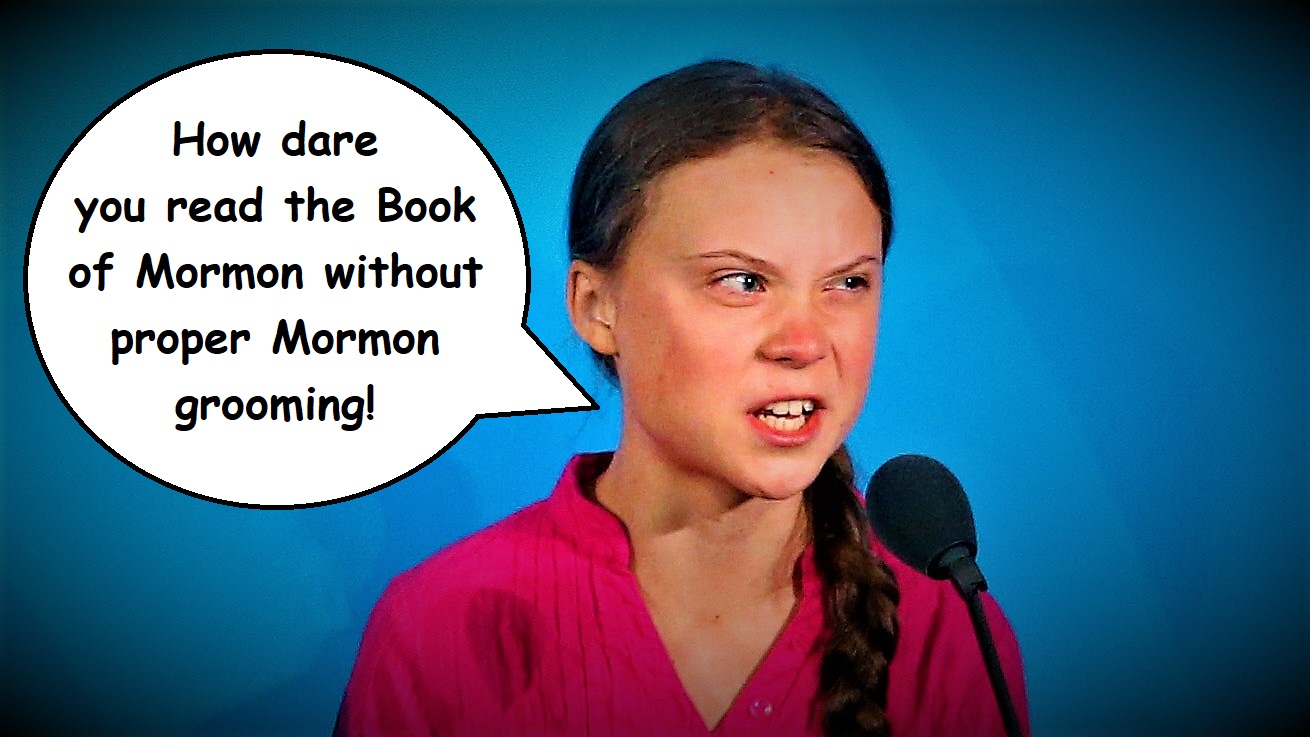
… Read the Book of Mormon Without Proper Mormon Grooming!

Social Justice Warrior, Greta “How Dare You!” Thunberg, weighs in on the matter.

by Fred W. Anson
The Book of Mormon is one of the worse pieces of American literature ever published. I say this as someone who has read it cover-to-cover not just once but more than once and then only after studying it for decades prior to that. But hey, don’t take my word for it, take the word of the man who is considered by many to be one of America’s greatest authors and creator of some of the best American literature ever written, Mark Twain, who said of the book:

“All men have heard of the Mormon Bible, but few except the “elect” have seen it, or, at least, taken the trouble to read it. I brought away a copy from Salt Lake. The book is a curiosity to me, it is such a pretentious affair, and yet so “slow,” so sleepy; such an insipid mess of inspiration. It is chloroform in print. If Joseph Smith composed this book, the act was a miracle—keeping awake while he did it was, at any rate. If he, accourding to tradition, merely translated it from certain ancient and mysteriously-engraved plates of copper, which he declares he found under a stone, in an out-of-the-way locality, the work of translating was equally a miracle, for the same reason…

The Mormon Bible is rather stupid and tiresome to read, but there is nothing vicious in its teachings. Its code of morals is unobjectionable—it is “smouched” from the New Testament and no credit given.”
(Mark Twain, “Roughing It”, Chapter 16)

Or how about the assessment of Charles H. Spurgeon, one of the most respected and influential preachers of the late 19th Century:

“One of the most modern pretenders to inspiration is the Book of Mormon. I could not blame you should you laugh outright while I read aloud a page from that farrago.”
(C.H. Spurgeon, “Our Manifesto”, April 25th, 1890)

And if you don’t believe Mark Twain, C.H. Spurgeon, or me, consider the words of Harold Bloom, American’s leading 20th Century Literary Critic:

“With the Book of Mormon, we arrive at the center of Joseph Smith’s prophetic mission, but hardly at any center of Mormonism, because of Smith’s extraordinary capacity for speculative development in the fourteen years that remained to him after its publication. The Book of Mormon was not only his first work; it is the portrait of a self-educated, powerful mind at the untried age of twenty-four. It has bravura, but beyond question it is wholly tendentious and frequently tedious. If one compares it closely to Smith’s imaginings in the Pearl of Great Price and Doctrine and Covenants, it seems the work of some other writer, and I don’t mean Mormon or Moroni.”
(Harold Bloom, “The American Religion”, Chu Hartley Publishers. Kindle Edition, Locations 1184-1189) 

And if you’re thinking, “Well, that’s not fair, you and Harold Bloom are critiquing a 19th Century literary style based on today’s modern standards”, consider this from Alexander Campbell, the founder, and leader of Campbellism, who said this of the book only two years after its publication:

“These are but as one drop out of a bucket compared with the amount of Smithisms in this book. It is patched up and cemented with “And it came to pass” — “I sayeth unto you” — “Ye saith unto him” — and all the King James’ haths, dids and doths; in the lowest imitation of the common version; and is, without exaggeration, the meanest book in the English language; but it is a translation made through stone spectacles, in a dark room, and in the hat of the prophet Smith from the reformed Egyptian!!! It has not one good sentence in it, save the profanation of those sentences quoted from the Oracles of the living God. I would as soon compare a bat to the American eagle, a mouse to a mammoth, or the deformities of a spectre to the beauty of Him whom John saw in Patmos, as to contrast it with a single chapter in all the writings of the Jewish or Christian prophets. It is as certainly Smith’s fabrication as Satan is the father of lies, or darkness the offspring of night. So much for the internal evidences of the Book of Mormon.”
(Alexander Campbell, “Delusions an analysis of the Book of Mormon…”, (1832), p.14) 

And if that’s still not enough, I would encourage you to speak to anyone who has read the book on its own merits without having Mormon Missionaries or any other Mormon influence hovering around them and telling them what a marvelous work and a wonder this insipid mess of mangled Elizabethan English combined with antiquated 19th Century ideas (such as American Restorationism and American Anglo-Israelism) it really is.

So the question remains, then how and why can millions of Mormons all over the world claim that this horrible book is some kind of inspired glory? Enter the power of suggestion. From the 2004 edition of the current, official LdS Church Missionary Manual:

“This message of the Restoration is either true or it is not. We can know that it is true by the Holy Ghost, as promised in Moroni 10:3–5. After reading and pondering the message of the Book of Mormon, any who desire to know the truth must ask in prayer to our Heavenly Father in the name of Jesus Christ if it is true. In order to do this, we address our Heavenly Father. We thank Him for our blessings and ask to know that the message of the Book of Mormon is true. No one can know of spiritual truths without prayer.

In answer to our prayers, the Holy Ghost will teach us truth through our feelings and thoughts.

Feelings that come from the Holy Ghost are powerful, but they are also usually gentle and quiet. As we begin to feel that what we are learning is true, we will desire to know all that we can about the Restoration.

Knowing that the Book of Mormon is true leads to a knowledge that Joseph Smith was called as a prophet and that the gospel of Jesus Christ was restored through him.”
(LdS Church, “Preach My Gospel: A Guide to Missionary Service” (2004 edition), p.39)

Not enough? Then how about this from former LdS Church President and “Living Prophet” Thomas S. Monson?

“This morning I speak about the power of the Book of Mormon and the critical need we have as members of this Church to study, ponder, and apply its teachings in our lives. The importance of having a firm and sure testimony of the Book of Mormon cannot be overstated.

We live in a time of great trouble and wickedness. What will protect us from the sin and evil so prevalent in the world today? I maintain that a strong testimony of our Savior, Jesus Christ, and of His gospel will help see us through to safety. If you are not reading the Book of Mormon each day, please do so. If you will read it prayerfully and with a sincere desire to know the truth, the Holy Ghost will manifest its truth to you. If it is true—and I solemnly testify that it is—then Joseph Smith was a prophet who saw God the Father and His Son, Jesus Christ.

Because the Book of Mormon is true, The Church of Jesus Christ of Latter-day Saints is the Lord’s Church on the earth, and the holy priesthood of God has been restored for the benefit and blessing of His children.

If you do not have a firm testimony of these things, do that which is necessary to obtain one. It is essential for you to have your own testimony in these difficult times, for the testimonies of others will carry you only so far. However, once obtained, a testimony needs to be kept vital and alive through continued obedience to the commandments of God and through daily prayer and scripture study.

My dear associates in the work of the Lord, I implore each of us to prayerfully study and ponder the Book of Mormon each day. As we do so, we will be in a position to hear the voice of the Spirit, to resist temptation, to overcome doubt and fear, and to receive heaven’s help in our lives. I so testify with all my heart in the name of Jesus Christ, amen.”
(Thomas S. Monson, “The Power of the Book of Mormon”, Spring General Conference 2017)

I mean, with over-the-top hyperbole and gushing like that how can it possibly be anything but one of the greatest, most powerful, stunningly inspired, incredible, works of English literature ever produced, right?

Two words in response: Read it. Yes, read it yourself so you can experience “inspired” prose like this, for yourself:

1 Nephi 14
23 Wherefore, the things which he shall write are just and true; and behold they are written in the book which thou beheld proceeding out of the mouth of the Jew; and at the time they proceeded out of the mouth of the Jew, or, at the time the book proceeded out of the mouth of the Jew, the things which were written were plain and pure, and most precious and easy to the understanding of all men.

24 And behold, the things which this apostle of the Lamb shall write are many things which thou hast seen; and behold, the remainder shalt thou see.

25 But the things which thou shalt see hereafter thou shalt not write; for the Lord God hath ordained the apostle of the Lamb of God that he should write them.

Wow, how can you argue with circular, over-blown, repetitious, grammar-challenged, gibberish like that?

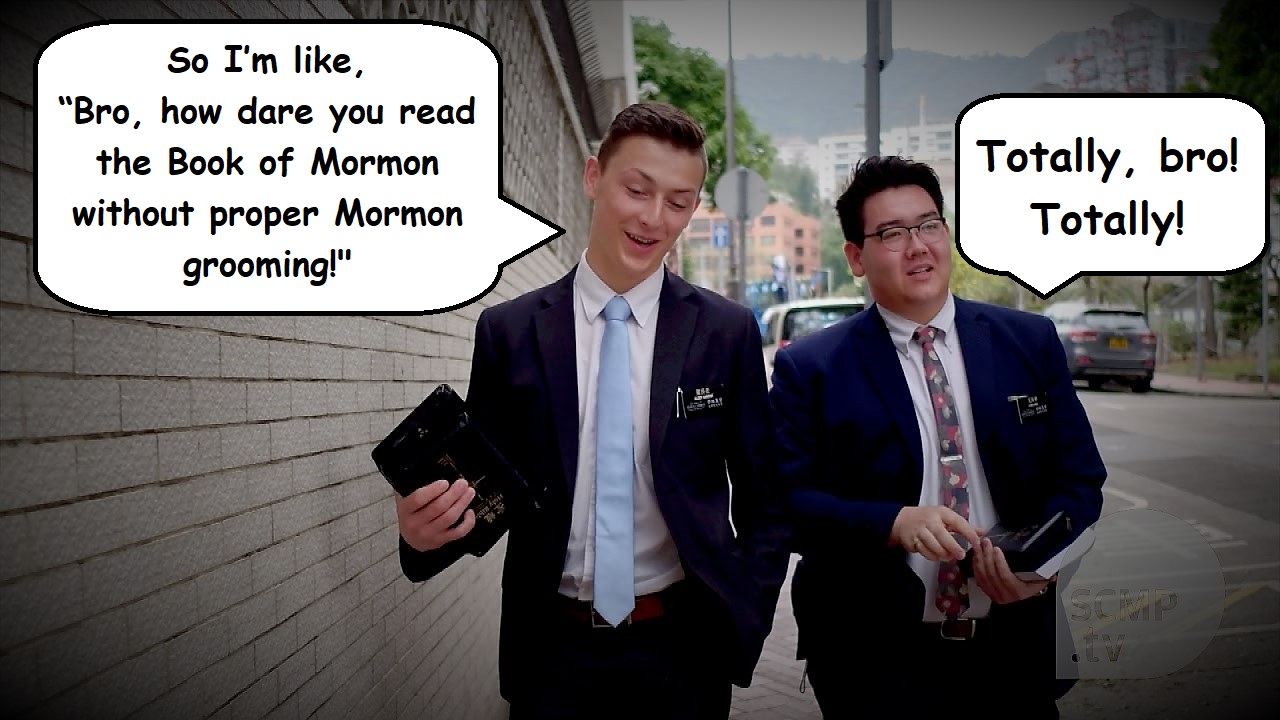
Missionaries weigh in on the matter.

Back in December 2019, my Mormon Studies colleague, Kathy Petersen, had the brilliant idea of setting up a Book of Mormon daily reading program so non-Mormons could do just that – read it all in a year, cover-to-cover, just like many Bible reading programs out there do. And to do all that without any Mormon influence or interference, so the group could discuss the book honesty without being told (see above) what we should think and feel about it in advance, during, or after it was read. So she did. And, full disclosure here, I agreed to help her get it established, running and maintained because, candidly, I thought that the idea was pure, absolute, genius (still do!) Here’s how the group description, in part, reads:

“The One Year BOM: Non-Mormons Reading Through the Book of Mormon in a Year (aka “TOYBOM”) is specifically for Non-Mormons reading the Book of Mormon in a year as a group so that we can openly and honestly discuss and deconstruct it without any Mormon interference, umbrage, or offense…

NO MORMONS ARE ALLOWED HERE
Mormons (that is, members of any Latter Day Saint group or denomination) are NOT allowed in this group. Period.

That’s so we can speak freely and deconstruct the Book the Mormon honestly and openly without having to deal with the typical Latter Day Saint agendas, dogmas, thin-skinned offense, spin doctoring, and confirmation bias driven apologetics that typically swirl around the Book of Mormon in public.

Our goal here is to quietly, objectively, civilly and dispassionately consider the Book of Mormon devoid of any of such partisan Latter Day Saint encumbrances.”
(see Facebook, The One Year BOM: Non-Mormons Reading Through the Book of Mormon in a Year

The wailing, moaning, and gnashing of teeth that we got from Latter-day Saints in general, and Mormon Missionaries was swift and to the point: We were told that no one could possibly understand or appreciate this great, soaring, inspired, paradigm-changing work on its own without Latter-day Saints being in the room to explain it to them. We were told by virtue of the fact that Mormons could not be a part of the discussion and conversation the Book of Mormon would, no doubt, be completely misunderstood and misinterpreted by the non-Mormons in the group.

To all this, my Latter-day Friends and Mormon Missionary friends I just have one question: Why?

After all, if the Book of Mormon is truly everything that you all claim it is, shouldn’t it speak for itself? Shouldn’t its stunning inspiration and clear veracity be apparent simply by cracking its cover and reading it? Shouldn’t it be exactly as the Moroni 10 Challenge states?

“Behold, I would exhort you that when ye shall read these things, if it be wisdom in God that ye should read them, that ye would remember how merciful the Lord hath been unto the children of men, from the creation of Adam even down until the time that ye shall receive these things, and ponder it in your hearts.

And when ye shall receive these things, I would exhort you that ye would ask God, the Eternal Father, in the name of Christ, if these things are not true; and if ye shall ask with a sincere heart, with real intent, having faith in Christ, he will manifest the truth of it unto you, by the power of the Holy Ghost.

And by the power of the Holy Ghost ye may know the truth of all things.”
— Moroni 10:3-5

Latter-day Saint friends, can you please show us where in the Moroni 10 Challenge it says, “Unless, of course, there are no Latter-day Saints around or present to groom and guide you, in which case, fuggedaboutit!”? I can’t seem to find it, and neither can anyone else.

So, back to the “The One Year BOM: Non-Mormons Reading Through the Book of Mormon in a Year” group. We started the daily readings and it didn’t take long before the wailing, moaning, and gnashing of teeth were soon coming from these intrepid non-Mormons who had committed to reading this overwhelmingly boring and dreadfully written book in a year. They were stunned, absolutely stunned from the front cover to the back cover that anyone could come to anything but the obvious conclusion that (to borrow and paraphrase from Lamoni’s queen in Alma 19:5): As for myself, to me it doth truly stink.

So I will end this article the way that I began it: The Book of Mormon is one of the worse pieces of American literature ever published. Or to put it another way, friends, the Emperor has no clothes! And if you doubt that, then just read it for yourself. With no one else around. It speaks for itself, and it says loudly, “These things are not true.”

(click to zoom)

I think that anyone who has actually done it can relate to this.

A Position Statement by the XM-Christians Administrators

First, let’s define terms. From Wikipedia: 

“As a form of Western esotericism, the New Age drew heavily upon a number of older esoteric traditions, in particular, those that emerged from the occultist current that developed in the eighteenth and nineteenth centuries. Such prominent occultist influences include the work of Emanuel Swedenborg and Franz Mesmer, as well as the ideas of Spiritualism, New Thought, and Theosophy… The exact origins of the phenomenon remain contested, but there is general agreement that it became a major movement in the 1970s, at which time it was centered largely in the United Kingdom. It expanded and grew largely in the 1980s and 1990s, in particular within the United States.”
(see https://en.wikipedia.org/wiki/New_Age

Since its inception of the Ex-Mormon Christians Facebook group (aka “XM-Christians”) back in 2015, a recurring pattern emerged with former Latter-day Saints preaching, teaching, advocating for, and asking questions about New Age teachings and practices in the group. This should have come as no surprise to us given how deeply embedded New Age doctrine and practice is in Mormonism, but it did. Perhaps we should have paid better attention when Harold Bloom, a self-styled Jewish Gnostic, explained:

“The God of Joseph Smith is a daring revival of the God of some of the Kabbalists and Gnostics, prophetic sages who, like Smith himself, asserted that they had returned to the true religion… Mormonism is a purely American Gnosis, for which Joseph Smith was and is a far more crucial figure than Jesus could be. Smith is not just ‘a’ prophet, another prophet, but he is the essential prophet of these latter days, leading into the end time, whenever it comes.”
(Harold Bloom, “The American Religion” (New York: Simon & Schuster, 1992), pp.99;123

To this thesis, Gnostic author Lance S. Owens noted: 

“Harold Bloom’s coupling of Joseph Smith to the Gnostic tradition has aroused animated disagreement among students of Mormonism and Gnosticism alike. Several questions crucial to modern Gnostic studies are raised by this emerging dialogue: What is the relationship of later “Gnostic” movements to classical Gnosticism? Were rudiments of the tradition conveyed to post-classical groups by historical links (oral transmissions, myths and texts); was it instead the independent product of a recurrent type of creative vision? Or are dual forces of historical transmission and primary Gnostic experience generally interdependent, even occultly linked? While Joseph Smith had historical connection with late remnants of Gnosticism conveyed by Renaissance Hermeticism and Kabbalah, his religious creation nonetheless clearly derived in large part from a personal experience.”
(Lance S. Owens, “Joseph Smith: America’s Hermetic Prophet”; Gnosis: A Journal of Western Inner Traditions, Spring 1995)

The bottom line is that New Ageism in the form of classic Gnosticism has been and is a part of Mormon from its very inception. But the question is this: How is any of this in any way “Christian”? And the answer is, it’s not. The Bible is quite clear that the type of divination, transcendentalism, and pagan rituals that we see in both the classic Gnosticism of Joseph Smith, as well as its current manifestation in the modern New Age movement, is pagan, not Judeo-Christian. In fact, God denounces these teachings and practices in the strongest terms possible: 

“There shall not be found among you anyone who burns his son or his daughter as an offering, anyone who practices divination or tells fortunes or interprets omens, or a sorcerer or a charmer or a medium or a necromancer or one who inquires of the dead, for whoever does these things is an abomination to the Lord…”
(Deuteronomy 18:10-12, ESV, bolding added for emphasis. Also, see Leviticus 19:31; Leviticus 20:6; Leviticus 20:27, and;  Isaiah 8:19)

Consider this: Even the Book of Mormon, the very keystone of the Mormon faith, was brought forth via the occult practice of “scrying”: 

‘Scrying, also known by various names such as “seeing” or “peeping”, is the practice of looking into a suitable medium in the hope of detecting significant messages or visions. The objective might be personal guidance, prophecy, revelation, or inspiration, but down the ages, scrying in various forms also has been a prominent means of divination or fortune-telling. It remains popular in occult circles, discussed in many media, both modern and centuries old.’
(see https://en.wikipedia.org/wiki/Scrying

This is the exact type of “peeping” divination that is explicitly condemned in the Bible by name: 

“And when they [false prophets and brethren] say to you, “Seek those who are mediums and wizards, who whisper and mutter,” should not a people seek their God? Should they seek the dead on behalf of the living? To the law and to the testimony! If they do not speak according to this word, it is because there is no light in them.”
(Isaiah 8:19-20 NKJV, bracketed text based on context)

And for 4,000 plus years of Judeo-Christian History, God’s covenant people have been unanimous in their condemnation of these occult practices. Yet despite this, New Ageism has started to creep into our culture, up to and included the Christian Church:

“New Age practices have made their way into almost every area of the culture – sociology, psychology, medicine, the government, ecology, science, arts, the business community, the media, entertainment, sports, education, and even the church. Christians and non-Christians alike have been seduced to accept practices and beliefs that are clearly based on anti-Christian doctrines.

Historically, the New Age Movement can be seen as the modern revival of ancient religious traditions and practices. Its actual original roots are found in the Garden of Eden, as described in Genesis 3:4-5

‘And the serpent said unto the woman, you shall not surely die. For God knows that when you eat of it your eyes will be opened, and you will be like God, knowing good and evil.’

In the original lie, Satan questions God’s word and authority and, disputes that death results from disobedience, and claims that through the acquisition of secret or Gnostic wisdom man can be enlightened and can be like God. Over the centuries, this lie resulted in a variety of religious traditions and occult practices, which were already strongly condemned in the Old Testament (Deuteronomy 18:9-17; Isaiah 47:9-15) but nevertheless developed in the pagan cultures. It continues to its ultimate state of development and will be revealed as Satan’s one-world system at the end of the age (Revelation 17-18).”
(“What the Cults believe”; Sunday School Notes Tabernacle Baptist Church, Ithaca, NY 14850, Summer 1999

This was reflected in a recent Pew Research that survey shows a majority of Americans now holding to varying degrees of New Age belief: 

“Most American adults self-identify as Christians. But many Christians also hold what are sometimes characterized as “New Age” beliefs – including belief in reincarnation, astrology, psychics and the presence of spiritual energy in physical objects like mountains or trees. Many Americans who are religiously unaffiliated also have these beliefs.

Overall, roughly six-in-ten American adults accept at least one of these New Age beliefs. Specifically, four-in-ten believe in psychics and that spiritual energy can be found in physical objects, while somewhat smaller shares express belief in reincarnation (33%) and astrology (29%).”
(“‘New Age’ beliefs common among both religious and nonreligious Americans”, Pew Research website, October 18, 2018)

So yes, it’s pervasive – far more pervasive than we Admins first realized back in the day. And yes it’s become and is becoming increasingly common in Mormonism. We get that now too. And yes, we have come to understand well that those Ex-Mormons coming from a New Age background can often point to their own, often dramatic, experiences in making their case for their beliefs and practices. We get that as well. But as well-known Charismatic Christian Bible Teacher, the late Derek Prince, pointed out poignantly all this is nothing but denial and self-deception: 

“Deception—not sickness, poverty, or persecution—is the greatest single danger in the end of the age. Anyone who denies his vulnerability to deception is already deceived, for Jesus has foretold it and He does not err. Our hearts are incapable of discerning truth on their own. Proverbs 28:26 teaches, “He who trusts in his own heart is a fool.” “We must not be fools by trusting our hearts. Whatever our hearts tell us is unreliable, as on their own. Proverbs 28:26 teaches, “He who trusts in his own heart is a fool.” We must not be fools by trusting our hearts. Whatever our hearts tell us is unreliable, as Jeremiah 17:9 attests: “The heart is deceitful above all things, and desperately wicked; who can know it?” In Hebrew, the word deceitful is active rather than passive. The heart is not deceived; rather, the heart is a deceiver, leading you astray. 

It is also important to realize that signs and wonders neither guarantee nor determine truth. Truth is established and unchanging; it is the Word of God. In John 17:17, Jesus prayed to the Father, “Your word is truth.” The psalmist declared, “Forever, O Lord, Your word is settled in heaven” (Psalm 119:89). No event on earth, whether natural or supernatural, can change the slightest sign or letter in the Word of God. 

True signs attest the truth; lying signs attest lies. Many Christians assume that every supernatural sign must be from God, forgetting that Satan, or the devil, is completely capable of performing supernatural signs and wonders. As Paul wrote in his second epistle to the Thessalonians, 

‘The coming of the lawless one [the Antichrist] is according to the working of Satan, with all power, signs, and lying wonders, and with all unrighteous deception among those who perish, because they did not receive the love of the truth, that they might be saved. And for this reason God will send them strong delusion, that they should believe the lie, that they all may be condemned who did not believe the truth but had pleasure in unrighteousness.’ (2 Thessalonians 2:9–12)”
(Derek Prince, “Protection from Deception”, locations 79-91, Whitaker House, Kindle Edition)

In other words, while all of us are most certainly entitled to our personal feelings, personal experiences, and personal opinions, the real question for truly Biblical Christians is always the same: What does the Bible say? For the true Christian, God’s Word is always the ultimate standard for all matters of Christian faith and life, isn’t it? 

Not our personal feelings.
Not our personal experiences. 
And not our personal opinions. 

This is just as the Apostle Paul pointedly challenges us in God’s Word: 

“I beseech you therefore, brethren, by the mercies of God, that you present your bodies a living sacrifice, holy, acceptable to God, which is your reasonable service. And do not be conformed to this world, but be transformed by the renewing of your mind, that you may prove what is that good and acceptable and perfect will of God… Do not be overcome by evil, but overcome evil with good.”
(Romans 12:1-2; 21 NKJV)

Friend, this stuff has eternal consequences, if we claim Jesus as Lord, then Jesus is either Lord, or He isn’t, right? After all, wasn’t Christ Himself clear in the Book of Revelation when He warned us about engaging in several often taught and used New Age practices: 

‘And He [Christ] said to me, “It is done! I am the Alpha and the Omega, the Beginning and the End. I will give of the fountain of the water of life freely to him who thirsts. He who overcomes shall inherit all things, and I will be his God and he shall be My son. But the cowardly, unbelieving, abominable, murderers, sexually immoral, sorcerers, idolaters, and all liars shall have their part in the lake which burns with fire and brimstone, which is the second death.”’
(Revelation 21:6-8 NKJV) 

In end, the Got Questions website summed things up nicely when they concluded: 

“The New Age movement is a counterfeit philosophy that appeals to the feelings of individuals, leading them to think that they are God and can enhance their lives through their own person. The reality is that we are born, grow up, live a while on planet Earth, and die. Humans are finite. We can never be God. We need someone greater than we who can provide us forgiveness and life eternal. Praise the Lord for the God-man, Jesus Christ. Through His death and bodily resurrection, He has won for us what we desperately need: forgiveness from God, a life of purpose and meaning in this life, and eternal life beyond the grave. Don’t miss out on who Jesus Christ is and what He has done for you. Read John chapter 3. Ask Christ to be your Savior. Your life will be transformed, and you will know who you are, why you are here, and where you are going.”
(“What is the New Age movement?”)

So while the XM-Christians Admins are empathetic and sympathetic to the confusion that the LdS Church has created within its membership by relabeling and redefining New Ageism as “Christian”, a transition from that type of obfuscation into historic, Biblical Christianity is the goal and purpose of this group. Therefore, while we understand the inner turmoil and misunderstanding a firm affirmation of the biblical stance on these things might cause with Ex-Mormons who were heavily into Mormon New Age practices and teachings when they were members, we will, nonetheless, remain firm. And this is the boundary and stance that we will maintain in this group. 

Thank you.

The XM-Christian Admin Team

Amy Fuller
Michael Stevens
Jackie Davidson
Matthew Eklund
Rachel Miller 
Russ East
Barb Griffith
Fred W. Anson

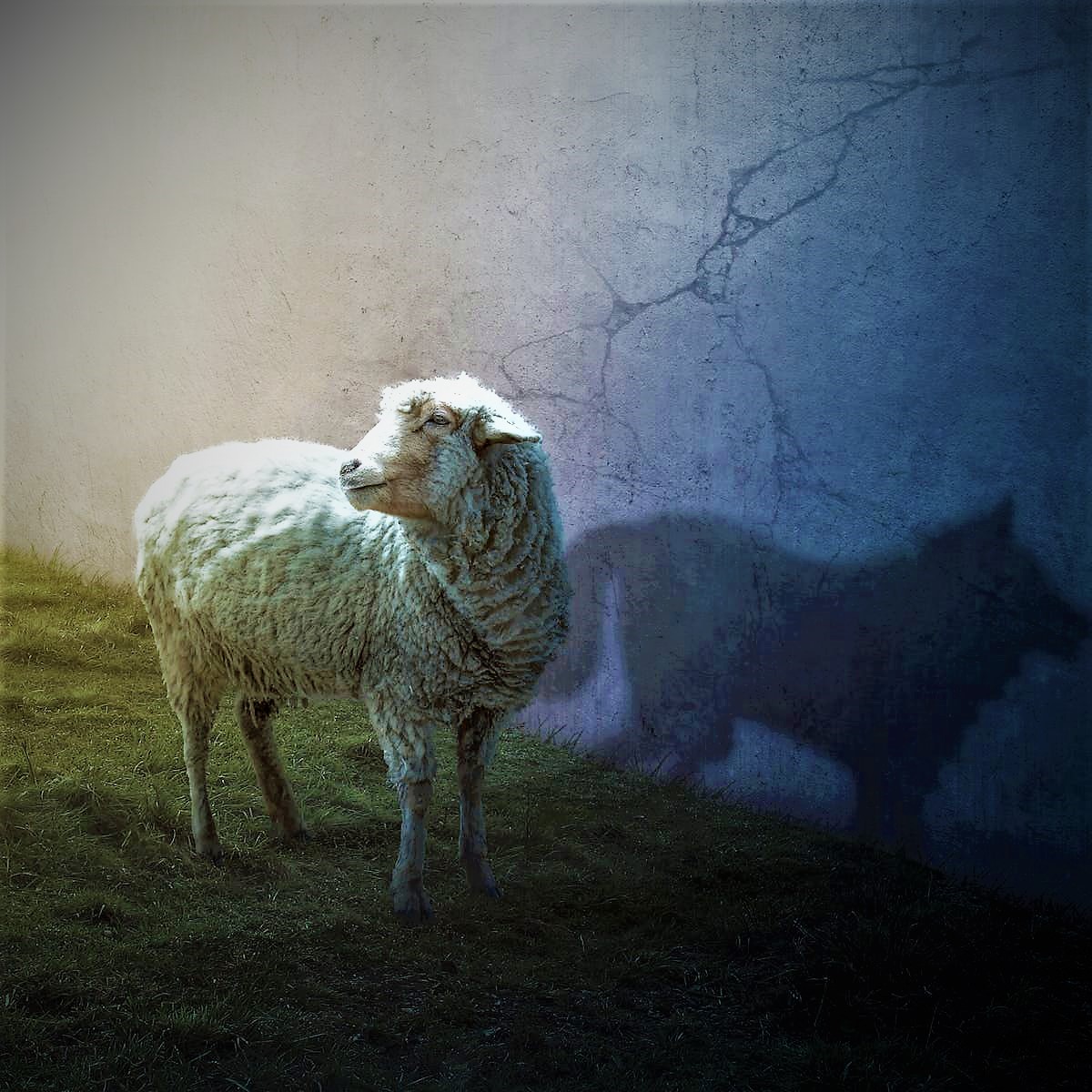
“Beware of false prophets who come disguised as harmless sheep but are really vicious wolves.” (Jesus Christ, Matthew 7:15 NLT)

Recommended Reading: 
“Deceived No More: How Jesus Led Me out of the New Age and into His Word”, by Doreen Virtue
(this is the book that the recovered former New Agers in the XM-Christians group seem to recommend above all others)

“What’s New with the New Age? Why Christians Need to Remain on Guard against the Threat of New Age Spirituality” by Phil Johnson
(a good short primer on the subject)

“A Christian Response to the New Age” by John A. Saliba
(a good short primer on the subject that’s more scholarly than the Phil Johnson article)

‘Jesus Christ The Bearer of the Water of Life: A Christian reflection on the “New Age”’, The Vatican
(a six-year study by the Roman Catholic Church on the New Age movement)

“New Age Beliefs Aren’t Christian, Vatican Finds”, Larry B. Stammer, LA Times, February 8, 2003
(a good synopsis of the above Roman Catholic study that is easier and quicker to read)

“If history has shown us one thing, it’s that today’s Mormonism is tomorrow’s dustbin fodder”

by Fred W. Anson
The Church of Jesus Christ claims, “The gospel has been known throughout eternity, and its principles have been preached among men and women from their beginnings on this earth.” (Robert L. Millet, “The Eternal Gospel”, Ensign, July 1996) and “The gospel of Jesus Christ is a divine and perfect plan. It is composed of eternal, unchanging principles, laws, and ordinances which are universally applicable to every individual regardless of time, place, or circumstance. Gospel principles never change.” (Ronald E. Poelman, “The Gospel and the Church”, Ensign, November 1984).

But history tells a different tale: The Mormon gospel is temporal and constantly changing. Here’s a partial list of Mormon Doctrine, scripture, and bits and various pieces that have been left on the dustbin of history. This is the eighth in this ongoing, intermittent series of articles.

34) Use of the cross in Mormon architecture and fashion
In today’s Mormon Culture the cross is treated more like it’s a radioactive or a symbol of shame, not glory. As LdS President, Gordon B. Hinckley said in a 2005 address:

The cross had been the bitter fruit of Judas’s betrayal, the summary of Peter’s denial. The empty tomb now became the testimony of His divinity, the assurance of eternal life, the answer to Job’s unanswered question: “If a man die, shall he live again?” (Job 14:14)… And because our Savior lives, we do not use the symbol of His death as the symbol of our faith.
(Gordon B. Hinckley, “The Symbol of Our Faith”, Ensign, April 2005) 

However, as Mormon Studies Scholar, Michael G. Reed points out this was not always the case – quite the contrary in fact:

In the nineteenth and early twentieth centuries many Latter-day Saints individually used and promoted the symbol of the cross in its visual and material form. The current taboo emerged among Mormons at the grass-roots level around the turn of the twentieth century, and became institutionalized mid-century under the direction of David O. McKay, president of the LDS Church 1951–70.
(Reed, Michael G. “Banishing the Cross: The Emergence of a Mormon Taboo”, John Whitmer Books. Kindle Edition locations 136-143)

And a 2009 Deseret News article on Mr. Reed’s book explains further:

In 1916 a church asked the Salt Lake City Council to allow them to build a huge cross, “the symbol of Christianity,” on Ensign Peak. “We would like to construct it of cement, re-enforced with steel, of sufficient dimensions that it can be readily seen from every part of the city,” the request read.

That request came from The Church of Jesus Christ of Latter-day Saints. The cross was to honor the Mormon pioneers.

Even though the proposal was approved by the City Council, the monument was never built.

Today there are no crosses on Mormon temples. Yet two are shaped like a cross. Mormon chapels do not have crosses either. But many have prints of the crucifixion hanging on their walls…

It appeared as jewelry on Brigham Young’s wives and daughters. It appeared in floral arrangements in funerals. It appeared as tie tacks on men’s ties and watch fobs on men’s vests. It appeared on cattle as the official LDS Church brand. Crosses were on church windows, attic vents, stained-glass windows and pulpits. They were on gravestones and quilts.

Even two temples, the Hawaiian and the Cardston, Alberta, Canada Temple were described in a 1923 general conference as being built in the shape of a cross.
(Michael De Groote, “Mormons and the cross”, Deseret News, Sep 10, 2009)

And if any further proof of this is required, please consider the photographs that are included throughout the Deseret New article that I’ve just cited from (link provided above).  This article contains several photographs from an earlier age of Mormon History when the cross was a glory, not the symbol of shame that it is today. They’re interesting, to say the least.

LdS President Joseph F Smith at a funeral in the Brigham City Tabernacle with a floral Cross that’s central to the funeral arrangements.

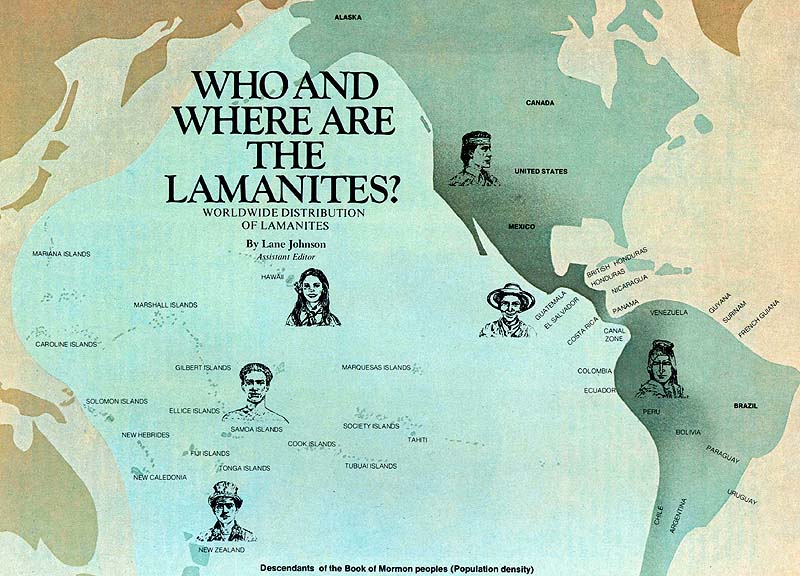
35) Plain identity of extant Native Americans as Lamanites.
Prior to the DNA evidence discrediting the claim that the American Aboriginals were the descendants of the Lamanites claims that was, in fact, THE official, correlated view of the LdS Church. As the Daily Herald summarized so nicely back in 2007:

“The Lamanites, church members have long believed, are the direct ancestors of the indigenous peoples found in North, South and Central America by European explorers in the 15th and 16th centuries.

It’s a matter of some controversy, then, that LDS officials have now changed the text of the Introduction to the Book of Mormon, softening the assertion made when the Introduction was first included, in 1981, that the Lamanites “are the principal ancestors of the American Indians.” The new text says only that the Lamanites “are among the ancestors of the American Indians.”

And the historical record backs their claims and documents this now dust binned doctrine well:

“Verily, I say unto you, that the wisdom of man, in his fallen state, knoweth not the purposes and the privileges of my hold priesthood, but ye shall know when ye receive a fullness by reason of the anointing: For it is my will, that in time, ye should take unto you wives of the Lamanites and Nephites, that their posterity may become white, delightsome and just, for even now their females are more virtuous then the gentiles.”
(Prophet Joseph Smith, Jr., 1831 revelation, recorded in a letter from W.W. Phelps to Brigham Young, dated August 12, 1861)

“In addition to this, and to co-operate with it, it has been made known by revelation, that it will be pleasing to the Lord, should they form a matrimonial alliance with the Natives; and by this means the Elders, who comply with the thing so pleasing to the Lord, and for which the Lord has promised to bless those who do it abundantly, gain a residence in the Indian territory, independent of the agent. It has been made known to one, who has left his wife in the state of N.Y. that he is entirely free from his wife, and he is at liberty to take him a wife from among the Lamanites. It was easily perceived that his permission was perfectly suited to his desires. I have frequently heard him state, that the Lord had made it known to him, that he is as free from his wife as from any other woman; and the only crime that I have ever heard alleged against her is, she is violently opposed to Mormonism.”
(Ezra Booth, Ohio Star, December 8, 1831)

“After the people again forgot the Lord and dissensions arose, some of them took upon themselves the name Lamanites and the dark skin returned. When the Lamanites fully repent and sincerely receive the gospel, the Lord has promised to remove the dark skin. The Lord declared by revelation that, ‘before the great day of the Lord shall come, Jacob shall flourish in the wilderness, and the Lamanites shall blossom as a rose.’ The dark skin of those who have come into the Church is no longer to be considered a sign of the curse. Many of these converts and delightsome and have the Spirit of the Lord. Perhaps there are some Lamanites today who are losing the dark pigment. Many of the members of the Church among the Catawba Indians of the South could readily pass as of the white race; also in other parts of the South.”
(Prophet Joseph Fielding Smith, Answers to Gospel Questions, v. 3, p. 123, 1953)

“The day of the Lamanites is nigh. For years they have been growing delightsome, and they are now becoming white and delightsome, as they were promised. In this picture of the twenty Lamanite missionaries, fifteen of the twenty were as light as Anglos; five were darker but equally delightsome. The children in the home placement program in Utah are often lighter than their brothers and sisters in the hogans on the reservation…. At one meeting a father and mother and their sixteen-year-old daughter were present, the little member girl-sixteen sitting between the dark father and mother, and it was evident she was several shades lighter than her parents on the same reservation, in the same Hogan, subject to the same sun and wind and weather. There was the doctor in a Utah city who for two years had had an Indian boy in his home who stated that he was some shades lighter than the younger brother just coming into the program from the reservation. These young members of the Church are changing to whiteness and delightsomeness. One white elder jokingly said that he and his companion were donating blood regularly to the hospital in the hope that the process might be accelerated.”
(Prophet Spencer W. Kimball, “Day of the Lamanites”, General Conference, Oct. 1960)

“The Lord has never indicated that black skin came because of being less faithful. Now, the Indian; we know why he has changed, don’t we? The Book of Mormon tells us that; and he has a dark skin, but he has promise there that through faithfulness, that they all again become a white and delightsome people.”
(Apostle LeGrand Richards, Interview by Wesley P. Walters and Chris Vlachos, Aug. 16, 1978, Church Office Building)

“We are greatly conscious of the fact that among the Lamanites – as well as among all peoples of other countries – we have a responsibility to see that the gospel touches their hearts and minds and that they understand it.”
(Prophet Spencer W. Kimball, October 1980 General Conference, Ensign, November 1980, p.76)

“The Lamanites [Native Americans], now a down-trodden people, are a remnant of the house of Israel. The curse of God has followed them as it has done the Jews, though the Jews have not been darkened in their skin as have the Lamanites.”
(Prophet Wilford Woodruff, Journal of Discourses, v. 22, p.173)

And if that’s not enough, you will find many more such quotes here: http://www.mormonthink.com/QUOTES/native.htm

A map from the December 1975 Ensign Magazine from the article, “Who and Where Are the Lamanites?” by Lane Johnson. Ensign magazine is an official, correlated LDS Church periodical.

36) D&C 89’s encouragement to drink beer.
As Rock Waterman explains:

“God tells us in Section 89 that beer is one of the reasons He gave us barley.

If you didn’t know that, it’s probably because like many latter day saints, you learned all about the Word of Wisdom in Sunday school, but you’ve most likely never gotten around to really reading the thing.

So let’s look at it again. Remember the part describing the purposes of the various grains, the one that begins “Nevertheless, wheat for man…”? Open your scriptures to Doctrine and Covenants Section 89 and turn to verse 17. Let’s read, in God’s own words, what he created barley for: “…and barley for all useful animals and for mild drinks, as also other grain.”

The early saints would have been astounded that future members would ever conflate their mild barley drink -beer- with the “strong drink” advised against in verses 5 and 7. Early Mormons regularly consumed beer without compunction, as had most of mankind throughout recorded history.

In 1843 the church’s newspaper, the Nauvoo Neighbor, advertised ale and beer available at the Nauvoo Brewery. Joseph Smith oversaw a fully stocked bar located at his home in the Mansion House. In an 1844 journal entry Joseph Smith mentions that he stopped in and “drank a glass of beer at Moesser’s“. He mentions this in passing as if it was no big deal, because to him it wasn’t.

This was eleven years after Joseph received the revelation known as the Word of Wisdom, so you can’t say he didn’t know better. The fact is, beer was not proscribed by Section 89; it was prescribed.

Within three years of the saints’ arrival in the Salt Lake Valley, breweries were operating at the mouths of every river canyon from Logan to Nephi. Most of the saints were immigrants from England, Denmark, and Germany, and these Teutonics brought with them their old-world brewing skills. A sizable brewery once sat close to where the Provo temple is now, and the Henry Wagener Brewery took up a massive 150 acres just across the street from where the “This Is The Place” monument now stands. So many breweries appeared so fast that by 1851 the smell emanating from all these operations provoked the city council to declare them a nuisance. Yet they continued to operate.

Beer was manufactured and consumed by faithful members of the church who never gave a second thought to the idea that there might be anything wrong with it. Most would have applied Benjamin Franklin’s famous declaration regarding wine to their beer and ale, that it was “proof that God loves us and loves to see us happy”.

By the time Johnston’s Army arrived in 1857, ushering in a steady stream of thirsty gentiles through Utah, things really took off for the Mormon brewers. Beer was available everywhere, including the church owned ZCMI where both Mormons and gentiles could stop in to grab a brewski any day but Sunday.

So how did the LDS church membership devolve from an appreciation of beer as a gift from God, to our present-day anathema toward it?

Well, we got the idea from the protestants.

Temperance Nation
By the time of the Manifesto in 1890, the LDS conversion rate was practically nil. All anybody knew about Mormons were that they were that crazy bunch of polygamous weirdos off in the desert. Any growth the church experienced was primarily internal, as pretty much the only baptisms Utahns were performing were on eight year old kids who already lived there. Certainly nobody new wanted to join.

The united states government and the eastern newspapers had painted us such pariahs that we couldn’t get anybody to take our religion seriously on a bet. Missionaries couldn’t get anyone to take a pamphlet, let alone read the Book of Mormon. Proselyting was at a standstill. We needed to find some way to get our numbers up.

Meanwhile back in the states, a huge temperance movement was sweeping the sectarian religious world, a backlash against decades of unbridled American alcoholism and public drunkenness. Public vows of abstinence were all the rage. It was no longer cool to profess Christ on Sunday if you spent Saturday night in a saloon; now a man’s spiritual measure was taken by how vociferously he denounced the demon rum.

The motto of virtuous young women everywhere was “lips that touch liquor shall never touch mine”, and young men, whose lips desperately wanted to touch the lips of young women, dutifully fell into line. It was futile to argue with these women that beer and ale, which were brewed, did not belong in the same class as hard liquors such as whiskey, which was distilled. These young ladies had zero tolerance for any of it, it was all the same to them. Talk to the hand, ’cause the lips ain’t listenin‘.

There was a pious war against booze raging in Christian America, and mild drinks were getting caught in the crossfire.

The debate spilled over into Utah where, though public drunkenness was strictly forbidden, wine and distilled spirits had always been available (some members paid their tithing in wine they made themselves; the St George tithing office reported collecting 7000 gallons by 1887). Still, hard liquor was hardly tolerated by Mormons the way beer had traditionally been.

By 1900, the parsing of the Word of Wisdom was well under way in debate among the leaders of the church. According to BYU Professor Emeritus Thomas G. Alexander:

“…All general authorities were not in agreement on all aspects of the word of wisdom…After he became president of the church, Lorenzo Snow again emphasized the centrality of not eating meat…and in 1901 John Henry Smith and Brigham Young, Jr., of the Twelve both thought that the church ought not interdict beer, at least not Danish beer.” Apostle Anthon H. Lund, who happened to be Danish, agreed, especially with the part about Danish beer. So did Mathias F.Cowley and others.

Over the next couple of decades, the Mormon people as a whole jumped on the Temperance bandwagon, and in 1919 Utah enthusiastically ratified the 18th amendment prohibiting all alcoholic beverages, including beer. Utah breweries closed down and before long all traces disappeared. In time, the descendants of the pioneers forgot they had ever existed. Land once occupied by the sprawling Henry Wagoner Company eventually became home to the Hogle zoo.

The Mormon support of prohibition had a positive effect on missionary work. We could boast to teetotaling Christians that we were way ahead of the curve on the evils of alcohol, having been hip to that scene as far back as 1833. With the hub-bub over polygamy having pretty much quieted down, the church was experiencing a re-branding. Missionaries were no longer fearsome devils come to steal your daughters; they were now those nice young men who didn’t smoke or drink.

Looks like we’d found our gimmick.”
(Rock Waterman, “Too Bad I Don’t Like Beer”, Pure Mormonism website, June 18, 2009) 

37) Paid Clergy.
Mormon scripture explicitly mandates that clergy be paid:

Doctrine & Covenants 42
71 And the elders or high priests who are appointed to assist the bishop as counselors in all things, are to have their families supported out of the property which is consecrated to the bishop, for the good of the poor, and for other purposes, as before mentioned;

72 Or they are to receive a just remuneration for all their services, either a stewardship or otherwise, as may be thought best or decided by the counselors and bishop.

73 And the bishop, also, shall receive his support, or a just remuneration for all his services in the church.

Yet today, despite the clear command of scripture, today the LdS Church denounces churches with a paid clergy in the strong terms:

“Wherever creeds are found one can also expect to find a paid clergy, the simple truths of the gospel cloaked in the dark robes of mystery, religious intolerance, and a history of bloodshed.”
(Joseph Fielding McConkie and Craig Ostler, “Revelations of the Restoration”, p. 964, published 2000)

But as D. Michael Quinn explains this wasn’t always the case:

“In the nineteenth-century West, local officers of the LDS church obtained their support from the tithing they collected. As early as 1859, Brigham Young wondered “whether a Stake would not be better governed when none of the officers were paid for their services.” During Brigham Young’s presidency, ward bishops drew at will from the primarily non-cash tithing Mormons donated. President Young complained at the October 1860 general conference “against a principle in many of the Bishops to use up all the tithing they could for their own families.

Even full-time missionaries benefited from tithing funds in the nineteenth century The senior president of the First Council of Seventy commented in 1879 that the families of married missionaries should be supported from tithing funds.55 However, at best that practice barely kept struggling wives and children out of abject poverty while their husbands and fathers served two-year missions.

In 1884, Church President John Taylor limited bishops to 8 percent of the tithing they collected (now primarily cash), while stake presidents got 2 percent of the tithing collected by all the bishops of the stake. In 1888, Wilford Woodruff established set salaries for stake presidents, and provided that a stake committee would apportion 10 percent of collected tithing between the bishops and the stake tithing clerk. At the April 1896 general conference, the First Presidency announced the end of salaries for local officers, in response to the decision of the temple meeting “to not pay Salaries to any one but the twelve.
(D. Michael Quinn, “LDS Church Finances from the 1830’s to the 1990’s”, Sunstone Magazine, June 1996, p.21; audio presentation January 1, 1992)

And right into the dustbin a paid clergy, along with beer-drinking for health, clearly identifying American Indians as the descendants of the Lamanites, and glorying in the cross, swish, swish, swish, it goes. It’s just as Mormon Researcher, Aaron Shafovaloff’s Couplet says so well,

“As heresy is, Mormon doctrine once was.
As Mormon doctrine is, heresy will it become.”
— Shafovaloff’s Couplet

Domenico Ghirlandaio, “The Calling of the Apostles” (1481)

compiled by Fred W. Anson
Since few people outside of Restorationist circles have heard of David Bercot here’s a brief primer from his Wikipedia page that will give you his backstory: 

David Bercot was raised as a Jehovah’s Witness. After leaving Jehovah’s Witnesses in 1976, he began his university education. He graduated from Stephen F. Austin State University summa cum laude, and he obtained his Doctor of Jurisprudence degree cum laude from Baylor University School of Law.

In 1985, Bercot began an in-depth study of the early Christians who lived before the Council of Nicaea in A.D. 325. His studies started him on a spiritual pilgrimage. In 1989, he wrote the book, Will the Real Heretics Please Stand Up, which sets forth some of the teachings and lifestyle of the early Christians. That same year, he joined with an Assembly of God pastor to establish Scroll Publishing Company for the purpose of publishing various writings of the pre-Nicene Christians, as well as to publish other Christian books.

Bercot’s studies of the early Christians brought him into contact and dialogue with three different branches of Christianity: the Anabaptists (Mennonites, Amish, Brethren), the Anglican Church, and the churches of the Restoration Movement (Church of Christ, Disciples of Christ, International Church of Christ). In 1985, after completing his religious studies through Cambridge University, Bercot was ordained as an Anglican priest. However, he eventually left the Anglican Church and began fellowshipping with various Anabaptist churches.

Today Bercot is a lecturer and author who emphasizes the simplicity of Biblical doctrine and early (ante-Nicene) Christian teaching over against what he would call the heavy and complex body of theological understandings that have built up over the centuries in churches and in academia and that have come to be thought of as orthodoxy. He is particularly notable for his deeply nonresistant understanding of Jesus’s and New Testament teaching.

Bercot’s most widely read work is A Dictionary of Early Christian Beliefs, published in 1998. It is a work that collects together over 7000 excerpts from the writings believed by many to be those of early Christians, arranged alphabetically by topic. According to Bercot, before the publication of his work, the only practical way to determine what the early Christians believed about any given topic was to read the actual writings of the Ante-Nicene Fathers themselves. After the publication of A Dictionary of Early Christian Beliefs, the Evangelical Review of Theology stated: “David Bercot has done the church a great service in providing an accessible point of entry into the extant writings of the pre-Nicene church.” The Conservative Theological Journal stated: “This is a must text for everyone interested in modern theological trends in general and especially historical studies.”

Other popular books that Bercot has written are Will the Real Heretics Please Stand Up, published originally in 1989, and The Kingdom That Turned the World Upside Down (2003), and Will the Theologians Please Sit Down (2009).
(“David Bercot”, Wikipedia, retrieved 2020-11-12) 

If you saw a recurring Restorationist theme running through that biography, you’re not alone. From Jehovah’s Witness to Pentecostal, to Anabaptist, it’s all there in plain sight. So given that strong Restorationist skew, it should come as no surprise that Bercot has become a kind of go-to source for Restorationist heresy and error the world over. From Anabaptists to Mormons he’s cited as an authority on how Christian ecclesiology should be but now is not. While this is a common Restorationist theme, it’s not without problems – and those problems have left a wide swath of error and heresy in its path.

Suffice to say, there are serious problems and issues with using David Bercot as either an expert witness or final authority on issues of Church History and Ecclesiology. So with that short introduction, I will simply turn the reader over to some critiques of David Bercot, from qualified and credentialed sources to explain why in detail that is. 

From Eastern Orthodox Church Historian and Scholar, Patrick Barnes:
“My opening remarks are on the subject of epistemology. You [DavidBercot] acknowledge (p. 104) that the sole method of teaching for Christ, and the primary method for the Apostles, was oral; yet your arguments are based upon your personal interpretation of only a portion of the written patristic texts that exist in the English language (which is a very small percentage of the overall Patristic corpus in existence today, a corpus itself which is a small percentage of the writings that were available to the majority of the Fathers; cf. Eusebius’ reference to the library at Edessa; Papias’ book, etc.). You furthermore acknowledge in Chapter 11 that the effects of time, language, culture, etc. on one’s ability to properly interpret the Church’s Tradition can be quite pervasive and severe. Does this not apply equally to you and your ability to draw trustworthy conclusions from the small body of English texts you have examined? In short, how can you be even reasonably certain about many of your conclusions, especially the ultimate one that Anglicanism contains the purest “thread”?”

“I am also trying to underscore the seeming precarious nature of your epistemology (which, of course, is related to your ecclesiology). It strikes me as surprisingly uncharacteristic of one as seemingly steeped in the early Fathers as you are. I hope I am wrong in this, but it seems that your approach to discerning the content of the apostolic Faith is quite individualistic and empirical, betraying a distinctly American and certainly post-Enlightenment approach to the acquisition of truth. Do you really trust your own abilities to find the True Faith by merely an appeal to written Tradition—as opposed to finding the Body of God’s People, the Church, which has preserved this Truth—especially when you have consulted only those Patristic texts that are available in English and often interpreted through Protestant eyes?”
(Excerpts from a Letter by Patrick Barnes (1997), ‘A Critique of David Bercot’s “Will the Real Heretics Please Stand Up?”)

From Church Historian, R.A. Baker, Ph.D:
“My overall critique of Bercot’s book is this: he wants to point to the second century church as some kind of ideal that we should attempt to emulate. While I think there are positives to be seen in every era of church history, I do not think the second century, or any other era, should be pointed to as the “ideal.” In addition to the various specific critiques I have offered, the second century writers also held numerous doctrinal positions that Bercot would NOT want us to embrace: purgatory (Origen), mortal and venal sins (Tertullian), forgiveness of sins rests with the bishop (Ignatius, Cyprian), and many others. It appears to me that Bercot takes the Early Church Fathers on CD and does a “Ctrl + F” to “Find” passages that speak to a particular issue. If he likes the passage, he uses it. If the passage does not support his thesis, he ignores it. The writings of the early church fathers must be used with care. Historical context is critical.”

“Look, my point to Bercot is this: If you want to write a book criticizing modern evangelicals – Just do it. But don’t use early church fathers when you are not qualified to use them. It would be like me glibly citing Martin Luther when I really do not know his writings. Oh I have read about Luther. I have read short excerpts of Luther, but I would NEVER try to use Luther as some kind of proof, especially for theology (another category I am not competent to speak on as an authority).

Many have read Bercot and now think they know something about the early church when all they truly know is the small amount Bercot reveals of what he knows. And Bercot seems to know probably 20% of what I know…and I know such a very small amount about the first three centuries of Christian history…and I have a Ph.D. from a world leader in academic study. And I am not trying to be humble. I KNOW how little I know. My supervisor was an expert in Augustine. I would go across the street for a cup of tea with him, sit for 1-2 hours and just ask him questions about church history. It was awesome, but also very, very humbling and a bit discouraging. I hope I know 20% of what he knows.
(R.A. Baker, Book Review of “Will the Real Heretics Please Stand Up: A New Look at Today’s Evangelical Church in the Light of Early Christianity, by David Bercot”)

A fresco of Christ, the Apostles, and the Patristic Fathers from an Eastern Orthodox Church building.

From Christian Apologist James Holding:
“ Bercot’s effort otherwise is variously, often badly, misguided. In addition to the behavioral factors above, Bercot insists that we have lost our way in some doctrinal matters as well. His primary sources for this particular book are several patristic writers (i.e., Justin, Tertullian, Origen) and their practice and explication of Christianity. Bercot’s logic: These men were closer in time to the apostles, and closer in language, and closer in culture. Therefore their understanding of the Scriptures is more likely to be correct [101-2] and deserve scrutiny. He writes:

“…the second century Christians were basically only one generation away from the apostles. We’re nineteen generations away! How reasonable is it for us to argue that, after nineteen hundred years, evangelical Christianity is basically unchanged from that of the apostles?”

One senses a certain fallacy of excluded middle here, but more to the point, Bercot is off base, and ironically so. He devotes a single paragraph to the point that we today do not understand early Mediterranean culture, as the patristic writers would have. But he has no conception of a very deep rift between cultures that decidedly affected patristic understanding of the Scriptures: the difference between Jewish thinking and the sort of pagan thinking that the patristic writers were raised in. (The irony is doubled for me because I first read of Bercot through Bickmore, who makes similar errors.)

Where this shows most deeply is in Bercot’s attempt to understand the relationship between faith and works. He makes the same errors concerning baptism that we have covered in Link 1 below — including the same false interpretations of John 3:5, Acts 22:16, Titus 3:5, Acts 2:38, and 1 Peter 3:21. His justification for these interpretations is no more or less than that it was how the patristic writers interpreted these verses. But if Bercot wants to use the “closer is better” argument, then how would he respond to someone who said that heretics were equally close in time and culture? He acknowledges that waywards like the Gnostics existed, but does not seen to grasp how his own argument is refuted by their existence. Certainly if heretics were able to distort the meaning of the NT is such a short space, it was possible for the patristics, even in their commitment to Christ and study of the Word, to have made lesser and less significant errors in their understanding.”

“There are many patristic beliefs that David Bercot probably would reject. Clement of Alexandria and Origen, for example, refer to the possibility of people being saved after death. There was widespread acceptance of the belief that salvation could be lost without any possibility of regaining it if particular sins were committed. Such a view was advocated by Hermas, Clement of Alexandria, Tertullian, and Hippolytus, for example. Would David Bercot agree with Irenaeus that Jesus lived to be over 50 years old? Irenaeus claims to have received that information from apostolic tradition, and he cites his own (mis)understanding of John 8:57 in support of it. It’s an example of an *early* church father interpreting scripture, and claiming apostolic tradition in support of that interpretation, yet we know that the interpretation is incorrect. It’s true that many church fathers advocated some type of salvation through works, but not all of them did. Clement of Rome and Mathetes explicitly and repeatedly advocate concepts such as sola fide and the substitutionary righteousness of Christ.

They never even mention baptism in their discussions of salvation. There was no one view of salvation held by all of the church fathers. Many did believe in *some* type of salvation through works, but not all of them did. And among those who did, there were disagreements over just which works must be done and just which sins must be avoided. With some of the later church fathers, like John Chrysostom, we even find them referring to some type of salvation through works in one passage, but advocating sola fide (even with the words “faith alone”) elsewhere.

Some of the church fathers weren’t even consistent with *themselves* on the issue.I know that Bercot focuses on the Ante-Nicene fathers, but below are some examples of both the Ante-Nicene and later church fathers disagreeing with Bercot about the perspicuity of scripture. The fathers do refer to some passages being difficult to understand, but they don’t seem to have thought the problem was as significant as Bercot suggests. They thought that consulting the works of earlier writers was *helpful* in understanding scripture, but they didn’t think it was necessary, nor do they seem to have viewed scripture as being as unclear as Bercot suggests:

“Pay attention, therefore, to what I shall record out of the holy Scriptures, which do not need to be expounded, but only listened to.”
– Justin Martyr (Dialogue with Trypho, 55)

“A sound mind, and one which does not expose its possessor to danger, and is devoted to piety and the love of truth, will eagerly meditate upon those things which God has placed within the power of mankind, and has subjected to our knowledge, and will make advancement in acquaintance with them, rendering the knowledge of them easy to him by means of daily study. These things are such as fall plainly under our observation, and are clearly and unambiguously in express terms set forth in the Sacred Scriptures….the entire Scriptures, the prophets, and the Gospels, can be clearly, unambiguously, and harmoniously understood by all”
– Irenaeus (Against Heresies, 2:27:1-2)

“For, being accustomed to sweet and polished speeches or poems, they despise the simple and common language of the sacred writings as mean. For they seek that which may soothe the senses. But whatever is pleasant to the ear effects persuasion, and while it delights fixes itself deeply within the breast. Is God, therefore, the contriver both of the mind, and of the voice, and of the tongue, unable to speak eloquently? Yea, rather, with the greatest foresight, He wished those things which are divine to be without adornment, that all might understand the things which He Himself spoke to all.”
– Lactantius (Divine Institutes, 6:21)

“The religious perspicuity of the ancient Scriptures caused them [the Arians] no shame, nor did the consentient doctrine of our colleagues concerning Christ keep in check their audacity against Him.”
– Alexander of Alexandria (Epistles on the Arian Heresy and the Deposition of Arius, 1:10)

“Vainly then do they run about with the pretext that they have demanded Councils for the faith’s sake; for divine Scripture is sufficient above all things; but if a Council be needed on the point, there are the proceedings of the Fathers, for the Nicene Bishops did not neglect this matter, but stated the doctrines so exactly, that persons reading their words honestly, cannot but be reminded by them of the religion towards Christ announced in divine Scripture”
– Athanasius (De Synodis, 6)

“And this is usual with Scriptures, to express itself in inartificial and simple phrases.”
– Athanasius (Four Discourses Against the Arians, 4:33)

“For there have risen many who have given to the plain words of Holy Writ some arbitrary interpretation of their own, instead of its true and only sense, and this in defiance of the clear meaning of words. Heresy lies in the sense assigned, not in the word written; the guilt is that of the expositor, not of the text.”
– Hilary of Poitiers (On the Trinity, 2:3)

“All things are dear and open that are in the divine Scriptures; the necessary things are all plain.”
– John Chrysostom (Homilies on Second Thessalonians, 3, v. 5)

“For among the things that are plainly laid down in Scripture are to be found all matters that concern faith and the manner of life,–to wit, hope and love, of which I have spoken in the previous book. After this, when we have made ourselves to a certain extent familiar with the language of Scripture, we may proceed to open up and investigate the obscure passages, and in doing so draw examples from the plainer expressions to throw light upon the more obscure, and use the evidence of passages about which there is no doubt to remove all hesitation in regard to the doubtful passages.” – Augustine (On Christian Doctrine, 2:9)

“For this reason, where they cannot interpret them [the scriptures] otherwise according to their own sentence, be it ever so clear and manifest, they answer that it is obscure and uncertain because wrong and perverse they dare not call it.” – Augustine (Of the Work of Monks, 10)”

(James Holding, “David Bercot: A Critique”)

And last, but not least, here’s a powerful quote from Jason Engwer on why Patristic writings should not be considered equal to, let alone, superior to the Bible:
“Another example of how important it is to follow the scriptures first and foremost, as opposed to following the early church fathers, is the issue of baptismal regeneration, the teaching that baptism is a requirement for salvation. The scriptures are overwhelmingly in opposition to baptismal regeneration. Every scripture passage cited by those who argue that baptism is a requirement for salvation has a reasonable alternate interpretation that reconciles it with the larger number of passages that are in opposition to that doctrine (see Rebutting Baptismal Regeneration). Yet, most of the early church fathers taught baptismal regeneration. (Contrary to popular conception, not everybody in the post-apostolic early church did, however.

The earliest church father, and possibly the only one who wrote during the first century, is Clement of Rome. In the only material we have from him, his letter to the Corinthians, he explicitly teaches salvation through faith alone (1), and he says nothing about baptism being a requirement for salvation. Though people often make generalizations about how ‘everybody’ in the early church believed in baptismal regeneration, the truth is that not everybody did.)

One of the church fathers who taught that baptism is a requirement for salvation was Tertullian. An examination of his treatise On Baptism reveals just how unscriptural and weak were the arguments of those church fathers who did advocate baptismal regeneration.”
(Jason Engwer, “The Fallibility of the Early Church Fathers: Why Christians Should Look to the Bible Alone for Doctrine”)

Dirck van Baburen, “Christ Washing the Apostles Feet” (1616)

A peaceful march of hundreds of supporters and members of the Chicago Freedom Movement along State Street, Chicago, Illinois, July 26, 1965, that resulted in no deaths and no destruction of property. (photo credit: Robert Abbott Sengstacke/Getty Images)

A Common Sense Appeal to Biblically Approaching Mormonism

by Fred W. Anson
Let me ask you something: How inclined would you be to listen to someone whose goal is the destruction of your church? If you’re like most people the honest answer is, “Not very, if that!” In fact, a Christian needn’t go further than an atheist discussion board to find out how “receptive” this attitude makes one to listening to anything that someone with such an agenda has to say.

On the other hand, what if the person’s goal is to reform your church so that it’s a better church? While you may still be skeptical of their intentions and motives you would at least be willing to listen. In this case, it would only be the closed-minded die-hard defenders of the status quo – be it right or be it wrong – who would tend to take umbrage at such a stance right? But even in those cases, even the die-hards would be more inclined to listen to someone who’s trying to be constructive rather than someone who’s destructive right?

So here’s the irony: Relative to the largely orthodox Mormonism taught in early Mormonism the modern LdS Church is in a state of apostasy. In fact, and even more ironically, just a few years after the formation of the church Joseph Smith had managed to lead his followers into blatant heresy and error. This is clearly what a former member of the LdS Church First Presidency, William Law, and his associates stated in the Nauvoo Expositor:

‘As for our acquaintance with the Church of Jesus Christ of Latter Day Saints, we know, no man or set of men can be more thoroughly acquainted with its rise, its organization, and its history, than we have every reason to believe we are. We all verily believe, and many of us know of a surety, that the religion of the Latter Day Saints, as originally taught by Joseph Smith, which is contained in the Old and New Testaments, Book of Covenants [that is the original 1835 Doctrine & Covenants], and Book of Mormon, is verily true; and that the pure principles set forth in those books, are the immutable and eternal principles of Heaven, and speaks a language which, when spoken in truth and virtue, sinks deep into the heart of every honest man…We are earnestly seeking to explode the vicious principles of Joseph Smith, and those who practice the same abominations and whoredoms; which we verily know are not accordant and consonant with the principles of Jesus Christ and the Apostles; and for that purpose, and with that end in view, with an eye single to the glory of God, we have dared to gird on the armor, and with god at our head, we most solemnly and sincerely declare that the sword of truth shall not depart from the thigh, nor the buckler from the arm, until we can enjoy those glorious privileges which nature’s God and our country’s laws have guarantied to us–freedom of speech, the liberty of the press, and the right to worship God as seemeth us good.’
(The Nauvoo Expositor, June 7, 1844) 

As tempting as it might be to chuckle at the amusing irony of a church that claims that all other churches (other than theirs of course) need to be restored to their pure and primitive state, actually needs to be restored to it’s pure and primitive state itself, it’s still a fact. Mormons like D. Michael Quinn, Rock Waterman, Denver Snuffer, and many others see this clearly and have been lobbying for it for years – though I don’t think that many mainstream Christians would completely agree with their vision of what a truly reformed Mormon Church would or should look like.

And while I know that the idea of a “Reformation not destruction” stance isn’t popular among Christian critics of Mormonism – a fact I found out quickly when I asked for feedback on the concept on social media and promptly got thrown back about a mile by the explosive “Destruction not reformation!” outcries – I would ask the reader to still give the idea some thought and consideration despite how incredible it may sound to you now. And as you consider the question, I would point you to the precedence of the Quakers, The Shepherding Movement, and the World Wide Church of God churches as examples of full reformations and the Reorganized Church of Jesus Christ of Latter Day Saints (aka “RLDS”) as an example of partial reformation.

And to those who are still reluctant to consider a “Reformation not destruction” stance I would ask you to consider a few things:

1) Some at BYU have already taken baby steps toward reform distancing themselves from some Mormonism’s most blasphemous doctrines. They’re also putting a greater emphasis on grace. No, it’s not perfect, and yes, there are still a lot of problems – there is both good reason for hope and good cause for concern at this point. However, if this trend continues (and if they don’t get excommunicated) this could possibly lead to even greater reform over time;

2) There are reformers aplenty in the LdS Church right now. I’ve only mentioned three, there are more. And the engine of internal reformation just seems to be gathering steam. It’s been said that Mormonism is not only emptying out, but it’s also hollowing out and that, combined with the Neo-Orthodoxy movement within Mormonism, is any indication it looks like we’re in for quite a ride!

3) The stranglehold that Mormon Leaders have traditionally had on members of the LdS Church is waning. Yes, it’s alive and well and living in Chapel Mormonism, but one need only engage Mormons outside of those chapel walls to realize that many, if not most, members of the LdS Church in private will decide for themself whether they take or leave whatever the Brethren have to say on any given matter. As one Mormon Researcher said well,

The religion of Mormonism is hollowing out…there is a mass apostasy going on, intellectually and mentally speaking. People are leaving the LDS Church without leaving the LDS Church. Without asking probing questions, I can’t assume any Mormon I talk to even believes in the existence of God or the resurrection of Jesus. Even the Mormons who aren’t closet atheists are largely latent atheists (or agnostics) without knowing it.
(Aaron Shafovaloff, “The Creed of Practical Mormon Atheism”, Mormonism Research Ministry, March 14, 2013)

What if the institution were swayed in such a way that it was reformed to comply with biblical authority and absolutes? Is it just possible, that we could see far less latent atheists and agnostics sitting in Mormon pews? Personally, I think we will. Yes, you may call me a dreamer, but I’m not the only one – and I have learned the hard way to never put limits on the power and sovereignty of God, He is, after all, God, right?

4) If the LdS Church were to fully reform it would be a completely different organization than it is today. Spoken plainly it would cease to exist just as the World Wide Church of God ceased to exist after it became Grace Communion International. So in a sense, one could say that “Reformation of the LdS Church = Destruction of the LdS Church”. So if you’re really, really, really committed to the destruction of the LdS Church as we know it today perhaps one of the best things you could do to advance your agenda would be to push for reform!

But regardless of your stance, motivation, or idea of what the ideal reformed LdS Church would look like, this just makes sense, doesn’t it? I’m going to end this appeal the way that I began it – with this question, how inclined would you be to listen to someone whose goal is the destruction of your church? So friend, if you find that Mormons don’t listen to you and your good arguments, then … well, do I really need to finish that thought?

And if they don’t then I suspect that the words of Christ are just as applicable to Mormons as they are to us:

“I know your works, that you have a name that you are alive, but you are dead. Be watchful, and strengthen the things which remain, that are ready to die, for I have not found your works perfect before God. Remember therefore how you have received and heard; hold fast and repent. Therefore if you will not watch, I will come upon you as a thief, and you will not know what hour I will come upon you.”
(Revelation 3:1b-3 NKJV) 

12th Street, Detroit during the July 23, 1967, Detroit Riots that lead to millions of dollars of destruction and loss of life. (photo credit: Keystone Pictures USA/Alamy)

(portions of this material previously appeared in a slightly different form in Fred W. Anson, “Weak Arguments #6: “Mormon doctrine was heretical from the very beginning.”, Beggar’s Bread website November 16, 2014; it has been lightly edited and expanded for this new context and setting)

“If history has shown us one thing, it’s that today’s Mormonism is tomorrow’s dustbin fodder”

by Fred W. Anson
The Church of Jesus Christ claims, “The gospel has been known throughout eternity, and its principles have been preached among men and women from their beginnings on this earth.” (Robert L. Millet, “The Eternal Gospel”, Ensign, July 1996) and “The gospel of Jesus Christ is a divine and perfect plan. It is composed of eternal, unchanging principles, laws, and ordinances which are universally applicable to every individual regardless of time, place, or circumstance. Gospel principles never change.” (Ronald E. Poelman, “The Gospel and the Church”, Ensign, November 1984).

But history tells a different tale: The Mormon gospel is temporal and constantly changing. Here’s a partial list of Mormon Doctrine, scripture, and bits and various pieces that have been left on the dustbin of history. This is the seventh in this ongoing, intermittent series of articles.

30) Women holding, partaking, and practicing Priesthood authority.
Renowned Mormon Studies Scholar, D. Michael Quinn explains;

For 150 years Mormon women have performed sacred ordinances in the Church of Jesus Christ of Latter-day Saints. Every person who has received the LDS temple endowment knows that women perform for other women the “initiatory ordinances” of washing and anointing.1 Fewer know that LDS women also performed ordinances of healing from the 1840s until the 1940s.2 Yet every Mormon knows that men who perform temple ordinances and healing ordinances must have the Melchizedek priesthood. Women are no exception.3

Two weeks after he organized the Female Relief Society of Nauvoo, Illinois, Joseph Smith announced his intention to confer priesthood on women. He told them on 30 March 1842 that “the Society should move according to the ancient Priesthood” and that he was “going to make of this Society a kingdom of priests as in Enoch’s day—as in Paul’s day.” In printing the original minutes of the prophet’s talk after his death, the official History of the Church omitted Joseph’s first use of the word “Society” and changed the second “Society” to “Church.” Those two alterations changed the entire meaning of his statement. More recently an LDS general authority removed even these diminished statements from a display in the LDS Museum of Church History and Art which commemorated the sesquicentennial of the Relief Society.

On 28 April 1842 the prophet returned to this subject. He told the women that “the keys of the kingdom are about to be given to them that they may be able to detect everything false, as well as to the Elders.” The keys “to detect everything false” referred to the signs and tokens used in the “true order of prayer,” still practiced in LDS temples. Then Joseph Smith said, “I now turn the key to you in the name of God, and this society shall rejoice, and knowledge and intelligence shall flow down from this time …” For nineteenth-century LDS women, Joseph’s words were prophecy and inspiration to advance spiritually, intellectually, socially, professionally, and politically.

Mormon women did not request priesthood—Joseph Smith would soon confer it on them as part of the restoration of the gospel. His private journal, called the Book of the Law of the Lord, specified the priesthood promise in his instructions to the women on 28 April 1842: “gave a lecture on the pries[t]hood shewing [sic] how the Sisters would come in possession of the privileges & blessings & gifts of the priesthood & that the signs should follow them. such as healing the sick casting out devils &c. & that they might attain unto these blessings. by a virtuous life & conversation & diligence in keeping all the commandments.” Joseph clearly intended that Mormon women in 1842 understand their healings were to be “gifts of the priesthood,” not simply ministrations of faith.

Apostle Dallin H. Oaks observed in a 1992 general conference talk, “No priesthood keys were delivered to the Relief Society. Keys are conferred on individuals, not organizations.” The First Presidency and Quorum of the Twelve as organizations are not even exempt from the limitation he describes for the Relief Society. Elder Oaks noted, for instance, that “priesthood keys were delivered to the members of the First Presidency and the Quorum of the Twelve Apostles, not to any organizations.”
(D. Michael Quinn, “Mormon Women Have Had the Priesthood Since 1843”, Chapter 17 of “Women and Authority: Re-emerging Mormon Feminism”, Maxine Hanks, editor)

Quinn then goes on to explain how and why the Priesthood was slowly but surely denied to Mormon women:

By the early 1880s death had taken all the general authorities who had specifically stated that the endowment conferred priesthood upon women. Joseph and Hyrum Smith died in 1844, and John Smith joined them a decade later. Heber C. Kimball died in 1868, and Brigham Young in 1877. Sidney Rigdon had been excommunicated in 1844 but continued to affirm Nauvoo’s “female priesthood” until his death in 1876. In 1881, both Orson Pratt and Joseph Young died.

By 1888 Mormon misogyny was linked with denials of women’s authority, and this resulted in a public comment by Apostle Franklin D. Richards. He said: “Every now and again we hear men speak tauntingly of the sisters and lightly of their public duties, instead of supporting and encouraging them.” Apostle Richards added: “There are also some who look with jealousy upon the moves of the sisters as though they might come to possess some of the gifts, and are afraid they [LDS women] will get away with some of the blessings of the gospel which only men ought to possess.” Because of this “envy and jealousy,” Apostle Richards said some Mormon men “don’t like to accord to them [Mormon women] anything that will raise them up and make their talents to shine forth as the daughters of Eve and Sarah.” Franklin D. Richards is the only general authority to publicly acknowledge that jealousy and fear are the basis for the opposition of some Mormon men against the spiritual growth of all Mormon women.
(Ibid)

In current Mormon Theology Mormon women only have the Priesthood through her husband rather than apart from him, as Quinn explains:

In today’s church a woman who has received the temple endowment has more priesthood power than a boy who holds the office of priest. However, the priest has more permission to exercise his priesthood than does the endowed woman to exercise hers.
(Ibid)

31) The Mormon gospel law of Mormon men forbidden to marry black women.
LdS President and Living Prophet  Brigham Young, couldn’t have been clearer in his March 8, 1863, Mormon Tabernacle address:

Shall I tell you the law of God in regard to the African race? If the white man who belongs to the chosen seed mixes his blood with the seed of Cain, the penalty, under the law of God, is death on the spot. This will always be so. (Brigham Young, “The Persecutions of the Saints—Their Loyalty to the Constitution—the Mormon Battalion—the Laws of God Relative to the African Race”, Journal of Discourses 10:110)

In 1954, Mormon Apostle, Mark E. Peterson’s rhetoric was less extreme but still to the point:

“I think I have read enough to give you an idea of what the Negro is after. He is not just seeking the oppor[t]unity of sitting down in a café where white people sit. He isn’t just trying to ride on the same streetcar or the same Pullman car with white people. From this and other interviews I have read, it appears that the Negro seeks absorption with the white race. He will not. be satisfied until he achieves it by intermarriage. That is his objective and we must face it. We must not allow our feelings to carry us away, nor must we feel so sorry for Negroes that, we will open our arms and embrace them with everything we have. Remember the little statement that they used to say about sin, “First we pity, then endure, then embrace.”’
(Mark E. Peterson, “Race Problems – As They Affect the Church”, Address By Elder Mark E. Petersen Given At: The Convention of Teachers of Religion On The College Level, Provo, Utah, August 27, 1954)

An inter-racial couple takes wedding photos in front of the Salt Lake Temple.

“When He placed the mark upon Cain, He engaged in segregation. When he told Enoch not to preach the gospel to the descendants of Cain who were black, the Lord engaged in segregation. When He cursed the descendants of Cain as to the Priesthood, He engaged in segregation. When He forbade intermarriages as He does in Deuteronomy, Chapter 7, He established segregation. You remember when the Israelites were about to come into Palestine and there were evil nations there, the Lord was anxious to preserve his people by an act of segregation. He commanded His people Israel: “Neither shalt thou make marriages with them. Thy daughter thou shalt not give unto his son, nor his daughter shalt thou take unto thy son.” It was a law for the preservation of Israel and it certainly was an act of segregation.”
(Ibid)

“The Lord segregated the people both as to blood and place of residence, at least in the bases of the Lamanites and the Negroes we have the definite word of the Lord himself that He placed a dark skin upon then: as a curse — as a sign to all others. He forbade inter-marriage with them under threat of extension of the curse (2 Nephi 5:21) And He certainly segregated the descendants of Cain when He cursed the Negro as to the Priesthood, and drew an absolute line. You may even say He dropped an iron curtain there. The Negro was cursed as to the Priesthood, and therefore, was cursed as to the blessings of the Priesthood. Certainly God made a segregation there.”
(Ibid)

“Now what is our policy in regard to intermarriage? As to the Negro, of course, there is only one possible answer. We must not intermarry with the Negro.”
(Ibid)

But in today’s LdS Church not only are inter-racial marriages common but as of June 1, 1978, no one can be denied the Mormon Priesthood based on their race.

32) Couples should refrain from physical intimacy a week or so before attending the Temple.
Church archives document the prerequisites for Temple work during the 19th Century.

From 1868: 
“Pres[iden]ts [Brigham] Y[oung][,] [Heber C.] K[imball] & [Daniel H.] W[ells] Spoke on the impropriety of our youth marrying [for time], instead of getting sealed [for eternity]; also spoke of cleanliness in person before going to get their endowments; a woman should not go for a week after her menses were upon her; a man should not have intercourse with his wife for several days; but should be clean in body and exercised in spirit previous thereto. His clothing should be changed once or twice before going there. —Historian’s Office Journal, Jan. 31, 1868″
(Devery S. Anderson. “The Development of LDS Temple Worship, 1846-2000: A Documentary History”, Signature Books, Kindle Edition location 1470-1482, bolding added for emphasis)

From 1877:
“We herein embody a few instructions which we wish you to strictly enjoin upon the brethren and sisters who come to the Temple to officiate for themselves or their friends: Those who wish to receive endowments for themselves or friends should be provided with oil or means to purchase it. The sisters should be provided with two or three white skirts and the brethren should have their garments to button from the back, clear round and up the front, and skirts made to reach down to the knees or a little below or one may be pieced to this length for the occasion. Before the brethren or sisters go into the Temple to receive their endowments; they must wash themselves all over, perfectly clean, so as to enter the Temple clean. Men and women should have no sexual intercourse for a week or more previous to their going into the Temple to receive their endowments. —Brigham Young, John W. Young, Wilford Woodruff, Erastus Snow, and Brigham Young Jr. to Bishops, Jan. 13, 1877″
(Ibid, location 1649-1651, bolding added for emphasis)

Today, no such restrictions exist.

33) During his earthly ministry Jesus Christ was not only married but also a polygamist in order to fulfill all righteousness in modeling and demonstrating the Plan of Salvation for us – acts which eventually lead to His persecution and crucifixion.
This doctrinal principle was clearly taught in a  discourse by Mormon Apostle, Jedediah M. Grant in the Salt Lake City Tabernacle on Aug. 7, 1853:

The grand reason of the burst of public sentiment in anathemas upon Christ and his disciples, causing his crucifixion was evidently based upon polygamy, according to the testimony of the philosophers who rose in that age. A belief in the doctrine of a plurality of wives caused the persecution of Jesus and his followers. We might almost think they were “Mormons”.
(Jedediah M. Grant, “Uniformity” “Journal of Discourses” 1:346)

And this teaching was validated and reaffirmed in a circa 1857, Salt Lake City address by the President of the Quorum of the Twelve Apostles, Orson Hyde:

“It will be borne in mind that once on a time, there was a marriage in Cana of Galilee; and on a careful reading of that transaction, it will be discovered that no less a person than Jesus Christ was married on that occasion. If he was never married, his intimacy with Mary and Martha, and the other Mary also whom Jesus loved, must have been highly unbecoming and improper to say the best of it. I will venture to say that if Jesus Christ were now to pass through the most pious countries in Christendom with a train of women, such as used to follow him, fondling about him, combing his hair, anointing him with precious ointment, washing his feet with tears, and wiping them with the hair of their heads and unmarried, or even married, he would be mobbed, tarred, and feathered, and rode, not on an ass, but on a rail. What did the old Prophet mean when he said (speaking of Christ), “He shall see his seed, prolong his days, &c.” Did Jesus consider it necessary to fulfil every righteous command or requirement of his Father? He most certainly did. This be witnessed by submitting to baptism under the hands of John. “Thus it becometh us to fulfil all righteousness,” said he. Was it God’s commandment to man, in the beginning, to multiply and replenish the earth? None can deny this, neither that it was a righteous command; for upon an obedience to this, depended the perpetuity of our race. Did Christ come to destroy the law or the Prophets, or to fulfil them? He came to fulfil. Did he multiply, and did he see his seed? Did he honour his Father’s law by complying with it, or did he not? Others may do as they like, but I will not charge our Saviour with neglect or transgression in this or any other duty. At this doctrine the long-faced hypocrite and the sanctimonious bigot will probably cry, blasphemy! Horrid perversion of God’s word! Wicked wretch! He is not fit to live! &c, &c. But the wise and reflecting will consider, read, and pray. If God be not our Father, grandfather, or great grandfather, or some kind of a father in reality, in deed and in truth, why are we taught to say, “Our Father who art in heaven?” How much soever of holy horror this doctrine may excite in persons not impregnated with the blood of Christ, and whose minds are consequently dark and benighted, it may excite still more when they are told that if none of the natural blood of Christ flows in their veins, they are not the chosen or elect of God. Object not, therefore too strongly against the marriage of Christ, but remember that in the last days, secret and hidden things must come to light, and that your life also (which is the blood) is hid with Christ in God.”
(Orson Hyde, “Man the Head of Woman—Kingdom of God—The Seed of Christ—Polygamy—Society in Utah”, “Journal of Discourses” 4:259)

What did the old Prophet mean when he said (speaking of Christ), “He shall see his seed, prolong his days, &c.” Did Jesus consider it necessary to fulfil every righteous command or requirement of his Father? He most certainly did. This be witnessed by submitting to baptism under the hands of John. “Thus it becometh us to fulfil all righteousness,” said he. Was it God’s commandment to man, in the beginning, to multiply and replenish the earth? None can deny this, neither that it was a righteous command; for upon an obedience to this, depended the perpetuity of our race. Did Christ come to destroy the law or the Prophets, or to fulfil them? He came to fulfil. Did he multiply, and did he see his seed? Did he honor his Father’s law by complying with it, or did he not? Others may do as they like, but I will not charge our Savior with neglect or transgression in this or any other duty.
(Ibid, p.260)

But today, hardly a peep is said about this essential aspect of fulfilling all righteousness by obedience to the Plan of Salvation. And so it goes: swish, swish, swish when polygamy is a requirement of the gospel, the doctrine is taught. But should the requirement suddenly change – by say, Official Declaration 1 in 1890, for example – then swish, swish, swish it goes right into the dustbin.  Thus the only certainty in Mormonism is that it’s sure to change. And into the rubbish bin goes what was once essential doctrine it lands in the pile marked “heresy.”

“If history has shown us one thing, it’s that today’s Mormonism is tomorrow’s dustbin fodder”

by Fred W. Anson
The Church of Jesus Christ claims, “The gospel has been known throughout eternity, and its principles have been preached among men and women from their beginnings on this earth.” (Robert L. Millet, “The Eternal Gospel”, Ensign, July 1996) and “The gospel of Jesus Christ is a divine and perfect plan. It is composed of eternal, unchanging principles, laws, and ordinances which are universally applicable to every individual regardless of time, place, or circumstance. Gospel principles never change.” (Ronald E. Poelman, “The Gospel and the Church”, Ensign, November 1984).

But history tells a different tale: The Mormon gospel is temporal and constantly changing. Here’s a partial list of Mormon Doctrine, scripture, and bits and various pieces that have been left on the dustbin of history. This is the sixth in this ongoing, intermittent series of articles.

24) God has always been God.
Originally the gospel truth in Mormonism about God was that He was always God. Psalms 90:2 and Moroni 8:18 reflect this and Missionaries taught this truth about God for several years. For example, the 1835 Lectures on Faith, Lecture three clearly states:

The Lectures on Faith, Lecture 3
13. First, he was God before the world was created, and the same God he was after it was created…

15. Thirdly, he does not change, neither does he vary; but he is the same from everlasting to everlasting, being the same yesterday, today, and forever; and his course is one eternal round, without variation.

And the immutability of God was consistently still reaffirmed in the other unique Mormon scripture of the day. Specifically:

“God is not a partial God, neither a changeable being; but he is unchangeable from all eternity to all eternity.”
(Moroni 8:18)

“For behold, I am god; and I am a God of miracles; and I will show unto the world that I am the same yesterday, today, and forever.”
(2 Nephi 27:23)

“And I do this that I may prove unto many that I am the same yesterday, today, and forever.”
(2 Nephi 29:9)

“For do we not read that God is the same yesterday, today, and forever , and in him there is no variableness neither shadow of changing?”
(Mormon 9:9)

“And if there were miracles wrought then, why has God ceased to be a God of miracles and yet be an unchanging Being? And behold, I say unto you he changeth not; if so he would cease to be God; and he ceaseth not to be God, and is a God of miracles.”
(Mormon 9:19)

“For behold, God knowing all things, being from everlasting to everlasting, behold, he sent angels to minister unto the children of men, to make manifest concerning the coming of Christ; and in Christ there should come every good thing.”
(Moroni 7:22)

“The Lord Omnipotent who reigneth, who was, and is from all eternity to all eternity…”
(Mosiah 3:5)

“By these things we know that there is a God in heaven, who is infinite and eternal, from everlasting to everlasting the same unchangeable God, the framer of heaven and earth, and all things which are in them.”
(D&C 20:17, 1830)

“From eternity to eternity he is the same and years never fail…”
(D&C 76:4, February 16, 1832) 

But this doctrine was dramatically changed by Joseph Smith in 1844 in both the King Follett Sermon and the Sermon Grove. Consider this excerpt from the former:

“God himself WAS ONCE AS WE ARE NOW, AND IS AN EXALTED MAN, and sits enthroned in yonder heavens! That is the great secret. If the veil were rent today, and the great God who holds this world in its orbit, and who upholds all worlds and all things by His power, was to make himself visible—I say, if you were to see him today, you would see him like a man in form—like yourselves in all the person, image, and very form as a man; for Adam was created in the very fashion, image and likeness of God, and received instruction from, and walked, talked and conversed with Him, as one man talks and communes with another.”

“In order to understand the subject of the dead, for consolation of those who mourn for the loss of their friends, it is necessary we should understand the character and being of God and how He came to be so; for I AM GOING TO TELL YOU HOW GOD CAME TO BE GOD. We have imagined and supposed that God was God from all eternity. I will refute that idea, and take away the veil, so that you may see.

These ideas are incomprehensible to some, but they are simple. It is the first principle of the gospel to know for a certainty the character of God, and to know that we may converse with Him as one man converses with another, and that HE WAS ONCE A MAN LIKE US; YEA, THAT GOD HIMSELF, THE FATHER OF US ALL, DWELT ON AN EARTH, the same as Jesus Christ Himself did; and I will show it from the Bible”
(see “The King Follett Sermon”, Ensign magazine, April 1971; caps added for emphasis)

25) The superiority of the Joseph Smith Translation of the Bible over the KJV Bible.
It’s clear that Joseph Smith full intended his “inspired” translation of the Bible – known as “The Joseph Smith Translation” (JST) in the LdS Church – to displace the King James Version (KJV) when it was completed. And, yes, he did say that it was completed – not just once but twice. First, he wrote this in his personal journal, “I completed the translation and review of the New Testament, on the 2nd of July, 1833, and sealed it up; no more to be opened till it arrived in Zion” (History of the Church, vol. 1, p.324)

Then, in a letter dated July 2, 1833, signed by Joseph Smith, Sidney Rigdon, and F. G. Williams, the following statement is found:  “We this day finished the translation of the Scriptures, for which we return gratitude to our Heavenly Father …”
(History of the Church, vol. 1, p.368)

Further, unique Mormon scripture is filled with commandment after commandment that exalts the JST over all other English translations of the Bible and stressing the importance of its publication and distribution:

“… I have commanded you to organize yourselves, even to shinelah [print] my words, the fulness of my scriptures …”
(Doctrine & Covenants, 104:58)

“…. the second lot … shall be dedicated unto me for the building of a house unto me, for the work of the printing of the translation of my scriptures … “
(Doctrine & Covenants, 94:10)

“…. hearken to the counsel of my servant Joseph,… and publish the new translation of my holy word unto the inhabitants of the earth”
(Doctrine & Covenants, 124:89)

Further, as late as the 1980s, Mormon Apostle Bruce R. McConkie testified, the JST is “a thousand times over the best Bible now existing on earth.” (Bruce R. McConkie, “Doctrines of the Restoration: Sermons and Writings of Bruce R. McConkie”, ed. Mark L. McConkie, Salt Lake City: Bookcraft, 1989, p.289)

Finally, the JST translation published by the Reorganized Church of Jesus Christ of Latter Day Saints (aka, “RLDS” now known as The Community of Christ, aka “CoC”) has been validated by LdS Scholars. Thus Brigham Young’s original claim that it was maliciously corrupted by Emma Smith and the RLDS has been completely discredited. This was the conclusion of LdS Church Scholars, Scott H. Faulring, Kent P. Jackson, and Robert J. Matthews who were hand-picked by the General Authorities of the LdS Church. Robert J. Matthews, the head of the LdS Team stated in the April 1977 issue of the official LdS Church publication “New Era”:

“…research in the past few years with the original manuscripts has indicated that the Inspired Version of the Bible, published by the RLDS church, is an accurate representation of the sense of the original manuscripts prepared by Joseph Smith and his scribes. Furthermore, it seems to be increasing in use and acceptance in our church today.”
(“Q&A: Questions and Answers,” New Era, Apr 1977, p.46)

And elsewhere Matthews said:

“I have examined the original manuscript carefully, comparing every word with its published counterpart, and I feel that the printed editions by the RLDS church are correct and careful representations of the Prophet’s work.”
(Matthews, Robert J., “A Bible! A Bible!”, Ensign, January 1987; p. 90)

And yet despite all this, and in defiance of claimed commandments via revelations from God in their own scripture, the modern LdS Church continues to use the KJV Bible rather than the JST. This, despite the fact that other Mormon Denominations (such as the aforementioned RLDS/CoC) have made the JST their chosen, preferred translation for their churches. Still, into the dustbin, the JST goes! It makes no sense, does it?

Room in Johnson home where Joseph Smith worked on The Joseph Smith Translation of the Bible

26) God’s uniqueness lowered.
Mormonism originally taught that there is only one true Lord Almighty God as the Bible does:

And Zeezrom said unto him: Thou sayest there is a true and living God? And Amulek said: Yea, there is a true and living God. Now Zeezrom said: Is there more than one God? And he answered, No.”
(The Book of Mormon, Alma 11:26-29)

“Fear ye not; neither be afraid. Have not I told thee from that time and have declared it? Ye are even my witnesses. Is there a God besides me? Yea, there is no God; I know not any.”
(Isa 44:8 Joseph Smith Translation) 

“But the Lord is the true God; he is the living God and an everlasting King; at his wrath the earth shall tremble, and the nations shall not be able to abide his indignation. Thus shall ye say unto them, The gods that have not made the heavens and the earth, even they shall perish from the earth and from under these heavens.”
(Jeremiah 10:10-11 Joseph Smith Translation) 

However, after the aforementioned King Follet Sermon and Sermon in the Grove, Alma 11:26-31 was changed to teaching that there are many, many, many Gods – an infinite progression of gods. This planet’s God, Elohim, even has Gods above Him.

Consider Mormon Apostle, Orson Pratt in 1854:

The Gods who dwell in the Heaven from which our spirits came, are beings who have been redeemed from the grave in a world which existed before the foundations of this earth were laid. They and the Heavenly body which they now inhabit were once in a fallen state. Their terrestrial world was redeemed, and glorified. and made a Heaven: their terrestrial bodies, after suffering death, were redeemed, and glorified, and made Gods. And thus, as their world was exalted from a temporal to an eternal state, they were exalted also, from fallen men to Celestial Gods to inhabit their Heaven forever and ever.
(Orson Pratt, “The Seer”)

And Mormon Apostle, Milton R. Hunter in 1945:

No prophet of record gave more complete and forceful explanations of the doctrine that men may become Gods than did the American Prophet, and, furthermore, he definitely pointed the course which men must follow. A small portion of his teachings is as follows:

Here, then, is eternal life—to know the only wise and true God; and you have got to learn how to be Gods yourselves, and to be kings and priests to God, the same as all Gods have done before you, namely, by going from one small degree to another, and from a small capacity to a great one; from grace to grace, from exaltation to exaltation, until you attain the resurrection of the dead, and are able to dwell in everlasting burnings, and to sit in glory as do those who sit enthroned in everlasting power. . . .

They shall be heirs of God and joint heirs with Jesus Christ. What is it? To inherit the same power, the same glory and the same power, the same glory and the same exaltation, until you arrive at the station of a God, and ascend the throne of eternal power, the same as those who have gone before. What did Jesus do? “Why; I do the things I saw my Father do when worlds came rolling into existence. My Father worked out his kingdom with fear and trembling, and I must do the same; and when I get my kingdom, I shall present it to my Father, so that he may obtain kingdom upon kingdom, and it will exalt him in glory. He will then take a higher exaltation, and I will take his place, and thereby become exalted myself.”

So that Jesus treads in the tracks of his Father, and inherits what God did before; and God is thus glorified and exalted in the salvation and exaltation of all of his children.  Thus we do not become Godlike in this world, nor Gods in the world to come, through any miraculous or sudden gift, but only through the slow process of natural growth brought about as a result of righteous living. Some people may think that when they die they will instantaneously get rid of all their bad habits and become purified. Such is not the case. We can become purified in this world, and the same holds true in the next life, only through repentance; that is, overcoming our faults and sins and replacing them with virtues. Charles W. Penrose sustains these thoughts in the following words: “Men become like God not by some supernatural or sudden change, either in this world or another, but by the natural development of the divinity within. Time, circumstances, and the necessary intelligence are all that are required.
(Milton R. Hunter, “The Gospel Through the Ages”, p.116, Deseret Book Company. Kindle Edition)

And, finally, Mormon Apostle Bruce R. McConkie in 1966:

Commonly we are in the habit of considering man as a human being only and stopping there. Actually the gospel perspective is far broader. In the language of Adam, two of the names of God the Father are, Man of Holiness, and Man of Counsel (Moses 6:57; 7:35); that is, God is a holy Man, a Man who is perfect in counsel. All beings who are his offspring, who are members of his family, are also men. This applies to the pre-existent spirits, including those who rebelled and were cast out with Lucifer to suffer eternally as sons of perdition (Isa. 14:16); to embodied spirits living on earth as mortal men; to translated beings such as those who are awaiting the day of their resurrection; and to the beings whom we call angels, beings who either as spirits or having tangible bodies are sent as messengers to minister to mortal men.

Even mortal man has a higher status than a finite perspective sometimes gives him. Speaking of such earth-bound creatures the scriptures say: “What is man, that thou art mindful of him? and the son of man, that thou visitest him? For thou hast made him a little lower than the angels, and hast crowned him with glory and honour.” (Ps. 8:4-5.) The marginal reading, giving a more accurate translation, reads: “Thou hast made him but little lower than God [meaning Elohim].” Man and God are of the same race, and it is within the power of righteous man to become like his Father, that is to become a holy Man, a Man of Holiness.
(Bruce R. McConkie, “Mormon Doctrine (Second Edition, 1966)”, p.334)

“The Gospel Through the Ages” by Milton R. Hunter, pp.114-115 (click on image to zoom)

27) Heavenly Father and Jesus Christ are/were Polygamists.
Once Joseph Smith lowered God the Father to be only an exalted human male, and that he ( Smith) could become also a god, it came as no surprise when Mormon leaders started teaching that God the Father was married to a Goddess. After Brigham Young’s public announcement in 1852 that the LDS were practicing polygamy, he defended their practice by teaching that even Jesus Himself was a polygamist. Not surprisingly Brigham endorsed the teaching that Heavenly Father was also a polygamist, and allowed several of his under officers and some others to teach such:

For example, on October 6, 1854,  Mormon Apostle Orson Hyde stated,

How was it with Mary and Martha, and other women that followed him [that is, Christ]? In old times, and it is common in this day, the women, even as Sarah, called their husbands Lord; the word Lord is tantamount to husband in some languages, master, lord, husband, are about synonymous… When Mary of old came to the sepulchre on the first day of the week, instead of finding Jesus she saw two angels in white, ‘And they say unto her, Woman, why weepest thou?’ She said unto them,’ Because they have taken away my Lord,’ or husband, ‘and I know not where they have laid him.’ And when she had thus said, she turned herself back, and saw Jesus standing, and knew not that it was Jesus. Jesus saith unto her, Woman, why weepest thou? whom seekest thou? She, supposing him to be the gardener, saith unto him, Sir, if thou have borne him hence, tell me where thou hast laid him, and I will take him away. Jesus saith unto her, Mary. She turned herself, and saith unto him, Rabboni; which is to say, Master.’ Is there not here manifested the affections of a wife. These words speak the kindred ties and sympathies that are common to that relation of husband and wife…

Now there was actually a marriage; and if Jesus was not the bridegroom on that occasion, please tell who was. If any man can show this, and prove that it was not the Savior of the world, then I will acknowledge I am in error. We say it was Jesus Christ who was married, to be brought into the relation whereby he could see his seed, before he was crucified.
(Orson Hyde, “The Marriage Relations” Journal of Discourses 2:81-82)

And in the same year, Mormon Apostle Orson Pratt concurred:

“One thing is certain, that there were several holy women that greatly loved Jesus — such as Mary, and Martha her sister, and Mary Magdalene; and Jesus greatly loved them, and associated with them much; and when He arose from the dead, instead of showing Himself to His chosen witnesses, the Apostles, He appeared first to these women, or at least to one of them — namely, Mary Magdalene. Now it would be natural for a husband in the resurrection to appear first to his own dear wives, and afterwards show himself to his other friends. If all the acts of Jesus were written, we no doubt should learn that these beloved women were His wives”
(Orson Pratt, “The Seer”, p.159).

“We have now clearly shown that God, the Father had a plurality of wives, one or more being in eternity, by whom He begat our spirits as well as the spirit of Jesus His First Born… We have also proved most clearly that the Son followed the example of his Father, and became the great Bridegroom to whom kings’ daughters and many honorable Wives to be married.”
(Ibid, p.172)

A few years later on July 22, 1883, future LdS President, Wilford Woodruff recorded the words of Joseph F. Smith in his journal. At the time Woodruff was an LDS apostle while Smith was a member of the First Presidency serving as the second counselor to President John Taylor. Woodruff wrote:

Evening Meeting. Prayer By E Stephenson. Joseph F Smith spoke One hour & 25 M. He spoke upon the Marriage in Cana at Galilee. He thought Jesus was the Bridgegroom and Mary & Martha the brides. He also refered to Luke 10 ch. 38 to 42 verse, Also John 11 ch. 2 & 5 vers John 12 Ch 3d vers, John 20 8 to 18. Joseph Smith spoke upon these passages to show that Mary & Martha manifested much Closer relationship than Merely A Believer which looks Consistet. He did not think that Jesus who decended throug Poligamous families from Abraham down & who fulfilled all the Law even baptism by immersion would have lived and died without being married.
(Wilford Woodruff’s Journal 8:187, July 22, 1883, spelling left intact as cited on the Mormonism Research Ministry website)

28) Mormonism’s early Trinitarianism
The Book of Mormon does indeed state plainly that One God consists of the Father, Son and Holy Spirit – that is, the Book of Mormon teaches the doctrine of the Trinity, albeit with a strong modalistic skew. Here are some key passages with caps added for emphasis:

“And he hath brought to pass the redemption of the world, whereby he that is found guiltless before him at the judgment day hath it given unto him to dwell in the presence of God in his kingdom, to sing ceaseless praises with the choirs above, UNTO THE FATHER, AND UNTO THE SON, AND UNTO THE HOLY GHOST, WHICH ARE ONE GOD, in a state of happiness which hath no end.”
(Mormon 7:7)

“And now, behold, my beloved brethren, this is the way; and there is none other way nor name given under heaven whereby man can be saved in the kingdom of God. And now, behold, THIS IS THE DOCTRINE OF CHRIST, AND THE ONLY AND TRUE DOCTRINE OF THE FATHER, AND OF THE SON, AND OF THE HOLY GHOST, WHICH IS ONE GOD, WITHOUT END. Amen.”
(2 Nephi 31:21)

“And after this manner shall ye baptize in my name; for behold, verily I SAY UNTO YOU, THAT THE FATHER, AND THE SON, AND THE HOLY GHOST ARE ONE; AND I (Jesus) AM IN THE FATHER, AND THE FATHER IN ME, AND THE FATHER AND I ARE ONE.”
(3 Nephi 11:27)

“And now, my sons, I speak unto you these things for your profit and learning; for THERE IS A GOD [notice: singular not plural], and he hath created all things, both the heavens and the earth, and all things that in them are, both things to act and things to be acted upon.”
(2 Nephi 2:14)

“For behold, by the power of his word man came upon the face of the earth, which earth was created by the power of his word. Wherefore, IF GOD [again, notice: singular not plural] being able to speak and the world was, and to speak and man was created, O then, why not able to command the earth, or the workmanship of his hands upon the face of it, according to his will and pleasure?”
(Jacob 4:9)

…Nevertheless, the voice of the Lord commanded us that we should bear record of it; wherefore, to be obedient unto the commandments of God, we bear testimony of these things. And we know that if we are faithful in Christ, we shall rid our garments of the blood of all men, and be found spotless before the judgment-seat of Christ, and shall dwell with him eternally in the heavens. AND THE HONOR BE TO THE FATHER, AND TO THE SON, AND TO THE HOLY GHOST, WHICH IS ONE GOD. Amen.
(Testimony of Three Witnesses)

And then there’s this from an official LdS Church publication from 1832:

“Through Christ we understand the terms on which God will show favour and grace to the world, and by him we have ground of a PARRESIA access with freedom and boldness unto God. On his account we may hope not only for grace to subdue our sins, resist temptations, conquer the devil and the world; but having ’fought this good fight, and finished our course by patient continuance in well doing, we may justly look for glory, honor, and immortality,’ and that ‘crown of righteousness which is laid up for those who wait in faith,’ holiness, and humility, for the appearance of Christ from heaven. Now what things can there be of greater moment and importance for men to know, or God to reveal, than the nature of God and ourselves the state and condition of our souls, the only way to avoid eternal misery and enjoy everlasting bliss!

“The Scriptures discover not only matters of importance, but of the greatest depth and mysteriousness. There are many wonderful things in the law of God, things we may admire, but are never able to comprehend. Such are the eternal purposes and decrees of God, THE DOCTRINE OF THE TRINITY, the incarnation of the Son of God, and the manner of the operation of the Spirit of God upon the souls of men, which are all things of great weight and moment for us to understand and believe that they are, and yet may be unsearchable to our reason, as to the particular manner of them.”
(Joseph Smith, Jr. (Editor), “The Evening And Morning Star”, Vol. I, INDEPENDENCE, MO. JULY, 1832. No. 2. page 12, caps emphasis mine)

But today’s LdS Church denounces any form of the Trinity in the loudest, most strident terms. Consider this from Mormon Apostle, Bruce R. McConkie:

“This first and chief heresy of a now fallen and decadent Christianity—and truly it is the father of all heresies—swept through all of the congregations of true believers in the early centuries of the Christian era; it pertained then and pertains now to the nature and kind of being that God is. It was the doctrine, adapted from Gnosticism, that changed Christianity from the religion in which men worshipped a personal God, in whose image man is made (Gen. 1:26-27; James 3:9; Mosiah 7:27; Ether 3:15; D&C 20:18; Moses 6:8-9), into a religion in which men worshipped a spirit essence called the Trinity. This new God, no longer a personal Father, no longer a personage of tabernacle (D&C 130:22), became an incomprehensible three-in-one spirit essence that filled the immensity of space. The adoption of this false doctrine about God effectively destroyed true worship among men and ushered in the age of universal apostasy”
(Mark L. McConkie (Editor), “Sermons and Writings of Bruce R. McConkie”, pp.69-70)

1830 Mormonism v. Modern Mormonism.

29)  “Divine Investiture” is well buried, as in never clearly identified as “The Doctrine of Divine Investiture.”
Here’s an explanation of this doctrine from a Latter-day Saint source:

Neal A. Maxwell summarizes the concept:

Divine investiture is defined as that condition in which –in all His dealings with the human family Jesus the Son has represented and yet represents Elohim His Father in power and authority. … Thus. .. Jesus Christ spoke and ministered and through the Father’s name; and so far as power, authority and Godship is concerned His words and acts were and are those of the Father.”

The concept was first explained in a 1916 First Presidency message drafted by James Talmage: “The Father and the Son’: A Doctrinal Exposition of the First Presidency and the Twelve”. It was “subsequently championed by Joseph Fielding Smith and, to a much greater extent, by his son-in-law.”

It is well known that the 1916 doctrinal exposition “came about as a response to questions about the Godhead.” Members were confused about conflicting views of God between the Lectures on Faith, the Book of Mormon, the Bible, and later important sources of doctrine. The doctrine of divine investiture is seen by non-Mormons as an effort to account for the modalism of the Book of Mormon, wherein the person of the Father is indistinguishable from the person of the Son, as well as to account for tension heightened by the Elohim/Jehovah distinction, a convention which, like the divine investiture concept, was created in 1916. That the Son, being Jehovah in the Old Testament, demands and accepts prayer and worship, would be awkward for LDS theology, since the Father is the one who is to be worshiped and prayed to.

Mormons Ari D. Bruening and David L. Paulsen (BYU professor) both admit this was a new doctrine, although both disagree that it was needed to reconcile Book of Mormon passages:

“None of these doctrines, excepting perhaps divine investiture of authority, was new at the time [1916]. Divine investiture of authority is the process by which the Father allows the Son or the Holy Ghost to speak in his name, as if the Son or the Holy Ghost were the Father. This doctrine provides an interesting explanation through which to understand the apparently modalistic verses in the Book of Mormon, but it certainly is not a necessary explanation; the Book of Mormon itself describes Christ as creator (see Mosiah 3:8) and as father of those who abide in the gospel (see Mosiah 15:10–11). Thus, the principle of divine investiture of authority was a new doctrine, but it was certainly not a doctrine needed to reconcile ‘contradictory Book of Mormon passages.'”

Mormon Jeffrey D. Giliam writes:

“This principle [of divine investiture] was obviously invented (at least partially) to help harmonize the doctrine that Christ is Jehovah. Thus Christ can call himself the Father whenever he wants. This doctrine has been taken to the extreme wherein we now say that all revelation since the fall of Adam has come through the Son and not the Father. If the Father wants to reveal something, He send[s] Jesus to do it (again). If the Father appears to someone, it is only to introduce Jesus and let him take over.”
(MormonWiki, “Divine Investiture”)

In other words, the doctrine was originally developed in Mormonism as an attempt to reconcile Joseph Smith’s original modalistic trinitarian with the hedonistic polytheism which came later, and then that historic reality was denied. And what better way to deny it than to just sweep it in the dustbin? So there it goes into the dustbin and right down the memory hole as if it never happened at all.