Archive for the ‘Authors’ Category

by Fred W. Anson
Even though I haven’t seen or heard hide nor hair of it for a while now, at one point Floyd Weston’s “17 Points of the True Church” was once all the rage among Mormons. They would proudly present it as demonstrable proof of an obvious miracle that validated and confirmed the veracity of the Church of Jesus Christ of Latter-day Saints. For the benefit of those who are unfamiliar with this story you can hear it directly from Mr. Weston in the video link that I’ve provided above. Or, for those who prefer the short version, here’s the synopsis from a Mormon friendly source:

The “17 points of the true church” is a story often heard in sacrament meeting talks. The story goes like this: Five friends attending college hear Albert Einstein speak. Einstein gives his belief in God. The five friends return to their dorm and begin to map out what the “true” church of God would have to include. Eventually the friends come up with 17 points of the true church. They all separate. World War II happens. Years later they all meet up (one had died in the war). The four had gone off to find the “true” church based on their research. All four had joined the Church of Jesus Christ of Latter-day Saints.1

However, the body of evidence suggests that it never happened at all.
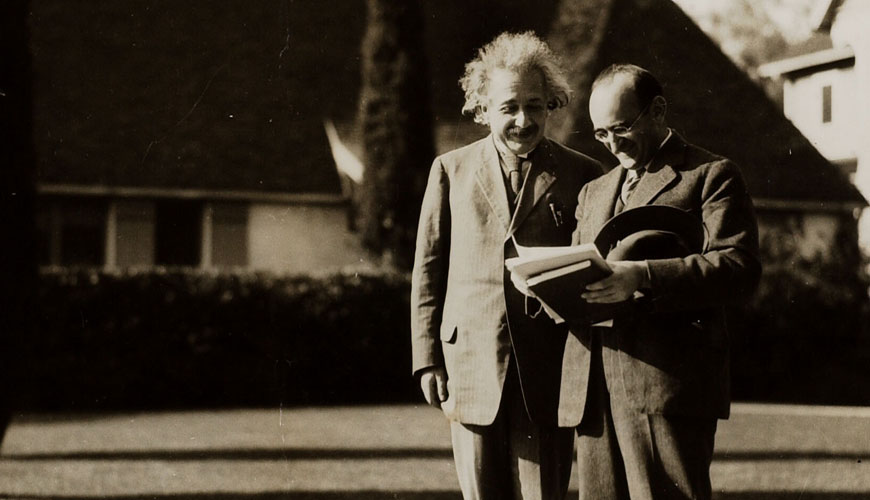
Einstein at Cal Tech.

Einstein at Cal Tech.

Hearing Albert Einstein Speak at Cal Tech
It is a fact that Albert Einstein was at Cal Tech in the 1930’s. As the school’s website explains:

Einstein was a visiting professor at Caltech for three winter terms only—1931, 1932, and 1933. When Einstein decided to settle in the United States permanently, he accepted an appointment at Princeton University.2

However, according to his obituary, Floyd Elmer Weston was born May 21, 1921 which means that he would have been between 10-12 years old when he was a student there. Further, there’s also no record of Einstein speaking at Cal Tech after leaving the school for his commission at Princeton. Further, since Einstein’s health was failing after the war, a cross country trip from Princeton to Cal Tech (which most likely would have been via train) in the post war 1940’s to mid 1950’s (he died in 1955) for an undocumented speaking engagement is highly improbable.3

Further, there’s this email from 1998:

A convert in our ward fifteen or twenty years ago, Dick Lockett, read Weston’s story of the 17 Points and recognized that Weston claimed to have been a student at Cal Tech at the same time he was there. But several small points didn’t match his own recollection of a few events Weston mentioned. Key among them was Weston’s recounting of Einstein’s visit to Cal Tech. Einstein did come to Cal Tech but several years before Weston and he were students there. Dick began to probe the story further. He found that Weston was indeed a student at Cal Tech during the years he attended and thus could not have heard Einstein speak.4

No Collaborating Witnesses
Another problem with Weston’s story is the lack of collaborating witnesses. Continuing from the same source:

…in his story Weston only identified one of the people in the “study group” with first and last names. The rest are only identified by first names. Dick found the one identifiable member of the study group in the alumni records and made contact. They guy [had] never heard of Weston, was not LDS, and certainly was not part of any study group.5

And Holy Fetch notes:

Here is what we know to be true about this story. It was first told by Floyd Weston. He claims that he was one of the four college students. He attended Cal Tech and Albert Einstein did speak there (although some claim that Weston was a student several years after the Einstein visit). Floyd Weston never denied the story and died still claiming the story to be true. The life event was even mentioned in his obituary.

Floyd Weston’s account of the story is the only historical proof we have of this story. None of the other three people involved in the story have ever come forward to back up the story.6
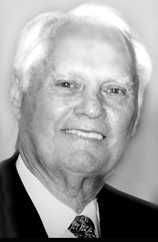
Floyd Weston (1921-2005)

Floyd Weston (1921-2005)

Did Weston Recant?
However, it’s possible that Holy Fetch is incorrect in its assertion that, “Floyd Weston never denied the story and died still claiming the story to be true.” as the aforementioned email notes:

Shortly after this, Weston was invited to speak at a fireside in our stake. When Dick heard this, he told the stake president what he had found. When Weston arrived, he was asked to meet with the SP who confronted him with Dick’s findings. Weston confessed that he had made up the story and was sent packing. This happened in San Jose South stake.

While I have some sympathies about how difficult it must be to untangle a web of deception (I’m sure he still gets phone calls begging him to come and tell the story one more time), I think it is irresponsible to deliver this talk as he did to a recent group of new mission presidents, at church firesides, and to continue to sell his tape.7

The Internal Confirmation Bias Speaks for Itself
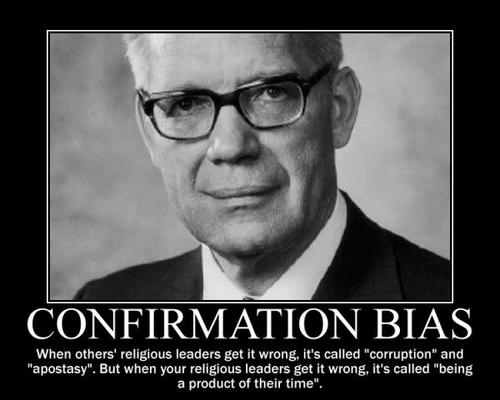
But the most compelling argument against Weston’s “17 Points” is that it’s clearly a case of confirmation bias. Wikipedia defines confirmation bias as follows:

Confirmation bias… is the tendency to search for, interpret, favor, and recall information in a way that confirms one’s beliefs or hypotheses, while giving disproportionately less consideration to alternative possibilities… People display this bias when they gather or remember information selectively, or when they interpret it in a biased way. The effect is stronger for emotionally charged issues and for deeply entrenched beliefs.8

A simpler, more vernacular way to define it is, “You only count the hits and ignore the misses for your predetermined, favored position.” Got it? So, once again for those who missed those 17-points here they are again:

  1. Christ organized the Church (Eph 4:11-14)
  2. The true church must bear the name of Jesus Christ (Eph 5:23)
  3. The true church must have a foundation of Apostles and Prophets (Eph 2:19-20)
  4. The true church must have the same organization as Christ’s Church (Eph 4:11-14)
  5. The true church must claim divine authority (Heb 5:4-10)
  6. The true church must have no paid ministry (1 Cor 9:16-18; Acts 20:33-34; John 10:11-13)
  7. The true church must baptize by immersion (Matt 3:13-16)
  8. The true church must bestow the gift of the Holy Ghost by the laying on of hands (Acts 8:14-17)
  9. The true church must practice divine healing (Mark 3:14-15)
  10. The true church must teach that God and Jesus are separate and distinct individuals (John 17:11; 20:17)
  11. The true church must teach that God and Jesus have bodies of flesh and bone (Luke 23:36-39; Acts 1:9-11; Heb 1:1-3)
  12. The officers must be called by God (Heb 4:4; Ex 28:1; 40:13-16)
  13. The true church must claim revelation from God (Amos 3:7)
  14. The true church must be a missionary church (Matt 28:19-20)
  15. The true church must be a restored church (Acts 3:19-20)
  16. The true church must practice baptism for the dead (1Cor 15:16&29)
  17. “By their fruits ye shall know them.” (Matt 7:20)

035af376-31c8-50be-97d9-f10bd8a94785.image

The solar-powered, eco-friendly LdS Church meeting house in Farmington, Utah.

Now without going any further, doesn’t that list look like a Mormon just took the distinctives and dogmas of the Mormon Church and then generated a list based on them? For example, do you know of any church other than the LdS Church that practices baptism for the dead? Or that claims to have no paid ministry? Or that teaches God the Father has a body of flesh and bones? These are clear and unique Mormon distinctives. In addition, Floyd Weston blatantly misrepresents other churches, their doctrines, their culture and their theology in his address. In fact, his depiction of those churches is more reflective of the type of ignorance driven caricatures, prejudice, and bigotry that non-Mormons still hear from Mormons rather than what one actually finds in those churches. One could easily conclude that he never visited those churches at all.

Further, if you’ve look at the proof texts that Weston provides for each of these points, in many cases, the point is only supported by the biblical text if one engages in Mormon-style eisegesis – that is, inserting words and meanings into the text that the author never intended based on preconceptions. Stated plainly, I question the idea that a non-Mormon approaching the text cold would be inclined to come to the corresponding conclusion that’s found in that particular point. LdS Church indoctrination is clearly at play here.

For example, he cites (Heb 5:4-10) in support of “The true church must claim divine authority” which is the classic text that Mormons eisegete into the text to support their dogma of the restoration of Priesthood Authority. Ditto for point 16 (“The true church must practice baptism for the dead.”) which ignores the fact the language of 1 Cor 15:29 which refers to “they” (third person) rather than “we” (second person), or “I” (first person) – a clear indication that neither Paul or the Corinthian Christians were engaging in the practice. Further, in the full context of the chapter, it’s clear that “they” refers to those who deny the resurrection not those who don’t.

Suffice to say, the “fingerprints” of confirmation bias are all over Weston’s points. In fact, all a knowledgeable person need do is listen to his address to hear it first hand. Mr. Weston’s overtly biased presentation is both self-incriminating and self-discrediting. This fact wasn’t lost on former Mormon Richard Packham who, using the Weston template, developed his own “20 Points of the True Church”:

THE TWENTY POINTS OF THE TRUE CHURCH

Teachings of the True Church:
1. There will be no physical, visible coming of the Kingdom of God (John 18:36, Luke 17:21).
2. The celebration of the Lord’s supper includes bread, wine (Matt 26:26-29) and the washing of each other’s feet (John 13:4-15).
3. Marriage and divorce are frowned upon (1 Cor 7, Matt 19:9, Mark 10:2-12).
4. The Jewish Temple ritual will be observed (Acts 2:46).
5. The Church takes priority over family (Luke 14:26, 12:51-53, Matt 10:21).
6. Women must cover the head while praying (1 Cor 11:5-10).
7. Eunuchs will have special respect in the Church (Matt 19:12).
8. Only two commandments: Love God and love thy neighbor (Matt 22:36-40).

Members of the True Church can be recognized by the following:
9. They hold all things in common ownership (Acts 2:44-45).
10. They do not sin (1 John 3:6-9).
11. They can drink poison without harm (Mark 16:18).
12. They do not strike back if you strike them (Matt 5:39).
13. If you ask to borrow anything from them, you do not have to return it (Luke 6:30).
14. They never have to hire movers or earthmoving equipment, or use UPS; they can literally move anything by the power of God (Matt 17:20, 21:21, Mark 11:23).
15. They have no retirement plans, savings account, or food supplies stored away (Matt 6:25-34). And no possessions (Matt 19:16-21, Mark 16:21, Luke 18:22).
16. They never pray in public (Matt 6:5-8).
17. They are like sheep or children (Matt 19:14, 18:3-4, Mark 10:15, John 10:2-27, Heb 13:20).
18. They do not go to a doctor when ill, but heal each other with prayer (James 5:13-15, Mark 16:18).
19. Their children are not rebellious; they kill them if they are (Matt 15:3-9).
20. They do not die (John 8:51, 11:25-26).9

So who’s to say that Packham’s list is any less valid than Weston’s? After all, they both claim to have biblical support for their claims, right? And since Packham is an atheist he doesn’t have a denominational or sectarian axe to grind or agenda to push. So who wins?
a2d0cdf015326399bf9e02bd4bf7e88d

Further, Mormon researcher Bill McKeever has deconstructed and analyzed Weston’s 17-Points in detail. In doing so he has done a superb job of exposing not only the aforementioned confirmation bias but logical fallacy, after logical fallacy as well:

1. Christ Organized the Church.
This argument is purely subjective as most organizations claiming to be Christian feel Christ organized their church. This would include the Watchtower Society (Jehovah’s Witnesses) and others that deny sound biblical doctrine. People make the Church. Because Christ’s Church is made up of many individuals who have trusted in Christ totally for their salvation, it would be erroneous to view any particular building, organization, or denomination as the “true church.”

2. The true church must bear the name of Christ.
If Mormons wish to use this argument, they must answer as to why their own church was called merely “The Church of the Latter-day Saints” from 1834-1838. By their reasoning their own church must have been in apostasy for at least four years. Those who belonged to the early Christian church were known more by their geographic location rather than an “organizational” name. In I Thessalonians 1:1 Paul addresses “The church of the Thessalonians.” Are we to assume that Paul was addressing a false church?

3. The true church must have a foundation of Apostles and Prophets.
The true church has as its foundation Jesus Christ. He is the Chief cornerstone and/or foundation. I Corinthians 3:11 reads, “For other foundation can no man lay than that which is laid, which is Jesus Christ.” Deuteronomy 18:15 makes it clear that Jesus Christ Himself is “the Prophet” who guides His Church today. (See also John 5:46; 6:14; 7:40; Acts 3:22-23.)

4. The true church must have the same organization as Christ’s church.
If the LDS Church follows Eph 4:11-14, why is the order of authority reversed? Paul says first in line come the apostles, next the prophets. Mormonism reverses this order. If Mormonism emulates the structure of the early church, where in the Bible is there any mention of multiple high priests, Relief Society presidents, Second Quorum of the Seventies, stake presidencies, ward bishoprics, etc.? Where are the Mormon’s pastors, and evangelists?

5. The true church must claim divine authority.
Again, this is purely subjective. Any organization can claim to be authoritative. Bible-believing Christians claim the authority of God’s Word, the Bible, not the words of mere men who contradict it.

6. The true church must have no paid ministry.
Mormons who believe their leaders are not paid are very misinformed. All the General Authorities in Salt Lake City receive remuneration for their services to the church and from the church. If they don’t believe it, they should call the LDS Church headquarters and ask. A paid ministry is not unbiblical. The entire Old Testament speaks of a paid ministry as well as I Corinthians chapter 9.

7. The true church must baptize by immersion.
If baptism (a work) was necessary in order for a person to be saved, this could be a debatable subject. However, Ephesians 2:8,9 clearly states that we are saved by grace through faith, not works such as baptism. Baptism is merely an outside sign of an inner work of the Holy Spirit in an individual’s life. Believers should be baptized as a testimony of their faith in Christ; however, baptism does not save.

8. The true church must bestow the gift of the Holy Ghost by the laying on of hands.
Many Christian churches do practice this. The Bible shows, however, that at times the Holy Ghost (Spirit) was received of men without mention of hands being laid on them. (See Acts 4:31; 10:44; 11:15.)

9. The true church must practice divine healing.
Again, many Christian churches do practice this and do get results.

10. The true church must teach that God and Jesus Christ are separate and distinct individuals.
The Christian church holds that Jesus Christ and God the Father are separate personages. Joseph Smith strayed from the truth when he said they were separate Gods. This conflicts with many passages such as Deut. 6:4 and Isaiah 43:10, just to name a few.

11. The true church must teach that God and Jesus Christ have bodies of flesh and bone.
Mormons believe this only to substantiate Joseph Smith’s so-called first vision. John 4:24 claims God is a spirit (lit. God is Spirit). Even Smith at one time taught God the Father was a personage of spirit (See Lectures on Faith, Lecture Fifth). He changed his mind later on.

12. The officers must be called of God.
Another subjective point. All cultists believe they are called of God.

13. The true church must claim revelation from God.
Again, a subjective point. All cultists claim revelation from God.

14. The true church must be a missionary church.
Any Christian church that wants to see souls saved is a missionary church whether that mission field is across the ocean or across the back fence. The Mormon church holds no exclusive rights to missionary activity.

15. The true church must be a restored church.
You can’t restore something that wasn’t lost. Jesus Himself said the gates of hell would not prevail against His church (Matthew 16:18). History proves this.

16. The true church must practice baptism for the dead.
The Christian church never condoned baptism for the dead. Paul excludes himself from such a practice when he uses a third person pronoun rather than first person (“Why do they baptize for the dead …”) (See Hebrews 9:27 and Alma 34:34,35 for that matter.)

17. By their fruits ye shall know them.
This expression is taken from Matthew 7:20, which ironically deals with judging false prophets, not churches. In examining the fruits of Joseph Smith, we find that he indeed was a false prophet. He introduced a foreign view of God, a false plan of salvation, and inaccurate predictions about future events. If we must use this verse to examine the fruits of Mormonism, we must have an answer as to why the Mormon Church must constantly reverse its position on matters that should never change (Alma 41:8). Why do their leaders contradict past leaders? Why did they change the Book of Mormon so many times when it was supposedly translated “by the gift and power of God the first time”? Why did they change their temple ceremony in 1990 when Smith claimed it came by direct revelation? And doesn’t it seem suspicious that many of the changes in the ceremony were things Christians (and Mormons) had been criticizing for years? Did God mess up or did Joseph Smith (or was it their current leaders)?10

And to further expand on Mr. McKeever’s critique of Point Six, LdS scripture actually demands a paid clergy in not one but two different places:

And the elders or high priests who are appointed to assist the bishop as counselors in all things, are to have their families supported out of the property which is consecrated to the bishop, for the good of the poor, and for other purposes, as before mentioned;

Or they are to receive a just remuneration for all their services, either a stewardship or otherwise, as may be thought best or decided by the counselors and bishop.

And the bishop, also, shall receive his support, or a just remuneration for all his services in the church.
(Doctrine & Covenants 42:71-73)

Behold, I say unto you, that it is the duty of the church to assist in supporting the families of those, and also to support the families of those who are called and must needs be sent unto the world to proclaim the gospel unto the world.
(Doctrine & Covenants 75:24)

So the modern Mormon Church’s assertion that a paid clergy is a sign of an apostate and/or untrue church blatantly contradicts what it also claims is part of God’s revealed commandments to His only true, living, and restored church. I believe the word for this is “hypocrisy.”

One can only wonder why Floyd Weston conveniently ignored these rather glaring incongruities in his analysis. The only logical explanation that is that he was not only just counting the “hits” but ignoring the “misses.” So in the end, its clear that Floyd Weston’s “17 Points of the True Church” appears to be nothing more than the type of confirmation bias driven, thought stopping, information and emotional controlling circular logic that Mormon culture produces in spades – and what’s remarkable about any of that?11
ta_us_sta_0087_xgaplus

A Comparable Evangelical Case Study
Further, when a public figure is caught fabricating inspiring falsehoods people tend to hold them accountable for it after they’re exposed. For example, let’s consider the case of Evangelical comedian Mike Warnke who got caught in a web of lies back in the 1990’s:

In 1991, Cornerstone magazine launched an investigation into Warnke’s life and testimony. The previous year, Cornerstone had debunked Lauren Stratford‘s story that had been recounted in Satan’s Underground. Stratford claimed her deep involvement in Satanism led her to partake in a ritual in which her own child was sacrificed. After the exposé showed Stratford’s alleged child had never existed, Cornerstone journalists Mike Hertenstein and Jon Trott investigated Warnke and his life.

The Cornerstone investigation spanned from interviews with over 100 of Warnke’s personal friends and acquaintances to his ministry’s tax receipts. The investigation revealed a number of inaccuracies and evidence of fraud and deceit in Warnke’s accounts. During the course of Cornerstone’s investigation, pictures of Warnke taken during the time he was alleged to be a Satanist priest were discovered. Rather than showing an emaciated drug-addict sporting long fingernails and waist-length hair, the pictures showed Warnke as a typical ‘square’ of the mid-1960s. The investigation also revealed Warnke’s claims that he and Charles Manson had attended a Satanic ritual to be false; Manson was in federal prison at the time, having no known ties to Satanic churches.

The investigation further uncovered that before joining the Navy, Warnke had been involved with the college Christian ministry Campus Crusade for Christ. The investigation also revealed the unflattering circumstances surrounding Warnke’s multiple marriages, affairs, and divorces. Most critically, however, the investigation showed how Warnke could not have done the many things he claimed to have taken part in throughout the nine months he claimed to be a Satanist – including his claims to be a drug-addicted dealer or a Satanic high priest.

Warnke sent a response to Cornerstone, published in July, insisting he told the truth, stating:

‘I stand by my testimony of being delivered and set free by the power of Jesus Christ after being a Satanic high priest exactly as published in my book, The Satan Seller…. some information was purposefully changed to protect the privacy of certain individuals and to prevent readers from using the book as a guide for occultism and Satanic purposes. But, as we stated in the front of the book, ‘The events are absolutely as described.”’

Despite these assertions, Warnke did not provide the name of a single Satanist but used invectives against ex-wife Carolyn. In the ensuing months, Warnke conceded parts of the allegations, telling Christianity Today that there had been only 13 members of his coven, not 1,500 as originally claimed, and that of those 13, the whereabouts of five were unknown to him, while the other eight had since died.12

The reaction from the Evangelical community to this deceit and attempt at manipulative damage control was quick and impacting:

Public response was varied but was nevertheless overwhelmingly against Warnke. Initially, Word Records stated that they would stand by their artist. However, further investigations by local Kentucky reporters at the Lexington Herald-Leader revealed that Warnke’s ministry had engaged in financial misdeeds and that “Mike, his ex-wife Rose, and her brother Neale [Hall] received a total of $809,680 in salary at a time when the ministry newsletter claimed donations were down and more funds were needed.” One week later, Word Records dropped Warnke from its label. Finally, on September 30, 1992, fewer than 100 days after the investigation was made public, Warnke Ministries closed its doors.13

moab_lds_church

This historic Moab LdS Church was constructed of adobe in 1884. It was built nine years after the establishment of Moab in 1880. Angus Stocks supervised the laying of the foundation and adobes. Within a few years of original construction an addition was made to the rear of the building. The church was used by the Moab Ward until 1925, when a new church was built and this church deeded to the Grand County School District.

The Mormon Response
Yet remarkably, despite all the evidence discrediting Weston’s 17-Points, the reaction been in Mormon Culture has been quite different to what we saw from Evangelicals in response to Warnke’s faith promoting yarn spinning and denials. Here’s a sampling of Mormon responses:

“I sat in a meeting where Brother Weston himself told that story. I have no reason to question Brother Weston’s veracity.”14

“Floyd Weston told me himself in 1983 that it really happend,[sic] five friends studied four joined (one died). Now about the 17 points that’s just interpretation of those scriptures. I once saw a 42 point one that was more detailed. But according to brother Weston and I have no reason to doubt him. Its true. According to Brother Weston’s son he never denied it to his family either. Please stop trying to make Brother Weston out to be a Paul H Dunn.”15

“I wanted to let you know that I just talked to one of Brother Weston’s relatives. He said that whether these claims are true or false… this 17 points of the true church has been effective & instrumental in helping people join the church and that Satan will do anything to diffuse that.

I highly recommend that you redirect this discussion before it causes Satan to have more power & influence on Jesus Christ’s people.”16

One will, of course, notice that no verifiable evidence is presented to support these claims of Weston’s vindication – once again it’s all “just take my word for it” and “I know a guy who knows a guy” second and third hand feel good hearsay.

Even the Mormon Apologists at FAIRMormon seem to be unable or unwilling to openly acknowledge Weston’s deceit and denounce the 17-Points as a contrived, faith promoting lie. Yet at the same time time they still seem to be posturing for a rapid retreat and slowly backing away from it:

It makes little difference for the Church if Weston made up his story, since the truth or falsity of Weston’s personal history has no bearing whatsoever on the truth of the restored gospel. Additionally, the “17 Points” may be used by certain individual members of the Church, but they have not been used in any official Church publications or adopted by the Church in any other way. The claims of the restored gospel stand independent of Weston’s list.17

Even more amusingly FAIRMormon attempts to woodshed critics of The 17-Points by incorrectly asserting that articles like this are some kind of indirect attack on the Mormon Church via ad-hominem attacks on Floyd Weston:

What this has to do with the validity of Weston’s “17 Points” is not entirely clear, but it seems that the critic is attempting to discredit Weston’s list (and, by implication, the Church) by discrediting Weston himself. This would be a form of the ad hominem fallacy… This confirms the perspective that the hostile reports targeted against Weston suffer from significant bias.18

Oh irony here! Critics are accused by FAIRMormon of engaging in argument “to the man” (the English translation of ad-hominem from the Latin) rather than “to the man’s evidence, arguments, logic, and reason” when those critics are doing nothing more than challenging Weston’s evidence, arguments, logic, and reason. Even more remarkably these charges come right on the tail of FAIRMormon acknowledging that Weston’s 17-Points are indeed rooted and grounded in confirmation bias:

The assumptions underlying the “17 points” are highly dependent upon a worldview widely assumed by Utah Mormons, but which rarely reflects the situation of those who are not members of the LDS Church: the idea that there is “one true church” and that people will accept the LDS faith once they are logically convinced that it “matches” the New Testament Church in salient ways. In reality, these concepts are totally foreign to the worldview of most non-Mormons and depend a great deal on the assumptions which one brings to such an analysis.

“17 Points” is thus a resource that may be interesting to Latter-day Saints in examining the scriptural basis for certain features of the modern Church, but it is one that has relatively little value or relevance to the missionary effort unless the non-member already shares many aspects of the LDS world-view.19

With “logic” and “consistency” like this who needs enemies – FAIRMormon seems to be doing just fine shooting itself in the foot, that is after that foot has been inserted into its mouth first. Say what you will about Evangelical Christianity but you won’t find its apologists defending a member of its tribe who’s been caught in a faith promoting lie. If you doubt me, just read the Warnke case above again and consider that at no time did you have Evangelicals claim that Mike Warnke was being “ad-hominemed” by critics in an agenda driven attempt to indirectly discredit Evangelicalism. In fact, Warnke’s harshest critics, not to mention the folks who exposed his deceit to begin with, were fellow Evangelicals.

Conclusion
At the end of it all, the body of evidence points to fact that the story of Floyd Weston’s “17-Points of the True Church” is a complete fabrication. So the fact that Mormons continue to defend it and use it as evidence in their discussions with outsiders raises some serious questions about the value of truth and integrity in Mormon Culture. As Richard Packham said well in response to one Mormon’s argument that, “whether these claims are true or false… this 17 points of the true church has been effective & instrumental in helping people join the church and that Satan will do anything to diffuse that”: 20

“Does this mean, then, that, according to this Mormon, the truth is a tool of Satan?”

Kinda makes you wonder folks don’t it? Kinda makes you wonder…

OvidChurch01

A former LdS Church building, now privately owned. Peter Jensen was the first branch president in Ovid, Utah in 1873. He later became the first Bishop of this church.

NOTES
1 “Is the “17 Points of the True Church” a true story”, Holy Fetch website.
2 “Fast Facts About Cal Tech History”, Cal Tech website.
3 See “Chronology of Einstein’s life”, Albert Einstein in the World Wide Web website. Also see Princeton University’s article on Einstein here.
4 Anonymous archived email, Wed, 28 Oct 1998 23:46:03 Pacific Time, Richard Packham website.
5 Ibid.
6 Op Cit, Holy Fetch. Underlining added for emphasis.
7 Op Cit, Anonymous email. By the way, one can still buy an audio copy of Weston’s 17-Point at Deseret Book. Or if you prefer the printed tact version, ditto.
8 Wikipedia article on Confirmation Bias.
9 Richard Packham, “The 17 Points of the True Church”.
10 Bill McKeever, ‘Examining the “17 Points of the True Church”‘
11 Also see Fred Anson, “A Short Course In Confirmation Bias” for another infamous example of this.
12 Wikipedia article on Mike Warnke, “Investigation and debunking“.
13 Ibid, “Aftermath”.
14 Mormon Discussion and Dialogue Board, post by ERayR, 4 Mar 2009.
15 Mormon Discussion and Dialogue Board, post by Anijen, 3 Mar 2009.
16 Fri, 30 Oct 1998 09:35:44 Pacific Time, Richard Packham website.
17 “Criticism of Mormonism/Criticism of “17 Points of the True Church”‘, FAIRMormon website.
18 Ibid.
19 Ibid.
20 Op Cit, Packham, “The 17 Points of the True Church”.
Church-at-Sunrise

Also Recommended: 
In November 2011 Bill McKeever and Eric Johnson discussed, deconstructed, and evaluated The 17-Points of the True Church on their Viewpoint on Mormonism podcast. You can listen to these podcasts via the following links: Part 1 Part 2 Part 3 
BACK TO TOP

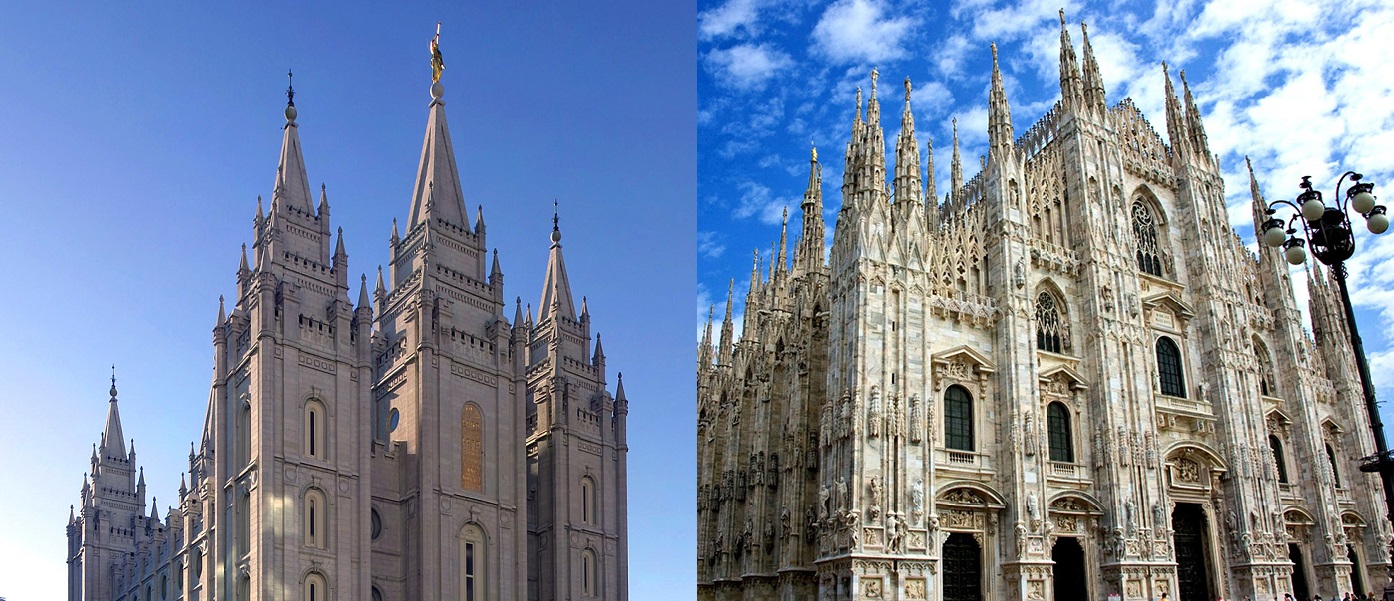
SLC Temple and Milan Cathedral

The Mormon Temple in Salt Lake City and Il Duomo Roman Catholic Cathedral in Milan.

by R. M. Sivulka

Introduction
For me as a committed Protestant, this subject of Catholicism’s theology on the gospel, justification, and works is quite complicated.  I’m not going to answer all the questions here, because I’m just not competent enough to do so, and I’d rather be spending my time in other areas I feel more important to my ministry.  So please offer me some grace even if you disagree with my conclusions.  If you want more competent authorities on the matter, I offer three sources: 1) Norm Geisler and Ralph MacKenzie’s “Roman Catholics and Evangelicals”, and Geisler’s recent statement in The Evangelical Dictionary of World Religions”“These doctrinal similarities are too strong to place a non-Christian label on the essential doctrines of official Roman Catholicism” (“Roman Catholicism,” [Baker, 2018], 434), 2) Ken Samples, Is the Catholic Church Christian? and Is Catholicism a Cult?,” and 3) Francis Beckwith’s “Return to Rome”.  (The latter is written by a former top evangelical apologist and a former president of the Evangelical Theological Society, who went back to his Catholic roots.)  I do think it’s important to note from Ken Samples above “that the majority of evangelical Protestant theologians and scholars who are knowledgeable concerning Catholicism would be perplexed to hear Catholicism classified simply as a ‘non-Christian religion’ or an ‘anti-Christian cult’” (“Is the Catholic Church Christian?”).  Even the greatest Christian apologist today, William Lane Craig, has stated that Catholicism is part of “Mere Christianity.” This could not be the case if these scholars understood Catholicism to be in fact teaching a false gospel.

Catholicism and Mormonism
I still don’t find Catholicism identical to what LDS teach on the matter at hand, viz., that one is only made right with God only after doing all one can do (i.e., personal perfection).  There is no initial justification for LDS, and as the late LDS President Spencer W. Kimball taught,

“Trying is [n]ot [s]ufficient [n]or is repentance complete when one merely tries to abandon sin.  To try with a weakness of attitude and effort is to assure failure in the face of Satan’s strong counteracting efforts.  What is needed is resolute action.

…This connection between effort and the repentance which attracts the Lord’s forgiveness is often not understood.

…[Concerning the woman caught in adultery,] [t]here seems to be no evidence of forgiveness.  His command to her was, ‘Go and sin no more.’  He was directing the sinful woman to go her way, abandon her evil life, commit no more sin, transform her life.  He ways saying, Go, woman, and start your repentance; and he was indicating to her the beginning step – to abandon her transgressions.

…[W]hen she had done these things the forgiveness of the Savior could overshadow her and claim her and give her peace.

…The Lord cannot save men in their sins but only from their sins, and that only when they have shown true repentance”
(The Miracle of Forgiveness, 164-6).

Furthermore, in LDS categories, Christ didn’t even die for all sins since some sins are not forgivable (e.g., killing and subsequent offenses of adultery in D&C 42, and also LDS leaders’ past teaching on one’s own blood atonement for certain grievous sins).  This is certainly all something Catholicism would doctrinally disagree.

Catholicism and Protestantism
The subject turns on the role of works in Catholic theology.  Do those works invalidate the true gospel making it a false gospel or is the true gospel simply packaged in a way that’s confusing to the hearer?  There’s a really important difference here.

It reminds me of the Positive Confession speakers’ claim that we are begotten gods.  Walter Martin made the controversial claim that these guys are still Christians.  (Martin also, by the way, held that Catholicism wasn’t a cult or heretical to the extent that it would qualify as “non-Christian” even though he certainly had problems with it.  Even after his debate on the John Ankerberg Show against Father Mitch Pacwa, SJ, Walter Martin [according to his daughter Jill] regarded him as a brother in Christ. Further, Martin had Pacwa on the editorial board of the Christian Research Journal and had him, among other ordained clergy, lay hands on Martin in his Southern Baptist ordination [Beckwith, Op. cit., 42-3]. Such would be impossible if Walter knew Pacwa’s doctrines were damnable heresy. I used to go to Walter’s Sunday school class while in college, I used to regularly listen to him on the Bible Answer Man Program, and I would attend a number of his lectures. In fact, I was looking forward to being his intern at the Christian Research Institute for the fall semester of 1989 when he suddenly died in June of that year. The phrase “Catholic, Protestant, and Orthodox” was continuously used by him to bring the weight of the authority of the historical Church against any heresy. Perhaps long before I knew him Martin was more disparaging of Catholicism. Nonetheless, the Roman Catholic Church was never included in his standard textbook of the cults—The Kingdom of the Cults. Also, by the way, the new General Editor for that book, the well-known Christian apologist Ravi Zacharias, with the endorsement of Martin’s family, has continued to keep Roman Catholicism out of it. When asked specifically, Zacharias wouldn’t label Catholicism as a cult.)  Robert Bowman in his article on various views of deification says that the Positive Confession view isn’t easily classified.  These Positive Confession speakers clearly affirm monotheism, and yet they speak in such a convoluted way.

For the average individuals untrained in theology, even cases of orthodox Christian deification are such that they conclude advocates of such a position must be polytheists and outside the Christian doctrine of monotheism.  Yet, whether it is Positive Confession speakers or orthodox theologians who teach deification, all steadfastly affirm monotheism and adamantly decry polytheism.  Yes, we have problems understanding what they are talking about since prima facie it seems so contradictory.  However, it’s not really fair to be so dismissive of these people given the parameters they’ve already clearly articulated.  In situations like this, if we have a hard time really understanding what’s being taught, then it’s better to use the principle of charity and give the benefit of the doubt to such people until we come to see how there really is no contradiction in their minds.  And this seems especially true when most evangelical Protestant theologians and scholars hold Catholicism to be classified as genuinely “Christian.”

There’s a fundamental problem with the Protestant mind when it comes to thinking in the Catholic categories of justification.  Catholics conflate the clear distinction that Protestants have made between justification and sanctification.  The Council of Trent put it this way: “[J]ustification itself, which is not only a remission of sins but also the sanctification and renewal of the inward man through the voluntary reception of the grace and gifts whereby an unjust man becomes just and from being an enemy becomes a friend, that he may be an heir according to hope of life everlasting” (Chapter VII).  Catholics teach a difference between initial justification and justification that ought to follow throughout one’s life.  The former is what Protestants typically mean by “justification.”  The other justification for Catholics is a matter of staying justified by works.

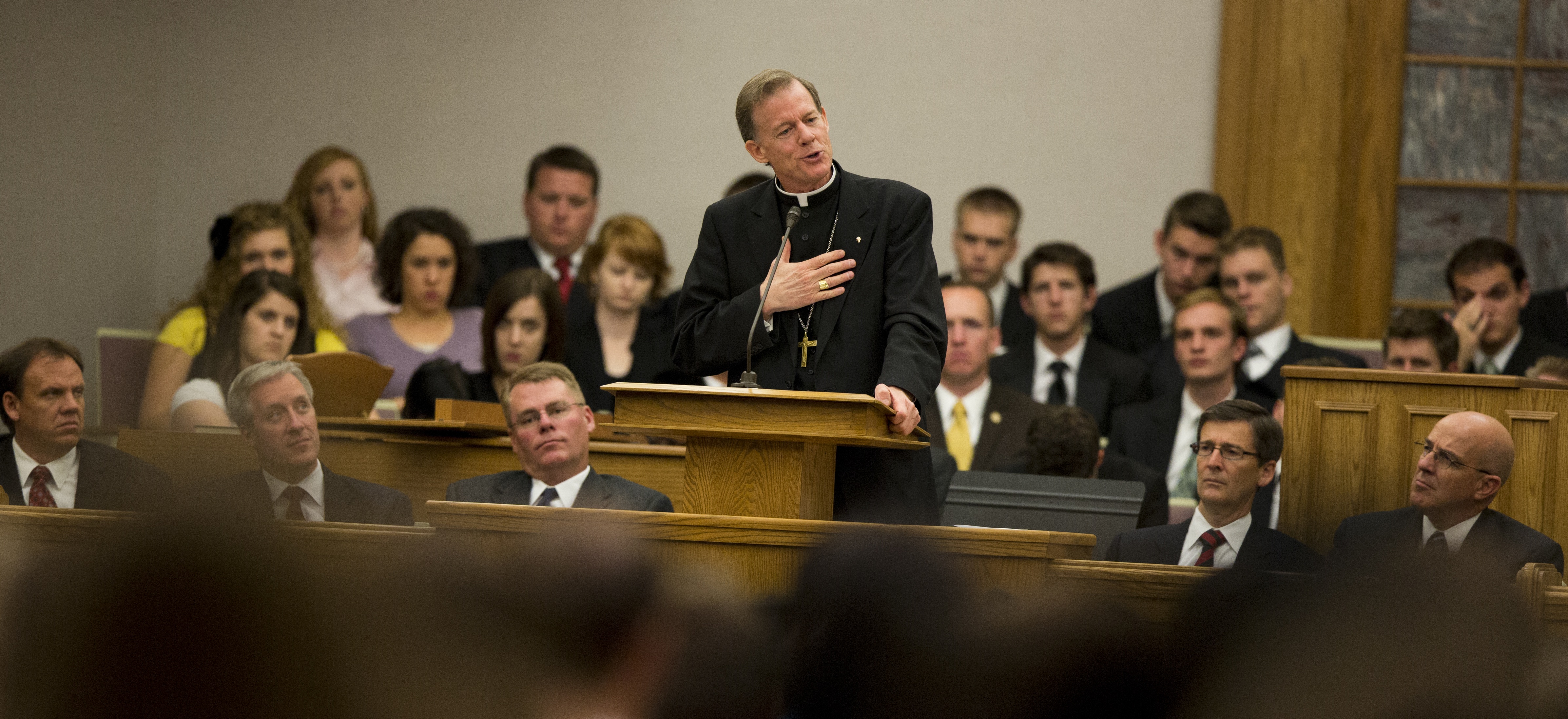
The Most Reverend Bishop John Charles Wester of the Salt Lake City Diocese of the Catholic Church speaks to students at the LDS Institute of Religion and at the Alumni House on the campus of Utah Valley University in Orem, Utah Tuesday Sept. 18, 2012. (August Miller, UVU Marketing)

The Most Reverend Bishop John Charles Wester of the Salt Lake City Diocese of the Catholic Church speaks to students at the LDS Institute of Religion and at the Alumni House on the campus of Utah Valley University in Orem, Utah Tuesday Sept. 18, 2012. (August Miller, UVU Marketing)

Now if a Protestant objects that this latter type of justification is not about works, then they would not simply be objecting to Catholicism, but to many other branches of Protestantism as well.  The objecting Protestant (typically one of a more Reformed bent) would also have to conclude that these other branches of Protestantism are outside of Christianity and preaching a false gospel.  That’s a pretty hard pill to swallow.  These other branches of Protestantism affirm that performing works of righteousness may be freely abdicated after our conversion, and thus, one’s salvation may be lost.  I disagree with this position and hold to the eternal security of the believer, but that’s beside the point.  They are all Christians who affirm the true gospel that our salvation on behalf of all our sins is ultimately given as a gift from God through the sacrifice of His Son.

The Council of Trent in chapter IX is clear that none of us can be absolutely certain that any of us have received the forgiveness of sins.  After all, Paul did say to test ourselves to see whether we are in the faith (2 Cor. 13:5).  As a result, chapter X talks about being further justified by one’s “faith co-operating with good works.”  One of the arguments given here is James 2:24: “Do you see that by works a man is justified, and not by faith only.”  So continued justification is just as biblical as what the Protestants mean by “sanctification.”  Then in chapter XI it goes on to talk about how Jesus taught that if we love Him, then we keep His commandments (Jn. 14:15).  Earlier Jesus ties belief with obedience when He says, “He who believes in the Son has eternal life; but he who does not obey the Son will not see life, but the wrath of God abides on him” (Jn. 3:36).  John is clear in his epistle that we know that we love Jesus if we keep His commands, and if we say we love Him and don’t keep His commands, then we’re liars (1 Jn. 2:3-4).  Hence, “the necessity” of keeping His commands.

There’s nothing that a Protestant should disagree with here per se.  Of course and again, a certain type of more Reformed Protestant may object to an understanding of this necessity of keeping the commands implying a loss of one’s initial justification if the commands aren’t followed, but as Trent stated the issue above, it’s all biblical and every Protestant should uphold that.

At this point, a Protestant may object by saying that Catholics are still teaching a false gospel, since the initial justification is dependent on baptismal regeneration whether that be for an adult or an infant, and belief is certainly ruled out for the latter.  However, again one would have to exclude various Protestant denominations that hold to the same means of initial justification.  Again, a pretty hard pill to swallow.  Certainly the nature of belief is up for debate here and is a secondary issue to the nature of the gospel itself, viz., that Christ paid for all our sins, He resurrected, and invites sinners to currently live in His kingdom by learning to live life as He would live (cf. Mat. 4:23 and 1 Cor. 15:1-5).  Such debates on the nature of belief have to do with how individual beliefs arise in a context of community.  Nonetheless, there is no passage of scripture that explicitly says that not getting the right answer here lands one in hell.

Anathema
Speaking of hell, the final issue I’ll address concerns the issue of “anathema” the Catholic Church has offered from the Council of Trent in reaction to Protestantism.  Canon 30, for example, says, “If anyone says that after the reception of the grace of justification the guilt is so remitted and the debt of eternal punishment so blotted out to every repentant sinner, that no debt of temporal punishment remains to be discharged either in this world or in purgatory before the gates of heaven can be opened, let him be anathema.”  Is this the gospel and does this entail that those who reject this are cursed of God and not saved is that they are outside the Church of Christ?

Even if that is what is meant by anathema, this is no reason to hold that this entails a false gospel.  Believers who have received the grace of justification may still have to be punished by God for their own transgressions, because “whom the Lord loves, He also chastens” (Heb. 12:6).  David had imputed righteousness apart from works (Rom. 4:4-8), but the Lord still chastened him in taking his son who was the product of adultery.  Whether the Lord metes out punishment in this life or the next prior to entering paradise, what real difference does it make?  Even though I take it that the Bible never says anything about a temporary punishment for believers after this life, that doesn’t entail such could not be the case.  To conclude this would be based on an argument from silence, and that’s fallacious.

Regardless of this point, it’s been argued that the literal meaning of anathema is not what is to be understood from the judgment of a Church council.  There was no intention of permanent damnation to hell.  The Lonely Pilgrim notes, “When the councils pronounced holders of a doctrine anathema, it marked a formal excommunication from the Church: nothing more and nothing less.”  He argues that if there was a connotation of permanent damnation, then the missionary efforts to Protestants by the Jesuits wouldn’t make much sense.  Further, he argues that if there is a problem here, it’s specifically for those who rebel against the judgments of their church.  There is no general relevancy to all Protestants today.  He says, “You can’t very well be excommunicated from something you were never formally a part of.”

Now even if The Lonely Pilgrim is wrong on all this, I don’t see why a group of believers being hyper-exclusionary of one’s judgments marks them as “false Christians” or “heretics,” who teach a false gospel and land them in hell anyway.  I don’t see the chapter and verse on that either, and again, we can easily think of other Protestant Christian groups who act in this way.

rob_sivulka_mugAbout the Author
R.M. Sivulka is the president of Courageous Christians United which is an outreach to Mormons, Jehovah’s Witnesses, and Muslims. Mr. Sivulka reside in West Jordan, UT with his wife Tara, and daughters.

Originally published on January 19, 2016, on the Courageous Christians United website. Reprinted with permission. Please note that this article was updated on February 1, 2019, on this website and the author published an updated and expanded version of this article on his website on April 16, 2022, which you can read by clicking here.

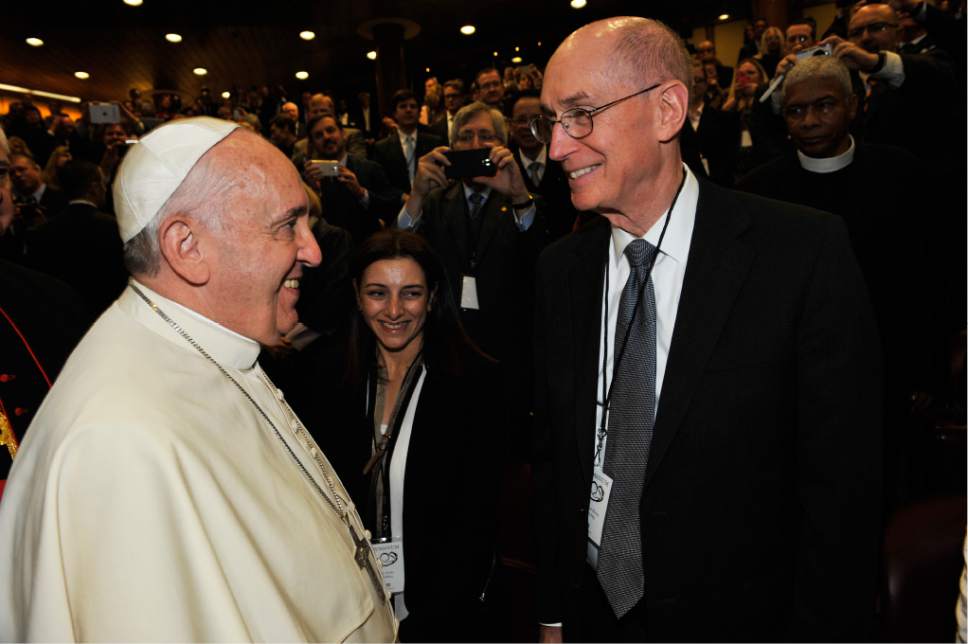
Pope Francis and Henry B. Eyring First Counselor in the First Presidency of The Church of Jesus Christ of Latter-day Saints. At a 2014 Vatican Summit of religious leaders on marriage.

Pope Francis and Henry B. Eyring First Counselor in the First Presidency of The Church of Jesus Christ of Latter-day Saints. At a 2014 Vatican Summit of religious leaders on marriage.

BACK TO TOP

An Appeal to Never Mormon and Ex-Mormon Christians
Preaching

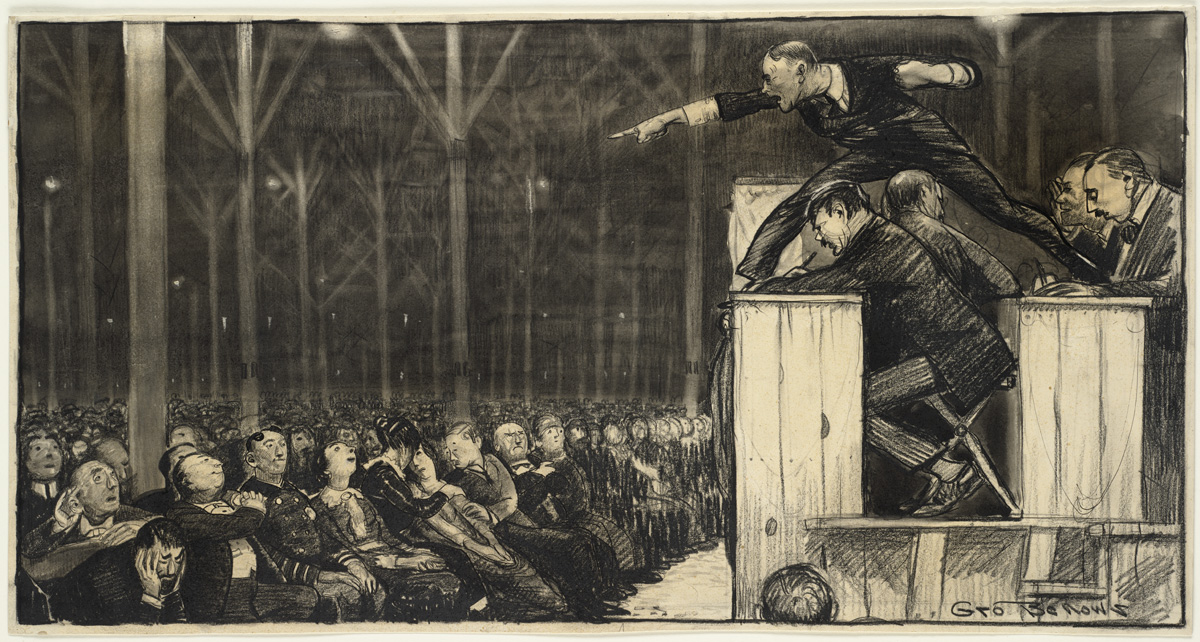
“Billy Sunday Preaching” by George Bellows (c.1915)

by Fred W. Anson and Jackie Davidson
Q: What’s the quickest way to drive a transitioning Mormon into atheism?
A: Christian infighting, dogmatism, and sectarianism.
This isn’t theory, Atheist Ex-Mormon discussion boards are filled with stories about former members of the LdS Church who gave up on Christianity on their way out of the Mormon Church when the Christians that they encountered were just as fanatically sectarian and absolutist as the Mormons that they knew were. Their conclusion? “They’re just two sides of the same fanatical coin.”

The Core Problem
It’s always good to remember what most Mormons think, and the LdS Church teaches: That all Christian churches other than theirs are a big ball of confusion. Consider this from the official LdS Church website:

During the Great Apostasy, people were without divine direction from living prophets. Many churches were established, but they did not have priesthood power to lead people to the true knowledge of God the Father and Jesus Christ.
(Official LdS Church website, “Apostasy”

This is a core doctrine in Mormonism. Public bickering on non-essential Christian doctrines in front of those who have ever been indoctrinated into Mormonism just validates and reinforces this stereotype and prejudice. And it doesn’t matter if that Mormon indoctrination took place last month or last century, the presumption of apostate corruption lingers on. So what does that have to do with Latter-day Saints becoming atheists due to Christian infighting, dogmatism, and sectarianism? Read on.

It Started On Facebook
Back in early 2015 we started an internet recovery group for Ex-Mormons who were trying to navigate the often difficult road into mainstream Christianity. We did this because we saw a crying need for such a group. At the time, while there were tons of  Atheist Ex-Mormon Internet support groups, they all seemed to lacked a positive sense of direction. As a result they had deteriorated into a quagmire of complaints, bitterness and anger. From what we could tell, the only shared value in the groups was a hatred of theism in general and the LdS Church in particular. In some cases there were some who had been out for years, even decades, but had become so eaten up by bitterness that they had become downright mean and nasty –  especially to Ex-Mormon Christians who wandered into their groups. We were sure that we could give these poor battered souls a safe and secure place to heal while they transitioned into mainstream Christianity. So we did.

Billy Sunday

However, it didn’t take very long for the Administrators of our group  to quickly became hyper-sensitive to sectarian infighting between mature Christians in the group. We were stunned at the incredible damage that it was having on those who were either new to the process or who still had wounds healing. The very people that we were trying to help were leaving the group because they were so confused and turned off by these well meaning but unbelievably insensitive and – it must be said – self absorbed, self interested, agenda driven, sectarian Christians. Every time Christians started dogmatically bickered over a non-essential doctrine we would lose a few more. It became quickly apparent that we couldn’t tolerate this behavior from our tribe and would have to take whatever action was required to eliminate it – up to and including a permanent ban on chronic violators.

The result was some of the most embarrassing drama queening that we’ve ever seen on the Internet – and that was on just giving simple warnings to these folks! It got so bad that at times we thought that some of those that got tossed or banned were going to petition their Pope, Patriarch, or Pastor to call us to Church councils so we could be properly anathematized. We were called and accused of some of the most unbelievable things imaginable. It was stunning. To hear some of these Christians tell it, you would think that the Devil and his minions (rather than a bunch of fellow believers and brother and sisters in Christ) were running this quiet little cyberspace community and damning all of its souls to hell!

You’re Kidding Right?
Now to  be fair, coming from mainstream Christian culture ourselves we understand that they were just doing what comes naturally. After all, after two thousand or so years of rough and tumble in house debate about every bit of doctrinal or theological minutiae imaginable – we’re used to this type of “hard ball” collegial exchange. We love it! We relish and luxuriate in it like a Parisian at a free cheese and wine tasting. So what’s the big deal, right?

The problem is that Mormonism is as much a culture as it is a religion – in some ways more so. Further, we mainstream Christians also, usually unknowingly, have a religion that’s heavily infused with our own cultural distinctives. One of them is a casual, easy going, even enthusiastic attitude about debate, discussion, and disagreement that’s generally missing in Mormon culture. As Utah Pastor and Ex-Mormon Ross Anderson explains:

The distinctives of Mormon culture and church life make it very challenging for former Latter-day Saints to become fully integrated into a Christian church. Like immigrants leaving their homeland behind to come to a new world, they must negotiate a confusing journey into a new cultural setting. To establish a new identity with a new church body, the ex-Mormon must develop a new worldview, new roots, new stories, new assumptions, new perspectives, new values and new symbols. On a practical level, he or she must adapt to a myriad of perplexing new customs and practices in the life of the local church.
(Ross Anderson, “Jesus Without Joseph: Following Christ After Leaving Mormonism”, Introduction) 

And a big part of the “country” that Ex-Mormons are immigrating from puts a high value on conflict avoidance. As Michael J. Stevens, a Latter-day Saint researcher and Professor of organizational behavior at Weber State University notes:

I often observe that mainstream LDS Church members along the Wasatch Front have a difficult time confronting any form of disagreement, even when they are clearly uncomfortable or unhappy with what’s being discussed or decided. It’s as if they were conflating all forms of disagreement or conflict with contention. This would be consistent with an overly simplistic reading of 3 Nephi 11:29:
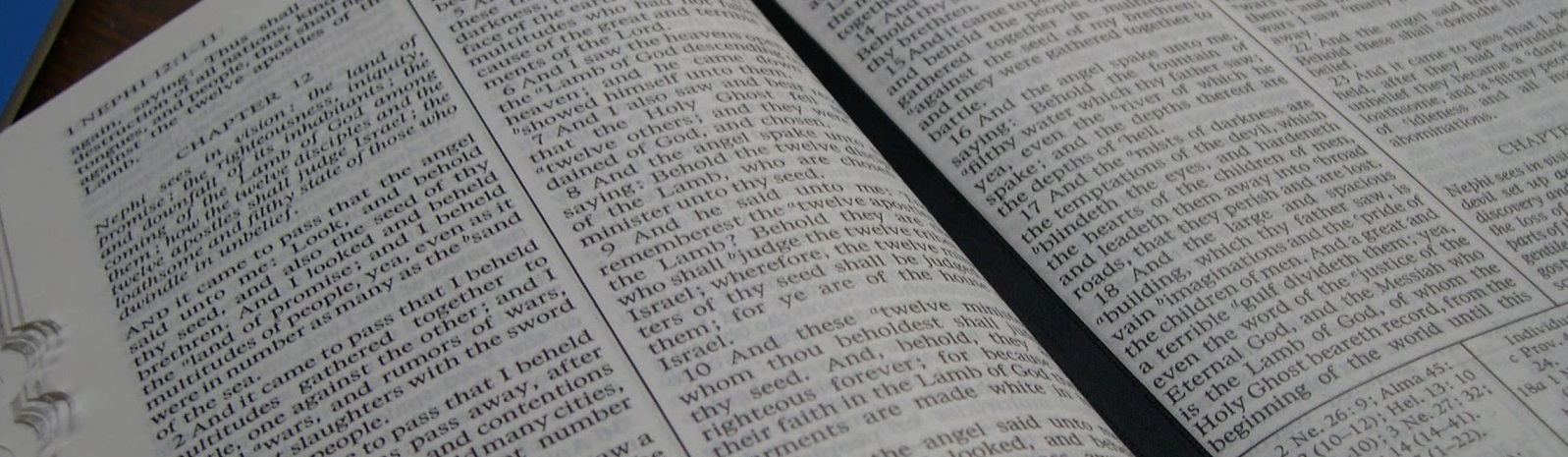
For verily, verily I say unto you, he that hath the spirit of contention is not of me, but is of the devil, who is the father of contention, and he stirreth up the hearts of men to contend with anger, one with another.

If all conflict is viewed as the functional equivalent of having the “spirit of contention,” what options are left to a person who disagrees, or sees things differently, or who has goals and interests different from the rest of the community? How can one raise objections or question and challenge others, or raise unpleasant topics, if doing so is tantamount to being in league with Beelzebub? If one’s view of all conflict is that it must be avoided so as to avoid contention, then there is no direct, healthy, constructive strategy available for resolving conflicts and disagreements.
(Michael J. Stevens, “Passive-aggression among the Latter-day Saints”, Sunstone magazine, April 12, 2013) 

Therefore, Christians that insensitively engage in overtly aggressive dogmatism on secondary or non-essential doctrines are unknowingly and needlessly “culture shocking” an immigrant who’s not equipped to emotionally process or intellectually understand the tank of “evil contention” that they’ve suddenly been dropped into. It doesn’t just make them uncomfortable, it freaks them out – we’ve seen it happen over and over and over again.

Are You Sure You’re Talking to the Right People?
Now if you’re a long term, full transitioned Ex-Mormon you may be wondering, “Why are you including us in this rant? Never Mormon Christians seems logical because they may not be able to empathize with transitioning Mormons having never been one. But I, on the other hand, was a transitioning Mormon back in the day – I get it!”

Unfortunately, our experience tells us that while long term Ex-Mormons may think that they “get it” in a lot of cases they’ve forgotten what it’s like to be tender, hurting, bleeding, broken, bitter, angry and confused after being leaving the Mormon Church. They’ve forgotten what it’s like to be an immigrant right off the boat.

In fact, we were shocked in the early days of our board to find out that some long term transitioned Ex-Mormons had the least amount of empathy for transitioning Mormons – they were our first, biggest problem group! And, nope, I’m not making this up – it’s all true folks.

So my dear Christians friends, if you really, really, really want to turn your transitioning Ex-Mormon friends into atheists, just keep it up! Fight, bicker, and spat over the smallest bits of theological and doctrinal lint you can find. Better yet, make sure you get incensed and indignant whenever an Arminian challenges your Calvinism, or an Ammillenialist questions your Rapturism. Swing those “convictions” like a sword, and never mind the collateral damage – as you watch the transitioning Mormons that you bump into while you’re tussling, fall into the nearest atheist pit.

Billy Sunday preaching 2- Internet ArchiveThe Solution
The solution is actually pretty simple:

  1. Maintain unity on the essential doctrines of the Christian faith.
  2. Extend liberty and grace on non-essential doctrines.

Or put another way:

“In essentials, unity;
In non-essentials, liberty;
In all things, charity.”
(17th century Theologian Rupertus Meldenius)

In terms of what determines what the essential doctrines of the Christian faith are, theologian Matt Slick, explains:

The Bible itself reveals those doctrines that are essential to the Christian faith. They are 1) the Deity of Christ, 2) Salvation by Grace, 3) Resurrection of Christ, 4) the gospel, and 5) monotheism. These are the doctrines the Bible says are necessary. Though there are many other important doctrines, these five are the ones that are declared by Scripture to be essential.
(Matt Slick, “Essential Doctrines of Christianity”, CARM website)

Again, the essential Doctrines of the Christian Faith are as follows:

1) The Deity of Jesus Christ.
2) Salvation by grace.
3) The resurrection of Jesus Christ.
4) The gospel of Jesus Christ, and
5) Monotheism.

A sampling of the non-essentials is as follows:

  • Eschatology (how and when the end times will unfold, the rapture, the millenium, the role of Israel today, etc.)
  • Earth Age (young v. old earth creationism, etc.)
  • Bible translation preferences (King James v. modern translations, word-for-word v. thought-for-thought, etc.)
  • Ecclesiology (church government models, the roles of clergy and laity, are Apostles and Prophets for today, etc.)
  • Soteriological Systems (Arminianism v. Calvinism, etc.)
  • Demonology (can a Christian have a demon or not, teachings on various kinds of spiritual warfare, etc.)
  • Sacrament practices (wine v. grape juice, leavened v. unleavened bread, who can administer, etc.)
  • Modes of baptism (sprinkling v. full immersion, infant baptism, etc.)
  • Worship styles (liturgical v. contemporary, hymns v. choruses, choirs, drums v. organs, etc.)
  • The gifts of the Holy Spirit (tongues v. no tongues, cessationism v. continuationism, etc.)
  • Worship observances (Sabbatarianism v. Sunday worship, observance of special holy days, tithing, etc.)
  • Food and drink (consumption of alcohol v. abstinence, kosher v. non-kosher food, etc.)
  • Various do’s and don’ts (tobacco consumption, playing cards, dancing, makeup, “acceptable” dress, movies, etc.)
  • Etc., etc., etc. This is far from an exhaustive or comprehensive list of Christian non-essentials – it seems endless at times!

Billy SundayHow You Say it Matters
So when you’re in the presence of transitioning Ex-Mormons on the non-essentials of the faith qualify your words. In other words, use terms like, “In my opinion”, “Speaking as a Presbyterian/Methodist/Episcopalian/etc. we believe”, “From my perspective”, “As I see it in the Bible”, etc.

Further, on the non-essentials of the faith do not use absolutisms such as: “The Bible says”; “The truth is”; “Reality is”; “All orthodox Christians believe”, etc. Further, responding, “that’s not Biblical”, while perfectly fine in Christianese, will usually cause a visceral reaction because in Mormonese it means, “Take that back or I’ll beat you up with scripture!”

Additionally, words such as cult, brainwashing, deception, etc. should never be used. Even though the transitioning Mormon has come out of the LdS Church and come to Christ, these are “hot button fightin’ words.” To them, “cult” really is a four letter word. You might as well have said, “Yo’ Momma!” Want to see a person transitioning out of Mormonism flee your support group at full speed and never look back? Just use the “c-word” friend.

Finally, on the essentials of the Christian faith, absolutisms are perfectly acceptable – even encouraged. For example, if a Christian couldn’t sincerely say the following, I would have serious doubts if they’re a Christian at all: “The truth, in reality is, that the Bible says – and all orthodox Christians believe – that Jesus Christ died on the cross, was buried in a rich man’s grave, and rose from the dead on the third day.”

Next, allow others to disagree with you. Extend charity to them even if, in your mind, they’re dead wrong.

And finally, if you still feel like you absolutely, positively must straighten the other person out after that you have the following options:

a) Private Message the person via email, the Facebook messaging system, etc. Or better yet, set up a telephone call or a face to face meeting. Who knows, you may end up with a friend if you do this.

b) Take the discussion to one of the many, many, many good theological discussion and debate groups on Facebook and the Internet.

Overall the biggest guideline is this:

If what you’re about to say won’t help an Ex-Mormon who’s transitioning into Biblical Christianity, then don’t say it in their presence. And, stated plainly brothers and sisters, Christian infighting never helps transitioning Ex-Mormons.

Or put another way: “Curb your dogma”

Billy Sunday preaching 3- Internet ArchiveYeah, we get it. We really, really do! 
In closing, please understand that the authors most certainly realize that just because something isn’t essential doesn’t make it unimportant. However, we have found that we Protestants are far too quick to try to turn non-essentials into essentials and then fight to the death over them. For example, is eschatology really worth dying on a hill over? After all and in the end, isn’t God going to do what God is going to do regardless of what you or I think, feel, and are convinced from scripture is going to happen? As Francis Schaeffer said so well all those many years ago:

“Among many of the youth, prophecy, rather than being a part of a larger whole of theology, has become the integration point of whatever theology they have. Eschatology has been blown out of proportion. Concentration on the second coming of Christ is falsely made an excuse for not accepting Christian responsibility for reformation in the church and in society. I hold very definite views on eschatology, but eschatology is not the integration point of my theology.”
(Francis A. Schaeffer V, “The Complete Works of Francis A. Schaeffer: A Christian view of Spirituality”, “The New Super Spirituality”, c.1972, pp.395-396)

Regardless of what non-essential doctrine that you and the authors may hold to, many Transitioning Ex-Mormons simply aren’t ready for the kind of theological nuance and rough and tumble discussions that established Christians feel so comfortable moving through and around in. So brother or sister in Christ, whatever it is, if it ain’t in the list of essential doctrines of the Christian Faith then please let it go – hold it in your hand loosely!

Again, Remember the Immigrants
Also, please remember that transitioning Ex-Mormons are like immigrants, they may not know our culture or speak our language. As a result some of their questions may come across as naive, ignorant, abrasive, even rude. And they most certainly aren’t going to speak the “Christianese” that you and I so take for granted that we don’t even realize that we speak it any more. They may also be projecting their inner pain, anger, bitterness, and frustration into the question without realizing it – we all do this from time to time, don’t we? Ex-Mormon Janis Hutchinson in her book, “Out of the Cults and Into the Church” quotes from a former cultist describing how painful this “migration” process can be:

Even now, I sometimes defend the cult! When I give our pastor and his wife a trying time, I say to myself, Myra, you’re completely hopeless. You’re not going to make it in this church! “When I become dogmatic and headstrong, I get angry with myself – especially when I know the pastor and his wife are only trying to help. Much more of this, I keep saying , and I doubt I’ll survive. But I suppose those working with me probably wonder if they’ll survive! I’m sure they must be disgusted with me. If they are, I think it’s because they just expect too much too soon.
(Janis Hutchinson, “Out of the Cults and Into the Church”, Kindle Locations 459-465)

So when you encounter such a question, comment, post, push back, or whatever from a transitioning Ex-Mormon we would ask you to take a deep breath, pray for wisdom and guidance, calm down and then respond in an even, non-threatening tone. In other words, be kind, gracious, and understanding rather than reactionary.

Finally, we know that you probably already know these Bible verses but we want to bring them to your attention again:

“Opponents must be gently instructed, in the hope that God will grant them repentance leading them to a knowledge of the truth.”
— 2 Timothy 2:25 (NIV)

“Let your conversation be always full of grace, seasoned with salt, so that you may know how to answer everyone.”
— Colossians 4:6 (NIV)

“But in your hearts revere Christ as Lord. Always be prepared to give an answer to everyone who asks you to give the reason for the hope that you have. But do this with gentleness and respect.”
— 1 Peter 3:15 (NIV)

And, as always, may God guide our conversation as we try with love, humility, and the fear of the Lord to aid our transitioning Ex-Mormons friends in their journey out of Mormonism and into mainstream Biblical Christianity.

Walt Kelly

Q: How did the Mormon land the Atheist pit?
A: He was bumped while two Christians were bickering over non-essentials.

RECOMMENDED RESOURCES
For further clarification on the essentials and non-essentials of the Christian faith we recommend the following resources:

Matt Slick, “Essential Doctrines of Christianity”, CARM website.

While Mr. Slick’s article is an excellent short vernacular primer, C. Michael Patton’s “Essentials and Non-Essentials in a Nutshell” article is the better resource for those seeking a fuller, more nuanced understanding of the subject.

Finally for those who find Mr. Slick’s outline format a bit too cryptic and Mr. Patton’s article too long should consider this short but insightful “What are the essentials of the Christian faith?” article on the “Got Questions?” website instead.

“A Bruised Reed” by R.C. Sproul (click link to watch streaming video)
This sermon by offers a fantastic perspective on finding that oh so elusive balance between truth, love, integrity, and tolerance. Christian brothers and sisters you I both appeal to you to and challenge you to listen to this amazing sermon. Here’s the description from the Ligonier website:

We don’t have to look beyond our own churches to see Christians fighting amongst themselves over all kinds of issues. What is the proper way to respond to Christian brothers and sisters when we are in disagreement with them? Should we treat everyone in the church the same? In this message entitled “A Bruised Reed,” Dr. Sproul teaches us about the judgement of charity as we seek to maintain peace and unity within the church.

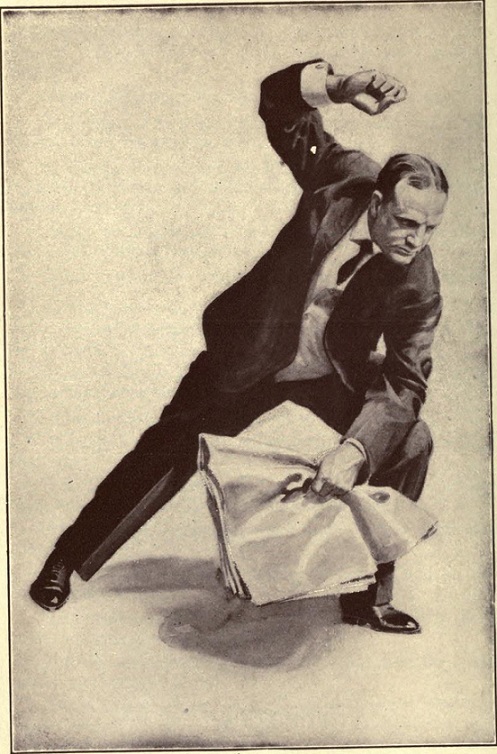
The authors are thankful for Wikipedia Commons and Internet Archive for the images of 20th early Century evangelist Billy Sunday preaching that appear throughout the first part of this article.

BACK TO TOP

A caution to transitioning Ex-Mormon Christians
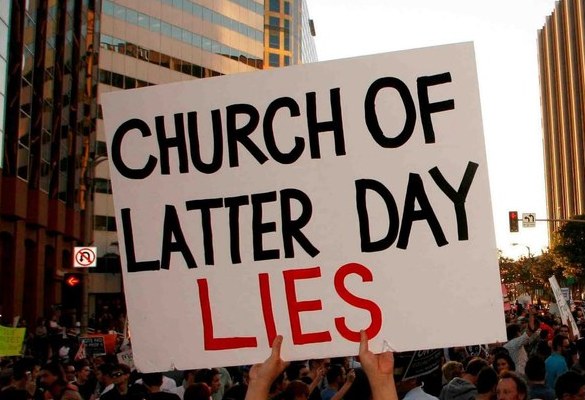
MormonProtest1

“If your true motivation is not simply hatred of Mormonism… then our plea is simple.”

by Jason Wallace, Pastor, Christ Presbyterian Church, Magna, Utah
Former Mormons recognize that religion doesn’t make someone a Christian. Mormonism may say nice things about Jesus, produce a great deal of sincerity, emotion, and activity, but it is a fraud. Mormons may quote the Bible, but they are selective in their use of it, touting what fits their personal preferences, while ignoring the parts that contradict them.

What many former Mormons don’t seem to recognize is that, in leaving Mormonism, many have embraced a faith that is simply another counterfeit of Biblical Christianity. Their religion may also produce great sincerity, emotion, and activity, but it is often just as selective in its use of the Bible. The gospel gets reduced to Ephesians 2:8-9 and a “personal relationship” with Jesus, that is divorced from the rest of the Bible. Like the Mormons, they bitterly resent anyone pointing them to the parts of the Bible that don’t fit their system and demonize those who challenge them to test their religion from God’s Word.

If your true motivation is not simply hatred of Mormonism, but a real love of Jesus Christ and the truth, then our plea is simple – – hear Jesus and His apostles. Jesus said,

Not every one that saith unto me, Lord, Lord, shall enter into the kingdom of heaven; but he that doeth the will of my Father which is in heaven. Many will say to me in that day, Lord, Lord, have we not prophesied in thy name? and in thy name have cast out devils? and in thy name done many wonderful works? And then will I profess unto them, I never knew you: depart from me, ye that work iniquity.”
— Matthew 7:21-23, KJV

Many Mormons claim that James 2 contradicts Paul in Ephesians 2. They see Paul teaching a “cheap grace” of faith without works. Rather than correcting the Mormon’s view of Ephesians 2, many former Mormons have embraced it and simply ignore what James said.

True conversion involves more than forgiveness of sins; it also involves being given a new heart and the Holy Spirit (Ezekiel 36:36). We are not saved by our works (Ephesians 2:8-9), but the new birth manifests itself in new life (Romans 6) and in good works (Ephesians 2:10). We are not saved by our works, but they are the fruit of the Spirit within converted Christians.

Jesus is saying in the Sermon on the Mount that many will go to the day of judgment, trusting in their religion and thinking they are right with Jesus, only to discover their religion was a fraud with which they not only fooled others, but also themselves. The Apostle Paul warns,

“Know ye not that the unrighteous shall not inherit the kingdom of God? Be not deceived: neither fornicators, nor idolaters, nor adulterers, nor effeminate, nor abusers of themselves with mankind, nor thieves, nor covetous, nor drunkards, nor revilers, nor extortioners, shall inherit the kingdom of God. And such were some of you: but ye are washed, but ye are sanctified, but ye are justified in the name of the Lord Jesus, and by the Spirit of our God.”
— 1 Corinthians 6:9-11, KJV

"True conversion involves more than forgiveness of sins; it also involves being given a new heart ..."

“True conversion involves more than forgiveness of sins; it also involves being given a new heart …”

Many former Mormons love to quote Paul saying we are no longer under law, but under grace. They use this passage as a club to bludgeon anyone who points out the totality of what Paul said. Jesus said that He never knew those who call Him Lord, but practice iniquity. Just as someone can say they love God and hate their brother (1 John 2:9), people can say they love God and practice iniquity, but both are lies. The Apostle John writes,

“And hereby we do know that we know him, if we keep his commandments. He that saith, I know him, and keepeth not his commandments, is a liar, and the truth is not in him. But whoso keepeth his word, in him verily is the love of God perfected: hereby know we that we are in him.”
— 1 John 2:3-5, KJV

Over and over, Jesus makes clear that the new birth involves more than mouthing the words to a prayer.

“For if ye forgive men their trespasses, your heavenly Father will also forgive you: but if ye forgive not men their trespasses, neither will your Father forgive your trespasses.”
— Matthew 6:14-15, KJV

“But whosoever shall deny me before men, him will I also deny before my Father which is in heaven. Think not that I am come to send peace on earth: I came not to send peace, but a sword. For I am come to set a man at variance against his father, and the daughter against her mother, and the daughter in law against her mother in law. And a man’s foes shall be they of his own household. He that loveth father or mother more than me is not worthy of me: and he that loveth son or daughter more than me is not worthy of me. And he that taketh not his cross, and followeth after me, is not worthy of me. He that findeth his life shall lose it: and he that loseth his life for my sake shall find it.”
— Matthew 10:33-39, KJV

“Moreover if thy brother shall trespass against thee, go and tell him his fault between thee and him alone: if he shall hear thee, thou hast gained thy brother. But if he will not hear thee, then take with thee one or two more, that in the mouth of two or three witnesses every word may be established. And if he shall neglect to hear them, tell it unto the church: but if he neglect to hear the church, let him be unto thee as an heathen man and a publican.”
— Matthew 18:15-17, KJV

Mormons can weep as they relate the burning in their bosom and other spiritual experiences, but the Bible shows that they are deceived and worshiping a false god and proclaiming a false gospel. Anti-Mormons can gush as they relate their spiritual experiences, but unless they line up with God’s Word, they are just another fraud.

Having been burned with the legalism and organizational oppression of Mormonism, many former Mormons have embraced a cheap grace that requires them to hear no church anywhere. They do not have to seek reconciliation with other believers (Matthew 18:15-17), and they submit to no elders (Hebrews 13:17).

“Many former Mormons have embraced a cheap grace that requires them to hear no church anywhere.”
Exhibit A: Ex-Mormon Shawn McCraney’s “Christian Anarchist” teachings.

These are not optional matters. Believers in the first century were baptized into a visible church, with real elders (Titus 1). It can be hard to overcome past abuse, but we are not given the option. Jesus asks,

“And why call ye me, Lord, Lord, and do not the things which I say?”
— Luke 6:46, KJV

If you refuse to hear the church, Christians are commanded to treat you as an unbeliever; we are to pray for you and be kind to you, but we are to call you to repentance and true faith. Those who pick and choose what they like from the Bible are not Christians. The Apostle John said,

“If we say that we have fellowship with him, and walk in darkness, we lie, and do not the truth:”
— 1 John 1:6, KJV

You may have left Mormonism, with its tithing, temples, and rules, but unless you embrace the Biblical gospel, you’ve simply repackaged the same false gospel in a more palatable form. There is a gospel that involves more than mouthing the words to a prayer and living like the world. It is not a gospel of grace plus works, but a grace that transforms – – the Biblical gospel of a real new birth, with a new heart and the giving of the Holy Spirit. We call you to the gospel in which Jesus nails not only our sinful record, but our stony heart and poisonous life to the cross – – a gospel in which we have his perfect record, loving heart, and Holy Spirit given to sinners like us.

When King Josiah heard the Word of God that had been neglected, he rent his clothes and repented (2 Kings 22). The answer to Phariseeism is not becoming a Saducee, but a Christian. Is the real problem with Mormonism its idolatry or just how it treated you? Will you substitute the Jesus of Joseph Smith with the real Jesus of the Bible, or just a counterfeit of your own imagination? Will you come to Jesus on His terms, or will you hear on the day of judgment, “I never knew you: depart from me, ye that work iniquity”?

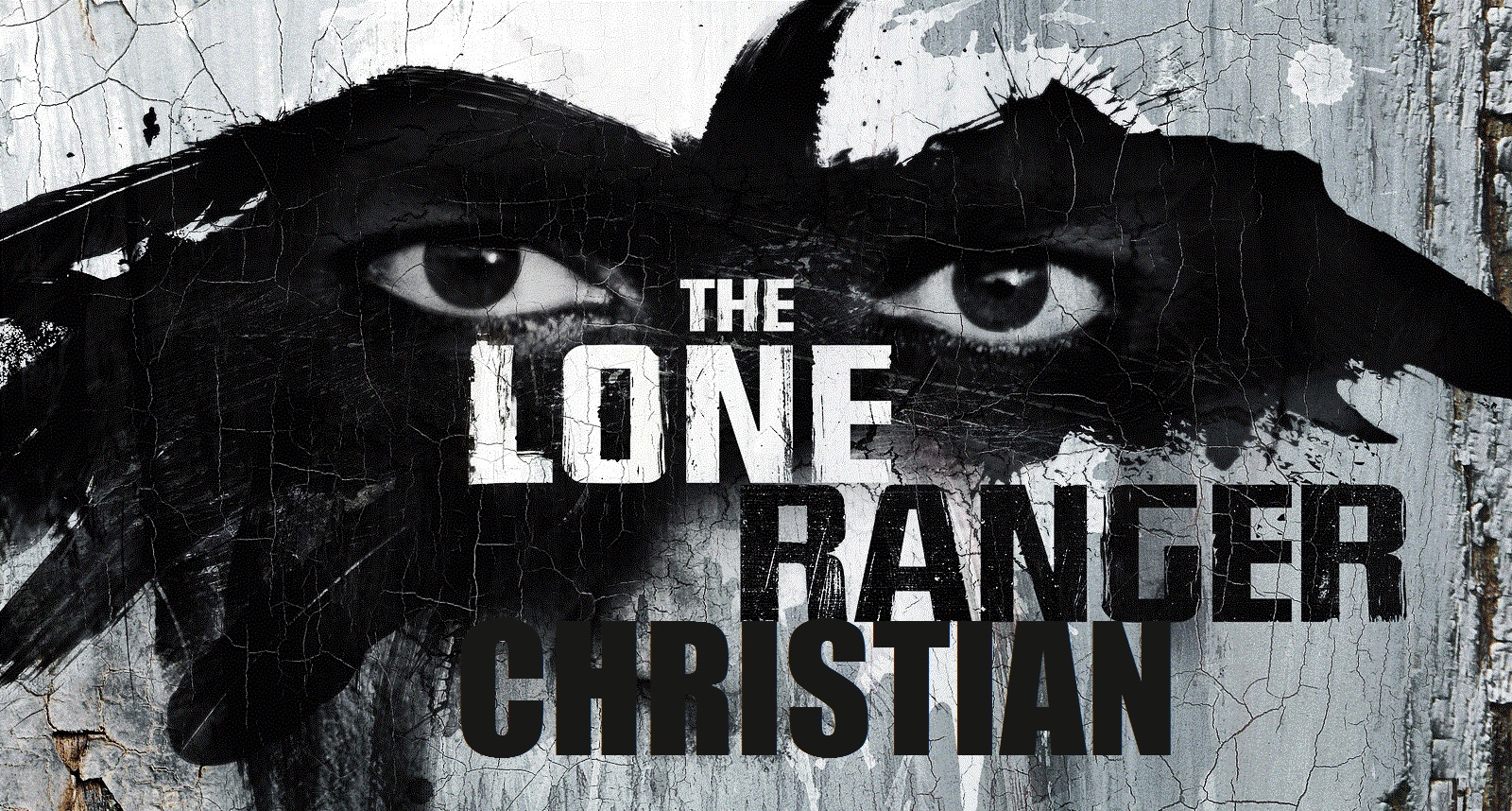
The-Lone-Ranger_EDITED

“Will you substitute the Jesus of Joseph Smith with the real Jesus of the Bible, or just a counterfeit of your own imagination?”

BACK TO TOP

church_sign-wideby Fred W. Anson
Since I’m known in most circles for my strong Reformed theological stance, a lot of people are surprised to discover that I’m also full blown, tongues speaking non-cessationist Charismatic.

There’s a reason for that: I’m embarrassed. Yes folks, I’m embarrassed by so much of the insanity that goes on among my Charismatic/Pentecostal Brethren these days that I find myself wanting to distance myself from a movement that I once was proudly part of. If anyone has any doubts about why, just pick the latest copy of Charisma Magazine skip the editorial content (which is generally written by sane, reasonable people), and read the ads (which in many cases seem to written by people who are neither).1 If that doesn’t convince you, just flip to the Trinity Broadcasting Network (aka “TBN”) on your television and try to last for more than about 15-minutes – them folks is all nuts from what I can tell!

Yes, the lack of biblical theological, sound doctrine, discernment, and good old common sense that some of today’s Pentecostals and Charismatics engage in is embarrassing folks, truly embarrassing – and I’m saying this as someone who’s part of the tribe! The term that we thinking Charismatics use for these lunatic fringe nutballs is “Charismaniacs” – and trust me, they have legitimately earned the title! In fact, a few have even go so far off the rails that they openly embrace – and even promote – Mormon error. Let’s look at a couple of these.

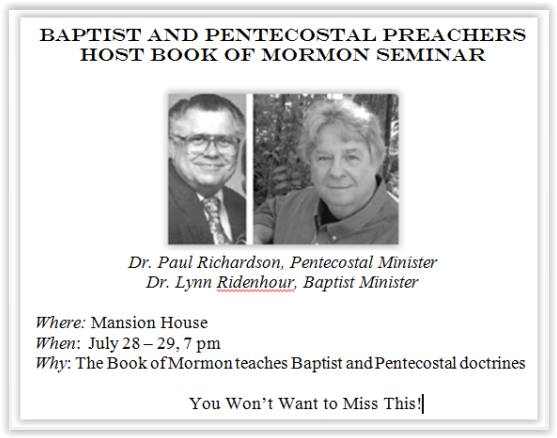
Paul Richardson and Lynn Ridenhour

Advertisement for a joint Paul Richardson, Lynn Ridenhour seminar. (click to zoom)

The Errors of Paul Richardson
In previous articles2 Beggar’s Bread readers were introduced to Dr. Lynn Ridenhour, an allegedly ordained Baptist Minister who has a testimony of Joseph Smith as prophet due to being introduced to the Book of Mormon by one of his Reorganized Church of Jesus Christ of Latter Day Saints (RLDS)/Community of Christ neighbors in Missouri. Dr. Ridenhour merited his own article because he’s the most notorious personality in this regard. In fact, it was through Lynn Ridenhour’s Facebook page that I discovered Dr. Paul Richardson, of whom he wrote:

MEET A DEAR FRIEND. Meet Dr. Paul Richardson, Pentecostal minister who loves and preaches out of the Book of Mormon. A few years back we hosted a Book of Mormon seminar in Independence. Two protestant preachers—a Baptist and a Pentecostal—preaching out of the Book of Mormon. I remember the night. The place was packed! We had an LDS Bishop there, missionaries were there. RLDS brothers and sisters were there. A Catholic priest came.

I consider Dr. Paul and his lovely wife, Faye, the dearest of friends. What a John the Baptist they are! Forerunners ahead of their time—spreading the good news of the restoration gospel and the message of the precious Book of Mormon throughout the southern states of this nation. Dr. Richardson publishes his monthly newspaper and mails it out to Pentecostals, mostly pastors all over southern United States. He also gives away free “Record of the Nephites,” as he calls the Book of Mormon.

Dr. Richardson is the chancellor of Spirit of Truth Institute, a Bible School. His school has ordained over 430 Pentecostal ministers. What a friend!3
Now it should probably be noted here that Dr. Ridenour actually transitioned from being a cessationist Baptist to continuationist Pentecostal during the Charismatic Renewal of the 1970’s. So if you attended that seminar what you really got, despite Lynn Ridenhour’s spin doctored rhetoric, was not one, but two Pentecostals who have fallen into Mormon error. And Dr. Ridenhour isn’t joking about any of the stuff he said about Paul Richardson, let’s consider some “gems” from his website:

El Greco, "The Pentecost"

“The Pentecost” by El Greco

OUR DISTINCTIVE STAND
We accept the Book of Mormon, which we also refer to as “The Record of the Nephites” or “The Nephite Record.” Why? Because …

  • It is a companion to and comparable to the traditional 66 books of our Holy Bible, as Sacred Writ
  • It is obviously inspired of God and from heaven.
  • It is in harmony with our Holy Bible, confirms and supports fundamental Christian teachings and is another powerful witness unto our Lord Jesus Christ.
  • It is a fascinating true account of ancient Israelites who migrated by ship to America about 600 B.C.
  • This authentic account was dug up, supernaturally translated by the power of the Holy Ghost, and first printed in 1830. Sadly, the Utah “Mormons” have made many little alterations in their version of it, but we still have copies that conform to the original manuscript.
  • It authoritatively corrects a number of old false teachings that have plagued the Church for generations.
  • It is theologically sound, full of spiritual light, and very edifying to the soul.
  • It is the first installment of much more extra-Biblical Revelation prophesied to come forth in this end time.4

And how does Paul Richardson support his claims that the Book of Mormon is an “authentic account”, “obviously inspired of God and from heaven”, and a “true account”? Archaeology? Science perhaps? Cross referencing the historic records? Evaluating the linguistics of the Book of Mormon relative to Native American linguistics maybe? Theological consensus perhaps?

Of course not! Rather, given the fact that it’s been soundly discredited archaeologically, scientifically, historically, linguistically, theologically, and just about every other way, he just does it the same way that all true believing Mormons do: He elevates his feelings and experience above all else. He simply ignores the fact that not only isn’t there a scrap of evidence to validate the Book of Mormon, there’s a mountain of evidence that discredits it. Here’s an example of the type of feellings driven, Mormon style, mental gymnastics that he engages in:

SOMEONE HAD TO WRITE THE BOOK OF MORMON
—It did not just drop down out of Heaven. There are only three possible origins: 1. God, 2. Man, or 3. the devil.

Joseph Smith, Jr. did not write the Book of Mormon. He only translated it. Then soon afterward his life became such a lie that the Book he translated was stigmatized causing the Christian church to rejected [sic] it.

What does the Book of Mormon do for me?
• Well, it inspires me to pray and to be loving and kind.
• It convicts me of any selfishness, fleshly disposition or worldly attitudes.
• It builds up my faith and gives me courage to trust the Lord.
• It puts me in a Heavenly frame of mind and kindles a strong desire in me to walk with God and to live holy for Him.

Each time you lay the Book of Mormon down and walk away, it feels just like you had a real good church service. Reading the Book of Mormon does all the same things for me as reading the Holy Bible does.5

But the fact of the matter is that objective evidence simply can’t be ignored. And if that evidence contradicts your emotional decision it still has to be dealt with somehow. Given that, consider how arbitrary and inconsistent he is in accepting the divine calling of Joseph Smith as inspired translator of the Book of Mormon while simultaneously throwing him under the bus as a fallen prophet:

Joseph Smith was a true prophet of God and a great Seer.

His gift was utterly supernatural!

He had an amazing gift from God to translate the ancient Nephite Record. His great contribution was incomparable, for which we are very grateful.

But not long after he translated the Book of Mormon, he clearly became deceived and misguided and no one should follow either his personal example or his false teachings, which clashed with both the Holy Bible and the Book of Mormon.

I prefer to follow the pure Word of God!6

Wiggin-Pentecost-smaller

“Pentecost” by Mark Wiggin

This is pretzel logic at it’s finest! This is like saying that Mohammed was a divinely inspired moralist when he received the Koran but lost the anointing when he started slaughtering infidels. Or that L. Ron Hubbard was an expert in human psychology when he wrote Dianetics but suddenly became a manipulative hack after it fell off the bestseller list. Neither narrative is true: The moral character of neither man changed before or after the these works were published, they remained the same. Likewise, the historical record demonstrates that Joseph Smith was a con-man and a shyster before, during, and after the creation of the Book of Mormon. In all cases, the only thing that really changed was the amount of power and influence that these men were able to consolidate to themselves as a result of the publication of their defining work. And once they had that power consolidation protecting them, their true nature manifested itself.

So apparently in Richardson’s mind the rationale goes something like this: “So what if Joseph Smith didn’t live a life that produced good fruit (per Matt 7:15-20)? So what if the rotten fruit he produced has resulted in a plethora of abusive Mind Control Cults that have followed him in engaging in the practice of polygamy? So what if he taught that the God of the Bible is just an exalted man who is just one of an infinite number of such gods throughout the cosmos (in violation of Deut 13:1-11)? So what if Joseph Smith destroyed fortunes and families through failed prophecies (in violation of Deut 18:18-22)? Brother, his book sure makes me feel like I’m in a really good church meeting when I read it, so it must be of God, right?”

Clearly Dr. Paul Richardson is failing to plumb line any of his beliefs against the absolute and objective standard of the Bible. I can say this emphatically because while the Book of Mormon is an interesting example of 19th Century American Protestant Restorationism, it simply isn’t fully “in harmony with our Holy Bible”. As Donna Morley noted in her analysis of similar claims by Lynn Ridenhour:

Here’s what Alma 13:13 actually says:

“And now, my brethren, I would that ye should humble yourselves before God, and bring forth fruit meet for repentance, that ye may also enter into that rest.”
(Alma 13:13, RLDS, bolding added)

Further, here’s something else Alma says in chapter 13:

“Now, as I said concerning the holy order, or this high priesthood, there were many who were ordained and became high priests of God; and it was on account of their exceeding faith and repentance, and their righteousness before God, they choosing to repent and work righteousness rather than to perish.”
(Alma 13:10, RLDS, bolding added)

In the above, Alma stated that the high priests escaped damnation only by working righteousness. The righteousness is credited as “their righteousness.” This isn’t the unconditional grace that’s taught in the Bible this is conditional grace where one must perform good works in order to merit grace rather than it being a unilateral gift of unmerited favor and mercy from God Himself!

True Christianity isn’t based upon our righteousness. The prophet Isaiah says that our righteousness is as “filthy rags” (Isaiah 64:6, NASB). Because we don’t have righteousness of our own, true followers of Christ are given His righteousness:

“But now apart from the Law the righteousness of God has been manifested, being witnessed by the Law and the Prophets, even the righteousness of God through faith in Jesus Christ for all those who believe.”
(Romans 3:22, NASB)

“He made Him who knew no sin to be sin on our behalf, so that we might become the righteousness of God in Him.”
(2 Corinthians 5:21, NASB)7

pentecost 2

“Pentecost 2” by William Grosvenor Congdon (1912-1998)

The Book of Mormon also contradicts with biblical theology on other key points as well. For example, it’s view of the Godhead is modalistic8 and it rejects salvation by grace alone through faith alone (that is unconditional grace) for Roman Catholic style conditional grace ( that is, salvation by grace plus works):

“For we labor diligently to write, to persuade our children, and also our brethren, to believe in Christ, and to be reconciled to God; for we know that it is by grace that we are saved, after all we can do.
(2 Nephi 25:23 LDS bolding added for emphasis)

This is in direct contradiction with the Bible:

“For it is by faith you are saved through faith, not that of yourselves it is the gift of God”
(Ephesians 2:8-9, NASB bolding added for emphasis)

“But if it is by grace, it is no longer on the basis of works, otherwise grace is no longer grace.”
(Romans 11:6, NASB)

So it’s clear that Dr. Paul Richardson is in very grave error. He isn’t following the “pure Word of God” at all. I would respectfully suggest that he reconsider his feelings regarding the Book of Mormon in light of what the pure Word of God actually says regarding using feelings as the ultimate means of discerning truth:

“The heart is deceitful above all things, and desperately wicked: who can know it?”
(Jeremiah 17:9, KJV)

“He that trusteth in his own heart is a fool: but whoso walketh wisely, he shall be delivered.”
(Proverbs 28:26, KJV)

Dr. Paul Richardson pitches the “Record of the Nephites” without explicitly stating that it’s the Book of Mormon.

The Errors of Cal Fullerton
While he’s not well known, probably the most interesting of the Charismatics who have been snared by the spirit of Mormonism is Cal Fullerton. Unlike Lynn Ridenhour and Paul Richardson, his justification for his stance isn’t quite as eye rollingly, face palmingly, ham fistedly inane, absurdist, and irrational. Rather, like non-Charismatic LdS Church advocates Richard J. Mouw and Roger E. Olson, he has been seduced into an odd form of theological liberalism and eyes wide shut ecumenicalism that’s rooted in feelings and experiences trumping both biblical orthodoxy and reality. One need go no further than the home page of his website to see this:

“Is the Church of Jesus Christ of Latter-day Saints (LDS) Christian?” This question and others about Christianity in the Mormon Church are reverberating worldwide.

The answers given are usually polarizing. Those who say no are primarily evangelical Christians. Those who say yes are primarily Mormons . . . but not all of them.

Respected evangelical leaders such as Joel Osteen have said yes.

The president of Fuller Theological Seminary, Dr. Richard Mouw, who has been recognized as an important voice among reform-oriented evangelicals, confessed that evangelicals have spread lies about LDS beliefs…

In order to do this completely and most effectively, there must be unity among us. Jesus prayed, “I have given them [my disciples] the glory that you gave me, that they may be one as we are one. . . . May they be brought to complete unity to let the world know that you sent me” (John 17:22-23 NIV).9

"Icon-Pentecost" by Phiddipus

“Icon-Pentecost” by Phiddipus

So there you have it, an Evangelical Scholar whose work in Mormon Studies has been discredited and denounced by recognized and respected Evangelical Mormon Studies Scholars (Richard J. Mouw)10 and an ear tickling heretic (Joel Osteen)!11 I mean if these guys say it’s true, then it must be – right? I mean, with “evangelical leaders” like this who needs wolves, we have them right in the flock!

But, wait it gets, even better: Though it’s rarely mentioned in public, Cal Fullerton also bases his stance regarding the LdS Church on a prophecy from an errant Charismatic prophetess. Here’s how he relayed this incident on a Mormon/Evangelical discussion board:

I heard the prophecy (not a dream or vision) by the prophetess long after the Word of God—printed & living—revealed to me God’s perspective on the LDS.

Incidentally, the prophetess fell short of saying the LDS is Christian and should be accepted into the Christian fold. Rather, she rebuked the church of Christ for pointing fingers at Mormons. At one point she yelled, “THROW DOWN YOUR STONES!” I liked it so much that I asked permission to use her prophecy in something I was writing. She denied permission, which is why, for the sake of integrity, I’m not mentioning her name now. (She is well known and highly respected among charismatics.)12

And there you have it – classic Charismaniac error. When push comes to shove, Biblical absolutes get shoved to the side and are subordinated to feelings and experiences. This theme can be found again, again, and again on Mr. Fullerton’s website. Again one need go no further than his home page:

Helen [Cal Fullerton’s wife] and I are not taking this stand because we have another opinion– opinions are already too easy to find–it’s because the Spirit of the living God has revealed it to us. Have you ever noticed that virtually all non-Mormons who say the Mormon Church isn’t Christian, don’t say that God told them so? The reason is He didn’t!13

So it came as no surprise to me when Mr. Fullerton offered the same, “Pray about it my friend” defense of the Mormon Church in the aforementioned online discussion that one would expect from a Mormon. Here was my response:

[Your challenge that I pray about the Mormon Church] deserves special, detailed attention. With this statement you have demonstrated WHY some Charismatics/Pentecostals and nearly all Latter-day Saints fall into error.

Cal, I don’t HAVE to pray about whether Mormonism is Christian anymore than I have to pray about whether I should lie, cheat, steal, or commit adultery. Nowhere in the Bible are we told to told to pray about Biblical absolutes.

Rather, for a true Christian the Bible is his/her absolute authority – not feelings, not experiences, not relationships, and not . . . whatever. And in this case Joseph Smith failed to pass every Biblical test for a true prophet and he passed every test for a false one:

1) Deceiving God’s covenant people into following another God. (Deu 13:1-11)
2) Giving future predictions that failed to come to pass. (Deu 18:18-22)
3) A life that produces bad fruit. (Mat 7:15-20)
4) Denying that Jesus Christ was God eternal incarnated in human flesh. (1 John 4:1-3)

In addition we can add:
5) Use of Occult practices like scrying and Shamanism.
6) Incorporating Freemasonry into the LDS Temple ceremonies.
(Freemasonry is rooted in Kabbalah which is occultic)

As I’m sure you know occult practices are soundly condemned throughout both the Old and New Testament so I won’t bore you and the other readers with a list of proof texts on this. In regard to Joseph Smith’s involvement with these practices here’s a good write up by former Mormon, Janis Hutchinson that ends with this closing statement: “No individual, knowing the truth about the Mormon Church’s occult background, could possibly follow Joseph Smith as a prophet or embrace his teachings.”
http://www.janishutchinson.com/joeoccult.html

So no Cal, there’s no need to pray about whether Mormonism is Christian anymore than I need to pray to determine if Branch Davidianism, Christian Spiritualism, Freemasonry, or Scientology are. Sure there are good, moral, admirable people in each of these religions but that doesn’t make them Christian any more than it makes their founders true prophets of the God of the Bible.

And, I must say it, suggesting that I – or any other Christian for that matter – disregard Biblical absolutes and pray about whether the false religion started and based on the teachings of the false prophet Joseph Smith simply demonstrates how flawed, errant, and unbiblical your theology has become.14

At this point, I’m not quite sure what to add in regard in regard the Errors of Cal Fullerton. One need only parse through his website to see error, after error, after error.

"Pentecost" (Unknown Artist)

“Pentecost” (Unknown Artist)

Good Theology? We Don’t Need No Stinkin’ Good Theology!
Lynn Ridenhour, Paul Richards, and Cal Fullerton represent the Charismaniac extremism that John MacArthur and his supporters pointed to with glee in their “Strange Fire” book and conferences in indicting Pentecostal/Charismatic Movement as a fountainhead of error. They’re easy targets since, unlike many Charismatics, they seem to lack any real theological depth. For example, consider this “gem” from Cal Fullerton:

It has been said that the Church of Jesus Christ of Latter-day Saints (LDS) is not a Christian organization because Mormonism denies one or more of the “essential” doctrines of the gospel. To determine if that statement is correct, we need to have a good grasp of what actually is essential. To correctly classify the LDS we need to be sure which doctrines of the Holy Bible are absolutely mandatory in order for someone to become a Christian and enter heaven. Roughly seventy percent of Mormon teachings agree with evangelical teachings. But that does not prove that the LDS is a Christian denomination. The tenets and members have to agree with the Bible’s essentials.

I have assembled these essentials into four.

Essential Number 1: Believe God Rewards…
Essential Number 2: Repent to Faith in Jesus…
Essential Number 3: Receive Jesus (the Holy Spirit) Into Your Heart (Be Born Again)…
Essential Number 4: Believe Jesus is the Son of God, the Christ…

According to the Bible, if the Church of Jesus Christ of Latter-day Saints teaches the four essentials I’ve listed above, we must classify it as a Christian denomination instead of an unchristian cult. That is because God has plainly promised that if you do the essential requirements I have outlined, he will accept you into his eternal family.

Back when I thought the Mormon Church wasn’t Christian, I didn’t pay much attention to whether each of their doctrines had to do with a mandatory requirement for entering heaven. That was one of the reasons I made a tragic mistake of judgment.15

I can hear the sound of palms hitting faces throughout cyberspace as those grounded in historic, biblical theology read that “masterpiece”. I know of no credible theologian who would accept that list as fundamentally sound criteria for soteriology, let alone mainstream Christian orthodoxy! He apparently has no clue that the Essential Doctrines of the Christian faith have recognized throughout Christian Church History as the following:16

"Pentecost 4" William Grosvenor Congdon (1912 - 1998)

“Pentecost 4” by William Grosvenor Congdon (1912 – 1998) (click to zoom)

The Essential Doctrines of the Christian Faith
1) The Deity of Jesus Christ.
2) Salvation by Grace.
3) The resurrection of Jesus Christ.
4) The gospel of Jesus Christ, and
5) Monotheism.

In the end Cal Fullerton only demonstrates his own ignorance and destroys his own case by doing a Mormon style “redefining the terms to fit the predetermined conclusion”. In fact, Mormonism doesn’t even get through the Judeo-Christian gate because of it’s rejection of monotheism in favor of henotheistic polytheism.

Likewise, as pointed out in a previous article, Lynn Ridenhour can’t even properly articulate the orthodox doctrine of the Trinity held by mainstream Christianity without speaking heretically. And he then one ups that heresy by concluding that Joseph Smith’s blasphemous tri-theistic view of the godhead is correct.17 Finally, as noted previously, Paul Richardson seems quite happy with the modalistic version of the Trinity presented in the Book of Mormon, as well as its denial of salvation by grace alone. Folks, if you’re looking for theological depth from these three, look elsewhere! The aforementioned John MacArthur could well have been writing specifically about them when he said:

We ought to begin with the Word of God, allowing a proper interpretation of the text to govern our experiences. A true work of the Spirit thrives on sound doctrine. It promotes biblical truth; it does not dismiss it or see it as a threat. Once experience is allowed to be the litmus test for truth, subjectivism becomes dominant and neither doctrine nor practice is defined by the divine standard of Scripture.

Charismatics downplay doctrine for the same reason they demean the Bible: they think any concern for timeless, objective truth stifles the work of the Spirit. They envision the Spirit’s ministry as something wholly free-flowing, infinitely pliable— so subjective as to defy definition. Creeds, confessions of faith, and systematic theology are seen as narrow, confining, not elastic enough for the Spirit to work within. Acknowledging this tendency within charismatic circles, one author wrote, “A college student once warned me of the ‘dangerous doctrine of demons’— his description of systematic theology. ‘The Lord has given us the Holy Spirit to interpret Scripture,’ he explained. ‘Teaching doctrine is Satan’s attempt to use our minds to understand the Bible rather than relying on the Holy Spirit.” (William E. Brown, “Making Sense of Your Faith”, Wheaton, IL: Victor, 1989, p.55)

That is a shocking statement. In reality, the only thing good theology stifles is error, which is why sound doctrine is the single greatest antidote to charismatic deviations. Remember, the Holy Spirit is the Spirit of truth (John 16: 13). Any work of His will elevate biblical truth and sound doctrine in the hearts and minds of His people.18

Pentecostal Charismaniacs: Mormons Gone Bad
But now it should be apparent that these men are more Mormon than Christian in their epistemology. This should come as no surprise since as noted in prior articles19 Mormonism was a byproduct of the same 19th Century American Restorationist Pentecostalism that birthed today’s modern Pentecostal and Charismatic Movements. That epistemology, in a nutshell, can be described thusly: Feelings, faith, facts – in that order. As Lutheran Pastor, Don Matzat (who has past involvement with the Charismatic Movement) observed well:

There is nothing wrong with Christians desiring feelings, emotions, and experience. In fact, the lack of any experience is in itself an experience. The lack of feeling is a feeling. The lack of emotion is an emotion. Any cursory reading of the New Testament demonstrates that love, joy, peace, hope, contentment are to be the Christian’s experience, feeling, and emotion…

Rather than coming against a feel-good faith, we should clearly teach that true Christian feelings, emotions, and Holy Spirit experience are the product of sound theology. Rather than confronting imbalance in the church by promoting the alternative and pushing the pendulum to the other side, we should begin with a balanced perspective which means recognizing that feelings will follow a faith that clings to the objective promises of God in Scripture. The person who believes and confesses that his sins are forgiven because Jesus died on the cross should feel guilt-free and experience the joy of having a cleansed conscience. Feelings and emotions. while not the cause of our faith, are the expression of our faith. Martin Luther writes, “We can mark our lack of faith by our lack of joy; for our joy must necessarily be as great as our faith.” Again he writes, “You have as much laughter as you have faith.” (Ewald Plass, What Luther Says, (St. Louis: Concordia Publishing House, 1959), Vol. 2, p. 692.)…

Hopefully the present conflict between sound doctrine and feel-good experience will lead to a balanced perspective on both sides. Those who minimize sound doctrine and promote feelings and experience must recognize that they are plotting a course for deception and disaster. Those who focus on sound doctrine must begin teaching people to apply those great truths of Scripture to their daily living so that the experience of God’s people matches what the Word of God commands.20

And Charisma magazine more directly and forcefully articulated the same sentiment in a web article by Joseph Mattera entitled, “10 Signs You Are a Charismaniac”. In fact, according to Mr. Mattera, this is the #1 characteristic of a Charismaniac:

1. You put prophecies and extra-biblical leadings on the same level as the written Word of God. Isaiah 8:20 says if we speak not according to the Scripture then we have no light. Second Timothy 3:16 teaches that all Scripture is inspired by God and profitable for teaching, reproof, correction and training in righteousness. The Scriptures are our rule for life and the highest standard for judging truth.

Unfortunately, some in the charismatic camp seem to be led more by personal prophecies and supernatural visions and dreams than by the Scriptures. I have known some people who would record personal prophecies by well-known “prophets” and—without praying about it or comparing it to Scripture or getting discerning counsel from more seasoned leaders in the kingdom—would just obey the prophecy as if it were as inspired as the Bible.21

Jean_II_Restout_-_Pentecôte

“Pentecost” by Jean II Restout, (c.1732)

In other words, biblical epistemology is facts, faith, feelings – in that order. To see the contrast, just consider Paul Richardson’s “evidence” that the Book of Mormon must be true because, “Each time you lay the Book of Mormon down and walk away, it feels just like you had a real good church service.”22 Now compare this to his lack of any acknowledgement that the Book of Mormon does in fact contradict both the Bible and Christian orthodoxy. When you take that and then factor in the reality that there is absolutely no empirical evidence to support the historicity of the Book of Mormon – a glaring omission that somehow fails to be addressed on his website or in any of his articles – the work’s rejection as holy writ should be fait accompli. Instead, again, again, and again in his articles Mr. Richardson endorses the book as scripture equivalent to scripture based on subjective analysis that’s devoid of any objective evidence. As I said to Cal Fullerton regarding this same kind of lack of discernment and failure to plumb line such impressions against objective evidence:

I, a fellow Charismatic who believes in modern prophetic utterances and the other gifts of the Spirit say to you now as I did back on the [now defunct] Concerned Christians board [in 2010]: I don’t care WHO that prophetess was, I could care less what her reputation is among Charismatics or anyone else for matter, she gave a false prophecy – period.

When plumblined against the Bible it was a false prophecy. Period.

And most distressingly she validated a false prophet and a heretical non-Christian group in the name of (and allegedly in the voice of) God. She is, therefore, a false prophet and a deceiver. Period.23

This blatant disregard of objectivity (especially biblical objectivity) over personal subjectivity is very Mormon isn’t it? In fact, Chuck Smith, the founder of Calvary Chapel and a Charismatic with Pentecostal roots, could have been describing these men when he wrote:

It is of utmost importance that we allow the Bible to be the final authority for our faith and practice. Any time we begin to allow experiences to become the criteria for doctrine or belief, we have lost biblical authority, and the inevitable result is confusion. There are so many people today who witness of remarkable and exciting experiences. The Mormons, for example, “bear witness” to the experience of the truth of the Book of Mormon. They encourage people to pray in order to experience whether or not their Book of Mormon is true. One person says he has experienced that it is true, and another says he has experienced that it is false. Which one am I to believe? Each swears he has had a true experience from God; yet one has to be wrong. Whenever you open the door for experience to become the foundation or criterion for doctrinal truth, you are opening a Pandora’s box. The result is that the truth is lost in the conflicting experiences, and the inevitable consequence is total confusion. We know that God is not the Author of confusion.24

Further, didn’t Christ stress the importance of evidence throughout His sermons? And could Paul have been any clearer when he said that if our Christianity isn’t empirically true then “we are of all men the most pitiable”?

If Christ is not risen, then our preaching is empty and your faith is also empty. Yes, and we are found false witnesses of God, because we have testified of God that He raised up Christ, whom He did not raise up—if in fact the dead do not rise. For if the dead do not rise, then Christ is not risen. And if Christ is not risen, your faith is futile; you are still in your sins! Then also those who have fallen asleep in Christ have perished. If in this life only we have hope in Christ, we are of all men the most pitiable.
(1 Corinthians 15:14-19, NKJV)

In summary and conclusion, this unbiblical, feeling affirming, evidence denying pattern can be seen plainly in the writings and public instruction of all three men – again, one need only spend some “quality time” on their websites to see this clearly. By embracing false scripture from a False Prophet – and even worse, encouraging others to do the same – these men have become false teachers themselves. And the Bible was quite clear what God’s people are to do when we encounter a false teacher, false prophet, false apostle, or false anything for that matter:

You shall not listen to the words of that prophet or that dreamer of dreams, for the Lord your God is testing you to know whether you love the Lord your God with all your heart and with all your soul. You shall walk after the Lord your God and fear Him, and keep His commandments and obey His voice; you shall serve Him and hold fast to Him.
(Deuteronomy 13:3&4, NKJV) bolding added for emphasis

pentecost

A primitive fresco of Pentecost.

NOTES
1 Full disclosure and clarification: I worked as a Music Reviewer for “Worship Leader Magazine”, which is also owned by Strang Publications, the publisher of Charisma Magazine, from 1992-1993. During that time I found John Strang and his staff to be reasonable, personable, and theologically sound. I think that’s why you will find the editorial content of Charisma Magazine to be generally sound.

That’s why I’ve specifically recommended that you just view the advertisements in the magazine instead – they’re an unvetted, raw picture of the current state of the Pentecostal/Charismatic Church at the grassroots level and, frankly, it’s scary. Whenever someone asks (or challenges) me about my (admittedly blunt) assessment of the modern Pentecostal/Charismatic Movement I just point them to there. After seeing them, nothing else need be said. For example, let’s look at a couple of them from the December 2015 issue of Charisma magazine:

“Blood Moons are not about the end – they are about the beginning.

For over 3,000 years God has used the blood moon tetrads on His feast days of Passover and Tabernacles as a sign of special revival coming to His people. The last great blood moon revival came in 1967, when God poured out His Spirit to begin the charismatic renewal. Today there are over 600 million charismatic Christians who are the fruit of this revival, including most of the readers of this magazine.

The blood moon tetrad of 2014-2015 occurred in troubled time, as have most the previous 14 blood moon tetrads. Yet we can see the beginning of a new revival coming based on unity in Christ in answer to Jesus’ prayer in John 17. Don’t miss it!

we invite you to study the Scriptures, the heavenly signs, and the history of the blood moon tetrads in our new book . . . ”
(Charisma, December 2015, p.9)

But, wait folks, if blood moons aren’t enough, there’s more! Consider this “gem”:

“Discouraged?
Need a miracle?
Lack the faith to believe?
Desire to be empowered to heal?

– Receive step by step Biblical Instruction to activate God’s healing power in your life.
-Be encouraged as you read the amazing testimonies that are in this book.

Afraid?
Feel defeated?

– Tap into the supernatural potential of your faith.
– Unleash the power of God.
– Experience the impossible.
– Overcome in these Last Days.
(Charisma, December 2015, p. 15)

Even more disturbing are the titles and subtitles of the latter books being advertised in the second advertisement: “Dare to Believe: The True Power of Faith to Walk in Divine Healing and Miracles” and “Greater Than Magic: The Supernatural Power of Faith”. Apparently, the Bible isn’t enough any more, now we need the equivalent of “How To” Charismatic cookbooks and computer manuals! Further, if one didn’t know in advance one might even assume from the title alone that these are books from pagans on how to cast spells or channel metaphysical powers and forces. Yet there they are, being advertised in the flagship periodical of American Pentecostals and Charismatics! And not only does no one seem to care, but judging by the reviews of these books on Amazon, my Pentecostal and Charismatic brothers and sisters seem to be delighted by it! It is any wonder that prudent and conservative continuationists distance themselves from such things?

My dear Pentecostal and Charismatic brothers and sisters we can do better than this! Brothers and sisters we must do better than this in the Name of, and for the cause of, Christ alone!

2 See “The Errors of Dr. Lynn Ridenhour” and “Weak Arguments #7: ‘The Book of Mormon doesn’t have a trace of orthodox, mainstream Biblical Christianity in it.’” in particular.

3 Lynn Ridenhour, Facebook post October 20, 2014

4 Paul Richardson, “Our Distinctive Stand”; “The Full Revelation Believers” website (now archived). The reader may also be interested in reading Dr. Richardson’s biography (which for or some unknown reason he calls a “News Release”) by clicking here.

5 Paul Richardson, “Someone Had To Write The Book of Mormon”; “The Full Revelation Believers” website (now archived).

6 Paul Richardson, “The Charm of Joseph Smith”; “The Full Revelation Believers” website (now archived).

7 Donna Morley, “The Errors of Dr. Lynn Ridenhour, Appendix: Is the Book of Mormon Really “Baptist”?”

8 See Ronald V. Huggins, B.F.A., Th.D., “Joseph Smith’s Modalism: Sabellian Sequentialism or Swedenborgian Expansionism?”; Also see Bill McKeever, “Modalism in the Book of Mormon”.

9 Cal Fullerton, “Evangelicals and Mormons for Jesus” home page. Bolding retained from original.

And in accordance with the usage guidelines of that website we post the following: “Copyright © 2008 Cal Fullerton. Permission is granted, and you are encouraged, to print the above article in hard copy form, as well as send it to your own email lists and post it on your own websites. We only ask that you include the name of the originating website (EvangelicalsandMormonsforJesus.com) and this copyright and permission notice.”

10 Please see the Evangelical Ministries to New Religions “Statement On Richard Mouw And Evangelical Countercult Ministries”; And for a good analysis and deconstruction of Richard J. Mouw’s claim that Evangelical Christians have lied about and misrepresented the Mormon Church see Fred W. Anson, “Scolasticus cum Peter Principle”; Also recommended: Mike Thomas, “That Apology and How Liberal Theolgians “Go Native”’, and; Fred W. Anson, “Apologizing For Richard J. Mouw”.

11 See Matt Walsh, “Joel Osteen and his Wife are Heretics, and that’s why America Loves Them”; Also see “Joel Osteen-Preaching a False-Positive, with a Smile”.

12 Cal Fullerton comment, September 18, 2013 at 3:40 pm on the article “Turns out, the Bible says that Protestants should unite with Mormons” by Jared C. on the LDS and Evangelical Conversations website.

13 Op Cit, Fullerton, “Evangelicals and Mormons for Jesus” home page.

And by the way, and for the record Mr. Fullerton, there are thousands of Christians who can subjectively claim that the Mormon Church is neither true or Christian because God told them so. I’m one of them:

I would like to bear my testimony . . .
I have diligently sought God regarding whether the Church of Jesus Christ of Latter Day Saints is true or not. To that end, I have studied the Bible as well as the Book of Mormon and I have prayed consistently for over 30-years. I have taken the “Moroni 10 Challenge” and I have felt an intense “burning in my bosom” many, many, many times in my life — in fact, I carry it with me everyday of my life.

… and my testimony is this:
I am utterly convinced that the Church of Jesus Christ of Latter Day Saints is a non-Christian cult, that Joseph Smith was a false prophet, as is Thomas S. Monson. Further, I am utterly convinced that the Book of Mormon is an uninspired, man created work of 19th Century fiction.

Here I stand before God and before men – I can do no other.

In the Name of Jesus Christ, our Lord and Savior, amen.

And if my testimony isn’t enough, I can provide similar testimony from other Christians with little to no effort at all. Further Mr. Fullerton, please note that -unlike your testimony of the LdS Church – the body of objective evidence, including the bible itself, supports and verifies our subjective testimony. So in the end where has all this subjective testimony bearing of contrary positions gotten either of us? Answer: Absolutely nowhere.

What I have said to countless Mormons, I will now say to Misters Ridenhour, Richardson, and Fullerton: That Mormon testimony of yours plus a buck fifty will get you a cup of coffee at Denny’s and that’s about it! And what’s true for you is just as true for my contra-Mormon testimony: Testimony bearing in and of itself proves nothing. Rather, let’s see the objective evidence that supports and verifies it – because in the end that’s all that really matters.

14 Fred W. Anson reply to Cal Fullerton, September 18, 2013 at 11:01 pm; Op Cit, Jared C., “Turns out, the Bible says that Protestants should unite with Mormons”.

15 Cal Fullerton, “Essentials for Salvation”“Evangelicals and Mormons for Jesus” website. Bolding from original retained.

16 See Matt Slick, “Essential Doctrines of Christianity”, CARM website. While Mr. Slick’s article is an excellent short vernacular primer, C. Michael Patton’s “Essentials and Non-Essentials in a Nutshell” article is the better resource for those seeking a fuller, more nuanced understanding of the subject. Finally for those who find Mr. Slick’s outline format a bit too cryptic and Mr. Patton’s article too long should consider the short but insightful “What are the essentials of the Christian faith?” article on the “Got Questions?” website instead.

17 In his article, “God of the Philosophers: Brief Comments on the Godhead” (now archived) Lynn Ridenhour writes:

“The God of the Trinity wallows in modalism, stumbling to give its advice to new converts. Listen to Cyril of Jerusalem:

“…For there is one Salvation, one Power, one Faith; One God, the Father; One Lord, His only-begotten Son; One Holy Ghost; the Comforter. And it is enough for us to know these things; but inquire not curiously into His nature or substance: for had it been written, we would have spoken of it; what is not written, let us not venture on; it is sufficient for our salvation to know, that there is Father, and Son, and Holy Ghost.” –Catechetical Lectures 16:24

Enough.

What kind of Being is God?

Let Joseph answer. The Prophet preached that “…if you were to see [God] today, you would see him like a man in form,” and that “the Father has a body of flesh and bones as tangible as a man’s; the Son also; but the Holy Ghost has not a body of flesh and bones, but is a personage of Spirit” (D&C 130:22).

As I said in the beginning, this may be old hat to most, and not unlike the tour guide, some may be tempted to say “…O, we see it all the time…” and walk away, but for me—it’s like seeing the Niagara Falls for the very first time.”

In case you didn’t notice that a heretical definition of the Trinity followed by an endorsement of Joseph Smith’s blasphemous tri-theistic view of the godhead.

18 John F. MacArthur, “Strange Fire: The Danger of Offending the Holy Spirit with Counterfeit Worship” (pp. 73-74) Kindle Edition.

I would ask the reader to note that while I find much to soundly applaud in this work, overall I was disappointed by John MacArthur’s extremist stances, exaggerations, misrepresentations and generally ungracious, polemic attitude in both this book and the conferences that preceded it. Perhaps Dr. Timothy George, Dean of Beeson Divinity School of Samford University and general editor of the “Reformation Commentary on Scripture” as well as several other books said it best when he wrote:

“Within the worldwide charismatic movement, there are no doubt instances of weird, inappropriate, and outrageous phenomena, perhaps including some of the things MacArthur saw on TBN. Many Pentecostal leaders themselves acknowledge as much. But to discredit the entire charismatic movement as demon-inspired because of the frenzied excess into which some of its members have fallen is both myopic and irresponsible. It would be like condemning the entire Catholic Church because some of its priests are proven pedophiles, or like smearing all Baptist Christians because of the antics of the Westboro Baptist Church.

When told that his all-charismatics-are-outside-the-pale approach was damaging the Body of Christ because he was attacking his brothers and sisters in the Lord, MacArthur responded that he “wished he could affirm that.” This is a new version of extra ecclesiam nulla salus—except that the ecclesia here is not the one, holy, catholic, and apostolic church but rather an exclusively non-charismatic one.”
(Timothy George, “Strange Friendly Fire”, First Things, November 4, 2013)

I also agree with Reformed Theologian John Piper who wrote:

‘On each point, it is surely misguided to single out charismatics, says Piper. “Charismatic doctrinal abuses, emotional abuses, discernment abuses, financial abuses, all have their mirror image in non-charismatic churches.” Of charismatics and non-charismatics alike, “we all stand under the word of God and we all need repentance.”

But those charismatic abuses remain. So how are these excesses best policed? How are Christians today protected from the abuses of the charismatic church? Is it through attack-centered books and conferences?

“I don’t go on a warpath against charismatics. I go on a crusade to spread truth. I am spreading gospel-centered, Christ-exalting, Bible-saturated, Calvinistic truth everywhere, and I am going to push it into the face of every charismatic I can find, because what I believe, if they embrace the biblical system of doctrine that is really there, it will bring all of their experiences into the right orbit around the sun of this truth.”’
(John Piper, “Piper Addresses Strange Fire and Charismatic Chaos”, Desiring God website)

I’m trying hard in this article to tread a fine line between being too polemic and too tolerant regarding Charismatic practices that I consider imbalanced or outright unbiblical. I will leave it to the reader’s judgment to determine if I’ve succeeded or not.

19 See Fred W. Anson, “Mormons: Pentecostals Gone Bad”“Mormons: Pentecostals Gone Bad [The Sequel]”; Also see John Farkas, “Speaking in Tongues and The Mormon Church”.

20 Don Matzat, “Feelings, Emotions and Christian Truth”

21 Bishop Joseph Mattera, “10 Signs You Are a Charismaniac”, Charisma magazine’s “Charisma News” website. Bolding from original retained.

22 Paul Richardson, “Someone Had to Write The Book of Mormon”.

23 Fred W. Anson reply to Cal Fullerton, September 18, 2013 at 6:04 pm; Op Cit, Jared C., “Turns out, the Bible says that Protestants should unite with Mormons”.

24 Chuck Smith, “Charisma Versus Charismania”, Kindle Locations 1282-1289.

The Bible

“Study to shew thyself approved unto God, a workman that needeth not to be ashamed, rightly dividing the word of truth.”
(2 Timothy 2:1, KJV)

BACK TO TOP

what-is-the-gospel1_edited
“Beer is made by men, wine by God.”
― Martin Luther

by Marie Johnson
The Book of Mormon claims to be, “Another Testament of Jesus Christ” but when it is put to the test, the gospel it embodies is nothing more than a man made concoction of of law mixed with grace; a tainted gospel that is condemned by the Apostle Paul.

In Galatians 5:4 (AKJV) Paul writes, “Christ is become of no effect unto you, whosoever of you are justified by the law; you are fallen from grace.” He reiterates his point in Romans 4:13-14 (KJV), “For the promise, that he should be the heir of the world, was not to Abraham, or to his seed, through the law, but through the righteousness of faith. For if they which are of the law be heirs, faith is made void, and the promise made of none effect.”

The Bible teaches that before, during and after God made covenants with Israel, people were counted righteous by believing the promises of God (Romans 4); not by obedience to the the law of Moses (Romans 3:20). In the book of Hebrews we read that, prior to Christ, God’s people looked forward to the promise of a heavenly city; the Old Testament version of eternal life (Hebrews 11:9-16). In addition to God’s promise of a heavenly city, the Messiah and the New Covenant were also promised (Galatians 3:8, Hebrews 8:6-13). The people of God who lived before Christ were still living by faith when they died. They did not receive the things promised; they only saw them and welcomed them from a distance (Hebrews 11:1, 13-16, 39).

The Old Covenant sacerdotal system, which came 430 years after God made his promises to Abraham (Genesis 12: 1-3) was never designed to give eternal life. Its purpose was to act as a tutor and a disciplinarian; teaching people about the depths of their sinfulness. As their custodian, it watched over them and keep them in check until the fullness of time came and they could be justified by faith in Jesus (Galatians 3:19-24). Just as the promise was not the reality, the sacrifices of the Mosaic covenant were only a foreshadow of the good things that were coming in Christ (Hebrew 10:1-2).

Inaugurated with the shed blood of animals, the Mosaic covenant had a very distinct beginning. When Moses took the blood of calves and goats and sprinkled the book of the covenant and all the the people, the Israelites were bound to abide by the law of Moses (Exodus 24:8, Hebrews 9:19). They were required to continually perform sacrifices for the temporary covering of sins (Hebrews 10:11). If they intentionally defied the Mosaic law, they would be cut off from Israel; that is, put to death (Numbers 15:30, Hebrews 10:28). No Hebrew was exempt from this obligation to the law until, “the fulness of the time was come, [when] God sent forth his Son, made of a woman, made under the law, to redeem them that were under the law, that we might receive the adoption of sons (Galatians 4:4-5,KJV).

download
Because Jesus redeemed those under the law, the Old Covenant became obsolete when the New Covenant was ratified in his blood. (Hebrews 8:13, 10:9-10). Jesus addressed this in the parable of the wineskins. New wine can’t be poured into old wineskins: The old skins will burst and both will be ruined. (Matthew 9:14-17). The two covenants can’t be mixed.

In spite of Paul and Jesus’ teaching, the Book of Mormon asserts that people who were under Old Covenant law could freely partake of the New Covenant and claim remission of sins through Jesus’ atonement. One example can be found in the introduction to 2 Nephi 25, “The Nephites keep the law of Moses and believe in Christ, who is the Holy One of Israel. About 559–545 B.C. [about 575-580 years before the New Covenant existed].”

BYU Professor Noel B. Reynolds gives a nice summary of this teaching explaining how it is found throughout the Book of Mormon (emphasis mine):

Because of the great visions and revelations he rebloodd, Nephi shared a role with his father as a founding prophet. At a young age he was inspired by the Holy Spirit and believed his father’s words. He heard the voice of the Lord telling him that he would become a ruler and teacher over his brothers (1 Ne. 2:22). He witnessed the vision of the tree of life shown earlier to his father (1 Ne. 8), which showed him the future birth, baptism, and ministry of Jesus Christ, as well as the future rise and demise of his own people. He was shown also the future establishment of the Gentiles in the Western Hemisphere and the restoration of the gospel in their midst (1 Ne. 11-14). Because of these revelations, Nephi was able to teach his people the gospel or “doctrine of Christ”-the means by which they could come unto Christ and be saved (2 Ne. 30:5; 31:2-32:6). His carefully formulated teaching of this doctrine provided a model that other Nephite prophets invoked repeatedly (see Gospel of Jesus Christ).

Because the Nephites had received the fullness of the Gospel of Jesus Christ, their strict observance of the law of Moses was oriented toward its ultimate fulfillment in Jesus, and Nephi explained to his people that they should observe the law of Moses as a means of keeping Christ’s future atonement always in their minds (2 Ne. 25:29-30). The law itself had become “dead”to those who were “made alive in Christ” and who knew that Jesus was the one to whom they could look dirctly for “remission of thier sins” (2 Ne. 25:25-27).”
(Reynolds, Noel B., “Nephi 1”, The Encyclopedia of Mormonism)

Here is another example from Mosiah 3:13-16, 28 where, “strict observance of the law of Moses” is taught (that is the Old Covenant) while a direct appeal is made to the atonement of Christ for the remission of sins (which is the New Covenant):

“And the Lord God hath sent his holy prophets among all the children of men, to declare these things to every kindred, nation, and tongue, that thereby whosoever should believe that Christ should come, the same might receive remission of sins, and rejoice with exceedingly great joy, even as though he had already come among them…and yet they hardened their hearts, and understood not that the The law of Moses availath nothing except it were through his atonement. And even if it were possible that little children could sin they could not be saved; but I say unto you they are blessed; for behold, as in Adam, or by nature, they fall, even so the blood of Christ atoneth for their sins…. And moreover, I say unto you, that salvation doth not come by the law alone; and were it not for the atonement, which God himself shall make for the sins and iniquities of his people, that they must unavoidably perish, notwithstanding the law of Moses.”

“King Solomon Dedicates the Temple” by or in the style of James Tissot (c.1896–1902)

Splattered throughout the pages of the Book of Mormon, this concocted gospel attempts to mix the Old and New Covenants, only to rip apart the fabric of the Old Covenant and trample underfoot the New Covenant.

The Old Covenant was bound together and structured around the temple, the priests and the sacrifices. It was inaugurated in and kept by the blood of animals. Before the High Priest could enter God’s presence (The Most Holy Place in the temple), the blood of animals had to be spilled as a sin offering. If the High Priest had tried to enter the Most Holy Place without first making a sin offering, if he tried to enter by promising a future animal sacrifice and not by the literal shedding of animal blood, he would have died. (Leviticus 16:2-3).

The New Covenant was also inaugurated in and kept by blood; the blood of Jesus (Mark 14:24). Just as no one could enter into the Old Covenant without the literal shedding of animal blood, no one could enter into the New Covenant and gain the blessings of the atonement without the literal shedding of Jesus’ blood (Hebrews 9:16-28).

However, as seen in Mosiah 3:16 above, The Book of Mormon teaches that, before Jesus died, the, “blood of Christ atoneth for their sins“ and the children of men received, “remission of sins,… even as though he had already come among them.” This was impossible. For, as the writer of Hebrews explains, “without shedding of blood, there is no remission [of sin].” (Hebrews 9:22, KJV) 

Claiming to receive remission of sins based on blood which had not been shed, makes Jesus’ death into nothing more than a token or a symbol. Remission of sins and the gift of eternal life are not given through tokens or symbols. They are given based on the reality of a vital union with the one who shed his blood and died to take away our sins; the one and who is eternal life (1 John 1:2, 3:5, 5:9-12).

The claim that Nephi was given a revelation about Jesus Christ does not change how the covenants were ratified. The terms of ratifying the New Covenant were not, “Nephi will receive a vision about the restoration of the gospel” or “Nephi will be able to teach his people of the ‘Doctrine of Christ’.” The New Covenant came into effect only when Jesus was dead. (Hebrews 9:15-17).

In Alma 22:14, the missionary Aaron preaches the the gospel of The Book of Mormon to King Lamoni’s father and tells him, “…the sufferings and death of Christ atone for their [fallen men’s] sins, through faith and repentance, and so forth..” In response, King Lamoni’s father asks, what he should do that he might have eternal life, be born of God and receive [God’s] spirit (All blessings of the New Covenant. They were not available under the Old Covenant. See eternal redemption in Hebrews 9:12-26; see the requirement for Jesus death to be born again in Jn 3; see Jesus promise of the Spirit in John 14:16-18). Aaron responds to Lamoni’s father, “If thou desirest this thing, if thou wilt bow down before God, yea, if thou wilt repent of all thy sins, and will bow down before God, and call on his name in faith, believing that ye shall receive, then shalt thou receive the hope which thou desirest.”…and Lamoni’s father does so.

This story is infused with the Biblical concepts of calling on God’s name in faith, repentance, bowing down, believing and receiving. It has a strong air of authenticity. However, when tested, it is missing the most essential ingredient required for the forgiveness of sins: a sacrifice.

Aaron’s gospel overlooks the fact that under Mosaic law animal blood must be shed to make atonement for sins (Leviticus 17:11). Instead of requiring an animal sacrifice, Aaron tells King Lamoni’s father he is covered by Jesus’ sacrifice; a sacrifice that has not taken place and does not exist.

1886-1894 --- A painting from a series of Bible illustrations by James Tissot. --- Image by © Brooklyn Museum/Corbis

“The Crucifixion” by James Tissot
(c.1886-1894)

Today, we look back on Jesus’ death and from our perspective we see that the people of faith who lived under the Old Covenant are now covered by the reality of Jesus’ sacrifice. When they lived under the Old Covenant they were counted righteous because they believed God’s promises; not because those promises were a reality. As a demonstration of their faith in the promises of God, they performed the animal sacrifices required under the covenant they had with God. They did not claim remission of sins based on blood that had not been shed or a covenant that did not exist.

This is the bitter gall The Book of Mormon asks us to swallow – wrapped in catch phrases and words that have been lifted from the Bible. In 1982 the LdS Church labeled the Book of Mormon, “Another testament of Jesus Christ”. The word, “testament,” is Latin for covenant. The Book of Mormon is not another covenant of Jesus Christ. It is not , “Another testament of Jesus Christ”. The Book of Mormon teaches a gospel that violates both the Old and the New Testaments of God. Those who imbibe it’s false gospel will stumble and fall short of the pure grace and truth that are offered to us by Jesus Christ.

“And he took the cup, and gave thanks, and gave it to them, saying, Drink ye all of it; For this is my blood of the new testament, which is shed for many for the remission of sins.” (Matthew 26:27-28, KJV).

The law was given by Moses, but grace and truth came by Jesus Christ (John 1:17). Another gospel comes by the Book of Mormon.

About the Author
Marie Johnson is the pen name of Pam Hanvey who is a freelance writer and researcher in Utah who specializes in Latter-day Saint culture and theology. 

quote-the-good-news-of-the-gospel-of-grace-cries-out-we-are-all-equally-privileged-but-unentitled-brennan-manning-85-84-77_EDITED

BACK TO TOP

LynnRidenhourYouTube

Dr. Lynn Ridenhour working his shtick for a Community of Christ audience in September 2015. (click to watch video)

by Fred W. Anson
Well it’s happened again! Every so often some Mormon will rediscover Dr. Lynn Ridenhour and think he’s “the bomb.” What you don’t know who Dr. Lynn Ridenhour is? Well, you’re not alone. Please take a seat…

Dr. Lynn Ridenhour is a former Liberty University professor and allegedly an ordained Southern Baptist Minister1 who, despite the fact that he has never been baptized into any Latter Day Saint church, has a Mormon-style testimony of the Book of Mormon and Joseph Smith. He has been warmly embraced by both Brighamite (that is members of the Salt Lake City, LdS church) and Josephite (that is members of the Reorganized Church of Latter Day Saints/Community of Christ, herein referred to as RLDS/CoC) churches as “a witness of the Restoration”. Consider this excerpt from a BYU article on Dr. Ridenhour:

Shortly thereafter, his new neighbor handed him a copy of the Book of Mormon. Lynn [Ridenhour] retorted, “Sir, that’s a Book of Mormon—I thought this was a Christian community.” Undeterred, the neighbor left the book, and Lynn decided to read it as a courtesy and with the intent of lifting his neighbor out of darkness. Lynn described what happened next: “I opened that precious book of the stick of Joseph, and I did not get out of the first page. When I read, ‘I, Nephi, having been born of goodly parents,’ I knew! From then on, I knew I was reading the divine word of God, I really did. That was in May of 1985, and I haven’t stopped. I tell my Baptist friends I have been born again—again!”2

Dr. Lynn Ridenhour in a BYU TV interview (click to view video)

Dr. Lynn Ridenhour bears testimony in a BYU TV interview (click to watch video)

So there you have it, according to BYU, Dr. Lynn Ridenhour is living proof of the veracity of Mormonism as well as the epitome of what a truly honest, spirit-led, and enlightened Protestant/Evangelical/Mainstream Christian looks like. Care to argue with the Church owned university? Further, Dr. Ridenhour’s article, “The Baptist Version of The Book of Mormon: Protestant Doctrines within the Book of Mormon” is typically cited or linked to as proof of Dr. Ridenhour’s great spiritual enlightenment. This is the circa 2001 article in which he claims that the following Baptist doctrines can found in the Book of Mormon: Born Again Experience, Plan of Salvation, Plan of Redemption, Salvation, The Lord Jesus Christ, Repentance, Faith, and Grace.

Lynn Ridenhour is right . . .
And, indeed, the Book of Mormon proof texts that Dr. Ridenhour cites in support of his thesis, if taken strictly at face value, do indeed appear to reflect modern mainstream Protestant doctrine. So Dr. Ridenhour is largely correct when he concludes:

The two go hand in hand, really–Protestant doctrine and the Book of Mormon. They’re not at odds.The Book of Mormon is filled with Protestant cardinal doctrines, believe it or not. In fact, I discovered, the Book of Mormon is more “Baptist” than the Baptist hymnal in places. I know that’s hard to believe, but it’s so. I read the Book from cover to cover and found as a Baptist minister, there is absolutely nothing in it that contradicts the Bible.

For example, the book uplifts the blood of Christ (Mosiah 1:118, RLDS), declares that salvation is only by God’s grace (2 Nephi 7:42, RLDS), defends the grand theme of salvation (Mosiah 1:108, RLDS), and proclaims that salvation comes only through faith on the Lord Jesus Christ (Mosiah 3:8,9, RLDS). Other themes such as repentance, atonement by Christ’s blood, redemption, and forgiveness run like a scarlet thread through the book as well (Alma 3:86, Helaman 2:71, Alma 13:13, Mosiah 2:3,4, all RLDS). Thus, our “tongue ‘n’ cheek” title, The Baptist Version of the Book of Mormon. I’m telling you, the grand themes of Protestantism are found recorded through and through. From cover to cover.3

In fact, I’ll do Dr. Ridenhour one better: The Book of Mormon is actually more Trinitarian than the Bible is.4 Yes, that’s right, the Book of Mormon explicitly, and repeatedly, states plainly that the one (and only one) God consists of the Father, Son and Holy Spirit:

Mormon 7:7, LDS
And he hath brought to pass the redemption of the world, whereby he that is found guiltless before him at the judgment day hath it given unto him to dwell in the presence of God in his kingdom, to sing ceaseless praises with the choirs above, unto the Father, and unto the Son, and unto the Holy Ghost, which are one God, in a state of happiness which hath no end.

2 Nephi 31:21, LDS
And now, behold, this is the doctrine of Christ, and the only and true doctrine of the Father, and of the Son, and of the Holy Ghost, which is one God, without end. Amen.

3 Nephi 11:27, LDS
And after this manner shall ye baptize in my name; for behold, verily I say unto you, that the Father, and the Son, and the Holy Ghost are one; and I am in the Father, and the Father in me, and the Father and I are one.

2 Nephi 2:14, LDS
And now, my sons, I speak unto you these things for your profit and learning; for there is a God [notice: singular not plural], and he hath created all things, both the heavens and the earth, and all things that in them are, both things to act and things to be acted upon.

The

The “three witnesses” to the Book of Mormon: Oliver Cowdrey, David Whitmer, and Martin Harris

Jacob 4:9, LDS
For behold, by the power of his word man came upon the face of the earth, which earth was created by the power of his word. Wherefore, if God [again, notice: singular not plural] being able to speak and the world was, and to speak and man was created, O then, why not able to command the earth, or the workmanship of his hands upon the face of it, according to his will and pleasure?

Testimony of Three Witnesses, LDS
And we know that if we are faithful in Christ, we shall rid our garments of the blood of all men, and be found spotless before the judgment-seat of Christ, and shall dwell with him eternally in the heavens. And the honor be to the Father, and to the Son, and to the Holy Ghost, which is one God. Amen.

So Lynn Ridenhour is right about the strong Protestant affirmation in the Book of Mormon. But does he really “get it” folks? Answer: No.

… but so what?
While Dr. Ridenhour’s evidence is sound, his “leap of faith” conclusion that the book was divinely inspired and testifies of Joseph Smith’s legitimacy as a true prophet of God isn’t. After all isn’t this abundance of 19th Century Protestantism exactly what we would expect to find in the Book of Mormon given the sources that Joseph Smith synthesized, compiled, and plagiarized it from?5 Why is any of this astounding, surprising, or deserving of over-the-top hyperbolic gushing like . . .

What a book!

Perhaps the late [Mormon educator and writer] John Henry Evans(1872-1947) said it best when he penned an overview of the Prophet’s life with typical nineteenth century eloquence:

“…Here is a man,” says Evan, “who was born in the stark hills of Vermont; who was reared in the backwoods of New York; who never looked inside a college or high school; who lived in six States, no one of which would own him during his lifetime; who spent months in the vile prisons of the period; who, even when he has his freedom, was hounded like a fugitive; who was covered once with a coat of tar and feathers, and left for dead; who, with his following, was driven by irate neighbors from New York to Ohio, from Ohio to Missouri, and from Missouri to Illinois; and who, at the unripe age of thirty-eight, was shot to death by a mob with painted faces.

Yet this man became mayor of the biggest town in Illinois and the state’s most prominent citizen, the commander of the largest body of trained soldiers in the nation outside the Federal army, the founder of cities and of a university, and aspired to become President of the United States.

He wrote a book which has baffled the literary critics for a hundred years and which is today more widely read than any other volume save the Bible…”
Joseph Smith, An American Prophet, 1933 preface

Joseph Smith “…wrote a book which has baffled the literary critics…” So true.6

Literary Critic, Harold Bloom

Literary Critic, Harold Bloom

Really? Well, I don’t know of any scholars who are “baffled” by the Book of Mormon. I have no idea where John Henry Evans and Lynn Ridenhour are getting this from. For example, literary critic Harold Bloom (who devoted an entire chapter to Smith entitled, “The Religion-Making Imagination of Joseph Smith” in his book, “The American Religion”) certainly wasn’t baffled when he stated plainly:

With the Book of Mormon, we arrive at the center of Joseph Smith’s prophetic mission, but hardly at any center of Mormonism, because of Smith’s extraordinary capacity for speculative development in the fourteen years that remained to him after its publication. The Book of Mormon was not only his first work; it is the portrait of a self-educated, powerful mind at the untried age of twenty-four. It has bravura, but beyond question it is wholly tendentious and frequently tedious. If one compares it closely to Smith’s imaginings in the Pearl of Great Price and Doctrine and Covenants, it seems the work of some other writer, and I don’t mean Mormon or Moroni.7

Nor was Joseph Smith or the Book of Mormon “baffling” to Lutheran Pastor, Robert N. Hullinger in his award winning, and critically acclaimed book, “Mormon Answer to Skepticism: Why Joseph Smith Wrote the Book of Mormon”. Like Bloom, Hullinger is impressed with the religious creativity and dedication to Protestant fidelity in the Book of Mormon. However, unlike Ridenhour, he sees clear evidence of naturalistic inspiration behind the work:

In defense of God, Joseph Smith assailed the natural revelation of deism and the static revelation of traditional Christianity. To enable revealed religion to overcome natural religion, however, he supported the deistic attack upon the view that the present Bible is God’s complete and errorless revelation to mankind. Destruction of the traditional view left him free to preserve special revelation by his own means.8

Validation of Pastor Hullinger’s assertions can be seen in the fact that Joseph Smith and early Mormonism treated the Book of Mormon more like Joseph Smith’s prophetic credential than authoritative scripture. As Mormon Apologist Daniel C. Peterson notes:

Studies of Latter-day Saint sermons and curriculum from the earliest period of church history well into the 20th century demonstrate surprisingly little use of the Book of Mormon to establish doctrines or as a text from which to preach. Many Saints were converted by reading it, but, thereafter, they tended to overlook its specific content. Early members, mostly converts, knew the Bible well and used it extensively in their teaching and missionary efforts, but the Book of Mormon served mainly as a kind of talisman, its sheer existence pointing to Joseph Smith’s prophetic calling.

Even Joseph Smith used the Bible far more than he used the Book of Mormon in his sermons.”9

And last but not least, among his contemporaries neither Joseph Smith or the Book of Mormon were a mystery. In 1831, only a year after the Book of Mormon was published, in his pointed review of the Book of Mormon, renowned Christian leader Alexander Campbell noted (with a far amount of sarcasm) how closely aligned early Mormon doctrine was with the Protestant American Christianity of the time:

This prophet Smith, through his stone spectacles, wrote on the plates of Nephi, in his book of Mormon, every error and almost every truth discussed in N. York for the last ten years. He decides all the great controversies – infant baptism, ordination, the trinity, regeneration, repentance, justification, the fall of man, the atonement, transubstantiation, fasting, penance, church government, religious experience, the call to the ministry, the general resurrection, eternal punishment, who may baptize, and even the question of freemasonry, republican government, and the rights of man. All these topics are repeatedly alluded to. How much more benevolent and intelligent this American Apostle, than were the holy twelve, and Paul to assist them!!!10

Using Dr. Ridenhour's criteria for Joseph Smith isn't C.S. Lewis a prophet too?

Using Dr. Ridenhour’s criteria for Joseph Smith isn’t C.S. Lewis a prophet too?

So how and why would one conclude that because Joseph Smith was able to put together a 19th Century work of fiction (and one that’s merely a reflection of the Christianity of his time) that he was a prophet of God? Should we declare John Bunyan a prophet for writing “Pilgrim’s Progress”, or C.S. Lewis for writing “The Chronicles of Narnia”,“The Screwtape Letters”, or “The Space Trilogy”? After all, many moderns sense the same spark of the divine in those books that Mormons do in the Book of Mormon. So if the Book of Mormon is a legitimate prophetic credential for Joseph Smith why aren’t these works for these authors? With all due respect to Dr. Ridenhour, this is beyond an irrational leap of faith – it’s patently absurd!

This is especially true when one considers what Smith followed the Book of Mormon with. The Book of Moses, The Book of Commandments, Doctrine & Covenants, The Book of Abraham are filled with heresy of the type that any qualified ordained Southern Baptist minister would and could never endorse – let alone bear witness to someone who as a true prophet of God! Oh, and by the way, the Book of Mormon does indeed contradict the Bible repeatedly – on that point Dr. Ridenhour is simply wrong.11 OK, but that said, even if I’m generous and go along with his premise that, “the grand themes of Protestantism are found recorded through and through from cover to cover” in the Book of Mormon . . .

So what? Modern Mormonism still can’t be found in it. So in the end Dr. Lynn Ridenhour is much ado about nothing! But wait, if that’s not enough, there’s more.

A “Heads Up!” To Our Latter-day Saint Mormon Friends
Fellow Mormon Studies Scholar Bob Betts and I first engaged Dr. Ridenhour on a now defunct interfaith discussion board over a decade ago. By then he’d already been going with this “shtick” for several years. So this guy is nothing new. That said, here are some things that we discovered in regard to Dr. Ridenhour at the time that I think our Mormon friends should know:

  1. Graceland University

    Lynn Ridenhour speaking at Graceland University, the flagship university and seminary of the Community of Christ.

    Lynn Ridenhour practices Pentecostal-style tongues speaking and thinks that all Latter Day Saint Restorationist should too. Which is why he considers himself more RLDS/CoC than LdS.12

  2. Dr. Ridenhour has never been baptized into any Mormon church – be the LdS Church, the RLDS/CoC, or any other Latter Day Saint denomination. He has a small following with the RLDS/CoC folks and an on again, off again following with the LdS crowd but that’s about it. He is neither RLDS/CoC or LdS, he’s cobbled together his own form of Mormonism – much of which I suspect most LdS Mormons would disagree with strongly.13
  3. One reason why Dr. Ridenhour has never been baptized into any Latter Day Saint group is because he (like us) has real concerns, issues, and differences with some of the things that Joseph Smith taught after the Book of Mormon. To my knowledge Dr. Ridenhour has never published anything in this regard but he has told several people (in one-on-one settings, never in a public group setting) this verbally. Therefore, Dr. Ridenhour is in reality more aligned with the RLDS/CoC stance that at some point Joseph Smith became a fallen prophet rather than the LdS stance that Smith was faithful and true to the end.14

And this is just the tip of the iceberg. I suspect that if our Mormon friends and family members will simply spend some “quality time” time on Dr. Ridenhour’s websites their enthusiasm for him will wane – it typically does. This is a case where knowledge really is power. Here are the links to them (yes, there are two):

Lynn Ridenhour’s “Building Bridges Ministry” website (new, now archived)
Lynn Ridenhour’s “Winepress Ministries” website (old, now archived)

These facts usually sober the Latter-day Saint crowd up in regard to his shtick. When all this “other stuff” starts coming up Mormons of all flavors tend to drop Dr. Ridenhour like a hot potato and then get some distance – quickly.

Lynn Ridenhour and Robert Millett

BYU Professor Robert Millet and Lynn Ridenhour at a joint speaking engagement that they did at the historic Stone Church in Independence, Missouri in June 2013.

NOTES:
1 Dr. Ridenhour’s claim of being an ordained Southern Baptist Minister has always been in dispute. He claims to have received this ordination in 1965 in a small Baptist church in Missouri but has never produced any verifiable evidence for it and the details that he has provided are cryptic and sketchy. For what it’s worth, Dr. Ridenhour’s open letter regarding these issues, entitled “Clearing up Baptist Background Controversy”  (now archived) can be found here.

Unfortunately, due to the fact we’re talking about something that supposedly happened fifty-years ago and before the digital age, most of the principals involved are most likely dead now. So until Dr. Ridenhour produces some hard and verifiable evidence that he is indeed currently a Southern Baptist Minister in good standing, the qualifier “alleged” will remain regarding this claim.

Finally, please note that email and social media requests to Dr. Ridenhour for objective, verifiable evidence of his Southern Baptist ordination (such as a scan of his ordination certificate, letter of ordination, clerical license, etc.) have gone unanswered as of the date of publication.

2 Keith J. Wilson, “A Witness of the Restoration”, BYU Religious Education website.

3 Lynn Ridenhour, “The Baptist Version of The Book of Mormon: Protestant Doctrines within the Book of Mormon”, CenterPlace.org website. Bolding and italics are in the original article. The links to an online 1908 RLDS edition of The Book of Mormon have been added for this article.

4 It should be noted that the strong, explicit Trinitarianism of the Book of Mormon somehow gets overlooked in Dr. Ridenhour’s writing and in his presentations to Brighamite Latter-day Saints – who are Tri-Theistic, unlike their Trinitarian RLDS/CoC counterparts. One could very easily get the impression that this is deliberate.

It should also be noted that Dr. Ridenhour has written on the Trinity. However, his writing on the subject (which is sparse) demonstrates ignorance rather than mastery of Trinitarian orthodoxy. Candidly, he seems as confused on this doctrine as he does on most points of essential Christian orthodoxy. This general confusion on Dr. Ridenhour’s part raises even more questions about his claim to be an ordained Baptist minister. Specifically, it raises questions as to why a Baptist church (a denomination known for its unyielding commitment to sound doctrine and biblical fidelity) would ordain someone this theologically compromised.

5 A few of these sources are discussed in my article, “Weak Arguments #7: “The Book of Mormon doesn’t have a trace of orthodox, mainstream Biblical Christianity in it.”’

6 Op Cit, Ridenhour, “The Baptist Version of the Book of Mormon …”

7 Harold Bloom, “The American Religion”, Chu Hartley Publishers. Kindle Edition, Locations 1184-1189.

8 Robert N. Hullinger, “Mormon Answer to Skepticism: Why Joseph Smith Wrote the Book of Mormon”, Clayton Publishing House, 1980, p. 150

9 Dan Peterson, “Embracing the power of the Book of Mormon”; The Deseret News, Thursday, Jan. 5 2012 5:00 a.m. MST

10 Alexander Campbell, “Delusions: An analysis of the book of Mormon with an examination of its internal and external evidences, and a refutation of its pretenses to divine authority”, The Millennial Harbinger, February 7, 1831. Red bolding added for emphasis.

11 As Marv Cowan notes in his open letter to Dr. Ridenhour:

“You said you found the Book of Mormon consistent with the Bible but there are some serious conflicts. II Nephi 25:23 [LDS] is often quoted by Mormons who reject salvation by God’s grace apart from our works. “It says “We know that it is by grace we are saved after all we can do.” Do you believe that? Or, do you believe Eph. 2:8-9 and Rom 5:6? It can’t be both ways…

You said the Book of Mormon is consistent with the Bible, but there is a problem in verse 2 of the first book. Lehi, who lived in Jerusalem, had the learning of the Jews and the language of the Egyptians in 600BC. Anyone speaking Egyptian in Jerusalem in 600 BC would probably have had a very short life. Do you know why and what the Bible says happened about that time? [Note: Mr. Cowan is referring to the Babylonian Exile here]

I Nephi 2:5-9 [LDS] says the River Laman runs continually into the Red Sea. Can you name a river that runs into the Red Sea? There never has been any! When it rains, which is seldom, the wadi’s run a little water down the dry washes to the sea, but that is all.
(this letter is archived on the MormonInfo.org website)

Also see Sandra Tanner, “Bible and Book of Mormon Contradictions”,
and Luke P. Wilson, “Contradictions Between the Book of Mormon and the Bible”.

12 See Lynn Ridenhour, “Those Crazy Charismatic Book of Mormon Lovers”, now archived. The reader will also note that all Book of Mormon and other references in Lynn Ridenhour’s work uses RLDS/CoC scripture rather than the equivalent LdS Church scripture.

13 See Lynn Ridenhour, “All Things to All Men — Is Lynn a Baptized Member?”, now archived.

14 While readily admitted the anecdotal nature of the evidence backing this claim, the fact remains that Dr. Ridenhour publicly expressed this in response to Bob Betts’ challenges regarding Joseph Smith’s polygamy, polyandry, and criminal activities on the now-defunct Concerned Christians discussion board back in 2006. He reiterated it to both Bob Betts and me on the same discussion board again in 2009 when we challenged him with the same historical facts.

Further, John Hamer, a historian for the Community of Christ and a former President of the John Whitmer society has confirmed that Dr. Ridenhour has said this to him in private email exchanges. Other Community of Christ/RLDS members have disclosed that he has said it in person before or after speaking in their congregations – however, never during his public addresses.

Not surprisingly, this is a detail that Dr. Ridenhour tends to overlook and leave unsaid when he’s interacting with Brighamite Latter-day Saints. In fact, he publicly denied that he believes that Joseph Smith was a fallen prophet in an article published in 1999:

“Many restoration saints who embrace the Book of Mormon also believe that Joseph Smith was a fallen prophet. To me, that’s like saying Andy Griffeth [sic] robbed the Mayberry Bank, or that Roy Rogers was a crook. It just doesn’t compute, add up.”
(Lynn Ridenhour, “Introduction to Lynn Ridenhour: Prologue”, now archived)

However, when his back is pressed against the wall regarding the overwhelming body of historical data regarding Joseph Smith’s late in life megalomania, sins, and crimes, Dr. Ridenhour will join us in reality (after all Andy Griffith and Roy Rogers were actors playing fictional characters on television. The real men were just men.) and acknowledge that things are far more nuanced regarding the Joseph Smith “prophet puzzle” than his standard, public shtick (which is also largely anecdotal) would indicate.

Despite Mr. Ridenhour's claims the Bible and the Book of Mormon are not in harmony and do, in fact, contradict.

Despite Dr. Ridenhour’s claims the Bible and the Book of Mormon are not in harmony and do, in fact, contradict.

Appendix: Is the Book of Mormon Really “Baptist”?
The following analysis is from Donna Morley a Christian author and Adjunct Faculty member in the Communications department at The Master’s College

I believe Ridenhour was deceptive in his article, “The Baptist Version of the Book of Mormon”. Specifically, he understates and glosses over the very real contradictions and differences between how the gospel is presented in the Bible versus the Book of Mormon. Let’s consider just a few of the comments that he made:

The two go hand in hand, really– Protestant doctrine and the Book of Mormon. They’re not at odds. The Book of Mormon is filled with Protestant cardinal doctrines, believe it or not. In fact, I discovered, the Book of Mormon is more “Baptist” than the Baptist hymnal in places. I know that’s hard to believe, but it’s so. I read the Book from cover to cover and found as a Baptist minister, there is absolutely nothing in it that contradicts the Bible.

For example, the book uplifts the blood of Christ (Mosiah 1:118, RLDS), declares that salvation is only by God’s grace (2 Nephi 7:42, RLDS), defends the grand theme of salvation (Mosiah 1:108, RLDS), and proclaims that salvation comes only through faith on the Lord Jesus Christ (Mosiah 3:8,9, RLDS). Other themes such as repentance, atonement by Christ’s blood, redemption, and forgiveness run like a scarlet thread through the book as well (Alma 3:86, Helaman 2:71, Alma 13:13, Mosiah 2:3,4, all RLDS). Thus, our “tongue ‘n’ cheek” title, The Baptist Version of the Book of Mormon. I’m telling you, the grand themes of Protestantism are found recorded through and through. From cover to cover.
(Lynn Ridenhour, “The Baptist Version of the Book of Mormon”, bolding and other formatting retained from source)

 First, while there are obvious similarities between the Bible and the Book of Mormon (which are explained in Mr. Anson’s article above), there are areas where the Book of Mormon and the Bible contradict. And, it’s here where Ridenhour wasn’t being honest. Let’s look at the first Book of Mormon verse that Ridenhour gave:

“But men drink damnation to their own souls, except they humble themselves, and become as little children, and believe that salvation was, and is, and is to come, in and through the atoning blood of Christ, the Lord Omnipotent.”
(Mosiah 1:118, RLDS).

As we see, the Mosiah verse tells us that it’s “through the atoning blood of Christ, the Lord Omnipotent (Mosiah 1:118, RLDS). While the above sounds “biblical,” it’s far from it because the underlying meaning of the words have changed. The “atoning blood of Christ” (at least in Brighamite Mormonism) is defined as a means to an end rather than an end in itself. Consider this from the LdS Church owned Mormon.org website:

Jesus Christ did what only He could do in atoning for our sins. To make His Atonement fully effective in our individual lives, we must have faith in Christ, repent of our sins, be baptized and confirmed by one having authority, receive the gift of the Holy Ghost, obey God’s commandments, receive sacred ordinances, and strive to become like Him. As we do these things through His Atonement, we can return to live with Him and our Heavenly Father forever.
(“Atonement of Christ”, Mormon.org website)

Christ did only what he could do? Apparently it was not enough, because a person must also do other things (such as receive “sacred ordinances”) for the atonement to be complete. And the official LDS Church website says as much:

“Because of His Atonement, all people will be resurrected, and those who obey His gospel will receive the gift of eternal life with God.”
(“Atonement of Christ”, Official LdS Church website)

Second, Ridenhour wasn’t honest in regards to the Book of Mormon and God’s grace. Yes, he’s accurate in that 2 Nephi 7:42, RLDS “declares that salvation is only by God’s grace” yet, he skips what else Nephi said about grace: “… for we know that it is by grace that we are saved, after all we can do.” (2 Nephi 25:23, RLDS). Paul the apostle made it very clear: “But if it is by grace, it is no longer on the basis of works, otherwise grace is no longer grace” (Romans 11:6, NASB). He also said, in regards to salvation:

“For it is by faith you are saved through faith, not that of yourselves it is the gift of God”
(Ephesians 2:8-9, NASB; bolding added for emphasis)

Ridenhour also provides Mosiah 1:108, RLDS, stating that it “defends the grand theme of salvation.” Here is what Mosiah 1:108, RLDS says:

“But wo, wo unto him who knoweth that he rebelleth against God; for salvation cometh to none such, except it be through repentance and faith on the Lord Jesus Christ.”

Unfortunately Mosiah later in the same discourse gets a bit confused about salvation:

“Therefore, I would that ye should be steadfast and immovable, always abounding in good works, that Christ, the Lord God Omnipotent, may seal you his, that you may be brought to heaven, that ye may have everlasting salvation and eternal life, through the wisdom, and power, and justice, and mercy of him, who created all things, in heaven and in earth, who is God above all. Amen.”
(Mosiah 3:21, RLDS)

According to Mosiah, without “good works,” Christ won’t seal you as His, nor will you be brought to heaven.

Ridenhour tells us the Book of Mormon proclaims of a salvation that comes only through faith on the Lord Jesus Christ (Mosiah 3:8,9, RLDS). Again, Ridenhour overlooks what Mosiah also said:

“ye shall be steadfast and immovable always abounding in good works, that Christ the Lord God Omnipotent, may seal you his, that you may be brought to heaven…”
(Mosiah 3:21, RLDS, bolding added).

Ridenhour then wrote:

Other themes such as repentance, atonement by Christ’s blood, redemption, and forgiveness run like a scarlet thread through the book as well (Alma 3:86, Helaman 2:71, Alma 13:13, Mosiah 2:3,4 [all RLDS]).
(Op Cit, Ridenhour)

Alma 3:86 (RLDS) states:

“Yea, to preach unto all, both old and young, both bond and free; yea, I say unto you, the aged, and also the middle aged, and the rising generation; yea, to cry unto them that they must repent and be born again.”

Let’s get this straight. Alma the elder (to distinguish from his son, “the younger”) was born roughly in 174 B.C. In the Book of Mormon, he was a Nephite prophet. He was the one to establish the Church of Jesus Christ in the Americas. Here’s an obvious question, how is the Church of Christ established when Christ had not even been alive in 174 B.C.? Historically speaking, this just doesn’t add up. As we know Jesus preached about repentance (Matthew 4:17; Mark 1:14, 15). He told us we must be “born again” (John 3:1-21). You can find this in the New Testament teachings of Christ, NOT in a story that supposedly took place in the B.C. era.

While the message of repentance and being “born-again,” is a good message, so too is the story of Pilgrim’s Progress, yet we certainly can’t say, historically speaking, that the Pilgrim’s Progress is true. We just don’t have any evidence, just as there is not any evidence for the Book of Mormon story.

The next Ridenhour referenced verse to consider is Helaman 2:71 (RLDS) which says:

“O remember, remember, my sons, the words which King Benjamin spake unto his people; yea, remember that there is no other way nor means whereby man can be saved, only through the atoning blood of Jesus Christ, who shall come; yea, remember that he cometh to redeem the world.”

Notice the above words, “only through the atoning blood of Jesus Christ.” We’ve already discussed the Mormon atonement, so we won’t belabor the point any further, only to say that Ridenhour does not understand the Mormon view of Christ’s atonement. For him to believe it’s identical to the biblical view, is reckless on his part, since he claims to be a “Christian pastor” (which, as noted in footnote 1 of the main article is debatable).

Further problems emerge when you consider the next verse he uses as a proof text. Alma 13:13 (RLDS) actually says:

“And now, my brethren, I would that ye should humble yourselves before God, and bring forth fruit meet for repentance, that ye may also enter into that rest.”
(Alma 13:13, RLDS, bolding added)

Once again, Ridenhour doesn’t tell the entire story. Further, here’s something else Alma says in chapter 13:

“Now, as I said concerning the holy order, or this high priesthood, there were many who were ordained and became high priests of God; and it was on account of their exceeding faith and repentance, and their righteousness before God, they choosing to repent and work righteousness rather than to perish.”
(Alma 13:10, RLDS, bolding added)

 In the above, Alma stated that the high priests escaped damnation only by working righteousness. The righteousness is credited as “their righteousness.” This isn’t the unconditional grace that’s taught in the Bible. This is conditional grace where one must perform good works in order to merit grace rather than it being a unilateral gift of unmerited favor and mercy from God Himself!

True Christianity isn’t based upon our righteousness. The prophet Isaiah says that our righteousness is as “filthy rags” (Isaiah 64:6, NASB). Because we don’t have righteousness of our own, true followers of Christ are given His righteousness:

“But now apart from the Law the righteousness of God has been manifested, being witnessed by the Law and the Prophets, even the righteousness of God through faith in Jesus Christ for all those who believe.”
(Romans 3:22, NASB)

“He made Him who knew no sin to be sin on our behalf, so that we might become the righteousness of God in Him.”
(2 Corinthians 5:21, NASB)

This is the process that Protestant Theologians call “imputation”:

“Imputed righteousness therefore means that upon repentance and belief in Christ, individuals are forensically declared righteous. This righteousness is not the believer’s own, rather it is Christ’s own righteousness ‘imputed’ to the believer.”
(“Imputed Righteousness”, Theopedia website)

So despite the hyperbolic spin doctoring, what we see again and again in Lynn Ridenhour’s work is confirmation bias driven hermeneutics where he ignores context, and cherry picks proof texts that support his predetermined conclusions – while simultaneously ignoring those that don’t. This isn’t honest biblical scholarship, this is blatant manipulation. The vernacular term for this is “scripture twisting”. And without it, Lynn Ridenhour’s thesis that the Book of Mormon doesn’t contradict the Bible, teach another Christ, or preach another gospel, simply falls apart.

Therefore, and in conclusion, if Lynn Ridenhour thinks that the Book of Mormon offers “grand themes of Protestantism,” then he is either confused about Mormonism and the Book of Mormon, or he’s confused about Biblical Christianity and the Word of God—the Bible. One thing for sure, something is amiss in his thinking.

scriptures open book of mormon_edited

A modern Book of Mormon open to 1 Nephi 12

Also recommended:
– MormonInfo.org has archived a series of open letters to Lynn Ridendour here. These letters were written after his article, “The Baptist Version of The Book of Mormon: Protestant Doctrines within the Book of Mormon” was originally published on his website. These letters are not only interesting from a historical perspective but contain some arguments and evidence that are outside the scope of this article.

– There are several excellent reference articles on the contradictions between the Bible and the Book of Mormon. First and foremost, I would recommend the late Luke P. Wilson’s, “Contradictions Between the Book of Mormon and the Bible” as a brief overview. Second, Sandra Tanner’s, “Bible and Book of Mormon Contradictions” provides a nice drill down with full source citations. Her companion article, “Contradictions in LDS Scriptures” also discusses the differences between the Book of Mormon and Joseph Smith’s other, later revelations. Finally, Marian Bodine’s, article for the Christian Research Institute, “The Book of Mormon Vs The Bible” is a long but rewarding tour of intra-book contradictions.

– Portions of this article were previously used in “Weak Arguments #7: ‘The Book of Mormon doesn’t have a trace of orthodox, mainstream Biblical Christianity in it.’”. Reading this article will give the reader the “big picture” view that Lynn Ridenhour is missing in his analysis of the Book of Mormon. It’s my opinion that if Dr. Ridenhour had considered the greater historical, social, theological, and cultural context surrounding the advent of the Book of Mormon he never would have stumbled into the error that he has.

– My article, “Weak Arguments #6: “Mormon doctrine was heretical from the very beginning.”’ explores how Mormonism started out largely aligned with mainstream 19th Century American orthodoxy only to slide into heresy and error down the road. Conspicuously absent in Dr. Ridenhour’s rhetoric is an acknowledgement that the modern Latter Day Saint Restorationist movement is buried under the heresies and blasphemies which emanate from the revelations of the false prophet Joseph Smith that came after the Book of Mormon was published. This is particularly true of the Brighamite Salt Lake City LdS Church but is also true to varying degrees of all the various Latter Day Saint splinter groups, denominations, and affiliates. This article demonstrates that the Book of Mormon is now in fact an incongruous relic of a Mormonism that simply no longer exists today.

KeithWalkerQuote_Edited

BACK TO TOP

loveguruHere’s another classic Luna Flesher Lindsey article for your enjoyment, edification, and enlightenment. If you like this article please consider getting a copy of Luna’s book “Recovering Agency: Lifting the Veil of Mormon Mind Control”

Mind Control 101: Myths of Brainwashing
by Luna Flesher Lindsey
I’ve studied a lot about mind control over the years. My interest piqued shortly after I left a rigorous and restrictive religion. I wanted to better understand how I had willingly allowed myself to be controlled, all the while believing and protesting loudly that I was free.

These methods are deceptive and unethical, tricking the mind rather than persuading through honesty and reason. Knowing this, I now have a very unique perspective on American politics. I can see these techniques used all the time, by politicians, media, and regular people.

This is not owing to a vast conspiracy. It doesn’t take an evil mastermind to notice certain approaches work better to persuade. These methods have always worked and will always continue to work, and so they perpetuate through society. Some who study memetics might even say they self-replicate.

This post is one in a series called “Mind Control 101″, which precedes its non-evil step-twin, “Logical Fallacies 101″.

Please do not use this as a How To! I address this topic not with the intent that you try to take over the world. In instead wish to make you better able to defend yourself when your mind comes under assault.

Let’s begin with the myths. The entire subject of brainwashing is “loaded”. Loading a word is itself, fittingly, a mind control technique that limits thought by giving you preconceived and highly incorrect notions. I’ll start “deprogramming” you by showing where your existing understanding of the topic is probably far from reality.

Mind catrol - ur doing it rong akshully

Remember this guy? Well, he’s STILL doing it wrong!

When I say these words, “Thought Control” or “Brainwashing”, you no doubt envision a wild-haired hypnotist swinging a silver watch, while a stern doctor injects your arm with a strange serum. In the background, hooded figures chant, and soon your eyes begin to glaze over. All the while you are helpless to resist because you are strapped to a chair.

This is all complete fantasy. The great secret is that while being brainwashed you feel in complete control of yourself. A much more accurate term is “coercive persuasion“, because you are persuaded to want the same thing the manipulator wants, to believe as he wants you to believe.

Those who have been thusly persuaded never know they have been brainwashed. Conversely if you think you’ve been brainwashed, you probably haven’t been.

So let’s dispel some myths, shall we?

Thought reform does not require physical restraint.
Scientists used to think this, back in the 1950s, when American POWs returned from Korea singing the praises of their captors. But coercive persuasion in our free society requires a little more skill. No force is required. All it takes is listening to someone who is talking. It also requires that you trust them, at least a little bit. If they do their job right, you will go willingly.

This picture is totally Photoshopped.

This picture is totally Photoshopped.

It does not involve hypnotic disks.
Hypnosis
is a broad word that means any varying state of consciousness other than the one you’re probably experiencing now. Various levels of hypnosis, trance, and meditation are sometimes used by cult groups, but this is never, ever a requirement.

No drugs, truth serums, elixirs, or magical incantations are used in brainwashing.
Other than a few 60′s cults that were using drugs anyway, I’ve never come across any thought reform involving chemicals. Nor does it have anything to do with Satan. No demonic possession, summoning of evil spirits, or worshiping pagan gods is required.

Brainwashed people are not glassy-eyed, drooling zombies.
Most actually appear quite normal. In fact, I would venture to say everyone ends up brainwashed to one degree or another, at some point in their lives. Our brains seem wired to accept manipulation and deception. It seems logical that humankind would have better survived those very dangerous first 100,000 years of pre-history by following a leader without question. Thought control merely capitalizes on those build-in survival skills we are all born with.

There is absolutely no way to know that you’ve been brainwashed.
That’s exactly the point. If you knew you were being controlled, you wouldn’t like it very much, and you wouldn’t stand for it. The manipulated fully believe they are making their own choices, that they are completely free to act in any way they choose.

A good deal of brainwashing involves setting up trigger thoughts, little tricks and traps that help you deflect any incoming facts, beliefs, thoughts, or feelings that would make you suddenly stop believing the lies you’ve been duped into. Part of this series is going to be identifying those traps, so you can avoid them in the first place.

(I could say “…and so you can escape if you’re already brainwashed.” But you see, if I were to accuse you of being controlled, you would immediately become defensive and protest, thinking, “There is no possible way!” That is exactly what I’m talking about.)

There is no “one size fits all” method of mind control.
To paraphrase Abraham Lincoln, you can control some of the people all of the time, or all the people some of the time, but you can’t control all the people all the time. Manipulators throw out a line with some bait to see what bites. Sometimes it’s you, but usually you will laugh at their crazy ideas. Everyone is ripe for being manipulated at some point in their lives. Someone has something to say that will appeal specifically to you. You will always be able to see how other people are being brainwashed, but you won’t necessarily notice when it’s happening to you, because you will like it.

There are a lot of mind control tricks, but not all are required.
There isn’t a checklist that says, “Must meet all 50 requirements to be considered mind control”. To control, you only need to do what works.

Brainwashing is not total.
It is possible to be partly brainwashed. You can be brainwashed about certain topics but not others. You can be brainwashed to the point of doing or believing almost everything the leader wants, but not quite. Victims of mind control can eventually be freed.

This is what all Mind Control practitioners look like... NOT!

This is what all Mind Control practitioners look like… NOT!

Brainwashers are not creepy, bizarre, crazy, mean-spirited men who ooze evil and darkness from every pore.
Images of cackling, sneering, British-accept-wielding villains were created for the drama of movie fiction, not to reflect reality.

If you’re going to be good at manipulation, you’ve got to be likable. To persuade, you must be charismatic. To convince, you must be, well… convincing. I listened to old recordings of Jim Jones recorded just before the infamous Jonestown kool-aid mass-suicides and he sounded sincere, kind, loving, and wise.

Furthermore, controlling groups or ideologies work best when believers are taught to use brainwashing techniques themselves. That’s right. In almost every case, the controlled end up controlling.

No one is immune from mind control.
Not even me, not even after all I’ve learned about it. I can build up defenses, but even then I will be susceptible to it at some point.

Conclusion.
Now you know what mind control is not, which gives you an advantage over most people.

Yeah . . . this kinda isn't how it works either. Pretty cool graphic though, eh?

Yeah . . . ain’t workin’ is it?

(As originally published on the Mormon Expression Blogs website on September 21, 2011)

BACK TO TOP

Confirmation driven apologetics.

Confirmation Bias driven apologetics.

by Fred W. Anson
In 2009 a local newspaper in Provo, Utah ran a series of articles written by local people who were trying to persuade members of the Church of Jesus Christ of Latter-Day Saints (commonly known as the “Mormon Church”) to leave their church. In response to these highly critical and spirited articles, a true believing member of the Mormon Church wrote this rebuttal which has been kicking around the Internet ever since:1

Editor:

I have been thinking of quitting the Mormon Church. Yes, if I can, I am going to get even with that church. As soon as I can find another church that teaches about the Gathering of the House of Israel; the return of the Ten Tribes and their mission; the return of the Jews to Palestine and why, and how they are going to build the temple; the building of temples and what to do with them; the mission of Elias, the prophet, as predicted by Malachi; the method for the salvation of the people that died at the time of Noah in the flood; the origin of the American Indian; the complete explanation of why Jesus of Nazareth had to have a mortal mother but not a mortal father; the explanation of the three degrees of glory (three heavens) as mentioned by Paul; the complete explanation of why Elias and Moses did not die but had to be translated (since they both lived before the resurrection was introduced by Christ); the restoration of the gospel by modern revelation as promised by Peter and Paul and Jesus himself; the belief in eternal marriage and the family, and the knowledge and the place to seal for eternity; that teaches abstinence from all harmful drugs and foods; and that sells the best fire insurance policy on earth, for the last days, for only a 10th of my income.

BRM_ConfirmationBias

(click to zoom)

Yes sir, as soon as I can find another church that teaches all that, or even half as much, I will say good-bye to this Mormon Church. The church that I am looking for must also be able to motivate 50,000+ youth, and adults, for the first, second or third time, to leave their homes for two years at their own expense and go to far-away places to teach and preach without salary. It must be able to call, on a frosty day, some 5 or 6 thousand professors, students, lawyers, doctors, judges, policemen, businessmen, housewives and children to go and pick apples at 6 am. It must be able to call meetings and get the attention for two hours of more than 150,000 men. Yes, it must also teach and show why salvation is assured for children who die before eight years of age.

Mr. Editor, could you help me find a church that teaches all that and more than hundreds of other doctrines and principles, which I have no room to mention here, and which brings solace and comfort to the soul; peace, hope, and salvation to mankind, and above all, that answers the key questions that all the great philosophers have asked; questions and answers that explain the meaning of life, the purpose of death, suffering and pain; the absolute need for a Redeemer and the marvelous plan conceived by our Father and executed by Jesus Christ the Savior? Yes, as soon as I find another church that teaches that, and also that has the organization and the powers to make that teaching effective, I am going to quit the Mormon Church. For I should not tolerate that “they” should change a few words in the Book of Mormon-even if those changes simply improve the grammar and the syntax of the verses-for, after all, don’t you think the Divine Church should employ angels as bookmakers, and clerks, to do all the chores on earth? Don’t you think, Mr. Editor that the Divine Church should also have prophets that don’t get sick and don’t get old and die, and certainly, that don’t make a goof here and there. No, sir! A Divine Church should be so divine that only perfect people should belong to it, and only perfect people should run it. As a matter of fact, the Church should be so perfect that it should not even be here on earth!

An example of the double standard – another form of confirmation bias.
(click to zoom)

So, I repeat, if any one of the kind readers of this imperfect letter knows about another church that teaches and does as much for mankind as the Mormon Church, please let me know. And please do it soon, because my turn to go to the cannery is coming up. Also, “they” want my last son (the fifth one) to go away for two years and again, I have to pay for all that. And I also know that they expect me to go to the farm to prune trees, and I have heard that our ward is going to be divided again, and it is our side that must build the new chapel. And also, someone the other day had the gall of suggesting that my wife and I get ready to go on a second mission, and when you come back, they said, you can volunteer as a temple worker.

Boy, these Mormons don’t leave you alone for a minute. And what do I get for all that, I asked? “Well,” they said, “for one, you can look forward to a funeral service at no charge!”… Do you think you can help me to find another church?

Thomas D. Clark

This letter is usually presented by True Believing Mormons as proof of the superiority and veracity of the LdS Church. They tend to think that this letter represents one of the strongest, most convincing arguments for their church available. But outsiders see a problem with this perspective.

Stated plainly, this letter is about as fine a collection of logic fallacies as one could hope to find! I could write a very long article, deconstructing this letter point by point and identifying them. However, you wouldn’t want to read it, and frankly, I don’t want to write it.2 Rather, let’s just focus on the core fallacy used here by both the author of the letter and those who present it as compelling evidence for the Mormon Church: Confirmation Bias.

Wikipedia defines confirmation bias as follows: “Confirmation bias… is the tendency to search for, interpret, favor, and recall information in a way that confirms one’s beliefs or hypotheses, while giving disproportionately less consideration to alternative possibilities… People display this bias when they gather or remember information selectively, or when they interpret it in a biased way. The effect is stronger for emotionally charged issues and for deeply entrenched beliefs.”3

A simpler, more vernacular way to define it is, “You only count the hits and ignore the misses for your predetermined, favored position.” To illustrate how this works in Mormonism I wrote an article using the analogy of a Military Tank to paint a picture of how confirmation bias surrounds, runs through, and permeates the culture of the Mormon Church. Stretching the analogy a bit, fanatical confirmation bias is the fuel that runs the Mormon Tank.

ByFacoMIcAA2roX.png large

To illustrate just how easy it is to create a confirmation bias driven equivalent to Thomas D. Clark’s arguments, here’s my version of his letter derived from my experiences, theology, ecclesiology, and preferred church culture.

Editor:

I have been thinking of quitting my church. Yes, if I can, I am going to get even with that church. As soon as I can find another church that teaches about the authority of scripture; the importance of the Reformation; the importance of confessing the creeds; spending money on people not things, that doesn’t teach that the gifts of the Spirit ceased with the death of the Apostles; that teaches that salvation is by grace alone through faith alone; that explains the human condition biblically; the complete explanation of why Jesus of Nazareth had to be sacrificed to atone for the sins of the elect; that has a fully formed theology of heaven; that still practices the gifts of the Holy Spirit as they appear in the Bible; that still believes in, acknowledges, and practices the 5-fold ministries that are taught in Ephesians 4:11; that is committed to strong marriages and families even over ministry, that teaches a Christianity that’s both head and heart not just one or the other; that helps captive addicts snared in bondage (like I was) get free; and that doesn’t demand at least a 10th of my income like authoritarian, legalistic churches do.

Yes sir, as soon as I can find another church that teaches all that, or even half as much, I will say good-bye to my church. The church that I am looking for must also be able to motivate youth, and adults, for the first, second or third time, to leave their homes for one or two years at their own expense and go to far-away places to teach and preach without salary – as so many in my church are doing and have done.

It must be able to call, on an inconvenient day, some 5 or 6 thousand professors, students, lawyers, doctors, judges, policemen, businessmen, housewives and children to volunteer and go serve their neighbors – whether that neighbor be next door or half way around the globe. It must be able to get the entire church to pitch in for a project as so often happens. It must be able to call meetings that get the attention of the men in the church and motivate them in love to be the best husbands, fathers, and Christians that they can be.

confirmation-bias-2Mr. Editor, could you help me find a church that teaches all that and more than hundreds of other doctrines and principles, which I have no room to mention here, and which brings solace and comfort to the soul; peace, hope, and salvation to mankind, and above all, that answers the key questions that all the great philosophers have asked; questions and answers that explain the meaning of life, the purpose of death, suffering and pain; the absolute need for a Redeemer and the marvelous gift of eternal life that we have through the atonement of Jesus Christ my Savior? Yes, as soon as I find another church that teaches that, and also that has the organization and the powers to make that teaching effective, I am going to quit my church.

Further, I should not tolerate that “they” should insist on using the King James Bible alone when better modern translations that use the better, older manuscripts that weren’t available in the 17th Century are available.

And don’t you think, Mr. Editor that the Divine Church should also have imperfect, in process, clergy and laity that God works and speaks through despite their flaws? Yes sir, a Divine Church should be so divine that God’s grace and agape love flows through it in such a way that despite the fact that common, ordinary, broken, imperfect people fill and run it, the gates of hell will not and have not prevailed against it.

As a matter of fact, the Divine Church should be so imperfect that that the song, “Come Just As You Are” is the constant call to both those on the outside and inside of the Church. And in the Divine Church, while Christlike holiness is still the ideal and goal, all are worthy – by grace alone, through faith alone, in Christ alone, right here, right now – aren’t they? The Divine Church is one where God in Christ is given all the glory through the weak made strong.  And through Christ’s glorious freedom church members can be 100% authentic 100% of the time – pretense is neither necessary or desirable in God’s true Church is it?

So, I repeat, if any one of the kind readers of this imperfect letter knows about another church that teaches and does as much for mankind as my Church, please let me know. So do you think you can help me to find another church?

Fred W. Anson

See how easy that was? All I did was copy Thomas D. Clark’s letter, take my own biases (the big one of course being to assume that my church is the only one that has these qualities), add a big scoop or two of how we do things in my church, and voilà: The perfect Church according to Fred W. Anson emerges. That was easy wasn’t it?

It was so easy in fact, that I would challenge you to go forth and do likewise: Post your own confirmation bias driven version of Thomas D. Clark’s great opus in the comments section. And when it’s all said and done what have you, I, and Thomas D. Clark proven? Answer: That we all know how to build “the perfect Church” in our own image from our own biases, preferences, self-inflicted blindness, and desires. In other words, we’ve proven nothing at all – except that we all can be closed minded, biased, and prone to use self validation as a means of smug self denial of reality, of course.

But enough of my yackin’ already! It’s time for you to get busy: Rev up that confirmation bias engine of yours and get started. I’m looking forward to seeing your version of Thomas D. Clark’s letter in the comments section soon!

Kierkegaard

NOTES:
1 I discovered this letter on the “My Life by Go Go Goff” blogsite. As a light homage to this source (and because I was feeling a little lazy when I wrote this article) I used some of his original prose in the introduction.

2 However, if you’re just dying to play “find the logical fallacy” on your own, here’s a good list of common logical fallacies (click here) that are used in public rhetoric. Just match the argument to the fallacy and have fun with it! By the way, pay special attention to “Circular reasoning” – for that one you’ll need a tally sheet Mr. Clark used it so often in his letter.

3 Wikipedia article on Confirmation Bias.

2014-05-30-Confirmation-Bias

BACK TO TOP

I have always found Luna Flesher Lindsey‘s work on Mind Control to be particularly good. She has written many fine articles on the subject and recently compiled her work into a book entitled, “Recovering Agency: Lifting the Veil of Mormon Mind Control”.  This article has been lightly modified from the original version for this new context. Bon appetit! — Fred W. Anson

Mind catrol - ur doing it rong akshully

Mind catrol – ur doing it rong akshully

Mind Control 101: The Basics
by Luna Flesher Lindsey
Cult Conversion Walkthrough (Storytime!)
No one is immune from mind control. And contrariwise, mind control doesn’t always work. It takes the right combination of factors; specifically trust, common ideals, and receptivity.

Cults are a good place to study mind control because the changes they effect on people’s lives are extremely obvious.

Pretend for a moment you are having a difficult time in your life: a recent tragedy or major transition. Maybe you’ve just gone through divorce, lost a loved one, you’ve moved to a new town, or have recently been fired. You’re feeling alone, scared, depressed, ashamed, or desperate.

One day you encounter someone who is nice to you. Either it’s a friend or associate, or even a complete stranger. Maybe it is someone handing out pamphlets, or speaking to a crowd. Who ever it is, he has kind eyes, and you feel a little better when you’re around him. He also seems to share your values. Maybe he wants to help the poor, or he talks about the power of love, or God, or protecting animals. Imagine your greatest value, and he also shares that value with a level of passion you admire.

He invites you to a meeting or a party. Once there, you find a room full of people who say nice things to you, lifting your spirits. They are involved in a cause you wholeheartedly endorse. They take care of the sick or collect food for the poor, or educate kids about capitalism, or share the message of God to the world.

Being around these people makes you feel good. You feel as if you belong. You quickly forget your personal problems and begin spending more time with this group, working towards making the world a better place.

They have won your trust.

A completely staged, totally unrealistic depiction of a typical brainwasher. (Note the evil eyebrows.)

A completely staged, totally unrealistic depiction of a typical brainwasher. (Note the evil eyebrows.)

Slowly, you are introduced to new ideas you may not have accepted at first. Over time, more is required of you. More money, more time, more sacrifices. Your behavior is slowly restricted. Maybe you are required to dress a special way, eat or not eat certain foods, show up at a certain number of meetings, be so busy you don’t get proper sleep or nutrition. Now you are fairly receptive to what the leader may tell you. He will use this time to win more of your trust and make you more receptive. If you’ve had niggling doubts about your new friends or their beliefs, they are easily explained away.

Now the grip tightens. The leader teaches you doctrines to instill phobias about the outside world. You learn that your group has many enemies to fear. Those enemies are not to be listened to because you will be unable to resist when they try to lead you away from the love of the group. You are given thought-terminating cliche’s, phrases or words that help you easily dismiss criticism. You are elite, one of the chosen to help save the world from political error, or one of the blessed of God. Your very language is altered, as your words become “loaded”. This prevents you from properly thinking about certain concepts, and from properly communicating with people outside the group. You have become dependent upon the group for your emotional well-being, and you are possibly even physically or financially dependent. You are isolated, if not physically, then mentally, because there are many sources of information you are taught to distrust.

When you think about the group and its teachings, you are filled with a sense of euphoria. Thinking about outsiders or criticisms makes you feel anger or confusion. The thought of leaving the group or “switching sides” makes you feel guilty, ashamed, or afraid. If something is not going as promised, you blame yourself, not the group. There are no gray areas left in your world view — things are either good or evil, left or right, pure or tainted, full of life or death.

You now automatically reject any criticism, no matter how valid it is. You reject any fact that goes contrary to your beliefs, because your beliefs have become more important than reality. Certain words are now triggers that cause you to reject specific ideas before you even have a chance to hear them out.

You feel yourself to be perfectly rational, far more enlightened or intelligent than those with opposing views. Yet instead, your brain has been crippled from the mind viruses you voluntarily made part of you.

Jim Jones seemed like a really nice guy... till he lead 900 people to voluntarily drink cyanide-laced Kool-Aid.

Jim Jones seemed like a really nice guy… till he lead 900 people to voluntarily drink cyanide-laced Kool-Aid.

What Just Happened?
Here is the process:

1. Win Trust
Sometimes people just seem really trustworthy because they are kind, charismatic, or because everyone else also trusts and loves them.

2. Appeal to ideals, goals, beliefs. Win Trust
Sometimes people just seem really trustworthy because they are kind, charismatic, or because everyone else also trusts and loves them.

You probably feel very passionate about your beliefs, so it’s easy to involve you on this level. It’s also another way to win trust.

3. Create a state of emotions and receptivity
Once your defenses are down, there are many techniques for turning off your critical mind and putting you in an emotional state. There you are more willing to believe anything. Emotions may include fear, anger, idealistic euphoria, camaraderie, love, or any other strong emotion.

4. Slowly introduce new ideas and restrictions on thoughts and/or behavior
These are ideas or restrictions that dehumanize opponents, instill fears of the enemy, introduce thought-terminating cliche’s, create loaded words, give you feelings of elitism or of being special, and so on. This is the point at which you become tangled in the lie and become a perpetuator of that lie using the same techniques used against you.

It’s How We’re Wired
You don’t have to be a full member of a suicide cult to be manipulated. Mind control techniques are used every day: in the news, in commercials, in political speeches, on billboards, on the radio, in forwarded emails, and in conversations. Even abusive relationships practice the same manipulative methods.

We are always being asked to trust someone who wants to tell us who to fear, when to shut down our brains, who’s side to never respect, which facts are skewed and which are true. We are asked to immediately reject everything we disagree with and accept everything we agree with without question.

There used to be a lot more bowing and scraping. Those prone to backtalk were usually beheaded.

There used to be a lot more bowing and scraping. Those prone to backtalk were usually beheaded.

This process seems to be the rule rather than the exception. Our society now values free-thought, intellectual honesty, and persuasion through facts and reason, but this has not always been so. For most of history, mankind has blindly followed authority. Arguably, civilization might not have survived this far without these traits. Certainly, rebellious, contrarian individuals in those cultures didn’t survive long. Our minds seem prone to accept deceptive persuasive processes that bypass critical thinking. The tendency towards free thought was literally bred out of us.

It’s actually hard work to employ honest persuasion. We have to risk the discomfort of cognitive dissonance, which seems ever present in the harsh light of honesty. Our very brain chemicals make us unhappy when we critically question cherished beliefs.This process seems to be the rule rather than the exception. Our society now values free-thought, intellectual honesty, and persuasion through facts and reason, but this has not always been so. For most of history, mankind has blindly followed authority. Arguably, civilization might not have survived this far without these traits. Certainly, rebellious, contrarian individuals in those cultures didn’t survive long. Our minds seem prone to accept deceptive persuasive processes that bypass critical thinking. The tendency towards free thought was literally bred out of us.

Conversely, coercive persuasion is a much more comfortable process, but it always involves deception. Typically such persuaders believe the lies they tell. Followers of these distortions are just repeating the program, including mind control methods, they have been taught.

Who Can I Trust?
Ironically, you are actually more likely to be brainwashed by those you least expect to be capable. These will be people you fully trust, people with similar values and goals as you, someone who is on your side.

You cannot be brainwashed by someone you distrust, unless you are physically held hostage by them. This means if you hate liberals, you can’t be brainwashed by liberals. If you hate Republicans, you can’t be brainwashed by Republicans. If you’re God-fearing, you can never be brainwashed by atheists.

Think about that for a moment. The groups you might suspect most capable of mystically infecting your mind with deceit are actually the most incapable. Those you believe to be benevolent are those most capable of deceiving you, if they so choose.

There are members of every camp, every ideology, every school of thought who have used the powers of deceptive thought reform. Out there, somewhere, is a controlling group or belief system that is likely to appeal to you, that has the power to hook you and reel you in. It’s even possible, likely in fact, that it’s already happened to you to one degree or another.

When we’re born, we are about as helpless and dependent as we ever will be. We start out being programmed by our parents. In most ways, this is a good thing, because this is how we learn basic survival, how to behave in society, and how we gain culture and language. We learn useful values and principles. But we also come to blindly accept many untruths and thought patterns that keep us from critically thinking or asking questions when maybe we should.

I know it's true. I saw it on TV.

I know it’s true. I saw it on TV.

We also become susceptible when the world itself becomes terrifying. There are many things to fear: War, terrorism, disease, crime, violence, immorality, anarchy, socialism, racism, tyranny, oppression, and so on. Many will stand on podiums or behind TV screens and amplify those fears, and then promise to ease them if we but trust them. This isn’t much different from when a cult targets someone who has had a recent loss in their lives.

I have been brainwashed about some things. I still am, to some degree, even though I am aware of these techniques and do everything I can to spot them. But when someone is “on my side”, saying things I already tend to agree with, I’m just a little susceptible. And so are you.

Ultimately, you can only trust yourself. That is why questioning and critical thinking are so important. If you can become comfortable with cognitive dissonance and ok with being wrong, your mind becomes agile. If you learn good research techniques, you make yourself the ultimate authority. If you teach yourself rational habits and learn about the difference between good logic and fallacy, you can give yourself a built-in “baloney detector”. If you study mind control techniques, you shield yourself with awareness to disarm the lies. Trust yourself and become the guardian of your own mind.

And, hopefully, armed with this knowledge, you can be that much more immune to mind control. Because no one else can do it for you.

(As originally published on the Mormon Expression Blogs website on September 5, 2011)

BACK TO TOP