Archive for the ‘Authors’ Category

Latin_America_Christmas_pinata_2013

A Christmas piñata in the historic Mormon Tabernacle during the annual Latin Christmas program in December 2013.

by Fred W. Anson
I cringe when I see it. It’s like watching a train wreck unfolding in slow motion. It’s never pretty but the result is always the same. It’s ugly and it’s painful. I’m talking about a Latter-day Saint publicly bearing testimony outside of the friendly confines of Mormon culture. Specifically, presenting their testimony as evidence for the veracity of Mormonism as if it were just as credible as dropping an apple as proof of gravity. They put it up like a bright and shiny new piñata and by the time outsiders are done whacking at it it’s nothing more than a broken mess on the floor.

How I pity the poor testimony bearing Mormon! After all within the comfortable confines of the Mormon Tank this simply doesn’t happen! Rather, in there, their testimony is greeted with smiles and tears from spouses, parents, and grandparents. I can see it now, grandma starts fumbling in her purse for a tissue whenever she hears a family member (especially a child) step up to the microphone and say:

“I know that God is our Heavenly Father and He loves us. I know that His Son, Jesus Christ, is our Savior and Redeemer. I know that Joseph Smith is a prophet of God. He restored the gospel of Jesus Christ to the earth and translated the Book of Mormon by the power of God. I know that The Church of Jesus Christ of Latter-day Saints is the Lord’s Church on the earth today. I know that this Church is led by a living prophet who receives revelation.”1

And, of course, this powerful emotional impact is just as our poor Latter-day Saint friend has been promised by their church:

A testimony is a spiritual witness and assurance given by the Holy Ghost. To bear testimony is to give a simple, direct declaration of belief—a feeling, an assurance, a conviction of gospel truth. Sharing your testimony often is one of the most powerful ways of inviting the Spirit and helping others feel the Spirit.2

Further, they have been promised that they should expect similar results when they bear their testimony outside of the Mormon Tank:

The power of the Holy Ghost. The witness that comes to sincere investigators before baptism comes through the power of the Holy Ghost. “The power [of the Holy Ghost] can come upon one before baptism, and is the convincing witness that the gospel is true. It gives one a testimony of Jesus Christ and of his work and the work of his servants upon the earth” (Bible Dictionary, “Holy Ghost,” 704). The Holy Ghost testifies of truth. All people can know the truthfulness of the Book of Mormon through the power of the Holy Ghost. “By the power of the Holy Ghost ye may know the truth of all things” (Moroni 10:5).3

Further, their church teaches them that their testimony is unassailable – like a Royal Flush in a game of poker, or a flamer thrower in a knife fight:

People may sometimes intellectually question what you teach, but it is difficult to question a sincere, heartfelt testimony. When you testify, pray that those you are teaching will feel the confirming witness of the Holy Ghost. When you testify, you help create an environment for investigators to feel the Holy Ghost confirming your witness of the truth.4

Finally, they have been assured by their church that if they can get outsiders to just follow the “Moroni 10 Formula” they will inevitably see the light and get the “right” answer. Here’s how the official, correlated LdS Church Missionary curriculum, “Preach My Gospel” instructs Mormon Missionaries to lead outsiders through this process:

Rely on the promise in Moroni 10:3–5. Every person who sincerely reads and prays about this book can know with certainty of its truthfulness by the power of the Holy Ghost. Do all you can to help investigators:

• Read the Book of Mormon and ponder its message concerning Jesus Christ.
• Pray to God with faith in Jesus Christ to receive a testimony that the Book of Mormon is true and that Joseph Smith is the prophet of the Restoration.
• Pray sincerely and have real intent, which means that they intend to act on the answer they receive from God.

You too should apply this promise regularly to strengthen and renew your own testimony of the Book of Mormon. This renewed testimony will help you maintain a firm confidence that anyone who applies this promise will receive the answer.5

So our poor, unsuspecting Mormon friends are ushered out of the Mormon Tank and into the real world with these tools and expectations. They’re filled with absolute certainty that’s fueled by religious zeal. After all, didn’t sixth LdS President Joseph F. Smith (1901–1918) commission Latter-day Saints plainly when he said:

“We have a mission in the world: each man, each woman, each child who has grown to understanding or to the years of accountability, ought . . . to be qualified to preach the truth, to bear testimony of the truth”
(Gospel Doctrine, 13th ed. [1968], 251–52; cited in “Preach My Gospel”, p.12)

Life Outside the Mormon Tank
But instead, and all too often, it’s … WHACK! Sadly what happens in the real world outside of the Mormon Tank is typically very different than the warm, cozy promises that they were given inside that tank. For example, millions of people have faithfully applied the “Moroni 10 Formula”, gotten very different results and are not only not afraid to talk about it but are eager to do so. I am one of those millions. I have faithfully applied this formula not once, not twice, but three times and each time I have gotten the same answer:

I would like to bear my testimony…
I have diligently sought God regarding whether the Church of Jesus Christ of Latter Day Saints is true or not. To that end, I have studied the Bible as well as the Book of Mormon and I have prayed consistently for over 30-years. I have taken the “Moroni 10 Challenge” and I have felt an intense “burning in my bosom” many, many, many times in my life — in fact, I carry it with me every day of my life.

… and my testimony is this:
I am utterly convinced that the Church of Jesus Christ of Latter Day Saints is a non-Christian cult, that Joseph Smith was a false prophet, as is Thomas S. Monson. Further, I am utterly convinced that the Book of Mormon is an uninspired, man created work of 19th Century fiction.

Here I stand before God and before men – I can do no other.

In the Name of Jesus Christ, our Lord and Savior, amen.

Of course the common Mormon response to this contra-testimony is, “You clearly didn’t do it right!” In other words, there’s only one right answer – the one that they got. Problem Mormon friends: I did. So did the millions of others who got a different answer than the “right one” that you did. Doubt me? Keep reading.
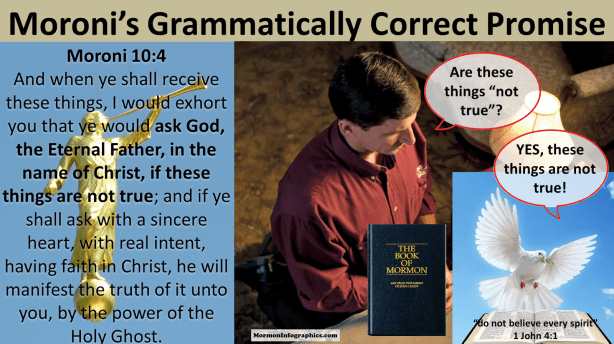
Moroni's Grammatically Correct Promise

WHACK! Here’s hard reality: This type of spiritual experience is hardly unique. Please consider this post from a Muslim women on a Catholic discussion board:

“For me, I believe that Muhammad was a prophet because of the Qur’an–because I read it, and in my own estimation after reading it, reflecting on it, and praying about it, I found in myself an unwavering belief that the Qur’an is without a doubt revealed by the Lord of the Worlds, by the Almighty God.”6

Sound familiar? Just substitute “Joseph Smith” where it says, “Muhammad” and “Book of Mormon” where it says “Qur’an” and you have the archetypical Mormon Testimony which simply mirrors the “stock” Muslim Testimony known as the Shahada:

“I bear witness that there is no god but Allah, and I bear witness that Mohammed is the servant and Messenger of Allah.”
(the “Shahada”)

So, I’m sorry Mormon friends but the infamous “Mormon Testimony” – the one that so much Latter-day Saint corporate epistemology and cultural identity is based on – simply isn’t that unusual or unique. In fact, it’s common. There are millions of testimonies from those of other faiths that are very similar, and in some cases exactly like, those of Mormons. Please consider this sampling:7

“I felt a burning in my heart, and a great burden seemed to have left me.”
(Protestant)

“But what can I say? How can I describe an experience so profound and so beautiful? Shall I say that it was the most blessed experience of my life? Shall I say that [God] touched my heart and gave me a feeling of peace I had not known before? Shall I describe the tears that flowed freely from my eyes, affirming my . . . faith, as I . . . beg[ged] [God’s] blessings for myself and for those I love?”
(Islam)

“The sense I had of divine things, would often of a sudden kindle up, as it were, a sweet burning in my heart; an ardor of soul, that I know not how to express.”
(Protestant)

WHACK!

“As I read these books in a . . . bookstore, . . . I felt a burning in my heart that I should come and investigate.”
(Catholic)

“[Even as a child], [w]ithout understanding much about the complex [doctrine] . . . he was attracted to [church]. There he often felt a strong feeling of peace flowing through his body.”
(Hindu)

“I was praying . . . when I felt a burning shaft of . . . love come through my head and into my heart.”
(Catholic)

“I truly [sic] wanted to know [the truth]. After a few weeks, I stumbled onto [texts] which . . . answered my questions in a way that I had not heard of before. I read everything . . .and I even tried the experiment of asking [God] for . . . his divine love. After about 6 weeks, I felt a burning in my chest and a sensation that was unlike anything I had ever felt. It was pure happiness and peace. I knew then that [God] had sent His love to me.”
(New Age)

“A feeling of peace and certitude would tell me when I had found the answers and often after people would help me by pointing in the right direction.”
(Islam)

“We gave up a lot of things. What did I get in return? I received a feeling of peace, hope and security. I no longer lay awake at night worrying. I stopped cussing. I became much more honest in all aspects of my life. [God] has changed my heart and my life. My husband’s heart is changing also. We pray all the time and really feel [God’s] presence in our marriage. My perspective has changed. My view of life has changed about what is truly important.”
(Protestant)

“Many women described a feeling of euphoria after they committed to following [God] . . . . One woman described a feeling of peace; she said: ‘It is like you are born again and you can start all over again, free from sin.'”
(Islam)

“A feeling of peace seemed to flow into me with a sense of togetherness . . . . . I felt very peaceful from inside and also felt [warmth] . . . .”
(Hindu)

Boy hitting pinata, explosion of candy

WHACK!

“I felt a burning sensation in my heart.”
(Protestant)

“That inner light, that we all have or had at some time in our existence, was nearly burnt out for me. But in the [church] . . . I found a feeling of peace, inner solitude and quietness that I’d also found in reading the [text] and pondering over its meaning and trying to practice what it tells us.”
(Islam)

“For the first time I not only felt accountable for my past sins but I had to fight back tears. I knew that I had let down [God] [and] my family . . . . However, I also knew I was forgiven! [It] gave me a feeling of peace that I have never felt it in my whole life. I felt like I had a huge weight lifted off of me and that I was finally home and free . . . . I felt like a new person.”
(Catholic)

“Every time I am there [at the church building], a feeling of peace overcomes me.”
(Buddhist)

“About 10 years ago, when Jenny and I decided to start a family, we began looking for a spiritual community for our kids. During my first service at [the church]. . . I was hooked. I recall the feeling of peace that I felt when I was attending [services].”
(Universal Unitarian)

“The power of [God] came into me then. I had this warm and overwhelming feeling of peace and security. It’s hard to explain. I had to . . . stop myself from falling backward.”
(Catholic)

“[The religious leader] looked into my eyes deeply for a moment, and I experienced a feeling of peace and love unlike anything I had ever experienced before.”
(Hindu)

“[After praying,] [i]mmediately I was flooded with a deep feeling of peace, comfort, and hope.”
(Protestant)

“I recently spent an afternoon on the northwestern shore of the Sea of Galilee, atop the mount where Jesus is believed to have preached his most famous sermon. . . . As I sat and gazed upon the surrounding hills gently sloping to an inland sea, a feeling of peace came over me. It soon grew to a blissful stillness that silenced my thoughts. In an instant, the sense of being a separate self—an “I” or a “me”—vanished. . . . The experience lasted just a few moments, but returned many times as I gazed out over the land where Jesus is believed to have walked, gathered his apostles, and worked many of his miracles.”
(Atheist)

Smashed donkey pinata on floor with candy

Smashed donkey pinata on floor with candy

SPLAT! Down comes the The Mormon Piñata
When we examine, analyze, measure and observe the above data points what they tell us is this:

  1. Because the results are so wide and varied this method of discerning “God” is clearly unreliable.
  2. Likewise, and for the same reasons, this method of discerning “truth” is also unreliable.
  3. This method of epistemology appears to be confirmation bias driven. That’s because the conclusions appear to be predetermined by the person’s presuppositions. That is, the person investigating Hinduism is just as likely to be persuaded that Vishnu, Brahma, Shiva, or Shakti is speaking to them as the person investigating Mormonism is convinced that the God of Mormon is.
  4. In a similar vein, borne testimony tends to reinforce the presuppositions of the audience. Stated simply, those who already hold to the same presuppositions as the testimony bearer will enthusiastically support their testimony and those who don’t will either challenge or ignore it.
  5. Therefore, objectively speaking, and in conclusion, testimony bearing ultimately proves nothing.

This is exactly as Clinton Wilcox pointed out in his superb article, ‘Weak Arguments #8: “I testify that Mormonism is false and Joseph Smith was a false prophet.”‘

In short, it’s [that is, giving a counter testimony against Mormonism is] a weak argument because it is subjective and inconclusive. It doesn’t give any actual reasons for why Mormonism is false and orthodox Christianity is true. It’s a bad argument against Mormonism because it’s a bad argument, period – which makes it a bad argument even when the Mormon uses it…

Testimonies are not inherently bad things. Testimonies are used in a court of law as evidence. But testimonies are given regarding a certain event that somebody witnessed. You can’t rely on your own subjective experiences to convince somebody else of the truth of your beliefs. The major problem is that in the Mormon’s testimony, they don’t give us any reason to believe Mormonism is true. A subjective experience may give you a reason to believe but it doesn’t give anyone else a reason to accept your beliefs as true. Arguing that it is the correct church doesn’t help. I need to know why it is the correct church….

Finally, this testimony can be turned right back around on the Mormon (or on you). You can just reply with, “I know that the Church of Jesus Christ of Latter-Day Saints is a false church. I know that Joseph Smith was a false prophet,” etc. Then you’re left with the dilemma of whose testimony is correct, or even which is the more powerful testimony? This can be rhetorically effective, but it offers no grounding for the claim that your respective beliefs are true.8

And a Latter-day Saint peer reviewer of my article, ‘Weak Arguments #15: “How to Make Weak Arguments for Mormonism – A Primer”’ seemed to agree with Mr. Wilcox when he said:

The witness of the spirit while not great evidence for convincing others is a fine answer to: Why do you believe this? Also it is a good lead in to, ‘And you can receive the same witness.’

Mormons need to keep in mind however that a personal witness is not meant for convincing others, its personal and should be kept out of debate except in answer to the above question or proceeding the invitation. It should also be kept in mind that inviting someone to seek their own witness from God does not win the argument, as some Mormons seem to believe.9

Put the Piñata down!
In other words my Mormon friends, put the Mormon Piñata down! Or as Clinton Wilcox said so well in his article:

Give reasons, not testimony.

He then goes on to explain:

We do not have to pray to test truth claims. We have the Scriptures given to us so that if we come across a particular idea, we can test it against Scripture to see if it holds up (1 Thessalonians 5:21). All over Scripture we are told to use our faculties of reason. If Mormonism is false, it stands or falls on its teachings, not on whether or not I believe it to be true. And more generally, Christianity, itself, is a religion that is based on evidence, not “blind faith,” as atheists tend to allege. We are told to “love the Lord your God with…all your mind” (Matthew 22:37, NASB). God told the Israelites “Come, let us reason together” (Isaiah 1:18, ESV, emphasis mine). And as C.S. Lewis, in his book Mere Christianity, has observed, “God is no fonder of intellectual slackers than he is of any other slackers.”10 The Christian life is one marked by reason and reflection. It is not based on feelings or emotion, which are not accurate guides for determining truth. We read in Scripture that “the heart is more deceitful than all else and is desperately sick. Who can understand it?”(Jeremiah 17:9, NASB).11

And, I will end with this paraphrased version of the closing paragraph of Mr. Wilcox’s classic article. Please note, that it has been modified to fit our context here:

If you believe the Mormon church to be true, you need to point out which doctrines are true and explain why they are true. If you believe Joseph Smith to be a true prophet, point out reasons why you believe so…. The bottom line is, if you want to be able to convince a non-Mormon of the truth of Mormonism, you need to give arguments for it.12

But whatever you do my Mormon friend: Put that Mormon Piñata down and don’t pick it back up! If you don’t, it will be just like you’re queuing it up for your thinking, bat toting non-Mormon friends like a piñata on a zip line.

qzvrvctik6rsbmcjqnor“Wrecking Ball  Piñata” shot in Salt Lake City at the Utah State Fairgrounds.

NOTES
1 “Testimony Glove”, Friend magazine, October 2008
2 “Preach My Gospel” official, correlated LdS Church Missionary curriculum, p.198
3 Ibid, p.90
4 Ibid, p.199
5 Ibid, p.111
6 Sister Amy, “The Koran and the Book of Mormons”, Catholic Answers website, February 21, 2008
7 While this sample of testimonies was compiled from the Mormon Think website, an even fuller collection of indexed testimonies can be found on the Testimonies of Other Faiths website.
8 Clinton Wilcox, ‘Weak Arguments #8: “I testify that Mormonism is false and Joseph Smith was a false prophet.”
9 Fred W. Anson, ‘Weak Arguments #15: “How to Make Weak Arguments for Mormonism – A Primer”’, footnote 4
10 C.S. Lewis, “Mere Christianity (C.S. Lewis Signature Classics)”, (p. 78, Kindle position 1071). HarperCollins. Kindle Edition.
11 Op cit, Wilcox.
12 Op cit, Wilcox. Please note that I have paraphrased from the original to fit the context of this article. The original was addressed to non-Mormon Christians and reads like this:
“If you believe the Mormon church to be false, you need to point out which doctrines are false and explain why they are false. If you believe Joseph Smith to be a false prophet, point out reasons why you believe so. Show some prophecies which have failed to take place (the Bible in Deuteronomy 18:22 says that if even one prediction fails, that person is not a prophet of the Lord). The bottom line is, if you want to be able to convince a Mormon of the truth of orthodox Christianity, you need to give arguments for it.”

Again, I apologize to Mr. Wilcox for abusing his fine prose like this but, frankly, since I couldn’t top it I used it instead!

The story behind the animated GIF above – this is just fun!
BACK TO TOP

Athanasius (circa 293-373AD)

Athanasius (circa 293-373AD)

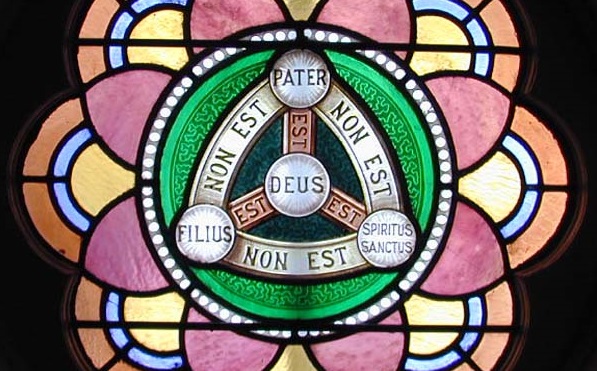
Introduction: The greatest exposition of the doctrine of the Trinity is the Athanasian Creed. Unfortunately, many modern readers often feel overwhelmed and confused by it. Perhaps this is due to the fact that good modern translations of the creed can be hard to find. The translation below is both modern and breaks the creed into paragraphs by theme – thereby making it more legible and easier to digest. If you will read it slowly, considering each line and paragraph before proceeding to the next one, we suspect that you will find it not only easy to comprehend but will come away with a fuller, richer understanding of the Trinity. Finally, please note that the term “catholic faith” in this translation is correct meaning, “on the whole, according to the whole or in general”, or more simply, “universal”. It is not referring to the Roman Catholic Church – which didn’t appear for hundreds of years, that is, long after this creed was written. — Editor

Whoever desires to be saved should above all hold to the catholic faith.
Anyone who does not keep it whole and unbroken will doubtless perish eternally.
Now this is the catholic faith:

That we worship one God in trinity and the trinity in unity,
neither blending their persons
nor dividing their essence.
For the person of the Father is a distinct person,
the person of the Son is another,
and that of the Holy Spirit still another.
But the divinity of the Father, Son, and Holy Spirit is one,
their glory equal, their majesty coeternal.

What quality the Father has, the Son has, and the Holy Spirit has.
The Father is uncreated,
the Son is uncreated,
the Holy Spirit is uncreated.

The Father is immeasurable,
the Son is immeasurable,
the Holy Spirit is immeasurable.

The Father is eternal,
the Son is eternal,
the Holy Spirit is eternal.

And yet there are not three eternal beings;
there is but one eternal being.
So too there are not three uncreated or immeasurable beings;
there is but one uncreated and immeasurable being.

Similarly, the Father is almighty,
the Son is almighty,
the Holy Spirit is almighty.
Yet there are not three almighty beings;
there is but one almighty being.

Thus the Father is God,
the Son is God,
the Holy Spirit is God.
Yet there are not three gods;
there is but one God.

Thus the Father is Lord,
the Son is Lord,
the Holy Spirit is Lord.
Yet there are not three lords;
there is but one Lord.

Just as Christian truth compels us
to confess each person individually
as both God and Lord,
so catholic religion forbids us
to say that there are three gods or lords.

The Father was neither made nor created nor begotten from anyone.
The Son was neither made nor created;
he was begotten from the Father alone.
The Holy Spirit was neither made nor created nor begotten;
he proceeds from the Father and the Son.

Accordingly there is one Father, not three fathers;
there is one Son, not three sons;
there is one Holy Spirit, not three holy spirits.

Nothing in this trinity is before or after,
nothing is greater or smaller;
in their entirety the three persons
are coeternal and coequal with each other.

So in everything, as was said earlier,
we must worship their trinity in their unity
and their unity in their trinity.

Anyone then who desires to be saved
should think thus about the trinity.

But it is necessary for eternal salvation
that one also believe in the incarnation
of our Lord Jesus Christ faithfully.

Now this is the true faith:

That we believe and confess
that our Lord Jesus Christ, God’s Son,
is both God and human, equally.

He is God from the essence of the Father,
begotten before time;
and he is human from the essence of his mother,
born in time;
completely God, completely human,
with a rational soul and human flesh;
equal to the Father as regards divinity,
less than the Father as regards humanity.

Although he is God and human,
yet Christ is not two, but one.
He is one, however,
not by his divinity being turned into flesh,
but by God’s taking humanity to himself.
He is one,
certainly not by the blending of his essence,
but by the unity of his person.
For just as one human is both rational soul and flesh,
so too the one Christ is both God and human.

He suffered for our salvation;
he descended to hell;
he arose from the dead;
he ascended to heaven;
he is seated at the Father’s right hand;
from there he will come to judge the living and the dead.

At his coming all people will arise bodily
and give an accounting of their own deeds.
Those who have done good will enter eternal life,
and those who have done evil will enter eternal fire.

This is the catholic faith:
one cannot be saved without believing it firmly and faithfully.

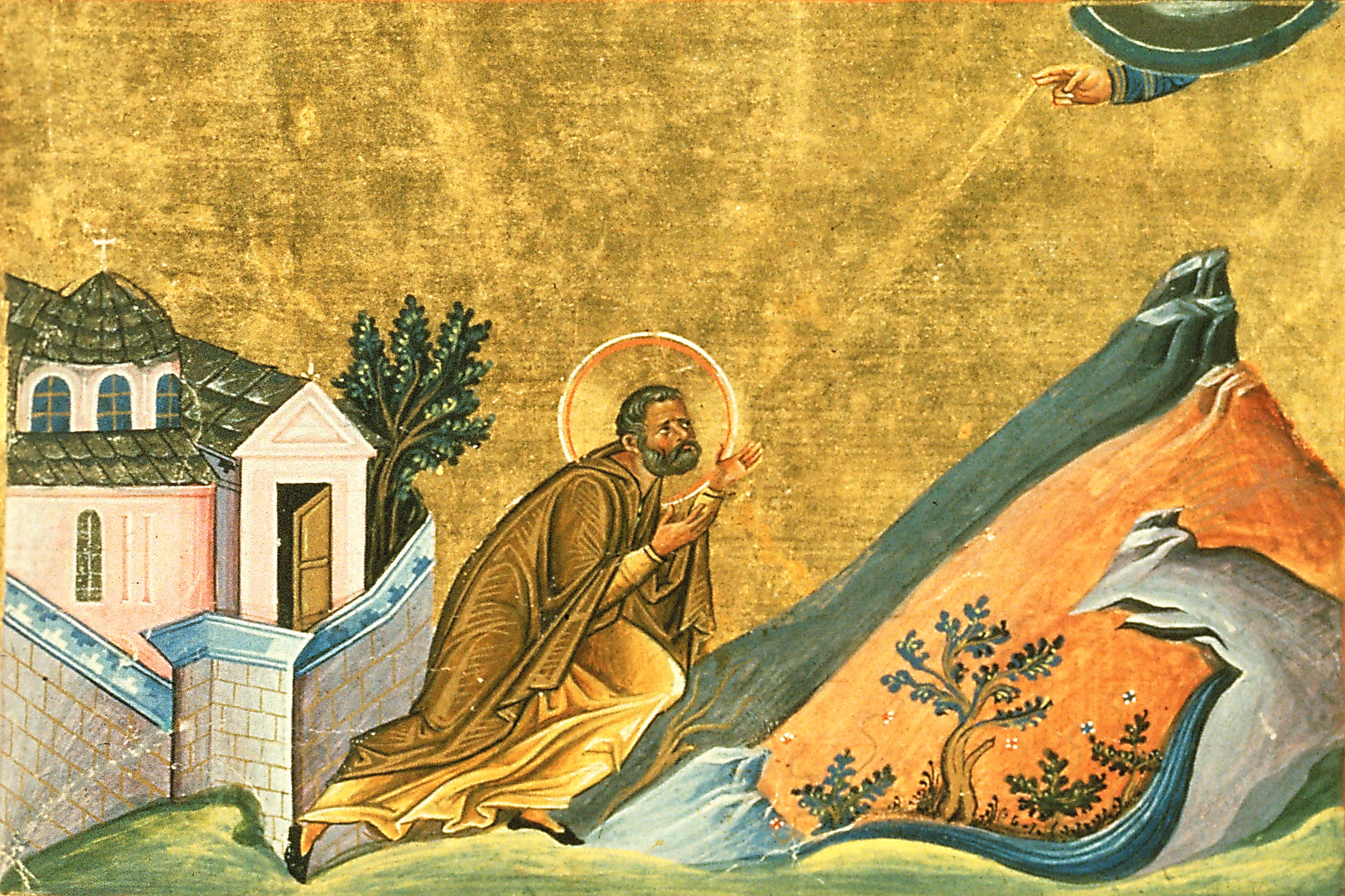
Athanasius_the_Confessor_of_Constantinople_(Menologion_of_Basil_II)

Athanasius the Confessor of Constantinople
(from Menologion of Basileiou an 11th century illuminated byzantine manuscript with 430 miniatures, now in the Vatican library)

BACKGROUND
This creed is named after Athanasius (A.D. 293-373), the champion of orthodoxy against Arian attacks on the doctrine of the trinity. Although Athanasius did not write this creed and it is improperly named after him, the name persists because until the seventeenth century it was commonly ascribed to him. It is not from Greek (Eastern), but from Latin (Western) origin, and is not recognized by the Eastern Orthodox Church today. Apart from the opening and closing sentences, this creed consists of two parts, the first setting forth the orthodox doctrine of the trinity, and the second dealing chiefly with the incarnation and the two-natures doctrine. The translation above was adopted by the CRC Synod of 1988. 

© 1987, CRC Publications, Grand Rapids MI. www.crcna.org. Reprinted with permission.

A caution to transitioning Ex-Mormon Christians
00-0628c2

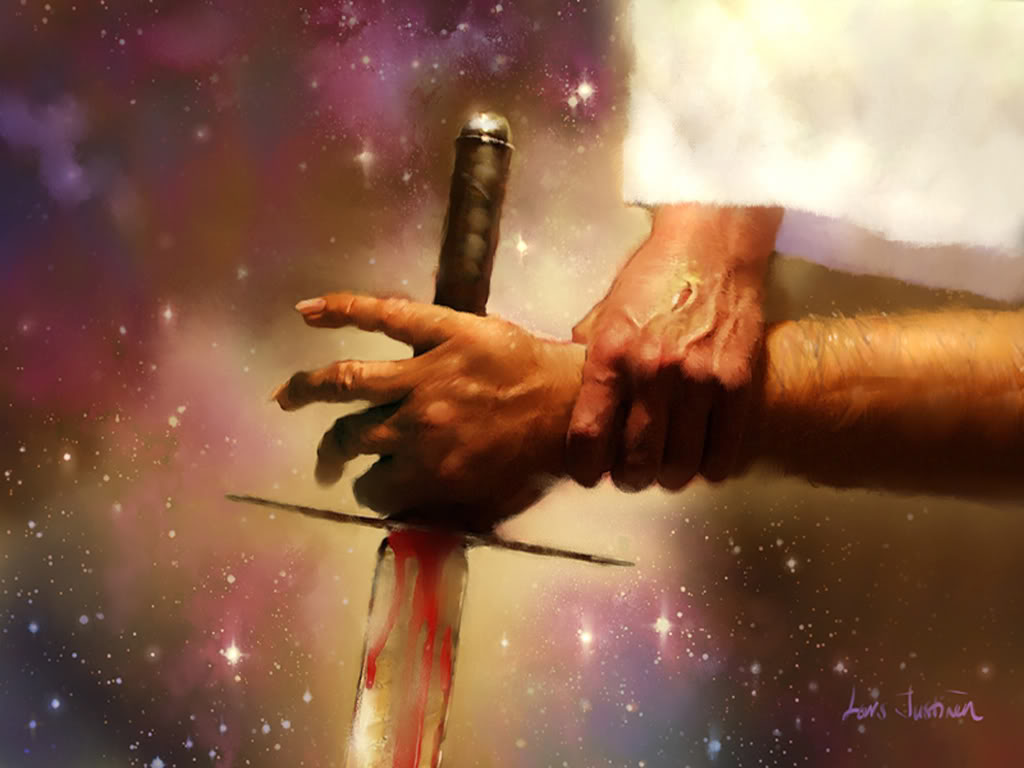
“Cosmic Conflict” by Lars Justinen

by Fred W. Anson
Without question the loss of community is one of the things most quickly, and often most painfully, felt by Mormons transitioning out of the Church of Jesus Christ of Latter-day Saints. That’s why I believe that former Mormons can and should find encouragement and support by joining with others like themselves as soon as possible after exiting the Mormon Church. The stories of those who don’t are, all too often, heartbreaking.

However, sometimes the stories who do are even worse. That’s because all too often, Ex-Mormon support groups, that lack a positive sense of direction can deteriorate into a quagmire of complaints, bitterness and anger. As a result many former Latter-day Saints stay stuck in a negative attitude for the rest of their life after leaving the Mormon Church. And we all have stories of those who have gotten downright mean and nasty.

This need not be!

While I understand that most people in the healing process need a gracious place where those feelings can be vented I always encourage my Christian Ex-Mormon friends to press past the quagmire of angry bitterness and into health and happiness through a restored relationship with the God of the Bible and His covenant people.

This is possible but requires belief and trust that God’s word is true when it says:

‘God opposes the proud
but shows favor to the humble.’

Submit yourselves, then, to God. Resist the devil, and he will flee from you. Come near to God and he will come near to you. Wash your hands, you sinners, and purify your hearts, you double-minded. Grieve, mourn and wail. Change your laughter to mourning and your joy to gloom. Humble yourselves before the Lord, and he will lift you up.
James 4:6-10 (NIV)

Simply put, I have found that all too often transitioning Mormons cut their own healing short and fail to gain the hard won wisdom that God is trying to impart to them by choosing to attack Mormonism rather than staying in the humble, reflective, broken place of learning spoken of in this passage. All too often it seems that they are trying to resurrect and exalt themselves by trying to kill and destroy their “Judas” rather than waiting for God to avenge, resurrect and lift them up as Christ did. As one Pastor said well of such God-given (but rarely welcome) lessons:

As soon as you pick up the sword the lesson ends.
Pastor Kevin Davenport, Saddleback Covenant Church (Mission Viejo, CA)

Yes, transitioning Ex-Mormon, an injustice has been done: You have been betrayed – and now your betrayers are out to crucify you! We acknowledge and validate that fact. However, there will be time enough for the sword later. The Mormon Church isn’t going anywhere, and we know where to find it because it’s a stronghold. But as Jesus said of strongholds:

No one can enter a strong man’s house and plunder his goods, unless he first binds the strong man. And then he will plunder his house.
Mark 3:37 (NKJV)

Binding the strong man and then plundering his house is going to take God given strength, wisdom and persistence! That’s why I encourage you to stay humble, submitted, and attentive to God’s lessons. You’ve been broken: Stay here for awhile, let others bind up your wounds then wait for them to heal. Be Christ not Peter. And always remember the words of Christ who not only said but also modeled:

Whoever exalts himself will be humbled, and he who humbles himself will be exalted.
Matthew 23:12 (NKJV)

Gain strength and acquire wisdom. then, once you’re whole, strong, wise, and endowed with power from on high, you may1 hear this call: “Go forth and conquer in My Name!” If so, then pick up your sword and we’ll storm the gates of the LdS Church together!2

Amen?

1-the-civil-war-wounded-soldiers-in-ward-everett

Suffice to say, these folks probably shouldn’t be storming the gates of hell for a while.

NOTES
1 And you may not hear that call – which is absolutely fine too. Many Ex-Mormons after they’re whole, strong, wise, and endowed with God’s power simply close the chapter of their life called, “The Mormon Church” and walk the other direction never looking back. God calls who He will to what He will and not all are called to storm gates.

2 See Matthew 16:18 (NKJV) which says:

“And I also say to you that you are Peter, and on this rock I will build My church, and the gates of Hades shall not prevail against it.”

Credits and Acknowledgments
The core principles introduced in this article are expounded and expanded on more fully in Gene Edwards’ classic book, “A Tale of three Kings: A Study in Brokenness”. This book has been of great aid and comfortable to recovering ex-cultists for over three decades. It’s a riveting tale that can easily be read in one or two sittings (it’s only 105 pages long). You will find the Amazon page for Mr. Edward’s book here. I simply can NOT recommend this book highly enough. I know that’s it’s a cliche but this book truly is a lifechanger and a must read!

Portions of the above text are from the introduction of Ross Anderson’s, “Jesus Without Joseph”. Once again, this is another resource for Ex-Mormons that I can’t recommend highly enough.

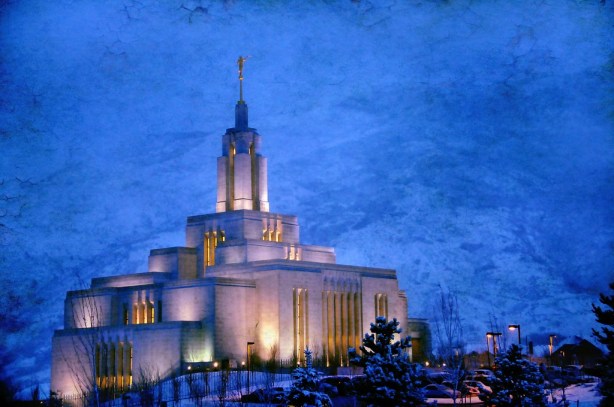
frigid temple

“The Mormon Church isn’t going anywhere, and we know where to find it because it’s a stronghold.”

“The Lord will fight for you. You just keep still.”
Exodus 14:14 (CEB)

BACK TO TOP

modernism_header-EDITEDIntroduction When the “I’m A Mormon” ad campaign hit the shores of Australia in 2011, frequent Mormon Expression board commentator Martin Jacobs was prompted to consider it’s message in light of trends he saw emerging in the Church of Jesus Christ of Latter-day Saints at that time.  What’s striking is how fresh and relevant his analysis still is today. — Editor

Hi, I’m Zelph and I’m a Modernist
by Martin Jacobs
The tag line “I’m [insert name here], and I’m a Mormon” superbly clinches the current advertising campaign by the Mormons. However, I suggest that the message that it projects is not the gospel of Jesus Christ, it’s not even the gospel of Mormonism’s founder, Joseph Smith; it’s modernism.

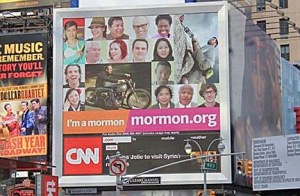
“I’m A Mormon” ads in a New York Subway Car

It’s a smart campaign. It aims at normalizing the religion by overcoming perceived stereotypes through the faces of ordinary, likable Mormons. It’s exactly what well-paid and successful PR companies would advise, with good reason; it’s a tried and tested formula for raising the profile of the brand. Put simply, it works.

My objection is not with the delivery, nor even with its modernist message (which has merits of its own within its own frame of reference). My objection is that the gospel of Jesus of Nazareth and his immediate followers, which Mormonism claims to have restored, was not modernist.

I don’t think I have the definitive angle on modernism, or on the species of modernism presented in the “I’m a Mormon” campaign, or even on Christianity, for that matter. However, I do see some profound differences in these competing perspectives, and contrasting them is not simply instructive, it deeply challenges our inherited, modernist sense of self-identity.

In a nutshell, the modernist sees himself as the author of his own story, and it’s a story that starts with his own advent. The ancients, by contrast saw their story as part of a continuum of history stretching back to the creation of the Cosmos, and forward to the end of this age. Both see their lives as a vindication of the respective authors of these stories. To the modernist, that author is himself, but to the ancient Christian, the ultimate author is God.

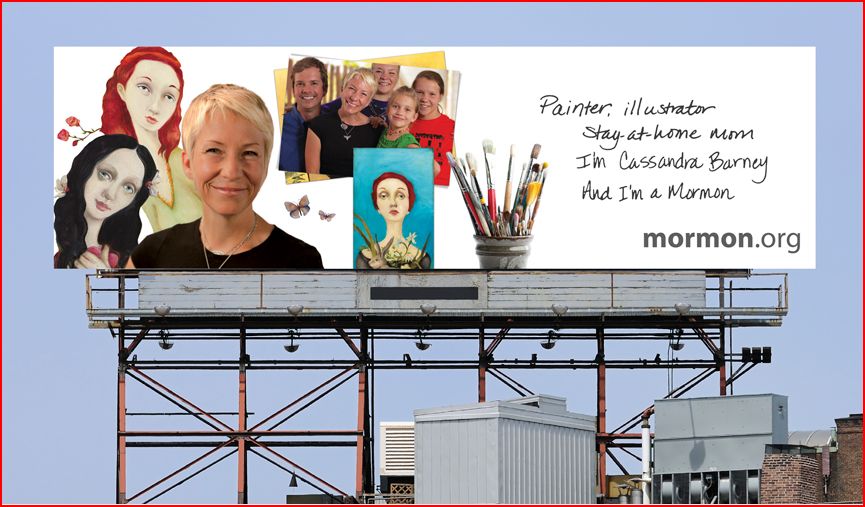
An

An “I’m A Mormon” billboard in Colorado Springs, Colorado

To contrast the ancient Christian perspective with the modernism that we are so familiar with, consider a curious part of the gospel that was taught by one of Jesus’ immediate followers;

This is how you can recognize the Spirit of God: Every spirit that acknowledges that Jesus Christ has come in the flesh is from God (1 John 4:2)

My first observation is that if you find the Bible hard to read, it’s probably because you’re a modernist.

Discovering that you’re a modernist might be something of a revelation to you. You didn’t choose modernism, you didn’t convert to modernism, and you didn’t apostatize from anti-modernism (whatever that may be). Yet, you are a modernist, nonetheless.

Another revelation to you might be that modernism has a history. You probably think that people all through the ages think just like you. However, that’s actually not the case, and the fact that you have assumed it is a tell-tale sign that you are a modernist. Professors of the History of Philosophy put the genesis of modernism around the time of the French Revolution. From there, it took a grip on the Western World, and its fruit is found in you, whether you willed it or not.

Modernism is not simply an optimistic view of what lies ahead. It insists that nobody really knew anything until we arrived on the scene (and by “we” I really mean “I”) and started to call things what they really are.

You've read the article, now read the book.

You’ve read the article, now read the book. (click for details)

The downside of presuming that you are the author of your own story is that it gives you license to re-write the book according to your own agenda, without the inconvenience of checking what happened “in the flesh”, as John puts it.

Hence, the winsome characters in the “I’m a Mormon” campaign appeal to us with the sub-text of “I am Mormonism”. Not what others may have seen as those loony “old school”, ignorant polygamists in the Utah desert, nor those simpletons from a by-gone age following those “old school” prophets bearing revelations that have drifted down from heaven, but me, because I get to determine what Mormonism is, and I am the nice, modern, informed, more evolved guy (or girl) from next door who makes up their own mind as to what and what isn’t Mormonism.

This is most evident in the fact that the “I’m a Mormon” campaign has little time for Joseph Smith, the most important character in the Mormon story. Why? Joseph Smith set the agenda for Mormonism, and Mormonism is stuck with it until it becomes something that is not Mormonism. It appears that those who are driving the campaign want to re-write the book according to the nice guy next door, which is a distinctively modernist thing to do.

An excellent primer on modernity can be found in an interview with Thomas Oden in 1990, who described modernism as the “idolatry of the new”. It is reproduced in a Christianity Today on-line article here. I am particularly struck by the second characteristic of modernism that Oden defines; autonomous individualism, which assumes that moral authority comes essentially from within.

An

An “I’m A Mormon” Billboard in London

It describes “us” more accurately than we’d like to think. How many Disney movies have taught our kids to “trust their heart”? What does contemporary Mormonism teach (along with a plethora of other religions)? If I read John rightly, this make-it-up-according-to-the-dictates-of-your-own-prejudices grates against his warning to base your sense of reality according to what has happened “in the flesh” in history, and it leads us into dangerous territory.

Please hear me carefully here. I’m not arguing that a person’s individual experiences and agenda are unimportant, uninteresting or irrelevant. It would be the height of churlishness and ignorance to dismiss the real stories behind the “I’m a Mormon” campaign as meaningless. They are not, thank God. (No, really, thank God that no human life is worthless and meaningless, even the ones that you and I might not particularly admire).

The problem I have is that the modernist-believer looks inward for signs of God. These signs are consigned to, and validated in the internal world of the believer’s internal psyche. There, they can be manipulated, unlike the signs “in the flesh” of John’s enigmatic diagnostic.

John’s strange comment is not the only Biblical text that tells us to look beyond our own lives and into the “flesh” of God’s public, historic and auditable acts. The Ten Commandments open with a statement of God’s redemption of Israel (Exodus 20:2). Jesus constantly validated what he was doing by appealing to “what was written” (Matthew 4:4 etc). Paul, who was probably the most didactic of New Testament authors, never got round to telling us how we should live our lives without framing it in the context of the history of the Old Testament, and the observed life of Christ (Philippians 2:5-11, for example).

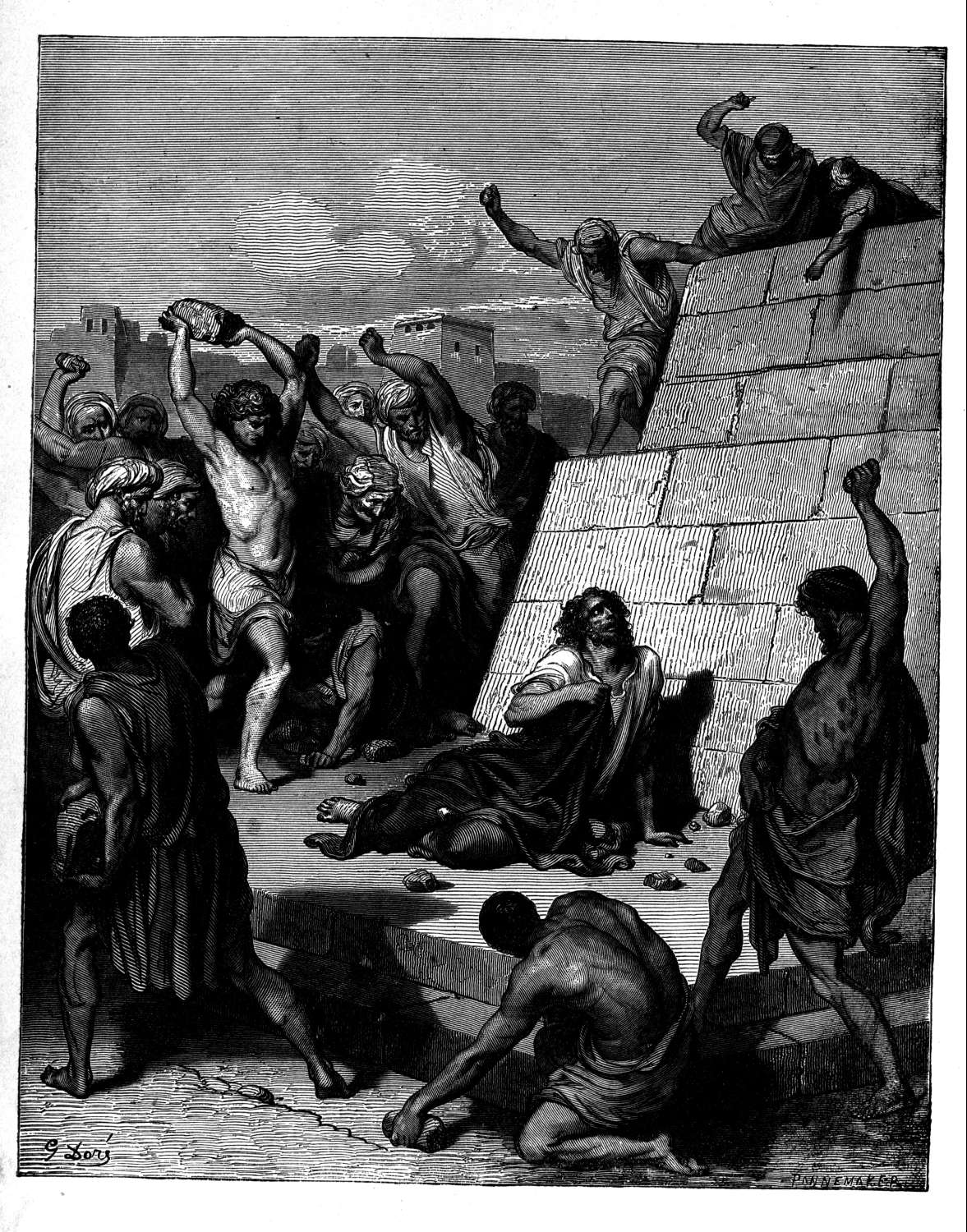
“The Stoning of Stephen” by Gustave Dore’ (1832-1883)

Consider Stephen’s testimony in Acts Chapter 7. He’s on trial, and the words he chooses next will determine if he lives or dies. Does he say something like “I asked Jesus to come into my life, and he made me into a better person”? No. Stephen gives a history lecture to the people holding the rocks. It’s only when the stones are going to fly that Stephen finally tells them what it means to him.

Stephen, like the first Christians and authors of the New Testament, did not evaluate the Gospel of Christ by what it meant to him, but by what God had already done “in the flesh”. It only meant something to him on a personal level because he saw himself as a small, but important component of that history. It was this history that called both him and his interrogators to account.

They didn’t feel comfortable with Stephen’s message of accountability, like modern modernists, and they had more freedom to express their emotional perturbation than us, which they did by killing him. Their moral authority was based firmly on what they saw within themselves, and not on what God had done “in the flesh”, as Stephen forcefully testified.

Contrast this scenario with the “I’m a Mormon” campaign, and it’s focus on the believer. The message of the New Testament, which reliably sets out the important and distinctive ethos and teachings of the first Christians, consistently looks beyond the self of the believer to Jesus Christ, and what he did “in the flesh”. It even does so to the detriment of the believers, who made up its authors and most of its principal players.

If we were serious about “restoring” the ancient Christian Faith, we ought to be mindful of the dominant voices of modernism in our environment that could derail our venture. We ought to be very wary of our (modernist) tendency to validate our chosen religion by the feelings that we experience within our hearts.

Screen shot from the

Screen shot from the “I’m A Mormon” website

The ancient Christian Faith had an entirely different frame of reference. The first Christians validated themselves by what they saw God doing “in the flesh”. Central to their vision was the life, death and resurrection of Jesus Christ, whom they regarded above all else as the tangible, definitive expression of God (see John 1:14, Colossians 1:10, Hebrews 1:1-4).

This expression of God in Christ then set the agenda for their lives (see Philippians 2:5-11) in a way that revolutionized the world. The rest, as they say, is history, and it’s well worth exploring if we want to understand why we are where we are today.

If we were to restore this ancient Christian faith, we would come to a place where we can no longer say “I believe in an [imaginary] Jesus because he has appeared in my heart”, but a place where we affirm that he has appeared “in the flesh”, as John says. Crucially, Christianity looks beyond the self of the believer and this is Good News because Christians have a redeemer who is not dependent on their efforts to make Him “true”.

Nothing you or I will do, say or feel will change this Jesus of the Flesh, contrary to the ‘gospel’ of modernism. God forgive us for ever believing otherwise.

(As originally published on the Mormon Expression Blogs website on November 14, 2011)

BACK TO TOP

mormonby Fred W. Anson
I grew up in Southern California and had Mormon friends and family members all my life.

But the big event was when a close family member converted in 1970. That was a watershed event the ripples of which are still resonating through my family.

I was Born Again in 1976 and lightly studied Mormonism starting around 1978 – mainly the Tanner’s material and Walter Martin. I dared not touch anything from the other side of the divide lest I get “contaminated” (typical ’70’s Jesus Movement ‘antiseptic Christian’ thinking no doubt).

Fast forward to the passing of Gordon B. Hinckley . . .

A Mormon family relative sent out a mass email praising Gordon B. Hinckley using “Fast and Testimony” language and expounding on the time that he met him and shook his hand. The “hook” that got me was when my normally rational, logical relative said, “When I looked into his eyes it was if I was he and I were the only people in the room – it was if I were looking into the eyes of Christ.”

That was wake up call #1.

Then a few months later Mitt Romney drops out of the Presidential race on the same week that the Wall Street Journal publishes an article revealing that most Americas consider Mormons “weird” and thus would have second thoughts about having one as President of the nation.

Apparently the Mormon General Authorities sent out some type of communique to the Wards about this article and Romney’s departure because that Sunday that same Mormon family member sent out another weepy “Fast and Testimony” email about how Mormons are just normal people and how we non-Mormons shouldn’t persecute them for their faith.

That was bad.

What was worse when someone else in my family (who’s not Mormon) immediately replied with words of comfort ending with, “… after all we all worship the same Christ.”

I sat there stunned and realized that I wasn’t equipped to reply intelligently to either of these bright, intelligent, well read family members.

So I dove into Mormon Studies with heart, mind and soul and to my shock and surprise discovered that: a) I love it! and; b) I’m pretty good at it.

I’m hooked.

My favorite Mormon Studies quote – and the one the epitomizes my Mormon Studies philosophy and experience – comes from LdS Scholar Kathleen Flake who said:

Superficially, one thinks of revealed religions as providing answers, and Smith provides as many questions as he does answers. Nobody is exempt from struggling with who he is. Whether you’re an insider or an outsider, thinking about Smith causes you to struggle, and that struggle brings as much of you into the question as it does Smith himself. He’s a bit of a religious Rorschach test.
Kathleen Flake, Historian
(from the PBS Series “The Mormons”)

That quote matches my experience to a T! I have grown deeper and wider in my own faith by studying Joseph Smith than I ever thought possible – that was unexpected. Further, I seem to be helping others through my own involvement on Internet discussion boards (Concerned Christians and AnswerBag).

I have been labeled, “An enemy of the only true Church” and “A Child of the Devil” by Mormons which I take as feedback that I’m doing something right and I’m effective to some small degree.

Oh, and I’m ready for either of my relatives and their families should the door ever open there.

(As originally published on Facebook on May 10, 2010) 

BACK TO TOP

fric-et-foi

Dr. Gene “God’s Angry Man” Scott

“I appeal to you, brothers, to watch out for those who cause divisions and create obstacles contrary to the doctrine that you have been taught; avoid them.”
– Romans 16:17 (ESV)

by Lowell Johnson
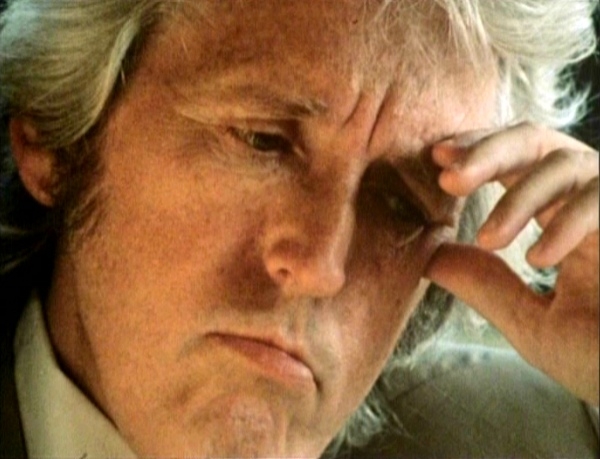
Up to 2014 I had watched almost every episode of Heart of the Matter show. I had enjoyed host Shawn McCraney’s ability to reach Mormons through his boisterous and challenging personality. At times, he reminded me of the late Dr. Gene Scott (1929 – 2005) who was labeled “God’s Angry Man”. Dr. Scott was a cigar chomping profane television preacher who disdained modern Christianity and arrogantly would point out perceived flaws. He was a Stanford educated man who seemed to be theologically sound when he was a young pastor. However, when he began TV preaching and rerunning his shows 24/7 on several UHF stations, many heresies were taught. Those who are too young to have see Dr. Scott on broadcast television can still find him on YouTube and featured in Werner Herzog‘s 1981 documentary film “God’s Angry Man”.

Sadly, starting in early 2014 Shawn began showing signs of becoming the next Dr. Gene Scott. Like Dr. Scott, Shawn had cussed on the air and yelled at the callers while looking directly at the television camera. However, it was Shawn’s evolution into a heresy embracing TV preacher that reminded me more and more of Dr. Scott of whom the Christian Research Institute said in 1994:

During the last few years, Scott has become more and more outrageous and offensive. His appearance, increasingly unkempt and outlandish, deliberately offends societal standards of propriety (compare Paul’s lifestyle 1 Corinthians 9:19-23). His language is crude, abusive, and profane, clearly violating God’s standards for Christians (Ephesians 4:29-31; 5:4; Colossians 3:8)…

he also dabbles in pyramidology and seems to promote a variation of the erroneous Anglo-Israelism doctrine. (CRI has information on both of these aberrational teachings.) In any case, a Christian ministry must be evaluated on the basis of both doctrine and practice; in the area of practice, Scott’s ministry cannot, in our opinion, be considered acceptably Christian.
— CRI Statement on Gene Scott, 1994

I had always found Shawn to be a fairly intelligent and entertaining individual, so the last time I was in Utah in 2012 for the Manti Temple Pageant (two years before all this) I was able to spend a Sunday worshiping with and listening to his teaching at his teaching fellowship known as C.A.M.P.U.S. During that time I found Shawn’s teaching from the Bible to be orthodox. I left the gathering feeling refreshed and ready to share Jesus with the lost in Manti, Utah.

Much has changed since that Sunday in June of 2012. On the February 11th, 2014 episode 381 of Heart of The Matter, Shawn spent the majority of the show attacking the Trinity. He said his study of God’s Word brought him to this conclusion. However, he also used several outside sources to justify why he has had a change of heart – including some sources from heretical groups like Oneness Pentecostals. Several people immediately took to the phone, to email, and to the internet to express concerns (see the Beggar’s Bread Position and Policy Statement on McCraneyism for links).

I was one of them. Before any of this happened, and because of comments he made on the previous show on February 4th, 2014 (episode 380), I had sent an email to Shawn asking if he was rejecting the Trinity Shawn graciously sent me a reply telling me to keep watching the shows and offered to send me his notes with book references when he was done. He did not really answer my questions, but I thought that I could wait to see where he was heading. So I was deeply saddened when he spent the majority of the next show (the episode 381 that I mentioned before) attacking the Trinity using arguments that could have just as easily been made by a Jehovah’s Witness (see Jehovah’s Witnesses and the Trinity: A Christian Perspective by Patrick Zukeran).

He even suggested that one reason the Trinity wasn’t valid because the word “Trinity” could not be found in the Bible. This is true, but it doesn’t mean that the Bible doesn’t teach the Trinity. The word “Bible” isn’t in the Bible, but it doesn’t stop us from calling it the Bible (see The word Trinity is not found in the Bible by Matt Slick). Essentially Shawn was teaching the ancient heresy of modalism which teaches that the Father, the Son, and the Holy Spirit are three different modes or aspects of one person, God, who is perceived by as three different “personas” or “modes” to the believer, rather than being one being, God, consisting of three distinct persons within the Godhead. As Shawn put it (starting at 25:48) in that broadcast:

One God. Always only and forever only one God. A monotheist God. He has manifested Himself in all sorts of means and ways to man.

He has appeared as fire.
Spoken as a still small voice.
As clouds, and mist, and wind, and an assortment of other ways.

Were they all God? Yes. Manifestations of One God Were they manifestations of more than one God? No.

One monotheistic God.

Did this God manifest Himself in spirit?

Yes. The second verse in the first chapter of Genesis says:

“And the earth was without form, and void; and darkness was upon the face of the deep. And the Spirit of God moved upon the face of the waters.”

Hey, listen up – this single monotheistic God also manifested Himself in . . . flesh.

That’s all. Not a new second or third “person” of the singular God co equal with the other persons. Just another manifestation of the single God.

Episode 393 White Board_edited

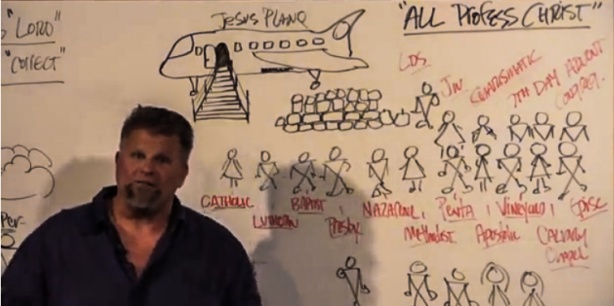
In true Gene Scott tradition, Shawn McCraney has shown a fondness for busy marker boards.

Jesus said it plainly to Philip:

“If you have seen me, you’ve seen the father.”

The Greek word for see in this passage is Horao and is better understood as Jesus saying:

“If you have discerned me, Philip, and not literally seen (which is the Greek word blepo).

That’s all I’m saying. The Spirit – God. One with God. From God, of God, and just God. Jesus – God. One with God. From God, of God – God. Holy Spirit God.

The only deal about God being “a or the Father” is in relation to Him having a Son in flesh.

He was not a Father until He manifested Himself as the Son.

It’s all really no more complicated than this:

“God is one who manifests Himself in a bunch of different ways. If the manifestation is from God, then the manifestation is God, and is sent by the One God to teach us of Him.”

So where did all this stuff about three persons, co-equal, co-eternal, comprising the one true God come from?

Stupid men who want formulae, who love control.”
(the above transcription is from the official Heart of the Matter website)

Simply put, that’s modalism. No matter how much you deny, spin, or try to talk your way around it, that’s just the way it is. Sure, it may be Openess Pentecostal style non-sequential modalism, but it’s still modalism all the same. As they say, “If it looks like a duck, has duck feathers, and walks like a duck, it’s a duck” – insisting that it’s not, no matter how many times you say it, doesn’t change that fact!

Now, in the past Shawn had played pranks on his show (see Shawn Becomes A Mormon Again). However, his teachings on the nature of God didn’t give any indication that he was cleverly pranking his audience in order to further strengthen their acceptance of the Trinity. Rather, he seemed, much like the late Dr. Gene Scott, to passionately believe everything that he was teaching. Still, maybe, just maybe, I thought at the time, it was all just a well really executed, poker faced, “gotcha!”

DrGeneScottWhiteboard

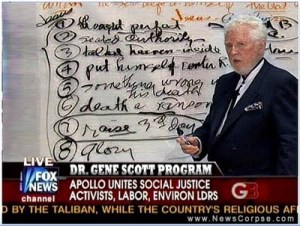
A classic busy Gene Scott marker board.

And I was persuaded that Shawn wasn’t the next Dr. Gene Scott, or that he had actually become a modalist, when on February 25th, 2014 (episode 383) he had Rob Bowman from the Institute for Religious Research on the show. Shawn was very humble on the show and admitted he could have been clearer on his points in the previous shows. I even apologized to Shawn via private email for doubting him and then publicly apologized for doing so on my blogsite. Shawn accepted my apology, I thought that my prayers had been answered, and I moved on – content that all was right with the world once again.

And I was wrong, dead wrong!

After Rob Bowman left town Shawn not only continued to teach the heresy of modalism (while all the time denying that he was) but went on to embrace and teach even more heretical doctrines. So on March 18th, 2014, just after episode 386 aired and just a few weeks after his appearance on Heart on the Matter, Rob Bowman had no choice but to finally publicly declare Shawn’s teachings heretical:

Shawn asserted that he doesn’t like the term Trinity and doesn’t like saying there were three persons before creation. Apparently saying there are three persons now is fine (at one point Shawn said this himself). If so, then the term “person” is not itself the problem; the problem is substantive, not merely semantic. But if God was once not three persons and now he is three persons, then the fundamental nature of God has changed. That implication creates all sorts of theological mischief. This is not comparable to God becoming a man, in which God’s nature remains the same but he assumes human nature (the union of two natures in the one person); Shawn’s idea amounts to God changing the divine nature.

I was hoping that Shawn would move closer to the position he continues to cite in his defense, the “eternal Word” form of Trinitarianism espoused by Walter Martin. That at least would still be orthodox. Instead, in my estimation he has if anything moved further away from it, though he continues to make statements that do not fit neatly into the monarchian or modalist system. Without making any judgment about Shawn as a believer or Christian, and with the hope that he may still change or correct what he has been teaching, I regretfully think that at present what he is articulating about the doctrine of God is heresy.

This isn’t the only problem. At the end, in response to another caller, Shawn affirmed universal reconciliation, a doctrine that is really a form of universalism under a different name. Although Shawn claimed this wasn’t universal salvation, he referred the caller to the website tentmaker.org, which clearly teaches universal salvation. “The Bible, correctly translated teaches Jesus Christ, the Chosen One of our heavenly Father will save the whole world.” The website also appears to endorse the idea that the devil and his fallen angels will also eventually be saved, but apparently not in this age. Shawn seemingly didn’t agree with that view, but he wasn’t completely clear on the issue. In any case, universal salvation is also heresy.”
(click to read source)

Yet despite all attempts at private and public correction of his heretical teachings, Shawn continued this attack on the Trinity. Again, his initial attack started with the previously mentioned February 4th, 2014 episode 380 and continued in some form or fashion in subsequent broadcasts all the way up to episode 392 on April 29th 2014. Further, he regularly affirmed his rejection of the Trinity on other shows (particularly in the Q&A segments) and in his ministry newsletters.

And if his rejection of the doctrine of the Trinity wasn’t enough, later in 2014 (see Heart of the Matter episodes 419-425) Shawn validated Rob Bowman’s March 18th, 2014 concerns that he was holding to a form of  universal salvation when he taught that there is a possibility that Eternal Damnation and hell may not be as eternal as we think. Shawn claimed that he wasn’t teaching universalism because he doesn’t believe all roads lead to Heaven. However, he still seemed to be suggesting that everyone seems to get some kind of glory through Jesus, even those in hell. Ironically, this view is very similar in some ways to the Latter-day Saint “three degrees of glory” doctrine. But whether it is or not, it’s still heretical as Mr. Bowman stated clearly in his earlier public statement.

But all this was just the prequel to the bomb that dropped on the October 6th, 2015 Heart of the Matter broadcast (episode 466 starting at 28:46) in which Shawn McCraney publicly announced that he was a “committed modalist”. Here’s the video and official HOTM transcript of that announcement:

At this point I will publicly admit that I am a committed modalist but refuse the Trinitarians pejorative that claims I err by “confounding the persons.”

I would reply they err by creating “three persons deserving worship” rather than the one true and living God deserving it alone.

In Smith’s life modalism was a popular alternative to trinitarianism but the differences are not easily observed by most Christians then or even today.

I can’t tell you how many people who are devout followers of Christ who cannot articulate the fundamentals of creedal trinitarianism and who typically, when asked to define their beliefs on the subject describe modalist thinking instead.

Anyway, the main difference between modalists and Trinitarians is Trinitarians label Father, Son and Holy Spirit “persons” and modalists label them all expressions or manifestations of the One God.

In reality, modalists do not deny three in one – they simply do not see the three as individual entities entirely separate from each other.

Also, there are differences between sabellian modalism – which says that the Father became the son and the son became the Holy Spirit and plain modalism which asserts that God manifested Himself in and through the Son and in and through the Holy Spirit.

I am certainly of the later form.

But Love and I had the wit to win, and

We drew a circle that took him in.
(Episode 466: Ontology of God – Part 1, from the official HOTM transcription; bolding and redding added for emphasis)

So it’s now clear that Shawn McCraney has gone from being a church pastor to being a cult leader. Pray for Shawn and all the Shawnites in his fledgling McCraneyism movement because they are proudly (even militantly) turning from the biblical Jesus and embracing heresy. You see, I don’t believe that Shawn has to end up, like the late Dr. Gene Scott did – the butt of jokes and a precautionary tale of what could have been for the Kingdom of God. My God answers prayers.

hqdefault

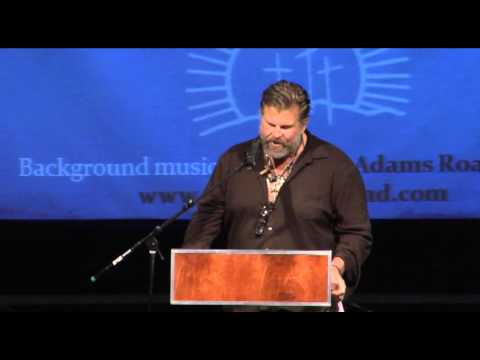
Tearing a page from the Dr. Gene Scott playbook, Shawn McCraney rails from the pulpit against American Evangelicalism at the April 22, 2013 Concerned Christians conference.
(click to watch video)

About the Author
Lowell Johnson
Lowell Johnson was an active Mormon for almost 12 years before realizing, while teaching a Mormon history class for the Oklahoma University LDS Institute, that Mormon history and doctrine was ever evolving. At this time he withdrew from his calling as the Elder’s Quorum President and returned his temple recommend. After investigating other religions, mainly SGI Buddhism, he gave his life to the Jesus of the Bible. He hasn’t regretted his decision ever since. He is a flawed Christian whose head gets in the way of his heart at times, but knows that Jesus is the only way to Eternal Salvation. Thus he is now a soundly saved Ex-Mormon.

This article was originally published on the “The Reflections & Ruminations Of A Soundly Saved Ex-Mormon” website on February 13th, 2014. This updated and expanded edition has been published here with the permission of the author.

Corrections:
As originally published, this article stated that “Like Dr. Scott, Shawn had… exhibited frustrations with the crew when technical difficulties would arise.” Shawn McCraney contacted the author and explained that he uses only technical difficulties for comedic fodder and only mock berates his staff when they arise. The author agrees with this explanation. Therefore, this claim has been deleted from the article. Our apologies to Mr. McCraney for any misunderstanding that it’s original inclusion may have caused. — Editor (2015-12-04)  

BACK TO TOP

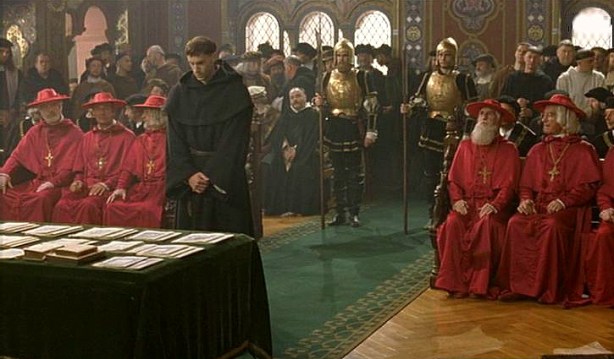
On April 17th 1521, left with only twenty four hours to either recant his body of work or face Church discipline as a heretic – a sentence that meant certain death – Martin Luther found himself looking to God as he stood at the precipice of the greatest transformative movement that the church has seen in the last one thousand years. This was his prayer:

Martin Luther at the Diet of Worms (scene from the 2003 movie

Martin Luther at the Diet of Worms (scene from the movie “Luther”)

Almighty, eternal God! How dreadful is the world! Behold how its mouth opens to swallow me up, and how small is my faith in You!

O the weakness of the flesh and the power of Satan! If I am to depend upon any strength from this world, all is lost. O my God! Help me against all the wisdom of this world. Do this, I beg You.

The work is not mine, but Yours. I have no business here. I have nothing to contend for with these great men of the world! I would gladly pass my days in happiness and peace. But the cause is Yours, my Lord; and it is righteous and everlasting! Stand by me! O faithful and unchangeable God! I lean not upon man. It would be vain!

You have chosen me for this work. I know it! Therefore, O God, accomplish Your own will! Stand by me in the name of Jesus Christ, who will be my shelter and my shield, yes, my mighty fortress, through the might and strengthening of the Holy Spirit.

I am ready, even to lay down my life for this cause, patient as a little lamb. For the cause is holy. It is Your own. Though this world be filled with devils, and though my body, originally the work and creation of Your hands, go to destruction in this cause — yes, though it be shattered into pieces — Your Word and Your Spirit they are good to me still! It concerns only the body. The soul is Yours. It belongs to You and will also remain with You forever. God help me.

Amen.

Grant That I May Not Pray Alone With the Mouth - Martin Luther

by Fred W. Anson
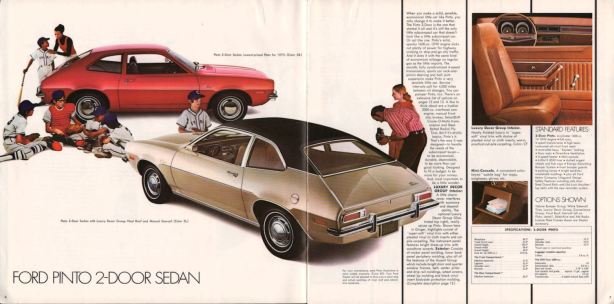
In the response to the infamous Mormon, “if you want to know about Fords, then you don’t ask a Chevrolet dealer,” argument I offer the following:

The callow chestnut of Mormonism that says if you want to know about Fords, then you don’t ask a Chevrolet dealer, and if you want to know about Mormonism, then don’t ask a non-Mormon, is both wrong and lacks critical judgment. Groups like Consumer Reports prove their maxim false. Some of the best information comes from outside investigation (like Ford’s exploding Pinto gas tank), which outside information can be life-saving.
— Kurt Van Gorden, (as cited in “The Mormon Mirage” by Latayne Scott, p.19)

The promise.

The Ford dealer’s version of the truth.

The Ford Pinto fuel tank controversy is really old news now but at the time it was a hot topic – I know I was 17-years old at the time and remember it well. It was common knowledge at the time that Ford and Ford dealers were mum about the problem and would deny it outright if customers asked about it. From the Wikipedia article on the subject:

Controversy followed the Pinto after 1977 allegations that the Pinto’s structural design allowed its fuel tank filler neck to break off and the fuel tank to be punctured in a rear-end collision, resulting in deadly fires from spilled fuel.

Critics alleged that the vehicle’s lack of reinforcing structure between the rear panel and the fuel tank meant the tank would be pushed forward and punctured by the protruding bolts of the differential — making the car less safe than its contemporaries.

According to a 1977 Mother Jones article by Mark Dowie, Ford allegedly was aware of the design flaw, refused to pay for a redesign, and decided it would be cheaper to pay off possible lawsuits. The magazine obtained a cost-benefit analysis that it said Ford had used to compare the cost of repairs (Ford estimated the cost to be $11 per car) against the cost of settlements for deaths, injuries, and vehicle burnouts . The document became known as the Ford Pinto Memo.

An example of a Pinto rear-end accident that led to a lawsuit was the 1972 accident resulted in the court case Grimshaw v. Ford Motor Co., in which the California Court of Appeal for the Fourth Appellate District upheld compensatory damages of $2.5 million and punitive damages of $3.5 million against Ford, partially because Ford had been aware of the design defects before production but had decided against changing the design.

The reality.

The Chevrolet dealer’s version of the truth. (click to see video of a Ford Pinto crash test)

The National Highway Traffic Safety Administration (NHTSA) ultimately directed Ford to recall the Pinto. Initially, the NHTSA did not feel there was sufficient evidence to demand a recall due to incidents of fire. 27 deaths were attributed to Pinto fires (the same number of deaths attributed to a Pinto transmission problem) and in 1974 the NHTSA ruled that the Pinto had no “recallable” problem.

In 1978, Ford initiated a recall providing a plastic protective shield to be dealer-installed between the fuel tank and the differential bolts, another to deflect contact with the right-rear shock absorber, and a new fuel-tank filler neck that extended deeper into the tank and was more resistant to breaking off in a rear-end collision.
(“Ford Pinto Fuel Tank Controversy” Wikipedia article) 

The bottom line is this if you want to know about anything you need to consult outside sources as well as inside sources. And absolutely the best sources are former insiders that are now outsiders. That’s because they know the inside secrets and will share rather than hide them. That’s why in my article, “The Problem of the Mormon Tank (Revisited)”  I stressed this key point:

Internal evidence that hasn’t been validated against external evidence can’t be completely trusted!

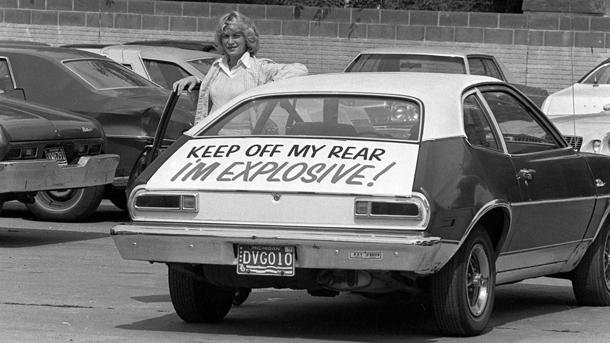
And what’s true of cars is true of churches too: If you’re going to make a decision where the stakes are high you would be wise to take your time, talk to insiders, outsiders, and former insiders – consider as much evidence as possible. The wise person always gathers facts and does their research before they make any major decision. And in the case of the Ford Pinto, it looks like this lady would have been a good source of information!

I'm Explosive

The Consumer Reports version of the truth.

“The Price of Nice” by John Bradshaw

Reviewed by Fred W. Anson

Title: Recovering Agency: The Price of Nice
Author: John Bradshaw
Publisher: John Bradshaw Media Group
Genre: Non-fiction, psychology
Year Published: 2008
Length: 100 minutes
Binding: Audio CD
ISBN10: 1573882259
ISBN13: 978-1573882255
Price: $70.00

Many of us remember John Bradshaw through his two PBS televised series on the family and “Inner Child” therapy (entitled “Bradshaw on the Family” and “Homecoming” respectively) with fondness. Some of us had an epiphany, others had fodder for new jokes, and still others had both. I was in the last category. At first I found in Bradshaw an endless mine for jokes (“My family was so out of control you could have used it for a wind chime”, “My inner child punched your inner child in the nose”, etc.)  but many years and several family traumas later found it to be a rich well of wisdom . . . and some really silly “out there” New Agey junk.  With Bradshaw one has to have one’s discernment filters up to separate the wheat from the chaff. Thankfully the audiobook being reviewed here is, in this reviewer’s estimation, mostly wheat.

Those familiar with those earlier Bradshaw works will remember that he repeatedly introduced the concept of the price of nice in them both. However, he didn’t go into much detail on it, nor did he give the antidote for the problem. “Problem?” the reader may be asking at this point, “How can being nice be a problem?” As the product description from Mr. Bradshaw’s website explains:

“The price is of nice is about your own life, and not really being connected with others,” says noted New York Times Best Selling Author John Bradshaw“Nice people often finish last in many ways.”

In this powerful lecture, THE PRICE OF NICE, psychologist and Emmy nominated talk show host John Bradshaw, exposes the hidden and frequently destructive forces behind the façade of being the “nice guy”, a people pleaser and co-dependent. This lecture is for people who use “nice” as a disguise to cover shame. John Bradshaw uncovers the dishonestly, selfishness, and resentments that builds as a result. He explains how to heal from co-dependency.

From our earliest years, we learn that we are rewarded with acceptance for being “nice” at the expense of being denied the expression of our true feelings or being who we really are. Ultimately, we become the actor in a role of being the nice guy or sweetheart. John Bradshaw explains how such behavior can destroy relationships and intimacy by never being honestly connected with others. It creates an intimacy vacuum where the victim is the nice person

In its ultimate destructive form, it erupts into rage or spontaneous acts of violence or it can be internalized in the form of emotional or physical illness. John Bradshaw offers practical insights into how we can learn to be kind but firmly direct about how we feel and find that place in our lives where we can be who we are. This series provides excellent resources and will help the listener understand how toxic, and potentially dangerous, a person who is, on most levels, “too nice,” can be. Ministers, counselors, therapists and anyone in helping professions could gain much understanding from the material found in this series. The problem with being overly nice is that it is a mask for stored internal rage and it is at the same time rage producing.

And as he explains in the lecture, nice behavior eventually has a price for both the nice person and the people involved with him/her. It is alienating, indirectly hostile, and self destructive because:

1. The nice person tends to create an atmosphere such that others avoid giving honest, genuine feedback. This blocks emotional growth.

2. Nice behavior will ultimately be distrusted by others. That is,it generates a sense of uncertainty and lack of safety in others who can never be sure if they be supported by the nice person in a crisis situation that requires an aggressive confrontation with others.

3. Nice people stifle growth of others. They avoid giving others genuine feedback,and deprive others of a real person to assert against. This tends to force others in the relationship to turn their aggression against themselves. It also tends to generate guilt and depressed feelings in others who are intimately involved and dependent on them.

4. Because of chronic niceness others can never be certain if the relationship with a nice person can endure a conflict or sustain an angry confrontation. If it did occur spontaneously, This places great limits on the potential extent of intimacy in the relationship by placing others constantly on their guard.

5. Nice behavior is not reliable. Periodically the nice person explodes in unexpected rage and those involved are shocked and unprepared to cope with it.

6. The nice person by holding aggression in, may pay a physiological price in the form of psychosomatic problems and a psychological price in the form of alienation.

7. Nice behavior is emotionally unreal behavior. It puts severe limitations on all relationships and the ultimate victim is the nice person him/her self.

Mr. Bradshaw explains in the lecture that the antidote for nice behavior isn’t being mean, it’s being authentic. This can be a scary proposition for those of us who have become accustomed to using “nice” as a defense or coping mechanism. In particular, those recovering from a religious addiction may come to find that the “Be ye nice!” 11th Commandment of far too many of our faith communities has become so embedded in their theology and religious worldview that it’s painful to knead it slowly out of the tangled up knot that they’ve created. Very often from these individuals, we will hear the protest that to not be “nice” isn’t Christlike (or whatever religious terminology that’s used to justify using niceness as a hiding place and aggression suppressant). To those folks I offer this:

800px-El_Greco_016_edited

El Greco, “Christ Driving the Money Changers from the Temple” (circa 1600)

Jesus wasn’t Christ-like
Jesus was incredulous.
He was exasperated.
He was furious.
He insulted.
He ridiculed.
He told of coming judgment.
He exorcised demons.
He said he was God.
He said he had final authority given to him to judge the living and the dead.
He said he had power over life and death.
He scared people.
He confused people.
He repulsed people.
He wouldn’t answer questions asked by the local authorities.
He stayed away three days knowing Lazarus would die, and then wept when he showed up to his tomb.
He supplied the party wine.
He preached fire and brimstone.
He used satire and mockery.
He frustrated his mother.
He told his apostles they had new names when he met them.
He used frustratingly vague metaphors and parables to purposefully judge a stubborn people (fulfilling Isaiah), and then later told the hidden meanings to the apostles.
He chose a forerunner who looked and smelled like a crazy hobo, and who badgered the local mayor over sexual and marital ethics.
He healed people on the Sabbath just to tweak the religious elite.
He monitored financial giving and gave live commentary on it.
He said the world hated him and his followers.
He told people to eat his flesh and drink his blood and let them walk away misinterpreting.
He had incredibly awkward and blunt conversations about spiritual things 15 seconds into meeting a stranger.
He let a presumably sensual woman wipe his feet with her hair.
He told a female stranger that she had five husbands.
He went out to eat with creepy guys who preyed on families via financial extortion.
He went to the most significant religious structure local to him and said he would destroy and rebuild it, speaking of his own body and predicting the destruction to come.
He said he existed before Abraham.
What is “Christ-like” about any of that?[1]

Based on the example of Christ alone I would suggest that Bradshaw is onto something: Christ was always authentic even though He wasn’t always “nice”. I would propose to my fellow recovering religious addicts that it’s far better to be authentically genuine than inauthentically nice. Perhaps being truly Christlike, simply means being yourself – that is the new creation spoken of in 2 Corinthians 5:17 under the guidance and direction of the Holy Spirit. I can’t help but wonder if that was what Paul was really describing in Romans 8 and Galatians 5 when he wrote about “walking in the Spirit”. The incarnated Christ exemplified “walking in the Spirit” and showed the full range of human emotion and behavior – including aggression and directness in that walk.[2] Simply put, the price of nice is too high if it means compromising truly Christlike behavior isn’t it?

In the end, I found “The Price of Nice” to be an enlightening and liberating audiobook – and one with significant biblical support to boot.[3] I suspect that you will too.

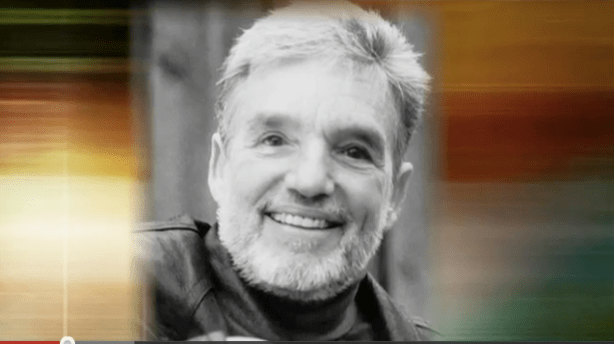
John Bradshaw

John Bradshaw

NOTES:
[1] Aaron Shafovaloff, “Jesus wasn’t Christ-like” And for those wondering this isn’t in the Bradshaw lecture, I’ve added it here to support my point.

[2] I tackled the subject of the biblical case for aggression in my review of Andy Stanley’s book “Enemies of the Heart: Breaking Free from the Four Emotions That Control You” entitled, “Three Hits and a ‘Whiff'”.

[3] For those who are unaware, John Bradshaw was raised Roman Catholic and has a Bachelor’s Degree in Sacred Theology. Due to the rather overt New Age and Post Modern nature of some of his teachings I’m uncertain what where he stands theologically today – though in my opinion, he seems to be leaning toward the old heresy of Christian Pantheism – though I could be wrong.

As I said in the introduction, one must always have one’s discernment filters up to separate the wheat from the chaff when it comes to Bradshaw. I always find an abundant of gems in his work but sometimes I have to push aside some pockets of New Age rubbish to get to it.

BACK TO TOP

trinity_edited

Joy Stained Glass Studio, “The Trinity”

by Rob Bowman
If you do not believe the doctrine of the Trinity, and favor another view yourself, I am going to give you some free advice. I am going to tell you exactly what you need to do in order to defend your non-Trinitarian position as a superior alternative to the Trinitarian view. I know, this is very generous of me, but in the interests of full disclosure I think it only fair to make this information available to the opponents of the doctrine of the Trinity.

1. Refute one or more of the essential propositions of the doctrine of the Trinity.
In my outline study of the biblical basis of the doctrine of the Trinity, I explain that the doctrine is simply a systematization of six core propositions that are all based directly on the teaching of the Bible:

  1. There is one God (i.e., one proper object of religious devotion).
  2. This one God is a single divine being, called Jehovah or Yahweh in the Old Testament (the LORD).
  3. The Father of our Lord Jesus Christ is God, the LORD.
  4. The Son, Jesus Christ, is God, the LORD.
  5. The Holy Spirit is God, the LORD.
  6. The Father, Son, and Holy Spirit are each someone distinct from the other two.

In order to defend an alternative position, you must refute at least one of these premises, or, you must show that all six of these propositions are consistent with another theological position besides the Trinity. I do not think the latter is possible, and in fact I do not know of any non-Trinitarian theology that affirms all six propositions (at least, not without some heavy equivocation). So, for all practical purposes, if you’re going to defend another view in place of the Trinity, you’ll have to refute one of the above premises.

2. Present a clear alternative to the doctrine of the Trinity.
Constantly carping at things about the Trinity that you don’t like, can’t understand, and won’t accept is not enough. You must tell us what we should believe instead. Your position must be specific and cover the same basic issues that are addressed in the doctrine of the Trinity.

3. Identify the religion associated with that alternative to Trinitarian Christianity.
It’s no good telling us that you believe X, Y, and Z instead of the Trinity, if this “alternative” is your own private confection of beliefs. I say this because the true doctrine of God will be held by a community of believers in Jesus Christ—by the church. Theologies do not exist in a vacuum, or in isolation. You are either part of a church that teaches the theology you espouse, or you are picking and choosing what you will believe from others and not committing yourself to a way of life that puts a set of teachings into practice. Jesus Christ said that he would be with his people until the end of the age as they engaged in the work of making disciples, baptizing and teaching them (Matt. 28:19-20). So, what people today are Christ’s people? This question has become acutely relevant in the Internet age, in which many individuals appear to be one-man religions, trolling the Web to attack orthodox Christian beliefs (often loudly and aggressively) but who are unprepared to identify a belief system they accept and a community that represents that belief system.

4. Show that your alternative theology does not suffer from the defects you claim to find in Trinitarianism.
For example:

a. If you criticize the doctrine of the Trinity for developing in the fourth century, identify the religious tradition or movement that predated the fourth century that you think had—and has—the truth.

b. If you criticize the doctrine of the Trinity for its use of extrabiblical language, show that your theology consistently avoids the use of all extrabiblical words. This is much harder than just about all anti-Trinitarians think.

c. If you criticize the doctrine of the Trinity for being influenced by non-Christian philosophy or religion, show that your theology is completely free of such influences. Again, this is easier said than done.

d. If you criticize the doctrine of the Trinity for being difficult to understand, show that your theology is free of anything incoherent, confusing, paradoxical, or mysterious.

5. Demonstrate that your theology explains the full range of biblical information better than the doctrine of the Trinity.
This means showing that your view accounts for a wider range of biblical material, based on sound exegesis of the texts, with a minimum of ad hoc reasoning. In other words, it is not enough to argue that certain textsmight be translated so as to avoid the Trinity, or that other texts need not be interpreted in a Trinitarian fashion. Rather, you must show that your non-Trinitarian view is the best reading of more biblical texts than can be claimed on the Trinitarian side.

Of course, everyone is likely to run into a text or two that is more difficult to cohere with their position, but the right view will have fewer of these difficulties.

Note: All such argumentation will have to contrast the anti-Trinitarian alternative with the doctrine of the Trinity as it is actually taught in serious works of theology, not your own over-simplistic or fractured impression of what the doctrine means.

Good luck!

The Trinity Triangle:

The Trinity Triangle: We believe in the Triune God-Father, Son, and Holy Spirit. This window uses the Latin Pater, Filius, and Spiritus Sanctus (Father, Son, and Holy Spirit) to name the persons in the Trinity. The window explains that the Persons are not (non est) each other, but each is (est) God (Deus).

About the author: 
Rob Bowman is the Executive Director of the Institute for Religious Research (IRR). He has been with IRR since 2008 and is IRR’s Executive Director. Previously he served as Manager of Apologetics & Interfaith Evangelism for the North American Mission Board (2006-2008). For ten years Rob taught graduate courses in apologetics, biblical studies, and religion at Luther Rice University (1994-99) and Biola University (2001-2005). He has also worked with other apologetics and discernment ministries, most notably the Christian Research Institute (1984-91), the Atlanta Christian Apologetics Project (1994-99), and Watchman Fellowship in Alabama (1999-2000). Rob has spoken at over a hundred churches and at some three dozen conferences and debates. He has five years of experience hosting call-in radio talk shows focusing on apologetics, including the nationally famous Bible Answer Man show.

Rob Bowman earned the M.A. in Biblical Studies and Theology from Fuller Theological Seminary, did doctoral studies in Christian Apologetics at Westminster Theological Seminary, and earned his Ph.D. in Biblical Studies at South African Theological Seminary. He is the author of roughly 60 articles (e.g., in the Journal of the Evangelical Theological Society, Review of Biblical Literature, Christian Research Journal, Moody Monthly, Pastoral Renewal, Mission Frontiers, and Journal of Evangelism and Missions) and 13 books pertaining to apologetics, religion, and biblical theology, including two winners of the Gold Medallion Award, An Unchanging Faith in a Changing World (1997) and Faith Has Its Reasons (2001; 2d ed., 2006). His most recent books are Putting Jesus in His Place: The Case for the Deity of Christ (co-authored with Ed Komoszewski, 2007), which received numerous endorsements from such scholars as Ravi Zacharias and Richard Bauckham, and What Mormons Believe (2012).

Rob and his wife, Cathy, have been married since 1981 and have four children, three of them still living at home.
(source: “Who We Are: The People of IRR and What We Are All About”

This article was originally published on the IRR website.
It is reprinted here in accord with IRR’s usage guidelines  and with the author’s expressed permission.