Archive for the ‘Authors’ Category

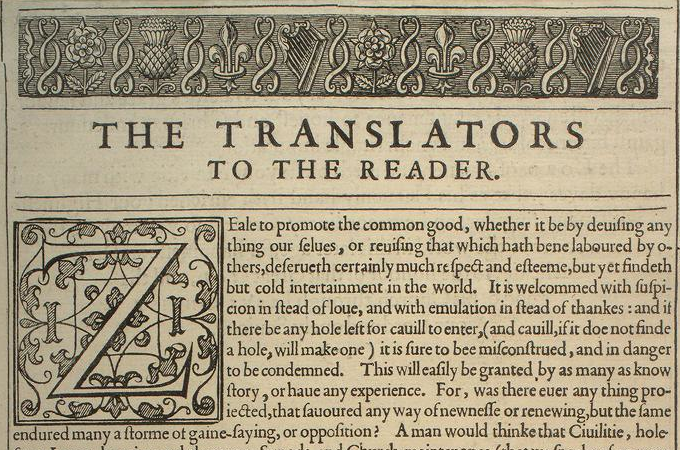
The 1611 Translators Preface to the KJV Bible.

The first page of the eleven page Translators Preface to the 1611 KJV Bible.

An ongoing series of articles on some common and recurring weak arguments that Christians make against Mormonism.

by Fred W. Anson
The Argument:
“Well at least you use the King James Bible – it’s the only true and inspired translation. It alone is God’s Word!”

Why It’s Weak:
This stance is from the “The King James Only Movement” (or “KJV Onlyism” as it will hereby be referred) which, in a nutshell, holds to the stance that the King James Version of the Bible is superior to all other English translations of the Bible and, therefore, the only version that should be used by individual Christians or Christian congregations. KVJ Onlyism also teaches that all other English translations are corrupt, hence the KJV is the only the English Bible that can be trusted.  Some KJV Onlyists even go so far at to teach that the King James Bible is without error and was divinely inspired. Some even teach that if there’s a conflict between what the original language manuscripts say and the KJV says you should choose the latter.

KJV Onlyism is fraught with a multiplicity of problems[1] that get exacerbated and amplified within a Mormon Studies context. And while I will make every attempt to show charity to my KJV Only brothers and sisters in Christ throughout my critique of their stance, I’m still going to be direct and honest about those problems throughout this article.

That said, let me be crystal clear: I love the King James Bible! The KJV was the Bible translation that I grew up with. It’s the Bible that I memorize from. It’s the Bible that I first fell deeply and passionately in love with, and it’s the one that I first read from cover-to-cover (and then read cover-to-cover several more times). To this day the KJV is still the first translation that I turn to first whenever I’m doing research. I also honor and respect it’s unique position and profound influence in the history of the English speaking world. In my opinion, the elegant English of the King James Bible has yet to be matched by any other translation of the Bible.

But objectively speaking, The King James Bible isn’t really God’s Word.  Neither is the New International Version of the Bible, the English Standard Version, the New American Standard, the New Living Translation, the New King James Version, the Common English Bible, the Holman Christian Standard Bible, or even the Reina Valera (which is the topping selling Spanish Bible in the world).
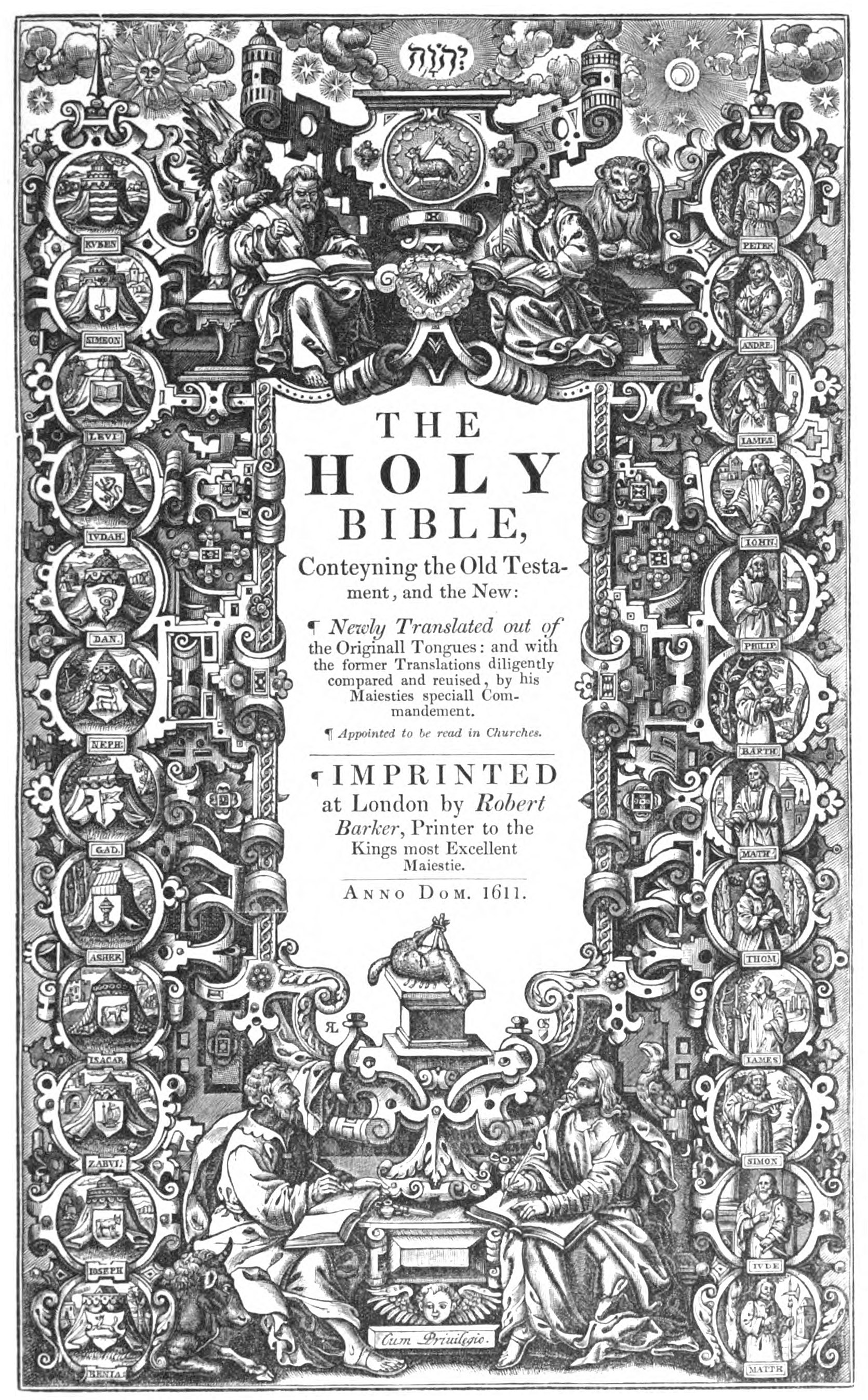
The title page of a 1611 KJV Bible

The title page of a 1611 KJV Bible (click to zoom)

These are all translations of God’s Word.  Therein lies a difference – a big difference!

If one holds to Biblical inerrancy (as the author does) then God’s pure and unadulterated written revelation to mankind is only found in the original handwritten manuscripts that were produced by either the biblical author or their scribes.

These are known as the “autograph” manuscripts (or “autographa”) and none of them have survived.  What’s left are imperfect copies (or, more likely, fragments of copies) that, thankfully, we have in such an abundance that we have been able to reconstruct the autographa with a high degree of certainty.[2] Those reconstructed manuscripts are the closest thing we have to “God’s divinely inspired Word”.  Therefore, a translation is only as authoritative as it accurately reflects those original language reconstructions and they are only as authoritative as they reflect the autographa.

Further, translation is always an interpretative process since no two languages translate precisely word-for-word the same. For example, take a simple Spanish phrase like “¿Qué pasa?” The most common English translation is “What’s happening?” but if you transliterate it word-for-word it would be: “What passing?” So does that mean that the ONLY 100% accurate, true, or correct translation is “What passing?” Clearly, that’s nonsense.

“¿Qué pasa?” can also be translated:  “What’s up?”, “How’s it going?”, “What’s goin’ down?”, or even “Wazzup?” While all these translations are correct Spanish to English translations some are more accurate, some more elegant, others more vernacular, but all are valid translations appropriate to different English speaking contexts and dialects. So if it’s this complex for just a simple two word translation between two living contemporary languages consider how much more so it is going from complete sentences and paragraphs from ancient languages into modern English.

All that to simply say, getting fanatically dogmatic about a translation – any translation – of the Bible is bound to get you in trouble.

1) King James Onlyism is a non-essential of the Christian faith
As previously mentioned in article #4 of this series, focusing on non-essentials weakens our arguments when engaging Mormons:

Mormon Researcher Bill McKeever has a a great saying, “The gospel is offensive enough – let’s make sure we offend Mormons with what really matters!” Arguing from dogma, preferences, and non-essential doctrine dilutes the message to Mormons that really matters.

… strong arguments against Mormonism are always rooted and grounded firmly in the essentials of the Christian faith.  Specifically, strong arguments will always be some variation on the themes we introduced earlier in this article:

1) Mormonism teaches another Jesus.
2) Mormonism teaches another salvation.
3) Mormonism gets Christ’s resurrection mostly right but is still wrong.
4) Mormonism teaches another gospel.
5) Mormonism teaches polytheism.
6) Mormonism follows a false prophet.

Like the notes in a musical theme these six points can be woven into a seemingly endless array of strong, persuasive arguments. Use them skillfully and creatively and your arguments against Mormonism will be as moving as a Mozart symphony. But if you deviate too far from them, we’re talking Spike Jones.[3]

2) King James Onlyism mirrors Mormonism’s irrational, feelings based epistemology.
As Robert C. Newman and Douglas S. Chinn of the Interdisciplinary Biblical Research Institute explain, KJV Onlyism is very “Mormon” behavior:

So, if scholarship is not the ultimate basis for the present TR-KJV [Textus Receptus-King James Version] movement, what is? What kind of non-scholastic methodology is thought to allow God to be the final authority on what constitutes the Bible instead of men? Their answer is FAITH! The same kind of faith that God demands when one believes in Jesus as his Lord and Savior — so they claim. By this method, one can be independent of other men and come to a final conclusion by himself concerning what constitutes the Word of God.

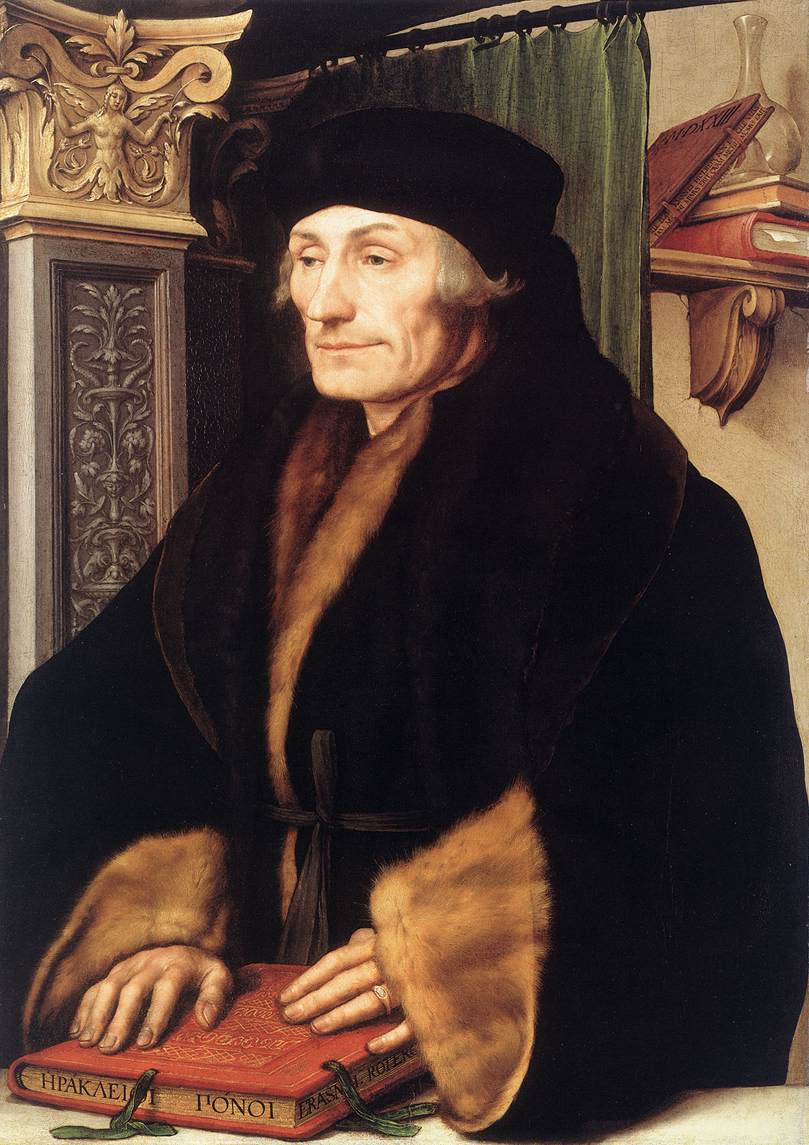
Desiderius Erasmus in 1523 as depicted by Hans Holbein the Younger. Erasmus was responsible for the Textus Receptus.

Dutch humanist and Roman Catholic Priest, Desiderius Erasmus in 1523 as depicted by Hans Holbein the Younger. Erasmus was responsible for the Textus Receptus.

An example of this kind of faith is seen in the following case. When confronted with a difference between the KJV and (say) the NASB [New American Standard Bible], how does one tell which reading is genuine? By the method of scholarship, one would have to study the manuscripts and their history. By the method of “faith,” however, one only has to pray and ask God to reveal to him in some way (without scholarship) which reading is correct. If one has been saved under preaching from the KJV, it is very easy to appeal to one’s personal experience as God’s revealed “proof.” They would say, “I can see the changes that have taken place in my life since I believed what was taught in the KJV. These changes are evidence that God is really working in my life. Therefore, I know that the KJV is the best text without any manuscript evidence.” This methodology, of course, is then later used to defend every word in the KJV text. In our discussions with pro-KJV people, it is not uncommon for them to claim that even the TR [Textus Receptus, the manuscript the KJV New Testament was translated from] can be wrong, but the KJV cannot.

However, is this the kind of “faith” the Bible talks about? Blind faith based on personal experience and independent of other evidence such as manuscripts and history? In I Corinthians 15:14, the Apostle Paul wrote, “And if Christ be not risen, then is our preaching vain, and your faith is also vain.” How does one determine whether Christ has actually risen from the dead? Are not historical and archaeological evidence (using scholarship) for the reliability of Scripture involved? Did not Paul give historical evidence when he told the Corinthians to ask the other Apostles and the five hundred brethren who saw saw the risen Christ (I Co.15:4-7)? Would this not involve some scholarship in determining whether a person actually saw Christ or was lying? Should not every Bible believer be ready to renounce his faith if a grave in Palestine were ever identified unmistakably to contain the remains of Jesus Christ? If not, what would be the difference between that person and a liberal who says that it does not really matter what happened, only what a person believes happened is important?

We fundamentalists sometimes claim that some of the hymns we sing are doctrinally unsound. Is this not the case for that line in the hymn “He Lives” which says “You ask me how I know He lives? He lives within my heart!”? There is more to Biblical faith than belief without objective evidence. If not, then how does one witness to a Mormon?

Present day Mormons claim that scholarship can never prove or disprove that Joseph Smith is a prophet of God or that the Book of Mormon is also the Word of God. That would make other men the final authority on Mormonism, not God. If one should point out some of the abundant evidences against Mormonism, Mormons will usually respond that these problems will eventually be resolved in favor of Mormonism given enough time. The primary evidence for the truth of Mormonism comes from the Holy Spirit working in one’s life, so their claim goes.

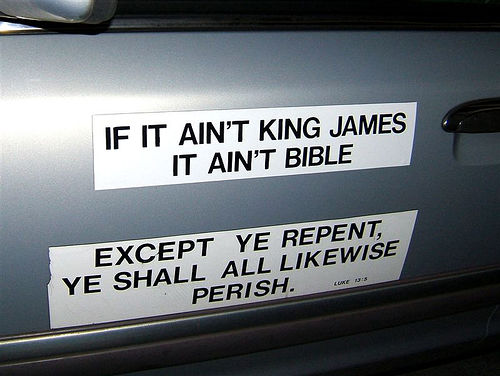
A KJV-Onlyist's car sign leaves little doubt where he stands.

A KJV-Onlyist’s car sign leaves little doubt where he stands.

Prospective converts are first given a presentation of Mormonism. Then they are asked to pray to God and sincerely ask Him to show them by divine revelation whether or not Mormonism is true. By this methodology, many people do indeed become Mormons while others do not. With the passing of time, many converts will be able to give glowing testimonies of the changes God has supposedly wrought in their lives. If one asks why certain people who prayed decided not to become Mormons, Mormons will typically answer that such people must have prayed (at least subconsciously) with an insincere heart. Otherwise, they would have become Mormons! Indeed if the growth of a church is the evidence of God’s blessing the use of a particular text, the Book of Mormon would do well. Mormonism is one of the fastest growing religions in America.

Does the methodology of faith without scholarship produce any more certainty than faith based on scholarship? Has not every person once thought he was certainly right on some issue only to later change his mind and believe he was totally wrong? Is God really the final authority in this methodology? If He is, then why do people become Mormons and claim to have peace and assurance in their times of need? Has not God really been replaced by “leading by feelings” concerning their experiences using the KJV in this methodology of faith without scholarship? Nowhere in the Bible are we taught that the feelings about our experiences, even after sincere prayer, are the voice of God.[4]
Whenever I’ve had discussions with KJV Onlyists I’ve encountered exactly the same type of evidence denial, thought stopping and information control tactics, ad-homineming, testimony bearing, subjectivity, apologetic spin doctoring, and feelings based irrationality that I see in my engagements with Mormons.  Making non-essentials essential is a very Mormon thing to do – and KJV Onlyists in this regard are very Mormon.

3) KJV Onlyism reinforces Mormon Article of Faith Eight dogma.
Joseph Smith’s Article Eight of the canonized Articles of Faith of the Church of Jesus Christ of Latter-day Saints is as follows:

We believe the Bible to be the word of God as far as it is translated correctly; we also believe the Book of Mormon to be the word of God.[5]

Taken at face value, I agree with the first part of Article Eight – the Bible is the word of God as far as it is translated correctly. However, what Joseph Smith’s words actually say and how they’re understood and applied by Mormons are often two different things.  As Robert N. Hullinger observed in his award winning book, “Mormon Answer to Skepticism: Why Joseph Smith Wrote the Book of Mormon”, Joseph Smith’s real agenda from the beginning was to undermine the absolute authority of the Bible and replace it with his own:

“In defense of God, Joseph Smith assailed the natural revelation of deism, which excluded the supernatural, and the static revelation of traditional Christianity contained in a closed canon. But to enable revealed religion to overcome natural religion, Smith supported the deistic attack on the Bible’s being complete and errorless. Rejection of the traditional view left him free to pursue special revelation specific to his own cause.”[6]

Article eight reflects this subtle deviation and Mormon orthopraxy confirms it. So while KJV Onlyists may feel like they’ve had a major break through when they see their Mormon friends smiling and nodding in agreement at their attacks on non-King James translations of the Bible, they’re really just helping to dig the grave that those very same Latter-day Saint will later throw both them and the Bible (including their KJV Bible) into down the road.

Photo Credit: British Library

The Codex Sinaiticus was handwritten well over 1600 years ago. This manuscript contains the entire Christian Bible in Greek, including the oldest complete copy of the New Testament.

4) KJV Onlyism takes the focus off source manuscripts – and in Mormon Studies source manuscripts are a critical issue.
Whenever we’re talking about translated text the source manuscripts are vitally important.  In the case of the Bible they’re important for the all reasons outlined above. In the case of the Book of Mormon they’re important because: a) Not only do we not have the original autographs (that is, the Golden Plates) we have no evidence that they existed at all, and; b) In the case of the extant Book of Mormon manuscripts we have exactly the same type of text variants that Latter-day Saints use to create doubt about the integrity of the Bible.[7] In the case of the Joseph Smith Translation of the Bible (which we’ll discuss later) there is no manuscript support for his revisions to the KJV text. Further, in the case of the Book of Moses, we have no manuscripts to support Joseph Smith’s “translation” – period.  Finally, in the case of the Book of Abraham the autograph manuscripts actually discredit Joseph Smith’s “translation”. When it comes to Mormon Studies, manuscripts are a constant topic of conversation – it never seems to end.

Taking the focus off of the source manuscripts puts the Bible, which has strong manuscript support, on the same level as Mormon scripture which doesn’t.

5) KJV Onlyism eliminates a powerful tool: The appeal to better translations.
By today’s standards the King James bible is a good translation but not a great one.  The King James bible translators didn’t have benefit of  the earliest manuscripts  nor did they have the overwhelming volume of source manuscripts that we have today.[8] Further, the Textus Receptus Greek manuscript that they used was rife with problems.  Many examples could be cited here but I’ll just point to one that’s rather telling:

Perhaps the most ironic part of the pro-TR-KJV [Textus Receptus-King James Verse] position is their use of Revelation 22:18-19:

For I testify unto every man that heareth the words of the prophecy of this book, If any man shall add unto these things, God shall add unto him the plagues that are written in this book; and if any man shall take away from the words of the book of this prophecy, God shall take away his part out of the book of life, and out of the holy city, and from the things which are written in this book.

The point usually made in connection with these verses is that it is a very serious thing for a manuscript to have even one word added, missing, or altered from what God originally inspired. However, the phrase “book of life” in verse 19 is found in no Greek manuscript. Every Greek manuscript has “tree of life.” The phrase “book of life” appears to be an uninspired change imported by Erasmus from the Roman Catholic Latin Vulgate.[9]

From a Mormon Studies perspective, since the King James is the only officially endorsed version of the Bible it’s membership may benefit from it’s strengths but it also gets dragged down by it’s weaknesses. Without the ability to appeal to better, alternate translations of the original languages and manuscripts it’s hard to overcome this.

Consider, for example, how Mormons use the King James mistranslation of the Hebrew words for “copper” or “bronze” (nechushah or nechosheth, see 2 Samuel 22:35Job 20:24Psalm 18:34Jeremiah 15:12) to justify the anachronistic usage of steel in the Book of Mormon (see 1 Nephi 16:18,  1 Nephi 4:92 Nephi 5:15Ether 7:9, Jarom 1:8).  If you hold to the stance that the translation of the KJV Bible was divinely inspired then translations of the Hebrew words as “copper” or “bronze” in modern translations are actually corruptions – right? However, the exact opposite is true – making the KJV Onlyist stance for KJV “steel” just as fallacious as the Mormon Apologist rationalization for steel in the Book of Mormon is.

6) The archaic English of the King James Bible can be hard to understand and lead to misinterpretation.
Has this article left you astonied? Do you suffer from blains? Are you afraid of cockatrices?  Do you do a lot of downsitting? How do you feel about evilfavouredness? Can you help me with a little furbishing?  Does all this Jacobean English leave you vexed?  If so, you’re not alone, most of us find this archaic 17th century dialect confusing. KJV Bible aside, do your remember your first Shakespeare read?  How many trips to the glossary or annotations did that “adventure” take?  Well, that too is Jacobean English – I rest my case.

All languages change and fragment over time, this is nothing new. As Theologian and educator D.A. Carson explains:

Clearly, what is reverent and respectful to one group is stuffy and artificial to another; what is irreverent and disrespectful to one group is a sign of personal relationship and boldness of access to another.

In the first century, books written for the literati were still written in Attic Greek [aka, “Ancient Greek” the posh, formal, scholarly dialect of the time]. Is there something to be learned from the fact that the New Testament documents were written by men who, moved by the Holy Spirit, chose rather the colloquial Hellenistic Greek?

Moreover, there is a decreasing number of people today who can read Elizabethan English and readily understand it. The person brought up on the KJV knows that “deny” in Matthew 26:34 really means “disown”; that “Suffer little children …” really means to permit them to come; that “prevent” in I Thessalonians 4:15 really means “precede.” But not many others do.[10]

Further, the use of archaic language can also lead to gross misinterpretation:

Genesis 1 in a 1611 KJV Bible. (click to zoom)

Genesis 1 in a 1611 KJV Bible.
(click to zoom)

Another problem we need to be aware of in using the King James Version is that the English language has changed. For example, what does the following verse mean?

“And God blessed them, and God said unto them, ‘Be fruitful, and multiply, and replenish the earth, and subdue it: and have dominion over the fish of the sea, and over the fowl of the air, and over every living thing that moveth upon the earth.'” – Genesis 1:28

The word I’m focusing on is “replenish”. We understand this word to mean to replace, or fill, or build up again. In other words, if we replenish the water in a bucket, we are replacing water that used to be there but no longer is.

This makes this verse seem to be saying that the earth was once populated, and Adam & Eve are to fill the earth with people again.

However, at the time the King James Version was translated, the word “replenish” meant to “fill to capacity.” It did not mean to refill. So it had a totally different meaning. Thus in Genesis 1:28 God is telling Adam & Eve to fill the earth to its capacity.[11]

In this author’s opinion that any English Bible that requires a glossary of English words in order to be properly understood by common, modern, native English speakers is best approached with caution.

7) KJV Onlyism reinforces Mormon Great Apostasy dogma.
Most Mormons think, and the LdS Church teaches, that all Christian churches other than theirs are nothing but a big ball of confusion. Watching Christians do their “in house” debating over non-essentials on Mormon discussion boards is what some (but thankfully not all) Mormons live for. I’m an administrator on several Mormon themed discussion boards and I have seen more than one Mormon deliberately bait the King James Onlyists to get them arguing with those who don’t hold to that stance (or vice versa) simply so they can sit back and watch the Christian fur flying and get the heat off of the errors of Mormonism.  They love it because the spatting, hair pulling, caterwauling cat fight the Christians are having in front of a worldwide audience is something that they can point to and (incorrectly) say, “See what I mean? Mormons never bicker like this! We have a living prophet to guide us! We have unity, peace, and serenity in our church! We don’t bicker over  silly little things like Bible translations – our leaders have settled the matter for us. We’re homogenized and boring – and we love it that way!”

Yes, this is really how many Mormons see us!

Yes, this is really how most Mormons see us!

Overall Theologian and Apologist James White summed things up well when he said:

The KJV Only controversy is, in reality, a non-issue when compared with the serious challenges that face the Christian Church today. That so much time and effort has to be put into debunking the wild allegations of such individuals as Gail Riplinger [a writer and speaker known for her support of the King James Only movement] is more of an indication of how easily American Christianity is distracted from its true purpose than anything else.[12]

The Stronger Arguments:
As stated repeatedly in this series, strong arguments against Mormonism are always rooted and grounded firmly in the essentials of the Christian faith. Arguing over a non-essential like which Bible translation that all Christians should be using isn’t even an argument, it’s at the very least a pointless distraction and at the very most it’s a public embarrassment. That said, here are some basic guidelines and suggestions for when you’re discussing those essentials of the faith with Mormons:

When engaging Mormons use the King James Bible but don’t be limited by it:
The KJV Bible is the only translation of the Bible that Latter-day Saint are authorized to use.  As explained in the 2010 Church Handbook of Instruction:

English-speaking members should use the Latter-day Saint edition of the King James Version of the Bible. This edition includes the Topical Guide; footnotes; excerpts from the Joseph Smith Translation; cross-references to other passages in the Bible and to the Book of Mormon, Doctrine and Covenants, and Pearl of Great Price; and other study aids. Although other versions of the Bible may be easier to read, in doctrinal matters, latter-day revelation supports the King James Version in preference to other English translations.[13]

This is further explained in a 1987 Ensign magazine article:

When the Church was organized in 1830, the King James Version (KJV), also known as the Authorized Version, was the translation predominantly used in the English-speaking world. Latter-day Saints relied on it in their meetings, and the Book of Mormon, Doctrine and Covenants, and Pearl of Great Price were written in a style of language similar to that in the KJV.

Joseph Smith also used an 1828 edition of the KJV to prepare an inspired version of the Bible. President J. Reuben Clark lists the Joseph Smith Translation (JST) as one reason the Church uses the KJV:

“For our Church membership, the Authorized Version is to be followed in preference to others because the Inspired Version by the Prophet Joseph Smith [that is, The Joseph Smith Translation of the Bible] agrees with the Authorized Version in those essential particulars where other versions vary.” (Why the King James Version? Salt Lake City: Deseret Book, 1956, pp. 60–61.)[14]
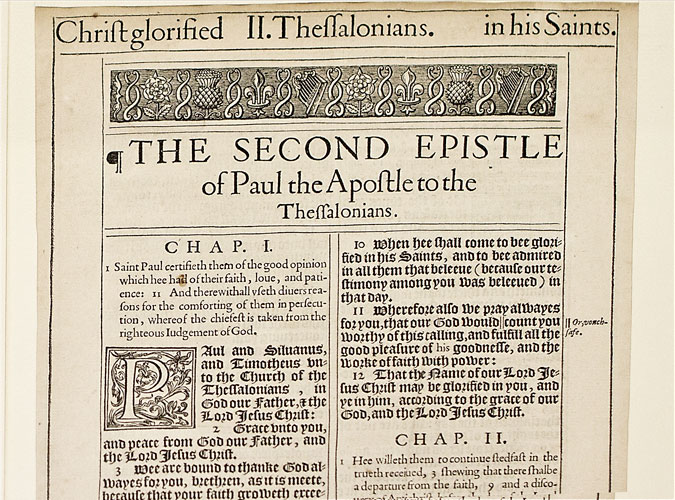
2 Thessalonians from a 1611 KJV Bible. Can you read this? (click to zoom)

2 Thessalonians from a 1611 KJV Bible. Can you read this?
(click to zoom)

So if you want to be heard by Latter-day Saints you must at least start with the King James Bible.  However, as the same Ensign article explains:

Is there any value then for the Latter-day Saint in using modern English translations? Although the Church prefers to continue with the KJV for its English-speaking members, we should not assume that the many other translations are not useful. They oftentimes explain passages that are difficult to understand. In cases of confusing phrases and archaic words, readers can quickly compare the verses with those in other translations. In addition, comparing many different translations will often expand one’s understanding of a particular verse.[15]

So even the LdS Church recognizes the limitations of the KJV and supports considering alternate English translations of the Biblical text. If one is unencumbered by KJV Onlyism this can be a powerful tool in leading Mormons to the true meaning of the biblical text that they or their church have abused or twisted.  That’s the good news! Now for the bad news, The Church Handbook of Instructions also states:

The most reliable way to measure the accuracy of any biblical translation is not by comparing different text, but by comparison with the Book of Mormon and modern-day revelations.[16]

So, the question is, “How do you overcome that?” The answer can be found in the next section.

Better yet, when engaging Mormons use the Joseph Smith Translation (aka “Inspired Version”):
You may have noticed the passing references to the Joseph Smith Translation (also known as “The Inspired Version”) in the LdS Church sources above.  As Mormon Researchers Bill McKeever and Eric Johnson explain:

The LDS Church officially sanctions the King James Version Bible, although church manuals and publications have been increasingly giving more attention to Joseph Smith’s Inspired Version, it “translation” of the Bible he claimed to have “finished” in 1833 (History of the Church of Jesus Christ of Latter–day Saints Salt Lake City: Deseret Book Co., 1973, 1:368: Deseret News 1999-2000 Church Almanac [Salt Lake City: Deseret News, 1981, 483). In the June 1999 edition of the LDS magazine Ensign, Andrew Skinner, department chair of ancient scripture at BYU, apparently agreed with its importance: “In the words of Elder Bruce R. McConkie (1915-85) of the Quorum of the Twelve Apostles, ‘The Joseph Smith Translation, or Inspired Version, is a thousand times over the best Bible now existing on earth.”‘ Skinner went on to say, “The JST is a special gift given of the Lord. It is one of the great evidences of the Prophet Joseph Smith’s divine calling.” Despite such accolades, the LDS Church does not give away copies of the Joseph Smith Translation.[17]

And as LdS Church manuals explain, the Joseph Smith Translation (JST) is considered to be more accurate than the KJV since it was “translated”[18] under the power and inspiration of the Holy Spirit:

While translating the Book of Mormon, Joseph Smith learned that over the years many “plain and most precious” parts of the Bible had been taken away or lost (see 1 Nephi 13:26). The Bible is a sacred book that contains the word of God, but mistakes were made as it was copied and translated into different languages. Words were left out, changed, or added, changing the meaning of some of the scriptures. During the apostasy following Jesus Christ’s death, there were no prophets or apostles to make sure the scriptures were copied and translated correctly. Joseph Smith was instructed to prepare a new translation of the Bible that would restore and correct these plain and precious parts…

Image courtesy of Library-Archives, Community of Christ, Independence, Missouri.

Detail of Joseph Smith Translation Old Testament Manuscript 1, page 19, lines 40–50. The dictated text is in the handwriting of Sidney Rigdon. The subsequent corrections are in the handwriting of Oliver Cowdery. (click to zoom)

In 1830 Joseph Smith began working on a correct translation of the Bible. Sidney Rigdon was his scribe. In preparing this translation of the Bible, Joseph was not translating from an ancient language, as he did with the Book of Mormon, but was restoring the Bible to its original meaning. As Joseph studied and pondered the Bible, he was inspired through the power of the Holy Ghost to correct errors in it.

As Joseph Smith worked on his inspired translation of the Bible, his knowledge of the gospel grew, and he was blessed by the Holy Ghost. Many revelations in the Doctrine and Covenants are answers to questions about statements in the Bible that Joseph did not understand.[19]
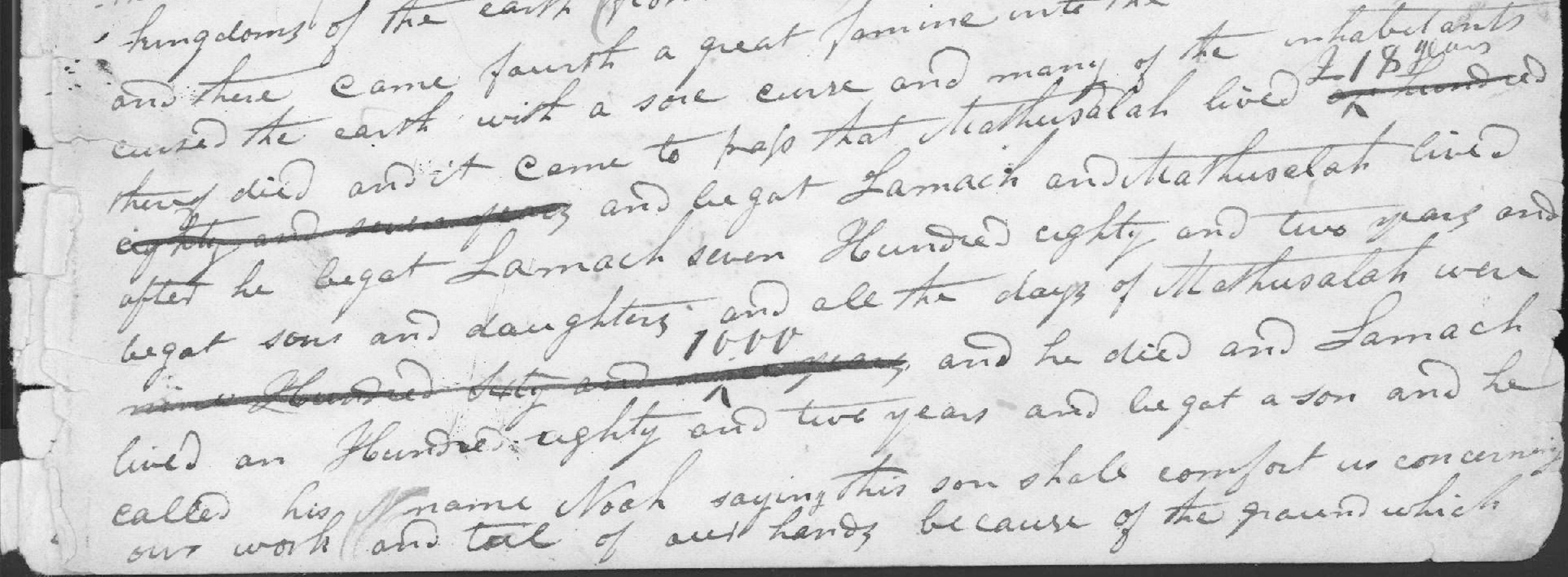
Therefore, when dialoguing with Latter-day Saints it’s actually better to cite from the Joseph Smith Translation of the Bible than the King James because it takes the Articles of Faith, Article 8 “as far as it is translated correctly” weapon out of the Mormon’s hand – the Latter-day Saint presumption is that the Joseph Smith Translation is translated correctly and no other Bible is.

I would also point out to my fellow Evangelicals that Joseph Smith left about 90% of the original KJV text that he was working from intact.  For the remaining 10% that he corrupted I simply switch back to the KJV and use it instead.[20]  So while it’s a bit more work to use the JST, I certainly don’t hear the “that’s not translated correctly!” objection as much as I did back when I was exclusively using the KJV with Mormons.

Oh, and by the way, you can get a copy of the Joseph Smith Translation/Inspired Version right here, right now for free:

Even better yet, take them all the way them back to the Biblical manuscripts:
Charles Larson, in his 2009 ExMormon Foundation address, told the story of how he overcame one Mormon’s Article Eight bias by taking him directly to the source manuscripts and then comparing them to the KJV, the JST, and several modern English translations. The Mormon could see for himself that Article 8 was nonsense – the English Bibles, old and new, were translated correctly relative to their sources.  However, in the case of the JST, he saw that Article Eight was true – there was a huge disconnect between the manuscripts and Smith’s “translation.”  Thus, it became readily apparent from the body of evidence who was telling the truth and who wasn’t. So I thought I would try it, and sure enough, it works.

This is actually easier that you might think, just use an Interlinear.  I prefer this one since it also includes the English transliteration of the original language:
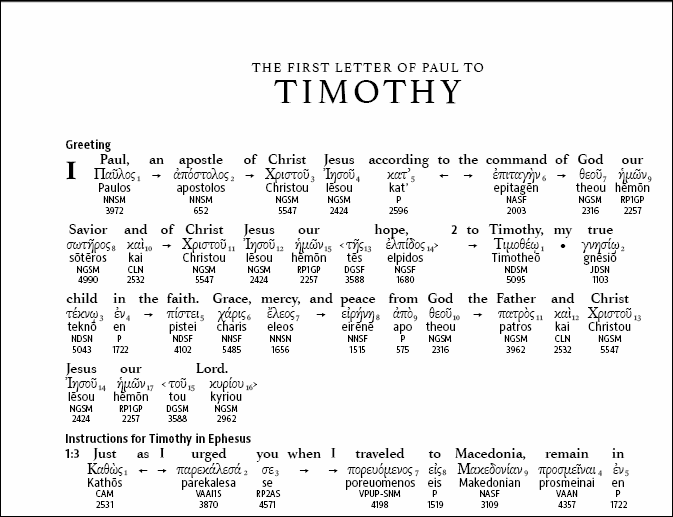
1 Timothy in a Greek Interlinear.

1 Timothy in a Greek Interlinear. (click to zoom)

Scripture 4 All Bible Interlinear
Hebrew Interlinear Bible
Greek Interlinear Bible

This final approach is a lot of heavy lifting so I use it sparingly – typically only for the really hard cases.  However, it works really well.  Of course, all too often when painted into this corner many Mormons will play the, “well Article 8 actually means that the Bible wasn’t transmitted correctly!” and start quoting Bart Ehrman in a, “Bart said it! I believe it! That settles it!” fashion in a last ditch effort in order to find an escape hatch – but that’s yet another article (and a long a complex one to boot) for another day.[21]

Summary and Conclusion:
The KJV Only stance opens up can of worms, after can of worms, after can of worms.  In the end, and after the body of evidence has been examined, KJV Only truth claims don’t hold up to scrutiny any better than Mormon truth claims do. Both belief systems are ultimately irrational and feeling, not fact, based.

So I suppose it should come as no surprise that I have heard more than one Atheist ExMormon state it was extreme “escape from reason” type stances like King James Onlyism on the Christian side of the divide that convinced them that there was no difference between it and Mormonism. In their words, they’re both just two sides to the same fanatical coin. And, frankly, if Mormonism and King Onlyism were the only two things that I’d ever known I might be inclined to agree! In fact, and to open the kimono a bit here, it was the legalistic “escape from reason” Christianity that I experienced as a child that caused me to go atheist in my younger days.

Thankfully, the infinite, personal God revealed in the Bible is bigger than that. The God that I worship delights in His children’s ability to think, reason, question, seek and grow. This is the God who in response to a skeptic’s, “Unless I see the wounds from the nails in his hands, and put my finger into the wounds from the nails, and put my hand into his side, I will never believe it!” bares those wounds and says, “Put your finger here, and examine my hands. Extend your hand and put it into my side. Do not continue in your unbelief, but believe.” (see John 20:24-29, NET Bible).  This is the God who says, “Come now, let us reason together.” (Isaiah 1:18, KJV) not “Shut up, believe and obey!”  The God that I worship doesn’t require new believers to get lobotomies immediately following their baptism. Rather, through the Apostle Paul, He instructs us to, “Test all things; hold fast what is good.” (1 Thessalonians 5:21, NKJV)
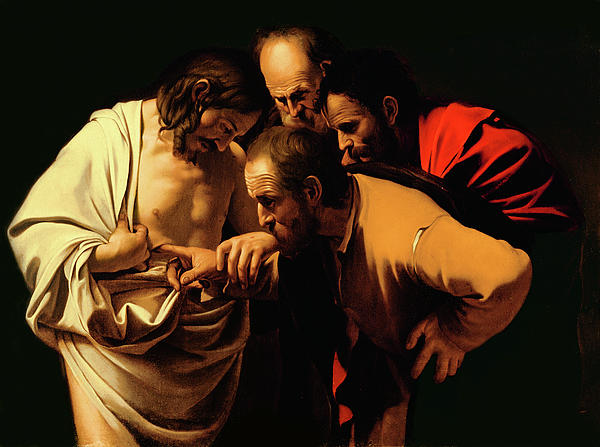
The Incredulity of Saint Thomas by Caravaggio

The Incredulity of Saint Thomas by Caravaggio.

In my opinion, at the core of both the Mormon “follow the prophet” and King James Only dogmas is a self deceptive denial that the world isn’t as simple, easy, or straightforward as we would like it to be.  Thus the deniers try to turn this incredibly complex, often overwhelming life passage into something it’s not: A simplistic melodrama in which everyone is either the faultless and righteous Eliza or the purely evil Simon Legree. A world in which the ne’er do wrong good guys always wear white hats and never miss when they shoot. And, of course, the ne’er do right scheming bad guys in the black hats are out to get ’em one way or another! The orderly world of the deniers is one in which, unless the black hats get in their way, there’s a place for everything and everything is in it’s place.

Rather, we live in a messy, fallen, broken world in which the Biblical New Testament autographa was preserved by massive, unsupervised, dissemination by all God’s people – commoner, priest, and king – who, with the best of intentions and motives; and with as much skill as they could muster, still managed to create a massive jigsaw puzzle for those who followed in their wake to reassemble.  It’s both a blessing and a curse that there are multiple pieces for any given part of the original picture on the box – which oh by the way is long gone. But the good news is that we have so many pieces and clues between pieces that we  can reconstruct the original picture with a high degree of certainty – thank God for that! Oh, and, by the way, we’re still finding new pieces so the reconstruction of the original just keeps getting better and better and better.[22]

In the end, the best we can do is produce the best translations from what we’ve got. And, according to the original 1611 preface that was all the was the only thing the King James Bible translators claimed to do – and nothing more (click here for text, here for photographs, and here for a good summation by a seminarian).

Further, no so-called prophet can sort all this messy complexity out it by simply uttering a “Thus saith the Lord!” waving his hand and then offering up some contrived clarifying set of revelations, divine inspired interpretations, or even a new Bible. The history of Christian cults shows the utter failure of such a proposition. Rather, the sloppy business of daily dependence on God continues for us all until our pilgrimage ends. We must daily love and trust Him heart, mind, soul and strength if we are to live and  finish well – and that’s just as God intended isn’t it? At least that’s what the Bible says. (see Matthew 22:35-40 in any translation)

Now that’s not simple and it’s certainly not easy but it’s what we’ve got – it’s reality, and we should be grateful for it. And when it comes to God’s Word I think that John Ankerberg and John Weldon expressed it well when they said:

Both KJO [King James Only] promoters and those who use modern translations have been more than blessed by God as far as His Word is concerned. They are privileged to have the Word of God more complete than the vast majority of God’s people throughout history.

Abraham and his family did not have the Word of God at all. Moses and the early Israelites had only the first few books of the Bible (the Pentateuch). King David had less than half the Old Testament. Even the apostle Paul had only the Old Testament. Early Christians to the fourth century had only the relatively few copies that were made and circulated in their particular locale. Christians from the fourth through sixteenth centuries had to be content with those few versions that existed prior to the King James—which were usually not even produced in their own language. Christians from the seventeenth to the nineteenth centuries had only the King James Version and a few others. And, until the use of the printing press became widespread the vast majority of believers couldn’t even own a Bible. Copies were simply too expensive—even if they were available. Christians had to rely upon what was heard at church services.

By comparison, Christians of today are immeasurably richer—not only to have the King James translation, but to also have reliable modern versions. All believers should give thanks for the great wealth they do have rather than bickering over relatively minor differences among translations.

If you are a Christian who uses the King James Version—if you understand what you read and are comfortable with it—then by all means continue to use it. If you are a Christian who uses a good modern translation, you should also feel free to continue to use it. Don’t be deterred or intimidated  by those who would tell you that you do not have the true Word of God in your hands.[23]

A final note:
Finally, and in closing, I encourage every reader to learn the history of the English Bible.  That said, and to that end, I can’t recommend the following series of lectures from Dr. Daniel B. Wallace highly enough, it is superb:

And for those who interesting in hearing both sides of the of the KJV Only issue I recommend the following debate:

NOTES
[1]  It’s outside the scope of this article to articulate and deal with all the problems of The King James Only Movement.  Suffice to say, the problems are immense and deep as I found out as I researched this article. For a good overview I would refer the reader to the Wikipedia article (click here) on the movement – which contains links should the reader wish to take a “deeper dive” into the controversy.  Dr. Daniel Wallace’s article, “Why I Do Not Think the King James Bible Is the Best Translation Available Today” is also an excellent primer as is the GotQuestions? article on the subject, “What is the KJV Only movement?”

For those looking for even greater depth, I would recommend the following books:
John Ankerberg; John Weldon, “Facts on King James Only Debate”
Short (54-pages), concise, and direct – an excellent primer.

Robert C. Newman; Douglas S. Chinn, “Demystifying the Controversy over the Textus Receptus & the King James Version” Even shorter (33-pages) but a bit technical. A good next step after Ankerberg and Weldon since it assumes some degree of prior knowledge on the subject.

D. A. Carson, “King James Version Debate, The: A Plea for Realism”
Written in 1978, this was the watershed critique of KJV Onlyism. All other works listed here cite extensive from this book.

James R. White, “The King James Only Controversy: Can You Trust Modern Translations?”
This is a nearly exhaustive treatise on the subject for layman. It’s now considered the definitive critique of KJV Onlyism – even D.A. Carson recommends this book now.

Finally, I would refer the reader to the Preface of the 1611 edition of the King James Version – go directly to the source. 
(click here for text, here for photographs, and here for a good summation by a seminarian).
In the 1611 KJV preface the translators explicitly state that they don’t consider their translation perfect, just an incremental improvement over past translations. They also state that a translation can never be infallible since it’s not exactly like the original manuscripts. They even state that they fully expect better translations to follow theirs since this had been the pattern in English Bible translation since the Reformation. In other words, the KJV translators considered their work to merely be a link in a long chain of good translations, not the final end-all, be-all translation that the KJV Only Movement claims that it is.

[2] As Michael J. Kruger of The Gospel Coalition notes:

“Historically, Christian affirmations of biblical authority are often expressly restricted to the “autographs.” And there are obvious reasons for this view. Biblical authority does not apply to whatever a later scribe might happen to write down—it applies to what the biblical authors actually wrote.

But does the lack of autographs mean such affirmations of biblical authority are meaningless? No, because the authority does not reside in a physical object, but in the original text. And the original text has been preserved in another way, namely through the multiplicity of manuscripts.”
(Michael J. Kruger, “The Difference Between Original Autographs and Original Text”)

Also see: Mark D. Roberts, “Can We Know What the Original Gospel Manuscripts Really Said?”

[3] Fred W. Anson, Weak Arguments #4: “The Bible says that my sectarian, partisan, non-essential doctrine is the only true truth!”

[4] Robert C. Newman; Douglas S. Chinn  (2012-07-20). Demystifying the Controversy over the Textus Receptus & the King James Version (IBRI Research Reports) (Kindle Locations 441-490). Interdisciplinary Biblical Research Institute. Kindle Edition.

[5] The Pearl of Great Price, The Articles of Faith 1:8

[6] Robert N. Hullinger, “Mormon Answer to Skepticism: Why Joseph Smith Wrote the Book of Mormon”, Clayton Publishing House, 1980, p. 150

[7] Royal Skousen is the leading expert on on the extant Book of Mormon manuscripts. In regard to Mr. Skousen’s work on the text variants between the original BoM manuscripts and the published 1830 Book of Mormon, the fly leaf of his book, “The Book of Mormon: The Earliest Text” summarizes nicely:

Over the past twenty-one years, editor Royal Skousen has pored over Joseph Smith’s original manuscripts and identified more than 2,000 textual errors in the 1830 edition. Although most of these discrepancies stem from inadvertent errors in copying and typesetting the text, the Yale edition contains about 600 corrections that have never appeared in any standard edition of the Book of Mormon, and about 250 of them affect the text’s meaning.

In other words, the Book of Mormon has exactly the same kind of manuscript text variants that source Biblical manuscripts do – the same variants that Mormons point to regarding our so-called “compromised” Bible. And proportionally there are more of them relative to the size and scope of the manuscript record.

[8] The KJV New Testament was translated from Desiderius Erasmus‘ Textus Receptus which was the best Greek manuscript reconstruction available at the time.  To compare and contrast, Desiderius Erasmus but had only six Greek manuscripts to work from and they all dated from the 12th Century or later – over 1,000 years after the autographs were authored. Erasmus also lacked a complete copy of the book of Revelation and was forced to translate the last six verses back into Greek from the Latin Vulgate. Further, Erasmus adjusted the text in many places to correspond with readings found in the Vulgate rather than adhering tightly to his source Greek manuscripts.

By comparison, today translators have over 5,800 Greek manuscripts to work from ranging from fragments to complete editions of the New Testament.  And the oldest manuscripts date back to the 2nd Century.

[9] Op Cit, Robert C. Newman; Douglas S. Chinn. (Kindle Locations 414-422)

[10] D.A. Carson, “King James Version Debate, The: A Plea for Realism” (Kindle Locations 1666-1674). Baker Publishing Group. Kindle Edition.

[11] Mission to America website, “Two things Mormons should know about the King James Version.”

[12] James R. White, “The King James Only Controversy: Can You Trust Modern Translations?”, VI-VII

[13] Official LdS Church publication, Church Handbook of Instructions: Handbook 1 Stake Presidents and Bishops, 2010 edition, p.152

[14] Ensign, June 1987, “I Have a Question: With so many English translations of the Bible that are easy to read, why does the Church still use the King James Version?”

[15] Ibid, Ensign

[16] Op Cit, Church Handbook of Instructions, p.153

[17] Bill McKeever; Eric Johnson. “Mormonism 101: Examining the Religion of the Latter-day Saints” (Kindle Locations 3178-3184). Kindle Edition

[18]  The word “translation” is a misnomer since Smith was “translating” from the same language (English to English) rather than from one language to another. Further, in many cases new words were inserted into the text of the Bible based on no source manuscript support at all. As Rob Bowman of the Institute for Religious Research notes:

If there was a “problem” with the New Testament of Joseph’s day it was that it had just a bit more material than was original to those New Testament books. (Scribes almost never deleted anything from the manuscripts they copied, but they sometimes added words or phrases, often in the margins as explanations that later scribes copied as if they were part of the book.) The additional material is insignificant except in two places: the ending of Mark (16:9-20) and the story of the woman caught in adultery (John 7:53-8:11). The consensus of New Testament scholars is that these two passages of a dozen verses each were later additions to the Gospels. And here is something worth noting: in his revisions to the Bible, Joseph did not indicate that either of these two passages should be omitted. In fact, Joseph added some words to the passage about the adulterous woman (in John 8:6).

The LDS view of the “corruption” of the text of the Bible, then, has things exactly backwards. The original text of the books of the Bible has survived with no significant omissions. “Many plain and precious things” were not lost. Instead, scribes added words here or there, and in a couple of places short passages, that were not part of the original text. Joseph Smith’s revision to the Bible consists almost entirely of additions, several of them lengthy, that we can say with reasonable certainty were not part of the original books of the Bible. Furthermore, Joseph failed to identify those two major additions to the New Testament that did not belong.
(Rob Bowman, “The Joseph Smith Translation of the Bible”)

[19] Official LdS Church Manual, “Primary 5: Doctrine and Covenants and Church History: Lesson 20, Joseph Smith Translates the Bible and Other Scriptures” (1997), pp.104–109

[20] This Kindle title makes the process of picking Joseph Smith’s revisions easy by bolding Smith’s additions and including but showing the removals as strike-throughed text:  Kenneth and Lyndell Lutes, “Joseph Smith Translation” [Kindle Edition]   The authors have also included the original KJV chapter and verses numbers – which is a big help when cross referencing against the KJV.

[21] Those interested in the issue of manuscript transmission as it relates to the reliability of the New Testament should consider these articles:  Matt Slick, “Manuscript evidence for superior New Testament reliability”; Greg Koukl, “Is the New Testament Text Reliable?”;  Mark D. Roberts, “Can We Know What the Original Gospel Manuscripts Really Said?”

Those interested in a good, even toned critique of Bart Ehrman and methodologies should consider this article from one of Ehrman’s most well known and long standing colleagues: Ben Witherington, “Misanalyzing Text Criticism–Bart Ehrman’s ‘Misquoting Jesus'”

Also recommended on the subject of critiquing Bart Ehrman’s scholarship and methodology are these debates featuring Mr. Ehrman versus various debate opponents from the British “Unbelievable” radio program:
Unbelievable? 3 Jan 2009 “Misquoting Jesus” Ehrman & Williams
Unbelievable? 16 Apr 2011 – Biblical evidence for the Resurrection – Bart Ehrman & Mike Licona
Unbelievable? 6 Aug 2011 – Bart Ehrman & Darrell Bock on “Forged”

Unbelievable? ‘How Jesus became God’ debate Pt 1 – Bart Ehrman vs Simon Gathercole
Unbelievable? ‘How God became Jesus’ debate Pt 2 – Bart Ehrman & Simon Gathercole

And this Ehrman debate versus James White:

[22] As James White articulated so well on this point:

“When we see how God lead His people to recognize the canon of Scripture, the listing of the books that were inspired over against those books that were not, we note that He did not therein engage in any celestial fireworks. No angels showed up with golden tablets marked, ‘Divine Index’. Instead, God worked with His people over time, leading them to recognize what He had already done through the act of inspiration. Some might wish that it had happened faster, and some might wish for a more spectacular process, but God did it in His way, in His time.

The same is true regarding the protection and preservation of the biblical text. One might well see tremendous divine wisdom in the way God worked over the years. By having the text of the New Testament in particular explode across the known world, ending up in the far-flung corners of the Roman Empire in relatively short order, God protected that text from one thing we, centuries and millennia later, could never detect: wholesale change of doctrine or theology by one particular man or group who had full control over the text at any one point in its history.

You see, because the New Testament books were written at various times and were quickly copied and distributed as soon as they were written, thre was never a time when anyone or any group could gather up all the manuscripts and make extensive changes in the text itself, like cutting out Christ’s deity or inserting some foreign doctrine or concept. Neither could someone gather up the texts and try to make them say the same thing by harmonizing them. If someone had indeed done this, we could never be certain what the apostles had actually written, or what the truth actually is.”
(James R. White, “The King James Only Controversy”, pp.77-78)

[23] John Ankerberg; John Weldon, “Facts on King James Only Debate” (Kindle Locations 816-829). ATRI Publishing. Kindle Edition.

Top of Article Banner Photo: The 1611 Translators Preface to the KJV Bible.

BACK TO TOP

Graphic.OpenBible.16x9_Edited
An ongoing series of articles on some common and recurring weak arguments that Christians make against Mormonism.

by Fred W. Anson
The Argument:
“The Bible says that my sectarian, partisan, non-essential doctrine is the only true truth!”

First A Little Background:
A few years ago I was listening to the audio recordings from a conference that was held in Utah to educate Christians on the differences between Mormonism and Evangelical Christianity. The vast majority of the presentations were given in a non-partisan manner that any Christian – even non-Evangelical Christians – could agree with. That’s because they focused solely on the essential doctrines of the Christian faith or simply on the actual text of the Bible itself.

But then there was this one . . .

While the conference was non-denominational and featured speakers from a number of groups, it was held at a Calvary Chapel. One of the speakers (the wife in a husband and wife team who were members of the host church) gave a presentation that, frankly, had me grinding my teeth. That’s because she would first give the Mormon position on something, then say, “But the Bible says . . . ” and proceed to spew pure Calvary Chapel dogma and jargon (most notably on eschatology and demonology) as if it were absolutely and universally held to by all Christians in the way that she was articulating it.

By the end of the presentation, I was so frustrated by such overt “in yer face” bias that whenever she said, “But the Bible says . . . ” I would just talk over her voice on the recording with my own, “But Calvary Chapel says . . . ”

Now on the essential doctrines of the Christian faith there’s clearly no “wiggle room”. In their case, please dear reader, by all means, say “The Bible says” all you like – I do. However, on the non-essentials isn’t it better to preface our statements with a more gracious and qualified, “As I understand it the Bible says” or “To me the Bible says”? If that dear but sincerely misguided sister had done so, I would have had no issues with her presentation and wouldn’t be using it as an illustration of how not to do it.

Why It’s Weak:
1) It needlessly buries the essential doctrines of Christianity underneath a pile of non-essentials.
Here’s a question for my fellow Christian readers: Do you know what the essential doctrines of the Christian faith are? Do you know what the non-essentials are? If you were asked to do so could you list them? Please don’t feel embarrassed or ashamed if the answer to any or all of these questions is no – I didn’t have a good grasp on them when I entered Mormon Studies.  But boy, oh boy, did I learn them, and learn them fast – I had to in order to survive in this rough and tumble world where acrimony too often reigns supreme!

What was most helpful to me was Theologian Matt Slick’s primer on the subject where he explains:

The Bible itself reveals those doctrines that are essential to the Christian faith.  They are 1) the Deity of Christ, 2) Salvation by Grace, 3) Resurrection of Christ, 4) the gospel, and 5) monotheism.  These are the doctrines the Bible says are necessary.  Though there are many other important doctrines, these five are the ones that are declared by Scripture to be essential. [1]

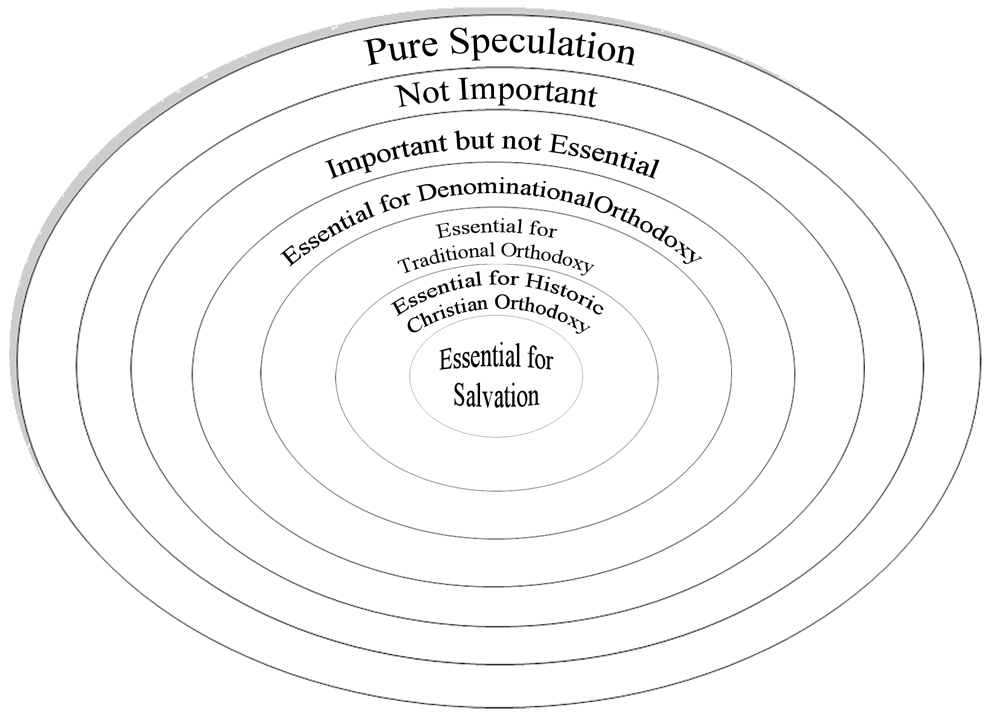
(click for larger view)

Figure A: The Different Types of Essentials and Non-Essentials by C. Michael Patton (click on chart to enlarge)

Once again for emphasis, the essential doctrines of the Christian faith are as follows:

The Essential Doctrines of the Christian Faith
1) The Deity of Jesus Christ.
2) Salvation by Grace.
3) The resurrection of Jesus Christ.
4) The gospel of Jesus Christ, and
5) Monotheism.

On these issues there is – and always has been – unity among Christians. Simply put if you’re not aligned with these Biblical essentials you and/or your group isn’t aligned with orthodox, mainstream, Biblical Christianity. As Mr. Slick goes on to explain, “A non-regenerate person (i.e., Mormon or Jehovah’s Witness, atheist, Muslim), will deny one or more of these essential doctrines.   Please note that there are other derivative doctrines of scripture that become necessary also and the Trinity being one.”[2]

Everything else is non-essential.  As theologian C. Michael Patton’s chart illustrates (see Figure A above) that’s not to say that the non-essentials are unimportant, it’s just to say that the Bible is silent, ambiguous, or unclear on them – or that they’re not essential for salvation.  Therefore, there’s “wiggle room” on them. We’re talking about things like:

  • Eschatology (how and when the end times will unfold, the rapture, the millennium, the role of Israel today, etc.)
  • Earth Age (young v. old earth creationism, etc.)
  • Bible translation preferences (King James v. modern translations, word-for-word v. thought-for-thought, etc.)
  • Ecclesiology (church government models, the roles of clergy and laity, are Apostles and Prophets for today, etc.)
  • Soteriological Systems (Arminianism v. Calvinism, etc.)
  • Demonology (can a Christian have a demon or not, teachings on various kinds of spiritual warfare, etc.)
  • Sacrament practices (wine v. grape juice, leavened v. unleavened bread, who can administer, etc.)
  • Modes of baptism (sprinkling v. full immersion, infant baptism, etc.)
  • Worship styles (liturgical  v. contemporary, hymns v. choruses, choirs, drums v. organs, etc.)
  • The gifts of the Holy Spirit (tongues v. no tongues, cessationism v. continuationism, etc.)
  • Worship observances (Sabbatarianism v. Sunday worship, observance of special holy days, tithing, etc.)
  • Food and drink (consumption of alcohol v. abstinence,  kosher v. non-kosher food, etc.)
  • Various do’s and don’ts (tobacco consumption, playing cards, dancing, makeup, “acceptable” dress, movies, etc.)
  • Etc., etc., etc. This is far from an exhaustive or comprehensive list of Christian non-essentials – it seems endless at times!

On these issues there’s liberty. Christians can and will have legitimate differences of opinion and beliefs on them.  Thus for modern Christians, the words of 17th-century Theologian Rupertus Meldenius still ring true today:

In essentials, unity;
In non-essentials, liberty;
In all things, charity

Or as Christian Theologian C. Michael Patton explains, “I often tell people that there are some things which I believe that I would die for; there are some things which I believe that I would lose an arm for; there are some things which I believe that I would lose a finger for; and then there are some things which I believe that I would not even get a manicure for.”[3]

2) It takes the focus off of the essentials.
Mormon Researcher Bill McKeever has a great saying, “The gospel is offensive enough – let’s make sure we offend Mormons with what really matters!”  Arguing from dogma, preferences, and non-essential doctrine dilutes the message to Mormons that really matters, specifically:

1) Mormonism teaches another Jesus. Jesus Christ wasn’t the procreated son of God. He’s not an exalted man who achieved deification. He is, and always has been, God eternal. (The Deity of Jesus Christ)

2) Mormonism teaches another salvation – specifically that additional works (baptism into a church, temple ordinances, temple marriage, etc.) are all required for full salvation. Rather, the Bible teaches repeatedly that we are saved by grace through faith in the atoning work of Christ on the cross, plus nothing. (Salvation by Grace)

3) Mormonism gets Christ’s resurrection mostly right but is still wrong. Thank you our Mormon friends for getting the resurrection of Jesus Christ mostly right! However, the teaching that Jesus by his resurrection assures immortality in some heavenly kingdom for virtually everyone isn’t biblical, it’s universalist heresy. (The resurrection of Jesus Christ)[4]

4) Mormonism teaches another gospel. Paul told us plainly what the gospel is: “Now, brothers, I want to remind you of the gospel I preached to you, which you received and on which you have taken your stand.  By this gospel, you are saved, if you hold firmly to the word I preached to you.  Otherwise, you have believed in vain.  For what I received I passed on to you as of first importance: that Christ died for our sins according to the Scriptures, that he was buried, that he was raised on the third day according to the Scriptures,”[5] Mormonism requires works in addition to Christ’s atonement (by making observance of laws and ordinances a salvific issue) thus nullifying God’s grace and putting Mormons back under the law. (The gospel of Jesus Christ)

5) Mormonism teaches a form of henotheistic idolatry. The Bible is clear from cover-to-cover that there is one – and only one – eternal being known as God who consists of three co-equal, co-eternal persons.  The Bible does not teach that there is a plurality of gods, be they exalted, deified men or otherwise. In fact, the Bible repeatedly denounces such teaching. (Monotheism)

6) Mormonism follows a false prophet. And of course, since all the errant, unbiblical, and heretical doctrines above were introduced to the world by Joseph Smith, the Christian message to Mormonism has also first and foremost always been:  You’re following a false prophet!  While that’s not directly tied to the essentials of the Christian faith it’s still an important Biblical distinctive[6] and has always been at the core of Christian arguments against Mormonism.

3) Making non-essentials essential is a very Mormon thing to do.
Stop for a moment and consider this:  Mormonism specializes in making molehills into mountains and non-essentials into essentials.  There’s a reason for this: Because systematic theology is impossible in Mormonism, it’s also impossible to distinguish essential doctrines from non-essential doctrines.[7]

To cite just one of many examples let’s consider baptism.  Mormonism is absolute in its belief that getting baptized in the right way, with the right words, by the right person, into the right church is essential for salvation. Consider this from the official LdS Church website:

Baptism by immersion in water by one having authority is the first saving ordinance of the gospel and is necessary for an individual to become a member of The Church of Jesus Christ of Latter-day Saints and to receive eternal salvation. All who seek eternal life must follow the example of the Savior by being baptized and receiving the gift of the Holy Ghost.[8]

In fact, baptism is so critically important in Mormon soteriology that Latter-day Saints make proxy baptism for dead folks (that is, the ones who got it “wrong” while they were alive) a major focus and priority. They consume countless hours and expend untold resources in this effort. Just notice how in the following excerpt from the LdS Church website the criticality of proper baptism for the dead is dogmatically stressed:

Jesus Christ taught that baptism is essential to the salvation of all who have lived on earth (see John 3:5). Many people, however, have died without being baptized. Others were baptized without proper authority. Because God is merciful, He has prepared a way for all people to receive the blessings of baptism. By performing proxy baptisms in behalf of those who have died, Church members offer these blessings to deceased ancestors. Individuals can then choose to accept or reject what has been done in their behalf.[9]

Yet, when one considers the Biblical record, baptism isn’t nearly as cut and dry – or even as vital – as Mormon doctrine makes it:

Requiring anything in addition to faith in Jesus Christ for salvation is a works-based salvation. To add anything to the gospel is to say that Jesus’ death on the cross was not sufficient to purchase our salvation. To say that baptism is necessary for salvation is to say we must add our own good works and obedience to Christ’s death in order to make it sufficient for salvation. Jesus’ death alone paid for our sins (Romans 5:8; 2 Corinthians 5:21). Jesus’ payment for our sins is appropriated to our “account” by faith alone (John 3:16; Acts 16:31; Ephesians 2:8-9). Therefore, baptism is an important step of obedience after salvation but cannot be a requirement for salvation.

Yes, there are some verses that seem to indicate baptism as a requirement for salvation. However, since the Bible so clearly tells us that salvation is received by faith alone (John 3:16; Ephesians 2:8-9; Titus 3:5), there must be a different interpretation of those verses. Scripture does not contradict Scripture. In Bible times, a person who converted from one religion to another was often baptized to identify conversion. Baptism was the means of making a decision public. Those who refused to be baptized were saying they did not truly believe. So, in the minds of the apostles and early disciples, the idea of an un-baptized believer was unheard of. When a person claimed to believe in Christ, yet was ashamed to proclaim his faith in public, it indicated that he did not have true faith.[10]

Trust me, I have very strong opinions on baptism – how it should be done, when it should be done, etc. – and I’m pretty darn certain in my little mind that they’re utterly biblical and totally legitimate. However, I still qualify them as my opinion as such when dealing with Mormons because I understand that other Christians can have equally biblical, equally legitimate positions on baptism.   After all, I would much rather have them focus on what really matters rather than whether someone should be dunked, sprinkled, or doused after they’ve accepted the gospel and made the decision to follow Jesus – wouldn’t you?

4) The argument unravels when and if it’s challenged by Christians who hold to equally valid positions.
This has happened to us all hasn’t it?  On more than one occasion when presenting an argument to a Mormon I’ve glossed poetic giving the logic, reason, and language of my church’s views on a particular non-essential of the faith. I’ve uttered the very words that gets the congregation nodding their heads in agreement and giving a hardy “Amen!” in our church.  I’ve been articulate. I’ve been clever. I’ve been witty.  I’ve been wise. And I’ve rested my case and sat back down smug and self-satisfied only to have some “loser” from another church or group say, “Really?  Well what about . . . ?” and then proceed to present evidence that demonstrates that’s there’s more than one valid view on the matter.  And so there I’ll sit, frowning with egg on my face while I watch while my beautiful and glorious “watertight” argument springs a leak right before my eyes (not to mention a worldwide audience). Yes folks, if humbling experiences build character then I must have a lot of character by now!

Curb Your DogmaIn the end, and to paraphrase and abuse an oft-quoted Mormon colloquialism, “When your pastor has spoken all the thinking hasn’t been done!”  I know you love your pastor – I love mine too; I know you love your church – I love mine too, and; I know you think you’re absolutely, positively right in your theology – so do I.  But the fact remains that on the non-essentials there are a lot of good, thoughtful, valid positions out there. Getting too dogmatic on them will only get you in trouble in the marketplace of ideas and make you unpleasant to be around. If you do it too much, you’ll simply be ignored. And like I said, that egg on the face thing has happened to us all hasn’t it? So, perhaps when it comes to the non-essentials we would all do well to “curb our dogma”.

5) It reinforces the Mormon Great Apostasy dogma.
Most Mormons think, and the LdS Church teaches, that all Christian churches other than theirs are a big ball of confusion. Consider this from the official LdS Church website:

During the Great Apostasy, people were without divine direction from living prophets. Many churches were established, but they did not have priesthood power to lead people to the true knowledge of God the Father and Jesus Christ.[11]

Public bickering in front of Mormons on non-essentials just validates and reinforces this stereotype and prejudice.

Further, watching Christians do their “in house” debating over non-essentials on Mormon discussion boards is what some (manipulative) Mormons live for. I’m an administrator on several Mormon themed discussion boards and I have seen more than one Mormon deliberately bait the Calvinists to get them arguing with the Arminians (or vice versa) simply so they can sit back and watch the Christian fur flying and get the heat off of the errors of Mormonism.  They love it because the spatting, hair pulling, caterwauling cat fight the Christians are giving to a worldwide audience is something that they can point to and (incorrectly) say, “See what I mean? Mormons never bicker like this! We have a living prophet to guide us! We have unity, peace, and serenity in our church! We’re homogenized and boring – and we love it that way!”

The Stronger Arguments:
Normally at this point in the articles in this series, we provide a series of suggested arguments to use instead of the weak argument that was originally presented.  However, this article is really more of an introduction to an overall problem that we see in weak arguments that Christians regularly make – just go onto a Mormon themed discussion board on Facebook after you’re done reading this and within minutes you’ll see what I mean.

Coming articles will echo this article in that we will present some common weak arguments that we’ve seen regularly that fall into the general category of arguing dogmatically over non-essentials.

That said, it should also be said that strong arguments against Mormonism are always rooted and grounded firmly in the essentials of the Christian faith.  Specifically, strong arguments will always be some variation on the themes we introduced earlier in this article:

1) Mormonism teaches another Jesus.
2) Mormonism teaches another salvation.
3) Mormonism gets Christ’s resurrection mostly right but is still wrong.
4) Mormonism teaches another gospel.
5) Mormonism teaches polytheism.
6) Mormonism follows a false prophet.

Like the notes in a musical theme, these six points can be woven into a seemingly endless array of strong, persuasive arguments. Use them skillfully and creatively and your arguments against Mormonism will be as moving as a Mozart symphony. But if you deviate too far from them, we’re talking Spike Jones.

in-essentials-unity-in-non-essentials-liberty-in-all-things-charity-43988

NOTES
[1] Matt Slick, “Essential Doctrines of Christianity”, CARM website. While Mr. Slick’s article is an excellent short vernacular primer, C. Michael Patton’s “Essentials and Non-Essentials in a Nutshell” article is the better resource for those seeking a fuller, more nuanced understanding of the subject. Finally for those who find Mr. Slick’s outline format a bit too cryptic and Mr. Patton’s article too long should consider the short but insightful “What are the essentials of the Christian faith?” article on the “Got Questions?” website instead.

[2] Ibid, Slick

[3] C. Michael Patton, “Essentials and Non-Essentials in a Nutshell”, Credo House website

[4] Yes, Mormonism gets this one mostly right – let’s give some credit where credit is due. Never-the-less, Theologian Rob Bowman of the Institute for Religious Research (IRR) explains how and why Mormonism still manages to get the resurrection of Christ wrong:

According to the LDS Church, Jesus’ death and resurrection guarantees resurrection to immortal life for practically everybody—Christian or not, moral or not—in one of three heavenly kingdoms. (The only exception are the “sons of perdition,” incorrigibly evil people that include some ex-Mormons.) We cannot discuss the three Mormon heavenly kingdoms here, but the Bible is clear that the wicked will be resurrected only to face, in their bodies, their condemnation to eternal punishment (Dan. 12:2; Matt. 10:28; 25:46; John 5:28-29; Acts 24:15). They derive no benefit from Christ’s atoning death. Only the righteous “in Christ”—those who belong to Christ—will be made alive and given immortality (1 Cor. 15:22-23, 53-54).

Finally, although the LDS Church affirms that Jesus ascended bodily into Heaven and will return bodily to the earth one day, it wrongly claims that Jesus has visited the earth bodily on other occasions between his ascension and second coming. The Book of Mormon claims that Jesus visited the Nephites in the Americas several separate times, destroyed whole cities of the wicked, preached to the righteous, and formed a church for them. In the First Vision story, Joseph Smith claimed that Jesus (and God the Father!) appeared personally to him to instruct him to join none of the existing churches. These LDS claims may seem innocent enough, but their significance is that they call into question the sufficiency and, ultimately, the reliability of the New Testament revelations of Jesus Christ.
(Rob Bowman, “The Mormon View of Jesus Christ: The Bottom-Line Guide to Mormonism, Part 5”, IRR website article)

[5] 1 Corinthians 15:1-4 (New International Version)

[6] Please consider Deuteronomy 13:1-5 in light of this which says:

If there arises among you a prophet or a dreamer of dreams, and he gives you a sign or a wonder, and the sign or the wonder comes to pass, of which he spoke to you, saying, ‘Let us go after other gods’—which you have not known—‘and let us serve them,’ you shall not listen to the words of that prophet or that dreamer of dreams, for the Lord your God is testing you to know whether you love the Lord your God with all your heart and with all your soul. You shall walk after the Lord your God and fear Him, and keep His commandments and obey His voice; you shall serve Him and hold fast to Him. But that prophet or that dreamer of dreams shall be put to death, because he has spoken in order to turn you away from the Lord your God, who brought you out of the land of Egypt and redeemed you from the house of bondage, to entice you from the way in which the Lord your God commanded you to walk. So you shall put away the evil from your midst.
(New King James Version)

[7] Systematic Theology is impossible in Mormonism because any established theological system or doctrine within that system can be overturned at any time via a new revelation from the current “Living Prophet”.  The latest example of this is Official Declaration 2 which overturned long standing doctrine which banned Negroes from holding the Mormon Priesthood.  Due to the Mormon doctrine that new continuing revelation from the Mormon god can contradict his past revelation(s) no Mormon doctrine is safe from such potential action. Mormon history is rife with examples which BYU Professor Charles Harrell has done a masterful job of documenting in his two-volume, “This Is My Doctrine” book series. (link to Amazon pages for these titles: Volume 1; Volume 2)

Hence the saying:
“As heresy is, Mormon doctrine once was.
As Mormon doctrine is, heresy will it become.”

[8] Official LdS Church website, “Topics: Baptism”

[9] Official LdS Church website, “Topics: Baptisms for the Dead”

[10] “Got Questions?” website, “Is baptism necessary for salvation?”

[11] Official LdS Church website, “Apostasy”

BACK TO TOP

Mormon Doctrine Large_Edited

An ongoing series of articles on some common and recurring weak arguments that Christians make against Mormonism.

by Bobby Gilpin
The Argument:
“I know what you believe, because Brigham Young, Bruce R. McConkie or some other general authority said…..”

Why It’s Weak:
In making this argument you are assuming the beliefs of an individual you have likely only just met. This is never a good thing to do. If you’re an LDS member with any experience of speaking with Evangelicals, or any other critics of Mormonism before, you have likely had a discussion like this before.

Beheld-Virgin-Bearing-AD

Scenario One
Critic You deny the virgin birth don’t you?
LDS No, as a matter of fact I don’t, please let me explain to you my belief on this.
Critic I don’t need to hear it, I have a great quote from Brigham Young when He says the birth of Christ was as natural as anyone else’s.[1] I know what you guys believe.
LDS As I said that is not my view, would you please let me explain my view on this?

This far from only applies to Brigham Young quotes. Lets try another – one that I have personally experienced and learned from by my mistakes:

Scenario Two
Critic Ah, so you’re a Mormon. Well I think it’s totally heretical that you believe God was once a man.
LDS As a matter of fact I don’t believe that either. As Moroni 8:18 and Psalm 90:2 say, God has always been God.
Critic I ‘m sorry but I think you’re just being dishonest, Joseph Smith taught this in the King Follett Discourse, so you must believe it.
LDS There are some renderings of Joseph Smith’s sermons that seem to suggest this. I’m not too persuaded by them as these are not scripture. Would you please let me explain what I believe.

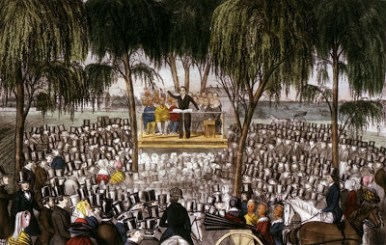
Joseph Smith delivering The King Follett Discourse on April 7, 1844 at Spring General Conference.

Joseph Smith delivering The King Follett Discourse on April 7, 1844 at Spring General Conference.

1) Point One.
We as evangelicals often have this notion that Mormons are all brainwashed and are in some big mind controlling cult, where they all believe the exact same thing – that they would never dream of questioning anything that their leadership says. This is not the case, there is a mass diversity of views within the LDS Church, some people take everything the general authorities say literally, some do not.

It’s always worth bearing this in mind when conversing with LDS people. Some are of the view that if it’s not in the Standard works, then it’s not binding; some may take a lot from the likes of Bruce R. Mcconkie and his book, “Mormon Doctrine”; some may look to James E. Talmage and his writings; some may take closer stock of Gordon B. Hinckley. It often depends on when they grew up or developed their faith.

2) Point Two.
This does not, for a second, take away the validity of your arguments against the teaching of Mormon leaders. What it does mean is that you need to word your argument a little differently. Rather than saying, “I already know what you believe Mr./Ms. Mormon”, instead say: “Here is what your leaders have taught, can we talk about it?”

3) Point Three.
You will inevitably come across the issue of what is official doctrine in the LDS Church. This is a question that no one really has an answer too, LDS or not. And can be a bit of a red herring in discussions. I could not possibly put forward a response to this that’s better than what Keith Walker from Evidence Ministries has done here – this is well worth a watch.

The Stronger Arguments:
First Suggested Strong Argument:
So with all this in mind lets try that first scenario again.

Critic Do you believe that Jesus was born of a virgin?
LDS No, as a matter of fact, I don’t. I affirm what the Bible says that Jesus was born without an earthly parent.
Critic Could you explain what you mean by an earthly parent?
LDS As a latter-day Saint I do not accept the idea that the Holy Ghost somehow “overshadowed” Mary then making her parent – no child is ever born this way. I believe that Jesus was a literal son of His Heavenly Father, and thus in the way that we would usually understand a birth to occur, Jesus was in fact born of a virgin. Bruce R. McConkie said this:

“For our present purposes, suffice it to say that our Lord was born of a virgin, which is fitting and proper, and also natural, since the Father of the Child was an Immortal Being”
(Bruce R. McConkie, The Promised Messiah: The First Coming of Christ, pg. 466)

This sums it up well for me.
Critic Thank you for explaining this. This to me still very much sounds like Jesus was not actually born of a virgin if you are saying that Heavenly Father impregnated Mary naturally.
LDS I guess we define virgin birth differently then, but this is my belief.

(Quick disclaimer: I know this last paragraph does not represent all LDS people – however it will some. It’s more the style of conversation than the content that I am attempting to model here.)

Do you see the difference? Rather than presuming what the Mormon believes, you ask, and then in the ensuing process you get them to tell you their view so you can discuss it from there. More often than not you will still have plenty of places to go with that based what the LDS person says. And sometimes you will even speak with a Mormon who is very “Evangelical savvy” and will give answers that sound identical to your view. That’s where the second stronger argument comes in.

Second Suggested Strong Argument:
While it is not good to make the assumption that Mormons believe something on the basis of a Mormon leader saying it, there is still a lot of ground for discussion on the back of what Mormon leaders have said. Lets try my scenario two again.

Critic Ah so you’re a Mormon, well I think it’s totally heretical that Joseph Smith taught that God was once a man, what is your view on this?
LDS As a matter of fact I don’t believe that. As Moroni 8:18 and Psalm 90:2 say, God has always been God.
Critic I appreciate your response, its good to know that LDS people can look past some of these statements and hold onto the truth about God. But is it not then an issue to you that people who are modern-day Prophets and Apostles are clearly teaching falsehoods about God?
LDS I don’t see LDS leaders as infallible, they are men and sometimes speak as such.
Critic That does not seem to measure up with the teachings of your church. For instance the 2013 LDS Manual, Teachings of Lorenzo Snow, said this:

President Snow later recalled, “the Spirit of the Lord rested mightily upon me—the eyes of my understanding were opened, and I saw as clear as the sun at noonday, with wonder and astonishment, the pathway of God and man. I formed the following couplet which expresses the revelation, as it was shown me. …

“As man now is, God once was:
“As God now is, man may be.”

Feeling that he had received “a sacred communication” that he should guard carefully, Lorenzo Snow did not teach the doctrine publicly until he knew that the Prophet Joseph Smith had taught it. Once he knew the doctrine was public knowledge, he testified of it frequently. [2]

Critic It seems that one of your Prophets saw that as a sacred communication, if he is the one with the authority to speak for your church, and this was reprinted in 2013 by your church, where is your authority to say that this is wrong?
LDS I guess I have no authority to say that this is wrong, I just don’t believe it.
Critic Ok I respect your view, however this seems to be what your church teaches, can we please focus on that as I see some massive issues there.

Dallin H Oaks Tweet

LDS Apostle Dallin H. Oaks’ tweet of September 26, 2014 regarding the upcoming Fall General Conference. (click to zoom)

Again not all LDS people will respond this way. Many LDS people will simply affirm that God was once a man, stop there and go no further. It’s more in LDS apologetic circles today where it’s being completely denied that it ever was or still is doctrine. But the point here is that while an LDS member may not believe what their leaders have taught on an issue, that does not change the massive issue that their leaders have actually taught it or that it’s still taught in current church manuals.

LDS Missionaries all over the world are knocking on doors talking about how amazing it is that they have a Prophet in their church that brings revelation today. So it’s not sufficient for LDS members to simply shrug off their Prophet’s statements past and present in discussion.

The fact is that those prophets have taught so many problematic things – such as Adam being God, black skin being a curse, and so many more issues – that there’s massive ground for discussion. Don’t just assume that the person you are speaking too holds this view, whatever it may be.

In fact, just this week Dallin Oaks of the Quorum of the Twelve Apostles “tweeted” that they only say what the Spirit directs them to say at general conference, that’s well worth noting for these discussions.

So in conclusion there is massive ground for discussion with LDS members. There are so, so many areas that you can discuss with them, challenge them on, and help them to know who Jesus really is and what His grace really means. Just don’t assume because you may have read a book about Mormonism, or read some quotes somewhere that you know where any given Mormon comes from on that issue. Ask where they are coming from and then take it from there.

NOTES
[1] “The birth of the Saviour was as natural as are the births of our children; it was the result of natural action. He partook of flesh and blood – was begotten of his Father, as we were of our fathers” (Brigham Young, July 8, 1860, Journal of Discourses 8:115).

[2] Official LDS Church Manual, “Teaching of the Presidents of the Church”, Chapter 5: The Grand Destiny of the Faithful 

This article originally appeared on the Mormonism Investigated UK website.
Beggar’s Bread wishes to express it’s appreciation to the author and this website for allowing us to republish it here.

BACK TO TOP

RA-Cover-Final-Front-Only-300Reviewed by Richard Packham for the Association for Mormon Letters

Title: Recovering Agency: Lifting the Veil of Mormon Mind Control
Author: Luna Lindsey
Publisher: CreateSpace
Genre: Non-fiction, psychology
Year Published: 2014
Number of Pages: 343
Binding: Soft cover
ISBN10: 1489595937
ISBN13: 978-1500290863
Price: Paperback $24.99, Kindle $9.99

[This review is based on an advance review copy]

This is one of those books that will most likely never be read by the people who most need to read it.

Luna Lindsey is a former Mormon who writes science fiction. She grew up in the LDS church, divorced, raised a son, and left the church in her late twenties. That story is in itself not unusual. Nor is it unusual that a former Mormon would write a book about Mormonism – with the present-day ease of getting a book into print there are hundreds of exmormon exit stories. But this book is not an exit story. Instead, the author writes about the psychological problems when one tries to leave a culture and belief system that promises “free agency,” but effectively prevents adherents from actually using it. Thus, the title: “Recovering Agency.” The purpose of the book is to help people regain the freedom of choice which they unwittingly have lost.

Lindsey has gathered together from dozens of sources a compendium of the techniques used by most organizations (usually religious, but also political) which tend to take over control of more and more aspects of members’ lives. She describes the methods such organizations use to attract new converts, and how the convert gradually becomes more and more enmeshed in the work of furthering the organization’s goals, and gives up more and more of her individuality and freedom in doing so. She has gathered here thousands of quotes from psychiatrists and sociologists who are experts in the field of mind control, as well as reports by former members of such organizations: Unification Church (“Moonies”), Branch Davidians (the Waco cult), People’s Temple (the Jonestown suicides), the Spiritual Rights Foundation (a California Christian cult), the Heavens Gate cult (which committed group suicide to ride a comet to heaven) and, yes, the Church of Jesus Christ of Latter-day Saints.

“Now just wait a goldarn minute!” you are thinking. “Those are cults! The Mormons aren’t a cult!”

Labels (like “cult”) are often not very useful, and all too often function as inefficient shortcuts to conclusions that may be false. That is one of the excellent things about this book. Lindsey does not label, but rather places side-by-side descriptions of similar techniques or practices from many organizations, shows how they affect members in unhealthy and negative ways, and how they are all similar. Including the LDS church. If it quacks like a duck, walks like a duck…

“But those other groups were teaching false doctrine!” you may say. “We Mormons have the Truth, the Only True Church on the face of the earth!” One of the important points Lindsey (and the authorities that she cites) makes is that ALL of those “cults” claimed to be the only source of truth, and their adherents also firmly testified of the miraculous evidence that confirmed their belief.

Another important point made by Lindsey and the experts she cites is that the actual content of the doctrines of mind-control organizations are generally irrelevant to the emotional damage which many of their members suffer. It is rather the methods used to recruit and hold members, and the psychological control that they exert on members.

This book is not the first attempt to deal with the psychological problems of the devout Mormon. Blair Watson published his essay “The Psychological Effects of Mormonism” several years ago ( http://members.shaw.ca/blair_watson ). Marion Stricker wrote “The Pattern of the Double Bind in Mormonism,” appearing first online and later in an expanded book version. But Lindsey’s effort is broader. She relies much more extensively than Watson on similarities with other mind-controlling organizations, and a broader base of experts in psychology and sociology. She also writes more broadly than Stricker, who limited herself to the “double bind” problem. Lindsey spends three chapters on the double bind, but also deals with many more problems and techniques.

The chapter headings indicate the scope of treatment: Cognitive Dissonance, Commitment, Obedience to Authority, Mirror Neurons, Love Bombing, Sacred Science, Mystical Manipulation, Milieu Control, Loading the Language, Thought-terminating Cliches, Black and White Thinking, Indirect Directives, Emotion Over Intellect, Guilt and Shame, and many others.

In each topic, the author quotes statements from leaders of cult-like organizations, statements by LDS general authorities, comments from former cult members and from former Mormons, and analyses by experts in the study of mind control. The juxtaposition is powerful.

The author’s intended audience includes devout Mormons and Mormons who are feeling doubts or unhappiness in Mormonism. Her intent is to help especially those Saints who are hesitant about doubting, by showing them what may be the source of their discomfort. One of the aspects of mind-control is that one subject to it is not aware of it. Cult members universally deny that they are in a cult. Those who have fallen victim most thoroughly to the manipulation of group leaders continue to insist that they are really free to do as they wish, even as their every motion and choice in life is made in obedience to the leaders.

Another intended audience is the non-Mormon reader. For their benefit, the author tries to explain peculiar Mormon terminology and customs. She is not always consistent in this. Frequently she will use a term or mention a name which any Mormon or ex-Mormon would recognize, but would leave a non-Mormon puzzled. This is not a problem for a Mormon reader, of course.

Sometimes a reader might also be confused as to whether it is the author speaking for herself, or whether she is paraphrasing a Mormon voice. Generally, however, she leaves her most personal comments to the end of the chapter, when she offers suggestions to her Mormon readers about how to process that chapter’s information.

As I commented at the beginning of this review, those who really should read this book will likely refuse even to look at it. For starters, the cover is an image of the Salt Lake temple being split apart by lightning. That would be off-putting for any Mormon. And what devout Saint would not immediately deny the implication in the title and subtitle: “I HAVE my free agency! I am NOT a victim of mind control! Ridiculous!”

But if any Mormon, especially one in church leadership, is secure enough in his faith to read this book, there will be benefits, even though the reader retains his faith. He will recognize more clearly what is going on, he will be more aware of the subtle techniques influencing him, just as it benefits any consumer to be knowledgeable about the techniques used by advertisers to increase their sales. To that extent, a reader of this book will indeed recover more of his agency than he had before.

About the Reviewer:
Richard Packham was raised in a fifth-generation Mormon family in Zion, graduated from BYU, married in the temple, and had no doubts about the church until he began studying church history and doctrine intensively in his 20s. His leaving the church cost him his marriage and his three children. His professional career has been as a college teacher (primarily in foreign languages) and attorney. After his retirement, he became active in the Recovery From Mormonism groups, and in 2001 incorporated the Exmormon Foundation. He lives with his never-Mormon wife of forty years on their ranch outside of Roseburg, Oregon. 
Mr. Packham’s website is http://packham.n4m.org
(reviewer biography from the Exmormon Foundation website)

This review originally appeared on the Association of Mormon Letter’s (AML) Discussion Board on August 31, 2014. Beggar’s Bread wishes to express it’s appreciation to Mr. Packham and AML for allowing us to republish it.

AMLLogo

BACK TO TOP

An ongoing series of articles on some common and recurring weak arguments that Christians make against Mormonism.

by Fred W. Anson
The Argument:
“None of the eleven Book of Mormon witnesses ever signed their testimonies.”

Why It’s Weak:
Based on the body of available evidence we don’t really know if the eleven Book of Mormon witnesses ever signed their testimony or not.

Yes, it is true that the signatures on the extant manuscript page that we have for the testimony of the eight and three witnesses were done by Oliver Cowdery. However, that manuscript was “P”, the Printer’s Manuscript, not “O”, the Original Manuscript, which P was copied from.  O was water damaged and almost nearly completely destroyed after being placed in the cornerstone of the Nauvoo House – Joseph Smith’s divinely mandated (see D&C 124:56-83) but never completed boarding house. As Book of Mormon manuscript expert Royal Skousen explains:

The printed versions of the Book of Mormon derive from two manuscripts. The first, called the original manuscript (O), was written by at least three scribes as Joseph Smith translated and dictated. The most important scribe was Oliver Cowdery. This manuscript was begun no later than April 1829 and finished in June 1829.

A copy of the original was then made by Oliver Cowdery and two other scribes. This copy is called the printer’s manuscript (P), since it was the one normally used to set the type for the first (1830) edition of the Book of Mormon. It was begun in July 1829 and finished early in 1830.

Exhibit A: Testimony of Eight Witnesses, late June 1829 Christian Whitmer, Jacob Whitmer, Peter Whitmer Jr., and others, Testimony of Eight Witnesses, Palymra, NY, late June 1829; in Book of Mormon Printer’s Manuscript, p. 464; handwriting of Oliver Cowdery; (credit: Joseph Smith Papers Project)

Exhibit A: Testimony of Eight Witnesses, Palmyra, NY, late June 1829; in Book of Mormon Printer’s Manuscript, p. 464; handwriting of Oliver Cowdery; (credit: Joseph Smith Papers Project)

The printer’s manuscript is not an exact copy of the original manuscript. There are on the average three changes per original manuscript page. These changes appear to be natural scribal errors; there is little or no evidence of conscious editing. Most of the changes are minor, and about one in five produce a discernible difference in meaning. Because they were all relatively minor, most of the errors thus introduced into the text have remained in the printed editions of the Book of Mormon and have not been detected and corrected except by reference to the original manuscript. About twenty of these errors were corrected in the 1981 edition.

The compositor for the 1830 edition added punctuation, paragraphing, and other printing marks to about one-third of the pages of the printer’s manuscript. These same marks appear on one fragment of the original, indicating that it was used at least once in typesetting the 1830 edition.

In preparation for the second (1837) edition, hundreds of grammatical changes and a few textual emendations were made in P. After the publication of this edition, P was retained by Oliver Cowdery. After his death in 1850, his brother-in-law, David Whitmer, kept P until his death in 1888. In 1903 Whitmer’s grandson sold P to the Reorganized Church of Jesus Christ of Latter-day Saints, which owns it today. It is wholly extant except for two lines at the bottom of the first leaf.

The original manuscript was not consulted for the editing of the 1837 edition. However, in producing the 1840 edition, Joseph Smith used O to restore some of its original readings. In October 1841, Joseph Smith placed O in the cornerstone of the Nauvoo House. Over forty years later, Lewis Bidamon, Emma Smith’s second husband, opened the cornerstone and found that water seepage had destroyed most of O. The surviving pages were handed out to various individuals during the 1880s.

Today approximately 25 percent of the text of O survives: 1 Nephi 2 through 2 Nephi 1, with gaps; Alma 22 through Helaman 3, with gaps; and a few other fragments. All but one of the authentic pages and fragments of O are housed in the archives of the LDS Historical Department; one-half of a sheet (from 1 Nephi 14) is owned by the University of Utah.[1]

Again, and to summarize, P was copied from O by Oliver Cowdery and two other scribes to prepare it for the typesetting process. Therefore, it’s only logical and reasonable that the dominant handwriting be his. Further, the portions of O that were destroyed were the first outside and last outside pages (water saturation works from the outside in on books – just like it does on a dry sponge) which included the page (or possibly pages) with the testimonies of the witnesses on it.

Therefore, it’s impossible to know for if the witnesses autographed their respective testimonies on O or not. Hard conclusions either way – no matter how dogmatically or emphatically stated – are nothing more than speculation.

Where Did This Weak Argument Come From?
This argument was practically non-existent until a photograph of the page from the P manuscript with the signatures in Oliver Cowdery’s handwriting was published as a part of the Joseph Smith Papers Project (see Exhibit A above). At that point some Mormon Critics who were unfamiliar with the history of the Book of Manuscripts drew wrong conclusions from the photograph based on the presumption that it was the only Book of Mormon manuscript ever created by Joseph Smith and his colleagues. They then went on to make uninformed, absolutist statements publicly which served only to spread ignorant inference as fact to a worldwide audience.

Further exacerbating the problem was Jeremy T. Runnells’ “Letter to a CES Director” in which he used the following as an argument against the Book of Mormon:

The closest thing we have in existence to an original document of the testimonies of the witnesses is a printer’s manuscript written by Oliver Cowdery. Every witness name on that document is not signed; they are written in Oliver’s own handwriting. Further, there is no testimony from any of the witnesses directly attesting to the direct wording and claims of the manuscript or statements in the Book of Mormon.[2]

MormonInfographics Book of Mormon Witnesses

Exhibit B: MormonInfographics meme with the questionable “Book of Mormon ‘Witnesses’ didn’t even sign their names” headline.

Mr. Runnells’ argument is, at it’s core and presented in it’s entirety, for the most part sound. But again, his point can easily be misunderstood by those who don’t have a full understanding of the manuscript history of the Book of Mormon thus leading to misstatement and wrong conclusions.

For example, after the “Letter to a CES Director” was published a graphic (see Exhibit B) appeared on the MormonInfographics website with the words, “Book of Mormon ‘Witnesses’ didn’t even sign their names” as the headline – that is, as if their missing signatures on the original testimonies were an established and verified fact rather than speculation based on the absence of evidence.

The MormonInfographics meme quickly went viral on social media further disseminating this weak argument.  Further, weakening the argument was the fact that Mr. Runnells overstated his case since Oliver Cowdery’s signature as a Book of Mormon witness on the page is legitimate. This oversight was later corrected in the revised 2014 edition of his “Letter to a CES Director”.[3]

And, as they say, the rest is history – this argument continues to be used by critics despite it’s fragility.

The Stronger Arguments:
When it comes to the Book of Mormon witnesses it often seems like there’s no end to strong, compelling, cogent, persuasive arguments against them and their testimonies to choose from. MormonThink has pages of them (click here) as does the aforementioned “Letter to a CES Director” (click here). And if that’s not enough the “Letter to a CES Director” companion piece “Debunking FAIR’s Debunking” (click here) has yet more.  That said, we offer a small sampling of those arguments for your consideration.

First Suggested Stronger Argument:
Use the fully formed and nuanced argument that Jeremy Runnells uses in “Letter to a CES Director” and “Debunking FAIR’s Debunking” in it’s entirety rather than anything short or cryptic:

From “Letter to a CES Director”:

From a legal perspective, the statements of the testimonies of the Three and Eight witnesses hold no credibility or weight in a court of law as there are a) no signatures, b) no specific dates, c) no specific locations, and d) most of the witnesses made statements after the fact that contradict and cast doubt on the specific claims made in the statements contained in the preface of the Book of Mormon.
(page 61, revised edition)

In discussing the witnesses, we should not overlook the primary accounts of the events they testified to. The official statements published in the Book of Mormon are not dated, signed (we have no record with their signatures), nor is a specific location given for where the events occurred. These are not eleven legally sworn affidavits but rather simple statements pre-written by Joseph Smith with claims of having been signed by three men and another by eight.
(page 62, revised edition)

From “Debunking FAIR’s Debunking”:

[LdS Apologist group] FAIR again misses the point, which is that no original, signed document of the witnesses’ testimonies exists.

We do not have an actual document of actual signatures of the Book of Mormon witnesses. We just have a document, in Oliver’s own handwriting, of the names of the Witnesses. We have a claim that there was a document of actual signatures and a claim that this document was “placed in the cornerstone of the Nauvoo House” and that it was “destroyed by water damage” years later.

We’re asked to put faith in a claim as opposed to being able to observe and analyze actual individual signatures written by actual individual witnesses. Without the original document, of course, there is no way of knowing with certainty whether the witnesses actually signed it. And, as explained below, subsequent accounts of two of the witnesses (Martin Harris and David Whitmer) conflict with key details of the account given in the Book of Mormon.
(link to source)

Second Suggested Stronger Argument:
Instead of using this argument argue that the body of evidence that strongly suggests that the witnesses never physically or tangibly saw or handled the golden plates. Mormon Researcher Bill McKeever explains:

Several LDS sources give the eleven men who bore their testimony to the authenticity of the Book of Mormon the special title of eyewitness; however, it appears doubtful that any of them actually saw the plates apart from a supernatural and subjective experience. While they all claimed to have handled what they were told were ancient plates, they did so while the plates were covered up and not visible. That being case, how is their experience any different from others who also claimed to handle the plates? Such persons include Joseph Smith’s mother, Lucy Mack Smith. Lucy admitted she never saw the plates, but she claimed to have handled what she was told were plates of “pure gold.” As mentioned earlier, Joseph Smith’s wife Emma also claimed that she handled the plates when she moved them to “do her work” in the Smith home, though she insisted that she never uncovered them.

I maintain that if the eleven are called eyewitnesses, why not Lucy and Emma as well? After all, their experiences with what they thought were gold plates are really not much different than that of the eleven. Mormons might find this conclusion troubling since it tends to take away some of the mysterious sensation associated with the accepted folklore, but it is a consistent conclusion when it comes to comparing the experiences of those involved. If Mormons want to insist that a person can’t be considered an eyewitness to the authenticity of the gold plates unless they actually saw them, then there were no eyewitnesses to Joseph Smith’s gold plates.[4]

Third Suggested Stronger Argument:
Compare and contrast how credible testimony should be done versus how it was done in the case of the Book of Mormon Witnesses. Here’s an example of how to present this argument from MormonThink:[5]

If someone was going to have witnesses to some earth-shattering event, and they wanted people to believe them, they would have done it very differently than Joseph did. The whole witnesses’ portion of the BOM would have been much better served if the following things had been done:

  1. None of the witnesses should have been related to Joseph or each other.
    Most of the witnesses were either related or good friends. Having unrelated people as witnesses would be far more effective than using your brothers and father.
  2. The witnesses should not have already been eager believers.
    There should have been some skeptics.
  3. There should have been no financial motive.
    Martin Harris mortgaged his farm and invested at least $3,000 of his own money into printing the Book of Mormon, so of course he had incentive to ‘promote’ the book.
  4. Each of the witnesses should each have written their own testimony instead of merely signing a prepared statement written by Joseph.
    If the prepared document wasn’t 100% accurate many people would simply sign it anyway as it would be too much of a hassle to have it completely rewritten by hand – especially in the 1800s.
  5. The witnesses should have been much more detailed about this amazing event.
    What did the angel look like? What exactly did he say? How did he speak? There are almost no details provided which can be analyzed and compared. If each witness had simply written their own account and provided significant details then their individual testimonies could corroborate each other.
  6. The witnesses should have been interviewed independently immediately after going public.
    They should have been interviewed the same way police do with witnesses to crimes or that investigators do with UFO cases. Ask questions to see if their stories match; How was the angel dressed? How tall was he? How did he speak?, etc.
  7. The witnesses should not have used subjective language and say strange things like comparing seeing the plates with seeing a city through a mountain or using spiritual eyes instead of their natural eyes to view physical plates.
  8. The witnesses should not have been gullible people that believed in things like ‘second sight’, divining rods, finding treasure by placing a rock in a hat, etc.
    That the Three Witnesses were a gullible sort is illustrated by an incident in July, 1837. Joseph had left on a five-week missionary tour to Canada, only to find on his return that all three of the Witnesses had joined a faction opposing him. This faction rallied around a young girl who claimed to be a seeress by virtue of a black stone in which she read the future. David Whitmer, Martin Harris, and Oliver Cowdery all pledged her their loyalty, and Frederick G. Williams, formerly Joseph’s First Counselor, became her scribe. The girl seeress would dance herself into a state of exhaustion, fall to the floor, and burst forth with revelations. (See Lucy Smith: Biographical Sketches, pp. 211-213).
  9. All of the witness should have been much more vocal and been interviewed much more often.
    There are very few interviews done with the witnesses that provide any additional information or corroboration of their statements. You would think that these people, after seeing such a magnificent sight, would spend their time testifying to the world about their experience instead of largely just signing a prepared statement and avoiding interviews by the media. Only three of the eight witnesses made separate statements that they had handled the plates. They were Joseph’s two brothers, Hyrum and Samuel, and John Whitmer.
  10. And of course it would have helped had all the witnesses remained loyal to the Church for the rest of their lives instead of having most of them abandon it later on.
    It doesn’t make much sense to leave the one, true Church of God if you have really received an indisputable witness that it was true. Why would these people risk being cast in Outer Darkness for all eternity for denying what they KNEW to be true unless they maybe had some doubts?
    (link to source)
The "three witnesses" to the Book of Mormon: Oliver Cowdrey, David Whitmer, and Martin Harris

The “three witnesses” to the Book of Mormon: Oliver Cowdrey, David Whitmer, and Martin Harris

NOTES
[1] Royal Skousen, “Book of Mormon Manuscripts”, article in The Encyclopedia of Mormonism, 1992 edition. For those who would like to go deeper on this subject the following video is recommended: Royal Skousen, “The Original and Printer’s Manuscripts”

[2] Jeremy T. Runnells, “Letter to a CES Director” (first edition), p.55

[3] Jeremy T. Runnells, “Letter to a CES Director” (revised edition), p.60

[4] Bill McKeever, “Did the Eleven Witnesses Actually See the Gold Plates?”

[5] Author uncredited, “How should it have been done?”, Mormon Think website

BACK TO TOP

An ongoing series of articles on some common and recurring weak arguments that Christians make against Mormonism.

by Fred W. Anson
The Argument:
“Everyone knows that the Biblical canon is closed – it says so at the very end of the Bible in Revelation 22:18 which says:

I testify unto every man that heareth the words of the prophecy of this book, If any man shall add unto these things, God shall add unto him the plagues that are written in this book

So Joseph Smith willfully defied God’s Word by adding new scripture to a canon of scripture that God said was complete and forever closed!”

Why it’s weak:
1) It’s a misinterpretation of the passage.
As Bill McKeever of Mormon Research Ministry explains:

Revelation 22:18 read in context and carefully is referring solely to itself – not the Bible in it’s entirety and not to any other book of the Bible.  This is clearer when the verse is considered in it’s full context:

I Jesus have sent mine angel to testify unto you these things in the churches. I am the root and the offspring of David, and the bright and morning star.

And the Spirit and the bride say, Come. And let him that heareth say, Come. And let him that is athirst come. And whosoever will, let him take the water of life freely.

For I testify unto every man that heareth the words of the prophecy of this book, If any man shall add unto these things, God shall add unto him the plagues that are written in this book:

And if any man shall take away from the words of the book of this prophecy, God shall take away his part out of the book of life, and out of the holy city, and from the things which are written in this book.

He which testifieth these things saith, Surely I come quickly. Amen. Even so, come, Lord Jesus.

The grace of our Lord Jesus Christ be with you all. Amen.
Revelation 22:16-21 (KJV)  

Notice the use of the terms,  ” the words of the prophecy of this book” and “the words of the book of this prophecy” limiting the conditions exclusively to “this book” and “this prophecy”.  The language of the text itself limits the scope of these conditions to this book of prophecy – that is, the book that we now know as “The Book of Revelation”.

2) It’s location at the close of the Biblical canon isn’t relevant.
The reasoning behind the order of the books of the New Testament  is no mystery:  In the ancient world works of literature were bound by category,  author, and then finally by length from longest to shortest. [1] As John MacArthur’s Grace to You website explains:

The books in the English Bible follow a subject arrangement and are not in the order they were written. The arrangement mirrors that of the Septuagint, a Greek translation of the Old Testament made a few hundred years before Christ…

The New Testament order is also based on subject categories. First come the historical books–the gospels and Acts. Then come the epistles–first those from Paul, then those written by the other writers. Revelation comes at the end.

The early church always grouped the gospels with Matthew first, followed by Mark or Luke, then the gospel of John. It also arranged the Pauline epistles in two categories–first the epistles to the churches, then the personal letters. It typically arranged those epistles according to size or length. The personal letters and general epistles (non-Pauline writings) appear to follow that arrangement–Hebrews first, followed by the writings of James, Peter, John, and Jude. [2]

So, just as the Old Testament Septuagint had the prophetic books at the end, so does the New Testament – it just so happened that there was only one prophetic book. Sure, one can argue that the order of the books were divinely inspired but it too is a weak argument given all the other evidence that contradicts what essentially amounts to nothing more than confirmation bias laden speculation.

3) Using this same tactic, it also be argued that the New Testament is likewise condemned in the Old Testament.
If one applies this same kind of (sloppy, out of context) exegesis consistently then the New Testament is condemned by similar, earlier passages in the Bible:

Ye shall not add unto the word which I command you, neither shall ye diminish ought from it, that ye may keep the commandments of the Lord your God which I command you.
 Deuteronomy 4:2 (KJV) 

What thing soever I command you, observe to do it: thou shalt not add thereto, nor diminish from it.
Deuteronomy 12:32 (KJV) 

Yet, many many books and commandments were added to the Biblical canon afterwards – including most the of the Old, all of the New Testament, and Christ’s new commandments in the gospels.  And like Revelation 22:18 one need only read these verses in context to see why this isn’t a problem – again, these words applied only to the portion of scripture that they were contained in, not the entirety of the Bible.

4) This argument condemns the Apostle John too.
If Revelation 22:18 is applied to the other canonized writings of the Apostle John (the author of the Book of Revelation) then he’s just as guilty as Joseph Smith is.  That’s because the body of evidence demonstrates that the Book of Revelation was the probably first book that John wrote with his gospel and epistles coming later. The approximate timeline is as follows:

The Book of Revelation – circa 68
The Gospel of John – circa 85
The Epistles of John – circa 90-95 [3]

This is because internal evidence in the Book of Revelation would seem to indicate that it was written before 70AD because the Temple in Jerusalem was still standing when it was written:

Revelation 1-11 alludes frequently to the fall of Jerusalem. John is called to measure the temple, without any suggestion that it is destroyed (11:1). Jesus told His disciples that within their generation, not one stone of the temple would be left on top another (Mt. 24:2). The temple was destroyed in A.D. 70 and never rebuilt. Thus, it is evident that Revelation was written before that judgment. [4]

Further, John’s epistles assume that the reader is familiar with material that’s unique to both the Book of Revelation and his gospel narrative:

Many of these themes in 1-3 John are also present in the Gospel of John. The subject of truth and the idea of a commandment of love is prominent in both books, along with the idea that God is light. “Eternal life” is a phrase that occurs with disproportionate frequency in John and 1 John. Common between the Gospel of John and Revelation are the ideas of Christ as the Lamb and the water of life. Christ is described by the Greek word “logos”, meaning “word”, in John 1:1, 14; 1 John 1:1, and Rev 19:13, but nowhere else in the Bible. Only Rev 1:7 and John 19:34 say Jesus was “pierced.” The picture of Christ as a lamb is also prominent in both books. Finally, Rev 1:1-2, “…John, who bore record of the word of God and the testimony of Jesus Christ, and of all things that he saw”, could be read as saying that the author of this book previously wrote the gospel as well. [5]
So if Revelation 22:18 applies to any and all additional scripture after the Book of Revelation was written then the Apostle John is just as condemned by it as Joseph Smith is.

The Stronger Arguments:
There are actually not one, but two stronger Biblical arguments that can be made for rejecting Joseph Smith’s prophetic claims as well as his alleged new scripture.

First Suggested Strong Argument:
Limit the scope of your argument to the Book of Revelation pointing out that in the Joseph Smith Translation of the Bible (JST) Joseph Smith both took away from and added to the Book of Revelation thus blatantly and willfully violating Revelation 22:18.

Remarkably, the LdS Church not only doesn’t deny this fact, it boasts about it:

Acting by the spirit of prophecy and revelation, Joseph Smith corrected portions, but not all, of what is amiss in the King James Version of the Bible. In the book of Revelation corrections, for instance, the angels of the various earthly churches become the servants (presiding officers) of those units. The lamb with seven horns and seven eyes becomes a lamb with 12 eyes and 12 horns, thus perfecting the symbolism to identify Christ and his apostles. Chapter 12 is so revised as to identify the woman as the church of God and the child that she brought forth as the kingdom of our God and of his Christ. And so forth.
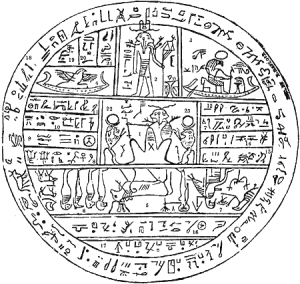
– LdS Apostle Bruce R. McConkie, “Understanding the Book of Revelation” [6]

Appendix A contains a list of the changes that Joseph Smith made to the Book of Revelation in the Joseph Smith Translation.

Second Suggested Strong Argument:
Use other Bible passages instead of Revelation 22:18 and reframe the argument. Mormon Researcher Bill McKeever explains:

…the Bible contains other warnings regarding those who would attempt to put words in God’s mouth. These include Deuteronomy 4:2; “Ye shall not add unto the word which I command you, neither shall ye diminish ought from it, that ye may keep the commandments of the LORD your God which I command you.” And Proverbs 30:6 states “Add thou not unto his words, lest he reprove thee, and thou be found a liar.”

If both passages were strictly speaking to the problem of adding scripture to the canon, it could be argued that nothing should have been written (or accepted) after Moses penned Deuteronomy since it contains the first of such admonitions. In both cases these passages address the temptation for anyone to presumptuously speak for God. God does not take lightly those who would pretend to speak for Him when they were not authorized to do so. In fact, to be found guilty of speaking for God when God did not speak warranted the death penalty according to Deuteronomy 18:20, “But the prophet, which shall presume to speak a word in my name, which I have not commanded him to speak, or that shall speak in the name of other gods, even that prophet shall die.

The real issue lies in whether or not Joseph Smith was really acting as a mouthpiece for the Almighty. Did he truly reflect the mind and will of God by his teachings? Or did he inject his own views into what is today referred to as the “restored gospel”? Since it is obvious that his teachings conflict in many respects with those of the Bible, we must choose the latter.
– Bill McKeever, “Does Revelation 22:18 Condemn the Book of Mormon?”

Another Bible passage that I use in this regard is Deuteronomy 13:1-4 – which I like to cite from the Joseph Smith Translation because: a) It’s identical to the King James Version, and; b) using the Joseph Smith Translation eliminates getting the “it’s not translated correctly” objection from Mormons:

If there arise among you a prophet, or a dreamer of dreams, and giveth thee a sign or a wonder,

And the sign or the wonder come to pass, whereof he spake unto thee, saying, Let us go after other gods, which thou hast not known, and let us serve them;

Thou shalt not hearken unto the words of that prophet, or that dreamer of dreams; for the Lord your God proveth you, to know whether ye love the Lord your God with all your heart and with all your soul.

Ye shall walk after the Lord your God, and fear him, and keep his commandments, and obey his voice, and ye shall serve him, and cleave unto him.
– Deuteronomy 13:1-4 (JST)

And not only did Joseph Smith say, “Let us go after other gods, which thou hast not known, and let us serve them” he actually boasted about it while doing so:

I will prove that the world is wrong, by showing what God is…God himself was once as we are now and is an exalted man, and sits enthroned in yonder heavens! That is the great secret…I am going to tell you how God came to be God. We have imagined and supposed that God was God from all eternity. I will refute that idea, and take away the veil, so that you may see.
– Joseph Smith, “The King Follett Sermon”[7]

I hope that the reader can see that these are much stronger arguments against Joseph Smith’s claim that he was a true prophet of God.  And if you’ve been using the weak argument that has been presented here you’ll consider using these instead.

"Landscape with St John the Evangelist at Patmos" by Gillis Coignet (ca. 1542–1599) from the Hermitage Museum

“Landscape with St John the Evangelist at Patmos” by Gillis Coignet (c. 1542–1599) from the Hermitage Museum

NOTES
[1] This system of arranging literature was called “Stichometry”.

[2] “Why are the books of the Bible in the order they are in? Are they listed chronologically?” Grace to You website, author uncredited

[3] J. W. McGarvey, “A Guide to Bible Study”  Appendix 8: Chronological Order of the Books of the New Testament

[4] Carl W. Bogue, Jr., Th.D., “The Dating of the Book of Revelation”, a full treatise of this subject can found in Ken Gentry’s classic work, “Before Jerusalem Fell: Dating the Book of Revelation”.

[5] Craig Davis, “Dating the New Testament”, The Gospel of John, the Letters of 1, 2 and 3 John, and Revelation. Note: While Mr. Davis presumes that the Gospel of John was written prior to the Book of Revelation, this isn’t entirely clear from the text of either book.  However, what is clear from the internal evidence is that John’s epistles were written last – after both John’s gospel and the Book of Revelation.

[6] Bruce R. McConkie, “Understanding the Book of Revelation”, Ensign, September 1975. What Mr. McConkie failed to mention here is that Joseph Smith had absolutely no manuscript support – or verifiable support of any kind for that matter – for his changes while the King James translators remained faithful to the source manuscripts they translated from.  A fuller explanation and analysis of Joseph Smith’s translation of the Bible can be found on the Mormon Think (click here) and Mormon Research Ministry (click here) websites.

[7] Joseph Smith, “The King Follett Sermon”, Ensign, April 1971; also see “Teachings of the Prophet Joseph Smith”, p.345

Appendix A: Changes that Joseph Smith made to the Book of Revelation in the Joseph Smith Translation of the Bible (JST)
The changes from the King James Version (KJV) of the Bible are italicized in their JST equivalents.

Rev 1:1-8
John received a revelation from Jesus Christ and delivered it to the leaders over the seven churches in Asia rather than the book being a revelation of Jesus Christ. 

JST
1 The Revelation of John, a servant of God, which was given unto him of Jesus Christ, to show unto his servants things which must shortly come to pass, that he sent and signified by his angel unto his servant John,

Who bore record of the word of God, and of the testimony of Jesus Christ, and of all things that he saw.

Blessed are they who read, and they who hear and understand the words of this prophecy, and keep those things which are written therein, for the time of the coming of the Lord draweth nigh.

Now this is the testimony of John to the seven servants who are overthe seven churches in Asia. Grace unto you, and peace from him who is, and who was, and who is to come; who hath sent forth his angel frombefore his throne, to testify unto those who are the seven servants over the seven churches.

Therefore, I, John, the faithful witness, bear record of the things which were delivered me of the angel, and from Jesus Christ the first begotten of the dead, and the Prince of the kings of the earth.

And unto him who loved us, be glory; who washed us from our sins in his own blood, and hath made us kings and priests unto God, his Father. To him be glory and dominion, forever and ever. Amen.

For behold, he cometh in the clouds with ten thousands of his saints in the kingdom, clothed with the glory of his Father. And every eye shall see him; and they who pierced him, and all kindreds of the earth shall wail because of him. Even so, Amen.

For he saith, I am Alpha and Omega, the beginning and the ending, the Lord, who is, and who was, and who is to come, the Almighty.

KJV
The Revelation of Jesus Christ, which God gave unto him, to shew unto his servants things which must shortly come to pass; and he sent and signified it by his angel unto his servant John:

Who bare record of the word of God, and of the testimony of Jesus Christ, and of all things that he saw.

Blessed is he that readeth, and they that hear the words of this prophecy, and keep those things which are written therein: for the time is at hand.

John to the seven churches which are in Asia: Grace be unto you, and peace, from him which is, and which was, and which is to come; and from the seven Spirits which are before his throne;

And from Jesus Christ, who is the faithful witness, and the first begotten of the dead, and the prince of the kings of the earth. Unto him that loved us, and washed us from our sins in his own blood,

And hath made us kings and priests unto God and his Father; to him be glory and dominion for ever and ever. Amen.

Behold, he cometh with clouds; and every eye shall see him, and they also which pierced him: and all kindreds of the earth shall wail because of him. Even so, Amen.

I am Alpha and Omega, the beginning and the ending, saith the Lord, which is, and which was, and which is to come, the Almighty.

Rev. 1:16, 20
The seven stars in the Savior’s hand are actually leaders of the seven churches rather than their angels.

JST
16 And he had in his right hand seven stars; and out of his mouth went a sharp two-edged sword; and his countenance was as the sun shining in his strength.

20 This is the mystery of the seven stars which thou sawest in my right hand, and the seven golden candlesticks. The seven stars are the servants of the seven churches; and the seven candlesticks which thou sawest are the seven churches.

KJV
16 And he had in his right hand seven stars: and out of his mouth went a sharp twoedged sword: and his countenance was as the sun shineth in his strength.

20 The mystery of the seven stars which thou sawest in my right hand, and the seven golden candlesticks. The seven stars are the angels of the seven churches: and the seven candlesticks which thou sawest are the seven churches.

Rev. 2: 22
Jezebel and the wicked will be cast into hell rather than into a bed.

JST
22 Behold, I will cast her into hell, and them that commit adultery with her into great tribulation, except they repent of their deeds.

KJV
22 Behold, I will cast her into a bed, and them that commit adultery with her into great tribulation, except they repent of their deeds.

Rev. 2:26–27
Several changes and additions made

JST
26 And to him who overcometh, and keepeth my commandments unto the end, will I give power over many kingdoms;

27 And he shall rule them with the word of God; and they shall be in his hands as the vessels of clay in the hands of a potter; and he shall govern them by faith, with equity and justice, even as I received of my Father.

KJV
26 And he that overcometh, and keepeth my works unto the end, to him will I give power over the nations:

27 And he shall rule them with a rod of iron; as the vessels of a potter shall they be broken to shivers: even as I received of my Father.

Rev. 5:6
Twelve servants of God are sent to all the earth rather than seven Spirits of God. 

JST
6 And I beheld, and, lo, in the midst of the throne and of the four beasts, and in the midst of the elders, stood a Lamb as it had been slain, having twelve horns and twelve eyes, which are the twelve servants of God, sent forth into all the earth.

KJV
And I beheld, and, lo, in the midst of the throne and of the four beasts, and in the midst of the elders, stood a Lamb as it had been slain, having seven horns and seven eyes, which are the seven Spirits of God sent forth into all the earth.

Rev. 12:1—17
Several changes and additions, including a reordering of verses. The woman and the man represent the kingdom of God and the Church of Jesus Christ.

JST
And there appeared a great sign in heaven, in the likeness of things on the earth; a woman clothed with the sun, and the moon under her feet, and upon her head a crown of twelve stars.

And the woman being with child, cried, travailing in birth, and pained to be delivered.

And she brought forth a man child, who was to rule all nations with a rod of iron; and her child was caught up unto God and his throne.

And there appeared another sign in heaven; and behold, a great red dragon, having seven heads and ten horns, and seven crowns upon his heads. And his tail drew the third part of the stars of heaven, and did cast them to the earth. And the dragon stood before the woman which was delivered, ready to devour her child after it was born.

And the woman fled into the wilderness, where she had a place prepared of God, that they should feed her there a thousand two hundred and threescore years.

And there was war in heaven; Michael and his angels fought against the dragon; and the dragon and his angels fought against Michael;

And the dragon prevailed not against Michael, neither the child, nor the woman which was the church of God, who had been delivered of her pains, and brought forth the kingdom of our God and his Christ.

Neither was there place found in heaven for the great dragon, who was cast out; that old serpent called the devil, and also called Satan, which deceiveth the whole world; he was cast out into the earth; and his angels were cast out with him.

And I heard a loud voice saying in heaven, Now is come salvation, and strength, and the kingdom of our God, and the power of his Christ;

10 For the accuser of our brethren is cast down, which accused them before our God day and night.

11 For they have overcome him by the blood of the Lamb, and by the word of their testimony; for they loved not their own lives, but kept the testimony even unto death. Therefore, rejoice O heavens, and ye that dwell in them.

12 And after these things I heard another voice saying, Woe to the inhabiters of the earth, yea, and they who dwell upon the islands of the sea! for the devil is come down unto you, having great wrath, because he knoweth that he hath but a short time.

13 For when the dragon saw that he was cast unto the earth, he persecuted the woman which brought forth the man-child.

14 Therefore, to the woman were given two wings of a great eagle, that she might flee into the wilderness, into her place, where she is nourished for a time, and times, and half a time, from the face of the serpent.

15 And the serpent casteth out of his mouth water as a flood after the woman, that he might cause her to be carried away of the flood.

16 And the earth helpeth the woman, and the earth openeth her mouth, and swalloweth up the flood which the dragon casteth out of his mouth.

17 Therefore, the dragon was wroth with the woman, and went to make war with the remnant of her seed, which keep the commandments of God, and have the testimony of Jesus Christ.

KJV
1 And there appeared a great wonder in heaven; a woman clothed with the sun, and the moon under her feet, and upon her head a crown of twelve stars:

And she being with child cried, travailing in birth, and pained to be delivered.

And there appeared another wonder in heaven; and behold a great red dragon, having seven heads and ten horns, and seven crowns upon his heads.

And his tail drew the third part of the stars of heaven, and did cast them to the earth: and the dragon stood before the woman which was ready to be delivered, for to devour her child as soon as it was born.

And she brought forth a man child, who was to rule all nations with a rod of iron: and her child was caught up unto God, and to his throne.

And the woman fled into the wilderness, where she hath a place prepared of God, that they should feed her there a thousand two hundred and threescore days.

And there was war in heaven: Michael and his angels fought against the dragon; and the dragon fought and his angels,

And prevailed not; neither was their place found any more in heaven.

And the great dragon was cast out, that old serpent, called the Devil, and Satan, which deceiveth the whole world: he was cast out into the earth, and his angels were cast out with him.

10 And I heard a loud voice saying in heaven, Now is come salvation, and strength, and the kingdom of our God, and the power of his Christ: for the accuser of our brethren is cast down, which accused them before our God day and night.

11 And they overcame him by the blood of the Lamb, and by the word of their testimony; and they loved not their lives unto the death.

12 Therefore rejoice, ye heavens, and ye that dwell in them. Woe to the inhabiters of the earth and of the sea! for the devil is come down unto you, having great wrath, because he knoweth that he hath but a short time.

13 And when the dragon saw that he was cast unto the earth, he persecuted the woman which brought forth the man child.

14 And to the woman were given two wings of a great eagle, that she might fly into the wilderness, into her place, where she is nourished for a time, and times, and half a time, from the face of the serpent.

15 And the serpent cast out of his mouth water as a flood after the woman, that he might cause her to be carried away of the flood.

16 And the earth helped the woman, and the earth opened her mouth, and swallowed up the flood which the dragon cast out of his mouth.

17 And the dragon was wroth with the woman, and went to make war with the remnant of her seed, which keep the commandments of God, and have the testimony of Jesus Christ.

Rev. 13:1
The beast of Revelation 13 is in “the likeness of the kingdoms of the earth.”

JST
1 And I saw another sign, in the likeness of the kingdoms of the earth; a beast rise up out of the sea, and he stood upon the sand of the sea, having seven heads and ten horns; and upon his horns ten crowns; and upon his heads the name of blasphemy.

KJV
1 And I stood upon the sand of the sea, and saw a beast rise up out of the sea, having seven heads and ten horns, and upon his horns ten crowns, and upon his heads the name of blasphemy.

Rev. 19: 15, 21
God uses the word of Christ rather than a sword to smite the nations.

JST
15 And out of his mouth proceedeth the word of god, and with it he will smite the nations; and he will rule them with the word of his mouth; and he treadeth the winepress in the fierceness and wrath of Almighty God.

21 And the remnant were slain with the word of him that sat upon the horse, which word proceeded out of his mouth; and all the fowls were filled with their flesh.

KJV
15 And out of his mouth goeth a sharp sword, that with it he should smite the nations: and he shall rule them with a rod of iron: and he treadeth the winepress of the fierceness and wrath of Almighty God.

21 And the remnant were slain with the sword of him that sat upon the horse, which sword proceeded out of his mouth: and all the fowls were filled with their flesh.

Additions in Doctrine & Covenants
And, finally, Doctrine & Covenants 77 is a wholesale addition to the Book of Revelation by claiming to be a divinely inspired interpretation of the book directly from God Himself.  For example, the woman [the Church], the child [the kingdom of God], the rod of iron [the word of God], the dragon [Satan], and Michael are explained. The war in heaven is continued on the earth.

Doctrine &Covenants 77
Q. What is the sea of glass spoken of by John, 4th chapter, and 6th verse of the Revelation?

A. It is the earth, in its sanctified, immortal, and eternal state.

Q. What are we to understand by the four beasts, spoken of in the same verse?

A. They are figurative expressions, used by the Revelator, John, in describing heaven, the paradise of God, the happiness of man, and of beasts, and of creeping things, and of the fowls of the air; that which is spiritual being in the likeness of that which is temporal; and that which is temporal in the likeness of that which is spiritual; the spirit of man in the likeness of his person, as also the spirit of the beast, and every other creature which God has created.

Q. Are the four beasts limited to individual beasts, or do they represent classes or orders?

A. They are limited to four individual beasts, which were shown to John, to represent the glory of the classes of beings in their destined order or sphere of creation, in the enjoyment of their eternal felicity.

Q. What are we to understand by the eyes and wings, which the beasts had?

A. Their eyes are a representation of light and knowledge, that is, they are full of knowledge; and their wings are a representation of power, to move, to act, etc.

Q. What are we to understand by the four and twenty elders, spoken of by John?

A. We are to understand that these elders whom John saw, were elders who had been faithful in the work of the ministry and were dead; who belonged to the seven churches, and were then in the paradise of God.

Q. What are we to understand by the book which John saw, which was sealed on the back with seven seals?

A. We are to understand that it contains the revealed will,mysteries, and the works of God; the hidden things of his economy concerning this earth during the seven thousand years of its continuance, or its temporal existence.

Q. What are we to understand by the seven seals with which it was sealed?

A. We are to understand that the first seal contains the things of the first thousand years, and the second also of the second thousand years, and so on until the seventh.

Q. What are we to understand by the four angels, spoken of in the 7th chapter and 1st verse of Revelation?

A. We are to understand that they are four angels sent forth from God, to whom is given power over the four parts of the earth, to save life and to destroy; these are they who have the everlasting gospel to commit to every nation, kindred, tongue, and people; having power to shut up the heavens, to seal up unto life, or to cast down to the regions of darkness.

Q. What are we to understand by the angel ascending from the east, Revelation 7th chapter and 2nd verse?

A. We are to understand that the angel ascending from the east is he to whom is given the seal of the living God over the twelve tribes of Israel; wherefore, he crieth unto the four angels having the everlasting gospel, saying: Hurt not the earth, neither the sea, nor the trees, till we have sealed the servants of our God in their foreheads. And, if you will receive it, this is Elias which was to come to gather together the tribes of Israel and restore all things.

10 Q. What time are the things spoken of in this chapter to be accomplished?

A. They are to be accomplished in the sixth thousand years, or the opening of the sixth seal.

11 Q. What are we to understand by sealing the one hundred and forty-four thousand, out of all the tribes of Israel—twelve thousand out of every tribe?

A. We are to understand that those who are sealed are high priests, ordained unto the holy order of God, to administer the everlasting gospel; for they are they who are ordained out of every nation, kindred, tongue, and people, by the angels to whom is given power over the nations of the earth, to bring as many as will come to the church of the Firstborn.

12 Q. What are we to understand by the sounding of the trumpets, mentioned in the 8th chapter of Revelation?

A. We are to understand that as God made the world in six days, and on the seventh day he finished his work, and sanctified it, and also formed man out of the dust of the earth, even so, in the beginning of the seventh thousand years will the Lord God sanctifythe earth, and complete the salvation of man, and judge all things, and shall redeem all things, except that which he hath not put into his power, when he shall have sealed all things, unto the end of all things; and the sounding of the trumpets of the seven angels are the preparing and finishing of his work, in the beginning of the seventh thousand years—the preparing of the way before the time of his coming.

13 Q. When are the things to be accomplished, which are written in the 9th chapter of Revelation?A. They are to be accomplished after the opening of the seventh seal, before the coming of Christ.

14 Q. What are we to understand by the little book which was eaten by John, as mentioned in the 10th chapter of Revelation?

A. We are to understand that it was a mission, and an ordinance, for him to gather the tribes of Israel; behold, this is Elias, who, as it is written, must come and restore all things.

15 Q. What is to be understood by the two witnesses, in the eleventh chapter of Revelation?

A. They are two prophets that are to be raised up to the Jewish nation in the last days, at the time of the restoration, and to prophesy to the Jews after they are gathered and have built the city of Jerusalem in the land of their fathers.

TOP OF PAGE

Photo Credit: Shutterstock/braedostokby Fred W. Anson
Introduction
The LdS Church has a dirty little secret:  The Book of Mormon not only doesn’t teach current Mormon doctrine, it discredits much of it.    

THE NATURE OF GOD
– God the Father was once a man, on another world (Kolob), and progressed to godhood by following perfectly the commands and precepts of his Father God.

The Book of Mormon says that God is eternal and unchanging
Moroni 8:18
For I know that God is not a partial God, neither a changeable being; but he is unchangeable from all eternity to all eternity.

2 Nephi 27:23
For behold, I am god; and I am a God of miracles; and I will show unto the world that I am the same yesterday, today, and forever; and I work not among the children of men save it be according to their faith.

2 Nephi 29:9
And I do this that I may prove unto many that I am the same yesterday, today, and forever; and that I speak forth my words according to mine own pleasure. And because that I have spoken one word ye need not suppose that I cannot speak another; for my work is not yet finished; neither shall it be until the end of man, neither from that time henceforth and forever.

Mormon 9:9
For do we not read that God is the same yesterday, today, and forever, and in him there is no variableness neither shadow of changing?

Mormon 9:19
And if there were miracles wrought then, why has God ceased to be a God of miracles and yet be an unchanging Being? And behold, I say unto you he changeth not; if so he would cease to be God; and he ceaseth not to be God, and is a God of miracles.”

Moroni 7:22
For behold, God knowing all things, being from everlasting to everlasting, behold, he sent angels to minister unto the children of men, to make manifest concerning the coming of Christ; and in Christ there should come every good thing.

The Lectures on Faith, which was a canonized part of D&C from 1835-1921 agreed with the Book of Mormon that God is a spirit (from the fifth Lecture on Faith, page 53.) Click on image to zoom and read.

The Lectures on Faith, which was a canonized part of Doctrine & Covenants from 1835-1921, agreed with the Book of Mormon that God is a spirit (from the fifth Lecture on Faith, page 53.) Click on image to zoom and read.

– God the Father is a person with a body of flesh and bones.

The Book of Mormon states that God is a Spirit.
Alma 18:26-29
26 And then Ammon said: Believest thou that there is a Great Spirit?

27 And he said, Yea.

28 And Ammon said: This is God. And Ammon said unto him again: Believest thou that this Great Spirit, who is God, created all things which are in heaven and in the earth?

29 And he said: Yea, I believe that he created all things which are in the earth; but I do not know the heavens.

Alma 22:8-11
8 And now when Aaron heard this, his heart began to rejoice, and he said: Behold, assuredly as thou livest, O king, there is a God.

9 And the king said: Is God that Great Spirit that brought our fathers out of the land of Jerusalem?

10 And Aaron said unto him: Yea, he is that Great Spirit, and he created all things both in heaven and in earth. Believest thou this?

11 And he said: Yea, I believe that the Great Spirit created all things, and I desire that ye should tell me concerning all these things, and I will believe thy words.

– The Father, Son and Holy Ghost are separate gods, “one in purpose” only but not one in being.

The original 1830 edition of the Book of Mormon states that God the Father and Jesus Christ are the same person:
(note: click here for a photo facsimile copy of the 1830 Book of Mormon)[1]

A first edition 1830 Book of Mormon open to 1 Nephi

A first edition 1830 Book of Mormon open to 1 Nephi

1 Nephi 11:18
“the virgin whom thou seest, is the mother of God

1 Nephi 11:21
“Behold the Lamb of God, yea, even the Eternal Father!”

1 Nephi 11:32
the Lamb of God, that he was taken by the people, yea, the Everlasting God was judged of the world.

1 Nephi 13:40
“that the Lamb of God is the Eternal Father and the Savior of the world.

Current edition of the Book of Mormon says the same thing in other verses:
Mosiah 15:1-4
1 And now Abinadi said unto them: I would that ye should understand that God himself shall come down among the children of men, and shall redeem his people.
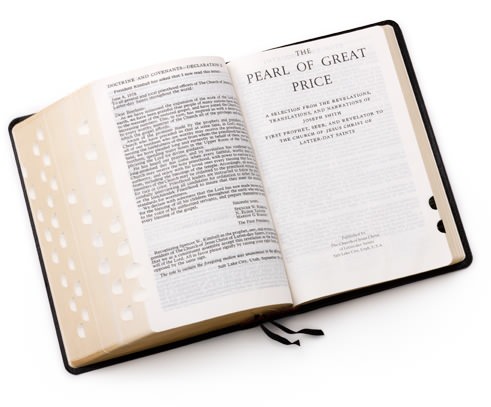
2 And because he dwelleth in flesh he shall be called the Son of God, and having subjected the flesh to the will of the Father, being the Father and the Son

3 The Father, because he was conceived by the power of God; and the Son, because of the flesh; thus becoming the Father and Son—

4 And they are one God, yea, the very Eternal Father of heaven and of earth.

Mosiah 16:15
Teach them that redemption cometh through Christ the Lord, who is the very Eternal Father. Amen.

2 Nephi 10:2-7
2 For behold, the promises which we have obtained are promises unto us according to the flesh; wherefore, as it has been shown unto me that many of our children shall perish in the flesh because of unbelief, nevertheless, God will be merciful unto many; and our children shall be restored, that they may come to that which will give them the true knowledge of their Redeemer.

3 Wherefore, as I said unto you, it must needs be expedient that Christ—for in the last night the angel spake unto me that this should be his name—should come among the Jews, among those who are the more wicked part of the world; and they shall crucify him—for thus it behooveth our God, and there is none other nation on earth that would crucify their God.

4 For should the mighty miracles be wrought among other nations they would repent, and know that he be their God.

5 But because of priestcrafts and iniquities, they at Jerusalem will stiffen their necks against him, that he be crucified.

6 Wherefore, because of their iniquities, destructions, famines, pestilences, and bloodshed shall come upon them; and they who shall not be destroyed shall be scattered among all nations.

7 But behold, thus saith the Lord God: When the day cometh that they shall believe in me, that I am Christ, then have I covenanted with their fathers that they shall be restored in the flesh, upon the earth, unto the lands of their inheritance.
God the Father and Jesus Christ, by Mormon Artist Del Parson. This is NOT what the Book of the Mormon teaches about God's nature.
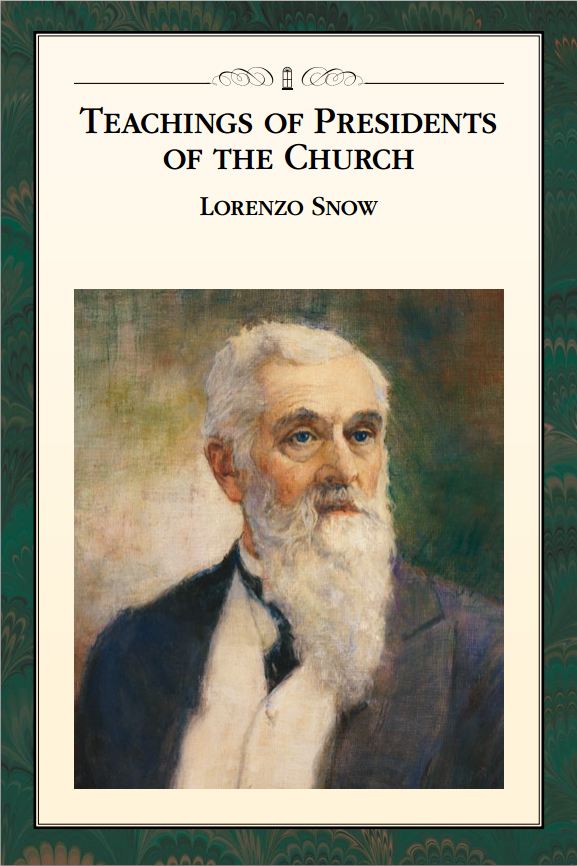
God the Father and Jesus Christ, by Mormon Artist Del Parson. This is not what the Book of the Mormon teaches about God’s nature.

2 Nephi 26:12
And as I spake concerning the convincing of the Jews, that Jesus is the very Christ, it must needs be that the Gentiles be convinced also that Jesus is the Christ, the Eternal God.

Alma 11:38-40, 44
38 Now Zeezrom saith again unto him: Is the Son of God the very Eternal Father?

39 And Amulek said unto him: Yea, he is the very Eternal Father of heaven and of earth, and all things which in them are; he is the beginning and the end, the first and the last;

40 And he shall come into the world to redeem his people; and he shall take upon him the transgressions of those who believe on his name; and these are they that shall have eternal life, and salvation cometh to none else.

44 Now, this restoration shall come to all, both old and young, both bond and free, both male and female, both the wicked and the righteous; and even there shall not so much as a hair of their heads be lost; but every thing shall be restored to its perfect frame, as it is now, or in the body, and shall be brought and be arraigned before the bar of Christ the Son, and God the Father, and the Holy Spirit, which is one Eternal God, to be judged according to their works, whether they be good or whether they be evil.

Ether 3:14
Behold, I am he who was prepared from the foundation of the world to redeem my people. Behold, I am Jesus Christ. I am the Father and the Son. In me shall all mankind have life, and that eternally, even they who shall believe on my name; and they shall become my sons and my daughters.

Mosiah 3:5
For behold, the time cometh, and is not far distant, that with power, the Lord Omnipotent who reigneth, who was, and is from all eternity to all eternity, shall come down from heaven among the children of men, and shall dwell in a tabernacle of clay, and shall go forth amongst men, working mighty miracles, such as healing the sick, raising the dead, causing the lame to walk, the blind to receive their sight, and the deaf to hear, and curing all manner of diseases.

Mosiah 5:15
Therefore, I would that ye should be steadfast and immovable, always abounding in good works, that Christ, the Lord God Omnipotent , may seal you his, that you may be brought to heaven, that ye may have everlasting salvation and eternal life, through the wisdom, and power, and justice, and mercy of him who created all things, in heaven and in earth, who is God above all . Amen.

Mosiah 13:34
Have they not said that God himself should come down among the children of men, and take upon him the form of man, and go forth in mighty power upon the face of the earth?

– There are a plurality of gods but we only worship the God of this world, God the Father (aka “Heavenly Father”)

The Book of Mormon states plainly that there is only one God…
Alma 11:26-39, 44
26 And Zeezrom said unto him: Thou sayest there is a true and living God?

Zeezrom asking Amulek and Alma questions (Alma 11) 

Amulek and Alma answering Zeezrom’s questions (illustration from “Book of Mormon Stories” LdS Church primary manual)

27 And Amulek said: Yea, there is a true and living God.

28 Now Zeezrom said: Is there more than one God?

29 And he answered, No.

30 Now Zeezrom said unto him again: How knowest thou these things?

31 And he said: An angel hath made them known unto me.

32 And Zeezrom said again: Who is he that shall come? Is it the Son of God?

33 And he said unto him, Yea.

34 And Zeezrom said again: Shall he save his people in their sins? And Amulek answered and said unto him: I say unto you he shall not, for it is impossible for him to deny his word.

35 Now Zeezrom said unto the people: See that ye remember these things; for he said there is but one God; yet he saith that the Son of God shall come, but he shall not save his people—as though he had authority to command God.

36 Now Amulek saith again unto him: Behold thou hast lied, for thou sayest that I spake as though I had authority to command God because I said he shall not save his people in their sins.

37 And I say unto you again that he cannot save them in their sins; for I cannot deny his word, and he hath said that no unclean thing can inherit the kingdom of heaven; therefore, how can ye be saved, except ye inherit the kingdom of heaven? Therefore, ye cannot be saved in your sins.

38 Now Zeezrom saith again unto him: Is the Son of God the very Eternal Father?

39 And Amulek said unto him: Yea, he is the very Eternal Father of heaven and of earth, and all things which in them are; he is the beginning and the end, the first and the last;

44 Now, this restoration shall come to all, both old and young, both bond and free, both male and female, both the wicked and the righteous; and even there shall not so much as a hair of their heads be lost; but every thing shall be restored to its perfect frame, as it is now, or in the body, and shall be brought and be arraigned before the bar of Christ the Son, and God the Father, and the Holy Spirit, which is one Eternal God, to be judged according to their works, whether they be good or whether they be evil.

An accurate depiction of Trinitarianism

An accurate depiction of Trinitarianism

…and it states plainly that One God consists of the Father, Son and Holy Spirit – that is, the Book of Mormon teaches the doctrine of the Trinity (albeit with a strong modalistic skew). 

Mormon 7:7
And he hath brought to pass the redemption of the world, whereby he that is found guiltless before him at the judgment day hath it given unto him to dwell in the presence of God in his kingdom, to sing ceaseless praises with the choirs above, unto the Father, and unto the Son, and unto the Holy Ghost, which are one God, in a state of happiness which hath no end.

2 Nephi 31:21
And now, behold, my beloved brethren, this is the way; and there is none other way nor name given under heaven whereby man can be saved in the kingdom of God. And now, behold, this is the doctrine of Christ, and the only and true doctrine of the Father, and of the Son, and of the Holy Ghost, which is one God, without end. Amen.

3 Nephi 11:27
And after this manner shall ye baptize in my name; for behold, verily I say unto you, that the Father, and the Son, and the Holy Ghost are one; and I am in the Father, and the Father in me, and the Father and I are one.

2 Nephi 2:14
And now, my sons, I speak unto you these things for your profit and learning; for there is a God [notice: singular not plural], and he hath created all things, both the heavens and the earth, and all things that in them are, both things to act and things to be acted upon.

Jacob 4:9
For behold, by the power of his word man came upon the face of the earth, which earth was created by the power of his word. Wherefore, if God [again, notice: singular not plural] being able to speak and the world was, and to speak and man was created, O then, why not able to command the earth, or the workmanship of his hands upon the face of it, according to his will and pleasure?

The "three witnesses" to the Book of Mormon: Oliver Cowdrey, David Whitmer, and Martin Harris

The “three witnesses” to the Book of Mormon: Oliver Cowdrey, David Whitmer, and Martin Harris

Testimony of Three Witnesses
Be it known unto all nations, kindreds, tongues, and people, unto whom this work shall come: That we, through the grace of God the Father, and our Lord Jesus Christ, have seen the plates which contain this record, which is a record of the people of Nephi, and also of the Lamanites, their brethren, and also of the people of Jared, who came from the tower of which hath been spoken. And we also know that they have been translated by the gift and power of God, for his voice hath declared it unto us; wherefore we know of a surety that the work is true. And we also testify that we have seen the engravings which are upon the plates; and they have been shown unto us by the power of God, and not of man. And we declare with words of soberness, that an angel of God came down from heaven, and he brought and laid before our eyes, that we beheld and saw the plates, and the engravings thereon; and we know that it is by the grace of God the Father, and our Lord Jesus Christ, that we beheld and bear record that these things are true. And it is marvelous in our eyes. Nevertheless, the voice of the Lord commanded us that we should bear record of it; wherefore, to be obedient unto the commandments of God, we bear testimony of these things. And we know that if we are faithful in Christ, we shall rid our garments of the blood of all men, and be found spotless before the judgment-seat of Christ, and shall dwell with him eternally in the heavens. And the honor be to the Father, and to the Son, and to the Holy Ghost, which is one God. Amen.

OLIVER COWDERY
DAVID WHITMER
MARTIN HARRIS

THE CHURCH
– Heavenly Father and Jesus Christ physically appeared to Joseph Smith (aka “The First Vision”).

The First Vision is conspicuous in it’s absence in the Book of Mormon. Further, key points of the First Vision are discredited by the Book of Mormon:
First, the Book of Mormon teaches that God the Father (aka “Heavenly Father”) and Jesus Christ are the same person.(see the “The Father, Son and Holy Ghost are separate gods, ‘one in purpose’ only but not one in being” section above)

Further the Book of Mormon teaches that God the Father is a spirit not a physical being.
(see the “God the Father is a person with a body of flesh and bones” section above)

THE CREATION
– God the Father, Jesus Christ, Joseph Smith and other sons of the Father did not create the universe and earth out of nothing, but “organized” them from eternally existing matter that pre-existed God the Father.

The Book of Mormon states that God created via nothing but His word – that is, “ex-nihilo” (out of nothing).
Jacob 4:8-9
8 Behold, great and marvelous are the works of the Lord. How unsearchable are the depths of the mysteries of him; and it is impossible that man should find out all his ways. And no man knoweth of his ways save it be revealed unto him; wherefore, brethren, despise not the revelations of God.

9 For behold, by the power of his word man came upon the face of the earth, which earth was created by the power of his word. Wherefore, if God being able to speak and the world was, and to speak and man was created, O then, why not able to command the earth, or the workmanship of his hands upon the face of it, according to his will and pleasure?

MEN CAN BECOME GODS (aka “Celestial Exaltation”)
– The LdS Church teaches that the most faithful and worthy Mormons can progress to godhood in the highest degree of the Celestial Kingdom, where they can obtain their own world and with their wife (or wives) procreate spirit children for eternity.

This is known as “Celestial Exaltation”. And LdS Scripture (in Doctrine & Covenants 132) states that the “new and everlasting covenant” of polygamy is necessary for this exaltation to godhood.

"Achieving a Celestial Marriage" LdS Church manual (1992)

“Achieving a Celestial Marriage” LdS Church manual (1992)

Polygamy is condemned in the Book of Mormon:

Jacob 1:15
And now it came to pass that the people of Nephi, under the reign of the second king, began to grow hard in their hearts, and indulge themselves somewhat in wicked practices, such as like unto David of old desiring many wives and concubines, and also Solomon, his son.

Jacob 2:24
Behold, David and Solomon truly had many wives and concubines, which thing was abominable before me, saith the Lord

Jacob 3:5
Behold, the Lamanites your brethren, whom ye hate because of their filthiness and the cursing which hath come upon their skins, are more righteous than you; for they have not forgotten the commandment of the Lord, which was given unto our father—that they should have save it were one wife, and concubines they should have none, and there should not be whoredoms committed among them.

Mosiah 11:2
For behold, he did not keep the commandments of God, but he did walk after the desires of his own heart. and he had many wives and concubines. And he did cause his people to commit sin, and do that which was abominable in the sight of the Lord. Yea, and they did commit whoredoms and all manner of wickedness.

Ether 10:5
And it came to pass that Riplakish did not do that which was right in the sight of the Lord, for he did have many wives and concubines, and did lay that upon men’s shoulders which was grievous to be borne; yea, he did tax them with heavy taxes; and with the taxes he did build many spacious buildings.

HEAVEN AND HELL
– There are three degrees (or “levels” in plain English) in heaven consisting of:
1. Telestial Kingdom- lowest degree
2. Terrestrial Kingdom – middle degree
3. Celestial Kingdom – highest degree, of which there are also three degrees

The Book of Mormon states that there is only heaven and hell.
1 Nephi 15:35
And there is a place prepared, yea, even that awful hell of which I have spoken, and the devil is the foundation of it; wherefore the final state of the souls of men is to dwell in the kingdom of God, or to be cast out because of that justice of which I have spoken.

– Every human being will find a place in one of the three degrees of glory (or “heaven” in plain English).

This doctrine is a form of universalism which The Book of Mormon denounces as a “false doctrine”.
The first chapter of the book of Alma describes a Universalist preacher named Nehor who is condemned for teaching “priestcraft” – including universalism:

A large, strong man named Nehor went about teaching lies. He said that everyone would be saved, whether they were good or bad. Alma 1:2–6 (Liahona magazine August 1992)

“A large, strong man named Nehor went about teaching lies. He said that everyone would be saved, whether they were good or bad.”
(Liahona magazine August 1992)

Alma 1:4, 12-16
4 And he [Nehor] also testified unto the people that all mankind should be saved at the last day, and that they might lift up their heads and rejoice; for the Lord had created all men, and had also redeemed all men; and, in the end, all men should have eternal life.

12 But Alma said unto him; Behold, this is he first time that priestcraft has been introduced among this people. And behold, thou art not only guilty of priestcraft, but hast endeavored to enforce it by the sword; and were priestcraft to be enforced among this people it would prove their entire destruction.

13 And thou has shed the blood of a righteous man; yea, a man who has done much good among the people; and were we to spare thee his blood would come upon us for vengeance.

14 Therefore thou are condemned to die, according to the law which has been given us by Mosiah, our last king; and it has been acknowledged by this people; therefore this people must abide by the law.

15 And it came to pass that they took him; and his name was Nehor; and they carried him upon the top of the hill Manti, and there he was caused, or rather did acknowledge, between the heavens and the earth, that what he had taught to the people was contrary to the world of God; and there he suffered and ignominious death.

16 Nevertheless, this did not put an end to the spreading of priestcraft through the land; for there were many who loved the vain things of the world, and they went forth preaching false doctrines; and this they did for the sake of riches and honor.

– The only people not in one of the three degrees of glory will be the Devil and his angels as well as those Mormons who have held the priesthood and become apostate. The latter are referred to as “the sons of perdition” in Mormon doctrine.

The Book of Mormon is clear that far more people will be sent to hell other than just the Devil, his angels and “the sons of perdition”:
1 Nephi 14:3
And that great pit, which hath been digged for them by that great and abominable church, which was founded by the devil and his children, that he might lead away the souls of men down to hell — yea, that great pit which hath been digged for the destruction of men shall be filled by those who digged it, unto their utter destruction, saith the Lamb of God; not the destruction of the soul, save it be the casting of it into that hell which hath no end.

1 Nephi 15:29,35
29 And I said unto them that it was a representation of that awful hell, which the angel said unto me was prepared for the wicked.

35 And there is a place prepared, yea, even that awful hell of which I have spoken, and the devil is the preparator of it; wherefore the final state of the souls of men is to dwell in the kingdom of God, or to be cast out because of that justice of which I have spoken.

"Spooky Mormon Hell Dream" from "The Book of Mormon The Musical"

“Spooky Mormon Hell Dream” from “The Book of Mormon The Musical”

2 Nephi 9:12,19
12 And this death of which I have spoken, which is the spiritual death, shall deliver up its dead; which spiritual death is hell; wherefore, death and hell must deliver up their dead, and hell must deliver up its captive spirits, and the grave must deliver up its captive bodies, and the bodies and the spirits of men will be restored one to the other; and it is by the power of the resurrection of the Holy One of Israel.

19 O the greatness of the mercy of our God, the Holy One of Israel! For he delivereth his saints from that awful monster the devil, and death, and hell, and that lake of fire and brimstone, which is endless torment.

2 Nephi 28:19-23
19 For the kingdom of the devil must shake, and they which belong to it must needs be stirred up unto repentance, or the devil will grasp them with his everlasting chains, and they be stirred up to anger, and perish;

20 For behold, at that day shall he rage in the hearts of the children of men, and stir them up to anger against that which is good.

21 And others will he pacify, and lull them away into carnal security, that they will say: All is well in Zion; yea, Zion prospereth, all is well — and thus the devil cheateth their souls, and leadeth them away carefully down to hell.

22 And behold, others he [the devil] flattereth away, and telleth them there is no hell; and he saith unto them: I am no devil, for there is none — and thus he whispereth in their ears, until he grasps them with his awful chains, from whence there is no deliverance.

23 Yea, they are grasped with death, and hell; and death, and hell, and the devil, and all that have been seized therewith must stand before the throne of God, and be judged according to their works, from whence they must go into the place prepared for them, even a lake of fire and brimstone, which is endless torment.

Alma 5:6-10
6 And now behold, I say unto you, my brethren, you that belong to this church, have you sufficiently retained in remembrance the captivity of your fathers? Yea, and have you sufficiently retained in remembrance his mercy and long-suffering towards them? And moreover, have ye sufficiently retained in remembrance that he has delivered their souls from hell?

7 Behold, he changed their hearts; yea, he awakened them out of a deep sleep, and they awoke unto God. Behold, they were in the midst of darkness; nevertheless, their souls were illuminated by the light of the everlasting word; yea, they were encircled about by the bands of death, and the chains of hell, and an everlasting destruction did await them.

8 And now I ask of you, my brethren, were they destroyed? Behold, I say unto you, Nay, they were not.

9 And again I ask, were the bands of death broken, and the chains of hell which encircled them about, were they loosed? I say unto you, Yea, they were loosed, and their souls did expand, and they did sing redeeming love. And I say unto you that they are saved.

10 And now I ask of you on what conditions are they saved? Yea, what grounds had they to hope for salvation? What is the cause of their being loosed from the bands of death, yea, and also the chains of hell?

19th Century Anti-Mormons had their own ideas about where Mormon hell was and who resided there.

19th Century Anti-Mormons had their own ideas about where Mormon hell was and who resided there.

Helaman 6:28
And also it is that same being who put it into the hearts of the people to build a tower sufficiently high that they might get to heaven. And it was that same being who led on the people who came from that tower into this land; who spread the works of darkness and abominations over all the face of the land, until he dragged the people down to an entire destruction, and to an everlasting hell.

Moroni 8:13
Wherefore, if little children could not be saved without baptism, these must have gone to an endless hell.

Mosiah 2:36-39
36 And now, I say unto you, my brethren, that after ye have known and have been taught all these things, if ye should transgress and go contrary to that which has been spoken, that ye do withdraw yourselves from the Spirit of the Lord, that it may have no place in you to guide you in wisdom’s paths that ye may be blessed, prospered, and preserved—

37 I say unto you, that the man that doeth this, the same cometh out in open rebellion against God; therefore he listeth to obey the evil spirit, and becometh an enemy to all righteousness; therefore, the Lord has no place in him, for he dwelleth not in unholy temples.

38 Therefore if that man repenteth not, and remaineth and dieth an enemy to God, the demands of divine justice do awaken his immortal soul to a lively sense of his own guilt, which doth cause him to shrink from the presence of the Lord, and doth fill his breast with guilt, and pain, and anguish, which is like an unquenchable fire, whose flame ascendeth up forever and ever.

39 And now I say unto you, that mercy hath no claim on that man; therefore his final doom is to endure a never-ending torment.

Mosiah 16:11
If they be good, to the resurrection of endless life and happiness; and if they be evil, to the resurrection of endless damnation, being delivered up to the devil, who hath subjected them, which is damnation

Alma 34:32-35
32 For behold, this life is the time for men to prepare to meet God; yea, behold the day of this life is the day for men to perform their labors.

33 And now, as I said unto you before, as ye have had so many witnesses, therefore, I beseech of you that ye do not procrastinate the day of your repentance until the end; for after this day of life, which is given us to prepare for eternity, behold, if we do not improve our time while in this life, then cometh the night of darkness wherein there can be no labor performed.

34 Ye cannot say, when ye are brought to that awful crisis, that I will repent, that I will return to my God. Nay, ye cannot say this; for that same spirit which doth possess your bodies at the time that ye go out of this life, that same spirit will have power to possess your body in that eternal world.

35 For behold, if ye have procrastinated the day of your repentance even until death, behold, ye have become subjected to the spirit of the devil, and he doth seal you his; therefore, the Spirit of the Lord hath withdrawn from you, and hath no place in you, and the devil hath all power over you; and this is the final state of the wicked.

LDS_Temple– Temples and temple ordinances pertaining to endowments are necessary in order to pass through the veil and enter the presence of God the Father, and consist of Temple Marriage, new names, secret key words and handshakes that will be used as an identification of the person in the next life.

The Book of Mormon repeatedly condemns the type of secret oaths and combinations that are found in the Latter-day Saint Temple Endowment ceremony in the strongest terms.
Specifically, it states that it is Satan who puts it into the hearts of the people to form secret oaths and covenants.  It also states that secret combinations aren’t the work of God, are forbidden, are a form of evil, are destructive, and lead to God’s judgment.

Ether 8:18-24
18 And it came to pass that they formed a secret combination, even as they of old; which combination is most abominable and wicked above all, in the sight of God;

19 For the Lord worketh not in secret combinations, neither doth he will that man should shed blood, but in all things hath forbidden it, from the beginning of man.

20 And now I, Moroni, do not write the manner of their oaths and combinations, for it hath been made known unto me that they are had among all people, and they are had among the Lamanites.

21 And they have caused the destruction of this people of whom I am now speaking, and also the destruction of the people of Nephi.

22 And whatsoever nation shall uphold such secret combinations, to get power and gain, until they shall spread over the nation, behold, they shall be destroyed; for the Lord will not suffer that the blood of his saints, which shall be shed by them, shall always cry unto him from the ground for vengeance upon them and yet he avenge them not.

23 Wherefore, O ye Gentiles, it is wisdom in God that these things should be shown unto you, that thereby ye may repent of your sins, and suffer not that these murderous combinations shall get above you, which are built up to get power and gain—and the work, yea, even the work of destruction come upon you, yea, even the sword of the justice of the Eternal God shall fall upon you, to your overthrow and destruction if ye shall suffer these things to be.

24 Wherefore, the Lord commandeth you, when ye shall see these things come among you that ye shall awake to a sense of your awful situation, because of this secret combination which shall be among you; or wo be unto it, because of the blood of them who have been slain; for they cry from the dust for vengeance upon it, and also upon those who built it up.

A handshake engraved onto the SLC Temple – symbolic of the “secret combinations” used in the LdS Temple Endowment Ceremony.

Helaman 6:21–31
21 But behold, Satan did stir up the hearts of the more part of the Nephites, insomuch that they did unite with those bands of robbers, and did enter into their covenants and their oaths, that they would protect and preserve one another in whatsoever difficult circumstances they should be placed, that they should not suffer for their murders, and their plunderings, and their stealings.

22 And it came to pass that they did have their signs, yea, their secret signs, and their secret words; and this that they might distinguish a brother who had entered into the covenant, that whatsoever wickedness his brother should do he should not be injured by his brother, nor by those who did belong to his band, who had taken this covenant.

23 And thus they might murder, and plunder, and steal, and commit whoredoms and all manner of wickedness, contrary to the laws of their country and also the laws of their God.

24 And whosoever of those who belonged to their band should reveal unto the world of their wickedness and their abominations, should be tried, not according to the laws of their country, but according to the laws of their wickedness, which had been given by Gadianton and Kishkumen.

25 Now behold, it is these secret oaths and covenants which Alma commanded his son should not go forth unto the world, lest they should be a means of bringing down the people unto destruction.

26 Now behold, those secret oaths and covenants did not come forth unto Gadianton from the records which were delivered unto Helaman; but behold, they were put into the heart of Gadianton by that same being who did entice our first parents to partake of the forbidden fruit—

27 Yea, that same being who did plot with Cain, that if he would murder his brother Abel it should not be known unto the world. And he did plot with Cain and his followers from that time forth.

28 And also it is that same being who put it into the hearts of the people to build a tower sufficiently high that they might get to heaven. And it was that same being who led on the people who came from that tower into this land; who spread the works of darkness and abominations over all the face of the land, until he dragged the people down to an entire destruction, and to an everlasting hell.

29 Yea, it is that same being who put it into the heart of Gadianton to still carry on the work of darkness, and of secret murder; and he has brought it forth from the beginning of man even down to this time.

30 And behold, it is he who is the author of all sin. And behold, he doth carry on his works of darkness and secret murder, and doth hand down their plots, and their oaths, and their covenants, and their plans of awful wickedness, from generation to generation according as he can get hold upon the hearts of the children of men.

2 Nephi 9:8-9
8 O the wisdom of God, his mercy and grace! For behold, if the flesh should rise no more our spirits must become subject to that angel who fell from before the presence of the Eternal God, and became the devil, to rise no more.

9 And our spirits must have become like unto him, and we become devils, angels to a devil, to be shut out from the presence of our God, and to remain with the father of lies, in misery, like unto himself; yea, to that being who beguiled our first parents, who transformeth himself nigh unto an angel of light, and stirreth up the children of men unto secret combinations of murder and all manner of secret works of darkness.

Alma 37:29-31
29 Therefore ye shall keep these secret plans of their oaths and their covenants from this people, and only their wickedness and their murders and their abominations shall ye make known unto them; and ye shall teach them to abhor such wickedness and abominations and murders; and ye shall also teach them that these people were destroyed on account of their wickedness and abominations and their murders.

30 For behold, they murdered all the prophets of the Lord who came among them to declare unto them concerning their iniquities; and the blood of those whom they murdered did cry unto the Lord their God for vengeance upon those who were their murderers; and thus the judgments of God did come upon these workers of darkness and secret combinations.

31 Yea, and cursed be the land forever and ever unto those workers of darkness and secret combinations, even unto destruction, except they repent before they are fully ripe.

Salt_Lake_temple_baptismal_font

Baptismal font in the Salt Lake Temple, circa 1912, where baptisms for the dead are performed by proxy. The font rests on the backs of twelve oxen representing the Twelve Tribes of Israel.

– Baptisms for the dead must be performed by proxy in this life for those who did not accept the gospel in this life, so that their sins can be forgiven and they can enter the Celestial Kingdom after they accept the Mormon gospel message in the next life.

The Book of Mormon not only denies that there is a second chance to repent and receive the gospel in the next life…
2 Nephi 9:38
And, in fine, wo unto all those who die in their sins; for they shall return to God, and behold his face, and remain in their sins.

Mosiah 16:5
But remember that he that persists in his own carnal nature, and goes on in the ways of sin and rebellion against God, remaineth in his fallen state and the devil hath all power over him. Therefor he is as thoughthere was no redemption made, being an enemy to God; and also is the devil an enemy to God.

Mosiah 27:31
Yea, every knee shall bow, and every tongue confess before him. Yea, even at the last day, when all men shall stand to be judged of him, then shall they confess that he is God; then shall they confess, who live without God in the world, that the judgment of an everlasting punishment is just upon them; and they shall quake, and tremble, and shrink beneath the glance of his all-searching eye.

Alma 34:31-35
31 Yea, I would that ye would come forth and harden not your hears any longer; for behold, now is the time and the day of your salvation; and therefore, if ye will repent and harden not your hearts, immediately shall the great plan of redemption be brought about unto you.

32 For behold, this life is the time for men to prepare to meet God; yea, behold the day of this life is the day for men to perform their labors.

33 And now, as I said unto you before, as ye have had so many witnesses, therefore, I beseech of you that ye do not procrastinate the day of your repentance until the end; for after this day of life, which is given to us to prepare for eternity, behold, if we do not improve our time while in this life, then cometh the night of darkness wherein there can be no labor performed.

34 Ye cannot say, when ye are brought to that awful crisis, that I will repent, that I will return to my God. Nay, ye cannot say this; for that same spirit which doth possess your bodies at the time that ye go out of this life, that same spirit will have power to possess your body in that eternal world.

35 For behold, if ye have procrastinated the day of your repentance even until death, behold, ye have become subjected to the spirit of the devil, and he doth seal you his; therefore, the Spirit of the Lord hath withdrawn from you, and hath no place in you, and the devil hath all power over you; and this is the final state of the wicked.

Pat Bagley, Salt Lake Tribune 5/19/2008

Pat Bagley, Salt Lake Tribune 5/19/2008

Alma 41:4-8
4 And if their works are evil they shall be restored unto them for evil. Therefore, all things shall be restored to their proper order, every thing to its natural frame—mortality raised to immortality, corruption to incorruption—raised to endless happiness to inherit the kingdom of God, or to endless misery to inherit the kingdom of the devil, the one on one hand, the other on the other—

5 The one raised to happiness according to his desires of happiness, or good according to his desires of good; and the other to evil according to his desires of evil; for as he has desired to do evil all the day long even so shall he have his reward of evil when the night cometh.

6 And so it is on the other hand. If he hath repented of his sins, and desired righteousness until the end of his days, even so he shall be rewarded unto righteousness.

7 These are they that are redeemed of the Lord; yea, these are they that are taken out, that are delivered from that endless night of darkness; and thus they stand or fall; for behold, they are their own judges, whether to do good or do evil.

8 Now, the decrees of God are unalterable; therefore, the way is prepared that whosoever will may walk therein and be saved.

Alma 42:16
Now, repentance could not come unto men except there were a punishment, which also was eternal as the life of the soul should be, affixed opposite to the plan of happiness, which was as eternal also as the life of the soul.

The Book of Mormon calls this a “dead work” and states that baptism is not required for little children to be saved.

… the Book of Mormon also states that baptism isn’t an absolute requirement for salvation:
Moroni 8:22-23
22 For behold that all little children are alive in Christ, and also all they that are without the law. For the power of redemption cometh on all them that have no law; wherefore, he that is not condemned, or he that is under no condemnation, cannot repent; and unto such baptism availeth nothing—

23 But it is mockery before God, denying the mercies of Christ, and the power of his Holy Spirit, and putting trust in dead works.

2 Nephi 9:25-26
25 Wherefore, he has given a law; and where there is no law given there is no punishment; and where there is no punishment there is no condemnation; and where there is no condemnation the mercies of the Holy One of Israel have claim upon them, because of the atonement; for they are delivered by the power of him.

26 For the atonement satisfieth the demands of his justice upon all those who have not the law given to them, that they are delivered from that awful monster, death and hell, and the devil, and the lake of fire and brimstone, which is endless torment; and they are restored to that God who gave them breath, which is the Holy One of Israel.

Mosiah 15:24-27
24 And these are those who have part in the first resurrection; and these are they that have died before Christ came, in their ignorance, not having salvation declared unto them. And thus the Lord bringeth about the restoration of these; and they have a part in the first resurrection, or have eternal life, being redeemed by the Lord.

25 And little children also have eternal life.

26 But behold, and fear, and tremble before God, for ye ought to tremble; for the Lord redeemeth none such that rebel against him and die in their sins; yea, even all those that have perished in their sins ever since the world began, that have wilfully rebelled against God, that have known the commandments of God, and would not keep them; these are they that have no part in the first resurrection.

27 Therefore ought ye not to tremble? For salvation cometh to none such; for the Lord hath redeemed none such; yea, neither can the Lord redeem such; for he cannot deny himself; for he cannot deny justice when it has its claim.

THE NATURE OF MAN
– Heavenly Father and Heavenly Mother procreated the spirits of every human being that has lived, is now living or will ever live on this earth.

The Book of Mormon states that man was created by the power of God’s word.
Jacob 4:9
For behold, by the power of his word man came upon the face of the earth, which earth was created by the power of his word. Wherefore, if God being able to speak and the world was, and to speak and man was created, O then, why not able to command the earth, or the workmanship of his hands upon the face of it, according to his will and pleasure?

Michelangelo's Creation of Adam from the Sistine Chapel

Michelangelo’s Creation of Adam from the Sistine Chapel

Alma 18:28, 34-36
28 And Ammon said: This is God. And Ammon said unto him again: Believest thou that this Great Spirit, who is God, created all things which are in heaven and in the earth?

34 Ammon said unto him: I am a man; and man in the beginning was created after the image of God, and I am called by his Holy Spirit to teach these things unto this people, that they may be brought to a knowledge of that which is just and true;

35 And a portion of that Spirit dwelleth in me, which giveth me knowledge, and also power according to my faith and desires which are in God.

36 Now when Ammon had said these words, he began at the creation of the world, and also the creation of Adam, and told him all the things concerning the fall of man, and rehearsed and laid before him the records and the holy scriptures of the people, which had been spoken by the prophets, even down to the time that their father, Lehi, left Jerusalem.

– The spirits procreated by Heavenly Father and Heavenly Mother lived with their father on his world as angels in the “pre-existence” before being sent to earth to inhabit human bodies.

The Book of Mormon makes a clear distinction between men and angels.
Further it states that man was created (not procreated) and placed on earth by God as his created dwelling place – just as heaven is the created dwelling place of God and his Angels  (who were also created, not procreated).

Alma 18:28-36
28 And Ammon said: This is God. And Ammon said unto him again: Believest thou that this Great Spirit, who is God, created all things which are in heaven and in the earth?

29 And he said: Yea, I believe that he created all things which are in the earth; but I do not know the heavens.

30 And Ammon said unto him: The heavens is a place where God dwells and all his holy angels.

31 And king Lamoni said: Is it above the earth?

32 And Ammon said: Yea, and he looketh down upon all the children of men; and he knows all the thoughts and intents of the heart; for by his hand were they all created from the beginning.

33 And king Lamoni said: I believe all these things which thou hast spoken. Art thou sent from God?

34 Ammon said unto him: I am a man; and man in the beginning was created after the image of God, and I am called by his Holy Spirit to teach these things unto this people, that they may be brought to a knowledge of that which is just and true;

35 And a portion of that Spirit dwelleth in me, which giveth me knowledge, and also power according to my faith and desires which are in God.

36 Now when Ammon had said these words, he began at the creation of the world, and also the creation of Adam, and told him all the things concerning the fall of man, and rehearsed and laid before him the records and the holy scriptures of the people, which had been spoken by the prophets, even down to the time that their father, Lehi, left Jerusalem.

Jesus tempted in the desert. According to current Mormon Doctrine these two are brothers.

Jesus tempted in the desert by Lucifer. According to current Mormon Doctrine not only are these two brothers, they’re the siblings of all human beings past and present.

JESUS CHRIST
– Jesus Christ is the brother of Lucifer (Satan), every human being past and present, and the angels.

The Book of Mormon teaches that Jesus is Eternal God. And as God, Christ was neither created or procreated.

3 Nephi 19:18
And behold, they began to pray; and they did pray unto Jesus, calling him their Lord and their God.

(also see “The Father, Son and Holy Ghost are separate gods, ‘one in purpose’ only but not one in being” and “There are a plurality of gods but we only worship the God of this world, God the Father” sections above)

Jesus Christ made atonement for sins in the Garden of Gethsemane.

The Book of Mormon states that Jesus Christ died on the cross for the sins of the world:
1 Nephi 11:33
And I, Nephi, saw that he was lifted up upon the cross and slain for the sins of the world.

3 Nephi 11:14
Arise and come forth unto me, that ye may thrust your hands into my side, and also that ye may feel the prints of the nails in my hands and in my feet, that ye may know that I am the God of Israel, and the God of the whole earth, and have been slain for the sins of the world.

2 Nephi 9:5
Yea, I know that ye know that in the body he shall show himself unto those at Jerusalem, from whence we came; for it is expedient that it should be among them; for it behooveth the great Creator that he suffereth himself to become subject unto man in the flesh, and die for all men, that all men might become subject unto him.

3 Nephi 27:13-15
Behold I have given unto you my gospel, and this is the gospel which I have given unto you—that I came into the world to do the will of my Father, because my Father sent me.

And my Father sent me that I might be lifted up upon the cross; and after that I had been lifted up upon the cross, that I might draw all men unto me, that as I have been lifted up by men even so should men be lifted up by the Father, to stand before me, to be judged of their works, whether they be good or whether they be evil—

And for this cause have I been lifted up; therefore, according to the power of the Father I will draw all men unto me, that they may be judged according to their works.

MISCELLANEOUS 
– Consumption of wine is a violation of a commandment of God (see D&C 89:5) that’s so egregious that it can result in having your access to Latter-day Saint Temples (and thereby your potential for full salvation via Celestial Exaltation) revoked. 

The Book of Mormon has Christ, the Apostles, and all Christians consuming wine in both sacred and secular fashion. In fact, Christ even commands them and us to consume wine as part of the sacrament.

3 Nephi 18:1-10
And it came to pass that Jesus commanded his disciples that they should bring forth some bread and wine unto him.

And while they were gone for bread and wine, he commanded the multitude that they should sit themselves down upon the earth.

And when the disciples had come with bread and wine, he took of the bread and brake and blessed it; and he gave unto the disciples and commanded that they should eat.

And when they had eaten and were filled, he commanded that they should give unto the multitude.

And when the multitude had eaten and were filled, he said unto the disciples: Behold there shall one be ordained among you, and to him will I give power that he shall break bread and bless it and give it unto the people of my church, unto all those who shall believe and be baptized in my name.

And this shall ye always observe to do, even as I have done, even as I have broken bread and blessed it and given it unto you.

And this shall ye do in remembrance of my body, which I have shown unto you. And it shall be a testimony unto the Father that ye do always remember me. And if ye do always remember me ye shall have my Spirit to be with you.

And it came to pass that when he said these words, he commanded his disciples that they should take of the wine of the cup and drink of it, and that they should also give unto the multitude that they might drink of it.

And it came to pass that they did so, and did drink of it and were filled; and they gave unto the multitude, and they did drink, and they were filled.

10 And when the disciples had done this, Jesus said unto them: Blessed are ye for this thing which ye have done, for this is fulfilling my commandments, and this doth witness unto the Father that ye are willing to do that which I have commanded you.

WHAT’S GOING ON HERE?
At this point the reader may be scratching their head wondering how the work that is held up as the “keystone of our religion” by the Church of Jesus Christ of Latter-day Saints not only contains very little of that religion (see the first article in this series) but discredits much of it.  The answer to that question is pretty simple:  The Book of Mormon doesn’t teach modern Mormonism, rather it teaches 19th Century American Restorationism[2]

As Latter-day Saint scholar Thomas G. Alexander explains, “Much of the doctrine that early investigators found in Mormonism was similar to contemporary Protestant churches.”[3] So if you strip away the baggage of Joseph Smith and the Book of Mormon origin story you’re left with a piece of Christian literature that’s more akin to “Pilgrim’s Progress” or “The Screwtape Letters” than “Dianetics”.  In the end it’s very much as  Shawn McCraney described it when he said, “[We] recognize the Book of Mormon as a piece of 19th century literary fiction aimed at teaching Jesus Christ. We reject the story of its origins.”[4]

"Mormons visit a country carpenter" (1856) by Christen Dalsgaard, depicting a mid-19th century visit of a missionary to a Danish carpenter's workshop. The first missionaries arrived in Denmark in 1850.

“Mormons visit a country carpenter” (1856) by Christen Dalsgaard, depicting a mid-19th century visit of a missionary to a Danish carpenter’s workshop. The first missionaries arrived in Denmark in 1850.

What’s even more surprising is what little weight and influence the Book of Mormon carried in early Mormon culture. As Latter-day Saint scholar Rock Waterman explains:

“As it happens, few early converts to Mormonism bothered to read the Book of Mormon and had little idea of its contents. Most hadn’t been converted through a reading of the book itself, but rather by what they thought the book represented. They saw the coming forth of ancient scripture on gold plates as evidence of God working miracles among men at the dawn of the millennial age. No need to actually read the book; the miracle was the message. Meanwhile, those converts who did read the Book of Mormon tended to scrounge around in it looking for parts that confirmed beliefs they already held. …a surprising amount of what we think is quintessentially “Mormon,” actually turns out to be more Protestant than LDS.”[5]

Mormon Apologist and scholar Daniel C. Peterson agrees and further observes:

“Studies of Latter-day Saint sermons and curriculum from the earliest period of church history well into the 20th century demonstrate surprisingly little use of the Book of Mormon to establish doctrines or as a text from which to preach. Many Saints were converted by reading it, but, thereafter, they tended to overlook its specific content. Early members, mostly converts, knew the Bible well and used it extensively in their teaching and missionary efforts, but the Book of Mormon served mainly as a kind of talisman, its sheer existence pointing to Joseph Smith’s prophetic calling.

Even Joseph Smith used the Bible far more than he used the Book of Mormon in his sermons.”[6]

Mr. Peterson is being generous, in actual fact other than passing references to Book of Mormon figures and stories, Joseph Smith never used it in his sermons.  Rather, then as now, the Book of Mormon was used as a kind of proof of Joseph Smith’s prophetic callings via a lengthy but familiar sounding tract.[7]

For the uninformed the Book of Mormon can be a powerful recruiting tool.[8]  But for the informed that power is quickly lost.

NOTES: 
[1] The 0riginal 1830 Book of Mormon was first modified by Joseph Smith and Oliver Cowdery in 1837 and has undergone regular modifications since (most recently in 2013).  Some changes have been material – resulting in major theological or meaning change – while others haven’t.   

John S. Dinger’s excellent introduction to the book “Significant Textual Changes in the Book of Mormon” provides a good overview of these changes.

Jim Spencer’s “1830 Book of Mormon Comparison Machine” is a valuable resource for doing a side-by-side comparison of the 1830 and modern editions of the Book of Mormon.

[2] The Book of Mormon is rife with 19th Century Campbellite doctrine – see “Campbellite Doctrine in The Book of Mormon”; Also see Daymon Smith, “Volume One: A Cultural History of The Book of Mormon, Setting, a Foundation, of Stones to Stumble Over”

[3] Thomas G. Alexander, “The Reconstruction of Mormon Doctrine: From Joseph Smith to Progressive Theology” Sunstone 5:4 (July-August 1980)

[4] Shawn McCraney, Born Again Mormon: Our Faith, The Book of Mormon (website)

[5] Rock Waterman, “The Book Of Mormon Bait & Switch”; Pure Mormonism blog, October 22, 2013

[6] Dan Peterson, “Embracing the power of the Book of Mormon”; The Deseret News, Thursday, Jan. 5 2012

 [7] The Jacobean English that the Book of Mormon shares with the King James Bible was as far from daily English vernacular then as it is now.  However, then like now, it’s peculiar cadence and vocabulary was considered more “holy” than common English – like some kind of special or sanctified religious dialect if you will.  For those English speakers looking for a religious experience, speaking in “Jacobean tongues” can feel like grandma’s warm comforter wrapped up around “that old time religion” – it feels like home. 

[8]  This is especially true when combined with the polished, HeartSell spin doctored marketing that’s delivered to the investigator through the Mormon Missionary lessons contained in the LdS Church’s “Preach My Gospel” curriculum.

Mormon Researcher Sharon Lindbloom’s article, “Strategic Emotional Advertising”, offers a good primer of how the LdS Church uses HeartSell in recruiting and retaining members.  And while the language is strong (and the editorial comments even stronger) Mormon Expression podcast #250 offers a thorough overview and analysis of how HeartSell works and how it saturates all aspects of Mormon Church culture.

Acknowledgements:
The author would like to acknowledge the following internet web pages – which this article was inspired by, based on, and built from: “Current Mormon Doctrines Not Found in the Book of Mormon” and “Contradictions in LDS Scriptures”.

Lead photo credit: Shutterstock/braedostok

by Fred W. Anson
Introduction
Anyone who has investigated Mormonism knows how intensively Latter-day Saints will press them to read the Book of Mormon. And no doubt, you’ll be told that the Book of Mormon contains the “fulness of the gospel” and that it’s the “keystone of our religion”. You might even be told that Joseph Smith himself said, “Take away the Book of Mormon and the revelations, and where is our religion? We have none.”

However, they also fail to tell you that very little Mormon doctrine can actually be found in the Book of Mormon – the vast majority is found elsewhere. For example, look at the three common claims that were made in the first paragraph above (the ones in quotes). The first is from another book of LdS Scripture known as “Doctrine & Covenants” (D&C 20:9 and D&C 27:5) and the third is from Joseph Smith’s “History of the Church” (Volume 2, Page 52). Only the second quote is actually from the Book of Mormon – and it’s from the introduction not the central narrative.[1]

But that’s just the tip of the iceberg, as one Mormon convert noted a couple of years after being baptized into the LdS Church (and while she was on her way back out of the Mormon Church), “They give you the normal stuff to get you in and then once there’s no turning back they teach you the really weird stuff!” Perhaps that’s why in the LdS Church Handbook of Instructions (the manual of standard operating procedures that Mormon clergy are supposed to follow) one must be a member for at least a year before you’ll even be granted a temple recommend Interview so you can be deemed worthy to enter an LdS Temple and go through the endowment ceremony[2] – and I’ve got to tell you that the LdS Temple endowment ceremony certainly is “really weird stuff!”[3]

But that said, one needn’t wait: Not only will this article tell you some of the “weird stuff” that’s not in the Book of Mormon, but it will also show you where to find it for yourself. 

THE CHURCH
– Heavenly Father and Jesus Christ physically appeared to Joseph Smith (aka “The First Vision”).

Stained glass depiction of the first vision of Joseph Smith, Jr., completed in 1913 by an unknown artist (Museum of Church History and Art).

Stained glass depiction of the first vision of Joseph Smith, Jr., completed in 1913 by an unknown artist (Museum of Church History and Art).

Where you’ll find it:
The Pearl of Great Price, Joseph Smith – History 1:16&17
(canonized LdS scripture)
16 But, exerting all my powers to call upon God to deliver me out of the power of this enemy which had seized upon me, and at the very moment when I was ready to sink into despair and abandon myself to destruction – not to an imaginary ruin, but to the power of some actual being from the unseen world, who had such marvelous power as I had never before felt in any being – just at this moment of great alarm, I saw a pillar of light exactly over my head, above the brightness of the sun, which descended gradually until it fell upon me.

17 It no sooner appeared than I found myself delivered from the enemy which held me bound. When the light rested upon me I saw two Personages, whose brightness and glory defy all description, standing above me in the air. One of them spake unto me, calling me by name and said, pointing to the other – This is My Beloved Son. Hear Him!
— Joseph Smith

– All other churches and their leaders are in a state of corrupt apostasy (aka “The First Vision”).

Where you’ll find it:
The Pearl of Great Price, Joseph Smith – History 1:18-20 (canonized LdS scripture)
18 My object in going to inquire of the Lord was to know which of all the sects was right, that I might know which to join. No sooner, therefore, did I get possession of myself, so as to be able to speak, than I asked the Personages who stood above me in the light, which of all the sects was right (for at this time it had never entered into my heart that all were wrong) – and which I should join.

19 I was answered that I must join none of them, for they were all wrong; and the Personage who addressed me said that all their creeds were an abomination in his sight; that those professors were all corrupt; that: “they draw near to me with their lips, but their hearts are far from me, they teach for doctrines the commandments of men, having a form of godliness, but they deny the power thereof.”

20 He again forbade me to join with any of them; and many other things did he say unto me, which I cannot write at this time.
— Joseph Smith

– The Priesthood is necessary in order for men to receive authority to act in the name of God and perform the various duties necessary to carry out the ordinances of the gospel.

Where you’ll find it:
“Priesthood Principles, Handbook 2: Administering the Church”, Chapter 2: Priesthood Principles
(official LdS Church manual)
“Priesthood keys are the authority God has given to priesthood leaders to direct, control, and govern the use of His priesthood on earth. The exercise of priesthood authority is governed by those who hold its keys (see D&C 65:2; 81:2; 124:123). Those who hold priesthood keys have the right to preside over and direct the Church within a jurisdiction.”
— Official LdS Church Manual

Image from the LdS Church Educational System Institute Manual

Image from the LdS Church Educational System Institute Manual “Doctrines of the Gospel” with this caption, “Righteousness is the key to priesthood power and eternal life.”

A. Theodore Tuttle (President of the First Council of the Seventy), “Priesthood Its Power and Vitality”, Ensign, July 1972, p.119 (official, correlated LdS church periodical)
“In order to gain exaltation a man must obtain, then magnify, the holy priesthood.

For whoso is faithful unto the obtaining these two priesthoods of which I have spoken, and the magnifying their calling, are sanctified by the Spirit unto the renewing of their bodies.

‘They become the elect of God.

‘And therefore all that my Father hath shall be given unto him.

‘And this is according to the oath and covenant which belongeth to the priesthood. (D&C 84:33 34, 38 39.)”

THE NATURE OF GOD
– God the Father was once a man, on another world (Kolob), and progressed to godhood by following perfectly the commands and precepts of his Father God.

Where you’ll find it:
“The King Follett Sermon”; Ensign, May 1971, p.13
(official LdS Church periodical)
“God himself was once as we are now, and is an exalted man, and sits enthroned in yonder heavens! That is the great secret. If the veil were rent today, and the great God who holds this world in its orbit, and who upholds all worlds and all things by His power, was to make himself visible – I say, if you were to see him today, you would see him like a man in form – like yourselves in all the person, image, and very form as a man.”
— Joseph Smith

“Sermon in the Grove, June 16, 1844”; History of the Church, Vol. 6, p. 473-479
(official LdS Church periodical)
“If Abraham reasoned thus—If Jesus Christ was the Son of God, and John discovered that God the Father of Jesus Christ had a Father, you may suppose that He had a Father also. Where was there ever a son without a father? And where was there ever a father without first being a son? Whenever did a tree or anything spring into existence without a progenitor? And everything comes in this way. Paul says that which is earthly is in the likeness of that which is heavenly, Hence if Jesus had a Father, can we not believe that He had a Father also? I despise the idea of being scared to death at such a doctrine, for the Bible is full of it.

I want you to pay particular attention to what I am saying. Jesus said that the Father wrought precisely in the same way as His Father had done before Him. As the Father had done before. He laid down His life, and took it up the same as His Father had done before. He did as He was sent, to lay down His life and take it up again; and then was committed unto Him the keys, I know it is good reasoning.”
— Joseph Smith

“Gospel Fundamentals”, pp.200-205
(official LdS Church manual)
“…our Father in Heaven was once a man who lived on an earth, the same as we do. He became our Father in Heaven by overcoming problems, just as we have to do on this earth.”
(retrieved 2016-05-18)

“Teachings of the Presidents of the Church: Brigham Young”, p.30
(official LdS Church manual)
“The great architect, manager and superintendent, controller and dictator [absolute ruler] who guides this work is out of sight to our natural eyes. He lives on another world; he is in another state of existence; he has passed the ordeals we are now passing through; he has received an experience, has suffered and enjoyed, and knows all that we know regarding the toils, sufferings, life and death of this mortality, for he has passed through the whole of it, and has received his crown and exaltation and holds the keys and the power of this Kingdom;”
(retrieved 2016-05-18)

“Teachings of the Presidents of the Church: Brigham Young”, p.34
(official LdS Church manual)
“The doctrine that God was once a man and has progressed to become a God is unique to this Church. How do you feel, knowing that God, through His own experience, “knows all that we know regarding the toils [and] sufferings” of mortality?”
(retrieved 2016-05-18)

“Achieving Celestial Marriage Student Manual”, pp. 4-5
(official LdS Church manual)
“God was once a man who, by obedience, advanced to his present state of perfection; through obedience and celestial marriage we may progress to the point where we become like God….God Became God by Obedience to Law….If God became God by obedience to all of the gospel law with the crowning point being the celestial law of marriage, then that’s the only way I can become a god.”

The Pearl of Great Price, Book of Abraham 3:2-3
(canonized LdS scripture)
And I saw the stars, that they were very great, and that one of them was nearest unto the throne of God; and there were many great ones which were near unto it;

And the Lord said unto me: These are the governing ones; and the name of the great one is Kolob, because it is near unto me, for I am the Lord thy God: I have set this one to govern all those which belong to the same order as that upon which thou standest.

Facsimile No. 2 from the Book of Abraham, which Smith said discusses Kolob. The part Smith said refers to Kolob is numbered by a

Facsimile No. 2 from the Book of Abraham, which Smith said discusses Kolob. The part Smith said refers to Kolob is numbered by a “1” in the center. (click to enlarge)

LdS Church Hymnal, Hymn #284, “If You Could Hie to Kolob”, verses 1-2
(official LdS Church hymnal)
If you could hie to Kolob
In the twinkling of an eye,
And then continue onward
With that same speed to fly,
Do you think that you could ever,
Through all eternity,
Find out the generation
Where Gods began to be?

Or see the grand beginning,
Where space did not extend?
Or view the last creation,
Where Gods and matter end?
Methinks the Spirit whispers,
“No man has found ‘pure space,’
Nor seen the outside curtains,
Where nothing has a place.”

B. H. Roberts (Mormon Seventy and LDS church historian), New Witness for God 1:476
“But if God the Father was not always God, but came to his present exalted position by degrees of progress as indicated in the teachings of the prophet, how has there been a God from all eternity? The answer is that there has been and there now exists an endless line of Gods, stretching back into the eternities.”

Milton R. Hunter (Mormon Seventy), “The Gospel Throughout The Ages”, p.104, 114-15
“Mormon prophets have continuously taught the sublime truth that God the Eternal Father was once a mortal man who passed through a school of earth life similar to that through which we are now passing. He became God-an exalted being.” (p.104)

“Yet, if we accept the great law of eternal progression, we must accept the fact that there was a time when Deity was much less powerful than He is today.” (p.114)

“Thus He grew in experience and continued to grow until He attained the status of Godhood.” (p.115)

– God the Father is a person with a body of flesh and bones.

Where you’ll find it:
Doctrine & Covenants 130:22 (canonized LdS scripture)
The Father has a body of flesh and bones as tangible as man’s; the Son also; but the Holy Ghost has not a body of flesh and bones, but is a personage of Spirit. Were it not so, the Holy Ghost could not dwell in us.

– The Father, Son and Holy Ghost are separate gods, “one in purpose” only but not one in being.

Where you’ll find it:
True to the Faith (2004), pp.73-74 (official, correlated LdS church manual)
“From the Prophet’s account of the First Vision and from his other teachings, we know that the members of the Godhead are three separate beings. The Father and the Son have tangible bodies of flesh and bones, and the Holy Ghost is a personage of spirit (see D&C 130:22).

Although the members of the Godhead are distinct beings with distinct roles, they are one in purpose and doctrine.”

“Godhead”, Gospel Topics (official LdS Church website)
“The Church’s first article of faith states, “We believe in God, the Eternal Father, and in His Son, Jesus Christ, and in the Holy Ghost.” These three beings make up the Godhead. They preside over this world and all other creations of our Father in Heaven.

The Mormon view of the members of the Godhead corresponds in a number of ways with the views of others in the Christian world, but with significant differences. Latter-day Saints pray to God the Father in the name of Jesus Christ. They acknowledge the Father as the ultimate object of their worship, the Son as Lord and Redeemer, and the Holy Spirit as the messenger and revealer of the Father and the Son. But where Latter-day Saints differ from other Christian religions is in their belief that God and Jesus Christ are glorified, physical beings and that each member of the Godhead is a separate being.”

– There are a plurality of gods but we only worship the God of this world, God the Father (aka “Heavenly Father”)

Where you’ll find it:
The Pearl of Great Price, Book of Abraham Chapter 4 (canonized LdS scripture)
Here’s an excerpt:

1 And then the Lord said: Let us go down. And they went down at the beginning, and they, that is the Gods, organized and formed the heavens and the earth.

A Mormon

A Mormon “Quad” (all four books of LdS scripture in one bound volume) open to the Pearl of Great Price.

2 And the earth, after it was formed, was empty and desolate, because they had not formed anything but the earth; and darkness reigned upon the face of the deep, and the Spirit of the Gods was brooding upon the face of the waters.

3 And they (the Gods) said: Let there be light; and there was light.

4 And they (the Gods) comprehended the light, for it was bright; and they divided the light, or caused it to be divided, from the darkness.

“The King Follett Sermon”; Ensign, April 1971, p.13
(official, correlated LdS church periodical)
“A Council of the Gods. In the beginning, the head of the Gods called a council of the Gods; and they came together and concocted a plan to create the world and people it.”
— Joseph Smith

“Sermon in the Grove”; History of the Church 6:474 (official LdS Church History)
“I will preach on the plurality of Gods… I have always declared God to be a distinct personage, Jesus Christ a separate and distinct personage from God the Father, and that the Holy Ghost was a distinct personage and a Spirit: and these three constitute three distinct personages and three Gods.”
— Joseph Smith, “Sermon On Plurality of Gods,” June 16, 1844

“Sermon in the Grove”; History of the Church 6:476 (official LdS Church History)
“The heads of the Gods appointed one God for us…”
— Joseph Smith, “Sermon On Plurality of Gods,” June 16, 1844

“The Bible, a Sealed Book”; Teaching Seminary Preservice Readings Religion 370, 471, and 475, (2004), pp.123–32 (official, correlated LdS church manual)
“The “King Follett Sermon” and the “Sermon in the Grove.” (See History of the Church, 6:302–17; 6:473–79.) These two sermons, one in thought and content, set forth the doctrine of the plurality of Gods and of becoming joint heirs with Christ. They show that man may become as his Maker and reign in celestial exaltation forever.”
— Official LdS Church Manual

“The Pattern of Our Parentage”, Ensign, November 1984 (official, correlated LdS Church periodical)
“Anyone who believes and teaches of God the Father, and accepts the divinity of Christ, and of the Holy Ghost, teaches a plurality of Gods.”
— Boyd K. Packer, LdS Apostle

– God is married and has at least one wife in heaven.

Where you’ll find it:
“Primary 2: Choose the Right”, Lesson 3, “I Am a Child of God” (official, correlated LdS church manual)
“we all lived in heaven with Heavenly Father before we came to this earth. We are his children. That is why we call him Heavenly Father. We also lived with our heavenly mother and all the rest of Heavenly Father’s children. Everyone who has been born on the earth is a child of Heavenly Father.”
— Official LdS Church Manual

The LdS Church Hymnal

The LdS Church Hymnal

LdS Church Hymnal, Hymn #292, “O My Father” verse 3
(official LdS Church hymnal)
I had learned to call thee Father,
Thru thy Spirit from on high,
But, until the key of knowledge
Was restored, I knew not why.
In the heav’ns are parents single?
No, the thought makes reason stare!
Truth is reason; truth eternal
Tells me I’ve a mother there.

Milton R. Hunter (Mormon Seventy), “The Gospel Throughout The Ages”, p.99
“The stupendous truth of the existence of a Heavenly Mother, as well as a Heavenly Father, became established facts in Mormon theology.”

THE CREATION
– God the Father, Jesus Christ, Joseph Smith and other sons of the Father did not create the universe and earth out of nothing, but “organized” them from eternally existing matter that pre-existed God the Father.

Where you’ll find it:
“The King Follett Sermon”; Ensign, April 1971, p.13 (official, correlated LdS church periodical)
“You ask the learned doctors why they say the world was made out of nothing, and they will answer, “Doesn’t the Bible say he created the world?” And they infer, from the word create, that it must have been made out of nothing. Now, the word create came from the word baurau, which does not mean to create out of nothing; it means to organize; the same as a man would organize materials and build a ship. Hence we infer that God had materials to organize the world out of chaos – chaotic matter, which is element, and in which dwells all the glory. Element had an existence from the time He had. The pure principles of element are principles which can never be destroyed; they may be organized and re-organized, but not destroyed. They had no beginning and can have no end.”
— Joseph Smith

“Sermon in the Grove”, History of the Church 6:473-479 (canonized LdS scripture)
“The head God organized the heavens and the earth. I defy all the world to refute me. In the beginning the heads of the Gods organized the heavens and the earth.”
— Joseph Smith, “Sermon On Plurality of Gods,” June 16, 1844

MEN CAN BECOME GODS (aka “Exaltation”)
– The Most faithful and worthy Mormons can progress to godhood in the highest degree of the Celestial Kingdom, where they can obtain their own world and with their wife (or wives) procreate spirit children for eternity.

Where you’ll find it:

“The King Follett Sermon”; Ensign, May 1971, p.13 (official, correlated LdS church manual)
“Here, then, is eternal life to know the only wise and true God; and you have got to learn how to be gods yourselves, and to be kings and priests to God, the same as all gods have done before you, namely, by going from one small degree to another, and from a small capacity to a great one; from grace to grace, from exaltation to exaltation, until you attain to the resurrection of the dead, and are able to dwell in everlasting burnings, and to sit in glory, as do those who sit enthroned in everlasting power.”
— Joseph Smith

Teachings of Presidents of the Church: Lorenzo Snow, 2011, p.83 (official, correlated LdS church manual)
“As man now is, God once was:
“As God now is, man may be.”
— The “Lorenzo Snow Couplet” as quoted in an official LdS Church Manual

“The Bible, a Sealed Book”; Teaching Seminary Preservice Readings Religion 370, 471, and 475, (2004), pp.123–32 (official, correlated LdS church manual)
“The “King Follett Sermon” and the “Sermon in the Grove.” (See History of the Church, 6:302–17; 6:473–79.) These two sermons, one in thought and content, set forth the doctrine of the plurality of Gods and of becoming joint heirs with Christ. They show that man may become as his Maker and reign in celestial exaltation forever.”
— Official LdS Church Manual

The official LdS Church manual,

The official LdS Church manual, “Teachings of the Presidents of the Church: Lorenzo Snow”, his famous couplet can be found on page 83.

LdS Church Hymnal, Hymn #284, “If You Could Hie to Kolob”, verse 3
(official LdS Church hymnal)
The works of God continue,
And worlds and lives abound;
Improvement and progression
Have one eternal round.
There is no end to matter;
There is no end to space;
There is no end to spirit;
There is no end to race.

– The “new and everlasting covenant” of polygamy is necessary for exaltation to godhood.

Where you’ll find it:
Doctrine & Covenants 132:4 (canonized LdS scripture)
“For behold, I reveal unto you a new and an everlasting covenant [polygamy]; and if ye abide not that covenant, then are ye damned; for no one can reject this covenant and be permitted to enter into my glory.”

– Mormons who are unmarried in this life and do not marry in the next life, cannot be exalted, but will become servant ministering angels to exalted Mormons in the next life.

Where you’ll find it:
Doctrine & Covenants 132:17 (canonized LdS scripture)
“For these angels did not abide my law; therefore, they cannot be enlarged, but remain separately and singly, without exaltation, in their saved condition, to all eternity; and from henceforth are not gods, but are angels of God forever and ever.”

HEAVEN AND HELL
– There are three degrees (or “levels” in plain English) in heaven consisting of:
1. Telestial Kingdom- lowest degree
2. Terrestrial Kingdom – middle degree
3. Celestial Kingdom – highest degree, of which there are also three degrees

Where you’ll find it:
Doctrine & Covenants 76:70-92 (canonized LdS scripture)
70 These are they whose bodies are celestial, whose glory is that of the sun, even the glory of God, the highest of all, whose glory the sun of the firmament is written of as being typical.

71 And again, we saw the terrestrial world, and behold and lo, these are they who are of theterrestrial, whose glory differs from that of the church of the Firstborn who have received the fulness of the Father, even as that of the moon differs from the sun in the firmament.

72 Behold, these are they who died without law;

73 And also they who are the spirits of men kept in prison, whom the Son visited, and preached the gospel unto them, that they might be judged according to men in the flesh;

The Mormon Plan of Salvation showing the Three Degrees of Glory

The Mormon Plan of Salvation showing the Three Degrees of Glory. (click to enlarge)

74 Who received not the testimony of Jesus in the flesh, but afterwards received it.

75 These are they who are honorable men of the earth, who were blinded by the craftiness of men.

76 These are they who receive of his glory, but not of his fulness.

77 These are they who receive of the presence of the Son, but not of the fulness of the Father.

78 Wherefore, they are bodies terrestrial, and not bodies celestial, and differ in glory as the moon differs from the sun.

79 These are they who are not valiant in the testimony of Jesus; wherefore, they obtain not the crown over the kingdom of our God.

80 And now this is the end of the vision which we saw of the terrestrial, that the Lord commanded us to write while we were yet in the Spirit.

81 And again, we saw the glory of the telestial, which glory is that of the lesser, even as the glory of the stars differs from that of the glory of the moon in the firmament.

82 These are they who received not the gospel of Christ, neither the testimony of Jesus.

Title page from an open 1835 edition of Doctrine And Covenants

Title page from an open 1835 edition of Doctrine And Covenants

83 These are they who deny not the Holy Spirit.

84 These are they who are thrust down to hell.

85 These are they who shall not be redeemed from the devil until the last resurrection, until the Lord, even Christ the Lamb, shall have finished his work.

86 These are they who receive not of his fulness in the eternal world, but of the Holy Spirit through the ministration of the terrestrial;

87 And the terrestrial through the ministration of the celestial.

88 And also the telestial receive it of the ministering of angels who are appointed to minister for them, or who are appointed to be ministering spirits for them; for they shall be heirs of salvation.

89 And thus we saw, in the heavenly vision, the glory of the telestial, which surpasses all understanding;

90 And no man knows it except him to whom God has revealed it.

91 And thus we saw the glory of the terrestrial which excels in all things the glory of the telestial, even in glory, and in power, and in might, and in dominion.

92 And thus we saw the glory of the celestial, which excels in all things where God, even the Father, reigns upon his throne forever and ever . . .”
– – Joseph Smith, A vision given to Joseph Smith the Prophet and Sidney Rigdon, at Hiram, Ohio, February 16, 1832; also see “History of the Church” 1:245-252

– Every human being will find a place in one of the three degrees of glory (or “heaven” in plain English). 

Where you’ll find it:
Joseph Smith, “History of the Church” 1:283 (canonized LdS scripture)
“A man may be saved, after the judgment, in the terrestrial kingdom, or in the telestial kingdom, but he can never see the celestial kingdom of God, without being born of water and the Spirit.”
— Joseph Smith

– The only people not in one of the three degrees of glory will be the Devil and his angels as well as those Mormons who have held the priesthood and become apostate. The latter are referred to as “the sons of perdition” in Mormon doctrine. 

Where you’ll find it: 
Gospel Topics: Hell (official LdS Church website)
“Latter-day revelations speak of hell in at least two ways. First, it is another name for spirit prison, a temporary place in the postmortal world for those who died without a knowledge of the truth or those who were disobedient in mortality. Second, it is the permanent location of Satan and his followers and the sons of perdition, who are not redeemed by the Atonement of Jesus Christ.

“Spooky Mormon Hell Dream” from “The Book of Mormon The Musical”

Spirit prison is a temporary state in which spirits will be taught the gospel and have the opportunity to repent and accept ordinances of salvation that are performed for them in temples (see D&C 138:30-35). Those who accept the gospel may dwell in paradise until the Resurrection. After they are resurrected and judged, they will receive the degree of glory of which they are worthy. Those who choose not to repent but who are not sons of perdition will remain in spirit prison until the end of the Millennium, when they will be freed from hell and punishment and be resurrected to a telestial glory (see D&C 76:81-85).

Those who are not redeemed by the Atonement are in outer darkness, which is the dwelling place of the devil, his angels, and the sons of perdition (see D&C 29:36-38; 76:28-33). Sons of perdition are those who receive “no forgiveness in this world nor in the world to come—having denied the Holy Spirit after having received it, and having denied the Only Begotten Son of the Father, having crucified him unto themselves and put him to an open shame” (D&C 76:34-35; see also D&C 76:31-33, 36-37). Such individuals will not inherit a place in any kingdom of glory; for them the conditions of hell remain (see D&C 76:38; 88:24, 32).”

Doctrines of the Gospel Student Manual, (2000), pp.90–93 (official, correlated LdS church manual)
“The scriptures explain who the sons of perdition are and what their fate will be.
1. Satan and the one-third of the hosts of heaven who followed him became sons of perdition (see D&C 76:25-3029:36–38Revelation 12:7–92 Peter 2:4Jude 1:6).
2. Those who in mortality have known the power of God, been made partakers of it, and then later denied the truth and defied God’s power will also be sons of perdition (see D&C 76:31–32).
3. Those who deny the Holy Ghost after having received it and crucify the Savior unto themselves will have no forgiveness and will be sons of perdition (see D&C 76:34–36Matthew 12:31–32).
4. Sons of perdition will suffer the wrath of God and partake of the second death (see D&C 76:33, 37–38).
Those who become sons of perdition in mortality will be resurrected but will not be redeemed in a kingdom of glory (see D&C 76:38–39, 43–4488:24, 32).
5. Only those who become sons of perdition will be able to comprehend the magnitude of the misery of those who inherit such a state (see D&C 76:44–48).”
— Official LdS Church website

– Temples and temple ordinances pertaining to endowments are necessary in order to pass through the veil and enter the presence of God the Father, and consist of temple marriage, new names, secret key words and handshakes that will be used as an identification of the person in the next life.

Where you’ll find it:
Doctrine & Covenants 124:37-48 (canonized LdS scripture)
37 And again, verily I say unto you, how shall your washings be acceptable unto me, except ye perform them in a house which you have built to my name?

38 For, for this cause I commanded Moses that he should build a tabernacle, that they should bear it with them in the wilderness, and to build a house in the land of promise, that those ordinances might be revealed which had been hid from before the world was.

LdS Temple Sealing Room, Dallas, Texas

LdS Temple Sealing Room, Dallas, Texas

39 Therefore, verily I say unto you, that your anointings, and your washings, and your baptisms for the dead, and your solemn assemblies, and your memorials for your sacrifices by the sons of Levi, and for your oracles in your most holy places wherein you receive conversations, and your statutes and judgments, for the beginning of the revelations and foundation of Zion, and for the glory, honor, and endowment of all her municipals, are ordained by the ordinance of my holy house, which my people are always commanded to build unto my holy name.

40 And verily I say unto you, let this house be built unto my name, that I may reveal mine ordinances therein unto my people;

41 For I deign to reveal unto my church things which have been kept hid from before the foundation of the world, things that pertain to the dispensation of the fulness of times.

42 And I will show unto my servant Joseph all things pertaining to this house, and the priesthood thereof, and the place whereon it shall be built.

43 And ye shall build it on the place where you have contemplated building it, for that is the spot which I have chosen for you to build it.

44 If ye labor with all your might, I will consecrate that spot that it shall be made holy.

45 And if my people will hearken unto my voice, and unto the voice of my servants whom I have appointed to lead my people, behold, verily I say unto you, they shall not be moved out of their place.

46 But if they will not hearken to my voice, nor unto the voice of these men whom I have appointed, they shall not be blest, because they pollute mine holy grounds, and mine holy ordinances, and charters, and my holy words which I give unto them.

47 And it shall come to pass that if you build a house unto my name, and do not do the things that I say, I will not perform the oath which I make unto you, neither fulfil the promises which ye expect at my hands, saith the Lord.

48 For instead of blessings, ye, by your own works, bring cursings, wrath, indignation, and judgments upon your own heads, by your follies, and by all your abominations, which you practise before me, saith the Lord.”
— Joseph Smith

LdS Temple Endowment Ceremony: Initiatory Rite
“With this garment, I give you a new name, which you should always remember and which you must keep sacred and never reveal, except at a certain place that will be shown you hereafter.

The name is _________.”
(NOTE: Everyone goes through the temple that day is given the same name such as “Adam”, “Noah”, “Sarah”, “Naomi”, etc.  A database of these names can be found here)

Simulated LdS Temple scene with examples of full LdS Temple Garments attire from the

Simulated LdS Temple scene with examples of full LdS temple garments attire from the “Big Love” television show

LdS Temple Endowment Ceremony: The Terrestrial World
“THE FIRST TOKEN OF THE MELCHIZEDEK PRIESTHOOD

PETER: We will now give unto you the first token of the Melchizedek priesthood, or Sign of the Nail, with its accompanying name, sign, and penalty.

[Peter demonstrates the token.]

We desire all to receive it. All arise.

[All initiates receive the token. Peter then reveals the name, sign, and penalty for this token.]

I will now explain the covenant and obligation of secrecy which are associated with this token, its name, sign, and penalty, which you will be required to take upon yourselves.

If I were receiving the endowment today, either for myself or for the dead, I would repeat in my mind these words, after making the sign, at the same time representing the execution of the penalty:

‘I covenant in the name _________ that I will never reveal the first token of the Melchizedek priesthood, or Sign of the Nail, with its accompanying name, sign, and penalty.’

[Peter leads the initiates in repeating this oath.]

That will do.”

LdS Temple Endowment Ceremony: The Veil
“First Token of the Melchizedek Priesthood

The first token of the Melchizedek priesthood, or Sign of the Nail.

The first token of the Melchizedek priesthood, or Sign of the Nail.

PETER: The Lord then gives the first token of the Melchizedek priesthood, or Sign of the Nail, and asks:

LORD: What is that?

PETER: The first token of the Melchizedek priesthood, or Sign of the Nail.

LORD: Has it a name?

PETER: It has.

LORD: Will you give it to me?

PETER: I will, through the veil.

The person then gives the name of this token, which is _________.”

– Baptisms for the dead must be performed by proxy in this life for those who did not accept the gospel in this life, so that their sins can be forgiven and they can enter the Celestial Kingdom after they accept the Mormon gospel message in the next life.

An LdS Temple baptismal Font.

An LdS Temple baptismal Font.

Where you’ll find it:
Doctrine & Covenants 128:15-16 (canonized LdS scripture)
15 And now, my dearly beloved brethren and sisters, let me assure you that these are principles in relation to the dead and the living that cannot be lightly passed over, as pertaining to our salvation. For their salvation is necessary and essential to our salvation, as Paul says concerning the fathers – that they without us cannot be made perfect – neither can we without our dead be made perfect.

16 And now, in relation to the baptism for the dead, I will give you another quotation of Paul, 1 Corinthians 15:29: Else what shall they do which are baptized for the dead, if the dead rise not at all? Why are they then baptized for the dead?

Mormon.org Frequently Asked Questions: Why do Mormons perform baptisms for the dead?
(official LdS Church website)
“The Prophet Joseph Smith first taught about the ordinance of baptism for the dead during a funeral sermon in August 1840. He read much of 1 Corinthians 15, including verse 29, and announced that the Lord would permit Church members to be baptized in behalf of their friends and relatives who had departed this life. He told them “the plan of salvation was calculated to save all who were willing to obey the requirements of the law of God” (Journal History of the Church, 15 Aug. 1840).”

THE NATURE OF MAN
– Heavenly Father and Heavenly Mother procreated the spirits of every human being that has lived, is now living or will ever live on this earth.

Where you’ll find it:
Doctrines of the Gospel Student Manual, (2000), pp.13–15 (official, correlated LdS church manual)
“We lived as spirit children of God in a premortal existence.

1. God is the father of the spirits of all mankind (see Hebrews 12:9; D&C 76:24; Acts 17:29; Romans 8:16).
2. Our spirit bodies are in the form of God’s physical body (see D&C 77:2; Ether 3:6–16).
3. Our instruction and preparation for earth life began in the world of spirits (see D&C 138:56).
4. God gave us agency in the premortal life (see Moses 4:3; D&C 29:36).
5. Many became noble and great in the premortal world (see Abraham 3:22–25; Jeremiah 1:4–6; Alma 13:3–5).”
— Official LdS Church Manual

Achieving a Celestial Marriage Manual

“Achieving a Celestial Marriage” official LdS Church manual

“Achieving a Celestial Marriage”, p.129
(official, correlated LdS church manual)
“By definition exaltation includes the ability to procreate the family unit throughout eternity. This our Father in heaven has power to do. His marriage partner is our mother in heaven. We are their spirit children, born to them in the bonds of celestial marriage.”
— Official LdS Church Manual

– The spirits procreated by Heavenly Father and Heavenly Mother lived with their father on his world as angels in the “pre-existence” before being sent to earth to inhabit human bodies.

Where you’ll find it:
Doctrines of the Gospel Student Manual, (2000), pp.13–15
(official, correlated LdS church manual)
“These spirit beings, the offspring of exalted parents, were men and women, appearing in all respects as mortal persons do, excepting only that their spirit bodies were made of a more pure and refined substance than the elements from which mortal bodies are made. (Ether 3:16; D. & C. 131:7–8.)” (Bruce R. McConkie, Mormon Doctrine, 589)

“In the pre-existence we dwelt in the presence of God our Father. When the time arrived for us to be advanced in the scale of our existence and pass through this mundane probation, councils were held and the spirit children were instructed in matters pertaining to conditions in mortal life, and the reason for such an existence. In the former life we were spirits. In order that we should advance and eventually gain the goal of perfection, it was made known that we would receive tabernacles of flesh and bones and have to pass through mortality where we would be tried and proved to see if we, by trial, would prepare ourselves for exaltation. We were made to realize, in the presence of our glorious Father, who had a tangible body of flesh and bones which shone like the sun, that we were, as spirits, far inferior in our station to him” (Joseph Fielding Smith, Doctrines of Salvation, 1:57).”
— Official LdS Church Manual

The Guide to the Scriptures: Angels
(official LdS Church website)
“There are two kinds of beings in heaven who are called angels: those who are spirits and those who have bodies of flesh and bone. Angels who are spirits have not yet obtained a body of flesh and bone, or they are spirits who have once had a mortal body and are awaiting resurrection. Angels who have bodies of flesh and bone have either been resurrected from the dead or translated.”

JESUS CHRIST
– Jesus Christ is the brother of Lucifer (Satan), every human being past and present, and the angels.

cover

The LdS Church Education System Seminaries and Institute of Religion, “Pearl of Great Price Student Manual – Religion 327”

Where you’ll find it:
“Pearl of Great Price Student Manual – Religion 327”, chapter entitled, “Moses 1:12 – 23 – Satan Commanded Moses to Worship Him”
(official, correlated LdS church manual)
“The importance of not accommodating temptation in the least degree is underlined by the Savior’s example. Did not he recognize the danger when he was on the mountain with his fallen brother, Lucifer, being sorely tempted by that master tempter? [see Matthew 4:1–11 .] He could have opened the door and flirted with danger by saying, ‘All right, Satan, I’ll listen to your proposition. I need not succumb, I need not yield, I need not accept – but I’ll listen.’”
— Official LdS Church Education System Seminaries and Institute of Religion manual
(also see “The Teachings of Spencer W. Kimball”, p.163;  and “Teachings of Presidents of the Church: Spencer W. Kimball”, pp.107-108)

“Gospel Principles”, pp.17-18 [1997 edition]
(official, correlated LdS church manual)
“Our Father said, ‘Whom shall I send?’ (Abraham 3:27). Two of our brothers offered to help. Our oldest brother, Jesus Christ, who was then called Jehovah, said, ‘Here am I, send me’…” [NOTE: this passage is missing from the current – that is, 2009 – edition]
— Official LdS Church Manual

“Gospel Principles”, pp.17-18 [1997 and 2009 editions]
(official, correlated LdS church manual)
“Satan, who was called Lucifer, also came, saying, ‘Behold, here am I, send me, I will be thy son, and I will redeem all mankind, that one soul shall not be lost, and surely I will do it; wherefore give me thine honor’ (Moses 4:1).” [1997 and 2009 editions]
— Official LdS Church Manual

“Gospel Principles” p.15 [2009 edition]
(official, correlated LdS church manual)
“After hearing both sons speak, Heavenly Father said, ‘I will send the first.’ (Abraham 3:27).”
— Official LdS Church Manual

Milton R. Hunter (Mormon Seventy), “The Gospel Through the Ages”, p.15
“The appointment of Jesus to be the Savior of the world was contested by one of the other sons of God. He was called Lucifer, son of the morning. Haughty, ambitious, and covetous of power and glory, this spirit-brother of Jesus desperately tried to become the Savior of mankind.”

John A. Widtsoe (Mormon Apostle), “Joseph Smith – Seeker After Truth”, pp.156-157
“In the grand council called to ratify the Father’s plan, a great difference arose. The majority, led by the First Born of the Father, our Elder Brother, Jesus the Christ, was ready to accept the plan with all its conditions. The minority, led by Lucifer, a ‘son of the morning,’ feared the isolation and the pains and ills of earth. For them Lucifer proposed that they should be sent to earth, but that provisions should be made by which they would suffer no pain and would not have to make any sacrifices. All of them would be returned with earthly bodies irrespective of their works on earth. This latter plan seemed desirable that one-third of those present favored it, in direct opposition of God’s plan. Lucifer and his followers were thrown out of the council, and as opponents of God’s plan, became the devil and his angels, who strive ever to tempt men to disobey the laws of God.”

Joseph F. Merrill (Mormon Apostle) “Conference Report”, April 1941, p.49
(official, correlated LdS church periodical)
“According to our teachings, Satan and an army of supporters were cast down to earth from the premortal spirit world. They are spirit brothers of ours, and are real persons having spirit bodies.”

– Jesus Christ made atonement for sins in the Garden of Gethsemane.

Where you’ll find it:
Thomas S. Monson (LdS Prophet), “At Parting”, April 11, 2011 General Conference Address
 (official LdS Church website)
“Now, before we leave today, may I share with you my love for the Savior and for His great atoning sacrifice for us. In three weeks’ time the entire Christian world will be celebrating Easter. I believe that none of us can conceive the full import of what Christ did for us in Gethsemane, but I am grateful every day of my life for His atoning sacrifice in our behalf.”

This image is from the official LdS Church website with the following caption:

This image from the official LdS Church website with following caption: “The emblems of the sacrament (communion) that are taken weekly in worship services are symbols of His Atonement.”

M. Russell Ballard (LdS Apostle), “The Atonement and the Value of One Soul,” Ensign, May 2004, p.84
(official, correlated LdS church periodical)
“There in the quiet isolation of the Garden of Gethsemane, He knelt among the gnarled olive trees, and in some incredible way that none of us can fully comprehend, the Savior took upon Himself the sins of the world. Even though His life was pure and free of sin, He paid the ultimate penalty for sin – yours, mine, and everyone who has ever lived. His mental, emotional, and spiritual anguish were so great they caused Him to bleed from every pore (see Luke 22:44; D&C 19:18). And yet Jesus suffered willingly so that we might all have the opportunity to be washed clean – through having faith in Him, repenting of our sins, being baptized by proper priesthood authority, receiving the purifying gift of the Holy Ghost by confirmation, and accepting all other essential ordinances. Without the Atonement of the Lord, none of these blessings would be available to us, and we could not become worthy and prepared to return to dwell in the presence of God.”

Ezra Taft Benson (LdS Prophet), “Five Marks of the Divinity of Jesus Christ,” Ensign, Dec 2001, p.8
(official, correlated LdS church periodical)
“It was in Gethsemane where Jesus took on Himself the sins of the world, in Gethsemane where His pain was equivalent to the cumulative burden of all men, in Gethsemane where He descended below all things so that all could repent and come to Him. The mortal mind fails to fathom, the tongue cannot express, the pen of man cannot describe the breadth, the depth, or height of the suffering of our Lord – nor His infinite love for us. Yet there are those who arrogantly declare the most pernicious heresy, that the blood which extruded from the physical body of our Lord on that night had no efficacy for the redemption of man. They would have you believe the only significance to Gethsemane was that Jesus made His decision there to go to the cross. They say that any suffering Jesus endured was only personal, not redemptive for the whole human race. I know of no heresy more destructive to faith than this, for the individual who so accepts this delusion is beguiled to believe that he can achieve exaltation on the basis of his own merit, intelligence, and personal effort. Never forget … that ‘it is by grace that we are saved, after all we can do’ (2 Ne. 25:23).”

CONCLUSION AND SUMMARY
The significance of these missing doctrines is magnified when you realize that they are the key tenets of modern Latter-day Saint theology.  For example, no investigator of the Mormon Church can escape the importance and significance of the First Vision – after all, LdS Missionaries are told to memorize it and mention it frequently in their conversations with those that they’re proselytizing.[4]  And as former LdS Prophet and President, Gordon B. Hinckley noted well in his Fall 2002 LdS Church General Conference address: 

“Our whole strength rests on the validity of that [First] vision. It either occurred or it did not occur. If it did not, then this work is a fraud. If it did, then it is the most important and wonderful work under the heavens. I knew a so-called intellectual who said the Church was trapped by its own history. My response was that without that history we have nothing. The truth of that unique, singular, and remarkable event [The First Vision] is the pivotal substance of our faith.”
— “The Marvelous Foundation Of Our Faith”, General Conference, October 2002

Title page from a first edition 1830 Book of Mormon

Title page from a first edition 1830 Book of Mormon

And in relation to the Book of Mormon, as Theologian Rob Bowman of The Institute for Religious Research notes regarding the First Vision: 

“A Mormon might say that the Book of Mormon does not refer to it because it had not yet happened. But I would point out that in LDS mythology the First Vision is the most important event in history after the resurrection of Christ, and the Book of Mormon contains supposed prophecies about future events — including the Anthon transcript incident. One would think it would prophesy the event that initiated the Restoration.”
(Comment on the “Evangelicals Discussing Mormonism” Facebook page Monday, June 30, 2014 at 6:58am note: membership in group required to view content) 

Further, as we noted in “A Documented History of Joseph Smith’s First Vision” the LdS Church didn’t even publish the First Vision account that Mr. Hinckley and Mormon Missionaries depend so heavily on until March 15, 1842 – nearly twelve years after the publication of the Book of Mormon – and even then, it wasn’t canonized as a part of LdS Scripture until  October 10, 1880, over 50-years after Joseph Smith brought the Book of Mormon and his new religion forth.[5]

And the other “Missing In Action” Book of Mormon doctrines that we’ve addressed here, while perhaps not as vital as the First Vision, are still critical to modern Latter-day Saint theology. Simply put, take them away and Mormonism ceases being the unique, one-of-a-kind religion that is it and becomes irrelevant.  That will be the topic of our next article where we’ll then demonstrate how the Book of Mormon actually contradicts these unique Mormon doctrines and, instead, teaching something surprisingly – perhaps even shockingly – different. 

NOTES
[1] Oh by the way, we got all those quotes from chapter 5 of “Preach My Gospel” the LdS Church’s official training manual for it’s missionaries.

[2] From “Church Handbook of Instructions, Handbook 1: Stake Presidents and Bishops”, 2010 Edition, p.12
“A waiting period of at least one full year after confirmation is required before a worthy adult may be endowed. When issuing temple recommends for new members to be endowed, priesthood leaders ensure that the date that the endowment will be received is at least one full year from the member’s date of confirmation, not from the date of baptism. Only the First Presidency may authorize exceptions”

[3] Please don’t take the author’s word for it, watch it yourself by clicking here (hidden camera video of the entire LdS Temple endowment Ceremony) or here (full transcript of the entire LdS Temple endowment ceremony).

[4] From “Preach My Gospel” pp.31–46, which is the LdS Church’s official missionary training manual:
Memorize Joseph Smith—History 1:16–17
Memorize Joseph Smith’s description of seeing the Father and the Son (Joseph Smith—History 1:16–17), and always be ready to describe the First Vision using his own words. Do not rush through it. Bear sincere testimony that you know it is true. Do not hesitate to explain how you came to know of its truth. Invite your companion to do so as well.”

[5] The First Vision was canonized as part of the LdS scripture known as “The Pearl of Great Price”:

“The Pearl of Great Price is a selection of choice materials touching many significant aspects of the faith and doctrine of The Church of Jesus Christ of Latter-day Saints. These items were translated and produced by the Prophet Joseph Smith, and most were published in the Church periodicals of his day.

The first collection of materials carrying the title Pearl of Great Price was made in 1851 by Elder Franklin D. Richards, then a member of the Council of the Twelve and president of the British Mission. Its purpose was to make more readily accessible some important articles that had had limited circulation in the time of Joseph Smith. As Church membership increased throughout Europe and America, there was a need to make these items available. The Pearl of Great Price received wide use and subsequently became a standard work of the Church by action of the First Presidency and the general conference in Salt Lake City on October 10, 1880.”
(Introduction to The Pearl of Great Price)

Acknowledgement:
The author would like to acknowledge the following internet web page – which this article was inspired by, based on, and built from: “Current Mormon Doctrines Not Found in the Book of Mormon”.

(Note: this article was slightly expanded and revised by the author on September 13, 2014)

by Fred W. Anson
On his May 20, 2014 Heart of the Matter broadcast Shawn McCraney read the follow email from “Michelle”:

Michelle Email 01

Michelle Email 02

The email from Michelle read on the May 20, 2014 Heart of the Matter broadcast

Screen shots of the email from Michelle read on the May 20, 2014 Heart of the Matter broadcast

He then spent about 6-minutes (from 6:42-13:01 in the broadcast) using this email as validation for his rebellion against Christian orthodoxy and as a soapbox to (in his typical backhanded, thinly veiled manner) rail at his critics from. In the end, I don’t think that Michelle’s questions and issues were addressed and I think that they deserve and need to be – so here’s my response:

DEAR MICHELLE
Let me first say, “I get it!” I was in a Mind Control Cult for 13-years so I know how confusing and challenging transitioning out of one can be. Further, when one is leaving an authoritarian group it’s natural to feel stung and not want to trust authority figures – that is, any authority figure – again. And like Mormonism, my group was filled with formal and informal rules too so I can certainly appreciate your apprehension about them. And, of course, when you’ve been deceived by false teachings and white washed, spin doctored versions of the group’s history it’s only natural to be on “high alert” when approaching a new church.

It took me 4-years of searching before I found a good church family and I made some bad turns into some groups with less than sterling doctrine and practices during that time. I’ve come to find out that for those of us coming out of cults this is actually pretty normal. In my case, I went from a large authoritarian Mind Control Cult (The Shepherding Movement) that was being run by a bunch of experienced, mature, controlling old dudes to a mainstream denominational church was that essentially being run “man behind the curtain” style by a false prophetess and then to a small authoritarian church that was being run by a bunch of inexperienced, immature, controlling young dudes.

Can someone say, “Ouch?”  Well, we could, but since it’s so common for cultists to leave one errant or abusive group only to find themselves in another one, perhaps it would be better to say, “We have met the enemy and it is us!”

SAME MOTH, NEW FLAME
The reason why we former cultists are so prone to this type of error Michelle is because the past – whether we realize it or not – feels comfortable to us. As a result, we’re drawn to the old and familiar like a moth to a flame – so we tend to be “same moth, new flame.” That’s why I find your attraction to Shawn McCraney so concerning.

Michelle, I would ask you to stop for a moment, take a deep breath, and think about what Shawn McCraney’s has been saying in both in concept and in words lately:

  • That Christian churches who adhere to historic Christian orthodoxy are wrong.
  • Their creeds are an abomination in God’s sight.
  • Their professors are all corrupt and motivated by things other than the truth.
  • They’re treating Shawn’s communication not only lightly, but with great contempt, even saying it may be of the devil.
  • As a result, there’s prejudice against Shawn among these corrupt, self-interested professors of religion.
  • And that all the above is the cause of a great persecution of Shawn.
  • Further, his circumstances in life are such as to make Shawn of no real consequence in the world.
  • Yet despite all this men of high standing are taking notice sufficient to excite the public mind against him.
  • But Shawn has an inner witness that he can’t deny, lest he offend God and come under condemnation.
  • And so he continues to bring forth new revelations week after week after week.

Sound familiar? Yes, I’ve used Joseph Smith’s 1838 First Vision account as my template in describing Shawn’s basic, recurring message but I’ve done so because the shoe fits. Tell me, is there anything is that list that doesn’t match the themes and principles Shawn has been teaching lately?

MothInFlame

Same moth, new flame

Thus I found this assessment particularly astute and to the point:

“… a former Mormon, he is mainly targeting other former Mormons and disaffected Mormons. Without a ‘nod to Joseph,’ he is playing on their ingrained prejudices and leading them into another counterfeit of Biblical Christianity. Mormonism is often categorized as a Christian cult, because it primarily targets those from a Christian background. You don’t see many Mormons trying to evangelize Muslims. Similarly, Shawn is targeting those from a Mormon background. This is why I would loosely call it a Mormon splinter group.”[1]

Further, have you noticed how Shawn launches pre-emptive strikes against his critics? Joseph Smith did that too didn’t he Michelle?[2]

In fact, essentially wasn’t that the gist of how he responded to your email on the air?  Of course it was couched in terms of how you will be subjected to the same “persecution” that he has if you continue to “seek truth” in the same deaf, stubborn, rebellious, rogue, and obstinate “wild ass” (his description of himself at “Inquisition 2014”) fashion that he has.  Make no mistake about it Michelle, he was only talking to you tangentially – his real audience was his critics. And in the end, didn’t it all seem and sound something like this:

“Our religious principles are before the world ready for the investigation of all men, yet we are aware that all the persecution against our friends has arisen in consequence of calumnies and misconstructions without foundation in truth and righteousness. This we have endured in common with all other religious societies at their first commencement.”
— Joseph Smith, 1836[3]

Yes, it’s all very “Joseph Smith” isn’t it Michelle? I would ask you to think about that.

BECOMING A NEW MOTH
Michelle, I’ll be honest, it wasn’t until I began to change my way of thinking and became willing to consider getting outside of my comfort zone that I broke out of those old cult ways of thinking, evaluating, discerning, and behaving and finally got knit into a healthy, functional, Biblical church family. I would encourage you to do the same.

Now I know that you may not realize it but your email displayed some pretty strong Mormon tendencies. For example, in Mormonism defining and establishing the essential doctrine of the faith is pretty much impossible since they can change at any time. That’s why Joseph Smith was able to write “scripture” that was pretty much aligned with orthodox 19th Century Protestantism (the Book of Mormon, The Lectures on Faith, The Joseph Smith Translation) but then utterly contradict it with heresy old and new in what followed (The Book of Commandments, Doctrine and Covenants, The Pearl of Great Price). It’s why polygamy can be denied in one prophetic regime, an essential practice required for exaltation in the next, publicly abandoned (but still secretly practiced) a few years later, and then grounds for excommunication just a little over a decade later.  It’s why at first a trinitarian God can be taught, followed by a modalistic god, who’s finally followed by a pantheon of henotheistic gods. It was once even taught that Adam is God in Mormonism. All this begs the question, “What’s next in Mormon theology?”  And the fact of the matter is that nobody knows isn’t it?

My point is that in Mormonism the idea of adherence to a fixed set of essential doctrines of the faith is a foreign (perhaps even discomforting) concept. Exhibit A of this would be so-called “Cafeteria Mormonism” in which as long as one toes the lie publicly to the current set of doctrine, privately one can believe whatever one wants to. That’s why the old joke about how one could talk to ten different Mormons about what they believe walk away thinking that they’re all in ten different churches is so poignant. Michelle, I can even tell you about unbelieving Latter-day Saint atheists whose private apostasy was known to their bishop but he still allowed them to practice callings as Gospel Doctrine and/or Priesthood Quorum teachers because they “played the game” publicly.

With Biblical Christianity this isn’t the case – there is an established set of essential doctrines that one must privately believe in and publicly confess in order to be considered a Christian. And it’s the Bible itself that establishes and reveals those doctrines.[4] Groups that deviate from those essential doctrines are known as cults and those who teach doctrine contrary to them are known as false teachers, or even heretics. That’s why Christians can say with authority that Mormonism is a cult and Joseph Smith a false teacher and a heretic. It’s also why we can declare Shawn McCraney’s false, unbiblical teachings heretical as well.

SAY HELLO TO BOUNDARIES
Biblical Christianity has boundaries Michelle. As the Apostle Peter said, “… no prophecy of the scripture is of any private interpretation.” (2 Peter 1:20 KJV) and as a Christian you are joining a community of Spirit filled saints that for over 2,000 years has read, loved, struggled with, and sought God over the correct interpretation of His written revelation of Himself to man. Michelle, we’re all fallen sinners prone to error and the great “cloud of witnesses” (the one that Hebrews 12:1 describes) can be of great value and benefit in guiding us in sound Biblical interpretation if we’ll listen to them through their creeds, sermons, writings, and lives. In fact, even their flaws, foibles, follies, and mistakes can be instructive! No, Church History isn’t the Bible but it’s important. After all, as Elizabeth Browning said well:

“Always learn from experience – preferably someone else’s”

Further, the Bible is clear that we also need to be in a part of and accountable to the living community of saints:

“…submit to one another out of reverence for Christ.”
(Ephesians 5:21 NLT)

“…encourage one another and build one another up…”
(1 Thessalonians 5:11 ESV)

“And they devoted themselves to the apostles’ teaching and the fellowship, to the breaking of bread and the prayers.”
(Acts 2:42 ESV)

“For God is not a God of confusion but of peace. As in all the churches of the saints…”
(1 Corinthians 14:33 ESV)

That’s why I found your statements about “having this war against rules” and your praise for Shawn McCraney’s “explanation of culture” troubling. Michelle, like it or not the Bible is full of rules. So there’s nothing wrong with rules as long as they’re biblical is there? Further, Shawn McCraney’s explanation of culture is nothing more than a contrived, unbiblical rationalization for his own rebellion, teaching of heresy, and leading others into dangerous error. Once again, it’s just Joseph Smith all over again, isn’t it?

It’s my prayer that you will reconsider your stance on both because I must respectfully say that you’re not showing much insight, wisdom, or discernment on either of them. Yes, I know that the Mormon Church and other cults misuse and abuse spiritual authority, submission, and accountability so this may not be what you want to hear right now. And I know that due to the overbearing legalism of Mormonism you may find what I have to say next hard to believe, but the Bible tells us that mutual accountability and submission to one another is for our own protection due to our fallen nature and propensity to sin:

“The heart is deceitful above all things, and desperately sick; who can understand it?”
(Jeremiah 17:9 ESV)

“Iron sharpens iron, and one man sharpens another.”
(Proverbs 27:17 ESV)

“Two are better than one, because they have a good reward for their toil. For if they fall, one will lift up his fellow. But woe to him who is alone when he falls and has not another to lift him up! Again, if two lie together, they keep warm, but how can one keep warm alone? And though a man might prevail against one who is alone, two will withstand him — a threefold cord is not quickly broken.”
(Ecclesiastes 4:9-12 ESV)

Shawn McCraney is a great example of what happens when a Christian rebels against spiritual authority and refuses to listen to other wiser, more mature, experienced Christians. As James White said well of Shawn, “He does not realize that the people who are showing him the greatest love are the people who are warning him, ‘You’re goin’ down the wrong road!”[5]

SOME FINAL ADVICE
So Michelle, my final advice to you is this:

      1. Ignore Shawn McCraney’s bad, unBiblical advice and teachings.
      2. Be courageous in rethinking your Mormon comfort zone and presuppositions.[6]
      3. Find a good Church where the Bible is the final authority and is regularly taught.
      4. Be humble.
      5. Be teachable.
      6. Be in community.
      7. Be accountable.

On that third note (and so you don’t go through too much culture shock all at once while you’re transitioning) I would recommend that you try to find a church that’s in the Wesleyan/Methodist tradition. I make this recommendation because the Mormon Chapel liturgy was “borrowed” from the 19th Century Methodist church. Specifically, that means finding and attending a Methodist, Nazarene, Wesleyan, or Holiness church. And I would recommend that you stick with the “Traditional” (rather than the “Contemporary”) service as it’s closest to the 19th Century style liturgy that you’re familiar with in the Mormon Church.

Again, the most important thing with any church that you attend is that they love, respect, teach, and obey the Bible. Never the less, all too often transitioning Mormons are off-put by modern expressions of worship that are too far afield from the traditional Latter-day Saint Chapel service. If you want to try or move on to a different, more contemporary type of corporate worship later it’s up to you but I would recommend that you stick with the traditional “Methodist style” until you find your “sea legs” in modern mainstream Christianity.

And if you need help in finding a good church just let me know – I’ll be happy to help you out.

I hope that this helps Michelle and may God richly bless you in your quest to find a new church family outside of Mormonism. I (and I’m sure many others) will be praying for you.

A new moth

A new moth

NOTES
[1] Daniel Jason Wallace in the “Evangelicals Discussing Mormonism” Facebook Group.

[2] There are many, many, many examples of Joseph Smith’s public posturing and preemptive first strikes against critics.  Please consider these merely a sample:

“I have more to boast of than ever any man had. I am the only man that has ever been able to keep a whole church together since the days of Adam…Neither Paul, John, Peter, nor Jesus ever did it. I boast that no man ever did such a work as I. The followers of Jesus ran away from Him, but the Latter-day Saints never ran away from me yet”
(History of the Church, vol. 6, p.408-409)

“If you tell them that God made the world out of something, they will call you a fool. But I am learned, and know more than all the world put together”
(Teachings of the Prophet Joseph Smith, p.350-352).

“…how very strange it was that an obscure boy, of a little over fourteen years of age…should be thought a character of sufficient importance to attract the attention of the great ones of the most popular sects of the day, and in a manner to create in them a spirit of the most bitter persecution and reviling. But strange or not, so it was…I have thought since that I felt much like Paul”
(from Pearl of Great Price, Joseph Smith-History 1:23-24).

“God made Aaron to be the mouthpiece for the children of Israel, and He will make me be god to you in His stead…and if you don’t like it, you must lump it!”
(Teachings of the Prophet Joseph Smith, p.363).

“I will prove that the world is wrong, by showing what God is…God himself was once as we are now and is an exalted man, and sits enthroned in yonder heavens! That is the great secret…I am going to tell you how God came to be God. We have imagined and supposed that God was God from all eternity. I will refute that idea, and take away the veil, so that you may see”
(Teachings of the Prophet Joseph Smith, p.345)

[3] History of the Church, vol. 2, p.460; from a letter from Joseph Smith and others to John Thornton and others, July 25, 1836, Kirtland, Ohio, published in Messenger and Advocate, Aug. 1836, p.358.

And if you would like to read even more examples of how Joseph Smith used, and how the LdS Church still uses, this tactic of demonizing critics in order to alienate followers from them, please see “Teaching of the Presidents of the Church: Joseph Smith”, Chapter 32.  This is a common Mind Control Cult tactic Michelle – all cults do it.

[4] In a nutshell the Essential Doctrines of the Christian faith are:

1) The Deity of Jesus Christ
Jesus is eternal God who incarnated Himself as a man. He is fully God and fully man.

2) Salvation by Grace alone through faith
“For it is by grace you have been saved, through faith — and this not from yourselves, it is the gift of God — not by works, so that no one can boast,”
(Eph. 2:8-9, NIV).

“You who are trying to be justified by law have been alienated from Christ; you have fallen away from grace”
(Gal. 5:4).

This verse and its context plainly teach that if you believe that you are saved by faith and works then you are not saved at all. (Read Rom. 3-5 and Gal. 3-5)

3) The resurrection of Jesus Christ
“And if Christ has not been raised, our preaching is useless and so is your faith,” (1 Cor. 15:14). “And if Christ has not been raised, your faith is futile; you are still in your sins,”
(1 Cor. 15:17).

To deny the physical resurrection is to deny that Jesus’ work was a satisfactory offering to God the Father. It would mean that Jesus was corrupt and needed to stay in the grave. But, he did not stay because his sacrifice was perfect.

These verses clearly state that if you say that Jesus did not rise from the dead (in the same body He died in — John 2:19-21), then your faith is useless.

4) The Gospel
The gospel message which in its entirety is that Jesus is God in flesh, who died for sins, rose from the dead and freely gives the gift of eternal life to those who believe. Furthermore, it would not be possible to present the gospel properly without declaring that Jesus is God in flesh per John 1:1,14; 10:30-33; 20:28; Col. 2:9; Phil. 2:5-8; Heb. 1:8.

5) Monotheism
There is only one God in all existence (Isaiah 43:10; 44:6,8; 45:5,14,18,21,22; 46:9; 47:8)

A fuller discussion of these essential doctrines of the faith can be found in Theologian Matt Slick’s superb “Essential Doctrines of the Christian Faith”. I used Mr. Slick’s article for this brief endnote primer and for portions of the main article above.

[5] James White, “Ukraine, Hyper-Calvinism, David Allen, Shawn McCraney, and More!”; March 6th, 2014, at time stamp 1:09:00.

[6] By the way, a good Christian Mormons in Transition group or program can be very helpful here. If you can’t find a good one in your area, please consider the Institute of Religious Research’s online transition support group.

by Michael Omartian

Add up the wonders,
And all of the numbers that people do,
So much comes to nothing.

They ride all their sorrows
On a wave of tomorrows,
Just to get them through.
Then watch the tide come rushing.

dreamwashedaway

But You can lift my spirits high,
Like no one has before.
You’re not like this world,
You’re something more.

And You have filled my life with joy.
There’s so much love around You.
Your freedom has freed me too.

Gather the gladness,
In the rush hour madness,
Sell it all for a dime.
Someone will come to buy it.

MorningRushHourFreeway

Make a short cut to living
Without any giving,
And wait for a time.
Someone will always try it.

But You can lift my spirits high,
Like no one has before.
You’re not like this world,
You’re something more.

And You have filled my life,
With all the love that flows around you.
Your freedom has freed me too.

On with the choices
And the unhappy voices,
on the telephone line.
Another day to work through.

cold_call

At the end of the maze
And the spiritual haze,
It will all be fine,
Cause I’ve got you to come home to.

(From the album “White Horse” by Michael Omartian)