by John Farkas
INTRODUCTION
One of the unique doctrines of The Church of Jesus Christ of Latter-day Saints (the Mormons or LDS) is their Aaronic and Melchizedek [1](This is an endnote) Priesthoods, one of which is held by most male members 12 years and older. The Mormon church teaches that this is their authority from God to act in his name and do his work.[2] The Aaronic Priesthood was allegedly given to Joseph Smith and Oliver Cowdery by John the Baptist on May 15, 1829, and sometime later, but before August 1830, they received the Melchizedek Priesthood from Apostles Peter, James and John. The exact date for this important event is not known (for more on this see the last part of end note #4).
There are seven revelations in the Doctrine & Covenants (D&C) (a Mormon Scripture) on these priesthoods. Although five of them were allegedly received before October 1832, one as early as 1823, and one as late as September 1832, none of these five were included in the 1833 Book of Commandments.[3] Two of them did not showup in the D&C until the 1876 edition, three were first included the 1835 edition.
THE PRIESTHOOD IN LDS REVELATION
The Doctrine and Covenants (1981 edition) has the following about the early history of the LDS priesthoods. These revelations are in their chronological order.
“Behold, I will reveal unto you the Priesthood, by the hand of Elijah [4] the prophet, before the coming of the great and dreadful day of the Lord.”
(Sept. 21, 1823, Doctrine and Covenants 2:1)
Even though this revelation is dated September 21, 1823 it was not in the 1833 Book of Commandments or the 1835 and 1844 Doctrine and Covenants. It did not get into Scripture until the 1876 D&C and was not approved by the membership until 1880 (Robert J. Woodford, “The Story of the Doctrine and Covenants”, Ensign, Dec. 1984, pages 37-39).
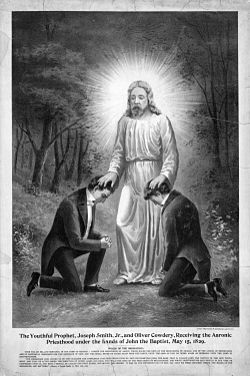
A 19th century depiction of John the Baptist conferring the Aaronic priesthood to Joseph Smith and Oliver Cowdery
A second alleged revelation has:
“Upon you my fellow servants, in the name of Messiah, I confer the Priesthood of Aaron, which holds the keys of the ministering of angels, and of the gospel of repentance, and of baptism by immersion for the remission of sins [5]; and this shall never be taken again from the earth until the sons of Levi do offer again an offering unto the Lord in righteousness.”
(May 15, 1829, Doctrine and Covenants 13).
The first written account of this revelation does not have the phrase the “Priesthood of Aaron.” There is more on this below under “LDS Leaders On The Priesthood” and “Differences In Description.” It also was not included in LDS Scripture until the 1876 D&C even though it is dated May 15, 1829. It also was not approved by the membership until 1880
(Ensign, Dec. 1984, pages 37-39).
A third alleged revelation has:
“Which John I have sent unto you, my servants, Joseph Smith, Jun., and Oliver Cowdery, to ordain you unto the first priesthood which you have received, that you might be called and ordained even as Aaron [6];…And also with Peter, and James, and John, whom I have sent unto you, by whom I have ordained you and confirmed you to be apostles, and especial witnesses of my name, and bear the keys of your ministry and of the same things which I revealed unto them;”
(August & September, 1830, Doctrine and Covenants 27:8, 12)
This revelation was not in the 1833 Book of Commandments. It is first found in the 1835 D&C, section 50, page 179. There is more on this below under “Historical Evidence.”
A fourth alleged revelation has:
“There remain hereafter, in the due time of the Lord, other bishops to be set apart unto the church, to minister even according to the first; Wherefore they shall be high priests who are worthy, and they shall be appointed by the First Presidency of the Melchizedek Priesthood, except they be literal descendants of Aaron. Wherefore they shall be high priests who are worthy, and they shall be appointed by the First Presidency of the Melchizedek Priesthood, except they be literal descendants of Aaron. And if they be literal descendants of Aaron they have a legal right to the bishopric, if they are the firstborn among the sons of Aaron; For the firstborn holds the right of the presidency over this priesthood, and the keys or authority of the same. No man has a legal right to this office, to hold the keys of this priesthood, except he be a literal descendant and the firstborn of Aaron. But, as a high priest of the Melchizedek Priesthood has authority to officiate in all the lesser offices he may officiate in the office of bishop when no literal descendant of Aaron can be found, provided he is called and set apart and ordained unto this power, under the hands of the First Presidency of the Melchizedek Priesthood.“
(Nov. 1831, Doctrine and Covenants 68:14-19)
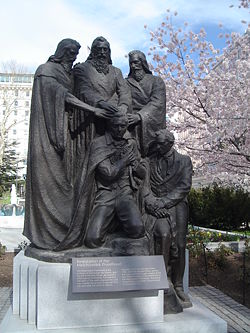
Bronze statue in Temple Square, Salt Lake City, representing Peter, James, and John in the act of conferring the Melchizedek priesthood to Joseph Smith and Oliver Cowdery, as envisioned by most modern Latter-day Saints
The first account of this revelation was in the LDS newspaper Evening and Morning Star, Oct. 1832, page 35. Even then It did not include any of the bolded words. It was not in the 1833 Book of Commandments but was included in the 1835 D&C, section 22, page 147.
A fifth alleged revelation has:
“And this greater priesthood administereth the gospel and holdeth the key of the mysteries of the kingdom, even the key of the knowledge of God. Therefore, in the ordinances thereof, the power of godliness is manifest. And without the ordinances thereof, and the authority of the priesthood, the power of godliness is not manifest unto men in the flesh;
For without this no man can see the face of God, even the Father, and live [7]…And the lesser priesthood continued, which priesthood holdeth the key of the ministering of angels and the preparatory gospel; Which gospel is the gospel of repentance and of baptism, and the remission of sins, and the law of carnal commandments, which the Lord in his wrath caused to continue with the house of Aaron among the children of Israel until John, whom God raised up, being filled with the Holy Ghost from his mother’s womb…
And again, the offices of elder and bishop are necessary appendages belonging unto the high priesthood…
And again, the offices of teacher and deacon are necessary appendages belonging to the lesser priesthood, which priesthood was confirmed upon Aaron and his sons…
For whoso is faithful unto the obtaining these two priesthoods of which I have spoken, and the magnifying their calling, are sanctified by the Spirit unto the renewing of their bodies. They become the sons of Moses and of Aaron and the seed of Abraham, and the church and kingdom, and the elect of God.
And also all they who receive this priesthood receive me, saith the Lord; For he that receiveth my servants receiveth me; And he that receiveth me receiveth my Father; And he that receiveth my Father receiveth my Father’s kingdom; therefore all that my Father hath shall be given unto him. And this is according to the oath and covenant which belongeth to the priesthood.
Therefore, all those who receive the priesthood, receive this oath and covenant of my Father, which he cannot break, neither can it be moved.”
(Nov. 22-23, 1832, Doctrine and Covenants 84:19-22, 26, 27, 29, 30, 33-40).
[NOTE: modern paragraphing added to improve legibility – editor]
Even though this is dated November 1832 it was not in the 1833 Book of Commandments. It was in the 1835 D&C, section 4, page 89.
A sixth alleged revelation has:
“There are, in the church, two priesthoods, namely, the Melchizedek and Aaronic, including the Levitical Priesthood.”
(March 28, 1835, Doctrine and Covenants 107:1).
This was first in the 1835 D&C, section 3, page 82.
A seventh alleged revelation has:
“And again, what do we hear? Glad tidings from Cumorah!
Moroni, an angel from heaven, declaring the fulfillment of the prophets–the book to be revealed.

Title page from an open 1835 edition of Doctrine And Covenants
A voice of the Lord in the wilderness of Fayette, Seneca county, declaring the three witnesses to bear record of the book!
The voice of Michael on the banks of the Susquehanna, detecting the devil when he appeared as an angel of light!
The voice of Peter, James, and John in the wilderness between Harmony, Susquehanna county, and Colesville, Broome county, on the Susquehanna river, declaring themselves as possessing the keys of the kingdom, and of the dispensation of the fulness of times!
And again, the voice of God in the chamber of old Father Whitmer, in Fayette, Seneca county, and at sundry times, and in divers places through all the travels and tribulations of this Church of Jesus Christ of Latter-day Saints!
And the voice of Michael, the archangel; the voice of Gabriel, and of Raphael, and of divers angels, from Michael or Adam down to the present time, all declaring their dispensation, their rights, their keys, their honors, their majesty and glory, and the power of their priesthood; giving line upon line, precept upon precept; here a little, and there a little; giving us consolation by holding forth that which is to come, confirming our hope!”
(Sept. 6, 1842, Doctrine and Covenants 128:20-21).
[NOTE: modern paragraphing added to improve legibility – editor]
Note the date this revelation was given and that it includes a summary of the two priesthoods. Also note that there is no support found for these statements in the two early “new Scriptures” of the Mormon church, the Book of Mormon and the 1833 Book of Commandments.
LDS LEADERS ON THE PRIESTHOOD
William Phelps, as the editor of the Mormon newspaper Evening and Morning Star (Independence, Missouri), provides the first public evidence of the two priesthoods, the Aaronic and Melchizedek.

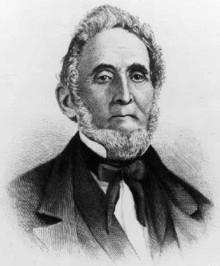
William Wines Phelps (February 17, 1792 – March 7, 1872) was an early leader of the Latter Day Saint movement. He was an assistant president of the church in Missouri, scribe to Joseph Smith, Jr., and a church printer, editor, and song-writer
After the high priesthood comes elders, priests, teachers, and deacons. Now the offices are separate, for the edification and benefit of the whole church, and, though the elders and bishops are appendages to the high priesthood, & the teachers and deacons are appendages to the lesser priesthood, yet these offices are important to their places, and regular in their gradation: from deacon to teacher, from teacher to priest, from priest to elder, from elder to high priest.
(March, 1833, page 74)
While not directly named, this is the first apparent mention together of the two LDS priesthoods in an official Mormon publication. The Book of Mormon, in the book of Alma, does mention the “high priesthood,” but the “lesser priesthood” is not mentioned at all in the Book of Mormon.
Phelps’ article does require the reader to know the meaning of “high priesthood” and “lesser priesthood.” The priesthood revelations from God were allegedly received in 1823, 1829, 1830, 1831 and September 1832. The Evening and Morning Star was first published June 1832, so there was a nine-month opportunity to mention all of them sooner than Phelps’ article.
Oliver Cowdery, the only other human participant with Smith in the restoration of the priesthood,[8] as the editor of a Mormon newspaper in Kirtland, Ohio (near present day Cleveland) said:
“But, dear brother think, further think for a moment, what joy filled our hearts and with what surprise we must have bowed, (for who would not have bowed the knee for such a blessing?) when we received under his [John the Baptist] hand the holy priesthood, as he said, “upon you my fellow servants, in the name of Messiah I confer this priesthood and this authority, which shall remain upon earth, that the sons of Levi may yet offer an offering unto the Lord [9] in righteousness!”‘
(Messenger and Advocate, Oct., 1834, pages 15 and 16 and Joseph Smith-History page 59, footnote by Oliver Cowdery)
The reliability of this statement by Mr. Cowdery is supported by an earlier statement in this same paper.
“That our narrative may be correct, and particularly the introduction, it is proper to inform our patrons, that our brother J. Smith jr. has offered to assist us…With his labor and with authentic documents now in our possession, we hope to render this a pleasing and agreeable narrative well worth the examination and perusal of the Saints.”
(ibid, page 13)
DIFFERENCES IN DESCRIPTIONS
Now compare the statement just above by Oliver Cowdery on the priesthood to the following LDS Scripture:
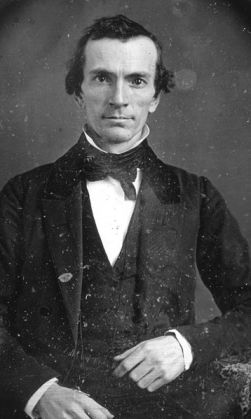
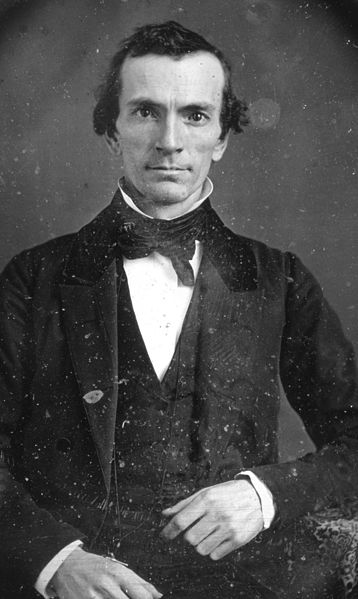
Photograph of Oliver Cowdery found in the Library of Congress, taken in the 1840s by James Presley Ball
Upon you my fellow servants, in the name of Messiah, I confer the Priesthood of Aaron, which holds the keys of the ministering of angels, and of the gospel of repentance, and of baptism by immersion for the remission of sins [10]; and this shall never be taken again from the earth until the sons of Levi do offer again an offering unto the Lord in righteousness.”
(Doctrine and Covenants 13, May 15, 1829 and Joseph Smith-History 1:39)
“I confer the Priesthood of Aaron” is not the same as “I confer this priesthood and this authority.” As will be shown below, Oliver Cowdery’s quotation is consistent with the claim of David Whittmer, another top leader in the early Mormon church.
HISTORICAL EVIDENCE
It should be evident by now that the scriptural foundation for the bestowal of the priesthoods is on shaky ground. To give you a sense of the changes made and the confusion in the revelations on the priesthood let us look at one of them, Doctrine and Covenants 27, as it appeared chronologically in LDS Scripture. The 1833 Book of Commandments has:
“A Commandment to the church of Christ, given in Harmony, Pennsylvania, September 4, 1830,
“LISTEN to the voice of Jesus Christ, your Lord, your God, and your Redeemer, whose word is quick and powerful.
2 For, behold, I say unto you, that it mattereth not what ye shall eat or what ye shall drink when ye partake of the sacrament, if it so be that ye do it with an eye single to my glory;
3 Remembering unto the Father my body which was laid down for you, and my blood which was shed for the remission of your sins:
4 Wherefore, a commandment I give unto you, that you shall not purchase wine, neither strong drink of your enemies:
5 Wherefore, you shall partake of none, except it is made new among you, yea, in this my Father’s kingdom which shall be built up on the earth.
6 Behold this is wisdom in me, wherefore, marvel not, for the hour cometh that I will drink of the fruit of the vine with you, on the earth, and with, all those whom my Father hath given me out of the world:
7 Wherefore, lift up your hearts and rejoice, and gird up your loins, and be faithful until I come:- even so. Amen.”
(Book of Commandments, chapter 28, verses 1-7, page 60)
Notice that this alleged revelation has nothing about the LDS priesthood. It was later changed. The 1835 Doctrine and Covenants has the following for the same revelation. The bold type words are the added ones; the ones in brackets { } were removed.
“Revelation given, {A Commandment to the church of Christ, given in Harmony, Pennsylvania,} September {4}, 1830.
1 Listen to the voice of Jesus Christ, your Lord, your God, and your Redeemer, whose word is quick and powerful. For, behold, I say unto you, that it mattereth not what ye shall eat or what ye shall drink when ye partake of the sacrament, if it so be that ye do it with an eye single to my glory–remembering unto the Father my body which was laid down for you, and my blood which was shed for the remission of your sins. Wherefore, a commandment I give unto you, that you shall not purchase wine neither strong drink of your enemies; Wherefore, you shall partake of none except it is made new among you; yea, in this my Father’s kingdom which shall be built up on the earth.
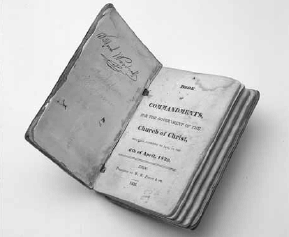
LdS President (March 1, 1807 – September 2, 1898) Wilford Woodruff’s copy of The Book of Commandments
2 Behold, this is wisdom in me; wherefore, marvel not, for the hour cometh that I will drink of the fruit of the vine with you on the earth, and with Moroni, whom I have sent unto you to reveal the Book of Mormon, containing the fulness of my everlasting gospel, to whom I have committed the keys of the record of the stick of Ephraim; And also with Elias, to whom I have committed the keys of bringing to pass the restoration of all things spoken by the mouth of all the holy prophets since the world began, concerning the last days; And also John the son of Zacharias, which Zacharias he (Elias) visited and gave promise that he should have a son, and his name should be John, and he should be filled with the spirit of Elias; Which John I have sent unto you, my servants, Joseph Smith, Jun., and Oliver Cowdery, to ordain you unto the first priesthood which you have received, that you might be called and ordained even as Aaron; And also Elijah, unto whom I have committed the keys of the power of turning the hearts of the fathers to the children, and the hearts of the children to the fathers, that the whole earth may not be smitten with a curse; And also with Joseph and Jacob, and Isaac, and Abraham, your fathers, by whom the promises remain; And also with Michael, or Adam, the father of all, the prince of all, the ancient of days:
3 And also with Peter, and James, and John, whom I have sent unto you, by whom I have ordained you and confirmed you to be apostles, and especial witnesses of my name, and bear the keys of your ministry and of the same things which I revealed unto them; Unto whom I have committed the keys of my kingdom, and a dispensation of the gospel for the last times; and for the fulness of times, in the
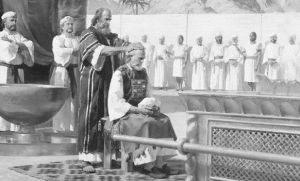
Image from the LdS Church Educational System Institute Manual “Gospel Doctrines” with this caption, “Righteousness is the key to priesthood power and eternal life.”
which I will gather together in one all things, both which are in heaven, and which are on earth; And also with all those whom my Father hath given me out of the world. Wherefore, lift up your hearts and rejoice, and gird up your loins, and take upon you my whole armor, that ye may be able to withstand the evil day, having done all, that ye may be able to stand. Stand, therefore, having your loins girt about with truth, having on the breastplate of righteousness, and your feet shod with the preparation of the gospel of peace, which I have sent mine angels to commit unto you; Taking the shield of faith wherewith ye shall be able to quench all the fiery darts of the wicked; And take the helmet of salvation, and the sword of my Spirit, which I will pour out upon you, and my word which I reveal unto you, and be agreed as touching all things whatsoever ye ask of me, and be faithful until I come, and ye shall be caught up, that where I am ye shall be also. {even so.} Amen.”
(1835 Doctrine and Covenants 50:1-3, pages 179-180. The present 1981 edition of the Doctrine and Covenants 27:1-18 reads the same except for the heading, verse numbering and some punctuation.)
Note that the historical heading of this revelation was changed, the day was omitted and many significant additions were made in the text with no notes or comments of any kind as to why.
Some Mormons may point to Doctrine and Covenants 13 to support the restoration of the Mormon priesthood, it has:
“Ordination of Joseph Smith and Oliver Cowdery to the Aaronic Priesthood along the bank of the Susquehanna River, near Harmony, Pennsylvania, May 15, 1829. HC 1:39-42. The ordination was done by the hands of an angel, who announced himself as John, the same that is called John the Baptist in the New Testament. The angel explained that he was acting under the direction of Peter, James, and John, the ancient apostles, who held the keys of the higher priesthood, which was called the Priesthood of Melchizedek. The promise was given to Joseph and Oliver that in due time the Priesthood of Melchizedek would be conferred upon them. See also Section 27:7, 9, 12…..
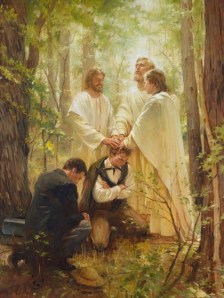
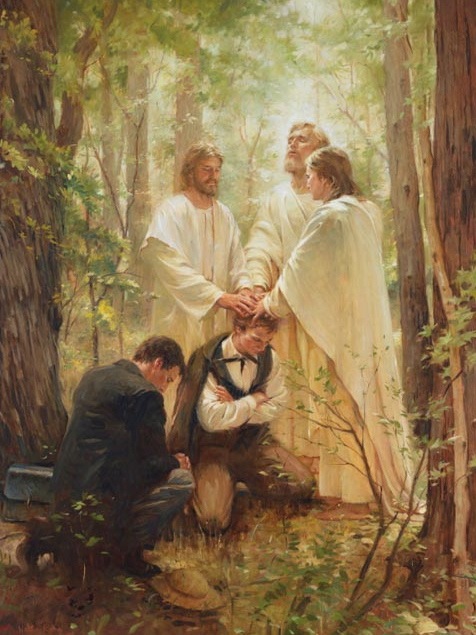
Contemporary painting of Joseph Smith and Oliver Cowdery receiving the Melchizedek Priesthood
UPON you my fellow servants, in the name of Messiah I confer the Priesthood of Aaron, which holds the keys of the ministering of angels, and of the gospel of repentance, and of baptism by immersion for the remission of sins; and this shall never be taken again from the earth, until the sons of Levi do offer again an offering unto the Lord in righteousness.”
(Doctrine and Covenants 13, May 15, 1829)
As stated at the start of this article, this revelation was not in the Mormon Scriptures until the 1876 edition, and not accepted “by common consent” until 1880. The same idea is also in the Pearl of Great Price, Joseph Smith – History, verses 68-69, which was also not in LDS scripture until 1876.
There are no reasons given why it was not in the two earlier collections of LDS revelations, A Book of Commandments (1833) and the 1835 Doctrine and Covenants. I believe the historical reliability of these verses is significantly in question because of their late canonization.
These are key foundational revelations. If they existed they should have been in the first collection of new revelation.
WHAT DO OTHERS SAY?
Joseph Smith was killed in 1844. In 1846 Brigham Young lead many of the Mormons on their way to what was to become Salt Lake City. Not all Mormons chose to go, including Joseph Smith’s wife and children. In 1860 Joseph Smith’s oldest son, Joseph Smith III, became the president and prophet of a newly founded church, the Reorganized Church of Jesus Christ of Latter Day Saints (RLDS). They claim to be the true continuation of the Church Joseph Smith founded. They deny that Peter, James and John “restored” the Melchizedek Priesthood to Joseph Smith. The following statement by Mormon historian and then Apostle Joseph Fielding Smith explains their position:
“‘REORGANITES’ DENY RESTORATION OF MELCHIZEDEK PRIESTHOOD
Was the Melchizedek Priesthood conferred upon Joseph Smith and Oliver Cowdery by Peter, James, and John?
In the History of the Church, no account is given of the date when the Melchizedek Priesthood was restored. For this reason certain parties not of the Church, who profess to believe in the divine mission of the martyred Seer, in order to bolster up their weak position, have made the claim that this priesthood was not restored by those heavenly messengers, but that it grew out of the Aaronic Priesthood, which was restored by John the Baptist on the 15th day of May 1829. According to this claim, the Prophet and Oliver Cowdery, having received the Aaronic Priesthood, did, by virtue of that priesthood, on the 6th day of April 1830, ordain each other elders, and that this eldership ordained high priests and apostles.”[a]
The actual statement, as officially published by the so-called “Reorganized” Church, is:
“In justification of the course taken, and the principles involved on `the question of authority,’ we have ever courted, and still do, investigation of the rigid character of the facts in the first organization. Here they are: Joseph Smith and Oliver Cowdery were ordained to the lesser priesthood by an angel; then, by this authority and a commandment they, on the 6th day of April, ordained each other elders, and this eldership ordained high priests and apostles, and this high priesthood ordained, by commandment, the President of the High Priesthood — the highest office in the church; so that the alleged lesser ordained [sic][11] the greater, is common to both the first organization and the Reorganization alike. The same class of facts justify both or condemn both.”
(Doctrines of Salvation, 3:95)

The “three witnesses” to the Book of Mormon: Oliver Cowdery, David Whitmer, and Martin Harris
David Whitmer, one of the “Three Witnesses” (found right after the Introduction of the Book of Mormon) of the Book of Mormon and an early leader in the Mormon church, had this to say about the priesthoods in the Mormon Church.
“Now Brethren, seeing they had no High Priests in the church of Christ of old, and none in the church of Christ [12] in these last days until almost two years after its beginning [13] — when the leaders began to drift into error; remembering the fact of the revelation being changed two years after it was given to include High Priests;…
In no place in the word of God does it say that an Elder is after the order of Melchisedec, or after the order of the Melchisedec Priesthood….This matter of ‘priesthood,’ since the days of Sydney [sic] [Sidney] Rigdon[14], has been the great hobby and stumbling-block of the Latter Day Saints. …This matter of the two orders of priesthood….all originated in the mind of Sydney Rigdon. He explained these things to Brother Joseph in his way, out of the old Scriptures, and got Brother Joseph to inquire, etc. He would inquire and as mouthpiece speak out the revelations just as they had it fixed up in their hearts…How easily a man can receive some other spirit, appearing as an Angel of Light, believing at the time that he is giving the revealed will of God…..”
(An Address to All Believers in Christ, pages 64)
The RLDS’ and David Whitmer’s position are supported by the historical evidence previously presented and support the idea that the high priesthood was first given at the Kirtland conference of June 3-7, 1831 (D&C 52 historical heading; 1833 Book of Commandments 54, page 123; Far West Record, page 7 and end notes 4 and 5 on page 8; Deseret Book Co., 1983, edited by D. Q. Cannon & L. W. Cook. ).[15]
It also seems reasonable to believe that the priesthood, if it really existed, would also clearly and frequently show up in many of the other publications by the Mormon Church. Those to be examined below are the Book of Mormon, The Holy Bible, Book of Commandments and a collection of early teachings called the Lectures on Faith.
THE PRIESTHOOD IN THE BOOK OF MORMON
The Book of Mormon, one of the unique scriptures of the Mormon Church, also does not show the present day Mormon priesthood. The following terms and phrases used in describing their priesthood could not be found in a search of the text of the Book of Mormon.

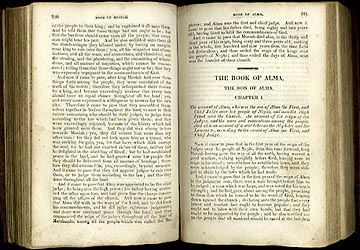
A first edition 1830 Book of Mormon open to the Book of Alma
a. “Aaronic Priesthood”, with of without capitals.
b. “Melchizedek/Melchisedec Priesthood,” with or without capitals.
c. “the fulness of the everlasting gospel,” except in the Introduction of the current edition of the Book of Mormon. The term is also not in the 1830 edition.
d. “new and everlasting covenant”
e. “married”, “marriage”, “marry”, “marrying”, “divorce”.
f. “wife and husband,” or “husbands and wife,” or “husband and wives” in the same paragraph.
g. “gospel of salvation”
h. “fulness of salvation”
i. “fulness of eternal glory”
j. “celestial”
k. “Aaronic,” with or without capitals.
l. “deacon”
m. “seventy,” or “seventies” as an office in the Melchizedek Priesthood.
n. “highpriest” as one word.
It is interesting to find the Book of Mormon has nothing on the Aaronic Priesthood and deacons. It does have teachers and priests, positions/offices that a present day Mormon would recognize, which are ordained by the laying on of hands (Moroni 3). But nothing is said through the one thousand years plus period of the Book of Mormon about the priesthood (and the term “lesser priesthood), that these offices are part of in present day Mormonism. Moroni 3 would have been a logical place to include instructions on conferring the Priesthood, but nothing is given.
Similarly, there is no direct wording in the Book of Mormon on the Melchizedek Priesthood. It does describe a priesthood, but it is different from the present day Mormon Church’s priesthood.
Terms like Melchizedek (as the name), order of God, order of his Son and high priesthood are used, but then only in the Book of Alma, which only covers the time period of about 91 BC to about 52 BC. Moroni 3; Alma 13 and 6:1 and Mosiah 18:18 give instructions for ordaining teachers, priests, elders, and high priests but there is nothing about conferring a priesthood. These would have been logical places for this, but they only give instruction for ordination to an office.
It seems reasonable to think that the Melchizedek Priesthood, at the very least using the terminology used in the Book of Alma, would be frequently mentioned in all parts of the Book of Mormon, especially during Jesus Christ’s visit to the New World (3 Nephi 8 and following chapters) and in the period of peace and tranquility that supposedly followed it (4 Nephi 1). Not only are they not mentioned in these books, but there is little said in other parts of the Book of Mormon (except Alma).

Simulated LdS Temple scene with examples of full LdS Temple Garments attire from the “Big Love” television show
It appears, in almost all uses, that the terms high priest, high priesthood and high priests are only used as part of the Mosaic law that the first Book of Mormon people would have brought with them when they traveled from Jerusalem to the New World (see 1 Nephi chapters 1-18). But they are surprisingly missing once the alleged visit of Jesus Christ occurs as related in 3 Nephi. 3 Nephi 12:1 does say: “…now the number of them who had been called, and received power and authority to baptize was twelve…I have given power that they may baptize you…”.
While a present day Mormon may understand these words to mean the Melchizedek Priesthood and apostles, the text does not say this. How were the Book of Mormon people, or even non-Mormons now, to understand this?
The Book of Mormon is still considered to be “the most correct of any book on earth”! This idea and wording has been in use since 1844 and are still being used, and were clearly stated by the late President Benson (Ensign, October 1992, page 2).
Throughout the entire Book of Mormon nothing is said about the Melchizedek Priesthood offices of seventies, patriarchs, president and apostles. Jesus does appoint twelve men in the New World, but they are called disciples all the way through 3 and 4 Nephi. If New World disciples were also considered apostles by the Lord, this would have been the place to find it, not about 370 years later from Mormon. Mormon 9:18 may at first look like an exception, but this appears to be referring to apostles in the Old World, the one Jesus called in the Jerusalem area, as shown in verse 22.
Moroni 6:1 has a very unique statement on who may be baptized. He says:
“And now I speak concerning Baptism. Behold, elders, priests, and teachers were baptized; and they were not baptized save they brought forth fruit meet that they were worthy of it.”
This has people who apparently held the priesthood, by present day Mormon Church teachings, in the offices mentioned, being baptized. In the present day Mormon Church men must be baptized before they receive a priesthood and an office in it!
All of this has to lead to the conclusion that the Book of Mormon has a different priesthood than currently taught by the Mormon Church. While this difference is significant now, it did not exist to the same extent in 1833 between the Book of Mormon and the Book of Commandments.
A close examination of each will show a close similarity in how the priesthood is described. There are only two significant differences. The Book of Mormon has twelve disciples, a high priesthood and no deacons while the Book of Commandments names apostles and deacons but no high priesthood. They both have nothing on the Aaronic or Melchizedek Priesthood.
THE PRIESTHOOD IN THE BIBLE
The following Mormon phrases and keywords could not be found in the text of the King James Version [16] of the Bible:
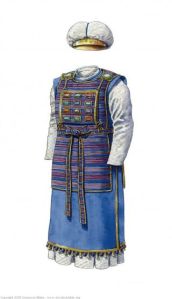
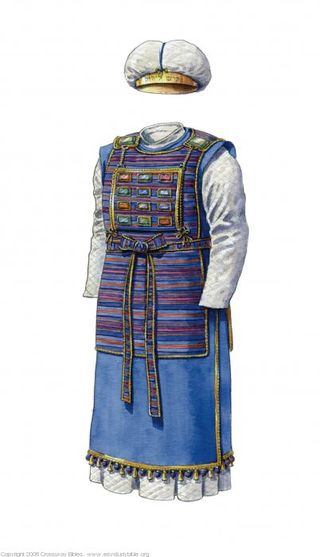
High Priest’s garments as described in the Bible
a. “Aaronic Priesthood,” with or without capitals.
b. “Melchizedek/Melchizedek Priesthood,” with or without capitals.
c. “fulness of the everlasting gospel”
d. “fulness of the gospel”
e. “fulness of eternal glory”
f. “fulness of salvation”
g. “new and everlasting covenant”
h. “gospel of salvation”
i. “holy order of God”
j. “highpriest,” as one word.
k. “high priesthood”
The New Testament is very clear that the Aaronic priesthood (including laws and ordinances) was abolished when our Lord died on the cross (Gal 3:19, 23-25; Col 2:14-17; Heb 10:1-10). There was in fact a change in the priesthood – it was abolished and even Christ did not hold the Aaronic priesthood (Heb 7:11-14). The New Testament tells us that all true born-again Christians are priests by the blood of Christ (Rev 1:5-6). This priesthood has nothing to do with the old Aaronic priesthood because it is far superior! It is a royal priesthood of believers in the Living Christ, our Great High Priest forever (1 Pet 2:9-10).
The Bible does say a little about Melchizedek (Gen 14:17-20, Ps 110:4, Heb 4:14 to 8:4). The only Melchizedek priest in the Old Testament was the King of Salem. In the New Testament only Jesus Christ has the Melchizedek priesthood and he was appointed by God (Heb 5:5-6, 10). No priestly succession is mentioned. These ideas were summarized in a paper given by David Crump, as published in Christian Institute for Mormon Studies, Proceedings and Papers, Vol 1, page 35, where he said:
“In the New Testament, Paul’s epistle to the Hebrews tells us what personal qualities are required to hold the Melchizedek priesthood:
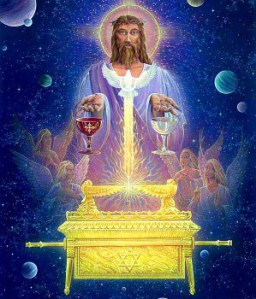
Artist’s speculative depiction of Jesus Christ acting as High Priest in heaven
1. You must live forever. This does not mean that you have somehow gained eternal life; it means that you have no beginning as well as no end. You endure forever through the inherent, self-possessed power of your own indestructible, eternal life. (Is there anyone who still hopes to be in the market for this job?)
2. You need to have personally received an oath from God promising that he has made you the Messiah of the world.
3. You must be holy. Mind you, you are not just trying to be holy; you must already share in God’s own character, in his inherent perfection, which means that you are free of all sin. There can be no blemish of inadequacy in your life; you have never done anything even slightly wrong.
4. You must be the eternal Son of God who meets the seven qualifications of sonship outlined in Hebrews 1:1-4. In other words, you must be the eternal mediator of creation, who continues to sustain the creation through the power of your own spoken word.
The position of Melchizedek Priesthood is taken; it is held by God’s Son Jesus Christ, and he has chosen not to share it with us.”
THE PRIESTHOOD IN THE LECTURES ON FAITH
The Lectures on Faith were prepared by Joseph Smith (probably with help from others) and delivered to a class of elders in Kirtland, Ohio in the winter of 1834-1835. [17] They were first included in the 1835 edition of the Doctrine and Covenants. The preface of this book has:
“The first part of the book will be found to contain a series of Lectures as delivered before a Theological class in this place, and in consequence of their embracing the important doctrine of salvation, we have arranged them into the following work.”
(Preface of 1835 D&C)
This preface was signed by Joseph Smith, Oliver Cowdery, Sidney Rigdon, and F. G. Williams. These men were the top leaders (first presidency and assistant president) of the Mormon Church at that time. Note that they said the Lectures on Faith had the important doctrine of salvation.They thought them important enough to make them scripture.
The Lectures on Faith do not use any of the important terms and phrases used to describe the Mormon priesthood and its offices. This is amazing seeing they were to contain “the important doctrine of salvation.” For example, according to the present day Mormon Church, baptism is a necessary part of a Mormon’s “salvation.”[18] Without the priesthood no one has the authority to baptize, hence no “salvation.”
THE PRIESTHOOD IN THE BOOK OF COMMANDMENTS
The 1833 Book of Commandments was the first published collection of alleged revelations received by Joseph Smith. In its time it was considered one of the three LDS Scriptures (the Holy Bible, Book of Mormon, Book of Commandments). As shown above it does not contain the Mormon priesthood as currently known.

Sidney Rigdon, founding member of the First Presidency, Joseph Smith’s First Counselor and the person suspected to be the chief fabricator of LdS Priesthood theology according to David Whitmer
Priesthood revelations that are now Doctrine and Covenants 2, 13, 27, 68 and 84 were not in it. Apostles were called elders (chapter 24:1-2, 22:1, 12, 14) and the only priesthood offices mentioned were elders, priests, teachers and deacons (chapter 24:31). There is nothing about the Aaronic and Melchizedek priesthood, lesser and higher priesthoods, seventies and high priests as currently exists.
God allegedly made it clear that the revelations were “true and faithful” (Book of Commandments 1:7), “neither doth he vary from that which he hath said” (Book of Commandments 2:1) and “now the decrees of God are unalterable” (Alma 41:8). We have God’s word that he would not change and alter what he had said. It should be clear by now that changes and additions were made. What then is the only possible conclusion?
SUMMARY
We have shown how two key alleged revelations about the restoration of the LDS priesthood were not in the first and second published collections and two others were not in the first collection. David Whitmer and the RLDS church stated a similar view.
All this can only lead to the clear conclusion that the present day Mormon Church’s priesthood is not the same one that existed from 1829 to about 1833. It was changed about 1833 and then support was inserted into the LDS scriptures after the fact.[19] In some case this was done 43 years later.
Both 1 Cor 14:33 and Doctrine and Covenants 132:8 say that God is not the author of confusion. We are then left with the only conclusion possible, the confusion in the early LDS Church, particularly the teachings about the priesthood, can only be by man.
THE LDS RESPONSE
The Mormon response to this paper will probably be harsh, for it will be an emotional subject for most LDS, particularly men. This strikes at the heart of Mormonism.
Many will seem to be incredulous and just reject everything out right. On the other end of the spectrum others will take the information and seriously examine it in detail. Some to find reasons to reject it, but some to better understand it and grow from it. All anyone can do as they present the above information is to keep bringing the discussion back to the subject and the facts presented. You will need to dwell on the facts and their accuracy.
There is only one clear conclusion. The priesthood now taught by the Mormon Church is significantly different from the one taught by the Mormon Church from 1830 (their start date) to roughly 1835. It also appears that they tried to hide the changes by post dating the early alleged revelations and making new ones to support the change.
END NOTES
[1] Melchisedec is the New Testament spelling of the Old Testament Melchizedek. The Mormon Church uses this latter spelling.
[2] Gospel Principles, published by the Church of Jesus Christ of Latter-day Saints, Deseret Book Co., Salt Lake City, 1978, page 73. The majority of Bible believing Christians, however, believe that only Jesus Christ held the Melchizedek Priesthood which is “unchangeable”; and that ALL true Christians, men and women, are a royal priesthood (1 Peter 2:5, 9; Heb. 4:14, 7:24, 6:20, 10:10; Rev 1:5-6).
[3] The Book of Commandments, a Scripture published in 1833, was the first collection of alleged revelations received by Joseph Smith. Following editions were titled The Doctrine and Covenants. In the early years of the Mormon church in the United States there were editions in 1833, 1835, 1844 and 1876. There were several British editions, with an 1854 printing that was sent to Utah (Ensign, December 1984, pages 36-37) .
[4] Joseph Smith-History 1:68-72 said it was John the Baptist that ordained them to the Aaronic Priesthood and Peter, James and John (who held the keys for this) ordained them to the Melchizedek Priesthood. The Aaronic Priesthood supposedly on May 15, 1829. The exact date for the Melchizedec Priesthood restoration is not know. The best date that most LDS scholars think this happened is between May 15, 1829 and April 1830, and one said, “probably June 1829” (A Joseph Smith Chronology, by J. Christopher Conkling, Deseret Book Co. 1979, page 10-11).
[5] Doctrine and Covenants 20:37 says we receive the remission of sins by faith in Jesus Christ, by repentance and service to the Lord, all before we are baptized. Which one is correct?
[6] From Lev 8:33 and Ex 29:37 we learn that Aaron’s ordination took 7 days. Mormon Aaronic Priesthood ordinations that I (John Farkas) saw or participated in took less than 15 minutes.
[7] Then how did Joseph Smith see the Father and Son in 1820 and live as he related in Joseph Smith-History 1:17. He did not, as officially taught, get the priesthood until May 1829 (Joseph Smith-History 1:72).
[8] Cowdery was the Second Elder (D&C 20:3 ) and assistant president of the High Priesthood. He was one of Smiths scribes during the alleged “translation” of the Book of Mormon from the “gold plate.” They were both together when the priesthood was allegedly restored.
[9] Mormons have said that these are animal sacrifices, as done in the Jerusalem temple, which are to be restored. (Mormon Doctrine, page 666).
[10] Doctrine and Covenants 20:37 says we receive the remission of sins by faith in Jesus Christ, by repentance and service to the Lord, all before we are baptized.
[a] Joseph Fielding Smith and Bruce R. McConkie, “Doctrines of Salvation Vol. 3” pp.94-95, (this citation was missing from Mr. Farkas’ original article — Editor)
[11] The bracket is in the quote.
[12] The Mormon Church since its beginning has had three names: Church of Christ, 1830-1834; Church of Latter Day Saints, 1834-1838; The Church of Jesus Christ of Latter-day Saints, 1838 to the present.
[13] If David Whitmer by “beginning” means the formal start of the Mormon Church on April 6, 1830, them 1832 is the approximate start of High Priests.
[14] Sydney Rigdon probably came into the Mormon Church December, 1830 (The Voice of One Crying in the Wilderness: Sidney Rigdon, Religious Reformer, 1793-1876, by F. Mark McKiernan, Herald House, 1979, pages 41-44). This is the earliest date for the change discussed by David Whitmer.
[15] While History of the Church 1:175-176 uses the term “authority of the Melchizedek Priesthood was manifested,” D&C 53 does not use the term at all or “high Priesthood.” The Far West Record, page 7, in the meeting minutes only uses the term “high Priesthood.”
[16] This is the version used by the Mormon Church.
[17] Doctrines of Salvation, by Joseph Fielding Smith, Salt Lake City, Bookcraft, 1955, 2:304; the book Lectures on Faith, Deseret Book Co., Salt Lake City, page v.
[18] For the importance of baptism see: Mormon Doctrine, page 69. Salvation means spending eternity with God in the Celestial Kingdom (Gospel Principles, Deseret Book Co., Salt Lake City, 1976, pages 124-130).
[19] This same idea of after the fact changes is also supported by D. Michael Quinn in his book The Mormon Hierarchy, Signature Books, 1994, pages 7-38.
About the Author
John R. Farkas (1932-2011) was a convert to Mormonism in 1975 and served in several callings up to and including Elder’s Quoruom President of the Rochester 1st Ward, New York Stake. In 1984 he left the LdS Church and became involved with Berean Christian Ministries where he served until his death. Mr. Farkas is the author of several books on Mormonism and other subjects which can be found on his Author’s page on Amazon. Beggar’s Bread is grateful that before he passed Mr. Farkas granted us the permission to republish the articles from his now defunct website.
John Farkas is of one the giants on whose shoulders we stand and to whom we owe a debt that we simply can never repay! We look forward to thanking him again in heaven for the example of his life and treasure of wisdom that he left behind for our benefit.
[Please note that while this article has been very lightly reformatted and re-paragraphed to improve overall legibility no content has been changed from Mr. Farkas’ original, March 27, 1998 source article. — Fred W. Anson, editor]
 On that note, and to get specific regarding observed behavior on our side of the divide I’ve watched in stunned disbelief as the President of Fuller Theological Seminary, Richard J. Mouw has seriously, publicly, and repeatedly misrepresented the beliefs and practices of both the evangelical and Mormon communities. Indeed, let me state it bluntly to the evangelicals and Mormons reading this: Richard J. Mouw has sinned against you. The God of the Scriptures makes it clear that it is a terrible thing to bear false witness against our neighbors, and he has been guilty of that sort of transgression in things he has said about all of us – evangelical and Mormon alike.
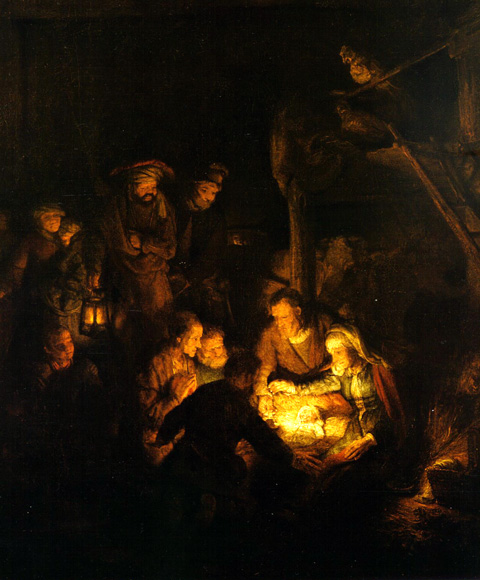 Next month will mark the 207th anniversary of the birth of Joseph Smith. We know and understand that Mormon culture typically uses the month as an occasion to pay special attention to Joseph’s life and teachings. However, please hear my heart when I tell you that we evangelicals are praying and long for the day when the month will be far, far, far less about Joseph Smith for our Mormon friends, but all about the One whose incarnation Christians celebrate each year instead. This is the One about whose birth we sing and whom we exalt above all. I should add, that there is nothing more that we long for more than our Mormon friends to join us with swelled hearts and spiritual eyes solely fixed on that One when we sing -“the hopes and fears of all the years are met in thee tonight.”









 Beggar's Bread