Archive for the ‘Mormon Culture’ Category

by Brian Horner
Like virtually all of the 19th century, American cults of Christianity, Mormonism began as an attack on the historically orthodox, biblical faith that it claims to have “restored”. While individual Mormons and Mormon leaders hold some diverse views on this matter, the basic idea they all share is that at some time shortly after the death of the last apostle, the authority of the gospel, the church and the Word of God (the Bible) was lost due to a universal, general apostasy and corruptions introduced into the Bible. The predicate to Mormonism’s alleged, “restoration”, is what Mormons are taught to regard as the “great apostasy”. The disdain that Mormon “prophets” and other leaders held for the vast majority of Christians who populated the orthodox Body of Christ throughout the ages –actually for the roughly 95% of the history of Christianity between this “great apostasy” and the initiation of Joseph Smith’s prophetic career in 1830—is palpable and obvious in their own words.

Mormonism begins with Joseph Smith’s alleged “First Vision” – an event, which Smith described with contradictory variations. But the basic message lies in every version: Mr. Smith claimed to have received this revelation from God (or the Mormon Gods “Heavenly Father” and his son “Jesus Christ”):

I was answered that I must join none of them, for they were all wrong; and the Personage who addressed me said that all their creeds were an abomination in his sight; that those professors were all corrupt.
(Joseph Smith – History 1:19)

Here Smith attributes an explicit condemnation of the Christian church as “corrupt” and “an abomination” to God himself (or by the Mormon Gods, including Jesus Christ).

Brigham Young, the second “prophet” of the LDS organization carried on this Mormon tradition teaching that, “The Christian world, so-called, are heathens as to their knowledge of the salvation of God” (Journal of Discourses 8:171). He continued, “With regard to true theology, a more ignorant people never lived than the present so-called Christian world.” (ibid, 8:199). According to this Mormon “prophet”, Christians are totally ignorant heathens.

Young’s successor, John Taylor, confirmed this in his preaching. “What does the Christian world know about God? Nothing; yet these very men assume the right and power to tell others what they shall and what they shall not believe in. Why, so far as the things of God are concerned, they are the veriest fools; they know neither God nor the things of God.” (Taylor, ibid, 13:225). Taylor taught the Mormon faithful, that Christians are fools.

Similar assaults against historically orthodox, biblical Christianity continued throughout several generations of Mormon “prophets”. Their message regarding this “great apostasy” was driven to the logical and common conclusion held by Mormons today as represented by B.H. Roberts, the most highly placed, official LDS historian within the organization. He said, “Nothing less than a complete apostasy from the Christian religion would warrant the establishment of the Church of Jesus Christ of Latter-day Saints.” (History of the Church, vol. 1, p.xlii).

Dug's Special Mission_EDITED

This is consistent with both the message of the Mormon “prophets”, on this matter as well as the natural, even the necessary logical extension of the original, alleged “revelation from God” experienced by Smith and his successors, ever since. If Christianity had survived and was still alive and well in any form, anywhere on earth in 1830, then it would have been impossible to “restore” it with Mormonism. It is impossible to “restore” anything, in the sense that Mormonism uses the term, which already exists. This message is nothing less than the condemnation of the entire Christian church, allegedly from God himself. It has been carried down through the history of Mormonism to the present day and it is one of the key, essential claims that Mormons use to justify the existence of their religion. If Christ had remained with and in His church as He promised and God had not condemned the Christian church, as Mormons claim, then there would be no need for the existence of the entire Mormon religion. Its existence would simply be redundant as well as contradictory to the historic orthodox faith.

So what does all of this have to do with the Mormon rhetorical tactic of deflection? It serves as a topic that provides an excellent example of the kind of argumentation I want to describe here. I have debated this particular topic (and many others) with Mormons for decades. I have found that This topic is highly useful in exposing the falsehood of Mormonism since like so many things taught and believed by Mormons. Their view on this matter cannot be reduced to a matter of “faith”. It is a purely historical topic and the truth of any such claims as this can be easily determined by simply examining the historical facts.

Keep that in mind as we proceed, using this issue as an example of this kind of problem. After all, we are simply discussing the historical assertion of what Jesus, his apostles, and their churches taught. The issue is not the truthfulness or the meaning of what they affirmed and taught; it is simply a matter of identifying the teaching itself. Did Jesus teach the distinctively Mormon doctrines and practice of not? One can agree or disagree with what these doctrines meant or how to interpret them. The issue here is this: Were they actually taught it in the first place?

When Christians question or challenge the claims of Mormonism you can count on one thing: Mormons will almost invariably try to change the subject when they perceive that they cannot answer or defend the claims of their organization. The above doctrine of this supposed, “great apostasy” is an excellent example. The dialog usually follows this basic pattern, exemplified by Mark (a Christian) and Larry (a Mormon):

Mark: So let me be sure of our claim here; Joseph Smith received revelations from God about how the whole Christian faith had been corrupted and had decayed into an abomination to God. Is that right?

Larry: Yes that’s basically it.

Mark: “And now, at this point in time, we have Mormonism, which is the restoration of what was lost in this ‘Great Apostasy’, right?”

Larry: Correct. Joseph Smith was appointed by God to bring people back to the true gospel and God used him as the prophet of the Restoration. As a result, the Church of Jesus Christ of Latter-day Saints is God’s one true church, which is the only church on the earth today that retains the authority of the prophets and apostles who are still the foundation of the church, according to Ephesians 2:20.

Mark: Well that is pretty difficult to believe.

Larry: Why? Don’t you think that God wants his authority and the true gospel to be represented by his church?

Mark: Yes. But, if Mormonism is the restoration of the Gospel of Christ then we should be able to see that Christ himself taught the distinctive doctrines and practices that Mormons claim to have “restored”. I mean, you guys cannot have ‘restored’ something that never existed. And if it exists today, there was no need to “restore” it. Mormonism includes a whole bunch of things, in fact even requires lots of things that neither Christ nor his 12 apostles ever taught, like polytheism, the Mormon temple rituals, God the Father is a man living in outer space, and so on. Can you show me some reasons to think that Jesus or his apostles ever taught such things? …

At this point, Larry (or any Mormon) will almost always evade that question, and then cover his retreat with any of a variety of “red herrings” – a named logical fallacy, aka “Ignoratio elenchi”. This fallacy is deployed to distract the exchange or an audience from a point or a question. If successful, the Mormon will derail the conversation away from the question that he or she knows they cannot answer without causing irreparable damage to their religion’s public image.

In this scenario, Larry might respond to Mark’s question by ignoring it and launching a counter-question such as, “Can you prove that Jesus taught the Sermon on the Mount”? Or he might ask, “Can you prove that Jesus walked on water”? or “Can you show me some reasons to think that the Hebrews migrated out of Egypt?” etc.

It is important to notice that there is no answer to Mark’s question in Larry’s response. Instead, he is trying to evade the question (avoid answering it) and then misdirect the conversation off onto a different topic, usually in such a way as to illustrate that no one can “prove” anything in the Bible to be true as long as someone refuses to believe it, just as we Christians refuse to believe that Christ ever taught the distinctive Mormon doctrines that their organization supposedly “restored” such as, for example, that dogma God the Father is a man living in outer space.

But the red herring fallacy is not the only evasion they use. Frequently the Mormon will deflect a direct question by attempting to abstract the subject matter to a level where he can technically “answer” the question by answering a question about the broader context containing Mark’s question. For example, the Mormon might respond to a challenge to show that Jesus and his apostles ever taught Mormonism’s distinctive dogmas by trying to show that the Bible elsewhere mentions other “gods” and that the Jews were indeed polytheistic, thereby proving that Jesus taught polytheism – a central dogma of Mormonism that are absent from the New Testament and Christianity for it’s entire history. This effort to broaden the issue is just another trick. It’s a bit more clever since it can be shown that indeed the Bible at least mentions other ‘gods’. It also describes the Jews practicing polytheism. But this deflection falls flat on its face in light of two simple facts so easily observed in the text of the Bible.

First, this “answer” simply ignores the obvious fact so evident in the context where these gods are mentioned, that they are repeatedly identified as false gods (Ps 115 and 135 are good examples). It also ignores the many explicit declarations by God that He alone is the only God that is, was or ever will be. (There are numerous examples throughout the Bible. Isaiah 44-46 contain clear and explicit revelations on this matter). Finally, it ignores the horrific punishment that God meted out on His people for their sin of practicing and teaching polytheism. Thus, the mentions of polytheism in the Old Testament are purely descriptive and not proscriptive. God tells the truth that some of His chosen people did indeed slip into this worldview. But pointing out that they sinned is not God’s endorsement of their sin of polytheism.

Secondly, this answer does not answer the actual question that was asked, pertaining to Jesus Christ, his apostles, and their churches supposedly teaching polytheism. If Jesus understood the Old Testament to actually endorse polytheism, as Mormons infer he must have, then we rightly expect that he would have made that point. After all, the number of Gods in existence must obviously be a critically important element of ANY coherent theology and we expect Jesus to have come with the truth on this essential point. If Jesus understood that there really are MANY Gods (one of the alleged, teachings of Christ that Mormons claim to have “restored”), then surely we should see some evidence of that somewhere in his own words, the words of his apostles or even their churches. Yet, no such evidence exists. The state of the evidence argues that the Mormon claim that Jesus taught polytheism to his disciples is therefore rightly regarded as false, by virtue of the lack of any reason to think he did!

I do not want to get down in the weeds of these particular Mormon doctrines here in this post. This issue of the Mormons claiming to have “restored” the original, authentic teachings of Jesus Christ supposedly lost to the earth in the alleged, “great apostasy” is only here as an example of the point I want to make, which is an examination of the tactics used by Mormons when responding to Christian challenges to the claims of their religion.

The larger point here is to be on the lookout for the distractions, deflections, evasions, counter-challenges, etc. used by Mormons in ways that, by virtue of their highly predictable commonality, appear to have been somehow ingrained into their subconscious. If you have ever debated Mormons and have not seen this behavior, consider yourself to be extremely unique. I have debated Mormons for decades and cannot remember even a single encounter wherein my Mormon correspondent did not quickly try to change the subject when it was clear that he or she could not allow him/herself to answer me honestly.

When challenging or questioning the claims of Mormonism, you will find or have already found that the deceptive practice of deflecting questions and responding with red herrings is a real problem. My advice is twofold:

BYU Professor Robert L. Millet. Click on the above image to see a video of Mr. Millett instructing Mormon Young People on how to deflect and evade direct questions and challenges from outsiders and critics.

1. Formulate your questions and challenges carefully and thoughtfully.
Another game Mormons seem to have been trained to play is to avoid answering your questions and challenges by parsing out words and/or quibbling with the form of the question rather than its intended content. They will frequently misrepresent your question (a straw man fallacy), in an effort to answer the question you “should have asked”, to quote Robert Millett, a popular BYU professor, and Mormon Apologist, instead of the question that you actually asked. There is nothing you can do to eliminate this evasion. But you can make it hard for them to use it effectively by carefully stating a well-thought-out challenge or question.

2. Do not be distracted by the tricks.
Pay careful attention to the Mormon’s response. Listen for a direct, honest answer to your question or challenge. This does not mean siphoning the response for only the answer you want. It means accepting an honest, truthful and valid answer to the question. As long as your question/challenge strikes at the heart of the Mormon claim in question, you are unlikely to get that answer. What you are far more likely to get is a deflection of some kind – perhaps very much like the ones illustrated above. In that case, your response should be to point out that you do not see how the deflection answers the specific question that you asked. Stay focused on your question or challenge. Repeat your question until you get an answer and always insist on an actual answer.

This is where forethought about your own question is important. You do not want to have to clarify the question after the Mormon evades it, because then you run the risk of being accused of “moving the goalposts” and your Mormon friend (or opponent) is not likely to let that slip and will use it constantly as an excuse to continue avoiding your questions. Also, see if you can get your Mormon friend to back up their answer, if it ever comes, by offering some supporting evidence and valid argumentation. (You will almost never get this far). When a direct answer, backed up by evidence and/or valid reasoning does not come, be careful in how you point out that failure. Expect it and don’t let it bug you. Just point out why the answer is invalid.

Unfortunately trying to lead someone who has been deceived –in some cases for an entire lifetime—to simply be honest with you and therefore with themselves will rarely end well. We human beings have a tendency to be defensive about the things we believe. A psychological condition called, “normalcy bias” will kick in and cause people to try whatever they can to get away from the facts that prove that they have been deceived. Moreover, a confrontation with factual reality that debunks closely held beliefs will frequently induce cognitive dissonance, causing many people serious intellectual and emotional distress. So be gentle if you can. Remember that 1st Peter 3:15 calls us to be prepared to have an answer (Greek: “apologia”) for the hope that is within us, but to do so with gentleness and respect:

But in your hearts revere Christ as Lord. Always be prepared to give an answer to everyone who asks you to give the reason for the hope that you have. But do this with gentleness and respect.
— Peter 3:15 NIV

About the Author
Brian Horner graduated with a Master’s Degree in Christian Apologetics from Biola University. He now sails around the Caribbean serving various ministries and teaching apologetics when he’s not writing articles like this one.


“Darkness to Light” Unknown Artist

by Michael Flournoy
In my book, “A Biblical Defense of Mormonism”, I wrote a chapter called, “Is Revelation an Achilles Heel?” After comparing the church to a game of chess, I nominated the king to symbolize the LDS testimony. I wrote,

In every chess game, there is one piece so important, that its capture ends the game: the king. The king is what enables the game to continue, is the point of the enemy’s attack, and the piece that must be defended at all costs. If the king is misplayed and put in a predicament, he becomes a hindrance or an Achilles heel. For every Latter-day Saint, there is something personal behind the doctrines, the key principles, the scriptures, and the atonement, which is the equivalent to the king in our game of chess: our testimonies. It is our testimonies that give life and utility to everything Mormonism has to offer, and our testimonies are also the most logical points of attack for our enemies.
(Michael Flournoy, “A Biblical Defense of Mormonism”, p.193)

Even then, I knew full well that every Mormon’s strength was also their greatest weakness. Latter-day Saints are subconsciously aware that they would be sunk without their spiritual conversion. They typically shield their weak spot and talk about the doctrinal and social aspects of their faith instead, in exactly the way a chess player shields their king with less important pieces.

What is Spiritual Conversion?
I classify spiritual conversion as anything that convinces a Latter-day Saint that Mormonism is true. This is usually a specific event or a series of events. It may be a spiritual experience, or it may just be an occurrence that they interpret as a sign of Mormonism’s validity. Almost all the Latter-day Saints I have spoken with admit to having had an indisputable spiritual conversion.

The most popular spiritual conversion comes from reading The Book of Mormon and praying about it. Many members claim to receive a confirmation from the Holy Ghost that it’s the word of God through a burning in the bosom or some other subjective feeling.

But spiritual conversion is not limited to that experience. As I sat in an LDS class one day, a classmate explained that he was mowing the lawn one day, when an audible voice told him to stop. He immediately stopped what he was doing and discovered that he almost ran over a hollow den inhabited by baby rabbits. I’ve heard countless stories from LDS parents where they had an impression that their child was in danger, only to find their toddler wading into the street or near a swimming pool.

No matter the experience, whether it be a dream, an experience, or a strong feeling, it strengthens a Mormon’s spiritual conversion. Even if the experience doesn’t relate to the restoration at all, Latter-day Saints immediately jump to the conclusion that the church is true.

In reality, several explanations could be given for any of these events. Satan could be in the business of saving baby bunnies in order to deceive LDS people. Or God might mercifully intervene in their lives, despite them being Mormon. Or sensing a child in the street could be good old-fashioned mother’s intuition. Yet for Latter-day Saints, all signs point to yes. Mormonism takes all the credit, and it is glorified in their eyes.

These experiences are considered extremely sacred to Latter-day Saints, and in their eyes revealing them openly is casting their pearls before swine. It’s also their last line of defense, so if their spiritual conversion is overcome they will have nothing left. The LDS usually keep these experiences securely hidden under lock and key.

In fact, when I first departed from Mormonism my uncle told me he’d had experiences and knew without a doubt that the church was true. He did not tell me what the experiences were. Even if it meant bringing a family member back into the fold, putting his spiritual conversion out there was too much of a risk.

Apostates
If there is one group the LDS feel threatened by, it’s Ex-Mormons. I think I know why that is. Mormons are fully aware that many Ex-Mormons possessed spiritual conversions, and they left anyway.

Latter-day Saints cannot comprehend why someone would reject what they consider an unshakable witness. They sometimes feel like they have to minimize Ex-Mormons’ reasons for leaving. They’ll try to say the spiritual conversion either faded away or was overpowered by sin. They desperately want to believe that their spiritual conversions can’t falter.

As a Mormon, I believed the same thing. Apostates of the faith were blinded by mists of darkness and the enticing of sin and could not remember their own spiritual experiences. I believed my testimony would never falter. Even if the whole church dwindled and only one congregation remained on earth, my resolve was to remain faithful.

Knocking out the Leg of Spiritual Conversion
In theory, an Ex-Mormon has a much higher chance of disrupting spiritual conversion than someone who has never experienced it. However, because of trust issues between Latter-day Saints and former members, never Mormons can have an equal or an even greater opportunity.

It’s important to speak the spiritual language of Latter-day Saints. As a Mormon, I thought Evangelicals were overly objective, especially for their constant emphasis on relationship over religion. A relationship without some subjectivity is an alien concept to Latter-day Saints.

Sometimes when a Latter-day Saint pulls out their shiny apple, the one they claim exclusive rights to, your best move is to pull out their own shiny apple and eat it in front of them. Saying something like, “the Spirit told me [insert what He said here]” is sure to knock Mormons off balance a little, and an apostate doing it is especially worrisome! A similar tactic could be to share an experience that bolstered your testimony of Christianity.

I do not recommend sharing anything like this unless it is legitimately, and utterly true. We are not helping anyone, nor are we glorifying God if these stories are fabricated. If you are unable to speak the Mormon’s spiritual language, you might be better off attacking their social and doctrinal conversions instead.

If an Ex-Mormon has the opportunity to have an open conversation with an active Mormon, he or she should make it a point to use the broken pieces of their spiritual conversion if at all possible.

I had a family member tell me once that he always suspected I would intellectualize my way out of the faith. I replied that the reasons for my departure were just as much spiritual as they were intellectual, thwarting his attempt to distance my apostasy from my spiritual conversion.

Another relative asked how I could leave after all the spiritual experiences I’d had. I replied that I had indeed had spiritual experiences, but upon closer examination, they pointed to Christ’s divinity and not to Mormonism being true. She began sputtering off the plethora of experiences her testimony was built from in an attempt to shield herself from the threat my words posed. Ironically, she was in the same boat as me. Not one of them proved the church was true.

Using a Mormon’s spiritual language is key to undermining their conversion. Statements like, “I read and prayed over The Book of Mormon. I received a witness that it’s not true” are difficult for Mormons to deal with. God wouldn’t tell some people that Mormonism is true and others that it’s false. Latter-day Saints are faced with the fact that one testimony cannot overpower another, and it becomes a stalemate. However, on this front, a stalemate is actually a checkmate.

About the Author
Michael Flournoy served a two-year mission for the LDS Church where he helped organize three Mormon/Evangelical dialogues and has participated in debate at the Southwestern Baptist Theological Seminary. Born into Mormonism, Mr. Flournoy converted to Evangelical Christianity in 2016.

Also Recommended: “The Three LDS Conversions: A Primer for the Befuddled”
by Michael Flournoy

A Prayer of Release for Former Mormons and their Descendants

by Tracy Tennant
The following is a prayer of release for former Mormons and their descendants. This can be used in conjunction with healing and deliverance ministry sessions or can be used by individuals who have left or are in the process of leaving Mormonism, or those with Mormon ancestry.

As with all forms of inner healing, forgiveness is key to breaking any “legal” rights the Enemy (unclean spirits, etc.) have to harass us or keep us in spiritual bondage. Being able to forgive LDS parents and/or ancestors for their participation in Mormonism is essential to being set free. So is forgiving yourself! Forgiveness can be stated out loud in private or in the presence of other Christians. This prayer should be spoken out loud.

Praise be to You Lord my God, King of the universe! I come to You in the name of Your Son, Jesus Christ, to seek cleansing and deliverance from the spiritual bondage of Mormonism and the curses related to the temple ceremonies.

I renounce every oath and vow made by my ancestors and myself as Mormons and rebuke every spiritual power consequently affecting me and my family.

I renounce my baby dedication into the Church of Jesus Christ of Latter-day Saints and the status of being “born in the covenant.”

I renounce my baptism and confirmation into the Mormon Church, and all priesthood blessings I received by the laying on of hands from Mormon priesthood holders.

I renounce the temple initiatory “washing and anointing,” and the sealing of the anointing,  done for myself and on behalf of the dead. I renounce the prayers, proclamations, and pronouncements made over me during the initiatory ceremony.

I renounce the New Name given to me in the temple.

I renounce the First Token of the Aaronic Priesthood with its accompanying name, sign, and penalty.

I renounce the Second Token of the Aaronic Priesthood with its accompanying name, sign, and penalty.

I renounce the First Token of the Melchizedek Priesthood, or sign of the nail, with its accompanying name, sign, and penalty.

I renounce the Second Token of the Melchizedek Priesthood, the Patriarchal grip or sure sign of the nail, with its accompanying name, sign, and penalty.

I renounce all oaths made in the Temple, and all their accompanying signs, blessings, and penalties (curses).

I renounce all vows made at the various altars of the temple.

I renounce the True Order of Prayer spoken around the altar in the temple.

I renounce all covenants made to obey the five Laws given in the temple ceremony.

I renounce all the work done at and through the veil, with all the names, signs, and tokens.

I renounce all vows made over the altar during the sealing ceremony, with all its names, signs, and tokens, and any soul ties that were formed as a result.

I renounce the false marriage covenant of Mormonism, the “New and Everlasting Covenant,” and any unholy soul tie formed.

I renounce all temple work done by me on behalf of the dead.

I renounce all secrecy, work, rituals, vows, pagan symbolism, bondages, and blessings and curses of the Mormon temple ceremonies done for myself or on behalf of my ancestors and for the deceased, both known and unknown to me.

I renounce all sacraments, oaths, vows, covenants, promises, penalties, curses, prophecies, blessings, pronouncements, and laying on of hands done under the authority of the Mormon Aaronic and Melchizedek priesthoods.

I renounce and reject Mormonism and all false teachings, rites, and ordinances therein.

Father God, I ask for the holy blood of Your Son, Yeshua Messiah (Jesus Christ) to cleanse me from all residue of Mormonism. Cleanse my spirit, soul, and mind, my will, emotions, and every part of my body that has been affected by my participation in Mormonism. I ask You to dissolve all legal rights over me obtained by the Adversary and all unclean spirits; in Jesus’ name, I pray, amen!

(originally published on the “Equipping Christians” website. Republished here with the permission of the author.)

About the Author
Tracy Tennant holds a Bachelor of Arts in communication; Associate of General Studies, with a focus on early childhood education; and Certificate of Achievement in Practical Nursing. Her greatest accomplishment is being the mother of ten children. While an active member of the Church of Jesus Christ of Latter-day Saints for 26 years, Tracy held many positions, including: Young Married Adult Activities Leader, Primary Teacher, Nursery Assistant, Assistant Ward Librarian, Ward Bulletin Specialist, Cub Scout Den Leader, Ward Music Chairman, Visiting Teaching Supervisor, Relief Society Teacher, and Relief Society President, among others. Tracy was a frequent vocalist and speaker at special youth and adult firesides.  She was serving as Relief Society President when she left Mormonism for a Biblical faith in Jesus Christ in November of 2000. She currently writes, blogs, and speaks on motherhood, family, and health, as well as shares her experience and knowledge of Mormonism.


Smoke, nothing but smoke. [That’s what the Quester says.]
There’s nothing to anything—it’s all smoke.
What’s there to show for a lifetime of work,
a lifetime of working your fingers to the bone?
One generation goes its way, the next one arrives,
But nothing changes—it’s business as usual for old
planet earth.
—Ecclesiastes 1:2-4 (The Message)

by Paul Nurnberg
Accepting the Labels
I’m a quester. A seeker. I accept those labels, because “he who seeks shall find.”1 Eugene Peterson’s paraphrase of Ecclesiastes renders the Hebrew qoheleth as “quester” (typically preacher). This word choice highlights a reality that surprised me as I completed graduate studies at a Christian seminary. Namely, many of my fellow students—often vocational ministers—were also seekers. That is, they were intensely interested in seeking and knowing God’s truth and had passed through crucibles of doubt and suffering that ultimately drew them closer to God. Such is true of most of the believers I count among my spiritual mentors. Petersen’s rendering of the opening verses of Solomon’s realist musings powerfully capture the tragic quest of seeking to know and grow closer to the heart of God and the disillusionment one feels when one’s faith universe implodes.

In 1984, Mormon thinker, professor, literary critic, and yes, theologian, Eugene England published his first collection of personal essays, Dialogues with Myself. In the first essay in that collection, “Joseph Smith and the Tragic Quest” England quotes from and shares his thoughts on an essay  entitled “Tragedy as Religious Paradox” by the former chairman of the English Department at BYU, P.A. Christensen:

. . . the emerging and unifying element in the richly diverse tragic tradition is the focus on that ultimate desolation, available to us all, when by accident or our own questing we come to feel “the universe has lost its meaning, its moral bearings, its spiritual security.” Tragic man, the subject of our greatest literature, unwilling to rest with simplistic and thus secure conceptions of the universe, pushes at the paradoxes of his mind and experience uncover, “lives precariously on the growing margin of knowledge,” and challenges—or obeys—the Gods of his conceptions in ways that bring, in either case, suffering and loss out of all proportion to his actions. Yet tragic man persists in testing the paradoxes and enduring the suffering. Perhaps he does so because that is the process of all significant learning, of breaking out of confining concepts, out of old seed husks into new life, the process of dying in the old man so a new one can be born; perhaps he does so because it is the ultimate way of courageously confronting the real universe.2

England’s life and letters have been celebrated by a certain subset of progressive and liberal Mormons since he co-founded Dialogue: A Journal of Mormon Thought at Stanford in 1966. Since his death in 2001, younger generations of progressive Internet Mormons have paid homage to England through blog posts and podcasts.3

Mormon thinker, professor, literary critic, and theologian, Eugene England.

I learned of England’s writings posthumously. As a young LDS return missionary in 1999, I began a long quest of seeking and discovery. I began discussing Mormonism online—debating my beliefs and epistemology with others of similar disposition. In 2002, as my religious views began to lean towards the unorthodox in Mormonism, I was in spiritual turmoil. The universe was reeling. It was no longer a secure place. A friend recommended England’s book of essays Making Peace, which I purchased and devoured.

My journey has taken me out of the LDS Church, but the drawing of God to his Son, supported by the evidence for Christianity, has continued to be compelling and convincing to me. I’ve since found a new spiritual home. The tragic nature of being a quester is that one risks losing everything. Just ask Job! As an ex-Mormon, I’ve experienced my share of loss—of friends, of trust and intimacy in family relationships, and of community. Over the years, I’ve witnessed many other young Mormons go through their own quests, a few were family, friends or mission companions, some were merely online acquaintances—all tragic. Some have lost spouses and children to painful separation and divorce, some have lost their sense of community, and many have lost faith in God altogether.

If the above resonates with you, if the universe has lost its meaning, bearings and spiritual security; my hope is that you will decide to continue the tragic quest with me through this series of posts. I understand the pain, loneliness, fear, and rejection that comes from deconstructing one’s faith. I also know the comfort, companionship, assurance, and intimacy that comes from renewal of faith. I hope that you will one day find the words of my apostolic namesake to be as affirming of your journey and transformation as I do now— “. . . whatever gain I had, I counted as loss for the sake of Christ. Indeed, I count everything as loss because of the surpassing worth of knowing Christ Jesus my Lord.”4

Pinned to the Spot Where I Stood
My mind screamed: RUN! FIRE! GET OUT! For a moment, I stood there in the darkness—pinned to the spot where I stood by fear—however irrational it seemed. Smoke swirled around the neon green exit signs, glowing brightly, but providing no reassurance. I’d been to enough local rock concerts to recognize the unmistakable smell of artificial smoke and the hiss of smoke machines, but I should back up a bit.

When I was a sophomore in high school, the LDS Seminary teachers at my school in West Jordan, Utah planned a special devotional. In the days leading up to it, we were told that rather than meeting in our classrooms, we would meet in the large subdivided room that was used for devotionals. When the day arrived, I left the school building, crossing the parking lot to the seminary building.

The side entrance was locked, which was unusual. A seminary teacher standing nearby told me that I must enter through the front doors. This change in routine was confusing, but I made my way to the front of the building where a line was forming and waited with my classmates to get into the building.

The glass double doors were obscured. Smoke drifted from beneath a heavy black curtain, which was hung to block our view inside. The whole experience had an ominous feeling. Near the door stood another of the seminary teachers, admitting students one at a time through the curtain. I watched the teacher speak briefly to each student and admit one every thirty seconds or so.

I soon realized that whatever devotional the teachers had planned would not be completed in the fifty-five minutes allotted for third period, especially if they kept up the pace of one-by-one admittance. I wondered about the purpose of this exercise. When it was my turn to enter, the “seminary bouncer” greeted me and asked me to extend my right hand through the curtain. I was told that I would feel a guide take me by the hand, that I should trust the guide, and do as he instructed.

It was a surreal and somewhat unsettling experience, but I followed the instructions and reached my hand through the curtain. As soon as I did, someone inside grasped my hand and gently drew me into the building, which was smoky and dark, and my eyes struggled to adjust. My guide placed my hand on a cold railing, wrapping my fingers securely around it. He gave some brief, whispered instructions. “Hold fast the iron rod,” he said. “It will safely guide you through.” Then he left me. And that is when I stood in place, illogically terrified, before finally moving.

I lumbered through the dark, holding onto the rod, which led to the devotional room, where I was instructed to sit quietly and ponder the experience. A CD loop played Joseph L. Townsend’s Mormon hymn based on 1 Nephi, chapter 8 in the Book of Mormon:

Hold to the rod,
the iron rod;
‘Tis strong and bright and true.

The Iron Rod is the word of God;
‘Twill safely guide us through.5

At sixteen, I couldn’t really grasp the significance of that experience for my spiritual life. It was, at the time, a direct and physical experience with fear and despair—one paradoxically tied to my religious experience. Since then, it has come to be a formative event in my life of faith. Not because anything transcendent happened that day, but because of the experiences I’ve had in the ensuing years.

“Hold to the rod, the iron rod; ‘Tis strong and bright and true.”

Theologians Don’t Know Nothing
The seminal Wilco song Theologians begins with these enigmatic lyrics: “Theologians / They don’t know nothing / About my soul / About my soul. / I’m an ocean / Abyss in motion / Slow motion / Slow motion. / Inlitterati lumen fidei / God is with us everyday / That illiterate light / Is with us every night.”

That indecipherable Latin line leaves the listener deliberating just what Jeff Tweedy is lashing at. On one hand, he seems to be conveying a post-modern approach to truth, which disdains the idea that God has revealed propositional truths of the type that theologians discuss and define—or even that there is a God to reveal propositional truths. On the other, he seems to be suggesting that the light illiterate is with us every night as it was with the ancient Israelites.6

It’s a fascinating line, given that the title for their album A Ghost is Born is taken from the lyrics to this song and the lyrics contain a reference to Christ’s ascension. Perhaps, one should consider the text from the album’s cover design (Wilco ≤ A Ghost is Born) in light of John 8:12, the way Jesus in John’s gospel uses the theme of light to point back to the pillar of fire that led the Israelites in the wilderness by night, and John Lennon’s controversial statement to the effect that the Beatles were “bigger than Jesus now” to fully grasp what may be going on here.

In several ways, this song and the album cover art is a microcosm of my walk with God. Paul Nurnberg ≠ Jesus (see 1 Cor 2:2). Now seems like the right time to finally begin this series of posts that have been rattling around in my head and taking shape for two decades.

There’s the younger, Mormon me, who spent two years in a foreign land, wearing a white shirt and black name badge—peddling Mormonism’s unique brand of Christian Restorationism to the Hungarian people. The one who was serious and conscientious about his beliefs, while also a bit naïve and laissez-faire about his theology. The one crippled by doubt and feelings of unworthiness. The one who came back to the United States and spent well over a decade discussing and debating the merits and pitfalls of Mormon theology and culture in online forums before finally walking away—setting aside with full knowledge and agency the faith, the community, and the beliefs of his birth, all of which he’d once cherished. The one who understands the deconstructionist, “burn it down” skeptical nature of John Lennon.

And then there’s the middle-aged, non-denominational Evangelical Christian me, who watches with bewilderment and sadness as others, seemingly in increasing numbers, take a similar—and sometimes not so similar—path to mine, only in more public forums, and from more faith traditions than just Mormonism. The one who has graduated with an MDiv in Biblical Studies from Cincinnati Christian University. The one who loves the Bible and affirms it as God’s inerrant Word. The one who loves the writings of St. John of the Cross about darkness and spiritual growth. The one who understands the reconstructionist “find what’s burning inside me” nature of Jeff Tweedy. The one who is passionate about living the examined life; about integration and wholeness—the abundant life given me by that illiterate Light.

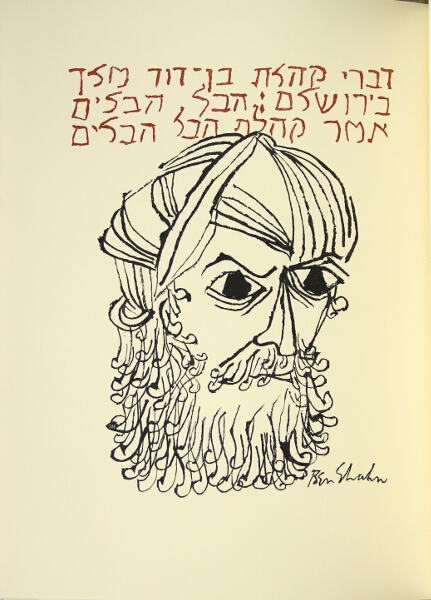
Ben Shahn, “Ecclesiastes Or, The Preacher”

Enemies to That Illiterate Light
There is something to Jeff Tweedy’s insistence: “that illiterate light / is with us every night.” Theologians aren’t the other. We’re all theologians. When we think about God, we’re all doing theology. The question is whether or not we do it well. Tweedy’s lyrics lead me to conclude the truth of this statement: “We have met the enemy, and the enemy is us.”7

Integrating the Tragic Quest
What is conceived here is a series of posts on reconstructing faith that I’ve named Dialogues with My Former Self. Part of reconstruction is integration. In these posts, I will seek to integrate every part of my mind, heart, and soul. They will include creative writing, philosophical and theological arguments, and personal experience; an integrative whole. After this first introductory post to kick off the series, we’ll tackle a simple subject: God. In the meantime, enjoy this poem I wrote to encapsulate my journey—my tragic quest.

Nightwatch
Wolves at the cave’s mouth snarling,
but how wolves,
if Nothing?

Childhood fears
soothsaid and smothered by pious lines,
Faith is standing at the edge of the darkness,
and taking one
faltering footstep forward,
only to find the way lighted
one step ahead.

Such is not
faith! If every step were lighted,
too soon,
you would know.

Where the Mystery?
As if,
no one ever took that uncertain step, only
to be shadowed in blackness,
crowded, shrouded in deep
despair, crushing the soul.

πάτερ εὶ βούλει παρένεγκε τοῦτο τὸ ποτήριον ἀπ’ ἐμοῦ . . .
“Father, if you are willing, remove this cup from me . . .”

As if,
no one has ever mouthed that pleading prayer, only
to carry a cross, one
faltering step after another, through
a darkened wilderness, lighted only
occasionally but brilliantly by
lightning striking on
the distant horizon;
beaten, broken by the empty
air surrounding their bed.

St. John of the Cross taught me
of the beauty, the healing
found in darkness.

And St. John the Beloved of
the Light to come,
Who has, and ever will,
everything illuminate,
all shadows
cast aside;
every crevice
of the small cave
thrown into radiance.

Every shaky aleph, every rounded
omega, each faltering figure,
arms upstretched, that I
scrawled on the rock
wall with the tip
of a branch
blackened in the fire
I light
to keep the wolves at bay—
because God loves
a madman.

Waltham St. Lawrence, “Ecclesiastes, or The Preacher Ecclesiastes”, book illustration.

NOTES
1 Matthew 7:8
2 Eugene England, “Joseph Smith and the Tragic Quest,” Dialogues with Myself: Personal Essays on Mormon Experience (Salt Lake City: Signature Books, 1984), 1-2.
3 For blog posts, see for example Shawn Larsen’s article at Mormon Matters, “Why Eugene England Still Matters” from 2008, or Boyd Petersen’s article at his blog Dead Wood and Rushing Water, “Eugene England and the Future of Mormonism” from 2016. For podcasts, see John Dehlin’s four-part tribute at Mormon Stories “Eugene England’s Life and Legacy” from 2011 and Gina Colvin’s podcast episode at A Thoughtful Faith from 2015, “The Life and Writings of Eugene England.”
4 Philippians 3:7-8a
5 Hymns of the Church of Jesus Christ of Latter-day Saints, Deseret Book Company, Salt Lake City, Utah, 1985, 274.
6 See Exodus 13:21
7 For the morphology of this oft-used phrase, see https://humorinamerica.wordpress.com/2014/05/19/the-morphology-of-a-humorous-phrase/

BACK TO TOP

Apologists-anti-mormons_INVERTEDby Michael Flournoy
Some years ago, FAIRMormon put out an article by Maxwell Institute contributor, Russell C. McGregor entitled, “Are Anti-Mormons Christians?” It was a response to the common assertion that Latter-day Saints are not true Christians. The article claims that it is the detractors of Mormonism, not Mormons themselves that “need to be concerned about their Christian credentials”.

The question posed is: is Anti-Mormonism a Christian activity? According to the article, it isn’t. It asserts that Christian is a synonym for Christ-like, but Anti-Mormons are actively opposed to, and attack the doctrines and policies of the LDS church.

First off, even if Anti-Mormonism is opposed to the values of Christianity, it still does not discredit someone from being a Christian. For example, sin isn’t exactly a Christian activity, and yet all Christians are sinners.

Secondly, the LDS notion that Jesus was a gentle lamb who never spoke out against false religious leaders, is a myth. One only need to go to Matthew 23 to find Jesus calling scribes and Pharisees hypocrites, blind guides, and children of hell.

To be fair, there is such a thing as aggressive, over-the-top Anti-Mormonism, and it needs to stop. Mormons are not wrong to question the Christianity or at least the spiritual maturity of those who preach with rudeness and disrespect.

McGregor says Anti-Mormonism is satanic, and that Satan means “accuser” or “slanderer”. By this logic, Jesus was certainly engaged in a satanic activity when he told his disciples to beware the teachings of the Pharisees and Sadducees.

For the sake of argument though, let’s assume the article is right on all accounts, and anyone who speaks out against Mormonism is not a Christian.

What does that say of Anti-Anti-Mormons, who spend every waking hour debating Mormon Critics online?

If the arguments in the article are valid, then the author himself is not a Christian, because he engages in the satanic activity of accusing and slandering Anti-Mormons!

The fact is, Jesus told his disciples to turn the other cheek rather than resist evil (Matthew 5:39). Anti-Anti-Mormonism is the opposite of this mindset. It’s not a Christian activity, and therefore Anti-Anti-Mormons aren’t Christian.

Furthermore, 3 Nephi 11:29 in The Book of Mormon states:

For verily, verily I say unto you, he that hath the spirit of contention is not of me, but is of the devil, who is the father of contention, and he stirreth up the hearts of men to contend with anger, one with another.

Anger and contention form the core of the article written by Russell McGregor, and I call on FAIRMormon to remove the article from their website. It’s full of hate speech against those who do nothing worse than proselytize Latter-day Saints with sincerity and out of a heart of love. Further, its logic serves as a double-edged sword.

That said, I acknowledge that some Christians do engage in mockery, ridicule, and saying hurtful things to Latter-day Saints about their religion. At the same time, I’ve seen LDS apologists be just as vile in return. I assume it’s a reaction to perceived hostility, but it’s still unacceptable and unchristian. The Book of Mormon doesn’t say contention is of the devil, except when someone else starts it. Jesus didn’t say to turn the other cheek unless they’re speaking against your religion. When Jesus was taken in the Garden of Gethsemane, one of his disciples cut off the ear of the high priest’s servant. Although it was technically a defensive move, Jesus immediately healed the man.

And turning to the other side of the divide, I call on my Christian brothers and sisters to repent if looking out for the interests of Latter-day Saints above their own self-interest isn’t their driving motivation. The vernacular term for this kind of self-effacing, self-sacrificial behavior is “love”. The other term for it is “respect”. And it is centermost in the infamous apologetic mandate of 1 Peter 3:15-16 (NIV) which says,

But in your hearts revere Christ as Lord. Always be prepared to give an answer to everyone who asks you to give the reason for the hope that you have. But do this with gentleness and respect, keeping a clear conscience, so that those who speak maliciously against your good behavior in Christ may be ashamed of their slander.

Jesus rebukes his disciples in Matthew 26:52, saying, “Put up again thy sword into his place: for all they that take up the sword shall perish with the sword.” (KJV)

The Savior also rebukes the apostles in Luke 9:55-56 when they suggest calling fire down from heaven to destroy a Samaritan village. He says, “Ye know not what manner of spirit ye are of. For the Son of man is not come to destroy men’s lives, but to save them.” (KJV)

The most glaring issue with Russell McGregor’s article is it wrongly defines “Anti-Mormon” as anyone who opposes LDS doctrine and policy. To be clear, it is possible to oppose something lovingly. If this is not the case, then by default, all Mormon missionaries are Anti-Christian for teaching and converting Christians, aren’t they?

True “Anti-ism” is an aggressive, shameful way of attacking someone’s faith, and it exists on both sides of the divide. We should strive not to be Anti anything but stand for the Truth.

It may be hard for Latter-day Saints to accept, but standing for the truth does encompass exposing falsehood. Why is it, that it’s perfectly acceptable for a bishop to say, “You’re wrong if you think you’re worthy after breaking the law of chastity,” but when a Christian tells a Mormon they’re wrong, it’s hateful?

LDS apostle, J. Reuben Clark once said, “If we have the truth, it cannot be harmed by investigation. If we have not the truth, it ought to be harmed.”

To Mr. Clark’s point, mainstream Christians hold to the stance that Latter-day Saints believe in an another Jesus and a false gospel. And neither a faux Savior or a false gospel can save anyone, can they? Is it Anti-Mormon to want Mormons to know the truth? Is it Anti-Mormon to reveal the mercy and boundless grace of Jesus Christ? Is it Anti-Mormon to desire to spend eternity with them in God’s presence?

Of course not. In fact, it is the responsibility of believers to speak the truth and expose falsehood. This is as the Apostle James said,

Let him know, that he which converteth the sinner from the error of his way shall save a soul from death, and shall hide a multitude of sins. (James 5:20 KJV)

In closing, I can’t think of anything more Pro-Mormon than converting a Latter-day Saint from the error of a false gospel that doesn’t truly save to one that does. Can you? In fact, I would argue that the true Anti-Mormons are the people who oppose those who do so.

logeye-720x340

“And why beholdest thou the mote that is in thy brother’s eye, but considerest not the beam that is in thine own eye?” (Matthew 7:3 KJV)

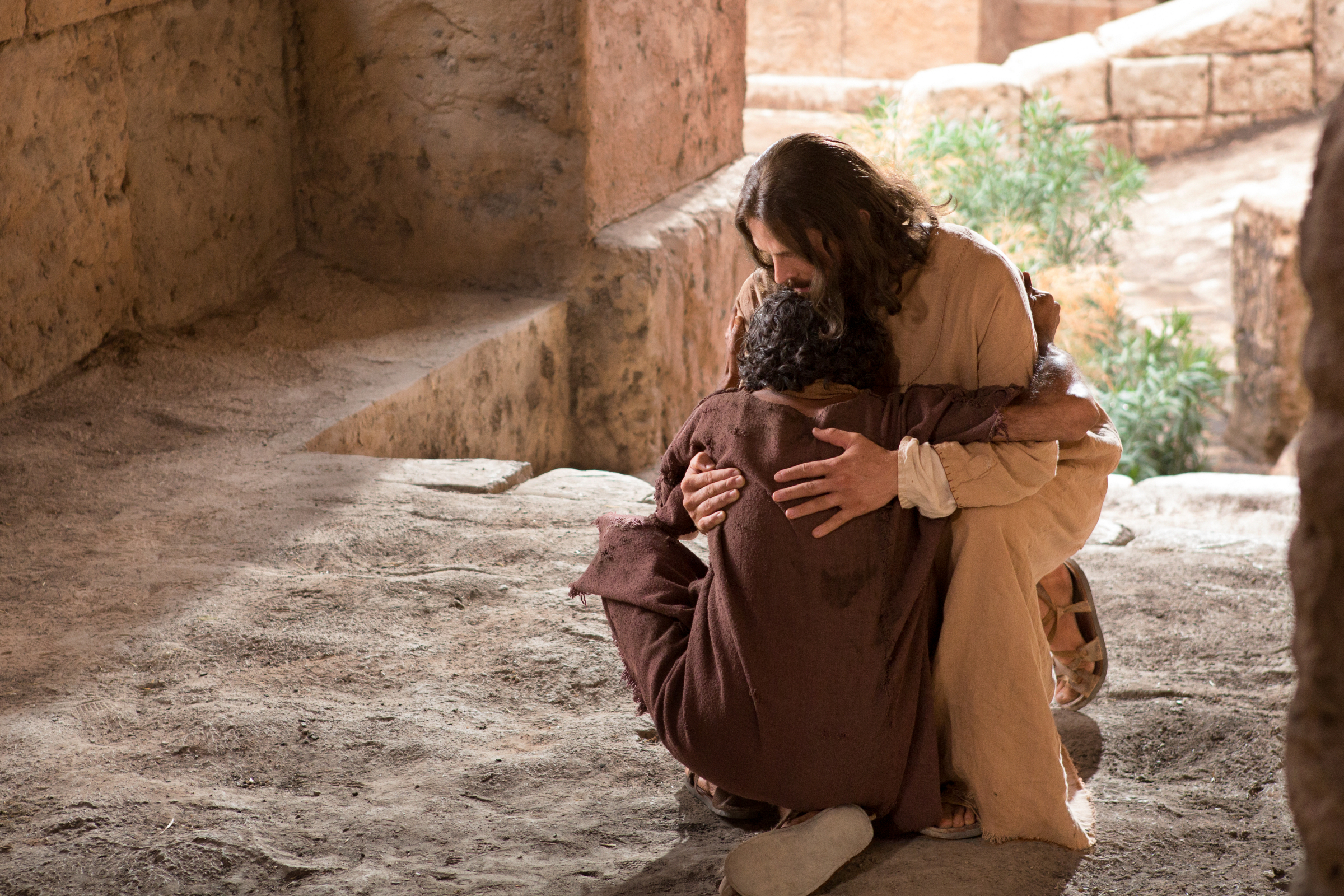
The blind man, now healed, hugging Christ in a gesture of gratitude.

by Michael Flournoy
On August 14, 2017, an article entitled, “A Message to the Most Ardent Critic of the Mormon Church” was posted by Ben Arkell on his blog “Mormon Light”. This faith-promoting “masterpiece” is about a two-minute read, and it focuses on the experience of dropping sons and daughters off at the Missionary Training Center.

He gives a second-hand experience from a Mormon who shared his testimony from the pulpit. This unnamed brother was dropping off his son and daughter to serve as missionaries for about two years.  While at the MTC, he saw other families doing the same thing.

He said, “I was completely overcome with emotion as the reality of what these families were doing set in. These families, which come from all walks of life and arrive in anything from a beat up mini-van to a $60,000 SUV, send their children off to unknown countries where they trudge through mud, eat bugs, and endure poor living conditions.”

Feeling the weight of the sacrifice being made, this Mormon wished Ex-Mormon critics were by his side so they could see what he was seeing. In this hypothetical scenario, he would tell them, “You mean to tell me these people are brainwashed? These individuals and families who in all other walks of life, in their education, in their careers, and in their communities are successful, smart, and industrious – you mean to tell me in this one area they are so ignorant and brainwashed that they could send away their sons and daughters?”

He replies, “Never. They would never do it. But the reason they do allow their children to sacrifice two years of their lives is because the gospel of Jesus Christ is true.”

Before I left the faith in 2016, I felt the same way about apostates as every other Latter-day Saint: they were deceived by Satan, they were trapped in sin, or they had just plain been offended. When they left, the devil warped them into hateful maniacs who could never leave the church alone again.

It was all fun and games until suddenly I was an apostate. I didn’t leave because I was offended or trapped in sin. I simply found something better, namely the doctrine of imputed righteousness. Nevertheless, I have been accused of intellectualizing my way out of the church. One woman had the audacity to tell me I’d left for the enticing of an easier path.

I wish sometimes that ardent followers of Mormonism could stand by my side and see what I see in the Ex-Mormon community. There are people from all walks of life, driving anything from a mini-van to an SUV, who have left the church. Their stories are far more diverse than you would think. I see people leaving all the time, and the weight of their sacrifice hangs heavy on my heart.

It takes a lot to leave a religious system that means everything to you. I know people who have lost everything meaningful in their lives because they left the faith, and yet they are accused of taking the easy way out.

In all fairness, I understand what the author is getting at. I was a Mormon missionary myself. I’ve had all the same experiences and the same testimony. It’s not like I woke up one morning and mists of darkness covered those feelings up. I walked away with them intact, and it was excruciating. So why did I do it? Like so many others, I was compelled to follow my conscience and take up the true gospel of Jesus Christ.

I want to ask ardent followers of the LDS church, “You mean to tell me these people are brainwashed? These individuals and families who in all other walks of life, in their education, in their careers, and in their communities are successful, smart, and industrious – you mean to tell me in this one area they are so deceived and brainwashed that they could leave the most important thing in their lives behind?”

Never, they could never do it. The reason they do is that they discover the Church of Jesus Christ of Latter-day Saints is not true.

“The ex-member is motivated to stay away from religion for fatigue, for fear of being duped, and for fear of relinquishing control.”

by Joshua Valentine
Members who learn the truth about The Church of Jesus Christ of Latter-day Saints and Mormonism most often feel betrayed and duped by their church, friends, and family.  If they leave the church, they often go through a burn out period, not wanting to deal with religion at all.  They are understandably resistant to even considering any other religion any time soon for fear of being taken in again.  Many go through a period of anger.  The realization of being manipulated, being put through so much, and losing so much of their lives for a lie, is understandably infuriating.  The necessary and reasonable thing to do, when ready and rested, is to reevaluate one’s beliefs.  Often this includes a period of studying the LDS Church even more.  Whether before leaving or after, many Mormons feel embarrassed by all the things they did and believed, which they now see as so obviously untrue or even silly.  They understandably never want to be manipulated or to allow their lives to be controlled by anyone else again.

This last, control, is a strong motivation toward atheism.  While in many ways the atheistic worldview can be bleak, in that there is no longer someone watching out for you, there is also a strong sense of self-determination, of your decisions being wholly your own, under your own control.  Members of The Church of Jesus Christ of Latter-day Saints have relinquished leadership and control of so much of their lives for so long, and upon learning the truth, realized that so much of it was a waste and harmful, that any sense of letting go of their new found control, of submitting themselves to anything — an organization or even a belief — is simply unacceptable.  Ex-Mormon atheists speak of the difficulty of getting atheists to come together and embrace a long-term vision and goal (there is a Mormon Expression podcast, toward the end of his time hosting it, in which John Larsen mentions this issue).  While there may be something about an atheist worldview that inhibits this activity, the victim of Joseph Smith and the LDS Church has all the motivation to keep all control and not relinquish it to anyone or anything, a group, a movement, an ideal, or even the actual God.

The ex-member is motivated to stay away from religion for fatigue, for fear of being duped, and for fear of relinquishing control.  And these can lead to a life of practical, if not consciously chosen, atheism.  But, as we have seen, the very teachings of Mormonism and The Church of Jesus Christ of Latter-day Saints may set up its members to turn away from faith and even provide the content of an atheistic worldview.  If these teachings are not re-evaluated, then the ex-member may embrace atheism not solely based on rational and accurate arguments and evidence, but also from false biases, skewed perceptions, and feelings trained into them by the LDS Church.  The man or woman who leaves must be resolute and steadfast in rooting out and reconsidering all that they have received from Mormonism; not just doctrines and history, but all of the assumptions and implications of the teachings that they were not even aware of, but that are still determining the way they think about and see the world.  Unfortunately, there are several possible motivations for not re-evaluating everything learned from their church.

No one wants to believe that they believed something false.  No one wants to believe that they believed something obviously false.  No one wants to believe they dedicated their lives to something untrue, let alone a lie.  No one wants to admit that they have been fooled.  No one wants to believe they have perpetuated a lie or been involved in the manipulation and duping of others to believe the same lie.  This self-preservation is one reason why people of all groups hesitate, if not refuse, to really consider the possibility that their beliefs are false, and risk having to leave their church, discard their philosophy, or relinquish their life vision.  Many members of the LDS Church resist the arguments of critics and respond to the evidence against their church often so irrationally, not just because of the way their church has taught them to respond, but for fears like these.  But what about those who leave?

Just as members do not wish to consider that they are wrong and will deny the facts out of self-preservation, those who leave may continue to do the same.  When a member exits the church, they have a subconscious motivation not to discover all of the false beliefs they have embraced.  So, they continue to believe them.  They come to the conclusion that The Church of Jesus Christ of Latter-day Saints is not true, that its scriptures, prophets, and gods are not real.  But they may not want to know just how much they were duped into believing, just how much they took for granted, just how many false beliefs they have taught their children and friends.  Most do a lot of research about the church’s history and unique teachings, but they may not reconsider the less explicit teachings and their implications.  This includes what faith is, how it relates to reason, what spiritual experience really is, and when mystery and complexity are acceptable.

“Two are better than one, Because they have a good reward for their labor. For if they fall, one will lift up his companion. But woe to him who is alone when he falls, For he has no one to help him up.” (Ecclesiastes 4:9-10 NKJV)

(This article was originally published on the Mormon Coffee website on

Link to Part 1
Link to Part 2
Link to Part 3
Link to Part 4
Link to Part 5

The Star Child from “2001: A Space Odyssey”

by Joshua Valentine
Why do so many Mormons become atheists? Whatever the validity of the observation, online discussions of this topic usually only revolve around the answers of not wanting to be fooled again, burnout, and that the same things that deconstruct Mormonism deconstruct all religions. All of these look outside for an answer, but what about Mormonism, itself?  The very doctrines, teachings, and culture of The Church of Jesus Christ of Latter-day Saints not only directs its members toward atheism but actually gives them atheistic beliefs and atheistic perspectives such that, upon exiting the LDS faith, they find themselves closer to atheism on the spectrum of worldviews than to anything else.

In fact, it is Mormon doctrine that actually provides much of the content of an atheist worldview. Mormonism is the most materialistic worldview next to atheism. In Mormon doctrine, it is not the Mormon God or Gods, but Matter, itself, which is truly eternal, having existed from everlasting to everlasting.  With Matter are Eternal Laws or Principles as well. These exist before and independently of the Mormon God. In fact, the Mormon God, like all Gods before him, is himself made up of this eternal matter and subject to these eternal laws or principles.  Joseph Smith taught that spirit was actually matter, just a more “fine” form of it. God, according to Mormonism, had to obey these Eternal Principles in order to progress from eternal fine matter, or “intelligence,” to a god. This is in stark contrast to many religions that assume that independence from, and being the source of, all creation is definitive of what it means to be “God” or the “Ultimate.” However, in LDS cosmology, Matter and Eternal Law are the true Ultimate, not God.

Thus, The Church of Jesus Christ of Latter-day Saints provides its members an understanding of the universe that is nearly identical to that of naturalistic atheism, where matter and its inherent properties that are described by humans as universal physical laws are ultimately all there is. When a member realizes that the Mormon God does not exist, when this deity is removed from the materialist LDS worldview, they are left with a materialist atheist worldview already in place, provided by the LDS Church.

The Church of Jesus Christ of Latter-day Saints teaches the Plan of Happiness.  One of the main purposes of the Mormon God is to bring about the eternal life and happiness of mankind.  The LDS Church teaches that traditional family is critical to this happiness. Mormons are known for holding the family in high regard.  Outsiders who study the religion find it difficult not to conclude that Mormons practically deify their family by their devotion to it, and how it plays such a prominent role in the purpose of existence, and the definition of happiness, and even heaven, itself. In fact, the Mormon God is subsumed into the human family as the literal physical father of all spirits.  Mormons are also known for their service to others. With the exalted doctrine of family and the principles of greatest good being service to humans and family, the ex-member has already embraced the highest good in atheist practice – loved ones and humankind.

The Church of Jesus Christ of Latter-day Saints also teaches that God and humans are of the same kind or species. It teaches that God used to be a regular human and that humans can become Gods.  All Gods and humans started as “intelligences,” or fine spirit matter. By an unknown process, this intelligence is embodied in a spirit body provided by a previous God and Goddess’ reproductive activity. The resultant “spirit child” may eventually obtain a physical body, living on a world as a human.  The human may, upon dying and an unknown number of millennia in the afterlife, attain “exaltation” and become another God, and the process repeats. In this way, the LDS Church teaches that humans are the highest form of life in the universe and that our development as individuals and the continuation of our posterity is the highest good. This is strongly analogous to the closest thing to purpose in atheism, the development and continuation of species and, the highest form of life, in particular, humankind.

The primacy and essentiality of the family in the LDS conception of purpose and eternal happiness does not simply give a sense of idolatry but the “eternal round” of gods making spirit babies, who become humans, who become gods, and repeat endlessly is also a sacralizing of reproduction and genetic continuance. The LDS Church teaches that the glory of God is this eternal increase of his posterity. This increase is also only possible through the most worthy members, those who have overcome the challenges of life and flourished in the LDS gospel of laws and ordinances. One could say that Mormonism is a religion of not only individual evolution from spirit to human to god but also a religion of the exaltation of the fittest. Upon leaving the LDS Church and relinquishing belief in its transcendent dimensions of God and afterlife, ex-members are by default evolutionary atheists whose highest good and reason for what they do is their own happiness, which in its greatest form is found in benefiting and continuing the human race.

A scene from the “Stargate” sequence in “2001: A Space Odyssey”.

(This article was originally published on the Mormon Coffee website on

Link to Part 1
Link to Part 2
Link to Part 3
Link to Part 4
Link to Part 5

by Michael Flournoy
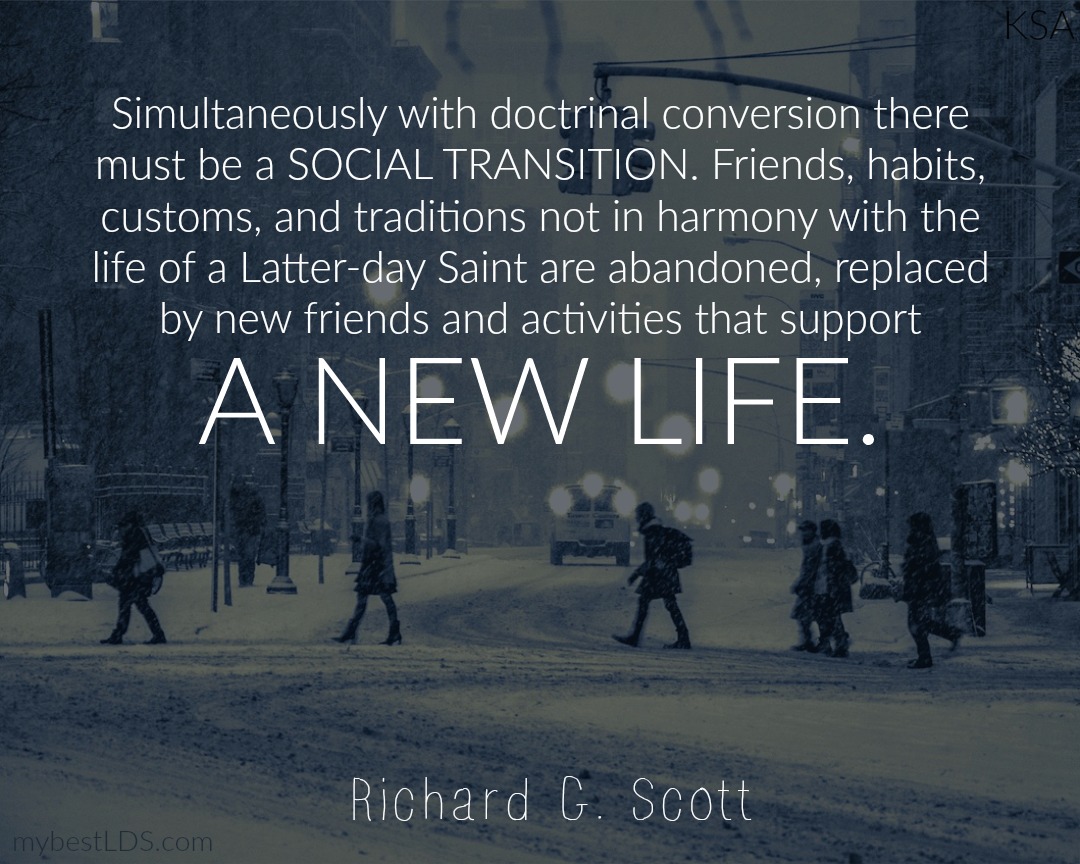
There are three conversions in Mormonism: social, doctrinal, and spiritual.

Doctrinal Conversion is to believe that the tenets of Mormonism are true, along with The Book of Mormon, Doctrine and Covenants, and the Pearl of Great Price.

Social Conversion is to believe that the LDS church is a godly institution, its leaders are inspired, and its founder, Joseph Smith, had an upright, moral character.

Spiritual Conversion is any experience that validates a Mormon’s beliefs.

The most common of these is Spiritual Conversion. It typically occurs after reading The Book of Mormon, which challenges the reader to ask God if it’s true. It promises that God will reveal its truthfulness through the power of the Holy Ghost. Rather than testing The Book of Mormon against the Bible, Latter-day Saints resort to subjective feelings, and often equate a burning in the bosom to an answer from the Spirit. The exact wording in The Book of Mormon is as follows.

Moroni 10:4 And when ye shall receive these things, I would exhort you that ye would ask God, the Eternal Father, in the name of Christ, if these things are not true; and if ye shall ask with a sincere heart, with real intent, having faith in Christ, he will manifest the truth of it unto you, by the power of the Holy Ghost.

These conversions serve as a three-legged stool to keep Mormons tethered to the LDS gospel. If one leg is kicked out, they can keep going on two legs while the damaged one is repaired. Thus, in order to bring them out of the church, at least two of the three conversions must be targeted. However, Latter-day Saints are unlikely to divulge details about their spiritual conversion because those experiences are considered sacred. To them, talking about their experiences with Christians is casting their pearls before swine.

That leaves the social and doctrinal conversions to target. Most Mormons lean either to the doctrinal or the social side of their faith. Rarely, if ever, do you find a Mormon who is on fire about the doctrine and the culture of the church. If they don’t lean either way, they are probably less active. I was a Ward Mission Leader right before leaving, and it was often said that a new convert to Mormonism needed three things: A friend (social conversion), a calling (social conversion), and to be nourished by the good word of God (doctrinal conversion).

Of the two types of Latter-day Saints, the vast majority are socially converted, cultural Mormons. They do not participate in online debates, and their testimonies are not founded on logic. I have been in several wards over the years, and typically I have found only 1 or 2 individuals per congregation that really know their stuff. These doctrinal Mormons are, to some degree or another, outcasts in the faith.

I heard a talk over the pulpit once, where a man was comparing his parents, one of whom was doctrinal, while the other was a cultural Mormon. He said, “My father knew The Book of Mormon backward and forward, he had much of it memorized, and he could explain why each passage was important, but my mom knew it was true…” He implied that because of her blind faith, his mother was the more righteous of the two.

My Conversions into Mormonism
Although I was born under the covenant, I still had to be converted to Mormonism. My social conversion came at age fifteen. I finally made good friends at church and it’s where the pretty girls were. I would have gone without being dragged there by my parents.

My spiritual conversion came a year later when I attended Especially for Youth, a week-long retreat for Latter-day Saints. On Thursday night they ushered us into a room and showed a video about Jesus. It had people testifying that he was their Savior and he’d changed them. That night, the real Jesus visited me.

I was faced with his majesty and righteousness. I knew that I was a wretched sinner, and I would have been satisfied if he had wiped me off the face of the planet. However, instead of wrath, he sent me his love. It was an unbelievable love. It’s the kind of love that says, “You hate my counsel, your feet are slow to do good and swift to do evil, and many of the things you do displease me, but I love you anyway.”

God’s overwhelming, undeserved love made me weep for hours on end. I looked at the context of the situation. I was at a Mormon sponsored event, which I interpreted to mean that the church was true. I decided that my allegiance would be to the Church of Jesus Christ of Latter-day Saints.

When I turned 19, I turned in my mission papers and went to the far away land of California to preach the gospel. Even then, I was seeking the burning in the bosom my counterparts had experienced after reading The Book of Mormon. I was expecting something powerful like my Jesus experience, but it never came. Eventually, I settled on a logical testimony that The Book of Mormon was true, even though it made me feel like a second class citizen in the church.

Spiritual Conversion as articulated by a Mormon Apostle. (click to zoom)

In time, other experiences bolstered my spiritual conversion. On my mission, I met my friend Ed Enochs, an Evangelical Christian, who debated my companion and me for three hours one day. I walked away from that encounter convinced that Mormonism was false. I was saddened at the thought of my family and friends back home. How, I wondered, could such intelligent people be roped in by a scam like Mormonism?

Ed also convinced me that the Bible was the word of God. I decided to examine it and see if it supported the truth claims of the church.

Somehow, as I studied the Bible, I came across all the passages that seemed to support Mormonism, and my doctrinal conversion was complete. When I returned home I became an amateur apologist bent on defending Mormons from smooth talking Christians. With all three conversions in place, the LDS church had me hooked. I spent the next decade as its captive.

My Three Conversions out of Mormonism
By 2015, God was waging war on all three of my conversions. I decided that year to study grace in order to become a more effective weapon. In Mormonism, there are 3 levels of heaven, 6 definitions of salvation, and 50 shades of grace. So every time I came across heaven or salvation in LDS scripture, I had to decipher which level of heaven and what kind of salvation was being described. It was the most frustrating thing I had ever done in my life and I was envious of the elegant simplicity of the gospel my Christian friends believed in.

Later that year the church came out with its policy that children of gay parents could not be baptized. I was not on board with the policy, but what irked me, was the day after it was leaked Mormons were already defending the policy online. It seemed like Latter-day Saints everywhere were abandoning Spirit and scripture in favor of uncontested apostolic authority.

I was on an online forum one day and another Latter-day Saint said he didn’t have a problem with the policy, but if he did, he would just pray about it until he didn’t anymore. I responded, “If that’s not a cult mindset, I don’t know what is!”

Unfortunately, it was a public forum and my family decided to hold a small intervention for me. They warned me to use caution when discussing the church and one family member said throwing the prophet under the bus was the same as throwing Jesus under the bus.

I knew that despite my family’s concern, the truth could withstand criticism. In favor of my relationships, however, I decided to keep my big mouth shut. It was just a stupid policy, after all.

A few days later I saw Elder Nelson speak to Millennials on BYU TV about the policy. He explained that it was not a policy at all, but a revelation from God that had been unanimously received by all 15 prophets, seers, and revelators. My jaw dropped. Suddenly, my issues with the church were just as much doctrinal as they were cultural since God himself was the alleged mastermind behind the policy.

In Mormonism, there are three pillars of truth: the leadership, the Spirit, and the scriptures. Any of these can be used to acquire truth, but in my case, the Spirit and the scriptures were telling me the exact opposite of what the leaders were saying. That October I learned that there had been over 30 suicides of gay and lesbian LDS youth. I was shocked that the so-called “plan of happiness” was causing so much sorrow.

My social conversion shattered into a million pieces. I was no longer proud to be a Mormon; I was ashamed of it. And with my doctrinal conversion struggling as it was, I was dragged into a faith crisis lasting several months. Mormonism had infiltrated every aspect of my identity and questioning it caused me to fall into a confused state of depression.

I managed to stay active through it all. I kept studying grace and came to believe that Christ’s imputed righteousness granted salvation. I found evidence of it in both the Bible and The Book of Mormon, and for a time my doctrinal conversion stabilized. That is until God opened my eyes to the fact that my new favorite doctrine was hostile to the mandatory LDS covenants and ordinances.

My spiritual conversion collapsed soon after that. It didn’t matter that I still had experiences that I couldn’t explain away. One leg was simply not enough to support my testimony. I gave my life to Jesus and over time I discovered that my spiritual experiences did not hold up under scrutiny.

Kicking out the Legs of Conversion
Spiritual conversion is the toughest to target since Mormons are so protective of it. Ex-Mormons might have a shot though, by talking about the spiritual experiences they had while active, and why they failed the test of time. Most Christians will need to go after social and doctrinal conversion instead.

First, find out what kind of Mormon you’re talking to. Does she believe her leaders’ words are always inspired? Does she blur the lines between culture and doctrine? Is she LDS because of the great programs and family values? Does she think people leave the church because they intellectualize their way out? If so, she’s probably a cultural Mormon.

Does he believe the prophets and apostles sometimes speak as men? Is he wary of the culture, but protective of the beliefs? Does his testimony of the LDS scriptures have some basis in logic? Does he think people leave the church over cultural issues? If so, he’s probably a doctrinal Mormon.

Doctrinal and Social Conversion as articulated by a late Mormon Apostle. (click to zoom)

Conventional wisdom says to strike where the Mormon is weak, but that may not be the right strategy. Since my social conversion was weak, I doubled down on the doctrine to overcompensate. I overlooked the prophets’ mistakes because they were men. When faced with Joseph Smith’s misdeeds, it never dented my view that he was a prophet. I just thought he was abusing authority God had actually given him. All the social problems in the world could not have relinquished my grip on the Mormon church.

God attacked my doctrinal conversion first. That made me vulnerable to social problems in the church and set the stage for the avalanche to come. So if you’re talking to doctrinal Mormons, talk about doctrinal issues first: like contradictions between LDS scriptures and the Bible. If you’re witnessing to cultural Mormons, talk primarily about social problems: like Joseph Smith’s polyandry.

I would caution against coming off too aggressive with Latter-day Saints. Above all else, be a friend first. Mormons are wary of Christians who constantly attack their beliefs. We don’t have to tell our LDS friends they’re in a cult every time we see them. They already know what we think, I promise. Bold, fiery preaching may erode their doctrinal conversion, but if it is not coming from a relationship of trust, it will simultaneously bolster their social conversion.

Navigating someone past the three conversions is ultimately the work of God, and it’s a long, drawn out process. Sometimes all we can do is plant seeds, pray for the LDS, and love them. Mormons are unlikely to ever choose Christianity if all they remember from us is: ‘attack, attack, attack’.

I am forever grateful to the many Christians who befriended me while I was LDS, who respected me despite my beliefs, who saw past my religion and saw me, who prayed for me, who built me up, who let the light of Jesus shine through them, and who treated me like a brother before I was one. I don’t know where I’d be without them.

About the Author
Michael Flournoy served a two-year mission for the LDS Church where he helped organize three Mormon/Evangelical dialogues and has participated in debate at the Southwestern Baptist Theological Seminary. Born into Mormonism, Mr. Flournoy converted to Evangelical Christianity in 2016.


A Critique of Brad Wilcox’s “His Grace is Sufficient”

“And if you had known what this means, ‘I desire mercy, and not sacrifice,’ you would not have condemned the guiltless.”
(Matthew 12:7 ESV) 

by Michael Flournoy
I was born and raised in the Mormon Church, and in early 2015 I began a serious study on the topic of grace. One of the first videos I watched was a BYU devotional given by Brad Wilcox called “His Grace is Sufficient”. Not only did Mr. Wilcox revolutionize the way I viewed grace, his talk was largely responsible for my journey out of Mormonism and into mainstream Christianity.

I was surprised when I listened to it recently, to see how it sounded to my Protestant ears. I caught myself saying “amen” half a dozen times. I was struck by how useful his catchphrases were for explaining my own transition. He says for instance, that we aren’t earning heaven, we’re “learning heaven.” He uses a piano analogy where Mom pays for lessons and requires us to practice. Practicing does not pay for the lessons, nor does it pay back Mom. He goes on to say that we’re keeping the commandments for a different reason, “it’s like paying a mortgage instead of rent, making deposits in a savings account instead of paying off debt…”

To this day Brad Wilcox is a favorite LDS speaker of mine. However, I found a few problems with his speech. Namely, the way he describes Evangelical Christians is mostly false. He says his Born Again friends often ask him if he has been saved by the grace of Christ, and he replies with a question they haven’t fully considered: “Have you been changed by grace?”

This is a common misconception about Evangelical Christianity. Having been LDS, I recall thinking the Christian model of salvation was very 2-dimensional. Having passed through the veil so to speak, to the other side, I see now that Christianity is not what Brad portrays it to be.

In fact, as an Evangelical, my day to day lifestyle is not so different from how I lived as a Mormon. What has changed is my motivation for living the way I do: before, I was trying to earn heaven, and now I’m learning it. I was obeying from a place of condemnation, but now it’s from a place of acceptance. Before it was about fear, now it’s about appreciation. When I embraced Brad Wilcox’s grace, I found that I fit in with Evangelicals much more than my fellow Latter-day Saints. So in answer to his unconsidered question, here is my unexpected answer: yes, the grace of Christ is changing me.

As a Latter-day Saint, I scoffed at the idea that we were created for God’s glory alone. As I mentioned previously, it seemed 2-dimensional. I thought those who were “saved” would have no motivation to be better spouses, parents, employees, and disciples. I assumed as Brad stated, that Christians believed “God required nothing of [them]”. Nothing could be further from the truth. In reality, God’s abundant grace motivates Christians to improve and give their lives to Jesus.

He goes on to explain that Latter-day Saints can sometimes view God’s commandments as overbearing and say, “Gosh, none of the other Christians have to tithe. Gosh, none of the other Christians have to go on missions…” Actually, we do. To set the record straight, “other Christians” do understand the importance of obedience.

I was shocked the first time tithing was discussed at my Protestant church. I thought I had gotten away from all that! My pastor explained that we don’t pay tithing to get into heaven, but because we’re free. As a Latter-day Saint, my perception was that Christians viewed grace as a license to sin. I see now that grace is better described as insurance, covering us in case we sin.

In his speech, Brad Wilcox mentions several people who don’t understand grace: there are those who are giving up on the LDS church because they are tired of falling short, young men and women who graduate from high school and slip up time and again and think it’s over, return missionaries who slip back into bad habits and break temple covenants and give up on hope, and married couples who go through divorce.

He chides anyone who thinks there are only two options: perfection, or giving up. He does not seem concerned that such a huge swath of Latter-day Saints are ignorant about grace, even after admitting he used to picture himself begging to be let into heaven after falling short by two points. My idea of grace was not dissimilar to his. Ironically, he belittles Christians for having the same view of grace he has now, while turning a blind eye to Latter-day Saints who hold an opposing view, as if it were a coincidence.

However, these views against grace are not a coincidence, but a byproduct. My diagnosis is that Brad Wilcox understands grace, but he doesn’t understand Mormonism.

After all, Alma 5:28-29 in The Book of Mormon says if we are not stripped of pride and envy we are not prepared to meet God, nor do we have eternal life. Where’s the grace in that? Doctrine and Covenants 82:7 says if we sin our former sins return to us. Where’s the grace in that? Moroni 8:14 states that should someone die while thinking children need baptism, his destination is hell. Where’s the grace in that? Alma 11:37 says that Jesus cannot save us in our sins. My friends, there is no grace in a religion that says we must amputate all sin from our lives before Jesus can save us.

Mr. Wilcox conveniently leaves out covenants in his speech, which form the foundation of eternal life in Mormonism. According to LDS doctrine, covenants like baptism and temple sealings are required to enter the Celestial Kingdom. These covenants are two-way promises where God gives us eternal life if we keep our end of the bargain. The temple covenants include keeping the commandments, so a Latter-day Saint who fails by 2 points on judgment day will have no right to plead for grace. In Mormonism, grace is not enough.

I do love Brad Wilcox’s speech. I would not be where I am today without it. That said, I call upon him to repent for his false witness against Evangelical Christians and I pray he will see the error in defending an organization that tramples the grace of God. I can say from experience that coming into Protestant Christianity from Mormonism is like “…paying a mortgage instead of rent, making deposits in a savings account instead of paying off debt…”, it’s the difference between being a servant of your own free will, and being a slave.

mercy-and-grace-heat-map

About the Author
Michael Flournoy served a two-year mission for the LDS Church where he helped organize three Mormon/Evangelical dialogues and has participated in debate at the Southwestern Baptist Theological Seminary. Born into Mormonism, Mr. Flournoy converted to Evangelical Christianity in 2016.