Archive for the ‘Mormon Culture’ Category

An article on some common and recurring weak argument and debating tactics that Latter-day Saints use in their defense of Mormonism that result in weak arguments.
by Fred W. Anson

“Caïn venant de tuer son frère Abel” by Henry Vidal in Tuileries Garden in Paris, France

“”The non-LDS world has a history of perpetuating criticism, caricature, othering, antagonism and shaming of Mormons. This leads to a reaction on the part of the Latter-day Saints: retrenchment, militancy, withdrawal from civic conversation, and a dynamic I call ‘undergrounding,’ something that happens a lot in our political history where we tell the outside world one story in order to protect our inside story.”
Joanna Brooks, “Violence, Mormonism, and the Sobering Lessons of History”,
Sunstone Magazine, Summer 2015, p.50

Introduction:
The last article in this series created quite a stir. It was “grass catcher” list of weak arguments and debate tactics that mainstream Christians regularly use that undermine their engagements with Latter-day Saints. And while the article was warmly, often even enthusiastically, received on both sides of the Evangelical-Mormon divide, a common response was, “OK, where’s the equivalent list for Mormons?” Well, the wait is over, here it is.

How to Make Weak Arguments for Mormonism:

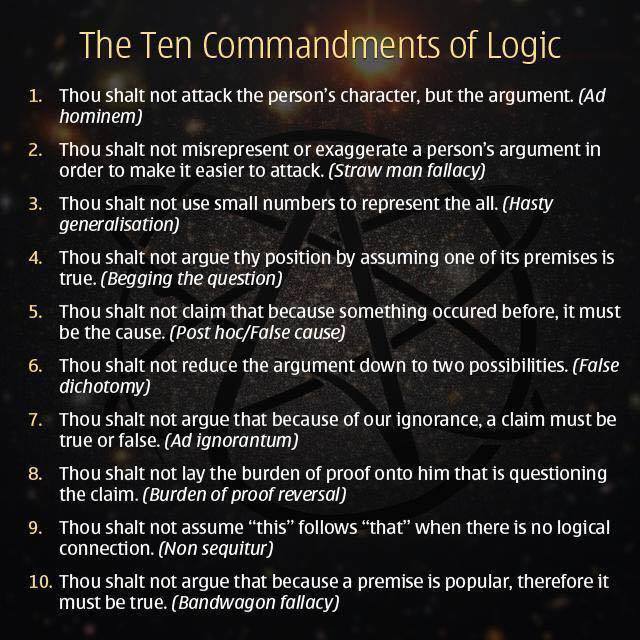
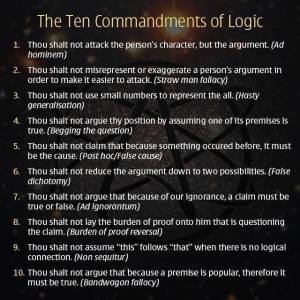
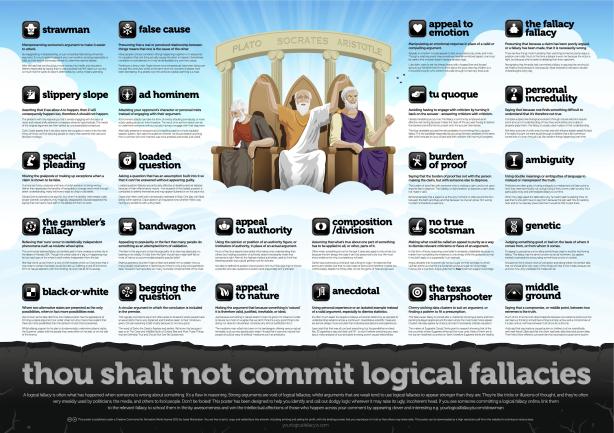
  1. Attack your debating opponent instead of their evidence or arguments. Use ad-hominem arguments.
  2. Misrepresent or exaggerate your debating opponent’s arguments so they’re easier to overcome. Use straw man arguments.
  3. Misquote and abuse 3 Nephi 11:29.  That is, rail against your debating opponent with a bold “Contention is of the devil” denunciation while you’re contending for the Mormon faith. Oh and, since you’re already playing the “beam in your eye” hypocrite before an amused audience, make sure that you completely ignore the passages in scripture that blatantly advocate (such as Jude 1:3, I Thessalonians 2:2) and model (like most of the Book of Mormon for example) righteous contention. Compromised integrity and duplicity is always so persuasive isn’t it? (NOT!)
  4. Over generalize! If you’re the only Mormon who believes something say that all Mormons do. If an uncorrelated, progressive, or Neo-Orthodox Mormon (like Terryl or Fiona Givens for example) makes an unorthodox claim then point to it as the norm. Claim that a “one off” address by a modern Mormon Leader represents what Mormonism has always taught throughout it’s history. You know, do things like point to Brad Wilcox’s 2011 BYU devotional, “His Grace Is Sufficient” or President Uchtdorf’s, Spring General Conference 2015 address “The Gift of Grace” and claim that they accurately represent official current and historic LDS soteriology.[1]
  5. In a similar vein, stereotype! For example, identify a mainstream Christian who has behaved badly (Jim Bakker, Jimmy Swaggert, Ted Haggard, etc.) and treated God’s grace and mercy as a license to sin, and then claim that all mainstream Christians behave this way. After all, Mormons never do that (think John D. LeePaul H. Dunn, Porter Rockwell, Wild Bill Hickman, John C. Bennett, Sidney Rigdon) do they?
  6. Use your conclusion as evidence for your argument. Engage in circular logic – you know something like, “I know that the only true church is The Church of Jesus Christ of Latter-day Saints because I have an inner witness that it’s the only true church.” I mean, really, who can argue with logic like that?
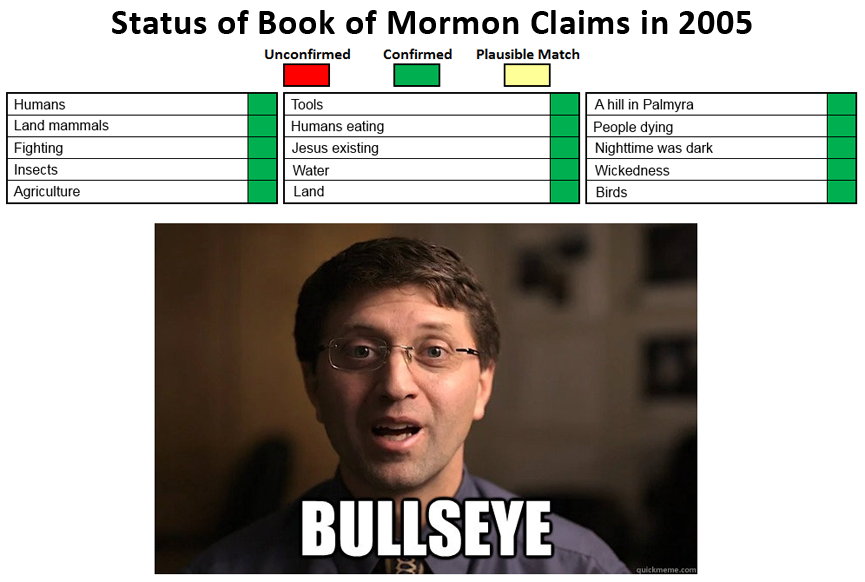
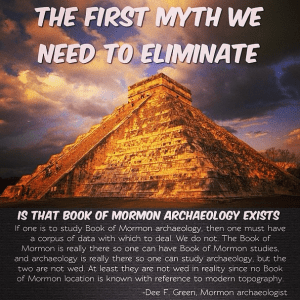
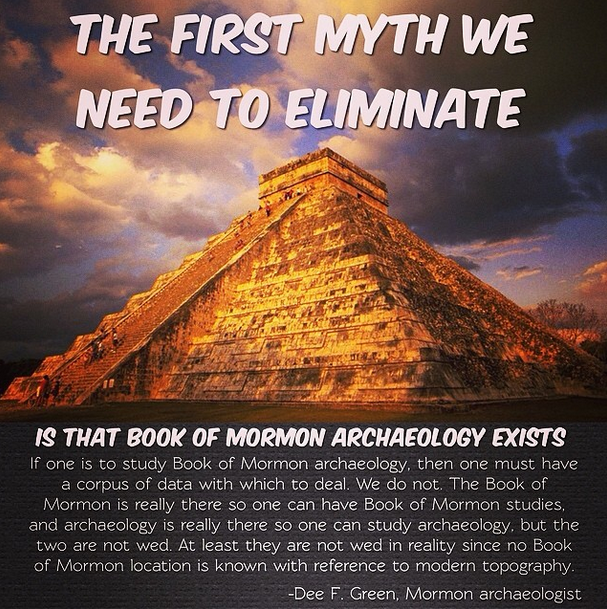
  7. Present speculation and conjecture with no supporting evidence to back them as fact. Argue from silence. For example, argue that the lack of archaeological evidence for the Book of Mormon proves nothing. Even better, argue that the lack of such evidence actually proves that it’s true because God is using it to test our faith.[2]
    book-of-mormon-archaeology-myth

    (click to zoom)

  8. Bifurcate rather than nuance. Claim that there is only black or white, good or evil, on or off. Create false dichotomies.
  9. Argue that because you don’t know or understand something it must be false. Or better yet, to claim that something must be true! Use your ignorance as irrefutable proof that your debating opponent is wrong. When in doubt appeal to ignorance – I mean, sure, it makes you look like an uninformed fool, but what the hey!
  10. Don’t support your arguments with any evidence (let alone objective evidence). And if challenged, act indignant and offended that you should be required to produce any evidence at all! I mean, after all, isn’t the burden of proof on the person not arguing your position? You know, just like it’s the prosecuting attorney’s job to produce evidence for the defense in a criminal case – yeah, it’s like that.[3]
  11. Assert that something is true simply because you’ve said it is. After all, your word is good enough, right? I mean, come on, you’re Mormon, and therefore, you know everything about Mormonism by virtue of that fact – that should be enough, right? Appeal to yourself as authority – use yourself as indisputable, absolutely authoritative, irrefutable evidence! Why does anyone need to research anything when the best, most reliable source is right there in front of them telling them the way it is?
  12. Use testimony bearing or “the witness of the Spirit” as evidence. Argue from feelings, promptings, and impressions and other appeals to emotion.[4]
  13. Assert that your debate opponent “doesn’t get it” and “can’t get it” because they don’t have the Holy Ghost and, therefore, can’t hear His voice. And when you do make sure that you’re as condescending and arrogant as possible in using this variation on the ad-hominem fallacy so they can fully understand and feel the great depth of their state of blindness.
  14. Argue that because something is popular it must be true. Drive that bandwagon fallacy right over your debating opponent! For example, argue that Mormonism must be true or it wouldn’t be growing so fast worldwide. Uh, by the way, about that “growing so fast” claim . . .[5]
  15. Don’t acknowledge when your debating opponent makes a valid point. Never surrender, never give in! After all this war right?
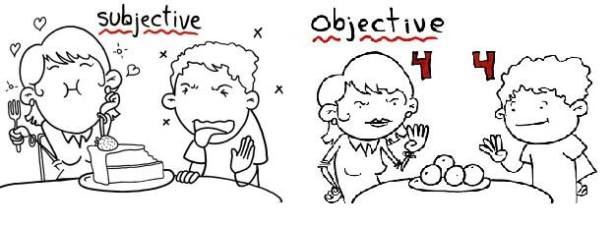
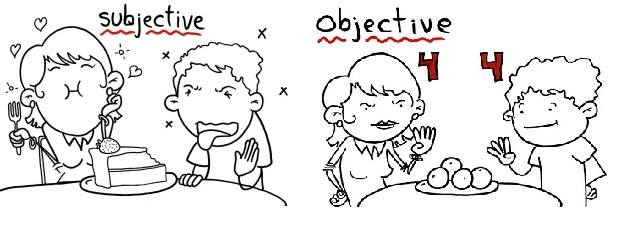
    Subjective v. Objective Evidence. One can proved by means of search, like analysis, measurement, and observation and one can't. One is valid and unchanging regardless of one's feelings, and one isn't.

    Subjective v. Objective Evidence. One can proved by means of search, like analysis, measurement, and observation and one can’t. One is valid and unchanging regardless of one’s feelings, and one isn’t.

  16. Suddenly and without warning disappear from the debate. Let chirping Mormon crickets argue for you instead. If there were a name for this it might be called the “Cop Out” or “Argue with my Back!” Fallacy. And some Mormons seem to like it a lot – especially when they’re issued a “OK, show me where I’m wrong” challenge.[6]
  17. Cyber stalk or conspire against your debating opponents behind the scenes. After all this is war – so sabotage is just par for the course. Of course, it’s just a form of the type of walking in spiritual darkness that’s consistently condemned in scripture but what the hey, it’s so cool to be a modern Gadianton robber ain’t it? (By the way, this is sociopathological behavior – I just thought that you’d like to know)
  18. Don’t give your debating opponent’s evidence any serious consideration. Better yet, just ignore it and act like it doesn’t exist. For example, even though mainstream Christians repeatedly tell you that they believe in, “Salvation by grace alone through faith alone,” continue to argue that they believe in “Salvation by grace alone” and pound away on that straw man argument.
  19. Ditto for challenging questions. Ignore them. Socratic Method is so stupid!
  20. Don’t become familiar with your debating opponent’s culture and language. After all, if they have anything of value to say they can say and do like we do it in Mormon culture! After all we’re better than they are, aren’t we?
  21. Be condescending because, frankly, we really are better than they are – especially all those lousy, despicable “Anti’s” out there who hate and only want to destroy God’s only true and living Church.[7]
    (click to zoom)

    (click to zoom)

  22. Speaking of “Anti’s”, always label. After all labeling is a wonderful defense mechanism since once it’s done you can stereotype and thus deceive yourself into feeling like you have power over them.  And if you use negative labels you can condescend to those below you – even better! And have we recommended arrogant condescension yet? Oh, we did? Well you can never emphasize that one too much can you? It’s a good one – it puts those “Anti’s” right in their place!
  23. Use special pleading fallacies. Argue that rules, laws, evidences and realities that apply everywhere else don’t apply to Mormonism. I mean, come on, why should DNA evidence apply to the Book of Mormon people anyhow? Really people, really?
  24. Assert your Priesthood Authority whenever possible. I mean, it means absolutely nothing to anyone or carries any weight outside of Mormonism but why not? And I assert this in the name of the Royal Priesthood![8]
  25. Use lots and lots of insults and personal attacks! Oh, did we already mention this one? Oh yeah, that was kinda included in the very first one by implication wasn’t it? Well, since this is one the most common weak arguments used by Latter-day Saints, it probably bears repeating doesn’t it?
  26. Troll. Throw out provocative, incendiary arguments of little real substance but high emotional impact with the deliberate intent of provoking readers into an emotional response or of otherwise disrupting normal on-topic discussion. (and thank you Wikipedia for that excellent definition)
  27. Appeal to authority from sources that Mormons would never preach from or use in their services since they attack and undermine the fundamental truth claims that undergird Judaism, Mormonism and/or mainstream Christianity. This includes, but isn’t limited to: John Shelby Spong, The Jesus SeminarRobert Price, Margaret Barker, James Tabor, Richard Dawkins, and Bart Ehrman. Yeah, it’s kind of like drinking your own poison or shooting yourself in the foot but it’s better to be hospitalized or lose a foot if it protects Joseph Smith and modern Mormon dogma ain’t it? Besides it’s fun to argue like an atheist!
  28. Cite from unofficial, uncorrelated Latter-day Saint sources as if they’re official voices of the Church. First and foremost do so with with your own personal opinion – state it as if it’s being delivered by the President of the LDS Church at General Conference himself. After that move onto Mormon Apologist websites like FAIRMormon or Lightplanet. Not official? Who cares – after all a rock can be a fork if it gets the job done, right? unofficial-mormon-apologist

  29. Cite from partisan Mormon Apologists but then object strenuously when your debating opponent cites from Mormon Critics. Sure it’s a hypocritical double standard but weak and inexperienced debaters may not catch or call you on it – so go for it. For example, cite from Sorenson’s “Mormon’s Codex” but then throw a hissy fit when someone cites from the Tanner’s “Mormonism Shadow or Reality?”.
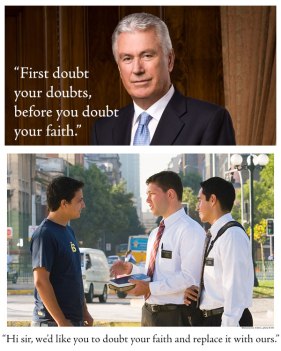
  30. Which brings us to another Latter-day Saint rhetorical favorite: Use double standards. For example: First, demand that your debating opponent produce a single verse from the Bible that explicitly proves the Trinity rather than building a case from several verses throughout the Bible; Then claim that they’re making a ridiculous and unfair demand on you when they demand the same “single verse as the standard of proof” for Celestial Marriage.
  31. Use Latter-day Saint scripture (other than the Bible) as if it’s authoritative for your non-Mormon opponent as it is for you. Nothing will silence them as quickly as, “As the Book of Mormon tells us . . . ” will it? (hint: It won’t) Better yet give them quotes from General Conference – surely they’ll listen to and respect the authority of Living Prophets won’t they? (hint: They won’t)
  32. Ignore the rules of sound text interpretation and hermeneutics.[9]  For example, use lots and lots of eisegesis – inserting meaning that the author didn’t intend and content into the text that the author didn’t say. Sound text interpretation and hermeneutics are based on exegesis – drawing meaning and content directly from the text – but that’s another subject for another day (probably an entire article in fact).
  33. Be inconsistent. For example, bear your testimony as evidence that you have the witness of God that Mormonism is right and true. But when your debating opponent bears their testimony that they have the witness of God that Mormonism isn’t right or true, refuse to accept it claiming that it’s from a source other than God.[10]
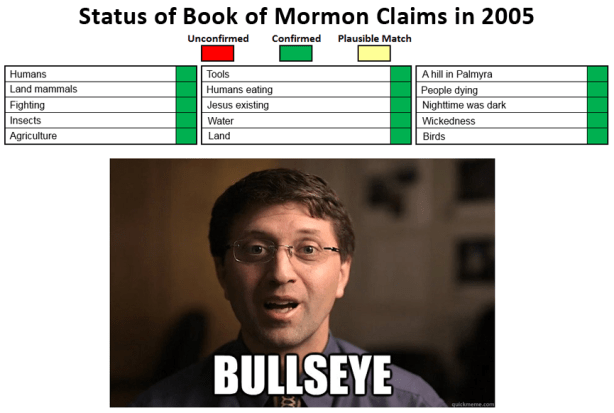
  34. Be confirmation bias driven. For example, argue that Mormon must be truth because Mormons are good, warm, loving, sincere, well intentioned people genuinely tiring to always be their best and do the right thing.In other words, use the “inspect the fruit” argument while ignoring the fact that most people are good, warm, loving, sincere, well intentioned people who are genuinely trying to always be their best and do the right thing. The only way that one can be blind to the fact that Mormons are hardly unique in this is to put those confirmation bias blinders on!
    Confirmation driven apologetics.

    Confirmation Bias driven apologetics.

  35. Engage in Drama Queening. To continue from the previous example, get really indignant and offended when your debating opponent points out that one can be a good, warm, loving, sincere, well intentioned person and still be dead wrong. Better yet, threaten to withdraw from this place of persecution filled with haters! And if you do leave, make sure you cyber bomb social media about how you’ve been unjustly wounded, hounded, and wronged by these modern Korihors. Bleed over everything and everybody – let it flow like a river! Guilt manipulate baby, it works like a Jedi mind trick!
  36. Use Postmodern relativism as a defense. Say something like, “Well if what you believe works for you and what I believe works for me then who’s to say that the other person is wrong?” If that’s the case then all the Mormon Missionaries need to be called in from the field and the program shut down since what all those folks already believe is working for them, right? Who’s to say that they’re wrong, right?
  37. Instead of directly engaging your debating opponent’s arguments try to parry with a, “Well, what about when you and you guys? You do and say such and such!” Tu Quoque fallacy ’em to heck! I mean it’s really a non-argument because the moral character or past actions of the opponent are generally irrelevant to the logic of the argument. But what the hey, if they’re stupid enough to “bite” why not try it if it gets Joseph Smith and Mormonism off the hook? Then again, a trained logician will call you on and you’ll just look foolish . . . oh well!
  38. Use aliases and sock puppet accounts to hide your true identity so you can behave badly online. Yes, it’s yet more sociopathological behavior but, hey man, if you used your real identity you’ve have to behave better in public or your reputation would be ruined wouldn’t it? And we can’t have that!
  39. Lie for the Lord. After all if Muslims can do it and since past Mormon Leaders have done it, why not?
  40. Dismiss an statement as ridiculous or absurd without giving proof or reasoned arguments for why. In other words, engage in an “Appeal to the Stone” fallacy. For example, when a debating opponent produces evidence that Official Declarations 1 and 2 were born out of political, social, and financial expediency rather than anything divine (as evidenced by the fact that they refer to revelations but don’t actually give them) claim that the whole argument is, “Just ridiculous! Utterly absurd!” without offering any countering evidence for your rebuttal. Better yet, combine it with an, “And you’re just a cynical, hate filled ‘Anti’ for saying that!” ad-hominem to make it ridiculous and absurd.

    ME_262_HowToWinAnArgument
  41. Engage in Psychological Projection: Project your behavior onto your debating opponent rather than acknowledging and owning it. For example, if you’re engaging in arrogant condescension accuse your debating opponent of looking down at you and having a superior air about them. If you’re angry, upset, and out of control accuse them of being angry, upset, and out of control. This is a wonderful defense mechanism, use it often! Yeah, it’s a form of self deception that keeps you in denial, but… whatever!
  42. Say things like, “The ends justify the means” to rationalize your bad arguments and behavior. Sure, it’s not scriptural, but why be picky when the defense of your testimony is on the line?
  43. Move the goalposts. For example, insist that your debating opponent only use official Church sources like the official church website. When they do insist that they didn’t interpret the content properly. When they then cite Mormon Leaders who share exactly the same interpretation from the official church website, then pull out #13 and tell them that they can’t possibly truly understand Mormon Leaders or Latter-day Saint Doctrine because they’re not a member and, therefore, don’t have the Holy Ghost giving them the true enlightenment that you possess. And if they overcome that then pick up that goalpost yet again and, “Push ’em back! Push ’em back! Push ’em way back!” Eventually they’ll either call you on this fallacy or give up.
  44. Ignore or refuse to publicly challenge the bad behavior and/or bad arguments that you see fellow Mormons making. After all this is war and who wants to be a traitor to the cause right? Besides “Anti’s” deserve every bit of condescension and disrespect that we can muster don’t they? Hang the Golden Rule!
  45. Make sure that you use a lot of snark and sarcasm! Everyone loves being condescended to by obnoxious smart alecks with bad attitudes. By the way, I hope you’re loving reading this article as much as I am writing it. If not, you’re just a loser who just doesn’t “get it!”[11]
    “Use double standards” (click to zoom)

  46. Use the bad arguments and behavior of mainstream Christians to rationalize, compensate for, and justify any or all of the above.
  47. Assume that any constructive criticism from others on how to better engage outsiders (especially if it’s from “Anti’s”) is meant for everyone else.
  48. Assume that lists like this apply to every other Latter-day Saint but you.
Summary and Conclusion:
If that seemed like a sarcasm filled lesson in logic and rhetoric that’s probably because it was. Stated plainly, that’s what the majority of bad arguments that I’ve seen Latter-day Saints make in public discourse always seem to come down to: Flawed logic and rhetoric combined with incivility and paranoia driven defensiveness. From my experience, I would have to say that award winning Journalists Richard and Joan Ostling were correct when they observed:

Mormon scriptural scholarship functions almost entirely within an enclosed, intramural world… Mormon Bible scholars face serious problems.
— Richard N. and Joan K. Ostling, “Mormon America (Revised and Updated Edition”, p.299

This seems odd to me since, generally speaking, Mormons are better educated and higher degreed than the general population.[12] Doesn’t all that good education require some training in logic, critical thinking, and civil rhetoric? If so, you would never know if from the sloppy, adolescent, rude rhetoric that many Latter-day Saints engage in public. Therefore, the first thing that Latter-day Saints could do to improve their public discourse would be to learn and stick to the rules of logic and rhetoric that most assuredly must have been a part of their secular education.

Another contributing factor seems to be the infamous “Mormon Persecution Complex” which has been endlessly discussed in Mormon Studies and elsewhere. As the aforementioned Ostlings said well:

The thin-skinned and image-conscious Mormon can display immature, isolationist, and defensive reactions to outsiders, perhaps because there is no substantive debate and no “loyal opposition” within their kingdom. With some, it almost seems that the wilderness is still untamed, the federal “polyg” police are on the prowl, and the Illinois lynch mob is still oiling muskets and preparing to raid Carthage Jail. All too often Saints use the label “anti-Mormon” as a tactic to forestall serious discussion.
— Richard N. and Joan K. Ostling, “Mormon America (Revised and Updated Edition”, p. 115

Read through the list of bad arguments again asking yourself this question, “Would Mormons be more or less likely to engage in this behavior if they didn’t presume that the world in general and their debating opponent in particular was against them?” I dare say that at least half – perhaps as much as three quarters of the list – would disappear were the Mormon Persecution Complex mindset were set aside. Stated plainly, Many Mormons are far too quick to play the victim, or over react in inappropriately aggressive, and unduly defensive ways simply because they’re perceiving an attack or persecution by their debating opponent when there simply isn’t one.

defaultIn fact, due to this dynamic, and linking it with the logic and rhetoric issue previously discussed, all too often Mormons will play the “victim card” when all their debating opponent has done is expose the holes, gaps, problems, and fallacies in the argument that they’ve just presented. The wounded howls of these self-perceived Mormon victims can be found on just about every inter-faith discussion board (some Mormons lead with it as their opening argument) and the greatest tragedy is that it need not be.

So I challenge you my Latter-day Saint friends, whenever you’re tempted to play that victim card, first take a deep breath, revisit both your arguments and the arguments of your debating opponent, and ask yourself these questions:

  1. Where and how can my argument be improved?
  2. What valid points has my debating opponent made?
  3. What countering evidence can I present, along with stronger logic and reason, to overcome their points?
  4. Viewing that evidence through their point of view rather than my own, what countering arguments can I expect from my debating opponent after I respond?
  5. How can I word this so that it’s clear that I’m responding rather than reacting to my debating opponent?

I think if you’ll do that rather than assuming that you’re being picked on or attacked and reacting defensively (as opposed to responding productively) you’ll end up making better, more convincing arguments in defense of Mormonism. This isn’t to deny that many outsiders, as the Joanna Brooks epigraph to this article stated, love to Mormon Bash – it’s a fact, many do. However, Mormon friends this isn’t true of all outsiders. And my dear Latter-day  Saint friend you instantly erode your credibility just as soon as you play that card. So here’s the easy solution to the problem: Don’t play the victim card – ever.

Finally, a question must be asked: Why wasn’t this article written by a Latter-day Saint? I know that Latter-day Saints are aware of the issues that I’ve raised above because privately they complain to me about them. In fact, when the last article in this series came out and woodshedded mainstream Christians for their weak arguments against Mormonism I was told, again privately, by several Latter-day Saints that many, if not most, of the items in the list were true of many Latter-day Saints too.

However, publicly most Mormons will draw their Mormon Persecution Complex around them like a quilt, close ranks, and rail at “those nasty Anti’s!” Even worse, they will applaud the efforts of Mormon Apologists who regularly engage in polemics, pejoratives, bullying, and many of the items noted in the list above.[13]

So instead the task falls to the guy who has not only never been Mormon but is known primarily as a critic of Mormonism. In fact, I couldn’t even get a Mormon to co-author this piece with me – I tried!  So here’s the deal Mormons: If you don’t like either the tone or content this article then publish a better one – I challenge you to.

Finally, let me give you a tip: The wrong way to respond to this article is to write protest articles about how unfair I was to Mormons, or how I singled them out for persecution, or how little I understand about what it’s really like to be a Mormon being endlessly picked on by outsiders, or that I’m just a stupid, biased, blind “Anti” and we all know how they are! If you do any of that you’ll just be proving many of the points made in this article.

Further, since I’ve just published fourteen (14) such articles publicly woodshedding the bad arguments of my fellow mainstream Christians I think that it’s fair to say that I’m more than willing to do with my “tribe” what Latter-day Saints refuse to do with theirs: Challenge it to be excellent and not “muff the ball”. So Latter-day Saints, I challenge you to go and do the same!
quote-you-are-people-with-a-present-and-with-a-future-don-t-muff-the-ball-be-excellent-gordon-b-hinckley-237507

NOTES
[1] The fact that these “one off” addresses are like loose spikes sticking up along the rails of historic Mormon orthodoxy can easily be seen by listening to the other addresses by other speakers before and after Mr. Uchtdorf’s at the very same General Conference or reading the articles immediately before and after Mr. Wilcox’s in Ensign magazine. They both contradict and undermine them.

And the problem is even more glaring when compared to other official LDS Church sources and the historic record. As Mormon Researcher Bill McKeever notes:

“The Mormon who believes that Uchtdorf is abandoning all former teaching is making an assumption that is just not verified in this talk.  While his language is certainly ambiguous, it’s hard to believe that this general authority is suggesting that the other leaders and decades of teaching are to be abandoned.”
— Bill McKeever, “Does Mormonism Really Offer a “Gift of Grace”? A Review of Dieter F. Uchtdorf’s Talk on Easter Sunday 2015″

The same applies to Brad Wilcox’s BYU address – which was so far askew from historic Latter-day Saint soteriology that it had to be redacted and abridged for publication in the LDS Church’s official publication, Ensign magazine. As Mormon Studies scholar Rob Bowman notes:

“It may seem strange to ask how the doctrine of a popular speech given by a BYU professor and member of the Sunday School General Board compares with other teachings of the LDS Church. However, as a statement by LDS Church spokesman Michael Purdy reminds us, “BYU faculty members do not speak for the church.” The question, then, is not necessarily illegitimate. On the other hand, the publication of Wilcox’s speech in Ensign indicates that it is representative of Mormon doctrine—at least in the version published there. That qualification turns out to be at least potentially significant, since the Ensign article omits elements of the speech that appear to have been out of sync with the LDS Church’s general teaching over the years. The significance of such omissions must be considered with some caution, since omissions may have been simply the result of producing a shorter, more concise article for publication in the popular-level church-wide magazine. Nevertheless, the excisions of material appear to have been strategically performed to bring the article into line with the standard Mormon doctrinal paradigm concerning salvation and grace.”
— Rob Bowman, “Mormonism and the Sufficiency of Grace: Brad Wilcox’s Speech ‘His Grace Is Sufficient'”

[2] “What can be asserted without evidence can be dismissed without evidence.” (Hitchen’s Razor)

[3] Simply put, it’s the responsibly of the person making an assertion to prove it. It’s not their debating opponent’s role or responsibility. This is just common sense folks! This is the laziest form of scholarship imaginable – if you can even call it “scholarship.”

[4] As Clinton Wilcox noted in “Weak Arguments #8: ‘I testify that Mormonism is false and Joseph Smith was a false prophet'”

“[Testimony bearing is] a bad argument against Mormonism because it’s a bad argument, period – which makes it a bad argument even when the Mormon uses it…

You can’t rely on your own subjective experiences to convince somebody else of the truth of your beliefs. The major problem is that in the Mormon’s testimony, they don’t give us any reason to believe Mormonism is true. A subjective experience may give you a reason to believe but it doesn’t give anyone else a reason to accept your beliefs as true. Arguing that it is the correct church doesn’t help. I need to know why it is the correct church.”

And as a Latter-day Saint peer reviewer of this article noted well in his feedback on this point:

“The witness of the spirit while not great evidence for convincing others is a fine answer to: Why do you believe this? Also it is a good lead in to, ‘And you can receive the same witness.’

Mormons need to keep in mind however that a personal witness is not meant for convincing others, its personal and should be kept out of debate except in answer to the above question or proceeding the invitation. It should also be kept in mind that inviting someone to seek their own witness from God does not win the argument, as some Mormons seem to believe.”

[5] It should be noted that the rapid growth argument for Mormonism has been problematic since 1990 when growth flattened and activity rates began to decline. Reliable figures and analysis (derived from official Spring General Conference Reports) can be found here.

[6] To be clear here, temporarily excusing yourself from the conversation due to the rigors of life outside of the debate is one thing (that is unless you overuse this excuse to the point that you’re just using as it as nothing more than an escape hatch) but doing a permanent disappearing act whenever the going gets rough is something else. If you do temporarily excuse yourself due to life’s demands then make a point of returning and continuing the discussion when you can.

However, if you really want to set yourself apart as a civil and accomplished debater, when your debating opponent is presenting arguments and evidence that is so strong and compelling that it’s hard to overcome, then simply acknowledge it and tell them that they’ve given you a lot to consider. This isn’t “throwing in the towel” it’s simply being honest and humble – and people respect honest humility. A simple way to do this is to just say, “Point taken.”

Oh, and by the way, does it really need to be said that putting an Internet block or ban on your debating opponents – and thereby making it impossible for them to engage you or you them online – is the ultimate form of this bad argument? Yes, since this tactic is so commonly used (or put more accurately “abused”) by Mormon debaters on the Internet I think that it probably does!

[7] This tendency by many Mormons so concerned former LDS Church President Gordon B. Hinckley that he publicly addressed it several times:

“We must not only be tolerant, but we must cultivate a spirit of affirmative gratitude for those who do not see things as we see them. We do not in any way have to compromise our theology . . . We can offer our own witness of the truth, quietly, sincerely, honestly, but never in a manner that will give offense to others.”
(President Hinckley, LDS General Conference, April 2005).

“[There] should never be any cause for self-righteousness, for arrogance, for denigration of others for looking down upon others. All mankind is our neighbor. . . . Regardless of the color of our skin, or the shape of our eyes, of the language we speak, we all are sons and daughters of God and must reach out to one another with love and concern.”
(President Hinckley, LDS General Conference, April 2005, Ensign May 2005, 102).

“As we recognize our place and our goal, we cannot become arrogant. We cannot become self-righteous. We cannot become smug or egotistical. We must reach out to all mankind. They are all sons and daughters of God our Eternal Father . . . . And as we go forward, may we bless humanity with an outreach to all, lifting those who are downtrodden and oppressed, feeding and clothing the hungry and the needy, extending love and neighborliness to those about us who may not be part of this Church.”
(President Hinckley, LDS General Conference, October 2001)

“As I have said before, we must not be clannish. We must never adopt a holier-than-thou attitude. We must not be self-righteous. We must be magnanimous, and open, and friendly. We can keep our faith. We can practice our religion. We can cherish our method of worship without being offensive to others. I take this occasion to plead for a spirit of tolerance and neighborliness, of friendship and love toward those of other faiths.”
(President Hinckley, Pioneer Day Commemoration, July 2001)

“But we shall go forward, returning good for evil, being helpful and kind and generous. I remind you of the teachings of our Lord concerning these matters. You are all acquainted with them. Let us be good people. Let us be friendly people. Let us be neighborly people.”
(President Hinckley, LDS General Conference, April 2001)

“Let us as Latter-day Saints reach out to others not of our faith. Let us never act in a spirit of arrogance or with a holier-than-thou attitude. Rather, may we show love and respect and helpfulness toward them. We are greatly misunderstood, and I fear that much of it is of our own making. We can be more tolerant, more neighborly, more friendly, more of an example than we have been in the past. Let us teach our children to treat others with friendship, respect, love, and admiration. That will yield a far better result than will an attitude of egotism and arrogance.”
(President Hinckley, LDS General Conference, April 2000; Ensign, May 2000, p.87)

[8] For an explanation of that Royal Priesthood reference see “Weak Arguments #12: ‘There is no priesthood anymore.’” And, yeah, since authority can only be given not taken, Mormon Priesthood Authority claims kinda fall flat if the other person doesn’t recognize or acknowledge it doesn’t it? For example, admit it, you kinda yawned or snickered at that “Royal Priesthood” thing when you read it didn’t you my Mormon friend? See my point?

[9] The Eight Rules of Interpretation used by legal experts for more than 2500 years are as follows:

1) Rule of Definition.
Define the term or words being considered and then adhere to the defined meanings.

2) Rule of Usage.
Don’t add meaning to established words and terms. What was the common usage in the cultural and time period when the passage was written?

3) Rule of Context.
Avoid using words out of context. Context must define terms and how words are used.

4) Rule of Historical background.
Don’t separate interpretation and historical investigation.

5) Rule of Logic.
Be certain that words as interpreted agree with the overall premise.

6) Rule of Precedent.
Use the known and commonly accepted meanings of words, not obscure meanings for which their is no precedent.

7) Rule of Unity.
Even though many documents may be used there must be a general unity among them.

8) Rule of Inference.
Base conclusions on what is already known and proven or can be reasonably implied from all known facts.
(source = http://www.apologeticsindex.org/b11.html)

[10] As noted in footnote 4, using testimony bearing as an argument or evidence is just a bad argument. Period.

[11] And before the “You’re a hypocrite – just look at the tone and content of your article!” phone calls, and letters start pouring in, this article was written in a tongue in cheek style that’s intended to mirror the same condescension, disrespect, snark, and sarcasm that are so prevalent in the weak arguments and tactics that are being addressed. If you’re offended by it then please consider how such behavior feels to others when it’s directed at them.

[12]  “Mormons are significantly more likely than the population overall to have some college education. Six-in-ten Mormons (61%) have at least some college education, compared with half of the overall population. However, the proportion of Mormons who graduate from college (18%) or receive postgraduate education (10%) is similar to the population as a whole (16% and 11%, respectively).”
— Pew Research Center, “A Portrait of Mormons in the U.S.”, Education and Income

[13]   For example, please consider this polemic and pejorative laden inflammatory prose from Mormon Apologist Russell McGregor of FAIRMormon (which the reader can also consider supporting evidence for many of the points above – #21, 22, 44, and 47 in particular):

“It is not the LDS Christians, but their critics, who need to be concerned about their Christian credentials. This may seem, at first glance, to be a rather odd thing to say; the anti-Mormon movement has defined the debate in such a way that their Christianity is not open to question. Many of them are (or profess to be) clergymen, while most of them are conservative Evangelical Protestants of one sort or another. And yet the question remains and continues to be asked: is anti-Mormonism truly a Christian activity? The answer, both in the general case and in the particulars, is a clear and resounding no…

So we return to the question with which we began this survey: are anti-Mormons Christian? The answer: of course not. They were never even in the hunt. Their clerical collars and pious platitudes are simply a smokescreen to hide the ugly reality that anti-Mormonism is one of the clear manifestations of the darkest side of human nature; the side that made possible the death camps and burning crosses, the massacre of the Hutus and the wholesale slaughter of the Native Americans. Just as vicious and repressive dictatorships like to give themselves grandiose and liberal-sounding titles like “The People’s Democratic Socialist Republic of Such-and-such”, so these nasty religious haters appropriate the label of “Christian” in order to claim for themselves a specious respectability that their deeds and attitudes do not merit.”
— Russell McGregor, “Are Anti-Mormons Christians?”; FAIRMormon website
(click to zoom)

(click to zoom)

BACK TO TOP

by Fred W. Anson
In the response to the infamous Mormon, “if you want to know about Fords, then you don’t ask a Chevrolet dealer,” argument I offer the following:

The callow chestnut of Mormonism that says if you want to know about Fords, then you don’t ask a Chevrolet dealer, and if you want to know about Mormonism, then don’t ask a non-Mormon, is both wrong and lacks critical judgment. Groups like Consumer Reports prove their maxim false. Some of the best information comes from outside investigation (like Ford’s exploding Pinto gas tank), which outside information can be life-saving.
— Kurt Van Gorden, (as cited in “The Mormon Mirage” by Latayne Scott, p.19)

The promise.

The Ford dealer’s version of the truth.

The Ford Pinto fuel tank controversy is really old news now but at the time it was a hot topic – I know I was 17-years old at the time and remember it well. It was common knowledge at the time that Ford and Ford dealers were mum about the problem and would deny it outright if customers asked about it. From the Wikipedia article on the subject:

Controversy followed the Pinto after 1977 allegations that the Pinto’s structural design allowed its fuel tank filler neck to break off and the fuel tank to be punctured in a rear-end collision, resulting in deadly fires from spilled fuel.

Critics alleged that the vehicle’s lack of reinforcing structure between the rear panel and the fuel tank meant the tank would be pushed forward and punctured by the protruding bolts of the differential — making the car less safe than its contemporaries.

According to a 1977 Mother Jones article by Mark Dowie, Ford allegedly was aware of the design flaw, refused to pay for a redesign, and decided it would be cheaper to pay off possible lawsuits. The magazine obtained a cost-benefit analysis that it said Ford had used to compare the cost of repairs (Ford estimated the cost to be $11 per car) against the cost of settlements for deaths, injuries, and vehicle burnouts . The document became known as the Ford Pinto Memo.

An example of a Pinto rear-end accident that led to a lawsuit was the 1972 accident resulted in the court case Grimshaw v. Ford Motor Co., in which the California Court of Appeal for the Fourth Appellate District upheld compensatory damages of $2.5 million and punitive damages of $3.5 million against Ford, partially because Ford had been aware of the design defects before production but had decided against changing the design.

The reality.

The Chevrolet dealer’s version of the truth. (click to see video of a Ford Pinto crash test)

The National Highway Traffic Safety Administration (NHTSA) ultimately directed Ford to recall the Pinto. Initially, the NHTSA did not feel there was sufficient evidence to demand a recall due to incidents of fire. 27 deaths were attributed to Pinto fires (the same number of deaths attributed to a Pinto transmission problem) and in 1974 the NHTSA ruled that the Pinto had no “recallable” problem.

In 1978, Ford initiated a recall providing a plastic protective shield to be dealer-installed between the fuel tank and the differential bolts, another to deflect contact with the right-rear shock absorber, and a new fuel-tank filler neck that extended deeper into the tank and was more resistant to breaking off in a rear-end collision.
(“Ford Pinto Fuel Tank Controversy” Wikipedia article) 

The bottom line is this if you want to know about anything you need to consult outside sources as well as inside sources. And absolutely the best sources are former insiders that are now outsiders. That’s because they know the inside secrets and will share rather than hide them. That’s why in my article, “The Problem of the Mormon Tank (Revisited)”  I stressed this key point:

Internal evidence that hasn’t been validated against external evidence can’t be completely trusted!

And what’s true of cars is true of churches too: If you’re going to make a decision where the stakes are high you would be wise to take your time, talk to insiders, outsiders, and former insiders – consider as much evidence as possible. The wise person always gathers facts and does their research before they make any major decision. And in the case of the Ford Pinto, it looks like this lady would have been a good source of information!

I'm Explosive

The Consumer Reports version of the truth.

McCraneyism

“The bottom line of the whole thing is that Shawn wants to be able to teach whatever he feels like at any given moment, call it “real” Christianity . . . and never have to answer for it.”
Brother Thomas, February 13, 2015

The Short Version
McCraneyism (the system of doctrine and theology taught by Shawn McCraney, and the community that surrounds it) for the purposes of this website will be treated like a Mormon splinter group. That is, no proselytizing for it will be allowed, and it’s heretical teachings will be publicly exposed and denounced as deemed appropriate here. What follows explains the reasoning behind this position. Please read it in full before commenting and/or contacting us with any questions or concerns.

We also encourage you to consider this short video that does an analysis of the teachings of Shawn McCraney relative to the Bible.

The Long Version
The Dilemma
Since the issue of the false teachings of Shawn McCraney and his McCraneyism movement continue to be an issue it was felt that better clarification and group boundaries from this website on the issue needed to be given.

This is a difficult issue since we all saw the good fruit that Shawn McCraney bore through his Heart of the Matter program prior to January 2013 – that was the time period when Shawn McCraney focused exclusively on the errors of Mormonism. We recognize and appreciate the fact that many of this website’s Ex-Mormon readers wouldn’t have left Mormonism and began their transition into Biblical Christianity had it not been for Mr. McCraney’s good work during this period. However, that was then, this is now.

The Current Problem
Starting in 2013 Mr. McCraney began teaching error and in some cases heresy. Ironically, while the content of those teachings are different, in concept they are the same as what Joseph Smith taught. Specifically:

  • That Christian churches who adhere to historic Christian orthodoxy are wrong.
  • Their creeds are an abomination in God’s sight.
  • Their professors are all corrupt and motivated by things other than the truth.
  • They’re treating Shawn’s communication not only lightly, but with great contempt, even saying it may be of the devil.
  • As a result, there’s prejudice against Shawn among these corrupt, self-interested professors of religion.
  • And that all the above is the cause of a great persecution of Shawn.
  • Further, his circumstances in life are such as to make Shawn of no real consequence in the world.
  • Yet despite all this men of high standing are taking notice sufficient to excite the public mind against him.
  • But Shawn has an inner witness that he can’t deny, lest he offend God and come under condemnation.
  • And so he continues to bring forth new revelations week after week after week.

Sound familiar? Yes, the above list uses Joseph Smith’s 1838 First Vision account as the template in describing Shawn’s basic, recurring message but it does so because the shoe fits. Therefore, this assessment is particularly astute and to the point:

… a former Mormon, he is mainly targeting other former Mormons and disaffected Mormons. Without a ‘nod to Joseph,’ he is playing on their ingrained prejudices and leading them into another counterfeit of Biblical Christianity. Mormonism is often categorized as a Christian cult, because it primarily targets those from a Christian background. You don’t see many Mormons trying to evangelize Muslims. Similarly, Shawn is targeting those from a Mormon background. This is why I would loosely call it a Mormon splinter group.
(Jason Wallace in the “Evangelicals Discussing Mormonism” Facebook Group)[1]

Even his familiar recurring exhortation to, “Don’t trust me – read the Bible for yourself and see if this is true!” mirrors Mormonism:

I have heard many followers of Shawn say they don’t agree with Shawn on some things, but they aren’t worried because he tells them not to trust him, but check out the Bible for themselves. This sounds good, until you recognize that Shawn mocks and ridicules every pastor who says he’s teaching error. Though he may allow latitude in individual beliefs, he cannot tolerate any public disagreement with him. Critics are accused of “character assassination.” The subtle pressure in such a community is to conform. Would a false teacher invite someone to test them from the Bible? Most have; Brigham Young said in 1873, “I say to the whole world, receive the truth, no matter who presents it to you. Take up the Bible, compare the religion of the Latter-day Saints with it, and see if it will stand the test” (Journal of Discourses 16:46).[2]

The Heresies
In addition, in February 2014 with his rejection of the doctrine of the Trinity Shawn McCraney crossed the line from “concerning” to “heretical”. Since then he has gone on to teach several other heresies including Universalism and Full Preterism.[3] A list of the heresies, taught by Mr. McCraney can be found in the December 2018 article, “The Short List of Heresies Taught by Shawn McCraney”. However, the best short summation of the errors and heresies of McCraneyism to date is Jason Wallace’s article, “McCraney-ism”.

And for those who would like to get fully up to speed (or review) how and when Shawn McCraney went from Christian orthodoxy to Christian heretic please consider these resources:

Timeline Articles and Podcasts
(the long version)
Fred W. Anson
“The Trial(s) of Shawn McCraney (Part One)”January 2013-March 2014
“The Trial(s) of Shawn McCraney (Part Four)”April 2014-October 2016
“HOTM Rebranding Timeline and History”, August 2019

Jason Wallace interviewed by Nic Laughter, “Zany McCraney”, Christian Utah podcast, March 25, 2016
(covers the entire period from Shawn McCraney’s arrival in Utah in 2005 to March 2016) 

Summation and Editorial Articles
(the short “bite-sized” version)
Lowell Johnson
Is Shawn McCraney Auditioning To Be The Next Dr. Gene Scott?”, November 2015

Jason Wallace
McCraney-ism”, March 2015
“McCraneyism 2.0”, November 2017
“Shawn McCraney and The Church of Anti-Mormonism”, December 2017

Rob Bowman
“Shawn McCraney Against the Personhood of the Holy Spirit”April 2014

Cory Anderson
“A Pastor’s Appeal to Shawn McCraney”March 2014

Rob Sivulka
“Shawn McCraney is a Heretic and Needs Adult Supervision”
, February 2014
“The “Inquisition” of Shawn McCraney—What the Heck Was That?”February 2014

Fred W. Anson,
“The Trial(s) of Shawn McCraney (Part Two)”
, March 2014
“The Trial(s) of Shawn McCraney (Part Three)”, March 2014
“The Trial(s) of Shawn McCraney (Part Five)”, February 2015
“Dear Michelle”, May 2014
“Shawn McCraney and the Church of Post-Modernism”, March 2018
“The Short List of Heresies Taught by Shawn McCraney”, December 2018

Finally, I want to give a special recommendation to the body of work from Brother Thomas. He is a recovered Shawnite who began to sense problems in Shawn’s teaching, theology and behavior around late 2012. An eyewitness to Shawn McCraney’s transition from orthodoxy to heresy, he wrote about it as things went from good to bad to even worse.

He has produced such a rich, prolific, and insightful analysis of Shawn’s descent from orthodoxy into heresy that I recommend that the reader consider his blog articles from oldest to newest as they act as a kind of “insider’s view” into the development of McCraneyism in much the same way early Mormon documents do Joseph Smith and Mormonism. Click here for a link to his articles on Shawn McCraney and McCraneyism from newest to oldest.

But Brother Thomas is one of the fortunate ones. Unfortunately, our observation of the behavior of Shawn’s remaining followers over several months and situations is that they act and think exactly like Mormons except that they’re now in a new group and religion. The behavior is so similar in fact, that in many of their arguments one need only substitute “Joseph Smith” for “Shawn McCraney”, “Mormon Church” for “CAMPUS”, and “the church teaches” for “Shawn teaches” and you have exactly the same arguments that Latter-day Saints use in defending Mormonism.  This includes a heavy use of labeling, name calling, villainizing, marginalizing, and ad-homineming of critics. Thus we have seen the warning  in “Dear Michelle” fulfilled in real life:[4]

The reason why we former cultists are so prone to this type of error Michelle is because the past – whether we realize it or not – feels comfortable to us. As a result we’re drawn to the old and familiar like a moth to a flame – so we tend to be same moth, new flame.

Same moth, new flame.

Same moth, new flame.

Summary and Conclusion
As a result of the above, McCraneyism (the system of doctrine and theology taught by Shawn McCraney, and the Shawnite community that surrounds it) for the purposes of this website will be treated like a Mormon splinter group. That is, no proselytizing for it will be allowed, and its heretical teachings will be publicly exposed and denounced as deemed appropriate by this website.

Please note that we’re not singling McCraneyism out here: ANY and ALL Mormon splinter groups will receive the same treatment be they the Community of Christ, the various RLDS splinter groups, Christopher Nemelka’s group, Matthew Gill’s group, the Strangites, Bickertonites, or any of the other close to 200 such Latter Day Saint groups currently in existence.[5]

If you have any questions or concerns regarding this policy please contact us. The contact information is on this website’s “About” page.

Thank you.

NOTES
[1] From Fred Anson, “Dear Michelle”

[2] From Jason Wallace, “McCraney-ism”

[3] See Fred Anson, “The Trial(s) of Shawn McCraney (Part Five)”  also see Jason Wallace “McCraney-ism”

[4] Op cit, Anson, “Dear Michelle”

[5] See Wikipedia, “Sects in the Latter Day Saint movement”, also see Steven L. Shields, “Divergent Paths of the Restoration (A History of the Latter Day Saint Movement)”

Shawn McCraney

Shawn McCraney in a Heart of the Matter broadcast from 2014

Appendix A: Shawn McCraney Responds
When an earlier version of this Position and Policy Statement was adopted by two Facebook groups in March 2015 Shawn McCraney addressed it on the March 11, 2015 Heart of the Matter broadcast (that is, Episode 436: Sola Scriptura – Part 2). The following response was posted on the both the HOTM.tv website page for the episode (where it was initially deleted – a repost was done on March 18th, 2015) and YouTube page (where the initial post is currently still up):

In this Heart of the Matter broadcast (@00:02:45) Shawn McCraney issued a statement regarding the recent Position and Policy Statement on McCraneyism which was posted on at least two Facebook groups.

I would ask the reader to first read the FULL VERSION of this statement (see https://www.facebook.com/groups/MormonInfo.org/10153152763992938/) and then watch Mr. McCraney’s public statement (see https://www.youtube.com/watch?v=6v_59QXwHAg#t=2m45s) before proceeding further.

Now please consider the following regarding Mr. McCraney’s public response to this statement:

1) He misrepresented the arguments that are being leveled at he and the McCraneyism movement.

2) He failed to address the substance of those arguments.

3) His statement, “Jesus is God in flesh – the Word uncreated” is too broad and general to be accepted as fully “orthodox”. As worded, this confession could refer to the heretical modalism that McCraney teaches, a number of other heretical stances on the nature of God, and/or biblically orthodox Christology. In summary, it fails because of its imprecision.

4) His statement “The Holy Spirit as God in spirit” is skewed to the heretical – especially given the fact that he has taught on the Holy Spirit as an “it” or a “force” rather than a person.

5) He has never apologized for or renounced the content of his heretical teachings, merely the delivery.

6) The errors of his teachings have been addressed from the Bible on the Beggar’s Bread website, on Brother Thomas’ blogsite and elsewhere many, many, many times. However, Mr. McCraney continues to hold to and teach them. The problem isn’t that his error hasn’t been exposed and addressed from the Bible, the problem is that Mr. Craney refuses to listen.

In fact, in 2014 a world renowned and widely respected theologian even flew out to Utah at his own expense to correct Shawn on the heresy he was teaching. These face-to-face sessions were done over the course of several days and this too, ultimately, was to no avail.

In conclusion, Mr. McCraney’s statement was exactly the same kind of spin doctored, obfuscation that we see from the LdS Church and other Mormon splinter groups.

Further, Mr. McCraney engaged in the classic Mormon tactic of using Christian terminology but changing the underlying meaning in this statement.

There is, therefore, no need to withdraw the charge. In fact, Mr. McCraney’s statement actually confirmed it’s validity and veracity.

Thank you.

BACK TO TOP


Lies
An ongoing series of articles on some common and recurring weak arguments that Christians make against Mormonism.

by Fred W. Anson
The Argument:
“There’s nothing in Mormonism that’s true – it’s all wrong and nothing but a pack of lies!”

Why It’s Weak:
As stated a number of times throughout this series, exaggeration erodes credibility and overstatement turns strong arguments into weak ones. This is an example of both: The fact of the matter is that there is some good and some truth in Mormonism despite the preponderance of errors and lies. This is just as pioneering cult researcher and lecturer Walter Martin said so well:

Within the theological structure of the cults there is considerable truth, all of which, it might be added, is drawn from biblical sources, but so diluted with human error as to be more deadly than complete falsehood.[1]

And as Bible teacher Don Basham noted, “All cults are at least 10% truth and 90% lie. If they didn’t contain some truth then no one would believe the lies – no one would join them.”[2] And I would add, based on my own experience in a cult, that if they didn’t meet some kind of a need no one would stay. So it shouldn’t surprise us to find some truth and some good in all cults – and the Mormon Church is no exception. Therefore, acknowledging what’s true and what’s good – without underestimating or discounting what isn’t – is simply a matter of common sense. And giving credit where credit is due is a matter of integrity.

1) Point One: There is some truth in the Mormon Church
Focusing exclusively on Christology, here’s what the Mormon Church gets right:

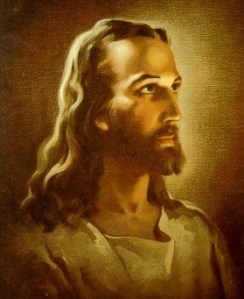
Warner Sallman,

Warner Sallman, “The Head of Christ”
(circa 1941)

  1. They believe that Jesus preexisted in Heaven before becoming a man.
  2. They believe that Jesus is Jehovah, the God of Israel.
  3. They believe that we are to pray to God the Father in the name of Jesus.
  4. They believe that Joseph was not Jesus’ biological father.
  5. They believe that Jesus was the Messiah, lived a sinless life, and did the miracles reported in the Gospels.
  6. They believe that Jesus suffered and died on a cross.
  7. They believe that Jesus rose physically, bodily from the grave.
  8. They believe that Jesus ascended bodily into Heaven.
  9. They believe that Jesus will return physically to the earth.[3]

2) Point Two: It’s not all wrong
It tends to get downplayed in the heat of battle but in the area of values, morality, and social issues, the Mormon Church is spot on in a number of areas. Mormon Researcher Eric Johnson, an Evangelical Christian who is generally critical of Mormonism, has gone so far as to identify ten areas (in David Letterman countdown fashion) that the LdS Church excels at and that he believes we can learn from:

10. Dedication to the heritage and the faith.
From a young age, Mormon children are taught about their heritage and the struggles that the early LDS pioneers faced when it came to living their faith. On the other hand, most of us Bible-believing Christians have very little knowledge of our history, including the conflicts and persecutions of the early Christian church. As a result, we do not benefit from the examples of our own past…

9. Overall morality.
While Mormons struggle with sin just like everyone else, they are generally well known for keeping a high moral codes and abstaining from a secular lifestyle. Faithful members are not to partake in drugs, alcohol, or tobacco. Remaining chaste, personal modesty, and being honest (along with the other commandments) are important virtues in the LDS lifestyle…

8. Politics and religion mix.
The Mormon Church is willing to put its money where its mouth is when political issues warrant a moral response. Certainly not every member may like the conservative stance that the LDS Church takes. But it is admirable how the Church is willing to support those things it strongly believes in…

7. Organization in its leadership.
The LDS Church is a well-oiled machine when it comes to organization, from the top down to the bottom…

6. Positive peer pressure towards missions.
Many Mormon young people look with anticipation for the day when they can leave on a church mission… Wouldn’t it be wonderful if every Christian young person were encouraged to spend two years of his or her life on the mission field? Perhaps many more career missionaries would be a result if short-term missions became a Christian priority…

5. Respecting Sundays as sacred.
Sundays in the Mormon Church are treated as a quiet day, a time to reflect and be with the family after attending the morning service at the local ward. Recreational and sporting activities as well as retail excursions are discouraged… We should not forget that the day of rest was created for the benefit of man…

4. Religious education for the youth.
The LDS Church is very concerned about educating its young people in the ways of its faith… Later, when the college years come and the young adult is challenged in his faith, he will have some possible answers to help him remain faithful to his religion…

3. Helping to supply the needs of the membership.
Mormons are known for being generous, even going out of their way to help their fellow members…

2. Preventing members from falling through the cracks.
When a Mormon fails to attend the services of his designated local ward for several weeks, he is sure to be missed… While I am not suggesting that Christian churches should become legalistic nags in order to force its membership to attend meetings and volunteer for projects, perhaps the general idea of following up on those who all of a sudden are no longer there would fulfill the shepherd role that the church is supposed to have…

1. The importance of families.
And the number-one thing we can learn from the Mormons is (drum roll, please) the priority the Mormon Church places on family life. Certainly many Christian families are very successful. Yet few churches emphasize the importance of the family like the Mormons do; they even set aside every Monday evening for Family Home Evenings to play games, talk, do devotions, etc…[4]

And Mr. Johnson isn’t alone, Christian Commentator Nick Asolas has developed his own list:

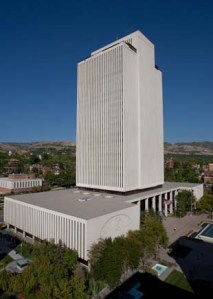
The Church Office Building for the Church of Jesus Christ of Latter-day Saints

The Church Office Building of the Church of Jesus Christ of Latter-day Saints

1. Public Relations
If Christianity had a PR firm, it should have been fired decades ago. The fact that we don’t is so painfully obvious that preaching against our past failures has almost replaced the Gospel itself…

2. Staffing Issues
In the average Christian church, the largest budget section is the salary of the staff. We have managed to take a couple curious verses in the New Testament and turn them into a mandate for creating medium-sized corporations complete with corporate perks and parking spaces. I am not going to make a case against paid staff in this post, but it is possible…

3. Engaging the Community
I think this is because as church leaders, we know what we need to do (talk to our neighbors, etc) but we don’t know how to do it. The Mormons are great at this. Granted, their strategy is simple and hasn’t changed for decades, but they have conditioned their community now to know who they are and what they are about based on looks alone…

4. Social Media
The LDS Church is excellent at talking with people across their social media sites. There are several Facebook pages for the different sections and interests and multiple Twitter feeds users can follow for church news, devotions etc. The official LDS Facebook page is updated daily with videos, polls and conversations and has almost half a million users…

5. Unity
This is the biggest and most important. While there are varying sects of the LDS religion, for the most part, they are one unified body that offers a consistent experience across all regions and wards. The statement of faith for all communities is the exact same and there is no competition among branches…[5]

Now I have been extremely critical of Greg Stier the president and founder of “Dare 2 Share” in the past for his uncritical and discernment impaired “Mormon Envy” of Mormon youth programs[6] but I will acknowledge that in pointing to the finer aspects of those programs he made some good points, including this one:

We need to push our teens. We need to turn them into active activists. We need to build consistent opportunities for service, outreach and training. We need to equip them to share their faith and then go with them, leading the way. After all, we are youth leaders.[7]

And Methodist minister and youth ministry expert Kenda Creasy Dean agrees. In her book “Almost Christian: What the Faith of Our Teenagers is Telling the American Church” she devotes the entire third chapter (entitled “Mormon Envy: Sociological Tools for a Consequential Faith”) to deconstructing and analyzing the Mormon youth enculturation process. In the end she concludes:

By intentionally reinforcing the significance of Mormonism’s particular God-story, by immersing young people in a community of belonging, by preparing them for a vocation and by modeling a forward-looking hope, Mormons intentionally and consistently create the conditions for consequential faith—so much so that Mormon teenagers are more likely than teenagers from any other group to fall in the category of young people the NSYR [National Studies of Youth and Religion] called highly devoted.[8]

In addition to everything that been said above, I would add my own “Mormon Envy” item to the list: Community. It was hinted at in the lists above but I would like to state it plainly: The LdS Church does a great job of creating a faith-based community of belonging that meets members social needs. Further, Mormon culture includes an element that’s missing from far too many of our churches: Good clean, fun. To be exact, they have fun for fun’s sake and nothing else.

When I was a kid I used to secretly hope that my parents would convert to Mormonism because the social events at the Ward Halls of Mormon friends and family members were always so darn fun! My Mormon cousins did Boy Scouting and they regularly had awesome, memory building, family outings. On the other hand my dreary, church meeting addicted, Nazarene parents seemed to think that fun was a sin and boredom a virtue. Their church’s idea of “fun” in my mind was, “Hey, I’ve got it! Let’s have another revival/potluck/prayer/testimony meeting!” Now you boring old religious people might love those things but they’re not exactly a good memory building, family bonding, experience if you’re a kid who’s still undecided about this whole Christianity thing – sorry folks, but there it is!

Even today, decades later, I have to ask: Why are so many of our churches so darn boring? Why can’t we just have some good clean fun every once in a while? Why can’t we just get together and have a good time? Why does everything have to be some form of religious utilitarianism?  I’m sorry fellow mainstream Biblical Christians but on the community thing, in comparison to the Mormon Church, we’re losing badly. This is an area where we can do a lot better in my opinion. I mean, come on, in the Old Testament God commanded the Jews to have seven festivals per year.[9] Yes, that’s right He commanded them! And since God seems to love a party shouldn’t we, His covenant people, love them too?

In fact, I’ve found that the rich community of Mormonism is the one thing that will keep members in the LdS Church long after they stopped believing in Joseph Smith, Mormon doctrine, or even God. Mormon culture is so rich and need fulfilling that it can be hard to leave when you’ve decided that its beliefs are hooey. If we did better in this area we would probably see far more Mormons leave the LdS Church and far less transition into atheism when they do.

The bottom line is this: The Church of Jesus Christ of Latter-day Saints doesn’t get everything wrong and they get quite a few things right. In fact, in terms of operations, maintaining a family first philosophy, very intentionally and deliberately engaging the surrounding cultural, creating a community of purpose and belonging, and caring for their membership they do some things better than many mainstream Christian churches do.

3) Point Three: It’s not all lies
Well now, okay, okay, okay, yes, there is a lot of deceit that goes on in the LdS Church! I’ve said it, I feel better now. Most egregious of all is how it chronically, even habitually, lies to its own members. Never-the-less, as stated above, since it still contains at least 10% truth, there is some truth in Mormonism.

Further, Mormon Leaders don’t lie all the time.  And official church literature doesn’t lie all the time – but when you do lie they do “go big!” So the problem that I have with the “it’s nothing but a pack of lies!” portion of the weak argument isn’t that it’s not more true than false but that it’s hyperbole.

The Stronger Arguments:
Building a stronger argument in this area involves two things: 1) Not engaging in over-the-top hyperbolic rhetoric, and; 2) Presenting your argument in a way that’s fair and balanced rather than obviously biased.

First Suggested Strong Argument: Present a balanced rather than biased argument 
To illustrate how one does this, let’s consider the list of things that Mormonism gets right in the Christology that was presented above. Rather than arguing that, “There’s nothing in Mormon Christology that’s true!” (which is so extreme that it’s like announcing, “I’m biased, my mind is closed, and I’m unwilling to consider the full body of evidence!”) a more balanced argument would look something like this:

Unknown Artist,

Unknown Artist, “Mormon Corporate Jesus”

“Well the LdS Church does get some things right in it’s Christology – including the two most important things, His divinity and His bodily resurrection from the dead. However, it also gets far more wrong, specifically: 

  1. Jesus is one of billions of spirits who preexisted in Heaven before becoming human.
  2. Jesus is one of three Gods ruling the universe (among other Gods that also exist).
  3. We are never supposed to pray directly to Jesus.
  4. God is Jesus’ “literal” father in the flesh—compromising the truth that Mary was a virgin.
  5. Some of Jesus’ statements must be revised according to Joseph Smith’s revelations.
  6. Jesus accomplished the Atonement primarily in the garden of Gethsemane.
  7. Jesus by his resurrection assures immortality in some heavenly kingdom for virtually everyone.
  8. Jesus returned to the earth to preach to the Nephites and start a separate church for them.
  9. Jesus appeared to Joseph Smith, condemned all existing churches, and restored the true church.[10]

Unfortunately, due to what it gets wrong, the Mormon Jesus isn’t the Christ of the bible – he is the type of ‘another Jesus’ that Paul warned us against in 2 Corinthians 11:4.”

Second Suggested Strong Argument: Present both sides of the coin
Closely aligned with the first strong argument is simply giving both sides of the coin. For example, even though the last section presented only the positive side of the coin, an argument regarding the both sides of the LdS Church’s Mormon Missionary program coin might look like this:

“Christian Youth Ministry experts like Greg Stier and Kenda Creasy Dean have praised your missionary program. Even Eric Johnson, who’s a critic of the Mormon Church, has said that it creates ‘positive peer pressure’ within your youth groups and culture. However, it has a dark side too, specifically: 

  1. BandaidMissionaryBadgeIt has created a culture whereby fear of their family’s reaction puts pressure on disenchanted LDS Missionaries to continue with their missions whether they want to or not. [click here for supporting evidence]
  2. LDS Church Missionary training and policies employ Mind Control techniques and tactics.
  3. The LDS Church focuses on the needs and interests of the institution over the needs and interests of the members. For example, on January 29, 2013, the LDS Church announced that the Benemerito De Las Americas private school in Mexico would be closed and converted into a Missionary Training Center leaving its more than 2,000 LDS students to the mercy of the vastly inferior Mexican public education system.[11]

So while I and other Christians applaud the good impact that your missionary programs have on Mormon young people, at the same time we often wonder if they and others get hurt more often than they get helped by it. After all, isn’t 18-years old awfully young to be taking on a role in life that requires some degree of maturity and life experience? Sometimes I wonder if the price for being a Mormon Missionary is simply too high.”

Another example might go like this:

“One thing that I love about the LdS Church is how it does such a great job of creating a faith-based community of belonging that meets member social needs. As kid I loved how you all know how to have good clean fun for fun’s sake and nothing else. I mean, for goodness sake, even after they’ve left Ex-Mormons still try to find ways to stay engage in Mormon Culture – that says something!

However, what seems to be missing from LdS community is real authenticity and vulnerability. The community relations are social but not intimate. The perfectionist expectations create a culture of “looking good” – where you don’t admit that you aren’t measuring up or that you are  struggling in some way. As former Mormon composer J.A.C. Redford once said, “You get a casserole if you’re sick, but not if you’re doubting.” To be sure, evangelical churches can suffer from the same problem, but from what I’ve seen in the LdS Church it’s both extreme and chronic. Candidly, I think if I’d had to deal with my drug and alcohol addictions as a Mormon I’d still secretly be drunk and using! Have you ever thought about any of this?”

And you can trust me when I say this: They probably have. I know this because I’ve had Mormons talk to me about this when we were in private and they feel safe enough to open up. They can’t talk about this stuff to insiders but they will to outsiders that they feel safe with.

Third Suggested Strong Argument: “So what?”
Now I would imagine that some Mormons reading this article might be tempted to point to the positive things that have been said in this article and crow, “This only proves that we are indeed the only true and living Church!” This isn’t speculation, Mormon are prone to use the good works and positive aspects of their institution as proof of its veracity. How many times have we heard a Latter-day Saint say, “Just inspect the fruit – it’s good!” as evidence of the truthfulness of Mormonism? However, as thesis #70 of the 95 LDS Theses points out:

70. It [the LdS Church] publicly (and loudly) trumpets its philanthropic work, when compared to other churches its per capita outlay is less than what smaller, less wealthy, less organized religious organizations spend: “A study co-written by Cragun and recently published in Free Inquiry estimates that the Mormon Church donates only about 0.7 percent of its annual income to charity; the United Methodist Church gives about 29 percent.”
(Caroline Winter, “How The Mormons Make Money”, Business Week; July 18, 2012)
[click here for supplemental evidence]

In the end, this argument proves nothing – it’s just a bad argument. There are a lot of groups that not only do good works but do far more of it than the LdS Church both per capita and in total. To cite one example, let’s talk about WalMart which in 2012 gave 1.7% of its pre-tax profits to charity.[12] Does that make WalMart the only true and living store?

Further, there are many other groups getting similar positive results from their members and in their communities. And this isn’t limited to religious groups, we could point to groups like the Red Cross, the United Way, the Shriners, the Kiwanis, Alcoholics Anonymous, and other institutions that give and do far more than the LdS Church does. And in terms of religious groups the Roman Catholic Church absolutely buries the LdS Church in terms of giving, good works – and some would add, demonstrably positive outcomes – with its membership. So I guess the Roman Catholic Church is really the only true and living church, right?

LDS Hospital, Salt Lake City which was sold off to Intermountain Healthcare. The Mormon Church now owns no hospitals.

LDS Hospital, Salt Lake City, which was sold off to Intermountain Healthcare in 1975. The Mormon Church now owns no hospitals. period.

Finally, whenever, a Mormon uses this argument with me I always ask this question: “Where are the Mormon Church owned hospitals and orphanages?” Between where I live and work (a 51-mile stretch) there are seven Catholic hospitals and several Catholic orphanages. And I haven’t even added in the hospitals and orphanages that are owned by Protestant churches in the same area. So how many Mormon equivalents are there? Answer: Zero.  The LdS Church doesn’t even have any church owned hospitals – it sold them all off years ago.[13] And while the Mormon Church offers adoption as part of its family services portfolio it doesn’t own a single orphanage and has even outsourced its adoption agency.[14] In this area the LdS Church is conspicuous in its absence. Thus, its “good works” bravado is most certainly more heat than light – while it may sound good at first, it simply doesn’t hold up under scrutiny.

Finally, always remember the Golden Rule of Apologetics
The Golden Rule of Apologetics is:[15]

Always treat your debating opponent’s evidence and arguments the way that you would want to have your evidence and arguments treated

All too often I see Christians engaging in the exact opposite of this, in something that apologists call “Scorched Earth Tactics”. This is a tactic whereby one is determined to win the debate no matter what the cost. It’s like dropping napalm or salting the ground after each advance so nothing can grow in your wake. The end result is that all too often you win the debate but lose your debating opponent – forever.

This is a formula for failure since it can take Mormon years, even decades to shake off the mind control of the LdS Church, to unsnap psychologically, and to start considering the body of evidence through clear eyes rather than Mormon sunglasses. And then there are typically several years more after that before they transition out due to family, professional, and cultural entanglements. Therefore, it’s always best to strive to maintain a good relationship even if you’re at loggerheads as debating opponents. Think long, not short term, and always, always, always consider how to maintain the relationship without compromising your message or yourself.

That sounds so easy doesn’t it? It’s not. It can be so hard to keep one’s passions, ego, and pride in check when engaging Mormons. And if you really like the person it can be hard not to soften your message to maintain the relationship.  It’s a balancing act. Which is why we so desperately need the mind of Christ and the power of the Holy Spirit guiding us rather than our fallen human nature. So for those moments when you feel your adrenaline beginning to pump, your palms beginning to sweat, and your eyes beginning to bulge I would encourage you to remember (or better yet, memorize) what God has said to us through His word:

Opponents must be gently instructed, in the hope that God will grant them repentance leading them to a knowledge of the truth,
(2 Timothy 2:25 NIV) 

Let your conversation be always full of grace, seasoned with salt, so that you may know how to answer everyone.
(Colossians 4:6 NIV)

But in your hearts revere Christ as Lord. Always be prepared to give an answer to everyone who asks you to give the reason for the hope that you have. But do this with gentleness and respect,
(1 Peter 3:15 NIV)

For as my wiser older sister once said so well, “The church is a mess and always has been. If it wasn’t for Jesus none of us would be Christians!” And that’s the best news of all – nothing depends entirely on you or me!

Summary and Conclusion:
Again, exaggeration erodes credibility and overstatement turns strong arguments into weak ones. The weak argument as presented here is an example of both.  As I have shown here there is some good and some truth in Mormonism despite the mountain of lies and errors in the LdS Church.  There is not only no shame in giving credit where credit is due, but doing so builds credibility. And not only do fair, full arguments demonstrate integrity, they also build trust so that honest relationships can form.  And above all they demonstrate that you’re committed to the truth above all else.

Do these things and your arguments will always be strong and have impact. It’s all about balance.

balanceTruth without love is too hard. Love without truth is too soft
— Jim Spencer, Idaho Pastor and former Mormon

NOTES
[1] Walter Martin, The Kingdom of the Cults”, p.24

[2] Don Basham, “Spiritual Warfare”, lecture at Santa Ana High School 1980, taken from author’s personal notes from the event.

[3] Adapted from Rob Bowman, “The Mormon View of Jesus Christ”, Institute for Religious Research website.  I would encourage the reader to read this article in its entirety as it also discusses in full detail how Mormon Christology is both right and wrong in each of these areas.

[4] Abridged from Eric Johnson, “10 Things Christians Can Learn from the Mormons”, Mormon Research Ministry website. Again, I would encourage the reader to read this article in its entirety as it also discusses the LdS Church’s imbalances and flaws in regard to each of these items.

[5] Abridged from Nick Asolas, “5 Things We Need to Learn from the Mormon Church”, Shrink The Church website.

[6] See “An Open Letter to Greg Stier”

[7] Greg Stier, “Why Mormons Do Better Youth Ministry Than We Do”, Christian Post website.

[8] Kenda Creasy Dean, “Almost Christian: What the Faith of Our Teenagers is Telling the American Church” (p. 50, Kindle position 881). Oxford University Press. Kindle Edition.

[9] See “What are the different Jewish festivals in the Bible?”, GotQuestions.org website

[10] Op cit, Rob Bowman.

[11] These three points were taken from “The 95 LDS Theses”.  They are  theses #30, #75  and #2 respectively.

[12] Sarah Frostenson and Megan O’Neil, “10 Companies That Gave the Most Cash in 2013”, The Chronicles of Philanthropy website.

[13] See the “Hospitals” article in the “The Encyclopedia of Mormonism”. BYU Harold B. Lee Library website.

[14] From the LdS Church’s “Adoption Services” website:

Current Services Offered by LDS Family Services
We have made changes to the way we provide services to single expectant parents and prospective adoptive families. As of August 1, 2014, we no longer function as a full-service adoption agency and instead outsource most adoption functions. However, we continue to provide consultation for adoptive couples, screening and registration on an adoption matching website, and counseling for single expectant parents.
(retrieved January 7, 2015)

[15] For a more thorough analysis and explanation of “The Golden Rule of Apologetics” see Kenneth R. Samples‘ seven part series on the subject which starts here, “The Golden Rule of Apologetics Part 1”.

BACK TO TOP

Curriculum-2012-collage-580

Collage of official Mormon Church 2012 Sunday Curriculum

An ongoing series of articles on some common and recurring weak arguments that Christians make against Mormonism.

by Fred W. Anson
The Argument:
“I will never, ever use official Mormon Church sources like church manuals, LdS Scripture, or the official church website. It’s all just spin doctored, faith promoting propaganda!”

Why It’s Weak:
One of the hardest things for many Christians in Mormon Studies seems to be the ability to view things from the Latter-day Saint point of view. However, for your arguments to be truly effective you have to be willing to leave your side of the divide and stand next to the guy who disagrees with you so you can see things through his eyes.

For example, while Christianity is a religion drenched in and driven by an adherence to orthodoxy defined by 2,000-years of systematic theology, Mormonism – a young religion by comparison – is a “cafeteria religion.” By this I mean that the LdS Church gives it’s members a smorgasbord of doctrine and theology to choose from and then doesn’t seem to get too upset when they take what they want and leave the rest. One reason for this is that in Mormonism orthopraxy carries more weigh than orthodoxy. As one Mormon Studies scholar observed:

Mormonism lacks a solid, systematic theology by which a serious scholar could pinpoint beliefs. Those of you who have been in many debates with Mormons no doubt have run into this frustration. How many times has a Mormon claimed something you thought to be a central piece of Mormon theology to not be ‘official doctrine’? It’s happened to me often, even when I pull that doctrine in question right out of officially published manuals used to teach Sunday school. Ultimately this confusion stems from the fact that the LDS leadership is uneducated in religion or philosophy, generally, and therefore avoids clarifying rather important doctrines, leaving individual Mormons interested in the topic to their own devices.[1]

Due to this phenomenon, what Mormons believe in practice may or may not be aligned with they’re supposed to believe according to the LdS Church. This can be frustrating and baffling for someone coming from the historical Christian perspective. Talk to ten Mormons and you may find ten different belief systems. Very often in dialog with a particular Mormon you might even find that belief system shifting based on the ebb and flow of the arguments and evidence that’s being presented. Never-the-less as the same Mormon Studies scholar notes:

A young Mormon woman bearing her testimony

A young Mormon woman bearing her testimony

Here’s the problem though, Mormonism is very interested in orthodoxy, at least as much as orthopraxy. Go to any fast and testimony meeting and one thing you’ll hear from almost all participants who speak is something akin to “I know this church is true, I know that Joseph Smith is a prophet of God, I know that Jesus is the Christ,” and so on. “I know” is rather strong phrasing of a statement of Mormon orthodoxy. Or, how about meet with some Mormon missionaries and allow them to run through the standard missionary discussions. One of the first things they will do is teach you how to ‘recognize the witness of the Spirit’ which consists of associating good feelings with statements that they argue are true. From the very beginning the potential convert is encouraged to form an orthodoxy grounded in an epistemology consisting of the formula “good feelings about things which authorities claim to be true= witness of the Spirit of the truthfulness of the said claims”. In order to be baptized, you have to agree to a set of belief claims, not just promises to obey the Word of Wisdom, the law of chastity and the law of tithing. Likewise, to go through the temple the Mormon must affirm core doctrines which in practice constitute a sort of Mormon creed. I argue the only reason this isn’t systematized, is as I said before, due to the Mormon aversion to theological learning, but that doesn’t mean that Mormonism isn’t a religion obsessed with orthodoxy. It surely is. It’s just a sloppy theology, which does have the affect of allowing the few to take their belief system in unique directions but remain Mormons in good standing.[2]

So the question is, “How does one cut through the non-systematized theology of the typical Mormon so meaningful discussion can ensue?” And the answer, to paraphrase Obi-Wan Kenobi is, “Use the manuals Christian, use the manuals.”

1) Yes, it’s spin doctored, faith promoting propaganda…
I will affirm, validate, and agree with at least a portion the second part of this weak argument: LdS Church manuals and the church website are indeed spin doctored propaganda. Some examples: 

  • The “Teachings of Presidents of the Church: Brigham Young” manual (circa 1997) only mentions his first two monogamous legal wives (he remarried after being widowed), never mentions his illegal plural wives (fifty-three that we know of), and never uses the word “polygamy”, “plural wives”, or any derivation thereof anywhere therein. Further, the biggest scandal of his presidency, the Mountain Meadows Massacre, is never mentioned despite it’s profound historical and social significance.[3]
  • In a similar manner the “Teachings of Presidents of the Church: Joseph Smith” manual (circa 2011) limits the subject of plural marriage in the introductory notes to the teacher. Throughout the rest of the manual only his marriage to Emma Hale Smith is mentioned and polygamy is conveniently (and as explained in the introduction, deliberately) avoided. Consider for example, this: Although their marriage would be tested by the deaths of children, financial difficulties, and Joseph’s frequent absences from home in fulfillment of his duties, Joseph and Emma always loved one another deeply.”[4] The biggest test of their marriage was, no doubt, Joseph Smith’s polygamy yet it isn’t mentioned at all.[5]
  • The front cover of the “Church History In The Fullness of Times” manual

    Finally, the manual, “Church History in the Fulness of Times” (circa 2014) is a cornucopia of skewed, white washed, historical revisionism. For example, the section entitled, “Missouri Persecutions and Expulsion”[6] goes into great detail about the atrocities and horrors inflicted on Mormons by their Missouri neighbors but fails to mentions the atrocities and horrors inflicted on the Missourians by Mormons during the 1838 Mormon War in Missouri.[7] And the section on the the Kirtland Safety Society[8] absolves Joseph Smith of all culpability concluding with this “masterpiece” of spin doctored white washing:

Joseph Smith’s losses from the failure of the company were greater than anyone else’s. While seeking to achieve success with the bank and, at the same time, to purchase land in Kirtland and goods for his store, he accumulated debts amounting to approximately one hundred thousand dollars. Although he had assets in land and goods that were of greater value in some respects than his debts, he was unable to immediately transform these assets into a form that could be used to pay his creditors. The Prophet endured seventeen lawsuits during 1837 in Geauga County for debts involving claims of more than thirty thousand dollars. Unfortunately, few people correctly understood the causes of their economic difficulties. Many Saints spoke against the Prophet and accused him of being responsible for all of their problems.[9]

To compare and contrast, consider this account from the neutral source, Wikipedia:

Regardless of the reasons for the Kirtland Safety Society Anti-Banking Company’s (KSSABC) failure, much of the blame was laid upon Smith. Half of The Quorum of Twelve Apostles accused Smith of improprieties in the banking scandal, and LDS Apostle Heber C. Kimball later said that the bank’s failure was so shattering that afterwards “there were not twenty persons on earth that would declare that Joseph Smith was a prophet of God.” Woodruff records that Smith had an alleged revelation on the topic, but declined to share it, saying only that “if we would give heed to the commandments the Lord had given this morning all would be well.” Then Woodruff expresses his own hopes that the KSSABC will “become the greatest of all institutions on EARTH.”

A Two Dollar Bill from Joseph Smith's Kirtland Safety Society Anti-Bank

A Two Dollar Bill from the Kirtland Safety Society Anti-Bank
(click to zoom)

On January 12, 1838, faced with a warrant for his arrest on a charge of illegal banking, Smith fled with Rigdon to Clay County, Missouri just ahead of an armed group out to capture and hold Smith for trial. Smith and Rigdon were both acquainted with not only conflict and violent mobbing they experienced together in Pennsylvania and New York, but with fleeing from the law. According to Smith, they left “to escape mob violence, which was about to burst upon us under the color of legal process to cover the hellish designs of our enemies.” Brigham Young left Kirtland for Missouri weeks earlier on December 22 to avoid the dissidents who were angry with Young and threatened him because of his persistent public defense of Smith’s innocence. Most of those who remained committed to the church moved to join the main body of the LDS in Missouri.[10]

2) …but it’s official spin doctored, faith promoting propaganda.
But despite any deficiencies, the fact remains that these official church resources define what the Mormon should believe. They are as close to systematized theology as one is going to get in Mormonism. For example, the next time a Mormon tells you that the Lorenzo Snow couplet (“As man is, God once was; as God is, man may become.”) no longer has any meaningful or relevant place in Mormon doctrine or theology, you can say: “Then why does page 83 of the official LdS Church manual, ‘Teachings of the Presidents of the Church: Lorenzo Snow’ contain the couplet and go on to say this: ‘Because we have divinity within us, we can become like our Father in Heaven’? Why don’t you believe what your church says you should believe?”[11]

Or the next time a Latter-day Saint tells you that in Mormonism salvation is by grace alone you can say, “Then why in the official Church Education System ‘Book of Mormon Student Study Guide’ on page 53 does it say: ‘We are saved by the power of the Atonement of Jesus Christ. We must, however, come unto Christ on His terms in order to obtain all the blessings that He freely offers us. We come unto Christ by doing “all we can do” to remember Him, keep our covenants with Him, and obey His commandments.’[12]

Further, my Mormon friend, LdS Apostle Dallin H. Oaks said this in the May 1998, Ensign magazine on page 55:

‘And what is ‘all we can do’? It surely includes repentance (see Alma 24:11) and baptism, keeping the commandments, and enduring to the end. Moroni pleaded, ‘Yea, come unto Christ, and be perfected in him, and deny yourselves of all ungodliness; and if ye shall deny yourselves of all ungodliness, and love God with all your might, mind and strength, then is his grace sufficient for you, that by his grace ye may be perfect in Christ’ (Moroni. 10:32).’[13]

jellytoawall

While defining Mormon doctrine may be like nailing Jello to a wall…

How is it ‘grace alone’ if covenant keeping, self denial, and obedience to commandments are requirements or prerequisites? And, by the way, why is it that you don’t believe what your church says you should believe?”

See how this works? While defining Mormon doctrine may be like nailing Jello to a wall at least official LdS Church sources provide a mold that the Jello is supposed to stay in. And if determining what individual Mormons may believe may be like herding cats but at least working with official LdS Church sources give you a net and cat carrier to work with.

3) Stay on safe ground
A common problem that everyone in Mormon Studies struggles with is the issue of exactly what official Mormon Doctrine is. As Mormon Researcher Aaron Shafovaloff notes:

Christians who attempt to engage in meaningful dialog with their Mormon friends are often frustrated by the way teachings and beliefs can be obfuscated and downplayed. When a question is posed by a Christian they are many times told that a particular teaching “is not official.” Behind this are the assumptions that Mormonism is immune to any fatal criticism if it involves anything outside the scope of officiality, and that evangelical engagement should be limited to that which is binding upon Mormon members.

One problem with this is that the Mormon Church has no binding and official position on what constitutes a binding and official position. Mormon leaders and thinkers have proposed a variety of approaches to defining what constitutes official doctrine, not one being settled upon. (bolding added)[14]

This led Mormon Critic, Keith Walker of Evidence Ministries, to make this poignant but humorous statement about the absurdity of the conundrum and how Mormons abuse it:

So while it appears that Mormonism from the First President to the Ward Janitor both is blessed and cursed with the need for a plausible deniability escape hatch, it seems incredulous to argue that current, correlated, officially vetted and published church materials don’t establish a standard of belief that good Mormons are beholden to. As Mormon Apostle Carlos Asay explained in General Conference:

“Church publications (the Ensign, the New Era, the Friend, and the International Magazines) are referred to as the voices of the Church and the official line of communication from the First Presidency and the Council of the Twelve to the members of the Church. Each month a First Presidency message appears in the Ensign. Home teachers are expected to discuss this article with all assigned families. Quite obviously, the curriculum would become stagnant and lose its relevance if we failed to hear the voices of living prophets. One of the most significant of all Church publications is the conference edition of the Ensign magazine. This important issue carries the current written messages of the Brethren conveying the mind and will of the Lord.”[15]

And the importance of staying faithful to church manuals and not deviating from them is emphasized again, again, and again on the official church website. For example, consider this excerpt of a General Conference address from Mormon Apostle M. Russell Ballard

Teachers would be well advised to study carefully the scriptures and their manuals before reaching out for supplemental materials. Far too many teachers seem to stray from the approved curriculum materials without fully reviewing them. If teachers feel a need to use some good supplemental resources beyond the scriptures and manuals in presenting a lesson, they should first consider the use of the Church magazines.

Teachers can stay on safe ground when they use the standard works, the approved manuals, and the writings of the General Authorities.[16]

… as well as this Church Educational System video to seminary teachers: The Importance of the Seminary and Institute Curriculum.

So, to paraphrase Elder Ballard, Mormon Critics can stay on safe ground when they use the standard works, the approved manuals, and the writings of the General Authorities.

Summary and Conclusion
My observation in dialoging with Mormons over a number of years is that when they’re confronted with hard or uncomfortable evidence they start looking for an escape hatch to wiggle out of. Using official LdS Church resources won’t eliminate this but it reduces their options. Further, there’s great power in asking Mormons why they don’t believe what they’re supposed to. After all, if it’s in their standard works and approved manuals, they’re supposed to believe it are they not? I mean aren’t you, dear Christian, supposed to believe what’s in your church’s scripture and church approved manuals? And if the answer is, “No!” then I would ask you the same question that I would ask a Latter-day Saint: “Then why are you in a church whose beliefs you don’t share?”

Finally, I would ask to consider this: If you scroll through this article, including the footnotes, you may notice something – the majority of my sources and arguments in this article were derived from what? Answer: Official LdS Church materials. And I would suggest that if you found them persuasive, even though you’re not beholden to them, how much more so will your Mormon friend, who is?

Use the manuals Christian, use the manuals!

NOTES
[1] Nebula0, “Orthodoxy vs Orthopraxy”, About Mormonism website

[2] Ibid, Nebula0

[3] LdS Church, “Teachings of Presidents of the Church: Brigham Young”, LdS Church website

[4] LdS Church, “Teachings of Presidents of the Church: Joseph Smith” (Kindle Locations 480-482). Kindle Edition. The statement about why polygamy was deliberately avoided in this manual can be found at Kindle Location 204 in the Kindle Edition where it says:

“This book deals with teachings of the Prophet Joseph Smith that have application to our day. For example, this book does not discuss such topics as the Prophet’s teachings regarding the law of consecration as applied to stewardship of property. The Lord withdrew this law from the Church because the Saints were not prepared to live it (see D& C 119, section heading). This book also does not discuss plural marriage. The doctrines and principles relating to plural marriage were revealed to Joseph Smith as early as 1831. The Prophet taught the doctrine of plural marriage, and a number of such marriages were performed during his lifetime. Over the next several decades, under the direction of the Church Presidents who succeeded Joseph Smith, a significant number of Church members entered into plural marriages. In 1890, President Wilford Woodruff issued the Manifesto, which discontinued plural marriage in the Church (see Official Declaration 1 ). The Church of Jesus Christ of Latter-day Saints no longer practices plural marriage.” (bolding added for emphasis)

The above statement can also be found on the LdS Church website by clicking on this link.

[5] There’s ample evidence of the conflict and turmoil that polygamy created in Joseph and Emma Smith’s marriage but probably none more dramatic than this famous incident:

“A door opposite opened and dainty, little, dark-haired Eliza R. Snow (she was “heavy with child”) came out . . . Joseph then walked on to the stairway, where he tenderly kissed Eliza, and then came on down stairs toward Brother Rich. Just as he reached the bottom step, there was a commotion on the stairway, and both Joseph and Brother Rich turned quickly to see Eliza come tumbling down the stairs. Emma had pushed her, in a fit of rage and jealousy; she stood at the top of the stairs, glowering, her countenance a picture of hell. Joseph quickly picked up the little lady, and with her in his arms, he turned and looked up at Emma, who then burst into tears and ran to her room. Joseph carried the hurt and bruised Eliza up the stairs and to her room. ‘Her hip was injured and that is why she always afterward favored that leg,’ said Charles C. Rich. ‘She lost the unborn babe.’”
(Maureen U. Beecher, Linda K. Newell, and Valeen T. Avery, “Emma, Eliza, and the Stairs: An Investigation”, BYU Studies 22 (Winter 1982), pp.86-94)

[6] LdS Church, “Church History in the Fulness of Times” (Kindle Location 6012). Kindle Edition. You can also click on this link to see the referenced content on the LdS Church website.

[7] Consider, for example, this incident:

“The [non-Mormon] Gentiles, who numbered but 36 men, were completely routed and driven from the field in a few minutes. They fought bravely and effectively, but could not withstand the sudden and impetuous attack which was made upon them, and Capt. Bogart led them off in the direction of Elkhorn, but finally fell back to the southern part of the county. The Mormons did not pursue, owing chiefly to the fall of their leader, whose death had a demoralizing effect upon them, chiefly because they had deemed him invincible, as he had repeatedly declared that he could not be killed.

In this engagement the Mormons lost Capt. Patton and two men named Patrick O’Banion and Gideon Carter killed, and James Holbrook and another man wounded. In the dark the latter fought by mistake, and cut up one another with their corn knives, or ” swords,” as they called them, very severely. Capt. Bogart’s Gentiles lost Moses Rowland killed and Thos. H. Loyd, Edwin Odell, James Lockard, Martin Dunnaway, Samuel Tarwater, and Wyatt Craven wounded.

Two Mormons attacked Tarwater with corn knives and nearly cut him to pieces. He received a terrible gash in the skull, through which his brain was plainly visible, one terrible blow across the face severed the jaw bone and destroyed all the upper teeth, and there was an ugly gash made in his neck. He kept his bed six months and his wounds considerably affected his speech and his memory, Mr. Tarwater is yet alive, and resides near Orrick, Ray county. Since 1840 he has drawn a pension from the State of Missouri of $100 per year, for the wounds and disability he received in the Crooked river fight. Wyatt Craven lives near Crab Orchard, Ray county. He was taken prisoner early in the fight, and the Mormons started with him to Far West, but after traveling some distance they released him and told him to go home. He started off and was walking away pretty briskly, when Parley P. Pratt, a very prominent and noted Mormon and one of the ” Twelve Apostles,” laid his gun against a tree, took deliberate aim, fired and shot him down. Then, believing he was dead, the Mormons went off and left him.”
(Ora Merle Hawk Pease, “History of Caldwell and Livingston Counties, Missouri”, pp.130-131)

And as Mormon researcher Bill McKeever notes regarding the Mormon white washing of the 1838 Mormon War in Missouri:

“When speaking of Mormon persecution, the tragedy at Haun’s Mill is rarely overlooked. The film spoke of a Mormon who was “hacked to death by a corn-cutter.” The brevity of this episode in the film fails to mention that the atrocities at Haun’s Mill stemmed in part from an incident a week earlier at what has come to be called “the Battle of Crooked River.” Former Mormon historian D. Michael Quinn explained on page 100 of his book, A Mormon Hierarchy: Origins of Power:

“A generally unacknowledged dimension of both the extermination order and the Haun’s Mill massacre, however, is that they resulted from Mormon actions in the Battle of Crooked River. Knowingly or not, Mormons had attacked state troops, and this had a cascade effect… upon receiving news of the injuries and death of state troops at Crooked River, Governor Boggs immediately drafted his extermination order on 27 October 1838 because the Mormons ‘have made war upon the people of this state.’ Worse, the killing of one Missourian and mutilation of another while he was defenseless at Crooked River led to the mad-dog revenge by Missourians in the slaughter at Haun’s Mill” (Origins of Power, p.100)

The mutilated Missourian was Samuel Tarwater who was left for dead by the fleeing state militia. Quinn noted how enraged Mormons mutilated the unconscious Tarwater “with their swords, striking him lengthwise in the mouth, cutting off his under teeth, and breaking his lower jaw; cutting off his cheeks…and leaving him [for] dead” (p.99). Tarwater survived to press charges.”
(“Part One of ‘The Mormons’ on PBS” reviewed by Bill McKeever. Mormonism Research Ministry website)

[8] Op cit, “Church History in the Fulness of Times” (Kindle Location 5402). You can also click on this link to see the referenced content on the LdS Church website.

[9] Ibid, (Kindle Locations 5436-5443). You can also click on this link to see the referenced content on the LdS Church website.

[10] Wikipedia, “Kirtland Safety Society”, “Response in the LDS community”; Also see “Kirtland Safety Society Anti-Banking Company” on the MormonThink.com website for a good collection of citations from non-neutral sources. There’s just no denying that the example citation from the church manual is spin doctored, white washed, revisionism. Joseph Smith, along with his First Counselor Sidney Rigdon, legitimately bore a heavy fiduciary burden for the failure of the bank.

[11] LdS Church, “Teachings of Presidents of the Church: Lorenzo Snow”, “Chapter 5: The Grand Destiny of the Faithful” p.83, LdS Church website

[12] LdS Church, “Book of Mormon Student Study Guide”, “2 Nephi 25: ‘Believe in Christ'”, p.53, LdS Church website

[13] Dallin H. Oaks, “Have You Been Saved?” Ensign, May 1998, p. 55, LdS Church website

[14] Aaron Shafovaloff, “Mormonism, Officiality, and Plausible Deniability”, Mormon Research Ministry website

[15] Carlos Asay, “‘For the Perfecting of the Saints’: A Look at Church Curriculum”, Ensign, Jan. 1986, p.17, LdS Church website

[16] M. Russell Ballard, “Teaching—No Greater Call”, April 1983 LDS General Conference, LdS Church website

RECOMMENDED READING
Mormon Doctrine: What’s Official, And What Isn’t?, by Donald L. Ashton. Mr. Ashton is a member of StayLDS.com which is a, “We don’t believe anymore but still stay LDS,” New Order Mormon style group. I would have loved to cite several times from this fascinating article but the author has tightened up the use rights to the point of making that impractical. Apparently he doesn’t want it to get into the hands of all those nasty Mormon critics out there – and for good reason, there’s a lot to work with here if you’re a critic!

In the end this article expends a lot of time and effort to essentially say, “There is no official Mormon doctrine. The truth is what you make it.” (These are my words not the author’s) In other words, it advocates a form of relativist post modernism. Never-the-less, it still contains some good lists of official LdS Church sources and quotes from Mormon leaders on the subject of what constitutes official Mormon doctrine and what doesn’t. If nothing else, this article defines the problem well even if it’s solution is “squishy” and, at least to this author’s way of thinking, unsatisfying.

“What is Official Doctrine?”, by Stephen E. Robinson and Joseph Fielding Smith. BYU Professor (cum Mormon Apologist) Stephen Robinson’s glowing treatise in support of the kind of circular logic and appeal to authority fallacies that were noted in the main article above. If nothing else this article is worth reading to see the lengths that Mormons will go to protect their “Not official!” escape hatch.

My favorite line is this wonder of circular logic: “the only valid judgments of whether or not LDS doctrine is Christian must be based on the official doctrines of the Church, interpreted as the Latter-day Saints interpret them.” In other words, outside objective evidence is irrelevant to Mormonism’s closed system – a phenomenon I wrote about in my article, “The Problem of the Mormon Tank (Revisited)”. Robinson also tacks on an excerpt from Joseph Fielding Smith’s, “Answers to Gospel Questions”, that proves that Mormon Prophets can be just as irrational, circular, and fallacious as BYU Professors.

“Approaching Mormon Doctrine”, LDS Newsroom. An official LdS Church source that explicitly states that feelings alone aren’t a sufficient means of discerning truth. I use this one a lot with Mormons who insist that the “witness of the Spirit” alone is sufficient for discerning truth and that objective evidence is irrelevant:

“Individual members are encouraged to independently strive to receive their own spiritual confirmation of the truthfulness of Church doctrine. Moreover, the Church exhorts all people to approach the gospel not only intellectually but with the intellect and the spirit, a process in which reason and faith work together.” (bolding added for emphasis)

“Should one limit consideration of ‘Mormonism’ to what minimalists deem ‘official’ and ‘binding’?”, by Aaron Shafovaloff. This article offers some thoughts on why Mormon “not official” objections shouldn’t be allowed to stop or limit discussion.

“Mormon Belief: The Doctrine of the LDS Church”, by Robert Bowman Jr. Provides a short, succinct of core Latter-day Saint beliefs with citations from official LdS Church sources.

BACK TO TOP

 by Fred W. Anson
A funny thing happened on the way to this blog when I wrote it back in August 2011. I was actually planning to publish – and was working on – brand new, original material when several of the Mormon Expression Podcast and Blog discussion boards “lit up” with interesting dialog. I feel that that the content of this previously published article is relevant to several of them. So with no further adieu – and with a nod, a wink, and a grin to Eric’s blog (from back then) – I offer for your consideration, “The Problem of The Mormon Tank (Revisited)”.

Artist's depiction of the crew in a Sherman Tank.

Artist’s depiction of the crew in a Sherman Tank.

Here’s the problem
If you’re in an Army Tank and pull out a compass the needle will point toward magnetic north. However, the compass is only validated if when you get outside that Tank and it’s still pointing in the exact same direction.Then, it’s only truly validated if it’s compared to yet another “known good” compass while outside the tank and they both point in the same direction. That is, the one point of internal reference and two points of external reference are all calibrated. The reason for this is simple: The magnetic field created by the iron armor of the Tank interferes with the compass’s operating integrity. You could consult a thousand compasses inside the Tank, and still get the same compromised and errant result every time.

A Stanley Pocket Compass and a map. You will notice that the compass is pointing true magnetic North and will always do so anywhere on earth regardless of the level of the user’s faith, diligence, or the orientation of the map. The only exception is if it’s ability to integrate itself with true North is compromised or blocked by an magnetic field other than the earth’s.

A million compasses?
14-million?
A billion?
Same result time after time.

Thus it’s only when one eliminates the corrupting influence of the Tank that the compass will give a proper and accurate reading. However, even then one must validate the integrity of the compass itself by validating it against a compass that is known to have full integrity – that is, you have confirmed that the dynamic guidance system for the internal system (the compass) is fully integrated with fixed external reality (the earth’s magnetic field).

Validating An Internal System
Thus an internal system is only validated if the trustworthiness of it’s operation has been established – that is, it is consistent and calibrated against a set of objective, dispassionate, unchanging, absolute external standards. A system that’s not tested and that’s only internally consistent with and calibrated against itself is prone to corruption and, therefore, is not trustworthy.

Short version: Internal evidence that hasn’t been validated against external evidence can’t be completely trusted!

And practically speaking, this is important stuff because if you’re trying to get from Los Angeles to San Francisco with the corrupted compass readings inside the Tank you just might end up in the Nevada Desert instead!

An artist’s recreation of the “Liahona” – the Book of Mormon ‘compass’ that only worked “according to the faith and diligence” (1 Nephi 16:28) with which the user heeded its direction.

The Mormon Tank
Mormonism is like a tank – the “compass” may appear to be “true” while you’re inside – after all it “feels right” and everything seems to nicely integrated, correlated, unified, logical, rational  and “working” – but all the while the Mormon Tank is corrupting the end result. It’s not only not externally integrated with true “north” – it hasn’t really been established that the “compass” itself is working properly!

Which, of course, is why it seems to me that the LdS Church Leadership instructs and directs members to ignore external, objective evidence. For to do so is like taking a compass outside of a tank and discovering that the thick iron walls of the tank were skewing how both the compass reported “truth” and, thus, how you discerned “truth” while you were hunkered down inside it.

And I think that’s why my experience has been that that when one attempts to calibrate the internal Mormon system against external reality it simply does not validate.

(As originally published on the Mormon Expression Blogs website on August 13, 2011) 

BACK TO TOP