Archive for the ‘Mormon Studies’ Category

by Fred W. Anson

“Even when you lose you’re still the winner
At least you’ve got the makin’s of a song”
Waylon Jennings & Willy Nelson
[1]

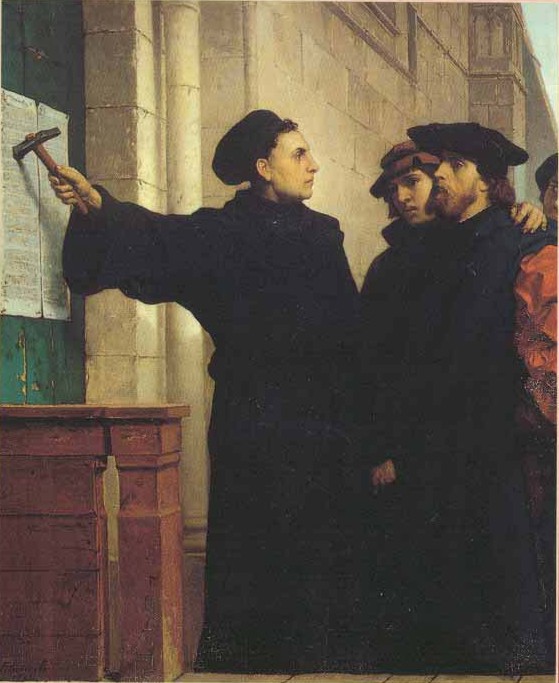
Luther posting the 95-Theses onto the door of Wittenberg Castle Chapel (circa 1517)

Sit back, relax, and let me tell you a little story . . .
THE STORY
On the last two Reformation Days[2] I have released a list of 95-Theses very loosely based on Martin Luther’s which offers some concerns and grievances that I and a random collection of active Mormons, inactive Mormons, former Mormons, and never Mormons see in the current Church of Jesus Christ of Latter-day Saints (LdS Church). This began as and has always been a group effort, it has never been a solo act. Rather, it’s the result of many, many, many kind and generous collaborators (many whom are, no doubt, reading this article) however, inevitably – and no matter how much I stress this fact – both the praise and the blame for the published piece tends to be directed solely at me.   Please don’t understand me, there’s no harm, no foul here – after all I did willingly, and deliberately sign up for this gig!

The response to this list is always been interesting but this year it was particularly so, leaving me with the fine “makin’s of a song,” or more precisely, a mighty fine Mormon Studies case study.

Generally speaking, this year the feedback was positive and affirming with very little “push back” from faithful Mormons or suggestions for improvement from disaffected and former Mormons – which was the case last year.  So there’s not much to report there except that it was unexpected.

Rather, the big surprise came in the closed “Mormon Stories” Facebook group the day after I posted the standard promotional blurb (“With hope and prayer that we will see true reform by this time next year . . .”) with a link to the article. Again, for the most part the responses there were pretty much in line with what I was seeing elsewhere with the exception of a clarification on why I use the term “LdS Church” rather than “LDS Church”[3] and a lengthy discussion with one group member on how Mormon leaders and members tend to engage in eisegesis[4] when they interpret holy writ, history, science, and life in general. It’s a complex subject, and I think an interesting one, so I was happy to try to satisfy her interest in the subject.

Then, the next day, I received this private Facebook message from Mormon Stories founder and board administrator John Dehlin:[5]
“Fred – I’m getting lots of complaints about your participation on the MS board. I don’t mean to offend, but I feel like it might not be a good fit. It feels to many like your intent really is to lead people out of the church (whether that is your intent or not…that’s how it comes across). And that’s just not what this forum is about. Do you mind if we part ways? There are LOTS of forums out there….I feel like your engagement in this forum is driving away many of the people that I’m trying to include/reach.

Now, before I go any further I should probably explain that I’ve always felt I had a good understanding of the Mormon Stories mission. After all, it’s clearly outlined on their website starting with this summary statement, “Mormon Stories is a nonprofit organization that seeks to create online and in-person environments that allow for authentic self-expression and the open discussion of Mormonism.” It then proceeds to expand and describe in further detail the purpose and intention of the organization in some detail including, “… we endeavor to ensure that the projects we undertake 1) support individuals in Mormon-related faith crises, 2) save marriages, 3) heal families, and 4) celebrate, challenge, and advance Mormon culture in healthy ways.”[6]

Some thoughts immediately occur at this point:
1) Nowhere in their mission statement was I able to find a clause about how a tenet of the Mormon Stories mission is to help people stay in the LdS Church.

2) The declaration read before the August 12th, 2011 Mormon Stories event honoring D. Michael Quinn[7] explicitly affirmed the right to self identify as “Mormon” regardless of one’s state of membership in the LdS Church, again affirming the idea that Mormon Stories isn’t a membership retention organization.

3) I have always been sensitive to the fine line that John Dehlin walks in trying to help Mormons come to grips with true Mormon History and the issues in the LdS Church in a productive way. He takes “hits” from all sides that, frankly, I have frequently thought unjust, unfair, and unduly harsh.

4) Based on the rhetoric that John Dehlin has regularly used publicly, I had always thought that the Mormon Stories agenda included lobbying internally and externally for reform in the LdS Church. Personally, I had always thought of John Dehlin as an ally not an adversary.

4) The article in question was, to my way of thinking, very much presented and aligned with Mormon Stories stated intention to “challenge, and advance Mormon culture in healthy ways.”

So I immediately responded with the following, “Sorry about that is there something I can do to rectify the situation?”

I then attempted to enter the Facebook Mormon Stories discussion board only to find that my membership in the group had been revoked – in the vernacular, I had been banned. I then received notification from a friend who was still a member of the group that the following had been newly posted at the tail end of the aforementioned thread discussing the Reformation Day article:

Ms. D
“By the way, folks, I just want to point out to you that Fred W. Anston (sic) is NOT , and never has been a Mormon-LDS, LdS, or anything like that. You might want to keeep (sic) that in mind when considering his comments, his motives, his empathy and friendship. He does NOT know what it is like to be LDS, just so you know that, in case it makes a difference to you.”

So I contacted John Dehlin and asked him to remove the comment – which he did. My request to John was worded as follows:
“This is, quite simply, an ad-hominem AND a not too subtle attempt at character assassination.

I think that you and I can agree that this is inappropriate. Frankly, whether I’ve ever been LdS or not is irrelevant. Further, Ms. D doesn’t know my full background, my motives, or anything else about me. If she bumped into me at the supermarket tomorrow she might not even know it was me.

This is, quite simply, inappropriate.”

I was then contacted again, by a friend who was still in the group. That person provided me with the following discussion which immediately followed after John Dehlin deleted the aforementioned Ms. D’s comment:
Mr. P
“You can still have a Mormon Story without having been a member.”

Ms. H
“how?”

Ms. D
“So, as I was saying, Fred W. Anson is not, nor has he ever been a Mormon or LDS, or LdS or anything like that. You might want to keep that in mind when you read his comments, about how much he empathizes with you, understands you, is your friend, etc. He does NOT understand what it is like to be a member because he never has been one. He takes great care to conceal that fact–have you ever seen him reveal his status here? No, of course not. Not only that, but he avoids answering the direction question put to him in this thread above. Not only that, but he deleted my earlier, briefer comment in which I said that Fred W. Anson is not and never was Mormon. Let’s see if he takes this one down, too.[8]

Fred Ason (sic) is totally agenda driven , and his agenda is to fight against the Mormon Church and to dissuade people from the CHurch (sic). He takes umbridge (sic) at being called anti Mormon, and calls himself a scholar. Yet he does not act like a scholar. An example of a non Mormon scholar on Mormonism is Jan Shipps, a professor, and former president of the Mormon History Association. I don’t recall her tearing down the CHurch.(sic) Scholars STUDY things, they don’t wage war on things.”[9]

Ms. H
“thank you Ms. D…lets see how long before your comment disapears (sic) again.”

Mr. MH
“Another interesting conversation! Wow! I think Ms. D, Fred said NeverMO. I think that means he’s not a Mormon? He talks like a person who studies religion not a person who is religious. I think there is much difference. I read all of these posts and him and Ms. M, and he studies a lot, and posts a lot, but he does not have the spirit of Mormonism. Just sayin’…”

Ms. D
“OK, I went back and read everything more carefully, and I see where he mentions the Never Mo. my bad; missed it the first time. He is very cagey about what he reveals and when he reveals it. He studies a lot, yes, but with only one purpose in mind, to bolster his claims about what is wrong with the Mormon Church. That is not the way a scholar operates; a scholar studies to understand, and is objective and not emotional about the subject.

Fred uses a lot of fawning comments to garner trust. He uses false modesty and flattery. But his writing give me the impression of someone who is not what he says he is, but rather someone who is a narcissistic syncophant (sic).”

So I contacted John Dehlin via private message again and the following conversation ensued:
Fred W. Anson
“John, if you would please deal with the continuing vitriol from Ms. D I would appreciate it. But, of course I only say this because I am apparently a brown nosing, self-absorbed, self-loving Narcissistic Sycophant. Well now I know – my self awareness has chinked [up] a notch!

And, of course, the person who deleted her prior litany of ad-hominems wasn’t I – if you would clear that up I would appreciate that too.”

John Dehlin
“Thanks, Fred. Sorry things didn’t work out.”

Fred W. Anson
“Me too John. I really loved your group. Be well.”

And that was that. In the end , it just left me wonderin’, to paraphrase from one of my Country Western music heroes, “Did ol’ Luther really do it thisa way?”

FROM STORY TO CASE STUDY …
There’s a lot here isn’t there? In the end, this story makes a fascinating case study – it is, to use a tired cliche, quite revealing.

For a start, could someone explain to me why someone who’s just compiled and published a paper lobbying for internal reform of the LdS Church would being trying to push everyone out of it? If we assume that’s my goal and “hidden agenda” then it’s flawed because in the end there won’t be anyone left in the organization to reform it. I’d like to believe that I’m just not that stupid.

Rather, I would suggest, there seems to be a perception within Mormon Culture that criticism – and it seems ANY criticism – is a cry for an exodus from the organization.  To me, this mindset belies the deeply seeded propensity within Mormon Culture to bifurcate: That is, either you’re good or you’re evil; either you’re faithful or you’re an “Anti”; either you’re all in you’re all out. Though, thankfully there are exceptions, it seems like the typical Latter-day simply can not fathom the concept of a nuanced stance, loyal opposition, a full, free talk, and/or good willed investigation and criticism by outsiders. As journalists Richard J. and Joan Ostling observe:

“Such [scrutiny, analysis, commentary, and criticism by outsiders] is the give-and-take of a free and freewheeling society. The thin-skinned and image-conscious Mormons can still display immature, isolationist, and defensive reactions to outsiders, perhaps because there is no substantive debate and no “loyal opposition” within their kingdom. With some, it almost seems that the wilderness is yet untamed, the federal “polyg” police are on the prowl, and the Illinois lynch mob is oiling muskets and preparing to raid Carthage Jail. All too often Saints use the label “anti-Mormon” as a tactic to forestall serious discussion.

Nor are the Mormons alone in facing cultural despisers. Catholics put up with continual insults without complaint (except from the Catholic League). And the Protestant Evangelicals, who are not organized enough to create their own anti-defamation league, have had to endure the Scopes trial and Inherit the Wind, Sinclair Lewis’s Elmer Gantry, a recent onslaught of books claiming they seek to destroy American democracy in favor of “theocracy,” and the crude stereotypes in the latest made-for-TV movie.”[11]

And this author found it curious that Ms. D claims to be familiar with my work yet shows such incredible ignorance of it. For example, I have publicly and clearly stated my stance in regard to the Mormon Church on numerous occasions in my work – simply put it’s “Reformation not Destruction”. Or if you prefer the long version:

“I see some good things in the LdS Church and I see even more in Mormon Culture. There’s also much – particularly in the former – that, in my opinion, is really, really bad and needs to change. Never-the-less I’m just crazy enough to believe that there must be a way to keep the good and jettison the bad. After all isn’t that what happened to the Worldwide Church of God?

However, to get there from here the Church of Jesus Christ of Latter-day Saints, from my perspective, must reform. And THAT, at least for me, is still a work in progress. That’s to say, it’s a work in progress for me because while I think I have an idea as to what end state might look like, I know that I’m not alone in this vision and I’m find the ideas and thoughts of others often more interesting than my own – hence the need for ongoing dialog.”[12]

Further, another interesting irony is that Ms. D both demonstrated and validated several of the grievances that were made in the offending document in question. Specifically:

#3) It [the LdS Church] villainizes critics – even constructive critics – both within and without its ranks.

#37) Its leaders and members use ad-hominems, insults, slurs, derogatories, labeling, and character assassination in their dealings with critics and apostates and then deny that they do so – often going so far as to claim that those who call them on this behavior are persecuting them.

#87) It hypocritically defines polemic arguments as “persecution” and then engages in polemics with its critics.[13]

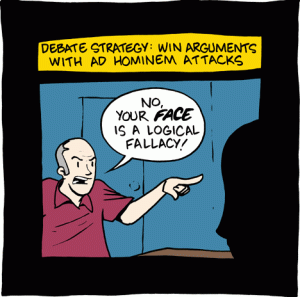
What seems to be lost on most Mormons is that even if you successfully discredit  the messenger it still doesn’t discredit either their message or the evidence presented in support of that message.  Ultimately ad-hominem arguments in any form are logically fallacious because they relate to the opponent’s person and/or character – neither of which have  anything to do with the logical merit of the opponent’s argument.[14] That is, even if 100% of the claims about your debating opponent’s person and/or character are true, in the end logic, reason, and evidence is what produces rational, cogent argument not personality, credentials, or character.

For example, Secretary of State, Henry Kissinger‘s labeling of Daniel Ellsberg, “The most dangerous man in America” as well as President Richard Nixon‘s labeling him a traitor didn’t make the Pentagon Papers any less true. In fact, they still would have been just as true if the Nixon Administration had successfully produced evidence that Ellsberg was mentally unstable – or even completely insane.  In the end such ad-hominem attacks said more about Mr. Nixon and his staff than they did about Mr. Ellsberg didn’t they?

In a similar vein, to assert that someone is a Narcissistic Sycophant and launching into a campaign of character assassination while utterly ignoring their evidence and arguments says far more about the ad-hominemer than the ad-hominee doesn’t it?
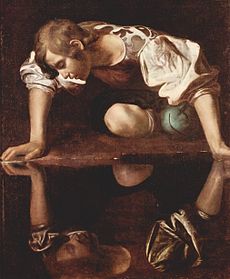
Please don’t misunderstand me – I would be the last to deny some narcissistic tendencies, I’m human and some degree of narcissism is normal and healthy. However, I would hope that mine is in the healthy range and not a clinical “disorder” such as Narcissism Personality Disorder (aka “NPD”).[15] But better safe than sorry so I “reality checked” with my accountability partners, (which includes a credentialed Mental Health Professional), and was assured that if narcissism were electricity I might power a light bulb (in the healthy range) but I wouldn’t power a marque (definitely not in the healthy range).

Further, and you can trust me on this one folks, if you want to have your ego kicked around and run over like a can in the street just get into Mormon Studies – it’s guaranteed to keep you humble!  Most of the Mormon Studies Scholars I know are humble, down-to-earth, folks not pathologists with an inner NPD fire underscoring their work.

As for the equally telling assertion that I engage in sycophancy[16] in support of my alleged pathological narcissism.  In response, I would simply point to my body of work: Tell me, does a sycophant compile a body of work that agitates, provokes, and challenges the status quo? Rather, my mentors have consistently encouraged me to use more tact as well as a kinder, gentler approach with those I’m trying to reach.  I am painfully aware that my default style is to shoot first and ask questions later. Therefore, I’m doing my best to listen more, talk less, and when I do talk be kinder and gentler in my demeanor and choice of words. Perhaps it’s this conscious – probably clumsy – effort to be a better man that she mistakenly perceived as sycophancy.

And if more evidence is required for my defense, when I reality checked this with my wife she howled with laughter – nearly fell out of bed in fact – because she’s seen me “in action” both online and in person (it came  at the end of a hard day  for her so she’d like to thank my accuser for the good laugh by the way – it was sorely needed)

Narcissistic Sycophant? Sorry, but my case apparently the answer is, “No.”

And adding to the growing list of comedic ironies is that very behavior she’s accusing me of is the diagnosis that Latter Day Saint forensic health professionals (Robert Anderson, C. Jess Groesbeck, and William Morain, M.D.) and historians (Fawn Brodie topping the long list) have stamped on Joseph Smith, Jr.’s file.[17] Further, there’s a difference between being civil, kind and respectful, as I believe I was on the Mormon Stories discussion board – and manipulating people through, as the ad-hominemer put it so well, “fawning comments to garner trust … false modesty and flattery” which the historical record demonstrates Joseph Smith did so adroitly throughout his life.

So I would suspect that the dynamic that’s really in play here is psychological projection.[18] Indeed, she has the right diagnosis but the wrong patient.

… TO PRACTICAL APPLICATION
In the end this story really makes me wonder just what is going with Mormon Stories. As previously stated, I’ve always had the utmost respect for John Dehlin’s work. I have always felt that he’s reasonable and has a sense of justice and equity.

However, by first banning me from the group and then leaving a litany of derogatory, inflammatory personal attacks on me, my motives, and my character (after I’d specifically asked for their removal no less) was the cyber-equivalent of handcuffing me and then walking away while I was beat up. This isn’t just “bad form” it’s unjust and unfair.

This is even more telling when you consider that Ms. D didn’t post in the thread before Mr. Dehlin banned me from the Mormon Stories Facebook group – her sole purpose in posting, therefore, was clearly to character assassinate me thereby, in her mind, discrediting my work simply because she disagreed with it.  This is hardly a mature, rational approach to public disagreement but sadly these days it’s common.

Further, I find Mr. Dehlin’s behavior particularly puzzling given what transpired earlier this year in June:
“In 1998, FARMS was brought into BYU under the umbrella of the Maxwell Institute, and the Mormon Studies Review came with it. Review writers responded to critics’ allegations by dissecting their arguments — and motives — sometimes writing scathing and often personal attacks on those who challenged LDS origins. It was, they believed, the essence of apologetics.
The tipping point against that approach may have been a 100-page article about John Dehlin, a church member in Logan who launched Mormon Stories, which welcomes those who question aspects of LDS history, practice and theology. Dehlin’s group has published articles about reasons Mormons leave the fold and research on gay members, among other topics.

After hearing about the piece, Dehlin called an LDS general authority who was a personal friend. Eventually, Maxwell Institute Director Gerald Bradford pulled the article from the journal, leaving a giant hole and putting it behind in its publishing schedule.

‘I have had enough conversations with general authorities to know,” Dehlin said this week, “that they don’t view ad hominem attacks as a constructive way to do apologetics.'”[19]

So is it reasonable to now conclude that while Mr. Dehlin feels that ad-hominem attacks aren’t appropriate or constructive when he’s the target of such attacks, that’s not the case for others?

Cases in point:  In June Daniel C. Peterson was terminated from his position at Maxwell amidst a chorus of ad-hominems from the Mormon Stories community.  Then in November I was terminated from the Mormon Stories Facebook group as ad-hominems flowed. In both cases some hand wringing and regret was expressed by Mr. Dehlin but the end result was the same – as they say, “Actions speak louder than words.”

Further, a consensus is building that the tone, nature, and content of Mormon Stories after the Daniel C. Peterson firing became noticeably less critical and more and more an advocate for the LdS Church. More and more critical voices it seems are being pruned from all things Mormon Stories and being replaced with those who skew toward a conciliatory, occasionally even apologetic stance. Nothing has been said but this trend has been noted by many.  Simply put, Mormon Stories “ain’t what it used to be” and even seems to drifting further and further away from it’s mission statement.

For me, this is disappointing. Like so many others I have trusted, liked, and respected the Mormon Stories founder, and I have supported Mormon Stories to the best of my ability (including financially I might add), and defended both against critics from all sides. Now I find that I must reconsider that stance as I have discovered the hard way that perhaps my trust and support was misguided.

For myself and others who watched this story unfold the final take away seems to be: “Well now we know what we’re really dealing with”

Further, and in a similar vein, the final lesson learned here seems to be just how incredibly elitist and exclusive Mormon Culture can be. Let’s consider a few more of the statements that were made in the thread:

“Fred W. Anston (sic) is NOT , and never has been a Mormon-LDS, LdS, or anything like that. You might want to keeep (sic) that in mind when considering his comments, his motives, his empathy and friendship.”

Depersonalizing that and taking it at face value, I take that to mean that someone who’s never been a Latter-day Saint can’t possibly be knowledgeable about and/or trusted to have a legitimate perspective about Mormon Culture. The contemporary LdS mindset still seems to be, as the Ostlings said so well in Mormon America, “the wilderness is yet untamed, the federal “polyg” police are on the prowl, and the Illinois lynch mob is oiling muskets and preparing to raid Carthage Jail.”  The idea that outsiders could be watching, hoping, praying, and lobbying for positive reform in the LdS Church seems to be lost on some Mormons.

Further, I’ve seen similar but even more vitriolic language used by true believing Mormons to describe both former and active members that publicly express their criticism of the institution – so it seems to be that having a reasonable understanding of the LdS Church and it’s resulting culture isn’t the real issue here.[20] Rather, I think, that what’s being demonstrated here is Anson’s long held view of how many Mormons practically define “Anti-Mormon,” which is: “I’m upset because I don’t like what you’re saying so you MUST be an Anti-Mormon!”[21]

The next assertion is even more telling: “He does NOT know what it is like to be LDS.” Though Mormons don’t like hearing it the former members of other Mind Control Cults who educate themselves on the LdS Church typically react with an, “I can’t believe it – the Mormon Church is just like only with different words, leaders, and sacred books!”[22] In fact, every cultist is utterly and completely convinced that there has never – in the entire history of the world – been a group like theirs, never will be, and only insiders can truly understand and appreciate that fact. However, this type of exclusivist, insular, myopic thinking, we’re told by experts is one of the biggest indicators that a group is cult.

And this was certainly true in my case. I was a member of a Mind Control Cult from 1976-1989[23] and to this day it stuns me how much like the LdS Church we were. And the more Mormon History I read, the more similarities I see in the developmental paths of our group and the LdS Church – it is simply amazing. And yes, I thought that both my group and my experience in that group was utterly and completely unique in world history. So in the end, no, I can’t say that I know EXACTLY what it’s like to be a Latter-day Saint, but yes, I can certainly empathize and relate based on my experience in a group that was so similar that at times it seems like I was really in the LdS Church by another name.

And I’m reminded of how when I was exiting my group in I frequently used the defense mechanism know as “Ugly Sister Syndrome” in which I critiqued, criticized, condemned, even mocked my “ugly sister” but if you – someone who had never been a member – did I would do a “18o” come to her defense, and attack you instead.  Perhaps that was one of the dynamics in play here – after all some of the critical commentary by current and former Latter-day Saints in the closed Mormon Stories Facebook group that I saw while I was still a member was absolutely brutal – far, far, far more extreme than any rhetoric that I’ve ever used.

Perhaps this explains the commonly observed phenomenon of Jack, Ex, New Order, and Atheist LdS Church members who will passionately and bluntly criticize LdS leaders, the organization, policies, culture – even their own families – endlessly but turn around and defend them with the same level of passion if an “outsider” does.

Further, and in support of my case, I would ask those in Mormon Culture to consider what one Ex-Mormon observed: “Mr. IT [my alias on PostMormon.org] did something even more remarkable. He is a nevermo with Mo relatives. He went directly from unaffiliated to apostate without experiencing all the pain and surreal experience of being a member.”[24] And since I’m nothing special I would suggest that what’s true for me may be true of other “NeverMo’s” too.

That’s why I find the objection that someone who has never been a member of the Mormon Church couldn’t possibly have a “Mormon Story” closed minded and elitist to the extreme. The final comment in the thread (as of the time of writing that is) said it so well that I will simply echo and endorse it as, in a nutshell, it describes my Mormon Story:

Mr. P
Ms. H, Nevermos have Mormon Stories too. They may have family or close friends that are Mormon and it can affect their lives deeply. Others may have investigated with a close encounter to baptism.

Yes friends it’s true, NeverMo’s have their own Mormon Stories and if you doubt me just start at the top of this article and read to the bottom. And, yep, in the end and yessiree, I reckon ol’ Luther really did do it thisa way!
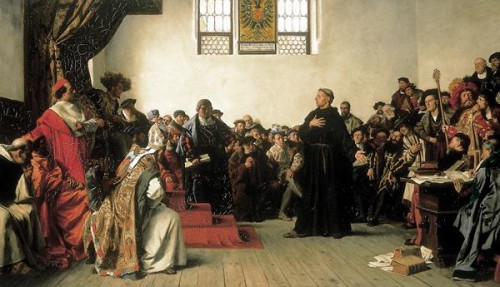
Martin Luther at The Diet of Worms (circa 1521)

NOTES
[1] Lyrics from the chorus of “The Makin’s of a Song” by Jennings, Seals, Barnes, Nelson as recorded on the album “Clean Shirt” by Waylon Jennings & Willy Nelson.

[2] Reformation Day is October 31st of each year. See http://en.wikipedia.org/wiki/Reformation_Day

[3] The Church of Jesus Christ of Latter Day Saints (aka, “LDS Church”) is the name of the Strangite Church (see http://www.strangite.org ). The Church of Jesus Christ of Latter-day Saints (aka “LdS Church”) is the official name of the Brighamite church (see http://en.wikipedia.org/wiki/The_Church_of_Jesus_Christ_of_Latter-day_Saints ) that was being addressed in the article. To not honor this distinction would have been a incongruent contraction with #93 on the list which says:

“93) It fails to recognize the over sixty (60) active Latter Day Saint movement denominations (aka “splinter groups”) while hypocritically condemning the denominationalism of Christianity as a proof of apostasy and lack of divine legitimacy. This hypocrisy is even more pronounced when one considers that over the 180+ year history of the LDS movement there have been over 200 Latter Day Saint denominations in total with new ones forming at a rate will be eventually far exceed and out pace the total number of Christian denominations.”

[4] “Eisegesis (from Greek εἰς “into” as opposed to exegesis from ἐξηγεῖσθαι “to lead out”) is the process of interpreting a text or portion of text in such a way that it introduces one’s own presuppositions, agendas, and/or biases into and onto the text. The act is often used to “prove” a pre-held point of concern to the reader and to provide him or her with confirmation bias in accordance with his or her pre-held agenda.”
http://en.wikipedia.org/wiki/Eisegesis (retrieved 2012-11-05)

[5] Should anyone object to the disclosing of private messages in response to public ad-hominems I would simply point to John Dehlin’s disclosure of private messages in response to the threat of public ad-hominems that were to be published in a The Maxwell Institute publication:

Grindael, “Of Mice And Egos”, Mormon Musings, July 20, 2012
http://mormonitemusings.com/tag/john-dehlin/ (retrieved 2012-11-05)

MormonStories, “Greg Smith, Dan Peterson, John Dehlin, & Lou”, Mormon Dialogue, thread started May 10, 2012; private emails are disclosed by John Dehlin and others throughout the entire 29 page discussion thread.
http://www.mormondialogue.org/topic/57768-greg-smith-dan-peterson-john-dehlin-lou/page__st__40 (retrieved 2012-11-05)

[6] Mormon Stories Podcast About page: http://mormonstories.org/about (retreived 2012-11-03)

[7] John Dehlin, “285-287: D. Michael Quinn – 21st Century Mormon Enigma”; Mormon Stories Podcast, September 17, 2011
http://mormonstories.org/register-now-an-evening-with-d-michael-quinn-august-12th-2011 (retreived 2012-11-03)

[8] She is, of course, referring to the post that John Dehlin deleted at my request. Since I wasn’t a Administrator of the group I couldn’t have deleted her post. I find this projection of a  power onto me that I have never possessed – and never will possess – to be telling.

[9] By the way, I addressed this argument in “Falsely Accused: My Life As An ‘Anti’”, Mormon Expression Blogs, July 11, 2011; http://mormonexpression.com/blogs/2011/07/11/falsely-accused-my-life-as-an-anti (retrieved 2012-11-04)

[10] Here’s an example of Ms. D’s continuing character assassination campaign that was posted on November 6th in another discussion thread in the closed Mormon Stories Facebook page:
“Yeah, here in Oklahoma people like to tell us what we believe. It’s the southern Baptist/Evangelical thing–their preacher preaches against Mormons in Church and tell them what Mormons believe, what the Book of Mormon is about, etc. They even have some people who specialize in “Mormonism” who do it like full-tme (sic) (like that Fred Anson guy–I never understood what he gets out of “studying” Mormonism all the time and trying to convince people to get out of the church. I don’t miss him one bit). Anyway, my kids grew up with this all the time in school. But yeah, you can sometimes see where they actually have some stuff “right”, but usually a bit distorted or out of context, so it sounds even wierder. (sic)”

I found this particularly amusing since: a) I’ve never been Baptist – and if I have a choice in the matter I never will be; b) Like most in Mormon Studies, I don’t do it full time – it’s solely an avocation; c) My objective isn’t, and never has been, “to convince people to get out of the [LdS] church.”  I have made very clear in my body of work – more on this later.

And, to this author, it’s amusing that Ms. D starts her argument complaining about those who “shoot first and ask questions later” while she is in fact engaging in the very behavior that she’s so incensed about. I have advised many a ranting Mormon flamer to “ask not tell” but I’ve noticed common sense and practical wisdom tend to fall on deaf ears once someone has been labeled an “Anti” by a Mormon – after all, sociologists tell us that facts, respect, and civility are secondary once the other party is psychologically labeled “enemy”.

[11] Richard and Joan Ostling, “Mormon America, Revised Edition”, position 310.7/1158 Kindle edition

[12] Op Cit, Fred W. Anson, “Falsely Accused: My Life As An ‘Anti’”

[13] “What’s Wrong With The Mormon Church?” (2012 edition)
https://beggarsbread.org/2012/10/31/whats-wrong-with-the-mormon-church-2012-edition
(retrieved 2012-11-07)

[14] “Abusive ad hominem (also called personal abuse or personal attacks) usually involves insulting or belittling one’s opponents in order to attack their claims or invalidate their arguments, but can also involve pointing out true character flaws or actions that are irrelevant to the opponent’s argument. This is logically fallacious because it relates to the opponent’s personal character, which has nothing to do with the logical merit of the opponent’s argument, whereas mere verbal abuse in the absence of an argument is not ad hominem nor any kind of logical fallacy.”
http://en.wikipedia.org/wiki/Ad_hominem (retrieved 2012-11-16)

[15] For a primer on Narcissist Personality Disorder please see the following U.S. National Library of Medicine  article: http://www.ncbi.nlm.nih.gov/pubmedhealth/PMH0001930  (retrieved 2012-11-07)

[16]  The definition of “sycophant” or “sycophancy” with links to other resources regarding sycophantic behavior can be found here: http://dictionary.reference.com/browse/sycophant  (retrieved 2012-11-07)

In this context Ms. D is referring to sycophancy as a psychological supply system for narcissism.  The relationship between the behaviors is discussed here:  http://en.wikipedia.org/wiki/Narcissistic_supply (retrieved 2012-11-23)

[17] Those interested in a short primer on the case for Joseph Smith’s NPD should consider Appendix A  below.

[18] Psychological projection or projection bias (including Freudian Projection) is the unconscious act of denial of a person’s own attributes, thoughts, and emotions, which are then ascribed to the outside world, such as to the weather, a tool, or to other people. Thus, it involves imagining or projecting that others have those feelings.

Projection is considered one of the most profound and subtle of human psychological processes, and extremely difficult to work with, because by its nature it is hidden. It is the fundamental mechanism by which we keep ourselves uninformed about ourselves. Humor has great value in any attempt to work with projection, because humor presents a forgiving posture and thereby removes the threatening nature of any inquiry into the truth.”
http://en.wikipedia.org/wiki/Psychological_projection  (retrieved 2012-11-07)

[19] Peggy Fletcher-Stack, “Shake-up hits BYU’s Mormon studies institute”, The Salt Lake City Tribune, June 26, 2012; http://www.sltrib.com/sltrib/utes/54358137-78/mormon-institute-peterson-studies.html.csp (retrieved 2012-11-04)

[20] Op Cit, Fred W. Anson, “Falsely Accused: My Life As An ‘Anti’”; the list of “Anti-Mormons” so described even includes former LdS President, Gordon B. Hinckley – believe it or not!

[21] Ibid. Please note that I expanded on this further in my article, “Can A Mind Control Cult Reform Itself?” ( http://mormonexpression.com/blogs/2011/10/20/can-a-mind-control-cult-reform-itself )

[22] Please consider the following:

Anonymous, “Scientology-Lite”; Mormon Expression, February 19, 2011
http://mormonexpression.com/blogs/2011/02/19/scientology-lite (retrieved 2012-11-05)

John Larsen and “Joe”; “Episode 80: Leaving the Jehovah’s Witnesses”, September 14, 2010
http://mormonexpression.com/2010/09/14/80-leaving-jehovah-witnesses (retrieved 2012-11-05)

“Teddy”, “My Former Cult (World Wide Church of God)”, Sam Harris Forum, May 25, 2007
http://www.samharris.org/forum/viewthread/6839 (retrieved 2012-11-05)

[23] I’ve written two articles that reference my experiences in the Mind Control Cult known as “The Shepherding Movement” thus far:

Fred W. Anson, “My Life as a Mind Control Cultist Part 1”, Mormon Expression, August 22, 2011
http://mormonexpression.com/blogs/2011/08/22/my-life-as-a-mind-control-cultist-part-1 (retrieved 2012-11-05)

Fred W. Anson, “Can A Mind Control Cult Reform Itself?”, October 20, 2011
http://mormonexpression.com/blogs/2011/10/20/can-a-mind-control-cult-reform-itself (retrieved 2012-11-05)

[24] “HikerR” Posting on PostMormon.org 2007-11-26; link now dead – this quote was captured at the time. And. yes, I am rather proud of it.

APPENDIX A: THE NARCISSISM AND SYCOPHANCY OF JOSEPH SMITH, JR.
C. Jess Groesbeck, M.D.

The subject of Joseph Smith Narcissistic Sycophancy is one that this author feels is best covered in Robert Anderson’s book, “Inside The Mind of Joseph Smith” and William D. Morain’s book, “The Sword of Laban“. While both of these books, in my opinion are watershed, Jungian Psychiatrist, C. Jess Groesbeck also compiled an impressive supporting body of work on the subject via his Sunstone lectures and articles prior to his death in 2009. Let the reader note that all of these men are Latter Day Saints – two (Anderson and Groesbeck) are Latter-day Saints and the third (Morain) is a member of the Community of Christ. What now follows is a brief, far from comprehensive, overview and primer on the subject that I hope will spur the reader to consider the aforementioned esteemed works in it’s wake.
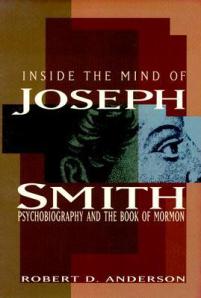
“[‘Inside the Mind of Joseph Smith’ author Robert] Anderson theorizes that Joseph Smith suffered from the narcissistic personality disorder. He points out that there is a danger in attempting to explain human behavior through psychodynamic theory. Accepting such theory as fact can cause damage. A few decades ago psychiatrists speculated that some serious mental illnesses were caused by the influence of the mother or of the environment. Now we know that chemical treatments such as lithium can effectively treat some of these illnesses. It is possible that in the future narcissistic personalities may respond favorably to specific medications. The fact is that the cause and source of the narcissistic personality are not known. However, the psychodynamic setting provides an unusual laboratory for studying this emotional problem, and some individuals do seem to respond to prolonged intensive psychotherapy.

In his analysis of Joseph Smith, Anderson draws upon the body of literature, especially the Book of Mormon, produced by observation, experiment, theory, and psychiatric experience in his attempt to understand the founder of Mormonism. He says that splitting, a fundamental of personality weakness, is a major psychological defense demonstrated by the prophet. Its most obvious manifestations are:

1) the division of the world into polar opposites and
2) the lack of integration of the various parts of the patient’s psyche.

The individual may oscillate between two opposite positions. This behavior can be seen in the polarized opposites of the Nephite and Lamanite people depicted in the Book of Mormon, as well as in Smith’s ability to present one face in public (such as denying polygamy) while simultaneously converting associates and new plural wives to the principle in private.
The individual may also exhibit psychological reversal of attitudes toward particular persons, by switching instantly from compliments to vilification, or of oscillation in moral positions, yet not be troubled in the contradiction. Examples are the instantaneous conversions of Alma, Jr., Zeezrom and the whole Lamanite population in 30 BCE in the Book of Mormon. Another example was Smith’s strong opposition to Masonry as a young man, followed by his later becoming a Mason himself and drawing on Masonic ritual for temple ceremonies.”
(Robert Layton, “Discussion Group Report: Inside the Mind of Joseph Smith”; retrieved 2012-11-03)

And Smith’s tendencies in this regard are well documented in the historical record. For example, in 1843 Charlotte Haven wrote some letters from Nauvoo which contain some candid observations about Joseph Smith:

“Joseph Smith … is evidently a great egotist and boaster, for he frequently remarked that at every place he stopped going to and from Springfield people crowded around him, and expressed surprise that he was so ‘handsome and good looking'”
(Overland Monthly, December 1890, p.621).

“He talked incessantly about himself, what he had done and could do more than other mortals, and remarked that he was “a giant, physically and mentally.” In fact, he seemed to forget that he was a man…. They say he is very kindhearted, and always ready to give shelter and help to the needy. We may hope so, for a kind heart in this place can always be active.”
(p.623).
I rushed out with the umbrella to shield Mrs. Smith, the others followed…. Mrs. Smith was pleasant and social, more so than we had ever seen her before…. while her husband is the greatest egotist I ever met.”
(p.631)

And for evidence of Joseph Smith’s sycophantic tendencies one need only refer to passages like this in Doctrine & Covenants:

“Verily, verily, I say unto thee, blessed art thou [Oliver Cowdery] for what thou hast done; for thou hast inquired of me, and behold, as often as thou hast inquired thou hast received instruction of my Spirit. If it had not been so, thou wouldst not have come to the place where thou art at this time.

Behold, thou knowest that thou hast inquired of me and I did enlighten thy mind; and now I tell thee these things that thou mayest know that thou hast been benlightened by the Spirit of truth;

Yea, I tell thee, that thou mayest know that there is none else save God that knowest thy thoughts and the intents of thy heart.

I tell thee these things as a witness unto thee—that the words or the work which thou hast been writing are true.

Therefore be diligent; astand by my servant Joseph, faithfully, in whatsoever difficult circumstances he may be for the word’s sake.”
(Doctrine & Covenants 6:14-18 ; http://www.lds.org/scriptures/dc-testament/dc/6.14-18?lang=eng#13 )

Now if this revelation wasn’t divinely inspired then it’s about as fine an example of narcissistic sycophancy as one could hope for. Further, this is just one of many such examples of Smith’s use of sycophantic language (albeit using the voice of God) in Doctrine & Covenants.  If this thesis is correct then the following resources can be used to read through other examples of how Smith used sycophancy to manipulate his followers:

Doctrine and Covenants and Church History Seminary Student Study Guide
“People and Terms in the Doctrine and Covenant”
https://www.ldsces.org/manuals/doctrine-and-covenants-and-church-history-seminary-student-study-guide/dc-ssg-8-people.asp

Susan Easton Black, “Who’s Who in the Doctrine and Covenants” [Kindle Edition]
http://www.amazon.com/Whos-Who-Doctrine-Covenants-ebook/dp/B004BDOZEY

Again, this appendix is intended to be a short primer and overview.  If the reader is interested in further study of this complex and nuanced issue, the books, articles, and lectures mentioned at the start of this short primer are recommended.
by Fred W. Anson
Introduction
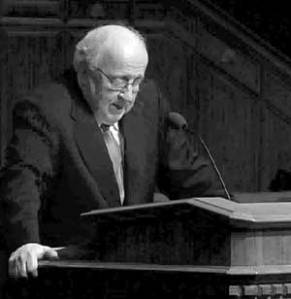
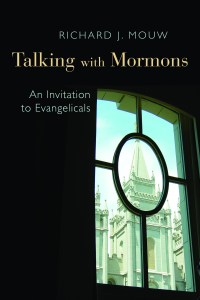
Eight years ago today on November 14, 2004 for the first time in 105 years, non-Latter-day Saint “gentiles” stood at the pulpit of the Mormon Tabernacle in Salt Lake City, Utah. The focus of the event was to be an address by Christian Apologist and Philosopher Ravi Zacharias entitled, “The Exclusivity and Sufficiency of Jesus Christ”. However, Mr. Zacharias’ superb address was eclipsed by a short, slightly less than seven-minute address by Fuller Theological Seminary president Richard J. Mouw.

Richard J. Mouw Apologizing in the MormonTabernacle

Dr. Mouw, in what the Deseret News referred to as “stunningly candid” comments, apologized to Mormons on behalf of evangelicals for what he sees as less than Christian treatment of Latter-day Saints and the LdS Church throughout Mormon History. His language, in this writer’s opinion, was overly broad, general, universal, and lacking nuance. The royal “we” was used extensively and qualifying terms like “some”, “a few”, or their equivalent were conspicuous in their absence.

Essentially all evangelicals (with the exception of Dr. Mouw and his associates, who were praised directly or indirectly) were thrown under the bus creating the impression among Mormons that their worst fears about Evangelicals that challenge and confront Mormonism are true after all: Specifically, that they are bigoted liars who are driven by deeply seeded animosity toward Mormons. This, in most cases, is not only unfair but untrue.

In reality, regardless his thoughts and intentions, Dr. Mouw has made relations between Mormons and Evangelicals worse not better. In this author’s opinion he has done both sides a disservice and created a volatile and confused environment that didn’t exist prior to his apology. Dr. Mouw’s poor choice of words and bad judgment created this unfortunate situation and I, for one, think it high time that someone did something about it.

Now since Dr. Mouw seems to think it perfectly acceptable and appropriate to apologize for others without their permission, consent, or foreknowledge, I’ll simply borrow a page from his play book and, using the template that he created and precedent that he established, set the record straight:

The Apology
It is difficult for me to find adequate words to express how thrilled I am to be in Mormon Studies in this ‘Mormon Moment’! Here we are, evangelical Protestants and members of the Church of Jesus Christ of Latter-day Saints, gathered together on the Internet and elsewhere dialoguing, discussing, debating – it’s an exciting time to be alive!

So I am not being melodramatic when I say that this is surely an historic period. To be sure, there have long been friendships between evangelicals and Latter-day Saints but they generally haven’t appeared on the public radar screen. Often the public relations between our two communities have been, to put it mildly, decidedly strained. This is hardly surprising given the mutually contradictory belief systems and theological world views that we hold to.

From the very beginning, when Joseph Smith organized his church in 1830, my evangelical forebearers very correctly and rightly confronted he and his followers with the incongruity between their beliefs and practices relative to the absolute standard of the Bible. This is a practice that continues from most quarters of mainstream Christianity even into this present day. And I think it is fair to say that most Mormons haven’t always “appreciated” these efforts no matter how well intended. As a result, friendship with each other has not always come easily for our two communities – but, never-the-less and thankfully, it has come.
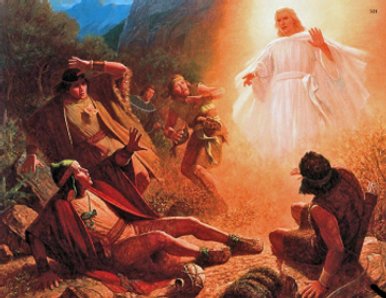
In recent times things have begun to change both for the better and for the worse. The good news is that evangelicals and Mormons have continued to work together on important matters of public morality and policy. However, the bad news that some evangelicals have mistakenly believed that such interaction requires compromise with and pandering to Mormonism. For example in Utah, the Standing Together ministry seems to have chosen a path of appeasement and accommodation with the LdS Church. Further it has embraced Mormons who seem to make manipulation and deception their stock-in-trade. That has only not been inappropriate it has created needless confusion on both sides of the divide and with the public.

Thankfully like the town squares of old we can all gather via the gracious hospitality of the internet and hold these errant, counter-productive groups and people accountable for their folly. When appropriate there’s been a loud evangelical outcry on those occasions when groups like Standing Together accommodate LdS Church error.  And I’ve noticed that a ground swell of Mormon voices is slowly building regarding how the LdS Church (as well as some of it’s members) present itself, its history and its teachings to both it’s membership and the public. This is encouraging!

On a personal level, over the past half-dozen years I have been a member of a group of evangelical scholars who have been engaged in lengthy public discussions about spiritual and theological matters with Latter-day Saints. We have not been afraid to argue strenuously with each other, but our arguments have been conducted in a sincere desire genuinely to understand each other-and in the process some deep bonds of friendship have been formed in the midst our disagreements.

I know that I have learned much in this continuing dialogue, and I am a far better person today as a result of it. And I am now convinced that despite the fact that some evangelicals have often seriously misrepresented the beliefs and practices of the Mormon community the majority have not. And, personally, whenever I’ve encountered that small minority I have been as direct and to the point as I have been with those Mormons who misrepresent the beliefs and practices of the evangelical community.

On that note, and to get specific regarding observed behavior on our side of the divide  I’ve watched in stunned disbelief as the President of Fuller Theological Seminary, Richard J. Mouw has seriously, publicly, and repeatedly misrepresented the beliefs and practices of both the evangelical and Mormon communities. Indeed, let me state it bluntly to the evangelicals and Mormons reading this: Richard J. Mouw has sinned against you. The God of the Scriptures makes it clear that it is a terrible thing to bear false witness against our neighbors, and he has been guilty of that sort of transgression in things he has said about all of us – evangelical and Mormon alike.

The body of evidence indicates that He has accepted the personal opinions, spin doctored and “milk before meat” version about what the Lds Church believes from honesty challenged Mormons without making a sincere effort to fact check what he’s been told against official, correlated LdS Church sources.

Further, while he has recognized that we evangelicals have made much of the need to provide Mormons with a strong defense of traditional Christian convictions, regularly quoting the Apostle Peter’s mandate that we present them a reasoned account of the hope that lies with in us, Dr. Mouw hasn’t been careful to also recognize how most evangelicals throughout the ages have always endeavored to follow the Apostolic counsel that immediately follows that mandate, when Peter tells us that we must always make our case with “gentleness and reverence” toward those with whom we are speaking.[1]

Further, and most distressingly, he has demonized those evangelicals who have confronted the Mormon teachings that the Bible condemns as false. He has even woven bizarre conspiracy theories that suggest that those in the Christian Counter Cult community are “really” motivated by and trafficking in covert bigotry, exaggeration and lies. This also is simply not true, therefore and in my opinion, Mr. Mouw needs to repent of bearing false witness against his brothers and sisters in Christ.

In fact, most in the Counter Cult community are committed to speaking the truth in love. By doing so over the years they have formed some wonderful friendships with both Mormons and ExMormons. These friendships have helped us to see the ways in which Mr. Mouw has misinterpreted and misrepresented the true perception and impact of these evangelicals in Mormon Culture. To be sure, as a result of those conversations we also remained convinced that there are very real issues of disagreement between us-and that some of these issues are matters of eternal significance. But we can continue to discuss these topics as friends and fellow seekers of the truth – and the Internet has been a Godsend in this regard. God be praised!

Next month will mark the 207th anniversary of the birth of Joseph Smith. We know and understand that Mormon culture typically uses the month as an occasion to pay special attention to Joseph’s life and teachings. However, please hear my heart when I tell you that we evangelicals are praying and long for the day when the month will be far, far, far less about Joseph Smith for our Mormon friends, but all about the One whose incarnation Christians celebrate each year instead. This is the One about whose birth we sing and whom we exalt above all. I should add, that there is nothing more that we long for more than our Mormon friends to join us with swelled hearts and spiritual eyes solely fixed on that One when we sing -“the hopes and fears of all the years are met in thee tonight.”

What a wonderful thing it is that we can meet together to talk about the Lord Jesus and about who he is and what he has done on behalf of all who have accepted His free gift of salvation through faith by grace plus nothing and can thus now know with complete certainty that they will spend eternity securely and completely in the presence of God. There is much here to talk about for we pray for the day when our Latter-day friends and family members will receive this free gift without believing that it must be paid for with good works.

I personally take great encouragement for hope of a Great Restoration in the LdS Church – for in the words of LdS Scholar Thomas G. Alexander, “…before about 1835 the LDS doctrines on God and man were quite close to those of contemporary Protestant denominations.”[2] And I’m reminded of the words that Joseph Smith uttered on the occasion of the founding of the Church of Jesus Christ of Latter-day Saints in April of 1830 when he said: “…we know,that all men must repent and believe on the name of Jesus Christ, and worship the Father in his name, and endure in faith on his name to the end, or they cannot be saved in the kingdom of God.”[3] He then added: “And we know that justification through the grace of our Lord and Savior Jesus Christ is just and true, and we know also that sanctification through the grace of our Lord and Savior Jesus Christ is just and true, to all those who love and serve God with all their mights, minds, and strength.”[4] Thus, it is my prayer that Mormonism will be restored to true, historic Christian, Biblical orthodoxy within my lifetime.

Thus I greet you in that spirit-as one who wants more than anything else to love and serve God with all my might, mind and strength, in the power made available by the amazing grace that sent the Lord Jesus first to Bethlehem’s manger and then ultimately to the Cross of Calvary, where he shed his blood and sacrificed himself to fully pay the debt of my sin and yours -a debt that we can never, never pay on our own.

This is the spirit in which the Holy Spirit speaks to us all -the spirit of devotion to the One whose name is above every name, the One who alone is mighty to save, and before whom someday every knee will bow and every tongue will confess that he is Lord to the glory of the Father. May our continuing dialog and conversations point us all to that great day.

Thank you and God bless you.

NOTES
[1] 
“… sanctify Christ as Lord in your hearts, always being ready to make a defense to everyone who asks you to give an account for the hope that is in you, yet with gentleness and reverence; and keep a good conscience so that in the thing in which you are slandered, those who revile your good behavior in Christ will be put to shame.”
1 Peter 3:15&16; New American Standard Bible (NASB)
[2] Thomas G. Alexander, “The Reconstruction of Mormon Doctrine: From Joseph Smith to Progressive Theology”; Sunstone Magazine, July-August 1980,  p.24
[3] Joseph Smith, Jr., “Doctrine & Covenants”, Section 20, verse 29; April 1830
[4] Joseph Smith, Jr., “Doctrine & Covenants”, Section 20, verse 30&31: April 1830

Further Reading
– A transcript of Dr. Muow’s original November 14, 2004 Mormon Tabernacle apology can be read here.  
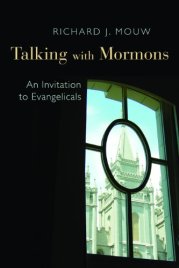
– The Beggar’s Bread review of Richard J. Mouw’s book, “Talking With Mormons” can be read here.
– A critical analysis and editorial on Dr. Muow’s methods and mean cans can be read here.

(all links retrieved 2012-11-12) 

Introduction:
Today is October 31st, “Reformation Day”, 2012.

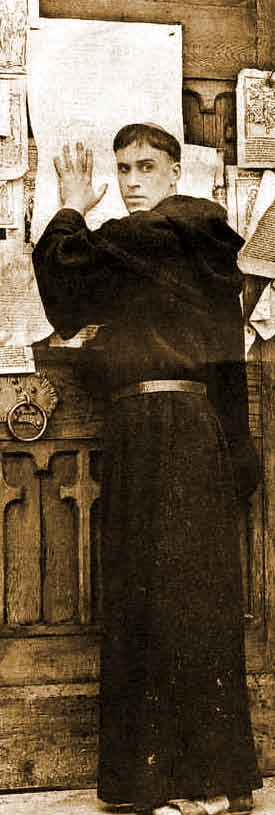
Martin Luther hanging the The Ninety-Five Theses unto the door of The Castle Church in Wittenberg, Germany
(scene taken from the 2003 MGM movie “Luther”)

It was on this day 495 years ago that Martin Luther nailed the “Disputation of Doctor Martin Luther on the Power and Efficacy of Indulgences” (commonly known as “The Ninety-Five Theses”) unto the door of The Castle Church in Wittenberg, Germany. “The Ninety-Five Theses” is widely regarded as the primary catalyst for the Protestant Reformation.

And while readily acknowledging that I’m no Martin Luther, it is with a hopeful spirit for reformation in our lifetime that I offer these Ninety-Five Theses to a modern church that, in my opinion (as well as in the opinion of many others) is badly in need of it.

And while  I offer these theses to the public in general for discussion, debate, and consideration, I offer them even more specifically to the LdS Church and its members in light of  Joseph Smith’s challenge …
“… call upon them [Mormon Critics] to meet you both in public and in private; and inasmuch as ye are faithful their shame shall be made manifest. Wherefore, let them bring forth their strong reasons against …”
(Doctrine & Covenants 71:7)

… in accordance with the exhortation of Mormon Apostle Orson Pratt who said…
“… convince us of our errors of doctrine, if we have any, by reason, by logical arguments, or by the word of God, and we will be ever grateful for the information, and you will ever have the pleasing reflection that you have been instruments in the hands of God of redeeming your fellow beings from the darkness which you may see enveloping their minds.”
(Orson Pratt, “The Seer”, pp. 15-16)

… and finally in agreement with third LdS Church President John Taylor who said:
“I think a full, free talk is frequently of great use; we want nothing secret nor underhanded, and I for one want no association with things that cannot be talked about and will not bear investigation.” 
(John Taylor, Journal of Discourses, Vol. 20, p. 264)

So with no further adieu we present . . .
The Disputation of Ninety-Five Theses on the Power and Efficacy of the Church of Jesus Christ of Latter-day Saints: Ninety-Five Theses for consideration, discussion, and action regarding a modern church badly in need of reform
(aka “What’s Wrong With The Mormon Church?”)

Question:
What’s Wrong With The Church of Jesus Christ of Latter-day Saints?

Answer:
1) It lies to and attempts to deceive its own members and investigators regarding Mormon History and Theology.

2) It focuses on the needs and interests of the institution over the needs and interests of the members.

3) It villainizes critics – even constructive critics – both within and without its ranks.

4) It engages in Mind Control tactics and techniques in indoctrinating and retaining members.

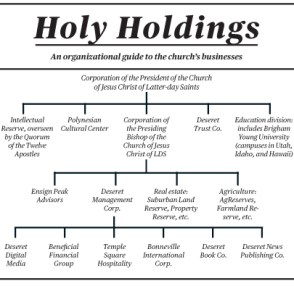
5) It suppresses its financial records eliminating full accountability in terms of how member contributions are used.

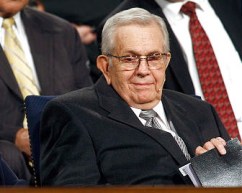
Mormon Apostle Boyd K. Packer

6) It tolerates abuse of ecclesiastical power by LdS Church Leaders.

7) It suppresses loyal dissent from within its ranks via disciplinary action up to and including excommunication.

8) It forces members to choose between the LdS Church and apostate spouses.

9) LdS Church Leaders denounce and shun former members and encourages members to do the same.

9) It keeps members so busy with LdS Church related activities that they don’t have time for personal reflection and self-autonomy. This is especially true of men as the demands of lay leadership tend to deprive them of real, regular, authentic family time.

10) It deceptively claims to be “Christian” when in reality it has taken Christian words, terms and forms and then changed the underlying meaning and content to an extent that they’re no longer congruent with historic, mainstream, Christian orthodoxy.

11) It erroneously asserts that former members didn’t leave the LdS Church for any thoughtful or legitimate reasons but rather that they were thin skinned reactive, malcontents who left the LdS Church because they wanted to sin with impunity, or because of a perceived offense.

12) It drives a wedge between member and non-member family members. Ex-Mormon family members in particular are to be avoided but the LdS Church also encourages members to avoid “Never Mormon” family members who are openly critical of the LdS Church.

13) It encourages arrogance and self-righteousness in members by preaching that they’re more enlightened and morally superior relative to the general population – including other people of faith.

14) It suppresses – and has even destroyed – LdS Church owned documents and artifacts that would expose #1.

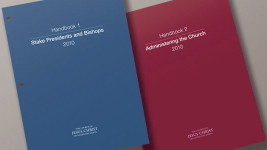
LdS Church Handbook of Instruction (2010 edition)

15) It restricts distribution of the LdS “Church Handbook of Instruction Book 1: Stake Presidents and Bishops” (aka “Handbook 1”) to only the Bishopric level and higher. This eliminates transparent “bottom up” accountability enabling ecclesiastical abuse because lay members can’t confront local leaders and/or report policy violations to higher authorities for rectification.

16) It practices graceless, merciless, condemning, legalistic disciplinary extremes – far beyond Biblical standards – in regard to those who have engaged in sexual activity outside of marriage that, as been reported by many, often leads to a  “no-win” double-bind spiral into hopeless despair.

17) It uses guilt as a means of controlling members.

18) It puts its untrained clergy in a position where they must give counsel on vital life issues that they are not qualified or equipped to competently address. The result, all too often, is ecclesiastical malpractice. `

19) It preaches doctrine that leads to unhealthy, aberrant, dating and courtship behavior.

20) It uses the LdS Temple system (via the Temple Recommend process) as a means of coercing members into compliance with the will of the extant Mormon leaders.

21) It discourages intellectual self-autonomy and self-responsibility and encourages dependency on LdS Church Leaders.

22) It puts undue financial strain on member families via manipulative doctrine and coercive policy that makes tithing mandatory rather than voluntary.

23) It drives a wedge between member and non-member family members via exclusionary and highly restrictive American LdS Church marriage policies – which, paradoxically, are more flexible and inclusionary outside of the United States.

24) It teaches an irrational and subjective epistemological system while simultaneously belittling epistemology based on reason, objectivity, and empiricism.

25) When it claims, “No tithing dollars were used for this, the funds came from for-profit, church-owned entities” it ignores and/or obfuscates the fact that the seed, start-up, or acquisition funds logically and ultimately came from member tithes – a fact which negates the original claim.

26) It uses LdS Priesthood Authority dogma to devalue women thus subordinating them to “second class” status in the LdS Church.

27) It values and praises “total obedience to leaders” as one of its more important core values even though this is the first symptom that a group is a Mind Control Cult.

28) It imposes discredited and unbiblical 19th Century dietary regulations on members.

29) It contrives man created “revelations” and claims that they are of divine origin.

30) It uses employment in LdS Church and member owned institutions and businesses to coerce obedience to its dogma and leaders.

31) It quells and compromises good scholarship within its rank by shunning, dis-fellowshipping and excommunicating members who produce scholarly works discussing Mormon History, Theology, or culture that have scholastic integrity.

32) It rewards inauthentic compliance and punishes authentic self-autonomy.

33) It punishes doubt and questioning – especially when it’s publicly expressed – and rewards blind compliance.

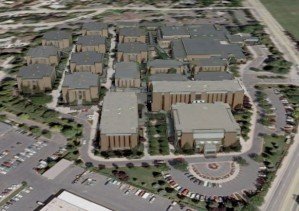
The LdS Missionary Training Center in Provo, Utah

34) LdS Church Missionary training and policies employ Mind Control techniques and tactics.

35) It wavers on whether its ultimate authority for doctrine is the Bible, Mormon scriptures, statements of former Mormon prophets, statements of living Mormon prophets, and individual “revelation” even though these sources are often mutually contradictory.

36) It requires members to remain in a “snapped” psychological state in order to remain believing members.

37) Its leaders and members use ad-hominems, insults, slurs, derogatories, labeling, and character assassination in their dealings with critics and apostates and then deny that they do so – often going so far as to claim that those who call them on this behavior are persecuting them.

38) It “love bombs” investigators and new converts as a means of drawing them in.

39) It allows members to privately believe whatever they want – even if it’s atheistic or contradicts LdS orthodoxy – as long as they publicly “toe the party line” and continue to contribute their time and money to the LdS Church.

40) It damages member psychology via the use of manipulative fear and unachievable standards of “worthiness”.

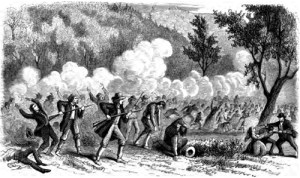
Mountain Meadows Massacre drawing by T.B.H. Stenhouse, 1873

41) It refuses to acknowledge and apologize for the role of church leaders in the massacre of 120 innocent people in 1857 at Mountain Meadows.

42) It makes extraordinary – even outrageous – truth claims that are easily discredited by science, history, and the Bible.

43) It requires members to adhere to moral and intellectual relativism in order to create the delusion that its incongruous and inconsistent belief system works, has integrity, and is both moral and ethical.

44) It excuses, rationalizes, justifies, and white washes the crimes of its founder, famous members, and past leaders.

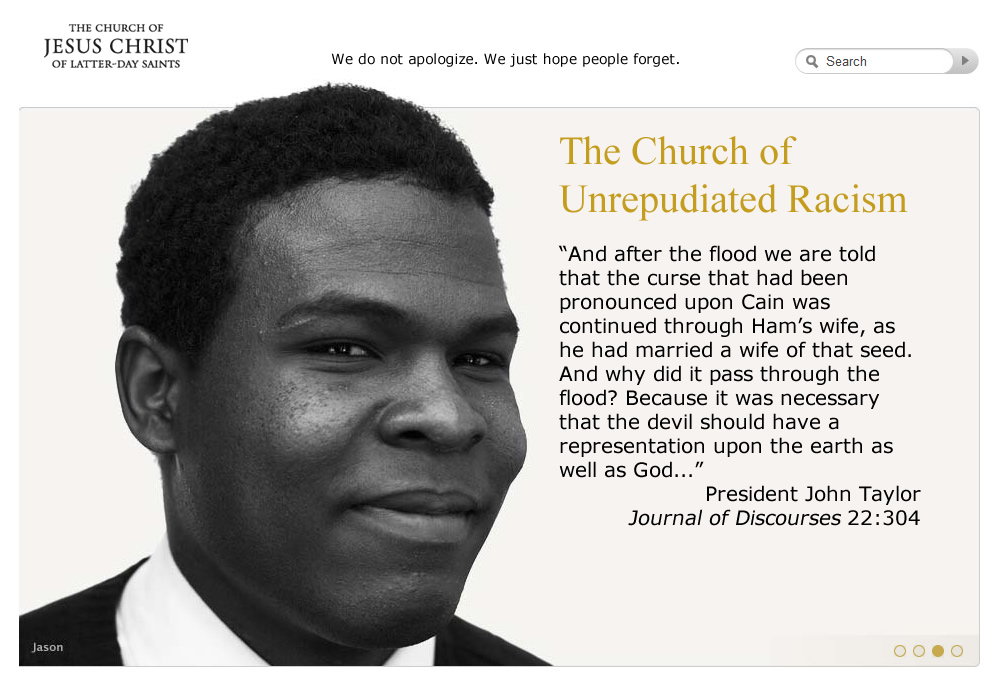
45) It refuses to acknowledge and apologize for the fact that until 1978 as a point of official doctrine and policy the church excluded from the priesthood and from the temple any member who had “Negro” blood.

46) It privately judges and abandons members that have life problems rather than patiently, encouraging, undergirding, supporting, and attempting to restore them to a healthy, productive place. This while publicly declaring that the LdS Church treats all such cases with benevolent kindness.

47) It tends to view any doubt, character flaw, or personal deficiency as “sin” rather than as a normal expression of the human condition and life experience. Thus it has created an implied and unstated expectation that members must always be perfect and/or “all together” or they’re in sin and unworthy of advancement within the organization.

48) It tries to expose, quarantine, isolate, shun – and if necessary expel – those who doubt rather than creating a safe place when they can honestly and openly work through their doubts and questions.

49) It asserts in the strongest language that doctrinal differences, criticisms, or questions about LdS Church policies and/or leaders are sin, for the ‘prophet’ is always right. Those who engage in such behaviors – or refuse to comply with the status quo – are subject to discipline up to and including ex-communication.

50) It has used home teachers and the “Strengthening Church Members Committee” as a means of spying on members.

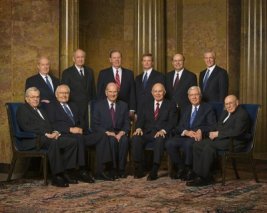
The LdS “Quorum of Twelve Apostles”
The Celestial Polygamists: Dallin H. Oaks, front row, third from right; L. Tom Perry, front row, second from left; Russell M. Nelson, front row, third from left

51) It hypocritically claims that polygamy has no place in the contemporary LdS Church even though Joseph Smith’s revelation on polygamy (Doctrine & Covenants 132) is still canonized scripture and “Celestial Polygamy” (being eternally married to at least one more woman after being widowed or divorced) is practiced. Currently, three widowed Mormon Apostles (Dallin H. Oaks, L. Tom Perry, and Russell M. Nelson) are Celestial Polygamists.

52) It uses arbitrary, capricious, and ever changing criteria for Temple Recommend “worthiness”.

53) It preaches extreme, legalistic, and arbitrary sexual standards regarding masturbation that are not Biblically or Scientifically supportable.

54) It has created a clannish and elitist “authority” system via its unbiblical Temple and Priesthood system that results in unhealthy elitist pride in men and their wives.

55) It claims that the LdS Church is patterned after the early church of Jesus’ apostles, but there are major differences.

56) It encourages arrogant, condescending pride in members at all levels by telling them that they “have the whole and restored truth” that “apostates” only have in part and “gentiles” lack entirely.

57) Via the Correlation Program it tries to turn everyone into a Utah Mormon and every Chapel, Ward, and Stake into a Utah Chapel, Ward, and Stake rather than encouraging – even celebrating – each culture’s unique distinctives.

58) It has so exalted things over people that, in the words of a former LdS Bishop, “The Mormon Church would leave you dead by the side of the road if that’s what it took to protect the institution.”

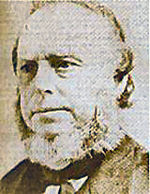
Former LdS First Presidency member, William Law who was excommunicated in 1844 for publicly exposing uncomfortable truths about Joseph Smith

59) It dis-fellowships and excommunicates its true prophets.

60) It mandates that LdS Church History be presented by members to members (even in private) in a manner that’s uplifting and only presents the LdS Church in a favorable light – even if the resulting narrative is no longer factual and/or supported by the body of evidence.

61) It rationalizes and excuses the sin, bad behavior, errors of judgment, and disastrous decisions its prophets. They are buried, ignored, or ‘spun’ as “well-meaning human error with no need for apology or confession”.

62) It rationalizes away the revelations – even those that were fully canonized – of present or past “Living Prophets” that contradict contemporary LdS Church teachings and culture. The no-longer-in-vogue revelations are buried, ignored, or recast as “opinion not divine”. The “He was speaking as a man not a prophet” apologetic is typically used as the rationalization in these cases.

63) It rationalizes the failed prophecies of future events by past “Living Prophets” by burying, ignoring, or spin doctoring them as “just his opinion”, or as requiring more time for fulfillment.

64) It employs circular logic in its core truth claim: “The only true church is The Church of Jesus Christ of Latter-day Saints because The Church of Jesus Christ of Latter-day Saints says it’s the only true church.”

65) It tolerates the chronic practice of eisegesis (injecting words and ideas into the text that the author did not intend, use or mean) by LdS Church Leaders as their standard hermeneutic in interpreting the Biblical, historical, and scientific record.

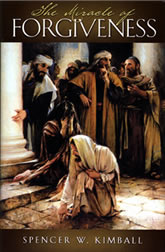
“Also far-reaching is the effect of the loss of chastity. Once given or taken or stolen it can never be regained. Even in a forced contact such as rape or incest… It is better to die in defending one’s virtue than to live having lost it without a struggle.”
– Prophet Spencer W. Kimball, “The Miracle of Forgiveness”, p.196

66) It teaches that a rape victim has “lost her chastity” and that a woman should fight off her attacker or be killed in the attempt. Thus, young Mormon women are taught that their chastity is more valuable than their life. The result is that a Mormon woman who survives a rape is made to feel guilty, and is thus victimized again, this time by her church.

67) It undermines intellectual integrity when, by following the example learned from LdS Church Leaders and Church Educational System (CES) curriculum  members engage in eisegesis as a lifestyle in all areas of life.

68) It poisons members who leave the LdS Church against all other Theistic religions.

69) It uses the term “official doctrine” as a means of silencing critics and dissents even though there is no formal, codified definition for constitutes “official doctrine”.

70) It tolerates an untenable situation whereby the canonization process isn’t officially defined or codified yet is used to deny past publications, prophetic revelations, and other utterances from past Mormon Leaders that are no longer in vogue.

71) Its behavior throughout history demonstrates that there are no unchanging, absolute, objective truths in the LdS Church. Rather, “truth” is subjective, relative, in flux, and subject to change.

72) It has allowed Mormon folklore to take on pseudo-scriptural equivalency.

73) It has created a culture whereby fear of their family’s reaction forces disenchanted LdS Missionaries to continue with their missions whether they want to or not.

74) It has created a culture whereby a man or a woman who decides to leave the LdS Church must also be willing to give up his or her family.

75) It so thoroughly indoctrinates members that their highest loyalty is to the LdS Church (not to a husband, wife, son, daughter, or even to the truth) that a member who associates or sympathizes with an “apostate” or a non-Mormon family member who is critical of the LdS Church risks failing his or her temple recommend interview.

76) It preaches a soteriological system that incentivizes converts to Mormonism to divorce their unbelieving spouse and marry a believing Mormon instead.

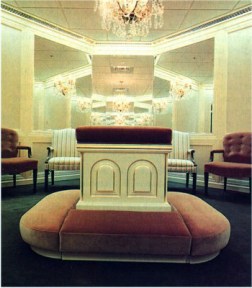
A LdS Temple Sealing Room where the Mormon marriage ceremony is performed and where only “Temple Worthy” Mormon adults can attend

77) It doesn’t allow young Mormon siblings (usually under 18) to see an older sister or brother get married in an LdS Temple – even if the younger person is a faithful Mormon in good standing.

78) It claims to be “pro-family” while simultaneous creating a culture that breaks up both Mormon and non-Mormon families via the aforementioned.

79) It has failed to officially, publicly, and directly address the ever mounting discrepancies between the claims of The Book of Mormon and the archaeological, historical, theological, and scientific body of evidence.

80) It has failed to explain the incriminating consistency between the claims of The Book of Mormon and the empirical 19th Century, political, literary, cultural and theological record.

81) It has failed to provide an adequate, rational explanation for how Joseph Smith could “translate” the Book of Abraham from a set of Egyptian Book of Breathings papyri.

82) It has failed to reasonably explain how Joseph Smith could, via The Joseph Smith Translation of the Bible, append the Bible with “translations” of entire new books and chapters that have utterly no manuscripts backing them while simultaneously purging words, verses – even entire books – that are substantially supported by the extant manuscript base.

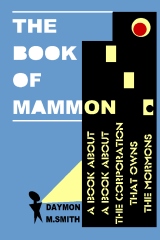
83) It compensates leaders via employment in LdS Church owned businesses, generous honoraria, stipends, grants, scholarships, gifts, company cars, free travel and lodging, housing and other non-cash contributions then deceptively claims that “The LdS Church has no paid clergy”. This is nothing more than deception via manipulative semantics and a sophisticated financial “shell game”.

“The Book of Mammon” by former LdS Church employee Daymon M Smith exposes how the Mormon Church’s “Unpaid Clergy” are indirectly compensated

84) It bestows the title “Elder” onto adolescent men (typically 18-years old) with little to no real life experience, thus puffing them up with arrogance and deluding them with prideful ignorance.

85) It hypocritically denounces those who claim to bring forth new scripture and revelations using the same methods and means that Joseph Smith did because they fail to conform to established LdS Church orthodoxy. This, while simultaneously criticizing the mainstream Christian Church for rejecting Mormonism because the revelations and scripture of its founder and subsequent “prophets” fail to conform to established Christian orthodoxy.

86) It hypocritically rails against all sound logic and reason as “the hollow and vain philosophies of men, not God” and then hypocritically attempts to (albeit poorly and inconsistently) employ logic and reason in its arguments and rhetoric.

87) It hypocritically defines polemic arguments as “persecution” and then engages in polemics with its critics.

88) It allows LdS Church leaders and the Church Educational System (CES), to distance themselves from the work of LdS Apologists so as – it is believed – to create a “plausible deniability” escape hatch should the work of said Apologists be discredited by more qualified, objective scholarship. Never-the-less, both cite from the work of LdS Apologists (albeit typically not credited) while allowing the LdS Church to quietly fund the work of said apologists through indirect cash flows.

89) It engages in political action via direct and indirect cash flows and privately exhorts members to organize and engage in particular causes and then publicly denies any involvement. California’s Propositions 22 (circa 2000) and 8 (circa 2008) are two cases in point.

90) It publicly (and loudly) trumpets its philanthropic work when compared to other churches its per capita outlay is less than what smaller, less wealthy, less organized religious organizations spend.

The First Presidency of the LdS Church at the City Creek Center ribbon cutting

91) It sent the wrong message in 2003 by pledging to spend $1-Billion US dollars to redevelop downtown Salt Lake City (via the City Creek Center mall and housing redevelopment project). Due to cost over runs the final project cost is now forecast to be around $8-Billion US dollars.

92) It has a double standard for treating non-members with charitable benevolence (as a means of proselytizing and public relations) while exacting, high, often unattainable standards that members must meet to receive the same levels of attention, aid, and assistance.

93) It fails to recognize the over sixty (60) active Latter Day Saint movement denominations (aka “splinter groups”) while hypocritically condemning the denominationalism of Christianity as a proof of apostasy and lack of divine legitimacy. This hypocrisy is even more pronounced when one considers that over the 180+ year history of the LDS movement there have been over 200 Latter Day Saint denominations in total with new ones forming at a rate will be eventually far exceed and out pace the total number of Christian denominations.

94) Based on its observed behavior its core unifying principle seems to be “Image over truth always and in all things.”

95) It creates undue demands as well as mental, emotional, and spiritual stress and strain on members via all the above.

Compiled by Fred W. Anson, with the generous aid and assistance of current and former members of the Church of Jesus Christ of Latter-day Saints, as well as knowledgeable outsiders, all whom long to see the Mormon Church reform for the sake of all its members – but especially for the sake of their Latter-day Saint friends and family members.

by Keith Walker
Billy Graham,

I want to thank you for your many years of serving our Lord and Savior, Jesus Christ. You came to Rochester, New York in September of 1988. A friend invited me to the crusade and I went three times that week. On Friday evening the 16th, I surrendered my life to Christ at the Crusade and have been serving Him since. A short time after I was saved, a couple of Jehovah’s Witness ladies came to my door and challenged my new faith. That incident led me to become a missionary to Jehovah’s Witnesses and Mormons. My wife and I founded Evidence Ministries in 1992 and I have been a full-time missionary to these two cults since 1999.

This morning I read an online article which stated that you endorsed Mitt Romney, and then your ministry took down some information from your web site which describes Mormonism as a cult. The article can be read here.

I am writing because I wanted to get your side of the story and make an appeal to you. I understand the hesitancy of Christians to vote for a Mormon and I also understand why Christians would like to see him become the next President of the United States. What I do not understand is why a ministry would take down information which correctly identifies Mormonism as a cult.

I believe it is possible to be a Christian, understand that Mormonism is a cult, yet still in good conscience vote for Mitt Romney. Mr. Graham, I believe this is what you are doing. Please, correct me if I am wrong, but I also believe that the reason the critical information about Mormonism was taken off of your site is because you do not want to dissuade Christians from voting for Romney, even though he is a cult member. This is problematic for a number of reasons.

First and foremost, it sends a message that Christians must focus on perceived threats to their earthly kingdom more so than on threats to the Kingdom of God. Let’s face it. Many Christians believe that a second Obama Presidency could destroy the Constitution of this great nation. I have even had misguided Christians tell me that if we don’t vote for Romney, we will not be able to preach the gospel because it will become illegal. It has never occurred to them that a significant portion of our New Testament was written by a prisoner named Paul who was imprisoned precisely because he refused to stop preaching the gospel.

Some Christians are so fearful of Obama that they have allowed themselves to be fooled into thinking that our votes alone will be responsible for placing the president of their liking into the Whitehouse. They have forgotten that God told us in Romans 13:1-7 that He is the one who establishes governing authorities. I believe that as Christians we have a responsibility to vote for the person who best represents and will protect Godly values, but at the same time, I am not overlooking the fact that God alone is in control of the results of this election.

I can’t help but wonder if you have forgotten that. What other reason would you have for taking down information that is critical of Mormonism right after you endorsed Mitt Romney? Are you afraid that you may sway someone not to vote for Romney because he belongs to a pseudo-Christian cult? I don’t know if this is true of you (thus my purpose for writing), but I do know that many Christians are so fearful of a second term for Obama that they are willing to ignore the spiritual dangers of Mormonism.

A friend of mine visited a Family Christian bookstore after Church this past Sunday. He noticed that all of the books about Mormonism had been removed from the comparative religions section even though books on the Jehovah’s Witnesses, Scientology and Islam were still there. When he asked a clerk about the books on Mormonism, he was informed that they had been removed until the election. My friend asked what was going to happen if Romney is elected. He was told that if Romney won, the books would most likely not be returned to the shelves.

The policy of this book store may seem absurd, but I do not see much difference between what they did and what has been done to your web site. Are Christians now going to give Mormonism legitimacy for the sake of their patriotism? Which dangers should concern Christians more, temporal or spiritual dangers? I can’t help but wonder which is more important to Christians who make policies like this, their country or the souls of men? Given your many years of preaching the gospel, I pray that you are not led astray like these other Christians who have allowed their patriotism to become an idol worshiped in Jesus’ name.

If you believe that God is leading you to endorse Mitt Romney for President, then by all means do so, Just, please do not indirectly endorse Mormonism in the process. I humbly ask that you put the critical information about Mormonism back on your web site. The Church of Jesus Christ of Latter-day Saints is very adept at fooling people into thinking that Mormonism is a legitimate expression of Christianity. They do not need your assistance.

Respectfully,

Keith Walker

President, Evidence Ministries

(used with the permission of the author whose original version of this letter can be found here)

by John Farkas

INTRODUCTION
One of the unique doctrines of The Church of Jesus Christ of Latter-day Saints (the Mormons or LDS) is their Aaronic and Melchizedek [1](This is an endnote) Priesthoods, one of which is held by most male members 12 years and older. The Mormon church teaches that this is their authority from God to act in his name and do his work.[2] The Aaronic Priesthood was allegedly given to Joseph Smith and Oliver Cowdery by John the Baptist on May 15, 1829, and sometime later, but before August 1830, they received the Melchizedek Priesthood from Apostles Peter, James and John. The exact date for this important event is not known (for more on this see the last part of end note #4).

There are seven revelations in the Doctrine & Covenants (D&C) (a Mormon Scripture) on these priesthoods. Although five of them were allegedly received before October 1832, one as early as 1823, and one as late as September 1832, none of these five were included in the 1833 Book of Commandments.[3] Two of them did not showup in the D&C until the 1876 edition, three were first included the 1835 edition.

THE PRIESTHOOD IN LDS REVELATION
The Doctrine and Covenants (1981 edition) has the following about the early history of the LDS priesthoods. These revelations are in their chronological order.

“Behold, I will reveal unto you the Priesthood, by the hand of Elijah [4] the prophet, before the coming of the great and dreadful day of the Lord.” 
(Sept. 21, 1823, Doctrine and Covenants 2:1)

Even though this revelation is dated September 21, 1823 it was not in the 1833 Book of Commandments or the 1835 and 1844 Doctrine and Covenants. It did not get into Scripture until the 1876 D&C and was not approved by the membership until 1880 (Robert J. Woodford, “The Story of the Doctrine and Covenants”, Ensign, Dec. 1984, pages 37-39).

A 19th century depiction of John the Baptist conferring the Aaronic priesthood to Joseph Smith and Oliver Cowdery

A second alleged revelation has:
“Upon you my fellow servants, in the name of Messiah, I confer the Priesthood of Aaron, which holds the keys of the ministering of angels, and of the gospel of repentance, and of baptism by immersion for the remission of sins [5]; and this shall never be taken again from the earth until the sons of Levi do offer again an offering unto the Lord in righteousness.”
(May 15, 1829, Doctrine and Covenants 13).

The first written account of this revelation does not have the phrase the “Priesthood of Aaron.” There is more on this below under “LDS Leaders On The Priesthood” and “Differences In Description.” It also was not included in LDS Scripture until the 1876 D&C even though it is dated May 15, 1829. It also was not approved by the membership until 1880
(Ensign, Dec. 1984, pages 37-39).

A third alleged revelation has:
“Which John I have sent unto you, my servants, Joseph Smith, Jun., and Oliver Cowdery, to ordain you unto the first priesthood which you have received, that you might be called and ordained even as Aaron [6];…And also with Peter, and James, and John, whom I have sent unto you, by whom I have ordained you and confirmed you to be apostles, and especial witnesses of my name, and bear the keys of your ministry and of the same things which I revealed unto them;”
(August & September, 1830, Doctrine and Covenants 27:8, 12)

This revelation was not in the 1833 Book of Commandments. It is first found in the 1835 D&C, section 50, page 179. There is more on this below under “Historical Evidence.”

A fourth alleged revelation has:
“There remain hereafter, in the due time of the Lord, other bishops to be set apart unto the church, to minister even according to the first; Wherefore they shall be high priests who are worthy, and they shall be appointed by the First Presidency of the Melchizedek Priesthood, except they be literal descendants of Aaron. Wherefore they shall be high priests who are worthy, and they shall be appointed by the First Presidency of the Melchizedek Priesthood, except they be literal descendants of Aaron. And if they be literal descendants of Aaron they have a legal right to the bishopric, if they are the firstborn among the sons of Aaron; For the firstborn holds the right of the presidency over this priesthood, and the keys or authority of the same. No man has a legal right to this office, to hold the keys of this priesthood, except he be a literal descendant and the firstborn of Aaron. But, as a high priest of the Melchizedek Priesthood has authority to officiate in all the lesser offices he may officiate in the office of bishop when no literal descendant of Aaron can be found, provided he is called and set apart and ordained unto this power, under the hands of the First Presidency of the Melchizedek Priesthood.
(Nov. 1831, Doctrine and Covenants 68:14-19)

Bronze statue in Temple Square, Salt Lake City, representing Peter, James, and John in the act of conferring the Melchizedek priesthood to Joseph Smith and Oliver Cowdery, as envisioned by most modern Latter-day Saints

The first account of this revelation was in the LDS newspaper Evening and Morning Star, Oct. 1832, page 35. Even then It did not include any of the bolded words. It was not in the 1833 Book of Commandments but was included in the 1835 D&C, section 22, page 147.

A fifth alleged revelation has:
“And this greater priesthood administereth the gospel and holdeth the key of the mysteries of the kingdom, even the key of the knowledge of God. Therefore, in the ordinances thereof, the power of godliness is manifest. And without the ordinances thereof, and the authority of the priesthood, the power of godliness is not manifest unto men in the flesh;

For without this no man can see the face of God, even the Father, and live [7]…And the lesser priesthood continued, which priesthood holdeth the key of the ministering of angels and the preparatory gospel; Which gospel is the gospel of repentance and of baptism, and the remission of sins, and the law of carnal commandments, which the Lord in his wrath caused to continue with the house of Aaron among the children of Israel until John, whom God raised up, being filled with the Holy Ghost from his mother’s womb…

And again, the offices of elder and bishop are necessary appendages belonging unto the high priesthood…

And again, the offices of teacher and deacon are necessary appendages belonging to the lesser priesthood, which priesthood was confirmed upon Aaron and his sons…

For whoso is faithful unto the obtaining these two priesthoods of which I have spoken, and the magnifying their calling, are sanctified by the Spirit unto the renewing of their bodies. They become the sons of Moses and of Aaron and the seed of Abraham, and the church and kingdom, and the elect of God.

And also all they who receive this priesthood receive me, saith the Lord; For he that receiveth my servants receiveth me; And he that receiveth me receiveth my Father; And he that receiveth my Father receiveth my Father’s kingdom; therefore all that my Father hath shall be given unto him. And this is according to the oath and covenant which belongeth to the priesthood.

Therefore, all those who receive the priesthood, receive this oath and covenant of my Father, which he cannot break, neither can it be moved.”
(Nov. 22-23, 1832, Doctrine and Covenants 84:19-22, 26, 27, 29, 30, 33-40).
[NOTE: modern paragraphing added to improve legibility – editor]

Even though this is dated November 1832 it was not in the 1833 Book of Commandments. It was in the 1835 D&C, section 4, page 89.

A sixth alleged revelation has:
“There are, in the church, two priesthoods, namely, the Melchizedek and Aaronic, including the Levitical Priesthood.”
(March 28, 1835, Doctrine and Covenants 107:1).

This was first in the 1835 D&C, section 3, page 82.

A seventh alleged revelation has:

“And again, what do we hear? Glad tidings from Cumorah!

Moroni, an angel from heaven, declaring the fulfillment of the prophets–the book to be revealed.

Title page from an open 1835 edition of Doctrine And Covenants

A voice of the Lord in the wilderness of Fayette, Seneca county, declaring the three witnesses to bear record of the book!

The voice of Michael on the banks of the Susquehanna, detecting the devil when he appeared as an angel of light!

The voice of Peter, James, and John in the wilderness between Harmony, Susquehanna county, and Colesville, Broome county, on the Susquehanna river, declaring themselves as possessing the keys of the kingdom, and of the dispensation of the fulness of times!

And again, the voice of God in the chamber of old Father Whitmer, in Fayette, Seneca county, and at sundry times, and in divers places through all the travels and tribulations of this Church of Jesus Christ of Latter-day Saints!

And the voice of Michael, the archangel; the voice of Gabriel, and of Raphael, and of divers angels, from Michael or Adam down to the present time, all declaring their dispensation, their rights, their keys, their honors, their majesty and glory, and the power of their priesthood; giving line upon line, precept upon precept; here a little, and there a little; giving us consolation by holding forth that which is to come, confirming our hope!”
(Sept. 6, 1842, Doctrine and Covenants 128:20-21).
[NOTE: modern paragraphing added to improve legibility – editor]

Note the date this revelation was given and that it includes a summary of the two priesthoods. Also note that there is no support found for these statements in the two early “new Scriptures” of the Mormon church, the Book of Mormon and the 1833 Book of Commandments.

LDS LEADERS ON THE PRIESTHOOD
William Phelps, as the editor of the Mormon newspaper Evening and Morning Star (Independence, Missouri), provides the first public evidence of the two priesthoods, the Aaronic and Melchizedek.

William Wines Phelps (February 17, 1792 – March 7, 1872) was an early leader of the Latter Day Saint movement. He was an assistant president of the church in Missouri, scribe to Joseph Smith, Jr., and a church printer, editor, and song-writer

After the high priesthood comes elders, priests, teachers, and deacons. Now the offices are separate, for the edification and benefit of the whole church, and, though the elders and bishops are appendages to the high priesthood, & the teachers and deacons are appendages to the lesser priesthood, yet these offices are important to their places, and regular in their gradation: from deacon to teacher, from teacher to priest, from priest to elder, from elder to high priest.
(March, 1833, page 74)

While not directly named, this is the first apparent mention together of the two LDS priesthoods in an official Mormon publication. The Book of Mormon, in the book of Alma, does mention the “high priesthood,” but the “lesser priesthood” is not mentioned at all in the Book of Mormon.

Phelps’ article does require the reader to know the meaning of “high priesthood” and “lesser priesthood.” The priesthood revelations from God were allegedly received in 1823, 1829, 1830, 1831 and September 1832. The Evening and Morning Star was first published June 1832, so there was a nine-month opportunity to mention all of them sooner than Phelps’ article.

Oliver Cowdery, the only other human participant with Smith in the restoration of the priesthood,[8] as the editor of a Mormon newspaper in Kirtland, Ohio (near present day Cleveland) said:

“But, dear brother think, further think for a moment, what joy filled our hearts and with what surprise we must have bowed, (for who would not have bowed the knee for such a blessing?) when we received under his [John the Baptist] hand the holy priesthood, as he said, “upon you my fellow servants, in the name of Messiah I confer this priesthood and this authority, which shall remain upon earth, that the sons of Levi may yet offer an offering unto the Lord [9] in righteousness!”‘
(Messenger and Advocate, Oct., 1834, pages 15 and 16 and Joseph Smith-History page 59, footnote by Oliver Cowdery)

The reliability of this statement by Mr. Cowdery is supported by an earlier statement in this same paper.

“That our narrative may be correct, and particularly the introduction, it is proper to inform our patrons, that our brother J. Smith jr. has offered to assist us…With his labor and with authentic documents now in our possession, we hope to render this a pleasing and agreeable narrative well worth the examination and perusal of the Saints.”
(ibid, page 13)

DIFFERENCES IN DESCRIPTIONS
Now compare the statement just above by Oliver Cowdery on the priesthood to the following LDS Scripture:

Photograph of Oliver Cowdery found in the Library of Congress, taken in the 1840s by James Presley Ball

Upon you my fellow servants, in the name of Messiah, I confer the Priesthood of Aaron, which holds the keys of the ministering of angels, and of the gospel of repentance, and of baptism by immersion for the remission of sins [10]; and this shall never be taken again from the earth until the sons of Levi do offer again an offering unto the Lord in righteousness.”
(Doctrine and Covenants 13, May 15, 1829 and Joseph Smith-History 1:39)

“I confer the Priesthood of Aaron” is not the same as “I confer this priesthood and this authority.” As will be shown below, Oliver Cowdery’s quotation is consistent with the claim of David Whittmer, another top leader in the early Mormon church.

HISTORICAL EVIDENCE
It should be evident by now that the scriptural foundation for the bestowal of the priesthoods is on shaky ground. To give you a sense of the changes made and the confusion in the revelations on the priesthood let us look at one of them, Doctrine and Covenants 27, as it appeared chronologically in LDS Scripture. The 1833 Book of Commandments has:

“A Commandment to the church of Christ, given in Harmony, Pennsylvania, September 4, 1830,
“LISTEN to the voice of Jesus Christ, your Lord, your God, and your Redeemer, whose word is quick and powerful.

2 For, behold, I say unto you, that it mattereth not what ye shall eat or what ye shall drink when ye partake of the sacrament, if it so be that ye do it with an eye single to my glory;

3 Remembering unto the Father my body which was laid down for you, and my blood which was shed for the remission of your sins:

4 Wherefore, a commandment I give unto you, that you shall not purchase wine, neither strong drink of your enemies:

5 Wherefore, you shall partake of none, except it is made new among you, yea, in this my Father’s kingdom which shall be built up on the earth.

6 Behold this is wisdom in me, wherefore, marvel not, for the hour cometh that I will drink of the fruit of the vine with you, on the earth, and with, all those whom my Father hath given me out of the world:

7 Wherefore, lift up your hearts and rejoice, and gird up your loins, and be faithful until I come:- even so. Amen.”
(Book of Commandments, chapter 28, verses 1-7, page 60)

Notice that this alleged revelation has nothing about the LDS priesthood. It was later changed. The 1835 Doctrine and Covenants has the following for the same revelation. The bold type words are the added ones; the ones in brackets { } were removed.

Revelation given, {A Commandment to the church of Christ, given in Harmony, Pennsylvania,} September {4}, 1830.

1 Listen to the voice of Jesus Christ, your Lord, your God, and your Redeemer, whose word is quick and powerful. For, behold, I say unto you, that it mattereth not what ye shall eat or what ye shall drink when ye partake of the sacrament, if it so be that ye do it with an eye single to my glory–remembering unto the Father my body which was laid down for you, and my blood which was shed for the remission of your sins. Wherefore, a commandment I give unto you, that you shall not purchase wine neither strong drink of your enemies; Wherefore, you shall partake of none except it is made new among you; yea, in this my Father’s kingdom which shall be built up on the earth.

LdS President (March 1, 1807 – September 2, 1898) Wilford Woodruff’s copy of The Book of Commandments

2 Behold, this is wisdom in me; wherefore, marvel not, for the hour cometh that I will drink of the fruit of the vine with you on the earth, and with Moroni, whom I have sent unto you to reveal the Book of Mormon, containing the fulness of my everlasting gospel, to whom I have committed the keys of the record of the stick of Ephraim; And also with Elias, to whom I have committed the keys of bringing to pass the restoration of all things spoken by the mouth of all the holy prophets since the world began, concerning the last days; And also John the son of Zacharias, which Zacharias he (Elias) visited and gave promise that he should have a son, and his name should be John, and he should be filled with the spirit of Elias; Which John I have sent unto you, my servants, Joseph Smith, Jun., and Oliver Cowdery, to ordain you unto the first priesthood which you have received, that you might be called and ordained even as Aaron; And also Elijah, unto whom I have committed the keys of the power of turning the hearts of the fathers to the children, and the hearts of the children to the fathers, that the whole earth may not be smitten with a curse; And also with Joseph and Jacob, and Isaac, and Abraham, your fathers, by whom the promises remain; And also with Michael, or Adam, the father of all, the prince of all, the ancient of days:

3 And also with Peter, and James, and John, whom I have sent unto you, by whom I have ordained you and confirmed you to be apostles, and especial witnesses of my name, and bear the keys of your ministry and of the same things which I revealed unto them; Unto whom I have committed the keys of my kingdom, and a dispensation of the gospel for the last times; and for the fulness of times, in the

Image from the LdS Church Educational System Institute Manual “Gospel Doctrines” with this caption, “Righteousness is the key to priesthood power and eternal life.”

which I will gather together in one all things, both which are in heaven, and which are on earth; And also with all those whom my Father hath given me out of the world. Wherefore, lift up your hearts and rejoice, and gird up your loins, and take upon you my whole armor, that ye may be able to withstand the evil day, having done all, that ye may be able to stand. Stand, therefore, having your loins girt about with truth, having on the breastplate of righteousness, and your feet shod with the preparation of the gospel of peace, which I have sent mine angels to commit unto you; Taking the shield of faith wherewith ye shall be able to quench all the fiery darts of the wicked; And take the helmet of salvation, and the sword of my Spirit, which I will pour out upon you, and my word which I reveal unto you, and be agreed as touching all things whatsoever ye ask of me, and be faithful until I come, and ye shall be caught up, that where I am ye shall be also. {even so.} Amen.”
(1835 Doctrine and Covenants 50:1-3, pages 179-180. The present 1981 edition of the Doctrine and Covenants 27:1-18 reads the same except for the heading, verse numbering and some punctuation.)

Note that the historical heading of this revelation was changed, the day was omitted and many significant additions were made in the text with no notes or comments of any kind as to why.

Some Mormons may point to Doctrine and Covenants 13 to support the restoration of the Mormon priesthood, it has:

“Ordination of Joseph Smith and Oliver Cowdery to the Aaronic Priesthood along the bank of the Susquehanna River, near Harmony, Pennsylvania, May 15, 1829. HC 1:39-42. The ordination was done by the hands of an angel, who announced himself as John, the same that is called John the Baptist in the New Testament. The angel explained that he was acting under the direction of Peter, James, and John, the ancient apostles, who held the keys of the higher priesthood, which was called the Priesthood of Melchizedek. The promise was given to Joseph and Oliver that in due time the Priesthood of Melchizedek would be conferred upon them. See also Section 27:7, 9, 12…..

Contemporary painting of Joseph Smith and Oliver Cowdery receiving the Melchizedek Priesthood

UPON you my fellow servants, in the name of Messiah I confer the Priesthood of Aaron, which holds the keys of the ministering of angels, and of the gospel of repentance, and of baptism by immersion for the remission of sins; and this shall never be taken again from the earth, until the sons of Levi do offer again an offering unto the Lord in righteousness.”
(Doctrine and Covenants 13, May 15, 1829)

As stated at the start of this article, this revelation was not in the Mormon Scriptures until the 1876 edition, and not accepted “by common consent” until 1880. The same idea is also in the Pearl of Great Price, Joseph Smith – History, verses 68-69, which was also not in LDS scripture until 1876.

There are no reasons given why it was not in the two earlier collections of LDS revelations, A Book of Commandments (1833) and the 1835 Doctrine and Covenants. I believe the historical reliability of these verses is significantly in question because of their late canonization.

These are key foundational revelations. If they existed they should have been in the first collection of new revelation.

WHAT DO OTHERS SAY?
Joseph Smith was killed in 1844. In 1846 Brigham Young lead many of the Mormons on their way to what was to become Salt Lake City. Not all Mormons chose to go, including Joseph Smith’s wife and children. In 1860 Joseph Smith’s oldest son, Joseph Smith III, became the president and prophet of a newly founded church, the Reorganized Church of Jesus Christ of Latter Day Saints (RLDS). They claim to be the true continuation of the Church Joseph Smith founded. They deny that Peter, James and John “restored” the Melchizedek Priesthood to Joseph Smith. The following statement by Mormon historian and then Apostle Joseph Fielding Smith explains their position:
“‘REORGANITES’ DENY RESTORATION OF MELCHIZEDEK PRIESTHOOD
Was the Melchizedek Priesthood conferred upon Joseph Smith and Oliver Cowdery by Peter, James, and John?

In the History of the Church, no account is given of the date when the Melchizedek Priesthood was restored. For this reason certain parties not of the Church, who profess to believe in the divine mission of the martyred Seer, in order to bolster up their weak position, have made the claim that this priesthood was not restored by those heavenly messengers, but that it grew out of the Aaronic Priesthood, which was restored by John the Baptist on the 15th day of May 1829. According to this claim, the Prophet and Oliver Cowdery, having received the Aaronic Priesthood, did, by virtue of that priesthood, on the 6th day of April 1830, ordain each other elders, and that this eldership ordained high priests and apostles.”[a]

The actual statement, as officially published by the so-called “Reorganized” Church, is:

“In justification of the course taken, and the principles involved on `the question of authority,’ we have ever courted, and still do, investigation of the rigid character of the facts in the first organization. Here they are: Joseph Smith and Oliver Cowdery were ordained to the lesser priesthood by an angel; then, by this authority and a commandment they, on the 6th day of April, ordained each other elders, and this eldership ordained high priests and apostles, and this high priesthood ordained, by commandment, the President of the High Priesthood — the highest office in the church; so that the alleged lesser ordained [sic][11] the greater, is common to both the first organization and the Reorganization alike. The same class of facts justify both or condemn both.”
(Doctrines of Salvation, 3:95)

The “three witnesses” to the Book of Mormon: Oliver Cowdery, David Whitmer, and Martin Harris

David Whitmer, one of the “Three Witnesses” (found right after the Introduction of the Book of Mormon) of the Book of Mormon and an early leader in the Mormon church, had this to say about the priesthoods in the Mormon Church.

“Now Brethren, seeing they had no High Priests in the church of Christ of old, and none in the church of Christ [12] in these last days until almost two years after its beginning [13] — when the leaders began to drift into error; remembering the fact of the revelation being changed two years after it was given to include High Priests;…

In no place in the word of God does it say that an Elder is after the order of Melchisedec, or after the order of the Melchisedec Priesthood….This matter of ‘priesthood,’ since the days of Sydney [sic] [Sidney] Rigdon[14], has been the great hobby and stumbling-block of the Latter Day Saints. …This matter of the two orders of priesthood….all originated in the mind of Sydney Rigdon. He explained these things to Brother Joseph in his way, out of the old Scriptures, and got Brother Joseph to inquire, etc. He would inquire and as mouthpiece speak out the revelations just as they had it fixed up in their hearts…How easily a man can receive some other spirit, appearing as an Angel of Light, believing at the time that he is giving the revealed will of God…..”
(An Address to All Believers in Christ, pages 64)

The RLDS’ and David Whitmer’s position are supported by the historical evidence previously presented and support the idea that the high priesthood was first given at the Kirtland conference of June 3-7, 1831 (D&C 52 historical heading; 1833 Book of Commandments 54, page 123; Far West Record, page 7 and end notes 4 and 5 on page 8; Deseret Book Co., 1983, edited by D. Q. Cannon & L. W. Cook. ).[15]

It also seems reasonable to believe that the priesthood, if it really existed, would also clearly and frequently show up in many of the other publications by the Mormon Church. Those to be examined below are the Book of Mormon, The Holy Bible, Book of Commandments and a collection of early teachings called the Lectures on Faith.

THE PRIESTHOOD IN THE BOOK OF MORMON
The Book of Mormon, one of the unique scriptures of the Mormon Church, also does not show the present day Mormon priesthood. The following terms and phrases used in describing their priesthood could not be found in a search of the text of the Book of Mormon.

A first edition 1830 Book of Mormon open to the Book of Alma

a. “Aaronic Priesthood”, with of without capitals.
b. “Melchizedek/Melchisedec Priesthood,” with or without capitals.
c. “the fulness of the everlasting gospel,” except in the Introduction of the current edition of the Book of Mormon. The term is also not in the 1830 edition.
d. “new and everlasting covenant”
e. “married”, “marriage”, “marry”, “marrying”, “divorce”.
f. “wife and husband,” or “husbands and wife,” or “husband and wives” in the same paragraph.
g. “gospel of salvation”
h. “fulness of salvation”
i. “fulness of eternal glory”
j. “celestial”
k. “Aaronic,” with or without capitals.
l. “deacon”
m. “seventy,” or “seventies” as an office in the Melchizedek Priesthood.
n. “highpriest” as one word.

It is interesting to find the Book of Mormon has nothing on the Aaronic Priesthood and deacons. It does have teachers and priests, positions/offices that a present day Mormon would recognize, which are ordained by the laying on of hands (Moroni 3). But nothing is said through the one thousand years plus period of the Book of Mormon about the priesthood (and the term “lesser priesthood), that these offices are part of in present day Mormonism. Moroni 3 would have been a logical place to include instructions on conferring the Priesthood, but nothing is given.

Similarly, there is no direct wording in the Book of Mormon on the Melchizedek Priesthood. It does describe a priesthood, but it is different from the present day Mormon Church’s priesthood.

Terms like Melchizedek (as the name), order of God, order of his Son and high priesthood are used, but then only in the Book of Alma, which only covers the time period of about 91 BC to about 52 BC. Moroni 3; Alma 13 and 6:1 and Mosiah 18:18 give instructions for ordaining teachers, priests, elders, and high priests but there is nothing about conferring a priesthood. These would have been logical places for this, but they only give instruction for ordination to an office.

It seems reasonable to think that the Melchizedek Priesthood, at the very least using the terminology used in the Book of Alma, would be frequently mentioned in all parts of the Book of Mormon, especially during Jesus Christ’s visit to the New World (3 Nephi 8 and following chapters) and in the period of peace and tranquility that supposedly followed it (4 Nephi 1). Not only are they not mentioned in these books, but there is little said in other parts of the Book of Mormon (except Alma).

Simulated LdS Temple scene with examples of full LdS Temple Garments attire from the “Big Love” television show

It appears, in almost all uses, that the terms high priest, high priesthood and high priests are only used as part of the Mosaic law that the first Book of Mormon people would have brought with them when they traveled from Jerusalem to the New World (see 1 Nephi chapters 1-18). But they are surprisingly missing once the alleged visit of Jesus Christ occurs as related in 3 Nephi. 3 Nephi 12:1 does say: “…now the number of them who had been called, and received power and authority to baptize was twelve…I have given power that they may baptize you…”.

While a present day Mormon may understand these words to mean the Melchizedek Priesthood and apostles, the text does not say this. How were the Book of Mormon people, or even non-Mormons now, to understand this?

The Book of Mormon is still considered to be “the most correct of any book on earth”! This idea and wording has been in use since 1844 and are still being used, and were clearly stated by the late President Benson (Ensign, October 1992, page 2).

Throughout the entire Book of Mormon nothing is said about the Melchizedek Priesthood offices of seventies, patriarchs, president and apostles. Jesus does appoint twelve men in the New World, but they are called disciples all the way through 3 and 4 Nephi. If New World disciples were also considered apostles by the Lord, this would have been the place to find it, not about 370 years later from Mormon. Mormon 9:18 may at first look like an exception, but this appears to be referring to apostles in the Old World, the one Jesus called in the Jerusalem area, as shown in verse 22.

Moroni 6:1 has a very unique statement on who may be baptized. He says:
“And now I speak concerning Baptism. Behold, elders, priests, and teachers were baptized; and they were not baptized save they brought forth fruit meet that they were worthy of it.”

This has people who apparently held the priesthood, by present day Mormon Church teachings, in the offices mentioned, being baptized. In the present day Mormon Church men must be baptized before they receive a priesthood and an office in it!

All of this has to lead to the conclusion that the Book of Mormon has a different priesthood than currently taught by the Mormon Church. While this difference is significant now, it did not exist to the same extent in 1833 between the Book of Mormon and the Book of Commandments.

A close examination of each will show a close similarity in how the priesthood is described. There are only two significant differences. The Book of Mormon has twelve disciples, a high priesthood and no deacons while the Book of Commandments names apostles and deacons but no high priesthood. They both have nothing on the Aaronic or Melchizedek Priesthood.

THE PRIESTHOOD IN THE BIBLE
The following Mormon phrases and keywords could not be found in the text of the King James Version [16] of the Bible:

High Priest’s garments as described in the Bible

a. “Aaronic Priesthood,” with or without capitals.
b. “Melchizedek/Melchizedek Priesthood,” with or without capitals.
c. “fulness of the everlasting gospel”
d. “fulness of the gospel”
e. “fulness of eternal glory”
f. “fulness of salvation”
g. “new and everlasting covenant”
h. “gospel of salvation”
i. “holy order of God”
j. “highpriest,” as one word.
k. “high priesthood”

The New Testament is very clear that the Aaronic priesthood (including laws and ordinances) was abolished when our Lord died on the cross (Gal 3:19, 23-25; Col 2:14-17; Heb 10:1-10). There was in fact a change in the priesthood – it was abolished and even Christ did not hold the Aaronic priesthood (Heb 7:11-14). The New Testament tells us that all true born-again Christians are priests by the blood of Christ (Rev 1:5-6). This priesthood has nothing to do with the old Aaronic priesthood because it is far superior! It is a royal priesthood of believers in the Living Christ, our Great High Priest forever (1 Pet 2:9-10).

The Bible does say a little about Melchizedek (Gen 14:17-20, Ps 110:4, Heb 4:14 to 8:4). The only Melchizedek priest in the Old Testament was the King of Salem. In the New Testament only Jesus Christ has the Melchizedek priesthood and he was appointed by God (Heb 5:5-6, 10). No priestly succession is mentioned. These ideas were summarized in a paper given by David Crump, as published in Christian Institute for Mormon Studies, Proceedings and Papers, Vol 1, page 35, where he said:

“In the New Testament, Paul’s epistle to the Hebrews tells us what personal qualities are required to hold the Melchizedek priesthood:

Artist’s speculative depiction of Jesus Christ acting as High Priest in heaven

1. You must live forever. This does not mean that you have somehow gained eternal life; it means that you have no beginning as well as no end. You endure forever through the inherent, self-possessed power of your own indestructible, eternal life. (Is there anyone who still hopes to be in the market for this job?)

2. You need to have personally received an oath from God promising that he has made you the Messiah of the world.

3. You must be holy. Mind you, you are not just trying to be holy; you must already share in God’s own character, in his inherent perfection, which means that you are free of all sin. There can be no blemish of inadequacy in your life; you have never done anything even slightly wrong.

4. You must be the eternal Son of God who meets the seven qualifications of sonship outlined in Hebrews 1:1-4. In other words, you must be the eternal mediator of creation, who continues to sustain the creation through the power of your own spoken word.

The position of Melchizedek Priesthood is taken; it is held by God’s Son Jesus Christ, and he has chosen not to share it with us.”

THE PRIESTHOOD IN THE LECTURES ON FAITH
The Lectures on Faith were prepared by Joseph Smith (probably with help from others) and delivered to a class of elders in Kirtland, Ohio in the winter of 1834-1835. [17] They were first included in the 1835 edition of the Doctrine and Covenants. The preface of this book has:

“The first part of the book will be found to contain a series of Lectures as delivered before a Theological class in this place, and in consequence of their embracing the important doctrine of salvation, we have arranged them into the following work.”
(Preface of 1835 D&C)

This preface was signed by Joseph Smith, Oliver Cowdery, Sidney Rigdon, and F. G. Williams. These men were the top leaders (first presidency and assistant president) of the Mormon Church at that time. Note that they said the Lectures on Faith had the important doctrine of salvation.They thought them important enough to make them scripture.

The Lectures on Faith do not use any of the important terms and phrases used to describe the Mormon priesthood and its offices. This is amazing seeing they were to contain “the important doctrine of salvation.” For example, according to the present day Mormon Church, baptism is a necessary part of a Mormon’s “salvation.”[18] Without the priesthood no one has the authority to baptize, hence no “salvation.”

THE PRIESTHOOD IN THE BOOK OF COMMANDMENTS
The 1833 Book of Commandments was the first published collection of alleged revelations received by Joseph Smith. In its time it was considered one of the three LDS Scriptures (the Holy Bible, Book of Mormon, Book of Commandments). As shown above it does not contain the Mormon priesthood as currently known.

Sidney Rigdon, founding member of the First Presidency, Joseph Smith’s First Counselor and the person suspected to be the chief fabricator of LdS Priesthood theology according to David Whitmer

Priesthood revelations that are now Doctrine and Covenants 2, 13, 27, 68 and 84 were not in it. Apostles were called elders (chapter 24:1-2, 22:1, 12, 14) and the only priesthood offices mentioned were elders, priests, teachers and deacons (chapter 24:31). There is nothing about the Aaronic and Melchizedek priesthood, lesser and higher priesthoods, seventies and high priests as currently exists.

God allegedly made it clear that the revelations were “true and faithful” (Book of Commandments 1:7), “neither doth he vary from that which he hath said” (Book of Commandments 2:1) and “now the decrees of God are unalterable” (Alma 41:8). We have God’s word that he would not change and alter what he had said. It should be clear by now that changes and additions were made. What then is the only possible conclusion?

SUMMARY
We have shown how two key alleged revelations about the restoration of the LDS priesthood were not in the first and second published collections and two others were not in the first collection. David Whitmer and the RLDS church stated a similar view.

All this can only lead to the clear conclusion that the present day Mormon Church’s priesthood is not the same one that existed from 1829 to about 1833. It was changed about 1833 and then support was inserted into the LDS scriptures after the fact.[19] In some case this was done 43 years later.

Both 1 Cor 14:33 and Doctrine and Covenants 132:8 say that God is not the author of confusion. We are then left with the only conclusion possible, the confusion in the early LDS Church, particularly the teachings about the priesthood, can only be by man.

THE LDS RESPONSE
The Mormon response to this paper will probably be harsh, for it will be an emotional subject for most LDS, particularly men. This strikes at the heart of Mormonism.

Many will seem to be incredulous and just reject everything out right. On the other end of the spectrum others will take the information and seriously examine it in detail. Some to find reasons to reject it, but some to better understand it and grow from it. All anyone can do as they present the above information is to keep bringing the discussion back to the subject and the facts presented. You will need to dwell on the facts and their accuracy.

There is only one clear conclusion. The priesthood now taught by the Mormon Church is significantly different from the one taught by the Mormon Church from 1830 (their start date) to roughly 1835. It also appears that they tried to hide the changes by post dating the early alleged revelations and making new ones to support the change.

END NOTES
[1] Melchisedec is the New Testament spelling of the Old Testament Melchizedek. The Mormon Church uses this latter spelling.

[2] Gospel Principles, published by the Church of Jesus Christ of Latter-day Saints, Deseret Book Co., Salt Lake City, 1978, page 73. The majority of Bible believing Christians, however, believe that only Jesus Christ held the Melchizedek Priesthood which is “unchangeable”; and that ALL true Christians, men and women, are a royal priesthood (1 Peter 2:5, 9; Heb. 4:14, 7:24, 6:20, 10:10; Rev 1:5-6).

[3] The Book of Commandments, a Scripture published in 1833, was the first collection of alleged revelations received by Joseph Smith. Following editions were titled The Doctrine and Covenants. In the early years of the Mormon church in the United States there were editions in 1833, 1835, 1844 and 1876. There were several British editions, with an 1854 printing that was sent to Utah (Ensign, December 1984, pages 36-37) .

[4] Joseph Smith-History 1:68-72 said it was John the Baptist that ordained them to the Aaronic Priesthood and Peter, James and John (who held the keys for this) ordained them to the Melchizedek Priesthood. The Aaronic Priesthood supposedly on May 15, 1829. The exact date for the Melchizedec Priesthood restoration is not know. The best date that most LDS scholars think this happened is between May 15, 1829 and April 1830, and one said, “probably June 1829” (A Joseph Smith Chronology, by J. Christopher Conkling, Deseret Book Co. 1979, page 10-11).

[5] Doctrine and Covenants 20:37 says we receive the remission of sins by faith in Jesus Christ, by repentance and service to the Lord, all before we are baptized. Which one is correct?

[6] From Lev 8:33 and Ex 29:37 we learn that Aaron’s ordination took 7 days. Mormon Aaronic Priesthood ordinations that I (John Farkas) saw or participated in took less than 15 minutes.

[7] Then how did Joseph Smith see the Father and Son in 1820 and live as he related in Joseph Smith-History 1:17. He did not, as officially taught, get the priesthood until May 1829 (Joseph Smith-History 1:72).

[8] Cowdery was the Second Elder (D&C 20:3 ) and assistant president of the High Priesthood. He was one of Smiths scribes during the alleged “translation” of the Book of Mormon from the “gold plate.” They were both together when the priesthood was allegedly restored.

[9] Mormons have said that these are animal sacrifices, as done in the Jerusalem temple, which are to be restored. (Mormon Doctrine, page 666).

[10] Doctrine and Covenants 20:37 says we receive the remission of sins by faith in Jesus Christ, by repentance and service to the Lord, all before we are baptized.

[a]  Joseph Fielding Smith and Bruce R. McConkie, “Doctrines of Salvation Vol. 3” pp.94-95, (this citation was missing from Mr. Farkas’ original article — Editor)

[11] The bracket is in the quote.

[12] The Mormon Church since its beginning has had three names: Church of Christ, 1830-1834; Church of Latter Day Saints, 1834-1838; The Church of Jesus Christ of Latter-day Saints, 1838 to the present.

[13] If David Whitmer by “beginning” means the formal start of the Mormon Church on April 6, 1830, them 1832 is the approximate start of High Priests.

[14] Sydney Rigdon probably came into the Mormon Church December, 1830 (The Voice of One Crying in the Wilderness: Sidney Rigdon, Religious Reformer, 1793-1876, by F. Mark McKiernan, Herald House, 1979, pages 41-44). This is the earliest date for the change discussed by David Whitmer.

[15] While History of the Church 1:175-176 uses the term “authority of the Melchizedek Priesthood was manifested,” D&C 53 does not use the term at all or “high Priesthood.” The Far West Record, page 7, in the meeting minutes only uses the term “high Priesthood.”

[16] This is the version used by the Mormon Church.

[17] Doctrines of Salvation, by Joseph Fielding Smith, Salt Lake City, Bookcraft, 1955, 2:304; the book Lectures on Faith, Deseret Book Co., Salt Lake City, page v.

[18] For the importance of baptism see: Mormon Doctrine, page 69. Salvation means spending eternity with God in the Celestial Kingdom (Gospel Principles, Deseret Book Co., Salt Lake City, 1976, pages 124-130).

[19] This same idea of after the fact changes is also supported by D. Michael Quinn in his book The Mormon Hierarchy, Signature Books, 1994, pages 7-38.

About the Author
John R. Farkas (1932-2011) was a convert to Mormonism in 1975 and served in several callings up to and including Elder’s Quoruom President of  the Rochester 1st Ward, New York Stake. In 1984 he left the LdS Church and became involved with Berean Christian Ministries where he served until his death. Mr. Farkas is the author of several books on Mormonism and other subjects which can be found on his Author’s page on Amazon. Beggar’s Bread is grateful that before he passed Mr. Farkas granted us the permission to republish the articles from his now defunct website. 

John Farkas is of one the giants on whose shoulders we stand and to whom we owe a debt that we simply can never repay!  We look forward to thanking him again in heaven for the example of his life and treasure of wisdom that he left behind for our benefit.

[Please note that while this article has been very lightly reformatted and re-paragraphed to improve overall legibility no content has been changed from Mr. Farkas’ original, March 27, 1998 source article — Fred W. Anson, editor]

by John R. Farkas
….my wife…was waiting for me, and she started to lecture me, saying that I was breaking the Word of Wisdom. She suddenly stopped, and by the gift of tongues she gave me a most remarkable and wonderful blessing and promised me that I should live to pay off all my debts, which I did live to do….Unless the gift of tongues and the interpretation thereof are enjoyed by the Saints in our day, then we are lacking one of the evidences of the true faith.­­YWJ [Young Woman’s Journal], 16:128″

(Gospel Standards, page 11-12 by President Heber J. Grant)

Heber J. Grant, 7th President of the LdS Church

There are two parts to this paper. The first, and smallest, are sources from LDS Scriptures. The second, and most predominate, are dozens of sources from Mormon history. There is no narrative. The references speak for themselves.

WHAT DO THE MORMON SCRIPTURES SAY ABOUT TONGUES?
Mark 16:17:
“And these signs shall follow them that believe; In my name shall they cast out devils; they shall speak with new tongues;”

Acts 2:4-6, 12-18:
“And they were all filled with the Holy Ghost, and began to speak with other tongues, as the Spirit gave them utterance. And there were dwelling at Jerusalem Jews, devout men, out of every nation under heaven. Now when this was noised abroad, the multitude came together, and were confounded, because that every man heard them speak in his own language…

And they were all amazed, and were in doubt, saying one to another, What meaneth this? Others mocking said, These men are full of new wine. But Peter, standing up with the eleven, lifted up his voice, and said unto them, Ye men of Judea, and all ye that dwell at Jerusalem, be this known unto you, and hearken to my words: For these are not drunken, as ye suppose, seeing it is but the third hour of the day. But this is that which was spoken by the prophet Joel; And it shall come to pass in the last days, saith God, I will pour out of my Spirit upon all flesh…

El Greco,

El Greco, “The Pentecost”

Acts 10:44-47:
“While Peter yet spake these words, the Holy Ghost fell on all them which heard the word. And they of the circumcision which believed were astonished, as many as came with Peter, because that on the Gentiles also was poured out the gift of the Holy Ghost. For they heard them speak with tongues, and magnify God. Then answered Peter, Can any man forbid water, that these should not be baptized, which have received the Holy Ghost as well as we?”

Acts 11:15:
“And as I began to speak, the Holy Ghost fell on them, as on us at the beginning.”
[see Acts 2:4-6 above]

Acts 19:6:
“And when Paul had laid his hands upon them, the Holy Ghost came on them; and they spake with tongues, and prophesied.

1 Corinthians 12:10, 28-30:
“To another the working of miracles; to another prophecy; to another discerning of spirits; to another divers kinds of tongues; to another the interpretation of tongues….And God hath set some in the church, first apostles, secondarily prophets, thirdly teachers, after that miracles, then gifts of healings, helps, governments, diversities of tongues. Are all apostles? are all prophets? are all teachers? are all workers of miracles? Have all the gifts of healing? do all speak with tongues? do all interpret?

1 Corinthians 14:21,39:
“In the law it is written, With men of other tongues and other lips will I speak unto this people; and yet for all that will they not hear me, saith the Lord….Wherefore, brethren, covet to prophesy, and forbid not to speak with tongues.”

The Book of Mormon, An Angel Appears to Alma

Omni 1:25:
“…exhorting all men to come unto God, the Holy One of Israel, and believe in prophesying, and in revelations, and in the ministering of angels, and in the gift of speaking with tongues, and in the gift of interpreting languages, and in all things which are good; for there is nothing which is good save it comes from the Lord; and that which is evil cometh from the devil.”

Alma 9:21:
“Having been visited by the Spirit of God; having conversed with angels, and having been spoken unto by the voice of the Lord; and having the spirit of prophecy, and the spirit of revelation, and also many gifts, the gift of speaking with tongues, and the gift of preaching, and the gift of the Holy Ghost, and the gift of translation;”

Mormon 9:24:
“And these signs shall follow them that believe­­in my name shall they cast out devils; they shall speak with new tongues; they shall take up serpents; and if they drink any deadly thing it shall not hurt them; they shall lay hands on the sick and they shall recover;”

Moroni 10:15-17:
“And again, to another, all kinds of tongues; And again, to another, the interpretation of languages and of divers kinds of tongues. And all these gifts come by the Spirit of Christ; and they come unto every man severally, according as he will.”

DC 46:24-26, March 1831:
“And again, it is given to some to speak with tongues; And to another is given the interpretation of tongues. And all these gifts come from God, for the benefit of the children of God.”

Articles of Faith #7, March 1842; Pearl of Great Price:
“We believe in the gift of tongues, prophecy, revelation, visions, healing, interpretation of tongues, and so forth.

David Whitmer, Book of Mormon Witness and Early Mormon Leader

WHAT DOES MORMON HISTORY SAY?
An Address to All Believers in Christ, by David Whitmer, p. 33, 1887
The Holy Ghost was with us in more power during the eight months previous to April 6, 1830, than ever at any time thereafter. Almost everyone who was baptized received the Holy Ghost in power, some prophesying, some speaking in tongues, the heavens were opened to some and all the signs which Christ promised should follow the believers were with us abundantly.

History of the Church 4:485, Footnotes, spring 1831:
“Soon after he [Alpheus Gifford] went to Kirtland, Ohio, to see the Prophet Joseph Smith and the brethren, when he was ordained an Elder; he was accompanied by his brother Levi Elial Strong, Eleazar Miller, Enos Curtis and Abraham Brown, who were baptized on returning to Pennsylvania he preached and baptized many, among whom was Heber C. Kimball. The gifts of the Gospel were enjoyed by many; signs following those that believed, devils were cast out; the sick were healed; many prophesied; some spake with new tongues; while others interpreted the same.”

History of the Church 1:295-297, November 1832:
“About the 8th of November I received a visit from Elders Joseph Young, Brigham Young, and Heber C. Kimball of Mendon, Monroe county, New York. They spent four or five days at Kirtland, during which we had many interesting moments. At one of our interviews, Brother Brigham Young and John P. Greene spoke in tongues, which was the first time I had heard this gift among the brethren; others also spoke, and I [Joseph Smith] received the gift myself.”

Brigham Young, Second LdS Church President

History of the Church 1:297, Footnotes, September 1832: Article in the Western Monitor, printed at Fayette, Missouri, the proceedings of the mob, on Jackson County troubles; “The above incident is thus related by President Brigham Young in his own history:­­
“In September, 1832, Brother Heber C. Kimball took his horse and wagon, Brother Joseph Young and myself accompanying him, and started for Kirtland to see the Prophet Joseph. We visited many friends on the way and some branches of the Church. We exhorted them and prayed with them, and I [Brigham young] spoke in tongues Some pronounced it genuine and from the Lord, and others pronounced it of the devil We proceeded to Kirtland and stopped at John P. Greene’s, who had just arrived there with his family. We rested a few minutes,….In the evening, a few of the brethren came in, and we conversed upon the things of the kingdom. He called upon me to pray: in my prayer I spoke in tongues As soon as we arose from our knees, the brethren flocked around him, and asked his opinion concerning the gift of tongues that was upon me. He [Joseph Smith] told them it was the pure Adamic language. Some said to him they expected he would condemn the gift Brother Brigham had, but he said “No, it is of God.”­­Millennial Star, vol. xxv, p. 439….The gift of tongues here spoken of was first exercised in one of the Pennsylvania branches: next at Mendon, where the Youngs and Kimballs resided then in the branches between Mendon and Kirtland, then in Kirtland under the circumstances above related and shortly afterwards it was a gift quite generally exercised by the Saints in Ohio. `And it came to pass,’ writes John Whitmer in his history of the Church (chap. x), `that in the fall of 1832, the disciples in Ohio received the gift of tongues, and in June, 1833, we received the gift of tongues in Zion.'”

History of the Church 1:323, January, 1833:
“On the 23rd of January, we again assembled in conference; when, after much speaking, singing praying, and praising God, all in tongues, we proceeded to the washing of feet (according to the practice recorded in the 13th chapter of John’s Gospel), as commanded of the Lord. Each Elder washed his own feet first, after which I [Joseph Smith] girded myself with a towel and washed the feet of all of them, wiping them with the towel with which I was girded. Among the number, my father presented himself, but before I washed his feet, I asked of him a father’s blessing, which he granted by laying his hands upon my head,….”
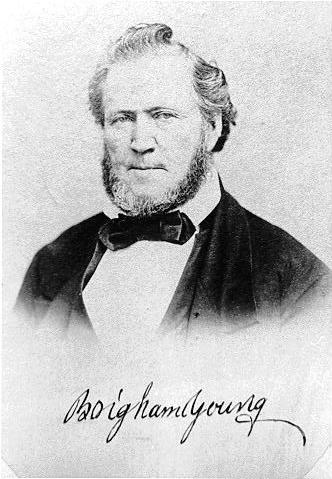
John Murdock, Early Mormon Leader

History of the Church, 1:325, February 1833, by John Murdock:
“…remember the exhortation which I gave you while I was yet present with you, to beware of delusive spirits. I rejoice that our Heavenly Father hath blessed you greatly, as He also has me, in enabling me to speak the praises of God and the mysteries of the kingdom in other tongues according to promise; and this without throwing me down or wallowing me on the ground, or any thing unbecoming or immoral, also, without any external operation of the system, but it is the internal operation and power of the Spirit of God, so that I know that those odd actions and strange noises are not caused by the Spirit of the Lord as is represented by Brother King. Therefore in the name of the Lord Jesus Christ, by the Spirit of the living God, according to the authority of the Holy Priesthood committed to me, I command Brother Thomas King, (as though I were present), to cease from your diabolical acts of enthusiasm, and also from acting as an Elder in this Church of Christ,…”

History of the Church 1:397, July 1833:
“What would be the fate of our lives and property, in the hands of jurors and witnesses, who do not blush to declare, and would not upon occasion hesitate to swear, that they have wrought miracles, and have been the subjects of miraculous and supernatural cures, have converse with God and His angels, and possess and exercise the gifts of divination and of unknown tongues, and fired with the prospect of obtaining inheritances without money and without price­­may be better imagined than described.”

History of the Church 1:409, September 1833:
“A hymn, concerning the travels, toils, troubles, and tribulations of the Nephites, was sung in tongues by Elder W. W. Phelps, interpreted by Elder Lyman Wight,…”

Gary Smith, “Jesus Christ appearing to Joseph Smith and Oliver Cowdrey in the Kirtland Temple”

History of the Church 1:422, October 1833:
“Tuesday, 29.­­After preaching at 10 o’clock a. m., I [Joseph Smith] baptized two, and Confirmed them at the water’s side. Last evening we ordained F. A. Nickerson an Elder; and one of the sisters received the gift of tongues, which made the Saints rejoice exceedingly.++ Tuesday, the 29th of October, also we took our departure from Mount Pleasant, on our return to Kirtland, and arrived at Buffalo, New York, on the 31st.”

History of the Church 2:40, December, 1833:
“…. I [Joseph Smith] extract from Brother Moses Chapman Nickerson’s letter of December 20, 1833. `Your labors in Canada have been the beginning of a good work; there are thirty­four members attached to the Church at Mount Pleasant, all of whom appear to live up to their profession, five of whom have spoken in tongues, and three have sung in tongues; and we live at the top of the mountain.'”

History of the Church 2:137, July 1834:
“Elder Nathan West preferred charges against Samuel Brown, High Priest, for teaching contrary to counsel, namely, encouraging the brethren in practicing gifts (speaking in tongues,) in ordaining Sylvester Hulet a High Priest (without counsel) in a clandestine manner; asserting that he had obtained a witness of the Lord, which was a command to perform the same on receiving the gift of tongues, which gift he had never before received, but afterwards said that he had been in possession of that gift for the space of a year;…”

Burbank, “Camp Meeting” (1839)

History of the Church 2:139-141, August 1834:
“Charles English testified that the Hulet Branch believed that they received the word of the Lord by the gift of tongues, and would not proceed to their temporal business without receiving the word of the Lord….Daniel Stanton testified that Sally Crandall said she saw his heart and saw two books in it, and that there was a Nephite standing behind him to push him into his duty; also that Sylvester Hulet spoke in tongues in meeting, and Sally Crandall interpreted thus: Verily, verily, thus saith the Lord unto you, little band, ye must beware, for there are many who are seeking to pry into your privileges….Absalom Crichfield testified that when he was in Jackson county last spring, the Hulet Branch said, in tongues, that they would be safe, during the night, from any interruption by the mob; but, before morning, Lyman Leonard and Josiah Sumner were whipped; they also said that they saw my heart, and three young women in it…..After councilors had spoken, the president said: `As for the gift of tongues in the manner it was used in the Hulet Branch, the devil deceived them, and they obtained not the word of the Lord, as they supposed, but were deceived; and as for the gift of `seeing,’ as held by the Hulet Branch, it is of the devil, saith the Lord God.’….I have been thus particular in giving the history of this council, as the gift of tongues is so often made use of by Satan to deceive the Saints.”

History of the Church 2:162, September 1834:
“President Joseph Smith then gave an explanation of the gift of tongues, that it was particularly instituted for the preaching of the Gospel to other nations and languages, but it was not given for the government of the Church….He further said, if Brother Gordon introduced the gift of tongues as a testimony against Brother Carpenter, it was contrary to the rules and regulations of the Church, because in all our decisions we must judge from actual testimony….Elder Gordon said the testimony was received and the decision given

before the gift of tongues was manifested….President Smith said, relative to the first question, that Brother Gordon’s tongue in the end did operate as testimony, as, by his remarks in tongues, the former decision was set aside and his (given in tongues) taken; that it was his (President Smith’s) decision that Brother Gordon’s manifestation was incorrect, and from a suspicious mind. He approved the first decision, but discarded the second.

Sidney Rigdon Founding Member of the First Presidency of The LdS Church

History of the Church 2:376, January 1836:
“President Rigdon then arose and observed that instead of preaching the time would be occupied by the Presidency and Twelve, in speaking each in his turn until they had all spoken. The Lord poured out His Spirit upon us, and the brethren began to confess their faults one to the other, and the congregation was soon overwhelmed in tears, and some of our hearts were too big for utterance. The gift of tongues came on us also, like the rushing of a mighty wind, and my soul was filled with the glory of God.”

History of the Church 2:383, January 1836:
“President Rigdon arose to conclude the services of the evening by invoking the blessing of heaven upon the Lord’s anointed, which he did in an eloquent manner; the congregation shouted a long hosanna: the gift of tongues fell upon us in mighty power, angels mingled their voices with ours, while their presence was in our midst, and unceasing praises swelled our bosoms for the space of half­an­hour.”

History of the Church 2:392, February 1836:
“President Zebedee Coltrin, one of the Seven, saw a vision of the Lord’s host. And others were filled with the Spirit, and spake with tongues and prophesied. This was a time of rejoicing long to be remembered. Praise the Lord.”
William Draper Autobiography, (1807-1881) typescript, April, 1836, BYU­S, page 2­3:
“And there in the [Kirtland] temple on the Day of Pentecost of the 6th day of April 1836 there was such a time of the outpouring of the spirit of the Lord that my pen is inadequate to write it in full or my tongue to express it. But I will here say that the spirit was poured out and came like a mighty rushing wind and filled the house, that many that were present spoke in tongues and had visions and saw angels and prophesied, and had a general time of rejoicing such as had not been known in this generation.”
History of the Church 2:428, 27 March 1836:
[at the end of the temple dedication]
“President Brigham Young gave a short address in tongues, and David W. Patten interpreted, and gave a short exhortation in tongues himself, after which I [Joseph Smith] blessed the congregation in the name of the Lord, and the assembly dispersed a little past four o’clock, having manifested the most quiet demeanor during the whole exercise….[during the evening of the same day] Brother George A. Smith arose and began to prophesy, when a noise was heard like the sound of a rushing mighty wind, which filled the Temple, and all the congregation simultaneously arose, being moved upon by an invisible power; many began to speak in tongues and prophesy; others saw glorious visions; and I beheld the Temple was filled with angels, which fact I declared to the congregation. The people of the neighborhood came running together (hearing an unusual sound within, and seeing a bright light like a pillar of fire resting upon the Temple), and were astonished at what was taking place. This continued until the meeting closed at eleven p. m.”

Vilate Kimball Autobiography in Women of Mormondom (1877), 1806-1837, page 105-106:
“At their meetings Brigham and Heber saw the manifestations of the spirit and heard the gift of speaking and singing in tongues. They were constrained by the spirit to bear testimony to the truth, and when they did this the power of God rested upon them….They stayed with the Church about six days, saw the power of God manifested and heard the gift of tongues, and then returned rejoicing, bearing testimony to the people by the way. They were not baptized, however, until the following spring. Brigham was baptized on Sunday, April 14th, 1832, by Eleazer Miller, and Heber C. Kimball was baptized the next day.”

Willard Richards autobiography, in MS 27 (1865), page 133:
“January 8, 1837.­­I partook of the sacrament, and was confirmed by Reynolds Cahoon. I received such a measure of the Spirit as to be sensible of the subject of a song of Zion, which was sung by Elder Lyman Sherman, in the gift of tongues, on the coming of Christ.”

History of the Church, 3:379, Instruction from the Prophet Joseph Smith, June 1839:
“TONGUES were given for the purpose of preaching among those whose language is not understood; as on the day of Pentecost, etc., and it is not necessary for tongues to be taught to the Church particularly, for any man that has the Holy Ghost, can speak of the things of God in his own tongue as well as to speak in another; for faith comes not by signs, but by hearing the word of God.”,.

Though married to Norman Buell at the time, Prescindia Huntington was secretly sealed to Joseph Smith by her brother Dimick on December 11, 1841

Prescindia Huntington autobiography, (1836-1839) in Women of Mormondom (1877), pages 207-209:
“When the brethren and sisters came home in the evening, they told of the power of God manifested in the temple [Kirtland temple] that day, and of the prophesying and speaking in tongues. It was also said, in the interpretation of tongues, `That the angels were resting down upon the house…At another time a cousin of ours came to visit us at Kirtland. She wanted to go to one of the saints’ fast meetings, to hear someone sing or speak in tongues, but she said she expected to have a hearty laugh. Accordingly we went with our cousin to the meeting, during which a Brother McCarter rose and sang a song of Zion in tongues; I arose and sang simultaneously with him the same tune and words, beginning and ending each verse in perfect unison, without varying a word. It was just as though we had sung it together a thousand times. After we came out of meeting, our cousin observed, `Instead of laughing, I never felt so solemn in my life.'”

Journal of Discourses 6:240, Joseph Smith, June 2, 1839:
“Every spirit, or vision, or singing is not of God. The Devil is an orator. He is powerful. He took our Saviour on to a pinnacle of the Temple, and kept him in the wilderness for forty days. The gift of discerning spirits will be given to the Presiding Elder. Pray for him that he may have this gift. Speak not in the gift of tongues without understanding it, or without interpretation. The Devil can speak in tongues: the Adversary will come with his work. He can tempt all classes­­can speak in English or Dutch. Let no one speak in tongues, unless he interpret, except by the consent of the one who is placed to preside; then he may discern or interpret, or another may.

History of the Church 3:379, June 1839:
[Instruction from the Prophet Joseph Smith]
“TONGUES were given for the purpose of preaching among those whose language is not understood; as on the day of Pentecost, etc., and it is not necessary for tongues to be taught to the Church particularly, for any man that has the Holy Ghost, can speak of the things of God in his own tongue as well as to speak in another; for faith comes not by signs, but by hearing the word of God.”

Artist’s depiction of Peter James and John laying their hands upon the head of Joseph Smith

History of the Church, 4:485-486, December 1841
“Sunday, 26­­: The public meeting of the Saints was at my [Joseph Smith] house this evening, and after Patriarch Hyrum Smith and Elder Brigham Young had spoken on the principles of faith, and the gifts of the Spirit, I [Joseph Smith] read the 13th chapter of First Corinthians, also a part of the 14th chapter, and remarked that the gift of tongues was necessary in the Church; but that if Satan could not speak in tongues, he could not tempt a Dutchman, or any other nation, but the English, for he can tempt the Englishman, for he has tempted me, and I am an Englishman; but the gift of tongues by the power of the Holy Ghost in the Church, is for the benefit of the servants of God to preach to unbelievers, as on the day of Pentecost. When devout men from every nation shall assemble to hear the things of God, let the Elders preach to them in their own mother tongue, whether it is German, French, Spanish or `Irish,’ or any other, and let those interpret who understand the language spoken, in their own mother tongue, and this is what the Apostle meant in First Corinthians xiv: 27.”

History of the Church 4:296-297, February 1841:
“Since Stanley Hill conference, I [Levi Richards] have attended about thirty council meetings of Church officers, in eleven different places in Herefordshire, Gloucestershire, and Worcestershire, making a circuit of nearly one hundred miles. Union and harmony prevail among them, and a disposition to add to their faith. New places are frequently opened for preaching, which is generally supplied. Many are baptized every week, although the ice has to yield its natural claims, and be put aside. The gift of healing is manifested to quite an extent in this region. The gift of tongues is received in most of the branches where I am acquainted.”

Hyrum Smith, brother of Joseph Smith, Jr.

History of the Church, 4:485, December, 1841:
“Sunday, 26­­The public meeting of the Saints was at my house this evening, and after Patriarch Hyrum Smith and Elder Brigham Young had spoken on the principles of faith, and the gifts of the Spirit, I [Joseph Smith] read the 13th chapter of First Corinthians, also a part of the 14th chapter, and remarked that the gift of tongues was necessary in the Church; but that if Satan could not speak in tongues, he could not tempt a Dutchman, or any other nation, but the English, for he can tempt the Englishman, for he has tempted me, and I am an Englishman; but the gift of tongues by the power of the Holy Ghost in the Church, is for the benefit of the servants of God to preach to unbelievers, as on the day of Pentecost. When devout men from every nation shall assemble to hear the things of God, let the Elders preach to them in their own mother tongue, whether it is German, French, Spanish or “Irish,” or any other, and let those interpret who understand the language spoken, in their own mother tongue, and this is what the Apostle meant in First Corinthians xiv: 27.

History of the Church 4:580, April 1842:
“At a subsequent period a Shaker spirit was on the point of being introduced, and at another time the Methodist and Presbyterian falling down power, but the spirit was rebuked and put down, and those who would not submit to rule and good order were disfellowshiped. We have also had brethren and sisters who have had the gift of tongues falsely; they would speak in a muttering unnatural voice, and their bodies be distorted like the Irvingites before alluded to; whereas, there is nothing unnatural in the Spirit of God. A circumstance of this kind took place in Upper Canada, but was rebuked by the presiding Elder; another, a woman near the same place, professed to have the discerning of spirits, and began to accuse another sister of things that she was not guilty of, which she said she knew was so by the spirit, but was afterwards proven to be false; she placed herself in the capacity of the “accuser of the brethren,” and no person through the discerning of spirits can bring a charge against another, they must be proven guilty by positive evidence, or they stand clear.”

History of the Church 4:607, April, 1842:
“If you have a matter to reveal, let it be in your own tongue; do not indulge too much in the exercise of the gift of tongues, or the devil will take advantage of the innocent and unwary. You may speak in tongues for your own comfort, but I lay this down for a rule, that if anything is taught by the gift of tongues, it is not to be received for doctrine.

History of the Church 5:31, June 1842; from the Prophet Joseph Smith:
“Be not so curious about tongues, do not speak in tongues except there be an interpreter present; the ultimate design of tongues is to speak to foreigners, and if persons are very anxious to display their intelligence, let them speak to such in their own tongues. The gifts of God are all useful in their place, but when they are applied to that which God does not intend, they prove an injury, a snare and a curse instead of a blessing. We may some future time enter more fully into this subject, but shall let this suffice for the present.

Ebenezer Robinson The Return 1 (June 1889), 1832-1843, page 90:
“President S. (Sidney) Rigdon then made a few appropriate closing remarks, and a short prayer which was ended with loud acclamation of Hosanna! Hosanna! Hosanna! to God and the Lamb, Amen, Amen, and Amen! Three times. Elder B. (Brigham) Young, one of the Twelve, gave a short exhortation in tongues himself; Elder D. (David) W. Patten interpreted and gave a short exhortation in tongues himself; after which, President J. (Joseph) Smith, Jr., blessed the congregation in the name of the Lord, and at a little past four P.M. the whole exercise closed and the congregation dispersed.”

Brigham Young History, 1801­44, ed., E. Watson (1968), page 2, 4-5:
“We arrived at the place where there was a small branch of the Church; we conversed with them, attended their meetings and heard them preach, and after staying about one week we returned home, being still more convinced of the truth of the work, and anxious to learn its principles and to learn more of Joseph Smith’s mission. The members of the branch in Pennsylvania were the first in the Church who received the gift of tongues….In the evening a few of the brethren came in, and we conversed together upon the things of the kingdom. He called upon me to pray; in my prayer I spoke in tongues. As soon as we arose from our knees the brethren flocked around him, and asked his opinion concerning the gift of tongues that was upon me. He told them it was the pure Adamic language. Some said to him they expected he would condemn the gift Brother Brigham had, but he said, “No, it is of God, and the time will come when Brother Brigham Young will preside over this Church. The latter part of this conversation was in my absence.”

Nauvoo Temple 1847

History of the Church 7:557, December 1845, in the Nauvoo temple:
“After the dancing had continued about an hour, several excellent songs were sung, in which several of the brethren and sisters joined. The `Upper California’ was sung by Erastus Snow, after which I [Brigham Young] called upon Sister Whitney who stood up and invoking the gift of tongues, sang a beautiful song of Zion in tongues. The interpretation was given by her husband, Bishop Whitney, and me, it related to our efforts to build this house to the privilege we now have of meeting in it, our departure shortly to the country of the Lamanites, their rejoicing when they hear the gospel and of the ingathering of Israel.”

Lorenzo Brown Journal, 1823-1846, typescript, BYU­S, page 5:
“Our meetings were good. We were blessed spiritually with the gift of tongues, through which, and the interpretation, we learned many things. There were several hymns given, one of which was given through myself and interpreted by Sister Esther Crowely, who had the gift the most perfect of any person I ever knew. These lines I cannot withhold the impulse to subjoin as I then thought and still think them good. They were given several times until they were committed to memory.

Come every Saint and hearken now
Did you not make a solemn vow
When the Savior’s name ye took on you
With all your sins to bid adieu”

Sarah Leavitt History (1919), 1799-1847, page 18:
“But I will return to my history. We had lost our only cow, but my husband made rails and bought another and finally we concluded we would go to Nauvoo, as lots of our friends were going. We never had lived where there was a branch of the Church, but we got together every week and had prayer meetings and the Lord was with us and poured out His spirit upon us insomuch that they spoke in tongues and prophesied. The children took an active part in these meetings. They would talk in tongues and prophesy and it was interpreted. We depended on no leader but the Lord and He led us into all truth; the sick were healed as often as any were taken sick.”

History of the Church 7:557-558, December 1845:
[This event was in the Nauvoo temple after the death of Joseph Smith]
“After the dancing had continued about an hour, several excellent songs were sung, in which several of the brethren and sisters joined. The `Upper California’ was sung by Erastus Snow, after which I [Brigham Young] called upon Sister Whitney who stood up and invoking the gift of tongues, sang a beautiful song of Zion in tongues. The interpretation was given by her husband, Bishop Whitney, and me, it related to our efforts to build this house to the privilege we now have of meeting in it, our departure shortly to the country of the Lamanites [to end up in what is now Salt Lake City], their rejoicing when they hear the gospel and of the ingathering of Israel.”

Warren Foote Autobiography, typescript, BYU­S, 1817-1846, page 18:
“4th. We had trouble in the camp again. After considerable talking in, tongues, and confessions, it was again settled. O the folly and weakness of man. Mr. Markham has been sick, but is now getting better.

Heber Chase Kimball was a leader in the early Latter Day Saint movement. He served as one of the original twelve apostles in the early Mormon church, and as first counselor to Brigham Young in the First Presidency of The Church of Jesus Christ of Latter-day Saints from 1847 until his death

Heber Kimball Journal, Millennial Star 26 (1864), page 488:
“As soon as I heard them I was convinced that they taught the truth, and that I had only received a part of the ordinances under the Baptist Church. I also saw and heard the gifts of the spirit manifested by the elders, for they spoke in tongues and interpreted, which tended to strengthen my faith. Brigham Young and myself were constrained, by the Spirit, to bear testimony of the truth, and when we did this, the power of God rested upon us.”

Heber Kimball Journal, Millennial Star 26 (1864), Pg.535:
“The Hill Cumorah is a high hill for that country, and had the appearance of a fortification or entrenchment around it. In the state of New York, probably, there are hundreds of those fortifications which are now visible and I have seen them in many other parts of the United States. We received the gift of tongues and interpretation a few days after we were baptized. The brethren who brought the Gospel to us belonged to the first Branch of the Church that received the gift of tongues, and the Branch at Mendon was the next. Brothers Brigham and Joseph Young and myself went to Kirtland, with my horses and wagon, to visit the Prophet, a distance of three hundred miles. We saw Brother Joseph Smith and had a glorious time; during which Brother Brigham spoke in tongues before Brother Joseph, it being the first time he had heard any one speak in tongues; he testified that the gift was from God, and spoke in tongues himself. Soon the gift of tongues became general in the Church in Kirtland. We had a precious season and returned with a blessing in our souls.”

Journal of Discourses 11:10, George Albert Smith, November 15, 1864:
“On the first day of the dedication [Kirtland temple], President Frederick G. Williams, one of the Council of the Prophet, and who occupied the upper pulpit, bore testimony that the Savior, dressed in his vesture without seam, came into the stand and accepted of the dedication of the house, that he saw him, and gave a description of his clothing and all things pertaining to it. That evening there was a collection of Elders, Priests, Teachers and Deacons, etc., amounting to four hundred and sixteen, gathered in the house; there were great manifestations of power, such as speaking in tongues, seeing visions, administration of angels. Many individuals bore testimony that they saw angels, and David Whitmer [he left the Church in 1838] bore testimony that he saw three angels passing up the south aisle, and there came a shock on the house like the sound of a mighty rushing wind, and almost every man in the house arose, and hundreds of them were speaking in tongues, prophesying or declaring visions, almost with one voice.”

Journal of Discourses 2:215, George Smith, 8 April 1855:
“On the evening after the dedication of the temple [Kirtland, 27 March 1836], hundreds of the brethren received the ministering of angels, saw the light and personages of angels, and bore testimony of it. They spake in new tongues, and had a greater manifestation of the power of God than that described by Luke on the day of Pentecost. Yet a great portion of the persons who saw these manifestations, in a few years, and some of them in a few weeks, apostatized.”

Benjamin Brown Testimonies For The Truth (1853), page 7:
“The Saints that I gathered at Portland, and that met at my house, were richly blessed with the various gifts of the Spirit­­ tongues, interpretations, prophecy, etc. I will relate an instance or two. One Sunday morning, while opening the meeting with prayer, the gift of tongues came upon me, but thinking of Paul’s words, that it is sometimes wisdom not to speak in tongues, unless one is present who can interpret, and forgetting that a sister, possessing the gift of interpretation, was present, I quenched the Spirit, and it left me. Immediately, another brother broke out in tongues, the interpretation of which was, that, `the Lord knew we were anxious to learn of the affairs of our brethren in Missouri, and that if we would humble ourselves before him, and ask, he would reveal unto us the desires of our hearts.’ Missouri was some thousand miles from Portland. We accordingly bowed again in supplication before the Lord, and, after rising from our knees, and reseating ourselves, the same brother broke out singing in tongues, in a low, mournful strain. But judge our feelings when the interpretation was given, and was found to be some thirteen or fourteen verses of poetry, descriptive of affairs in Missouri, the murder of our brethren there, and telling us that just at that time­­”

Journal of Discourses 1:131, Brigham Young, April 6, 1853:
“Were it not that our bodies have to be fed and clothed, I would propose that we tarry here a few months, to give all a chance to speak, to exhort, to pray, to prophesy, to sing, to speak in tongues, or to do whatsoever the Spirit should manifest unto them. But our work is a work of the present. The salvation we are seeking is for the present, and, sought correctly, it can be obtained, and be continually enjoyed.”

John Taylor was the third president of The Church of Jesus Christ of Latter-day Saints from 1880 to 1887. For the entire seven years of his presidency, he served with George Q. Cannon, left, first counselor, and Joseph F. Smith, second counselor.

Journal of Discourses 1:374-375, John Taylor, April 19, 1854:
“….but there must be missionary boxes to swallow up the money put into them, and if they go abroad, they must be well supplied with money, but they call upon the people to trust them for their spiritual welfare, while they cannot trust God for a piece of Johnny cake. I think we are very like them sometimes; we have a good supply of faith, we can speak and sing in tongues, and some of us have the gift of prophecy, and are full of religion and zeal. We pray fervently for the President, and for the Twelve, and for the rolling forth of God’s kingdom, and we seem all alive in it in this way; but what about our temporal interests?….`Yes, we have a great deal of faith, we can speak in tongues, and cast out devils in thy name.'”

Journal of Discourses 3:9, Jedediah M. Grant, May, 30, 1855:
“I remember well, when a boy, of hearing brother Brigham speak in tongues, and the effect it produced I shall never forget; I could feel the spirit, although I did not fully understand the tongue. I have heard others speak in tongues, but it had not the same effect, and I have marked the different impressions received under different individuals.”

Discourses of Brigham Young, page 162, June 1856:
“The gift of seeing with the natural eyes is just as much a gift as the gift of tongues. The Lord gave that gift and we can do as we please with regard to seeing; we can use the sight of the eye to the glory of God, or to our own destruction.” JD 3:364.

Journal of Discourses 3:364, Brigham Young, June 22, 1856:
“Take, for instance, the gift of tongues; years ago in this Church you could find men of age, and seemingly of experience, who would preach and raise up Branches, and when quite young boys or girls would get up and speak in tongues, and others interpret, and perhaps that interpretation instructing the Elders who brought them into the Church, they would turn round and say, “I know my duty, this is the word of the Lord to me and I must do as these boys or girls have spoken in tongues.”

Journal of Discourses 4: 170, Heber C. Kimball, January 11, 1857:
“As for the gift to tongues, I do not speak in tongues often. Can I speak in tongues? Yes, I can speak in a good, beautiful language to this people at any time. Why? Because God gave me the gift, and He does not give gifts to men and then take them away again, so long as those men are doing their duty.”

Parley Pratt Autobiography (1985), 1808-1857, pages 91-92:
“She then rode home, and was baptized in connection with several others, who came forward and obeyed the fullness of the gospel. We afterwards laid our hands on them for the gift of the Holy Ghost, when it fell upon them in great power, insomuch that all in the room felt its power and influence and glorified God; some spake in tongues, others prophesied and bore testimony to the truth.

Journal of Discourses 11:135­-136, Brigham Young, August 1­10, 1865:
” A sister who receives the gift of tongues is not thereby empowered to dictate her president, or the church. All gifts and endowments given of the Lord to members of His church are not given to control the church; but they are under the control and guidance of the priesthood, and are judged of by it. Some have erred upon this point, and have been led captive by the devil.”

Brigham Young, clean shaven and rising through the ranks of LdS Church leadership

“When Joseph asked Brigham Young to pray, Brigham spoke in tongues, using strange sounds and unfamiliar words. The others looked at Joseph in some perplexity, for this type of spiritual phenomenon was not common to them. It was Joseph’s first experience with the puzzling speech and he called it ‘pure Adamic’ and stated that it was ‘of God.’ Speaking in tongues spread through the Pennsylvania branches of the church first, then occurred in Mendon, New York. Brigham Young brought it to Kirtland. The practice became a part of the Saints’ worship – particularly among women – until well into the next century.”
(King and Newell, Mormon Enigma: Emma Hale Smith, p. 46)

Journal of Discourses 13:58, Brigham Young, July 18, 1869:
“This Gospel is for all the children of men, and it will save all who will believe and obey it. Do this people believe in this Gospel?….Yes; and this is not all. They speak with new tongues, they lay hands on the sick and they do recover. In these particulars we differ from those with whom we formerly fellowshipped in the Christian world, who say they tell the people how to come to God and be saved. ”

Zebedee Coltrin Minutes, HP Spanish Fork, 5 Feb 1870, page 103:
[approximately 1835]
“At Kirtland, we were called to the school of the prophets, and at one time when Joseph was in the translating room, myself and others were talking about the gift of tongues, when the spirit of tongues fell upon me and I [Zebedee Coltrin] spoke under its influence. Joseph came into the room and said, `God bless you, Brother Zebedee, that is the spirit of God.’ He told me to continue and the gift of tongues and of prophesying rested on the greater part of the brethren present and we continued speaking in tongues and prophesying through that day and the greater part of the following night.”

Journal of Discourses 15:76, Orson Pratt, February 4, 1872:
“If the former­day Saints taught the necessity of having the various gifts of the Gospel, such as the gifts of vision, the ministration of angels, prophecy, revelation, healing the sick, speaking with tongues, the interpretation of tongues, and all the various gifts mentioned in the New Testament; if they taught these things in former days, the Latter­day Saints have been commissioned to teach the same things in our day, consequently there is no difference so far as doctrines, ordinances and the gifts are concerned.”

Discourses of Brigham Young, page 161, August 1873:
“There is a variety of blessings;….They have such power that when a person enters this congregation they can tell the spirit of such person; then they have received the gift of discerning of spirits. Some may receive the gift of tongues, that they will get up and speak in tongues, and speak in many other languages beside their mother tongue, the language that they were brought up in, that they were first taught,…” JD 16:164.

Journal of Discourses 16:291­-292, Orson Pratt, November 2, 1873:
“We find a great many gifts besides those I have mentioned. The gift of tongues, the interpretation of tongues, the discerning of spirits, and the beholding of angels, were all given in ancient times by the Spirit, and the Church possessing them was compared to the body of Christ;….Says Paul, speaking to the Church­­`You are the body of Christ, and members in particular. God has set in the church, first apostles, second prophets, after that teachers, workers of miracles, speakers with tongues, interpreters of tongues.’ All these different ones are members of the body of Christ. Now, have we any right to say to the lowest of these members, `We have no need of you in the body?’ Supposing the teacher should say to the speaker in tongues­­`I have no need of you, now in the body, the Lord has a different kind of a body on the earth from what he had eighteen hundred years ago, and we do not need you now.’ Another says to the interpreter of tongues­­`We have persons who have studied all these languages, and we do not need a person to interpret tongues, by the Spirit,..”

Orson Pratt was a leader in the Latter Day Saint movement and an original member of the Quorum of Twelve Apostles

Key to the Science of Theology, by [Apostle] Parley P. Pratt, 1874, pages 98­-99, 106:
“He may perhaps speak in power, in the word of wisdom, in the word of knowledge, in prophecy, or in other tongues. He may see a vision, dream an inspired dream, or possess the gift to be healed, or to heal others, by the laying on of hands in the name of Jesus Christ…The members of the Church also partook of this Spirit, through the ministry of the Apostles, by which miraculous gifts were imparted unto them, some to one and some to another: some to speak in tongues, some to interpret, or translate from one language into another; some to prophesy, see visions, or converse with angels; others to control, or cast out devils, or heal the sick; and others, again, to teach and edify the Church, or the world, by the word of wisdom, and by the word of knowledge.”

Journal of Discourses 25:136, B. H. Roberts, January 28th, 1884:
“Did the ancient Saints enjoy the spiritual gifts and blessings of the Gospel ­­the gifts of knowledge, wisdom, faith, healing, tongues, interpretations, discerning of spirits, revelation, prophecy, visitation of angels, etc.? Yes: and do the Latter-­day Saints enjoy these things? You know they do, for you are witnesses of these things­­ then this institution exactly resembles that which Jesus established upon the earth when He was here.”

David O. McKay was the ninth president of The LdS Church serving from 1951 until his death. Ordained an apostle and member of the Quorum of the Twelve Apostles in 1906, McKay was a general authority for nearly sixty-four years, longer than anyone else in history

Gospel Ideals, by [President] David O. McKay, 1873-1970, page 552:
“THE GIFT OF INTERPRETATION ­­ The occasion was a conference held at Huntly, New Zealand, a thousand people assembled. Before that time I had spoken through interpreters in China, Hawaii, Holland, and other places, but I felt impressed on that occasion to speak in the English language. In substance I said, “I have never been much of an advocate of the necessity of tongues in our Church, but today I wish I had that gift. But I haven’t. However, I am going to speak to you, my brothers and sisters, in my native tongue and pray that you may have the gift of interpretation of tongues. We will ask Brother Stuart Meha who is going to interpret for me, to make notes, and if necessary he may give us a summary of my talk afterwards. Well, the outpouring of the gift of tongues on that occasion was most remarkable….So it is the gift of interpretation rather than the gift of tongues, that was remarkable.”

Mormon Doctrine, by [Apostle] Bruce R. McConkie, 1979, Bookcraft, page 801:
“TONGUES As with other spiritual gifts, tongues “never will be done away,” as long as the earth remains in its present state, “only according to the unbelief of the children of men.” (Moro. 10:19.) But in the ultimate perfect day the gifts pertaining to tongues “shall cease.” (1 Cor. 13:8.)…”

Influential LdS Apostle Bruce R. McConkie preaching

A New Witness for the Articles of Faith, Apostle Bruce R. McConkie, 1985, Deseret Book Co., page 374:
“These are of two kinds:

(1) Learning to speak foreign tongues, to understand the words spoken by aliens, and to translate what is written in other languages; and
(2) Speaking or understanding alien and unknown languages without premeditation.

The first kind is by far the more important and more commonly conferred; the second type is more dramatic and may involve languages spoken by others now living or dead languages long unknown among men. Some have spoken, for instance, in the pure Adamic language.”

CONCLUSION
Do Mormons now speak in tongues? As an active Mormon between 1975 and early 1984 I never once heard of any Mormon speaking in tongues as the early Mormons did. This does not mean it didn’t happen, I just never heard of it, then or since. Have you?

Now read again, just below, the quote under the title at the beginning of this paper for the significance to one Mormon prophet and president of speaking in tongues.
“…my wife….waiting for me, and she started to lecture me, saying that I was breaking the Word of Wisdom. She suddenly stopped, and by the gift of tongues she gave me a most remarkable and wonderful blessing and promised me that I should live to pay off all my debts, which I did live to do…Unless the gift of tongues and the interpretation thereof are enjoyed by the Saints in our day, then we are lacking one of the evidences of the true faith.­­YWJ [Young Women’s Journal], 16:128.”
(Gospel Standards, (President) Heber J. Grant (1870-1945), pages 11-12, describing a personal experience)

Hebert J. Grant (circa 1900) with his three wives and the first two of what would eventually total twelve children in all. Left to Right: Grace Grant (Evans), Heber J. Grant, Emily Wells Grant, Frances Grant (Bennett), Emily Grant (Mansen), Deseret “Dessie” Grant (Boyle)

About the Author
John R. Farkas (1932-2011) was a convert to Mormonism in 1975 and served in several callings up to and including Elder’s Quoruom President of  the Rochester 1st Ward, New York Stake. In 1984 he left the LdS Church and became involved with Berean Christian Ministries where he served until his death. Mr. Farkas is the author of several books on Mormonism and other subjects which can be found on his Author’s page on Amazon. Beggar’s Bread is grateful that before he passed Mr. Farkas granted us the permission to republish the articles from his now defunct website. 

John Farkas is of one the giants on whose shoulders we stand and to whom we owe a debt that we simply can never repay!  We look forward to thanking him again in heaven for the example of his life and treasure of wisdom that he left behind for our benefit. 

Introduction
While I was preparing the prior Beggar Bread article, “Mormons: Pentecostals Gone Bad!”  I was fortunate enough to find an email address for the webmaster of the now (and I hope temporarily) defunct WhyMormons.net website that contained important articles that I had sourced when I originally researched and wrote my piece back in 2009.

Recontact in this case was important because two articles from that much missed resource are cited in both editions of my piece. Further, I make every attempt to be diligent in providing not only justification for the evidence that I present and conclusions that I draw but in creating an audit and research trail for future researchers should they wish to validate or build on my work as I have on the work of others.  Fortunately, in this case, I had had the foresight in 2009 to capture one of the articles in it’s entirety (Shamdango’s “Alcohol & Mormon Temples: Getting Crunk in the House of the Lord” – see Appendix A of “Mormons: Pentecostals Gone Bad!”) in my research archives.  However, one article was still Missing In Action (MIA). 

That MIA article, I felt, was especially critical because it contained rare and unique summations of early Latter-day Saint initiatory ordinances – including the unusual practice of washing in perfumed whiskey – as well as some important historical transcripts of that ordinance.   So you can imagine my delight and surprise today when I not only received a response to my email from the WhyMormons.net webmaster but the entire text of that MIA article as well! 

So it’s with delight and pleasure that I present that same said article as  both Appendix B to “Mormons: Pentecostals Gone!” and as it’s own stand-alone article:  

APPENDIX B:
The Kirtland (Spiritual Endowment): An Early Template for the Initiatory
by “Shamdango” (author’s pen name)
The early Kirtland initiatory ordinances were for “worthy brethren” who were,“invited to participate in certain purifying ordinances preparatory to receiving a spiritual endowment of power. These ordinances consisted of washing ‘head to foot’ in soap and water, washing in clear water and perfumed whiskey, having one’s head anointed with consecrated oil and receiving a blessing by the spirit of prophesy, having the anointing blessing sealed with uplifted hands (solemn prayer, a sealing prayer, and the hosanna shout), and washing of faces and feet and partaking of the Lord’s Supper.”
(Backman & Cook eds. “Kirtland Elders’ Quorum Record” (1985), p.25-26)

Artist’s depiction of the Kirtland Temple

In summary, the Kirtland Endowment & Initiatory Ceremony included:

  • Washing with soap and water;
  • Washing with water and perfumed whiskey
    (Using whiskey for washing is supported by Doctrine and Covenants 89:7);
  • Consecration with oil and receiving blessing
    (solemn prayer, sealing prayer, and hosanna shout);
  • Blessing sealed;
  • Washing of faces and feet and partaking of the Lord’s Supper;

The men participating in these Spiritual Endowments were informed that they should fast during the day that they attended to these ordinances.

The men would become completely naked and bathe themselves completely in soap and water.
After attending to the duties above spoken I repaired to a room in Company with Elder Meeks & Priest J Turpin to attend to our first washing. After washing our bodies from head to foot in soap & watter we then washed ourselves in clear watter next in perfumed spirits [whiskey].”
(“Wilford Woodruff’s Journal”, edited by Scott G. Kenny)

Upon breaking the fast to partake of the Lord’s supper…
The fast was then broken by eating light wheat bread, and drinking as much wine as they saw proper. Smith knew well how to infuse the spirit which they expected to receive; so he encouraged the brethren to drink freely, telling them that the wine was consecrated, and would not make them drunk. As may be supposed, they drank to the purpose. After this, they began to prophesy, pronouncing blessings upon their friends, and curses upon their enemies.”
(William Harris, “Mormonism Portrayed”)

These washings and anointings would later be incorporated into the Nauvoo temple ceremony and became known as the “initiatory ordinance” or “preparatory ordinances” to the secret and sacred endowment created for Joseph Smith’s closest inner-circle of polygamy-practicing friends.

The earliest account that we have of the Nauvoo initiatory ordinance is given to us in Heber C. Kimball’s journal in 1845. He says:
. . . John D Lee and others have been fitting up stoves in the two west rooms [of the temple]. As they will be devoted to washing and Anointing and to heet water. We have two Large traves [troughs]. . . . Three men can wash in either of them at the same time”

Men and women’s washings and anointings were performed in separate areas of the temple by members of the same gender (males performing the ritual on males and females performing the ritual for females)

The earliest accounts of the initiatory washings indicate a literal Old Testament model of actual bathing. Large tubs of water are specified in the separate men’s and women’s rooms. The anointing was performed by liberally pouring consecrated oil from a horn over the head and allowing it to run over the whole body.

As late as 1931, the Salt Lake Temple had full-sized bathtubs for the washing ceremony. Men and women were still expected to become completely nude and “wash” themselves according to the ordinance.

(The House of the Lord: A Study of Holy Sanctuaries Ancient and Modern, by James E. Talmage, Signature Books, 1998, p. 118)On the right is a photo of one of the ten washing and anointing rooms in the Salt Lake Temple as it appeared in 1912.

Sometime after 1931, the ordinance for the initiatory washings and anointings was modified to become a much less intimate procedure – one requiring a simple and symbolic touching of the patron’s naked body in certain places with oil and water.

This ordinance continued to evolve into the patron wearing a white pancho-looking cloth called a “shield” with the sides completely open allowing the officiator to touch the patron’s naked body in the places that were being symbolically washed and anointed.

While the initiatory & endowment work is now done for both the living and the dead within Mormon temples, these secret rituals and ceremonies weren’t performed for the dead within Mormon temples until 1877.

“The first recorded endowments for the dead were performed in St. George on 11 January 1877, according to temple president David H. Cannon. Shortly thereafter Wilford Woodruff, the new temple president, received a revelation about endowments and sealings for his dead, which he recorded in his journal . . . Accordingly on 1 March 1877 Woodruff spent his seventieth birthday in the St. George temple with 154 women performing proxy endowments for deceased women who had been or were being sealed to Woodruff.”
(David J. Beurger, “The Mysteries of Godliness: A History of Mormon Temple Worship” pp.108-9)

Cross section view of the Kirtland Temple

The Initiatory Ordinance (Pre-2005)
What Follows is the actual wording of the initiatory.
(parenthesis indicates my own description of the actions)
Words in red represent wording & actions from the initiatory pre-2005

(Each initiate is presented individually to the washing rooms. Throughout the initiatory, women officiate for women, and men for men.)

Washing
(An officiator places water on the initiate’s head while pronouncing the following words)

Brother _________, having authority, I wash you preparatory to your receiving your anointings [for and in behalf of _________, who is dead], that you may become clean from the blood and sins of this generation.

(While pronouncing the blessings which follow, the officiator touches each part of the body as it is named)

I wash your head, that your brain and your intellect may be clear and active;

your ears, that you may hear the word of the Lord;

your eyes, that you may see clearly and discern between truth and error;

your nose, that you may smell;

your lips, that you may never speak guile;

your neck, that it may bear up your head properly;

your shoulders, that they may bear the burdens that shall be placed thereon;

your back, that there may be marrow in the bones and in the spine;

your breast, that it may be the receptacle of pure and virtuous principles;

your vitals and bowels, that they may be healthy and perform their proper functions;

your arms and hands, that they may be strong and wield the sword of justice in defense of truth and virtue;

your loins, that you may be fruitful and multiply and replenish the earth, that you might have joy in your posterity;

your legs and feet, that you might run and not be weary, and walk and not faint.

(A second officiator enters. Both officiators place their hands on the initiate’s head, and the second officiator seals the washing as follows.)

Brother _________, having authority, we lay our hands upon your head [for and in behalf of _________, who is dead] and seal upon you this washing, that you may become clean from the blood and sins of this generation through your faithfulness; in the name of Jesus Christ. Amen.

Anointing
(An officiator places oil on the initiate’s head while pronouncing the following words.)

Brother _________, having authority, I pour this holy anointing oil upon your head [for and in behalf of _________, who is dead] and anoint you preparatory to your becoming a king and a priest unto the most high God, hereafter to rule and reign in the house of Israel forever.

(While pronouncing the blessings which follow, the officiator touches each part of the body as it is named)

I anoint your head, that your brain and your intellect may be clear and active;

your ears, that you may hear the word of the Lord;

your eyes, that you may see clearly and discern between truth and error;

your nose, that you may smell;

your lips, that you may never speak guile;

your neck, that it may bear up your head properly;

your shoulders, that they may bear the burdens that shall be placed thereon;

your back, that there may be marrow in the bones and in the spine;

your breast, that it may be the receptacle of pure and virtuous principles;

your vitals and bowels, that they may be healthy and perform their proper functions;

your arms and hands, that they may be strong and wield the sword of justice in defense of truth and virtue;

your loins, that you may be fruitful and multiply and replenish the earth, that you might have joy in your posterity;

your legs and feet, that you might run and not be weary, and walk and not faint.

(A second officiator enters. Both officiators place their hands on the initiate’s head, and the second officiator confirms the anointing as follows.)

Brother _________, having authority, we lay our hands upon your head [for and in behalf of _________, who is dead] and confirm upon you this anointing, wherewith you have been anointed in the temple of our God preparatory to becoming a king and a priest unto the most high God, hereafter to rule and reign in the house of Israel forever, and seal upon you all the blessings hereunto appertaining, through your faithfulness; in the name of Jesus Christ. Amen.

The Garment
Click here [note: link now dead] for the history of the garment
(An officiator clothes the initiate in the garment. The officiator then pronounces the following words.)

Brother _________, having authority, I place this garment upon you [for and in behalf of _________, who is dead], which you must wear throughout your life. It represents the garment given to Adam when he was found naked in the garden of Eden and is called the garment of the holy priesthood.

Inasmuch as you do not defile it, but are true and faithful to your covenants, it will be a shield and a protection to you against the power of the destroyer until you have finished your work here on earth.

The New Name
(In the case of a living endowment, the officiator who clothed the initiate in the garment continues as follows.)

With this garment, I give you a new name, which you should always remember and which you must keep sacred and never reveal, except at a certain place that will be shown you hereafter.

The name is _________.

Temple Square, Salt Lake City 1891

The 2005 Changes to the Initiatory
In January 2005, the initiatory ordinance was once again changed. This time the patron arrives already wearing the garment and the pancho-looking shield zips up on the sides. The patron is no longer naked or touched on any parts of their body other than their head.
Words in red represent the new verbiage & changes
Everything else about the verbiage is exactly the same as the pre-2005 ordinance verbiage.

(The initiate dons the garment and the shield before being presented individually to the washing rooms. Throughout the initiatory, women officiate for women, and men for men.)

PREFACE
Brother _________, the temple washing, anointing, and clothing ordinances were given anciently, as recorded in the book of Exodus: “And thou shalt bring Aaron and his sons unto the door of the tabernacle of the congregation, and wash them with water. And thou shalt put upon Aaron the holy garments, and anoint him, and sanctify him.”

We likewise administer these ordinances in our day, but you are washed and anointed only symbolically, as follows.

Washing Changes
(While pronouncing the blessings, the officiator lays hands on the initiate’s head only.)

Anointing Changes
(While pronouncing the blessings, the officiator lays hands on the initiate’s head only.)

Garment Verbiage Changes
Brother _________, under proper authority, the garment placed upon you is now authorized [for and in behalf of _________, who is dead], and is to be worn throughout your life. It represents the garment given to Adam when he was found naked in the garden of Eden and is called the garment of the holy priesthood.

Everything else about the verbiage is exactly the same as pre-2005.

New Name
(In the case of a living endowment, the officiator who authorized the initiate’s garment continues as follows.)

Pre-2005 verbiage is exactly the same.

by Fred W. Anson
(Second Edition to original June 2009 edition published on “Concerned Christians”)
Tongues speaking, vision seeing, holy rolling Mormons? For many the fact that primitive Mormonism was as Pentecostal as their local Foursquare or Assemblies of God Church may come as a shock but it’s a historical fact.

And could there be any greater evidence of the Pentecostalism of early Mormonism than the Dedication of the Kirtland Temple? Maybe, but it’s pretty hard to top – especially since we have such a rich trove of first hand reports to choose from.  A few of these accounts follow this brief introduction.

And since this author comes from a Pentecostal/Charismatic tradition I think it important to note that I’m not saying that these experiences would be considered legitimate by Christians of any ilk either then or now. Thankfully, the test for orthodoxy then, as it is now, rests on Biblical authority as well as reasonable empiricism and common sense (well, at least for the most part on the last one). Consider, for example, this empirical commentary from a modern Mormon Studies Scholar who suggests that something more than a move of the Spirit was a factor in Early Mormon practice of the Gifts of the Holy Spirit (aka “Charismata”):

Oh, there was prophesying, testifying, speaking in tongues, blessing and cursing, visions, angels, appearances by all kinds of characters including Elijah, Jesus, Adam, and Abraham.

But the Mormon church conveniently never discusses the fact that everyone arrived fasted – starving and thirsty. And how did they break the fast? With the Lord’s Supper, of course: bread and wine. Lots of wine.[1]

Yet despite any challenges to the causality, legitimacy or orthodoxy of any particular charismatic expression  Early Mormonism was unquestionably rooted in the burgeoning Pentecostalism of it’s day. Further, you can still see evidences and echoes of that legacy in the modern LdS Church – though today it’s only a shadow-like (actually more like a zombie-like, that is, animated but dead) aberration of what it once was.

 First Hand Accounts of the Dedication of the Kirtland Temple:
Joseph Smith, Jr.
“Brother George A. Smith arose and began to prophesy, when a noise was heard like the sound of a rushing mighty wind, which filled the Temple, and all the congregation simultaneously arose, being moved upon by an invisible power; many began to speak in tongues and prophesy; others saw glorious visions; and I beheld the Temple was filled with angels, which fact I declared to the congregation. The people of the neighborhood came running together (hearing an unusual sound within, and seeing a bright light like a pillar of fire resting upon the Temple), and were astonished at what was taking place.”[2]

Oliver Cowdery
“Sunday, the 27th attended on the dedication of the Lord’s house. For the particulars of this great event see my account written by myself, and printed in the March No. of The Messenger and Advocate, signed C. In the evening I met with the officers of the church in the Lord’s house. The Spirit was poured out–I saw the glory of God, like a great cloud, come down and rest upon the house, and fill the same like a mighty rushing wind. I also saw cloven tongues, like as of fire rest upon many, (for there were 316 present,) while they spake with other tongues and prophesied.”[3]

Heber C. Kimball
“During the ceremonies of the dedication, an angel appeared and sat near President Joseph Smith, Sen., and Frederick G. Williams, so that they had a fair view of his person. He was a very tall personage, black eyes, white hair, and stoop shouldered; his garment was whole, extending to near his ankles; on his feet he had sandals. He was sent as a messenger to accept of the dedication…While these things were being attended to the beloved disciple John was seen in our midst by the Prophet Joseph, Oliver Cowdery and others.”[4]

George A. Smith
“There were great manifestations of power, such as speaking in tongues, seeing visions, administration of angels. Many individuals bore testimony that they saw angels, and David Whitmer bore testimony that he saw three angels passing up the south aisle, and there came a shock on the house like the sound of a mighty rushing wind, and almost every man in the house arose, and hundreds of them were speaking in tongues, prophecying or declaring visions, almost with one voice.”[5]

Eliza R. Snow
“One striking feature of the ceremonies, was the grand shout of hosanna, which was given by the whole assembly, in standing position, with uplifted hands. The form of the shout is as follows: ‘Hosanna-hosanna-hosanna-to God and the Lamb-amen-amen, and amen.’ The foregoing was deliberately and emphatically pronounced, and three times repeated, and with such power as seemed almost sufficient to raise the roof from the building.

A singular incident in connection with this shout may be discredited by some, but it is verily true. A notice had been circulated that children in arms would not be admitted at the dedication of the temple. A sister who had come a long distance with her babe, six weeks old, having, on her arrival, heard of the above requisition, went to the patriarch Joseph Smith, Sr., in great distress, saying that she knew no one with whom she could leave her infant; and to be deprived of the privilege of attending the dedication seemed more than she could endure. The ever generous and kind-hearted father volunteered to take the responsibility on himself, and told her to take her child, at the same time giving the mother a promise that her babe should make no disturbance; and the promise was verified. But when the congregation shouted hosanna, that babe joined in the shout. As marvelous as that incident may appear to many, it is not more so than other occurrences on that occasion

The ceremonies of that dedication may be rehearsed, but no mortal language can describe the heavenly manifestations of that memorable day. Angels appeared to some, while a sense of divine presence was realized by all present, and each heart was filled with ‘joy inexpressible and full of glory.'”[6]

Benjamin Brown
“There the Spirit of the Lord, as on the day of Pentecost, was profusely poured out. Hundreds of Elders spoke in tongues. We had a most glorious and never-to-be-forgotten time. Angels were seen by numbers present. It was also at this time that Elijah the Prophet appeared, and conferred upon Joseph the keys of turning the hearts of the fathers to the children, previous to the re-institution of the ordinance of baptism for the dead.”[7]

Truman Angell
“When about midway during the prayer, there was a glorious sensation passed through the house [Kirtland Temple]; and we, having our heads bowed in prayer, felt a sensation very elevating to the soul. At the close of the prayer, F. [Frederick] G. Williams being in the upper east stand- -Joseph being in the speaking stand next below–rose and testified that midway during the prayer an holy angel came and seated himself in the stand. When the afternoon meeting assembled, Joseph, feeling very much elated, arose the first thing and said the personage who had appeared in the morning was the Angel Peter come to accept the dedication.”[8]

NOTES
[1] Shamdango, “Alcohol & Mormon Temples: Getting Crunk in the House of the Lord”; (http://www.whymormons.net/2008/04/alcohol-mormon-temples.html ; retrieved 2009-06; link now dead but full text follows in Appendix A)
[2] Joseph Smith, “History of The Church of Jesus Christ of Latter-day Saints”, 7 vols., introduction and notes by B. H. Roberts (Salt Lake City: The Church of Jesus Christ of Latter-day Saints, 1932-1951), Volume 2, p.428.
[3] Leonard J. Arrington, “Oliver Cowdery’s Kirtland Ohio ‘Sketch Book,'” BYU Studies, Volume 12, (Summer 1972), 426.
[4] Journal of Discourses, 26 vols. (London: Latter-day Saints’ Book Depot, 1854-1886), Volume 9, p.376
[5] Ibid, Volume 11, p.10.
[6] Edward W. Tullidge, “The Women of Mormondom” (New York: Tullidge & Crandall, 1877), p.95
[7] Benjamin Brown, “Testimony for the Truth,” Gems for the Young Folks (Salt Lake City: Juvenile Instructor Office, 1881), p.65
[8] Truman Angell, Autobiography, Our Pioneer Heritage, Writings of Early Latter-day Saints, p.198.

APPENDIX A:
Alcohol & Mormon Temples: Getting Crunk in the House of the Lord

by “Shamdango” (author’s pen name)
To “get crunk”: (verb) The act of getting crazy drunk.

The Church of Jesus Christ of Latter-day Saints is quick to tell fascinating tales of spiritual manifestations about its temples.

Some fantastic tales are the remarkable events that transpired in 1836 before and during the dedication of the Kirtland temple.

Oh, there was prophesying, testifying, speaking in tongues, blessing and cursing, visions, angels, appearances by all kinds of characters including Elijah, Jesus, Adam, and Abraham.

But the Mormon church conveniently never discusses the fact that everyone arrived fasted – starving and thirsty. And how did they break the fast? With the Lord’s Supper, of course: bread and wine. Lots of wine.

Speaking of the endowment event, William Harris gives us this account: “In the evening, they met for the endowment. The fast was then broken by eating light wheat bread, and drinking as much wine as they saw proper. Smith knew well how to infuse the spirit which they expected to receive; so he encouraged the brethren to drink freely, telling them that the wine was consecrated, and would not make them drunk…..they began to prophecy, pronounce blessings upon their friends, and curses on their enemies. If I should be so unhappy as to go to the regions of the damned, I would never expect to hear language more awful, or more becoming the infernal pit, than was uttered that night.”

Some years later, a brother Milo Andress “spoke of blessings and power of God manifested in the Kirtland Temple. Said he once asked the Prophet why he (Milo) did not feel the power that was spoken of as the power that was felt on the day of the Pentecost?….when we had fasted for 24 hours and partaken of the Lord’s supper, namely a piece of bread as big as your double fist and a half pint of wine in the Temple. I was there and saw the Holy Ghost descend upon the heads of those present like cloven tongues of fire.” – Diary of Charles L. Walker 1855-1902, excerpts typed 1969, page 35.

Mrs. Alfred Morley made this comment: “I have heard many Mormons who attended the dedication, or endowment of the Temple say that very many became drunk….The Mormon leaders would stand up to prophesy and were so drunk they said they could not get it out and would call for another drink. Over a barrel of liquor was used at the service.”

Isaac Aldrich stated: “My brother, Hazen Aldrich, who as president of the Seventies, told me when the Temple was dedicated a barrel of wine was used and they had a drunken pow-wow.”

Stephen H. Hart gave this information: “Mr McWhithey, who was a Mormon…said he attended a service which lasted from 10 AM until 4 PM, and there was another service in the evening. The Lord’s Supper was celebrated and they passed the wine in pails several times to the audience, and each person drank as much as he chose from a cup. He said it was mixed liquor and he believed the Mormon leaders intended to get the audience under the influence of the mixed liquor, so they would believe it was the Lord’s doings….When the liquor was repassed, Mr McWhithey told them he had endowment enough, and said he wanted to get out of the Temple, which was densely crowded.”

“The great heavenly ‘visitation,’ which was alleged to have taken place in the temple at Kirtland, was a grand fizzle. The elders were assembled on the appointed day, which was promised would be a veritable day of Pentecost, but there was no visitation. No Peter, James and John; no Moses and Elias, put in an appearance. ‘I was in my seat on that occasion,’ says Mr. Whitmer, ‘and I know that the story sensationally circulated, and which is now on the records of the Utah Mormons as an actual happening, was nothing but a trumped up yarn…”

High Priest David Whitmer, one of the Three Witnesses, The Des Moines Daily News, Oct. 16, 1886;

The statement by Mormon Apostle George A. Smith would also lead a person to believe that wine was used to excess: “… after the people had fasted all day, they sent out and got wine and bread…. they ate and drank…. some of the High Counsel of Missouri stepped into the stand, and, as righteous Noah did when he awoke from his wine, commenced to curse their enemies (Journal of Discourses, vol. 2, p.216).

Yes, wine was pouring that day and everyone was “drunk” with the spirit, from having drunk too many spirits.

It seems that the majority of the time, you can hardly find Joseph Smith having any of his historical visions and visitations without having the Lord’s Supper somewhere around the event – lots of wine.

It wasn’t until July 5, 1906 that the First Presidency and Quorum of the Twelve Apostles officially abandoned the practice of drinking wine in their weekly temple sacrament meetings.

The early initiatory ordinances also included bathing naked in strong perfumed “spirits” (e.g. whiskey) You can learn more about that here.

It’s apparent that the early saints were much more liberal with the wine at Joseph Smith’s request. Have you ever noticed that the outpouring of the spiritual manifestations and pentecostal gifts seemed to fade once Joseph Smith was gone?

BACK TO TOP

by Mike Thomas
(as previously published on “The Mormon Chapbook”

Richard Mouw, offered this apology at the Salt Lake Tabernacle in Nov. 2004 just before Ravi Zacharias stood and gave an inspired and inspiring sermon on the gospel:

Richard J. Mouw Apologizing in the MormonTabernacle

I am now convinced that we evangelicals have often seriously misrepresented the beliefs and practices of the Mormon community. Indeed, let me state it bluntly to the LDS folks here this evening: we have sinned against you. The God of the Scriptures makes it clear that it is a terrible thing to bear false witness against our neighbors, and we have been guilty of that sort of transgression in things we have said about you. We have told you what you believe without making a sincere effort first of all to ask you what you believe.”

The first question that springs to mind is who gave Professor Mouw the right to speak for Evangelicals? Mormons make great play of the fact that they “do not speak for the church.” On every blog and website, in every book, periodical and article you will find a version of this disclaimer.

Given the Mormons’ history of leaving hostages to fortune, from the self-aggrandising pronouncements of Joseph Smith and Brigham Young to the scandalous statements of Bruce R McConkie in his Mormon Doctrine and the shocking prevarications and obfuscations of Gordon B Hinckley, you can understand this. Of course, such disclaimers are now ubiquitous leaving us wondering if anyone actually speaks for the Mormon Church.

But Richard Mouw apologising on behalf of Evangelicals makes about as much sense as Hans Kung apologising on behalf of Catholics, or Mitt Romney on behalf of Mormons. The connection of one with the other is tenuous at best.

Fuller Seminary is the seed bed of the Church Growth Movement in which pragmatism trumps truth and spirituality trumps spiritual integrity. It promotes the Emerging Church Movement and celebrates the questionable teachings of Rob Bell and others. How can Mouw say such a thing?

Buying the Mormon Idiom
This is a classic example of someone parroting the Mormon line instead of critically examining the facts. Mormonism didn’t start when, in 1820, Joseph Smith claimed he had a vision. The first reliable mention of the Book of Mormon outside Smith’s immediate circle was June 11th 1829 when he obtained a copyright for it at the US District Court. Before that time all we have are fables, unsubstantiated claims, all of which came to light after the establishment of the church.

It was only later that he told the story of the vision because he had to have some account of how he obtained the book. Yet we all too easily do the Mormons’ work for them by telling the story of Mormonism the way they tell it, even as we criticise and challenge Mormon beliefs. This is what Richard Mouw does here.

BYU Professor Robert Millet

BYU Professor Robert Millet

Richard Mouw has said, “For the past dozen years, I’ve been co-chairing, with Professor Robert Millet of Brigham Young University – the respected Mormon school – a behind-closed-doors dialogue between about a dozen evangelicals and an equal number of our Mormon counterparts.”

He tells the story of persecuted and misrepresented Mormonism because that’s the way Mormons tell it and he has spent so much time with them he has simply gone native. Ironically, in making his apology he demonstrates eloquently why Mormons engage in these exercises, i.e. not to find truth together but, as Jude 16 tells it, to win over respectable names to their cause.

Mormons have not been misrepresented and there is very little misunderstanding of Mormonism. If Mormons wish to claim that critics don’t understand Mormonism I would issue a counter challenge and say that Mormons cannot honestly and reasonably answer Mormonism’s critics!

So, to answer the question posed by the title of this short series, Mormonism is a cult in terms established and understood by sociologists, by Christian leaders and academics alike. “Cult” is not a pejorative but a description. The only “Christians” saying otherwise are liberals who would rather be branded with hot irons than define a doctrine, identify an orthodoxy or draw a line in the sand.

The full video of the November 14, 2004 Mormon Tabernacle event.
(note, the uncredited gentleman at the podium in the opening scene is Greg Johnson of “Standing Together”)

About the Author:
Mike Thomas was a convert to Mormonism but eventually left it.  As he describes this process:
“I was a member of the Mormon Church for 14 years, and find myself frequently disappointing people when I tell them that I enjoyed being a Latter-day Saint. You will understand that people expect to hear a little scandal with my kind of testimony, but I have none to offer. My wife was a member for 18 years in all, and we left together in August of 1986. Our time in the church was mostly happy. We started a family there and have much for which to be thankful, and very many happy memories. The church was good to us, being supportive through some very difficult times. 

Mormons sometimes ask me, ‘Why did you turn your back on the church?’ I always reply, ‘I didn’t turn my back on the Mormon Church. I turned my face to Christ and found the Mormon Church behind me.’ “
(note the full story can be read by clicking here)

Today, he describes himself like this:
“A son not a dog (Rev.21:7,8;22:15), ‘Sanctification is the progressive restoration of a man’s rationality so that he become a man’ (J I Packer). Mormonism because I was a Mormon. Christian Apologetics because I am a Christian who dares to think. Tea for the cheer and conviviality.”

This article was reprinted with the kind permission of Mr. Thomas.

NOTES:
– This article was Part 4 of Mr. Thomas’ series, “Is Mormonism a Cult?” which can be read on his Mormon Chapbook blog.
– The Beggar’s Bread review of Richard J. Mouw’s book, “Talking With Mormons” can be read here.

BOOK REVIEW: “Talking with Mormons: An Invitation To Evangelicals” by Richard J. Mouw
Reviewed by Fred W. Anson

Scolasticus Consummati
Richard J. Mouw’s book “Talking with Mormons: An Invitation to Evangelicals” represents his maiden voyage into the vast sea of Mormon Studies books.  As such, anticipation of a valuable  and timely message was high given his bio:

Richard J. Mouw

“Richard J. Mouw has served as president of Fuller Theological Seminary since 1993, after having served the seminary for four years as provost and senior vice president. A philosopher, scholar, and author, Mouw joined the faculty of Fuller Theological Seminary as professor of Christian philosophy and ethics in 1985. Before coming to Fuller he served for 17 years as professor of philosophy at Calvin College in Grand Rapids, Michigan. He has also served as a visiting professor at the Free University in Amsterdam.

A graduate of Houghton College, Mouw studied at Western Theological Seminary and earned a master’s degree in philosophy at the University of Alberta. His PhD in philosophy is from the University of Chicago.

Mouw has a broad record of publication. He has been an editor of the Reformed Journal and has served on many editorial boards, including currently Books and Culture. He is the author of 19 books…”[1]

Indeed, Dr. Mouw has had a long and distinguished career and many of his books, particularly those on Reformed, Creedal Theology are recommended reading.

Out Of His League
Of course, given such an impressive resume, there’s an expectation that this book should be well written, and it is. Dr. Mouw writes in a tight, succinct, engaging style and his arguments are logical, clear, and understandable. Dr. Mouw is a craftsman of style and rhetoric, however the substance of his argument fails to satisfactorily address those issues with Mormonism that present the greatest challenges to Evangelicals and others with years of experience in the field. Ultimately this new entry into the arena is clumsy and counter-productive. It’s quickly apparent that Dr. Mouw has exceeded the limits of his competency.

For a start, Dr. Mouw is talking to the wrong Mormons. “College Professor” and/or “Scholar” has no place in the hierarchy of the LdS Church.[2]  They don’t interpret official doctrine, they don’t define LdS orthodoxy, they don’t dictate LdS Church policy and they have exactly no “Priesthood Authority” over those who do. Thirteenth President Ezra Taft Benson made this quite clear when he said:

“Doctrinal interpretation is the province of the First Presidency. The Lord has given that stewardship to them by revelation. No teacher has the right to interpret doctrine for the members of the Church. If Church members would remember that, we could do away with a number of books which have troubled some of our people”[3]

In expecting the learned lay person to have any influence on the theology, doctrines and practice of the LdS Church, Dr. Mouw appears to have psychologically projected his own Evangelical tradition onto the Mormon movement. He doesn’t appear to grasp that Mormonism is, and always has been governed magisterially by its First Presidency. It is a “top down” institution that simply does not answer to the professors in its private university.[4]

To illustrate this point, it should be noted that of all the myriad changes to LdS theology that have been enacted in Salt Lake City (home of the Church Office Building for the Church of Jesus Christ of Latter-day Saints)[5], I can think of none that have originated in Provo (home of Brigham Young University).[6]

A Fine Example Of … What Exactly?  
This isn’t to say that Dr. Mouw limits himself exclusively to leading LdS academics. He also relates his interaction with Elder Jeffrey Holland, who is a member of the “Quorum of the Twelve Apostles” and occupies one of the top positions in the Mormon hierarchy:[7]

‘Elder Jeffrey Holland, one of the LDS General Authorities, not only has talked privately with some of us about the ways in which LDS leaders are placing a much stronger emphasis these days on the “finished work” of the atoning sacrifice of Jesus Christ on the Cross of Calvary, as well as the need for fallen sinners to rely completely on the grace of God for salvation; he and his colleagues have also publicly preached that kind of message in unambiguous terms to tens of thousands of Mormons in their addresses in recent years at the annual General Conferences. The evidence is available to anyone who has access to YouTube!’[8]

However, there’s an incongruity between what Dr. Mouw claims and the supporting evidence he produces to support it.[9]

Specifically, the address that Dr. Mouw presents as “a fine example” of this new trend in Mormonism was the 2009 General Conference Easter Message.[10]  If you watch the video, Holland doesn’t present the mainstream Christian view of “the ‘finished work’ of the atoning sacrifice of Jesus Christ on the Cross of Calvary, as well as the need for fallen sinners to rely completely on the grace of God for salvation”, instead what he gave was the  type of generic LdS Easter Message that’s been given at Annual General Conference sessions for decades.

And in accordance with LdS Theology, the main emphasis (please note the graphics in the video in particular) is on the Garden of Gethsemane where – in direct contradiction to what’s taught in the New Testament – LdS General Authorities have always taught that the atonement took place.[11] Further, the message that Mouw claims is clearly presented here is hardly “unambiguous” – Holland’s words can be interpreted to refer to either Gethsemane or Golgotha depending on your presuppositions.

And notice that Holland doesn’t mention, or reference grace in this address at all!  Nor, is the atonement presented as all sufficient and final.  Rather, when Holland uses the word, “finished” it’s given in the context of Christ finally ending the suffering.[12] So, Jeffrey Holland simply does not use the type of orthodox, mainstream Christian language that Mouw credits him with in the address.

And though the difference between Gethsemane and Golgotha might appear to be a trivial technicality, it underscores the vast differences between orthodox Evangelical Christianity and Mormonism. By situating it at Golgotha, Evangelicals locate the atonement in the sacrifice of Christ; by situating it in Gethsemane, Mormons locate the atonement in the obedience of the believer.

It’s the difference between grace and works. On the one hand, there is the truly finished work that the believer looks to in faith; and on the other there is the completed demonstration that the believer aspires to recreate (albeit metaphorically). In the latter, Christ might show the way, but he stops short of becoming the way, thus the believer is thrust back on his own efforts to secure the goal. As one recent commentator noted, Mormonism is more about attainment than atonement,[13] but such a focus denies the redemption narrative that is so highly valued by Evangelicals.

And oddly, the fact that Holland’s address doesn’t mention or refer to grace at all doesn’t seem to trouble Dr. Mouw in the least. Rather he seems to prefer to detect a “shift” towards the Reformed Christian understanding of grace somewhere between the lines in a place, apparently, where no one else can see it.

Nothing New to See Here!
Given this propensity, one might suggest that he ought to listen more closely to the 2011 Easter message given by Thomas S Monson, the ultimate authority in the LdS Church, in which he states that: “He it was who died on the cross to atone for our sins. He became the firstfruits of the Resurrection. Because He died, all shall live again.” [14]  Could this be what Dr. Mouw is looking for?

But again and alas, this is nothing new, the LdS Church has always taught that Christ died and extended unconditional grace to the world so that ALL human would be resurrected and judged. This is often referred to as “General Salvation” in LdS Theology, as opposed to “Individual Salvation” which is only for a select few (that is faithful, righteous, endowed, commandment keeping Mormons) who earn eternal life in the presence of God via their good works.[15] Thus, when considered in context and in total, every single one of the references to the atoning work of the cross in these Conference Addresses is referring to General Salvation rather than Individual Salvation – this is a distinction that continues to land Mormonism in the theological cult category.[16]

So, ultimately, Elder Holland’s so-called ‘fine example’ combined with all the other General Conferences addresses, the continued teaching of LdS Leaders and the body of official, correlated[17] Church Educational System manuals[18] discredit Mouw’s assertions. There’s just nothing new here – nothing has changed! So why is Dr. Mouw getting so excited?

Now About Your Choice of Friends…
Further, Dr. Mouw ought to be more discerning in seeking authoritative voices within Mormonism. Elder Jeffrey Holland has demonstrated the greatest pattern of manipulation both within and without the LdS Church.

For example, his infamous “Safety for the Soul” address from the Fall 2009 General Conference [19] is now held up by many Mormon Studies Scholars as a modern example of the Mormon practice of rhetorical manipulation as well as “Lying for the Lord”.[20] And I found it ironic that the “Safety For The Soul” address was given in the Fall General Conference a mere 6-months after the Spring Easter Message that Dr. Mouw presents as ‘Exhibit A’ of alleged movement toward mainstream Christian orthodoxy by The Brethren.[21]

Another example of Holland blatantly lying is his videotaped interview with BBC journalist John Sweeney about whether Mitt Romney took blood oaths when he went through the Temple. Mitt Romney took these oaths before becoming a missionary for the LDS Church in 1966. The Temple penalties were removed in 1990, well after Mitt Romney took them.[22]

BYU Professor, Robert Millet, who is featured prominently throughout the book, has regularly been “caught in the act”. Numerous examples could be cited for Mr. Millet but probably the most dramatic example was his presentation to a group of LdS Missionaries preparing for their 2-year mission in which he coaches them on “how to handle anti-Mormon criticism”[23]

Robert Millet
(click to view referenced video)

In this video Millet speaks about how to handle the tough “anti-Mormon” questions missionaries may face while on their missions (or afterward) using tactics like:  “We never provide meat when milk will do”, in other words obfuscation; “We seek to answer any serious question by finding the most direct route to the Sacred Grove”, in other words redirection; “Don’t answer the question they ask, answer the question they should have asked”, in other words deflection.  And while we’re not privy to the private sessions between Mouw and Millet’s “teams” it seems reasonable to expect that the Millet team engages in such tactics.

Regarding that team, concern has also been expressed about BYU Professor J. Spencer Fluhman of whom Mouw writes:

“Spencer Fluhman is a young Mormon scholar who recently earned his Ph.D. and is now a history professor at Brigham Young University. A participant in our Mormon-evangelical dialogue, Spencer converses easily with evangelicals, showing a willingness to entertain new – and old! – questions in a self-critical spirit. There’s no question about his fidelity to his Mormon faith, but he also clearly wants to link his Mormon convictions to what he sees as the deep concern in the Christian tradition to acknowledge the supremacy of Jesus Christ as Lord and Savior.” [24]

Based on that analysis, wouldn’t you think that Mouw is right to have great hope for future change in Mormonism given the presence of open-minded young men like this?  Perhaps we should consider what Mr. Fluhman had to say about Evangelicals in a recent New York Times article before we draw any hard conclusions:

“Anti-Mormon attacks by evangelicals have betrayed anxiety over the divisions in their movement and their slipping cultural authority as arbiters of religious authenticity. Some big-hearted evangelicals have recently reached out to Mormons with genuine understanding, but they must now fend off charges of getting too cozy with Satan’s minions. Because evangelicals are hard pressed for unity to begin with, and because they have defined themselves less and less in terms of historic Christian creeds, their objections to Mormonism might carry less and less cultural weight.” [25]

Based on that one, is tempted to ask, “Dr. Mouw, while it appears that this young Mormon scholar seems to be ‘impressed’ with your hearts, he seems to be somewhat less than impressed with your heads (not to mention Evangelical heads in general). It would seem that Mr. Fluhman is of the opinion that the LdS Church has Evangelicalism on the ropes, that we’re fading fast and that we don’t really have much of value to add to society relative to Mormonism – now one can only wonder where he got these ideas from Dr. Mouw!”

“Peace for our time”

Adding it all up, Dr. Mouw’s uncritical acceptance of what these rather notorious Mormon figures say in their private discussions, combined with how he appears to use “reading between the lines” as definitive evidence of a major shift taking place in the LdS Church one could easily lead one to conclude that he is ignorant, naive, and lacks good judgment as well as discernment.  One need only recall the picture of Neville Chamberlain declaring “Peace for our time” as a tutorial as to where having such deficiencies in an Ambassador can lead.[26]

For The Sake Of Brevity (really!)  
It’s an important subject, but for the sake of brevity I haven’t broached on how Dr. Mouw insists on publicly misrepresenting, slandering and libeling fellow Evangelicals.  The late Walter Martin who died in 1989 seems to be a favorite target for the wheels of Mouw’s bus but there are others. This pattern of behavior had already gotten him labeled everything from a “Pandering Slanderer” to “the LdS Church’s best Apologist” so I expect this book will simply add fuel to the fire. Suffice to say, Dr. Mouw’s infamous November 4th, 2004 Tabernacle apology to Mormons sounds hypocritical given how thoroughly and repeatedly he’s borne false witness of his own people!

Another complaint I have with this book is how Dr. Mouw is constantly lamenting Christians for not really understanding official LdS Theology, then filling page after page with misinformation derived solely from the unofficial, private, uncorrelated, personal opinions of LdS intellectuals while ignoring the vast body of approved, public, correlated LdS materials (books, magazines, manuals, etc.) — the latter being the material that defines what constitutes official LdS doctrine and theology and that contradicts what he’s hearing in those private meetings.

So tell me, who would you advise Dr. Mouw to listen to: A bunch of BYU Professors sequestered away and privately arguing over their personal opinions out in Provo, or the LdS Church First Presidency publicly dictating official Church dogma and doctrine to the membership in Salt Lake City?

If It Walks Like A Duck 
Finally, it’s hard to take Dr. Mouw seriously when he uses criteria like this to conclude that Mormonism isn’t a cult:

“In fact, even the label ‘cult’ seems inappropriate for describing the Mormonism that we’ve seen up close. Jehovah’s Witnesses – they’re a cult. They stick to a party line. You don’t find them arguing among themselves – at least in a way the rest of us can see and hear. If someone does insist on raising questions from within about Jehovah’s Witness teachings, they’re quickly expelled from the group. And the very idea of a world-class Jehovah’s Witness university is a hard one to entertain.

Mormonism is a different story altogether. Brigham Young University is world class. It has an excellent faculty, with doctorates from some of the best graduate programs in the world. Some devout Mormons are well-known scholars at major secular schools.” [27]

Ambassador College

What about the Worldwide Church of God?  They had a respected and accredited University too, but they were still a cult.[28] And let’s not forget “The September Six” (all academics and most BYU Professors) who were excommunicated on September 1993 for not sticking to the Mormon party line.[29]

Then there’s the recent Excommunication of Lyndon Lamborn on August 19, 2007 for “raising questions from within” about official church accounts of Mormon History that didn’t reconcile with reality – what about that?[30]

If the LdS Church isn’t a cult, then why has 13th LdS Church President Ezra Taft Benson’s “Fourteen Fundamentals in Following the Prophet” been quoted from at least once in every recent General Conference and continues to be cited and reprinted regularly in official, correlated LdS Church books, periodicals, and manuals? [31] Dr. Mouw, if President Benson’s pervasive and highly influential address isn’t a formula for mind control, I don’t know what is!

And let’s not forget the countless Mormons who have had their Temple Recommends pulled – or have even been excommunicated – because they gained a testimony of Jesus Christ but lost their testimony of Joseph Smith. Why is belief in and loyalty to a human being (the founder) so paramount if the Mormon Church isn’t a cult?

Finally we have the BITE Model[32] and other Sociological models for Mind Control Cults that we can “use as a plumb line” against.  Mormonism has consistently met the criteria when evaluated against such tests.[33]

michael-jordan-white-sox-si-cover-baseball

The Peter Principle circa 1994

Michael Jordan Shouldn’t Play Baseball . . .
Much more could be said about just how flawed and misguided the substance of this book is – Mouw exposes his naiveté and ignorance on virtually every page. It’s hard for this reviewer to see a scholar of Dr. Mouw’s stature embarrass himself so thoroughly by stumbling and bumbling around in an arena where he’s so obviously so unqualified.  Dr. Mouw appears to be in very deep denial on a great many things – not the least being his qualifications to work in an area that’s outside of his area of accomplishment, training, expertise and skills.

Or put another way, just as Michael Jordan shouldn’t play baseball, Richard J. Mouw shouldn’t talk with Mormons.

So despite my respect for many of Dr. Mouw’s other accomplishments, in the end I simply cannot recommend this book. However, I have a book recommendation for Dr. Mouw:  Please read “The Peter Principle”[34] because, to me it explains what’s really going on when you’re talking with Mormons.

NOTES:
[1] See http://www.fuller.edu/president/
(retrieved 2012-08-10)

[2] For a more complete description – including a superb graphical representation – of the hierarchy of the LdS Church see http://www.mormonwiki.org/LDS_Hierarchy
(retrieved 2012-08-07)

[3] “Teachings of Ezra Taft Benson“, p.317; “The Gospel Teacher and His Message”, also cited in “Charge to Religious Educators”, p.14, and; The LdS Church manual, “Teachings of the Living Prophets”, pp.51-52;
(retrieved 2015-09-19)

[4] A case in point is how the LdS Church treated BYU Professor Randy Bott’s Washington Post comments on race in February 2012 (see http://www.mormonnewsroom.org/article/racial-remarks-in-washington-post-article ; retrieved 2012-08-12)  In their church statement, the LdS Church clearly stated, “BYU faculty members do not speak for the Church.”

[5] See Wikipedia “Church Office Building” http://en.wikipedia.org/wiki/Church_Office_Building (retrieved 2012-08-10)

[6] See Wikipedia “Brigham Young University” http://en.wikipedia.org/wiki/Brigham_Young_University (retrieved 2012-08-10)

[7] Richard J. Mouw. “Talking with Mormons: An Invitation to Evangelicals”, Kindle Locations 873-877

[8] See Wikipedia, “Jeffrey R. Holland: LDS Church Leadership”
http://en.wikipedia.org/wiki/Jeffrey_R._Holland#LDS_Church_leadership
(retrieved 2012-08-08)

[9] The accompanying endnote then references the YouTube video http://www.youtube.com/watch?v=yr6Un5XpFZU ; Op Cit, Holland, “Talking with Mormons”, Kindle Location 961

[10] “None Were With Him” by Jeffrey R. Holland
http://www.lds.org/general-conference/2009/04/none-were-with-him
(retrieved 2012-08-07)

[11] “[It was in the Garden of Gethsemane that Christ] “suffered as only as God would suffer, bearing our griefs, carrying our sorrows, being wounded for our transgressions, voluntarily submitting Himself to the iniquity of us all, just as Isaiah prophesied.

It was in Gethsemane that Jesus took on Himself the sins of the world, in Gethsemane that His pain was equivalent to the cumulative burden of all men, in Gethsemane that He descended below all things so that all could repent and come to Him”
(Ezra Taft Benson, “The Teachings of Ezra Taft Benson”, pp.14&15; http://www.amazon.com/Teachings-Ezra-Taft-Benson/dp/0884946398 )
(retrieved 2012-8-08)

[12] “But Jesus held on. He pressed on. The goodness in Him allowed faith to triumph even in a state of complete anguish. The trust He lived by told Him in spite of His feelings that divine compassion is never absent, that God is always faithful, that He never flees nor fails us. When the uttermost farthing had then been paid, when Christ’s determination to be faithful was as obvious as it was utterly invincible, finally and mercifully, it was ‘finished.’”
(Op cit, Holland, “None Were With Him”)

[13] Adam Gopnik, “I, Nephi: Mormonism and its meanings”; The New Yorker, August 13, 2012; http://www.newyorker.com/arts/critics/atlarge/2012/08/13/120813crat_atlarge_gopnik?currentPage=all
(retrieved 2012-08-12)

[14] “At Parting” by Thomas S. Monson
http://www.lds.org/general-conference/2011/04/at-parting
(retrieved 2012-08-07)

[15] For a good overview of Mormon Soteriology see “Salvation According to Mormonism” by Mormon Research Ministry; http://www.mrm.org/salvation
(retrieved 2012-08-07)

Here’s a salient excerpt:
“Mormonism teaches of a general salvation and an individual salvation. General salvation refers to the unconditional, universal gift of resurrection to all. Individual salvation refers to the process one must go through to receive exaltation in the highest heavenly kingdom of the afterlife, the Celestial Kingdom, where one may eternally enjoy family and become a God over his own spirit children. While Mormonism teaches that this process is made possible by the necessary merits of Christ and blessings of his atonement, and that gracious guidance, encouragement, and strengthening is granted throughout the journey, it nevertheless teaches that the decisive factor which determines one’s final destination is one’s personal, meritorious righteousness and worthiness.”

Also see,  Marvin W. Cowan, “Mormon Claims Answered”, Chapter 8
http://utlm.org/onlinebooks/mclaims8.htm
(retrieved 2012-08-08)

[16] See Alan W. Gomes, “Unmasking The Cults”;  Kindle Locations 103-106
Mr. Gomes is a graduate of Dr. Mouw’s University (Fuller Seminary) who teaches at Talbot Seminary and Biola  University.  He defines a cult as, “… is a group of people who claim to be Christian, yet embrace a particular doctrinal system taught by an individual leader, group of leaders, or organization, which (system) denies (either explicitly or implicitly) one or more of the central doctrines of the Christian faith as taught in the sixty-six books of the Bible.”

[17] See “Priesthood Correlation Program”
http://en.wikipedia.org/wiki/Priesthood_Correlation_Program
(retrieved 2012-08-07)

[18] These are the manuals used in Sunday School, LdS Seminary, and all other church related instruction see http://en.wikipedia.org/wiki/Church_Educational_System
(retrieved 2012-08-07)

[19] See http://www.youtube.com/watch?v=TMWK20vZFwQ for the address as it was given.

Some good deconstructions, analyses and critiques of the address can be found at:
“An LDS Gem Elder Holland’s Opus”
http://equalitysblog.typepad.com/equality_time/2009/10/an-lds-gem-elder-hollands-opus.html

“Examing Holland’s Talk” (Part 1 of 5)
http://www.youtube.com/watch?v=O57HTriXrIY&feature=PlayList&p=49F9B9EB968F55B0&playnext_from=PL&index=0&playnext=1

“Understanding Elder Holland’s Address The Book of Mormon”
http://gdteacherpnw.blogspot.com/2009/10/understanding-elder-hollands-address-on.html
(all above links retrieved 2012-08-07)

The official transcript of the address can be found here:
http://www.lds.org/general-conference/2009/10/safety-for-the-soul?lang=eng
(retrieved 2012-08-10)

[20] See “Lying for the Lord” MormonWiki Article
http://www.mormonwiki.org/Lying_for_the_Lord
(retrieved 2012-08-07)

[21] Op Cit, Richard J. Mouw. “Talking with Mormons: An Invitation to Evangelicals”, Kindle Locations 314-318; also see Kindle Location 961 for relevant endnote

[22] This video can be viewed at http://www.youtube.com/watch?v=4jyU97I12AQ
(retrieved 2012-08-10)

[23] This video can be viewed at http://newnewsnet.byu.edu/flv/overcomingobjections.html
(retrieved 2012-08-07)

[24] Op Cit, Richard J. Mouw, “Talking with Mormons: An Invitation to Evangelicals”; Kindle Locations 892-895

[25] J. Spencer Fluhman, “Why We Fear Mormons”; The New York Times, June 3, 2012; http://www.nytimes.com/2012/06/04/opinion/anti-mormonism-past-and-present.html
(retrieved 2012-08-08)

Elsewhere in this article Mr. Fluhman exposes one of his underlying presuppositions with this astounding statement, “… evangelical hatred has been the driving force behind national anti-Mormonism.”

To that assertion I would first respond, “Disagreement is disagreement, not hatred.” Further, I would echo in agreement the words of Richard and Joan Ostling in when they observed:

“The thin-skinned and image-conscious Mormon can display immature, isolationist, and defensive reactions to outsiders, perhaps because there is no substantive debate and no “loyal opposition” within their kingdom. With some, it almost seems that the wilderness is still untamed, the federal ‘polyg’ police are on the prowl, and the Illinois lynch mob is still oiling muskets and preparing to raid Carthage Jail. All too often Saints use the label “anti-Mormon” as a tactic to forestall serious discussion.”
(Richard N. and Joan K. Ostling, “Mormon America: The Power and the Promise (2007 Edition)”; p. 115; http://www.amazon.com/Mormon-America-Revised-Updated-Edition/dp/0061432954/ref=sr_1_1?ie=UTF8
(retrieved 2012-08-10)

And I would remind those that use it that “Anti-Mormon” is the Mormon “N-word” – it’s the equivalent of an Evangelical calling a Mormon an “Anti-Evangelical”.  If you really want to demonstrate that you are a person of good intent and good will (not to mention not prejudiced or bigoted) please refrain from name calling and replace it with the far more accurate terms, “Mormon Critic” or “Critic of Mormonism.”

Finally, I would point out again to the reader that this is the type of up-and-coming-Mormon that Dr. Mouw places hope for a bright future in. One is tempted to ask Dr. Mouw, “Exactly WHAT are you seeing in a person that we, members your people group, fellow Christians and allies for the Reformed faith are missing? Candidly he seems to be too contentious for respectful dialog!”

[26] See “Peace for our time” Wikipedia article
http://en.wikipedia.org/wiki/Peace_for_our_time
(retrieved 2012-08-12)

[27] Richard J. Mouw. Talking with Mormons: An Invitation to Evangelicals; Kindle Locations 314-318

[28] See “Ambassador College” Wikipedia article
http://en.wikipedia.org/wiki/Ambassador_College ; (retrieved 2012-08-10)

[29] See “September Six” Wikipedia article
http://en.wikipedia.org/wiki/September_Six
(retrieved 2012-08-09)

[30] See the Lyndon Lamborn webpage on Mormon Think
http://www.mormonthink.com/lyndonlamborn.htm
(retrieved 2012-08-09)

Or read Mr. Lamborn’s book, “Standing For Something More: The Excommunication of Lyndon Lamborn” http://www.amazon.com/Standing-For-Something-More-Excommunication/dp/1438947437/ref=sr_1_1?ie=UTF8&qid=1344568153&sr=8-1
(retrieved 2012-08-09)

[31] Ezra Taft Benson, “Fourteen Fundamentals in Following the Prophet”, Liahona, June 1981; http://www.lds.org/liahona/1981/06/fourteen-fundamentals-in-following-the-prophet
(retrieved 2012-08-09)

[32] There are many sociological aspects we can examine to determine if a group fits the criteria of a “cult,” but one of the easiest models to use in evaluating cult mind-control is given by Steven Hassan in his book Releasing the Bonds: Empowering People to Think for Themselves, published in 2000 by Freedom of Mind Press, Somerville MA.  (see http://www.amazon.com/Releasing-Bonds-Empowering-People-Themselves/dp/0967068800 )
(retrieved 2012-08-10)

In chapter two, he gives four basic components of mind control, which form the acronym BITE. You can read more about the BITE Model here:
http://freedomofmind.com/resourcecenter/articles/bite/
(retrieved 2012-08-09)

This model was based primarily on Robert Lifton’s work but also draws from research from Margaret Singer and many others. It doesn’t target any group in particular and can be applied to ANY group be they religious, political, secular, etc. It just doesn’t matter.

[33] Steven Hassan recommends that the BITE Model analysis be done by former members as they have the greatest insight into the group’s formal and informal behavior. So with that in mind, here are links to the BITE analysis’s that have been completed by former Mormons.

I would politely suggest that these analyses answer this nagging question rather nicely – and I will leave it to the reader to decide the answer for them self what that answer is:

The BITE Model and Mormon Control
by Luna Flesher
(an ExMormon and a Cult Exit Counselor at the time this analysis was completed)
http://www.rationalrevelation.com/library/bite.html
(retrieved 2012-08-09)

The BITE model applied toward Mormonism’s two-year missionary program as submitted by an ex-Mormon
http://www.freedomofmind.com/resourcecenter/groups/m/mormon/BITE-missionary.htm
(retrieved 2012-08-09)

The BITE model applied toward Mormonism as submitted by an ex-Mormon
http://www.freedomofmind.com/resourcecenter/groups/m/mormon/BITE-Mormonism.htm
(retrieved 2012-08-09)

Are Mormons (LDS or Latter-day Saints) A Cult?
http://www.4witness.org/jehovahs_witness/jw_lds_cults.php
(retrieved 2012-08-09)

[34] Laurence J. Peter & Raymond Hull, “The Peter Principle”
http://www.amazon.com/Peter-Principle-Things-Always-Wrong/dp/0062092065/ref=sr_1_1?s=books&ie=UTF8&qid=1344564389
(retrieved 2012-08-09)

From the Amazon product description:
“The Peter Principle, the eponymous law Dr. Laurence J. Peter coined, explains that everyone in a hierarchy—from the office intern to the CEO, from the low-level civil servant to a nation’s president—will inevitably rise to his or her level of incompetence.”

Also see: Wikipedia Article, “Peter Principle”
http://en.wikipedia.org/wiki/Peter_Principle
(retrieved 2012-08-10)

(And last but not least, while taking full responsibility for this article’s content, the author would like express his sincere appreciation to his editors and peer reviewers for making it far, far, far better, they are:  Martin Jacobs and Keith Walker)