Archive for the ‘Mormon Studies’ Category

An Honest Take on “The Articles of Faith
of The Church of Jesus Christ of Latter-day Saints”  Based on Current LDS Church Doctrine and Practice

A young girl reads the Articles of Faith from the Pearl of Great Price in the printed scriptures.

by Michael “The Ex-Mormon Apologist” Flournoy
1 We believe in God, the Eternal Father, and in His Son, Jesus Christ, in the Holy Ghost, and in Heavenly Mother. We believe we are the same species as God and may ascend to Godhood someday, just as countless other heavenly beings have done.

2 We believe that neither Adam’s transgression nor Christ’s obedience is imputed to mankind. Both of these events are merely incentives that entice us to do good or evil.

3 We believe that the Atonement of Christ merely opens a path for us to repent of our sins and reach perfection through our own righteousness.

4 We believe the path to heaven consists of faith, repentance, baptism, a temple endowment, marriage, and honoring and keeping all of the temple covenants because Jesus isn’t enough.

5 We believe that we solely have the authority to preach the gospel and baptize. Christ’s Great Commission and Royal Priesthood (see Matthew 28:18-20, 1 Peter 2:9, Revelation 1:5-6; 5:10) aren’t enough, you must also have the LDS priesthood or any and all claimed authority is utterly illegitimate.

6 We rely on bishops, apostles, prophets, and so forth because we reject Jesus as our living prophet and high priest.

7 We theoretically believe in the gift of tongues, prophecy, revelation, visions, healing, and so forth. These things are not seen in our church and our prophet doesn’t prophecy, but that doesn’t mean the Spirit isn’t working in mundane yet significant ways that we just can’t witness.

8 We believe the Bible to be the word of God as far as it supports LDS doctrine. The rest of it has been corrupted and is no longer trustworthy. We also believe the Book of Mormon to be the word of God inasmuch it is interpreted correctly, which only the Prophet can do. All this is why the Prophet is ultimately our highest authority.

9 We believe all that God has revealed unless it contradicts what the prophet teaches today. As far as tomorrow, we’ll cross that bridge when we come to it.

10 We believe that 99.9% of us are from the tribe of Ephraim and are tasked with the gathering of Israel, or in other words, missionary work. When someone is baptized into our church, they become the seed of Abraham. Yes, we are that arrogant.

11 If cornered, we will say we believe all the same things as Christianity. It’s our similarities that really matter, outsiders should act like the differences aren’t important, just like we do!

12 We believe in fashioning God’s decrees after the laws of the land in general, and the United States in particular. God’s command to stop practicing polygamy and the parallel laws of the U.S. government make for excellent plausible deniability for Official Declaration 1. Ditto for dropping the Priesthood ban on those of African descent for Offical Declaration Two.

13 We believe in appearing honest, true, chaste, benevolent, and virtuous. In essence, we mimic Christian ideals and language in order to ensnare and confuse Christians into joining our ranks. We follow the morally compromised admonition of Joseph Smith — “That which is wrong under one circumstance, may be, and often is, right under another… Whatever God requires is right, no matter what it is.” (History of the Church, 5:135)
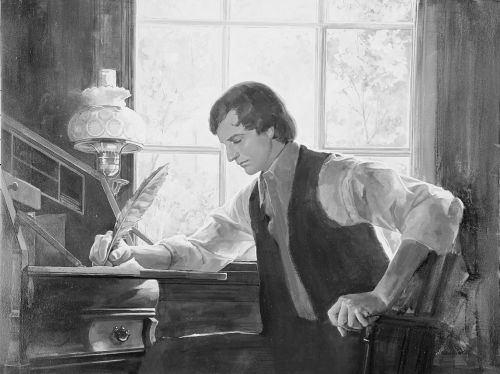
An artist’s depiction of Joseph Smith writing the Wentworth Letter which later became the canonized, “Articles of Faith”.

Appendix I: The Backstory of the Articles of Faith
by Fred W. Anson
From the official LdS Church website:

The Articles of Faith outline 13 basic points of belief of The Church of Jesus Christ of Latter-day Saints. The Prophet Joseph Smith first wrote them in a letter to John Wentworth, a newspaper editor, in response to Mr. Wentworth’s request to know what members of the Church believe. They were subsequently published in Church periodicals. They are now regarded as scripture and included in the Pearl of Great Price.
(Church of Jesus Christ of Latter-day Saints, “Gospel Topics: The Articles of Faith”, official LdS Church Website; retrieved 2022-02-05) 

It has been noted that the Articles of Faith, which was originally called “The Wentworth Letter”, was deliberately word crafted by Joseph Smith to sound “Christian” and downplay any unorthodox or controversial Latter-day Saint doctrine because it was written for an outsider, Christian audience. As the neutral source Wikipedia explains: 

“The “Wentworth letter” was a letter written in 1842 by Latter Day Saint movement founder Joseph Smith to “Long” John Wentworth, editor and proprietor of the Chicago Democrat. It outlined the history of the Latter Day Saint movement up to that time, and included Mormonism’s Articles of Faith.

The letter was written in response to Wentworth’s inquiry on behalf of one of his friends, George Barstow, who was writing a history of New Hampshire. The letter was first published on March 1, 1842, in the Times and Seasons in Nauvoo, Illinois.

A similar letter (with some slight revisions) was published by Daniel Rupp in 1844 in a book called An Original History of the Religious Denominations at Present Existing in the United States.”
(Wikipedia, “Wentworth letter”; retrieved 2002-02-05) 

In addition, the Wikipedia article notes that “The wording of some of the articles was modified in 1851 and 1902” (Ibid). Regardless, the fact of the matter remains that the Articles of Faith have never truly been reflective of Mormon Theology or orthodoxy. And it has always been used as a kind of Public Relations tool to buttress and protect the LdS Church from outside criticism of its unique doctrine – the stuff that mainstream Christians might find offensive or evidence of the lack of true biblical orthodoxy. In other words, it has never met the standard of honesty that the LdS Church itself teaches which includes the following criterion:

“There are many other forms of lying. When we speak untruths, we are guilty of lying. We can also intentionally deceive others by a gesture or a look, by silence, or by telling only part of the truth. Whenever we lead people in any way to believe something that is not true, we are not being honest.”
(Church of Jesus Christ of Latter-day Saints, “Gospel Principless” Chapter 31, “Honesty”, official LdS Church Website; retrieved 2013-06-29) 

Therefore, Michael Flournoy’s “The LDS Articles of Faith: Honest Version” may, in fact, be the first version of the Articles of Faith that is truly representative of current Brighamite doctrine, theology, and practices. 

note: The current canonized version of “The Articles of Faith of The Church of Jesus Christ of Latter-day Saints” can be read by clicking here.

About Michael “The Ex-Mormon Apologist” Flournoy
The Ex-Mormon Apologist was a Born Into The Covenant Mormon. His Mormon heritage dates back to a family member, Jones Flournoy, who sold Joseph Smith land for the Temple Lot temple. He faithfully served a mission in Anaheim, CA. When he returned from his mission he became a published Mormon Apologist. He served several callings faithfully and successfully in his 30+ years in the LdS Church. He still has Mormon friends and family members to this day. He is still in Mormon Studies despite leaving the LdS Church.
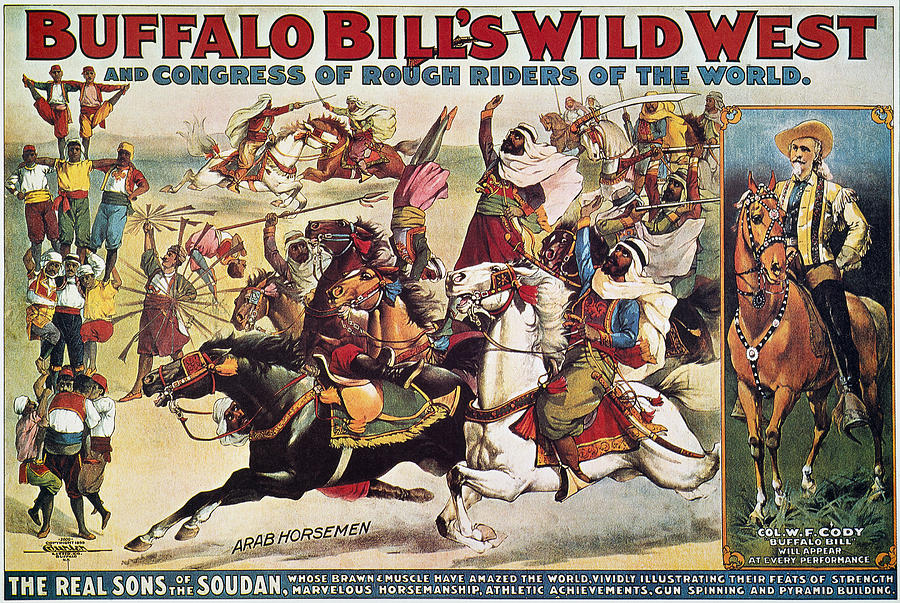

by Fred W. Anson
Dime Novels are as American as baseball, apple pie, and Chevrolet. They are so entrenched in the American psyche and culture that most consumers of American Pop Culture have been exposed to the Dime Novel genre even if they have never actually seen or read a Dime Novel. As Wikipedia explains: 

“The dime novel is a form of late 19th-century and early 20th-century U.S. popular fiction issued in series of inexpensive paperbound editions. The term dime novel has been used as a catchall term for several different but related forms, referring to story papers, five- and ten-cent weeklies, “thick book” reprints, and sometimes early pulp magazines. The term was used as a title as late as 1940, in the short-lived pulp magazine Western Dime Novels. In the modern age, the term dime novel has been used to refer to quickly written, lurid potboilers, usually as a pejorative to describe a sensationalized but superficial literary work.”
(Wikipedia, “Dime Novel”

If you have ever seen an early 20th Century Western, or Mystery that was produced in America you have been exposed to Dime Novel fiction. American Television, Radio, Movies, popular literature, and plays all followed the Dime Novel formula which was as follows: 

“[Western] Protagonists would often come into conflict with Native Americans, which would become a recurring feature of the genre and lend it a reputation for racism and jingoism. These stories are occasionally fictional accounts of real historical figures, such as Davy Crockett and Daniel Boone, but more often the characters are completely fictional, like Nick Whiffles. It wasn’t long before the setting of these novels shifted to the contemporary Western frontier, especially mining camps in the Dakotas and California. At first, outlaws, gamblers, and other anti-heroes were especially popular, such as Edward L. Wheeler’s Deadwood Dick or real-life gang leader Jesse James. These characters were almost always driven to a life of crime by their circumstances, but often had basically good intentions. With growing concerns about the moral appropriateness of dime novels for children, however, stories about cowboys and plainsmen came to replace outlaws…

At the dawn of the dime novel era, historical fiction was almost as popular as Western stories, with tales about the American Revolutionary War and the War of 1812 predominating. In many ways, America’s popular conception of its early history can be attributed to these novels, which often focused on the exploits of self-reliant patriots, either spies or privateers, who would heroically stand up against English and Tory oppression…

Real historical figures sometimes featured in these novels, like George Washington or Ulysses S. Grant, but more often these stories deal with few real historical events or characters, even sometimes leaving the date unspecified (e.g. 187-). When historical figures do appear, their character is often based on their popular conception, with seldom any relation to reality.”
(North Illinois University, “Nickels and Dimes: Genre”)

For those of us who have read through the Book of Mormon at least once is this all beginning to sound eerily familiar: 

      • Morality Plays
      • War Rhetoric
      • Battlefield Narratives
      • Racism
      • Jingoism
      • Patriotism
      • Cardboard, Two-Dimensional characters
      • Heroes (the “White Hats”) 
      • Outlaws (the “Black Hats”) 
      • Self Reliant Patriots (fighting to defend their religion, freedom, peace, and families)
      • Spies 
      • Privateers
      • Real Historical Figures inserted into fictional settings

Interesting, isn’t it? Now consider all the above in light of the following excerpts from the Book of Mormon: 

Mosiah 19:4-7
And now there was a man among them whose name was Gideon, and he being a strong man and an enemy to the king, therefore he drew his sword, and swore in his wrath that he would slay the king.

And it came to pass that he fought with the king; and when the king saw that he was about to overpower him, he fled and ran and got upon the tower which was near the temple.

And Gideon pursued after him and was about to get upon the tower to slay the king, and the king cast his eyes round about towards the land of Shemlon, and behold, the army of the Lamanites were within the borders of the land.

And now the king cried out in the anguish of his soul, saying: Gideon, spare me, for the Lamanites are upon us, and they will destroy us; yea, they will destroy my people.

Now just recontextualize that for the Old West with guns, Sheriffs and Desperados and you have a great Western story, don’t you? 

Helaman 6:16-20
And in the commencement of the sixty and seventh year the people began to grow exceedingly wicked again.

For behold, the Lord had blessed them so long with the riches of the world that they had not been stirred up to anger, to wars, nor to bloodshed; therefore they began to set their hearts upon their riches; yea, they began to seek to get gain that they might be lifted up one above another; therefore they began to commit secret murders, and to rob and to plunder, that they might get gain.

And now behold, those murderers and plunderers were a band who had been formed by Kishkumen and Gadianton. And now it had come to pass that there were many, even among the Nephites, of Gadianton’s band. But behold, they were more numerous among the more wicked part of the Lamanites. And they were called Gadianton’s robbers and murderers.

And it was they who did murder the chief judge Cezoram, and his son, while in the judgment-seat; and behold, they were not found.

And now it came to pass that when the Lamanites found that there were robbers among them they were exceedingly sorrowful; and they did use every means in their power to destroy them off the face of the earth.

And there it is, another otherwise good territory has privateering outlaws running amuck. So the good guys have to hunt down them and clear them out. Several exciting armed conflicts ensue. Sound familiar?

Alma 46:19-24, 34-36
And when Moroni had said these words, he went forth among the people, waving the rent part of his garment in the air, that all might see the writing which he had written upon the rent part, and crying with a loud voice, saying:

Behold, whosoever will maintain this title upon the land, let them come forth in the strength of the Lord, and enter into a covenant that they will maintain their rights, and their religion, that the Lord God may bless them.

And it came to pass that when Moroni had proclaimed these words, behold, the people came running together with their armor girded about their loins, rending their garments in token, or as a covenant, that they would not forsake the Lord their God; or, in other words, if they should transgress the commandments of God, or fall into transgression, and be ashamed to take upon them the name of Christ, the Lord should rend them even as they had rent their garments.

Now this was the covenant which they made, and they cast their garments at the feet of Moroni, saying: We covenant with our God, that we shall be destroyed, even as our brethren in the land northward, if we shall fall into transgression; yea, he may cast us at the feet of our enemies, even as we have cast our garments at thy feet to be trodden under foot, if we shall fall into transgression.

Moroni said unto them: Behold, we are a remnant of the seed of Jacob; yea, we are a remnant of the seed of Joseph, whose coat was rent by his brethren into many pieces; yea, and now behold, let us remember to keep the commandments of God, or our garments shall be rent by our brethren, and we be cast into prison, or be sold, or be slain.

Yea, let us preserve our liberty as a remnant of Joseph; yea, let us remember the words of Jacob, before his death, for behold, he saw that a part of the remnant of the coat of Joseph was preserved and had not decayed. And he said—Even as this remnant of garment of my son hath been preserved, so shall a remnant of the seed of my son be preserved by the hand of God, and be taken unto himself, while the remainder of the seed of Joseph shall perish, even as the remnant of his garment…

Now, Moroni being a man who was appointed by the chief judges and the voice of the people, therefore he had power according to his will with the armies of the Nephites, to establish and to exercise authority over them.

And it came to pass that whomsoever of the Amalickiahites that would not enter into a covenant to support the cause of freedom, that they might maintain a free government, he caused to be put to death; and there were but few who denied the covenant of freedom.

And it came to pass also, that he caused the title of liberty to be hoisted upon every tower which was in all the land, which was possessed by the Nephites; and thus Moroni planted the standard of liberty among the Nephites.

I can almost feel the flag fluttering in the air while Moroni proudly hugs his scripture to his chest, can’t you? Haven’t we all seen this scene before somewhere… 

The Jay Ward cartoon characters Dudley Do-Right and his nemesis Snidely Whiplash were satirical takes on Dime Novel heroes and villains as they manifested themselves in the American Silent Film era.

1 Nephi 4:6-27
And I was led by the Spirit, not knowing beforehand the things which I should do.

Nevertheless I went forth, and as I came near unto the house of Laban I beheld a man, and he had fallen to the earth before me, for he was drunken with wine.

And when I came to him I found that it was Laban.

And I beheld his sword, and I drew it forth from the sheath thereof; and the hilt thereof was of pure gold, and the workmanship thereof was exceedingly fine, and I saw that the blade thereof was of the most precious steel.

And it came to pass that I was constrained by the Spirit that I should kill Laban; but I said in my heart: Never at any time have I shed the blood of man. And I shrunk and would that I might not slay him.

And the Spirit said unto me again: Behold the Lord hath delivered him into thy hands. Yea, and I also knew that he had sought to take away mine own life; yea, and he would not hearken unto the commandments of the Lord; and he also had taken away our property.

And it came to pass that the Spirit said unto me again: Slay him, for the Lord hath delivered him into thy hands;

Behold the Lord slayeth the wicked to bring forth his righteous purposes. It is better that one man should perish than that a nation should dwindle and perish in unbelief.

And now, when I, Nephi, had heard these words, I remembered the words of the Lord which he spake unto me in the wilderness, saying that: Inasmuch as thy seed shall keep my commandments, they shall prosper in the land of promise.

Yea, and I also thought that they could not keep the commandments of the Lord according to the law of Moses, save they should have the law.

And I also knew that the law was engraven upon the plates of brass.

And again, I knew that the Lord had delivered Laban into my hands for this cause—that I might obtain the records according to his commandments.

Therefore I did obey the voice of the Spirit, and took Laban by the hair of the head, and I smote off his head with his own sword.

And after I had smitten off his head with his own sword, I took the garments of Laban and put them upon mine own body; yea, even every whit; and I did gird on his armor about my loins.

And after I had done this, I went forth unto the treasury of Laban. And as I went forth towards the treasury of Laban, behold, I saw the servant of Laban who had the keys of the treasury. And I commanded him in the voice of Laban, that he should go with me into the treasury.

And he supposed me to be his master, Laban, for he beheld the garments and also the sword girded about my loins.

And he spake unto me concerning the elders of the Jews, he knowing that his master, Laban, had been out by night among them.

And I spake unto him as if it had been Laban.

And I also spake unto him that I should carry the engravings, which were upon the plates of brass, to my elder brethren, who were without the walls.

And I also bade him that he should follow me.

And he, supposing that I spake of the brethren of the church, and that I was truly that Laban whom I had slain, wherefore he did follow me.

And he spake unto me many times concerning the elders of the Jews, as I went forth unto my brethren, who were without the walls.

And there you have it, a good and righteous man is forced to slay an evil villain for the sake of the greater good due to circumstances beyond his control. Surely this is one that we’ve never heard before, well, except for in just about every Dime Novel Western Hero story ever, that is, of course.

I think you get the idea, here. I would encourage you to read (or reread) the Book of Mormon in light of these Dime Novel genre formulations and consider how they just pop out at you. 

Consider, for example, The “Dudley Do-Rightism” of the courageous and righteous Nephi against the constant malice and murmurings of the scheming and the conniving “Snidely Whiplash” characters of Laman and Lemuel in the opening books of the Book of Mormon. 

Then compare and contrast those simplistic protagonists and antagonists against the deep, complex, characters in the Bible. The biblical characters are never cardboard, they’re deep and conflicted. Case in point, King David was a man after God’s whole heart due to his devotion and passion for God, but he was also a murderer and an adulterer. This isn’t a superficial, shallow, easily understood, literary figure, is it? 

Ditto for Noah who God calls just and perfect (see Genesis 6:9) but who still manages to get crazy, drunk, and naked in the midst of God’s calling on his life. Furthermore, the Noah narrative in the Bible, it has been noted, has strong parallels to the Sumerian and Babylonian flood narratives (see Wikipedia, “Gilgamesh Flood Myth”)And let’s not forget the book of Job for which there are similar “lamentation songs” and stories from the ancient Mesopotamian basin (see, for example, Morris Jastrow, Jr., “A Babylonian Parallel to the Story of Job”)Thus, regardless of whether you believe that it’s divinely inspired or not, the body of evidence is clear that the Bible is indeed ancient, Middle Eastern literature.

On the other hand, The Book of Mormon claims to be an ancient work of Middle Eastern origin but is actually more reflective of a uniquely American literary genre from the 19th Century – which would suggest that it is neither. Rather, it is strongly suggestive of American culture in general and 19th Century American culture in particular. Couple that with the fact that as of a decade ago, 150-Million copies of The Book of Mormon had been published (see LdS Newsroom, “Book of Mormon Reaches 150-Million Copies”) and you will understand why my assertion is that based on the body of evidence, The Book of Mormon is, quite simply, the most successful 19th Century Dime Novel in history. 

Presenting the Most Successful 19th Century Dime Novel in History.

A 19th Century etching of Alexander Campbell preaching at the 1801 Cane Ridge Revival, the birthplace of the American Restorationist Movement.

From “Andrew” A Mormon Source

What follows is an excerpt from a review of David Bercot’s book, “Will the Real Heretics Please Stand Up” that was published on the Mormon-friendly website “Mormon Matters” in 2009. The full, original article can be found by clicking here. — Fred W. Anson

“Another movement to restore primitive Christianity sprung up in America in the early 1800s out of the Presbyterian church. . . . Barton W. Stone, a Presbyterian minister, began a movement in Kentucky to restore apostolic Christianity. Stone’s chief objective was to restore the holy living and separation from the world that had marked early Christianity.

In the 1820s, Stone’s movement merged with a separate movement begun by Thomas and Alexander Campbell, who were also seeking to restore primitive Christianity. One of Alexander Campbell’s primary objectives was to achieve unity among all Christians, forsaking all man-made creeds and traditions and returning to the forms, structures, and doctrines of the apostolic church.”
(David Bercot, “Will the Real Heretics Please Stand Up”, p. 151)

Both Stone and the Campbells published journals urging a Restoration of the Early Church in the early 1800’s (The Christian Baptist, Millennial Harbinger, and The Christian Messenger).

Those familiar with Mormon history will recognize the names of Thomas and Alexander Campbell as the founders of the “Campbellite” Restoration movement that Sidney Rigdon, Parley Pratt, Edward Partridge, Isaac Morley, and at one point a majority of all Mormons belonged to before converting to Mormonism. When Sidney Ridgon read the Book of Mormon in 1830 while he was a Campbellite preacher, he converted to Mormonism as did many other Campbellites. This enormous influx of former Campbellites into Mormonism doubled the Church’s membership in three weeks and resulted in Joseph Smith relocating the Saints’ gathering place by joining the former Campbellite converts in Kirtland, Ohio.

Why was Mormonism so appealing to Campbellites? Starting in 1823, Campbell’s publication The Christian Baptist advocated an abandonment of all creeds and sects that divided Christendom and a restoration of a unified Church in which the “original gospel and order of things” are present. (Alexander Campbell, “The Christian Baptist”)

Alexander Campbell explained the Campbellites’ “distinguishing views and practices” as follows:
“They regard all the sects and parties of the Christian world as having, in greater or less degrees, departed from the simplicity of faith and manners of the first Christians, and as forming what the apostle Paul calls “the apostasy.” . . .

They look for unity of spirit and the bonds of peace in the practical acknowledgment of one faith, one Lord, one immersion, one hope, one body, one Spirit, one God and Father of all; not in unity of opinions, nor in unity of forms, ceremonies, or modes of worship. . . .

Thus while they proclaim faith and repentance, or faith and a change of heart, as preparatory to immersion, remission, and the gift of the Holy Spirit, they say to all penitents, or all those who believe and repent of their sins, as Peter said to the first audience addressed after the Holy Spirit was bestowed after the glorification of Jesus, “Be immersed every one of you, in the name of the Lord Jesus, for the remission of sins, and you shall receive the gift of the Holy Spirit.”

The immersed believers are congregated into societies according to their propinquity to each other, and taught to meet the first day of every week in honor and commemoration of the resurrection of Jesus, and to break the loaf which commemorates the death of the Son of God, to read and hear the living oracles, to teach and admonish one another, to unite in all prayer and praise, to contribute to the necessities of saints, and to perfect holiness in the fear of the Lord.

Every congregation chooses its own overseers and deacons, who preside over and administer the affairs of the congregations; and every church, either from itself or in co-operation with others, sends out, as opportunity offers, one or more evangelists, or proclaimers of the word, to preach the word and to immerse those who believe, to gather congregations, and to extend the knowledge of salvation where it is necessary, as far as their means extend.”
(Alexander Campbell, “The Christian Baptist”)

Although the Campbellites and Mormons held many other beliefs in common, the above provides a sampling of the types of similarities that have presented religion historians with a fascinating chicken-or-the-egg question: did Joseph Smith’s teachings resemble the Early Church’s “original gospel and order of things” because Joseph Smith was a true prophet of God whose authentic revelations enabled him to restore the true Church of Jesus Christ, or because contemporary Restorationists like Alexander Campbell first identified correct Early Christian beliefs and practices that were later adopted by Joseph Smith? In other words, did God use the broader Restoration movement of the American frontier as an “Elias” that prepared Rigdon and eventually thousands of souls to embrace the true Church of Jesus Christ restored later by Joseph Smith, or was Joseph Smith’s success in duplicating many Early Christian beliefs and practices the result of his simply mimicking the beliefs and practices of contemporary Restorationist preachers who got it right first.

Because Campbellite converts to Mormonism such as Parley Pratt reported that they were converted Mormonism because they were inspired by the truthfulness of the doctrine contained in the Book of Mormon (Parley Pratt, “Autobiography of Parley Parker Pratt”, Chapter 1), it seems the answer to that question depends on whether the Book of Mormon is an accurate translation of an authentic record compiled by Early Christians living on the American continent, or is a fabrication cobbled together by Smith and possibly others inspired by the Restorationist ethos that pervaded the American frontier when it was published. (We know where Alexander Campbell stood on that question: in 1831 he denounced the Book of Mormon as a fraud because it all-too-coincidentally addressed “every error and every truth discussed in New York for the last ten years.” (Alexander Campbell, “The Mormonites,” Millenial Harbinger 2, (January 1831): 93.)

(source: Andrew, “Will the Real Heretics Please Stand Up” (Book Review), Mormon Matters website)

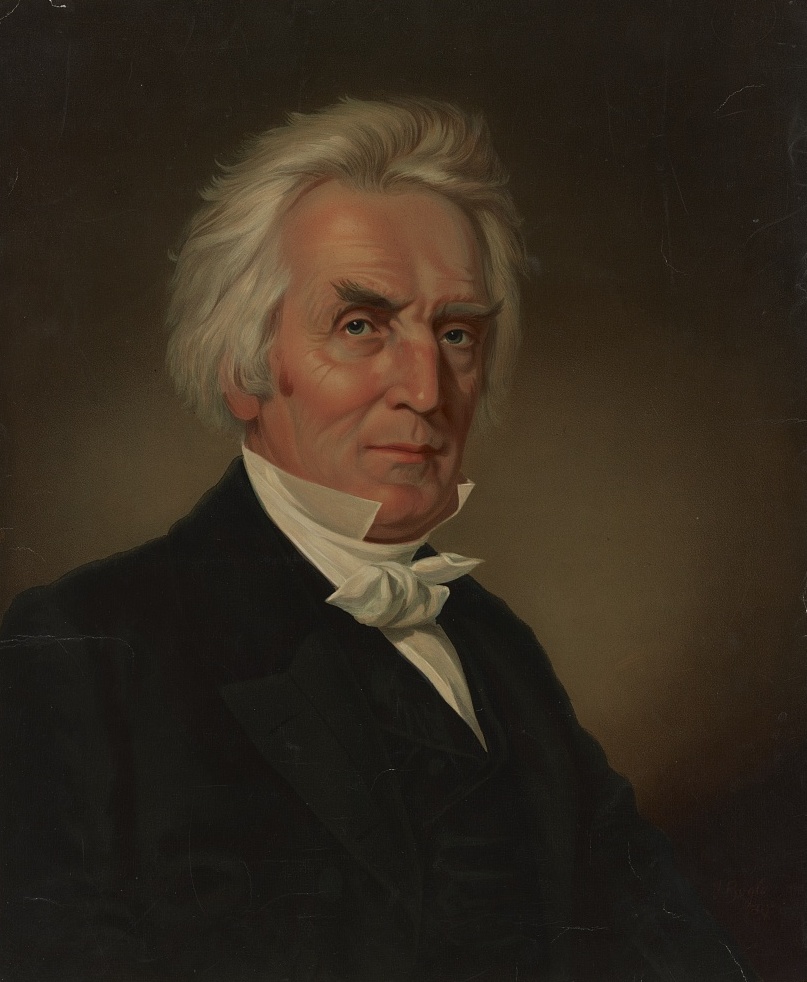
Alexander Campbell (1788-1866) from a period life portrait painting.

compiled by Fred W. Anson
A common refrain from the LdS Church and other Latter Day Saint sources is that founding Prophet, Joseph Smith, Jr. wasn’t motivated by money in the founding and perpetuation of Mormonism in general and in his role as the Great Prophet of the Restoration in particular. If this is the case then why does the historical record clearly indicate that he benefited financially from both? Please consider the following two summations of the body of evidence.

First, from renowned Mormon Historian, D. Michael Quinn’s last book:

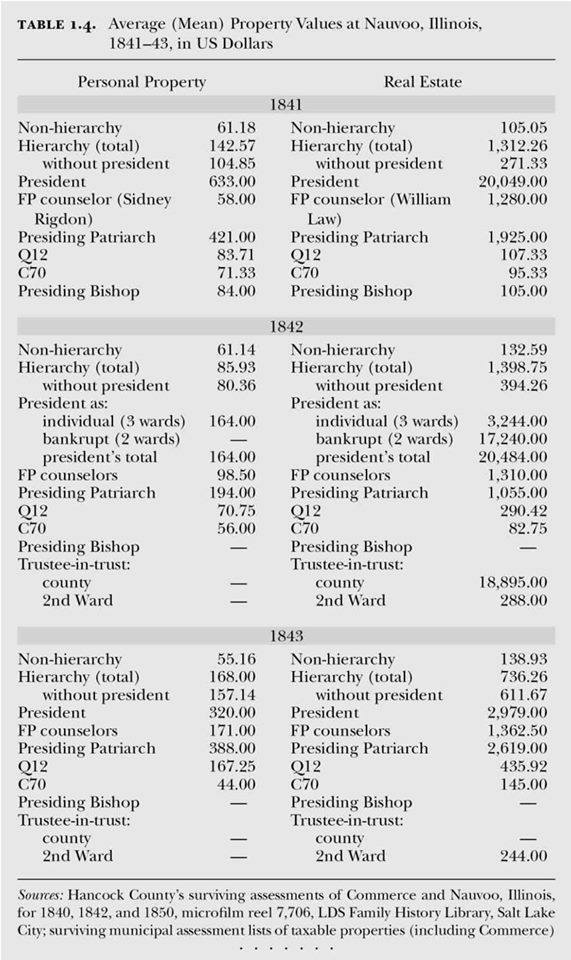
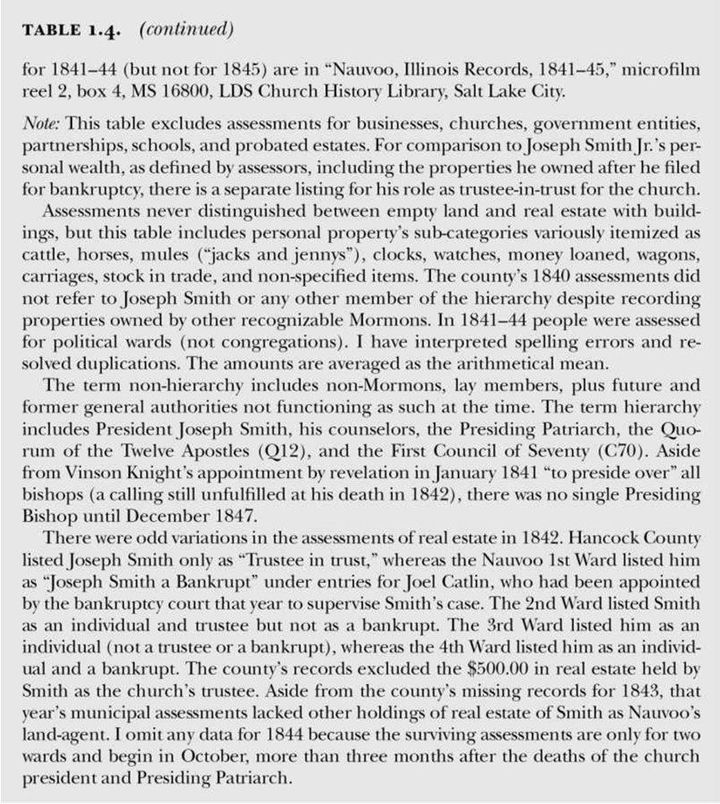
“The municipal assessment rolls for taxation from 1841 to 1843 show an unprecedented divergence between the church president’s assessed wealth and everyone else’s (table 1.4). This was not simply due to Joseph Smith’s role as trustee-in-trust after 1841, because LDS assessors itemized his personal real estate as distinct from each parcel of land he owned as the church’s trustee. . . . in 1842 and 1843, Smith’s personal ownership of land remained at least twenty-one times higher than for Nauvoo’s average resident. His personal property (non-land wealth) remained at least 2.7 times greater than for Nauvoo’s non-hierarchy. During those years, he also owned at least twice as much personal property than the average general authority, and his personal ownership of land remained at least 4.9 times their average.”
(D. Michael Quinn, “The Mormon Hierarchy: Wealth and Corporate Power”, Kindle Locations 507-516. Signature Books. Kindle Edition)

D. Michael Quinn, “The Mormon Hierarchy: Wealth and Corporate Power” Table 1.4 (part one)

D. Michael Quinn, “The Mormon Hierarchy: Wealth and Corporate Power” Table 1.4 (part two)

Second, from the RfM (Recovery from Mormonism) website archives:

1. Joseph Smith cleared over $73,000 in debt by filing for bankruptcy in 1842 (his brothers Hyrum and Samuel, along with other LDS dignitaries took advantage of a brief window where Congress enacted a lenient bankruptcy law only to rescind it months later when $440 million in liabilities in the country were wiped clean for $44 million in assets). Joseph’s $73k debt represented nearly $2 million in 2010 dollars. [see Dallin H. Oaks & Joseph I. Bentley, “Joseph Smith and Legal Process: In the Wake of the Steamboat Nauvoo”, pp.767-782; https://digitalcommons.law.byu.edu/cgi/viewcontent.cgi?article=1087&context=lawreview]

2. By Joseph’s own account, he owed approximately $70,000 again by the time he was killed just 2 years later in 1844 (over $1.84 million in 2010 dollars). [see Dallin H. Oaks & Joseph I. Bentley, “Joseph Smith and Legal Process: In the Wake of the Steamboat Nauvoo”, pp.767-782; https://digitalcommons.law.byu.edu/cgi/viewcontent.cgi?article=1087&context=lawreview]

3. LAND SPECULATION. Nauvoo land purchased for $2 per acre, lots sold for average price of $500 per acre (minimum $200 per acre | maximum $800 per acre) multiply by factor of 25 to 28 for value in 2010 dollars—this is how frontier land speculation works when masses of people are gathered by revelation.

SPIRITUAL BLACKMAIL TO PROMOTE SALES.
February 13, 1843: I spent the evening at Elder Orson Hyde’s. In the course of conversation I remarked that those brethren who came here having money, and purchased without the Church and without counsel, must be cut off. This, with other observations, aroused the feelings of Brother Dixon, from Salem, Massachusetts, who was present, and he appeared in great wrath. [“History of the Church”, vol 5., ch.14, p.272; https://byustudies.byu.edu/content/volume-5-chapter-14]

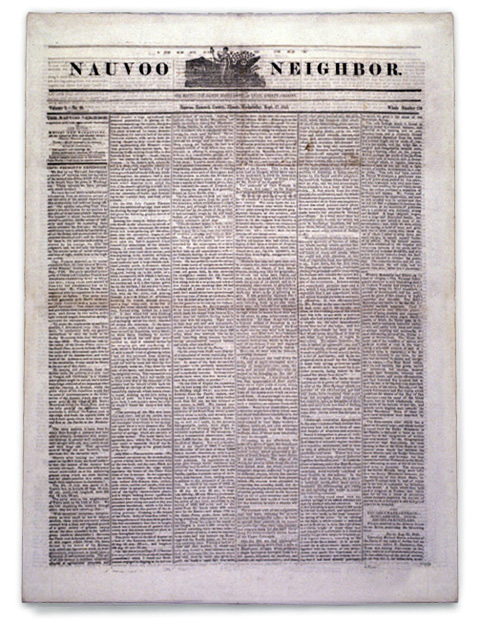
The Front Page of the Nauvoo Neighbor.

SPIRITUAL COERCION TO PROMOTE SALES.
[NOTE: “ The Nauvoo Neighbor was a weekly newspaper edited and published by Latter Day Saint Apostle John Taylor in Nauvoo, Illinois from 1843 to 1845. While it was not an official publication of the Church of Jesus Christ of Latter Day Saints, the Neighbor was consistently pro-Mormon and its primary target audience was the Latter Day Saint residents of Nauvoo. When The Wasp ceased publication in April 1843, the Neighbor replaced it as Nauvoo’s premier secular newspaper.” (Wikipedia, “Nauvoo Neighbor”; https://en.wikipedia.org/wiki/Nauvoo_Neighbor )]

———-BEGIN NAUVOO NEIGHBOR EXCERPT ———-

20 December 1843, Nauvoo Neighbor 37: To Emigrants and Latter-Day Saints Generally: I feel it my duty to say … that there is in the hands of the trustee in trust, a large quantity of lands, both in the city and adjoining townships in this county, which is for sale, some of which belongs to the Church and is designed for the benefit of the poor, and also to liquidate debts owing to the Church, for which the trustee in trust is responsible. Some, also, is land which has been consecrated for the building of the Temple and the Nauvoo House.If the brethern who move in here and want an inheritance, will buy their lands of the trustee in trust, they will thereby benefit the poor, the Temple, and the Nauvoo House, and even then only will be doing that which is their duty, and which I know, by considerable experience, will be vastly for their benefit and satisfaction in days to come. Let all the brethern, therefore, whey they move into Nauvoo, consult President Joseph Smith, the trustee in trust, and purchase their lands of him; and I am bold to say that God will bless them. …We hold ourselves ready at any time to wait upon the brethern and show them the lands … and can be found any day, either at President Joseph Smith’s bar-room, or the Temple Recorder’s office at the Temple.

———- END NAUVOO NEIGHBOR EXCERPT ———-

4. ABUSE OF POWER.
Nauvoo city council awarded Joseph Smith sole right to sell liquor in city limits. He established bar in Mansion House/Hotel for that purpose, but Emma forced him to remove it by threatening to take the kids and move back to the Homestead house.

5. ASSETS OWNED BY JOSEPH/EMMA:
• Joseph Smith Mansion House (http://en.wikipedia.org/wiki/Joseph_Smith_Mansion_House)
• Nauvoo House built by order of revelation at the Church’s expense (http://en.wikipedia.org/wiki/Nauvoo_House)
• Homestead house in Nauvoo (http://cofchrist.org/js/homestead/default.asp)
• Brigham Young claimed that Emma owned $50,000 in *city property* when they finished settling the assets with Emma ($1.4 million in 2010 dollars). This apparently referred to the Hugh White purchase which Joseph had deeded to her before his death (http://www.dialoguejournal.com/wp-content/uploads/sbi/articles/Dialogue_V17N03_89.pdf).
• Quincy property (aka Cleveland farm)
• One or more additional farms (Brigham Young twice used the plural when referring to farms given to Emma, saying that “besides these farms she owned city property worth fifty thousand dollars”).
• Owned at least two steamships: the Maid of Iowa and the Nauvoo (Joseph Smith owed a debt on the latter at the time of his death that was settled for over $5,000 (over $140,000 in 2010 dollars). [see Dallin H. Oaks & Joseph I. Bentley, “Joseph Smith and Legal Process: In the Wake of the Steamboat Nauvoo”, pp.767-782; https://digitalcommons.law.byu.edu/cgi/viewcontent.cgi?article=1087&context=lawreview]
• Steamship docks (ownership was under dispute—still looking for more info on this one).
• Egyptian papyrus and mummies purchased by friends of Joseph Smith for $2,400 in 1835 ($60,000 in 2010 dollars).
• Mother Smith would charge admission (25 cents or around $7 in 2010 dollars) to see the Egyptian mummies and papyrus. Lying, Joseph reportedly told visitors that his mother had purchased them herself for $6,000 ($150,000 in 2010 dollars).
• They remained in the Smith family until Emma sold them shortly after Lucy Mack Smith’s death in 1855.
(source = http://exmormon.org/phorum/read.php?2,1190844,1220856 )

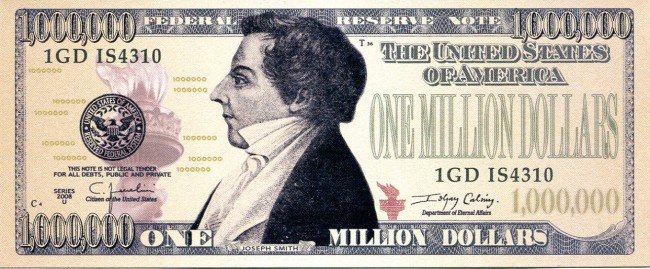
Banner Art: A fictional Million-Dollar Bill featuring Joseph Smith’s profile that was produced by Mormonism Research Mormonism (MRM) a few years ago.

An Explanation of Sanctification for Latter-day Saints

“Come unto me, all ye that labour and are heavy laden, and I will give you rest. Take my yoke upon you, and learn of me; for I am meek and lowly in heart: and ye shall find rest unto your souls. For my yoke is easy, and my burden is light.”
Matthew 11:28-30 (KJV)

by Michael Flournoy
In a previous article, I described two types of gospels: the gospel of amputation and the gospel of imputation. The gospel of amputation says we must remove the sin from our lives in order to become righteous. Since this includes sins of omission, we must also do all that God requires. In short, this is the gospel of obedience rewarded by grace. It also happens to be the gospel Latter-day Saints adhere to.

If you’re LDS reading this, there’s about a 50% chance you take umbrage at what I just said. However, I can be reasonably sure that I’ve spoken the truth based solely on the fact that the LDS church is a religion. 

Let me ask you a few questions. Does an ordinance bring you into a covenantal relationship with God? Can major sins overturn that relationship? If another religion showed up that did baptisms and sealings for the dead, would they be discredited as a false church? If the answer to any of these questions is yes, then you’re an adherent of amputation. I’m fully aware that some Latter-day Saints prefer grace over obedience. But even if you only have to keep one commandment and it’s the equivalent of clipping a fingernail, that still falls within the bounds of amputation. 

Imputation is the opposite proposition. Instead of cutting off sin, we put on the righteousness of Christ. This righteousness drowns out our wickedness and immediately makes us worthy of the Father’s presence. What’s more, it occurs before we obey commandments or undergo a single ordinance. Since obedience doesn’t lead to salvation, our sin can’t undo salvation. It’s not even in the equation. And if another religion pops up that does ordinances like baptism, but claims they’re saved by faith first, they are considered a legitimate faith. 

This is why many Protestant denominations can coexist, but the LDS Church can’t tolerate another organization appropriating their temples and performing their rites. If another religion does baptisms, those baptisms are considered illegitimate by the LDS church. Again, this is because The Church of Jesus Christ of Latter-day Saints ties the ordinances themselves to eternal life. Once a religion does this, they must claim exclusive rights to their rituals, or else there would be no need for their faith. This is true not only of your religion but of every belief system on earth. 

The exception is those that believe in imputed righteousness. Those who accept Christ and His vicarious work on the cross become His children and are immediately and forever worthy of eternal life.  After we are declared perfect in Christ, we enter a sanctification process whereby we grow closer to God in love and trust. Our hearts are gradually changed so we desire the things of God. In practice, this isn’t all that different from how Latter-day Saints live out their lives. 

The difference is twofold. First, grace acts as a safety net to catch us when we fall, thus keeping us inside the covenant. And second, we don’t have to reach a certain stage of sanctification to gain eternal life, since we are worthy the moment we’re born again through faith. 

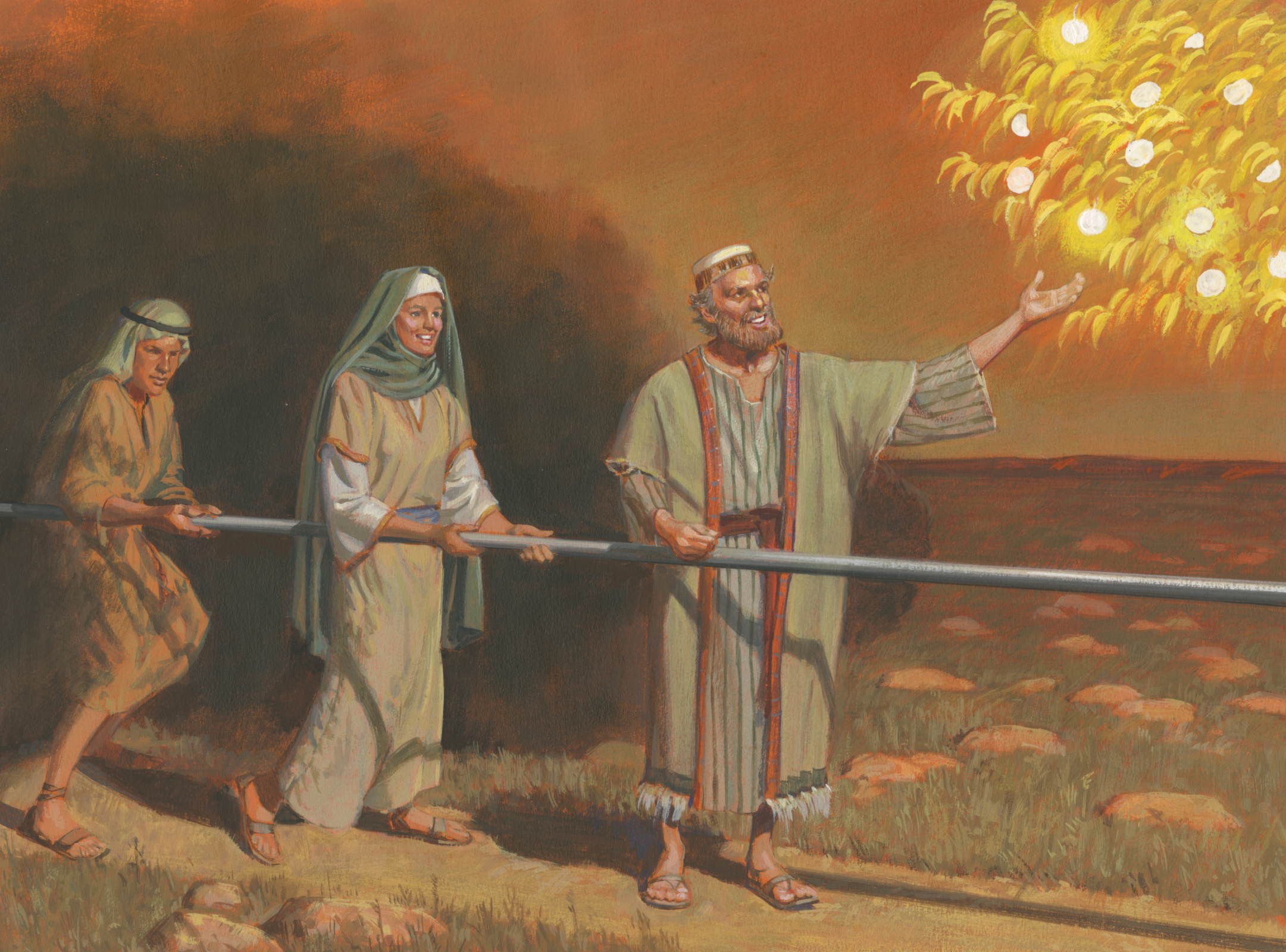
A painting by Jerry Thompson depicting Lehi reaching for the fruit of the tree of life while holding onto the iron rod; (from the official and correlation LdS Church “Primary Manual 4-14”).

The Iron Rod
To demonstrate these two gospels, let’s look at a well-known Book of Mormon analogy: the iron rod. Lehi has a dream in 1 Nephi 8, where he sees a rod of iron leading to the tree of life. Throngs of people hold tight to this rod as they make their way to the tree. This is a good representation of the gospel of amputation.

The tree symbolizing the love of God lies at the end of the path and effort is required to get there. The journey is treacherous, and many fall into forbidden paths and are lost. Others wander into filthy waters and drown therein. Even after reaching the tree and partaking of the fruit, some are embarrassed by the mocking of onlookers in a great and spacious building. They discard the fruit and enter the building, which later collapses.

The point is, there’s no assurance in the gospel of amputation. There’s no point in the journey where anyone can rest in the knowledge that their salvation is secure. Even after reaching the end of the journey and partaking in the love of God, they can be coaxed away. But what if I told you there’s another route to the tree?

After wandering around in the darkness for hours, Lehi prays for mercy and the darkness subsides. He finds himself in a spacious field near the tree. He simply walks up and eats the fruit. And he’s not the only one to forgo the rod. Nephi, Sam, and Sariah also approach the tree without using it. Of the four of them, none are lost to forbidden paths or drowned in the filthy waters, making this path far superior to the iron rod.

Imputation teaches that Christ already did the hard work of obeying God’s word. He made it past the iron rod, planted the tree of life, and built an escalator to heaven. This is the path of mercy. Justice is satisfied that Christ walked the path, and now Jesus can take us straight to the tree. The tree isn’t the end of the path, it’s the beginning.

Once we board the escalator through faith, we can rest assured that our salvation is secure in the blood of the lamb. There’s no way to get off and wander into the swamps of damnation. Our future in heaven with the Father, Son, and Holy Spirit is an absolute certainty. 

Sealed for Eternity
When faced with salvation by faith alone, Latter-day Saints often ask what role obedience plays. Allow me to answer that with an analogy about marriage.  When we get married to someone, all we have to do is say the words, “I do.” We don’t enter this relationship to earn the other person’s love, rather we marry as a result of that love.

Contrary to what fairy tales teach, the story doesn’t end at marriage. It’s the beginning of the adventure. It’s a rollercoaster of highs and lows. It’s an opportunity to grow closer to your spouse and learn to trust each other. But even during the tumultuous drops, the marriage covenant remains intact.  Nothing changes within us when we enter this relationship. There’s no transformation of character shouting to the world that we’re married. A couple may wear rings as an outward sign of their devotion, but that isn’t what makes them married. What makes them married is simply a legal declaration that they are. 

Now let’s pretend the bride was 100,000 dollars in debt on the day of the wedding but she married a billionaire. By virtue of her husband’s name, she is now a billionaire too despite all that debt. That’s how imputation works. We take Christ’s name upon us and acquire His righteousness. The difference is, His righteousness is infinite. So there’s nothing we can do to make up the difference or slide back into spiritual debt. 

In my analogy, the husband may teach his bride to be wiser with money, but that comes after the marriage. In the same way, God’s word is a standard to teach us morality, but our covenantal relationship with Him predates our obedience. Consider this question by the apostle Paul: when was Abraham counted righteous? Was it before or after he was circumcised? He answers that it was before circumcision and explains why in Romans 5:11-13 (KJV) which reads:

“And he received the sign of circumcision, a seal of the righteousness of the faith which he had yet being uncircumcised: that he might be the father of all them that believe, though they be not circumcised; that righteousness might be imputed unto them also:  

And the father of circumcision to them who are not of the circumcision only, but who also walk in the steps of that faith of our father Abraham, which he had being yet uncircumcised.  

For the promise, that he should be the heir of the world, was not to Abraham, or to his seed, through the law, but through the righteousness of faith.”

“And Jesus said unto him, Thou hast both seen him, and it is he that talketh with thee. And he said, Lord, I believe. And he worshipped him.” (John 9:37-38 KJV)

Can Salvation Be Lost?
Most Latter-day Saints balk at the idea that grace is sufficient for eternal life. They consider sola gratia to be “cheap grace” and a license to sin. Let’s shift over to a parent/child analogy. Some Latter-day Saints have told me they give rules to their children to teach them discipline, and argue that our loving Heavenly Father employs the same methods.

I agree, but with a caveat. Disobedience doesn’t undo the covenantal relationship. Can you imagine kicking your kid out of the house because he didn’t clean his room? Or disowning him because he told a lie? Or is your love unconditional? Do you value your relationship with your children, even when they do things you’re ashamed of? If your child grew up and said they hated you and walked away, wouldn’t they still be a son or daughter in your eyes?

I believe this resembles the relationship we have with God. When we sin, God doesn’t abandon us until we get our act together. If anything, He’s closer to us in these times, giving us the comfort and direction we desperately need. As Paul so eloquently preaches in Romans 5:20, “Moreover the law entered, that the offence might abound. But where sin abounded, grace did much more abound.”

This is evidenced in the story of David and Bathsheba. Not only does King David commit adultery, but he puts the woman’s husband on the front lines of the battle to die. When Nathan the prophet confronts him, David confesses his sin and Nathan replies: “The Lord also hath put away thy sin; thou shalt not die.” (2 Samuel 12:13) How great is God’s grace, and how boundless is His mercy that He could forgive so great a sin! Surely there is nothing cheap about grace like this. 

So to my LDS reader I ask, does the same God who forgave David of murder and adultery really take away salvation when we do less evil than that? Does the Jesus who died for us while we were yet sinners (Romans 5:8) abandon us because we’re still sinners? Jesus prayed for the very people who condemned him to death saying, “Father, forgive them; for they know not what they do.” (Luke 23:34 KJV) And I posit that it’s against Christ’s nature to turn around and disown His own children. 

But what about us? Can’t we turn our backs on Him? We can leave him, but He will move heaven and earth to bring us back to the fold. Ultimately, the question that needs to be asked is this: do we adopt God or does He adopt us? If God adopts us, what right do we have to nullify that? We can complain or act out in disobedience, but nothing we do can sever our relationship with Him. Even if we walk down an escalator, the stairs still work to bring us up.

Another disagreement Latter-day Saints have with Evangelicals is our tendency to say those who leave Christianity never believed in Jesus at all. But let me explain, using marriage as an example again. I was married to my first wife for nine years. At the end of it, she informed me that she wanted to date other men. When I protested, she filed for divorce. I spent months in a state of agony, reliving our most cherished memories, and yet they meant nothing to her. She saw my sorrow and wasn’t fazed. 

Did she fall out of love? No. The simpler explanation is she never loved me at all. What she felt for me was actually infatuation. Many people have an infatuation with the idea of God, but as soon as being a disciple becomes inconvenient, they abandon their Christian ideals. My friends, do not be deceived. Someone like this could never have loved God. 1 Corinthians 13:7 tells us that love bears all things, believes all things, hopes all things, and endures all things. If it doesn’t endure then it isn’t true love, is it? 

As a Latter-day Saint, you may say: people get divorced all the time. Doesn’t that prove someone can walk away from God’s covenantal relationship? Can’t we reject His love? The question of divorce was posed to Jesus by the Pharisees and He replied,

“For the hardness of your heart [Moses] wrote you this precept.  But from the beginning of the creation God made them male and female. For this cause shall a man leave his father and mother, and cleave to his wife; and they twain shall be one flesh: so then they are no more twain, but one flesh. What therefore God hath joined together, let not man put asunder.”
(Mark 10:5-9 KJV)

In other words, divorce is not a God thing, but a man thing. And according to the New Testament, Christ is our bridegroom (Matthew 25:5). If we have been sealed to Him, how can we be separated?

I would also note that love can’t be rejected. If someone loves us, that love is present whether we feel it or not. It’s there whether we want it or not. However, the rod of the iron gospel teaches the opposite. Since the tree in Lehi’s vision represents the love of God, we can infer that God’s love only covers those who make it to the shade the tree provides. He doesn’t love those who walk away from Him. He doesn’t love the lost, or even the ones obeying His word, because they haven’t endured to the end. This love must be earned, and therefore is not love at all. This resembles an abusive, narcissistic relationship more than it resembles real charity. Like the iron rod itself, this love will inevitably rust.  Contrast that with what Paul writes in Romans 8:35-39 (KJV):

“Who shall separate us from the love of Christ? Shall tribulation, or distress, or persecution, or famine, or nakedness, or peril, or sword? ‘As it is written, For thy sake we are killed all the day long; we are accounted as sheep for the slaughter.'” Nay, in all these things we are more than conquerors through him that loved us. For I am persuaded, that neither death, nor life, nor angels, nor principalities, nor powers, nor things present, nor things to come, nor height, nor depth, nor any other creature, shall be able to separate us from the love of God, which is in Christ Jesus our Lord.”

If you’re tired of fighting a losing battle to reach perfection, if broken covenants condemn you, if your sins have traded your peace with fear, and if a love that runs at the sight of your imperfections is what you’re used to, then I invite you to flee from it. You will never be or do enough in a gospel like that and you will never finish proving your worthiness. Instead, I invite you to embrace the unconditional, unending, fully accepting, ever merciful, totally sufficient, and all-encompassing love of Christ.

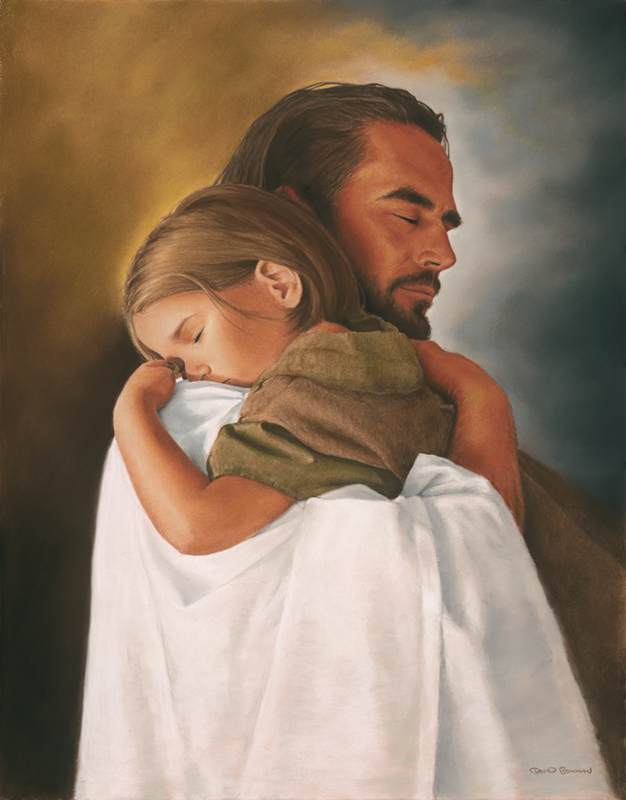
“Security” by David Bowman

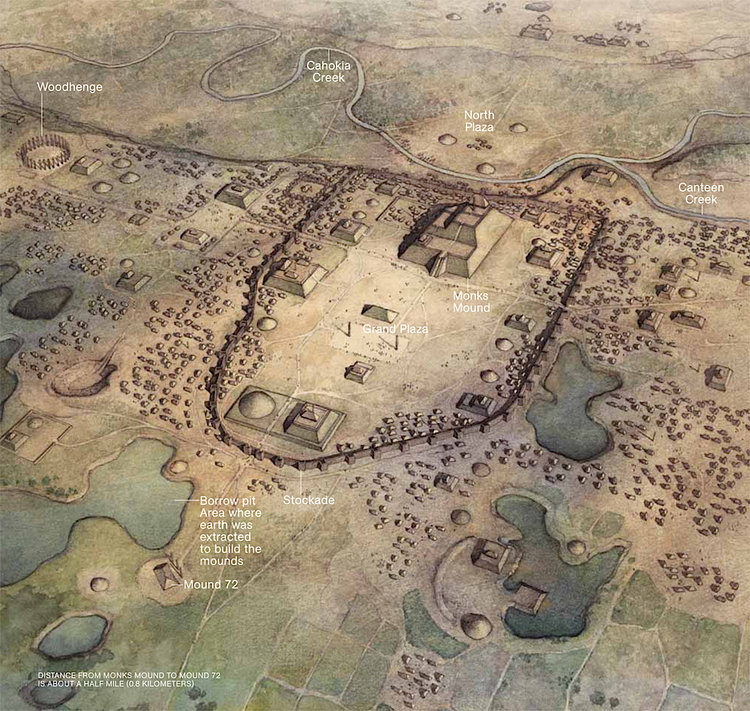
An artist’s interpretation of what downtown Cahokia would have looked like in the late Sterling period after the palisade wall had been built around Monk’s Mound and the Grand Plaza. credit: National Geographic (click to zoom)

compiled by Fred W. Anson
A common body of evidence that’s often presented by some Mormon faithful as the best evidence for The Book of Mormon is the Hopewell Mound Builder culture in general and the mount builder complex of Cahokia in particular. A well-known case in point is Rock Waterman’s article in which he attempts to make that very case, starting his lengthy treatise like this:

“What struck me when I first arrived in Cahokia was the incredible stink.

I had been called to serve in the Missouri-Independence Mission, but my first area, Plattsmouth, Nebraska, was far from any of the historic church locations I had expected to to see when I got my call. Now, near the end of 1973, I had been transferred to my second location. I would spend my first winter as a missionary in smelly Cahokia, Illinois; as far from Far West or Independence or Adam-Ondi-Ahman as a guy could possibly get.

The small town of Cahokia was located next to East St. Louis on the Illinois side of the Mississippi river, famous for its slaughterhouses. The smell of bovine death and gore hovered in the air long after slaughtering had ceased for the day, floating up and mixing with the rancid smoke spewed from the smokestacks of the nearby Monsanto chemical plant, then slowly settling down over the hapless town of Cahokia to choke its residents while they slept. “It’s something you just get used to,” my new companion told me.

Had I known then what I know now, I would have been delighted to find myself in Cahokia instead of dreading it. As it turns out, I had landed smack dab in the middle of Book of Mormon Central and never even knew it.”
(Rock Waterman, “Best Evidence For The Book of Mormon”, Pure Mormonism website, November 1, 2011)

Mr. Waterman then goes on to point to a long list of secular and Mormon Apologist sources, especially Heartland Apologists like Rod Meldrum, to support the case that Cahokia and the Hopewell Culture as stunning historical and archaeological support for The Book of Mormon. There’s only one problem: It’s been already been soundly discredited by both those inside and outside of Mormonism. Consider, for example, well-known RLDS/CoC scholar “Uncle” Dale Broadhurst, who concluded thusly:

“The Mississippian Culture was NOT a “civilization.” Its members did not live in cities.

Cahokia was NOT Teotihuacan nor Pekin nor Rome — it was a ceremonial center surrounded by farmers’ huts and connected by waterways to other, smaller villages.

We should not think of its residents as engaging in city life, with artisans, shops, government workers, city planning, etc.

If you want to look at a culture on the verge of becoming a civilization, look at the Valley of Mexico at the time Cortez arrived.

No reputable paleo-anthropologist will resort to exotic, transoceanic dispersions to account for the technology, social structure, language, etc., of American Indians associated with the Adena, Hopewell, or Mississippian cultures.

Take a minute to address letters of inquiry to the topmost cultural anthropologists at Brigham Young University, asking them what aspects of the Mississippian Culture necessarily depended upon importation from elsewhere — in other words, what parts of their society could not have been “home-grown” from the ground up.

The answer you will get back is: maize agriculture.

That, and perhaps some external “hints” on how to make better pottery, or weave better baskets, or better shape native copper into ornaments.”
(Dale Broadhurst, Mormon Discussions, Thu Feb 25, 2010 12:39 pm; link now dead)

And then there’s this from secular Science Journalist, Charles Mann, in his award-winning book, “1491: New Revelations of the Americas Before Columbus”:

“The Hopewell apparently sought spiritual ecstasy by putting themselves into trances, perhaps aided by tobacco. In this enraptured state, the soul journeys to other worlds. As is usually the case, people with special abilities emerged to assist travelers through the portal to the numinous. Over time these shamans became gatekeepers, controlling access to the supernatural realm. They passed on their control and privileges to their children, creating a hereditary priesthood: counselors to kings, if not kings themselves. They acquired healing lore, mastered and invented ceremonies, learned the numerous divinities in the Hopewell pantheon. We know little of these gods today, because few of their images have endured to the present. Presumably shamans recounted their stories to attentive crowds; almost certainly, they explained when and where the gods wanted to build mounds. “There is a stunning vigor about the Ohio Hopewell …,” Silverberg wrote,

‘a flamboyance and fondness for excess that manifests itself not only in the intricate geometrical enclosures and the massive mounds, but in these gaudy displays of conspicuous consumption [in the tombs]. To envelop a corpse from head to feet in pearls, to weigh it down in many pounds of copper, to surround it with masterpieces of sculpture and pottery, and then to bury everything under tons of earth—this betokens a kind of cultural energy that numbs and awes those who follow after.’

Vibrant and elaborate, perhaps a little vulgar in its passion for display, Hopewell religion spread through most of the eastern United States in the first four centuries A.D. As with the expansion of Christianity, the new converts are unlikely to have understood the religion in the same way as its founders. Nonetheless, its impact was profound. In a mutated form, it may well have given impetus to the rise of Cahokia.”
(Charles C. Mann, “1491 (Second Edition): New Revelations of the Americas Before Columbus” (Kindle Locations 5242-5255). Knopf Doubleday Publishing Group. Kindle Edition)

In regard to The Book of Mormon, Mann explains elsewhere in the same book:

“Contact with Indians caused Europeans considerably more consternation. Columbus went to his grave convinced that he had landed on the shores of Asia, near India. The inhabitants of this previously unseen land were therefore Asians—hence the unfortunate name “Indians.” As his successors discovered that the Americas were not part of Asia, Indians became a dire anthropogonical problem.

According to Genesis, all human beings and animals perished in the Flood except those on Noah’s ark, which landed “upon the mountains of Ararat,” thought to be in eastern Turkey. How, then, was it possible for humans and animals to have crossed the immense Pacific? Did the existence of Indians negate the Bible, and Christianity with it?

Among the first to grapple directly with this question was the Jesuit educator José de Acosta, who spent a quarter century in New Spain. Any explanation of Indians’ origins, he wrote in 1590, “cannot contradict Holy Writ, which clearly teaches that all men descend from Adam.” Because Adam had lived in the Middle East, Acosta was “forced” to conclude “that the men of the Indies traveled there from Europe or Asia.” For this to be possible, the Americas and Asia “must join somewhere.”

If this is true, as indeed it appears to me to be, … we would have to say that they crossed not by sailing on the sea, but by walking on land. And they followed this way quite unthinkingly, changing places and lands little by little, with some of them settling in the lands already discovered and others seeking new ones.

Acosta’s hypothesis was in basic form widely accepted for centuries. For his successors, in fact, the main task was not to discover whether Indians’ ancestors had walked over from Eurasia, but which Europeans or Asians had done the walking. Enthusiasts proposed a dozen groups as the ancestral stock: Phoenicians, Basques, Chinese, Scythians, Romans, Africans, “Hindoos,” ancient Greeks, ancient Assyrians, ancient Egyptians, the inhabitants of Atlantis, even straying bands of Welsh. But the most widely accepted candidates were the Lost Tribes of Israel. Tribes of Israel.

The story of the Lost Tribes is revealed mainly in the Second Book of Kings of the Old Testament and the apocryphal Second (or Fourth, depending on the type of Bible) Book of Esdras. At that time, according to scripture, the Hebrew tribes had split into two adjacent confederations, the southern kingdom of Judah, with its capital in Jerusalem, and the northern kingdom of Israel, with its capital in Samaria. After the southern tribes took to behaving sinfully, divine retribution came in the form of the Assyrian king Shalmaneser V, who overran Israel and exiled its ten constituent tribes to Mesopotamia (today’s Syria and Iraq). Now repenting of their wickedness, the Bible explains, the tribes resolved to “go to a distant land never yet inhabited by man, and there at last to be obedient to their laws.” True to their word, they walked away and were never seen again.

Because the Book of Ezekiel prophesizes that in the final days God “will take the children of Israel from among the heathen … and bring them into their own land,” Christian scholars believed that the Israelites’ descendants—Ezekiel’s “children of Israel”—must still be living in some remote place, waiting to be taken back to their homeland. Identifying Indians as these “lost tribes” solved two puzzles at once: where the Israelites had gone, and the origins of Native Americans.

Acosta weighed the Indians-as-Jews theory but eventually dismissed it because Indians were not circumcised. Besides, he blithely explained, Jews were cowardly and greedy, and Indians were not. Others did not find his refutation convincing. The Lost Tribes theory was endorsed by authorities from Bartolomé de Las Casas to William Penn, founder of Pennsylvania, and the famed minister Cotton Mather. (In a variant, the Book of Mormon argued that some Indians were descended from Israelites though not necessarily the Lost Tribes.) In 1650 James Ussher, archbishop of Armagh, calculated from Old Testament genealogical data that God created the universe on Sunday, October 23, 4004 B.C. So august was Ussher’s reputation, wrote historian Andrew Dickson White, that “his dates were inserted in the margins of the authorized version of the English Bible, and were soon practically regarded as equally inspired with the sacred text itself.” According to Ussher’s chronology, the Lost Tribes left Israel in 721 B.C. Presumably they began walking to the Americas soon thereafter. Even allowing for a slow passage, the Israelites must have arrived by around 500 B.C. When Columbus landed, the Americas therefore had been settled for barely two thousand years.

The Lost Tribes theory held sway until the nineteenth century, when it was challenged by events. As Lund had in Brazil, British scientists discovered some strange-looking human skeletons jumbled up with the skeletons of extinct Pleistocene mammals. The find, quickly duplicated in France, caused a sensation. To supporters of Darwin’s recently published theory of evolution, the find proved that the ancestors of modern humans had lived during the Ice Ages, tens of thousands of years ago. Others attacked this conclusion, and the skeletons became one of the casus belli of the evolution wars. Indirectly, the discovery also stimulated argument about the settlement of the Americas. Evolutionists believed that the Eastern and Western Hemispheres had developed in concert. If early humans had inhabited Europe during the Ice Ages, they must also have lived in the Americas at the same time. Indians must therefore have arrived before 500 B.C. Ussher’s chronology and the Lost Tribes scenario were wrong.

The nineteenth century was the heyday of amateur science. In the United States as in Europe, many of Darwin’s most ardent backers were successful tradespeople whose hobby was butterfly or beetle collecting. When these amateurs heard that the ancestors of Indians must have come to the Americas thousands of years ago, a surprising number of them decided to hunt for the evidence that would prove it.”
(Charles C. Mann, “1491: New Revelations of the Americas Before Columbus”, positions 331.0-334.2/1222 Kindle Edition)

Therefore, it should come as no surprise when modern amateur scientific voyeurs retread the same path trod by those after 1492 and prior to better, more complete evidence arising that discredits these now long-discredited American Lost Tribes theories. As the saying goes, the more things change, the more they stay the same.

In short, and in conclusion, the only way to turn Cahokia and the Hopewell Culture into evidence for The Book of Mormon is to come to the conclusion first and then both cherry-pick the body of evidence for “hits” while ignoring the far more numerous “misses”. In other words, this is yet another one where Mormon Confirmation Bias reigns supreme over logic and reason. Cahokia and the Hopewell Mount Builders are not only not a bull’s eye for The Book of Mormon, but they’re also not even in the same pub where the dartboard resides.

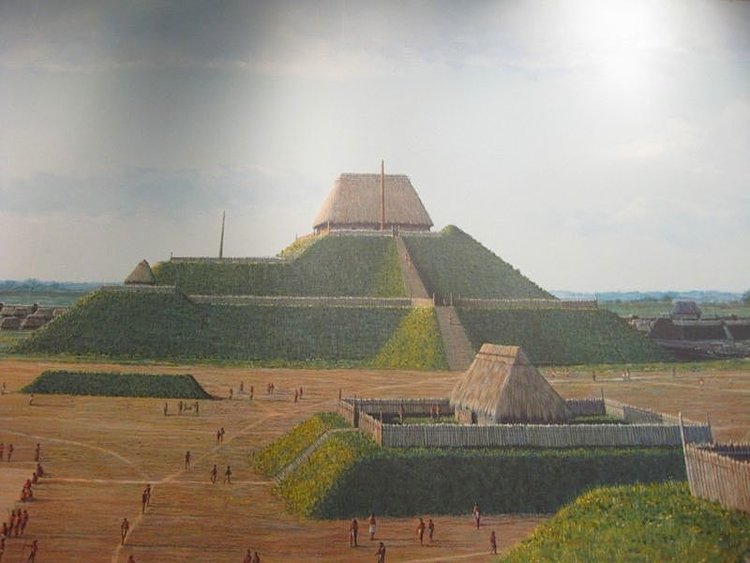
An artist’s recreation of downtown Cahokia, with Monk’s Mound at its center. (click to zoom)

 Artwork courtesy of ArsTechnica

… Read the Book of Mormon Without Proper Mormon Grooming!

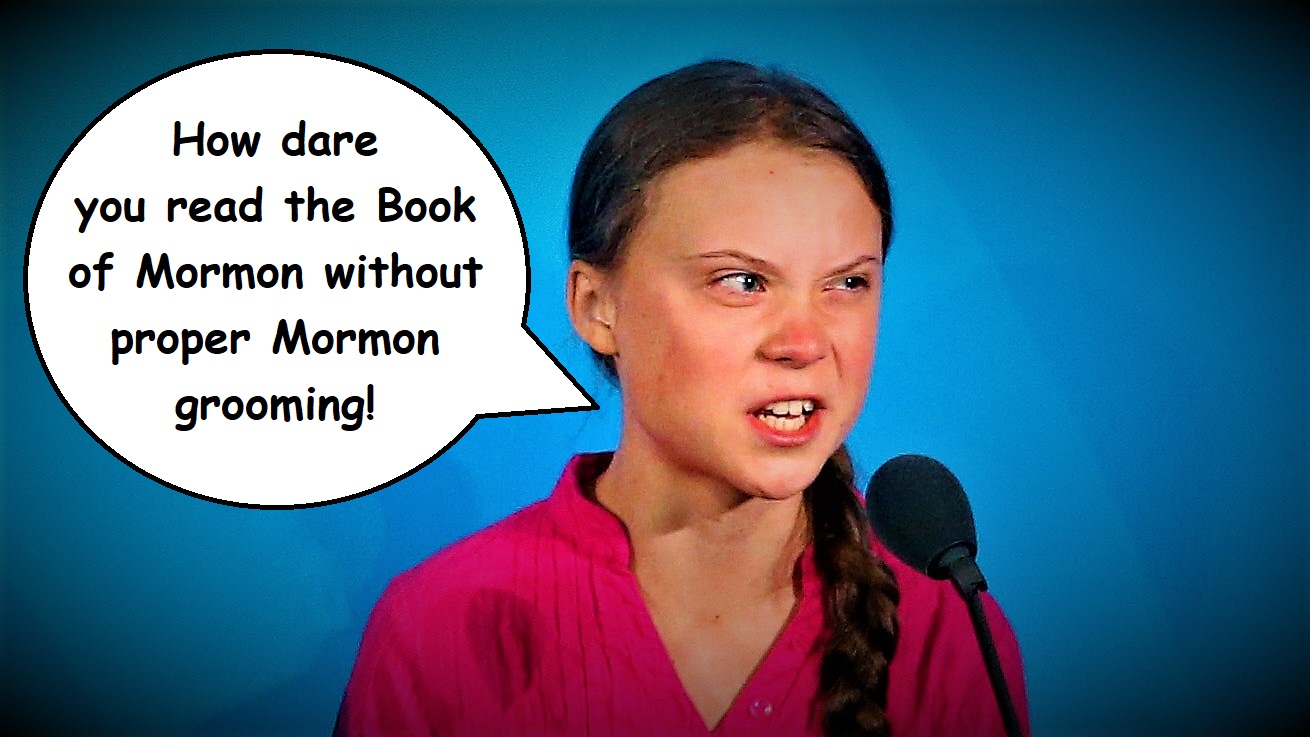
Social Justice Warrior, Greta “How Dare You!” Thunberg, weighs in on the matter.

by Fred W. Anson
The Book of Mormon is one of the worse pieces of American literature ever published. I say this as someone who has read it cover-to-cover not just once but more than once and then only after studying it for decades prior to that. But hey, don’t take my word for it, take the word of the man who is considered by many to be one of America’s greatest authors and creator of some of the best American literature ever written, Mark Twain, who said of the book:

“All men have heard of the Mormon Bible, but few except the “elect” have seen it, or, at least, taken the trouble to read it. I brought away a copy from Salt Lake. The book is a curiosity to me, it is such a pretentious affair, and yet so “slow,” so sleepy; such an insipid mess of inspiration. It is chloroform in print. If Joseph Smith composed this book, the act was a miracle—keeping awake while he did it was, at any rate. If he, accourding to tradition, merely translated it from certain ancient and mysteriously-engraved plates of copper, which he declares he found under a stone, in an out-of-the-way locality, the work of translating was equally a miracle, for the same reason…

The Mormon Bible is rather stupid and tiresome to read, but there is nothing vicious in its teachings. Its code of morals is unobjectionable—it is “smouched” from the New Testament and no credit given.”
(Mark Twain, “Roughing It”, Chapter 16)

Or how about the assessment of Charles H. Spurgeon, one of the most respected and influential preachers of the late 19th Century:

“One of the most modern pretenders to inspiration is the Book of Mormon. I could not blame you should you laugh outright while I read aloud a page from that farrago.”
(C.H. Spurgeon, “Our Manifesto”, April 25th, 1890)

And if you don’t believe Mark Twain, C.H. Spurgeon, or me, consider the words of Harold Bloom, American’s leading 20th Century Literary Critic:

“With the Book of Mormon, we arrive at the center of Joseph Smith’s prophetic mission, but hardly at any center of Mormonism, because of Smith’s extraordinary capacity for speculative development in the fourteen years that remained to him after its publication. The Book of Mormon was not only his first work; it is the portrait of a self-educated, powerful mind at the untried age of twenty-four. It has bravura, but beyond question it is wholly tendentious and frequently tedious. If one compares it closely to Smith’s imaginings in the Pearl of Great Price and Doctrine and Covenants, it seems the work of some other writer, and I don’t mean Mormon or Moroni.”
(Harold Bloom, “The American Religion”, Chu Hartley Publishers. Kindle Edition, Locations 1184-1189) 

And if you’re thinking, “Well, that’s not fair, you and Harold Bloom are critiquing a 19th Century literary style based on today’s modern standards”, consider this from Alexander Campbell, the founder, and leader of Campbellism, who said this of the book only two years after its publication:

“These are but as one drop out of a bucket compared with the amount of Smithisms in this book. It is patched up and cemented with “And it came to pass” — “I sayeth unto you” — “Ye saith unto him” — and all the King James’ haths, dids and doths; in the lowest imitation of the common version; and is, without exaggeration, the meanest book in the English language; but it is a translation made through stone spectacles, in a dark room, and in the hat of the prophet Smith from the reformed Egyptian!!! It has not one good sentence in it, save the profanation of those sentences quoted from the Oracles of the living God. I would as soon compare a bat to the American eagle, a mouse to a mammoth, or the deformities of a spectre to the beauty of Him whom John saw in Patmos, as to contrast it with a single chapter in all the writings of the Jewish or Christian prophets. It is as certainly Smith’s fabrication as Satan is the father of lies, or darkness the offspring of night. So much for the internal evidences of the Book of Mormon.”
(Alexander Campbell, “Delusions an analysis of the Book of Mormon…”, (1832), p.14) 

And if that’s still not enough, I would encourage you to speak to anyone who has read the book on its own merits without having Mormon Missionaries or any other Mormon influence hovering around them and telling them what a marvelous work and a wonder this insipid mess of mangled Elizabethan English combined with antiquated 19th Century ideas (such as American Restorationism and American Anglo-Israelism) it really is.

So the question remains, then how and why can millions of Mormons all over the world claim that this horrible book is some kind of inspired glory? Enter the power of suggestion. From the 2004 edition of the current, official LdS Church Missionary Manual:

“This message of the Restoration is either true or it is not. We can know that it is true by the Holy Ghost, as promised in Moroni 10:3–5. After reading and pondering the message of the Book of Mormon, any who desire to know the truth must ask in prayer to our Heavenly Father in the name of Jesus Christ if it is true. In order to do this, we address our Heavenly Father. We thank Him for our blessings and ask to know that the message of the Book of Mormon is true. No one can know of spiritual truths without prayer.

In answer to our prayers, the Holy Ghost will teach us truth through our feelings and thoughts.

Feelings that come from the Holy Ghost are powerful, but they are also usually gentle and quiet. As we begin to feel that what we are learning is true, we will desire to know all that we can about the Restoration.

Knowing that the Book of Mormon is true leads to a knowledge that Joseph Smith was called as a prophet and that the gospel of Jesus Christ was restored through him.”
(LdS Church, “Preach My Gospel: A Guide to Missionary Service” (2004 edition), p.39)

Not enough? Then how about this from former LdS Church President and “Living Prophet” Thomas S. Monson?

“This morning I speak about the power of the Book of Mormon and the critical need we have as members of this Church to study, ponder, and apply its teachings in our lives. The importance of having a firm and sure testimony of the Book of Mormon cannot be overstated.

We live in a time of great trouble and wickedness. What will protect us from the sin and evil so prevalent in the world today? I maintain that a strong testimony of our Savior, Jesus Christ, and of His gospel will help see us through to safety. If you are not reading the Book of Mormon each day, please do so. If you will read it prayerfully and with a sincere desire to know the truth, the Holy Ghost will manifest its truth to you. If it is true—and I solemnly testify that it is—then Joseph Smith was a prophet who saw God the Father and His Son, Jesus Christ.

Because the Book of Mormon is true, The Church of Jesus Christ of Latter-day Saints is the Lord’s Church on the earth, and the holy priesthood of God has been restored for the benefit and blessing of His children.

If you do not have a firm testimony of these things, do that which is necessary to obtain one. It is essential for you to have your own testimony in these difficult times, for the testimonies of others will carry you only so far. However, once obtained, a testimony needs to be kept vital and alive through continued obedience to the commandments of God and through daily prayer and scripture study.

My dear associates in the work of the Lord, I implore each of us to prayerfully study and ponder the Book of Mormon each day. As we do so, we will be in a position to hear the voice of the Spirit, to resist temptation, to overcome doubt and fear, and to receive heaven’s help in our lives. I so testify with all my heart in the name of Jesus Christ, amen.”
(Thomas S. Monson, “The Power of the Book of Mormon”, Spring General Conference 2017)

I mean, with over-the-top hyperbole and gushing like that how can it possibly be anything but one of the greatest, most powerful, stunningly inspired, incredible, works of English literature ever produced, right?

Two words in response: Read it. Yes, read it yourself so you can experience “inspired” prose like this, for yourself:

1 Nephi 14
23 Wherefore, the things which he shall write are just and true; and behold they are written in the book which thou beheld proceeding out of the mouth of the Jew; and at the time they proceeded out of the mouth of the Jew, or, at the time the book proceeded out of the mouth of the Jew, the things which were written were plain and pure, and most precious and easy to the understanding of all men.

24 And behold, the things which this apostle of the Lamb shall write are many things which thou hast seen; and behold, the remainder shalt thou see.

25 But the things which thou shalt see hereafter thou shalt not write; for the Lord God hath ordained the apostle of the Lamb of God that he should write them.

Wow, how can you argue with circular, over-blown, repetitious, grammar-challenged, gibberish like that?

Missionaries weigh in on the matter.

Back in December 2019, my Mormon Studies colleague, Kathy Petersen, had the brilliant idea of setting up a Book of Mormon daily reading program so non-Mormons could do just that – read it all in a year, cover-to-cover, just like many Bible reading programs out there do. And to do all that without any Mormon influence or interference, so the group could discuss the book honesty without being told (see above) what we should think and feel about it in advance, during, or after it was read. So she did. And, full disclosure here, I agreed to help her get it established, running and maintained because, candidly, I thought that the idea was pure, absolute, genius (still do!) Here’s how the group description, in part, reads:

“The One Year BOM: Non-Mormons Reading Through the Book of Mormon in a Year (aka “TOYBOM”) is specifically for Non-Mormons reading the Book of Mormon in a year as a group so that we can openly and honestly discuss and deconstruct it without any Mormon interference, umbrage, or offense…

NO MORMONS ARE ALLOWED HERE
Mormons (that is, members of any Latter Day Saint group or denomination) are NOT allowed in this group. Period.

That’s so we can speak freely and deconstruct the Book the Mormon honestly and openly without having to deal with the typical Latter Day Saint agendas, dogmas, thin-skinned offense, spin doctoring, and confirmation bias driven apologetics that typically swirl around the Book of Mormon in public.

Our goal here is to quietly, objectively, civilly and dispassionately consider the Book of Mormon devoid of any of such partisan Latter Day Saint encumbrances.”
(see Facebook, The One Year BOM: Non-Mormons Reading Through the Book of Mormon in a Year

The wailing, moaning, and gnashing of teeth that we got from Latter-day Saints in general, and Mormon Missionaries was swift and to the point: We were told that no one could possibly understand or appreciate this great, soaring, inspired, paradigm-changing work on its own without Latter-day Saints being in the room to explain it to them. We were told by virtue of the fact that Mormons could not be a part of the discussion and conversation the Book of Mormon would, no doubt, be completely misunderstood and misinterpreted by the non-Mormons in the group.

To all this, my Latter-day Friends and Mormon Missionary friends I just have one question: Why?

After all, if the Book of Mormon is truly everything that you all claim it is, shouldn’t it speak for itself? Shouldn’t its stunning inspiration and clear veracity be apparent simply by cracking its cover and reading it? Shouldn’t it be exactly as the Moroni 10 Challenge states?

“Behold, I would exhort you that when ye shall read these things, if it be wisdom in God that ye should read them, that ye would remember how merciful the Lord hath been unto the children of men, from the creation of Adam even down until the time that ye shall receive these things, and ponder it in your hearts.

And when ye shall receive these things, I would exhort you that ye would ask God, the Eternal Father, in the name of Christ, if these things are not true; and if ye shall ask with a sincere heart, with real intent, having faith in Christ, he will manifest the truth of it unto you, by the power of the Holy Ghost.

And by the power of the Holy Ghost ye may know the truth of all things.”
— Moroni 10:3-5

Latter-day Saint friends, can you please show us where in the Moroni 10 Challenge it says, “Unless, of course, there are no Latter-day Saints around or present to groom and guide you, in which case, fuggedaboutit!”? I can’t seem to find it, and neither can anyone else.

So, back to the “The One Year BOM: Non-Mormons Reading Through the Book of Mormon in a Year” group. We started the daily readings and it didn’t take long before the wailing, moaning, and gnashing of teeth were soon coming from these intrepid non-Mormons who had committed to reading this overwhelmingly boring and dreadfully written book in a year. They were stunned, absolutely stunned from the front cover to the back cover that anyone could come to anything but the obvious conclusion that (to borrow and paraphrase from Lamoni’s queen in Alma 19:5): As for myself, to me it doth truly stink.

So I will end this article the way that I began it: The Book of Mormon is one of the worse pieces of American literature ever published. Or to put it another way, friends, the Emperor has no clothes! And if you doubt that, then just read it for yourself. With no one else around. It speaks for itself, and it says loudly, “These things are not true.”

(click to zoom)

I think that anyone who has actually done it can relate to this.

An Ex-Mormon Apologist Faces His Most Formidable Foe: His Past Self

by Michael Flournoy
As a Latter-day Saint I believed Christ’s church fell into apostasy after the deaths of the apostles because there was no one left to hold priesthood keys or receive revelation for the organization. Without their leadership, damnable heresies entered the Church and corrupted it completely.

In my book, I approached this topic by examining the prophecy at the end of the Old Testament. I wrote:

“In Matthew 17 Jesus takes Peter, James, and John up the Mount of Transfiguration. At its top they see Moses and Elijah and hear God’s voice, proclaiming Jesus is His Son. On the way down the disciples ask the Master a question, ‘Why then say the scribes that Elias must first come?’ Elias is the Greek form of the name Elijah. This question is in reference to the final prophecy of the Old Testament which states:

Behold I will send you Elijah the prophet before the coming of the great and dreadful day of the Lord. And he shall turn the heart of the fathers to the children, and the heart of the children to the fathers, lest I come and smite the earth with a curse. (Malachi 4:5-6 KJV)

The Jews were under the mistaken impression that the Messiah would only come once and promptly deliver them from Rome. They were looking for Christ to come, but they also seemed to be looking for Elijah to come first. This is evident in the first chapter of John. When John the Baptist confesses he is not Christ, he is immediately asked, ‘What then, art thou Elias? Art thou that prophet?’ (John 1:21)

In fact, Jews to this day believe Elijah will arrive as a sign of the Messiah’s coming. From a Christian perspective, and with the knowledge we gain in the New Testament, we understand there will be a second coming of the Messiah, which is often referred to as the great and dreadful day of the Lord in scripture. So the prophecy at the end of the Old Testament could safely be translated: Behold I will send you Elijah the prophet before the [second coming] of the Lord.

Let’s look at the Savior’s answer to his disciples’ inquiry. In Matthew 17:11 he says, ‘Elias truly shall first come, and restore all things.’ By speaking in the future tense, Christ clarifies that the prophecy had yet to be fulfilled. He also explains that not only would Elijah come, he would restore all things. At the time Jesus said this, he was on earth, his apostles were called, and the gospel was being preached; so for all things to be restored, all things had to first be lost.”
(Michael Flournoy, “A Biblical Defense of Mormonism”, p.60)

Obviously, there’s a lot here to unpack, but the basic points I made were that John the Baptist wasn’t Elijah and that the prophecy wouldn’t be fulfilled until much later, presumably during the last days.

My first point that the great and dreadful day is a nod to the second coming, is a non-starter. I hoped to persuade my audience that Elijah didn’t show up until the restoration, but you know what else happened before the great and dreadful day of the Lord? Israel became a nation and was conquered. Moses led God’s people out of Egypt, and Adam and Eve partook of the forbidden fruit. Technically, everything in the history of our planet has happened before the second coming. So to that, I say, strike one.

I tried to say that Jesus referred to the prophecy in the future tense, proving that it hadn’t happened. However, let’s bear in mind that he was referencing the prophecy, and not explaining it. I might say, for example, “In Genesis, God says that if Adam and Eve partake of the forbidden fruit, they will surely die.” Although I am speaking in future tense, that does not mean the fall hasn’t happened. In fact, Christ’s next sentence, which my LDS self failed to mention, switches immediately to past tense, “Elijah has come already.” This is exactly the kind of pivot someone would make when explaining God’s decree in the Garden of Eden. That’s strike two.

Now let’s look at the rest of Christ’s response:

“He answered, “Elijah does come, and he will restore all things. But I tell you that Elijah has already come, and they did not recognize him, but did to him whatever they pleased. So also the Son of Man will certainly suffer at their hands.” Then the disciples understood that he was speaking to them of John the Baptist.”
(Matthew 17:11-13 ESV)

The text of scripture specifically says the prophecy was fulfilled in John the Baptist. This coincides with Luke 1:17 (ESV) where the angel tells Zacharias that John will “go before him in the spirit and power of Elijah, to turn the hearts of the fathers to the children, and the disobedient to the wisdom of the just, to make ready for the Lord a people prepared.”

Not only do we have an angel attributing the same wording to John the Baptist that we find in the Elijah prophecy, we also have Christ reverting to past tense and New Testament scripture indicating that he was speaking of John. So to my intrepid LDS self, I say, strike three.

The Darvaza gas crater also known as “The Gates of Hell”, is a natural gas field that collapsed into a cavern in Darvaza, Turkmenistan. (source: Wikipedia)

The Gates of Hell Shall Not Prevail
For Latter-day Saints to say the church fell into apostasy, they must do so by crawling over or under or around Matthew 16:18 to make that claim. In my Mormon days, I employed various gymnastic feats to weave around this difficult verse. For context, here is the entire passage:

“Now when Jesus came into the district of Caesarea Philippi, he asked his disciples, “Who do people say that the Son of Man is?” And they said, “Some say John the Baptist, others say Elijah, and others Jeremiah or one of the prophets.” He said to them, “But who do you say that I am?” Simon Peter replied, “You are the Christ, the Son of the living God.” And Jesus answered him, “Blessed are you, Simon Bar-Jonah! For flesh and blood has not revealed this to you, but my Father who is in heaven. And I tell you, you are Peter, and on this rock I will build my church, and the gates of hell shall not prevail against it. I will give you the keys of the kingdom of heaven, and whatever you bind on earth shall be bound in heaven, and whatever you loose on earth shall be loosed in heaven.”
(Matthew 16:13-19 ESV)

Latter-day Saints hyper-focus on the rock the church was built on, believing this to be a conditional promise. The gates of hell would not prevail against the church if it remained on the rock. Instead of narrowing the rock down to one thing, Latter-day Saints take bits and parts of all the elements in this passage and build the rock from that.

For instance, flesh and blood not revealing the truth to Peter, but his Father in heaven, must mean that revelation is the rock of the church. The keys to the kingdom of heaven represent priesthood authority. And finally, Peter himself is the rock in the sense that prophets and apostles will always be needed to run things.

Let’s start with prophets and apostles, and why they aren’t the rock Jesus spoke of. In my book I made a case for prophets and apostles by saying:

“Whenever there was a dispute in the Church, the problem was brought to the apostles, and their answers became doctrine. For example, Acts chapter 15 tells us some new Christians began to say circumcision was still essential for salvation, but the matter was brought to the apostles who deemed it unnecessary. The apostles were also largely responsible for writing the New Testament; so clearly they were privileged to know God’s will for the Church and had the authority to implement it.”
(Michael Flournoy, “A Biblical Defense of Mormonism”, p. 63)

Here I was trying to kill two birds with one stone, saying that revelation and apostles went hand in hand. However, it wasn’t as simple as that. In Acts 15, after the debate began, Barnabas and Paul were sent to inquire of the apostles at Jerusalem. But wait, wasn’t Paul an apostle by then? Why didn’t he evoke revelation right then? Once the matter is brought to the rest of the apostles, they don’t resort to revelation either. Instead, the text says they argue about it.

In his letter to the Romans, Paul writes,

“Is this blessing then only for the circumcised, or also for the uncircumcised? For we say that faith was counted to Abraham as righteousness. How then was it counted to him? Was it before or after he had been circumcised? It was not after, but before he was circumcised.”
(Romans 4:9-10 ESV)

What’s interesting about this, is revelation wasn’t necessary to end the debate. Instead of appealing to revelation from God, Paul appealed to the scriptures. In this way, he fulfilled the same role that pastors do in Christian churches today.

But what about his new scripture, doesn’t that prove his importance as an apostle? Without a doubt, God used Paul to write amazing scripture. But if that is the sign of an apostle today, then the LDS leadership has failed miserably for decades now. Not only that, but some of the writers of the New Testament aren’t even apostles. Where is Luke’s call to be an apostle? What about Mark and Jude? The fact is, if these men were not ordained apostles or prophets and yet were able to write scripture, then the whole argument for the leadership of the LDS church falls on its face.

To reinforce the necessity of revelation I wrote,

“Revelation is also a very practical way to lead the Church; Acts chapter 10 is a great example of how the early church functioned. A man named Cornelius, a gentile, was visited by an angel and told to seek out Peter, and informed that Peter would tell him what to do. So Cornelius sent three men to Joppa where Peter was staying. Before Peter could be confronted with the situation, and forced to make a decision based on finite reasoning, he was shown a vision in which a great sheet fell before him, which was inhabited by animals deemed unclean and inedible by the Law of Moses.

A voice spoke to him saying, ‘Rise Peter, kill and eat.’ But Peter said, ‘Not so Lord, for I have never eaten anything that is common or unclean.’ The voice spoke to him again, ‘What the Lord hath cleansed, that call not thou uncommon.’ This vision was given to Peter so he might know not to call any man common or unclean because it was time for the gospel to go to the gentiles. Since Christ personally instructed the apostles to go only to the Jews (Matthew 10:5-6), without indicating an expiration date for the command, it’s impossible to think Peter could have come to this conclusion without revelation.

It’s also quite telling that the Gentile emergence into Christianity happened through Peter. Why didn’t the angel tell Cornelius to start his own Christian denomination? It’s because apostles were a major part of the Church’s foundation!”
(Michael Flournoy, “A Biblical Defense of Mormonism”, p.64)

Let’s start with the easy stuff first. Why didn’t the angel tell Cornelius to start his own denomination? It makes total sense for Cornelius and the other Gentiles to go to Peter, whether he was an apostle or not. He had more experience being a Christian leader than they did. Not to mention, he knew Jesus personally and was well acquainted with the story and doctrine. Even as an Evangelical, I think it would have been foolish for them to set out on their own.

Now onto the tricky part. Was it really impossible for Peter to know to go to the Gentiles? To answer that question, let’s take a look at the words of the Apostle Paul:

‘For I tell you that Christ became a servant to the circumcised to show God’s truthfulness, in order to confirm the promises given to the patriarchs, and in order that the Gentiles might glorify God for his mercy. As it is written,

Therefore I will praise you among the Gentiles,
and sing to your name.”

And again it is said,
“Rejoice, O Gentiles, with his people.”

And again,
“Praise the Lord, all you Gentiles,
and let all the peoples extol him.”

And again Isaiah says,
“The root of Jesse will come,
even he who arises to rule the Gentiles;
in him will the Gentiles hope.”

May the God of hope fill you with all joy and peace in believing, so that by the power of the Holy Spirit you may abound in hope.’
(Romans 15:8-13 ESV)

The vision Peter received may have helped him know God’s will faster, but since the Old Testament said the Gentiles would place their hope in God, it’s a certainty that Peter and the apostles would have realized it even without revelation. In fact, all the revelations given by the apostles had a basis in scripture. This is in sharp contrast to the LDS church where practitioners are admonished to pray for a spiritual witness that their prophets are called of God. According to the New Testament, the Bereans tested what Paul said by scripture to see if his words were true, and because of this they were “more noble than those at Thessalonica.” (Acts 17:11 KJV)

I went on to argue that there was a concerted effort to keep the sanctity of the twelve apostles because when Judas took his life, they chose Matthias as a new apostle. Then, when James was martyred, Paul became an apostle.

First off, this is just two instances, and that’s a far cry from proving anything. Secondly, the LDS Church doesn’t even have twelve apostles. They have 15 prophets, seers, and revelators. If the number 12 is so important, why isn’t Mormonism sticking to it? Might I also hammer in the fact that they chose to ordain a new apostle under the direction of scripture and not revelation? If revelation is the foundation of Mormonism, it’s pretty odd to see the apostles sweeping it under the rug all the time.

I also tried to posit, as all Latter-day Saints do, that modern prophets fit the pattern God established throughout the Old Testament. But things aren’t really that black and white. For example, there were a number of women prophets in the Old Testament including Miriam, Deborah, Huldah, and Noadiah, who God used to speak to His people.

LDS doctrine does not allow women to be prophets or to receive God’s word, and that presents a shift from the Old Testament pattern. Furthermore, at one point the apostles tell Jesus they saw a man casting out demons in His name, and told him to stop because he wasn’t one of them.

Jesus responds, “Do not stop him, for no one who does a mighty work in my name will be able soon afterward to speak evil of me. For the one who is not against us is for us.” (Mark 9:39-40 ESV) 

If this man had the authority to cast out demons, despite not being under the apostles’ leadership, what was to stop him from passing out saving ordinances? And if a random man could do all that, what need did there remain for prophets and apostles at all if we presume that LDS hierarchy claims are biblical and true?

“The whole idea that God’s church could fail, is derived from a small, insignificant deity.” (Flournoy’s Fatal Flaw)

Flournoy’s Fatal Flaw
I admitted in my book that Jesus was part of the foundation of the church, constituting the chief cornerstone. When the apostles died, the priesthood keys, revelation, and apostles were lost. Only Jesus remained, but that wasn’t enough to fend off the apostasy of the ancient church.

These days, I take umbrage at the idea that Jesus constitutes ¼ of our foundation. The whole idea that God’s church could fail, is derived from a small, insignificant deity. I wonder if Latter-day Saints would be so quick to call it an apostasy if their precious priesthood had remained. Or revelation through a prophet? Yet somehow, Jesus simply isn’t enough.

Well here’s a newsflash for my LDS readers: If the apostles’ deaths resulted in the Great Apostasy, then Christ stood by and watched as His bride was murdered. He abandoned the wheat to the tares and ignored the wolves that ravaged His flock. He ceased to be the bridegroom and was anything but a good shepherd.

As a Biblical Christian, I proclaim that the opposite is true. The church didn’t collapse because it fell off the rock. The church persevered because the rock it was built upon was Christ, the Son of the Living God. He explains to Peter that “flesh and blood have not revealed this to you…” In other words, Christ’s identity is still the subject at hand and continued to be in the following statement, “upon this rock I will build my church, and the gates of hell shall not prevail against it.”

If Jesus makes up the cornerstone, and everything else falls away, then that still leaves a foundation, and that means the apostasy could not have occurred. And since there was no apostasy, there could have been no restoration. And if there was no need for a restoration then as Joseph Smith, himself said so well, there is no need for the LDS Church:

“Nothing less than a complete apostasy from the Christian religion would warrant the establishment of the Church of Jesus Christ of Latter-Day Saints”
(Joseph Smith, “Comprehensive History of the Church” 1:42)


An Ex-Mormon Apologist Faces His Most Formidable Foe: His Past Self

by Michael Flournoy
I confess that I looked away when the Mormon looked at me with a pained look and asked, “Are you saying we’re not Christian?” It’s the most awkward part of discussing theology with Latter-day Saints. As Evangelicals, we’re left speechless. We can’t simply say no because of their reaction. To them, they are so obviously Christian, that any assertion to the contrary is simply absurd – laughable in fact. Ridiculous! Absurd! Stupid beyond words!

To them, it’s just the excuse they need to write us off forever. Clearly, we’re just hateful antis who are more interested in fighting against God than having a fair discussion. I have had many conversations end here, with Latter-day Saints walking away shaking their heads, and I’m not alone, I’m sure.

I have come to realize that our response to that question should be, “That’s an interesting question. Why do you think you’re Christian?” This encourages dialogue instead of stifling it. It opens a door rather than slamming it shut with the sound of deadbolts being pulled. We can then go point by point, and give each argument the attention it deserves rather than simply being shut down and out. To illustrate, let’s consider my old Mormon Apologist arguments through fresh eyes, and explain why the typical Evangelical response left me unconvinced back in the day.

Case in point, in my book, “A Biblical Defense of Mormonism”, Michael the Mormon Apologist attempted to persuade Evangelicals that Mormons were Christian too. I spent half a chapter trying to scare them out of preaching to Latter-day Saints. After all, I argued, Mormons could be Christian. I pointed to the apostle Paul, who persecuted Christians but later said he was the least of the apostles because of it. Clearly, the only thing to be gained by messing with Mormons was a future of shame and regret.

To that, today’s Michael the Ex-Mormon Apologist calls, “Baloney!” He says, “You’re telling me that I’m supposed to avoid preaching to someone because they might be saved and that would be embarrassing? How exactly? I would be tickled to find a Mormon I preached to in God’s Kingdom, and I think they’d feel the same about me. No one says ‘I told you so’ in heaven, do they, Mr. Mormon?”

Here’s the reality. The possibility that I didn’t preach to an unsaved sinner because he seemed Christian is the graver error. The end result of that isn’t a little awkwardness. It’s a soul damned for eternity. Christians should be too afraid not to preach the gospel.

I also find it fascinating that my old Mormon Apologist equated preaching with persecution. Granted, there are times Evangelicals heap real persecution on Latter-day Saints, but challenging their theology doesn’t fit the bill. Stated plainly, disagreement is disagreement, not persecution. After all, if it is then Mormon Missionaries are some of the biggest persecutors on the planet, aren’t they? After all, they are called by their church with preaching to those that they disagree with, aren’t they? And that’s exactly what they do, isn’t it?

Latter-day Saints should welcome the challenge. If their theology proves stronger, it’s a chance to win us to their side. The fact that most of them prefer to throw out pejorative names like “anti-Mormon” instead of talking is a major sign they’re in a cult instead of a religion. To this day, I agree with Mormon Apostle, Orson Pratt when he said,

“Convince us of our errors of Doctrine, if we have any, by reason, by logical arguments, or by the Word of God and we will ever be grateful for the information and you will ever have the pleasing reflections that you have been instruments in the hands of God of redeeming your fellow beings from the darkness which you see enveloping their minds.”
(Orson Pratt, “The Seer”, p. 15)

In my book, I defined a Christian as someone who believes in Christ and accepts Him as their personal Savior,

“So whether The Book of Mormon is true or Joseph Smith was a prophet are irrelevant to this specific point.

For this question, all that really matters is whether we believe in Christ or not. As it turns out, we do. We believe Jesus was more than a prophet. He is our Savior, our Redeemer, and our Hope. Nephi of The Book of Mormon said, “…We talk of Christ, we rejoice in Christ, we preach of Christ, we prophecy of Christ, and we write according to our prophecies, that our children may know to what source they may look for a remission of their sins’ (2 Nephi 25:26).”
(Michael Flournoy, “A Biblical Defense of Mormonism”, p.34)

It has always amazed me how quick Mormons are to quote the dictionary like it is scripture. The current edition of the Merriam-Webster dictionary defines a Christian as, “one who professes belief in the teachings of Jesus Christ.” Yet, my Mormon Apologist self was careful not to define a Christian simply as one who believes in Christ. If he had, I would have pulled out my Bible and read James 2:19 (ESV) which says, “You believe that God is one; you do well. Even the demons believe—and shudder!”

So, according to the dictionary, demons must be Christian, right? But that’s clearly not enough, is it? There’s more to being a Christian than having the knowledge that Jesus is the Messiah. We must accept Him as Lord and Savior as well, mustn’t we?

Michael the Mormon Apologist did, in fact, assert that “we must accept the Lord”, but he and I have different ideas of what that means. He believed it meant receiving LDS ordinances and keeping the commandments. I believe it’s receiving His righteousness through faith alone.

My old self tried to create a choke point by dismissing the need to talk about Joseph Smith or The Book of Mormon. To that I say, let’s broaden the playing field. Believing in false scripture and prophets does matter, particularly when they teach a pseudo gospel, just as Paul warned us: “But even if we or an angel from heaven should preach to you a gospel contrary to the one we preached to you, let him be accursed.”
(Galatians 1:8 ESV)

The Greek word used for accursed is anathema, which implies ex-communication by an ecclesiastical leader. In Mormonism, ex-communication and salvation are mutually exclusive propositions.

My Mormon Apologist counterpart pointed out that many Latter-day Saints think that having Jesus in the name of their church proves they are Christian. I wrote:

“It should come as no surprise then, that Latter-day Saints are flabbergasted when someone says we aren’t Christian. It’s very common for us to say, ‘Look at the name of our church, it has Jesus’ name in it. Of course we’re Christian!'”(Michael Flournoy, “A Biblical Defense of Mormonism”, p.35)

If your church’s name makes you a Christian, then what’s to stop me from starting my own church and naming it “The Church of Jesus Christ of the Better Latter-day Saint Restoration”? Would that make a Latter-day Saint? Would that make me a Latter-Saint Restorationist? Would naming myself Jesus Christ make me the Messiah? Of course not. Going further, back then I wrote:

“So maybe we do believe the Father, Son, and Holy Ghost are three separate Gods, and maybe we do believe the Father and Son have bodies of flesh and bone as tangible as man’s. But you know what, it’s still irrelevant…

The Bible places emphasis on knowing God, not knowing about Him. Thus we can assume that a simple disciple who has a relationship with God is better off than a scholar who knows all about Him, but hasn’t bothered to get to know Him personally.”
(Michael Flournoy, “A Biblical Defense of Mormonism”, p.35)

Obviously, there’s a lot to unpack here. In this highly contrived hypothetical situation, it’s true that an unlearned disciple is better off than an unsaved scholar. But that doesn’t mean God will overlook an incorrect ontological view of Him. The Bible says it like this,

“Being then God’s offspring, we ought not to think that the divine being is like gold or silver or stone, an image formed by the art and imagination of man. The times of ignorance God overlooked, but now he commands all people everywhere to repent.”
(Acts 17:29-30 ESV)

In other words, it’s a sin to view God incorrectly. And while Michael the Mormon Apologist had no problem classifying Evangelicals as Christian, Michael the Ex-Mormon Apologist now sees far too many differences now for us to have the same Jesus. Specifically, our Jesus was never created. Our Jesus was always God. He never had to take a body to become complete. Our Jesus is one in essence with the Father and the Holy Ghost. Our Jesus saves sinners despite their works, not because of them. Michael the Mormon Apologist would have been appalled at this. Back then I argued,

“How much ignorance are we allowed to have before God withholds His grace?

Here’s why I ask: some Christians believe Melchezidek was Christ, some describe the Trinity in terms of Modalism, some Christians believe God chose who would be saved before we were born, and others think He’s the type to let us choose. Many Christians I’ve been in discussions with have even said the Trinity is mysterious.”
(Michael Flournoy, “A Biblical Defense of Mormonism”, p.36)

I, the Mormon Apologist, then quoted Acts 17:23 (KJV) where Paul pointed to an altar with the inscription: ‘To the unknown god’, and said, “Whom therefore ye ignorantly worship, him declare I unto you.” My argument was that God could be worshipped in ignorance. Otherwise, even Evangelicals couldn’t be called Christian due to their fragmented beliefs. But my arguments were misinformed. The Trinity is mysterious, but not in regards to the descriptions given in the Bible. We know what kind of a Being God is. As far as Modalism, they too are outside the bounds of Christianity and need repentance.

That might sound like nitpicking to Latter-day Saints, but even they have their limits. After all, they wouldn’t consider Muslims to be Christian, but I could use their logic to argue that they are. After all, don’t they believe in Christ? Sure, they don’t think He’s divine, and maybe they mistakenly call Heavenly Father “Allah”, but that’s just ignorant worship. Based on the dictionary, they’re Christians too, right?

Mormons can win the argument for their deviant form of Christianity, but merely on a technicality. Relying on a textbook definition to be saved is like relying on another driver’s blinker to keep from being hit. It’s the intentions that matter, not whether someone has their blinker on.

If I could tell Latter-day Saints anything, I’d remind them that Christ isn’t bringing a dictionary on Judgment Day. If our names aren’t written in the Book of Life, we’ll be damned forever. Salvation is an intensely personal matter. It’s not the name of our church that’s found in the Book of Life. We can’t get in under the prophet’s umbrella. It’s our names we should worry about. 

So the right question isn’t, “Are Mormons Christian?” The real, right question is for the individual, “Are you a Christian? Are you on His right hand? Is your name written in The Book of Life, and if so, by whose merits – your own flawed sin-tainted works, or His flawless, perfect, and holy work?”

There are thousands of nominal Christians in the world today who show up for church and go through the motions. If asked, they’ll claim Christianity as their religious affiliation. But that’s not the same as being born again. Jesus couldn’t have been clearer on this,

“Not everyone who says to me, ‘Lord, Lord,’ will enter the kingdom of heaven, but the one who does the will of my Father who is in heaven. On that day many will say to me, ‘Lord, Lord, did we not prophesy in your name, and cast out demons in your name, and do many mighty works in your name?’ And then will I declare to them, ‘I never knew you; depart from me, you workers of lawlessness.’”
(Matthew 7:21-23 ESV)

Friend, there’s no participation trophy for being in a Christian church. Even if we’ve done good works and ordinances in Christ’s name, they won’t count towards righteousness. In the end, all that really matters is whether or not we know Jesus – that is the real Jesus of time, space, and history that can be found and is revealed in the Bible. Fictional, man-contrived Jesus’s (and, trust me, there are many, many, many false Jesus’s) simply don’t count, do they?1

So in the end, can a Latter-day Saint be a Christian? Absolutely. Christ can save someone anywhere, at any time, be it in a temple, a prison, a mosque, a bar, or a gutter. He can and will save us right when and where we are right now. Just as we are – ugly, broken, bitter, dirty, and damaged. Period. In fact, He does it every day!

So the better question is this: Does the LDS church truly meet the requirements to be called a Christian church since it teaches another God, another Jesus, and another gospel than what is taught in the Bible? In other words, can the true Jesus of the Bible save a Latter-day Saint despite the false teachings of the LDS Church rather than because of those teachings? This is a question that simply never dawned on Michael the Mormon Apologist as a possibility – but it’s intriguing, isn’t it?

However, that also is another conversation for the Ex-Mormon Apologist to have with the Mormon Apologist on another day (or maybe two, or three). Stay tuned to this channel, there’s more – a lot more – to come!

The front cover of “A Biblical Defense of Mormonism”


1 Case in point, please consider the False Jesus of Self-Realization Fellowship:

“Jesus Christ is very much alive and active today. In Spirit and occasionally taking on a flesh-and-blood form, he is working unseen by the masses for the regeneration of the world. With his all-embracing love, Jesus is not content merely to enjoy his blissful consciousness in Heav­en. He is deeply concerned for mankind and wishes to give his followers the means to attain the divine freedom of entry into God’s Infinite Kingdom. He is disappointed because many are the churches and temples founded in his name, often prosperous and powerful, but where is the communion that he stressed — actual contact with God? Jesus wants temples to be established in human souls, first and foremost; then established outwardly in physical places of worship. Instead, there are countless huge edifices with vast congregations being indoctrinated in churchianity, but few souls who are really in touch with Christ through deep prayer and meditation.

“To reestablish God in the temples of souls through revival of the original teachings of God-communion as propounded by Christ and Krishna is why I was sent to the West by Mahavatar Babaji….

“Babaji is ever in communion with Christ; together they send out vibrations of redemption and have planned the spiritual technique of salvation for this age.”
(Paramahansa Yogananda, “The Second Coming of Christ: The Resurrection of the Christ Within You”, Introduction; also see “Spiritual Lineage” Self-Realization Fellowship website)

Banner Art: An image from the iconic Mad Magazine, “Spy v. Spy” cartoon series. (copyright Antonio Prohias, the Prohias Estate, Mad Magazine, and Mad Book) 

by Michael Flournoy
In my book, “A Biblical Defense of Mormonism”, I tried to downplay the importance of Joseph Smith. I wrote:

“Joseph Smith’s story is a remarkable one. It’s one which Mormon missionaries never fail to teach their investigators. Furthermore, opponents of the Church never tire of attacking Joseph’s character, and members of the Church usually feel obligated to defend him. I think it’s a waste of time.

If I went to my mother’s house for her famous green bean casserole, I wouldn’t denounce her or her specialty if I found out she used canned, instead of fresh green beans. Similarly, Joseph Smith is just a technical detail of the broader picture. A mortal man who is dead was never our central message; God becoming man and rising from the dead is our central message, along with the fact that His bride, the Church, has been restored to her former glory. We’re talking about a wedding here! Heaven forbid one of the guests should get all the attention!

I’m not trying to minimize Joseph since he played an essential role in the restoration of the gospel. Salt is an essential ingredient in bread too, but many a loaf’s been ruined because too much salt was added.”
(Michael Flournoy, “A Biblical Defense of Mormonism”, p.53)

Looking back, I see a frightened young Mormon who suspected that Joseph was involved in distasteful activities, but suppressed the truth in unrighteousness. I tried to create a choke point by defining what was and what wasn’t important to the debate.

To put things in perspective, Joseph isn’t a guest at the LDS wedding. He’s the best man. In fact, when the bride ran away last time, he’s the one who brought her back. He’s the reason the wedding is even happening. In Mormonism, Christ wasn’t appealing enough to win the bride by Himself, much less keep her from divorcing Him. He required a wingman. And this is the worst kind of wingman there is, because not only are the bride’s eyes on the Groom, they constantly glance back at Joseph. Jesus may have her hand, but Joseph has her heart.

I tried to shield Joseph from attack the same way a chess player tucks away his king. I pointed to other “weasels” in the Biblical narrative. There was Judas Iscariot, who Jesus handpicked as an apostle. There was Jonah who fled from his duty, and Aaron who built a molten calf for Israel to worship. If these men could be called of God despite their evil deeds, then God could use anyone. Arguments against the character of Joseph were irrelevant. In fact, it was preposterous to think someone had to be good to work for God.

Okay, Past Self, hold your horses. While God can use evil men to accomplish his work, that’s a far cry from what the LDS Church teaches about Joseph. He is proclaimed a prophet and must be worthy not only to receive revelation from God but to hold the priesthood keys necessary for governing the Church. The Bible makes it very clear that the works of the flesh are evil, but those who follow the Spirit will exemplify a holier set of traits. It reads:

“But if you are led by the Spirit, you are not under the law. Now the works of the flesh are evident: sexual immorality, impurity, sensuality, idolatry, sorcery, enmity, strife, jealousy, fits of anger, rivalries, dissensions, divisions, envy, drunkenness, orgies, and things like these. I warn you, as I warned you before, that those who do such things will not inherit the kingdom of God. But the fruit of the Spirit is love, joy, peace, patience, kindness, goodness, faithfulness, gentleness, self-control; against such things there is no law.”
(Galatians 5:18-23 ESV)

Simply stated, it’s erroneous to sweep Joseph’s traits under the rug and only look to The Book of Mormon as his fruit. Jesus said,

Jesus said,

“Beware of false prophets, who come to you in sheep’s clothing but inwardly are   ravenous wolves.  You will recognize them by their fruits. Are grapes gathered from thornbushes, or figs from thistles?  So, every healthy tree bears good fruit, but the diseased tree bears bad fruit.  A healthy tree cannot bear bad fruit, nor can a diseased tree bear good fruit.”
(Matthew 7:15-18 ESV)

Notice what He didn’t say. Christ didn’t say to sweep a prophet’s misdeeds under the rug. He didn’t say to ignore them when they speak heresy because they’re fallible men. And He certainly didn’t say it was wrong to criticize them even if the criticism is true. Rather, we are to call their works into question.

Granted, all believers are still sinners, and even Biblical prophets made mistakes. But if we look at the accusations against Joseph, we see someone who was anything but a saint. He was charged with treason and conspiracy to murder a former governor. He was arrested 42 times. He was charged with banking fraud and destroying a press that criticized him. He sent men on missions and married their wives in their absence. He lied about his polygamy in public and in private to his wife Emma.

Latter-day Saints denounce these claims as anti-Mormon fabrications designed to ruin Joseph’s reputation. However, the sources for this evidence are all Mormon or Mormon friendly – up to and including Joseph Smith himself in “The History of the Church” (see the online edition of  “The History of the Church” archived at BYU)

Since I didn’t argue for the character of Joseph in my pro-LDS book, it’s not my goal to argue against it here. I did argue that the First vision itself was evidence of Joseph’s prophetic calling. I wrote:

But what about 2 Corinthians 11:14 which says Satan is transformed into an angel of light? If the devil is capable of such trickery, how can we be sure Joseph wasn’t visited by Satan disguised as God? Everyone who’s served a mission has probably heard someone argue along these lines. However, the argument is Biblically unsound. In the New Testament when Jesus casts out demons, the Pharisees accuse him of casting out demons through Beelzebub, the prince of the devils. To this Christ replies, “Every kingdom divided against itself is brought to desolation; and every city or house divided against itself shall not stand: and if Satan cast out Satan, he is divided against himself; how shall then his kingdom stand?’ (Matthew 12:25-26 KJV)

Joseph Smith said when he prayed he was first set upon by a dark force before being delivered by God. Since neither God nor Satan is divided, we are left with only two options: first, that God attacked Joseph, but was abolished by Satan, or second, that Smith’s account is true and he was delivered by God.”
(Michael Flournoy, “A Biblical Defense of Mormonism”, p.57)

This is a classic false dichotomy. This whole argument assumes that Joseph was telling the truth about what happened. It’s a cleverly constructed house that lacks a foundation. The simplest explanation is the First Vision never happened. The whole event was fabricated. Joseph never saw God and was never called to restore Christianity from apostasy. In fact, Jesus promised the gates of hell would not prevail against the church (see Matthew 16:18).

My LDS self believed that the most important fruits to look at were The Book of Mormon and the restored gospel. In this series of articles, I will examine these fruits and show that Joseph brought forth false scripture, a false god, and a false gospel. But the rotten fruit of his life bears witness that Joseph Smith was not a prophet of God. It speaks for itself, despite how any Mormon Apologist or stack of books from Mormon Apologist may try to spin.

Joseph Smith was not only not God’s Prophet, according to the Matthew 7 “Fruit Test” he was clearly a False Prophet.1 And he is one of many reasons that I, once a staunch Mormon Apologist, am now an Ex-Mormon Apologist.


1 For those looking for a short, succinct, summary of the bad fruit of Joseph Smith, Fred W. Anson’s, Beggar’s Bread article on the subject: “The Fruit of Joseph Smith” is recommended.