Archive for the ‘Sociology’ Category

Confirmation driven apologetics.

Confirmation Bias driven apologetics.

by Fred W. Anson
In 2009 a local newspaper in Provo, Utah ran a series of articles written by local people who were trying to persuade members of the Church of Jesus Christ of Latter-Day Saints (commonly known as the “Mormon Church”) to leave their church. In response to these highly critical and spirited articles, a true believing member of the Mormon Church wrote this rebuttal which has been kicking around the Internet ever since:1

Editor:

I have been thinking of quitting the Mormon Church. Yes, if I can, I am going to get even with that church. As soon as I can find another church that teaches about the Gathering of the House of Israel; the return of the Ten Tribes and their mission; the return of the Jews to Palestine and why, and how they are going to build the temple; the building of temples and what to do with them; the mission of Elias, the prophet, as predicted by Malachi; the method for the salvation of the people that died at the time of Noah in the flood; the origin of the American Indian; the complete explanation of why Jesus of Nazareth had to have a mortal mother but not a mortal father; the explanation of the three degrees of glory (three heavens) as mentioned by Paul; the complete explanation of why Elias and Moses did not die but had to be translated (since they both lived before the resurrection was introduced by Christ); the restoration of the gospel by modern revelation as promised by Peter and Paul and Jesus himself; the belief in eternal marriage and the family, and the knowledge and the place to seal for eternity; that teaches abstinence from all harmful drugs and foods; and that sells the best fire insurance policy on earth, for the last days, for only a 10th of my income.

BRM_ConfirmationBias

(click to zoom)

Yes sir, as soon as I can find another church that teaches all that, or even half as much, I will say good-bye to this Mormon Church. The church that I am looking for must also be able to motivate 50,000+ youth, and adults, for the first, second or third time, to leave their homes for two years at their own expense and go to far-away places to teach and preach without salary. It must be able to call, on a frosty day, some 5 or 6 thousand professors, students, lawyers, doctors, judges, policemen, businessmen, housewives and children to go and pick apples at 6 am. It must be able to call meetings and get the attention for two hours of more than 150,000 men. Yes, it must also teach and show why salvation is assured for children who die before eight years of age.

Mr. Editor, could you help me find a church that teaches all that and more than hundreds of other doctrines and principles, which I have no room to mention here, and which brings solace and comfort to the soul; peace, hope, and salvation to mankind, and above all, that answers the key questions that all the great philosophers have asked; questions and answers that explain the meaning of life, the purpose of death, suffering and pain; the absolute need for a Redeemer and the marvelous plan conceived by our Father and executed by Jesus Christ the Savior? Yes, as soon as I find another church that teaches that, and also that has the organization and the powers to make that teaching effective, I am going to quit the Mormon Church. For I should not tolerate that “they” should change a few words in the Book of Mormon-even if those changes simply improve the grammar and the syntax of the verses-for, after all, don’t you think the Divine Church should employ angels as bookmakers, and clerks, to do all the chores on earth? Don’t you think, Mr. Editor that the Divine Church should also have prophets that don’t get sick and don’t get old and die, and certainly, that don’t make a goof here and there. No, sir! A Divine Church should be so divine that only perfect people should belong to it, and only perfect people should run it. As a matter of fact, the Church should be so perfect that it should not even be here on earth!

An example of the double standard – another form of confirmation bias.
(click to zoom)

So, I repeat, if any one of the kind readers of this imperfect letter knows about another church that teaches and does as much for mankind as the Mormon Church, please let me know. And please do it soon, because my turn to go to the cannery is coming up. Also, “they” want my last son (the fifth one) to go away for two years and again, I have to pay for all that. And I also know that they expect me to go to the farm to prune trees, and I have heard that our ward is going to be divided again, and it is our side that must build the new chapel. And also, someone the other day had the gall of suggesting that my wife and I get ready to go on a second mission, and when you come back, they said, you can volunteer as a temple worker.

Boy, these Mormons don’t leave you alone for a minute. And what do I get for all that, I asked? “Well,” they said, “for one, you can look forward to a funeral service at no charge!”… Do you think you can help me to find another church?

Thomas D. Clark

This letter is usually presented by True Believing Mormons as proof of the superiority and veracity of the LdS Church. They tend to think that this letter represents one of the strongest, most convincing arguments for their church available. But outsiders see a problem with this perspective.

Stated plainly, this letter is about as fine a collection of logic fallacies as one could hope to find! I could write a very long article, deconstructing this letter point by point and identifying them. However, you wouldn’t want to read it, and frankly, I don’t want to write it.2 Rather, let’s just focus on the core fallacy used here by both the author of the letter and those who present it as compelling evidence for the Mormon Church: Confirmation Bias.

Wikipedia defines confirmation bias as follows: “Confirmation bias… is the tendency to search for, interpret, favor, and recall information in a way that confirms one’s beliefs or hypotheses, while giving disproportionately less consideration to alternative possibilities… People display this bias when they gather or remember information selectively, or when they interpret it in a biased way. The effect is stronger for emotionally charged issues and for deeply entrenched beliefs.”3

A simpler, more vernacular way to define it is, “You only count the hits and ignore the misses for your predetermined, favored position.” To illustrate how this works in Mormonism I wrote an article using the analogy of a Military Tank to paint a picture of how confirmation bias surrounds, runs through, and permeates the culture of the Mormon Church. Stretching the analogy a bit, fanatical confirmation bias is the fuel that runs the Mormon Tank.

ByFacoMIcAA2roX.png large

To illustrate just how easy it is to create a confirmation bias driven equivalent to Thomas D. Clark’s arguments, here’s my version of his letter derived from my experiences, theology, ecclesiology, and preferred church culture.

Editor:

I have been thinking of quitting my church. Yes, if I can, I am going to get even with that church. As soon as I can find another church that teaches about the authority of scripture; the importance of the Reformation; the importance of confessing the creeds; spending money on people not things, that doesn’t teach that the gifts of the Spirit ceased with the death of the Apostles; that teaches that salvation is by grace alone through faith alone; that explains the human condition biblically; the complete explanation of why Jesus of Nazareth had to be sacrificed to atone for the sins of the elect; that has a fully formed theology of heaven; that still practices the gifts of the Holy Spirit as they appear in the Bible; that still believes in, acknowledges, and practices the 5-fold ministries that are taught in Ephesians 4:11; that is committed to strong marriages and families even over ministry, that teaches a Christianity that’s both head and heart not just one or the other; that helps captive addicts snared in bondage (like I was) get free; and that doesn’t demand at least a 10th of my income like authoritarian, legalistic churches do.

Yes sir, as soon as I can find another church that teaches all that, or even half as much, I will say good-bye to my church. The church that I am looking for must also be able to motivate youth, and adults, for the first, second or third time, to leave their homes for one or two years at their own expense and go to far-away places to teach and preach without salary – as so many in my church are doing and have done.

It must be able to call, on an inconvenient day, some 5 or 6 thousand professors, students, lawyers, doctors, judges, policemen, businessmen, housewives and children to volunteer and go serve their neighbors – whether that neighbor be next door or half way around the globe. It must be able to get the entire church to pitch in for a project as so often happens. It must be able to call meetings that get the attention of the men in the church and motivate them in love to be the best husbands, fathers, and Christians that they can be.

confirmation-bias-2Mr. Editor, could you help me find a church that teaches all that and more than hundreds of other doctrines and principles, which I have no room to mention here, and which brings solace and comfort to the soul; peace, hope, and salvation to mankind, and above all, that answers the key questions that all the great philosophers have asked; questions and answers that explain the meaning of life, the purpose of death, suffering and pain; the absolute need for a Redeemer and the marvelous gift of eternal life that we have through the atonement of Jesus Christ my Savior? Yes, as soon as I find another church that teaches that, and also that has the organization and the powers to make that teaching effective, I am going to quit my church.

Further, I should not tolerate that “they” should insist on using the King James Bible alone when better modern translations that use the better, older manuscripts that weren’t available in the 17th Century are available.

And don’t you think, Mr. Editor that the Divine Church should also have imperfect, in process, clergy and laity that God works and speaks through despite their flaws? Yes sir, a Divine Church should be so divine that God’s grace and agape love flows through it in such a way that despite the fact that common, ordinary, broken, imperfect people fill and run it, the gates of hell will not and have not prevailed against it.

As a matter of fact, the Divine Church should be so imperfect that that the song, “Come Just As You Are” is the constant call to both those on the outside and inside of the Church. And in the Divine Church, while Christlike holiness is still the ideal and goal, all are worthy – by grace alone, through faith alone, in Christ alone, right here, right now – aren’t they? The Divine Church is one where God in Christ is given all the glory through the weak made strong.  And through Christ’s glorious freedom church members can be 100% authentic 100% of the time – pretense is neither necessary or desirable in God’s true Church is it?

So, I repeat, if any one of the kind readers of this imperfect letter knows about another church that teaches and does as much for mankind as my Church, please let me know. So do you think you can help me to find another church?

Fred W. Anson

See how easy that was? All I did was copy Thomas D. Clark’s letter, take my own biases (the big one of course being to assume that my church is the only one that has these qualities), add a big scoop or two of how we do things in my church, and voilà: The perfect Church according to Fred W. Anson emerges. That was easy wasn’t it?

It was so easy in fact, that I would challenge you to go forth and do likewise: Post your own confirmation bias driven version of Thomas D. Clark’s great opus in the comments section. And when it’s all said and done what have you, I, and Thomas D. Clark proven? Answer: That we all know how to build “the perfect Church” in our own image from our own biases, preferences, self-inflicted blindness, and desires. In other words, we’ve proven nothing at all – except that we all can be closed minded, biased, and prone to use self validation as a means of smug self denial of reality, of course.

But enough of my yackin’ already! It’s time for you to get busy: Rev up that confirmation bias engine of yours and get started. I’m looking forward to seeing your version of Thomas D. Clark’s letter in the comments section soon!

Kierkegaard

NOTES:
1 I discovered this letter on the “My Life by Go Go Goff” blogsite. As a light homage to this source (and because I was feeling a little lazy when I wrote this article) I used some of his original prose in the introduction.

2 However, if you’re just dying to play “find the logical fallacy” on your own, here’s a good list of common logical fallacies (click here) that are used in public rhetoric. Just match the argument to the fallacy and have fun with it! By the way, pay special attention to “Circular reasoning” – for that one you’ll need a tally sheet Mr. Clark used it so often in his letter.

3 Wikipedia article on Confirmation Bias.

2014-05-30-Confirmation-Bias

BACK TO TOP

I have always found Luna Flesher Lindsey‘s work on Mind Control to be particularly good. She has written many fine articles on the subject and recently compiled her work into a book entitled, “Recovering Agency: Lifting the Veil of Mormon Mind Control”.  This article has been lightly modified from the original version for this new context. Bon appetit! — Fred W. Anson

Mind catrol - ur doing it rong akshully

Mind catrol – ur doing it rong akshully

Mind Control 101: The Basics
by Luna Flesher Lindsey
Cult Conversion Walkthrough (Storytime!)
No one is immune from mind control. And contrariwise, mind control doesn’t always work. It takes the right combination of factors; specifically trust, common ideals, and receptivity.

Cults are a good place to study mind control because the changes they effect on people’s lives are extremely obvious.

Pretend for a moment you are having a difficult time in your life: a recent tragedy or major transition. Maybe you’ve just gone through divorce, lost a loved one, you’ve moved to a new town, or have recently been fired. You’re feeling alone, scared, depressed, ashamed, or desperate.

One day you encounter someone who is nice to you. Either it’s a friend or associate, or even a complete stranger. Maybe it is someone handing out pamphlets, or speaking to a crowd. Who ever it is, he has kind eyes, and you feel a little better when you’re around him. He also seems to share your values. Maybe he wants to help the poor, or he talks about the power of love, or God, or protecting animals. Imagine your greatest value, and he also shares that value with a level of passion you admire.

He invites you to a meeting or a party. Once there, you find a room full of people who say nice things to you, lifting your spirits. They are involved in a cause you wholeheartedly endorse. They take care of the sick or collect food for the poor, or educate kids about capitalism, or share the message of God to the world.

Being around these people makes you feel good. You feel as if you belong. You quickly forget your personal problems and begin spending more time with this group, working towards making the world a better place.

They have won your trust.

A completely staged, totally unrealistic depiction of a typical brainwasher. (Note the evil eyebrows.)

A completely staged, totally unrealistic depiction of a typical brainwasher. (Note the evil eyebrows.)

Slowly, you are introduced to new ideas you may not have accepted at first. Over time, more is required of you. More money, more time, more sacrifices. Your behavior is slowly restricted. Maybe you are required to dress a special way, eat or not eat certain foods, show up at a certain number of meetings, be so busy you don’t get proper sleep or nutrition. Now you are fairly receptive to what the leader may tell you. He will use this time to win more of your trust and make you more receptive. If you’ve had niggling doubts about your new friends or their beliefs, they are easily explained away.

Now the grip tightens. The leader teaches you doctrines to instill phobias about the outside world. You learn that your group has many enemies to fear. Those enemies are not to be listened to because you will be unable to resist when they try to lead you away from the love of the group. You are given thought-terminating cliche’s, phrases or words that help you easily dismiss criticism. You are elite, one of the chosen to help save the world from political error, or one of the blessed of God. Your very language is altered, as your words become “loaded”. This prevents you from properly thinking about certain concepts, and from properly communicating with people outside the group. You have become dependent upon the group for your emotional well-being, and you are possibly even physically or financially dependent. You are isolated, if not physically, then mentally, because there are many sources of information you are taught to distrust.

When you think about the group and its teachings, you are filled with a sense of euphoria. Thinking about outsiders or criticisms makes you feel anger or confusion. The thought of leaving the group or “switching sides” makes you feel guilty, ashamed, or afraid. If something is not going as promised, you blame yourself, not the group. There are no gray areas left in your world view — things are either good or evil, left or right, pure or tainted, full of life or death.

You now automatically reject any criticism, no matter how valid it is. You reject any fact that goes contrary to your beliefs, because your beliefs have become more important than reality. Certain words are now triggers that cause you to reject specific ideas before you even have a chance to hear them out.

You feel yourself to be perfectly rational, far more enlightened or intelligent than those with opposing views. Yet instead, your brain has been crippled from the mind viruses you voluntarily made part of you.

Jim Jones seemed like a really nice guy... till he lead 900 people to voluntarily drink cyanide-laced Kool-Aid.

Jim Jones seemed like a really nice guy… till he lead 900 people to voluntarily drink cyanide-laced Kool-Aid.

What Just Happened?
Here is the process:

1. Win Trust
Sometimes people just seem really trustworthy because they are kind, charismatic, or because everyone else also trusts and loves them.

2. Appeal to ideals, goals, beliefs. Win Trust
Sometimes people just seem really trustworthy because they are kind, charismatic, or because everyone else also trusts and loves them.

You probably feel very passionate about your beliefs, so it’s easy to involve you on this level. It’s also another way to win trust.

3. Create a state of emotions and receptivity
Once your defenses are down, there are many techniques for turning off your critical mind and putting you in an emotional state. There you are more willing to believe anything. Emotions may include fear, anger, idealistic euphoria, camaraderie, love, or any other strong emotion.

4. Slowly introduce new ideas and restrictions on thoughts and/or behavior
These are ideas or restrictions that dehumanize opponents, instill fears of the enemy, introduce thought-terminating cliche’s, create loaded words, give you feelings of elitism or of being special, and so on. This is the point at which you become tangled in the lie and become a perpetuator of that lie using the same techniques used against you.

It’s How We’re Wired
You don’t have to be a full member of a suicide cult to be manipulated. Mind control techniques are used every day: in the news, in commercials, in political speeches, on billboards, on the radio, in forwarded emails, and in conversations. Even abusive relationships practice the same manipulative methods.

We are always being asked to trust someone who wants to tell us who to fear, when to shut down our brains, who’s side to never respect, which facts are skewed and which are true. We are asked to immediately reject everything we disagree with and accept everything we agree with without question.

There used to be a lot more bowing and scraping. Those prone to backtalk were usually beheaded.

There used to be a lot more bowing and scraping. Those prone to backtalk were usually beheaded.

This process seems to be the rule rather than the exception. Our society now values free-thought, intellectual honesty, and persuasion through facts and reason, but this has not always been so. For most of history, mankind has blindly followed authority. Arguably, civilization might not have survived this far without these traits. Certainly, rebellious, contrarian individuals in those cultures didn’t survive long. Our minds seem prone to accept deceptive persuasive processes that bypass critical thinking. The tendency towards free thought was literally bred out of us.

It’s actually hard work to employ honest persuasion. We have to risk the discomfort of cognitive dissonance, which seems ever present in the harsh light of honesty. Our very brain chemicals make us unhappy when we critically question cherished beliefs.This process seems to be the rule rather than the exception. Our society now values free-thought, intellectual honesty, and persuasion through facts and reason, but this has not always been so. For most of history, mankind has blindly followed authority. Arguably, civilization might not have survived this far without these traits. Certainly, rebellious, contrarian individuals in those cultures didn’t survive long. Our minds seem prone to accept deceptive persuasive processes that bypass critical thinking. The tendency towards free thought was literally bred out of us.

Conversely, coercive persuasion is a much more comfortable process, but it always involves deception. Typically such persuaders believe the lies they tell. Followers of these distortions are just repeating the program, including mind control methods, they have been taught.

Who Can I Trust?
Ironically, you are actually more likely to be brainwashed by those you least expect to be capable. These will be people you fully trust, people with similar values and goals as you, someone who is on your side.

You cannot be brainwashed by someone you distrust, unless you are physically held hostage by them. This means if you hate liberals, you can’t be brainwashed by liberals. If you hate Republicans, you can’t be brainwashed by Republicans. If you’re God-fearing, you can never be brainwashed by atheists.

Think about that for a moment. The groups you might suspect most capable of mystically infecting your mind with deceit are actually the most incapable. Those you believe to be benevolent are those most capable of deceiving you, if they so choose.

There are members of every camp, every ideology, every school of thought who have used the powers of deceptive thought reform. Out there, somewhere, is a controlling group or belief system that is likely to appeal to you, that has the power to hook you and reel you in. It’s even possible, likely in fact, that it’s already happened to you to one degree or another.

When we’re born, we are about as helpless and dependent as we ever will be. We start out being programmed by our parents. In most ways, this is a good thing, because this is how we learn basic survival, how to behave in society, and how we gain culture and language. We learn useful values and principles. But we also come to blindly accept many untruths and thought patterns that keep us from critically thinking or asking questions when maybe we should.

I know it's true. I saw it on TV.

I know it’s true. I saw it on TV.

We also become susceptible when the world itself becomes terrifying. There are many things to fear: War, terrorism, disease, crime, violence, immorality, anarchy, socialism, racism, tyranny, oppression, and so on. Many will stand on podiums or behind TV screens and amplify those fears, and then promise to ease them if we but trust them. This isn’t much different from when a cult targets someone who has had a recent loss in their lives.

I have been brainwashed about some things. I still am, to some degree, even though I am aware of these techniques and do everything I can to spot them. But when someone is “on my side”, saying things I already tend to agree with, I’m just a little susceptible. And so are you.

Ultimately, you can only trust yourself. That is why questioning and critical thinking are so important. If you can become comfortable with cognitive dissonance and ok with being wrong, your mind becomes agile. If you learn good research techniques, you make yourself the ultimate authority. If you teach yourself rational habits and learn about the difference between good logic and fallacy, you can give yourself a built-in “baloney detector”. If you study mind control techniques, you shield yourself with awareness to disarm the lies. Trust yourself and become the guardian of your own mind.

And, hopefully, armed with this knowledge, you can be that much more immune to mind control. Because no one else can do it for you.

(As originally published on the Mormon Expression Blogs website on September 5, 2011)

BACK TO TOP

Latin_America_Christmas_pinata_2013

A Christmas piñata in the historic Mormon Tabernacle during the annual Latin Christmas program in December 2013.

by Fred W. Anson
I cringe when I see it. It’s like watching a train wreck unfolding in slow motion. It’s never pretty but the result is always the same. It’s ugly and it’s painful. I’m talking about a Latter-day Saint publicly bearing testimony outside of the friendly confines of Mormon culture. Specifically, presenting their testimony as evidence for the veracity of Mormonism as if it were just as credible as dropping an apple as proof of gravity. They put it up like a bright and shiny new piñata and by the time outsiders are done whacking at it it’s nothing more than a broken mess on the floor.

How I pity the poor testimony bearing Mormon! After all within the comfortable confines of the Mormon Tank this simply doesn’t happen! Rather, in there, their testimony is greeted with smiles and tears from spouses, parents, and grandparents. I can see it now, grandma starts fumbling in her purse for a tissue whenever she hears a family member (especially a child) step up to the microphone and say:

“I know that God is our Heavenly Father and He loves us. I know that His Son, Jesus Christ, is our Savior and Redeemer. I know that Joseph Smith is a prophet of God. He restored the gospel of Jesus Christ to the earth and translated the Book of Mormon by the power of God. I know that The Church of Jesus Christ of Latter-day Saints is the Lord’s Church on the earth today. I know that this Church is led by a living prophet who receives revelation.”1

And, of course, this powerful emotional impact is just as our poor Latter-day Saint friend has been promised by their church:

A testimony is a spiritual witness and assurance given by the Holy Ghost. To bear testimony is to give a simple, direct declaration of belief—a feeling, an assurance, a conviction of gospel truth. Sharing your testimony often is one of the most powerful ways of inviting the Spirit and helping others feel the Spirit.2

Further, they have been promised that they should expect similar results when they bear their testimony outside of the Mormon Tank:

The power of the Holy Ghost. The witness that comes to sincere investigators before baptism comes through the power of the Holy Ghost. “The power [of the Holy Ghost] can come upon one before baptism, and is the convincing witness that the gospel is true. It gives one a testimony of Jesus Christ and of his work and the work of his servants upon the earth” (Bible Dictionary, “Holy Ghost,” 704). The Holy Ghost testifies of truth. All people can know the truthfulness of the Book of Mormon through the power of the Holy Ghost. “By the power of the Holy Ghost ye may know the truth of all things” (Moroni 10:5).3

Further, their church teaches them that their testimony is unassailable – like a Royal Flush in a game of poker, or a flamer thrower in a knife fight:

People may sometimes intellectually question what you teach, but it is difficult to question a sincere, heartfelt testimony. When you testify, pray that those you are teaching will feel the confirming witness of the Holy Ghost. When you testify, you help create an environment for investigators to feel the Holy Ghost confirming your witness of the truth.4

Finally, they have been assured by their church that if they can get outsiders to just follow the “Moroni 10 Formula” they will inevitably see the light and get the “right” answer. Here’s how the official, correlated LdS Church Missionary curriculum, “Preach My Gospel” instructs Mormon Missionaries to lead outsiders through this process:

Rely on the promise in Moroni 10:3–5. Every person who sincerely reads and prays about this book can know with certainty of its truthfulness by the power of the Holy Ghost. Do all you can to help investigators:

• Read the Book of Mormon and ponder its message concerning Jesus Christ.
• Pray to God with faith in Jesus Christ to receive a testimony that the Book of Mormon is true and that Joseph Smith is the prophet of the Restoration.
• Pray sincerely and have real intent, which means that they intend to act on the answer they receive from God.

You too should apply this promise regularly to strengthen and renew your own testimony of the Book of Mormon. This renewed testimony will help you maintain a firm confidence that anyone who applies this promise will receive the answer.5

So our poor, unsuspecting Mormon friends are ushered out of the Mormon Tank and into the real world with these tools and expectations. They’re filled with absolute certainty that’s fueled by religious zeal. After all, didn’t sixth LdS President Joseph F. Smith (1901–1918) commission Latter-day Saints plainly when he said:

“We have a mission in the world: each man, each woman, each child who has grown to understanding or to the years of accountability, ought . . . to be qualified to preach the truth, to bear testimony of the truth”
(Gospel Doctrine, 13th ed. [1968], 251–52; cited in “Preach My Gospel”, p.12)

Life Outside the Mormon Tank
But instead, and all too often, it’s … WHACK! Sadly what happens in the real world outside of the Mormon Tank is typically very different than the warm, cozy promises that they were given inside that tank. For example, millions of people have faithfully applied the “Moroni 10 Formula”, gotten very different results and are not only not afraid to talk about it but are eager to do so. I am one of those millions. I have faithfully applied this formula not once, not twice, but three times and each time I have gotten the same answer:

I would like to bear my testimony…
I have diligently sought God regarding whether the Church of Jesus Christ of Latter Day Saints is true or not. To that end, I have studied the Bible as well as the Book of Mormon and I have prayed consistently for over 30-years. I have taken the “Moroni 10 Challenge” and I have felt an intense “burning in my bosom” many, many, many times in my life — in fact, I carry it with me every day of my life.

… and my testimony is this:
I am utterly convinced that the Church of Jesus Christ of Latter Day Saints is a non-Christian cult, that Joseph Smith was a false prophet, as is Thomas S. Monson. Further, I am utterly convinced that the Book of Mormon is an uninspired, man created work of 19th Century fiction.

Here I stand before God and before men – I can do no other.

In the Name of Jesus Christ, our Lord and Savior, amen.

Of course the common Mormon response to this contra-testimony is, “You clearly didn’t do it right!” In other words, there’s only one right answer – the one that they got. Problem Mormon friends: I did. So did the millions of others who got a different answer than the “right one” that you did. Doubt me? Keep reading.

Moroni's Grammatically Correct Promise

WHACK! Here’s hard reality: This type of spiritual experience is hardly unique. Please consider this post from a Muslim women on a Catholic discussion board:

“For me, I believe that Muhammad was a prophet because of the Qur’an–because I read it, and in my own estimation after reading it, reflecting on it, and praying about it, I found in myself an unwavering belief that the Qur’an is without a doubt revealed by the Lord of the Worlds, by the Almighty God.”6

Sound familiar? Just substitute “Joseph Smith” where it says, “Muhammad” and “Book of Mormon” where it says “Qur’an” and you have the archetypical Mormon Testimony which simply mirrors the “stock” Muslim Testimony known as the Shahada:

“I bear witness that there is no god but Allah, and I bear witness that Mohammed is the servant and Messenger of Allah.”
(the “Shahada”)

So, I’m sorry Mormon friends but the infamous “Mormon Testimony” – the one that so much Latter-day Saint corporate epistemology and cultural identity is based on – simply isn’t that unusual or unique. In fact, it’s common. There are millions of testimonies from those of other faiths that are very similar, and in some cases exactly like, those of Mormons. Please consider this sampling:7

“I felt a burning in my heart, and a great burden seemed to have left me.”
(Protestant)

“But what can I say? How can I describe an experience so profound and so beautiful? Shall I say that it was the most blessed experience of my life? Shall I say that [God] touched my heart and gave me a feeling of peace I had not known before? Shall I describe the tears that flowed freely from my eyes, affirming my . . . faith, as I . . . beg[ged] [God’s] blessings for myself and for those I love?”
(Islam)

“The sense I had of divine things, would often of a sudden kindle up, as it were, a sweet burning in my heart; an ardor of soul, that I know not how to express.”
(Protestant)

WHACK!

“As I read these books in a . . . bookstore, . . . I felt a burning in my heart that I should come and investigate.”
(Catholic)

“[Even as a child], [w]ithout understanding much about the complex [doctrine] . . . he was attracted to [church]. There he often felt a strong feeling of peace flowing through his body.”
(Hindu)

“I was praying . . . when I felt a burning shaft of . . . love come through my head and into my heart.”
(Catholic)

“I truly [sic] wanted to know [the truth]. After a few weeks, I stumbled onto [texts] which . . . answered my questions in a way that I had not heard of before. I read everything . . .and I even tried the experiment of asking [God] for . . . his divine love. After about 6 weeks, I felt a burning in my chest and a sensation that was unlike anything I had ever felt. It was pure happiness and peace. I knew then that [God] had sent His love to me.”
(New Age)

“A feeling of peace and certitude would tell me when I had found the answers and often after people would help me by pointing in the right direction.”
(Islam)

“We gave up a lot of things. What did I get in return? I received a feeling of peace, hope and security. I no longer lay awake at night worrying. I stopped cussing. I became much more honest in all aspects of my life. [God] has changed my heart and my life. My husband’s heart is changing also. We pray all the time and really feel [God’s] presence in our marriage. My perspective has changed. My view of life has changed about what is truly important.”
(Protestant)

“Many women described a feeling of euphoria after they committed to following [God] . . . . One woman described a feeling of peace; she said: ‘It is like you are born again and you can start all over again, free from sin.'”
(Islam)

“A feeling of peace seemed to flow into me with a sense of togetherness . . . . . I felt very peaceful from inside and also felt [warmth] . . . .”
(Hindu)

Boy hitting pinata, explosion of candy

WHACK!

“I felt a burning sensation in my heart.”
(Protestant)

“That inner light, that we all have or had at some time in our existence, was nearly burnt out for me. But in the [church] . . . I found a feeling of peace, inner solitude and quietness that I’d also found in reading the [text] and pondering over its meaning and trying to practice what it tells us.”
(Islam)

“For the first time I not only felt accountable for my past sins but I had to fight back tears. I knew that I had let down [God] [and] my family . . . . However, I also knew I was forgiven! [It] gave me a feeling of peace that I have never felt it in my whole life. I felt like I had a huge weight lifted off of me and that I was finally home and free . . . . I felt like a new person.”
(Catholic)

“Every time I am there [at the church building], a feeling of peace overcomes me.”
(Buddhist)

“About 10 years ago, when Jenny and I decided to start a family, we began looking for a spiritual community for our kids. During my first service at [the church]. . . I was hooked. I recall the feeling of peace that I felt when I was attending [services].”
(Universal Unitarian)

“The power of [God] came into me then. I had this warm and overwhelming feeling of peace and security. It’s hard to explain. I had to . . . stop myself from falling backward.”
(Catholic)

“[The religious leader] looked into my eyes deeply for a moment, and I experienced a feeling of peace and love unlike anything I had ever experienced before.”
(Hindu)

“[After praying,] [i]mmediately I was flooded with a deep feeling of peace, comfort, and hope.”
(Protestant)

“I recently spent an afternoon on the northwestern shore of the Sea of Galilee, atop the mount where Jesus is believed to have preached his most famous sermon. . . . As I sat and gazed upon the surrounding hills gently sloping to an inland sea, a feeling of peace came over me. It soon grew to a blissful stillness that silenced my thoughts. In an instant, the sense of being a separate self—an “I” or a “me”—vanished. . . . The experience lasted just a few moments, but returned many times as I gazed out over the land where Jesus is believed to have walked, gathered his apostles, and worked many of his miracles.”
(Atheist)

Smashed donkey pinata on floor with candy

Smashed donkey pinata on floor with candy

SPLAT! Down comes the The Mormon Piñata
When we examine, analyze, measure and observe the above data points what they tell us is this:

  1. Because the results are so wide and varied this method of discerning “God” is clearly unreliable.
  2. Likewise, and for the same reasons, this method of discerning “truth” is also unreliable.
  3. This method of epistemology appears to be confirmation bias driven. That’s because the conclusions appear to be predetermined by the person’s presuppositions. That is, the person investigating Hinduism is just as likely to be persuaded that Vishnu, Brahma, Shiva, or Shakti is speaking to them as the person investigating Mormonism is convinced that the God of Mormon is.
  4. In a similar vein, borne testimony tends to reinforce the presuppositions of the audience. Stated simply, those who already hold to the same presuppositions as the testimony bearer will enthusiastically support their testimony and those who don’t will either challenge or ignore it.
  5. Therefore, objectively speaking, and in conclusion, testimony bearing ultimately proves nothing.

This is exactly as Clinton Wilcox pointed out in his superb article, ‘Weak Arguments #8: “I testify that Mormonism is false and Joseph Smith was a false prophet.”‘

In short, it’s [that is, giving a counter testimony against Mormonism is] a weak argument because it is subjective and inconclusive. It doesn’t give any actual reasons for why Mormonism is false and orthodox Christianity is true. It’s a bad argument against Mormonism because it’s a bad argument, period – which makes it a bad argument even when the Mormon uses it…

Testimonies are not inherently bad things. Testimonies are used in a court of law as evidence. But testimonies are given regarding a certain event that somebody witnessed. You can’t rely on your own subjective experiences to convince somebody else of the truth of your beliefs. The major problem is that in the Mormon’s testimony, they don’t give us any reason to believe Mormonism is true. A subjective experience may give you a reason to believe but it doesn’t give anyone else a reason to accept your beliefs as true. Arguing that it is the correct church doesn’t help. I need to know why it is the correct church….

Finally, this testimony can be turned right back around on the Mormon (or on you). You can just reply with, “I know that the Church of Jesus Christ of Latter-Day Saints is a false church. I know that Joseph Smith was a false prophet,” etc. Then you’re left with the dilemma of whose testimony is correct, or even which is the more powerful testimony? This can be rhetorically effective, but it offers no grounding for the claim that your respective beliefs are true.8

And a Latter-day Saint peer reviewer of my article, ‘Weak Arguments #15: “How to Make Weak Arguments for Mormonism – A Primer”’ seemed to agree with Mr. Wilcox when he said:

The witness of the spirit while not great evidence for convincing others is a fine answer to: Why do you believe this? Also it is a good lead in to, ‘And you can receive the same witness.’

Mormons need to keep in mind however that a personal witness is not meant for convincing others, its personal and should be kept out of debate except in answer to the above question or proceeding the invitation. It should also be kept in mind that inviting someone to seek their own witness from God does not win the argument, as some Mormons seem to believe.9

Put the Piñata down!
In other words my Mormon friends, put the Mormon Piñata down! Or as Clinton Wilcox said so well in his article:

Give reasons, not testimony.

He then goes on to explain:

We do not have to pray to test truth claims. We have the Scriptures given to us so that if we come across a particular idea, we can test it against Scripture to see if it holds up (1 Thessalonians 5:21). All over Scripture we are told to use our faculties of reason. If Mormonism is false, it stands or falls on its teachings, not on whether or not I believe it to be true. And more generally, Christianity, itself, is a religion that is based on evidence, not “blind faith,” as atheists tend to allege. We are told to “love the Lord your God with…all your mind” (Matthew 22:37, NASB). God told the Israelites “Come, let us reason together” (Isaiah 1:18, ESV, emphasis mine). And as C.S. Lewis, in his book Mere Christianity, has observed, “God is no fonder of intellectual slackers than he is of any other slackers.”10 The Christian life is one marked by reason and reflection. It is not based on feelings or emotion, which are not accurate guides for determining truth. We read in Scripture that “the heart is more deceitful than all else and is desperately sick. Who can understand it?”(Jeremiah 17:9, NASB).11

And, I will end with this paraphrased version of the closing paragraph of Mr. Wilcox’s classic article. Please note, that it has been modified to fit our context here:

If you believe the Mormon church to be true, you need to point out which doctrines are true and explain why they are true. If you believe Joseph Smith to be a true prophet, point out reasons why you believe so…. The bottom line is, if you want to be able to convince a non-Mormon of the truth of Mormonism, you need to give arguments for it.12

But whatever you do my Mormon friend: Put that Mormon Piñata down and don’t pick it back up! If you don’t, it will be just like you’re queuing it up for your thinking, bat toting non-Mormon friends like a piñata on a zip line.

qzvrvctik6rsbmcjqnor“Wrecking Ball  Piñata” shot in Salt Lake City at the Utah State Fairgrounds.

NOTES
1 “Testimony Glove”, Friend magazine, October 2008
2 “Preach My Gospel” official, correlated LdS Church Missionary curriculum, p.198
3 Ibid, p.90
4 Ibid, p.199
5 Ibid, p.111
6 Sister Amy, “The Koran and the Book of Mormons”, Catholic Answers website, February 21, 2008
7 While this sample of testimonies was compiled from the Mormon Think website, an even fuller collection of indexed testimonies can be found on the Testimonies of Other Faiths website.
8 Clinton Wilcox, ‘Weak Arguments #8: “I testify that Mormonism is false and Joseph Smith was a false prophet.”
9 Fred W. Anson, ‘Weak Arguments #15: “How to Make Weak Arguments for Mormonism – A Primer”’, footnote 4
10 C.S. Lewis, “Mere Christianity (C.S. Lewis Signature Classics)”, (p. 78, Kindle position 1071). HarperCollins. Kindle Edition.
11 Op cit, Wilcox.
12 Op cit, Wilcox. Please note that I have paraphrased from the original to fit the context of this article. The original was addressed to non-Mormon Christians and reads like this:
“If you believe the Mormon church to be false, you need to point out which doctrines are false and explain why they are false. If you believe Joseph Smith to be a false prophet, point out reasons why you believe so. Show some prophecies which have failed to take place (the Bible in Deuteronomy 18:22 says that if even one prediction fails, that person is not a prophet of the Lord). The bottom line is, if you want to be able to convince a Mormon of the truth of orthodox Christianity, you need to give arguments for it.”

Again, I apologize to Mr. Wilcox for abusing his fine prose like this but, frankly, since I couldn’t top it I used it instead!

The story behind the animated GIF above – this is just fun!

BACK TO TOP

 by Fred W. Anson
A funny thing happened on the way to this blog when I wrote it back in August 2011. I was actually planning to publish – and was working on – brand new, original material when several of the Mormon Expression Podcast and Blog discussion boards “lit up” with interesting dialog. I feel that that the content of this previously published article is relevant to several of them. So with no further adieu – and with a nod, a wink, and a grin to Eric’s blog (from back then) – I offer for your consideration, “The Problem of The Mormon Tank (Revisited)”.

Artist's depiction of the crew in a Sherman Tank.

Artist’s depiction of the crew in a Sherman Tank.

Here’s the problem
If you’re in an Army Tank and pull out a compass the needle will point toward magnetic north. However, the compass is only validated if when you get outside that Tank and it’s still pointing in the exact same direction.Then, it’s only truly validated if it’s compared to yet another “known good” compass while outside the tank and they both point in the same direction. That is, the one point of internal reference and two points of external reference are all calibrated. The reason for this is simple: The magnetic field created by the iron armor of the Tank interferes with the compass’s operating integrity. You could consult a thousand compasses inside the Tank, and still get the same compromised and errant result every time.

A Stanley Pocket Compass and a map. You will notice that the compass is pointing true magnetic North and will always do so anywhere on earth regardless of the level of the user’s faith, diligence, or the orientation of the map. The only exception is if it’s ability to integrate itself with true North is compromised or blocked by an magnetic field other than the earth’s.

A million compasses?
14-million?
A billion?
Same result time after time.

Thus it’s only when one eliminates the corrupting influence of the Tank that the compass will give a proper and accurate reading. However, even then one must validate the integrity of the compass itself by validating it against a compass that is known to have full integrity – that is, you have confirmed that the dynamic guidance system for the internal system (the compass) is fully integrated with fixed external reality (the earth’s magnetic field).

Validating An Internal System
Thus an internal system is only validated if the trustworthiness of it’s operation has been established – that is, it is consistent and calibrated against a set of objective, dispassionate, unchanging, absolute external standards. A system that’s not tested and that’s only internally consistent with and calibrated against itself is prone to corruption and, therefore, is not trustworthy.

Short version: Internal evidence that hasn’t been validated against external evidence can’t be completely trusted!

And practically speaking, this is important stuff because if you’re trying to get from Los Angeles to San Francisco with the corrupted compass readings inside the Tank you just might end up in the Nevada Desert instead!

An artist’s recreation of the “Liahona” – the Book of Mormon ‘compass’ that only worked “according to the faith and diligence” (1 Nephi 16:28) with which the user heeded its direction.

The Mormon Tank
Mormonism is like a tank – the “compass” may appear to be “true” while you’re inside – after all it “feels right” and everything seems to nicely integrated, correlated, unified, logical, rational  and “working” – but all the while the Mormon Tank is corrupting the end result. It’s not only not externally integrated with true “north” – it hasn’t really been established that the “compass” itself is working properly!

Which, of course, is why it seems to me that the LdS Church Leadership instructs and directs members to ignore external, objective evidence. For to do so is like taking a compass outside of a tank and discovering that the thick iron walls of the tank were skewing how both the compass reported “truth” and, thus, how you discerned “truth” while you were hunkered down inside it.

And I think that’s why my experience has been that that when one attempts to calibrate the internal Mormon system against external reality it simply does not validate.

(As originally published on the Mormon Expression Blogs website on August 13, 2011) 

BACK TO TOP

by “Enigma”
Introduction:
This article was originally posted on the ExMormon.org (aka “RfM) discussion board back in 2005 and quickly went viral. It’s the autobiographical account of a Born-in-the-Covenant Mormon who is forced to remain an active Mormon to maintain his marriage. This is an unfortunately common phenomenom – so common in fact, that the term that’s developed over time for Mormons in this situation is “Shadown Mormons”.   It is our hope that this article will impact and enlighten you in the same way that it has thousands of others to the pain and quiet despair that Shadow Mormons must endure. 

6a00e54f900c8e8833017d3bf4762a970c-800wi

ORIGINS
I was born into the church by parents whose lineage goes back to the founding of the LDS church. While they had their faults and mistakes, I was raised in a loving home with a very dedicated mother and father. They were wonderful examples to me of faith and endurance in trying circumstances and they tried every day to center their family’s life on the principles of the LDS Gospel.

I was born with a membrane disease in my lungs that nearly took my life at birth. My parents, extended family and several members of their local LDS congregation fasted and prayed many times on my behalf. My parents had already endured the devastation of losing their first-born son two days after his birth and they begged God not to take me. By virtue of the fact that I am writing this, I am there miracle baby. I was spared.

I went through all of the LDS Church rites of passage: Baptism at 8, priesthood at 12, president of my priesthood quorums, Seminary graduate/scripture mastery, mission at 19, and marriage at 23 and two beautiful daughters by the age of 28. By all accounts I was on the highway to heaven. I was the good son with the ideal family, budding successful career, faithful service in church callings, and extensive understanding of the LDS gospel.

SHOCK
In January of 1995 I prepare to go through the temple for the first time in preparation for my mission. I have been taught through the years that I would learn all that was necessary to gain my salvation by going through the temple. I believe it to be the pinnacle of true worship. I have expectations of learning great things through the covenants and true order of prayer as these parts of the temple have been quietly intimated to me through the years by my parents and teachers.

My parents, grandparents, various uncles and aunts and I meet at the Idaho Falls Idaho temple on a bright clear Saturday morning. I am a little nervous about the unknown but tremendously excited that I have reached this point in my life. I have one older sister who had made some serious mistakes and fallen away from the faith during her teen years. I am the first of my parents children to “make it” to the temple and it is the healing balm for their souls to see their oldest son “staying the course”.

“Let me take you now through my first experience in the temple”

I get my temple clothing packet from the rental counter. The first two whispering questions surface to my conscious mind…

“What is this clothing for?”

“Why are there moneychangers in the temple?”

“No matter” I rationalize, I am here to receive enlightenment and make covenants in the House of the Lord. I go with my father to a small room that serves as some kind of office. There, the temple president explains to me the sacred nature of the Garment and the need to wear it from this point on as a shield and a protection. I go through the Washing and Anointing and New Name ceremony without much concern. I accept these ordinances based on references in the bible regarding the washing and anointing of priests and the periodic assignment of new names to various biblical patriarchs in the Old Testament.

I proceeded to the waiting chapel to sit and meditate until the time of the next session. The time has arrived and the company of people assembled in the chapel is ushered into the creation room (the Idaho Falls Temple still has separate creation, garden, telestial and terrestrial rooms with the video and audio segments appropriate for those parts of the ceremony queued up in succession). I sit and wait.

washington-mormon-temple18The company is seated.

The lights grow dim.

I sit silently in the darkness…

This is the beginning of the end.

“You will be required to take upon yourselves sacred obligations, the violation of which will bring upon you the judgment of God. For God will not be mocked.”

I feel fear in the darkness.

“If any of you wish to withdraw rather than receive these covenants of your own free will and choice, you may now make it know by raising your hand.”

I look around in the darkness.

I see my family silhouetted in the darkness.

I feel fear in the darkness.

I remain seated in the darkness.

I witness the creation and go into the garden room. The fruit is eaten. The fall has commenced.

“Take some fig leaves and make you aprons. Father will see your nakedness. Quick! Hide!”

“Brothers and Sisters put on your aprons.”

I obey Satan.

I make my first covenant to obey God’s law and keep his commandments. I see the sisters bow their heads in submission to their husband’s. I am now ready to receive the first token of the Aaronic Priesthood with its accompanying name and sign.

What is a token?

What will I do with it?

I receive the first token: A secret handshake.

A secret handshake?

I make the sign. I make the covenant. “I, Jesse, solemnly covenant before God, Angels, and these witnesses at this altar, that I will never reveal the first token of the Aaronic Priesthood with its accompanying name and sign”

A secret combination?

All my life I have been taught from the Book of Mormon that secret signs, oaths and societies are from the devil. They are responsible for the destruction of civilizations and untold misery.

I have joined a secret society?

I am now a part of a secret combination?

I feel fear.

Adam and Eve are cast out of the garden. I go into the telestial room.

This is the entire Mormon Temple Endowment Ceremony (with movie) that is in every temple in the world except the Manti, Utah and Salt Lake City, Utah temples. (Those two temples have temple workers act out the endowment ceremony instead of showing a movie in those two temples.)

Michael Ballam playing Satan in the 1990 Temple Endowment Movie

Satan is looking at me.

“I have a word to say concerning these people. If they do not walk up to every covenant that they make at these altars in this temple today, the will be in my power”

I feel terror.

Satan is cast out. I receive more tokens and signs. I put on strange clothing.

I look at my father.

His face a mask of concentration, staring resolutely ahead.

I look at my mother.

Her face devoid of emotion, following by rote.

I look around at all the other patrons following en masse. All dressed in strange ceremonial clothing. All bow their heads and say yes.

I am in a cult.

My mind whispers quietly: “Please God no!”

“Each of you bow your head and say yes.”

The company chants in unison: “YES”

I am trapped.

My mind screams: “PLEASE DEAR GOD NO!”

“EACH OF YOU BOW YOUR HEAD AND SAY YES.”

I bow my head.

I say “Yes.”

“Raise both hands high above the head and while lowering the hands, repeating three times the words: O God, hear the words of my mouth”

Everyone raises their hands.

I raise my hands.

Everyone repeats the chant.

I repeat the chant.

The sound of many voices as one has a numbing effect.

I am no longer an individual.

The True order of prayer is introduced. I feel relief. Finally a prayer to sooth my tortured mind. We gather in a circle around the altar. This sisters veil their faces. We do not pray. We make the signs of all the tokens of the priesthood. We each take the hand of the sister to our left in the patriarchal grip, raise our left arms to the square, and rest them on the shoulder of the person to our left.

LDS_TempleThe officiator kneels.

He begins to pray.

“Those in the circle will repeat the words of the prayer”

We repeat the words of the officiator.

Our words are a monotone chant.

I am in a séance.

The sound of many voices as one has a numbing effect.

I am no longer an individual.

I feel my mind growing numb.

I obey.

I accept.

I pass through the veil after receiving the name of the second token of the Melchizedek Priesthood and go into the celestial room. Family congratulating me in hushed and reverent tones surrounds me. I sit for a moment to ponder.

I am in a cult.

Dear God what have I done?

I am in shock.

I have learned nothing.

I visit the temple repeatedly to gain more insight. None comes. I just accept it all as I have been taught to do and eventually the questions and doubts are silenced as the euphoria of accomplishment enshrouds me.

I made it.

I am one of the elite.

This is the beginning of the end.

UNANSWERED QUESTIONS
After my first time through the temple, I learn from my mother that the ordinances have been changed recently. I simply nod in acknowledgement of here statement, still too shocked to really respond to this revelation. Looking back, it was the perfect time to broach the subject, as I would not give it another thought for 10 years.

While on my mission I become aware of the existence of the Masonic order. I learn that Joseph Smith was a Mason. I learn of the similarities between the Masonic and Temple ceremonies. I learned that the temple endowment ceremony was introduced within two months of Joseph Smith’s induction into the Masonic Order. I learned that Joseph restored the endowment to its full purity from its ancient and corrupted Masonic origins. I am too indoctrinated as a missionary to even entertain a concern about the whole situation. I accept it all.

question-markIn my second year of college in 1999 a fellow student, upon learning that I was a Mormon confides in me that he used to be a Mormon but that he left because of the Book of Abraham. As I listen, he explains to me that is was nothing more than a common Egyptian funerary text and that Joseph Smith’s translation was completely false. He tells me how everybody told him to “read this or read that” writing written by various apologists to explain away the problem but none of it made any sense. He summarizes by saying that maybe he doesn’t have enough faith. He cannot reconcile the glaring inconsistency. My faith was unwavering. I feel pity for him.

By the end of 2004 I am a traditional believing married Mormon Father of two with a home in the northern Utah suburbs and a college degree completed. I am in the elder’s quorum presidency, working in my field of interest and life is good. Over the last few years, I have encountered and “resolved” to my satisfaction a multitude of evidences and questions that would shed doubt upon the divinity and authenticity of the church. I am a stalwart member. In October of 2004 I get a job offer within my company for a position at the corporate headquarters in Atlanta, Georgia. My wife and I prayerfully consider and accept the offer. This is the first big move for us. My wife’s father works at the Bountiful Utah temple and he and his wife are preparing to serve a mission. We sell our home during the Christmas season and move to a small suburb north of Atlanta in January 2005. We are now on our own.

Shortly after our move to Georgia, my wife relates to me a phone conversation she had with her parents (they call usually once a week) in which her father mentioned in passing that the Initiatory ordinance had been changed. The comment passes and the conversation continues. All is well.

All is not well.

Deep inside my mind, a thought emerges.

COLLAPSE
It keeps gnawing at me.

I can’t seem to shake it.

I’ll get over it.

I take the time one day to peruse the junk mail and run across an Oprah mail order book club list. I am browsing through the titles when I come across the title: “Leaving the Saints: How I Lost the Mormons and Found My Faith” by Martha Beck. I am intrigued and I read the brief description. I am always interested in why people leave the church if only to reinforce the various arguments I have constructed to bolster my faith. I do a search online at work and find that this is the daughter of Hugh Nibley, the most renowned church apologist. I read a few excerpts online”

There is a crack in the foundation of my fortress of faith.

The Book of Abraham is back.

For reasons I know not, I cannot ignore it this time.

I begin to read. I read stories online about why people leave the LDS church. I read for two months. I collect their stories. I laugh with them, cry with them, I sympathize with them.

I am now in violation of question number six in the temple recommend interview: “Do you affiliate with any group or individual whose teachings or practices are contrary to or oppose those accepted by The Church of Jesus Christ of Latter-day Saints, or do you sympathize with the precepts of any such group or individual?”

I bow my head and say yes.

HOPE
I begin to think.

I begin to question.

I begin to doubt.

I begin to learn.

I begin to awaken.

I spend every available break time at work reading on the Internet. I revisit all of my concerns with an objective point of view. The evidence is devastating. It has been here all along and I have refused to see it in the light of rational thought. I have forcefully refused to use the brain that God gave me for over 10 years. I drink from the fountains of knowledge like a man dying of thirst. I have never felt so liberated. I ask God if what I am doing is right. I feel an incredible sense of peace and love envelope me and I know in my heart and mind that what I am doing is right.

I am an individual!

I am alive!

I am free!

“Alone in a Crowd” by Dennis Wells

I am married to a devout Mormon woman and I have two daughters. I am in the elder’s quorum presidency. I am in a large Mormon family that, with only 2 exceptions, is all devout believers. I start to think again. We are on our own now. Family is thousands of miles away. I begin to hope. If I make the information passively available, my wife will listen to the voice of reason. I share my concern of the changing temple ordinances with her. She is shocked but tries to understand and agrees that I need to prayerfully study my concerns to get the answers that I am seeking. I bring “By His Own Hand Upon Papyrus” by Charles Larson home to casually read.

I am reading more and more each day. Finding a special thrill in entertaining serious questions and using my reason and intellect along with inspiration to find the truth. I am learning to love absolute truth without loyalty to any organization. It has truly set me free. I can question anything! I can reach my own carefully thought out conclusions! No information is off limits! I can truly exercise my mind! It is incredibly intoxicating.

I know the truth now.

The Mormon Church is a man-made institution.

It has no claim to exclusive authority.

I know.

I am so happy.

By this time I have stopped paying tithing. I am getting a better handle on the family finances as a result. I am cultivating a more tolerant and loving worldview. I am less judgmental. I no longer view life through the confining prism of Mormonism.

The freedom is intoxicating.

I don’t tell my wife.

This is my fatal mistake.

Thursday, July 28th, 2005: we come to an emotional confrontation that lasts until four o’clock in the morning. Because I now hold the church in suspect, my wife tells me that our marriage is based on a lie. She tells me that she wishes that our children had never been born. She tells me that she does not want her daughters raised in a home with an unbeliever.

I read the writing on the wall.

TRAPPED
Friday, July 29th, 2005: I come home from work and my wife tells me she has come to some conclusions. We sit and talk. She has read “By His Own Hand Upon Papyrus”. She tells me that the truth is anti-Mormon. She has thrown away the book. She tells me that Satan is tempting me with the facts. She tells me her testimony is unshakable. She tells me that in order for her to support me in my journey, I must do things her way. I must study only the scriptures and approved church scripture study guides alone and with her. She tells me I must put aside the facts and the truth for now. If at the end I still feel that the church is not true, she does not know what she will do. She may go into therapy. She may leave me. She may take my children away. She has called her parents and my parents while I am at work. They have all agreed to open their homes to her immediately if necessary. She tells me that my parents are prepared to come to my home this weekend and if necessary, she will go back with them. She has set an appointment with the bishop for Sunday morning.

I am trapped.

DECISION
Saturday, July 30, 2005 its midnight: I cannot sleep. I go to the downstairs living room. I lay on the couch. I talk with God. I know the truth now. I love my family more than life itself. I would rather die than lose my children.

Truth is irrelevant.

Truth must be ignored once again.

Facts must be buried once again.

Freedom must be surrendered once again.

dying-church-1I put on the blindfold.

I put on the shackles.

I am a voluntary prisoner in my own mind.

I commit intellectual suicide tonight.

I commit spiritual suicide tonight.

I do this willingly, fully aware of the consequences, for the rest of my life.

Freedom and reason are buried under the crushing weight of the foundation of my prison.

I cry tonight.

My soul dies tonight.

I go to the bishop Sunday morning. I say what is necessary. I will conform. I talk to my parents that night. I will conform. Because I love my family more than life itself I will conform. This is the legacy of Mormonism: conformity. I voluntarily submit myself to the horrifically comforting mental conditioning once again. I close forever the covers of enlightening literature. I will read and understand only what is approved.

It is so easy.

It is so simple.

Yes.

I understand.

I bow my head and say yes.

But…

Buried in the recesses of my conscience, there will always be a bright spark of pure truth.

Lingering.

I know.

REMEMBER US!
To those of you on the outside reading this, I beg you, please do not forget us. Please remember the hundreds of thousands of unique, special, beautiful individuals that are currently serving life sentences in the prison of Mormonism. Please do not cease to pray; to whatever God you serve, for our deliverance. Some of us have no hope for redemption or liberation. For the greater good, we willingly sacrifice our souls upon the altar of conformity and orthodoxy. Our pain is real. Our sentence is absolute.

I will always hold out hope that one day, perhaps within my lifetime though not likely, that pure truth will prevail. I hope someday that the desire to understand the truth at all costs will override the desire to maintain tradition and conformity. Until that day I will try to find some grain of happiness somewhere, anywhere, in the spiritual abyss that I have willingly entered into.

I bid farewell to progress.

I bid farewell to truth.

I bid farewell to reason.

I bid farewell to freedom.

photo credit: Talena Sanders http://talenasanders.com/home.htmlTo those of you on the outside, I thank you. I thank you for your courage. I thank you for your wisdom and insight. I thank you for your compassion and understanding. I thank you for your stories. I thank you for showing me the truth and allowing me to bask in its warmth, even if for a small moment. I love you all. I hope that truth will ultimately prevail. I hope that you and I will live to see it.

Until that time, I go, quietly, shackled and blinded once more into the prison that awaits me. I bid you all farewell.

Remember me.

Remember us.

I feel myself submerge once again into the group.

I feel the darkness close around my mind.

Strange.

It feels so comfortable.

So familiar.

It doesn’t hurt very much anymore.

I feel my identity slipping quietly away.

I am no longer and individual.

I bow my head and say yes.

Postscript: 
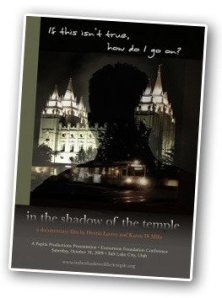
A few years after this article was published, an award winning documentary on the plight of Shadow Mormons entitled, “Under the Shadow of the Temple” was released.  This documentary acts as an excellent companion piece to this article.  We give it our highest recommendation. 

InTheShadowOfTheTemple

Click on image to see trailer

(NOTE: you can read Enigma’s original RfM post here: http://www.exmormon.org/mormon/mormon413.htm )

by Fred W. Anson

“Even when you lose you’re still the winner
At least you’ve got the makin’s of a song”
Waylon Jennings & Willy Nelson
[1]

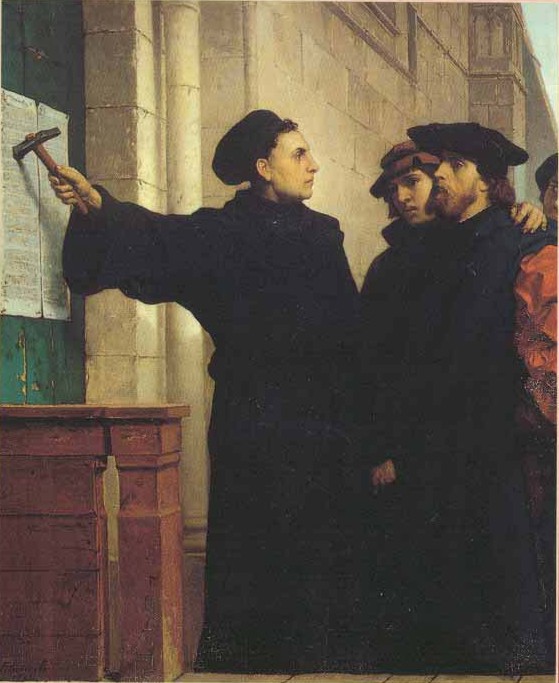
Luther posting the 95-Theses onto the door of Wittenberg Castle Chapel (circa 1517)

Sit back, relax, and let me tell you a little story . . .
THE STORY
On the last two Reformation Days[2] I have released a list of 95-Theses very loosely based on Martin Luther’s which offers some concerns and grievances that I and a random collection of active Mormons, inactive Mormons, former Mormons, and never Mormons see in the current Church of Jesus Christ of Latter-day Saints (LdS Church). This began as and has always been a group effort, it has never been a solo act. Rather, it’s the result of many, many, many kind and generous collaborators (many whom are, no doubt, reading this article) however, inevitably – and no matter how much I stress this fact – both the praise and the blame for the published piece tends to be directed solely at me.   Please don’t understand me, there’s no harm, no foul here – after all I did willingly, and deliberately sign up for this gig!

The response to this list is always been interesting but this year it was particularly so, leaving me with the fine “makin’s of a song,” or more precisely, a mighty fine Mormon Studies case study.

Generally speaking, this year the feedback was positive and affirming with very little “push back” from faithful Mormons or suggestions for improvement from disaffected and former Mormons – which was the case last year.  So there’s not much to report there except that it was unexpected.

Rather, the big surprise came in the closed “Mormon Stories” Facebook group the day after I posted the standard promotional blurb (“With hope and prayer that we will see true reform by this time next year . . .”) with a link to the article. Again, for the most part the responses there were pretty much in line with what I was seeing elsewhere with the exception of a clarification on why I use the term “LdS Church” rather than “LDS Church”[3] and a lengthy discussion with one group member on how Mormon leaders and members tend to engage in eisegesis[4] when they interpret holy writ, history, science, and life in general. It’s a complex subject, and I think an interesting one, so I was happy to try to satisfy her interest in the subject.

Then, the next day, I received this private Facebook message from Mormon Stories founder and board administrator John Dehlin:[5]
“Fred – I’m getting lots of complaints about your participation on the MS board. I don’t mean to offend, but I feel like it might not be a good fit. It feels to many like your intent really is to lead people out of the church (whether that is your intent or not…that’s how it comes across). And that’s just not what this forum is about. Do you mind if we part ways? There are LOTS of forums out there….I feel like your engagement in this forum is driving away many of the people that I’m trying to include/reach.

Now, before I go any further I should probably explain that I’ve always felt I had a good understanding of the Mormon Stories mission. After all, it’s clearly outlined on their website starting with this summary statement, “Mormon Stories is a nonprofit organization that seeks to create online and in-person environments that allow for authentic self-expression and the open discussion of Mormonism.” It then proceeds to expand and describe in further detail the purpose and intention of the organization in some detail including, “… we endeavor to ensure that the projects we undertake 1) support individuals in Mormon-related faith crises, 2) save marriages, 3) heal families, and 4) celebrate, challenge, and advance Mormon culture in healthy ways.”[6]

Some thoughts immediately occur at this point:
1) Nowhere in their mission statement was I able to find a clause about how a tenet of the Mormon Stories mission is to help people stay in the LdS Church.

2) The declaration read before the August 12th, 2011 Mormon Stories event honoring D. Michael Quinn[7] explicitly affirmed the right to self identify as “Mormon” regardless of one’s state of membership in the LdS Church, again affirming the idea that Mormon Stories isn’t a membership retention organization.

3) I have always been sensitive to the fine line that John Dehlin walks in trying to help Mormons come to grips with true Mormon History and the issues in the LdS Church in a productive way. He takes “hits” from all sides that, frankly, I have frequently thought unjust, unfair, and unduly harsh.

4) Based on the rhetoric that John Dehlin has regularly used publicly, I had always thought that the Mormon Stories agenda included lobbying internally and externally for reform in the LdS Church. Personally, I had always thought of John Dehlin as an ally not an adversary.

4) The article in question was, to my way of thinking, very much presented and aligned with Mormon Stories stated intention to “challenge, and advance Mormon culture in healthy ways.”

So I immediately responded with the following, “Sorry about that is there something I can do to rectify the situation?”

I then attempted to enter the Facebook Mormon Stories discussion board only to find that my membership in the group had been revoked – in the vernacular, I had been banned. I then received notification from a friend who was still a member of the group that the following had been newly posted at the tail end of the aforementioned thread discussing the Reformation Day article:

Ms. D
“By the way, folks, I just want to point out to you that Fred W. Anston (sic) is NOT , and never has been a Mormon-LDS, LdS, or anything like that. You might want to keeep (sic) that in mind when considering his comments, his motives, his empathy and friendship. He does NOT know what it is like to be LDS, just so you know that, in case it makes a difference to you.”

So I contacted John Dehlin and asked him to remove the comment – which he did. My request to John was worded as follows:
“This is, quite simply, an ad-hominem AND a not too subtle attempt at character assassination.

I think that you and I can agree that this is inappropriate. Frankly, whether I’ve ever been LdS or not is irrelevant. Further, Ms. D doesn’t know my full background, my motives, or anything else about me. If she bumped into me at the supermarket tomorrow she might not even know it was me.

This is, quite simply, inappropriate.”

I was then contacted again, by a friend who was still in the group. That person provided me with the following discussion which immediately followed after John Dehlin deleted the aforementioned Ms. D’s comment:
Mr. P
“You can still have a Mormon Story without having been a member.”

Ms. H
“how?”

Ms. D
“So, as I was saying, Fred W. Anson is not, nor has he ever been a Mormon or LDS, or LdS or anything like that. You might want to keep that in mind when you read his comments, about how much he empathizes with you, understands you, is your friend, etc. He does NOT understand what it is like to be a member because he never has been one. He takes great care to conceal that fact–have you ever seen him reveal his status here? No, of course not. Not only that, but he avoids answering the direction question put to him in this thread above. Not only that, but he deleted my earlier, briefer comment in which I said that Fred W. Anson is not and never was Mormon. Let’s see if he takes this one down, too.[8]

Fred Ason (sic) is totally agenda driven , and his agenda is to fight against the Mormon Church and to dissuade people from the CHurch (sic). He takes umbridge (sic) at being called anti Mormon, and calls himself a scholar. Yet he does not act like a scholar. An example of a non Mormon scholar on Mormonism is Jan Shipps, a professor, and former president of the Mormon History Association. I don’t recall her tearing down the CHurch.(sic) Scholars STUDY things, they don’t wage war on things.”[9]

Ms. H
“thank you Ms. D…lets see how long before your comment disapears (sic) again.”

Mr. MH
“Another interesting conversation! Wow! I think Ms. D, Fred said NeverMO. I think that means he’s not a Mormon? He talks like a person who studies religion not a person who is religious. I think there is much difference. I read all of these posts and him and Ms. M, and he studies a lot, and posts a lot, but he does not have the spirit of Mormonism. Just sayin’…”

Ms. D
“OK, I went back and read everything more carefully, and I see where he mentions the Never Mo. my bad; missed it the first time. He is very cagey about what he reveals and when he reveals it. He studies a lot, yes, but with only one purpose in mind, to bolster his claims about what is wrong with the Mormon Church. That is not the way a scholar operates; a scholar studies to understand, and is objective and not emotional about the subject.

Fred uses a lot of fawning comments to garner trust. He uses false modesty and flattery. But his writing give me the impression of someone who is not what he says he is, but rather someone who is a narcissistic syncophant (sic).”

So I contacted John Dehlin via private message again and the following conversation ensued:

Fred W. Anson
“John, if you would please deal with the continuing vitriol from Ms. D I would appreciate it. But, of course I only say this because I am apparently a brown nosing, self-absorbed, self-loving Narcissistic Sycophant. Well now I know – my self awareness has chinked [up] a notch!

And, of course, the person who deleted her prior litany of ad-hominems wasn’t I – if you would clear that up I would appreciate that too.”

John Dehlin
“Thanks, Fred. Sorry things didn’t work out.”

Fred W. Anson
“Me too John. I really loved your group. Be well.”

And that was that. In the end , it just left me wonderin’, to paraphrase from one of my Country Western music heroes, “Did ol’ Luther really do it thisa way?”

FROM STORY TO CASE STUDY …
There’s a lot here isn’t there? In the end, this story makes a fascinating case study – it is, to use a tired cliche, quite revealing.

For a start, could someone explain to me why someone who’s just compiled and published a paper lobbying for internal reform of the LdS Church would being trying to push everyone out of it? If we assume that’s my goal and “hidden agenda” then it’s flawed because in the end there won’t be anyone left in the organization to reform it. I’d like to believe that I’m just not that stupid.

Rather, I would suggest, there seems to be a perception within Mormon Culture that criticism – and it seems ANY criticism – is a cry for an exodus from the organization.  To me, this mindset belies the deeply seeded propensity within Mormon Culture to bifurcate: That is, either you’re good or you’re evil; either you’re faithful or you’re an “Anti”; either you’re all in you’re all out. Though, thankfully there are exceptions, it seems like the typical Latter-day simply can not fathom the concept of a nuanced stance, loyal opposition, a full, free talk, and/or good willed investigation and criticism by outsiders. As journalists Richard J. and Joan Ostling observe:

“Such [scrutiny, analysis, commentary, and criticism by outsiders] is the give-and-take of a free and freewheeling society. The thin-skinned and image-conscious Mormons can still display immature, isolationist, and defensive reactions to outsiders, perhaps because there is no substantive debate and no “loyal opposition” within their kingdom. With some, it almost seems that the wilderness is yet untamed, the federal “polyg” police are on the prowl, and the Illinois lynch mob is oiling muskets and preparing to raid Carthage Jail. All too often Saints use the label “anti-Mormon” as a tactic to forestall serious discussion.

Nor are the Mormons alone in facing cultural despisers. Catholics put up with continual insults without complaint (except from the Catholic League). And the Protestant Evangelicals, who are not organized enough to create their own anti-defamation league, have had to endure the Scopes trial and Inherit the Wind, Sinclair Lewis’s Elmer Gantry, a recent onslaught of books claiming they seek to destroy American democracy in favor of “theocracy,” and the crude stereotypes in the latest made-for-TV movie.”[11]

And this author found it curious that Ms. D claims to be familiar with my work yet shows such incredible ignorance of it. For example, I have publicly and clearly stated my stance in regard to the Mormon Church on numerous occasions in my work – simply put it’s “Reformation not Destruction”. Or if you prefer the long version:

“I see some good things in the LdS Church and I see even more in Mormon Culture. There’s also much – particularly in the former – that, in my opinion, is really, really bad and needs to change. Never-the-less I’m just crazy enough to believe that there must be a way to keep the good and jettison the bad. After all isn’t that what happened to the Worldwide Church of God?

However, to get there from here the Church of Jesus Christ of Latter-day Saints, from my perspective, must reform. And THAT, at least for me, is still a work in progress. That’s to say, it’s a work in progress for me because while I think I have an idea as to what end state might look like, I know that I’m not alone in this vision and I’m find the ideas and thoughts of others often more interesting than my own – hence the need for ongoing dialog.”[12]

Further, another interesting irony is that Ms. D both demonstrated and validated several of the grievances that were made in the offending document in question. Specifically:

#3) It [the LdS Church] villainizes critics – even constructive critics – both within and without its ranks.

#37) Its leaders and members use ad-hominems, insults, slurs, derogatories, labeling, and character assassination in their dealings with critics and apostates and then deny that they do so – often going so far as to claim that those who call them on this behavior are persecuting them.

#87) It hypocritically defines polemic arguments as “persecution” and then engages in polemics with its critics.[13]

What seems to be lost on most Mormons is that even if you successfully discredit  the messenger it still doesn’t discredit either their message or the evidence presented in support of that message.  Ultimately ad-hominem arguments in any form are logically fallacious because they relate to the opponent’s person and/or character – neither of which have  anything to do with the logical merit of the opponent’s argument.[14] That is, even if 100% of the claims about your debating opponent’s person and/or character are true, in the end logic, reason, and evidence is what produces rational, cogent argument not personality, credentials, or character.

For example, Secretary of State, Henry Kissinger‘s labeling of Daniel Ellsberg, “The most dangerous man in America” as well as President Richard Nixon‘s labeling him a traitor didn’t make the Pentagon Papers any less true. In fact, they still would have been just as true if the Nixon Administration had successfully produced evidence that Ellsberg was mentally unstable – or even completely insane.  In the end such ad-hominem attacks said more about Mr. Nixon and his staff than they did about Mr. Ellsberg didn’t they?

In a similar vein, to assert that someone is a Narcissistic Sycophant and launching into a campaign of character assassination while utterly ignoring their evidence and arguments says far more about the ad-hominemer than the ad-hominee doesn’t it?

Please don’t misunderstand me – I would be the last to deny some narcissistic tendencies, I’m human and some degree of narcissism is normal and healthy. However, I would hope that mine is in the healthy range and not a clinical “disorder” such as Narcissism Personality Disorder (aka “NPD”).[15] But better safe than sorry so I “reality checked” with my accountability partners, (which includes a credentialed Mental Health Professional), and was assured that if narcissism were electricity I might power a light bulb (in the healthy range) but I wouldn’t power a marque (definitely not in the healthy range).

Further, and you can trust me on this one folks, if you want to have your ego kicked around and run over like a can in the street just get into Mormon Studies – it’s guaranteed to keep you humble!  Most of the Mormon Studies Scholars I know are humble, down-to-earth, folks not pathologists with an inner NPD fire underscoring their work.

As for the equally telling assertion that I engage in sycophancy[16] in support of my alleged pathological narcissism.  In response, I would simply point to my body of work: Tell me, does a sycophant compile a body of work that agitates, provokes, and challenges the status quo? Rather, my mentors have consistently encouraged me to use more tact as well as a kinder, gentler approach with those I’m trying to reach.  I am painfully aware that my default style is to shoot first and ask questions later. Therefore, I’m doing my best to listen more, talk less, and when I do talk be kinder and gentler in my demeanor and choice of words. Perhaps it’s this conscious – probably clumsy – effort to be a better man that she mistakenly perceived as sycophancy.

And if more evidence is required for my defense, when I reality checked this with my wife she howled with laughter – nearly fell out of bed in fact – because she’s seen me “in action” both online and in person (it came  at the end of a hard day  for her so she’d like to thank my accuser for the good laugh by the way – it was sorely needed)

Narcissistic Sycophant? Sorry, but my case apparently the answer is, “No.”

And adding to the growing list of comedic ironies is that very behavior she’s accusing me of is the diagnosis that Latter Day Saint forensic health professionals (Robert Anderson, C. Jess Groesbeck, and William Morain, M.D.) and historians (Fawn Brodie topping the long list) have stamped on Joseph Smith, Jr.’s file.[17] Further, there’s a difference between being civil, kind and respectful, as I believe I was on the Mormon Stories discussion board – and manipulating people through, as the ad-hominemer put it so well, “fawning comments to garner trust … false modesty and flattery” which the historical record demonstrates Joseph Smith did so adroitly throughout his life.

So I would suspect that the dynamic that’s really in play here is psychological projection.[18] Indeed, she has the right diagnosis but the wrong patient.

… TO PRACTICAL APPLICATION
In the end this story really makes me wonder just what is going with Mormon Stories. As previously stated, I’ve always had the utmost respect for John Dehlin’s work. I have always felt that he’s reasonable and has a sense of justice and equity.

However, by first banning me from the group and then leaving a litany of derogatory, inflammatory personal attacks on me, my motives, and my character (after I’d specifically asked for their removal no less) was the cyber-equivalent of handcuffing me and then walking away while I was beat up. This isn’t just “bad form” it’s unjust and unfair.

This is even more telling when you consider that Ms. D didn’t post in the thread before Mr. Dehlin banned me from the Mormon Stories Facebook group – her sole purpose in posting, therefore, was clearly to character assassinate me thereby, in her mind, discrediting my work simply because she disagreed with it.  This is hardly a mature, rational approach to public disagreement but sadly these days it’s common.

Further, I find Mr. Dehlin’s behavior particularly puzzling given what transpired earlier this year in June:
“In 1998, FARMS was brought into BYU under the umbrella of the Maxwell Institute, and the Mormon Studies Review came with it. Review writers responded to critics’ allegations by dissecting their arguments — and motives — sometimes writing scathing and often personal attacks on those who challenged LDS origins. It was, they believed, the essence of apologetics.

The tipping point against that approach may have been a 100-page article about John Dehlin, a church member in Logan who launched Mormon Stories, which welcomes those who question aspects of LDS history, practice and theology. Dehlin’s group has published articles about reasons Mormons leave the fold and research on gay members, among other topics.

After hearing about the piece, Dehlin called an LDS general authority who was a personal friend. Eventually, Maxwell Institute Director Gerald Bradford pulled the article from the journal, leaving a giant hole and putting it behind in its publishing schedule.

‘I have had enough conversations with general authorities to know,” Dehlin said this week, “that they don’t view ad hominem attacks as a constructive way to do apologetics.'”[19]

So is it reasonable to now conclude that while Mr. Dehlin feels that ad-hominem attacks aren’t appropriate or constructive when he’s the target of such attacks, that’s not the case for others?

Cases in point:  In June Daniel C. Peterson was terminated from his position at Maxwell amidst a chorus of ad-hominems from the Mormon Stories community.  Then in November I was terminated from the Mormon Stories Facebook group as ad-hominems flowed. In both cases some hand wringing and regret was expressed by Mr. Dehlin but the end result was the same – as they say, “Actions speak louder than words.”

Further, a consensus is building that the tone, nature, and content of Mormon Stories after the Daniel C. Peterson firing became noticeably less critical and more and more an advocate for the LdS Church. More and more critical voices it seems are being pruned from all things Mormon Stories and being replaced with those who skew toward a conciliatory, occasionally even apologetic stance. Nothing has been said but this trend has been noted by many.  Simply put, Mormon Stories “ain’t what it used to be” and even seems to drifting further and further away from it’s mission statement.

For me, this is disappointing. Like so many others I have trusted, liked, and respected the Mormon Stories founder, and I have supported Mormon Stories to the best of my ability (including financially I might add), and defended both against critics from all sides. Now I find that I must reconsider that stance as I have discovered the hard way that perhaps my trust and support was misguided.

For myself and others who watched this story unfold the final take away seems to be: “Well now we know what we’re really dealing with”

Further, and in a similar vein, the final lesson learned here seems to be just how incredibly elitist and exclusive Mormon Culture can be. Let’s consider a few more of the statements that were made in the thread:

“Fred W. Anston (sic) is NOT , and never has been a Mormon-LDS, LdS, or anything like that. You might want to keeep (sic) that in mind when considering his comments, his motives, his empathy and friendship.”

Depersonalizing that and taking it at face value, I take that to mean that someone who’s never been a Latter-day Saint can’t possibly be knowledgeable about and/or trusted to have a legitimate perspective about Mormon Culture. The contemporary LdS mindset still seems to be, as the Ostlings said so well in Mormon America, “the wilderness is yet untamed, the federal “polyg” police are on the prowl, and the Illinois lynch mob is oiling muskets and preparing to raid Carthage Jail.”  The idea that outsiders could be watching, hoping, praying, and lobbying for positive reform in the LdS Church seems to be lost on some Mormons.

Further, I’ve seen similar but even more vitriolic language used by true believing Mormons to describe both former and active members that publicly express their criticism of the institution – so it seems to be that having a reasonable understanding of the LdS Church and it’s resulting culture isn’t the real issue here.[20] Rather, I think, that what’s being demonstrated here is Anson’s long held view of how many Mormons practically define “Anti-Mormon,” which is: “I’m upset because I don’t like what you’re saying so you MUST be an Anti-Mormon!”[21]

The next assertion is even more telling: “He does NOT know what it is like to be LDS.” Though Mormons don’t like hearing it the former members of other Mind Control Cults who educate themselves on the LdS Church typically react with an, “I can’t believe it – the Mormon Church is just like only with different words, leaders, and sacred books!”[22] In fact, every cultist is utterly and completely convinced that there has never – in the entire history of the world – been a group like theirs, never will be, and only insiders can truly understand and appreciate that fact. However, this type of exclusivist, insular, myopic thinking, we’re told by experts is one of the biggest indicators that a group is cult.

And this was certainly true in my case. I was a member of a Mind Control Cult from 1976-1989[23] and to this day it stuns me how much like the LdS Church we were. And the more Mormon History I read, the more similarities I see in the developmental paths of our group and the LdS Church – it is simply amazing. And yes, I thought that both my group and my experience in that group was utterly and completely unique in world history. So in the end, no, I can’t say that I know EXACTLY what it’s like to be a Latter-day Saint, but yes, I can certainly empathize and relate based on my experience in a group that was so similar that at times it seems like I was really in the LdS Church by another name.

And I’m reminded of how when I was exiting my group in I frequently used the defense mechanism know as “Ugly Sister Syndrome” in which I critiqued, criticized, condemned, even mocked my “ugly sister” but if you – someone who had never been a member – did I would do a “18o” come to her defense, and attack you instead.  Perhaps that was one of the dynamics in play here – after all some of the critical commentary by current and former Latter-day Saints in the closed Mormon Stories Facebook group that I saw while I was still a member was absolutely brutal – far, far, far more extreme than any rhetoric that I’ve ever used.

Perhaps this explains the commonly observed phenomenon of Jack, Ex, New Order, and Atheist LdS Church members who will passionately and bluntly criticize LdS leaders, the organization, policies, culture – even their own families – endlessly but turn around and defend them with the same level of passion if an “outsider” does.

Further, and in support of my case, I would ask those in Mormon Culture to consider what one Ex-Mormon observed: “Mr. IT [my alias on PostMormon.org] did something even more remarkable. He is a nevermo with Mo relatives. He went directly from unaffiliated to apostate without experiencing all the pain and surreal experience of being a member.”[24] And since I’m nothing special I would suggest that what’s true for me may be true of other “NeverMo’s” too.

That’s why I find the objection that someone who has never been a member of the Mormon Church couldn’t possibly have a “Mormon Story” closed minded and elitist to the extreme. The final comment in the thread (as of the time of writing that is) said it so well that I will simply echo and endorse it as, in a nutshell, it describes my Mormon Story:

Mr. P
Ms. H, Nevermos have Mormon Stories too. They may have family or close friends that are Mormon and it can affect their lives deeply. Others may have investigated with a close encounter to baptism.

Yes friends it’s true, NeverMo’s have their own Mormon Stories and if you doubt me just start at the top of this article and read to the bottom. And, yep, in the end and yessiree, I reckon ol’ Luther really did do it thisa way!

Martin Luther at The Diet of Worms (circa 1521)

NOTES
[1] Lyrics from the chorus of “The Makin’s of a Song” by Jennings, Seals, Barnes, Nelson as recorded on the album “Clean Shirt” by Waylon Jennings & Willy Nelson.

[2] Reformation Day is October 31st of each year. See http://en.wikipedia.org/wiki/Reformation_Day

[3] The Church of Jesus Christ of Latter Day Saints (aka, “LDS Church”) is the name of the Strangite Church (see http://www.strangite.org ). The Church of Jesus Christ of Latter-day Saints (aka “LdS Church”) is the official name of the Brighamite church (see http://en.wikipedia.org/wiki/The_Church_of_Jesus_Christ_of_Latter-day_Saints ) that was being addressed in the article. To not honor this distinction would have been a incongruent contraction with #93 on the list which says:

“93) It fails to recognize the over sixty (60) active Latter Day Saint movement denominations (aka “splinter groups”) while hypocritically condemning the denominationalism of Christianity as a proof of apostasy and lack of divine legitimacy. This hypocrisy is even more pronounced when one considers that over the 180+ year history of the LDS movement there have been over 200 Latter Day Saint denominations in total with new ones forming at a rate will be eventually far exceed and out pace the total number of Christian denominations.”

[4] “Eisegesis (from Greek εἰς “into” as opposed to exegesis from ἐξηγεῖσθαι “to lead out”) is the process of interpreting a text or portion of text in such a way that it introduces one’s own presuppositions, agendas, and/or biases into and onto the text. The act is often used to “prove” a pre-held point of concern to the reader and to provide him or her with confirmation bias in accordance with his or her pre-held agenda.”
http://en.wikipedia.org/wiki/Eisegesis (retrieved 2012-11-05)

[5] Should anyone object to the disclosing of private messages in response to public ad-hominems I would simply point to John Dehlin’s disclosure of private messages in response to the threat of public ad-hominems that were to be published in a The Maxwell Institute publication:

Grindael, “Of Mice And Egos”, Mormon Musings, July 20, 2012
http://mormonitemusings.com/tag/john-dehlin/ (retrieved 2012-11-05)

MormonStories, “Greg Smith, Dan Peterson, John Dehlin, & Lou”, Mormon Dialogue, thread started May 10, 2012; private emails are disclosed by John Dehlin and others throughout the entire 29 page discussion thread.
http://www.mormondialogue.org/topic/57768-greg-smith-dan-peterson-john-dehlin-lou/page__st__40 (retrieved 2012-11-05)

[6] Mormon Stories Podcast About page: http://mormonstories.org/about (retreived 2012-11-03)

[7] John Dehlin, “285-287: D. Michael Quinn – 21st Century Mormon Enigma”; Mormon Stories Podcast, September 17, 2011
http://mormonstories.org/register-now-an-evening-with-d-michael-quinn-august-12th-2011 (retreived 2012-11-03)

[8] She is, of course, referring to the post that John Dehlin deleted at my request. Since I wasn’t a Administrator of the group I couldn’t have deleted her post. I find this projection of a  power onto me that I have never possessed – and never will possess – to be telling.

[9] By the way, I addressed this argument in “Falsely Accused: My Life As An ‘Anti’”, Mormon Expression Blogs, July 11, 2011; http://mormonexpression.com/blogs/2011/07/11/falsely-accused-my-life-as-an-anti (retrieved 2012-11-04)

[10] Here’s an example of Ms. D’s continuing character assassination campaign that was posted on November 6th in another discussion thread in the closed Mormon Stories Facebook page:
“Yeah, here in Oklahoma people like to tell us what we believe. It’s the southern Baptist/Evangelical thing–their preacher preaches against Mormons in Church and tell them what Mormons believe, what the Book of Mormon is about, etc. They even have some people who specialize in “Mormonism” who do it like full-tme (sic) (like that Fred Anson guy–I never understood what he gets out of “studying” Mormonism all the time and trying to convince people to get out of the church. I don’t miss him one bit). Anyway, my kids grew up with this all the time in school. But yeah, you can sometimes see where they actually have some stuff “right”, but usually a bit distorted or out of context, so it sounds even wierder. (sic)”

I found this particularly amusing since: a) I’ve never been Baptist – and if I have a choice in the matter I never will be; b) Like most in Mormon Studies, I don’t do it full time – it’s solely an avocation; c) My objective isn’t, and never has been, “to convince people to get out of the [LdS] church.”  I have made very clear in my body of work – more on this later.

And, to this author, it’s amusing that Ms. D starts her argument complaining about those who “shoot first and ask questions later” while she is in fact engaging in the very behavior that she’s so incensed about. I have advised many a ranting Mormon flamer to “ask not tell” but I’ve noticed common sense and practical wisdom tend to fall on deaf ears once someone has been labeled an “Anti” by a Mormon – after all, sociologists tell us that facts, respect, and civility are secondary once the other party is psychologically labeled “enemy”.

[11] Richard and Joan Ostling, “Mormon America, Revised Edition”, position 310.7/1158 Kindle edition

[12] Op Cit, Fred W. Anson, “Falsely Accused: My Life As An ‘Anti’”

[13] “What’s Wrong With The Mormon Church?” (2012 edition)
https://beggarsbread.org/2012/10/31/whats-wrong-with-the-mormon-church-2012-edition
(retrieved 2012-11-07)

[14] “Abusive ad hominem (also called personal abuse or personal attacks) usually involves insulting or belittling one’s opponents in order to attack their claims or invalidate their arguments, but can also involve pointing out true character flaws or actions that are irrelevant to the opponent’s argument. This is logically fallacious because it relates to the opponent’s personal character, which has nothing to do with the logical merit of the opponent’s argument, whereas mere verbal abuse in the absence of an argument is not ad hominem nor any kind of logical fallacy.”
http://en.wikipedia.org/wiki/Ad_hominem (retrieved 2012-11-16)

[15] For a primer on Narcissist Personality Disorder please see the following U.S. National Library of Medicine  article: http://www.ncbi.nlm.nih.gov/pubmedhealth/PMH0001930  (retrieved 2012-11-07)

[16]  The definition of “sycophant” or “sycophancy” with links to other resources regarding sycophantic behavior can be found here: http://dictionary.reference.com/browse/sycophant  (retrieved 2012-11-07)

In this context Ms. D is referring to sycophancy as a psychological supply system for narcissism.  The relationship between the behaviors is discussed here:  http://en.wikipedia.org/wiki/Narcissistic_supply (retrieved 2012-11-23)

[17] Those interested in a short primer on the case for Joseph Smith’s NPD should consider Appendix A  below.

[18] Psychological projection or projection bias (including Freudian Projection) is the unconscious act of denial of a person’s own attributes, thoughts, and emotions, which are then ascribed to the outside world, such as to the weather, a tool, or to other people. Thus, it involves imagining or projecting that others have those feelings.

Projection is considered one of the most profound and subtle of human psychological processes, and extremely difficult to work with, because by its nature it is hidden. It is the fundamental mechanism by which we keep ourselves uninformed about ourselves. Humor has great value in any attempt to work with projection, because humor presents a forgiving posture and thereby removes the threatening nature of any inquiry into the truth.”
http://en.wikipedia.org/wiki/Psychological_projection  (retrieved 2012-11-07)

[19] Peggy Fletcher-Stack, “Shake-up hits BYU’s Mormon studies institute”, The Salt Lake City Tribune, June 26, 2012; http://www.sltrib.com/sltrib/utes/54358137-78/mormon-institute-peterson-studies.html.csp (retrieved 2012-11-04)

[20] Op Cit, Fred W. Anson, “Falsely Accused: My Life As An ‘Anti’”; the list of “Anti-Mormons” so described even includes former LdS President, Gordon B. Hinckley – believe it or not!

[21] Ibid. Please note that I expanded on this further in my article, “Can A Mind Control Cult Reform Itself?” ( http://mormonexpression.com/blogs/2011/10/20/can-a-mind-control-cult-reform-itself )

[22] Please consider the following:

Anonymous, “Scientology-Lite”; Mormon Expression, February 19, 2011
http://mormonexpression.com/blogs/2011/02/19/scientology-lite (retrieved 2012-11-05)

John Larsen and “Joe”; “Episode 80: Leaving the Jehovah’s Witnesses”, September 14, 2010
http://mormonexpression.com/2010/09/14/80-leaving-jehovah-witnesses (retrieved 2012-11-05)

“Teddy”, “My Former Cult (World Wide Church of God)”, Sam Harris Forum, May 25, 2007
http://www.samharris.org/forum/viewthread/6839 (retrieved 2012-11-05)

[23] I’ve written two articles that reference my experiences in the Mind Control Cult known as “The Shepherding Movement” thus far:

Fred W. Anson, “My Life as a Mind Control Cultist Part 1”, Mormon Expression, August 22, 2011
http://mormonexpression.com/blogs/2011/08/22/my-life-as-a-mind-control-cultist-part-1 (retrieved 2012-11-05)

Fred W. Anson, “Can A Mind Control Cult Reform Itself?”, October 20, 2011
http://mormonexpression.com/blogs/2011/10/20/can-a-mind-control-cult-reform-itself (retrieved 2012-11-05)

[24] “HikerR” Posting on PostMormon.org 2007-11-26; link now dead – this quote was captured at the time. And. yes, I am rather proud of it.

APPENDIX A: THE NARCISSISM AND SYCOPHANCY OF JOSEPH SMITH, JR.
C. Jess Groesbeck, M.D.

The subject of Joseph Smith Narcissistic Sycophancy is one that this author feels is best covered in Robert Anderson’s book, “Inside The Mind of Joseph Smith” and William D. Morain’s book, “The Sword of Laban“. While both of these books, in my opinion are watershed, Jungian Psychiatrist, C. Jess Groesbeck also compiled an impressive supporting body of work on the subject via his Sunstone lectures and articles prior to his death in 2009. Let the reader note that all of these men are Latter Day Saints – two (Anderson and Groesbeck) are Latter-day Saints and the third (Morain) is a member of the Community of Christ. What now follows is a brief, far from comprehensive, overview and primer on the subject that I hope will spur the reader to consider the aforementioned esteemed works in it’s wake.
“[‘Inside the Mind of Joseph Smith’ author Robert] Anderson theorizes that Joseph Smith suffered from the narcissistic personality disorder. He points out that there is a danger in attempting to explain human behavior through psychodynamic theory. Accepting such theory as fact can cause damage. A few decades ago psychiatrists speculated that some serious mental illnesses were caused by the influence of the mother or of the environment. Now we know that chemical treatments such as lithium can effectively treat some of these illnesses. It is possible that in the future narcissistic personalities may respond favorably to specific medications. The fact is that the cause and source of the narcissistic personality are not known. However, the psychodynamic setting provides an unusual laboratory for studying this emotional problem, and some individuals do seem to respond to prolonged intensive psychotherapy.

In his analysis of Joseph Smith, Anderson draws upon the body of literature, especially the Book of Mormon, produced by observation, experiment, theory, and psychiatric experience in his attempt to understand the founder of Mormonism. He says that splitting, a fundamental of personality weakness, is a major psychological defense demonstrated by the prophet. Its most obvious manifestations are:

1) the division of the world into polar opposites and
2) the lack of integration of the various parts of the patient’s psyche.

The individual may oscillate between two opposite positions. This behavior can be seen in the polarized opposites of the Nephite and Lamanite people depicted in the Book of Mormon, as well as in Smith’s ability to present one face in public (such as denying polygamy) while simultaneously converting associates and new plural wives to the principle in private.
The individual may also exhibit psychological reversal of attitudes toward particular persons, by switching instantly from compliments to vilification, or of oscillation in moral positions, yet not be troubled in the contradiction. Examples are the instantaneous conversions of Alma, Jr., Zeezrom and the whole Lamanite population in 30 BCE in the Book of Mormon. Another example was Smith’s strong opposition to Masonry as a young man, followed by his later becoming a Mason himself and drawing on Masonic ritual for temple ceremonies.”
(Robert Layton, “Discussion Group Report: Inside the Mind of Joseph Smith”; retrieved 2012-11-03)

And Smith’s tendencies in this regard are well documented in the historical record. For example, in 1843 Charlotte Haven wrote some letters from Nauvoo which contain some candid observations about Joseph Smith:

“Joseph Smith … is evidently a great egotist and boaster, for he frequently remarked that at every place he stopped going to and from Springfield people crowded around him, and expressed surprise that he was so ‘handsome and good looking'”
(Overland Monthly, December 1890, p.621).

“He talked incessantly about himself, what he had done and could do more than other mortals, and remarked that he was “a giant, physically and mentally.” In fact, he seemed to forget that he was a man…. They say he is very kindhearted, and always ready to give shelter and help to the needy. We may hope so, for a kind heart in this place can always be active.”
(p.623).
I rushed out with the umbrella to shield Mrs. Smith, the others followed…. Mrs. Smith was pleasant and social, more so than we had ever seen her before…. while her husband is the greatest egotist I ever met.”
(p.631)

And for evidence of Joseph Smith’s sycophantic tendencies one need only refer to passages like this in Doctrine & Covenants:

“Verily, verily, I say unto thee, blessed art thou [Oliver Cowdery] for what thou hast done; for thou hast inquired of me, and behold, as often as thou hast inquired thou hast received instruction of my Spirit. If it had not been so, thou wouldst not have come to the place where thou art at this time.

Behold, thou knowest that thou hast inquired of me and I did enlighten thy mind; and now I tell thee these things that thou mayest know that thou hast been benlightened by the Spirit of truth;

Yea, I tell thee, that thou mayest know that there is none else save God that knowest thy thoughts and the intents of thy heart.

I tell thee these things as a witness unto thee—that the words or the work which thou hast been writing are true.

Therefore be diligent; astand by my servant Joseph, faithfully, in whatsoever difficult circumstances he may be for the word’s sake.”
(Doctrine & Covenants 6:14-18 ; http://www.lds.org/scriptures/dc-testament/dc/6.14-18?lang=eng#13 )

Now if this revelation wasn’t divinely inspired then it’s about as fine an example of narcissistic sycophancy as one could hope for. Further, this is just one of many such examples of Smith’s use of sycophantic language (albeit using the voice of God) in Doctrine & Covenants.  If this thesis is correct then the following resources can be used to read through other examples of how Smith used sycophancy to manipulate his followers:

Doctrine and Covenants and Church History Seminary Student Study Guide
“People and Terms in the Doctrine and Covenant”
https://www.ldsces.org/manuals/doctrine-and-covenants-and-church-history-seminary-student-study-guide/dc-ssg-8-people.asp

Susan Easton Black, “Who’s Who in the Doctrine and Covenants” [Kindle Edition]
http://www.amazon.com/Whos-Who-Doctrine-Covenants-ebook/dp/B004BDOZEY

Again, this appendix is intended to be a short primer and overview.  If the reader is interested in further study of this complex and nuanced issue, the books, articles, and lectures mentioned at the start of this short primer are recommended.
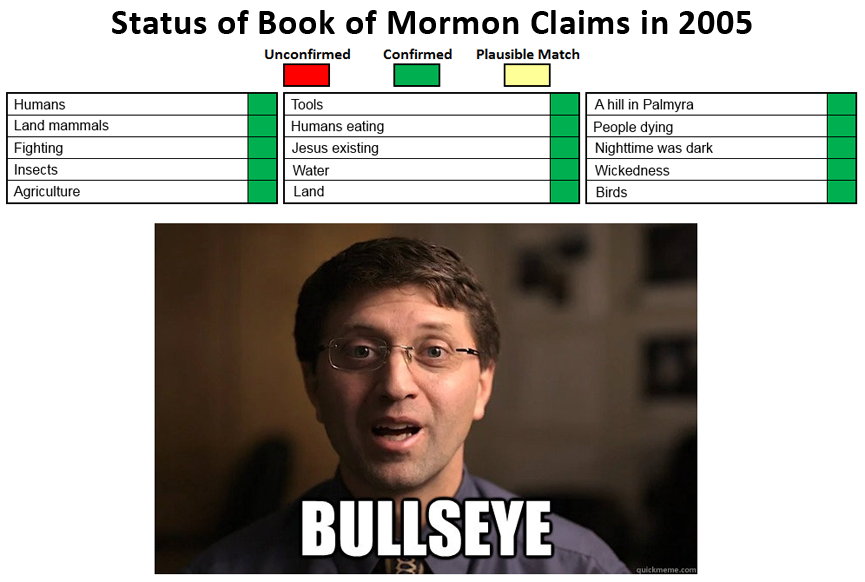
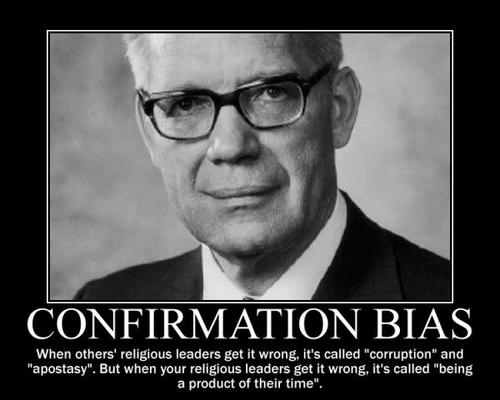
by Fred W. Anson
It was a simple question that was posted on Yahoo Answers . . .

Q: What’s your experience with The Church of Jesus Christ of Latter Day Saints? (good or bad)?
My question is what is your experience with The Church of Jesus Christ of Latter Day Saints, its followers (also known as Mormons) and if you could get one message through to Mormons and/or non Mormons, what would it be?

… and, even though most of it got chopped off, here was how I answered in full:

Q: What’s your experience with The Church of Jesus Christ of Latter Day Saints? (good or bad)?
A: I’ve never been Mormon but I have a lifetime of Mormon friends and family members and I’ve had direct experience with the LdS Church.

THE GOOD
First, I’ll say that my direct “face-to-face” experience with Mormons has been overwhelmingly positive.

Here’s how I described my face-to-face experience with Mormons in a Facebook article:
“Mormons are members of The Church of Jesus Christ of Latter-day Saints. Collectively they represent a rich, colorful, tapestry of personalities, talents, giftings, callings, and, yes, even beliefs. Or put another way, I find MUCH good in the Mormon people and Mormon Culture which I applaud, celebrate, revel in and strive to protect. … Mormons are our family members, our friends, our colleagues and our neighbors I do NOT dislike them – in fact, I love Mormons.”[1]

In face-to-face settings Latter-day Saints have always opened their hearts and homes to me and my family even though many of them know that in my role as a Mormon Studies scholar I am generally critical of the of the LdS Church, it’s leaders, Mormon Doctrine, and many aspects of Mormon Culture.

Second, I would also have to say that my direct experience with the LdS Church in Mormon Chapel meetings, Sunday School classes and, sadly, the funeral of a family member, has been equally positive. Their meetings are generally uplifting, inoffensive, include many bits of useful bits of “sage wisdom”. I generally leave feeling better than when you went in – I would liken them to what I experienced in Dale Carnegie classes, Self Help, and/or 12-Step meetings only with Joseph Smith sitting in Dale Carnegie, Zig Ziglar, Denis Waitley, Dr. Bob Smith, or Bill Wilson’s chair respectively.

THE BAD
Without question the worst “face-to-face” experience that I had in a Mormon Chapel meeting was when we attended a 3-hour “Fast & Testimony” meeting.

For those of you who are unfamiliar with these meetings, here’s how they’re described in The Encyclopedia of Mormonism:
“An LDS fast and testimony meeting is normally held on the first Sunday of each month, where faithful members of the Church are invited to bear a verbal witness of their feelings of the gospel of Jesus Christ. The meeting usually follows a fast by the members, usually from at least two consecutive meals and from liquids also. The fast is officially broken by partaking of the Sacrament of the Lord’s Supper. In modern scripture, fasting is described as “rejoicing and prayer” (D&C 59:14), which implies that it is more than just abstaining from food. That tone of devotion is also the feeling associated with contributing fast offerings, giving the equivalent cost of the meals, or more, to be used for the poor. The fast and testimony meeting becomes the locus of spiritual sensitivity and contrition, of concentration on the things of God.”[2]

That’s all true but what it fails to mention is that the testimonies tend to be overtly formulaic following this template:
“I TESTIFY TO YOU, I KNOW THE BOOK OF MORMON IS TRUE. I KNOW JOSEPH SMITH WAS A PROPHET OF GOD. I KNOW THE MORMON CHURCH IS TRUE.”[3] And sometimes an, “I love my family/husband/wife/mother/father/etc.”  got thrown as would an “I also testify that (fill in name of current LdS President) is a true prophet of God” and usually ending with an, “In the name of Jesus Christ, amen.”

However, by the end of the 3-hour session, I found that so many of the testimonies were almost word-for-word identical that it was a bit creepy.

But the most unsettling thing of all was when a parent would hold a far-too-young-to-fully-understand child up to the mic and have them parrot the formulaic testimony that they whispered in their ear. This occurred several times, resulting in dabbed eyes from the audience, and tears of joy from family members of the child.

Frankly, it was beyond weird, it was extremely unsettlingly and garnered a, “What the heck is going here? What’s wrong with these people? What’s wrong with this church?” from this author.

In fact, someone captured the audio one of these incidents on YouTube, listen to it for yourself, don’t take my word for it.[4]

THE UGLY
But without question, the worst experiences that I’ve had with Mormons has been on the Internet. The Internet brings out the bad side of everyone but Mormons seem to really, really, really go from “Jekyl” to “Hyde” there.

image credit “Flame Warrior” by Mike Reed

It seems that unless one is glowingly positive about the LdS Church and/or Mormon Culture on the Internet one is quickly labeled an “Anti-Mormon” and subjected to a litany of relentless personal and ad-hominem attacks that, frankly, I was shocked and surprised at given how I’d been treated in all my direct face-to-face Mormon experiences.[5]

I think that Richard and Joan Ostling described this well in their book on Mormonism when they said:
“The thin-skinned and image-conscious Mormon can display immature, isolationist, and defensive reactions to outsiders, perhaps because there is no substantive debate and no “loyal opposition” within their kingdom. With some, it almost seems that the wilderness is still untamed, the federal ‘polyg’ police are on the prowl, and the Illinois lynch mob is still oiling muskets and preparing to raid Carthage Jail. All too often Saints use the label “anti-Mormon” as a tactic to forestall serious discussion.”
(“Mormon America: The Power and the Promise (2007 Edition)”; Richard N. and Joan K. Ostling; p. 115)[6]

BUT AT THE END OF THE DAY
So, in the end, my feelings about the LdS Church and the Mormon people goes something like this:

Dislike? Hardly!
Contend with? Gladly!
Expose? Regularly!
Oppose? If necessary.
But through it all, and at the end of the day,
I LOVE Mormons!

Q: If you could get one message through to Mormons and/or non-Mormons, what would it be?
A: To Mormons, my one message would be two questions:
1) “How important is it to you that the truth claims of the LdS Church are in reality true?”
and
2) “Why do you stay in a group that it’s been documented engages in Mind Control tactics and behaviors?”[7]

And to non-Mormons it would be two statements:
1) “If a Church – any church, including the one that I may be in – claims to have the truth it’s probably a good idea to find out if it’s lying to you first.”
and
2) “The best place to find out about a religious group – any religious group, including the one that I may be in – is from former members.”

I hope that this helps.

NOTES
[1]
Fred Anson, “Through it all, and at the end of the day, I LOVE Mormons!”  
[2] Mary Jolley, “Fast and Testimony Meeting”; The Encyclopedia of Mormonism 
[3] The Mormon Testimony “I Testify to You…”‘
[4] “Mormon Parent Coerces Testimony From Child”
[5] In fact, I wrote a Mormon Expression blog on this subject:  ‘Falsely Accused: My Life As An ‘Anti’’ 
[6] Link to “Mormon America” page on Amazon
[7] The assertion that the leadership of the LdS Church and it’s membership engages in Mind Control tactics and behavior isn’t given lightly and/or without empirical support. It is a long standing and widely held view backed by a growing body of evidence:
“The BITE Model and Mormon Control”
“Is Mormonism a Cult? – A Rebuttal”
“The BITE Model Applied Toward Mormonism’s Two-Year Missionary Program”
“The BITE Model Applied Toward Mormonism”