Archive for the ‘Theology’ Category

The Difference a Vowel Makes
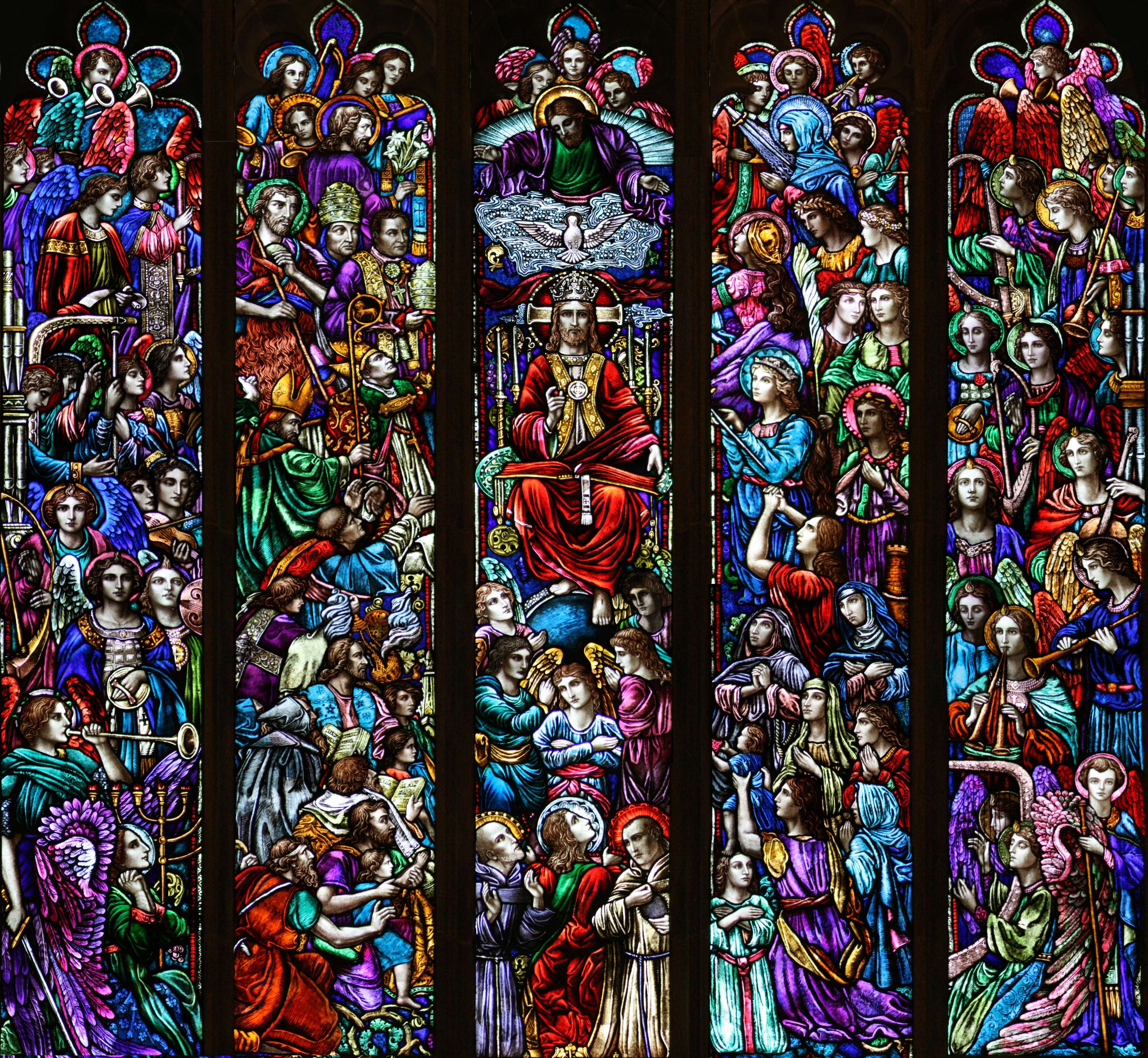
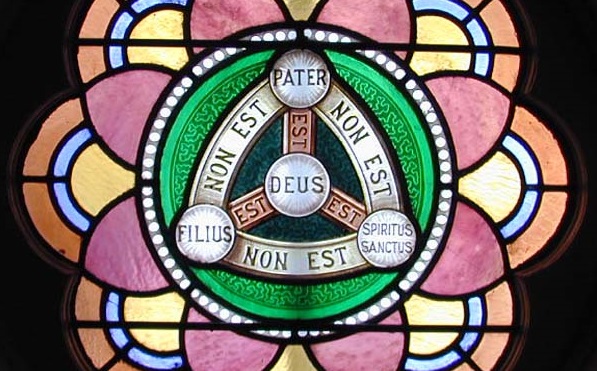
"Communion of Saints" (stained glass window)

“Communion of Saints” (stained glass window)

by Keith A. Mathison

The twentieth century could, with some accuracy, be called a century of theological anarchy. Liberals and sectarians have long rejected outright many of the fundamental tenets of Christian orthodoxy. But more recently professing evangelical scholars have advocated revisionary versions of numerous doctrines. A revisionary doctrine of God has been advocated by proponents of “openness theology.” A revisionary doctrine of eschatology has been advocated by proponents of full-preterism. Revisionary doctrines of justification sola fide have been advocated by proponents of various “new perspectives” on Paul. Often the revisionists will claim to be restating a more classical view. Critics, however, have usually been quick to point out that the revisions are actually distortions.

Ironically, a similarly revisionist doctrine of sola Scriptura has arisen within Protestantism, but unlike the revisionist doctrine of sola fide, the revisionist doctrine of sola Scriptura has caused very little controversy among the heirs of the Reformation. One of the reasons there has been much less controversy over the revisionist doctrine of sola Scriptura is that this doctrine has been gradually supplanting the Reformation doctrine for centuries. In fact, in many segments of the evangelical world, the revisionist doctrine is by far the predominant view now. Many claim that this revisionist doctrine is the Reformation doctrine. However, like the revisionist doctrines of sola fide, the revisionist doctrine of sola Scriptura is actually a distortion of the Reformation doctrine.

The adoption of the revisionist doctrine of sola Scriptura has resulted in numerous biblical, theological, and practical problems within Protestant churches. These problems have become the center of attention in recent years as numerous Protestants have converted to Roman Catholicism and Eastern Orthodoxy claiming that their conversion was due in large part to their determination that the doctrine of sola Scriptura was indefensible. Roman Catholic and Eastern Orthodox apologists have been quick to take advantage of the situation, publishing numerous books and articles devoted to critiquing the doctrine of sola Scriptura. One issue, however, that neither the converts nor the apologists seem to understand is that the doctrine they are critiquing and rejecting is the revisionist doctrine ofsola Scriptura, not the classical Reformation doctrine. In order to understand the difference, some historical context is necessary.

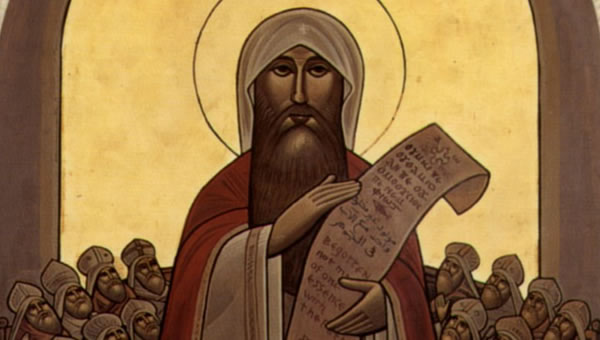
Unknown Artist, "The Great Cloud of Witnesses" (20th Century)

Unknown Artist, “The Great Cloud of Witnesses” (20th Century)

Historical Observations
Part of the difficulty in understanding the Reformation doctrine of sola Scriptura is due to the fact that the historical debate is often framed simplistically in terms of “Scripture versus tradition.” Protestants are said to teach “Scripture alone,” while Roman Catholics are said to teach “Scripture plus tradition.” This, however, is not an accurate picture of the historical reality. The debate should actually be understood in terms of competing concepts of the relationship between Scripture and tradition, and there are more than two such concepts in the history of the church. In order to understand the Reformation doctrine of sola Scriptura we must understand the historical context more accurately.

The Reformation debate over sola Scriptura did not occur in a vacuum. It was the continuation of a long-standing medieval debate over the relationship between Scripture and tradition and over the meaning of “tradition” itself. In the first three to four centuries of the church, the church fathers had taught a fairly consistent view of authority. The sole source of divine revelation and the authoritative doctrinal norm was understood to be the Old Testament together with the Apostolic doctrine, which itself had been put into writing in the New Testament. The Scripture was to be interpreted in and by the church within the context of the regula fidei (“rule of faith”), yet neither the church nor the regula fidei were considered second supplementary sources of revelation. The church was the interpreter of the divine revelation in Scripture, and the regula fidei was the hermeneutical context, but only Scripture was the Word of God. Heiko Oberman (1930-2001) has termed this one-source concept of revelation “Tradition 1.”1

The first hints of a two-source concept of tradition, a concept in which tradition is understood to be a second source of revelation that supplements biblical revelation, appeared in the fourth century in the writings of Basil and Augustine. Oberman terms this two-source concept of tradition “Tradition 2” (Professor Oberman had many gifts. The ability to coin catchy labels was apparently not one of them). It is not absolutely certain that either Basil or Augustine actually taught the two-source view, but the fact that it is hinted at in their writings ensured that it would eventually find a foothold in the Middle Ages. This would take time, however, for throughout most of the Middle Ages, the dominant view was Tradition 1, the position of the early church. The beginnings of a strong movement toward Tradition 2 did not begin in earnest until the twelfth century. A turning point was reached in the fourteenth century in the writings of William of Ockham. He was one of the first, if not the first, medieval theologian to embrace explicitly the two-source view of revelation. From the fourteenth century onward, then, we witness the parallel development of two opposing views: Tradition 1 and Tradition 2. It is within the context of this ongoing medieval debate that the Reformation occurred.

When the medieval context is kept in view, the Reformation debate over sola Scriptura becomes much clearer. The reformers did not invent a new doctrine out of whole cloth. They were continuing a debate that had been going on for centuries. They were reasserting Tradition 1 within their particular historical context to combat the results of Tradition 2 within the Roman Catholic Church. The magisterial reformers argued that Scripture was the sole source of revelation, that it is to be interpreted in and by the church, and that it is to be interpreted within the context of the regula fidei. They insisted on returning to the ancient doctrine, and as Tradition 1 became more and more identified with their Protestant cause, Rome reacted by moving toward Tradition 2 and eventually adopting it officially at the Council of Trent. (Rome has since developed a view that Oberman has termed “Tradition 3,” in which the “Magisterium of the moment” is understood to be the one true source of revelation, but that issue is beyond the scope of this brief essay).

At the same time the magisterial reformers were advocating a return to Tradition 1 (sola Scriptura), several radical reformers were calling for the rejection of both Tradition 1 and Tradition 2 and the adoption of a completely new understanding of Scripture and tradition. They argued that Scripture was not merely the only infallible authority but that it was the only authority altogether. The true but subordinate authority of the church and the regula fidei were rejected altogether. According to this view (Tradition 0), there is no real sense in which tradition has any authority. Instead, the individual believer requires nothing more than the Holy Spirit and the Bible.

In America during the eighteenth century, this individualistic view of the radical Reformation was combined with the rationalism of the Enlightenment and the populism of the new democracy to create a radical version of Tradition 0 that has all but supplanted the Reformation doctrine of sola Scriptura (Tradition 1). This new doctrine, which may be termed “solo” Scriptura instead of sola Scriptura, attacks the rightful subordinate authority of the church and of the ecumenical creeds of the church. Unfortunately, many of its adherents mistakenly believe and teach others that it is the doctrine of Luther and Calvin.
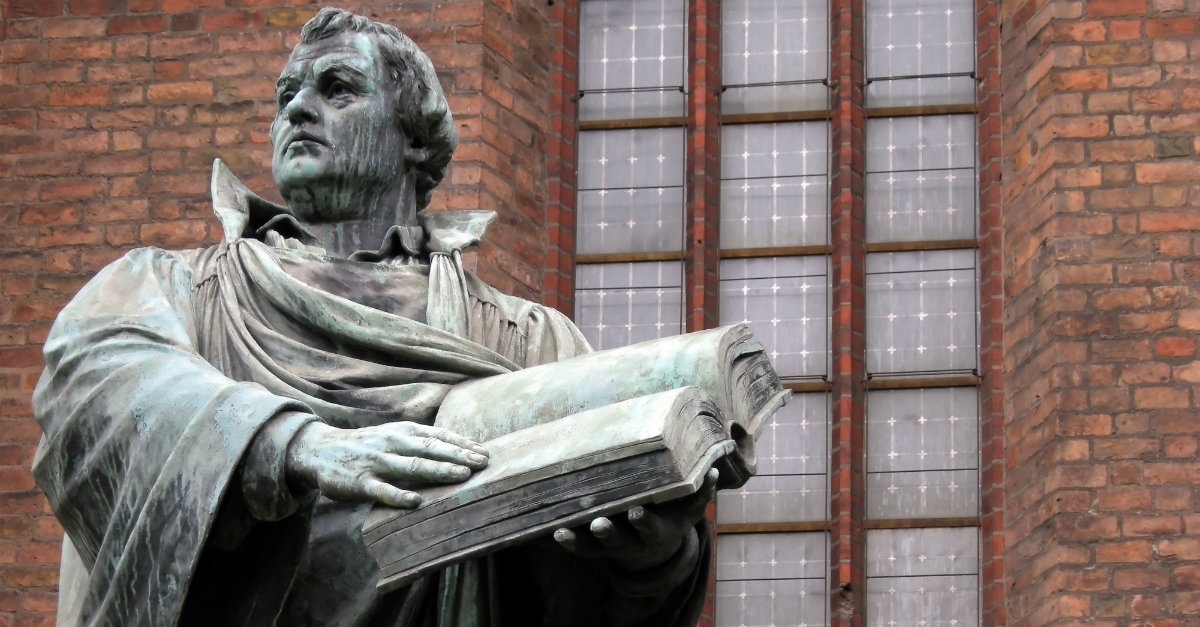
"The true rule is this: God's Word shall establish articles of faith, and no one else, not even an angel can do so." (Martin Luther, Smalcald Articles II, p.15)

“The true rule is this: God’s Word shall establish articles of faith, and no one else, not even an angel can do so.”
(Martin Luther, Smalcald Articles II, p.15)

The Reformation Doctrine of Sola Scriptura
To summarize the Reformation doctrine of sola Scriptura, or the Reformation doctrine of the relation between Scripture and tradition, we may say that Scripture is to be understood as the sole source of divine revelation; it is the only inspired, infallible, final, and authoritative norm of faith and practice. It is to be interpreted in and by the church; and it is to be interpreted within the hermeneutical context of the rule of faith. As Richard Muller observes, the Reformed doctrine of sola Scriptura did not ever mean, “all of theology ought to be constructed anew, without reference to the church’s tradition of interpretation, by the lonely exegete confronting the naked text.” That this is the Reformation doctrine of Scripture, tradition, and authority may be demonstrated by an examination of the reformers’ writings, only a sampling of which may be mentioned here.

Martin Luther is well known for his declaration at the Diet of Worms: “Unless I am convicted by Scripture and plain reason – I do not accept the authority of popes and councils, for they have contradicted each other – my conscience is captive to the Word of God.” Many point to this statement as evidence that Luther rejected Tradition 1, the teaching of the early church, but other factors must be considered before coming to such a conclusion, namely, the historical context of this statement and the fact that Luther said and wrote much more on the subject. As simply one example, in a 1532 letter to Duke Albert of Prussia about the doctrine of the real presence of Christ in the Lord’s Supper, Luther wrote the following:

This article moreover, has been clearly believed and held from the beginning of the Christian Church to this hour – a testimony of the entire holy Christian Church, which, if we had nothing besides, should be sufficient for us. For it is dangerous and terrible to hear or believe anything against the united testimony, faith and doctrine, of the entire holy Christian Church, as this hath been held now 1,500 years, from the beginning, unanimously in all the world. Whoso now doubted thereon, it is even the same as though he believed in no Christian Church, and he condemneth thus not only the entire holy Christian Church as a damnable heresy, but also Christ himself and all the apostles and prophets.

The second-generation Lutheran scholar Martin Chemnitz (1522-1586), writes along similar lines in his Examination of the Council of Trent:

This is also certain, that no one should rely on his own wisdom in the interpretation of the Scripture, not even in the clear passages…. We also gratefully and reverently use the labors of the fathers who by their commentaries have profitably clarified many passages of the Scripture. And we confess that we are greatly confirmed by the testimonies of the ancient church in the true and sound understanding of the Scripture. Nor do we approve of it if someone invents for himself a meaning which conflicts with all antiquity, and for which there are clearly no testimonies of the church.

Another of the magisterial reformers who addressed this issue was John Calvin. In the 1559 edition of his Institutes of the Christian Religion, for example, he writes:

In this way, we willingly embrace and reverence as holy the early councils, such as those of Nicaea, Constantinople, Ephesus I, Chalcedon, and the like, which were concerned with refuting errors-in so far as they relate to the teachings of faith. For they contain nothing but the pure and genuine exposition of Scripture, which the holy fathers applied with spiritual prudence to crush the enemies of religion who had then arisen.

And further:

We indeed willingly concede, if any discussion arises over doctrine, that the best and surest remedy is for a synod of true bishops to be convened, where the doctrine at issue may be examined.

To sum up the traditional Protestant view, the words of the nineteenth-century Reformed theologian Charles Hodge (1797-1878) are appropriate:

Again, Protestants admit that as there has been an uninterrupted tradition of truth from the protevangelium to the close of the Apocalypse, so there has been a stream of traditionary teaching flowing through the Christian Church from the day of Pentecost to the present time. This tradition is so far a rule of faith that nothing contrary to it can be true. Christians do not stand isolated, each holding his own creed. They constitute one body, having one common creed. Rejecting that creed, or any of its parts, is the rejection of the fellowship of Christians, incompatible with the communion of saints, or membership in the body of Christ. In other words, Protestants admit that there is a common faith of the Church, which no man is at liberty to reject, and which no man can reject and be a Christian.
hipster

“The reformers’ appeal to ‘Scripture alone,’… was never intended to mean ‘me alone.'”
— Keith A. Mathison

The Revisionist Doctrine of “solo” Scriptura
In contrast with the Reformation doctrine of sola Scriptura, the revisionist doctrine of “solo” Scriptura is marked by radical individualism and a rejection of the authority of the church and the ecumenical creeds. If we compare the statements made by advocates of “solo” Scriptura with the statements of Reformational Christians above, the difference is immediately evident. It is also important to observe the source of this doctrine in early America. As Nathan O. Hatch notes, the first Americans to push the right of private judgment over against the church and the creeds were unorthodox ministers.

The liberal minister Simeon Howard (1733-1804), for example, advised pastors to “lay aside all attachment to human systems, all partiality to names, councils and churches, and honestly inquire, ‘what saith the Scriptures?'” In his own effort to overturn orthodox Christianity, Charles Beecher (1815-1900) denounced “creed power” and argued for “the Bible, the whole Bible, and nothing but the Bible.” The universalist minister A. B. Grosh (d. 1884) declared in a similar way, “In religious faith we have but one Father and one Master, and the Bible, the Bible, is our only acknowledged creed book.”

The radical American version of “solo” Scriptura reached its fullest expression in the writings of the Restorationists as they applied the principles of Democratic populism to Enlightenment Christianity. In 1809, the Restorationist Elias Smith (1769-1846) proclaimed, “Venture to be as independent in things of religion, as those which respect the government in which you live.” Barton Stone (1772-1844) declared that the past should be “consigned to the rubbish heap upon which Christ was crucified.” Alexander Campbell (1788-1866) made his individualistic view of Scripture very clear, declaring, “I have endeavored to read the Scriptures as though no one had read them before me, and I am as much on my guard against reading them to-day, through the medium of my own views yesterday, or a week ago, as I am against being influenced by any foreign name, authority, or system whatever.” As the Reformed Princeton theologian Samuel Miller (1769-1850) rightly observed, “the most zealous opposers [of creeds] have generally been latitudinarians and heretics.”

Why “Solo” Scriptura Must Be Rejected
The revisionist doctrine of “solo” Scriptura has become so entrenched in the modern church that many Protestant Christians today will sympathize more with the sentiments of the liberal and sectarian clergymen quoted above than they will with the teaching of the reformers. The doctrine of “solo” Scriptura, however, is as problematic and dangerous today as it was in previous centuries. It remains unbiblical, illogical, and unworkable. Here I will address some of the more obvious problems.

The fundamental problem with “solo” Scriptura is that it results in autonomy. It results in final authority being placed somewhere other than the Word of God. It shares this problem with the Roman Catholic doctrine. The only difference is that the Roman Catholic doctrine places final authority in the church while “solo” Scriptura places final authority in each individual believer. Every doctrine and practice is measured against a final standard, and that final standard is the individual’s personal judgment of what is and is not biblical. The result is subjectivism and relativism. The reformers’ appeal to “Scripture alone,” however, was never intended to mean “me alone.”

The Bible itself simply does not teach “solo” Scriptura Christ established his church with a structure of authority and gives to his church those who are specially appointed to the ministry of the word (Acts 6:2-4). When disputes arose, the apostles did not instruct each individual believer to go home and decide by himself and for himself who was right. They met in a council (Acts 15:6-29). Even the well-known example of the Bereans does not support “solo” Scriptura (cf. Acts 17:10-11; cf. vv. 1-9). Paul did not instruct each individual Berean to go home and decide by himself and for himself whether what he was teaching was true. Instead, the Bereans read and studied the Scriptures of the Old Testament day by day with Paul present in order to see whether his teaching about the Messiah was true.

In terms of hermeneutics, the doctrine of “solo” Scriptura is hopeless. With “solo” Scriptura, the interpretation of Scripture becomes subjective and relative, and there is no possibility for the resolution of differences. It is a matter of fact that there are numerous different interpretations of various parts of Scripture. Adherents of “solo” Scriptura are told that these different interpretations can be resolved simply by an appeal to Scripture. But how is the problem of differing interpretations to be resolved by an appeal to another interpretation? All appeals to Scripture are appeals to interpretations of Scripture. The only real question is: whose interpretation? People with differing interpretations of Scripture cannot set a Bible on a table and ask it to resolve their differences. In order for the Scripture to function as an authority, it must be read and interpreted by someone. According to “solo” Scriptura, that someone is each individual, so ultimately, there are as many final authorities as there are human interpreters. This is subjectivism and relativism run amuck. The proponents of “solo” Scriptura rightly condemn the hermeneutical tyranny of Rome, but the solution to hermeneutical tyranny is not hermeneutical anarchy.

The doctrine of “solo” Scriptura also faces historical problems due to the fact that it cannot be reconciled with the reality that existed in the first decades and centuries of the church. If “solo” Scriptura were true, much of the church had no standard of truth for many years. In the first century, one could not walk down to his local Christian bookstore and buy a copy of the Bible. Manuscripts had to be hand-copied and were not found in every believer’s home. The first books of the New Testament did not even begin to be written until at least ten years after the death of Christ, and some were not written until several decades after Christ. Gradually some churches obtained copies of some books, while other churches had copies of others. It took many years before the New Testament as we know it was gathered and available as a whole. Even then, it too was hand-copied, so it was not available in the home of every individual Christian. If the lone individual is to judge and evaluate everything by himself and for himself by measuring it against Scripture, as proponents of “solo” Scriptura would have it, how would this have possibly worked in the first decades of the church before the New Testament was completed?

"Christians do not stand isolated, each holding his own creed." Charles Hodge

“Christians do not stand isolated, each holding his own creed.”
— Charles Hodge (1797-1878)

One of the most self-evident problems related to the doctrine of “solo” Scriptura is the question of the canon. If one is going to claim that Scripture is the only authority whatsoever, it is legitimate to ask how we then define what is and is not “Scripture.” Proponents of“solo” Scriptura claim that Scripture is authoritative but cannot say with any authority what Scripture is. The table of contents in the front of the Bible is not itself an inspired text written by a prophet or an apostle. It is, in a very real sense, a creed of the church declaring what the church believes to be the content of Scripture. One way to illustrate the problem “solo” Scriptura faces in connection with the canon is simply to ask the following: How would “solo” Scriptura deal with a modern day Marcion? How, for example, would a proponent of “solo” Scriptura argue with a person who claimed that the real New Testament includes only the books of Luke, Acts, Romans, and Revelation? He can’t appeal to the church, to history, or to tradition. A self-consistent adherent of “solo Scriptura” would have no way to respond to such a view because, as one such consistent adherent informed me in personal correspondence, it is the right and duty of each individual Christian to determine the canonicity of each biblical book by and for himself. This is the only consistent position for a proponent of “solo” Scriptura to take, but it is self-defeating because it destroys any objective notion of Scripture. One cannot appeal to the biblical authority of Romans, for example, if each believer determines for himself whether Romans is in fact to be considered a canonical and authoritative biblical book.

The question of the canon is not the only theological problem caused by “solo” Scriptura. Another serious problem is the fact that the adoption of “solo” Scriptura destroys the possibility of having any objective definition of what Christianity is and is not. “solo” Scriptura destroys the very concepts of orthodoxy and heresy. If the authority of the ecumenical creeds is rejected, and if each individual believer is to determine all questions of doctrine by and for himself, then the definitions of orthodoxy and heresy are completely relative and subjective. One man judges the doctrine of the Trinity to be biblical. Another deems it unbiblical. One judges open theism biblical. Another deems it unbiblical. The same is true with respect to every other doctrine. Each man defines Christianity as it seems right in his own eyes.

Finally, it must be realized that “solo” Scriptura ignores reality. The Bible simply did not drop out of the sky into our laps. We would not even be able to read a Bible for ourselves were it not for the labors of many others including archaeologists, linguists, scribes, textual critics, historians, translators, and more. If “solo” Scriptura were true, it should be possible to give untranslated ancient Hebrew and Greek manuscripts of biblical, apocryphal, and pseudepigraphal texts to some isolated tribe member somewhere on earth, and with no one’s assistance, that individual should be able to learn the Hebrew and Greek languages, read the various manuscripts, determine which of them are canonical, and then come to an orthodox understanding of the Christian faith. The reason this is not possible, however, is because “solo” Scriptura is not true. It is an unbiblical distortion of the truth.

The revisionist doctrine of “solo” Scriptura has been a source of great damage to the cause of Christ. The magisterial reformers were right to reject the early versions of it that appeared in the teaching of some radicals. Contemporary heirs of the reformers must follow the magisterial reformers here. The fight must be fought on two fronts. We are not only to reject the Roman Catholic doctrine (whether the two-source doctrine of Tradition 2 or the sola ecclesia doctrine of Tradition 3), which places final autonomous authority in the church. We must also reject the revisionist doctrine of “solo” Scriptura, which places final autonomous authority in the hands of each and every individual.
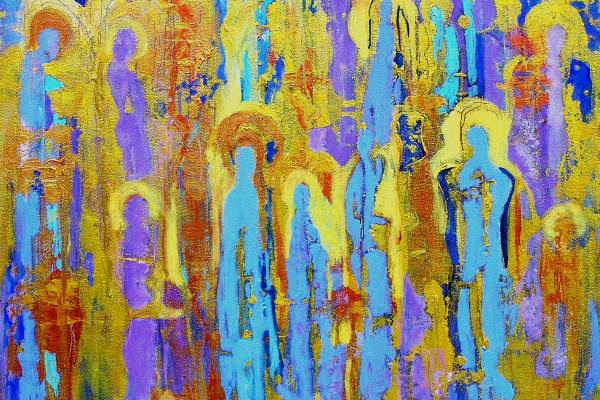
“Communion of Saints” by Elise Ritter (October 2010)

“Communion of Saints” by Elise Ritter (October 2010)


1 For more information on Heiko Oberman’s concept of Tradition 1, see his work The Dawn of the Reformation (Edinburgh: T&T Clark, 1986), p. 280. For background information on Tradition 0, see Alister McGrath’s Reformation Thought, 2nd ed. (Oxford: Blackwell), p. 144. For other background information on “solo” Scriptura see Nathan O. Hatch, “Sola Scriptura and Novus Ordo Seclorum,” in The Bible in America, ed. N. Hatch and M. Noll, pp. 59-78. The quotation from Richard Muller is taken from his Post-Reformation Reformed Dogmatics, Vol. 2 (Grand Rapids: Baker, 1993), p. 51. Luther’s letter to Duke Albert of Prussia is cited in Philip Schaff’s The Principle of Protestantism (Philadelphia: United Church Press, 1964 [1845]), pp. 116-117, note). Chemnitz’s quote can be found in Examination of the Council of Trent, tr. Fred Kramer, Vol. 1, (St. Louis: Concordia Publishing House, 1971), pp. 208-209. The quotations from Calvin are taken from his Institutes, 4.9.8 and 4.9.13. Mr. Mathison has taken his quotation of Charles Hodge from Hodge’s Systematic Theology, Vol. 1, pp. 113-114. Comments from Nathan Hatch on the revisionist doctrine of “solo” Scriptura are taken from “Sola Scriptura and Novus Ordo Seclorum,” in The Bible in America, ed. N. Hatch and M. Noll, p. 62. The quotation from Samuel Miller is found in The Utility and Importance of Creeds and Confessions (Greenville, SC: A Press, 1991 [1839]), p. 15. For a fuller discussion on this topic, Mr. Mathison refers readers to his book The Shape of Sola Scriptura (Canon Press, 2001).

Keith Mathison

Keith Mathison

About the Author
Keith Mathison is associate editor of Tabletalk and author of The Shape of Sola Scriptura (Canon Press, 2001).

This article originally appeared in the March/April 2007 edition of Modern Reformation and is reprinted with permission. For more information about Modern Reformation, visit www.modernreformation.org or call (800) 890-7556 FREE. All rights reserved.
BACK TO TOP

A Response to Richard Mouw

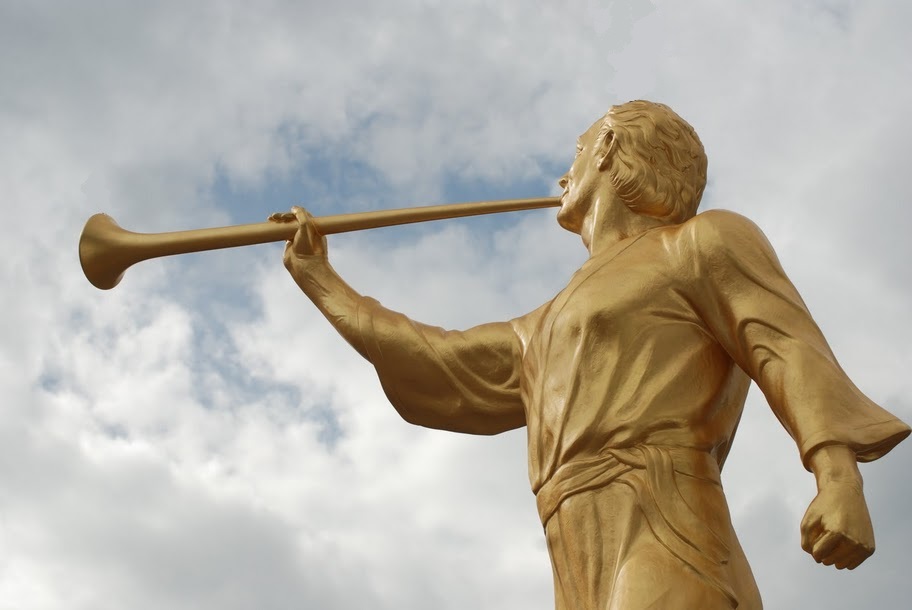
BCT-Angel-Moroni5

by Robert M. Bowman Jr.
The May 2016 issue of the Christian periodical First Things (appearing online in April) includes an article Richard Mouw, President Emeritus of Fuller Theological Seminary, entitled “Mormons Approaching Orthodoxy.” As I will document here, the Institute for Religious Research figures largely in Mouw’s article even though he never mentions IRR (or me) by name. As the spokesman for IRR in past efforts by our organization to dialogue with and respond to Professor Mouw, I have a special interest in Mouw’s article and a direct responsibility to offer this response.

The focus of Mouw’s article is on the question of whether Mormonism is still committed to the view of God represented by Lorenzo Snow’s couplet, “As man now is, God once was; as God now is, man may be.” Mouw’s main claim is that the LDS Church is quietly moving away from the notion that God was a mortal man who became exalted to Godhood in a process open to us as well. Mouw recognizes that this doctrine is incompatible with Christianity but insists that Mormons are doing what they can to retire this false doctrine.

If only it were so.

In this article I will be critically reviewing Mouw’s article, correcting the historical record, explaining the issues, summarizing the evidence as it pertains to those issues, and responding to Mouw’s arguments.

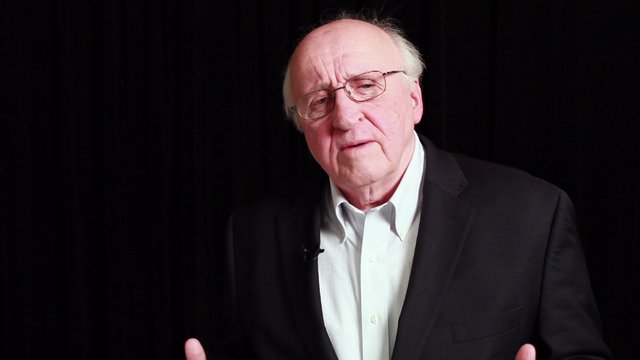
MouwInterview

Richard J. Mouw

Richard Mouw: Dialogue with Mormons but Not with Their Evangelical Critics
Mouw begins by giving a brief recitation of the history of the Snow couplet. Joseph Smith’s father had told Snow that he would become “as great as God,” an idea that Snow felt he came to grasp four years later, leading to his formulation of the couplet. He reports that Parley Pratt “not long after that” affirmed that “God, angels and men are all of one species” and that Joseph Smith taught that “God himself was once as we are now, and is an exalted Man.” (The order here is a little misleading: Snow composed his couplet in 1840, Joseph Smith delivered the sermon quoted in 1844, and Pratt published his book making the quoted statement in 1855.) Mouw admits that this view “denies an essential Jewish and Christian teaching,” namely that God is ontologically unique, a fundamentally different kind of being than humans, and that we will never become the same kind of being as God.

Yet Mouw argues that this doctrine, which he admits was taught by Joseph Smith as well as by Snow and Pratt, need not divide evangelicals and Mormons, because Mormons are at least in the process of abandoning it. As I shall explain, Mouw’s argument blithely ignores facts that have been presented to him and that flatly disprove his claim.

Mouw recounts the history of this controversy as follows:

I’ve been involved for a long time in an Evangelical-Mormon dialogue. When that dialogue began fifteen years ago, we were told by the Mormon participants that the Lorenzo Snow couplet has no canonical status in Mormon theology. I reported that assessment in print, arguing that the apparent denial of any ontological difference between God and man in the Snow couplet need not prevent Evangelical-Mormon dialogue.

Right away, Evangelical “countercult” groups responded in a sharply critical way. One issued a “Statement on Richard Mouw and Evangelical Countercult Ministries,” stating that “the evidence is voluminous that the LDS Church has been continuously teaching the doctrine of eternal progression, as it is commonly known, represented by the King Follett Discourse and the Lorenzo Snow couplet from 1844 right up to the present.” An extensive critique appeared in an essay by Ronald V. Huggins, published in the Journal of the Evangelical Theological Society, “Lorenzo Snow’s Couplet: ‘As Man Now Is, God Once Was; As God Now Is, Man May Be’; ‘No Functioning Place in Present-Day Mormon Doctrine?’ A Response to Richard Mouw.”

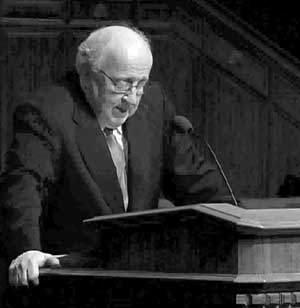
Richard J. Mouw Apologizing in the MormonTabernacle

Richard J. Mouw Apologizing in the MormonTabernacle (2004)

This account is rather misleading. Mouw’s original statement denying that the Snow couplet had no canonical status in LDS theology was made in an email in late 2004, following his controversial remarks at the Salt Lake Tabernacle on November 14, 2004. On that occasion, Mouw accused his evangelical brethren of “bearing false witness” against Mormons in the way they characterized Mormon doctrine. In a subsequent email responding to challenges to his criticism, Mouw asserted that evangelicals in countercult ministry had misrepresented Mormonism as teaching “that God was once a human being like us, and we can become gods just like God is now.” Mouw claimed that this idea had “no functioning place in present-day Mormon doctrine.” Huggins responded in the article Mouw mentions, which appeared in the September 2006 issue of the Journal of the Evangelical Theological Society.1 That periodical, of course, is not published by a “countercult” group, but by the premier academic society of evangelical scholars. Huggins himself was at the time a professor at Salt Lake Theological Seminary and had published two articles on the Book of Mormon in the academic periodicalDialogue: A Journal of Mormon Thought.2 Referring to Huggins in the context of a general swipe at evangelical “countercult” groups comes across as an attempt to broad-brush all evangelical criticism of Mouw as unscholarly. It also ignores the fact that many evangelicals engaged in so-called countercult work care about scholarship and that many evangelical scholars are supportive of countercult ministry. For example, Huggins himself has been a member of the board of our organization, the Institute for Religious Research, since before Mouw’s appearance at the Salt Lake Tabernacle.

In an attempt to frame the controversy as one stoked by “countercult” groups, Mouw claims that after his publicly asserting that the idea of man becoming gods just like God is now is not a part of present-day LDS doctrine, “Right away, Evangelical ‘countercult’ groups responded in a sharply critical way.” He then cites the “Statement on Richard Mouw and Evangelical Countercult Ministries.” However, that Statement was issued in April 2013, more than eight years after Mouw’s comment about Mormon doctrine (and more than six years after Huggins’s article). That is hardly “right away.”

Perhaps this is a good place to point out that Mouw made his critical remarks about the evangelical countercult movement without having engaged anyone in that movement in the kind of friendly dialogue he has pursued with Mormon scholars. He made no effort to explain to the evangelicals he criticized what he thought they were doing wrong. Between 2004 and the present he has not pursued such dialogue and has not welcomed overtures from those evangelicals who have expressed a desire to have such dialogue with him.

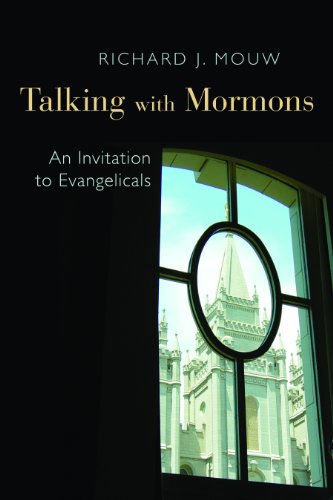
Talking With The Mormons Front Cover

“Talking with Mormons” by Richard J. Mouw (2012)

The Statement on Richard Mouw and Evangelical Countercult Ministries3 was prompted not by Mouw’s email in 2004 but by his very public campaign in 2012 and early 2013 to promote the notion that Mormonism was moving away from the doctrine of God and man as the same species. In 2012 Mouw published a book entitled Talking with Mormons that criticized the way most evangelicals have viewed Mormonism. That same year and in early 2013 he made some public appearances with LDS scholar Robert Millet in which the two of them discussed some of the subjects addressed in Mouw’s book. In effect, the book and appearances were a public relations campaign to argue that evangelicals should view Mormonism in a more positive way religiously and theologically. In both the book and his public appearances, Mouw expanded on his claim that evangelical “countercult” organizations were misrepresenting Mormon doctrine, especially with regard to the issue of the nature of God.

In early 2013, the Institute for Religious Research reached out to Mouw and attempted to pursue dialogue with him about his critical stance toward countercult ministry. On February 14 of that year I sent to Mouw on behalf of IRR a three-page letter along with a 36-page documentation packet that had been specially prepared to address the comments he had made regarding the LDS doctrine of God and man. Perhaps I might mention that I am a graduate of Fuller Theological Seminary (1981), where Mouw later served as president, and I had met with Mouw in his office at Fuller and discussed Mormonism with him in about 2001. After receiving no response to my letter, I sent Mouw a follow-up letter on March 14, which was answered by an email to me from Mouw on April 9. Mouw declined our invitation to dialogue, complaining about a number of things he thought we had said about him. After I responded with an email explaining that we had made none of the statements to which he took offense, Mouw wrote back and admitted that he had indeed confused us with someone else. However, he still chose not to engage us in dialogue or even to respond to the documentation we had provided him.

In the wake of Mouw’s unwillingness to participate in dialogue with evangelicals on the subject of Mormonism whose views he had been criticizing for years, we had a lengthy discussion on the matter at the Evangelical Ministries to New Religions conference in April 2013. EMNR is a consortium of evangelical organizations and researchers who are committed to supporting Christians in mission to people in a variety of new religious movements, including Mormonism. On April 12, 2013, EMNR issued a statement (which I drafted) responding to Mouw. After explaining briefly why we disagreed with Mouw’s comments about Mormonism, the statement concluded as follows:

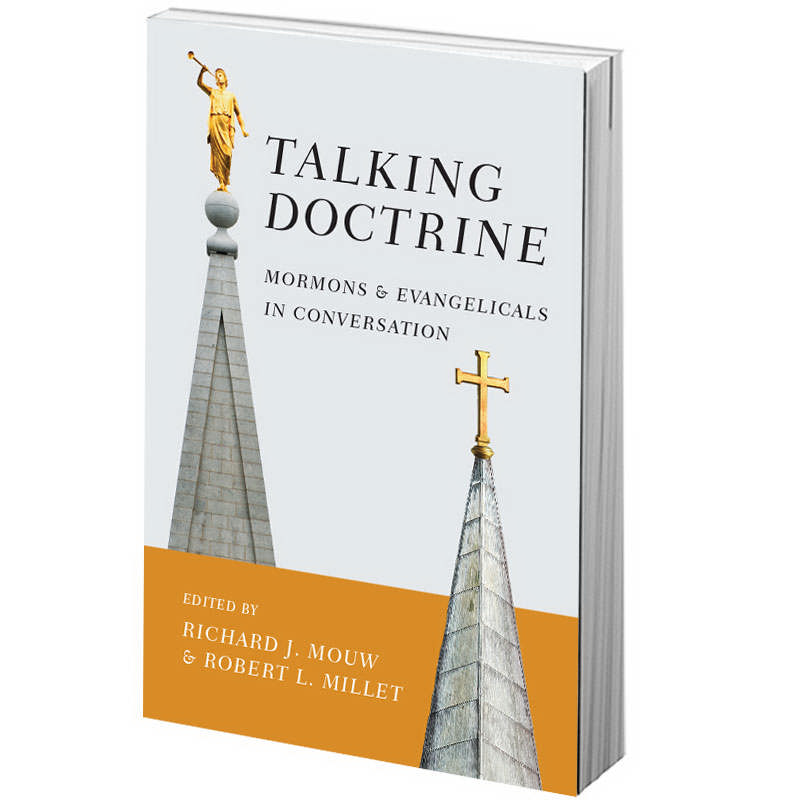
"Talking Mormon Doctrine" edited by Richard J. Mouw and Robert L. Millet (circa 2015)

“Talking Mormon Doctrine” edited by Richard J. Mouw and Robert L. Millet (2015)

Evangelical Ministries to New Religions applauds Dr. Mouw for his salutary call for Christian civility and his thoughtful engagement in dialogue with Mormon scholars and leaders. At the same time, EMNR respectfully yet strongly disagrees with Dr. Mouw’s generalizations about evangelicals misrepresenting Mormon beliefs and practices, and specifically with his own misrepresentation of the standard LDS doctrine of eternal progression as “folk Mormonism” having no official or functioning place in Mormon belief today. We invite Dr. Mouw to engage evangelical ministries to Mormons in general, and those of us who are part of EMNR in particular, in the same kind of civil dialogue he has rightly championed between evangelicals and Mormons. Furthermore, we encourage Latter-day Saints to engage a wider circle of evangelicals in open and candid dialogue.

Mouw has never taken us up on this invitation.

Ironically, Mouw continues to claim, as he did in his 2012 book, that unnamed evangelical critics of Mormonism disagree with him because they are closed in principle to engaging Mormons in respectful dialogue. Here is how he put it in his book:

Again, there are many evangelicals who are convinced that those of us on the evangelical side who are involved in these dialogues have been duped by the Mormons. Worse than that, they’re convinced that by engaging in friendly—and hopeful—dialogue with representatives of Mormonism, we’re hurting the cause of the gospel…. Promoting the idea of friendly dialogue with Mormons isn’t a popular thing to do.4

In his recent article in First Things, Mouw again criticizes unnamed evangelicals who think dialogue with Mormons is impossible:

At stake in this dispute is a choice between two approaches to Mormon teachings and practice. One is skeptical and presumes that Mormonism is a ­deeply heretical form of Christianity, so much so that dialogue is impossible. The other is more trusting and is willing to entertain the possibility that Mormonism has the resources for theological self-criticism and self-correction, and that dialogue might help in this process.

I do not know of a single evangelical in “countercult” ministry who thinks that dialogue with Mormons is a bad idea, let alone that it is impossible. Indeed, every such evangelical I know seeks opportunities to engage Mormons in dialogue. It seems here that Mouw is using the term “dialogue” as code for something else. Note that Mouw’s comment implies that he disagrees about Mormonism being “deeply heretical.” This implication is confirmed by the title of his article, “Mormons Approaching Orthodoxy.”

President George W. Bush (right) meets with the leadership of The Church of Jesus Christ of Latter-day Saints during his visit to Salt Lake City. Seated clockwise are: the late Gordon B. Hinckley, President; Thomas S. Monson, First Counselor (obscured); James E. Faust, Second Counselor (obscured), and F. Michael Watson, Executive Secretary.

President George W. Bush (right) meets with the leadership of The Church of Jesus Christ of Latter-day Saints during a visit to Salt Lake City in 2008. Seated clockwise are: the late Gordon B. Hinckley, President; Thomas S. Monson, First Counselor (obscured); James E. Faust, Second Counselor (obscured), and F. Michael Watson, Executive Secretary.

The Real Issue: What Do Mormons Actually Teach?
Here’s what is really “at stake in this dispute.” It is a choice between accepting what official LDS Church publications and its leading theologians actually teach their members or accepting what Richard Mouw says he thinks is happening based on his conversations with his “Mormon friends” despite the public record of LDS Church teaching.5 Mouw gives lip service to the importance of considering what the LDS Church teaches its own members when he writes, “The test for me is not what Mormons say to me, but what they say to each other.”6 However, he doesn’t actually show that this is the basis on which he has formed his theological judgments about Mormonism. Instead, he repeatedly appeals to the assurances of his Mormon friends, as in the following telling comment:

Mormonism is often portrayed as a self-deification program—and not without some legitimacy, given the popularity of the Lorenzo Snow couplet: “What Man now is, God once was; what God now is, Man may become.” My Mormon friends are quick to point out, however, that this couplet has no official canonical status—indeed, Gordon Hinckley famously told Time magazine that he had no idea what it means to say “As God is, man may become.”7

With all due respect, what Mouw’s Mormon friends told him carries no authority as far as defining what has official or canonical status in Mormonism. Gordon Hinckley’s statement to Time magazine also does not pass what Mouw himself says is the test, which is what Mormons say to each other—not what they say to the secular media.

Yet there is more to the story with regard to Hinckley’s supposed denial of the doctrine. As we explain in a separate article,8 Hinckley did not disavow any understanding of the Snow couplet. We will summarize the issue briefly here. In Hinckley’s 1997 interview, he was asked, “Is this the teaching of the church today, that God the Father was once a man like we are?” Here is what he said:

I don’t know that we teach it. I don’t know that we emphasize it. I haven’t heard it discussed for a long time in public discourse. I don’t know. I don’t know all the circumstances under which that statement was made. I understand the philosophical background behind it. But I don’t know a lot about it and I don’t know that others know a lot about it.9

In saying that he didn’t “know a lot about it,” Hinckley was admitting implicitly that he did know something about it, while at the same time saying that Mormonism doesn’t provide much in the way of details about God the Father’s life before he became a God. Thus, Hinckley was not suggesting that the doctrine expressed in the Snow couplet was not part of Mormon doctrine. It may not be something the LDS Church emphasized, but it is still part of their belief system.

In his recent First Things article, Mouw interprets Hinckley’s remarks as “signaling a decision on the part of the Mormon leadership to downplay the Snow couplet within the corpus of Mormon teachings about the deity,” suggesting that they are “interested in joining the broad Jewish and Christian consensus that God is ontologically different from man—or at least that Mormons today don’t want to directly contradict that consensus.” Since Hinckley’s comment to Time was made in 1997, we have had nearly twenty years to see if the LDS Church actually has pivoted away from its earlier doctrine. The record of the past twenty years demonstrably contradicts Mouw’s interpretation. Some of the evidence comes from sources surprisingly close to Mouw himself.

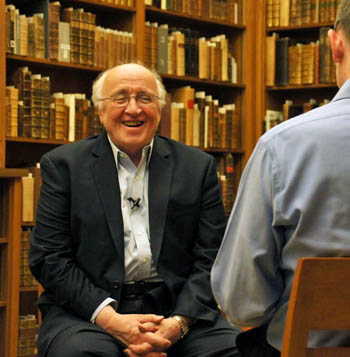
BYU Professor Robert L. Millet

BYU Professor Robert L. Millet

Robert Millet: God Was Once a Mortal Being
If Gordon Hinckley was signaling in 1997 that the LDS Church was moving away from the doctrine that God was once a man as taught by Joseph Smith and Lorenzo Snow, Mouw’s LDS friend Robert Millet did not get the message. The very next year Millet and Noel Reynolds, another BYU scholar, published a short book addressing “10 basic issues” including number 6, “What do Latter-day Saints mean when they say that God was once a man?” After quoting approvingly both the King Follett Discourse and the Snow couplet, Millet and Reynolds wrote:

That God was once a mortal being is in no way inconsistent with the fact that he now has all power and all knowledge and possesses every virtue, grace, and godly attribute. He acquired perfection through long periods of growth, development, and progression, “by going from one small degree to another, and from a small capacity to a great one; from grace to grace, from exaltation to exaltation,” as Joseph Smith explained…. Not much has been revealed about this concept beyond the fact that God was once a man and that over a long period of time he gained the knowledge, power, and divine attributes necessary to know all things and have all power…. These doctrines are not clearly stated in the Bible. Mormons believe, however, that this knowledge was once had among the ancients and that it has been restored through modern prophets.10

This is not the only place where Millet has affirmed the doctrine of the King Follett Discourse and the Snow couplet. In his 2005 book A Different Jesus? The Christ of the Latter-day Saints, Millet offered the following comments for the benefit primarily of evangelical readers:

The tougher issue for many Christians to deal with is the accompanying doctrine set forth in the King Follett Sermon and the Lorenzo Snow coupletnamely, that God was once a man. Latter-day scriptures state unequivocally that God is a man, a Man of Holiness (Moses 6:57) who possesses a body of flesh and bones (D&C 130:22). These concepts are clearly a part of the doctrinal restoration. We teach that man is not of a lower order or different species than God. This, of course, makes many of our Christian friends extremely nervous (if not angry), for it appears to them that we are lowering God in the scheme of things and thus attempting to bridge the Creator/creature chasm.11

Mouw definitely knew about this statement from Millet, because Mouw wrote a foreword and afterword to the book! Moreover, in his afterword Mouw acknowledged that Mormonism teaches that we human beings are of the same species as God:

At the heart of our continuing disagreements, I am convinced, are very basic worldview issues. Judaism and Christianity have been united in their insistence that the Creator and the creation—including God’s human creatures—are divided by an unbridgeable “being” gap. God is the “Wholly Other”—eternal and self-sufficient—who is in a realm of existence that is radically distinct from the creation that was brought into being out of nothing by God’s sovereign decree. On this view of things, to confuse the Creator’s being with anything in his creation is to commit the sin of idolatry. Mormons, on the other hand, talk about God and humans as belonging to the same “species.” Inevitably, then, the differences are described, not in terms of an unbridgeable gap of being, but in the language of “more” and “less.”12

Mouw and Millet were obviously working on this book in 2004 (if not before) in order for it to be published in 2005. This means that at the time Mouw spoke at the Salt Lake Tabernacle in November 2004 and shortly thereafter sent out an email claiming that the doctrine epitomized in Snow’s couplet had “no functioning place in present-day Mormon doctrine,” Mouw knew that in fact that doctrine was “clearly a part of the doctrinal restoration,” as Millet put it in his book. Less than a year after Mouw had denied that the doctrine had any functioning place in current Mormon doctrine, a book appeared clearly affirming that very doctrine as part of the Mormon doctrinal restoration, with a foreword and afterword by Mouw himself. Mouw’s own statement that in Mormon belief God and humans are members of the same species clearly presupposes the doctrine that God was once a mortal man like us who then became a God and that we as his children can do the same.

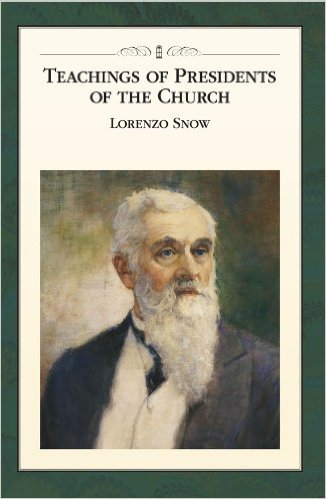
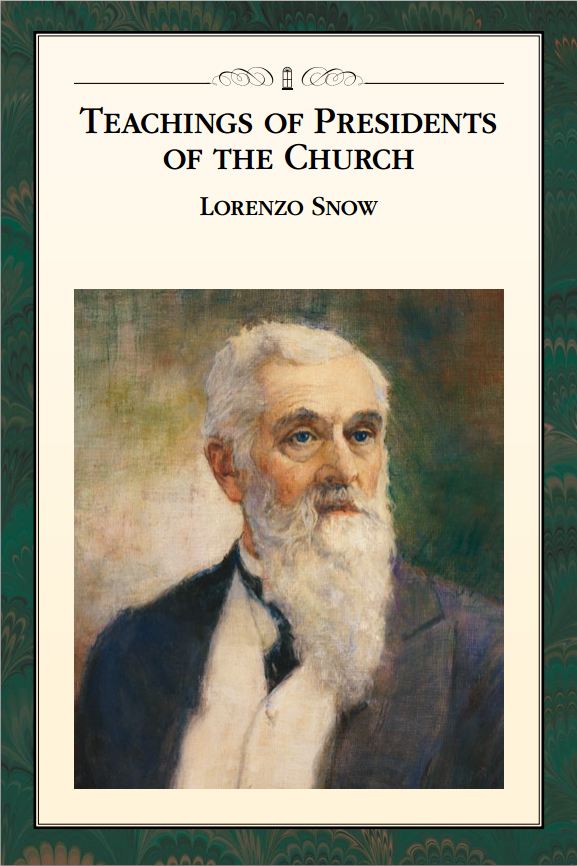
"Teachings of Presidents of the Church: Lorenzo Snow" official LDS Church manual (circa 2012)

“Teachings of Presidents of the Church: Lorenzo Snow” official LDS Church manual (2012)

God Was Once a Man: It’s Still Being Taught
The doctrine of eternal progression—that God the Father was once a mortal man, that he became a God, and that we can become Gods like him—has continued to be taught by Mormons right up to the present. In his May 2016 article in First Things, Mouw devotes several paragraphs to explaining why the inclusion of the Snow couplet in the 2012 curriculum manual Teachings of Presidents of the Church: Lorenzo Snow, part of a series of manuals on the past presidents of the LDS Church, was not necessarily endorsing the first half of the couplet. According to Mouw, the discussion of the couplet in the manual focuses entirely on the second half, neither affirming nor denying the first half. Mouw’s analysis of this particular manual’s treatment of the Snow couplet has some weaknesses, but the bigger point to be made is that this is only one of many publications of the past twelve years in which the LDS Church has reaffirmed the validity of the Snow couplet, the King Follett Discourse, and the traditional LDS doctrine of eternal progression. As I pointed out to Mouw in my first letter to him in 2012:

The 2004 manual Teaching Seminary Preservice Readings Religion 370, 471, and 475 stated that “there are approved and inspired writings that are not in the standard works” that “also are true and should be used along with the scripturesthemselves,” among the five most important of which it says are “the ‘King Follett Sermon’ and the ‘Sermon in the Grove.’” At least eight teaching manuals currently available on LDS.org teach the King Follett Discourse, the Lorenzo Snow couplet, or (in most cases) both, including six manuals published since 2003.13

For example, the LDS curriculum manual Doctrines of the Gospel Teacher Manual (2011), which is still on the official LDS website, states:

What we know about God is limited to what he has chosen to tell us through his prophets. The Prophet Joseph Smith’s first vision in 1820 (see Joseph Smith—History 1:11–20) and the famous King Follett discourse given shortly before Joseph’s martyrdom in 1844 (see Joseph Smith, Teachings of the Prophet Joseph Smith, pp. 343–62) are significant doctrinal teachings on the nature of God. From the beginning of his ministry until its end, the Prophet shared his increasing understanding of his Heavenly Father…. In the King Follett discourse, Joseph Smith declared that the first principle of the gospel consists of knowing the character of God. Joseph taught that God “was once a man like us; yea, that God himself, the Father of us all, dwelt on an earth, the same as Jesus Christ himself” (Teachings, p. 346…).14

In 2014, the LDS Church posted a “Gospel Topics” article on its website with the title “Becoming Like God.” Here is some of what that article stated:

What kind of a being is God?” he asked. Human beings needed to know, he argued, because “if men do not comprehend the character of God they do not comprehend themselves.” In that phrase, the Prophet collapsed the gulf that centuries of confusion had created between God and humanity. Human nature was at its core divine. God “was once as one of us” and “all the spirits that God ever sent into the world” were likewise “susceptible of enlargement.” Joseph Smith preached that long before the world was formed, God found “himself in the midst” of these beings and “saw proper to institute laws whereby the rest could have a privilege to advance like himself” and be “exalted” with Him…. Since that sermon, known as the King Follett discourse, the doctrine that humans can progress to exaltation and godliness has been taught within the Church. Lorenzo Snow, the Church’s fifth President, coined a well-known couplet: “As man now is, God once was: As God now is, man may be.” Little has been revealed about the first half of this couplet, and consequently little is taught. When asked about this topic, Church President Gordon B. Hinckley told a reporter in 1997, “That gets into some pretty deep theology that we don’t know very much about.” When asked about the belief in humans’ divine potential, President Hinckley responded, “Well, as God is, man may become. We believe in eternal progression. Very strongly.15

The above statement provides a convenient basis for a review of the main points that have been made here:

  • The LDS Church continues to cite approvingly both the King Follett Discourse and the Lorenzo Snow couplet. Mouw’s claim that the Snow couplet or the idea it expresses has “no functioning place in present-day Mormon doctrine” is still false.
  • Joseph Smith is credited with having “collapsed the gulf…between God and humanity” found in traditional (orthodox) Christian theology. The statement here, in attributing that “gulf” to “centuries of confusion,” obviously is approving of and affirming Joseph’s teaching that collapsed that gulf.
  • The LDS Church affirms here that human nature is divine; this is another way of saying that God and humans are the same kind or species of being, albeit at very different stages of development.
  • Hinckley’s point that not much is known about God’s life before becoming God is affirmed. To say that little has been revealed or is taught about this doctrine is not to deny that the doctrine exists. The LDS Church is still committed to teaching that God was once a man like us and became exalted to Godhood, even though it has little more to say about the matter than that.
  • The LDS Church also affirms strongly the doctrine of eternal progression, which includes the idea that human beings can become like God in his essential attributes. God is an exalted man, and we who are mortals can likewise become exalted like him. This doctrine clearly goes outside the boundaries of orthodox theology, according to which redeemed human beings will become like God morally (perfect in love, holiness, etc.) and become immortal but will not become ontologically the same kind of being as God.

Toward the end of his First Things article, Mouw writes:

My own sense is that many in the LDS community, including several of its leaders, recognize that the first half of the Snow couplet, the statement about God having been like man, is incompatible with what they genuinely want to sing about: spiritual reliance on the all-sufficient Savior. They also see that it works against the spiritual outlook they want to nurture in new generations of Mormons. Evangelicals may wish for an explicit denial by the LDS leadership of the first half of the couplet. But it is important to recognize that another option—to be sure, a less stabilizing one theologically—is simply to ignore that first half and focus on the second and potentially more orthodox half in what is affirmed and taught in Mormonism.

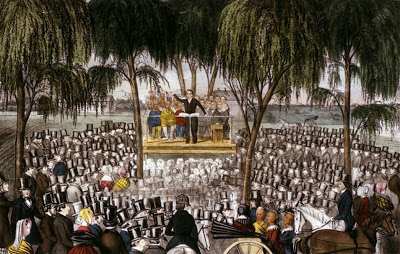
Joseph Smith delivering The King Follett Discourse on April 7, 1844 at Spring General Conference.

Joseph Smith delivering The King Follett Discourse on April 7, 1844 at Spring General Conference.

Up to now, what Mouw says is his “sense” conflicts with the direct statements made by the LDS Church’s leaders, curriculum manuals, and official website statements. The LDS Church continues to affirm the validity and truth of the first half of the Snow couplet even while acknowledging that it does not have anything to offer in the way of elaboration or details as to what God the Father’s life was like or what he did prior to attaining Godhood. The problem here is not merely that the LDS Church has yet to repudiate or explicitly deny the first half of the couplet. The problem is that it continues to affirm its validity, as well as the validity of Joseph Smith’s teaching along the same lines in the King Follett Discourse.

Thus, there is simply no basis for thinking that Mormonism is “approaching orthodoxy.” There has been no significant theological change on the controversial issue at hand. At the very time that Richard Mouw began asserting (in 2004) that the idea of God as a former mortal man had no functioning place in contemporary Mormon doctrine, he was working with Mormon theologian Robert Millet getting his book published by a Christian publisher (Eerdmans), and even writing a foreword and afterword to it, that flatly contradicted Mouw’s claim.

Mouw’s claim about the Snow couplet and eternal progression was refuted by Ronald Huggins in his excellent 2006 article. In the ten years that have passed since that time, Mouw has not rebutted Huggins or offered anything along the lines of a scholarly treatment of the subject. Meanwhile, throughout those ten years the LDS Church has repeatedly reaffirmed their belief in the theology set forth in the King Follett Discourse and epitomized in Lorenzo Snow’s couplet. Except for the 2012 manual on Lorenzo Snow, Mouw has yet to comment on any of the documentary evidence that contradicts his claim.

Forced to choose between accepting Mouw’s assurance that the sense he gets from his Mormon friends is that they would like to abandon the doctrine that God was once a man like us or accepting what the LDS Church’s leaders and theologians (including some of Mouw’s friends!) say is their position on the subject, the only reasonable course is to accept what the Mormons themselves say. Mouw may have his reasons for taking the position he does, and he may sincerely think he is doing the right thing. Regardless, the truth is that Mormon doctrine still stands opposed to the orthodox Christian belief that God is ontologically unique and radically different from his creation. Genuine dialogue between evangelicals and Mormons must begin by coming to terms with what each other actually believes.

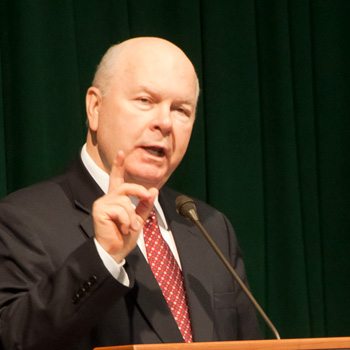
Richard J. Mouw

Richard J. Mouw

NOTES
1. Ronald V. Huggins, “Lorenzo Snow’s Couplet: ‘As Man Now Is, God Once Was; As God Now Is, Man May Be’; ‘No Functioning Place in Present-Day Mormon Doctrine?’ A Response to Richard Mouw,” Journal of the Evangelical Theological Society 49/3 (Sept. 2006): 549-68.
2. Ronald V. Huggins, “Did the Author of 3 Nephi Know the Gospel of Matthew?” Dialogue 30 (1997): 137-48; “‘Without a Cause’ and ‘Ships of Tarshish’: A Possible Contemporary Source for Two Unexplained Readings from Joseph Smith.” Dialogue 36 (2003): 157-79.
3. The statement is available on IRR’s website: see “Statement on Richard Mouw and Evangelical Countercult Ministries,” Evangelical Ministries to New Religions, 13 April 2013.
4. Richard J. Mouw, Talking with Mormons: An Invitation to Evangelicals (Grand Rapids: Eerdmans, 2012), 41.
5. Mouw’s book Talking with Mormons makes references to his Mormon “friends” over twenty times. By contrast, he cites Joseph Smith only twice and has only one or two other references to authoritative LDS sources.
6. Mouw, Talking with Mormons, 41.
7. Ibid., 55.
8. Robert M. Bowman Jr., “Gordon Hinckley, Richard Mouw, and Eternal Progression” (IRR, 2016).
9. This is the full answer in the unedited transcript provided to IRR by the interviewer for Time, Richard N. Ostling, and quoted in Luke P. Wilson and Joel B. Groat, “Dodging and Dissembling Prophet?” (IRR, 1997). See David Van Biema, “Kingdom Come: Salt Lake City was just for starters,” Time, 4 Aug. 1997.10. Robert L. Millet and Noel B. Reynolds, Latter-day Christianity: 10 Basic Issues (Provo, UT: Brigham Young University—FARMS, 1998), chapter 6, emphasis added.
11. Robert L. Millet, A Different Jesus? The Christ of the Latter-day Saints (Grand Rapids: Eerdmans, 2005), 144, emphasis added.
12. Richard J. Mouw, “Afterword,” in ibid., 182, emphasis added.
13. Letter from Robert M. Bowman Jr. to Richard J. Mouw, 14 Feb. 2013.
14.Chapter 3: God the Eternal Father,” in Doctrines of the Gospel Teacher Manual (2011), 7–8.
15.Becoming Like God” (LDS.org, 2014).

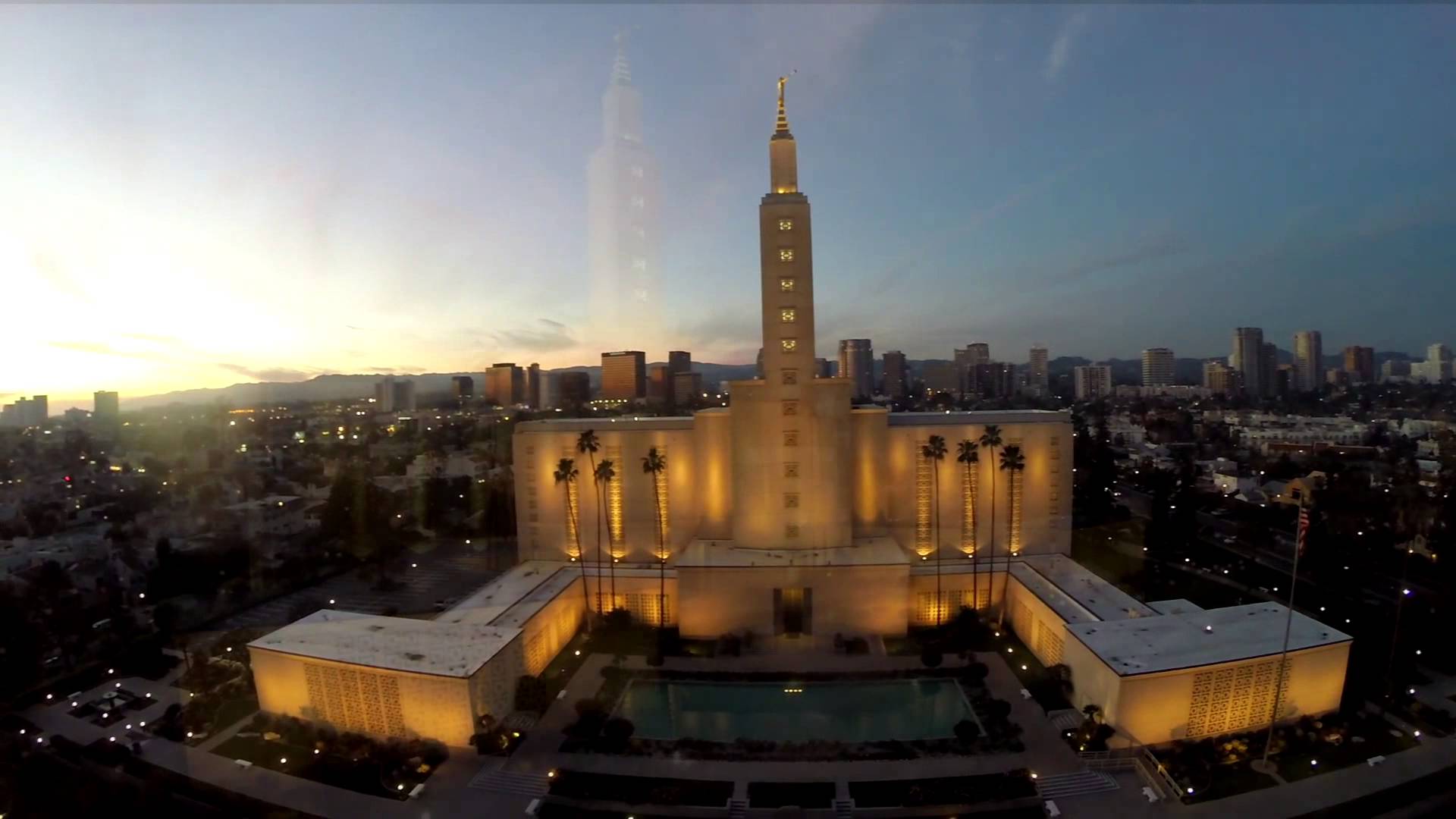
The Los Angeles, California LDS Church Temple at Sunset

The Los Angeles, California LDS Church Temple at Sunset

About the author: 
Rob Bowman is the Executive Director of the Institute for Religious Research (IRR). He has been with IRR since 2008 and is IRR’s Executive Director. Previously he served as Manager of Apologetics & Interfaith Evangelism for the North American Mission Board (2006-2008). For ten years Rob taught graduate courses in apologetics, biblical studies, and religion at Luther Rice University (1994-99) and Biola University (2001-2005). He has also worked with other apologetics and discernment ministries, most notably the Christian Research Institute (1984-91), the Atlanta Christian Apologetics Project (1994-99), and Watchman Fellowship in Alabama (1999-2000). Rob has spoken at over a hundred churches and at some three dozen conferences and debates. He has five years of experience hosting call-in radio talk shows focusing on apologetics, including the nationally famous Bible Answer Man show.

Rob Bowman, Executive Director of the Institute for Religious Research

Rob Bowman, Executive Director of the Institute for Religious Research

Rob Bowman earned the M.A. in Biblical Studies and Theology from Fuller Theological Seminary, did doctoral studies in Christian Apologetics at Westminster Theological Seminary, and earned his Ph.D. in Biblical Studies at South African Theological Seminary. He is the author of roughly 60 articles (e.g., in the Journal of the Evangelical Theological Society, Review of Biblical Literature, Christian Research Journal, Moody Monthly, Pastoral Renewal, Mission Frontiers, and Journal of Evangelism and Missions) and 13 books pertaining to apologetics, religion, and biblical theology, including two winners of the Gold Medallion Award, An Unchanging Faith in a Changing World (1997) and Faith Has Its Reasons (2001; 2d ed., 2006). His most recent books are Putting Jesus in His Place: The Case for the Deity of Christ(co-authored with Ed Komoszewski, 2007), which received numerous endorsements from such scholars as Ravi Zacharias and Richard Bauckham, and What Mormons Believe (2012).

Rob and his wife, Cathy, have been married since 1981 and have four children, three of them still living at home.
(source: “Who We Are: The People of IRR and What We Are All About”

This article was originally published on the Institute for Religious Research (IRR) website. It is republished here with the kind permission of the author.

church_sign-wideby Fred W. Anson
Since I’m known in most circles for my strong Reformed theological stance, a lot of people are surprised to discover that I’m also full blown, tongues speaking non-cessationist Charismatic.

There’s a reason for that: I’m embarrassed. Yes folks, I’m embarrassed by so much of the insanity that goes on among my Charismatic/Pentecostal Brethren these days that I find myself wanting to distance myself from a movement that I once was proudly part of. If anyone has any doubts about why, just pick the latest copy of Charisma Magazine skip the editorial content (which is generally written by sane, reasonable people), and read the ads (which in many cases seem to written by people who are neither).1 If that doesn’t convince you, just flip to the Trinity Broadcasting Network (aka “TBN”) on your television and try to last for more than about 15-minutes – them folks is all nuts from what I can tell!

Yes, the lack of biblical theological, sound doctrine, discernment, and good old common sense that some of today’s Pentecostals and Charismatics engage in is embarrassing folks, truly embarrassing – and I’m saying this as someone who’s part of the tribe! The term that we thinking Charismatics use for these lunatic fringe nutballs is “Charismaniacs” – and trust me, they have legitimately earned the title! In fact, a few have even go so far off the rails that they openly embrace – and even promote – Mormon error. Let’s look at a couple of these.

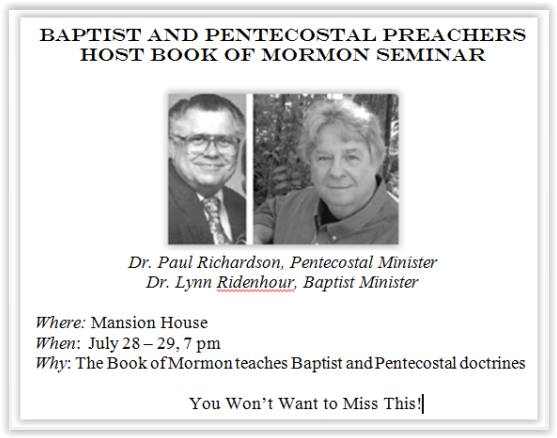
Paul Richardson and Lynn Ridenhour

Advertisement for a joint Paul Richardson, Lynn Ridenhour seminar. (click to zoom)

The Errors of Paul Richardson
In previous articles2 Beggar’s Bread readers were introduced to Dr. Lynn Ridenhour, an allegedly ordained Baptist Minister who has a testimony of Joseph Smith as prophet due to being introduced to the Book of Mormon by one of his Reorganized Church of Jesus Christ of Latter Day Saints (RLDS)/Community of Christ neighbors in Missouri. Dr. Ridenhour merited his own article because he’s the most notorious personality in this regard. In fact, it was through Lynn Ridenhour’s Facebook page that I discovered Dr. Paul Richardson, of whom he wrote:

MEET A DEAR FRIEND. Meet Dr. Paul Richardson, Pentecostal minister who loves and preaches out of the Book of Mormon. A few years back we hosted a Book of Mormon seminar in Independence. Two protestant preachers—a Baptist and a Pentecostal—preaching out of the Book of Mormon. I remember the night. The place was packed! We had an LDS Bishop there, missionaries were there. RLDS brothers and sisters were there. A Catholic priest came.

I consider Dr. Paul and his lovely wife, Faye, the dearest of friends. What a John the Baptist they are! Forerunners ahead of their time—spreading the good news of the restoration gospel and the message of the precious Book of Mormon throughout the southern states of this nation. Dr. Richardson publishes his monthly newspaper and mails it out to Pentecostals, mostly pastors all over southern United States. He also gives away free “Record of the Nephites,” as he calls the Book of Mormon.

Dr. Richardson is the chancellor of Spirit of Truth Institute, a Bible School. His school has ordained over 430 Pentecostal ministers. What a friend!3

Now it should probably be noted here that Dr. Ridenour actually transitioned from being a cessationist Baptist to continuationist Pentecostal during the Charismatic Renewal of the 1970’s. So if you attended that seminar what you really got, despite Lynn Ridenhour’s spin doctored rhetoric, was not one, but two Pentecostals who have fallen into Mormon error. And Dr. Ridenhour isn’t joking about any of the stuff he said about Paul Richardson, let’s consider some “gems” from his website:

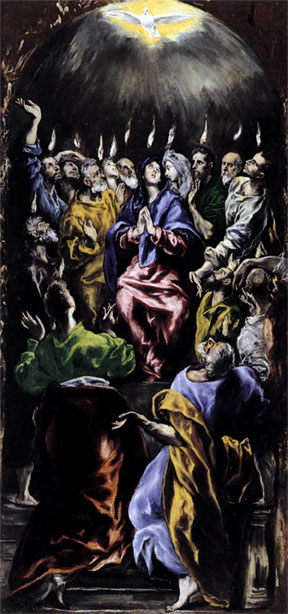
El Greco, "The Pentecost"

“The Pentecost” by El Greco

OUR DISTINCTIVE STAND
We accept the Book of Mormon, which we also refer to as “The Record of the Nephites” or “The Nephite Record.” Why? Because …

  • It is a companion to and comparable to the traditional 66 books of our Holy Bible, as Sacred Writ
  • It is obviously inspired of God and from heaven.
  • It is in harmony with our Holy Bible, confirms and supports fundamental Christian teachings and is another powerful witness unto our Lord Jesus Christ.
  • It is a fascinating true account of ancient Israelites who migrated by ship to America about 600 B.C.
  • This authentic account was dug up, supernaturally translated by the power of the Holy Ghost, and first printed in 1830. Sadly, the Utah “Mormons” have made many little alterations in their version of it, but we still have copies that conform to the original manuscript.
  • It authoritatively corrects a number of old false teachings that have plagued the Church for generations.
  • It is theologically sound, full of spiritual light, and very edifying to the soul.
  • It is the first installment of much more extra-Biblical Revelation prophesied to come forth in this end time.4

And how does Paul Richardson support his claims that the Book of Mormon is an “authentic account”, “obviously inspired of God and from heaven”, and a “true account”? Archaeology? Science perhaps? Cross referencing the historic records? Evaluating the linguistics of the Book of Mormon relative to Native American linguistics maybe? Theological consensus perhaps?

Of course not! Rather, given the fact that it’s been soundly discredited archaeologically, scientifically, historically, linguistically, theologically, and just about every other way, he just does it the same way that all true believing Mormons do: He elevates his feelings and experience above all else. He simply ignores the fact that not only isn’t there a scrap of evidence to validate the Book of Mormon, there’s a mountain of evidence that discredits it. Here’s an example of the type of feellings driven, Mormon style, mental gymnastics that he engages in:

SOMEONE HAD TO WRITE THE BOOK OF MORMON
—It did not just drop down out of Heaven. There are only three possible origins: 1. God, 2. Man, or 3. the devil.

Joseph Smith, Jr. did not write the Book of Mormon. He only translated it. Then soon afterward his life became such a lie that the Book he translated was stigmatized causing the Christian church to rejected [sic] it.

What does the Book of Mormon do for me?
• Well, it inspires me to pray and to be loving and kind.
• It convicts me of any selfishness, fleshly disposition or worldly attitudes.
• It builds up my faith and gives me courage to trust the Lord.
• It puts me in a Heavenly frame of mind and kindles a strong desire in me to walk with God and to live holy for Him.

Each time you lay the Book of Mormon down and walk away, it feels just like you had a real good church service. Reading the Book of Mormon does all the same things for me as reading the Holy Bible does.5

But the fact of the matter is that objective evidence simply can’t be ignored. And if that evidence contradicts your emotional decision it still has to be dealt with somehow. Given that, consider how arbitrary and inconsistent he is in accepting the divine calling of Joseph Smith as inspired translator of the Book of Mormon while simultaneously throwing him under the bus as a fallen prophet:

Joseph Smith was a true prophet of God and a great Seer.

His gift was utterly supernatural!

He had an amazing gift from God to translate the ancient Nephite Record. His great contribution was incomparable, for which we are very grateful.

But not long after he translated the Book of Mormon, he clearly became deceived and misguided and no one should follow either his personal example or his false teachings, which clashed with both the Holy Bible and the Book of Mormon.

I prefer to follow the pure Word of God!6

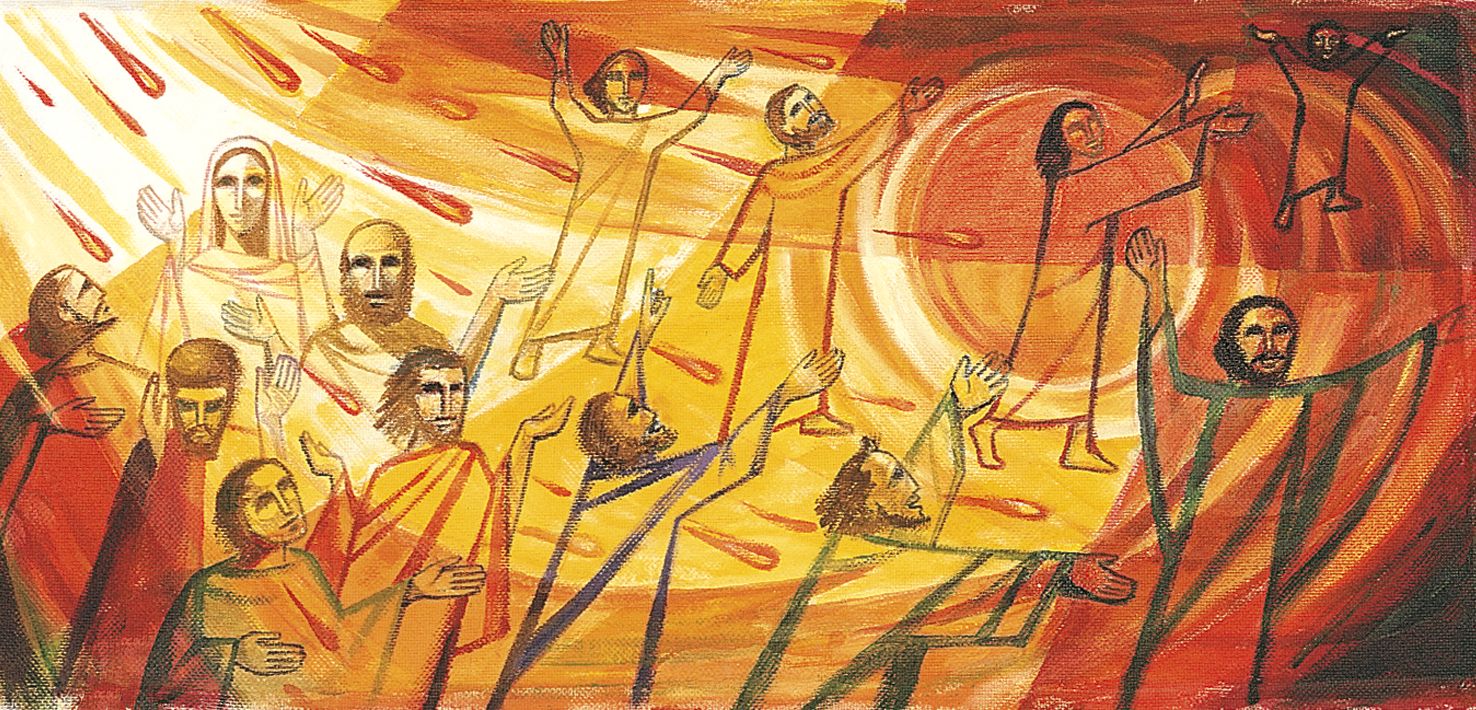
Wiggin-Pentecost-smaller

“Pentecost” by Mark Wiggin

This is pretzel logic at it’s finest! This is like saying that Mohammed was a divinely inspired moralist when he received the Koran but lost the anointing when he started slaughtering infidels. Or that L. Ron Hubbard was an expert in human psychology when he wrote Dianetics but suddenly became a manipulative hack after it fell off the bestseller list. Neither narrative is true: The moral character of neither man changed before or after the these works were published, they remained the same. Likewise, the historical record demonstrates that Joseph Smith was a con-man and a shyster before, during, and after the creation of the Book of Mormon. In all cases, the only thing that really changed was the amount of power and influence that these men were able to consolidate to themselves as a result of the publication of their defining work. And once they had that power consolidation protecting them, their true nature manifested itself.

So apparently in Richardson’s mind the rationale goes something like this: “So what if Joseph Smith didn’t live a life that produced good fruit (per Matt 7:15-20)? So what if the rotten fruit he produced has resulted in a plethora of abusive Mind Control Cults that have followed him in engaging in the practice of polygamy? So what if he taught that the God of the Bible is just an exalted man who is just one of an infinite number of such gods throughout the cosmos (in violation of Deut 13:1-11)? So what if Joseph Smith destroyed fortunes and families through failed prophecies (in violation of Deut 18:18-22)? Brother, his book sure makes me feel like I’m in a really good church meeting when I read it, so it must be of God, right?”

Clearly Dr. Paul Richardson is failing to plumb line any of his beliefs against the absolute and objective standard of the Bible. I can say this emphatically because while the Book of Mormon is an interesting example of 19th Century American Protestant Restorationism, it simply isn’t fully “in harmony with our Holy Bible”. As Donna Morley noted in her analysis of similar claims by Lynn Ridenhour:

Here’s what Alma 13:13 actually says:

“And now, my brethren, I would that ye should humble yourselves before God, and bring forth fruit meet for repentance, that ye may also enter into that rest.”
(Alma 13:13, RLDS, bolding added)

Further, here’s something else Alma says in chapter 13:

“Now, as I said concerning the holy order, or this high priesthood, there were many who were ordained and became high priests of God; and it was on account of their exceeding faith and repentance, and their righteousness before God, they choosing to repent and work righteousness rather than to perish.”
(Alma 13:10, RLDS, bolding added)

In the above, Alma stated that the high priests escaped damnation only by working righteousness. The righteousness is credited as “their righteousness.” This isn’t the unconditional grace that’s taught in the Bible this is conditional grace where one must perform good works in order to merit grace rather than it being a unilateral gift of unmerited favor and mercy from God Himself!

True Christianity isn’t based upon our righteousness. The prophet Isaiah says that our righteousness is as “filthy rags” (Isaiah 64:6, NASB). Because we don’t have righteousness of our own, true followers of Christ are given His righteousness:

“But now apart from the Law the righteousness of God has been manifested, being witnessed by the Law and the Prophets, even the righteousness of God through faith in Jesus Christ for all those who believe.”
(Romans 3:22, NASB)

“He made Him who knew no sin to be sin on our behalf, so that we might become the righteousness of God in Him.”
(2 Corinthians 5:21, NASB)7

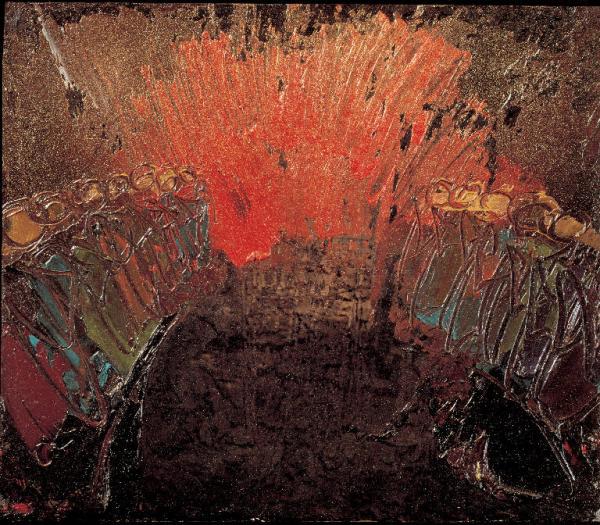
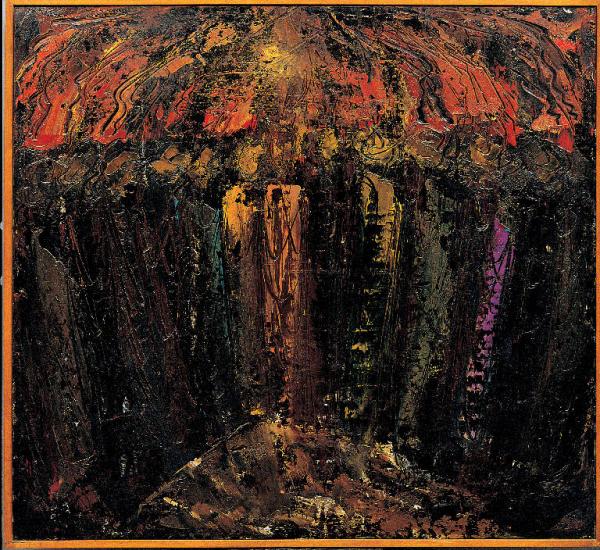
pentecost 2

“Pentecost 2” by William Grosvenor Congdon (1912-1998)

The Book of Mormon also contradicts with biblical theology on other key points as well. For example, it’s view of the Godhead is modalistic8 and it rejects salvation by grace alone through faith alone (that is unconditional grace) for Roman Catholic style conditional grace ( that is, salvation by grace plus works):

“For we labor diligently to write, to persuade our children, and also our brethren, to believe in Christ, and to be reconciled to God; for we know that it is by grace that we are saved, after all we can do.
(2 Nephi 25:23 LDS bolding added for emphasis)

This is in direct contradiction with the Bible:

“For it is by faith you are saved through faith, not that of yourselves it is the gift of God”
(Ephesians 2:8-9, NASB bolding added for emphasis)

“But if it is by grace, it is no longer on the basis of works, otherwise grace is no longer grace.”
(Romans 11:6, NASB)

So it’s clear that Dr. Paul Richardson is in very grave error. He isn’t following the “pure Word of God” at all. I would respectfully suggest that he reconsider his feelings regarding the Book of Mormon in light of what the pure Word of God actually says regarding using feelings as the ultimate means of discerning truth:

“The heart is deceitful above all things, and desperately wicked: who can know it?”
(Jeremiah 17:9, KJV)

“He that trusteth in his own heart is a fool: but whoso walketh wisely, he shall be delivered.”
(Proverbs 28:26, KJV)

Dr. Paul Richardson pitches the “Record of the Nephites” without explicitly stating that it’s the Book of Mormon.

The Errors of Cal Fullerton
While he’s not well known, probably the most interesting of the Charismatics who have been snared by the spirit of Mormonism is Cal Fullerton. Unlike Lynn Ridenhour and Paul Richardson, his justification for his stance isn’t quite as eye rollingly, face palmingly, ham fistedly inane, absurdist, and irrational. Rather, like non-Charismatic LdS Church advocates Richard J. Mouw and Roger E. Olson, he has been seduced into an odd form of theological liberalism and eyes wide shut ecumenicalism that’s rooted in feelings and experiences trumping both biblical orthodoxy and reality. One need go no further than the home page of his website to see this:

“Is the Church of Jesus Christ of Latter-day Saints (LDS) Christian?” This question and others about Christianity in the Mormon Church are reverberating worldwide.

The answers given are usually polarizing. Those who say no are primarily evangelical Christians. Those who say yes are primarily Mormons . . . but not all of them.

Respected evangelical leaders such as Joel Osteen have said yes.

The president of Fuller Theological Seminary, Dr. Richard Mouw, who has been recognized as an important voice among reform-oriented evangelicals, confessed that evangelicals have spread lies about LDS beliefs…

In order to do this completely and most effectively, there must be unity among us. Jesus prayed, “I have given them [my disciples] the glory that you gave me, that they may be one as we are one. . . . May they be brought to complete unity to let the world know that you sent me” (John 17:22-23 NIV).9

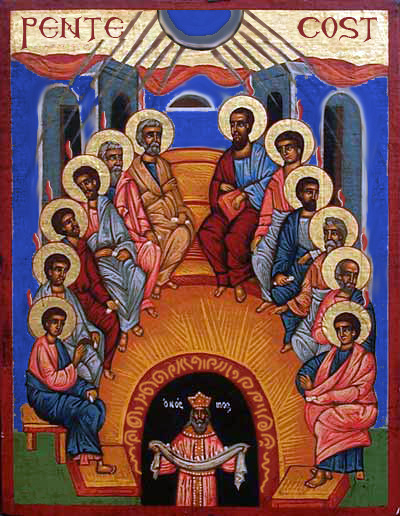
"Icon-Pentecost" by Phiddipus

“Icon-Pentecost” by Phiddipus

So there you have it, an Evangelical Scholar whose work in Mormon Studies has been discredited and denounced by recognized and respected Evangelical Mormon Studies Scholars (Richard J. Mouw)10 and an ear tickling heretic (Joel Osteen)!11 I mean if these guys say it’s true, then it must be – right? I mean, with “evangelical leaders” like this who needs wolves, we have them right in the flock!

But, wait it gets, even better: Though it’s rarely mentioned in public, Cal Fullerton also bases his stance regarding the LdS Church on a prophecy from an errant Charismatic prophetess. Here’s how he relayed this incident on a Mormon/Evangelical discussion board:

I heard the prophecy (not a dream or vision) by the prophetess long after the Word of God—printed & living—revealed to me God’s perspective on the LDS.

Incidentally, the prophetess fell short of saying the LDS is Christian and should be accepted into the Christian fold. Rather, she rebuked the church of Christ for pointing fingers at Mormons. At one point she yelled, “THROW DOWN YOUR STONES!” I liked it so much that I asked permission to use her prophecy in something I was writing. She denied permission, which is why, for the sake of integrity, I’m not mentioning her name now. (She is well known and highly respected among charismatics.)12

And there you have it – classic Charismaniac error. When push comes to shove, Biblical absolutes get shoved to the side and are subordinated to feelings and experiences. This theme can be found again, again, and again on Mr. Fullerton’s website. Again one need go no further than his home page:

Helen [Cal Fullerton’s wife] and I are not taking this stand because we have another opinion– opinions are already too easy to find–it’s because the Spirit of the living God has revealed it to us. Have you ever noticed that virtually all non-Mormons who say the Mormon Church isn’t Christian, don’t say that God told them so? The reason is He didn’t!13

So it came as no surprise to me when Mr. Fullerton offered the same, “Pray about it my friend” defense of the Mormon Church in the aforementioned online discussion that one would expect from a Mormon. Here was my response:

[Your challenge that I pray about the Mormon Church] deserves special, detailed attention. With this statement you have demonstrated WHY some Charismatics/Pentecostals and nearly all Latter-day Saints fall into error.

Cal, I don’t HAVE to pray about whether Mormonism is Christian anymore than I have to pray about whether I should lie, cheat, steal, or commit adultery. Nowhere in the Bible are we told to told to pray about Biblical absolutes.

Rather, for a true Christian the Bible is his/her absolute authority – not feelings, not experiences, not relationships, and not . . . whatever. And in this case Joseph Smith failed to pass every Biblical test for a true prophet and he passed every test for a false one:

1) Deceiving God’s covenant people into following another God. (Deu 13:1-11)
2) Giving future predictions that failed to come to pass. (Deu 18:18-22)
3) A life that produces bad fruit. (Mat 7:15-20)
4) Denying that Jesus Christ was God eternal incarnated in human flesh. (1 John 4:1-3)

In addition we can add:
5) Use of Occult practices like scrying and Shamanism.
6) Incorporating Freemasonry into the LDS Temple ceremonies.
(Freemasonry is rooted in Kabbalah which is occultic)

As I’m sure you know occult practices are soundly condemned throughout both the Old and New Testament so I won’t bore you and the other readers with a list of proof texts on this. In regard to Joseph Smith’s involvement with these practices here’s a good write up by former Mormon, Janis Hutchinson that ends with this closing statement: “No individual, knowing the truth about the Mormon Church’s occult background, could possibly follow Joseph Smith as a prophet or embrace his teachings.”
http://www.janishutchinson.com/joeoccult.html

So no Cal, there’s no need to pray about whether Mormonism is Christian anymore than I need to pray to determine if Branch Davidianism, Christian Spiritualism, Freemasonry, or Scientology are. Sure there are good, moral, admirable people in each of these religions but that doesn’t make them Christian any more than it makes their founders true prophets of the God of the Bible.

And, I must say it, suggesting that I – or any other Christian for that matter – disregard Biblical absolutes and pray about whether the false religion started and based on the teachings of the false prophet Joseph Smith simply demonstrates how flawed, errant, and unbiblical your theology has become.14

At this point, I’m not quite sure what to add in regard in regard the Errors of Cal Fullerton. One need only parse through his website to see error, after error, after error.

"Pentecost" (Unknown Artist)

“Pentecost” (Unknown Artist)

Good Theology? We Don’t Need No Stinkin’ Good Theology!
Lynn Ridenhour, Paul Richards, and Cal Fullerton represent the Charismaniac extremism that John MacArthur and his supporters pointed to with glee in their “Strange Fire” book and conferences in indicting Pentecostal/Charismatic Movement as a fountainhead of error. They’re easy targets since, unlike many Charismatics, they seem to lack any real theological depth. For example, consider this “gem” from Cal Fullerton:

It has been said that the Church of Jesus Christ of Latter-day Saints (LDS) is not a Christian organization because Mormonism denies one or more of the “essential” doctrines of the gospel. To determine if that statement is correct, we need to have a good grasp of what actually is essential. To correctly classify the LDS we need to be sure which doctrines of the Holy Bible are absolutely mandatory in order for someone to become a Christian and enter heaven. Roughly seventy percent of Mormon teachings agree with evangelical teachings. But that does not prove that the LDS is a Christian denomination. The tenets and members have to agree with the Bible’s essentials.

I have assembled these essentials into four.

Essential Number 1: Believe God Rewards…
Essential Number 2: Repent to Faith in Jesus…
Essential Number 3: Receive Jesus (the Holy Spirit) Into Your Heart (Be Born Again)…
Essential Number 4: Believe Jesus is the Son of God, the Christ…

According to the Bible, if the Church of Jesus Christ of Latter-day Saints teaches the four essentials I’ve listed above, we must classify it as a Christian denomination instead of an unchristian cult. That is because God has plainly promised that if you do the essential requirements I have outlined, he will accept you into his eternal family.

Back when I thought the Mormon Church wasn’t Christian, I didn’t pay much attention to whether each of their doctrines had to do with a mandatory requirement for entering heaven. That was one of the reasons I made a tragic mistake of judgment.15

I can hear the sound of palms hitting faces throughout cyberspace as those grounded in historic, biblical theology read that “masterpiece”. I know of no credible theologian who would accept that list as fundamentally sound criteria for soteriology, let alone mainstream Christian orthodoxy! He apparently has no clue that the Essential Doctrines of the Christian faith have recognized throughout Christian Church History as the following:16

"Pentecost 4" William Grosvenor Congdon (1912 - 1998)

“Pentecost 4” by William Grosvenor Congdon (1912 – 1998) (click to zoom)

The Essential Doctrines of the Christian Faith
1) The Deity of Jesus Christ.
2) Salvation by Grace.
3) The resurrection of Jesus Christ.
4) The gospel of Jesus Christ, and
5) Monotheism.

In the end Cal Fullerton only demonstrates his own ignorance and destroys his own case by doing a Mormon style “redefining the terms to fit the predetermined conclusion”. In fact, Mormonism doesn’t even get through the Judeo-Christian gate because of it’s rejection of monotheism in favor of henotheistic polytheism.

Likewise, as pointed out in a previous article, Lynn Ridenhour can’t even properly articulate the orthodox doctrine of the Trinity held by mainstream Christianity without speaking heretically. And he then one ups that heresy by concluding that Joseph Smith’s blasphemous tri-theistic view of the godhead is correct.17 Finally, as noted previously, Paul Richardson seems quite happy with the modalistic version of the Trinity presented in the Book of Mormon, as well as its denial of salvation by grace alone. Folks, if you’re looking for theological depth from these three, look elsewhere! The aforementioned John MacArthur could well have been writing specifically about them when he said:

We ought to begin with the Word of God, allowing a proper interpretation of the text to govern our experiences. A true work of the Spirit thrives on sound doctrine. It promotes biblical truth; it does not dismiss it or see it as a threat. Once experience is allowed to be the litmus test for truth, subjectivism becomes dominant and neither doctrine nor practice is defined by the divine standard of Scripture.

Charismatics downplay doctrine for the same reason they demean the Bible: they think any concern for timeless, objective truth stifles the work of the Spirit. They envision the Spirit’s ministry as something wholly free-flowing, infinitely pliable— so subjective as to defy definition. Creeds, confessions of faith, and systematic theology are seen as narrow, confining, not elastic enough for the Spirit to work within. Acknowledging this tendency within charismatic circles, one author wrote, “A college student once warned me of the ‘dangerous doctrine of demons’— his description of systematic theology. ‘The Lord has given us the Holy Spirit to interpret Scripture,’ he explained. ‘Teaching doctrine is Satan’s attempt to use our minds to understand the Bible rather than relying on the Holy Spirit.” (William E. Brown, “Making Sense of Your Faith”, Wheaton, IL: Victor, 1989, p.55)

That is a shocking statement. In reality, the only thing good theology stifles is error, which is why sound doctrine is the single greatest antidote to charismatic deviations. Remember, the Holy Spirit is the Spirit of truth (John 16: 13). Any work of His will elevate biblical truth and sound doctrine in the hearts and minds of His people.18

Pentecostal Charismaniacs: Mormons Gone Bad
But now it should be apparent that these men are more Mormon than Christian in their epistemology. This should come as no surprise since as noted in prior articles19 Mormonism was a byproduct of the same 19th Century American Restorationist Pentecostalism that birthed today’s modern Pentecostal and Charismatic Movements. That epistemology, in a nutshell, can be described thusly: Feelings, faith, facts – in that order. As Lutheran Pastor, Don Matzat (who has past involvement with the Charismatic Movement) observed well:

There is nothing wrong with Christians desiring feelings, emotions, and experience. In fact, the lack of any experience is in itself an experience. The lack of feeling is a feeling. The lack of emotion is an emotion. Any cursory reading of the New Testament demonstrates that love, joy, peace, hope, contentment are to be the Christian’s experience, feeling, and emotion…

Rather than coming against a feel-good faith, we should clearly teach that true Christian feelings, emotions, and Holy Spirit experience are the product of sound theology. Rather than confronting imbalance in the church by promoting the alternative and pushing the pendulum to the other side, we should begin with a balanced perspective which means recognizing that feelings will follow a faith that clings to the objective promises of God in Scripture. The person who believes and confesses that his sins are forgiven because Jesus died on the cross should feel guilt-free and experience the joy of having a cleansed conscience. Feelings and emotions. while not the cause of our faith, are the expression of our faith. Martin Luther writes, “We can mark our lack of faith by our lack of joy; for our joy must necessarily be as great as our faith.” Again he writes, “You have as much laughter as you have faith.” (Ewald Plass, What Luther Says, (St. Louis: Concordia Publishing House, 1959), Vol. 2, p. 692.)…

Hopefully the present conflict between sound doctrine and feel-good experience will lead to a balanced perspective on both sides. Those who minimize sound doctrine and promote feelings and experience must recognize that they are plotting a course for deception and disaster. Those who focus on sound doctrine must begin teaching people to apply those great truths of Scripture to their daily living so that the experience of God’s people matches what the Word of God commands.20

And Charisma magazine more directly and forcefully articulated the same sentiment in a web article by Joseph Mattera entitled, “10 Signs You Are a Charismaniac”. In fact, according to Mr. Mattera, this is the #1 characteristic of a Charismaniac:

1. You put prophecies and extra-biblical leadings on the same level as the written Word of God. Isaiah 8:20 says if we speak not according to the Scripture then we have no light. Second Timothy 3:16 teaches that all Scripture is inspired by God and profitable for teaching, reproof, correction and training in righteousness. The Scriptures are our rule for life and the highest standard for judging truth.

Unfortunately, some in the charismatic camp seem to be led more by personal prophecies and supernatural visions and dreams than by the Scriptures. I have known some people who would record personal prophecies by well-known “prophets” and—without praying about it or comparing it to Scripture or getting discerning counsel from more seasoned leaders in the kingdom—would just obey the prophecy as if it were as inspired as the Bible.21

Jean_II_Restout_-_Pentecôte

“Pentecost” by Jean II Restout, (c.1732)

In other words, biblical epistemology is facts, faith, feelings – in that order. To see the contrast, just consider Paul Richardson’s “evidence” that the Book of Mormon must be true because, “Each time you lay the Book of Mormon down and walk away, it feels just like you had a real good church service.”22 Now compare this to his lack of any acknowledgement that the Book of Mormon does in fact contradict both the Bible and Christian orthodoxy. When you take that and then factor in the reality that there is absolutely no empirical evidence to support the historicity of the Book of Mormon – a glaring omission that somehow fails to be addressed on his website or in any of his articles – the work’s rejection as holy writ should be fait accompli. Instead, again, again, and again in his articles Mr. Richardson endorses the book as scripture equivalent to scripture based on subjective analysis that’s devoid of any objective evidence. As I said to Cal Fullerton regarding this same kind of lack of discernment and failure to plumb line such impressions against objective evidence:

I, a fellow Charismatic who believes in modern prophetic utterances and the other gifts of the Spirit say to you now as I did back on the [now defunct] Concerned Christians board [in 2010]: I don’t care WHO that prophetess was, I could care less what her reputation is among Charismatics or anyone else for matter, she gave a false prophecy – period.

When plumblined against the Bible it was a false prophecy. Period.

And most distressingly she validated a false prophet and a heretical non-Christian group in the name of (and allegedly in the voice of) God. She is, therefore, a false prophet and a deceiver. Period.23

This blatant disregard of objectivity (especially biblical objectivity) over personal subjectivity is very Mormon isn’t it? In fact, Chuck Smith, the founder of Calvary Chapel and a Charismatic with Pentecostal roots, could have been describing these men when he wrote:

It is of utmost importance that we allow the Bible to be the final authority for our faith and practice. Any time we begin to allow experiences to become the criteria for doctrine or belief, we have lost biblical authority, and the inevitable result is confusion. There are so many people today who witness of remarkable and exciting experiences. The Mormons, for example, “bear witness” to the experience of the truth of the Book of Mormon. They encourage people to pray in order to experience whether or not their Book of Mormon is true. One person says he has experienced that it is true, and another says he has experienced that it is false. Which one am I to believe? Each swears he has had a true experience from God; yet one has to be wrong. Whenever you open the door for experience to become the foundation or criterion for doctrinal truth, you are opening a Pandora’s box. The result is that the truth is lost in the conflicting experiences, and the inevitable consequence is total confusion. We know that God is not the Author of confusion.24

Further, didn’t Christ stress the importance of evidence throughout His sermons? And could Paul have been any clearer when he said that if our Christianity isn’t empirically true then “we are of all men the most pitiable”?

If Christ is not risen, then our preaching is empty and your faith is also empty. Yes, and we are found false witnesses of God, because we have testified of God that He raised up Christ, whom He did not raise up—if in fact the dead do not rise. For if the dead do not rise, then Christ is not risen. And if Christ is not risen, your faith is futile; you are still in your sins! Then also those who have fallen asleep in Christ have perished. If in this life only we have hope in Christ, we are of all men the most pitiable.
(1 Corinthians 15:14-19, NKJV)

In summary and conclusion, this unbiblical, feeling affirming, evidence denying pattern can be seen plainly in the writings and public instruction of all three men – again, one need only spend some “quality time” on their websites to see this clearly. By embracing false scripture from a False Prophet – and even worse, encouraging others to do the same – these men have become false teachers themselves. And the Bible was quite clear what God’s people are to do when we encounter a false teacher, false prophet, false apostle, or false anything for that matter:

You shall not listen to the words of that prophet or that dreamer of dreams, for the Lord your God is testing you to know whether you love the Lord your God with all your heart and with all your soul. You shall walk after the Lord your God and fear Him, and keep His commandments and obey His voice; you shall serve Him and hold fast to Him.
(Deuteronomy 13:3&4, NKJV) bolding added for emphasis

pentecost

A primitive fresco of Pentecost.

NOTES
1 Full disclosure and clarification: I worked as a Music Reviewer for “Worship Leader Magazine”, which is also owned by Strang Publications, the publisher of Charisma Magazine, from 1992-1993. During that time I found John Strang and his staff to be reasonable, personable, and theologically sound. I think that’s why you will find the editorial content of Charisma Magazine to be generally sound.

That’s why I’ve specifically recommended that you just view the advertisements in the magazine instead – they’re an unvetted, raw picture of the current state of the Pentecostal/Charismatic Church at the grassroots level and, frankly, it’s scary. Whenever someone asks (or challenges) me about my (admittedly blunt) assessment of the modern Pentecostal/Charismatic Movement I just point them to there. After seeing them, nothing else need be said. For example, let’s look at a couple of them from the December 2015 issue of Charisma magazine:

“Blood Moons are not about the end – they are about the beginning.

For over 3,000 years God has used the blood moon tetrads on His feast days of Passover and Tabernacles as a sign of special revival coming to His people. The last great blood moon revival came in 1967, when God poured out His Spirit to begin the charismatic renewal. Today there are over 600 million charismatic Christians who are the fruit of this revival, including most of the readers of this magazine.

The blood moon tetrad of 2014-2015 occurred in troubled time, as have most the previous 14 blood moon tetrads. Yet we can see the beginning of a new revival coming based on unity in Christ in answer to Jesus’ prayer in John 17. Don’t miss it!

we invite you to study the Scriptures, the heavenly signs, and the history of the blood moon tetrads in our new book . . . ”
(Charisma, December 2015, p.9)

But, wait folks, if blood moons aren’t enough, there’s more! Consider this “gem”:

“Discouraged?
Need a miracle?
Lack the faith to believe?
Desire to be empowered to heal?

– Receive step by step Biblical Instruction to activate God’s healing power in your life.
-Be encouraged as you read the amazing testimonies that are in this book.

Afraid?
Feel defeated?

– Tap into the supernatural potential of your faith.
– Unleash the power of God.
– Experience the impossible.
– Overcome in these Last Days.
(Charisma, December 2015, p. 15)

Even more disturbing are the titles and subtitles of the latter books being advertised in the second advertisement: “Dare to Believe: The True Power of Faith to Walk in Divine Healing and Miracles” and “Greater Than Magic: The Supernatural Power of Faith”. Apparently, the Bible isn’t enough any more, now we need the equivalent of “How To” Charismatic cookbooks and computer manuals! Further, if one didn’t know in advance one might even assume from the title alone that these are books from pagans on how to cast spells or channel metaphysical powers and forces. Yet there they are, being advertised in the flagship periodical of American Pentecostals and Charismatics! And not only does no one seem to care, but judging by the reviews of these books on Amazon, my Pentecostal and Charismatic brothers and sisters seem to be delighted by it! It is any wonder that prudent and conservative continuationists distance themselves from such things?

My dear Pentecostal and Charismatic brothers and sisters we can do better than this! Brothers and sisters we must do better than this in the Name of, and for the cause of, Christ alone!

2 See “The Errors of Dr. Lynn Ridenhour” and “Weak Arguments #7: ‘The Book of Mormon doesn’t have a trace of orthodox, mainstream Biblical Christianity in it.’” in particular.

3 Lynn Ridenhour, Facebook post October 20, 2014

4 Paul Richardson, “Our Distinctive Stand”; “The Full Revelation Believers” website (now archived). The reader may also be interested in reading Dr. Richardson’s biography (which for or some unknown reason he calls a “News Release”) by clicking here.

5 Paul Richardson, “Someone Had To Write The Book of Mormon”; “The Full Revelation Believers” website (now archived).

6 Paul Richardson, “The Charm of Joseph Smith”; “The Full Revelation Believers” website (now archived).

7 Donna Morley, “The Errors of Dr. Lynn Ridenhour, Appendix: Is the Book of Mormon Really “Baptist”?”

8 See Ronald V. Huggins, B.F.A., Th.D., “Joseph Smith’s Modalism: Sabellian Sequentialism or Swedenborgian Expansionism?”; Also see Bill McKeever, “Modalism in the Book of Mormon”.

9 Cal Fullerton, “Evangelicals and Mormons for Jesus” home page. Bolding retained from original.

And in accordance with the usage guidelines of that website we post the following: “Copyright © 2008 Cal Fullerton. Permission is granted, and you are encouraged, to print the above article in hard copy form, as well as send it to your own email lists and post it on your own websites. We only ask that you include the name of the originating website (EvangelicalsandMormonsforJesus.com) and this copyright and permission notice.”

10 Please see the Evangelical Ministries to New Religions “Statement On Richard Mouw And Evangelical Countercult Ministries”; And for a good analysis and deconstruction of Richard J. Mouw’s claim that Evangelical Christians have lied about and misrepresented the Mormon Church see Fred W. Anson, “Scolasticus cum Peter Principle”; Also recommended: Mike Thomas, “That Apology and How Liberal Theolgians “Go Native”’, and; Fred W. Anson, “Apologizing For Richard J. Mouw”.

11 See Matt Walsh, “Joel Osteen and his Wife are Heretics, and that’s why America Loves Them”; Also see “Joel Osteen-Preaching a False-Positive, with a Smile”.

12 Cal Fullerton comment, September 18, 2013 at 3:40 pm on the article “Turns out, the Bible says that Protestants should unite with Mormons” by Jared C. on the LDS and Evangelical Conversations website.

13 Op Cit, Fullerton, “Evangelicals and Mormons for Jesus” home page.

And by the way, and for the record Mr. Fullerton, there are thousands of Christians who can subjectively claim that the Mormon Church is neither true or Christian because God told them so. I’m one of them:

I would like to bear my testimony . . .
I have diligently sought God regarding whether the Church of Jesus Christ of Latter Day Saints is true or not. To that end, I have studied the Bible as well as the Book of Mormon and I have prayed consistently for over 30-years. I have taken the “Moroni 10 Challenge” and I have felt an intense “burning in my bosom” many, many, many times in my life — in fact, I carry it with me everyday of my life.

… and my testimony is this:
I am utterly convinced that the Church of Jesus Christ of Latter Day Saints is a non-Christian cult, that Joseph Smith was a false prophet, as is Thomas S. Monson. Further, I am utterly convinced that the Book of Mormon is an uninspired, man created work of 19th Century fiction.

Here I stand before God and before men – I can do no other.

In the Name of Jesus Christ, our Lord and Savior, amen.

And if my testimony isn’t enough, I can provide similar testimony from other Christians with little to no effort at all. Further Mr. Fullerton, please note that -unlike your testimony of the LdS Church – the body of objective evidence, including the bible itself, supports and verifies our subjective testimony. So in the end where has all this subjective testimony bearing of contrary positions gotten either of us? Answer: Absolutely nowhere.

What I have said to countless Mormons, I will now say to Misters Ridenhour, Richardson, and Fullerton: That Mormon testimony of yours plus a buck fifty will get you a cup of coffee at Denny’s and that’s about it! And what’s true for you is just as true for my contra-Mormon testimony: Testimony bearing in and of itself proves nothing. Rather, let’s see the objective evidence that supports and verifies it – because in the end that’s all that really matters.

14 Fred W. Anson reply to Cal Fullerton, September 18, 2013 at 11:01 pm; Op Cit, Jared C., “Turns out, the Bible says that Protestants should unite with Mormons”.

15 Cal Fullerton, “Essentials for Salvation”“Evangelicals and Mormons for Jesus” website. Bolding from original retained.

16 See Matt Slick, “Essential Doctrines of Christianity”, CARM website. While Mr. Slick’s article is an excellent short vernacular primer, C. Michael Patton’s “Essentials and Non-Essentials in a Nutshell” article is the better resource for those seeking a fuller, more nuanced understanding of the subject. Finally for those who find Mr. Slick’s outline format a bit too cryptic and Mr. Patton’s article too long should consider the short but insightful “What are the essentials of the Christian faith?” article on the “Got Questions?” website instead.

17 In his article, “God of the Philosophers: Brief Comments on the Godhead” (now archived) Lynn Ridenhour writes:

“The God of the Trinity wallows in modalism, stumbling to give its advice to new converts. Listen to Cyril of Jerusalem:

“…For there is one Salvation, one Power, one Faith; One God, the Father; One Lord, His only-begotten Son; One Holy Ghost; the Comforter. And it is enough for us to know these things; but inquire not curiously into His nature or substance: for had it been written, we would have spoken of it; what is not written, let us not venture on; it is sufficient for our salvation to know, that there is Father, and Son, and Holy Ghost.” –Catechetical Lectures 16:24

Enough.

What kind of Being is God?

Let Joseph answer. The Prophet preached that “…if you were to see [God] today, you would see him like a man in form,” and that “the Father has a body of flesh and bones as tangible as a man’s; the Son also; but the Holy Ghost has not a body of flesh and bones, but is a personage of Spirit” (D&C 130:22).

As I said in the beginning, this may be old hat to most, and not unlike the tour guide, some may be tempted to say “…O, we see it all the time…” and walk away, but for me—it’s like seeing the Niagara Falls for the very first time.”

In case you didn’t notice that a heretical definition of the Trinity followed by an endorsement of Joseph Smith’s blasphemous tri-theistic view of the godhead.

18 John F. MacArthur, “Strange Fire: The Danger of Offending the Holy Spirit with Counterfeit Worship” (pp. 73-74) Kindle Edition.

I would ask the reader to note that while I find much to soundly applaud in this work, overall I was disappointed by John MacArthur’s extremist stances, exaggerations, misrepresentations and generally ungracious, polemic attitude in both this book and the conferences that preceded it. Perhaps Dr. Timothy George, Dean of Beeson Divinity School of Samford University and general editor of the “Reformation Commentary on Scripture” as well as several other books said it best when he wrote:

“Within the worldwide charismatic movement, there are no doubt instances of weird, inappropriate, and outrageous phenomena, perhaps including some of the things MacArthur saw on TBN. Many Pentecostal leaders themselves acknowledge as much. But to discredit the entire charismatic movement as demon-inspired because of the frenzied excess into which some of its members have fallen is both myopic and irresponsible. It would be like condemning the entire Catholic Church because some of its priests are proven pedophiles, or like smearing all Baptist Christians because of the antics of the Westboro Baptist Church.

When told that his all-charismatics-are-outside-the-pale approach was damaging the Body of Christ because he was attacking his brothers and sisters in the Lord, MacArthur responded that he “wished he could affirm that.” This is a new version of extra ecclesiam nulla salus—except that the ecclesia here is not the one, holy, catholic, and apostolic church but rather an exclusively non-charismatic one.”
(Timothy George, “Strange Friendly Fire”, First Things, November 4, 2013)

I also agree with Reformed Theologian John Piper who wrote:

‘On each point, it is surely misguided to single out charismatics, says Piper. “Charismatic doctrinal abuses, emotional abuses, discernment abuses, financial abuses, all have their mirror image in non-charismatic churches.” Of charismatics and non-charismatics alike, “we all stand under the word of God and we all need repentance.”

But those charismatic abuses remain. So how are these excesses best policed? How are Christians today protected from the abuses of the charismatic church? Is it through attack-centered books and conferences?

“I don’t go on a warpath against charismatics. I go on a crusade to spread truth. I am spreading gospel-centered, Christ-exalting, Bible-saturated, Calvinistic truth everywhere, and I am going to push it into the face of every charismatic I can find, because what I believe, if they embrace the biblical system of doctrine that is really there, it will bring all of their experiences into the right orbit around the sun of this truth.”’
(John Piper, “Piper Addresses Strange Fire and Charismatic Chaos”, Desiring God website)

I’m trying hard in this article to tread a fine line between being too polemic and too tolerant regarding Charismatic practices that I consider imbalanced or outright unbiblical. I will leave it to the reader’s judgment to determine if I’ve succeeded or not.

19 See Fred W. Anson, “Mormons: Pentecostals Gone Bad”“Mormons: Pentecostals Gone Bad [The Sequel]”; Also see John Farkas, “Speaking in Tongues and The Mormon Church”.

20 Don Matzat, “Feelings, Emotions and Christian Truth”

21 Bishop Joseph Mattera, “10 Signs You Are a Charismaniac”, Charisma magazine’s “Charisma News” website. Bolding from original retained.

22 Paul Richardson, “Someone Had to Write The Book of Mormon”.

23 Fred W. Anson reply to Cal Fullerton, September 18, 2013 at 6:04 pm; Op Cit, Jared C., “Turns out, the Bible says that Protestants should unite with Mormons”.

24 Chuck Smith, “Charisma Versus Charismania”, Kindle Locations 1282-1289.

The Bible

“Study to shew thyself approved unto God, a workman that needeth not to be ashamed, rightly dividing the word of truth.”
(2 Timothy 2:1, KJV)

BACK TO TOP

what-is-the-gospel1_edited
“Beer is made by men, wine by God.”
― Martin Luther

by Marie Johnson
The Book of Mormon claims to be, “Another Testament of Jesus Christ” but when it is put to the test, the gospel it embodies is nothing more than a man made concoction of of law mixed with grace; a tainted gospel that is condemned by the Apostle Paul.

In Galatians 5:4 (AKJV) Paul writes, “Christ is become of no effect unto you, whosoever of you are justified by the law; you are fallen from grace.” He reiterates his point in Romans 4:13-14 (KJV), “For the promise, that he should be the heir of the world, was not to Abraham, or to his seed, through the law, but through the righteousness of faith. For if they which are of the law be heirs, faith is made void, and the promise made of none effect.”

The Bible teaches that before, during and after God made covenants with Israel, people were counted righteous by believing the promises of God (Romans 4); not by obedience to the the law of Moses (Romans 3:20). In the book of Hebrews we read that, prior to Christ, God’s people looked forward to the promise of a heavenly city; the Old Testament version of eternal life (Hebrews 11:9-16). In addition to God’s promise of a heavenly city, the Messiah and the New Covenant were also promised (Galatians 3:8, Hebrews 8:6-13). The people of God who lived before Christ were still living by faith when they died. They did not receive the things promised; they only saw them and welcomed them from a distance (Hebrews 11:1, 13-16, 39).

The Old Covenant sacerdotal system, which came 430 years after God made his promises to Abraham (Genesis 12: 1-3) was never designed to give eternal life. Its purpose was to act as a tutor and a disciplinarian; teaching people about the depths of their sinfulness. As their custodian, it watched over them and keep them in check until the fullness of time came and they could be justified by faith in Jesus (Galatians 3:19-24). Just as the promise was not the reality, the sacrifices of the Mosaic covenant were only a foreshadow of the good things that were coming in Christ (Hebrew 10:1-2).

Inaugurated with the shed blood of animals, the Mosaic covenant had a very distinct beginning. When Moses took the blood of calves and goats and sprinkled the book of the covenant and all the the people, the Israelites were bound to abide by the law of Moses (Exodus 24:8, Hebrews 9:19). They were required to continually perform sacrifices for the temporary covering of sins (Hebrews 10:11). If they intentionally defied the Mosaic law, they would be cut off from Israel; that is, put to death (Numbers 15:30, Hebrews 10:28). No Hebrew was exempt from this obligation to the law until, “the fulness of the time was come, [when] God sent forth his Son, made of a woman, made under the law, to redeem them that were under the law, that we might receive the adoption of sons (Galatians 4:4-5,KJV).

download
Because Jesus redeemed those under the law, the Old Covenant became obsolete when the New Covenant was ratified in his blood. (Hebrews 8:13, 10:9-10). Jesus addressed this in the parable of the wineskins. New wine can’t be poured into old wineskins: The old skins will burst and both will be ruined. (Matthew 9:14-17). The two covenants can’t be mixed.

In spite of Paul and Jesus’ teaching, the Book of Mormon asserts that people who were under Old Covenant law could freely partake of the New Covenant and claim remission of sins through Jesus’ atonement. One example can be found in the introduction to 2 Nephi 25, “The Nephites keep the law of Moses and believe in Christ, who is the Holy One of Israel. About 559–545 B.C. [about 575-580 years before the New Covenant existed].”

BYU Professor Noel B. Reynolds gives a nice summary of this teaching explaining how it is found throughout the Book of Mormon (emphasis mine):

Because of the great visions and revelations he rebloodd, Nephi shared a role with his father as a founding prophet. At a young age he was inspired by the Holy Spirit and believed his father’s words. He heard the voice of the Lord telling him that he would become a ruler and teacher over his brothers (1 Ne. 2:22). He witnessed the vision of the tree of life shown earlier to his father (1 Ne. 8), which showed him the future birth, baptism, and ministry of Jesus Christ, as well as the future rise and demise of his own people. He was shown also the future establishment of the Gentiles in the Western Hemisphere and the restoration of the gospel in their midst (1 Ne. 11-14). Because of these revelations, Nephi was able to teach his people the gospel or “doctrine of Christ”-the means by which they could come unto Christ and be saved (2 Ne. 30:5; 31:2-32:6). His carefully formulated teaching of this doctrine provided a model that other Nephite prophets invoked repeatedly (see Gospel of Jesus Christ).

Because the Nephites had received the fullness of the Gospel of Jesus Christ, their strict observance of the law of Moses was oriented toward its ultimate fulfillment in Jesus, and Nephi explained to his people that they should observe the law of Moses as a means of keeping Christ’s future atonement always in their minds (2 Ne. 25:29-30). The law itself had become “dead”to those who were “made alive in Christ” and who knew that Jesus was the one to whom they could look dirctly for “remission of thier sins” (2 Ne. 25:25-27).”
(Reynolds, Noel B., “Nephi 1”, The Encyclopedia of Mormonism)

Here is another example from Mosiah 3:13-16, 28 where, “strict observance of the law of Moses” is taught (that is the Old Covenant) while a direct appeal is made to the atonement of Christ for the remission of sins (which is the New Covenant):

“And the Lord God hath sent his holy prophets among all the children of men, to declare these things to every kindred, nation, and tongue, that thereby whosoever should believe that Christ should come, the same might receive remission of sins, and rejoice with exceedingly great joy, even as though he had already come among them…and yet they hardened their hearts, and understood not that the The law of Moses availath nothing except it were through his atonement. And even if it were possible that little children could sin they could not be saved; but I say unto you they are blessed; for behold, as in Adam, or by nature, they fall, even so the blood of Christ atoneth for their sins…. And moreover, I say unto you, that salvation doth not come by the law alone; and were it not for the atonement, which God himself shall make for the sins and iniquities of his people, that they must unavoidably perish, notwithstanding the law of Moses.”

“King Solomon Dedicates the Temple” by or in the style of James Tissot (c.1896–1902)

Splattered throughout the pages of the Book of Mormon, this concocted gospel attempts to mix the Old and New Covenants, only to rip apart the fabric of the Old Covenant and trample underfoot the New Covenant.

The Old Covenant was bound together and structured around the temple, the priests and the sacrifices. It was inaugurated in and kept by the blood of animals. Before the High Priest could enter God’s presence (The Most Holy Place in the temple), the blood of animals had to be spilled as a sin offering. If the High Priest had tried to enter the Most Holy Place without first making a sin offering, if he tried to enter by promising a future animal sacrifice and not by the literal shedding of animal blood, he would have died. (Leviticus 16:2-3).

The New Covenant was also inaugurated in and kept by blood; the blood of Jesus (Mark 14:24). Just as no one could enter into the Old Covenant without the literal shedding of animal blood, no one could enter into the New Covenant and gain the blessings of the atonement without the literal shedding of Jesus’ blood (Hebrews 9:16-28).

However, as seen in Mosiah 3:16 above, The Book of Mormon teaches that, before Jesus died, the, “blood of Christ atoneth for their sins“ and the children of men received, “remission of sins,… even as though he had already come among them.” This was impossible. For, as the writer of Hebrews explains, “without shedding of blood, there is no remission [of sin].” (Hebrews 9:22, KJV) 

Claiming to receive remission of sins based on blood which had not been shed, makes Jesus’ death into nothing more than a token or a symbol. Remission of sins and the gift of eternal life are not given through tokens or symbols. They are given based on the reality of a vital union with the one who shed his blood and died to take away our sins; the one and who is eternal life (1 John 1:2, 3:5, 5:9-12).

The claim that Nephi was given a revelation about Jesus Christ does not change how the covenants were ratified. The terms of ratifying the New Covenant were not, “Nephi will receive a vision about the restoration of the gospel” or “Nephi will be able to teach his people of the ‘Doctrine of Christ’.” The New Covenant came into effect only when Jesus was dead. (Hebrews 9:15-17).

In Alma 22:14, the missionary Aaron preaches the the gospel of The Book of Mormon to King Lamoni’s father and tells him, “…the sufferings and death of Christ atone for their [fallen men’s] sins, through faith and repentance, and so forth..” In response, King Lamoni’s father asks, what he should do that he might have eternal life, be born of God and receive [God’s] spirit (All blessings of the New Covenant. They were not available under the Old Covenant. See eternal redemption in Hebrews 9:12-26; see the requirement for Jesus death to be born again in Jn 3; see Jesus promise of the Spirit in John 14:16-18). Aaron responds to Lamoni’s father, “If thou desirest this thing, if thou wilt bow down before God, yea, if thou wilt repent of all thy sins, and will bow down before God, and call on his name in faith, believing that ye shall receive, then shalt thou receive the hope which thou desirest.”…and Lamoni’s father does so.

This story is infused with the Biblical concepts of calling on God’s name in faith, repentance, bowing down, believing and receiving. It has a strong air of authenticity. However, when tested, it is missing the most essential ingredient required for the forgiveness of sins: a sacrifice.

Aaron’s gospel overlooks the fact that under Mosaic law animal blood must be shed to make atonement for sins (Leviticus 17:11). Instead of requiring an animal sacrifice, Aaron tells King Lamoni’s father he is covered by Jesus’ sacrifice; a sacrifice that has not taken place and does not exist.

1886-1894 --- A painting from a series of Bible illustrations by James Tissot. --- Image by © Brooklyn Museum/Corbis

“The Crucifixion” by James Tissot
(c.1886-1894)

Today, we look back on Jesus’ death and from our perspective we see that the people of faith who lived under the Old Covenant are now covered by the reality of Jesus’ sacrifice. When they lived under the Old Covenant they were counted righteous because they believed God’s promises; not because those promises were a reality. As a demonstration of their faith in the promises of God, they performed the animal sacrifices required under the covenant they had with God. They did not claim remission of sins based on blood that had not been shed or a covenant that did not exist.

This is the bitter gall The Book of Mormon asks us to swallow – wrapped in catch phrases and words that have been lifted from the Bible. In 1982 the LdS Church labeled the Book of Mormon, “Another testament of Jesus Christ”. The word, “testament,” is Latin for covenant. The Book of Mormon is not another covenant of Jesus Christ. It is not , “Another testament of Jesus Christ”. The Book of Mormon teaches a gospel that violates both the Old and the New Testaments of God. Those who imbibe it’s false gospel will stumble and fall short of the pure grace and truth that are offered to us by Jesus Christ.

“And he took the cup, and gave thanks, and gave it to them, saying, Drink ye all of it; For this is my blood of the new testament, which is shed for many for the remission of sins.” (Matthew 26:27-28, KJV).

The law was given by Moses, but grace and truth came by Jesus Christ (John 1:17). Another gospel comes by the Book of Mormon.

About the Author
Marie Johnson is the pen name of Pam Hanvey who is a freelance writer and researcher in Utah who specializes in Latter-day Saint culture and theology. 

quote-the-good-news-of-the-gospel-of-grace-cries-out-we-are-all-equally-privileged-but-unentitled-brennan-manning-85-84-77_EDITED

BACK TO TOP

Athanasius (circa 293-373AD)

Athanasius (circa 293-373AD)

Introduction: The greatest exposition of the doctrine of the Trinity is the Athanasian Creed. Unfortunately, many modern readers often feel overwhelmed and confused by it. Perhaps this is due to the fact that good modern translations of the creed can be hard to find. The translation below is both modern and breaks the creed into paragraphs by theme – thereby making it more legible and easier to digest. If you will read it slowly, considering each line and paragraph before proceeding to the next one, we suspect that you will find it not only easy to comprehend but will come away with a fuller, richer understanding of the Trinity. Finally, please note that the term “catholic faith” in this translation is correct meaning, “on the whole, according to the whole or in general”, or more simply, “universal”. It is not referring to the Roman Catholic Church – which didn’t appear for hundreds of years, that is, long after this creed was written. — Editor

Whoever desires to be saved should above all hold to the catholic faith.
Anyone who does not keep it whole and unbroken will doubtless perish eternally.
Now this is the catholic faith:

That we worship one God in trinity and the trinity in unity,
neither blending their persons
nor dividing their essence.
For the person of the Father is a distinct person,
the person of the Son is another,
and that of the Holy Spirit still another.
But the divinity of the Father, Son, and Holy Spirit is one,
their glory equal, their majesty coeternal.

What quality the Father has, the Son has, and the Holy Spirit has.
The Father is uncreated,
the Son is uncreated,
the Holy Spirit is uncreated.

The Father is immeasurable,
the Son is immeasurable,
the Holy Spirit is immeasurable.

The Father is eternal,
the Son is eternal,
the Holy Spirit is eternal.

And yet there are not three eternal beings;
there is but one eternal being.
So too there are not three uncreated or immeasurable beings;
there is but one uncreated and immeasurable being.

Similarly, the Father is almighty,
the Son is almighty,
the Holy Spirit is almighty.
Yet there are not three almighty beings;
there is but one almighty being.

Thus the Father is God,
the Son is God,
the Holy Spirit is God.
Yet there are not three gods;
there is but one God.

Thus the Father is Lord,
the Son is Lord,
the Holy Spirit is Lord.
Yet there are not three lords;
there is but one Lord.

Just as Christian truth compels us
to confess each person individually
as both God and Lord,
so catholic religion forbids us
to say that there are three gods or lords.

The Father was neither made nor created nor begotten from anyone.
The Son was neither made nor created;
he was begotten from the Father alone.
The Holy Spirit was neither made nor created nor begotten;
he proceeds from the Father and the Son.

Accordingly there is one Father, not three fathers;
there is one Son, not three sons;
there is one Holy Spirit, not three holy spirits.

Nothing in this trinity is before or after,
nothing is greater or smaller;
in their entirety the three persons
are coeternal and coequal with each other.

So in everything, as was said earlier,
we must worship their trinity in their unity
and their unity in their trinity.

Anyone then who desires to be saved
should think thus about the trinity.

But it is necessary for eternal salvation
that one also believe in the incarnation
of our Lord Jesus Christ faithfully.

Now this is the true faith:

That we believe and confess
that our Lord Jesus Christ, God’s Son,
is both God and human, equally.

He is God from the essence of the Father,
begotten before time;
and he is human from the essence of his mother,
born in time;
completely God, completely human,
with a rational soul and human flesh;
equal to the Father as regards divinity,
less than the Father as regards humanity.

Although he is God and human,
yet Christ is not two, but one.
He is one, however,
not by his divinity being turned into flesh,
but by God’s taking humanity to himself.
He is one,
certainly not by the blending of his essence,
but by the unity of his person.
For just as one human is both rational soul and flesh,
so too the one Christ is both God and human.

He suffered for our salvation;
he descended to hell;
he arose from the dead;
he ascended to heaven;
he is seated at the Father’s right hand;
from there he will come to judge the living and the dead.

At his coming all people will arise bodily
and give an accounting of their own deeds.
Those who have done good will enter eternal life,
and those who have done evil will enter eternal fire.

This is the catholic faith:
one cannot be saved without believing it firmly and faithfully.

Athanasius_the_Confessor_of_Constantinople_(Menologion_of_Basil_II)

Athanasius the Confessor of Constantinople
(from Menologion of Basileiou an 11th century illuminated byzantine manuscript with 430 miniatures, now in the Vatican library)

BACKGROUND
This creed is named after Athanasius (A.D. 293-373), the champion of orthodoxy against Arian attacks on the doctrine of the trinity. Although Athanasius did not write this creed and it is improperly named after him, the name persists because until the seventeenth century it was commonly ascribed to him. It is not from Greek (Eastern), but from Latin (Western) origin, and is not recognized by the Eastern Orthodox Church today. Apart from the opening and closing sentences, this creed consists of two parts, the first setting forth the orthodox doctrine of the trinity, and the second dealing chiefly with the incarnation and the two-natures doctrine. The translation above was adopted by the CRC Synod of 1988. 

© 1987, CRC Publications, Grand Rapids MI. www.crcna.org. Reprinted with permission.

trinity_edited

Joy Stained Glass Studio, “The Trinity”

by Rob Bowman
If you do not believe the doctrine of the Trinity, and favor another view yourself, I am going to give you some free advice. I am going to tell you exactly what you need to do in order to defend your non-Trinitarian position as a superior alternative to the Trinitarian view. I know, this is very generous of me, but in the interests of full disclosure I think it only fair to make this information available to the opponents of the doctrine of the Trinity.

1. Refute one or more of the essential propositions of the doctrine of the Trinity.
In my outline study of the biblical basis of the doctrine of the Trinity, I explain that the doctrine is simply a systematization of six core propositions that are all based directly on the teaching of the Bible:

  1. There is one God (i.e., one proper object of religious devotion).
  2. This one God is a single divine being, called Jehovah or Yahweh in the Old Testament (the LORD).
  3. The Father of our Lord Jesus Christ is God, the LORD.
  4. The Son, Jesus Christ, is God, the LORD.
  5. The Holy Spirit is God, the LORD.
  6. The Father, Son, and Holy Spirit are each someone distinct from the other two.

In order to defend an alternative position, you must refute at least one of these premises, or, you must show that all six of these propositions are consistent with another theological position besides the Trinity. I do not think the latter is possible, and in fact I do not know of any non-Trinitarian theology that affirms all six propositions (at least, not without some heavy equivocation). So, for all practical purposes, if you’re going to defend another view in place of the Trinity, you’ll have to refute one of the above premises.

2. Present a clear alternative to the doctrine of the Trinity.
Constantly carping at things about the Trinity that you don’t like, can’t understand, and won’t accept is not enough. You must tell us what we should believe instead. Your position must be specific and cover the same basic issues that are addressed in the doctrine of the Trinity.

3. Identify the religion associated with that alternative to Trinitarian Christianity.
It’s no good telling us that you believe X, Y, and Z instead of the Trinity, if this “alternative” is your own private confection of beliefs. I say this because the true doctrine of God will be held by a community of believers in Jesus Christ—by the church. Theologies do not exist in a vacuum, or in isolation. You are either part of a church that teaches the theology you espouse, or you are picking and choosing what you will believe from others and not committing yourself to a way of life that puts a set of teachings into practice. Jesus Christ said that he would be with his people until the end of the age as they engaged in the work of making disciples, baptizing and teaching them (Matt. 28:19-20). So, what people today are Christ’s people? This question has become acutely relevant in the Internet age, in which many individuals appear to be one-man religions, trolling the Web to attack orthodox Christian beliefs (often loudly and aggressively) but who are unprepared to identify a belief system they accept and a community that represents that belief system.

4. Show that your alternative theology does not suffer from the defects you claim to find in Trinitarianism.
For example:

a. If you criticize the doctrine of the Trinity for developing in the fourth century, identify the religious tradition or movement that predated the fourth century that you think had—and has—the truth.

b. If you criticize the doctrine of the Trinity for its use of extrabiblical language, show that your theology consistently avoids the use of all extrabiblical words. This is much harder than just about all anti-Trinitarians think.

c. If you criticize the doctrine of the Trinity for being influenced by non-Christian philosophy or religion, show that your theology is completely free of such influences. Again, this is easier said than done.

d. If you criticize the doctrine of the Trinity for being difficult to understand, show that your theology is free of anything incoherent, confusing, paradoxical, or mysterious.

5. Demonstrate that your theology explains the full range of biblical information better than the doctrine of the Trinity.
This means showing that your view accounts for a wider range of biblical material, based on sound exegesis of the texts, with a minimum of ad hoc reasoning. In other words, it is not enough to argue that certain textsmight be translated so as to avoid the Trinity, or that other texts need not be interpreted in a Trinitarian fashion. Rather, you must show that your non-Trinitarian view is the best reading of more biblical texts than can be claimed on the Trinitarian side.

Of course, everyone is likely to run into a text or two that is more difficult to cohere with their position, but the right view will have fewer of these difficulties.

Note: All such argumentation will have to contrast the anti-Trinitarian alternative with the doctrine of the Trinity as it is actually taught in serious works of theology, not your own over-simplistic or fractured impression of what the doctrine means.

Good luck!

The Trinity Triangle:

The Trinity Triangle: We believe in the Triune God-Father, Son, and Holy Spirit. This window uses the Latin Pater, Filius, and Spiritus Sanctus (Father, Son, and Holy Spirit) to name the persons in the Trinity. The window explains that the Persons are not (non est) each other, but each is (est) God (Deus).

About the author: 
Rob Bowman is the Executive Director of the Institute for Religious Research (IRR). He has been with IRR since 2008 and is IRR’s Executive Director. Previously he served as Manager of Apologetics & Interfaith Evangelism for the North American Mission Board (2006-2008). For ten years Rob taught graduate courses in apologetics, biblical studies, and religion at Luther Rice University (1994-99) and Biola University (2001-2005). He has also worked with other apologetics and discernment ministries, most notably the Christian Research Institute (1984-91), the Atlanta Christian Apologetics Project (1994-99), and Watchman Fellowship in Alabama (1999-2000). Rob has spoken at over a hundred churches and at some three dozen conferences and debates. He has five years of experience hosting call-in radio talk shows focusing on apologetics, including the nationally famous Bible Answer Man show.

Rob Bowman earned the M.A. in Biblical Studies and Theology from Fuller Theological Seminary, did doctoral studies in Christian Apologetics at Westminster Theological Seminary, and earned his Ph.D. in Biblical Studies at South African Theological Seminary. He is the author of roughly 60 articles (e.g., in the Journal of the Evangelical Theological Society, Review of Biblical Literature, Christian Research Journal, Moody Monthly, Pastoral Renewal, Mission Frontiers, and Journal of Evangelism and Missions) and 13 books pertaining to apologetics, religion, and biblical theology, including two winners of the Gold Medallion Award, An Unchanging Faith in a Changing World (1997) and Faith Has Its Reasons (2001; 2d ed., 2006). His most recent books are Putting Jesus in His Place: The Case for the Deity of Christ (co-authored with Ed Komoszewski, 2007), which received numerous endorsements from such scholars as Ravi Zacharias and Richard Bauckham, and What Mormons Believe (2012).

Rob and his wife, Cathy, have been married since 1981 and have four children, three of them still living at home.
(source: “Who We Are: The People of IRR and What We Are All About”

This article was originally published on the IRR website.
It is reprinted here in accord with IRR’s usage guidelines  and with the author’s expressed permission.

Graphic.OpenBible.16x9_Edited
An ongoing series of articles on some common and recurring weak arguments that Christians make against Mormonism.

by Fred W. Anson
The Argument:
“The Bible says that my sectarian, partisan, non-essential doctrine is the only true truth!”

First A Little Background:
A few years ago I was listening to the audio recordings from a conference that was held in Utah to educate Christians on the differences between Mormonism and Evangelical Christianity. The vast majority of the presentations were given in a non-partisan manner that any Christian – even non-Evangelical Christians – could agree with. That’s because they focused solely on the essential doctrines of the Christian faith or simply on the actual text of the Bible itself.

But then there was this one . . .

While the conference was non-denominational and featured speakers from a number of groups, it was held at a Calvary Chapel. One of the speakers (the wife in a husband and wife team who were members of the host church) gave a presentation that, frankly, had me grinding my teeth. That’s because she would first give the Mormon position on something, then say, “But the Bible says . . . ” and proceed to spew pure Calvary Chapel dogma and jargon (most notably on eschatology and demonology) as if it were absolutely and universally held to by all Christians in the way that she was articulating it.

By the end of the presentation, I was so frustrated by such overt “in yer face” bias that whenever she said, “But the Bible says . . . ” I would just talk over her voice on the recording with my own, “But Calvary Chapel says . . . ”

Now on the essential doctrines of the Christian faith there’s clearly no “wiggle room”. In their case, please dear reader, by all means, say “The Bible says” all you like – I do. However, on the non-essentials isn’t it better to preface our statements with a more gracious and qualified, “As I understand it the Bible says” or “To me the Bible says”? If that dear but sincerely misguided sister had done so, I would have had no issues with her presentation and wouldn’t be using it as an illustration of how not to do it.

Why It’s Weak:
1) It needlessly buries the essential doctrines of Christianity underneath a pile of non-essentials.
Here’s a question for my fellow Christian readers: Do you know what the essential doctrines of the Christian faith are? Do you know what the non-essentials are? If you were asked to do so could you list them? Please don’t feel embarrassed or ashamed if the answer to any or all of these questions is no – I didn’t have a good grasp on them when I entered Mormon Studies.  But boy, oh boy, did I learn them, and learn them fast – I had to in order to survive in this rough and tumble world where acrimony too often reigns supreme!

What was most helpful to me was Theologian Matt Slick’s primer on the subject where he explains:

The Bible itself reveals those doctrines that are essential to the Christian faith.  They are 1) the Deity of Christ, 2) Salvation by Grace, 3) Resurrection of Christ, 4) the gospel, and 5) monotheism.  These are the doctrines the Bible says are necessary.  Though there are many other important doctrines, these five are the ones that are declared by Scripture to be essential. [1]

(click for larger view)

Figure A: The Different Types of Essentials and Non-Essentials by C. Michael Patton (click on chart to enlarge)

Once again for emphasis, the essential doctrines of the Christian faith are as follows:

The Essential Doctrines of the Christian Faith
1) The Deity of Jesus Christ.
2) Salvation by Grace.
3) The resurrection of Jesus Christ.
4) The gospel of Jesus Christ, and
5) Monotheism.

On these issues there is – and always has been – unity among Christians. Simply put if you’re not aligned with these Biblical essentials you and/or your group isn’t aligned with orthodox, mainstream, Biblical Christianity. As Mr. Slick goes on to explain, “A non-regenerate person (i.e., Mormon or Jehovah’s Witness, atheist, Muslim), will deny one or more of these essential doctrines.   Please note that there are other derivative doctrines of scripture that become necessary also and the Trinity being one.”[2]

Everything else is non-essential.  As theologian C. Michael Patton’s chart illustrates (see Figure A above) that’s not to say that the non-essentials are unimportant, it’s just to say that the Bible is silent, ambiguous, or unclear on them – or that they’re not essential for salvation.  Therefore, there’s “wiggle room” on them. We’re talking about things like:

  • Eschatology (how and when the end times will unfold, the rapture, the millennium, the role of Israel today, etc.)
  • Earth Age (young v. old earth creationism, etc.)
  • Bible translation preferences (King James v. modern translations, word-for-word v. thought-for-thought, etc.)
  • Ecclesiology (church government models, the roles of clergy and laity, are Apostles and Prophets for today, etc.)
  • Soteriological Systems (Arminianism v. Calvinism, etc.)
  • Demonology (can a Christian have a demon or not, teachings on various kinds of spiritual warfare, etc.)
  • Sacrament practices (wine v. grape juice, leavened v. unleavened bread, who can administer, etc.)
  • Modes of baptism (sprinkling v. full immersion, infant baptism, etc.)
  • Worship styles (liturgical  v. contemporary, hymns v. choruses, choirs, drums v. organs, etc.)
  • The gifts of the Holy Spirit (tongues v. no tongues, cessationism v. continuationism, etc.)
  • Worship observances (Sabbatarianism v. Sunday worship, observance of special holy days, tithing, etc.)
  • Food and drink (consumption of alcohol v. abstinence,  kosher v. non-kosher food, etc.)
  • Various do’s and don’ts (tobacco consumption, playing cards, dancing, makeup, “acceptable” dress, movies, etc.)
  • Etc., etc., etc. This is far from an exhaustive or comprehensive list of Christian non-essentials – it seems endless at times!

On these issues there’s liberty. Christians can and will have legitimate differences of opinion and beliefs on them.  Thus for modern Christians, the words of 17th-century Theologian Rupertus Meldenius still ring true today:

In essentials, unity;
In non-essentials, liberty;
In all things, charity

Or as Christian Theologian C. Michael Patton explains, “I often tell people that there are some things which I believe that I would die for; there are some things which I believe that I would lose an arm for; there are some things which I believe that I would lose a finger for; and then there are some things which I believe that I would not even get a manicure for.”[3]

2) It takes the focus off of the essentials.
Mormon Researcher Bill McKeever has a great saying, “The gospel is offensive enough – let’s make sure we offend Mormons with what really matters!”  Arguing from dogma, preferences, and non-essential doctrine dilutes the message to Mormons that really matters, specifically:

1) Mormonism teaches another Jesus. Jesus Christ wasn’t the procreated son of God. He’s not an exalted man who achieved deification. He is, and always has been, God eternal. (The Deity of Jesus Christ)

2) Mormonism teaches another salvation – specifically that additional works (baptism into a church, temple ordinances, temple marriage, etc.) are all required for full salvation. Rather, the Bible teaches repeatedly that we are saved by grace through faith in the atoning work of Christ on the cross, plus nothing. (Salvation by Grace)

3) Mormonism gets Christ’s resurrection mostly right but is still wrong. Thank you our Mormon friends for getting the resurrection of Jesus Christ mostly right! However, the teaching that Jesus by his resurrection assures immortality in some heavenly kingdom for virtually everyone isn’t biblical, it’s universalist heresy. (The resurrection of Jesus Christ)[4]

4) Mormonism teaches another gospel. Paul told us plainly what the gospel is: “Now, brothers, I want to remind you of the gospel I preached to you, which you received and on which you have taken your stand.  By this gospel, you are saved, if you hold firmly to the word I preached to you.  Otherwise, you have believed in vain.  For what I received I passed on to you as of first importance: that Christ died for our sins according to the Scriptures, that he was buried, that he was raised on the third day according to the Scriptures,”[5] Mormonism requires works in addition to Christ’s atonement (by making observance of laws and ordinances a salvific issue) thus nullifying God’s grace and putting Mormons back under the law. (The gospel of Jesus Christ)

5) Mormonism teaches a form of henotheistic idolatry. The Bible is clear from cover-to-cover that there is one – and only one – eternal being known as God who consists of three co-equal, co-eternal persons.  The Bible does not teach that there is a plurality of gods, be they exalted, deified men or otherwise. In fact, the Bible repeatedly denounces such teaching. (Monotheism)

6) Mormonism follows a false prophet. And of course, since all the errant, unbiblical, and heretical doctrines above were introduced to the world by Joseph Smith, the Christian message to Mormonism has also first and foremost always been:  You’re following a false prophet!  While that’s not directly tied to the essentials of the Christian faith it’s still an important Biblical distinctive[6] and has always been at the core of Christian arguments against Mormonism.

3) Making non-essentials essential is a very Mormon thing to do.
Stop for a moment and consider this:  Mormonism specializes in making molehills into mountains and non-essentials into essentials.  There’s a reason for this: Because systematic theology is impossible in Mormonism, it’s also impossible to distinguish essential doctrines from non-essential doctrines.[7]

To cite just one of many examples let’s consider baptism.  Mormonism is absolute in its belief that getting baptized in the right way, with the right words, by the right person, into the right church is essential for salvation. Consider this from the official LdS Church website:

Baptism by immersion in water by one having authority is the first saving ordinance of the gospel and is necessary for an individual to become a member of The Church of Jesus Christ of Latter-day Saints and to receive eternal salvation. All who seek eternal life must follow the example of the Savior by being baptized and receiving the gift of the Holy Ghost.[8]

In fact, baptism is so critically important in Mormon soteriology that Latter-day Saints make proxy baptism for dead folks (that is, the ones who got it “wrong” while they were alive) a major focus and priority. They consume countless hours and expend untold resources in this effort. Just notice how in the following excerpt from the LdS Church website the criticality of proper baptism for the dead is dogmatically stressed:

Jesus Christ taught that baptism is essential to the salvation of all who have lived on earth (see John 3:5). Many people, however, have died without being baptized. Others were baptized without proper authority. Because God is merciful, He has prepared a way for all people to receive the blessings of baptism. By performing proxy baptisms in behalf of those who have died, Church members offer these blessings to deceased ancestors. Individuals can then choose to accept or reject what has been done in their behalf.[9]

Yet, when one considers the Biblical record, baptism isn’t nearly as cut and dry – or even as vital – as Mormon doctrine makes it:

Requiring anything in addition to faith in Jesus Christ for salvation is a works-based salvation. To add anything to the gospel is to say that Jesus’ death on the cross was not sufficient to purchase our salvation. To say that baptism is necessary for salvation is to say we must add our own good works and obedience to Christ’s death in order to make it sufficient for salvation. Jesus’ death alone paid for our sins (Romans 5:8; 2 Corinthians 5:21). Jesus’ payment for our sins is appropriated to our “account” by faith alone (John 3:16; Acts 16:31; Ephesians 2:8-9). Therefore, baptism is an important step of obedience after salvation but cannot be a requirement for salvation.

Yes, there are some verses that seem to indicate baptism as a requirement for salvation. However, since the Bible so clearly tells us that salvation is received by faith alone (John 3:16; Ephesians 2:8-9; Titus 3:5), there must be a different interpretation of those verses. Scripture does not contradict Scripture. In Bible times, a person who converted from one religion to another was often baptized to identify conversion. Baptism was the means of making a decision public. Those who refused to be baptized were saying they did not truly believe. So, in the minds of the apostles and early disciples, the idea of an un-baptized believer was unheard of. When a person claimed to believe in Christ, yet was ashamed to proclaim his faith in public, it indicated that he did not have true faith.[10]

Trust me, I have very strong opinions on baptism – how it should be done, when it should be done, etc. – and I’m pretty darn certain in my little mind that they’re utterly biblical and totally legitimate. However, I still qualify them as my opinion as such when dealing with Mormons because I understand that other Christians can have equally biblical, equally legitimate positions on baptism.   After all, I would much rather have them focus on what really matters rather than whether someone should be dunked, sprinkled, or doused after they’ve accepted the gospel and made the decision to follow Jesus – wouldn’t you?

4) The argument unravels when and if it’s challenged by Christians who hold to equally valid positions.
This has happened to us all hasn’t it?  On more than one occasion when presenting an argument to a Mormon I’ve glossed poetic giving the logic, reason, and language of my church’s views on a particular non-essential of the faith. I’ve uttered the very words that gets the congregation nodding their heads in agreement and giving a hardy “Amen!” in our church.  I’ve been articulate. I’ve been clever. I’ve been witty.  I’ve been wise. And I’ve rested my case and sat back down smug and self-satisfied only to have some “loser” from another church or group say, “Really?  Well what about . . . ?” and then proceed to present evidence that demonstrates that’s there’s more than one valid view on the matter.  And so there I’ll sit, frowning with egg on my face while I watch while my beautiful and glorious “watertight” argument springs a leak right before my eyes (not to mention a worldwide audience). Yes folks, if humbling experiences build character then I must have a lot of character by now!

Curb Your DogmaIn the end, and to paraphrase and abuse an oft-quoted Mormon colloquialism, “When your pastor has spoken all the thinking hasn’t been done!”  I know you love your pastor – I love mine too; I know you love your church – I love mine too, and; I know you think you’re absolutely, positively right in your theology – so do I.  But the fact remains that on the non-essentials there are a lot of good, thoughtful, valid positions out there. Getting too dogmatic on them will only get you in trouble in the marketplace of ideas and make you unpleasant to be around. If you do it too much, you’ll simply be ignored. And like I said, that egg on the face thing has happened to us all hasn’t it? So, perhaps when it comes to the non-essentials we would all do well to “curb our dogma”.

5) It reinforces the Mormon Great Apostasy dogma.
Most Mormons think, and the LdS Church teaches, that all Christian churches other than theirs are a big ball of confusion. Consider this from the official LdS Church website:

During the Great Apostasy, people were without divine direction from living prophets. Many churches were established, but they did not have priesthood power to lead people to the true knowledge of God the Father and Jesus Christ.[11]

Public bickering in front of Mormons on non-essentials just validates and reinforces this stereotype and prejudice.

Further, watching Christians do their “in house” debating over non-essentials on Mormon discussion boards is what some (manipulative) Mormons live for. I’m an administrator on several Mormon themed discussion boards and I have seen more than one Mormon deliberately bait the Calvinists to get them arguing with the Arminians (or vice versa) simply so they can sit back and watch the Christian fur flying and get the heat off of the errors of Mormonism.  They love it because the spatting, hair pulling, caterwauling cat fight the Christians are giving to a worldwide audience is something that they can point to and (incorrectly) say, “See what I mean? Mormons never bicker like this! We have a living prophet to guide us! We have unity, peace, and serenity in our church! We’re homogenized and boring – and we love it that way!”

The Stronger Arguments:
Normally at this point in the articles in this series, we provide a series of suggested arguments to use instead of the weak argument that was originally presented.  However, this article is really more of an introduction to an overall problem that we see in weak arguments that Christians regularly make – just go onto a Mormon themed discussion board on Facebook after you’re done reading this and within minutes you’ll see what I mean.

Coming articles will echo this article in that we will present some common weak arguments that we’ve seen regularly that fall into the general category of arguing dogmatically over non-essentials.

That said, it should also be said that strong arguments against Mormonism are always rooted and grounded firmly in the essentials of the Christian faith.  Specifically, strong arguments will always be some variation on the themes we introduced earlier in this article:

1) Mormonism teaches another Jesus.
2) Mormonism teaches another salvation.
3) Mormonism gets Christ’s resurrection mostly right but is still wrong.
4) Mormonism teaches another gospel.
5) Mormonism teaches polytheism.
6) Mormonism follows a false prophet.

Like the notes in a musical theme, these six points can be woven into a seemingly endless array of strong, persuasive arguments. Use them skillfully and creatively and your arguments against Mormonism will be as moving as a Mozart symphony. But if you deviate too far from them, we’re talking Spike Jones.

in-essentials-unity-in-non-essentials-liberty-in-all-things-charity-43988

NOTES
[1] Matt Slick, “Essential Doctrines of Christianity”, CARM website. While Mr. Slick’s article is an excellent short vernacular primer, C. Michael Patton’s “Essentials and Non-Essentials in a Nutshell” article is the better resource for those seeking a fuller, more nuanced understanding of the subject. Finally for those who find Mr. Slick’s outline format a bit too cryptic and Mr. Patton’s article too long should consider the short but insightful “What are the essentials of the Christian faith?” article on the “Got Questions?” website instead.

[2] Ibid, Slick

[3] C. Michael Patton, “Essentials and Non-Essentials in a Nutshell”, Credo House website

[4] Yes, Mormonism gets this one mostly right – let’s give some credit where credit is due. Never-the-less, Theologian Rob Bowman of the Institute for Religious Research (IRR) explains how and why Mormonism still manages to get the resurrection of Christ wrong:

According to the LDS Church, Jesus’ death and resurrection guarantees resurrection to immortal life for practically everybody—Christian or not, moral or not—in one of three heavenly kingdoms. (The only exception are the “sons of perdition,” incorrigibly evil people that include some ex-Mormons.) We cannot discuss the three Mormon heavenly kingdoms here, but the Bible is clear that the wicked will be resurrected only to face, in their bodies, their condemnation to eternal punishment (Dan. 12:2; Matt. 10:28; 25:46; John 5:28-29; Acts 24:15). They derive no benefit from Christ’s atoning death. Only the righteous “in Christ”—those who belong to Christ—will be made alive and given immortality (1 Cor. 15:22-23, 53-54).

Finally, although the LDS Church affirms that Jesus ascended bodily into Heaven and will return bodily to the earth one day, it wrongly claims that Jesus has visited the earth bodily on other occasions between his ascension and second coming. The Book of Mormon claims that Jesus visited the Nephites in the Americas several separate times, destroyed whole cities of the wicked, preached to the righteous, and formed a church for them. In the First Vision story, Joseph Smith claimed that Jesus (and God the Father!) appeared personally to him to instruct him to join none of the existing churches. These LDS claims may seem innocent enough, but their significance is that they call into question the sufficiency and, ultimately, the reliability of the New Testament revelations of Jesus Christ.
(Rob Bowman, “The Mormon View of Jesus Christ: The Bottom-Line Guide to Mormonism, Part 5”, IRR website article)

[5] 1 Corinthians 15:1-4 (New International Version)

[6] Please consider Deuteronomy 13:1-5 in light of this which says:

If there arises among you a prophet or a dreamer of dreams, and he gives you a sign or a wonder, and the sign or the wonder comes to pass, of which he spoke to you, saying, ‘Let us go after other gods’—which you have not known—‘and let us serve them,’ you shall not listen to the words of that prophet or that dreamer of dreams, for the Lord your God is testing you to know whether you love the Lord your God with all your heart and with all your soul. You shall walk after the Lord your God and fear Him, and keep His commandments and obey His voice; you shall serve Him and hold fast to Him. But that prophet or that dreamer of dreams shall be put to death, because he has spoken in order to turn you away from the Lord your God, who brought you out of the land of Egypt and redeemed you from the house of bondage, to entice you from the way in which the Lord your God commanded you to walk. So you shall put away the evil from your midst.
(New King James Version)

[7] Systematic Theology is impossible in Mormonism because any established theological system or doctrine within that system can be overturned at any time via a new revelation from the current “Living Prophet”.  The latest example of this is Official Declaration 2 which overturned long standing doctrine which banned Negroes from holding the Mormon Priesthood.  Due to the Mormon doctrine that new continuing revelation from the Mormon god can contradict his past revelation(s) no Mormon doctrine is safe from such potential action. Mormon history is rife with examples which BYU Professor Charles Harrell has done a masterful job of documenting in his two-volume, “This Is My Doctrine” book series. (link to Amazon pages for these titles: Volume 1; Volume 2)

Hence the saying:
“As heresy is, Mormon doctrine once was.
As Mormon doctrine is, heresy will it become.”

[8] Official LdS Church website, “Topics: Baptism”

[9] Official LdS Church website, “Topics: Baptisms for the Dead”

[10] “Got Questions?” website, “Is baptism necessary for salvation?”

[11] Official LdS Church website, “Apostasy”

BACK TO TOP

by Fred W. Anson
Introduction
Anyone who has investigated Mormonism knows how intensively Latter-day Saints will press them to read the Book of Mormon. And no doubt, you’ll be told that the Book of Mormon contains the “fulness of the gospel” and that it’s the “keystone of our religion”. You might even be told that Joseph Smith himself said, “Take away the Book of Mormon and the revelations, and where is our religion? We have none.”

However, they also fail to tell you that very little Mormon doctrine can actually be found in the Book of Mormon – the vast majority is found elsewhere. For example, look at the three common claims that were made in the first paragraph above (the ones in quotes). The first is from another book of LdS Scripture known as “Doctrine & Covenants” (D&C 20:9 and D&C 27:5) and the third is from Joseph Smith’s “History of the Church” (Volume 2, Page 52). Only the second quote is actually from the Book of Mormon – and it’s from the introduction not the central narrative.[1]

But that’s just the tip of the iceberg, as one Mormon convert noted a couple of years after being baptized into the LdS Church (and while she was on her way back out of the Mormon Church), “They give you the normal stuff to get you in and then once there’s no turning back they teach you the really weird stuff!” Perhaps that’s why in the LdS Church Handbook of Instructions (the manual of standard operating procedures that Mormon clergy are supposed to follow) one must be a member for at least a year before you’ll even be granted a temple recommend Interview so you can be deemed worthy to enter an LdS Temple and go through the endowment ceremony[2] – and I’ve got to tell you that the LdS Temple endowment ceremony certainly is “really weird stuff!”[3]

But that said, one needn’t wait: Not only will this article tell you some of the “weird stuff” that’s not in the Book of Mormon, but it will also show you where to find it for yourself. 

THE CHURCH
– Heavenly Father and Jesus Christ physically appeared to Joseph Smith (aka “The First Vision”).

Stained glass depiction of the first vision of Joseph Smith, Jr., completed in 1913 by an unknown artist (Museum of Church History and Art).

Stained glass depiction of the first vision of Joseph Smith, Jr., completed in 1913 by an unknown artist (Museum of Church History and Art).

Where you’ll find it:
The Pearl of Great Price, Joseph Smith – History 1:16&17
(canonized LdS scripture)
16 But, exerting all my powers to call upon God to deliver me out of the power of this enemy which had seized upon me, and at the very moment when I was ready to sink into despair and abandon myself to destruction – not to an imaginary ruin, but to the power of some actual being from the unseen world, who had such marvelous power as I had never before felt in any being – just at this moment of great alarm, I saw a pillar of light exactly over my head, above the brightness of the sun, which descended gradually until it fell upon me.

17 It no sooner appeared than I found myself delivered from the enemy which held me bound. When the light rested upon me I saw two Personages, whose brightness and glory defy all description, standing above me in the air. One of them spake unto me, calling me by name and said, pointing to the other – This is My Beloved Son. Hear Him!
— Joseph Smith

– All other churches and their leaders are in a state of corrupt apostasy (aka “The First Vision”).

Where you’ll find it:
The Pearl of Great Price, Joseph Smith – History 1:18-20 (canonized LdS scripture)
18 My object in going to inquire of the Lord was to know which of all the sects was right, that I might know which to join. No sooner, therefore, did I get possession of myself, so as to be able to speak, than I asked the Personages who stood above me in the light, which of all the sects was right (for at this time it had never entered into my heart that all were wrong) – and which I should join.

19 I was answered that I must join none of them, for they were all wrong; and the Personage who addressed me said that all their creeds were an abomination in his sight; that those professors were all corrupt; that: “they draw near to me with their lips, but their hearts are far from me, they teach for doctrines the commandments of men, having a form of godliness, but they deny the power thereof.”

20 He again forbade me to join with any of them; and many other things did he say unto me, which I cannot write at this time.
— Joseph Smith

– The Priesthood is necessary in order for men to receive authority to act in the name of God and perform the various duties necessary to carry out the ordinances of the gospel.

Where you’ll find it:
“Priesthood Principles, Handbook 2: Administering the Church”, Chapter 2: Priesthood Principles
(official LdS Church manual)
“Priesthood keys are the authority God has given to priesthood leaders to direct, control, and govern the use of His priesthood on earth. The exercise of priesthood authority is governed by those who hold its keys (see D&C 65:2; 81:2; 124:123). Those who hold priesthood keys have the right to preside over and direct the Church within a jurisdiction.”
— Official LdS Church Manual

Image from the LdS Church Educational System Institute Manual

Image from the LdS Church Educational System Institute Manual “Doctrines of the Gospel” with this caption, “Righteousness is the key to priesthood power and eternal life.”

A. Theodore Tuttle (President of the First Council of the Seventy), “Priesthood Its Power and Vitality”, Ensign, July 1972, p.119 (official, correlated LdS church periodical)
“In order to gain exaltation a man must obtain, then magnify, the holy priesthood.

For whoso is faithful unto the obtaining these two priesthoods of which I have spoken, and the magnifying their calling, are sanctified by the Spirit unto the renewing of their bodies.

‘They become the elect of God.

‘And therefore all that my Father hath shall be given unto him.

‘And this is according to the oath and covenant which belongeth to the priesthood. (D&C 84:33 34, 38 39.)”

THE NATURE OF GOD
– God the Father was once a man, on another world (Kolob), and progressed to godhood by following perfectly the commands and precepts of his Father God.

Where you’ll find it:
“The King Follett Sermon”; Ensign, May 1971, p.13
(official LdS Church periodical)
“God himself was once as we are now, and is an exalted man, and sits enthroned in yonder heavens! That is the great secret. If the veil were rent today, and the great God who holds this world in its orbit, and who upholds all worlds and all things by His power, was to make himself visible – I say, if you were to see him today, you would see him like a man in form – like yourselves in all the person, image, and very form as a man.”
— Joseph Smith

“Sermon in the Grove, June 16, 1844”; History of the Church, Vol. 6, p. 473-479
(official LdS Church periodical)
“If Abraham reasoned thus—If Jesus Christ was the Son of God, and John discovered that God the Father of Jesus Christ had a Father, you may suppose that He had a Father also. Where was there ever a son without a father? And where was there ever a father without first being a son? Whenever did a tree or anything spring into existence without a progenitor? And everything comes in this way. Paul says that which is earthly is in the likeness of that which is heavenly, Hence if Jesus had a Father, can we not believe that He had a Father also? I despise the idea of being scared to death at such a doctrine, for the Bible is full of it.

I want you to pay particular attention to what I am saying. Jesus said that the Father wrought precisely in the same way as His Father had done before Him. As the Father had done before. He laid down His life, and took it up the same as His Father had done before. He did as He was sent, to lay down His life and take it up again; and then was committed unto Him the keys, I know it is good reasoning.”
— Joseph Smith

“Gospel Fundamentals”, pp.200-205
(official LdS Church manual)
“…our Father in Heaven was once a man who lived on an earth, the same as we do. He became our Father in Heaven by overcoming problems, just as we have to do on this earth.”
(retrieved 2016-05-18)

“Teachings of the Presidents of the Church: Brigham Young”, p.30
(official LdS Church manual)
“The great architect, manager and superintendent, controller and dictator [absolute ruler] who guides this work is out of sight to our natural eyes. He lives on another world; he is in another state of existence; he has passed the ordeals we are now passing through; he has received an experience, has suffered and enjoyed, and knows all that we know regarding the toils, sufferings, life and death of this mortality, for he has passed through the whole of it, and has received his crown and exaltation and holds the keys and the power of this Kingdom;”
(retrieved 2016-05-18)

“Teachings of the Presidents of the Church: Brigham Young”, p.34
(official LdS Church manual)
“The doctrine that God was once a man and has progressed to become a God is unique to this Church. How do you feel, knowing that God, through His own experience, “knows all that we know regarding the toils [and] sufferings” of mortality?”
(retrieved 2016-05-18)

“Achieving Celestial Marriage Student Manual”, pp. 4-5
(official LdS Church manual)
“God was once a man who, by obedience, advanced to his present state of perfection; through obedience and celestial marriage we may progress to the point where we become like God….God Became God by Obedience to Law….If God became God by obedience to all of the gospel law with the crowning point being the celestial law of marriage, then that’s the only way I can become a god.”

The Pearl of Great Price, Book of Abraham 3:2-3
(canonized LdS scripture)
And I saw the stars, that they were very great, and that one of them was nearest unto the throne of God; and there were many great ones which were near unto it;

And the Lord said unto me: These are the governing ones; and the name of the great one is Kolob, because it is near unto me, for I am the Lord thy God: I have set this one to govern all those which belong to the same order as that upon which thou standest.

Facsimile No. 2 from the Book of Abraham, which Smith said discusses Kolob. The part Smith said refers to Kolob is numbered by a

Facsimile No. 2 from the Book of Abraham, which Smith said discusses Kolob. The part Smith said refers to Kolob is numbered by a “1” in the center. (click to enlarge)

LdS Church Hymnal, Hymn #284, “If You Could Hie to Kolob”, verses 1-2
(official LdS Church hymnal)
If you could hie to Kolob
In the twinkling of an eye,
And then continue onward
With that same speed to fly,
Do you think that you could ever,
Through all eternity,
Find out the generation
Where Gods began to be?

Or see the grand beginning,
Where space did not extend?
Or view the last creation,
Where Gods and matter end?
Methinks the Spirit whispers,
“No man has found ‘pure space,’
Nor seen the outside curtains,
Where nothing has a place.”

B. H. Roberts (Mormon Seventy and LDS church historian), New Witness for God 1:476
“But if God the Father was not always God, but came to his present exalted position by degrees of progress as indicated in the teachings of the prophet, how has there been a God from all eternity? The answer is that there has been and there now exists an endless line of Gods, stretching back into the eternities.”

Milton R. Hunter (Mormon Seventy), “The Gospel Throughout The Ages”, p.104, 114-15
“Mormon prophets have continuously taught the sublime truth that God the Eternal Father was once a mortal man who passed through a school of earth life similar to that through which we are now passing. He became God-an exalted being.” (p.104)

“Yet, if we accept the great law of eternal progression, we must accept the fact that there was a time when Deity was much less powerful than He is today.” (p.114)

“Thus He grew in experience and continued to grow until He attained the status of Godhood.” (p.115)

– God the Father is a person with a body of flesh and bones.

Where you’ll find it:
Doctrine & Covenants 130:22 (canonized LdS scripture)
The Father has a body of flesh and bones as tangible as man’s; the Son also; but the Holy Ghost has not a body of flesh and bones, but is a personage of Spirit. Were it not so, the Holy Ghost could not dwell in us.

– The Father, Son and Holy Ghost are separate gods, “one in purpose” only but not one in being.

Where you’ll find it:
True to the Faith (2004), pp.73-74 (official, correlated LdS church manual)
“From the Prophet’s account of the First Vision and from his other teachings, we know that the members of the Godhead are three separate beings. The Father and the Son have tangible bodies of flesh and bones, and the Holy Ghost is a personage of spirit (see D&C 130:22).

Although the members of the Godhead are distinct beings with distinct roles, they are one in purpose and doctrine.”

“Godhead”, Gospel Topics (official LdS Church website)
“The Church’s first article of faith states, “We believe in God, the Eternal Father, and in His Son, Jesus Christ, and in the Holy Ghost.” These three beings make up the Godhead. They preside over this world and all other creations of our Father in Heaven.

The Mormon view of the members of the Godhead corresponds in a number of ways with the views of others in the Christian world, but with significant differences. Latter-day Saints pray to God the Father in the name of Jesus Christ. They acknowledge the Father as the ultimate object of their worship, the Son as Lord and Redeemer, and the Holy Spirit as the messenger and revealer of the Father and the Son. But where Latter-day Saints differ from other Christian religions is in their belief that God and Jesus Christ are glorified, physical beings and that each member of the Godhead is a separate being.”

– There are a plurality of gods but we only worship the God of this world, God the Father (aka “Heavenly Father”)

Where you’ll find it:
The Pearl of Great Price, Book of Abraham Chapter 4 (canonized LdS scripture)
Here’s an excerpt:

1 And then the Lord said: Let us go down. And they went down at the beginning, and they, that is the Gods, organized and formed the heavens and the earth.

A Mormon

A Mormon “Quad” (all four books of LdS scripture in one bound volume) open to the Pearl of Great Price.

2 And the earth, after it was formed, was empty and desolate, because they had not formed anything but the earth; and darkness reigned upon the face of the deep, and the Spirit of the Gods was brooding upon the face of the waters.

3 And they (the Gods) said: Let there be light; and there was light.

4 And they (the Gods) comprehended the light, for it was bright; and they divided the light, or caused it to be divided, from the darkness.

“The King Follett Sermon”; Ensign, April 1971, p.13
(official, correlated LdS church periodical)
“A Council of the Gods. In the beginning, the head of the Gods called a council of the Gods; and they came together and concocted a plan to create the world and people it.”
— Joseph Smith

“Sermon in the Grove”; History of the Church 6:474 (official LdS Church History)
“I will preach on the plurality of Gods… I have always declared God to be a distinct personage, Jesus Christ a separate and distinct personage from God the Father, and that the Holy Ghost was a distinct personage and a Spirit: and these three constitute three distinct personages and three Gods.”
— Joseph Smith, “Sermon On Plurality of Gods,” June 16, 1844

“Sermon in the Grove”; History of the Church 6:476 (official LdS Church History)
“The heads of the Gods appointed one God for us…”
— Joseph Smith, “Sermon On Plurality of Gods,” June 16, 1844

“The Bible, a Sealed Book”; Teaching Seminary Preservice Readings Religion 370, 471, and 475, (2004), pp.123–32 (official, correlated LdS church manual)
“The “King Follett Sermon” and the “Sermon in the Grove.” (See History of the Church, 6:302–17; 6:473–79.) These two sermons, one in thought and content, set forth the doctrine of the plurality of Gods and of becoming joint heirs with Christ. They show that man may become as his Maker and reign in celestial exaltation forever.”
— Official LdS Church Manual

“The Pattern of Our Parentage”, Ensign, November 1984 (official, correlated LdS Church periodical)
“Anyone who believes and teaches of God the Father, and accepts the divinity of Christ, and of the Holy Ghost, teaches a plurality of Gods.”
— Boyd K. Packer, LdS Apostle

– God is married and has at least one wife in heaven.

Where you’ll find it:
“Primary 2: Choose the Right”, Lesson 3, “I Am a Child of God” (official, correlated LdS church manual)
“we all lived in heaven with Heavenly Father before we came to this earth. We are his children. That is why we call him Heavenly Father. We also lived with our heavenly mother and all the rest of Heavenly Father’s children. Everyone who has been born on the earth is a child of Heavenly Father.”
— Official LdS Church Manual

The LdS Church Hymnal

The LdS Church Hymnal

LdS Church Hymnal, Hymn #292, “O My Father” verse 3
(official LdS Church hymnal)
I had learned to call thee Father,
Thru thy Spirit from on high,
But, until the key of knowledge
Was restored, I knew not why.
In the heav’ns are parents single?
No, the thought makes reason stare!
Truth is reason; truth eternal
Tells me I’ve a mother there.

Milton R. Hunter (Mormon Seventy), “The Gospel Throughout The Ages”, p.99
“The stupendous truth of the existence of a Heavenly Mother, as well as a Heavenly Father, became established facts in Mormon theology.”

THE CREATION
– God the Father, Jesus Christ, Joseph Smith and other sons of the Father did not create the universe and earth out of nothing, but “organized” them from eternally existing matter that pre-existed God the Father.

Where you’ll find it:
“The King Follett Sermon”; Ensign, April 1971, p.13 (official, correlated LdS church periodical)
“You ask the learned doctors why they say the world was made out of nothing, and they will answer, “Doesn’t the Bible say he created the world?” And they infer, from the word create, that it must have been made out of nothing. Now, the word create came from the word baurau, which does not mean to create out of nothing; it means to organize; the same as a man would organize materials and build a ship. Hence we infer that God had materials to organize the world out of chaos – chaotic matter, which is element, and in which dwells all the glory. Element had an existence from the time He had. The pure principles of element are principles which can never be destroyed; they may be organized and re-organized, but not destroyed. They had no beginning and can have no end.”
— Joseph Smith

“Sermon in the Grove”, History of the Church 6:473-479 (canonized LdS scripture)
“The head God organized the heavens and the earth. I defy all the world to refute me. In the beginning the heads of the Gods organized the heavens and the earth.”
— Joseph Smith, “Sermon On Plurality of Gods,” June 16, 1844

MEN CAN BECOME GODS (aka “Exaltation”)
– The Most faithful and worthy Mormons can progress to godhood in the highest degree of the Celestial Kingdom, where they can obtain their own world and with their wife (or wives) procreate spirit children for eternity.

Where you’ll find it:

“The King Follett Sermon”; Ensign, May 1971, p.13 (official, correlated LdS church manual)
“Here, then, is eternal life to know the only wise and true God; and you have got to learn how to be gods yourselves, and to be kings and priests to God, the same as all gods have done before you, namely, by going from one small degree to another, and from a small capacity to a great one; from grace to grace, from exaltation to exaltation, until you attain to the resurrection of the dead, and are able to dwell in everlasting burnings, and to sit in glory, as do those who sit enthroned in everlasting power.”
— Joseph Smith

Teachings of Presidents of the Church: Lorenzo Snow, 2011, p.83 (official, correlated LdS church manual)
“As man now is, God once was:
“As God now is, man may be.”
— The “Lorenzo Snow Couplet” as quoted in an official LdS Church Manual

“The Bible, a Sealed Book”; Teaching Seminary Preservice Readings Religion 370, 471, and 475, (2004), pp.123–32 (official, correlated LdS church manual)
“The “King Follett Sermon” and the “Sermon in the Grove.” (See History of the Church, 6:302–17; 6:473–79.) These two sermons, one in thought and content, set forth the doctrine of the plurality of Gods and of becoming joint heirs with Christ. They show that man may become as his Maker and reign in celestial exaltation forever.”
— Official LdS Church Manual

The official LdS Church manual,

The official LdS Church manual, “Teachings of the Presidents of the Church: Lorenzo Snow”, his famous couplet can be found on page 83.

LdS Church Hymnal, Hymn #284, “If You Could Hie to Kolob”, verse 3
(official LdS Church hymnal)
The works of God continue,
And worlds and lives abound;
Improvement and progression
Have one eternal round.
There is no end to matter;
There is no end to space;
There is no end to spirit;
There is no end to race.

– The “new and everlasting covenant” of polygamy is necessary for exaltation to godhood.

Where you’ll find it:
Doctrine & Covenants 132:4 (canonized LdS scripture)
“For behold, I reveal unto you a new and an everlasting covenant [polygamy]; and if ye abide not that covenant, then are ye damned; for no one can reject this covenant and be permitted to enter into my glory.”

– Mormons who are unmarried in this life and do not marry in the next life, cannot be exalted, but will become servant ministering angels to exalted Mormons in the next life.

Where you’ll find it:
Doctrine & Covenants 132:17 (canonized LdS scripture)
“For these angels did not abide my law; therefore, they cannot be enlarged, but remain separately and singly, without exaltation, in their saved condition, to all eternity; and from henceforth are not gods, but are angels of God forever and ever.”

HEAVEN AND HELL
– There are three degrees (or “levels” in plain English) in heaven consisting of:
1. Telestial Kingdom- lowest degree
2. Terrestrial Kingdom – middle degree
3. Celestial Kingdom – highest degree, of which there are also three degrees

Where you’ll find it:
Doctrine & Covenants 76:70-92 (canonized LdS scripture)
70 These are they whose bodies are celestial, whose glory is that of the sun, even the glory of God, the highest of all, whose glory the sun of the firmament is written of as being typical.

71 And again, we saw the terrestrial world, and behold and lo, these are they who are of theterrestrial, whose glory differs from that of the church of the Firstborn who have received the fulness of the Father, even as that of the moon differs from the sun in the firmament.

72 Behold, these are they who died without law;

73 And also they who are the spirits of men kept in prison, whom the Son visited, and preached the gospel unto them, that they might be judged according to men in the flesh;

The Mormon Plan of Salvation showing the Three Degrees of Glory

The Mormon Plan of Salvation showing the Three Degrees of Glory. (click to enlarge)

74 Who received not the testimony of Jesus in the flesh, but afterwards received it.

75 These are they who are honorable men of the earth, who were blinded by the craftiness of men.

76 These are they who receive of his glory, but not of his fulness.

77 These are they who receive of the presence of the Son, but not of the fulness of the Father.

78 Wherefore, they are bodies terrestrial, and not bodies celestial, and differ in glory as the moon differs from the sun.

79 These are they who are not valiant in the testimony of Jesus; wherefore, they obtain not the crown over the kingdom of our God.

80 And now this is the end of the vision which we saw of the terrestrial, that the Lord commanded us to write while we were yet in the Spirit.

81 And again, we saw the glory of the telestial, which glory is that of the lesser, even as the glory of the stars differs from that of the glory of the moon in the firmament.

82 These are they who received not the gospel of Christ, neither the testimony of Jesus.

Title page from an open 1835 edition of Doctrine And Covenants

Title page from an open 1835 edition of Doctrine And Covenants

83 These are they who deny not the Holy Spirit.

84 These are they who are thrust down to hell.

85 These are they who shall not be redeemed from the devil until the last resurrection, until the Lord, even Christ the Lamb, shall have finished his work.

86 These are they who receive not of his fulness in the eternal world, but of the Holy Spirit through the ministration of the terrestrial;

87 And the terrestrial through the ministration of the celestial.

88 And also the telestial receive it of the ministering of angels who are appointed to minister for them, or who are appointed to be ministering spirits for them; for they shall be heirs of salvation.

89 And thus we saw, in the heavenly vision, the glory of the telestial, which surpasses all understanding;

90 And no man knows it except him to whom God has revealed it.

91 And thus we saw the glory of the terrestrial which excels in all things the glory of the telestial, even in glory, and in power, and in might, and in dominion.

92 And thus we saw the glory of the celestial, which excels in all things where God, even the Father, reigns upon his throne forever and ever . . .”
– – Joseph Smith, A vision given to Joseph Smith the Prophet and Sidney Rigdon, at Hiram, Ohio, February 16, 1832; also see “History of the Church” 1:245-252

– Every human being will find a place in one of the three degrees of glory (or “heaven” in plain English). 

Where you’ll find it:
Joseph Smith, “History of the Church” 1:283 (canonized LdS scripture)
“A man may be saved, after the judgment, in the terrestrial kingdom, or in the telestial kingdom, but he can never see the celestial kingdom of God, without being born of water and the Spirit.”
— Joseph Smith

– The only people not in one of the three degrees of glory will be the Devil and his angels as well as those Mormons who have held the priesthood and become apostate. The latter are referred to as “the sons of perdition” in Mormon doctrine. 

Where you’ll find it: 
Gospel Topics: Hell (official LdS Church website)
“Latter-day revelations speak of hell in at least two ways. First, it is another name for spirit prison, a temporary place in the postmortal world for those who died without a knowledge of the truth or those who were disobedient in mortality. Second, it is the permanent location of Satan and his followers and the sons of perdition, who are not redeemed by the Atonement of Jesus Christ.

“Spooky Mormon Hell Dream” from “The Book of Mormon The Musical”

Spirit prison is a temporary state in which spirits will be taught the gospel and have the opportunity to repent and accept ordinances of salvation that are performed for them in temples (see D&C 138:30-35). Those who accept the gospel may dwell in paradise until the Resurrection. After they are resurrected and judged, they will receive the degree of glory of which they are worthy. Those who choose not to repent but who are not sons of perdition will remain in spirit prison until the end of the Millennium, when they will be freed from hell and punishment and be resurrected to a telestial glory (see D&C 76:81-85).

Those who are not redeemed by the Atonement are in outer darkness, which is the dwelling place of the devil, his angels, and the sons of perdition (see D&C 29:36-38; 76:28-33). Sons of perdition are those who receive “no forgiveness in this world nor in the world to come—having denied the Holy Spirit after having received it, and having denied the Only Begotten Son of the Father, having crucified him unto themselves and put him to an open shame” (D&C 76:34-35; see also D&C 76:31-33, 36-37). Such individuals will not inherit a place in any kingdom of glory; for them the conditions of hell remain (see D&C 76:38; 88:24, 32).”

Doctrines of the Gospel Student Manual, (2000), pp.90–93 (official, correlated LdS church manual)
“The scriptures explain who the sons of perdition are and what their fate will be.
1. Satan and the one-third of the hosts of heaven who followed him became sons of perdition (see D&C 76:25-3029:36–38Revelation 12:7–92 Peter 2:4Jude 1:6).
2. Those who in mortality have known the power of God, been made partakers of it, and then later denied the truth and defied God’s power will also be sons of perdition (see D&C 76:31–32).
3. Those who deny the Holy Ghost after having received it and crucify the Savior unto themselves will have no forgiveness and will be sons of perdition (see D&C 76:34–36Matthew 12:31–32).
4. Sons of perdition will suffer the wrath of God and partake of the second death (see D&C 76:33, 37–38).
Those who become sons of perdition in mortality will be resurrected but will not be redeemed in a kingdom of glory (see D&C 76:38–39, 43–4488:24, 32).
5. Only those who become sons of perdition will be able to comprehend the magnitude of the misery of those who inherit such a state (see D&C 76:44–48).”
— Official LdS Church website

– Temples and temple ordinances pertaining to endowments are necessary in order to pass through the veil and enter the presence of God the Father, and consist of temple marriage, new names, secret key words and handshakes that will be used as an identification of the person in the next life.

Where you’ll find it:
Doctrine & Covenants 124:37-48 (canonized LdS scripture)
37 And again, verily I say unto you, how shall your washings be acceptable unto me, except ye perform them in a house which you have built to my name?

38 For, for this cause I commanded Moses that he should build a tabernacle, that they should bear it with them in the wilderness, and to build a house in the land of promise, that those ordinances might be revealed which had been hid from before the world was.

LdS Temple Sealing Room, Dallas, Texas

LdS Temple Sealing Room, Dallas, Texas

39 Therefore, verily I say unto you, that your anointings, and your washings, and your baptisms for the dead, and your solemn assemblies, and your memorials for your sacrifices by the sons of Levi, and for your oracles in your most holy places wherein you receive conversations, and your statutes and judgments, for the beginning of the revelations and foundation of Zion, and for the glory, honor, and endowment of all her municipals, are ordained by the ordinance of my holy house, which my people are always commanded to build unto my holy name.

40 And verily I say unto you, let this house be built unto my name, that I may reveal mine ordinances therein unto my people;

41 For I deign to reveal unto my church things which have been kept hid from before the foundation of the world, things that pertain to the dispensation of the fulness of times.

42 And I will show unto my servant Joseph all things pertaining to this house, and the priesthood thereof, and the place whereon it shall be built.

43 And ye shall build it on the place where you have contemplated building it, for that is the spot which I have chosen for you to build it.

44 If ye labor with all your might, I will consecrate that spot that it shall be made holy.

45 And if my people will hearken unto my voice, and unto the voice of my servants whom I have appointed to lead my people, behold, verily I say unto you, they shall not be moved out of their place.

46 But if they will not hearken to my voice, nor unto the voice of these men whom I have appointed, they shall not be blest, because they pollute mine holy grounds, and mine holy ordinances, and charters, and my holy words which I give unto them.

47 And it shall come to pass that if you build a house unto my name, and do not do the things that I say, I will not perform the oath which I make unto you, neither fulfil the promises which ye expect at my hands, saith the Lord.

48 For instead of blessings, ye, by your own works, bring cursings, wrath, indignation, and judgments upon your own heads, by your follies, and by all your abominations, which you practise before me, saith the Lord.”
— Joseph Smith

LdS Temple Endowment Ceremony: Initiatory Rite
“With this garment, I give you a new name, which you should always remember and which you must keep sacred and never reveal, except at a certain place that will be shown you hereafter.

The name is _________.”
(NOTE: Everyone goes through the temple that day is given the same name such as “Adam”, “Noah”, “Sarah”, “Naomi”, etc.  A database of these names can be found here)

Simulated LdS Temple scene with examples of full LdS Temple Garments attire from the

Simulated LdS Temple scene with examples of full LdS temple garments attire from the “Big Love” television show

LdS Temple Endowment Ceremony: The Terrestrial World
“THE FIRST TOKEN OF THE MELCHIZEDEK PRIESTHOOD

PETER: We will now give unto you the first token of the Melchizedek priesthood, or Sign of the Nail, with its accompanying name, sign, and penalty.

[Peter demonstrates the token.]

We desire all to receive it. All arise.

[All initiates receive the token. Peter then reveals the name, sign, and penalty for this token.]

I will now explain the covenant and obligation of secrecy which are associated with this token, its name, sign, and penalty, which you will be required to take upon yourselves.

If I were receiving the endowment today, either for myself or for the dead, I would repeat in my mind these words, after making the sign, at the same time representing the execution of the penalty:

‘I covenant in the name _________ that I will never reveal the first token of the Melchizedek priesthood, or Sign of the Nail, with its accompanying name, sign, and penalty.’

[Peter leads the initiates in repeating this oath.]

That will do.”

LdS Temple Endowment Ceremony: The Veil
“First Token of the Melchizedek Priesthood

The first token of the Melchizedek priesthood, or Sign of the Nail.

The first token of the Melchizedek priesthood, or Sign of the Nail.

PETER: The Lord then gives the first token of the Melchizedek priesthood, or Sign of the Nail, and asks:

LORD: What is that?

PETER: The first token of the Melchizedek priesthood, or Sign of the Nail.

LORD: Has it a name?

PETER: It has.

LORD: Will you give it to me?

PETER: I will, through the veil.

The person then gives the name of this token, which is _________.”

– Baptisms for the dead must be performed by proxy in this life for those who did not accept the gospel in this life, so that their sins can be forgiven and they can enter the Celestial Kingdom after they accept the Mormon gospel message in the next life.

An LdS Temple baptismal Font.

An LdS Temple baptismal Font.

Where you’ll find it:
Doctrine & Covenants 128:15-16 (canonized LdS scripture)
15 And now, my dearly beloved brethren and sisters, let me assure you that these are principles in relation to the dead and the living that cannot be lightly passed over, as pertaining to our salvation. For their salvation is necessary and essential to our salvation, as Paul says concerning the fathers – that they without us cannot be made perfect – neither can we without our dead be made perfect.

16 And now, in relation to the baptism for the dead, I will give you another quotation of Paul, 1 Corinthians 15:29: Else what shall they do which are baptized for the dead, if the dead rise not at all? Why are they then baptized for the dead?

Mormon.org Frequently Asked Questions: Why do Mormons perform baptisms for the dead?
(official LdS Church website)
“The Prophet Joseph Smith first taught about the ordinance of baptism for the dead during a funeral sermon in August 1840. He read much of 1 Corinthians 15, including verse 29, and announced that the Lord would permit Church members to be baptized in behalf of their friends and relatives who had departed this life. He told them “the plan of salvation was calculated to save all who were willing to obey the requirements of the law of God” (Journal History of the Church, 15 Aug. 1840).”

THE NATURE OF MAN
– Heavenly Father and Heavenly Mother procreated the spirits of every human being that has lived, is now living or will ever live on this earth.

Where you’ll find it:
Doctrines of the Gospel Student Manual, (2000), pp.13–15 (official, correlated LdS church manual)
“We lived as spirit children of God in a premortal existence.

1. God is the father of the spirits of all mankind (see Hebrews 12:9; D&C 76:24; Acts 17:29; Romans 8:16).
2. Our spirit bodies are in the form of God’s physical body (see D&C 77:2; Ether 3:6–16).
3. Our instruction and preparation for earth life began in the world of spirits (see D&C 138:56).
4. God gave us agency in the premortal life (see Moses 4:3; D&C 29:36).
5. Many became noble and great in the premortal world (see Abraham 3:22–25; Jeremiah 1:4–6; Alma 13:3–5).”
— Official LdS Church Manual

Achieving a Celestial Marriage Manual

“Achieving a Celestial Marriage” official LdS Church manual

“Achieving a Celestial Marriage”, p.129
(official, correlated LdS church manual)
“By definition exaltation includes the ability to procreate the family unit throughout eternity. This our Father in heaven has power to do. His marriage partner is our mother in heaven. We are their spirit children, born to them in the bonds of celestial marriage.”
— Official LdS Church Manual

– The spirits procreated by Heavenly Father and Heavenly Mother lived with their father on his world as angels in the “pre-existence” before being sent to earth to inhabit human bodies.

Where you’ll find it:
Doctrines of the Gospel Student Manual, (2000), pp.13–15
(official, correlated LdS church manual)
“These spirit beings, the offspring of exalted parents, were men and women, appearing in all respects as mortal persons do, excepting only that their spirit bodies were made of a more pure and refined substance than the elements from which mortal bodies are made. (Ether 3:16; D. & C. 131:7–8.)” (Bruce R. McConkie, Mormon Doctrine, 589)

“In the pre-existence we dwelt in the presence of God our Father. When the time arrived for us to be advanced in the scale of our existence and pass through this mundane probation, councils were held and the spirit children were instructed in matters pertaining to conditions in mortal life, and the reason for such an existence. In the former life we were spirits. In order that we should advance and eventually gain the goal of perfection, it was made known that we would receive tabernacles of flesh and bones and have to pass through mortality where we would be tried and proved to see if we, by trial, would prepare ourselves for exaltation. We were made to realize, in the presence of our glorious Father, who had a tangible body of flesh and bones which shone like the sun, that we were, as spirits, far inferior in our station to him” (Joseph Fielding Smith, Doctrines of Salvation, 1:57).”
— Official LdS Church Manual

The Guide to the Scriptures: Angels
(official LdS Church website)
“There are two kinds of beings in heaven who are called angels: those who are spirits and those who have bodies of flesh and bone. Angels who are spirits have not yet obtained a body of flesh and bone, or they are spirits who have once had a mortal body and are awaiting resurrection. Angels who have bodies of flesh and bone have either been resurrected from the dead or translated.”

JESUS CHRIST
– Jesus Christ is the brother of Lucifer (Satan), every human being past and present, and the angels.

cover

The LdS Church Education System Seminaries and Institute of Religion, “Pearl of Great Price Student Manual – Religion 327”

Where you’ll find it:
“Pearl of Great Price Student Manual – Religion 327”, chapter entitled, “Moses 1:12 – 23 – Satan Commanded Moses to Worship Him”
(official, correlated LdS church manual)
“The importance of not accommodating temptation in the least degree is underlined by the Savior’s example. Did not he recognize the danger when he was on the mountain with his fallen brother, Lucifer, being sorely tempted by that master tempter? [see Matthew 4:1–11 .] He could have opened the door and flirted with danger by saying, ‘All right, Satan, I’ll listen to your proposition. I need not succumb, I need not yield, I need not accept – but I’ll listen.’”
— Official LdS Church Education System Seminaries and Institute of Religion manual
(also see “The Teachings of Spencer W. Kimball”, p.163;  and “Teachings of Presidents of the Church: Spencer W. Kimball”, pp.107-108)

“Gospel Principles”, pp.17-18 [1997 edition]
(official, correlated LdS church manual)
“Our Father said, ‘Whom shall I send?’ (Abraham 3:27). Two of our brothers offered to help. Our oldest brother, Jesus Christ, who was then called Jehovah, said, ‘Here am I, send me’…” [NOTE: this passage is missing from the current – that is, 2009 – edition]
— Official LdS Church Manual

“Gospel Principles”, pp.17-18 [1997 and 2009 editions]
(official, correlated LdS church manual)
“Satan, who was called Lucifer, also came, saying, ‘Behold, here am I, send me, I will be thy son, and I will redeem all mankind, that one soul shall not be lost, and surely I will do it; wherefore give me thine honor’ (Moses 4:1).” [1997 and 2009 editions]
— Official LdS Church Manual

“Gospel Principles” p.15 [2009 edition]
(official, correlated LdS church manual)
“After hearing both sons speak, Heavenly Father said, ‘I will send the first.’ (Abraham 3:27).”
— Official LdS Church Manual

Milton R. Hunter (Mormon Seventy), “The Gospel Through the Ages”, p.15
“The appointment of Jesus to be the Savior of the world was contested by one of the other sons of God. He was called Lucifer, son of the morning. Haughty, ambitious, and covetous of power and glory, this spirit-brother of Jesus desperately tried to become the Savior of mankind.”

John A. Widtsoe (Mormon Apostle), “Joseph Smith – Seeker After Truth”, pp.156-157
“In the grand council called to ratify the Father’s plan, a great difference arose. The majority, led by the First Born of the Father, our Elder Brother, Jesus the Christ, was ready to accept the plan with all its conditions. The minority, led by Lucifer, a ‘son of the morning,’ feared the isolation and the pains and ills of earth. For them Lucifer proposed that they should be sent to earth, but that provisions should be made by which they would suffer no pain and would not have to make any sacrifices. All of them would be returned with earthly bodies irrespective of their works on earth. This latter plan seemed desirable that one-third of those present favored it, in direct opposition of God’s plan. Lucifer and his followers were thrown out of the council, and as opponents of God’s plan, became the devil and his angels, who strive ever to tempt men to disobey the laws of God.”

Joseph F. Merrill (Mormon Apostle) “Conference Report”, April 1941, p.49
(official, correlated LdS church periodical)
“According to our teachings, Satan and an army of supporters were cast down to earth from the premortal spirit world. They are spirit brothers of ours, and are real persons having spirit bodies.”

– Jesus Christ made atonement for sins in the Garden of Gethsemane.

Where you’ll find it:
Thomas S. Monson (LdS Prophet), “At Parting”, April 11, 2011 General Conference Address
 (official LdS Church website)
“Now, before we leave today, may I share with you my love for the Savior and for His great atoning sacrifice for us. In three weeks’ time the entire Christian world will be celebrating Easter. I believe that none of us can conceive the full import of what Christ did for us in Gethsemane, but I am grateful every day of my life for His atoning sacrifice in our behalf.”

This image is from the official LdS Church website with the following caption:

This image from the official LdS Church website with following caption: “The emblems of the sacrament (communion) that are taken weekly in worship services are symbols of His Atonement.”

M. Russell Ballard (LdS Apostle), “The Atonement and the Value of One Soul,” Ensign, May 2004, p.84
(official, correlated LdS church periodical)
“There in the quiet isolation of the Garden of Gethsemane, He knelt among the gnarled olive trees, and in some incredible way that none of us can fully comprehend, the Savior took upon Himself the sins of the world. Even though His life was pure and free of sin, He paid the ultimate penalty for sin – yours, mine, and everyone who has ever lived. His mental, emotional, and spiritual anguish were so great they caused Him to bleed from every pore (see Luke 22:44; D&C 19:18). And yet Jesus suffered willingly so that we might all have the opportunity to be washed clean – through having faith in Him, repenting of our sins, being baptized by proper priesthood authority, receiving the purifying gift of the Holy Ghost by confirmation, and accepting all other essential ordinances. Without the Atonement of the Lord, none of these blessings would be available to us, and we could not become worthy and prepared to return to dwell in the presence of God.”

Ezra Taft Benson (LdS Prophet), “Five Marks of the Divinity of Jesus Christ,” Ensign, Dec 2001, p.8
(official, correlated LdS church periodical)
“It was in Gethsemane where Jesus took on Himself the sins of the world, in Gethsemane where His pain was equivalent to the cumulative burden of all men, in Gethsemane where He descended below all things so that all could repent and come to Him. The mortal mind fails to fathom, the tongue cannot express, the pen of man cannot describe the breadth, the depth, or height of the suffering of our Lord – nor His infinite love for us. Yet there are those who arrogantly declare the most pernicious heresy, that the blood which extruded from the physical body of our Lord on that night had no efficacy for the redemption of man. They would have you believe the only significance to Gethsemane was that Jesus made His decision there to go to the cross. They say that any suffering Jesus endured was only personal, not redemptive for the whole human race. I know of no heresy more destructive to faith than this, for the individual who so accepts this delusion is beguiled to believe that he can achieve exaltation on the basis of his own merit, intelligence, and personal effort. Never forget … that ‘it is by grace that we are saved, after all we can do’ (2 Ne. 25:23).”

CONCLUSION AND SUMMARY
The significance of these missing doctrines is magnified when you realize that they are the key tenets of modern Latter-day Saint theology.  For example, no investigator of the Mormon Church can escape the importance and significance of the First Vision – after all, LdS Missionaries are told to memorize it and mention it frequently in their conversations with those that they’re proselytizing.[4]  And as former LdS Prophet and President, Gordon B. Hinckley noted well in his Fall 2002 LdS Church General Conference address: 

“Our whole strength rests on the validity of that [First] vision. It either occurred or it did not occur. If it did not, then this work is a fraud. If it did, then it is the most important and wonderful work under the heavens. I knew a so-called intellectual who said the Church was trapped by its own history. My response was that without that history we have nothing. The truth of that unique, singular, and remarkable event [The First Vision] is the pivotal substance of our faith.”
— “The Marvelous Foundation Of Our Faith”, General Conference, October 2002

Title page from a first edition 1830 Book of Mormon

Title page from a first edition 1830 Book of Mormon

And in relation to the Book of Mormon, as Theologian Rob Bowman of The Institute for Religious Research notes regarding the First Vision: 

“A Mormon might say that the Book of Mormon does not refer to it because it had not yet happened. But I would point out that in LDS mythology the First Vision is the most important event in history after the resurrection of Christ, and the Book of Mormon contains supposed prophecies about future events — including the Anthon transcript incident. One would think it would prophesy the event that initiated the Restoration.”
(Comment on the “Evangelicals Discussing Mormonism” Facebook page Monday, June 30, 2014 at 6:58am note: membership in group required to view content) 

Further, as we noted in “A Documented History of Joseph Smith’s First Vision” the LdS Church didn’t even publish the First Vision account that Mr. Hinckley and Mormon Missionaries depend so heavily on until March 15, 1842 – nearly twelve years after the publication of the Book of Mormon – and even then, it wasn’t canonized as a part of LdS Scripture until  October 10, 1880, over 50-years after Joseph Smith brought the Book of Mormon and his new religion forth.[5]

And the other “Missing In Action” Book of Mormon doctrines that we’ve addressed here, while perhaps not as vital as the First Vision, are still critical to modern Latter-day Saint theology. Simply put, take them away and Mormonism ceases being the unique, one-of-a-kind religion that is it and becomes irrelevant.  That will be the topic of our next article where we’ll then demonstrate how the Book of Mormon actually contradicts these unique Mormon doctrines and, instead, teaching something surprisingly – perhaps even shockingly – different. 

NOTES
[1] Oh by the way, we got all those quotes from chapter 5 of “Preach My Gospel” the LdS Church’s official training manual for it’s missionaries.

[2] From “Church Handbook of Instructions, Handbook 1: Stake Presidents and Bishops”, 2010 Edition, p.12
“A waiting period of at least one full year after confirmation is required before a worthy adult may be endowed. When issuing temple recommends for new members to be endowed, priesthood leaders ensure that the date that the endowment will be received is at least one full year from the member’s date of confirmation, not from the date of baptism. Only the First Presidency may authorize exceptions”
[3] Please don’t take the author’s word for it, watch it yourself by clicking here (hidden camera video of the entire LdS Temple endowment Ceremony) or here (full transcript of the entire LdS Temple endowment ceremony).

[4] From “Preach My Gospel” pp.31–46, which is the LdS Church’s official missionary training manual:
Memorize Joseph Smith—History 1:16–17
Memorize Joseph Smith’s description of seeing the Father and the Son (Joseph Smith—History 1:16–17), and always be ready to describe the First Vision using his own words. Do not rush through it. Bear sincere testimony that you know it is true. Do not hesitate to explain how you came to know of its truth. Invite your companion to do so as well.”

[5] The First Vision was canonized as part of the LdS scripture known as “The Pearl of Great Price”:

“The Pearl of Great Price is a selection of choice materials touching many significant aspects of the faith and doctrine of The Church of Jesus Christ of Latter-day Saints. These items were translated and produced by the Prophet Joseph Smith, and most were published in the Church periodicals of his day.

The first collection of materials carrying the title Pearl of Great Price was made in 1851 by Elder Franklin D. Richards, then a member of the Council of the Twelve and president of the British Mission. Its purpose was to make more readily accessible some important articles that had had limited circulation in the time of Joseph Smith. As Church membership increased throughout Europe and America, there was a need to make these items available. The Pearl of Great Price received wide use and subsequently became a standard work of the Church by action of the First Presidency and the general conference in Salt Lake City on October 10, 1880.”
(Introduction to The Pearl of Great Price)

Acknowledgement:
The author would like to acknowledge the following internet web page – which this article was inspired by, based on, and built from: “Current Mormon Doctrines Not Found in the Book of Mormon”.

(Note: this article was slightly expanded and revised by the author on September 13, 2014)

by Fred W. Anson
In the previous article in this series I gave a brief overview of these trials making every effort to simply report as dispassionately as possible without providing any analysis. However, this story is so complex and nuanced that, frankly, it’s hard to make sense of it without deconstructing the issues and history beneath it and trying to sort it all out. Here’s my take on the controversy.

Q: Has Shawn McCraney taught heresy?
A: Yes.
On the February 11, 2014 Heart of the Matter (Episode 381: God – Part 2) Mr. McCraney made the following statement (starting at 25:48 in the broadcast):

“One God. Always only and forever only one God. A monotheist God. He has manifested Himself in all sorts of means and ways to man.

He has appeared as fire.
Spoken as a still small voice.
As clouds, and mist, and wind, and an assortment of other ways.

Were they all God? Yes. Manifestations of One God Were they manifestations of more than one God? No.

One monotheistic God.

Did this God manifest Himself in spirit?

Yes. The second verse in the first chapter of Genesis says:

“And the earth was without form, and void; and darkness was upon the face of the deep. And the Spirit of God moved upon the face of the waters.”

Hey, listen up – this single monotheistic God also manifested Himself in . . . flesh.

That’s all. Not a new second or third “person” of the singular God co equal with the other persons. Just another manifestation of the single God.

Jesus said it plainly to Philip:

“If you have seen me, you’ve seen the father.”

The Greek word for see in this passage is Horao and is better understood as Jesus saying:

“If you have discerned me, Philip, and not literally seen (which is the Greek word blepo).

That’s all I’m saying. The Spirit – God. One with God. From God, of God, and just God. Jesus – God. One with God. From God, of God – God. Holy Spirit God.

The only deal about God being “a or the Father” is in relation to Him having a Son in flesh.

He was not a Father until He manifested Himself as the Son.

It’s all really no more complicated than this:

“God is one who manifests Himself in a bunch of different ways. If the manifestation is from God, then the manifestation is God, and is sent by the One God to teach us of Him.”

So where did all this stuff about three persons, co-equal, co-eternal, comprising the one true God come from?

Stupid men who want formulae, who love control.”
(the above transcription is from the official Heart of the Matter website http://hotm.tv/episode-381-god-part-2/)

That, dear reader, is pure unadulterated modalism, and it’s heretical.* He denied that it was modalism before he said it and he’s denied it repeatedly since.  However, pick your cliche:

If it walks like a duck and talks like a duck . . .
If the shoe fits . . .
If you’ve made your bed . . .

Modalism by any other name, and no matter how much rhetoric, back spin, and wordsmithing you pile on top of it, is still modalism. Period.

wear-your-modalism[1]

The classic modalist’s example: Water. To be accurately depict the Trinity, the water would have to co-exist as ice, liquid and cloud eternally, distinctly, and simultaneously. Thus this analogy is a fatally flawed illustration that in the end (pun intended) muddies the water and leads to heresy.


Now I understand that since that episode Shawn has claimed that what he taught there was fully compatible with the orthodox Trinitarian view but, simply put, it isn’t. Further, not only has he has yet to recant this teaching, but both in private and public meetings (such as the February 20, 2014 Heart of the Matter episode; INQUISITION 2014 – The Term “Trinity”) he has reiterated and affirmed this stance. For example as Rob Sivulka notes in his report and analysis of Inquisition 2014:

“Shawn clearly does say at one point in the debate that the Father, Son, and Holy Spirit “are three persons from eternity” (1:43:26, emphasis added).

However, just nine minutes later, Shawn goes on to clearly contradict this. At 1:52:28, a questioner from the audience, James Thompson, asks Shawn, “Would you also say that there are three distinct persons?” Shawn replies, “No.” James asks, “How would you prefer to describe the distinction that you see in Scripture?” Shawn says, “Word and Spirit,” and then in response to my question, “So the Word wasn’t a person then?,” he said, “Not a person, it was the Word.” I asked, “And the Word didn’t have a consciousness?,” and Shawn replied, “It didn’t have a body and a beard either.” I asked, “Okay, but you don’t believe they are different in their identities, so the Father is not different in his identity from the Son.” Shawn said, “When the Son became flesh, when his Word became flesh, yes.” I asked, “Okay, but not before any creation?,” and Shawn simply said, “It was God. …It’s the word ‘person’ were hanging up on here. That’s the word the Nicene Creed used. John himself called him the Logos, not a person. That’s my distinction” (1:55:45ff).

Whatever Shawn’s god turns out to be (I’m not even sure Shawn knows), it’s clear that he is still a heretic for rejecting that God eternally existed in three distinct centers of consciousness, egos, identities, or persons (whatever term you want to use). This is the crux of the whole debate, not that Shawn was being vilified for rejecting the term “Trinity.”’
( Rob Sivulka, “The ‘Inquisition’ of Shawn McCraney – What the Heck was That?”)

As theologian Rob Bowman explained in his February 26, 2014 statement on his Facebook page regarding his private meetings with Mr. McCraney:

“Some of the things Shawn has been teaching are in error, and it is important that he come to see that and make the necessary corrections. As a teacher, he is answerable to God and is held to a stricter standard with regard to what he says than other believers (James 3:1). Some of the things he said can even be fairly labeled as heretical, though he has also said things that contradicted those seemingly heretical statements.”

And later, in a post on the MormonInfo.org/JosephLied.com Facebook page Mr. Bowman corrected a poster who stated that he had exonerated Mr. McCraney of heresy:

“To clarify, as I said in my post on my own page, in my estimation Shawn has made conflicting statements, some of which could be described as heretical but others of which are orthodox. Thus it is difficult to neatly pigeon-hole Shawn’s position. Moreover, he seems to have already moved at least somewhat away from his most objectionable formulations. I’m therefore of the opinion that we should simply watch to see how things develop, with the hope that his teaching will become more consistently orthodox.”

So in the end, yes, Shawn McCraney did teach heresy. The question of whether he will continue to do so or not remains unanswered at this point – as does the question of whether he will recant and renounce those heresies.

Q: Why didn’t Mr. McCraney’s critics follow the “Matthew 18 Formula” and present their grievances privately rather than just exposing and denouncing his errant teachings publicly before speaking to him?
A: Several did speak with Mr. McCraney in private and he refused to listen.
Many more attempted to meet privately with Mr. McCraney but he refused, telling them to present their grievances at Inquisition 2014 instead.

Further, as renowned theologian D.A. Carson notes:
“The sin described in the context of Matt 18:15–17 takes place on the small scale of what transpires in a local church (which is certainly what is envisaged in the words “tell it to the church”). It is not talking about a widely circulated publication designed to turn large numbers of people in many parts of the world away from historic confessionalism. This latter sort of sin is very public and is already doing damage; it needs to be confronted and its damage undone in an equally public way. This is quite different from, say, the situation where a believer discovers that a brother has been breaking his marriage vows by sleeping with someone other than his wife, and goes to him privately, then with one other, in the hope of bringing about genuine repentance and contrition, and only then brings the matter to the church.

To put the matter differently, the impression one derives from reading Matt 18 is that the sin in question is not, at first, publicly noticed (unlike the publication of a foolish but influential book). It is relatively private, noticed by one or two believers, yet serious enough to be brought to the attention of the church if the offender refuses to turn away from it. By contrast, when NT writers have to deal with false teaching, another note is struck: the godly elder “must hold firmly to the trustworthy message as it has been taught, so that he can encourage others by sound doctrine and refute those who oppose it” (Titus 1:9 NIV).”
(D.A. Carson, “Editorial On Abusing Matthew 18”)

Finally, I think it’s important to note that in more than one private meeting Mr. McCraney reiterated his modalistic stance and was told to his face that what he had just articulated was in fact that ancient heresy.  Yet he remained resolute and determined in his error.

So whatever else Mr. McCraney may say going forward, he can’t say that he wasn’t told the truth – and on a number of occasions to boot!

Q: If Shawn McCraney recants his heretical teaching and apologizes for them will that satisfy and silence his critics?
A: I would like to say, “Yes, absolutely!”, but the more realistic answer is, “Probably not.”
Sadly, Shawn McCraney has a pattern of publicly apologizing only to revert to the same behavior shortly thereafter.

For example, on January 23rd, 2013, Shawn issued a public apology for his behavior on the now infamous January 1st, 2013 “The Price of Truth” Heart of the Matter episode which, in part, said:

“I apologize for my tone. In speaking to the Body (no matter how off-putting I find some activities going on within it today) I am (from the Word commanded to use kindness (1st Peter 3:15). I was not kind. Being in sinful flesh (Romans 7) I failed. Please forgive me. I completely accept responsibility for my sinful demeanor and also the end-result resulting from it.”
(Shawn McCraney, UPDATE-Wednesday January 23rd 2013)

He then went on to engage in exactly the same behavior in the Heart of the Matter broadcasts that followed.

And then on the July 7, 2013 “Time To Change” Heart of the Matter broadcast Mr. McCraney once again apologized for his behavior.  He then proceeded to engage in exactly the same behavior that he’d apologized for – twice. Further, his behavior ultimately got even worse – which takes us to where we are now.

As the saying goes, “Fool me once, shame on you. Fool me twice, shame on me.” At this point, Shawn will need to not only rebuild the trust bridges that he’s burned but will need to show some consistency in terms of changed behavior – that is, “the fruit of repentance”. And Christians aren’t being unreasonable by expecting this, since it’s not only common sense but Biblical. For proof of the latter, one need only consider the words of Paul in 2 Corinthians regarding the issues that he addressed in his first letter to the Church at Corinth: He clearly wasn’t content with merely words, he was clear that he expected ongoing and steadfastly changed behavior.

And while we anxiously pray for and await Shawn McCraney’s public denunciation of his prior heresies, we even more anxiously await a substantive and lasting change of behavior.

There’s been a lot of ink (or if you prefer “pixels”) spilled over former Mormon Shawn McCraney’s recent conflicts and challenges with fellow Christians and I’m sure that there will be a whole lot more spilled before it’s over. In Part Three of this series, we will consider the impact of Shawn McCraney’s false teachings and bad behavior on others.

*  for a primer on the heresy of modalism, see http://en.wikipedia.org/wiki/Sabellianism 
for a primer on the orthodox view of the Trinity see http://carm.org/what-trinity

An accurate depiction of Trinitarianism

An accurate depiction of the Trinity: One Being, God, co-existing eternally and simultaneously as three distinct persons: God the Father, God the Son, and God the Holy Spirit

LutherMovie-CROPPEDTHE 95 LDS THESES
Introduction:
Today is October 31st, “Reformation Day”, 2013. It was on this day 496 years ago that Martin Luther nailed the “Disputation of Doctor Martin Luther on the Power and Efficacy of Indulgences” (commonly known as “The Ninety-Five Theses”) unto the door of The Castle Church in Wittenberg, Germany. “The Ninety-Five Theses” is widely regarded as the primary catalyst for the Protestant Reformation. So it is with a hopeful spirit for reformation in our lifetime that we offer these Ninety-Five Theses to a modern church that is badly in need of it.

And while we offer these theses to the public in general for discussion, debate, and consideration, we offer them even more specifically to the LDS Church and its members in light of Joseph Smith’s challenge …

“. . . call upon them [Mormon Critics] to meet you both in public and in private; and inasmuch as ye are faithful their shame shall be made manifest. Wherefore, let them bring forth their strong reasons against”
(Doctrine & Covenants 71:7)

… and in agreement with Mormon Apostle Orson Pratt who said:

“. . . convince us of our errors of doctrine, if we have any, by reason, by logical arguments, or by the word of God, and we will be ever grateful for the information, and you will ever have the pleasing reflection that you have been instruments in the hands of God of redeeming your fellow beings from the darkness which you may see enveloping their minds.”
(Orson Pratt, “The Seer”, pp. 15-16)

So without further ado we present . . .
The Disputation of Ninety-Five Theses on the Power and Efficacy of the Church of Jesus Christ of Latter-day Saints: Ninety-Five Theses for consideration, discussion, and action regarding a modern church badly in need of reform
(aka “The 95 LDS Theses”)

Question: What’s wrong with the Church of Jesus Christ of Latter-day Saints?
Answer:

BEHAVIOR CONTROL ISSUES
1. LDS President Spencer W. Kimball said, “Brothers and sisters, pray for the critics of the Church” (“Remember the Mission of the Church”, Ensign, May 1982, p.4) but today’s LDS Church is quick to label and denounce internal and external critics as “enemies out to destroy” even when they’re simply speaking the truth, seeking to gain understanding, and/or trying to make the church a better place.

2. The LDS Church focuses on the needs and interests of the institution over the needs and interests of the members. For example, on January 29, 2013, the LDS Church announced that the Benemerito De Las Americas private school in Mexico would be closed and converted into a Missionary Training Center leaving its more than 2,000 LDS students to the mercy of the vastly inferior Mexican public education system.

3. D&C 121:39 says: “We have learned by sad experience that it is the nature and disposition of almost all men, as soon as they get a little authority, as they suppose, they will immediately begin to exercise unrighteous dominion.” Yet the modern LDS Church tolerates abuse of ecclesiastical power by LDS church leaders through various means from refusing to directly answer troubling questions from its members up to and including excommunication of members who speak truth to power.

4. LDS President, John Taylor, said, “I for one want no association with things that cannot be talked about and will not bear investigation.” (Journal of Discourses, Vol. 20, p. 264) but today’s LDS leaders refuse to publicly address members concerns about difficult facts of Mormon History and suppresses loyal dissent from within its ranks via disciplinary action up to and including excommunication.

5. The LDS Church website says, “Those who are married should consider their union as their most cherished earthly relationship.” Never-the-less, due to the doctrine of Celestial Marriage members often feel pressured to choose between the potential to be exalted into the Celestial Kingdom and their apostate (or non-member in the case of a convert) spouse. Choosing the former all too often results in divorce.

6. LDS Church leaders denounce and scorn former members and encourage members to do the same. To cite one example, the chapter in the official church curriculum “Teachings of Presidents of the Church: Joseph Smith” entitled “Beware The Bitter Fruit of Apostasy” (pp. 315-326) is a demonstration of how church leaders do this.

7. It asserts in the strongest language that doctrinal differences, criticisms, or questions about LDS Church policies and/or leaders are sin, for the ‘prophet’ is always right. Those who engage in such behaviors – or refuse to comply with the status quo – are subject to discipline up to and including ex-communication. An example of this is the recent excommunication action taken against Denver Snuffer.

8. It drives a wedge between member and non-member family members. Ex-Mormon family members in particular are to be avoided but the LDS Church also encourages members to steer clear of “Never Mormon” family members who are openly critical of the LDS Church. For example, one Temple Recommend Question asks, “Do you support, affiliate with, or agree with any group or individual whose teachings or practices are contrary to or oppose those accepted by the Church of Jesus Christ of Latter-day Saints?” The wording of this question strongly implies that temple worthiness requires eschewing those with beliefs opposing the LDS church. This often includes former members and/or family members critical of the church.

9. The LDS Church is the largest sponsor of Boy Scout units with over 30,000 units nationwide. Conversely, the Young Women’s Personal Progress Program receives significantly less funding and attention and demonstrates pronounced gender inequality. Why, for example, aren’t there an equal number of church sponsored Girl Scout units for girls?

10. The culture that results from LDS doctrine pressures members to marry too quickly often resulting in marriage between incompatible strangers. For example, 12th LDS President Spencer W. Kimball taught, “It was never intended by the Lord that a large portion of one’s life should be spent in the unmarried state… Long-delayed marriages are certainly not approved of the Lord.” (“The Marriage Decision”, Ensign, Feb. 1975)

11. The Lord, it is claimed, said, “Verily I say, men should be anxiously engaged in a good cause, and do many things of their own free will, and bring to pass much righteousness.” (D&C 58:27) But today LDS Leaders use the Temple Recommend process as a subtle, barely discernible means of manipulative coercion rather than allowing members to engage their free will.

12. It puts its untrained clergy in a position where they must give counsel on vital life issues that they are not qualified or equipped to competently address. The result, all too often, is ecclesiastical malpractice.

13. The LDS churches places an inordinate amount of emphasis on a commandment that enriches itself financially – the tithe. It is the only commandment that requires a yearly meeting with the bishop and must be paid without regard to a person’s personal welfare: “If paying tithing means that you can’t pay for water or electricity, pay tithing. If paying tithing means that you can’t pay your rent, pay tithing. Even if paying tithing means that you don’t have enough money to feed your family, pay tithing.” (“Sacred Transformations”, Ensign, Dec 2012. p.38)

14. The original 1835 D&C 101 said, “all marriages in this church of Christ of Latter Day Saints, should be solemnized in a public meeting” but today’s church drives a wedge between friends and family members by compelling Latter-day Saints to get married in private Temple services that exclude not only all non-members and their families, but even non-Temple Recommend holding LDS family members in addition to all children below a certain age – Mormon and non-Mormon alike.

15. The Apostle Paul wrote “there is neither male nor female: for you are all one in Christ Jesus” (Galatians 3:28). Yet the LDS Church gives men an exalted status over women; refuses them the Priesthood; denies that women are co-equals; and chooses instead to subordinate them to men.

16. LDS church leaders replace “ye are free; ye are permitted to act for yourselves” (Helaman 14:30) with obedience to trivial and arbitrary rules. Things like ear piercings, movies, tattoos, and clothing choices have nothing to do with salvation – therefore, these are areas where individual Free Agency and the leading of the Spirit should prevail.

17. It imposes vague, scientifically discredited 19th Century dietary regulations on members via the “Word of Wisdom” (Doctrine & Covenants section 89). This isn’t a trivial matter since a lack of compliance to these standards can result in the loss of one’s temple recommend – per the Temple Recommend Worthiness Interview question which directly asks, “Do you keep the Word of Wisdom?”

18. It quells and compromises good scholarship within its rank by demonizing, disfellowshipping and excommunicating members who produce scholarly works discussing Mormon History, Theology, or culture that have scholastic integrity. The classic example of this are The September Six – the six esteemed, respected, and in some cases award winning, Latter-day Saint scholars who were excommunicated in September 1993 for producing such work.

19. D&C 58:27 states “men should be anxiously engaged in a good cause, and do many things of their own free will, and bring to pass much righteousness” and Joseph Smith stated “I teach them correct principles, and they govern themselves.” (“The Organization of the Church”, Millennial Star, Nov. 15, 1851, p. 339). However, the church often does exactly the opposite: Such as rewarding Paul H. Dunn with a General Authority position for his compliant use of “faith promoting” lies, but excommunicating D. Michael Quinn for continuing to tell the authentic truth despite being told by Mormon leaders to stop.

20. By requiring a full tithing to participate in the temple endowment ceremony, and thereby achieve exaltation, the LDS church disregards Moroni’s censure: “Yea, it shall come in a day when there shall be churches built up that shall say: Come unto me, and for your money you shall be forgiven of your sins.”(Mormon 8:32)

21. It uses employment in LDS Church and member owned institutions and businesses to coerce obedience to its dogma and leaders. An example of this is John P. Hatch being terminated from Deseret Book for simply expressing his opinion regarding, “the Church’s efforts to suppress access to honest history.” in a letter to the Salt Lake Tribune without warning or asking for clarification on the letter.

22. Its leaders and members use ad-hominems, insults, slurs, derogatories, labeling, and character assassination in their dealings with critics and apostates and then deny that they do so – often going so far as to claim that those who call them on this behavior are persecuting them.

23. It allows members to privately believe whatever they want – even if it’s atheistic or contradicts LDS orthodoxy – as long as they publicly “toe the party line” and continue to contribute their time and money to the LDS Church.

24. It privately judges and abandons members that have life problems rather than patiently, encouraging, undergirding, supporting, and attempting to restore them to a healthy, productive place. This while publicly declaring that the LDS Church treats all such cases with benevolent kindness.  For example, many prisoners are excommunicated in absentia once convicted of a crime. And while a small number of individual members may volunteer for a local prison-ministry in their area, there is currently no formal church sponsored outreach to prisoners.  The same can be said for those suffering from alcoholism, drug abuse, sexual addiction, gambling addiction, etc., etc., etc.  Further, many snared in these life situations simply experience church discipline in various forms are and told to repent – nothing more.

25. It tends to view any doubt, character flaw, or personal deficiency as “sin” rather than as a normal expression of the human condition and life experience. Thus it has created an implied and unstated expectation that members must always be perfect and/or “all together” or they’re in sin and unworthy of advancement within the organization.

26. It practices graceless, merciless, condemning, legalistic disciplinary extremes – far beyond Biblical standards – in regard to those who have engaged in sexual activity outside of marriage that, as been reported by many, often leads to a “no-win” double-bind spiral into hopeless despair.  Seventh LDS President Heber J. Grant articulated this extremsim well when he said, “There is no true Latter-day Saint who would not rather bury a son or a daughter than to have him or her lose his or her chastity – realizing that chastity is of more value than anything else in all the world.” (Heber J. Grant quoted in, Gospel Standards”, complied by G. Homer Durham, p. 55)

27. The Apostle Jude commanded “Be merciful to those who doubt” (Jude 1:22, NIV). Instead LDS leaders often demand blind compliance from those questioning and wavering. Failing at that they will expose, quarantine, isolate – and if necessary expel – doubters rather encouraging, supporting, and protecting them while they work through their doubt.

28. It preaches extreme, legalistic, and arbitrary sexual standards regarding masturbation that are not scripturally or scientifically supportable.

29. Via the Priesthood Correlation Program it tries to turn everyone into a Utah Mormon and every Chapel, Ward, and Stake into a Utah Chapel, Ward, and Stake rather than encouraging – even celebrating – each culture’s unique distinctives.

30. It has created a culture whereby fear of their family’s reaction puts pressure on disenchanted LDS Missionaries to continue with their missions whether they want to or not.

31. Women are inappropriately subordinate, not equals, with men in the LDS church. For example, in the Temple Endowment Ceremony women swear obedience to God and to her husband while the man swears obedience only to God. Additionally women may not act as a voice in prayer circles and instead must veil their faces.

 32. It claims to be “pro-family” while simultaneously creating a culture that breaks up both Mormon and non-Mormon families via the aforementioned.

33. It has a double standard for treating non-members with charitable benevolence (as a means of proselytizing and public relations) while exacting, high, often unattainable standards that members must meet to receive the same levels of attention, aid, and assistance.

34. Despite the fact that The Book of Mormon says, “For behold, ye do love money, and your substance, and your fine apparel, and the adorning of your churches, more than ye love the poor and the needy, the sick and the afflicted.” (Moroni 8:37) the First Presidency choices to invest billions in building ornate malls and temples rather than using that money to show love to the poor and the needy, the sick and the afflicted.

INFORMATION CONTROL ISSUES
35. Although the LDS church sates that “we believe in being honest” (13th Article of Faith), it regularly substitutes faith promoting “spin” to its members, the media, and investigators instead of telling the full truth regarding its history and theology.

36. The LDS Church has suppressed – and allegedly has even destroyed – church owned documents and artifacts that would expose the fact that it’s not telling the full truth regarding its history and theology. Examples of suppressed documents include: a) the contents of the First Presidency’s Vault; b) The Mark Hofmann forgeries that the church purchased from him, and; c) The Joseph Smith seer stones that were used to “translate” the Book of Mormon and receive many of the revelations in Doctrine & Covenants, and many others.

37. Since 1959 it has suppressed its financial records in the United States and other countries where churches aren’t required to publicly disclose such records, thus eliminating full accountability in terms of how member contributions are used.

38. I Nephi 13:9 warns, “for the praise of the world do they destroy the saints of God, and bring them down into captivity,” yet the behavior of today’s LDS Church would suggest its core unifying principle seems to be “Image over truth always and in all things.” Could today’s Latter-day Saints be captives destroyed by their quest for the praise of the world rather than a peculiar people?

39. It contrives man-created “revelations” and claims that they are of divine origin. Two examples of this are Official Declarations 1 and 2 – one (OD-1) of which is essentially a policy statement in the form of a press release that addresses, “To whom it may concern” and the other (OD-2) which hints at a revelation but fails to produce it in any form within the actual declaration.

40. Hymn #292, “O My Father” acknowledges the LDS doctrine of a heavenly mother. Mormon leaders throughout history have confirmed this doctrine. However, Heavenly Mother is rarely discussed, is demonstrative of male bias within the LDS Church, and is illustrative of how the church deceives investigators and others.

41. It allows unsubstantiated “faith promoting” stories to run unchecked. Examples include Three Nephite sightings, attribution of magic protective power to temple garments, and falsely implying that all the apostles have been personally visited by Jesus.

42. It restricts distribution of the LDS “Church Handbook of Instruction Book 1: Stake Presidents and Bishops” (aka “Handbook 1”) to only the Bishopric level and higher. This eliminates transparent “bottom up” accountability enabling ecclesiastical abuse because lay members can’t confront local leaders and/or report policy violations to higher authorities for rectification.

43. Gospel Principles explains, “Whenever we lead people in any way to believe something that is not true, we are not being honest.” (see Chapter 31) yet LDS Church leaders mandate that Mormon History must always be presented to members (even privately) in a manner that’s uplifting and only presents the LDS Church in a favorable light – even if the resulting narrative is not true.

44. It deceptively claims to be “Christian” when in reality it has taken Christian words, terms and forms and then changed the underlying meaning and content to an extent that they’re no longer congruent with historic, mainstream, Christian orthodoxy.

45. When it claims, “No tithing dollars were used for this building or project – the funds came from for-profit, church-owned entities” it ignores and/or obfuscates the fact that the seed, start-up, or acquisition funds logically and ultimately came from member tithes – a fact which negates the original claim.

46. It wavers on whether its ultimate authority for doctrine is the Bible, Mormon scriptures, statements of former Mormon prophets, statements of living Mormon prophets, and individual “revelation” even though these sources are often mutually contradictory.

47. It refuses to acknowledge and apologize for the role of high ranking church leaders in the massacre of 120 innocent people in 1857 at Mountain Meadows.

48. It makes extraordinary – even outrageous – truth claims that are easily discredited by science, history, and the Biblical record.  For example: The genomics project has a vast body of DNA evidence that conclusively demonstrates that the American aborigines were from Asia not the Middle East; Those aborigines had already migrated and were well established in the Americas thousands of years prior to the alleged arrival of the Book of Mormon people, and; The Bible plainly states that the gospel, with its inclusion of Gentiles, was not fully revealed until after Christ’s death (see Ephesians 3:3-7).

49. It excuses, rationalizes, justifies, and white washes the crimes of its founder, famous members, and past leaders.  To cite just one of many such examples, polygamy was never legal whenever and wherever it was practiced by Latter-day Saint leaders and members.

50. On August 17, 1949, the First Presidency of the LDS Church stated: “The attitude of the Church with reference to Negroes remains as it has always stood. It is not a matter of the declaration of a policy but of direct commandment from the Lord” Yet the LDS Church refuses to acknowledge and apologize for the fact that until 1978 – as a point of official doctrine (not folklore, opinion, or speculative theology) and policy – the church taught racism and excluded blacks from the priesthood and temple.

51. It has used home teachers and the “Strengthening Church Members Committee” as a means of surveillance on and control of members.

52. It hypocritically claims that polygamy has no place in the contemporary LDS Church even though Joseph Smith’s revelation on polygamy (Doctrine & Covenants 132) is still canonized scripture and “Celestial Polygamy” (being eternally married to at least one more woman after being widowed or divorced) is practiced. Currently, three widowed Mormon Apostles (Dallin H. Oaks, L. Tom Perry, and Russell M. Nelson) are Celestial Polygamists.

53. It claims that the LDS Church is patterned after the early church of Jesus’ apostles, but there are major differences. To cite just one of many examples, Christ only had 12-apostles but the LdS Church has 15.

54. It rationalizes and excuses the sin, bad behavior, errors of judgment, and disastrous decisions its prophets. They are buried, ignored, or ‘spun’ as “well-meaning human error with no need for apology or confession”.

55. It rationalizes away the revelations – even those that were fully canonized – of present or past “Living Prophets” that contradict contemporary LDS Church teachings and culture. The no-longer-in-vogue revelations are buried, ignored, or recast as “opinion not divine”. The “He was speaking as a man not a prophet” apologetic is typically used as the rationalization in these cases. Hence the critic’s couplet: “As heresy is, Mormon doctrine once was. As Mormon doctrine is, heresy will it become.”

56. It tolerates the chronic practice of eisegesis (injecting words and ideas into the text that the author did not intend, use or mean) by LDS Church Leaders as their standard hermeneutic in interpreting the Biblical, historical, and scientific record.

57. It rationalizes the failed prophecies of future events by past “Living Prophets” by burying, ignoring, or spin doctoring them as “just his opinion”, or as requiring more time for fulfillment.

58. It undermines intellectual integrity when, by following the example learned from LDS Church Leaders and Church Educational System (CES) curriculum  members engage in eisegesis as a lifestyle in all areas of life – not just scriptural interpretation but just about anything, and everything. Well known LDS Apologist Hugh Nibley is one of many examples of how this works: “…Nibley often uses his secondary sources the same way he uses his primary sources–taking phrases out of context to establish points with which those whom he quotes would likely not agree. I asked myself frequently what some authors would think if they knew that someone were using their words the way Nibley does…”
(Kent P. Jackson, “Review of Hugh Nibley, Old Testament and Related Studies,” BYU Studies 28 no. 4 (1988), pp.115-17; also see http://lds-mormon.com/nibley1.shtml)

59. It uses the term “official doctrine” as a means of silencing critics and dissents even though there is no formal, codified definition for what constitutes “official doctrine”.

60. It tolerates an untenable situation whereby the canonization process isn’t officially defined or codified yet is used to deny past publications, prophetic revelations, and other utterances from past Mormon Leaders that are no longer in vogue. For example, despite the fact that the twenty-six volume “Journal of Discourses” contains General Conference addresses from 1854-1886 that were vetted and approved by the General Authorities at the time, they are soundly now rejected as “unofficial”. This despite Brigham Young’s assertion that, “I say now, when they [his discourses] are copied and approved by me they are as good Scripture as is couched in this Bible . . . “ (“Journal of Discourses”, vol. 13, p. 264; see also p. 95)

61. Alma 41:8 says, “Now, the decrees of God are unalterable; therefore, the way is prepared that whosoever will may walk therein and be saved.” yet the LDS Church keeps changing its scripture. Examples include the 1921 removal of the “Lectures on Faith”; the “Santa Biblia: Reina Valera 2009” which deviates wildly from both the source 1909 edition and the English LDS Edition of the Bible; the 2013 changes to all the English editions of The Standard Works; and the changes to the Book of Mormon that have been ongoing since 1830 – such as the 1981, post OD-2 change of “white and delightsome” to “pure and delightsome” in 2 Nephi 30:6.

62. It has failed to officially, publicly, and directly address the ever mounting discrepancies between the claims of The Book of Mormon and the archaeological, historical, theological, and scientific body of evidence.

63. It has failed to explain the incriminating consistency between the claims of The Book of Mormon and the empirical 19th Century, political, literary, cultural and theological record. For example, the Book of Mormon was so infused with 19th Century Campbellite doctrine and ideas that primitive Mormonism was referred to as “Campbellism Improved” by outsiders.

64. It has failed to provide an adequate, rational explanation for how Joseph Smith could “translate” the Book of Abraham from a set of Egyptian Book of Breathings papyri.

65. It has failed to reasonably explain how Joseph Smith could, via The Joseph Smith Translation of the Bible, append the Bible with “translations” of entire new books and chapters that have utterly no manuscripts backing them while simultaneously purging words, verses – even entire books – that are substantially supported by the extant manuscript base.

66. D&C 42:71-73 commands paid clergy: Saying in part, “they are to receive a just remuneration for all their services”. And while in actual fact the LDS Church compensates leaders via employment in church owned businesses, generous honoraria, stipends, grants, scholarships, gifts, company cars, free travel and lodging, housing and other non-cash contributions, in public it deceptively claims that “The LDS Church has no paid clergy”.

67. It hypocritically denounces those who claim to bring forth new scripture and revelations using the same methods and means that Joseph Smith did because they fail to conform to established LDS Church orthodoxy. This, while simultaneously criticizing the mainstream Christian Church for rejecting Mormonism because the revelations and scripture of its founder and subsequent “prophets” fail to conform to established Christian orthodoxy. One such example of this is Christopher Nemelka’s “The Sealed Portion”.

68. It allows LDS Church leaders and the Church Educational System (CES), to distance themselves from the work of LDS Apologists so as – it is believed – to create a “plausible deniability” escape hatch should the work of said Apologists be discredited by more qualified, objective scholarship. Nevertheless, both cite from the work of LDS Apologists (albeit typically not credited) while allowing the LDS Church to quietly fund the work of said apologists through indirect cash flows.

69. It engages in political action via direct and indirect cash flows and privately exhorts members to organize and engage in particular causes and then publicly denies any involvement. California’s Propositions 22 (circa 2000) and 8 (circa 2008) are two cases in point.

70. It publicly (and loudly) trumpets its philanthropic work when compared to other churches its per capita outlay is less than what smaller, less wealthy, less organized religious organizations spend: A study co-written by Cragun and recently published in Free Inquiry estimates that the Mormon Church donates only about 0.7 percent of its annual income to charity; the United Methodist Church gives about 29 percent.
(Caroline Winter, “How The Mormons Make Money”, Business Week; July 18, 2012)

71. It has allowed LDS Church leaders to obfuscate, spin-doctor, and blatantly lie to the media rather than standing with integrity and bolding telling the world what the LDS Church really believes, teaches, and practices.  Such behavior should be denounced and condemned not tolerated, justified, or praised. One example of this Gordon B. Hinckley lying to journalists about the role and function of the Lorenzo Snow couplet within LDS Theology.

72. It fails to recognize the over sixty (60) active Latter Day Saint movement denominations (aka “splinter groups”) while hypocritically condemning the denominationalism of Christianity as a proof of apostasy and lack of divine legitimacy. This hypocrisy is even more pronounced when one considers that over the 180+ year history of the LDS movement there have been over 200 Latter Day Saint denominations in total with new ones forming at a rate will be eventually far exceed and outpace the total number of Christian denominations.

THOUGHT CONTROL ISSUES
73. It teaches an irrational and subjective epistemological system while simultaneously belittling epistemology based on reason, objectivity, and empiricism.

74. It employs circular logic.  For example, consider its core truth claim: “The only true church is The Church of Jesus Christ of Latter-day Saints because The Church of Jesus Christ of Latter-day Saints says it’s the only true church.”  Another poignant example of circular logic is the infamous Doctrine & Covenants 9:8 “burning in the bosom” truth test that (in the vernacular) goes something like this:  “If you don’t get it, you did something wrong. If you do, that proves the church is true.” Further, when taking this test, you don’t ask God if the church is true, but rather to show you that it is true: “I will cause that your bosom shall burn within you; therefore, you shall feel that it is right.”

75. LDS Church Missionary training and policies employs Mind Control techniques and tactics.

76. It keeps members so busy with LDS Church related activities that they don’t have time for personal reflection and self-autonomy. This is especially true of men as the demands of lay leadership tend to deprive them of real, regular, authentic family time.

77. It erroneously asserts that former members didn’t leave the LDS Church for any thoughtful or legitimate reasons but rather that they were thin skinned reactive, malcontents who left the LDS Church because they wanted to sin with impunity, or because of a perceived offense. Stated plainly, this is a hypocritical double standard: It’s OK to be troubled by, doubt, criticize, and even leave other churches, but this one can’t be questioned or left.

78. It discourages intellectual self-autonomy and self-responsibility and encourages dependency on LDS Church Leaders.

79. It engages in Mind Control tactics and techniques in recruiting, indoctrinating, and retaining members.

80. The LDS Church denies being man centered or exalting – claiming that it only lifts up Heavenly Father and Jesus Christ as worthy of its worship. Yet its Hymnal contains songs of praise and adoration that exalts both dead (#27 “Praise to the Man”) and living men (#19 “We Thank Thee O God For A Prophet”). 

81. It requires members to remain in a “snapped” psychological state in order to remain believing members. For example, when members encounter troubling facts about Mormon History and/or doctrine they’re either told to pray about it or “put it on the shelf”. This is called “Thought Stopping” and it’s a technique that Mind Control Cults use to avoid the rigors of logic, reason, and uncomfortable realities.

82. The Book of Mormon warns, “Wo unto them that call evil good, and good evil” (2 Nephi 15:20) yet the LDS Church requires members to adhere to moral relativism, loose ethics, and intellectual dishonesty in support of a belief system that lacks ethical congruity, consistency, and integrity. Some of the most obvious examples of this are: The practice of polygamy and the rationalization of that past polygamy today; A failure to acknowledge and apologize for its pre-1978 institutionalized racism, and finally; The practice known as “Lying for the Lord” throughout Mormon History.

83. It hypocritically rails against sound logic and reason as “the hollow and vain philosophies of men, not God” and then hypocritically attempts to (albeit poorly and inconsistently) employ logic and reason in its arguments and rhetoric.

84. It poisons members who leave the LDS Church against all other Theistic religions. This is best illustrated by the cliché used by both members and former members that goes something like this, “If the Mormon Church isn’t true then nothing is true.”

EMOTIONAL CONTROL ISSUES
85. It damages member psychology via the use of manipulative fear and unachievable standards of “worthiness”. Sadly, this lament is all too common: “Of course I do [have a testimony]! That’s what’s so terrible. I know the gospel’s true. I just can’t do it. I’ve tried and I’ve tried, but I can’t do it all, all of the time.” (Stephen E. Robinson, “Believing Christ”; Ensign, April 1992)

86. Whereas, Mormon Prophet Brigham Young preached, “A good man, is a good man, whether in this church, or out of it.” (“The Lions of the Lord: A Tale of the Old West” by Harry Leon Wilson, chap XXVIII, par 2) the modern LDS Church engenders arrogance and self-righteousness in members by telling them that they’re more enlightened and morally superior relative to the general population – including other good people of faith.

87. It uses guilt as a means of controlling members.

88. It “love bombs” investigators and new converts as a means of drawing them in.

89. It uses arbitrary, capricious, and ever changing criteria for Temple Recommend “worthiness”. For example Brigham Young’s 1856 worthiness questions (also see this ByteLine article)  are almost completely different than the current set of Temple Recommend Interview questions.

90. The Book of Mormon speaks of those who, “do walk in the pride of your hearts; and there are none save a few only who do not lift themselves up in the pride of their hearts …yea, even every one, have become polluted because of the pride of your hearts.” (Mormon 8: 36) Despite this the LDS Church culture engenders clannish, elitist, and pride in members via it a Temple, Priesthood, and oligarchical calling system that puffs member up rather encouraging and rewarding humility.

91. It encourages arrogant, condescending pride in members at all levels by telling them that they “have the whole and restored truth” that “apostates” only have in part and “gentiles” lack entirely.

92. It teaches that a rape victim has “lost her chastity” and that a woman should fight off her attacker or be killed in the attempt.  For example, Apostle Spencer W. Kimball, in his book “The Miracle of Forgiveness” said, “far-reaching is the effect of loss of chastity. Once given or taken or stolen it can never be regained. Even in a forced contact such as rape or incest, the injured one is greatly outraged. If she has not cooperated and contributed to the foul deed, she is of course in a more favorable position. There is no condemnation when there is no voluntary participation. It is better to die in defending one’s virtue than to live having lost it without a struggle.” (p. 196)  Thus, young Mormon women are taught that their chastity is more valuable than their life. The result is that a Mormon woman who survives a rape is made to feel guilty, and is thus victimized again, this time by her church.

93. It bestows the title “Elder” onto adolescent men (typically 18-years old) with little to no real life experience, thus puffing them up with arrogance and deluding them with prideful ignorance.

94. It hypocritically defines polemic arguments as “persecution” and then engages in polemics with its critics and those of other faiths. For example, consider how it trains its missionaries to speak of other churches:

“Without the Apostles, over time the doctrines were corrupted, and unauthorized changes were made in Church organization and priesthood ordinances, such as baptism and conferring the gift of the Holy Ghost. Without revelation and priesthood authority, people relied on human wisdom to interpret the scriptures and the principles and ordinances of the gospel of Jesus Christ.

False ideas were taught as truth. Much of the knowledge of the true character and nature of God the Father, His Son Jesus Christ, and the Holy Ghost was lost. The doctrines of faith in Jesus Christ, repentance, baptism, and the gift of the Holy Ghost became distorted or forgotten. The priesthood authority given to Christ’s Apostles was no longer present on the earth. This apostasy eventually led to the emergence of many churches.”
(“Preach My Gospel: A Guide to Missionary Service”; Official LDS Church Missionary Training curriculum, p.35)

95. It creates undue demands as well as mental, emotional, and spiritual stress and strain on members via all the above.