by Michael Flournoy
I sat around feeling dazed after two Mormon missionaries left my house one evening. The conversation had not gone as well as I would have liked. Despite being an Ex-Mormon apologist, I had been outclassed during the discussion.

As I replayed the night’s dialogue in my head, it became clear why I had struggled. I had allowed the two Elders to go on the attack when I should have been pressuring them. Their victory had been assured in the first few moments of the discussion. Since I failed to pin them down, they were able to engage in guerrilla warfare. This made it impossible to counter-attack, because I never knew exactly where they were coming from.

It’s been said that pinning down LDS theology is like nailing Jello to the wall, and that’s true. My new approach “The Possible Gospel”, is a way to pin a Latter-day Saint down so you can focus your message appropriately.

Step 1: Pin them Down
The first question you need to ask a Latter-day Saint is, “What type of righteousness do you believe gets you Eternal Life?”

The 5 types are as follows (in order from most accurate to least accurate):

Imputed Righteousness: God accredits all His righteousness to the believer up front.

Infused Righteousness: God gives His righteousness to His followers little by little as a reward for their obedience.

Joint Righteousness: The believer does his best and Christ makes up the rest.

Enabled Righteousness: Christ’s atonement enables or empowers believers to keep the commandments and obtain their own worthiness.

Self Righteousness: Righteousness can be obtained without Jesus.

As an aside, the words “saved” and “salvation” are almost worthless in this discussion. They may believe in imputed righteousness for salvation an in another righteousness for eternal life and exaltation, which are more important in their theology. You are always better off saying “exaltation” or “eternal life”.

You may need to specify that you are talking about the righteousness needed to enter the highest heaven: the Celestial Kingdom.

I don’t recommend trying this with more than one or two Mormons at a time, because different answers will complicate the process.

Also, don’t be surprised if the Latter-day Saint tries to squirm out of answering this question. Mormon do not like being pinned down. They will always want to leave some windows open to leap through if they get in a tough spot. For example, they might say, “I believe in a combination of these.”

If this happens, simply explain that the types of righteousness are exclusive to each other. Infused and imputed righteousness is God’s righteousness, joint righteousness is a combination of the two, and enabled and self-righteousness belong to the individual person. Suggest that perhaps what they believe in is joint righteousness.

The worst thing a Mormon can say is, “Maybe it’s none of those. Maybe it hasn’t been revealed yet.” If this occurs, remind the Mormon that the gospel is the means of salvation. If Mormonism is the “restored gospel” there must be a solid answer to this question.

In short, you must get the Latter-day Saint to commit to one of these answers or there is no point in continuing the discussion.

Step 2: Sink the other Boats
Once you get the Mormon to commit to one of the 5 types of righteousness, it’s time to play some Battleship. Sink the other types of righteousness until there is nothing left except the answer they picked and imputed righteousness. This is to prevent them from switching answers later in the discussion.

Refer to Step 3 to get a feel for refuting the different types of righteousness.

What’s nice about this step, is you are temporarily siding with the Mormon against these other false types of righteousness, and it’s likely they will actually help you complete this step. If they do, make sure to use their own words if they try to change positions later.

Step 3: Sink their Boat
Sinking Self Righteousness
Chance of them choosing this: Very Low
You won’t need to spend a lot of time on self-righteousness because the Mormon will agree that salvation is impossible apart from Jesus. You will want to discuss this first, as it sets the stage to sink the other types of righteousness (hint: enabled, joint, and infused righteousness are really just fancy types of self-righteousness at the end of the day).

A good verse to bring up is Galatians 2:21, “I do not nullify the grace of God, for if righteousness were through the law, then Christ died for no purpose.”

Sinking Enabled Righteousness
Chance of them choosing this: High
I recommend using the “Impossible Gospel” approach to deal with enabled righteousness.

Start with this question: If you believe in enabled righteousness, you must be perfect. Right?”

On the off chance they say, “yes”, point to 2 Nephi 4:17-19 in The Book of Mormon. It says:

“Nevertheless, notwithstanding the great goodness of the Lord, in showing me his great and marvelous works, my heart exclaimeth: O wretched man that I am! Yea, my heart sorroweth because of my flesh; my soul grieveth because of mine iniquities.

I am encompassed about, because of the temptations and the sins which do so easily beset me. And when I desire to rejoice, my heart groaneth because of my sins; nevertheless, I know in whom I have trusted.”

Note: This is a great verse to bring up at some point in the discussion even if they admit to being imperfect, because the theme of this verse “trusting God while still in sin” goes against enabled, joint, and infused righteousness.

You can pressure the Mormon and say, “Do you really believe you’re more righteous than Nephi?”

You can also point out 1 John 1:8, “If we say we have no sin, we deceive ourselves, and the truth is not in us.”

Of course, the Mormon will usually admit they are not perfect yet. When this happens, ask them why not. After all, if they are covered in the enabling grace of Christ, then keeping the commandments should be easy, so why do they struggle?

Sometimes Mormons will say they are getting a little better at obeying God each day. If this happens, ask for their ETA on reaching perfection.

Ask them if God will be satisfied with just improvement on judgment day when they are still in sin. Be prepared with Alma 45:16 in The Book of Mormon, which says God cannot look upon sin with the least degree of allowance.

Some more verses to hammer in the impossibility of the enabled gospel are as follows:

James 2:10: “For whoever keeps the whole law but fails in one point has become guilty of all of it.”

2 Nephi 25:23 (Book of Mormon): “For we labor diligently to write, to persuade our children, and also our brethren, to believe in Christ, and to be reconciled to God; for we know that it is by grace that we are saved, after all we can do.”

Moroni 10:32 (Book of Mormon): “Yea, come unto Christ, and be perfected in him, and deny yourselves of all ungodliness; and if ye shall deny yourselves of all ungodliness, and love God with all your might, mind, and strength, then is his grace sufficient for you, that by his grace ye may be perfect in Christ; and if by the grace of God ye are perfect in Christ, ye can in nowise deny the power of God.”

Note: These Book of Mormon verses are great to use if the Mormon chose joint righteousness because they promote it more than enabled righteousness.

You’ll want to explain to your LDS friend that reaching perfection so we can have grace is actually the same thing as self-righteousness, and a perfect person doesn’t need grace.

Mormons may protest and say you are twisting their scriptures, and they rely on Christ. They may argue that commandments and covenants are simply part of faith because faith is an action word and not merely belief.

If this happens, ask if the Jews felt the same way. Didn’t they believe in the law and in God? Therefore Galatians 2:21 applies to them. If righteousness comes through the law, or commandments, or LDS covenants then Christ died in vain.

Challenge the Latter-day Saint to show you a passage in scripture that calls Jesus the great Empowerer or the Enabler.

Sinking Joint Righteousness
Chance of them choosing this: High
If the Latter-day Saint chooses joint righteousness, I recommend referring them to the talk “His Grace is Sufficient”, by Brad Wilcox. Although Mr. Wilcox is LDS, he is an enemy to joint righteousness, and he refutes the idea within the first six minutes of his talk. Mormons tend to be more receptive to correction from their own people.

Start with the question, “How much do you have to do before Christ makes up the difference?”

The Mormon will usually say they have to do their best. 2 Nephi 25:23 says we are saved after all we can do, and Moroni 10:32 says we must deny ourselves of all ungodliness for Christ’s grace to suffice.

Use the Impossible Gospel argument to point out that they aren’t doing “all they can do”. Could they have spent 5 more minutes praying this morning? Could they have read 10 more minutes of scripture? Could they have spent last weekend at the temple or feeding the homeless? Do they ever indulge in self-gratification when they could be serving God?

Use the arguments in my section about enabled righteousness to show that God cannot look upon sin with allowance, and if we falter in one point we are guilty of breaking His whole law.

Ask the Mormon if we can be saved in our sins and be prepared with Alma 11:37 in The Book of Mormon that says we cannot be saved in our sins. Explain to your LDS friend that joint righteousness is synonymous with salvation in sin.

Explain further that joint righteousness is impossible. Either we are worthy by ourselves and God doesn’t need to intervene, or we are sinners, and thus in the red. If we are in the red, God is saving us in sin, and fully on His own.

Sinking Infused Righteousness
Chance of them choosing this: Medium
Most Latter-day Saints have never heard of infused righteousness, but sometimes when it’s explained to them they’ll jump on the bandwagon.

If they choose infused righteousness, build it up first. Use Philippians 3:9 to show that Paul didn’t have a righteousness of his own, but a righteousness that came from God. Explain that infused and imputed righteousness are the only two viable options.

The trouble is, even though infused righteousness has a Biblical appearance, it still has the same practical problems as the other types of righteousness. For instance, if we are having righteousness infused into us, why would we still struggle? And why would God mix His righteousness with someone who is in sin?

If you are familiar with Catholicism (they believe in infused righteousness), use some comparisons. Catholics believe in a holding place for Spirits that aren’t righteous enough, just like Mormons. Catholics believe in ongoing communion to cancel out sin and add righteousness, just like Mormons.

The dilemma with infused righteousness is it never quite gets you all the way to perfect worthiness. Eternal life is always something you strive for, but never something you achieve.

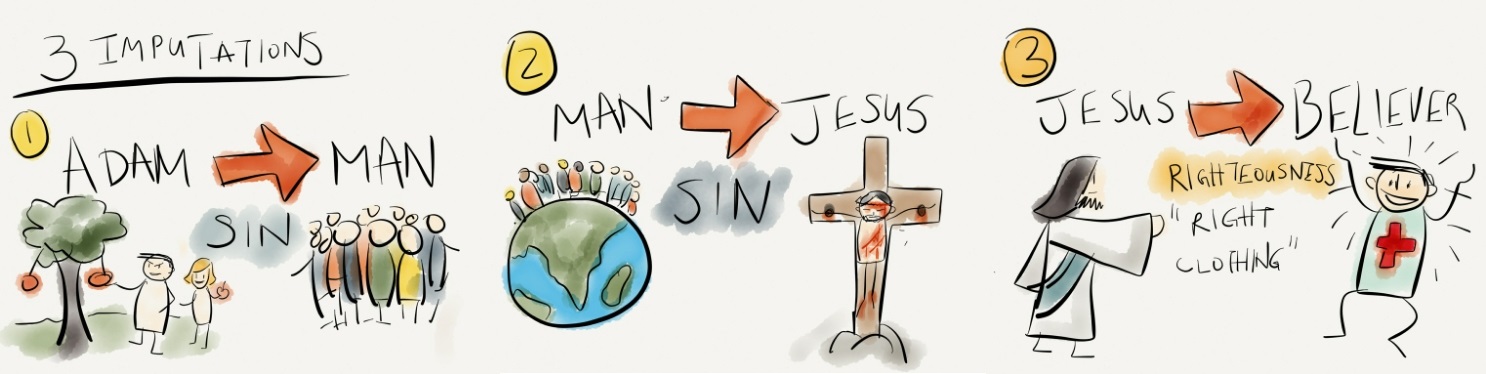
The apostle Paul dismantles infused righteousness in Romans 4:4-5:

“Now to the one who works, his wages are not counted as a gift but as his due. And to the one who does not work but believes in him who justifies the ungodly, his faith is counted as righteousness.”

In other words, if God hands out His righteousness as a result of our obedience, that’s a wage. However, Paul stresses over and over again that grace is a gift, and it has nothing to do with our works.
(click to zoom)

Step 4: Teach them Imputed Righteousness
At this point, the Mormon will be confused or anxious so offer them a way out. Tell them they might like imputed righteousness more than they think because it’s all over The Book of Mormon and it’s a major theme in the temple.

A Mormon likely won’t be familiar with imputed righteousness, so you’ll have to explain it a little. I do it like this:

“Imputation is kind of the opposite of amputation. Instead of having something taken off you, you’re having something put on, or accredited to you. It’s kind of like marrying a millionaire. Even if you were tens of thousands of dollars in debt before, you are now a millionaire by virtue of your spouse.

You actually do believe in it. You believe that when Jesus died, He took our sins upon Him. That’s imputation. The big difference between us, is I believe in double imputation. So not only did Jesus take the full weight of my sins, he also gave me the full weight of His righteousness when I became a believer.”

A good example of double imputation is the story of Barabbas, a guilty criminal, in the New Testament. Christ took the death penalty that Barabbas deserved, while Barabbas received the freedom that Jesus deserved.

Imputation is a major theme in LDS temples because Mormons do saving ordinances for the dead who can’t receive them. The dead do not have to physically perform any works, they just have to accept what has been done on their behalf. It is a flawless representation of imputed righteousness.

Mormons will probably push back a little by emphasizing obedience, sanctification, and repentance. Sometimes the phrase, “I believe that too,” is your best tool. This way Mormons come to realize that imputation covers all the bases that are important to them. The difference is, it provides a safety net for the believer while they are being sanctified.

Show the Mormon Moroni 10:32-33 in The Book of Mormon. The same passage that refutes joint and enabled righteousness, fits imputed righteousness perfectly. Especially verse 33 which says,

“And again, if ye by the grace of God are perfect in Christ, and deny not his power, then are ye sanctified in Christ by the grace of God, through the shedding of the blood of Christ, which is in the covenant of the Father unto the remission of your sins, that ye become holy, without spot.”

According to this verse, perfection comes before sanctification, and both are the result of grace and the shedding of Christ’s blood. I’ve told LDS before, “If that’s not imputed righteousness, then I don’t know what is!”

This passage in Moroni echoes Hebrews 10:14: “For by a single offering [Christ] has perfected for all time those who are being sanctified.”

The fact is imputed righteousness immediately satisfies the worthiness requirement to enter God’s presence, while allowing the believer to grow in his walk with God.

Step 5: Get out of God’s Way
This approach isn’t very flashy, and it’s not going to make anyone too defensive. You never really get to a resolution, it’s more about planting a seed and letting God grow it. Instead of attacking Mormonism, you are showing the virtues of a Biblical doctrine.

This is the belief that stole me away from Mormonism, it was the antidote to a works-based religion. Mormons say they are saved by grace, but they also believe ordinances like baptism are required to enter the Celestial Kingdom. Imputation is the missing puzzle piece that emphasizes grace and negates works and covenants.

Challenge the Latter-day Saint to study imputed righteousness. Tell them you have a testimony of the doctrine, and let them know you are available if they have questions about it.

The more a Latter-day Saint comes to embrace imputation, the more precarious their position becomes. If imputation is true, there is no requirement for temple ordinances because we already have sufficient righteousness. If imputation is true there was no need for a restoration because Christians already had the true gospel.

If imputation is true we don’t need a priesthood to seal us to God because Christ’s righteousness already does that. Simply stated, if imputation is true then Mormonism is false.
“Sinking of HMS Hood” by J.C. Schmitz-Westerholt

BACK TO TOP

“If history has shown us one thing, it’s that today’s Mormonism is tomorrow’s dustbin fodder”

by Fred W. Anson
The Church of Jesus Christ claims, “The gospel has been known throughout eternity, and its principles have been preached among men and women from their beginnings on this earth.” (Robert L. Millet, “The Eternal Gospel”, Ensign, July 1996) and “The gospel of Jesus Christ is a divine and perfect plan. It is composed of eternal, unchanging principles, laws, and ordinances which are universally applicable to every individual regardless of time, place, or circumstance. Gospel principles never change.” (Ronald E. Poelman, “The Gospel and the Church”, Ensign, November 1984).

But history tells a different tale: The Mormon gospel is temporal and constantly changing. Here’s a partial list of Mormon Doctrine, scripture, and bits and various pieces that have been left on the dustbin of history. More will follow in the articles in this ongoing, intermittent series of articles.

1) The 1830 Book of Mormon
The original 1830 edition was obsoleted by the 1837 revised edition and they’ve been changing it ever since. For a book Joseph Smith claimed to be “the most correct of any book on earth,” it is suspicious that the text has undergone nearly 4,000 changes. Most of the changes, Mormon apologists argue, are small grammatical or punctuation fixes. But consider this change between the 1830 and 1937 editions.

“… These last records … shall make known to all kindreds, tongues, and people, that the Lamb of God is the Eternal Father and the Savior … “ (Book of Mormon, 1830 edition, page 32)

“… These last records … shall make known to all kindreds, tongues, and people, that the Lamb of God is the Son of the Eternal Father, and the Savior …” (Book of Mormon, 1837 edition, 1 Nephi 13:40)

The change, of course, reflects Joseph Smith’s post, Book of Mormon shift from a form of modalistic Trinitarianism to Tri-Theism. And because other changes in the 1837 were equally significant, it’s not unfair to say that as of 1837 the original 1830 Book of Mormon was displaced by a new book. Please see the Encyclopedia of Mormonism for a list of Book of Mormon editions up to to the encyclopedia’s 1992 publication date.

2) The 1833 Book of Commandments
This was intended to be a bound collection of Joseph Smith’s published revelations (which had appeared intermittently in the official church newspaper, Evening and Morning Star) as well as some previously unreleased revelations. However, before it could be completed and distributed, a mob attacked the print shop where the Book of Commandments was being printed and destroyed the printing press. This was the end of the Book of Commandments which was obsoleted by the 1835 Doctrine & Covenants. However, even though Doctrine & Covenants contained many of the same revelations there were numerous, material revisions. For example, the apostles Peter, James, and John imparting Joseph Smith Jr. with the Priesthood is in section 27 of D&C, but is missing from the Book of Commandments. Another example is this one:

“…and he has a gift to translate the book and I have commanded him that he shall pretend to no other gift, for I will grant him no other gift.”
(Book of Commandments, 4:2)

This passage refers to Joseph Smith in the third person. However, in the re-numbered Doctrine and Covenants the same revelation reads:

“…and this is the first gift that I bestowed upon you; and I have commanded that you should pretend to no other gift until my purpose is fulfilled in this; for I will grant unto you no other gift until it is finished.”
(Doctrine and Covenants, 5:4)

So in the revelation in the Book of Commandments Smith was only to translate the Book of Mormon and claim no other role or gifting. However, in the Doctrine & Covenants version Smith is given far greater roles, callings, and ecclesiastical power over and above simply translating the Book of Mormon. This is just a small sampling of the numerous changes between the 1833 Book of Commandments and the 1835 Doctrine and Covenants. Of course, the logical question is, “Why did God change His mind on so many matters in just 2-years?”

The Lectures On Faith today: Decanonized and a stand-alone book

3) The Lectures on Faith
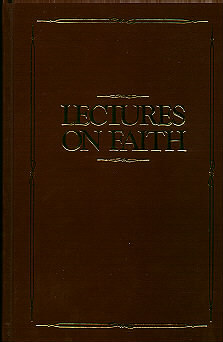
Approved by Common Consent in 1834, “stealth” de-canonized in 1921. From Wikipedia:

“Lectures on Faith” is a set of seven lectures on the doctrine and theology of the Latter Day Saint movement, first published as the doctrine portion of the 1835 edition of the canonical Doctrine and Covenants, but later removed from that work by both major branches of the faith [that is, the LdS Church and the RLDS Church]. The lectures were originally presented by Joseph Smith to a group of elders in a course known as the “School of the Prophets” in the early winter of 1834–35 in Kirtland, Ohio…

The LDS Church removed the lectures from the Doctrine and Covenants in the 1921 edition, with an explanation that the Lectures, “were never presented to nor accepted by the Church as being otherwise than theological lectures or lessons”. (See Introduction, 1921 edition.) This is in contrast to the remaining pages of the original Doctrine and Covenants, which are officially recognized by nearly all Latter Day Saint denominations as divine revelation given specifically to the church.”
(“Lectures on Faith”, Wikipedia article)

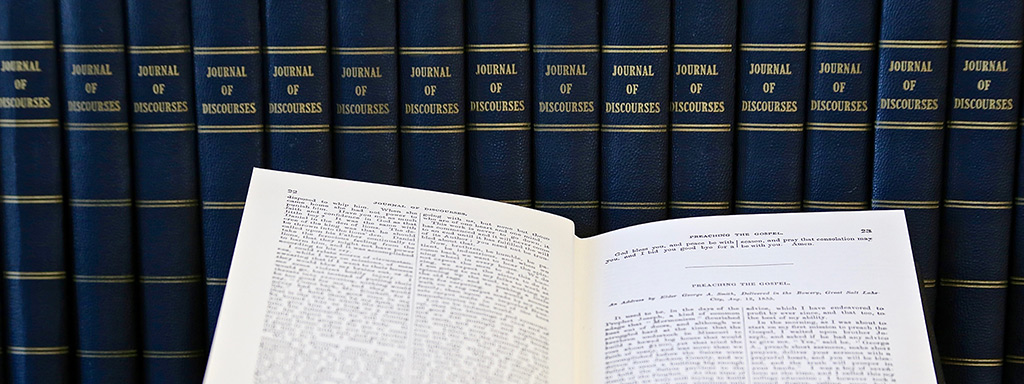
4) The Journal of Discourses
The 19th Century version of today’s Ensign magazine. The Journal of Discourses was considered one of the “Standard Works” (scripture) during its time of publication:

“The Journal of Discourses deservedly ranks as one of the standard works of the Church, and every rightminded Saint will certainly welcome with joy, every Number as it comes forth from the press as an additional reflector of ‘the light that shines from Zion’s hill.'”
(President George Q. Cannon, Journal of Discourses, Preface, Volume 8)

Yet today the LdS Church disavows and distances itself from the Journal of Discourses:

“The Journal of Discourses is not an official publication of The Church of Jesus Christ of Latter-day Saints. It is a compilation of sermons and other materials from the early years of the Church, which were transcribed and then published. It included some doctrinal instruction but also practical teaching, some of which is speculative in nature and some of which is only of historical interest.”
(Gospel Topics article, “Journal of Discourses”, Official LdS Church website)

5) Bruce McConkie’s “Mormon Doctrine”
Bruce McConkie’s classic book “Mormon Doctrine” is one of the single most cited Latter-day Saint works outside of scripture. As Wikipedia explains:

“Mormon Doctrine (originally subtitled A Compendium of the Gospel) is an encyclopedic work written in 1958 by Bruce R. McConkie, a general authority of The Church of Jesus Christ of Latter-day Saints (LDS Church). It was intended primarily for a Latter-day Saint audience and is often used as a reference book by church members because of its comprehensive nature. It was not and has never been an official publication of the church, and it has been both heavily criticized by some church leaders and members, while well regarded by others. After the book’s first edition was removed from publication at the instruction of the church’s First Presidency and Quorum of the Twelve, corrections were made in subsequent editions. The book went through three editions, but as of 2010, it is out of print.”
(Mormon Doctrine (book), Wikipedia article)

And as Mormon Researcher Bill McKeever observes:

Many Mormons who currently wish to distance themselves from McConkie and his teachings ignore both the impact he made on the LDS Church when he was alive and the statements made by colleagues after his death. When he died in 1985 after a long struggle with cancer, church leaders took turns giving his eulogy. An article written on McConkie’s life (“Elder Bruce R. McConkie: ‘Preacher of Righteousness,” Ensign, June 1985, pp. 15ff) concluded this way: “Because of his life and testimony, our faith has been strengthened and our hope for eternal life is brighter.” Several of his colleagues praised him for his personal piety while others took note of his ability to teach and understand LDS doctrine.

Ezra Taft Benson, then a fellow apostle, noted in his remarks that whenever a doctrinal question “came before the First Presidency and the Twelve,” it was Bruce McConkie “who was asked to quote the scripture or to comment on the matter. He could quote scripture verbatim and at great length.” According to Benson, McConkie “provided the entire Church with an example of gospel scholarship. He could teach the gospel with ease because he first understood the gospel.”

Mormon Apostle Boyd Packer spoke of McConkie’s uncompromising attitude he had toward his obligation to speak the truth. “It was not granted to Brother McConkie to judge beforehand how his discourses would be received and then to alter them accordingly. Nor could he measure what ought to be said and how it ought to be said by ‘what will people think?’”

Gordon Hinckley, then a member of the First Presidency, was the concluding speaker. In his comments he stated, “I felt like a little puppy trying to keep up with McConkie as he took his long measured steps…So it has been with most of us in keeping up with the stride of his mind in scholarship in the gospel” (Go Forward with Faith: The Biography of Gordon B. Hinckley, p.418).
Given the high regard these LDS leaders had for McConkie, why do so many members today seem to have such a low respect for this man?”
(Bill McKeever, “Bruce McConkie: Respected General Authority or Theological Hack?”)

Polygamy wedding cake

6) Mortal Polygamy
The fact that Mormons used to practice mortal polygamy (aka, a man being married to more than one living wife at the same time during his lifetime) is a secret to no one. It’s one of the most commonly known and distinguishing characteristics of Mormonism in the public’s mind. The subject is complex, deep, and wide so I can hardly do it justice in a paragraph or two.

What’s far more interesting, however, is how after its demise was announced to the public in 1890, it still continued privately among the leaders until 1904. As the official LdS Church website explains:

The [1890 Official Declaration 1] Manifesto declared President Woodruff’s intention to submit to the laws of the United States. It said nothing about the laws of other nations. Ever since the opening of colonies in Mexico and Canada, Church leaders had performed plural marriages in those countries, and after October 1890, plural marriages continued to be quietly performed there. As a rule, these marriages were not promoted by Church leaders and were difficult to get approved. Either one or both of the spouses who entered into these unions typically had to agree to remain in Canada or Mexico. Under exceptional circumstances, a smaller number of new plural marriages were performed in the United States between 1890 and 1904, though whether the marriages were authorized to have been performed within the states is unclear…

At the April 1904 general conference, President [Joseph F.] Smith issued a forceful statement, known as the Second Manifesto, attaching penalties to entering into plural marriage: “If any officer or member of the Church shall assume to solemnize or enter into any such marriage he will be deemed in transgression against the Church and will be liable to be dealt with according to the rules and regulations thereof and excommunicated therefrom.” This statement had been approved by the leading councils of the Church and was unanimously sustained at the conference as authoritative and binding on the Church.

The Second Manifesto was a watershed event. For the first time, Church members were put on notice that new plural marriages stood unapproved by God and the Church. The Second Manifesto expanded the reach and scope of the first. “When [the Manifesto] was given,” Elder Francis M. Lyman, President of the Quorum of the Twelve, explained, “it simply gave notice to the Saints that they need not enter plural marriage any longer, but the action taken at the conference held in Salt Lake City on the 6th day of April 1904 [the Second Manifesto] made that manifesto prohibitory.”
(“The Manifesto and the End of Plural Marriage”, official LdS Church website) 

That’s all well and good, except for the fact that polygamy is a requirement for Celestial Exaltation (being granted eternal life in the presence of Heavenly Father and being deified as a god)  as Doctrine & Covenant 132 explains in coded “insider” language – “covenant”, “everlasting covenant” meaning “polygamy”; “glory” meaning “celestial exaltation”.

Therefore, prepare thy heart to receive and obey the instructions which I am about to give unto you; for all those who have this law revealed unto them must obey the same.

For behold, I reveal unto you a new and an everlasting covenant; and if ye abide not that covenant, then are ye damned; for no one can reject this covenant and be permitted to enter into my glory.
(verses 3-4)

Then shall they [the couple sealed for time and eternity] be gods, because they have no end; therefore shall they be from everlasting to everlasting, because they continue; then shall they be above all, because all things are subject unto them. Then shall they be gods, because they have all power, and the angels are subject unto them.

Verily, verily, I say unto you, except ye abide my law ye cannot attain to this glory.
(verses 20-21)

(click to zoom)

So does this mean that Celestial Exaltation has been impossible since the two Manifestos? The answer is, “No.” Thanks to the magic of Latter-day Saint dustbin dynamics, the requirement for polygamy simply disappeared and now, one needs only be sealed in an LdS Temple to one’s spouse for “time and eternity”, fulfill all the other requirements of Celestial Law and according to modern Mormonism, you’re good to go. In fact, modern Mormons are now taught that the insider language in D&C 132 has always meant that. So right into the dustbin goes polygamy!

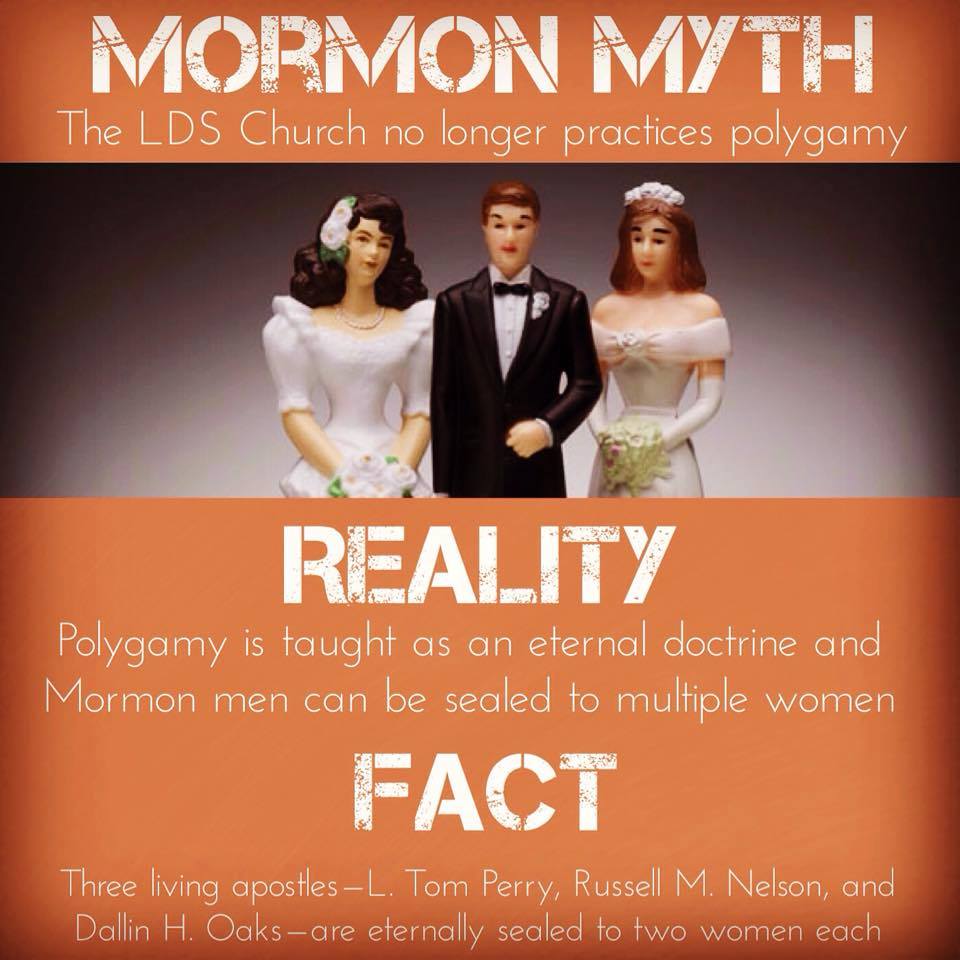
Or does it? What has never gone away is what’s known as “Celestial Polygamy”. Celestial Polygamy is when a man is widowed by a wife who he was sealed to in the Temple “for time and eternity” and then goes on to also marry one or more wives in the Temple “for time and eternity”. From the Salt Lake Tribune:

Though the LDS Church had disavowed polygamy, it is still enshrined in Mormon scripture (Doctrine & Covenants 132) and some believe it will one day be re-established, if not on Earth, at least in heaven. In his quasi-official 1966 book Mormon Doctrine, which remains in print, the late LDS Apostle Bruce R. McConkie wrote that ‘the holy practice will commence again after the Second Coming and the ushering in of the millennium.’ And by policy, men can be ‘sealed’ for eternity in LDS temple rites to more than one wife, though women are permitted only a single sealing. Three of the church’s current apostles, for example, were widowed and remarried. Each will have two wives in the eternities”
(Peggy Fletcher Stack, “Modern-day Mormons disavow polygamy”, Salt Lake Tribune, April 20, 2008)

At the time that this article was written, three Mormon Apostles qualified as Celestial Polygamists: Dallin H. Oaks, L. Tom Perry, and Russell M. Nelson. All three men are widowers, and all three men have since been “sealed” to a second wife. L. Tom Perry has since died (in 2015), leaving only Oaks and Nelson.

Sadly, this dust-binned version of polygamy still wreaks havoc in Mormon culture as well known Latter-day Saint poet Carol Lynn Pearson found out when she asked active Mormons and Ex-Mormon to talk about how they feel about the subject via a social media survey that she did in March 2014. Pearson claims that on the first day, more than 2,400-people responded, and within four weeks the number had surpassed 8,000 total survey responses which included comments like these:

“I live in constant fear that I will die before my husband and he will be sealed to a second wife, meaning I will live in a polygamous relationship for eternity. I’ve told him if this happens I will choose hell over heaven and he believes me. This is hard on our marriage.”

“A nice Mormon guy hung up the phone when he found I was a sealed widow. He said ‘Why would I want to love someone in this life and then turn her over to her first husband for eternity?—along with the children that came from my very own DNA and now belong to him?’”

“When I was a teenaged boy, I thought it was cool to look forward to lots of sex with my circle of wives in heaven. Now the idea of eternal polygamy disgusts me. No way do I want my wife to feel like I have all of her and she doesn’t have all of me. Crazy stuff, this doctrine.”
(Carol Lynn Pearson official website)

And this is the problem with dust-binned, man-contrived, bad theology, isn’t it? It still leaves carnage in its wake. It leaves a mess. By their fruit, you shall know them indeed.

“Sawdust” photograph by Chris Jordan. This is literally a mountain of sawdust.

BACK TO TOP


A Community of Christ World Conference session.

by Lisa Smith
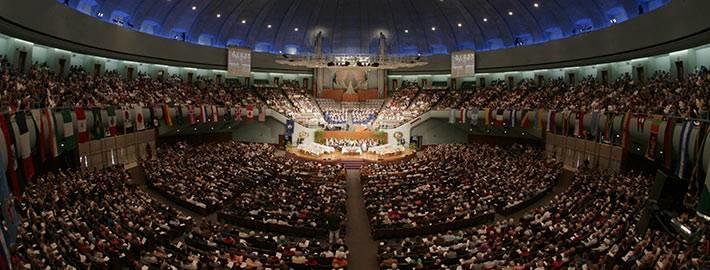
If you’re not familiar with the RLDS (the Reorganized Church of Jesus Christ of Latter Day Saints, who officially changed their name to Community of Christ (CoC) in 2001) they share a common history with Mormons – that is, the Church of Jesus Christ of Latter-day Saints. After Joseph Smith’s death in 1844, when Brigham Young led the majority of the group to Salt Lake City, a small group (including Emma Smith, Joseph’s widow) stayed in the Midwest. When their oldest son (Joseph Smith III) I reached adulthood, he was ordained Prophet-President (1860). Hence those in the Independence, Missouri headquartered RLDS/CoC are known by those in Mormon Studies as “Josephites” as opposed to the better known “Brighamites” in the LDS Church that’s headquartered in Salt Lake City, Utah.

I left this church in 2001, so my response is based on my research and experience at that time. My and my husband’s departure came after we came to a saving knowledge of the biblical Christ in 1997. We started attending BSF (Bible Study Fellowship) and came to understand the biblical definition of salvation (which was not taught in the RLDS church.) We learned that we were all sinners and that without accepting the salvation paid for by Jesus’ death on the cross, we would not be forgiven of our sins but God, and would go to hell. We both (separately) admitted to God that we were sinners and asked for his forgiveness, and acknowledged that surrender to God through Jesus was the only way to Heaven. We made the decision to stay in “the [RLDS] Church” at that time, with the hope that we could influence others for Christ. It was only after a friend gave me copies of “Part Way to Utah: The Forgotten Mormons” by Paul Trask and “Reorganized Latter Day Saints Church: Is It Christian?” by Carol Hansen that we realized what an aberrant foundation the church had, and made the decision that it was time to leave ourselves.

After reading a recent page on MormonThink “10 Things Common to Scientology and Mormonism,” I was asked how the RLDS/CoC Culture compared. Here are my thoughts based on the 10 points addressed in that article. (It will make more sense if you read that article first so that can see the framework that my analysis is based on!)

1) Keeping secrets about the religion from its members
In the CoC, it’s less an issue of “keeping secrets” and more of a refusal to face/actively repudiate the non-biblical foundations of the Church.

The RLDS/CoC still revered Joseph Smith during the time that I was in it, though even then they were likely to ignore anything unflattering. They didn’t want to acknowledge that he had approved (much less participated in) polygamy. The temple ordinances common to Mormonism (baptism of the dead, receiving Temple Endowments and wearing special undergarments, etc) came after the migration to Utah, so the RLDS/CoC don’t have that as part of their history or practice. (They revere the Kirtland and Nauvoo temples as part of their history but tend to ignore issues like the Masonic roots of the Temple or Smith’s “translation” of the papyri known as the Book of Abraham, etc, even though Smith was part of that development.) The Community of Christ built a temple in the early 1990s in Independence MO (across the street from the Temple Lot, where Joseph Smith prophesied that Christ would return, as well as from the Independence Mormon Visitors Center). CoC members pride themselves on not having secret ceremonies, advertising that it is open to all people at all times (at least during visiting hours!)

The RLDS/CoC also has minimal connection to the Masonic roots that Smith established in Nauvoo. They also minimize any discussion of what the “Urim and Thummim” actually were. There is no discussion of the Book of Abraham. I had never heard of it until I started researching church history!

Rather than a “quad”, we used the 3-in-1: the Inspired Version (Joseph Smith’s altered version of the Bible also known as The Joseph Smith Translation of the Bible or “JST”), the Book of Mormon, and the Doctrine and Covenants (both are slightly different from the Mormon versions).

2) You’ll be lost without the church
This was one of the biggest obstacles to leaving the Church! On my side, I was 7th generation RLDS on my mother’s side, 3rd on my dad’s. Both of my grandfathers converted to “the Restoration” after being a Methodist (maternal grandfather) and Baptist (paternal) minister. My husband’s family went back 6 generations on one side. Most of our family were RLDS, as were most of our friends. (My brother had converted to Catholicism, but that was excused in my family because “he had to for his wife.” My sister was actively participating in New Age worship and studying as a Native American shaman.) My leaving the RLDS church was a much bigger deal—family members were devastated by our decision, and our closest friends disfellowshipped us. While many of our former church “family” tried to be understanding and invited us to “worship with us anyway,” we felt compelled to get ourselves and our young kids into a Bible-based church.

3) Excessive financial conditions for Church membership
Honestly, the church financial teachings are “milk toast.” Because they are not a Bible-based church, they don’t teach the biblical principles of tithing. Because they pride themselves on being “nice,” no one ever talks to you about whether you’re giving appropriately. I never understood tithing until I took a Dave Ramsey “Financial Peace University” class at our new church! (Now we tithe because we know that everything we have is from God and we want to give Him our first fruits and because we know intimately the blessings of obedience to a loving God!)

4) Believers often defend the religion with the comment that “it’s a good organization”, whether or not it is literally true.
The RLDS/CoC is filled with many nice people — that’s probably why we stayed as long as we did! Like the rest of society, It also has its share of very evil people. They are sinners who don’t know God’s redeeming love and grace.

5) Read only faith-promoting materials produced by us.
While I was never told not to read anything, I know that books that were more Biblical were disparaged as “closed-minded”. There is a strong trend towards mainline theologically liberal Christianity, so anything that supported that viewpoint was talked up. Theologically conservative Christianity tends to be viewed as closed-minded, backward and runs counter to the spirit of the Restoration.

I love the irony that what drove us toward attending BSF was a comment from then-prophet/president Grant McMurray at World Conference. He told the audience that as a faith, the Community of Christ was scripturally illiterate, and we should get into our scriptures more. I don’t think he intended for us to have our eyes opened by the Bible and leave the church, though!

6) Churches use Internet filters to block some websites that frankly discuss some of the problems of their organization.
I can’t speak to this, as it wasn’t really an issue when we left. (We didn’t even have smartphones back then and the Worldwide Web was just coming of age). Members do tend to smile blankly when you try to tell them why this isn’t a biblical church, though.

7) Detractors of the faith are labeled as liars and “anti.”
It’s not that we were labeled as liars or “anti” — it’s just that there’s such a cultural and historical sense that this is the “one true church” and that they alone are entrusted with the truth that Joseph Smith restored to the earth that they can’t fathom what we’re telling them about the Bible and Jesus! My mother-in-law came to me at one point to “bear her testimony that this was the Truth” and she left in tears that we were taking her grandchildren away from “the Restoration”. To her credit, she did come to our baptism service a few years later, when our whole family was baptized (my parents refused), but she didn’t like it.

8) The founders and top leaders are hero-worshiped.
There’s some truth to this: the “First Presidency” and the “Apostles” (really, anyone who works for the “World Church”) are looked up to and treated reverentially.

9) Tear families apart.
No, it’s not formal “shunning.” Yes, some people manage to make their marriages work even with one spouse becoming Christian. In my experience, that’s mostly because the believing spouse tries to honor Paul’s counsel about being married to an unbeliever. (Obviously, sometimes this doesn’t help anyway, because the unbeliever will leave — but it’s inspiring to watch a believer do what they can to live out God’s Word.)

In our case, we count it as one of God’s great blessings that He brought us to saving faith at the same time, and to the decision to leave the Church together. In God’s great humor and timing, the BSF study where we both came to salvation (separately) was on the Acts of the Apostles. When I questioned her about what God really meant about “wives submitting to their husbands,” she challenged me to pray that week and ask God to show me what He meant.

That was the week our marriage changed – and for the better, I might add!

As I said before, our closest friends severed relationships with us. I was doing a book study with my two best friends at the time. We had raised our babies together and seen one of us through the loss of a husband to cancer, widowhood, and marriage to a new guy. I thought we would be friends forever. They told me that they couldn’t continue being friends with me if this is how I really felt about the Restoration.

The relationship with my parents was marred for the rest of their lives. My dad never accepted it. He died about 14 years later, and to my knowledge, he never came to a saving relationship with Jesus. He actually mocked me to friends, telling them Duane and I had “left the church and become fundamentalists.” (Our first church after leaving was a Baptist church with solid biblical teaching; we moved a year later to the non-denominational church where we stayed for 14 years — also a great biblical church.). My mother and I had a rocky relationship until her death 16 years later (worsened by the fact that she had a serious personality disorder.) In God’s great mercy, he allowed me to lead her to His throne days before she died. The last words she ever spoke to me were to say that she was a sinner and she needed a Savior. I’m so grateful I will get to see her mentally healed in Heaven!)

10) Have been labeled as a cult and the members as brainwashed.
On this side of leaving, I would say that it is not as much of a cult experience as Mormonism (especially after some of the stories some LDS have shared on the Internet, especially in Ex-Mormon recovery groups!), but it isn’t not a cult either! I liked this excerpt from the aforementioned MormonThink article:

Steve Hassan is considered one of the leading experts on cults and mind control. He is involved with the Freedom of Mind Resource Center to help those concerned with cults and dangerous organizations. Hassan appeared on CNN in the days following the airing of “Going Clear” to discuss the documentary on Scientology.

Regarding Mormonism, Steve has an article on his blog entitled “An Expert Responds to the Cult Controversy re: Mormonism – 12/12/2011 – by Steve Hassan”. Steve does not flat-out call Mormonism a cult. He leaves that judgment to the individual to decide. Steve uses the BITE (behavior; information; thoughts; emotions) model when he applies it to organizations that have attributes of cults. An Ex-Mormon applied the BITE model to Mormonism and posted the results here

Steve Hassan was invited to speak at an ex-Mormon conference in 2008 and gave his perspective being a former Moonie and now a cult expert. Here is the YouTube video of Steve’s presentation. I personally attended the presentation and very much enjoyed it. I do remember someone asking at the end if he thought Mormonism was a cult. Steve did not reply with a yes or no but said, “If it looks like a duck, walks like a duck and quacks like a duck—it’s a duck”.
(“Scientology and Mormonism”, MormonThink website)

So friends, if the RLDS/CoC looks like a duck, walks like a duck and quacks like a duck—it’s a duck.

Leaving the CoC required a willingness to walk away from everything we knew and trust God to provide. I will always be said that I lost relationships, but 17 years down the road, we can both say that God has replaced what the locusts have eaten. Things settled down with my husband’s family, and we have good relationships with them now (although we don’t talk about religion or our church experiences — ever!). I’ve been able to witness to my sister, and I think she is almost “there” in terms of surrendering to God! My kids (19 & 24) are currently both in a slightly spiritually rebellious time in their young adulthood — knowing God but not willing to walk with Him at this time (although my daughter has started attending the young adult ministry at our church on occasion.) We have surrendered that to God and are their most dedicated prayer warriors. We are in a strong biblical church, serving and growing. We’d do it all again in a heartbeat.

The RLDS/CoC is probably described accurately as “Mormonism Lite”. If Mormonism is 180-degrees off from biblical teaching (Temple ordinances, Law of Eternal Progression, belief in false scripture & priesthood, etc.), CoC is maybe only 45-degrees off (false priesthood, false scriptures, refusing to accept the Bible as authoritative, false claims of modern-day revelation, etc. They also ordain women to the priesthood— still a distinction between them and Mormons and much of mainstream Christianity.) Either way, neither of them lead people to a saving relationship with God through the sacrifice of Jesus. The failure to see the need for personal salvation and the attitude of “tolerating” everything as many of the liberal Christian churches do keep them from seeing God’s plan for them.

If this brief article has whet your appetite and you want to learn more about the RLDS/CoC, I’d suggest checking out Refiner’s Fire Ministries website at http://help4rlds.com/. My friend Paul Trask has been a mentor to me through this process, and I will always be grateful for his willingness to just tell the truth. If you have questions about what I’ve written, I’d be happy to try to answer. This is just my experience, but through it, I came to know my Savior!

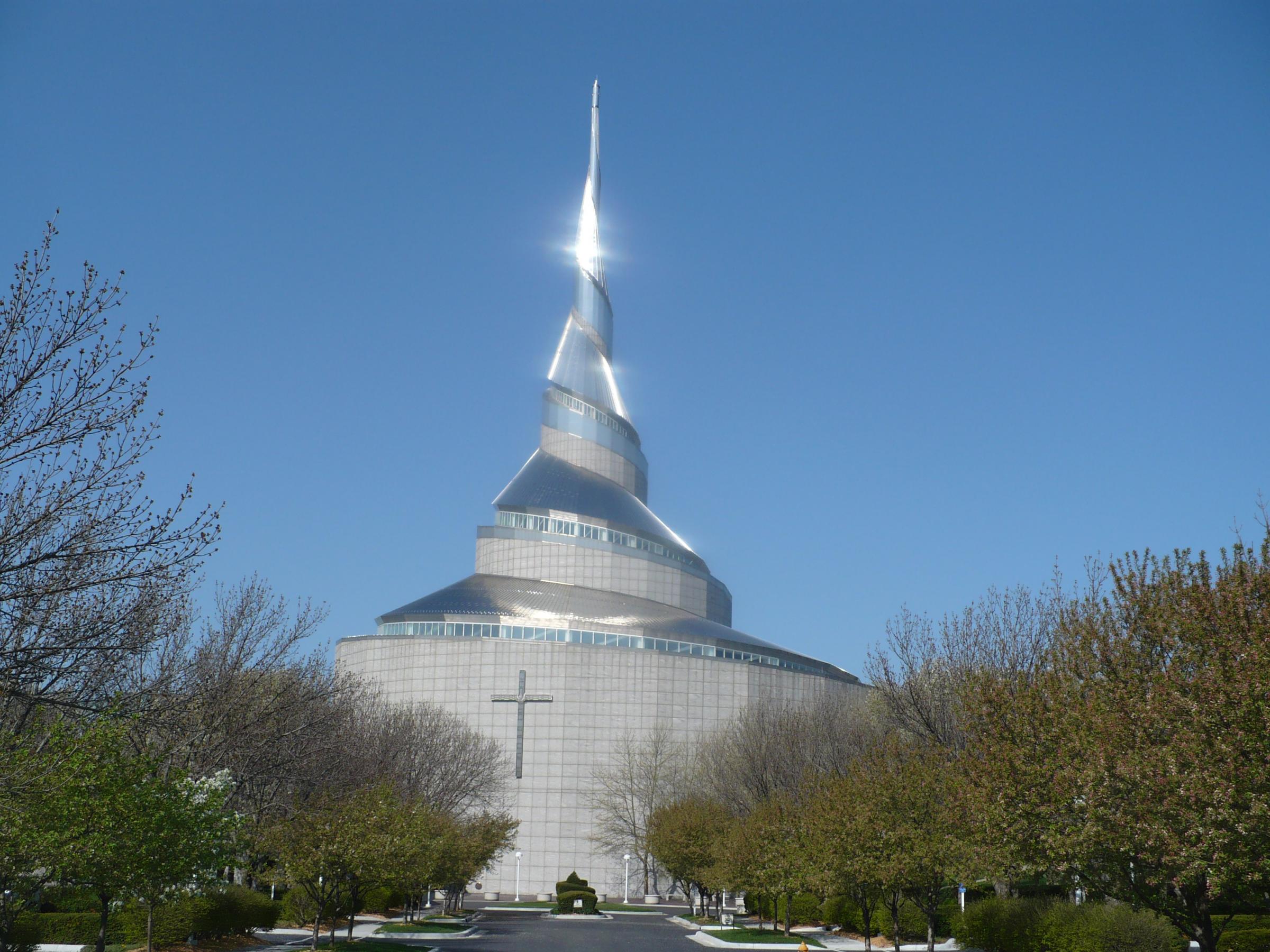
The Community of Christ Temple in Independence, Missouri. The Community of Christ is both Trinitarian and doesn’t eschew the cross – two things that distance it from Brighamite, LdS Mormonism.


compiled by Fred W. Anson
Citing Matthew 7:20 (“Wherefore by their fruits ye shall know them.”) Mormons challenge us to “inspect the fruit” of Joseph Smith. So I did, and this is what I found:

  1. While claiming that God demanded that he do it, he had at least 34-wives, about a third of them teenagers, (the youngest ones being two 14-year old girls) daughters of leading members of his church, and about another third of them already the wives of living husbands who also were prominent members of his church.
    (see official LdS Church website “Plural Marriage in the Church of Jesus Christ of Latter-day Saints”)
  2. He brought forth the Book of Mormon via the occult practice of scrying (the peep stone in a hat) while again claiming that God told him to do it.
    (see official LdS Church website, “Book of Mormon Translation”; also see Wikipedia, “Scrying”)
  3. He deceptively claimed that his contrived “divinely inspired” translation of a common Egyptian “Book of Breathings” funerary papyrus was a legitimate translation of the source text.
    (see official LdS Church website, “Translation and Historicity of the Book of Abraham”)
  4. He declared, “I will be to this generation a second Muhammad, whose motto in treating for peace was the Alcoran [Koran] or the Sword. So shall it eventually be with us Joseph Smith or the Sword!” (Joseph Smith, October 14, 1838). That, along with Sidney Rigdon’s (June 17th, 1838) “Salt Sermon”, were key provocations for the 1838 Mormon War in Missouri.
    (see official LdS Church website, “Peace and Violence Among 19th Century Latter-day Saints”; also see Wikipedia, “Salt Sermon”)
  5. He added and removed biblical text from the Bible even though there was no original language manuscript for the changes. He even went so far as to remove an entire book (The Song of Solomon) from the biblical canon.
    (see official LdS Church website “Song of Solomon”; also see official LdS Church History website, “Revelations in Context: Doctrine and Covenants, Joseph Smith Translation”)
  6. He ordered and coerced his fellow Mormon leaders to engage in illegal polygamy with him. And, oh by the way, polygamy was illegal everywhere the Mormons practiced it.
    (see official LdS Church website, “Plural Marriage in the Church of Jesus Christ of Latter-day Saints”; also see MormonThink website “Polygamy”)
  7. He taught the blasphemy that God was once a man. And that further taught that good and faithful “worthy” Latter-day Saints can likewise be exalted to godhood.
    (see official LdS Church website “Becoming Like God”)
  8. He plagiarized the pagan “Mother in Heaven” doctrine and claimed that is was from God.
    (see official LdS Church website, “Mother in Heaven”)
  9. He boasted that he was greater than Christ and the Apostles when he said, “I have more to boast of than ever any man had. I am the only man that has ever been able to keep a whole church together since the days of Adam. A large majority of the whole have stood by me. Neither Paul, John, Peter, nor Jesus ever did it. I boast that no man ever did such a work as I. The followers of Jesus ran away from Him; but the Latter-day Saints never ran away from me yet.”
    (see History of the Church Vol. 6, p. 408-412, or Millennial Star No. 42 Vol. 23 p. 672-674, also see Utah Lighthouse Ministry website “Joseph Smith’s Boasting and Polygamy Denial Sermon”)
  10. He publicly lied when he denied that he was practicing polygamy in a sermon on Sunday, May 26, 1844. Specifically, he said, “What a thing it is for a man to be accused of committing adultery, and having seven wives, when I can only find one.” And he said this while at least sixteen (16) of his polygamous wives were still members of his church and most likely in attendance.
    (see History of the Church Vol. 6, p. 408-412, or Millennial Star No. 42 Vol. 23 p. 672-674, also see Utah Lighthouse Ministry website “Joseph Smith’s Boasting and Polygamy Denial Sermon”)
  11. He taught moral relativism. For example, he once said, “That which is wrong under one circumstance, may be, and often is, right under another… Whatever God requires is right, no matter what it is, although we may not see the reason thereof till long after the events transpire. If we seek first the kingdom of God, all good things will be added. So with Solomon: first he asked wisdom, and God gave it him, and with it every desire of his heart, even things which might be considered abominable to all who understand the order of heaven only in part, but which in reality were right because God gave and sanctioned by special revelation.”
    (see History of the Church, 5:135)
  12. He violated state and local law by assuming every top ranking political office in Nauvoo, Illinois from Justice of the Peace to Mayor. This was done thanks to his absolute control over a sycophantic City Council who simply gave Smith whatever he asked for or demanded. The result was that he was able to ignore every writ of Habeus Corpus and/or Arrest Warrant that crossed his desk that was related to crimes for which he had been legally indicted outside of the city or state.
    (see John S. Dinger, “Joseph Smith and the Development of Habeus Corpus in Nauvoo 1841-1844”, Journal of Mormon History, vol. 36, no. 3 (Summer 2010), pp. 135-171)
  13. He ordered the Commander of the Nauvoo Legion to march on the Carthage Jail where he was being held a free him and his brother Hyrum from jail. This would have been an act of treason and sedition under State and Federal law which the Commander wisely ignored. (see Allen J. Stout, “Manuscript Journal, 1815-89”, p. 13; also see Thoma B.H. Stenhouse, “The Rocky Mountain Saints”, Kindle Locations 2698-2725), and; Fawn M. Brodie, “No Man Knows My History (Illustrated): The Life of Joseph Smith“, Kindle Locations 8848-8854)
  14. He brought forth countless contrived “revelations” in the voice of Christ claiming that Christ was speaking through him – even though many of these revelations contradict Christ’s own words in the Bible.
    (see Wikipedia, “Doctrine and Covenants”.  Also, see the author’s article, “Revelation by Numbers: Introducing “The Joseph Smith Formula” on this website)
  15. He claimed to restore and repair the allegedly “corrupt” text in the Bible via his “Inspired Version” translation of the Biblical text. Yet 99% of the text of the 1769 American Edition of the KJV Bible that he worked from remained unchanged.
    (see Wikipedia, “Joseph Smith Translation of the Bible”)
  16. He secretly plagiarized directly from Adam Clarke’s, “Commentary on the Bible”, in producing his aforementioned “inspired” translation of the Bible while simultaneously claiming direct, divine, inspiration for the changes that he made to the Bible.
    (see Haley Wilson and Thomas Wayment, “A Recently Recovered Resource: Rethinking Joseph Smith’s Bible Translation”, Brigham Young University, 2017)
  17. He ordered an assassination on Governor Boggs of Missouri by his private bodyguard, Porter Rockwell. Thankfully it failed even though Governor Boggs was wounded.
    (see Wikipedia, “Attempted Assassination of Lilburn Boggs”)
  18. In violation of the First Amendment of the US Constitution and Illinois state property laws, he had a private printing press destroyed because it was telling the truth about his secret polygamy and abuse of political and ecclesiastical power in Nauvoo.
    (see Wikipedia, “Nauvoo Expositor”)
  19. On June 18th, 1844, in violation of Federal and Illinois sedition and treason laws, he illegally mustered the Nauvoo Legion (his private army that was bigger and better armed than the Illinois State Militia) and declared Martial Law in Nauvoo in case the State of Illinois should attempt to arrest him for his destruction of the printing press.
    (see Wikipedia, “Death of Joseph Smith”)
  20. He defrauded his own church members out of monies – even entire estates – via the fraudulent Kirtland Safety Society.
    (see Wikipedia, “Kirtland Safety Society”)

Conclusion: When you scrutinize the fruit of Joseph Smith it is not only not good, it’s self-incriminatingly bad.

A period painting of General Joseph Smith reviewing his private army, the Nauvoo Legion. The Nauvoo Legion at the time of Joseph Smith’s death was larger and better equipped than the Illinois State Militia.

Standing-On-The-Shoulders-of-Giants_EDITED

Introduction:  John R. Farkas (1932-2011) was a convert to Mormonism in 1975 and served in several callings up to and including Elder’s Quoruom President of the Rochester 1st Ward, New York Stake. In 1984 he left the LdS Church and became involved Berean Christian Ministries where he served until his death. Mr. Farkas is the author of several books on Mormonism and other subjects which can be found on his Author’s page on Amazon. Beggar’s Bread is grateful that before he passed Mr. Farkas granted us the permission to republish the articles from his now defunct website – where this testimony originally appeared. 

John Farkas is of one the giants on whose shoulders we stand and to who we owe a debt that we simply can never repay! We look forward to thanking him again in heaven for the example of his life and treasure of wisdom that he left behind for our benefit.

His Mormon exit story is republished here in honor of this great man. Thank you John, we love you and we miss you.

by John Farkas
It is an early morning late in February 1984. As usual I am reading the scriptures while eating breakfast. I am in the Book of Mormon, 1 Nephi 18:25. This verse mentions the cow, ox, ass, horse, goat, and wild goat. This morning is a little unusual, though, in that I find myself questioning how some of these animals could have been in the New World. Didn’t the experts (historians, paleozoologist) say that full-size horses were not in the New World until the European explorers and settlers arrived? This thought had occurred to me at least once before, I think while I was investigating the Church of Jesus Christ of Latter-day Saints. But this time the questions stayed with me and I found myself thinking about other questions that I apparently had suppressed in the past. I now had become teachable and open, a necessary prerequisite to the receiving of productive witnessing.

Starting with the late February period when I questioned the presence of certain animals in the New world, and continuing for about two months, I seldom had a complete night’s sleep. Almost every night I woke up to study for one or two hours, in addition to using all of my free time for the same thing. By the end of February I had shared my doubts with my resident Mormon expert, my born-again Christian wife, Phyllis. In 1975 when I had joined the LDS Church, she became a Christian and started her studies of Mormonism. I had gone on to become the elders quorum president of the Fairport Ward (1981-1984), and in early 1984 of the newly reorganized Rochester 1st Ward, both in the Rochester, New York Stake, while Phyllis became an expert in Mormon studies and acquired a very extensive library. When I asked her for certain information, I almost always had it within minutes.

shutterstock_book_of_mormon-1280x960By March 15th I had made up my mind to leave the Mormon Church. I knew it when I woke up that night and removed my temple garments. I felt free! My drive to study and learn continued, this time to grow in depth and breadth in Mormon studies and about the Bible and Jesus Christ.

On March 20, 1984, I sent Stake President Dale Dallon My letter of resignation. The reasons I noted in my letter were: changes in the Book of Commandments versus Doctrine and Covenants; changes to the Book of Mormon; conflicts between early and present-day teachings, and the translation of the Book of Abraham. I said that “Joseph Smith was a fraud and has pulled off one of the greatest hoaxes ever!” My name was formally taken off the Church rolls at a Church court on May 10, 1984.

How did I get involved with the Mormon Church in the first place? It was my wife’s fault, I now say that partially in jest. In 1974 when I became concerned about the food supply chain and saw a need to have a long-term supply of food at home, Phyllis said, “The Mormons do that sort of thing. I’ll send them a letter in Salt Lake City.” Well, she did, and the LDS missionaries brought the answer to us. We both took the missionary lessons. As result I joined in July 1975, Phyllis became a Christian. (Growing up amidst the tug of war between Christian and Mormon parents was hard on our son Alan. Children suffer in such conflicts.)

During that time I asked a very significant question without realizing how significant it was. I said to Phyllis, “If we are both praying to the same God, how come we are getting different answers?” Now I realize that the Mormon gods are not of the Bible. Mormonism is not Biblical Christianity.

When I left the Mormon Church on March 15, 1984, I was left essentially with the beliefs that I had held in 1974 before I joined the Church. I was still a spiritual infant. I believed in a supreme being, a God, but I did not accept the Bible as the Word of God and I did not accept Jesus Christ as his Son and my Savior. I had a desire to know, so I studied the Bible and books about the Bible, associated with Christians, and attended Christian Sunday services and Sunday school. Through this I came to know that the Bible is the Word of God, and I came to know the real Lord Jesus Christ. But even at this point I didn’t know I was “saved.”

The Bible Only after prayerful reading of John 3:16 with my friend Ross Amico – the founder of a group that was to become Berean Christian Ministries, an organization dedicated to exposing cults – did I fully realize the truth of John 3:16 and that I was the “whosoever” mentioned in this verse. The promise that I could claim was the important thing. Ironically, I accepted Jesus in the Palmyra, New York, Christian church that is adjacent to the Mormon chapel where I had been baptized nine years earlier to the very week. These are both 35 miles from my home, therefore I believe it was God’s wisdom for it to happen there. On Sunday, July 19, 1984, I answered an altar call at a Webster, NY Christian church and made public my faith in the real Lord Jesus Christ. Now I know of the simplicity and beauty of his gospel.

I also had a drive to share my newfound knowledge and faith with others, both Mormons and non-Mormons. It is interesting that I had never had any thing like this drive to share Mormonism with others. I had not been a good member missionary. In fact, in my last four to six months of Church membership my feeling against missionary work surfaced. This became evident to me as my bishop attempted to increase missionary activity in our ward, and I only gave him passive support; but I didn’t understand it then.

The Mormon people are a great people. They and their church have many characteristics that I found appealing. They are hard-working, conservative, successful, well organized, and they give great socials. They are good people in a worldly sense and should have the real Jesus Christ of the Bible. Using the Bible, they present some convincing arguments that appear to support their doctrine. It is important for Christians to know the Bible and to know the real Lord Jesus Christ. A weak Christian is no match against the Mormon story; it is very appealing. It is easier to keep people from joining the Mormon Church than to get members out.

John Farkas with his wife Phyllis.

John Farkas with his wife Phyllis.

Groups like Berean Christian Ministries perform a multi-function service in combating the false non- Christian teachings of the Mormon church and similar groups. They help to educate Christians, Mormons, and others; they organize activities that individuals could not handle; they provide support for those trying to get out from under the control of Mormonism and similar organizations.

For over seven years I have coordinated the Berean Christian Ministries outreach at the Mormon Hill Cumorah Pageant held annually in July near Palmyra, New York. It is the largest outdoor pageant in America, and up to 100,000 people attend each year. Over 13,000 pieces of Christian literature have been distributed each year.

I am a graduate of the University of Connecticut with a B.S. degree in mechanical engineering, and I am a licensed New York State professional engineer. From 1962 to 1991 I worked at Xerox Corporation as a project engineer and project engineering manager. My wife, Phyllis, is editor of The Berean Report.

One of the reasons I share the items in this last paragraph with you is to illustrate that worldly accomplishment and intellectual capability are different from spiritual capability. I have often been asked how an intelligent person could believe Mormon doctrine, and I can understand why the question is asked. But when the Mormon missionaries came to our house, I was a spiritual baby, and they only taught the milk of the Mormon “gospel.” The meat comes later. As Hebrews 5:14 says, I was not “of full age”: “But strong meat belongeth to them that are of full age, even those who by reason of use have their senses exercised to discern both good and evil.” I was not able to discern the real gospel of Jesus Christ from the “gospel” the Mormon missionaries had.

Through the prayers of concerned Christians, including my wife, who persevered through a rough situation, I became teachable and then “of full age.” I hope and pray that the biblical Jesus Christ is your Lord and Savior as he is mine.

Graphic.OpenBible.16x9_Edited

Note: This testimony can also be found on the Christian Research & Council (aka “CRC”) website.

Appendix: Recommended Works by John R. Farkas
“Mormons Answered Verse by Verse” (1992)
by John R. Farkas and David A. Reed

“How to Rescue Your Loved One from Mormonism” (1994)
by David A. Reed and John R. Farkas

“Mormonism: Changes, Contradictions, and Errors” (1995)
by John R. Farkas and David A. Reed

“Joseph Smith Translating” by Nelson

by Fred W. Anson
One of the most common apologetics for the Book of Mormon is that an ignorant Farmboy couldn’t have possibly have written it. Mormon Apologists like to point to his wife Emma Smith’s 1879 statement to her son that, “Joseph Smith could neither write nor dictate a coherent and well-worded letter; let alone dictating a book like the Book of Mormon.”1 This apologetic ignores a few niggling details:

  1. A 23-year old male is a man, not a “farmboy”.
  2. Joseph Smith, Sr. was an itinerate school teacher2 and Joseph Smith, Jr. was homeschooled.
  3. This statement was made by the same woman who, in the very same interview, we now know lied about her husband’s polygamous marriages to her own son (Joseph Smith III).3 Emma Smith had a vested interest in maintaining and stewarding Joseph Smith, Jr’s reputation as a true prophet of God – even if it required lying to do so.
  4. The manuscript record demonstrates that while Joseph Smith, Jr. was spelling and grammar challenged he could, despite Emma Smith’s claims, write reasonably well.

To this last point, please consider the following letter written by Smith to Oliver Cowdery on October 22, 1829, half a year before Smith published the Book of Mormon:

Joseph Smith’s Letter to Oliver Cowdery, 22 October 1829

Respected sir I would in form you that I arrived at home on sunday morning the 4th. after having a prosperous journy, and found all well the people are all friendly to <us> except a few who are in opposition to evry thing unless it is some thing that is exactly like themselves and two of our most formadable persacutors are now under censure and are cited to a tryaltrial in the church for crimes which if true are worse than all the Gold Book business. we do not rejoice in the affliction of our enimies but we shall be glad to have truth prevail[.] there begins to be a great call for our books in this country the minds of the people are very much excited when they find that there is a copy right obtained and that there is really books about to be printed I have bought a horse of Mr. [Josiah] Stowell and want some one to come after it as soon as convenient Mr Stowell has a prospect of getting five or six hundred dol lars he does not know certain that he can get it but he is a going to try and if he can get the money he wants to pay it in immediately for books we want to hear from you and know how you prosper in the good work, give our best respects to Father & Mother and all our brothers and Sisters to Mr. [Martin] Harris and all the company concerned tell them that our prayers are put up daily for them that they may be prospered in evry, good word and work and that they may be preserved from sin here and and from the consequen[c]e of sin here after and now dear brother be faithful in the discharge of evry duty looking for the reward of the righteous and now may God of his infinite mercy keep an<d> pre serve us spotless untill his coming and receive us all to rest with him in eternal repose through the attonement of Christ our Lord Amen Joseph Smith Jr”
(source http://www.josephsmithpapers.org/paper-summary/letter-to-oliver-cowdery-22-october-1829/1#full-transcript)

As Mormon Researcher, Eric Johnson notes:

According to the editors of the Joseph Smith papers, this letter was indeed written by Smith:

‘JS wrote this letter from Harmony, Pennsylvania, to Oliver Cowdery, who was overseeing the printing of the Book of Mormon in Palmyra, New York. Four months earlier, on 11 June 1829, JS had obtained a copyright for the book, and after he and Martin Harris negotiated with local printers, Harris mortgaged his farm on 25 August to cover the cost of printing.’

Granted, the letter is not perfect in its grammar or structure. (Neither was the original Book of Mormon, for that matter.) Still, this is not the work of a rube, an unintelligent farm boy. Consider some of the words that were used: “prosperous,” “opposition,” “affliction,” “prevail,” “obtained,” “convenient,” “prospered,” “preserved,” “discharge,” and “infinite.” That he is able to use such vocabulary–yes, even spelling them correctly–is not the mark of an unintelligent person.”4

And for those who might object because, as the Joseph Smith Papers Project editor notes, this letter was actually dictated to transcribed, by Frederick G. Williams, here’s a link to the transcript of Joseph Smith’s 1832 handwritten (with a few scribal insertions also by Frederick G. Williams) First Vision account. As they say, the proof of the pudding is in the tasting. Bad spelling and grammar aside, this is prose equally reasonable and displays a better than average vocabulary: http://www.josephsmithpapers.org/paper-summary/history-circa-summer-1832/1#full-transcript (please click on link)

And here is how that transcript would read if but lightly edited and modernized (by adding light paragraphing and formatting for legibility and clarity, and by fixing the grammar and spelling). I think you will agree that this is hardly the bad, illegible chicken scratching of some uneducated farmboy:

A History of the life of Joseph Smith Jr.
An account of his marvelous experience and of all the mighty acts which he did in the name of Jesus Christ the son of the living God, of whom he bears record. This is also an account of the rise of the church of Christ in the eve of time according as the Lord brought forth and established by his hand, his first receiving this testimony from on high; Secondly, the ministering of Angels; Thirdly the reception of the holy Priesthood by the ministering of those Angels to administer the letter of the Law of the Gospel – the Law and commandments as they were given unto him and in those ordinances; Fourthly a confirmation and reception of the high Priesthood after the holy order of the son of the living God power and ordinance from on high to preach the Gospel in the administration and demonstration of the spirit, the Keys of the Kingdom of God conferred upon him, and the continuation of the blessings of God to him. – Frederick G. Williams

I was born in the town of Sharon in the State of Vermont North America on the twenty-third day of December AD 1805 of goodly Parents who spared no pains to instructing me in the Christian religion. At the age of about ten years, my Father Joseph Smith Seignior moved to Palmyra, Ontario County in the State of New York. And being in indigent circumstances my parents were obliged to labor hard for the support of a large Family having nine children. And as it required their exertions of all that were able to render any assistance for the support of the Family, therefore, we were deprived of the benefit of an education suffice it to say I was merely instructed in reading and writing and the ground rules of Arithmetic which constituted the whole of my literary acquirements.

At about the age of twelve years, my mind became seriously impressed in regard to the all-important concerns of for the welfare of my immortal Soul which led me to search the scriptures believing as I was taught, that they contained the word of God. Thus applying myself to them, and my intimate acquaintance with those of different denominations, led me to marvel exceedingly for I discovered that they did not adorn. Instead of adorning their profession by a holy walk and Godly conversation agreeable to what I found contained in that sacred depository this was a grief to my Soul. Thus from the age of twelve years to fifteen I pondered many things in my heart concerning the situation of the world of mankind the contentions and divisions the wickedness and abominations and the darkness which pervaded the of the minds of mankind my mind became exceedingly distressed for I become convicted of my sins and by searching the scriptures I found that mankind did not come unto the Lord but that they had apostatized from the true and living faith and there was no society or denomination that built upon the gospel of Jesus Christ as recorded in the New Testament. And I felt lead to mourn for my own sins and for the sins of the world for I learned in the scriptures that God was the same yesterday today and forever and that he was no respecter of persons for he was God.

I looked upon the sun the glorious luminary of the earth and also the moon rolling in their majesty through the heavens and also the stars shining in their courses and the earth also upon which I stood and the beast of the field and the fowls of heaven and the fish of the waters and also man walking forth upon the face of the earth in majesty. And in the strength of beauty whose power and intelligence in governing the things which are so exceeding great and marvelous – even in the likeness of He who created them – that when I considered upon these things my heart exclaimed well hath the wise man said that it is a fool that says in his heart there is no God.

My heart exclaimed all these things bear testimony and bespeak an omnipotent and omnipresent power a being who makes Laws and decrees and binds all things in their bounds. He who fills Eternity who was and is and will be from all Eternity to Eternity. And when I considered all these things and that being, I sought to worship him as one should worship him – in spirit and in truth.

Therefore, I cried unto the Lord for mercy, for there was none else to whom I could go to obtain mercy, and the Lord heard my cry in the wilderness and while in the attitude of calling upon the Lord while in the 16th year of my life, a pillar of fire light above the brightness of the sun at noon day come down from above and rested upon me and I was filled with the spirit of god and the Lord opened the heavens upon me and I saw the Lord. He spoke unto me saying Joseph my son thy sins are forgiven thee. Go thy way, walk in my statutes, and keep my commandments. Behold I am the Lord of glory. I was crucified for the world that all those who believe on my name may have Eternal life.

Joseph Smith’s handwritten 1832 First Vision account

Behold the world lies in sin and at this time and none doeth good – no not one. They have turned aside from the gospel and keep not my commandments. They draw near to me with their lips while their hearts are far from me and my anger is kindling against the inhabitants of the earth to visit them according to their ungodliness and to bring to pass that which has been spoken by the mouth of the prophets and Apostles. Behold and lo I come quickly as it is written of me in the cloud clothed in the glory of my Father. And my soul was filled with love and for many days I could rejoice with great Joy and the Lord was with me but could find none that would believe the heavenly vision.

Nevertheless, I pondered these things in my heart. But after many days I fell into transgressions and sinned in many things which brought a wound upon my soul and there were many things which transpired that cannot be written. And my Father’s family have suffered many persecutions and afflictions.

And it came to pass when I was seventeen years of age I called again upon the Lord and he shewed unto me a heavenly vision for behold an angel of the Lord came and stood before me and it was by night. He called me by name and he said the Lord had forgiven me my sins and he revealed unto me that in the Town of Manchester, Ontario County, N.Y. there was plates of gold upon which there were engravings which were engraved by Maroni and his fathers the servants of the living God in ancient days, deposited by the commandment of God, and kept by the power thereof. And Maroni commanded that I should go and get them. He also revealed unto me many things concerning the inhabitants of the earth which since have been revealed in commandments and revelations.

This was on the 22d day of September 1822 AD. And thus he appeared unto me three times in one night and once on the next day. So then I immediately went to the place and found where the plates were deposited as the angel of the Lord had commanded me and straightway made three attempts to get them. Then being exceedingly frightened, I supposed it had been a dream of Vision but when I considered I knew that it was not.

Therefore, I cried unto the Lord in the agony of my soul as to why I can’t obtain them. Then behold the angel appeared unto me again and said unto me, “You have not kept the commandments of the Lord which I gave unto you. Therefore, you cannot now obtain them for the time is not yet fulfilled. Therefore, thou were left unto temptation that thou might be made acquainted with the power of the adversary. Therefore, repent and call on the Lord that thou shalt be forgiven. And in his own due time, thou shalt obtain them. For now, I had been tempted of the adversary and sought the Plates to obtain riches. I have not kept the commandment that I should have an eye single to the Glory of God.

Therefore, I was chastened and sought diligently to obtain the plates and didn’t obtain them until I was twenty-one years of age – this is the year that I was married to Emma Hale, daughter of Isaac Hale, who lived in Harmony, Susquehanna County, Pennsylvania on the 18th of January 1827AD. On the 22d day of Sept of this same year, I obtained the plates. Then in the following December, we moved to Susquehanna with the assistance of a man by the name of Martin Harris who became convinced of the vision, and who gave me fifty Dollars to bear my expenses.

Because of his faith, and this righteous deed, the Lord appeared unto him in a vision and showed unto him the marvelous work which He was about to do. He immediately came to Susquehanna and said the Lord had shown him that he must go to New York City with some of the characters so we proceeded to copy some of them and he took his journey to the eastern cities and to learned men. He said to them, “Read this I pray thee. And the learned men said, “I cannot!” But they said that if he would bring the plates they would read it. But the Lord had forbidden it and he returned to me and gave them to me to translate and I said, “I cannot for I am not learned!”

But the Lord had prepared spectacles for to read the Book, therefore, I commenced translating the characters and thus the prophecy of Isaiah was fulfilled which is written in the 29th chapter concerning the book.

And it came to pass that after we had translated 116 pages that he desired to carry them to read to his friends that peradventure he might convince them of the truth. Therefore, I inquired of the Lord and the Lord said unto me that he must not take them. And I spoke unto him (Martin) the word of the Lord. And he said, “Inquire again.” So I inquired again, and also a third time, and the Lord said unto me, “Let him go with them. Only he shall covenant with me that he will not shew them to only but four persons.” So he covenanted with the Lord that he would do according to the word of the Lord.

Therefore he took them and took his journey unto his friends to Palmyra, Wayne County, in the State of New York, and he broke the covenant which he made before the Lord. So the Lord suffered the writings to fall into the hands of wicked men. Thus Martin was chastened for his transgression. And so I also was chastened also for my transgression for asking the Lord the third time. Therefore the Plates was taken from me by the power of God and I was not able to obtain them for a season and it came to pass after much humility and affliction of soul I obtained them again when Lord appeared unto a young man by the name of Oliver Cowdery and shewed unto him the plates in a vision. And he also showed him the truth of the work and what the Lord was about to do through me his unworthy servant.

Therefore, he was desirous to come and write for me and to translate. Now my wife had written some for me to translate, and also my Brother Samuel H Smith, but we had become reduced in property and my wife’s father was about to turn me out of doors. I had nowhere to go and I cried unto the Lord that he would provide for me to accomplish the work whereunto he had commanded me.

In summary, the claim that Joseph Smith was incapable of writing the Book of Mormon is simply wrong. Sure, he was no Dickens, but he could generate well-formed (albeit with poorly spelled and compromised grammar) sentences and his command of the English language was actually quite impressive. In a nutshell, he was more than capable of writing the Book of Mormon – especially given the fact that he had collaborators and capable editors to assist him. The apologetic that he couldn’t is just silly given the evidence.

“Joseph Smith in Liberty Jail” by Greg K. Olsen

NOTES
1 Joseph Smith III, “Last Testament of Sister Emma”, The Saints’ Herald, vol. 26, pp. 289, p.290, 1 Oct 1879; also cited in Joseph Smith, Heman Conoman Smith, and F. Henry Edwards, “The History of the Reorganized Church of Jesus Christ of Latter Day Saints” (Independence, Mo: Herald House, 1967), 3:353–358.

2 From Richard Lloyd Anderson, “The Early Preparation of the Prophet Joseph Smith”, Ensign, December 2005:

“Father Smith taught common school for several winters while the Smiths lived in the Prophet’s birthplace. But young Joseph was not ready for regular instruction until after his family had moved to neighboring Royalton Township, where Joseph Smith Sr. appears on the tax records from 1809 to 1811. A granddaughter of Royalton deacon Jonathan Kinney said he “oft repeated” that “I taught Joseph Smith, the Mormon prophet, his letters while teaching school upon Dewey Hill about the year 1810–15.”

3 Op cit, Joseph Smith III. The line of questioning in that interview with her son Joseph Smith III goes like this:

Question. Was there nothing about spiritual wives that you recollect?

Answer. At one time my husband came to me and asked me if I had heard certain rumors about spiritual marriages, or anything of the kind; and assured me that if I had, that they were without foundation; that there was no such doctrine, and never should be with his knowledge or consent. I know that he had no other wife or wives than myself, in any sense, either spiritual or otherwise.

But we now know from the historical record that Emma Smith was present at the sham second polygamous marriage of Joseph Smith, Jr. to the Partridge sisters.
(See Eric Johnson, “Did Emma Smith approve of polygamy?” for a full, short recounting of this event.  This event is also confirmed in several other sources such as Todd Compton’s, “In Sacred Loneliness”, Richard S. Van Wagoner’s, “Mormon Polygamy: A History”, and Linda King Newell and Valeen Tippetts Avery’s, “Mormon Enigma: Emma Hale Smith” which Mr. Johnson uses as his source in his article.)

4 Eric Johnson, “Book of Mormon Translation”, MRM website.

BACK TO TOP

Criticism

by Jason Wallace and “Team PFAAS”
1. Play the victim. While it may be true that the Pearl of Great Price says all other churches are “wrong” and that their creeds are an “abomination” in God’s sight, it’s completely unfair for anyone to respond. After all, God said it, not Joseph Smith. Tell them they should be more “Christ-like;” building up, rather than tearing down; preaching Christ, rather than pointing out the errors of the LDS. Ignore the tens of thousands of missionaries repeating Joseph Smith’s First Vision every day. Insist that the LDS church never speaks negatively of other churches.

2. Treat your critics with condescension. Don’t answer the questions they ask, but the questions they should have asked. Assume they are ignorant of Mormonism and tell them to read the Book of Mormon. Tell them the church has been growing all this time and there’s nothing they can do to stop it.

3. Dismiss their criticism. Insist these are claims that have been answered numerous times and that they need to read more. Don’t waste your time engaging their arguments.

4. Insist that nothing ever said by any General Authority can be used to criticize. They are fallible men. They should be obeyed without question, but they’re not always speaking for God, even when they say they are.

5. Demonize your critics. Insist that they are being hateful. Ask them why they hate Mormons so. Raise questions about monetary incentives to spew their venom. Lump them in with every crazy thing done in the name of non-LDS religion.

6. Tell them that when they spend less time criticizing and more time feeding the poor you’ll listen to them more.

7. Pursue radical skepticism. Deny that there is any objective truth in any religion, but then insist the LDS church is true. Try to make all other positions untenable, even if Mormonism would not withstand the same standard.

8. Point out all the differing opinions about the Bible and encourage them to pray that God would reveal the truth of Mormonism.

9. Bear your testimony and express your pain that they don’t know the happiness you do.

10. Pick one or all of the following: dismiss, attack, ignore, or bear testimony. Repeat until they finally give up out of frustration.

11. If the critic is an Ex-Mormon, inform them and anyone else listening that all apostates lie.

12. In a similar vein publicly state that former LDS have lost the Holy Ghost and forgotten any truth they had learned while members. They are now angry and bitter apostates. Therefore, anything that they say about their religious training and experiences in the LDS Church can be ignored.

13. Further, if the Ex-Mormon is a relative, conveniently forget their years of active participation, temple work, callings, etc. Then use #12 behind their back – use it publicly too if they become too much of an embarrassment to the family or a problem for the LdS Church.

14. If the critic has prayed about the truthfulness of the LDS religion and gotten the “wrong” answer (“these things are not true”), then publicly state there was something wrong with the way they prayed. Their prayer obviously lacked sincerity and/or genuine intent or they would have gotten the right answer!

15. Dismiss any and all non-partisan, secular sources as having an agenda against Mormonism because “Everyone knows that all non-Mormons hate Christ’s Church and want to destroy it – they’re tools of the Devil!” This includes sources where Mormonism is nowhere on their radar – including those that have never even heard of Mormonism. Examples include (but are not limited to): Archaeologists in general and/or Scientists working in biogenetics in particular.

16. If you see a fellow Latter-day Saint publicly engaging in uncivil, disrespectful, even hateful ways, don’t publicly challenge them or address their bad behavior. Instead, join right in! And then call on others to do the same: Swarm them. After all those “Anti’s” deserve everything that they get, right?

17. Cycle quickly and repeatedly between #1 and #5 as a means of rabbit trailing the discussion off topic and into the weeds. Do everything you can to reduce the discussion to a personality conflict between yourself and the critic rather than a civil, serious, discussion of evidence, issues, concepts, and principles. Make it personal!

18. If a critic quotes something you don’t like from an official, correlated LDS Church source, then inform them that the source was never (or is no longer) official and should be ignored.

19. Under no circumstances, engage their criticism.

Backstory
The first nine items in this tongue in cheek list (along with the last one) were generated by Utah Pastor Jason Wallace after being inundated by those tactics thanks to 50,000+ hits on his YouTube video, “An Earnest Plea to Latter-day Saints”. If you parse through the comments for the video on it’s YouTube page, you’ll see each and every one of these tactics represented at least once – often multiple times. 

Mr. Wallace posted his original “Top Ten” list on the “Preaching From an Asbestos Suit: Reasoning With Mormons on the Internet” Facebook group (aka “PFAAS”), which is a coaching and support group for Christians who wish to become more effective in outreach to Mormons. His list resonated with “Team PFAAS” and was an immediate hit. Soon the other members of the group made the additional contributions that have grown the list to its current size. Since PFAAS is a closed Facebook group, I thought that it was just too good to not share with the general public. So here it is. 

Oh, and a note to our Mormon friends, you might want to rethink each and every one of the tactics in the list – they only weaken the case for Mormonism, they don’t enhance it. And this is a real tip, LDS friends, not a tongue in cheek one.
— Fred W. Anson

George D. Watt the founding transcriber and publishing editor of the Journal of Discourses.

by Fred W. Anson
One of the most common suite of arguments that Mormons use against the Journal of Discourses involves George D. Watt – the founding transcriber, editor, and publisher of the first several volumes (from 1853-1868). There are two recurring arguments that are used here.

First Argument: “They weren’t recorded correctly!”
The first argument is based on the assumption that because there was no modern recording equipment used back then the sermons couldn’t possibly be captured accurately. Therefore, it’s argued, the Journal of Discourses sermons that were ultimately published can’t be trusted but they’re unreliable, and most certainly flawed.

This is an argument the History Department of the LdS Church itself refutes. The following is from the transcript of a video entitled, “Lost Sermons” that they put out a couple of years ago:

George Watt was a man born in England who joined The Church of Jesus Christ of Latter-day Saints as the first baptized member in that country. George D. Watt’s importance in the preservation of the history of the Church is that he learned how to use a new system of shorthand developed by Isaac Pitman.

Pitman’s shorthand is a vast improvement over previous shorthands. Before that, it was impossible to record things verbatim. In Pitman’s shorthand, a skilled reporter could record things verbatim so you would have exactly what the person said.

Before George Watt came on the scene in Nauvoo, people like William Clayton and Martha Coray and Thomas Bullock took notes as fast as they could of what Joseph Smith said. And we know about Joseph Smith’s Nauvoo sermons by taking their notes and combining them to try to get a total picture. George D. Watt became the first person to take down sermons word for word.
(“Lost Sermons” transcript of the video, bolding added for emphasis)

Other Latter-day Saint scholars have also refuted this claim. These excerpts are from, what is currently, the definitive biography of George D. Watt. It was published by Utah State University in 2009.

In November [1851] the Deseret News announced that Watt’s service as a reporter was available not only to the News but anybody who wanted correct reports, and “if the brethren will employ him, and sustain him in his employment, time will prove it a blessing to all concerned.
(“The Mormon Passage of George D. Watt: First British Convert, Scribe for Zion” by Ronald G. Watt, p.135,  bolding added for emphasis)

With permission to publish speeches of the church authorities, Watt needed to concentrate on the Journal of Discourses. The process of publishing each volume was laborious. He needed to be at all the meetings, recording the speeches in shorthand. Then, with the help of President [Brigham] Young, he chose the talks that would be transcribed. In the first volume, twenty-six of the fifty-three sermons were by Young. Heber C. Kimball and Parley P. Pratt had the next most sermons published with six each. In the second volume, Brigham Young had composed seventeen of the fifty-six sermons. Young’s sermons were spoken without notes and from memory. The phonographer had to work very hard to keep up with each speaker. Watt grew accustomed to the delivery style and speed of each speaker. If Young was not the first speaker, Watt sometimes did not arrive at the Tabernacle on time, and when he arrived late for the meeting, he slipped into his desk very quietly.

On July 2, 1854, he noted in his shorthand notes, “Phineas Young spoke but I was too late to report it.” At the same meeting, Young called upon Watt to speak. After he recorded the speeches, Watt transcribed them word for word, spending many hours at his desk. Next he read the sermons to those who gave them and they corrected them. Sometimes Thomas Bullock read Watt’s transcribed sermons, and Watt corrected them again. Albert Carrington copy-edited them, and then Watt sent the final collection of sermons by post to Liverpool for publication. The president of the British Mission also wrote a short preface. The sermons first came out in pamphlet, serial form and were sold to church members both in Britain and Utah by subscription. The publication of the Journal of Discourses meant that the sermons of the Mormon leaders were some of the first religious works to be available for potential world consumption. It helped both the missionary effort and membership.”
(Ibid, pp.135-136, bolding added for emphasis)

This argument is also directly discredited by Brigham Young himself who publicly stated, at least twice, that he reviewed his Journal of Discourses sermons before they were published:

Well, brethren and sisters, try and be Saints. I will try; I have tried many years to live according to the law which the Lord reveals unto me. I know just as well what to teach this people and just what to say to them and what to do in order to bring them into the celestial kingdom, as I know the road to my office. It is just as plain and easy. The Lord is in our midst. He teaches the people continually. I have never yet preached a sermon and sent it out to the children of men, that they may not call Scripture. Let me have the privilege of correcting a sermon, and it is as good Scripture as they deserve. The people have the oracles of God continually. In the days of Joseph, revelation was given and written, and the people were driven from city to city and place to place, until we were led into these mountains. Let this [discourse] go to the people with “Thus saith the Lord,” and if they do not obey it, you will see the chastening hand of the Lord upon them. But if they are plead with, and led along like children, we may come to understand the will of the Lord and He may preserve us as we desire.
(President Brigham Young, President Brigham Young, “Latter-Day Saint Families—Preaching the Gospel—Building Up the Kingdom”, Journal of Discourses, Vol. 13, Page 95, delivered in the Tabernacle, Salt Lake City, January 2, 1870, reported by John Grimshaw, bolding added for emphasis)

Brother Orson Hyde referred to a few who complained about not getting revelations. I will make a statement here that has been brought against me as a crime, perhaps, or as a fault in my life. Not here, I do not allude to anything of the kind in this place, but in the councils of the nations–that Brigham Young has said ‘when he sends forth his discourses to the world they may call them Scripture.’ I say now, when they are copied and approved by me they are as good Scripture as is couched in this Bible, and if you want to read revelation read the sayings of him who knows the mind of God, without any special command to one man to go here, and to another to go yonder, or to do this or that, or to go and settle here or there.
(Brigham Young, “Texts for Preaching Upon at Conference—Revelations—Deceitfulness of Riches—One-Man Power—Spiritualism”, Journal of Discourses, Vol.13, p.264, delivered in the Tabernacle, Salt Lake City, October 6, 1870, reported by David W. Evans, bolding added for emphasis)

A full set of the Journal of Discourses.

Second Argument: “They weren’t published correctly!”
This second argument comes from either misunderstanding and/or abusing the published and verbal analyses by LaJean Purcell Carruth, the LdS Church’s Pitman shorthand expert who has been transcribing the Journal of Discourses from George D. Watt’s original Pitman Shorthand manuscripts.  Here’s an example of the type of quote that gets cherry-picked and abused:

The published text in the Journal of Discourses simply cannot be relied upon to represent the actual words delivered by the speaker. The edited, published versions may represent ideas similar to what the speaker intended and may occasionally represent the speaker’s own editorial changes, but they do not represent a word-for-word echo. In fact, they often would not be recognizable when compared to the originally spoken words.
(Gerrit Dirkmaat and LaJean Purcell Carruth, “The Prophets Have Spoken, but What Did They Say?”, p.42, BYU Studies Quarterly 54, no.4, 2015)

However, if one keeps reading, on the very same page the authors go on to explain:

The differences between originally recorded shorthand and published versions of a particular document, however, are not unique to the Journal of Discourses. Indeed, in most other instances of nineteenth-century shorthand studied and transcribed by Carruth – ranging from trial testimony in the John D. Lee trails to Quaker sermons delivered in 1850 and 1851 – similar editing can be seen between the shorthand and the published versions.
(Ibid, p.42)

And while Mormon Apologists may try to find escape hatches from the authors’ words, the fact of the matter is that the words that were ultimately published in the Journal of Discourses, regardless of whether they’re a “word-for-word echo” or not, are what the LdS Church and the speakers ultimately wanted to be published for public consumption and future posterity.1 Consider this from the same article:

[Brigham] Young was likely also aware of, and possibly even condoned, Watt’s general practice of editing the sermons in order to present the speakers in a more polished, erudite light. Indeed, Watt’s efforts certainly portrayed to the public more refined discourses, and Young may have expressly charged Watt to make such changes.
(Ibid, p.36)

Third Argument: “The transcriber was a traitor!”
The third argument is that George D. Watt was secretly a traitor all along because he ultimately left the LdS Church and was later excommunicated. That argument usually goes something like this: “The man who wrote the Journal of Discourse was later excommunicated for being a devout Godbeite. Therefore, he was never a truly a Latter-day Saint and was, in fact, a wolf in sheep’s clothing all along.” This argument simply crumbles when exposed to the historical facts:

First, the Godbeite Church (“The Church of Zion”) didn’t even exist until 1869 – that’s after George D. Watt was no longer in the employ of the LdS Church. He had left the Church offices on May 15th, 1868 over a financial dispute with Brigham Young. This was months before the Godbeite Church was formed as this article explains:

In 1868, Godbe and other Mormon merchants began criticizing the economic demands and policies of Brigham Young in Utah Magazine, a periodical that would eventually become The Salt Lake Tribune. That same year, Godbe traveled with his friend (architect, publisher, and fellow Latter-day Saint) Elias L. T. Harrison on an extended business trip to New York. At the time, both men were beginning to question their beliefs in the LDS Church, especially the idea that the church’s president (whom members looked to as God’s prophet on earth) was infallible.

In New York, the two men began attending séances in the hopes of obtaining wisdom and direction from former LDS leaders such as Joseph Smith and Heber C. Kimball who had died. Through the services of a spiritual medium, the men claimed to receive visitations from both Joseph Smith and Heber C. Kimball; also Peter, James, John, and Solomon from the Bible; and finally the German naturalist Alexander Humboldt. The spirits of Smith and Kimball apparently instructed Godbe and Harrison to reform the Mormon Church, while the spirit of Humboldt told the two men he had important information for them that would revolutionize the world’s understanding of evolution (a common theme of 19th Century Spiritualism).

Upon returning to Salt Lake, the two men intensified their criticism of the LDS Church in Utah Magazine. On October 25, 1869, they were called before a council of Mormon leaders and tried for apostasy. Brigham Young reportedly gave Godbe the option of selecting his own jury, including one consisting entirely of women and children, if he so desired. Godbe refused the offer, claiming that the composition of the jury would unlikely affect the trial’s outcome. At the conclusion of the trial, Godbe and Harrison were excommunicated from the church.

Later known as the “Godbeites”, Godbe and several of his followers soon formed The Church of Zion. Initially, the new church based its practices around traditional LDS doctrines, with the intention of reforming those practices and policies that Godbe felt were incorrect. Many of the church’s new members became disenfranchised, however, when Godbe and Harrison attempted to modify those doctrines to accommodate tenets of Spiritualism. By the 1880s, Godbe’s church had ceased to exist.”
(see “Formation of The Church of Zion”, from the Wikipedia article on William S. Godbe)

Again, Watts’ affiliation with the Godbeites began in 1869, that is, after his role as primary editor of the Journal of Discourses had ended in May 1868. This can’t be emphasized enough. He was subjected to church discipline in 1869 and finally ex-communicated in 1874:

In 1869, Watt was disfellowshipped from the LDS Church for following the teachings of dissident William S. Godbe. Watt was identified as one of the leaders of the “Godbeites” and was disciplined by the Quorum of the Twelve Apostles. Although Watt was initially repentant and desired to return to full fellowship in the LDS Church, by 1874 he was a devoted Godbeite and was excommunicated from the LDS Church on May 3, 1874.
(see “George D. Watt” article on Wikipedia; also see: “Sailing ‘The old ship Zion’: The life of George D. Watt” Vol. 018 No. 1 BYU Studies, pp. 48-65; )

Further, George D. Watt was hand picked by Brigham Young for the job of producing the Journal of Discourses. So, if George D. Watt was indeed “a wolf in sheep’s clothing all along”, it raises serious questions about Brigham Young’s prophetic calling and gifting in general, and in his divinely endowed discernment in particular:

Using his skill as a stenographer, Watt began recording the sermons given by Young and other LDS Church leaders. Beginning in 1853, Watt published these sermons in a periodical known as the Journal of Discourses. Watt remained the primary editor of the Journal until 1868.
(see “George D. Watt” article on Wikipedia)

So this argument completely ignores the fact that he was hand selected and retained by the LdS Church to do the Journal of Discourses in 1851. It further ignores that during his entire time as Editor of the Journal of Discourses he was a faithful member of the LdS Church and a trusted friend of Brigham Young:

Watt was baptized a Latter Day Saint on July 30, 1837 by Heber C. Kimball in the River Ribble. Watt won the right to be the first official British Latter Day Saint convert by winning a footrace against eight others from Fielding’s congregation that desired to join the Mormons. In 1840 and 1841 Watt served as a Mormon missionary in Scotland. In 1842, Watt left England to join the gathering of the Latter Day Saints in Nauvoo, Illinois.

In 1846, Brigham Young sent Watt and his wife back to England as church missionaries. Watt used his skill at Pitman shorthand in serving as a clerk to mission president George Q. Cannon. In late 1850, the Watts returned to America and joined the new gathering of Latter-day Saints in the Salt Lake Valley in Utah Territory.

In Utah, Watt worked as a reporter for the Deseret News and as a private clerk for Brigham Young. Using his skill as a stenographer, Watt began recording the sermons given by Young and other LDS Church leaders. Beginning in 1853, Watt published these sermons in a periodical known as the Journal of Discourses. Watt remained the primary editor of the Journal until 1868.

In 1852, Watt was appointed by Young to a committee that was charged with creating a new phonetic alphabet that would assist non-English speaking Latter-day Saint immigrants to learn English. The result was the Deseret Alphabet. Although the alphabet was largely a failure, Watt remained a strong promoter of the language system.
(Ibid)

A page of Pittman Shorthand.

What About All The Other Transcribers?
This argument also fails because it doesn’t account for all the other people who transcribed, edited, and published the Journal of Discourses after George D. Watt’s departure. As the quasi-official Encyclopedia of Mormonism explains:

David W. Evans, also an English convert, an associate editor of the Deseret News, and the first violinist in the Salt Lake Theatre Orchestra, succeeded Watt as the main reporter to the Journal from 1867 to 1876. Another major reporter was George F. Gibbs, who was born in Wales and was the secretary to the First Presidency of the Church for fifty-six years. In all, twelve people reported sermons for the Journal of Discourses, including one of Brigham Young’s daughters, “Miss Julia Young,” who reported one of his speeches.
(The Encyclopedia of Mormonism, Journal of Discourse)

So are we to believe that Brigham Young’s daughter, the secretary to the First Presidency of the Church, and an associate editor of church-owned Deseret News were also complicit in this alleged secret conspiracy of George D. Watt to undermine the leaders of Mormonism and the LdS Church? And we’re to believe that leaders of the LdS Church who reviewed and approved the sermons before they were published went along with this? For thirty-two years? And they did nothing? Really?

Summary Conclusion
When scrutinized both of these arguments simply unravel. The body of evidence – especially that from official Church sources like the Church History Department – utterly discredits them.

NOTES
1 One need look no further than today’s Ensign magazine to see this pattern and tradition still in play. For example, one can consider BYU Professor Brad Wilcox’s infamous “His Grace is Sufficient” BYU devotional which is markedly different in Ensign (click here to read) than it is in the original version (click here for the transcript or here for the video).

And we can consider the well-known redactions and modifications to Boyd K. Packer’s Fall 2010 “Cleansing the Inner Vessel” (click on this link to view video) General Conference address which was modified for publication in Ensign (click here to read a Salt Lake Tribune article that summarizes what was changed).

And last, but not least, is the famous Pohlman General Conference address where they even went so far as to record the video of the sermon for release to the public. It was the re-recorded version that was published in Ensign, not the original address as originally given in General Conference.

Here’s the original address in two parts:
Part One
Part Two

Click here for the modified version in a side-by-side comparison.

Click here for a transcribed side-by-side comparison:

So if modern Mormons point a finger at George Watt and 19th Century Mormon leaders for engaging in these practices of pre-publication redaction and modification they’ll only find four fingers pointing back at themselves.

The Mormon Tabernacle where many of the addresses in the Journal of Discourses were delivered.

BACK TO TOP

by Michael Flournoy
Mormonism boasts an incredibly unique story. Its theology includes a pre-mortal existence where humanity lived as God’s literal children before coming to earth. Mormons also believe in eternal families and in the exaltation of man, or the ability to become Gods. Amid this story, there is also an unlikely hero: Lucifer.

Of course, any Latter-day Saint will tell you that Satan is certainly not the hero of their religion, but the facts speak otherwise. Below are three instances where, according to the LDS narrative, Satan is the good guy.

Instance 1: The Pre-Mortal Existence
According to Mormonism, we all lived with God the Father as spirits before coming to earth. All of us, including Jesus and Satan, were siblings, and literal children of God. One day, Jesus presented the Father’s “Earth Plan” to the rest of us.

We would pass through a veil of forgetfulness, which would erase our memories as we were born into mortal bodies on earth. Then we would be tested, to see if we were worthy to return back home. The fall of man was a part of the plan, and as such we would all fall short and sin, thus disqualifying ourselves from God’s presence. Luckily for us, Jesus would also come down and sacrifice himself, which would enable our return. However, tapping into this sacrifice would require that we keep all the commandments and abstain from sin.

One man had the gall to oppose the plan. Lucifer proposed an alternate plan, a plan where everyone would return to live with God because it would either be impossible to sin or said sin wouldn’t count against us.

The reason this makes Satan the good guy, is because the Father’s plan was evil. There is no specific account of what Satan said in Mormon theology, but I imagine it went something like this:

“Are you serious, Father? We’re your children, and you’re going to erase our memories and send us away to test us? And those who fail can never be with you again? Is this a game to you? There is not a single one of us here who denies that you are God, and we would do anything for you. We have already proven our loyalty, and now this? Have you gone mad?”

In Mormon belief, a third of the hosts of heaven sided with Lucifer and fought a war with those who stood with God. This was essentially a war over agency – man’s freedom of choice. In the end, God’s army won and Lucifer and his followers were cast down to earth without bodies. Mormons believe that every person who is born on earth accepted the plan to choose good and evil and that the choices we make are ultimately on our shoulders.

It is widely believed that Satan wanted to take the choice to sin away from us and control us. There has also been some speculation that his plan would allow agency, but our sins would not be imputed to us. President J. Reuben Clark said, “As I read the scriptures, Satan’s plan required one of two things: either the compulsion of the mind, the spirit, the intelligence of man, or else saving in sin.”1 In other words, what the devil may have been advocating is actually the Protestant view of grace: that sin does not count against the salvation of God’s children!

Lucifer front and center from the 2013 Temple Endowment film surrounded by (left to right) Adam & Eve; Peter, James & John, and, last but not least; Elohim (aka “Heavenly Father”).

Instance 2: The Garden of Eden
Adam and Eve were the first spirit children God sent to earth. He placed them in the Garden of Eden and planted the Tree of Life and the Tree of the Knowledge of Good and Evil there. They were given two commandments: not to eat from the Tree of Knowledge, and to multiply and replenish the earth.

Here’s where things get dicey. In Mormon theology, Adam and Eve were not capable of having offspring until after they partook of the forbidden fruit. God placed them in a Catch 22 and forbade them to do exactly the thing he wanted them to do. Dishonesty, anyone?

Lucky for them, Lucifer was there to persuade Eve to eat the forbidden fruit, and the fall (which the LDS call a “fall upward”) was initiated. However, rather than honor the devil for allowing mankind to procreate, Mormons believe that Satan was tricked into making God’s plan work, but was actually trying to stop it.

The videos in the LDS temples show otherwise. These videos give members an exclusive look at the creation and the fall of man, which you can’t find in the Bible or other LDS scripture. Each video has the same script, and in them when God rebukes Satan for giving Eve the forbidden fruit, he responds angrily, “If thou cursest me, for doing the same thing which has been done in other worlds…”

Satan is clearly aware of God’s plan in the videos, and he is rightfully upset at God for punishing him for doing his will.

Things become even more nefarious later in the temple videos. After the fall God and Jesus are portrayed as being distant from Adam and Eve, usually sending messengers in their stead to check on them. Meanwhile, Lucifer is in their presence almost the whole time.

At one point in the video, Lucifer breaks through the fourth wall and looks directly at the audience. He says, “I have a word to say concerning these people. If they do not walk up to every covenant they make at these altars in this temple this day, they will be in my power.”

By addressing the audience directly, saying “in this temple”, it is implied that Satan is, in fact, present inside the temple.

“I have a word to say concerning these people. If they do not walk up to every covenant they make at these altars in this temple this day, they will be in my power.”
(Lucifer breaking the fourth wall in a scene from the 1991 Temple Endowment film)

Instance 3: The Crucifixion
Fast forward to the end of the Savior’s ministry, and Lucifer does something strange that Mormon doctrine can’t explain. In Luke 22:3-4 we read:

Then Satan entered into Judas called Iscariot, who was of the number of the twelve. He went away and conferred with the chief priests and officers how he might betray him to them.

Why is this so strange? Think about it. According to LDS doctrine, Lucifer was there at the council in heaven. He knew that Jesus had to die in order for God’s plan to work. So why on earth would he convince Judas to betray him? It seems to me that if Lucifer really was the enemy of God, he would do the opposite. His best play would be to make everyone love Jesus so they wouldn’t kill him.

The only logical explanation within Mormonism is that Lucifer, being the good guy that he is, decided to do the right thing. He knew that everyone would go to Outer Darkness if Jesus didn’t die on the cross. Even though he didn’t agree with God’s plan, which necessitated the gruesome death of his brother Jesus from the beginning, it was the only chance mankind had. So he manned up and did the right thing, for which God pinned on him the blame.

Lucifer truly is the hero of the LDS narrative.

My Plea to Mormons
2 Nephi 15:20 in The Book of Mormon states: Wo unto them that call evil good, and good evil, that put darkness for light, and light for darkness, that put bitter for sweet, and sweet for bitter!

If you are LDS reading this, I plead with you to open your eyes and accept the simpler explanation. There was no pre-mortal existence. There was no fall upward. It was not Plan A for Jesus to die for mankind. In other words, Jesus was not brutally beaten and crucified because God planned it that way, but because we went astray from God’s plan. God is righteous, and Satan is evil.

I’ll tell you the truth in plainness: The Church of Jesus Christ of Latter-day Saints is not true.

That being said, our God is true! I call on you to put away your trust in a false religion that calls good evil, and evil good, and give your devotion to God instead. He will never fail you, He will never lie to you, and He will never forsake you.

NOTES
1 see Conference Report, Oct. 1949, p.193; also quoted in Doctrines of the Gospel Student Manual [2010], p.15.

BACK TO TOP

by Fred W. Anson
Introduction
The conference on Mormonism was in full swing and the speaker had the roomful of Evangelicals in the palm of his eloquent hand hanging on every word. His main thesis? “False prophecy is like murder. It only takes one time to make a false prophet.” And so he went on and on and on, one failed Joseph Smith prophecy after another, and always ending with this repetitive point, which was thrown out like a mantra that the crowd itself began repeating: “False prophecy is like murder. It only takes one time to make a false prophet.” Does anyone see a problem here?

I did. After the conference, I sent the speaker this email:

‘”False prophecy is like murder. It only takes one time to make a false prophet.” (Speaker’s Name)

So what does that say about Chuck Smith, Hal Lindsey, and other well-known “Soothsayers of the Second Advent”? We can’t apply one standard to cults and another one to Evangelicals. The plumb line is the plumb line.

And if we let Chuck Smith and Hal Lindsay off the hook using the, “Well, they were just speculating or thinking out loud not REALLY prophesying!” Then how are we any different than cultists?

I got no response.

Standards Are Standards
The problem here isn’t so much a weak argument as a double standard. For those who don’t know, the speaker’s argument was based on the biblical test for a False Prophet which can be found in Deuteronomy 18:17-22 (NKJV):

And the Lord said to me: ‘What they have spoken is good. I will raise up for them a Prophet like you from among their brethren, and will put My words in His mouth, and He shall speak to them all that I command Him. And it shall be that whoever will not hear My words, which He speaks in My name, I will require it of him. But the prophet who presumes to speak a word in My name, which I have not commanded him to speak, or who speaks in the name of other gods, that prophet shall die.’ And if you say in your heart, ‘How shall we know the word which the Lord has not spoken?’— when a prophet speaks in the name of the Lord, if the thing does not happen or come to pass, that is the thing which the Lord has not spoken; the prophet has spoken it presumptuously; you shall not be afraid of him.

And there is no denying that Joseph Smith fulfilled the requirement for a false prophet based on this criteria is there? Here’s a partial list of his failed prophecies from the neutral source Wikipedia:1

Zion in this generation: Zion and its temple will be built at Independence, Missouri, “in this generation”. (September 22 or 23, 1832, see D&C 84:2-5)

Zion built here: Promise that if the Saints are obedient in building a temple in Independence, Missouri, then the City of Zion will prosper and become glorious, and that Zion cannot “be moved” out of its place. (August 2, 1833, see D&C 97:15-20)

Missouri victory: Speaking through Smith, God says regarding Missouri: “I will fight your battles … the destroyer I have sent forth to destroy and lay waste mine enemies; and not many years hence they shall not be left to pollute mine heritage, and to blaspheme my name upon the lands which I have consecrated for the gathering together of my saints”. (June 22, 1834, see D&C 105:13-15)

Stated plainly, and Mormon apologetic spin aside, none of these prophecies were fulfilled. In 1838, due to losing the Mormon War in Missouri, Joseph Smith and the period Latter-day Saints were expelled from Missouri by Executive Order of the State Governor sealing the unfulfilled fate of all three prophesies.

And I could keep going, I’ve only given you three failed prophecies from the Missouri period of Early Mormon History that are canonized in Mormon scripture (Doctrine & Covenants). If I were to go to the Church published “History of the Church” (1856) or “Comprehensive History of the Church” (1930) the list gets even longer.

There is simply no question that if the standard is, “False prophecy is like murder. It only takes one time to make a false prophet” Joseph Smith is indeed guilty.

Joseph Smith

Standards Aren’t Standard If They’re Applied Unequally
But if we apply that standard equally and as stated on the Evangelical side of the divide then we need to add a few names to the list of False Prophets. Let’s start with these:

Hal Lindsey
Hal Lindsey is a well-known Christian teacher who’s probably best known for his books on eschatology (the study of the end times). Hal Lindsey has given several prophetic predictions that failed to come to pass. This is probably his most famous:

A generation in the Bible is something like 40 years. If this is a correct deduction, then within 40 years or so of 1948, all these things could take place. Many scholars who have studied Bible prophecy all their lives believe that this is so. … The most important sign in Matthew has to be the restoration of the Jews to the land in the rebirth of Israel. Even the figure of speech ‘fig tree’ has been a historic symbol of national Israel. When the Jewish people, after nearly 2,000 years of exile, under relentless persecution, became a nation again on 14 May 1948 the ‘fig tree’ put forth its first leaves. Jesus said that this would indicate that He was ‘at the door,’ ready to return. Then He said, ‘Truly I say to you, this generation will not pass away until all these things take place’ (Matt. 24:34, NASB). What generation? Obviously, in context, the generation that would see the signs-chief among them the rebirth of Israel.2

Taking away 7-years for the “Great Tribulation” Hal Lindsey made an implied prediction that the rapture would take place in 1981, that is, seven years prior to the modern state of Israel’s 40th anniversary. Well, 1981 came and went and nothing happened. And 1988 (40-years from 1948) came and went and nothing happened.

Prophecy failed.

Hal Lindsey in banner art from his “The Hal Lindsey Report” website.

Chuck Smith
Following in Hal Lindsey’s wake, the late Chuck Smith (1927-2013) also predicted a 1981 rapture in several of his books. Here are scans of those predictions from those books:

From “Future Survival” (1978)

Page 17.

Page 20.

Page 21.

Page 49.

From “Snatched Away” (1976 and 1980 editions)

Page 45.

Page 23.

From “End Times” (1978):

Page 35.

Clearly, none of this came to pass.

Chuck Smith.

Harold Camping
From Wikipedia:

American Christian radio host Harold Camping stated that the Rapture and Judgment Day would take place on May 21, 2011, and that the end of the world would take place five months later on October 21, 2011. The Rapture, in a specific tradition of premillennial theology, is the taking up into heaven of God’s elect people.

Camping, who was then president of the Family Radio Christian network, claimed the Bible as his source and said May 21 would be the date of the Rapture and the day of judgment “beyond the shadow of a doubt”. Camping suggested that it would occur at 6 pm local time, with the Rapture sweeping the globe time zone by time zone, while some of his supporters claimed that around 200 million people (approximately 3% of the world’s population) would be ‘raptured’. Camping had previously claimed that the Rapture would occur in September 1994…

Following the failure of the prediction, media attention shifted to the response from Camping and his followers. On May 23, Camping stated that May 21 had been a “spiritual” day of judgment and that the physical Rapture would occur on October 21, 2011, simultaneously with the destruction of the universe by God. However, on October 16, Camping admitted to an interviewer that he did not know when the end would come, and made no public comment after October 21 passed without his predicted apocalypse.3

Harold Camping meets a supporter before his prophecy failed.

If it’s good for the goose …
So again, if we are to apply the “False prophecy is like murder. It only takes one time to make a false prophet” standard equally, then Joseph Smith, Hal Lindsey, Chuck Smith, and Harold Camping are all, without question False Prophets, aren’t they? And oh, by the way, I can keep going – there are many other Evangelicals who have also made failed prophetic predictions.

So how’s that double standard working for ya Evangelical Christian? But before you answer, please note that I’ve already heard all of the following in the past in response to this evidence, so I’ll spare us both some time here . . .

Apologetic: “They didn’t claim to be a prophet like Joseph Smith did!”
Response: How is allegedly inspired preaching and teaching not acting as God’s oracle – that is, acting in a prophetic role? Further, can you show me where in the Deuteronomy 18 where it says, “But if they meet this criterion but don’t claim to actually be a prophet, it’s cool – you can let it slide!”

Further, I was alive when all of these failed Evangelical prophecies were given and I will tell you plainly that the Evangelicals that I knew who bought into them certainly treated them like they were a prophetic word from the Lord. That’s why some of those same Christians left the faith when the predictions of Hal Lindsey and Chuck Smith failed to come to pass, becoming disillusioned not only by their failed prophet but by what they perceived as their prophet’s “failed” Bible as well. Further, since many Christians consider the rapture a more essential doctrine than the Trinity and use eschatology as their core theological integration point, such arguments tend to fall flat given the weight that many give these matters in their daily Christian lives. So, I’m sorry, but this apologetic may sound good in concept but it simply doesn’t stand up to real-world scrutiny.

Apologetic: “They were just giving their opinion.”
Response: No, problem. Then Joseph Smith was just giving his. That is, in fact, a common Mormon Apologist response to this argument. So if we accept this apologetic for the guys in our tribe, then we should accept it for Joseph Smith too, right? That was easy.

Apologetic: “These men were remorseful and repented, Joseph Smith never was and never did.”
Response: Well it is true that Camping showed remorse and repented.4 However, Lindsey never has and Chuck Smith never did.5 Further, since the standard is, “False prophecy is like murder. It only takes one time to make a false prophet” should we start letting remorseful, repentant murders out of jail? If you’re going to set the standard that high and make it that absolute then you need to be consistent, you can’t “fudge” when it’s someone from your own tribe whose head is in the noose.

Apologetic: “They were speaking as a man, not as a prophet.”
Response: Seriously? Did an Evangelical Christian really just say that? (And yes, they have – many, many times as a matter of fact.) Are we Evangelicals, Mormons now? That’s the standard Mormon apologetic against the Deuteronomy 18 test when it’s applied to Joseph Smith, friends! After all, isn’t this really just a more succinct way of saying, “They didn’t claim to be a prophet like Joseph Smith did”?

And this is what I’ve found so interesting whenever I expose this weak argument to those in my own tribe: All of a sudden Evangelicals start using exactly the same arguments for our guys that Mormons use for Joseph Smith and their guys. Double standard anyone? Hypocrisy anyone? Beam in eye anyone?

And, yes, I realize that this point I have probably stepped on quite a few Evangelical toes. However, sore toes aside, I would suggest that there is a better way to apply this standard, that maintains the integrity of the Deuteronomy 18 test, while simultaneously vindicating Lindsey, Chuck Smith, and Harold Camping as the true but flawed and misguided Christian brethren that they are, and that condemns Joseph Smith as the False brother and Prophet that he is. Please keep reading.

“We’re not quite dead yet!”

The Stronger Argument
Here’s an interesting thing: For a group of people that constantly criticize Mormons for their chronically bad hermeneutics, we Evangelicals have been guilty of bad exegesis of the Deuteronomy 18 False Prophet test by cherry picking it and quoting it out of context. Please consider the passage in its full and complete context:

“When you come into the land which the Lord your God is giving you, you shall not learn to follow the abominations of those nations. There shall not be found among you anyone who makes his son or his daughter pass through the fire, or one who practices witchcraft, or a soothsayer, or one who interprets omens, or a sorcerer, or one who conjures spells, or a medium, or a spiritist, or one who calls up the dead. For all who do these things are an abomination to the Lord, and because of these abominations the Lord your God drives them out from before you. You shall be blameless before the Lord your God. For these nations which you will dispossess listened to soothsayers and diviners; but as for you, the Lord your God has not appointed such for you.

“The Lord your God will raise up for you a Prophet like me from your midst, from your brethren. Him you shall hear, according to all you desired of the Lord your God in Horeb in the day of the assembly, saying, ‘Let me not hear again the voice of the Lord my God, nor let me see this great fire anymore, lest I die.’

“And the Lord said to me: ‘What they have spoken is good. I will raise up for them a Prophet like you from among their brethren, and will put My words in His mouth, and He shall speak to them all that I command Him. And it shall be that whoever will not hear My words, which He speaks in My name, I will require it of him. But the prophet who presumes to speak a word in My name, which I have not commanded him to speak, or who speaks in the name of other gods, that prophet shall die.’ And if you say in your heart, ‘How shall we know the word which the Lord has not spoken?’— when a prophet speaks in the name of the Lord, if the thing does not happen or come to pass, that is the thing which the Lord has not spoken; the prophet has spoken it presumptuously; you shall not be afraid of him.
— Deuteronomy 18:9-22 (NKJV)

So the first thing that we see when the “test” is presented in context, that there are, in reality, three criteria for a False Prophet in the passage, not just one:

  1. The true prophet won’t speak to God’s people in the name other gods in order to get them to follow those gods. 
    (who speaks in the name of other gods”
  2. The true prophet won’t use divination. 
    (“… these nations which you will dispossess listened to soothsayers and diviners; but as for you, the Lord your God has not appointed such for you”) 
  3. The true prophet’s predictions of future events will come to pass.
    (“…when a prophet speaks in the name of the Lord, if the thing does not happen or come to pass, that is the thing which the Lord has not spoken; the prophet has spoken it presumptuously; you shall not be afraid of him.”)

The Messianic clause in Deuteronomy 18 – verse 15 to be precise.

As former Dallas Theological Seminary, now Charismatic Christian Leader and Teacher Jack Deere, explains:

Deuteronomy 18:15-22 is frequently understood as referring to a succession of the prophets from Moses onward who would never make a mistake in their predictions. Several contextual factors militate against this interpretation. First, Moses did not say that God would raise up a line of prophets, but rather a prophet (v. 15). Second, Moses claimed that this future prophet would be like me (v. 15). Moses was not simply a prophet who foretold the future. He was the theocratic founder of Israel’s religion and the mediator of the Old Covenant. The qualifying phrase “like me” leads us to expect someone who is also a covenant mediator. Third, the epilogue to Deuteronomy, chapter 34, which was written in the time of Joshua or later, specifically states:

Since then, no prophet has risen in Israel like Moses, whom the LORD knew face to face, who did all those miraculous signs and wonders the LORD sent him to do in Egypt—to Pharaoh and to all his officials and to his whole land. For no one has ever shown the mighty power or performed the awesome deeds that Moses did in the sight of all Israel (Deut. 34:10-12).

This means that not even Joshua was on a par with Moses, even though God promised to be with him as he was with Moses (Josh. 1:5). The significance of Deuteronomy 34:10-12, according to Patrick Miller, is that “one can hardly see 18:15-22 in terms of a continuing line of prophets through Israel’s history. The only way to resolve the tension between chapters 18 and 34 is to project into the future the announcement that God will raise up a prophet…” (Deuteronomy [Louisville: John Knox Press, 1990], 156-57; author’s emphasis). Fourth, this was how the passage was interpreted in Judaism (see Peter C. Craigie, The Book of Deuteronomy [Grand Rapids: Eerdmans, 1976], 263, n.20). Fifth, in the New Testament both the Jews and the apostles understood this passage to refer not to a line of prophets, but to the Messiah (John 1:21, 25; 6:14; 7:40; Acts 3:22-26). Thus the context and later biblical interpretation favor the messianic interpretation of Deuteronomy 18:15.

If that is the case, then the false prophets mentioned in 18:20-22 may not be prophets who simply make a mistake, but rather pretenders to the place of Moses or to the messianic role. At any rate, Craigie cautions us against an inflexible application of 18:20-22. He writes,

‘It would probably be wrong to take these criteria as rules to be applied rigidly every time a prophet opened his mouth. When a prophet announced God’s coming judgment and called for repentance, it would clearly be pointless to wait first to see if the judgment actually came to pass, and then to repent (too late!). Rather the criteria represent the means by which a prophet gained his reputation as a true prophet and spokesman of the Lord. Over the course of a prophet’s ministry, in matters important and less significant, the character of a prophet as a true spokesman of God would begin to emerge clearly. And equally, false prophets would be discredited and then dealt with under the law.’ (Deuteronomy, 263)

Furthermore, there is no evidence in Israel’s history that they ever put to death a prophet for a simple mistake in a prophetic utterance. For example, when David implied to Nathan that he wanted to build a temple for the Lord, Nathan said to him, “Whatever you have in mind, go ahead and do it, for the LORD is with you” (2 Sam. 7:3). But Nathan was wrong and later that night had to be corrected by the Lord (2 Sam. 7:4ff.). If someone pedantically objects that Nathan did not preface his first prophecy with “Thus says the LORD…,” it should be noted that Nathan did speak in the name of the Lord, for he said, “the LORD is with you.” Besides, would David have spoken to the prophet simply to obtain the prophet’s human opinion? Why did people consult prophets in the Old Testament if not to receive a word from God? Nathan gave a wrong word, but he was not put to death. A wrong word was not automatically classified as a presumptuous word or a word in the name of false gods (Deut. 18:20-22).6

Question: Did Hal Lindsey, Chuck Smith, Harold Camping, and Joseph Smith give predictions of future events that failed to come to pass?
Answer: Yes.

Question: Did Hal Lindsey, Chuck Smith and Harold Camping engage in divination in bringing forth their prophecies?
Answer:
No.

Question: Did Joseph Smith engage in divination in bringing forth his prophecies?
Answer:
Yes. In some cases, he used the same Seer Stone technique that he used in “translating” the Book of Mormon and portions of the Book of Abraham. That technique is called “scrying” and it is a form of divination:  

Scrying (also known by various names such as “seeing” or “peeping”) is the practice of looking into a suitable medium in the hope of detecting significant messages or visions. The objective might be personal guidance, prophecy, revelation, or inspiration, but down the ages, scrying in various forms also has been a prominent means of divination …
(“Scrying”, Wikipedia website) 

Question: Did Hal Lindsey, Chuck Smith, and Harold Camping speak in the name of other gods in order to get God’s people to follow them? 
Answer: No.

Question: Did Joseph Smith speak in the name of other gods in order to get God’s people to follow them?
Answer:
Yes. And the way that he did this was quite clever and subtle: First, he redefined who and what God was and then he spoke in the name of this newly revealed god. And not only that, as he was speaking in the name of this new god, he actually bragged about doing so:

Joseph Smith delivering The King Follett Discourse on April 7, 1844 at Spring General Conference.

‘I will prove that the world is wrong, by showing what God is. I am going to inquire after God; for I want you all to know Him, and to be familiar with Him; and if I am bringing you to a knowledge of Him, all persecutions against me ought to cease. You will then know that I am His servant; for I speak as one having authority.

I will go back to the beginning before the world was, to show what kind of a being God is. What sort of a being was God in the beginning? Open your ears and hear, all ye ends of the earth, for I am going to prove it to you by the Bible, and to tell you the designs of God in relation to the human race, and why He interferes with the affairs of man.

God himself was once as we are now, and is an exalted man, and sits enthroned in yonder heavens! That is the great secret. If the veil were rent today, and the great God who holds this world in its orbit, and who upholds all worlds and all things by His power, was to make himself visible—I say, if you were to see him today, you would see him like a man in form—like yourselves in all the person, image, and very form as a man; for Adam was created in the very fashion, image and likeness of God, and received instruction from, and walked, talked and conversed with Him, as one man talks and communes with another.’
(“The King Follett Sermon”, Ensign, April 1971, italics added for emphasis)

Friends, that is a very different god than the God who revealed Himself to the Children of Israel during the Exodus, the God who said of Himself just a few chapters earlier:

“Then you came near and stood at the foot of the mountain, and the mountain burned with fire to the midst of heaven, with darkness, cloud, and thick darkness. And the Lord spoke to you out of the midst of the fire. You heard the sound of the words, but saw no form; you only heard a voice. So He declared to you His covenant which He commanded you to perform, the Ten Commandments; and He wrote them on two tablets of stone. And the Lord commanded me at that time to teach you statutes and judgments, that you might observe them in the land which you cross over to possess.

“Take careful heed to yourselves, for you saw no form when the Lord spoke to you at Horeb out of the midst of the fire, lest you act corruptly and make for yourselves a carved image in the form of any figure: the likeness of male or female…
— Deuteronomy 4:11-16 NKJV (italics and bolding added for emphasis) 

Not to mention the God, who Christ, echoing this passage, clearly said in John 4:24 (NKJV) is spirit, not a man: “God is Spirit, and those who worship Him must worship in spirit and truth.” That’s the God of Hal Lindsey, Chuck Smith, and Harold Camping, not the false god and exalted man of Joseph Smith.

Summary and Conclusion
Yes, there is a False Prophet here, but it’s not Hal Lindsey, Chuck Smith or Harold Camping. Was there poor judgment on their part? Yes. Bad hermeneutics? Definitely. False Teachers? Yes, I think that a case can be made for that if you want to. But False Prophets, no. They simply do not meet all three Deuteronomy 18 False Prophet tests.

Joseph Smith, on the other hand, meets all three of the Deuteronomy 18 test criteria, and is, therefore, clearly a False Prophet. There is just no question about it given the historical body of evidence. And that can be determined by fairly applying the total and complete test for a False Prophet in the text rather than cherry picking from just one part of it.

LateGreatPlanetEarthMoviePoster

The movie poster for the 1979 movie that was based on Hal Lindsey’s best selling book.

NOTES
1 Wikipedia, “List of prophecies of Joseph Smith” (retrieved 2017-08-30)
2 Hal Lindsey, “The Late Great Planet Earth” (Grand Rapids, Michigan: Zondervan, 1970): pp.53-54.
3 Wikipedia, “2011 end times prediction”
4 As noted on Wikipedia, “In March 2012 Camping “humbly acknowledged” that he had been mistaken, that his attempt to predict a date was “sinful,” and that his critics had been right in pointing to the scriptural text “of that day and hour knoweth no man”. He then said he was searching the Bible “even more fervently… not to find dates, but to be more faithful in our understanding.”‘
(Wikipedia, “2011 end times prediction”, retrieved 2017-09-10)
5 In fact, both Hal Lindsey and Chuck Smith were strident and assertive in their defense that while naming dates is probably not a good idea, they had, really, done nothing wrong and just moved on.

In the case of Lindsey, as Charisma magazine notes:

In early 1977, when Hal Lindsey was asked by a journalist from Christianity Today what he would do if he was wrong about his end-time predictions, he responded with the following,

There is a split second’s difference between a hero and a bum. I didn’t ask to be a hero, but I guess I have become one in the Christian community. So I accept it. But if I am wrong about this, I guess I’ll become a bum.”

Though undeniably wrong about his end-time predictions over the last 46 years, Lindsey still hasn’t referred to himself as a “bum.” It’s not necessary for this to happen, yet a simple apology might be nice.
(J.D. King, “Learning From Failed End-Time Predictions”, retrieved 2017-09-10) 

And Chuck Smith, a few years later in the late Bill Alnor’s book, “Soothsayers of the Second Advent”, blamed his failed predictions on Hal Lindsay. Here’s what he said:

Page 41.

Page 42.

Endnote citation for the source for the above Chuck Smith quotations.

In fact, both continued to spin up apocalyptic scenarios that hinted at particular events happening based on current events, which never did. Yes, Joseph Smith had several failed prophecies, but, if we’re going to be honest, we have to also admit, so did these members of our tribe.
6 Jack Deere, “Surprised by the Voice of God: How God Speaks Today Through Prophecies, Dreams, and Visions” (p. 359). Zondervan. Kindle Edition.

Bibliography and Additional Resources
Wikipedia, “Unfulfilled Christian religious predictions”
Wikipedia, “Predictions and claims for the Second Coming of Christ”
Calvary Chapel Wiki, “Chuck Smith taught Jesus would return in 1981”
Rabbi Stanley Chester, Mosaic Ministries, “Hal Lindsey: False Prophet!”
J.D. King, “Learning From Failed End-Time Predictions”
Gary DeMar, “Before Harold Camping, there Were Hal Lindsey and Chuck Smith”

Foolish? Yes. Damnable? No.

BACK TO TOP