An Ex-Mormon Apologist Faces His Most Formidable Foe: His Past Self

by Michael Flournoy
I confess that I looked away when the Mormon looked at me with a pained look and asked, “Are you saying we’re not Christian?” It’s the most awkward part of discussing theology with Latter-day Saints. As Evangelicals, we’re left speechless. We can’t simply say no because of their reaction. To them, they are so obviously Christian, that any assertion to the contrary is simply absurd – laughable in fact. Ridiculous! Absurd! Stupid beyond words!
To them, it’s just the excuse they need to write us off forever. Clearly, we’re just hateful antis who are more interested in fighting against God than having a fair discussion. I have had many conversations end here, with Latter-day Saints walking away shaking their heads, and I’m not alone, I’m sure.
I have come to realize that our response to that question should be, “That’s an interesting question. Why do you think you’re Christian?” This encourages dialogue instead of stifling it. It opens a door rather than slamming it shut with the sound of deadbolts being pulled. We can then go point by point, and give each argument the attention it deserves rather than simply being shut down and out. To illustrate, let’s consider my old Mormon Apologist arguments through fresh eyes, and explain why the typical Evangelical response left me unconvinced back in the day.
Case in point, in my book, “A Biblical Defense of Mormonism”, Michael the Mormon Apologist attempted to persuade Evangelicals that Mormons were Christian too. I spent half a chapter trying to scare them out of preaching to Latter-day Saints. After all, I argued, Mormons could be Christian. I pointed to the apostle Paul, who persecuted Christians but later said he was the least of the apostles because of it. Clearly, the only thing to be gained by messing with Mormons was a future of shame and regret.
To that, today’s Michael the Ex-Mormon Apologist calls, “Baloney!” He says, “You’re telling me that I’m supposed to avoid preaching to someone because they might be saved and that would be embarrassing? How exactly? I would be tickled to find a Mormon I preached to in God’s Kingdom, and I think they’d feel the same about me. No one says ‘I told you so’ in heaven, do they, Mr. Mormon?”
Here’s the reality. The possibility that I didn’t preach to an unsaved sinner because he seemed Christian is the graver error. The end result of that isn’t a little awkwardness. It’s a soul damned for eternity. Christians should be too afraid not to preach the gospel.
I also find it fascinating that my old Mormon Apologist equated preaching with persecution. Granted, there are times Evangelicals heap real persecution on Latter-day Saints, but challenging their theology doesn’t fit the bill. Stated plainly, disagreement is disagreement, not persecution. After all, if it is then Mormon Missionaries are some of the biggest persecutors on the planet, aren’t they? After all, they are called by their church with preaching to those that they disagree with, aren’t they? And that’s exactly what they do, isn’t it?
Latter-day Saints should welcome the challenge. If their theology proves stronger, it’s a chance to win us to their side. The fact that most of them prefer to throw out pejorative names like “anti-Mormon” instead of talking is a major sign they’re in a cult instead of a religion. To this day, I agree with Mormon Apostle, Orson Pratt when he said,
“Convince us of our errors of Doctrine, if we have any, by reason, by logical arguments, or by the Word of God and we will ever be grateful for the information and you will ever have the pleasing reflections that you have been instruments in the hands of God of redeeming your fellow beings from the darkness which you see enveloping their minds.”
(Orson Pratt, “The Seer”, p. 15)
In my book, I defined a Christian as someone who believes in Christ and accepts Him as their personal Savior,
“So whether The Book of Mormon is true or Joseph Smith was a prophet are irrelevant to this specific point.
For this question, all that really matters is whether we believe in Christ or not. As it turns out, we do. We believe Jesus was more than a prophet. He is our Savior, our Redeemer, and our Hope. Nephi of The Book of Mormon said, “…We talk of Christ, we rejoice in Christ, we preach of Christ, we prophecy of Christ, and we write according to our prophecies, that our children may know to what source they may look for a remission of their sins’ (2 Nephi 25:26).”
(Michael Flournoy, “A Biblical Defense of Mormonism”, p.34)
It has always amazed me how quick Mormons are to quote the dictionary like it is scripture. The current edition of the Merriam-Webster dictionary defines a Christian as, “one who professes belief in the teachings of Jesus Christ.” Yet, my Mormon Apologist self was careful not to define a Christian simply as one who believes in Christ. If he had, I would have pulled out my Bible and read James 2:19 (ESV) which says, “You believe that God is one; you do well. Even the demons believe—and shudder!”
So, according to the dictionary, demons must be Christian, right? But that’s clearly not enough, is it? There’s more to being a Christian than having the knowledge that Jesus is the Messiah. We must accept Him as Lord and Savior as well, mustn’t we?
Michael the Mormon Apologist did, in fact, assert that “we must accept the Lord”, but he and I have different ideas of what that means. He believed it meant receiving LDS ordinances and keeping the commandments. I believe it’s receiving His righteousness through faith alone.
My old self tried to create a choke point by dismissing the need to talk about Joseph Smith or The Book of Mormon. To that I say, let’s broaden the playing field. Believing in false scripture and prophets does matter, particularly when they teach a pseudo gospel, just as Paul warned us: “But even if we or an angel from heaven should preach to you a gospel contrary to the one we preached to you, let him be accursed.”
(Galatians 1:8 ESV)
The Greek word used for accursed is anathema, which implies ex-communication by an ecclesiastical leader. In Mormonism, ex-communication and salvation are mutually exclusive propositions.
My Mormon Apologist counterpart pointed out that many Latter-day Saints think that having Jesus in the name of their church proves they are Christian. I wrote:
“It should come as no surprise then, that Latter-day Saints are flabbergasted when someone says we aren’t Christian. It’s very common for us to say, ‘Look at the name of our church, it has Jesus’ name in it. Of course we’re Christian!'”(Michael Flournoy, “A Biblical Defense of Mormonism”, p.35)
If your church’s name makes you a Christian, then what’s to stop me from starting my own church and naming it “The Church of Jesus Christ of the Better Latter-day Saint Restoration”? Would that make a Latter-day Saint? Would that make me a Latter-Saint Restorationist? Would naming myself Jesus Christ make me the Messiah? Of course not. Going further, back then I wrote:
“So maybe we do believe the Father, Son, and Holy Ghost are three separate Gods, and maybe we do believe the Father and Son have bodies of flesh and bone as tangible as man’s. But you know what, it’s still irrelevant…
The Bible places emphasis on knowing God, not knowing about Him. Thus we can assume that a simple disciple who has a relationship with God is better off than a scholar who knows all about Him, but hasn’t bothered to get to know Him personally.”
(Michael Flournoy, “A Biblical Defense of Mormonism”, p.35)
Obviously, there’s a lot to unpack here. In this highly contrived hypothetical situation, it’s true that an unlearned disciple is better off than an unsaved scholar. But that doesn’t mean God will overlook an incorrect ontological view of Him. The Bible says it like this,
“Being then God’s offspring, we ought not to think that the divine being is like gold or silver or stone, an image formed by the art and imagination of man. The times of ignorance God overlooked, but now he commands all people everywhere to repent.”
(Acts 17:29-30 ESV)
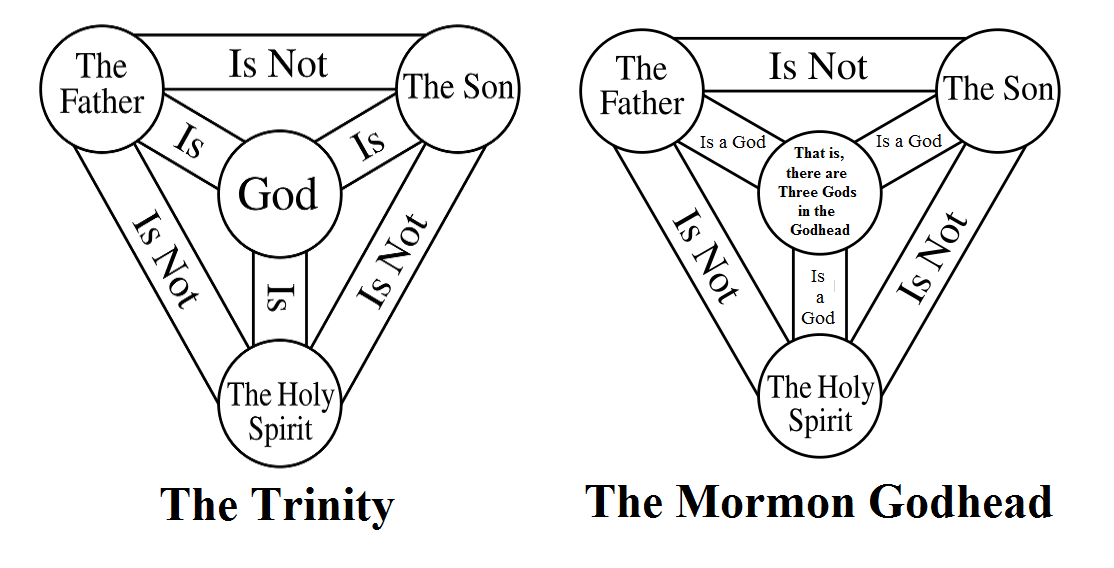
In other words, it’s a sin to view God incorrectly. And while Michael the Mormon Apologist had no problem classifying Evangelicals as Christian, Michael the Ex-Mormon Apologist now sees far too many differences now for us to have the same Jesus. Specifically, our Jesus was never created. Our Jesus was always God. He never had to take a body to become complete. Our Jesus is one in essence with the Father and the Holy Ghost. Our Jesus saves sinners despite their works, not because of them. Michael the Mormon Apologist would have been appalled at this. Back then I argued,
“How much ignorance are we allowed to have before God withholds His grace?
Here’s why I ask: some Christians believe Melchezidek was Christ, some describe the Trinity in terms of Modalism, some Christians believe God chose who would be saved before we were born, and others think He’s the type to let us choose. Many Christians I’ve been in discussions with have even said the Trinity is mysterious.”
(Michael Flournoy, “A Biblical Defense of Mormonism”, p.36)
I, the Mormon Apologist, then quoted Acts 17:23 (KJV) where Paul pointed to an altar with the inscription: ‘To the unknown god’, and said, “Whom therefore ye ignorantly worship, him declare I unto you.” My argument was that God could be worshipped in ignorance. Otherwise, even Evangelicals couldn’t be called Christian due to their fragmented beliefs. But my arguments were misinformed. The Trinity is mysterious, but not in regards to the descriptions given in the Bible. We know what kind of a Being God is. As far as Modalism, they too are outside the bounds of Christianity and need repentance.
That might sound like nitpicking to Latter-day Saints, but even they have their limits. After all, they wouldn’t consider Muslims to be Christian, but I could use their logic to argue that they are. After all, don’t they believe in Christ? Sure, they don’t think He’s divine, and maybe they mistakenly call Heavenly Father “Allah”, but that’s just ignorant worship. Based on the dictionary, they’re Christians too, right?
Mormons can win the argument for their deviant form of Christianity, but merely on a technicality. Relying on a textbook definition to be saved is like relying on another driver’s blinker to keep from being hit. It’s the intentions that matter, not whether someone has their blinker on.
If I could tell Latter-day Saints anything, I’d remind them that Christ isn’t bringing a dictionary on Judgment Day. If our names aren’t written in the Book of Life, we’ll be damned forever. Salvation is an intensely personal matter. It’s not the name of our church that’s found in the Book of Life. We can’t get in under the prophet’s umbrella. It’s our names we should worry about.
So the right question isn’t, “Are Mormons Christian?” The real, right question is for the individual, “Are you a Christian? Are you on His right hand? Is your name written in The Book of Life, and if so, by whose merits – your own flawed sin-tainted works, or His flawless, perfect, and holy work?”
There are thousands of nominal Christians in the world today who show up for church and go through the motions. If asked, they’ll claim Christianity as their religious affiliation. But that’s not the same as being born again. Jesus couldn’t have been clearer on this,
“Not everyone who says to me, ‘Lord, Lord,’ will enter the kingdom of heaven, but the one who does the will of my Father who is in heaven. On that day many will say to me, ‘Lord, Lord, did we not prophesy in your name, and cast out demons in your name, and do many mighty works in your name?’ And then will I declare to them, ‘I never knew you; depart from me, you workers of lawlessness.’”
(Matthew 7:21-23 ESV)
Friend, there’s no participation trophy for being in a Christian church. Even if we’ve done good works and ordinances in Christ’s name, they won’t count towards righteousness. In the end, all that really matters is whether or not we know Jesus – that is the real Jesus of time, space, and history that can be found and is revealed in the Bible. Fictional, man-contrived Jesus’s (and, trust me, there are many, many, many false Jesus’s) simply don’t count, do they?1
So in the end, can a Latter-day Saint be a Christian? Absolutely. Christ can save someone anywhere, at any time, be it in a temple, a prison, a mosque, a bar, or a gutter. He can and will save us right when and where we are right now. Just as we are – ugly, broken, bitter, dirty, and damaged. Period. In fact, He does it every day!
So the better question is this: Does the LDS church truly meet the requirements to be called a Christian church since it teaches another God, another Jesus, and another gospel than what is taught in the Bible? In other words, can the true Jesus of the Bible save a Latter-day Saint despite the false teachings of the LDS Church rather than because of those teachings? This is a question that simply never dawned on Michael the Mormon Apologist as a possibility – but it’s intriguing, isn’t it?
However, that also is another conversation for the Ex-Mormon Apologist to have with the Mormon Apologist on another day (or maybe two, or three). Stay tuned to this channel, there’s more – a lot more – to come!
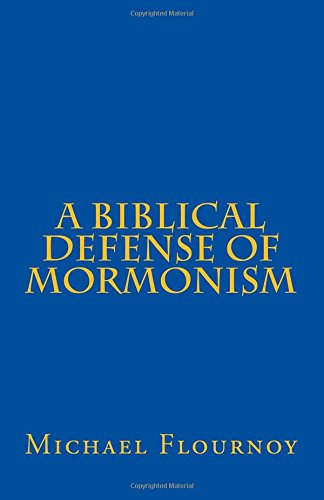
The front cover of “A Biblical Defense of Mormonism”
1 Case in point, please consider the False Jesus of Self-Realization Fellowship:
“Jesus Christ is very much alive and active today. In Spirit and occasionally taking on a flesh-and-blood form, he is working unseen by the masses for the regeneration of the world. With his all-embracing love, Jesus is not content merely to enjoy his blissful consciousness in Heaven. He is deeply concerned for mankind and wishes to give his followers the means to attain the divine freedom of entry into God’s Infinite Kingdom. He is disappointed because many are the churches and temples founded in his name, often prosperous and powerful, but where is the communion that he stressed — actual contact with God? Jesus wants temples to be established in human souls, first and foremost; then established outwardly in physical places of worship. Instead, there are countless huge edifices with vast congregations being indoctrinated in churchianity, but few souls who are really in touch with Christ through deep prayer and meditation.
“To reestablish God in the temples of souls through revival of the original teachings of God-communion as propounded by Christ and Krishna is why I was sent to the West by Mahavatar Babaji….
“Babaji is ever in communion with Christ; together they send out vibrations of redemption and have planned the spiritual technique of salvation for this age.”
(Paramahansa Yogananda, “The Second Coming of Christ: The Resurrection of the Christ Within You”, Introduction; also see “Spiritual Lineage” Self-Realization Fellowship website)
Banner Art: An image from the iconic Mad Magazine, “Spy v. Spy” cartoon series. (copyright Antonio Prohias, the Prohias Estate, Mad Magazine, and Mad Book)















 Beggar's Bread