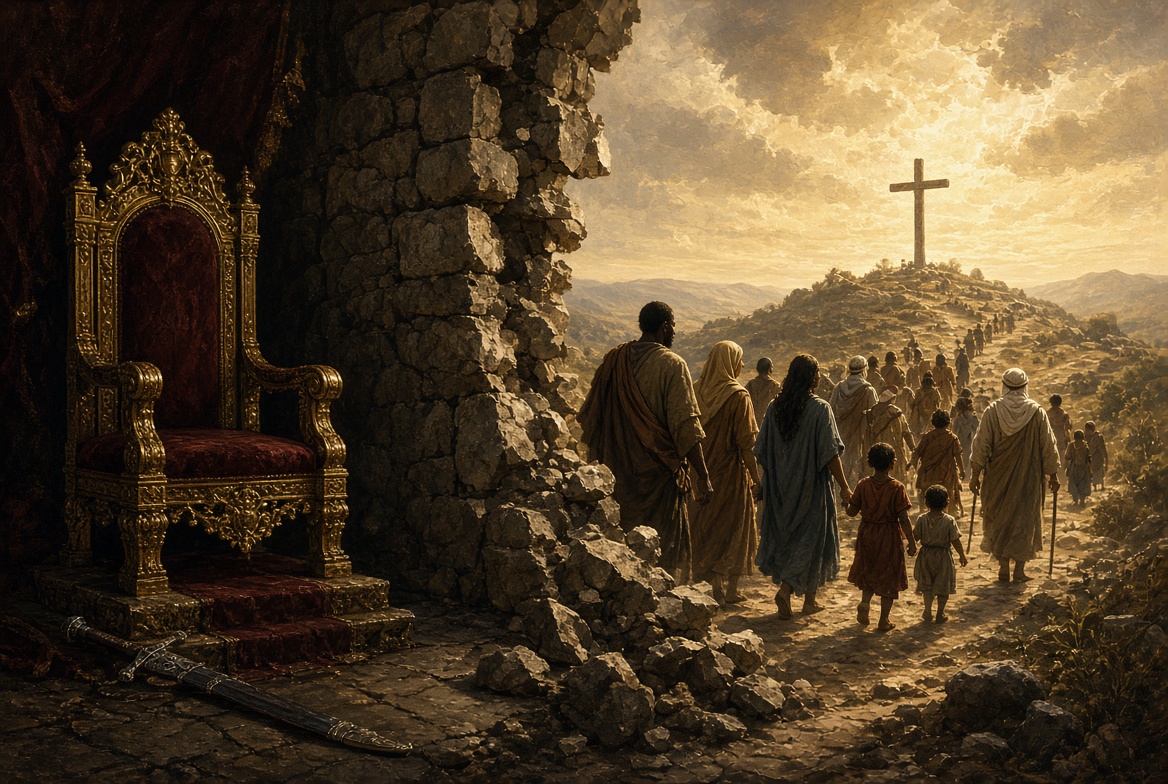
(1 Peter 2:9, 11 NKJV)
compiled by Fred W. Anson
INTRODUCTION
This document names Christian Nationalism directly and quotes every Scripture passage in full. No verse is cited without its text.
Christian Nationalism, as used here, is the claim that the United States is a Christian nation in the covenant sense: that a particular cultural Christianity should be legally privileged, and that national identity, peoplehood, and state power are proper instruments of the church’s mission. It is not the same thing as a Christian voting, holding office, loving his country, or arguing in public from Scripture. Those are ordinary civic acts. Christian Nationalism is the fusion of the church, the nation, and the sword.
I. THE HEART OF THE LAW: LOVE OF GOD AND NEIGHBOR
“Jesus replied: ‘Love the Lord your God with all your heart and with all your soul and with all your mind.’ This is the first and greatest commandment. And the second is like it: ‘Love your neighbor as yourself.’ All the Law and the Prophets hang on these two commandments.”
(Matthew 22:37–40 NIV)
Christian Nationalism hangs the law on a third commandment the text does not contain: love the nation as the measure of faithfulness. Neighbor is redefined as co-national, co-ethnic, or co-partisan. Jesus says the whole Law and the Prophets hang on love of God and love of neighbor. A movement that treats outsiders as threats to “our” Christian country has already left the hinge of the law.
II. MY KINGDOM IS NOT OF THIS WORLD
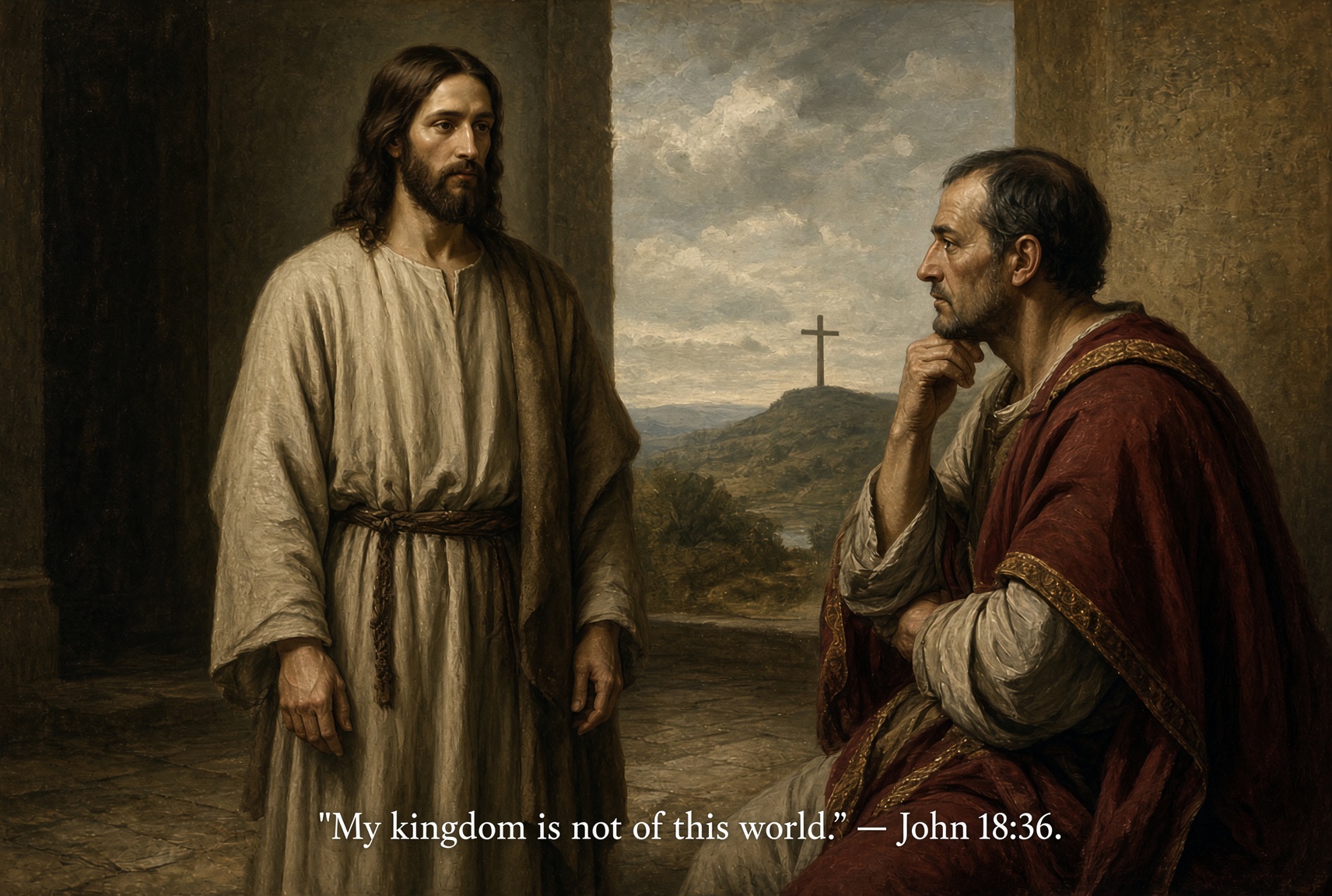
“Jesus answered, ‘My kingdom is not of this world. If my kingdom were of this world, my servants would have been fighting, that I might not be delivered over to the Jews. But my kingdom is not from the world.'”
(John 18:36 ESV)
This is Jesus under oath before the Roman state. He does not say his kingdom will later become a Christian America. He says it is not of this world, and he gives the test: if it were, his servants would fight. Christian Nationalism fails that test. It wants servants who fight, legislate, and seize the magistrate so that a nation can be delivered into Christian hands. Jesus refused that deliverance at the cost of his own life.
III. CAESAR’S COIN AND GOD’S IMAGE
“Then he said to them, ‘So give back to Caesar what is Caesar’s, and to God what is God’s.'”
(Matthew 22:21 NIV)
The coin bore Caesar’s image, so it went back to Caesar. The human being bears God’s image, so the person is not the state’s to baptize. Christian Nationalism collapses the two. It stamps the cross on the coin and the flag on the church, as if the image of God were the property of a nation. Jesus separated them. The tribute and the soul are not the same jurisdiction.
IV. THE HOLY NATION IS THE CHURCH
“But you are a chosen race, a royal priesthood, a holy nation, a people for his own possession, that you may proclaim the excellencies of him who called you out of darkness into his marvelous light. Once you were not a people, but now you are God’s people; once you had not received mercy, but now you have received mercy. Beloved, I urge you as sojourners and exiles to abstain from the passions of the flesh, which wage war against your soul.”
(1 Peter 2:9–11 ESV)
“Holy nation” is already taken. Peter gives that title to the church, not to Rome and not to any later republic. The same paragraph calls those holy-nation people sojourners and exiles. Christian Nationalism reverses both sentences. It makes America the holy nation and treats Christians as owners rather than exiles. Scripture will not allow the swap. The people of God are those called out of darkness, not those born inside a set of borders.
V. ONE NEW MAN, NOT A BLOOD-AND-SOIL CHURCH
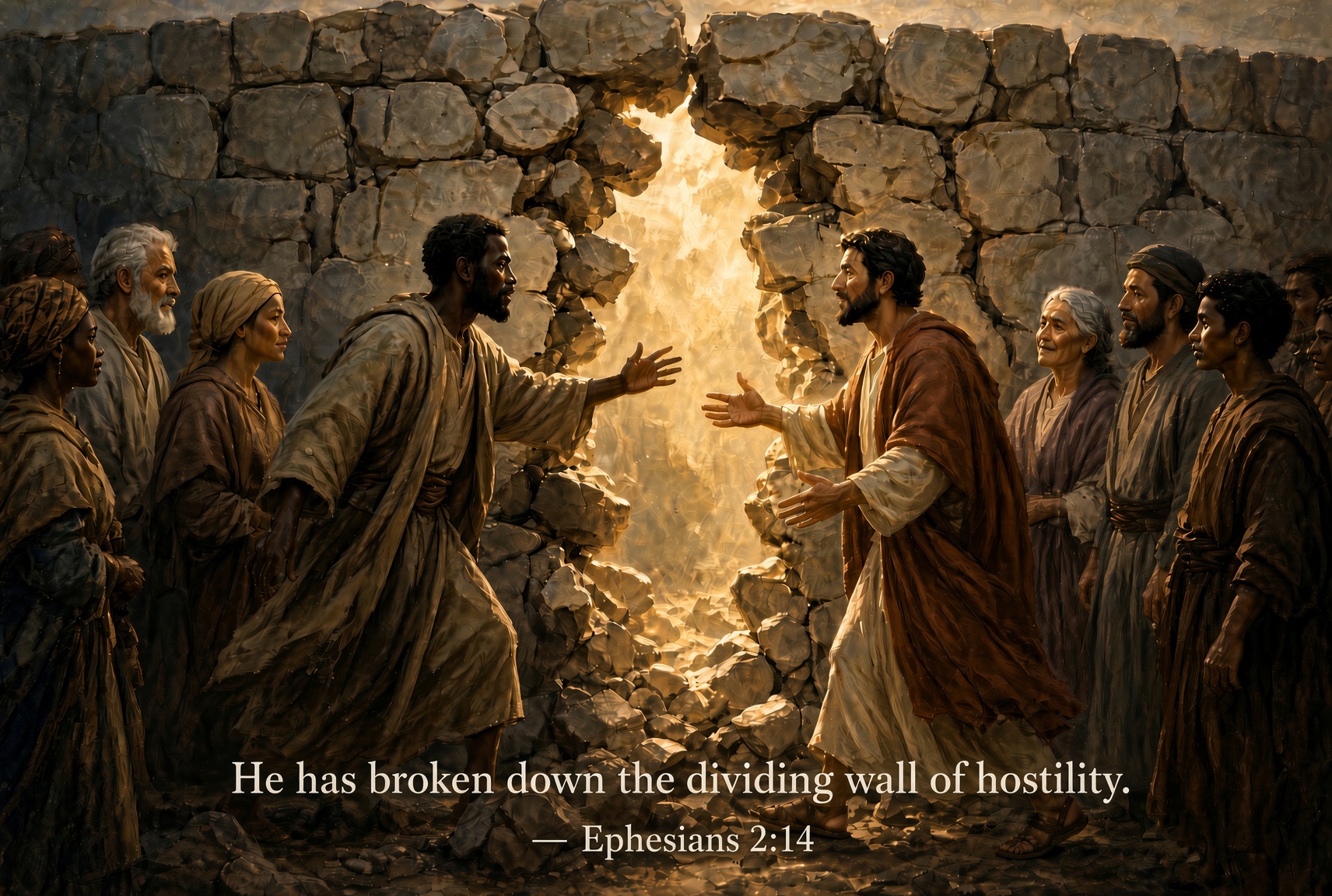
“For he himself is our peace, who has made us both one and has broken down in his flesh the dividing wall of hostility by abolishing the law of commandments expressed in ordinances, that he might create in himself one new man in place of the two, so making peace, and might reconcile us both to God in one body through the cross, thereby killing the hostility. And he came and preached peace to you who were far off and peace to those who were near. For through him we both have access in one Spirit to the Father. So then you are no longer strangers and aliens, but you are fellow citizens with the saints and members of the household of God.”
(Ephesians 2:14–19 ESV)
“There is neither Jew nor Greek, there is neither slave nor free, there is no male and female, for you are all one in Christ Jesus.”
(Galatians 3:28 ESV)
The wall Peter’s readers would have recognized was national and cultic. Christ tore it down. Citizenship in the household of God is not American citizenship. “Fellow citizens with the saints” is a rebuke to any church that sorts people by ancestry, language, or party before it sorts them by the cross. Christian Nationalism rebuilds the wall the cross killed, and calls the rebuilding faithfulness.
VI. ONE BLOOD, EVERY NATION
“And He has made from one blood every nation of men to dwell on all the face of the earth, and has determined their preappointed times and the boundaries of their dwellings.”
(Acts 17:26 NKJV)
Paul said this to Athenians who believed they had sprung from their own soil. “One blood” was an insult to ethnic pride. Boundaries are real. God sets them. They do not create a master people. Christian Nationalism takes the second half of the verse, the bounds of habitation, and buries the first half. Scripture gives both: nations exist, and every one of them is one blood. A gospel that needs a favored stock has already contradicted the apostle.
VII. ALL NATIONS, NOT ONE CHOSEN STATE
“After this I looked, and behold, a great multitude that no one could number, from every nation, from all tribes and peoples and languages, standing before the throne and before the Lamb, clothed in white robes, with palm branches in their hands.”
(Revelation 7:9 ESV)
“And Jesus came and said to them, ‘All authority in heaven and on earth has been given to me. Go therefore and make disciples of all nations, baptizing them in the name of the Father and of the Son and of the Holy Spirit, teaching them to observe all that I have commanded you. And behold, I am with you always, to the end of the age.'”
(Matthew 28:18–20 ESV)
The commission is to disciple nations, not to capture one and call the capture the kingdom. Authority belongs to Jesus, not to a Christian magistrate acting in his place. The end of the story is a multitude no nation can number. Christian Nationalism shrinks that multitude to a homeland and calls the shrinking a revival.
VIII. NO OTHER GODS: THE IDOLATRY OF THE NATION
“You shall have no other gods before me.”
(Exodus 20:3 ESV)
“I am the LORD; that is my name; my glory I give to no other, nor my praise to carved idols.”
(Isaiah 42:8 ESV)
“Pride goes before destruction, and a haughty spirit before a fall.”
(Proverbs 16:18 ESV)
A nation can be loved without being worshiped. Christian Nationalism crosses that line when the flag, the founding, and the leader are treated as bearers of God’s glory. Isaiah says God does not share his praise. Proverbs says the haughty spirit falls. A movement that cannot tell the difference between “God bless our country” and “our country is God’s” has already set another god before him, even if the god wears a cross.
IX. THE KINGDOMS WERE THE TEMPTATION, NOT THE MISSION
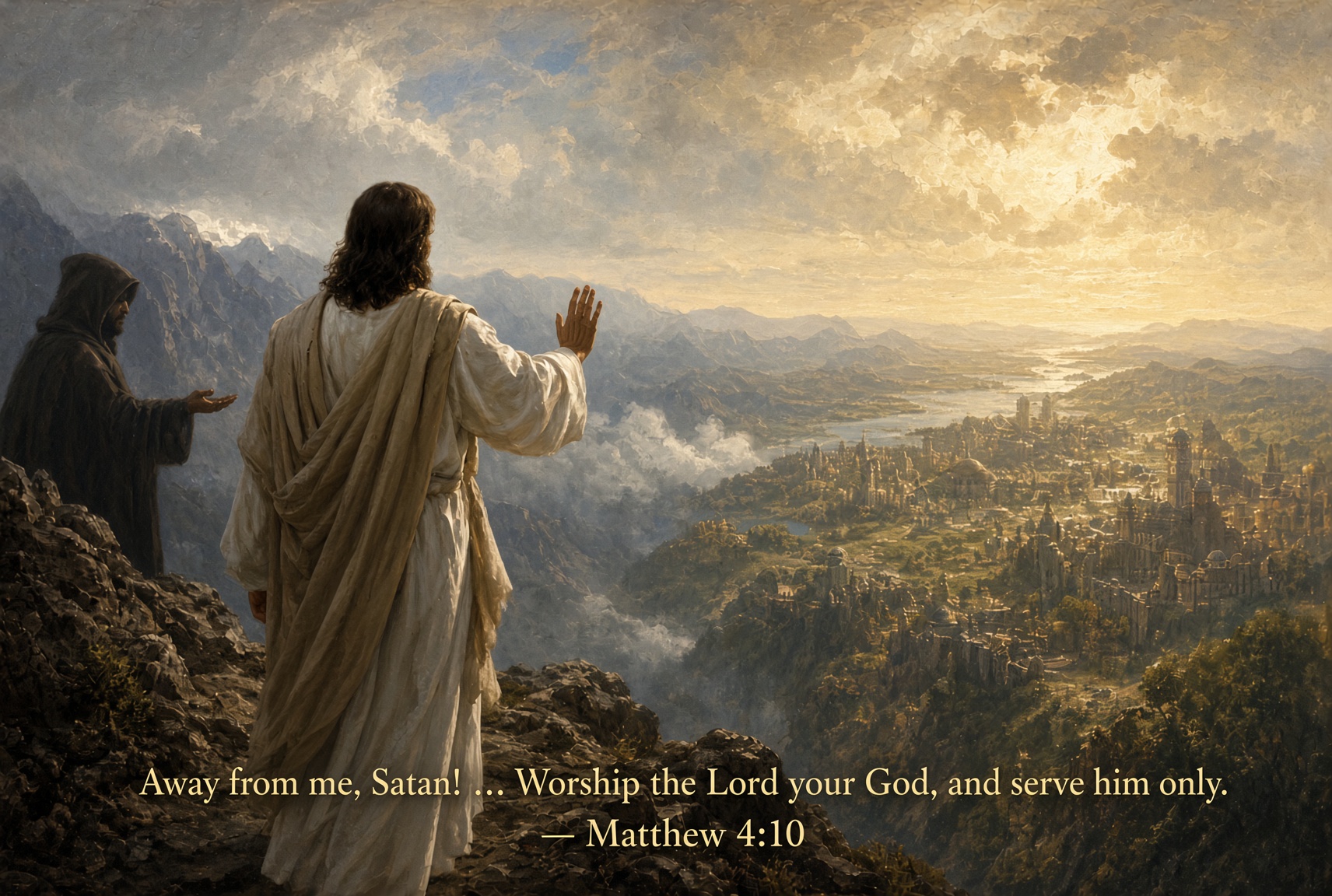
“Again, the devil took him to a very high mountain and showed him all the kingdoms of the world and their glory. And he said to him, ‘All these I will give you, if you will fall down and worship me.’ Then Jesus said to him, ‘Be gone, Satan! For it is written, “You shall worship the Lord your God and him only shall you serve.”‘”
(Matthew 4:8–10 ESV)
“Perceiving then that they were about to come and take him by force to make him king, Jesus withdrew again to the mountain by himself.”
(John 6:15 ESV)
The offer of the kingdoms was not a preview of Christian America. It was the satanic temptation. Jesus refused it. When the crowd tried to finish the offer by force, he withdrew. Christian Nationalism accepts the offer the Son refused, and it calls the acceptance “taking the land for Christ.” The text calls it the devil’s mountain.
X. NOT BY THE SWORD
“Then Jesus said to him, ‘Put your sword back into its place. For all who take the sword will perish by the sword.'”
(Matthew 26:52 ESV)
“For though we walk in the flesh, we are not waging war according to the flesh. For the weapons of our warfare are not of the flesh but have divine power to destroy strongholds. We destroy arguments and every lofty opinion raised against the knowledge of God, and take every thought captive to obey Christ.”
(2 Corinthians 10:3–5 ESV)
Peter drew the sword for a kingdom reason. Jesus sheathed it. Paul names the real weapons: arguments pulled down, thoughts taken captive, not precincts, courts, and militias baptized as spiritual war. Christian Nationalism keeps calling carnal weapons spiritual. Scripture calls that a category error, and it warns that the sword taken up returns on the one who took it.
XI. THE FIELD IS THE WORLD
“He answered, ‘The one who sowed the good seed is the Son of Man. The field is the world, and the good seed stands for the people of the kingdom. The weeds are the people of the evil one, and the enemy who sows them is the devil. The harvest is the end of the age, and the harvesters are angels. As the weeds are pulled up and burned in the fire, so it will be at the end of the age. The Son of Man will send out his angels, and they will weed out of his kingdom everything that causes sin and all who do evil.'”
(Matthew 13:37–41 NIV)
The servants asked to pull the weeds now. The householder refused, because the wheat would come up with them. Christian Nationalism is that request: clear the field, establish the pure nation, do the angels’ work before the harvest. Jesus says the field is the world, not the republic, and the separation belongs to the end of the age. A church that seizes the tares has disobeyed the parable it claims to fulfill.
XII. NO PARTIALITY, AND LOVE THE STRANGER
“My brothers, show no partiality as you hold the faith in our Lord Jesus Christ, the Lord of glory. … But if you show partiality, you are committing sin and are convicted by the law as transgressors.”
(James 2:1, 9 ESV)
“For the LORD your God is God of gods and Lord of lords, the great, the mighty, and the awesome God, who is not partial and takes no bribe. He executes justice for the fatherless and the widow, and loves the sojourner, giving him food and clothing. Love the sojourner, therefore, for you were sojourners in the land of Egypt.”
(Deuteronomy 10:17–19 ESV)
“When a stranger sojourns with you in your land, you shall not do him wrong. You shall treat the stranger who sojourns with you as the native among you, and you shall love him as yourself, for you were strangers in the land of Egypt: I am the LORD your God.”
(Leviticus 19:33–34 ESV)
Partiality is not a policy disagreement. James calls it sin, and he ties it to the faith of the Lord of glory. The God who shows no partiality commands love of the sojourner as the native. Christian Nationalism’s instinct is the reverse: the native is the real neighbor, and the stranger is the threat to the Christian order. That instinct is convicted by the law it claims to restore.
XIII. TRUST NOT IN PRINCES
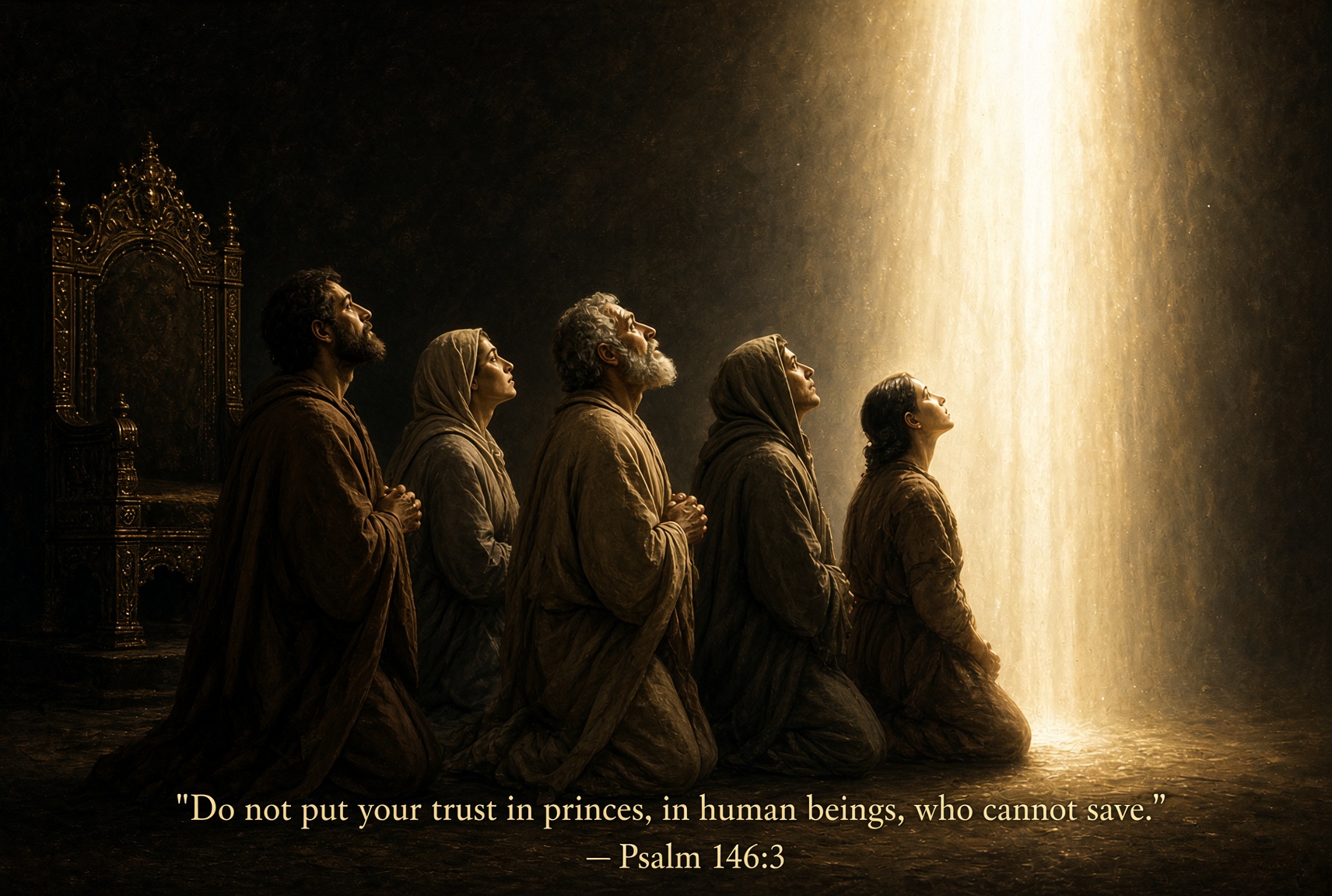
“Put not your trust in princes, in a son of man, in whom there is no salvation.”
(Psalm 146:3 ESV)
“He has told you, O man, what is good; and what does the LORD require of you but to do justice, and to love kindness, and to walk humbly with your God?”
(Micah 6:8 ESV)
Christian Nationalism puts the hope of the church in a Christian ruler, a Christian court, a Christian strongman. The psalm forbids that trust. Micah names the alternative: justice, kindness, humility. Domination is not a substitute for those three. A prince can punish. He cannot save. The movement that forgets that has already moved its hope off Christ.
XIV. FALSE PROPHETS WHO BAPTIZE POWER
“Beware of false prophets, who come to you in sheep’s clothing but inwardly are ravenous wolves. You will recognize them by their fruits. Are grapes gathered from thornbushes, or figs from thistles? So, every healthy tree bears good fruit, but the diseased tree bears bad fruit. A healthy tree cannot bear bad fruit, nor can a diseased tree bear good fruit. Every tree that does not bear good fruit is cut down and thrown into the fire. Thus you will recognize them by their fruits.”
(Matthew 7:15–20 ESV)
The sheep’s clothing, in this case, is the vocabulary of revival, anointing, and “God’s man for the nation.” The fruit is contempt, deceit, fear of the stranger, and the hunger for the sword. Jesus does not say judge them by the flag on the platform. He says judge them by the fruit. A tree that produces cruelty and calls it courage is the tree he said would be cut down.
XV. PEACEMAKERS, NOT DOMINION BY CONTEMPT
“Blessed are the peacemakers, for they shall be called sons of God.”
(Matthew 5:9 ESV)
“But I say to you, Love your enemies and pray for those who persecute you.”
(Matthew 5:44 ESV)
Christian Nationalism trains the church to treat political enemies as enemies of God, and then to enjoy their humiliation. Jesus blesses the peacemaker and commands love of the enemy. The sons of God are identified by that work, not by control of the state. A movement that cannot pray for the people it wants to rule has already failed the Beatitude it prints on its banners.
XVI. CALLING EVIL GOOD
“Woe to those who call evil good and good evil, who put darkness for light and light for darkness, who put bitter for sweet and sweet for bitter!”
(Isaiah 5:20 ESV)
The swap is the method. Cruelty is renamed strength. Exclusion is renamed order. The lie told for the nation is renamed prophetic. Dissent inside the church is renamed betrayal. Isaiah does not aim this woe at outsiders. He aims it at the people who have lost the ability to name things truly. Christian Nationalism requires that loss. Without it, the fusion of cross and flag cannot be maintained.
XVII. CALL TO REPENTANCE
“If my people who are called by my name humble themselves, and pray and seek my face and turn from their wicked ways, then I will hear from heaven and will forgive their sin and heal their land.”
(2 Chronicles 7:14 ESV)
The verse is not a charter for a Christian state. In its own setting, “my people” is Israel under covenant, and the condition is turning from wicked ways, not seizing the magistrate. Read as the church, which is the people now called by his name, the verse still indicts Christian Nationalism. The required acts are humility, prayer, seeking God’s face, and turning. National dominance is not on the list. The healing promised follows repentance, not victory.
APPENDIX: THE PROOF-TEXTS CHRISTIAN NATIONALISM MISUSES
“Blessed is the nation whose God is the LORD, the people whom he has chosen as his heritage!”
(Psalm 33:12 ESV)
The second line defines the first. The blessed people are the people God has chosen as his heritage. In the psalm, that people is Israel. In the New Testament, that people is the church, the holy nation of 1 Peter 2:9. The verse is not a deed to the United States. A nation that fears God may be spared many follies. That general mercy is not the same thing as covenant status, and it is not permission to confuse the republic with the heritage.
“Let every person be subject to the governing authorities. For there is no authority except from God, and those that exist have been instituted by God. Therefore whoever resists the authorities resists what God has appointed, and those who resist will incur judgment. For rulers are not a terror to good conduct, but to bad. Would you have no fear of the one who is in authority? Then do what is good, and you will receive his approval, for he is God’s servant for your good. But if you do wrong, be afraid, for he does not bear the sword in vain. For he is the servant of God, an avenger who carries out God’s wrath on the wrongdoer.”
(Romans 13:1–4 ESV)
Paul wrote this under Nero. The ruler he calls God’s servant was not a Christian, not a church officer, and not the instrument of the Great Commission. The sword in the text punishes the wrongdoer. It does not establish a sacrament, a creed, or an ethnicity. Christian Nationalism reads Romans 13 as a job description for a Christian king. The chapter will not carry that weight. It limits the state. It does not hand the state the keys of the kingdom.
“And if it is evil in your eyes to serve the LORD, choose this day whom you will serve, whether the gods your fathers served in the region beyond the River, or the gods of the Amorites in whose land you dwell. But as for me and my house, we will serve the LORD.”
(Joshua 24:15 ESV)
Joshua demands a choice. He does not draft the unwilling into a national faith. “As for me and my house” is a household confession, not a statute. Christian Nationalism turns a free answer into a civic requirement. Scripture keeps the choice on the hearer. Coerced worship is the thing the verse refuses.
“And in the days of those kings the God of heaven will set up a kingdom that shall never be destroyed, nor shall the kingdom be left to another people. It shall break in pieces all these kingdoms and bring them to an end, and it shall stand forever.”
(Daniel 2:44 ESV)
The kingdom is set up by the God of heaven. It is not left to another people, which means it is not handed to America, or to any nation, to finish. It breaks the kingdoms. It does not become one of them. Christian Nationalism wants a kingdom left to a people. Daniel says that is the one thing this kingdom will never be.
CONCLUSION
Taken together, these Scriptures form a consistent charge. Christian Nationalism gives to a nation what Christ gave to the church, takes up the sword he sheathed, rebuilds the wall he broke, accepts the kingdoms he refused, and trusts the prince the psalm forbids.
This is not a ban on Christians in public life. It is a ban on confusing the public with the kingdom. The holy nation already exists. It is not the United States. It is the people called out of every nation, under a King whose servants do not fight to keep him from the cross.

