Archive for the ‘Authors’ Category

Room in the Johnson home where Joseph Smith worked on The Joseph Smith Translation of the Bible

Room in the Johnson home where Joseph Smith worked on The Joseph Smith Translation of the Bible

by Fred W. Anson
In their zeal to build their case against Joseph Smith many biblical Christians unintentionally abuse Revelation 22:18 to argue for biblical support of a closed canon. However, when read in context that passage is referring solely to itself – not the Bible in it’s entirety, and not to any other book of the Bible:

I Jesus have sent mine angel to testify unto you these things in the churches. I am the root and the offspring of David, and the bright and morning star.

And the Spirit and the bride say, Come. And let him that heareth say, Come. And let him that is athirst come. And whosoever will, let him take the water of life freely.

For I testify unto every man that heareth the words of the prophecy of this book, If any man shall add unto these things, God shall add unto him the plagues that are written in this book:

And if any man shall take away from the words of the book of this prophecy, God shall take away his part out of the book of life, and out of the holy city, and from the things which are written in this book.

He which testifieth these things saith, Surely I come quickly. Amen. Even so, come, Lord Jesus.

The grace of our Lord Jesus Christ be with you all. Amen.
Revelation 22:16-21 (KJV)  

Notice the use of the terms,  “the words of the prophecy of this book” and “the words of the book of this prophecy” limiting the conditions exclusively to “this book” and “this prophecy”.  The language of the text itself limits the scope of these conditions to this book of prophecy – that is, the book that we now know as “The Book of Revelation”.

Because of this awkward misstep by their debating opponents, Latter-day Saints will often feel vindicated that Joseph Smith did not violate Christ’s explicit instructions to future generations in regard to the Book of Revelation. This too is in error. In actual fact, Joseph Smith in the Joseph Smith Translation of the Bible (JST), both took away from and added to the the words of the prophecy of the book. Let’s consider where and how he did this.

Joseph Smith’s additions to and deletions from the Book of Revelation
The changes from the King James Version (KJV) of the Bible are italicized in their JST equivalents.

Rev 1:1-8
John received a revelation from Jesus Christ and delivered it to the leaders over the seven churches in Asia rather than the book being a revelation of Jesus Christ. 

JST
1 The Revelation of John, a servant of God, which was given unto him of Jesus Christ, to show unto his servants things which must shortly come to pass, that he sent and signified by his angel unto his servant John,

Who bore record of the word of God, and of the testimony of Jesus Christ, and of all things that he saw.

Blessed are they who read, and they who hear and understand the words of this prophecy, and keep those things which are written therein, for the time of the coming of the Lord draweth nigh.

Now this is the testimony of John to the seven servants who are over the seven churches in Asia. Grace unto you, and peace from him who is, and who was, and who is to come; who hath sent forth his angel from before his throne, to testify unto those who are the seven servants over the seven churches.

Therefore, I, John, the faithful witness, bear record of the things which were delivered me of the angel, and from Jesus Christ the first begotten of the dead, and the Prince of the kings of the earth.

And unto him who loved us, be glory; who washed us from our sins in his own blood, and hath made us kings and priests unto God, his Father. To him be glory and dominion, forever and ever. Amen.

For behold, he cometh in the clouds with ten thousands of his saints in the kingdom, clothed with the glory of his Father. And every eye shall see him; and they who pierced him, and all kindreds of the earth shall wail because of him. Even so, Amen.

For he saith, I am Alpha and Omega, the beginning and the ending, the Lord, who is, and who was, and who is to come, the Almighty.

KJV
1 The Revelation of Jesus Christ, which God gave unto him, to shew unto his servants things which must shortly come to pass; and he sent and signified it by his angel unto his servant John:

2 Who bare record of the word of God, and of the testimony of Jesus Christ, and of all things that he saw.

3 Blessed is he that readeth, and they that hear the words of this prophecy, and keep those things which are written therein: for the time is at hand.

4 John to the seven churches which are in Asia: Grace be unto you, and peace, from him which is, and which was, and which is to come; and from the seven Spirits which are before his throne;

5 And from Jesus Christ, who is the faithful witness, and the first begotten of the dead, and the prince of the kings of the earth. Unto him that loved us, and washed us from our sins in his own blood,

6 And hath made us kings and priests unto God and his Father; to him be glory and dominion for ever and ever. Amen.

7 Behold, he cometh with clouds; and every eye shall see him, and they also which pierced him: and all kindreds of the earth shall wail because of him. Even so, Amen.

8 I am Alpha and Omega, the beginning and the ending, saith the Lord, which is, and which was, and which is to come, the Almighty.

“Landscape with St John the Evangelist at Patmos” by Gillis Coignet (ca. 1542–1599) from the Hermitage Museum

Rev. 1:16, 20
The seven stars in the Savior’s hand are actually leaders of the seven churches rather than their angels.

JST
16 And he had in his right hand seven stars; and out of his mouth went a sharp two-edged sword; and his countenance was as the sun shining in his strength.

20 This is the mystery of the seven stars which thou sawest in my right hand, and the seven golden candlesticks. The seven stars are the servants of the seven churches; and the seven candlesticks which thou sawest are the seven churches.

KJV
16 And he had in his right hand seven stars: and out of his mouth went a sharp twoedged sword: and his countenance was as the sun shineth in his strength.

20 The mystery of the seven stars which thou sawest in my right hand, and the seven golden candlesticks. The seven stars are the angels of the seven churches: and the seven candlesticks which thou sawest are the seven churches.

Rev. 2: 22
Jezebel and the wicked will be cast into hell rather than into a bed.

JST
22 Behold, I will cast her into hell, and them that commit adultery with her into great tribulation, except they repent of their deeds.

KJV
22 Behold, I will cast her into a bed, and them that commit adultery with her into great tribulation, except they repent of their deeds.

Rev. 2:26–27
Several changes and additions made

JST
26 And to him who overcometh, and keepeth my commandments unto the end, will I give power over many kingdoms;

27 And he shall rule them with the word of God; and they shall be in his hands as the vessels of clay in the hands of a potter; and he shall govern them by faith, with equity and justice, even as I received of my Father.

KJV
26 And he that overcometh, and keepeth my works unto the end, to him will I give power over the nations:

27 And he shall rule them with a rod of iron; as the vessels of a potter shall they be broken to shivers: even as I received of my Father.

“The Apocalypse of Saint John the Evangelist on the Island of Patmos” by Jan Massis (ca. 1563)

Rev. 5:6
Twelve servants of God are sent to all the earth rather than seven Spirits of God. 

JST
6 And I beheld, and, lo, in the midst of the throne and of the four beasts, and in the midst of the elders, stood a Lamb as it had been slain, having twelve horns and twelve eyes, which are the twelve servants of God, sent forth into all the earth.

KJV
6 And I beheld, and, lo, in the midst of the throne and of the four beasts, and in the midst of the elders, stood a Lamb as it had been slain, having seven horns and seven eyes, which are the seven Spirits of God sent forth into all the earth.

Rev. 12:1—17
Several changes and additions, including a reordering of verses. The woman and the man represent the kingdom of God and the Church of Jesus Christ.

JST
And there appeared a great sign in heaven, in the likeness of things on the earth; a woman clothed with the sun, and the moon under her feet, and upon her head a crown of twelve stars.

And the woman being with child, cried, travailing in birth, and pained to be delivered.

And she brought forth a man child, who was to rule all nations with a rod of iron; and her child was caught up unto God and his throne.

And there appeared another sign in heaven; and behold, a great red dragon, having seven heads and ten horns, and seven crowns upon his heads. And his tail drew the third part of the stars of heaven, and did cast them to the earth. And the dragon stood before the woman which was delivered, ready to devour her child after it was born.

And the woman fled into the wilderness, where she had a place prepared of God, that they should feed her there a thousand two hundred and threescore years.

And there was war in heaven; Michael and his angels fought against the dragon; and the dragon and his angels fought against Michael;

And the dragon prevailed not against Michael, neither the child, nor the woman which was the church of God, who had been delivered of her pains, and brought forth the kingdom of our God and his Christ.

Neither was there place found in heaven for the great dragon, who was cast out; that old serpent called the devil, and also called Satan, which deceiveth the whole world; he was cast out into the earth; and his angels were cast out with him.

And I heard a loud voice saying in heaven, Now is come salvation, and strength, and the kingdom of our God, and the power of his Christ;

10 For the accuser of our brethren is cast down, which accused them before our God day and night.

11 For they have overcome him by the blood of the Lamb, and by the word of their testimony; for they loved not their own lives, but kept the testimony even unto death. Therefore, rejoice O heavens, and ye that dwell in them.

12 And after these things I heard another voice saying, Woe to the inhabiters of the earth, yea, and they who dwell upon the islands of the sea! for the devil is come down unto you, having great wrath, because he knoweth that he hath but a short time.

13 For when the dragon saw that he was cast unto the earth, he persecuted the woman which brought forth the man-child.

14 Therefore, to the woman were given two wings of a great eagle, that she might flee into the wilderness, into her place, where she is nourished for a time, and times, and half a time, from the face of the serpent.

15 And the serpent casteth out of his mouth water as a flood after the woman, that he might cause her to be carried away of the flood.

16 And the earth helpeth the woman, and the earth openeth her mouth, and swalloweth up the flood which the dragon casteth out of his mouth.

17 Therefore, the dragon was wroth with the woman, and went to make war with the remnant of her seed, which keep the commandments of God, and have the testimony of Jesus Christ.

KJV
1 And there appeared a great wonder in heaven; a woman clothed with the sun, and the moon under her feet, and upon her head a crown of twelve stars:

2 And she being with child cried, travailing in birth, and pained to be delivered.

3 And there appeared another wonder in heaven; and behold a great red dragon, having seven heads and ten horns, and seven crowns upon his heads.

4 And his tail drew the third part of the stars of heaven, and did cast them to the earth: and the dragon stood before the woman which was ready to be delivered, for to devour her child as soon as it was born.

5 And she brought forth a man child, who was to rule all nations with a rod of iron: and her child was caught up unto God, and to his throne.

6 And the woman fled into the wilderness, where she hath a place prepared of God, that they should feed her there a thousand two hundred and threescore days.

7 And there was war in heaven: Michael and his angels fought against the dragon; and the dragon fought and his angels,

8 And prevailed not; neither was their place found any more in heaven.

9 And the great dragon was cast out, that old serpent, called the Devil, and Satan, which deceiveth the whole world: he was cast out into the earth, and his angels were cast out with him.

10 And I heard a loud voice saying in heaven, Now is come salvation, and strength, and the kingdom of our God, and the power of his Christ: for the accuser of our brethren is cast down, which accused them before our God day and night.

11 And they overcame him by the blood of the Lamb, and by the word of their testimony; and they loved not their lives unto the death.

12 Therefore rejoice, ye heavens, and ye that dwell in them. Woe to the inhabiters of the earth and of the sea! for the devil is come down unto you, having great wrath, because he knoweth that he hath but a short time.

13 And when the dragon saw that he was cast unto the earth, he persecuted the woman which brought forth the man child.

14 And to the woman were given two wings of a great eagle, that she might fly into the wilderness, into her place, where she is nourished for a time, and times, and half a time, from the face of the serpent.

15 And the serpent cast out of his mouth water as a flood after the woman, that he might cause her to be carried away of the flood.

16 And the earth helped the woman, and the earth opened her mouth, and swallowed up the flood which the dragon cast out of his mouth.

17 And the dragon was wroth with the woman, and went to make war with the remnant of her seed, which keep the commandments of God, and have the testimony of Jesus Christ.

“Great Day of His Wrath” by John Martin (ca.1851-1853)

Rev. 13:1
The beast of Revelation 13 is in “the likeness of the kingdoms of the earth.”

JST
1 And I saw another sign, in the likeness of the kingdoms of the earth; a beast rise up out of the sea, and he stood upon the sand of the sea, having seven heads and ten horns; and upon his horns ten crowns; and upon his heads the name of blasphemy.

KJV
1 And I stood upon the sand of the sea, and saw a beast rise up out of the sea, having seven heads and ten horns, and upon his horns ten crowns, and upon his heads the name of blasphemy.

Rev. 19: 15, 21
God uses the word of Christ rather than a sword to smite the nations.

JST
15 And out of his mouth proceedeth the word of god, and with it he will smite the nations; and he will rule them with the word of his mouth; and he treadeth the winepress in the fierceness and wrath of Almighty God.

21 And the remnant were slain with the word of him that sat upon the horse, which word proceeded out of his mouth; and all the fowls were filled with their flesh.

KJV
15 And out of his mouth goeth a sharp sword, that with it he should smite the nations: and he shall rule them with a rod of iron: and he treadeth the winepress of the fierceness and wrath of Almighty God.

21 And the remnant were slain with the sword of him that sat upon the horse, which sword proceeded out of his mouth: and all the fowls were filled with their flesh.

Additions via Doctrine & Covenants
And, finally, Doctrine & Covenants 77 is a wholesale addition to the Book of Revelation by claiming to be a divinely inspired interpretation of the book directly from God Himself.  For example, the woman [the Church], the child [the kingdom of God], the rod of iron [the word of God], the dragon [Satan], and Michael are explained. The war in heaven is continued on the earth. These are all additions to the Book of Revelation text with no manuscript support to justify them.

An early copy of Doctrine & Covenants 77 (click to zoom)

An early copy of Doctrine & Covenants 77

Doctrine &Covenants 77
Q. What is the sea of glass spoken of by John, 4th chapter, and 6th verse of the Revelation?

A. It is the earth, in its sanctified, immortal, and eternal state.

Q. What are we to understand by the four beasts, spoken of in the same verse?

A. They are figurative expressions, used by the Revelator, John, in describing heaven, the paradise of God, the happiness of man, and of beasts, and of creeping things, and of the fowls of the air; that which is spiritual being in the likeness of that which is temporal; and that which is temporal in the likeness of that which is spiritual; the spirit of man in the likeness of his person, as also the spirit of the beast, and every other creature which God has created.

Q. Are the four beasts limited to individual beasts, or do they represent classes or orders?

A. They are limited to four individual beasts, which were shown to John, to represent the glory of the classes of beings in their destined order or sphere of creation, in the enjoyment of their eternal felicity.

Q. What are we to understand by the eyes and wings, which the beasts had?

A. Their eyes are a representation of light and knowledge, that is, they are full of knowledge; and their wings are a representation of power, to move, to act, etc.

Q. What are we to understand by the four and twenty elders, spoken of by John?

A. We are to understand that these elders whom John saw, were elders who had been faithful in the work of the ministry and were dead; who belonged to the seven churches, and were then in the paradise of God.

Q. What are we to understand by the book which John saw, which was sealed on the back with seven seals?

A. We are to understand that it contains the revealed will,mysteries, and the works of God; the hidden things of his economy concerning this earth during the seven thousand years of its continuance, or its temporal existence.

Q. What are we to understand by the seven seals with which it was sealed?

A. We are to understand that the first seal contains the things of the first thousand years, and the second also of the second thousand years, and so on until the seventh.

Q. What are we to understand by the four angels, spoken of in the 7th chapter and 1st verse of Revelation?

A. We are to understand that they are four angels sent forth from God, to whom is given power over the four parts of the earth, to save life and to destroy; these are they who have the everlasting gospel to commit to every nation, kindred, tongue, and people; having power to shut up the heavens, to seal up unto life, or to cast down to the regions of darkness.

Q. What are we to understand by the angel ascending from the east, Revelation 7th chapter and 2nd verse?

A. We are to understand that the angel ascending from the east is he to whom is given the seal of the living God over the twelve tribes of Israel; wherefore, he crieth unto the four angels having the everlasting gospel, saying: Hurt not the earth, neither the sea, nor the trees, till we have sealed the servants of our God in their foreheads. And, if you will receive it, this is Elias which was to come to gather together the tribes of Israel and restore all things.

10 Q. What time are the things spoken of in this chapter to be accomplished?

A. They are to be accomplished in the sixth thousand years, or the opening of the sixth seal.

11 Q. What are we to understand by sealing the one hundred and forty-four thousand, out of all the tribes of Israel—twelve thousand out of every tribe?

A. We are to understand that those who are sealed are high priests, ordained unto the holy order of God, to administer the everlasting gospel; for they are they who are ordained out of every nation, kindred, tongue, and people, by the angels to whom is given power over the nations of the earth, to bring as many as will come to the church of the Firstborn.

12 Q. What are we to understand by the sounding of the trumpets, mentioned in the 8th chapter of Revelation?

A. We are to understand that as God made the world in six days, and on the seventh day he finished his work, and sanctified it, and also formed man out of the dust of the earth, even so, in the beginning of the seventh thousand years will the Lord God sanctify the earth, and complete the salvation of man, and judge all things, and shall redeem all things, except that which he hath not put into his power, when he shall have sealed all things, unto the end of all things; and the sounding of the trumpets of the seven angels are the preparing and finishing of his work, in the beginning of the seventh thousand years—the preparing of the way before the time of his coming.

13 Q. When are the things to be accomplished, which are written in the 9th chapter of Revelation?A. They are to be accomplished after the opening of the seventh seal, before the coming of Christ.

14 Q. What are we to understand by the little book which was eaten by John, as mentioned in the 10th chapter of Revelation?

A. We are to understand that it was a mission, and an ordinance, for him to gather the tribes of Israel; behold, this is Elias, who, as it is written, must come and restore all things.

15 Q. What is to be understood by the two witnesses, in the eleventh chapter of Revelation?

A. They are two prophets that are to be raised up to the Jewish nation in the last days, at the time of the restoration, and to prophesy to the Jews after they are gathered and have built the city of Jerusalem in the land of their fathers.
bible-revelation-1_EDITED

Summary and conclusion
So there is it, Joseph Smith blatantly, overtly, boldly, and without any trace of concern, embarrassment, guilt, or remorse took away from and added to the very biblical book that Christ stated doing so would result in plagues and damnation. Yet, remarkably, the LdS Church not only doesn’t deny this fact, it actually boasts about it:

Acting by the spirit of prophecy and revelation, Joseph Smith corrected portions, but not all, of what is amiss in the King James Version of the Bible. In the book of Revelation corrections, for instance, the angels of the various earthly churches become the servants (presiding officers) of those units. The lamb with seven horns and seven eyes becomes a lamb with 12 eyes and 12 horns, thus perfecting the symbolism to identify Christ and his apostles. Chapter 12 is so revised as to identify the woman as the church of God and the child that she brought forth as the kingdom of our God and of his Christ. And so forth.
– LdS Apostle Bruce R. McConkie, “Understanding the Book of Revelation”[1]

What Mr. McConkie failed to mention here is that Joseph Smith had absolutely no manuscript support – or verifiable support of any kind for that matter – for his changes while the King James translators remained faithful to the source manuscripts they translated from. In other words, Mr. McConkie’s arguments are fatally flawed and rooted in blatant confirmation bias – that is, Mr. McConkie comes to the conclusion first and then bends the facts to fit it.

Again, the evidence is clear that Joseph Smith very much disobeyed and violated the explicit instructions of Jesus Christ in Revelation 22:16-22 and one need go no further than official, correlated LdS Church sources to see it.[2]

NOTES
[1] Bruce R. McConkie, “Understanding the Book of Revelation”, Ensign, September 1975. A fuller explanation and analysis of Joseph Smith’s translation of the Bible can be found on the Mormon Think (click here) and Mormon Research Ministry (click here) websites.

[2] In addition to the McConkie Ensign article referenced in the prior footnote, the reader can also cross reference the passages using the LDS.org website as noted throughout this article. For example this link provides a quick summary of some (but not all) of the changes that Joseph Smith made to the Book of Revelation: Scriptures: JST Revelation.

“Joseph Smith Translating” by Nelson

BACK TO TOP

Introduction: In 2004, after Richard J. Mouw’s now infamous apology in the Mormon Tabernacle, Ron V. Huggins of  the Salt Lake Theological Seminary wrote an article that the ensuing years has come to be known as “the infamous Pander/Slander Article”. That is, the watershed article on how Christians wishing to enter into interfaith dialogue or relationship with members of the Church of Jesus Christ of Latter-day Saints will slander their brothers and sisters in Christ and pander to Latter-day Saints. Now, one would think that an article written eleven years ago would have little relevance over a decade later wouldn’t you? However, the recent pander/slander tactics of Baptist Theologian Roger E. Olson, and Evangelical Lutheran Church in America Pastor Chris Duckworth, have prompted us to reintroduce this classic article to a new audience for their edification and enlightenment. Folks, it looks like it’s 2004 all over again! — Editor

Those who don't study history are doomed to repeat it Yet those who do study history are doomed to stand by helplessly while everyone else repeats itby Ronald V. Huggins, B.F.A., Th.D.
On November 14, 2004, well-known Christian apologist Ravi Zacharias appeared in Salt Lake City’s Mormon Tabernacle. What might have been a remarkable opportunity for interfaith dialogue between Mormons and Christians was seriously damaged when Dr. Richard Mouw, President of Fuller Theological Seminary, issued a controversial apology that seemed to portray Evangelicals as commonly bearing false witness against Mormons. Evangelicals present at the event, even some of those sitting on the stage, went away with the clear impression that Mouw was aiming his criticism at them and excluding only the small group of out-of-towners brought in by Greg Johnson’s ministry, Standing Together, which sponsored the event.

Let me make it clear that I agree that some Evangelicals have certainly been unkind to Mormons and have been guilty of inaccurately portraying Mormon beliefs. But this does not characterize the attitudes and actions of most evangelical churches and ministries, which is what made Mouw’s blanket apology inappropriate.

In the days following the event Ravi’s powerful preaching was radically downplayed, as Mouw and his apology moved to center stage. The LDS Church News carried an article entitled “Ravi Zacharias Speaks at the Tabernacle,” that dedicated more than a third of its three columns to Mouw’s remarks and only a single paragraph at the end to Ravi’s message. The official LDS Church web page reported the event as if Richard Mouw had been the main and indeed the only speaker at the event, making no mention of Ravi Zacharias at all. I include here the entire story as it appeared on the official LDS Church website (www.mormonnewsroom.org) on 29 Nov. 2004:

Evangelical Calls for Greater Understanding. Richard Mouw, president of Fuller Theological Seminary, one of the largest in North America, spoke at Salt Lake Tabernacle November 14 during an ‘Evening of Friendship.’ At the event Mr. Mouw said, ‘I am now convinced that we evangelicals have often seriously misrepresented the beliefs and practices of the Mormon community. …We have told you what you believe without making a sincere effort first of all to ask you what you believe.’

Richard J. Mouw Apologizing in the MormonTabernacle

Richard J. Mouw Apologizing in the MormonTabernacle

The story is accompanied by a photograph of Dr. Mouw along with a link to Beliefnet.com, where his entire remarks on that occasion are found under the heading: “‘We Have Sinned Against You.’ A leading evangelical speaks at the Mormon Tabernacle and says evangelicals have spread lies about LDS beliefs.”

Richard Mouw is credited with posting the remarks, but the introduction speaks of Mouw in the third person. In that introduction the Southern Baptists are specifically named as representing (apparently) the kind of thing Mouw was attacking in his remarks, despite the fact that South East Baptist Church was one of the sponsors of the Tabernacle event and its pastor, Mike Gray, was included among those seated on the stage.

It’s hard, in light of this reporting, not to view the LDS Church as somewhat self-serving in its backing of Ravi’s appearance. Acting as if it wished to engender good relations between Mormons and Evangelicals before the event (which was co-sponsored by the Richard L. Evans Chair of Religious Studies at BYU), the LDS Church seemed to quickly drop any interest in Ravi once it was over.

Some Christians in Utah were surprised and disappointed by the apparent bad faith reflected in the LDS Church’s post-event coverage; others, including myself, expected it on the basis of the conviction that, contrary to the belief and hope of many Evangelicals, the LDS Church does not appear ready for, nor does it seem really to desire, authentic dialogue with Evangelicals. What the LDS Church certainly does seem to desire is mainline respectability. It is clearly interested in finding room at its events for those Evangelicals who are willing to publicly disparage their own brethren and so to lend a hand to its own project of marginalizing (rather than interacting with) careful and credible critics like Jerald and Sandra Tanner, the Institute for Religious Research (IRR), and others. As such, the LDS Church appears to be interested in “dialoguing” only with Evangelicals who lack an in-depth knowledge of Mormon history and doctrine, and who are thus more likely to take at face value the representations of its PR people.

This was dramatically illustrated for me at the 2004 regional meeting of the Society of Biblical Literature and American Association of Religion held at BYU. After the event Dr. James Wakefield and I were talking with another Evangelical scholar visiting from Fuller Theological Seminary. All three of us had presented papers. Suddenly a senior Mormon scholar and apologist very deliberately and ceremoniously reached his hand between Dr. Wakefield and me in order to introduce himself to the scholar from Fuller. He displayed no interest whatever in speaking to Dr. Wakefield or me, despite the fact that he had sat intently taking extensive notes during my entire paper, and also, that I had recently published an article in Dialogue: A Journal of Mormon Thought that had interacted with, and challenged, some of his writings.

Many pastors in Utah, including those supportive of the Tabernacle event, were deeply disappointed by Dr. Mouw’s apology. On December 3, 2004, some twenty-five pastors and other Christian ministers met with Standing Together director Greg Johnson to discuss the event. A number of those present (including myself) had come from ministries that had financially supported the event. Some had even been present on the stage during the event. There was, I think it is fair to say, a solid majority that felt Dr. Mouw’s apology was both ill-advised and inappropriate; a significant number of those present (again including myself) felt it was highly inappropriate.

After Greg Johnson had assured them that there had been no way to know beforehand that Dr. Mouw would make his unfortunate remarks, the gathered pastors naturally expressed surprise at learning that the faculty of Salt Lake Theological Seminary (SLTS) had communicated with Dr. Mouw in August 2004 and expressed concern that he avoid following the pattern he had established in writing and public events during the past few years of disparaging earlier Christian efforts to reach Mormons for Christ. Regrettably, Dr. Mouw ignored the SLTS faculty’s concern. Nearly all those present at the meeting understood Mouw’s accusation to be directed at ministers in Utah in general.

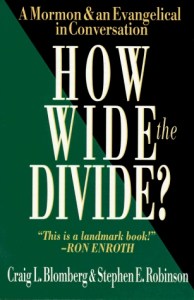
how-wide-the-divideUnfortunately, Dr. Mouw’s disparaging remarks towards his fellow Evangelicals at the Tabernacle are not the first example of this kind of behavior in an event sponsored by Standing Together. The difficulty is that Evangelicals associated with that ministry have developed unhealthy, lopsided relationships with Mormon apologists. Several years ago I came up with a name for this “evangelistic strategy” – the “Pander/Slander” method: “If you want to pander to the Mormon apologists not ready for real dialogue, the cost is going to be a willingness to slander the Christian brethren that went before you.” Anyone who has read How Wide the Divide? by Evangelical Craig Blomberg and Mormon Stephen Robinson, a project spurred on by Standing Together’s Greg Johnson, will have noticed that Mormon scholar Stephen Robinson very quickly wraps himself in a cloak of victim privilege and makes sure Blomberg understands he is going to regard any challenges to his idiosyncratic expressions of Mormon doctrine as persecution. He acts, in other words, as a victim-bully. Once the book was out there, anyone who criticized Blomberg for not challenging Robinson’s evasions was denounced by Mormon apologists. So the cloak of victim privilege was thrown over the shoulders of Blomberg too. So also now with Richard Mouw and Standing Together.

In saying this I must stress that Craig Blomberg is an excellent scholar and the fact that he behaved in a more scholarly and gentlemanly manner than Robinson did in that exchange should surely not be held against him.

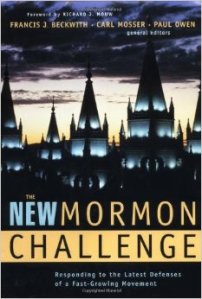
As early as 2002 I cautioned Greg Johnson against belittling earlier Christian efforts at reaching Mormons as a way of buying credibility with Mormon apologists. In 2001 I similarly cautioned Carl Mosser and Paul Owen, two of the editors of The New Mormon Challenge, a work with a Foreword by Richard Mouw, in which he again declares himself “ashamed” of fellow Christians who have labored in the field before him.

Acting, in my view, with similar lack of good faith in relation to the publication of that book, the Mormons first pretended to be supportive of the project and then quickly panned it afterwards as just another anti-Mormon effort. Not only so, but after promising to appear at a public book-launching event in Salt Lake City (The New Mormon Challenge Conference), the major Mormon participants cancelled out at the last minute, leaving only the idiosyncratic Mormon maverick lawyer-theologian-apologist Blake Ostler to represent the Mormon side. When the FARMS Review of Books came out with its take on The New Mormon Challenge in the winter of 2002, one of its authors, Louis Midgley, quoted one of the principles set out in Mormon apologist Hugh Nibley’s 1963 “How to Write an Anti-Mormon Book” against the book’s editors:

“A benign criticism of your predecessors will go far towards confirming your own preeminence in the field. Refer gently but firmly,” Nibley admonishes, “to the bias, prejudices, and inadequate research, however unconscious or understandable, of other books on the subject.” It should be noted that Mosser and Owen began their venture into Anti-Mormonism with an essay in which they neatly positioned themselves to come to the rescue of the evangelicals overwhelmed by the “new Mormon challenge,” by doing what previous writers have lacked the skill and knowledge to accomplish.[1]

The New Mormon ChallengeMidgley’s comments are interesting. Prior to the release of the book, FARMS had singled out Mosser and Owen for high acclaim as if they were the only Evangelicals that ever deserved the name “scholar,” even at the time when neither had his doctorate. It had even re-released and praised the article Midgley now damns as “anti-Mormon.” More than a year before this review I warned Mosser and Owen that they were being used and that all the apparent friendship and support the Mormon apologists pretended to be giving them then would suddenly vanish the moment they ceased being useful. I had hoped I was being too cynical, that there might have been a glimmer of something real in the Mormon apologists’ relationship with Mosser and Owen. Sadly, my fears subsequently appear to have been confirmed.

Mosser and Owen are fine scholars who should not be condemned for being naïve. They are young and it is surely forgivable that they would have wanted to assume that the trusted leaders of a religious organization that claims to represent Jesus Christ on the earth would act with greater ethical integrity in its relationship with outsiders. Alas, we must all live and learn.

In any case, The New Mormon Challenge did represent an important bluff caller. For a long time previous to its release Mormons had been complaining that no one with scholarly credentials had critically and carefully interacted with their scholarship. My own position on that question was that it was incumbent on nobody to interact with the work of Mormon apologists until they produced something of real scholarly significance that could stand on its own outside Mormon circles. I had read a good deal of it and found that in the areas in which I had particular expertise, their work was, with a few exceptions, appallingly inadequate. The New Mormon Challenge at least provided exactly the scholarly interaction the Mormon apologists wanted, and yet since its release they have shown themselves to be as disinterested in real interaction as before. Their only long-term interest seems to be with Evangelicals who, lacking a sufficient understanding of their teaching, will pander to them without challenging them with anything deeper than broad allusions to “serious differences that divide us.”

With Dr. Mouw’s most recent apology at the Tabernacle, I am concerned that Standing Together will become fixed in its commitment to a strategy of disparaging earlier efforts to reach Mormons. If this appearance is correct, it is not a healthy development.

Dr. Mouw’s troubling comments at the recent Tabernacle event have damaged not only his own credibility among ministers in Utah, but also the credibility of the leadership of Standing Together. This is regrettable because their role in fostering Evangelical-Mormon dialogue is an important one. Many Christians in Utah and elsewhere would long for an apology on the part of Dr. Mouw to Utah pastors and mainstream Evangelical ministries to the LDS community affected by his comments. This is especially so in view of his planned participation in a Joseph Smith bicentennial event at the Library of Congress event in May 2005. Robert Millet at BYU has had a leading role in planning this event and the non-Mormon scholars who are participating in it have apparently been carefully hand-picked for what they will not say rather than for what they will say. We should be very troubled if Mouw insists on offering another one of his blanket apologies at that event, although I am concerned that he may very well do so.

Meanwhile, I would urge those at BYU and the Library of Congress who are planning the May 2005 Joseph Smith Bicentennial event to include the participation of legitimate Mormon and non-Mormon scholars whose work is not necessarily “faith promoting.” My desire as a representative of the latter group is to participate in dialogue that is not only respectful, but also authentic.

Postscript: The Joseph Smith Bicentennial event (entitled “The Worlds of Joseph Smith”) was held at the Library of Congress on May 6&7, 2005. And, as the author anticipated, the roster was stacked with scholars whose work and narrative regarding Joseph Smith and the Mormon Church was overwhelmingly skewed toward the “faith promoting” side of the line. The audio and video files from this event are no longer available but a bound volumes of the papers presented at this event can be purchased from Amazon. — Editor

Ron Huggins Bio ShotABOUT THE AUTHOR
Ron V. Huggins, is Assistant Professor of Theological & Historical Studies, Salt Lake Theological Seminary and an Executive Board Member at The Institute for Religious Research.

Born in Moscow, Idaho and reared a Roman Catholic, Ron came to know Christ in 1976 during his last year as an undergraduate at the University of Idaho.

Shortly after his conversion Ron read a biography of Martin Luther, and it became clear to him (much to his surprise) that God can use educated people to further His kingdom. This new understanding sparked a desire for further theological education, which was not realized for a number of years while Ron was engaged in various ministries (including a four-year stint on the staff of Community Christian Ministries in Moscow, Idaho).

In 1984 Ron was able to see his dream fulfilled by beginning to pursue a Masters degree at Regent College, Vancouver. After finishing his doctorate at Toronto in 1997 and before coming to Salt Lake Theological Seminary, Ron taught Church History at Moody Bible Institute Center for External Studies in Spokane Washington. During the same period he also taught Latin in private Christian Schools.

Ron was married in 1980. He and his wife Marguerite have four daughters: Sarah, Anna, Nollie, and Mary.

NOTES
[1] Louis C. Midgley, “Faulty Topography,” FARMS Review of Books, 14.1-2 (2002): 148.

Further Reading
– A transcript of Dr. Mouw’s original November 14, 2004 Mormon Tabernacle apology can be read here.  
– The Beggar’s Bread review of Richard J. Mouw’s book, “Talking With Mormons” can be read here.
– Mike Thomas’ critical analysis and editorial on Dr. Mouw’s methods and mean cans can be read here.
– The Official Statement on Richard Mouw by Evangelical Ministries to New Religions can be read here.
– Fred W. Anson’s apology for Richard J. Mouw can be read here.

This article was originally published on the Institute for Religious Research website. It is republished here per IRR’s usage guidelines and with their express permission. Beggar’s Bread is thankful to IRR their generosity in allowing us to republish Dr. Huggin’s classic article.
© 2015 Institute for Religious Research. All rights reserved

BACK TO TOP

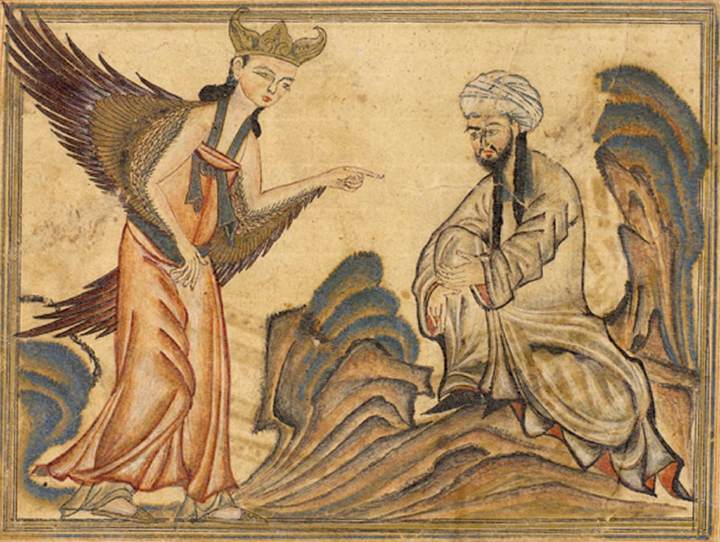
Mohammed_receiving_revelation_from_the_angel_Gabriel

Muhammad receiving his first revelation from the angel Gabriel. Miniature illustration on vellum from the book Jami’ al-Tawarikh (literally “Compendium of Chronicles” but often referred to as The Universal History or History of the World), by Rashid al-Din, published in Tabriz, Persia, (c.1307 CE)

by Fred W. Anson
In the wild world of Mormon Studies “parallel-mania” probably no subject has received more scrutiny and scorn than the parallels between Mormonism and Islam. A lot of ink has been spilled over it and there will, no doubt, be a lot more. I have been as guilty as anyone else in this regard. For example, in a previous article I pointed to the following similarities in support of my thesis that Mormonism is in fact more akin to Islam than Christianity and therefore should drop the pretense that it’s Christian and simply assume it’s place as the Fourth, distinct and unique, Abrahamic Religion:

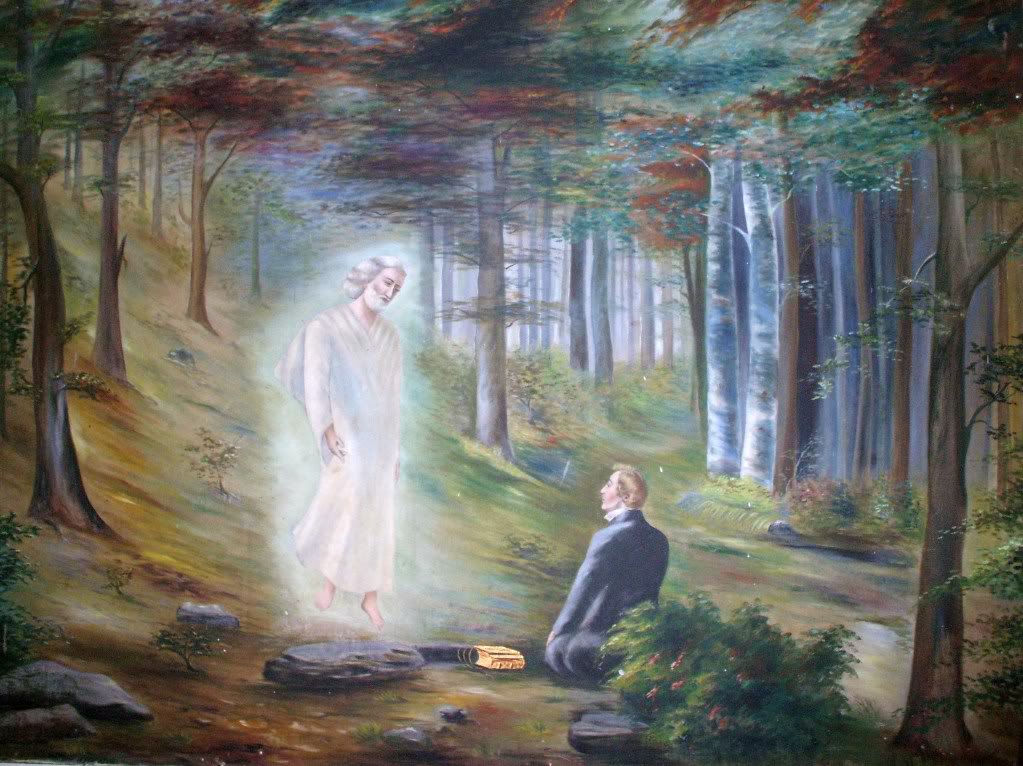
– Both Muhammad and Joseph Smith were reportedly inspired to start their movements by angelic visits.
The Archangel Jibreel (Gabriel) in the case of Muhammad, and the Angel Moroni for Joseph Smith (following a visit Smith claimed to have received from God and Jesus Christ three years earlier). In each event, the angel in question helped to prepare the prophet to receive a series of revelations from God.[1]

– Both Muhammad and Joseph Smith left behind authorized books they claimed to be direct revelations from God, books that their followers accept as Scripture.[2]
The Koran in the case of Muhammad and the Book of Mormon, Doctrine & Covenants in the case of Joseph Smith. The Brighamite followers of Joseph Smith (which is represented by today’s Salt Lake City denomination of Mormonism) later added The Pearl of Great Price which is a compilation of various and sundry revelations and scripture generated by Smith during his ministry.

– Both Muhammad and Joseph Smith were persecuted by hostile locals and later forced to relocate during the formative periods of their careers.[3]
Muhammad from Mecca to Medina, and Joseph Smith from Missouri to Illinois.

– Both Muhammad and Joseph Smith established theocratic city-states during their respective ministries.
Muhammad was invited to take the rule of Medina turning it into a Theocracy, while Joseph Smith would found Nauvoo, Illinois and assumed absolute power as God’s prophet.[4]

– Both Muhammad and Joseph Smith had humble beginnings.
Neither had formal religious connections or upbringing, and both were relatively uneducated. Yet both founded new religions by creating their own scriptures. In fact, followers of both prophets claim these scriptures are miracles since their authors were the most simple and uneducated of men.[5]

– Both Muhammad and Joseph Smith created new scripture which borrowed heavily from the Bible while simultaneously deviating from it.
In his Koran, Muhammad appropriates a number of Biblical themes and characters—but he changes the complete sense of many passages, claiming to “correct” the Bible. In so doing he changes many doctrines, introducing his own in their place. In like manner, Joseph Smith created the Book of Mormon, much of which is plagiarized directly from the King James Bible. Interestingly, the Book of Mormon claims that this same Bible has been substantially corrupted and is therefore unreliable. In addition, Joseph Smith went so far as to actually create his own version of the Bible itself, the Joseph Smith Translation (aka “Inspired Version”) in which he both adds and deletes significant portions of text, claiming he is “correcting” it. In so doing he also changes many doctrines, introducing his own in their place.[6]

– Both Muhammad and Joseph Smith saw themselves as prophesied in scripture, and both saw themselves as a continuation of a long line of Biblical prophets.
Muhammad saw himself as a continuation of the ministry of Moses and Jesus.[7] Joseph Smith saw himself as a successor to Enoch, Melchizedek, Joseph and Moses.[8] Joseph Smith actually wrote himself into his own version of the Bible—by name.[9]

– Both Muhammad and Joseph Smith held up their own scripture as superior to the Bible.
Muhammad claimed that the Koran was a perfect copy of the original which was in heaven. The Koran is therefore held to be absolutely perfect, far superior to the Bible and superceding it. In like manner, Joseph Smith also made the following claim: “I told the Brethren that the Book of Mormon was the most correct of any book on earth, and the keystone of our religion, and a man would get nearer to God by abiding its precepts, than by any other book.”[10]

– Both Muhammad and Joseph Smith, despite their claim that the Bible was corrupt, admonished their followers to adhere to its teachings.
An obvious contradiction, this led to selective acceptance of some portions and wholesale rejection of others. As a result, the Bible is accepted by both groups of followers only to the extent that it agrees with their prophet’s own superior revelation.[11]

– Both Muhammad and Joseph Smith claimed superiority over Jesus Christ.
Muhammad taught that Jesus was just another of a long line of human prophets, of which he was the last. He taught that he was superior to Christ and superseded Him.[12]

In comparison, Joseph Smith also made the following claim:
“I have more to boast of than ever any man had. I am the only man that has ever been able to keep a whole church together since the days of Adam. A large majority of the whole have stood by me. Neither Paul, John, Peter, nor Jesus ever did it. I boast that no man ever did such a work as I. The followers of Jesus ran away from Him, but the Latter-day Saints never ran away from me yet.”[13]

– Both Muhammad and Joseph Smith were polygamists who had many wives.
Muhammad had thirteen (13) wives including his first wife, Khadija bint Khuwaylid. Joseph Smith had at least thirty four (34) wives including his only legal wife, Emma Smith.[14]

Other similarities between Islam and Mormonism
– Belief that good deeds are required for salvation just as much as faith.[15]

– Belief that the text of the Bible, as presently constituted, has been adulterated from its original form.[16]

– Belief that their faith represents the genuine, original religion of Adam, and of all true prophets thereafter.[17]

– Belief that one’s marriage can potentially continue into the next life, if one is faithful to the religion.[18]

– Belief that there are multiple degrees or spiritual levels in heaven.[19]

– Both engage in institutionalized testimony bearing. The Shahada in the case of Islam and the formulaic 5-point Mormon Testimony in Mormonism. 

– Lying to outsiders in order to protect the religion is considered acceptable – even virtuous: The Taqiyya in the case of Islam and “Lying for the Lord” in the case of Mormonism.  

– Belief that a believer’s family, if appropriately faithful to the religion, can join them in the next world, only if they are equally faithful.[20]

– Assertions that modern Christianity does not conform to the original religion taught by Jesus Christ.[21]

– Rejection of the Christian doctrines of Original Sin and the Trinity.[22]

– Absolute prohibition of alcoholic beverages,and gambling.[23]

– Incorporation of a sacred ritual of ablution, though each religion’s rite differs in form, frequency and purpose.[24]

– A “top down” clerical hierarchy that is drawn from the laity and placed into leadership roles, without any requirements for completing collegiate or theological training first.[25]

– Special reverence for, though not worship of, their founding prophet.[26]

–  A continuing history of sects, or splinter groups, who claim to be following the “original doctrine” of the founding leaders and whose practices include violence against dissenters and critics, as well as polygamy. [27]

While these parallels are rather broad and general, Lutheran Pastor Hans Fiene found some surgically piercing parallels from Islamic and Mormon sources, bundled them up, and presented them in an amusing video:

Since they flash by so quickly on the screen during the video, here are those references:[28]

Reestablishing the one true religion
Islam
“Abraham was not a Jew, nor yet a Christian; but he was an upright man who had surrendered (to Allah), and he was not of the idolaters.”
Surah 3:67

“There is no reproach for the Prophet in that which Allah maketh his due. That was Allah’s way with those who passed away of old – and the commandment of Allah is certain destiny – Who delivered the messages of Allah and feared Him, and feared none save Allah. Allah keepeth good account. Muhammad is not the father of any man among you, but he is the messenger of Allah and the Seal of the Prophets; and Allah is ever aware of all things.”
Surah 33:38-40

Mormonism
“My object in going to inquire of the Lord was to know which of all the sects was right, that I might know which to join. No sooner, therefore, did I get possession of myself, so as to be able to speak, than I asked the Personages who stood above me in the light, which of all the sects was right (for at this time it had never entered into my heart that all were wrong)—and which I should join. I was answered that I must join none of them, for they were all wrong; and the Personage who addressed me said that all their creeds were an abomination in his sight; that those professors were all corrupt; that: ‘they draw near to me with their lips, but their hearts are far from me, they teach for doctrines the commandments of men, having a form of godliness, but they deny the power thereof.’”
Pearl of Great Price, Joseph Smith-History, 1:18-19, Joseph Smith

Christians changed the Bible
Islam
“And because of their saying: We slew the Messiah, Jesus, son of Mary, Allah’s messenger – they slew him not nor crucified him, but it appeared so unto them; and lo! those who disagree concerning it are in doubt thereof; they have no knowledge thereof save pursuit of a conjecture; they slew him not for certain.”
Surah 4:157

Joseph Smith
John 1:1 (Joseph Smith Translation)
“In the beginning was the gospel preached through the Son. And the gospel was the word, and the word was with the Son, and the Son was with God, and the Son was of God.”
(Meaning: Jesus is not God)
– versus-
John 1:1 (KJV)
“In the beginning was the Word, and the Word was with God, and the Word was God.”
(Meaning: Jesus is God)

Rejection of the the Trinity
Islam
“And when Allah saith: O Jesus, son of Mary! Didst thou say unto mankind: Take me and my mother for two gods beside Allah? He saith: Be glorified! It was not mine to utter that to which I had no right.”
Surah 5:116

Mormonism
“I will preach on the plurality of Gods… I have always declared God to be a distinct personage, Jesus Christ a separate and distinct personage from God the Father, and that the Holy Ghost was a distinct personage and a Spirit: and these three constitute three distinct personages and three Gods.”
–  “Sermon in the Grove”; History of the Church 6:474, Joseph Smith

“We declare it is self-evident from the scriptures that the Father, the Son, and the Holy Ghost are separate persons.”
“The Only True God and Jesus Christ Whom He Hath Sent”
Jeffery R. Holland (LDS Apostle June 23, 1994-present), General Conference, Fall 2007

“where Latter-day Saints differ from other Christian religions is in their belief that God and Jesus Christ are glorified, physical beings and that each member of the Godhead is a separate being.”
“Godhead”, official LDS Church website

Rejection of justification by grace through faith
Islam
“They surely disbelieve who say: Lo! Allah is the Messiah, son of Mary. The Messiah (himself) said: O Children of Israel, worship Allah, my Lord and your Lord. Lo! whoso ascribeth partners unto Allah, for him Allah hath forbidden paradise. His abode is the Fire.”
Surah 5:72

Joseph Smith
“The sectarian dogma of justification by faith alone has exercised an influence for evil.”
“The Articles of Faith”, James Talmage, (LDS Apostle, 1911-33), pg. 432

Good Works Required for Salvation
Islam
“To those who believe and do deeds of righteousness hath Allah promised forgiveness and a great reward.”
Surah 5:9

Mormonism
“We believe that through the Atonement of Christ, all mankind may be saved, by obedience to the laws and ordinances of the Gospel.”
The Pearl of Great Price, Articles of Faith, article 3

Multiple Levels of Heaven
Islam
Seven Levels: Firdaus, ‘Adn, Na’iim, Na’wa, Darussalaam, Daarul Muaqaamah, Al-Muqqamul, Amin, Khuldi
(click here for supporting evidence from an Islamic source) 

Mormonism
Three Degrees of Glory: Celestial, Terrestrial, Telestial
(click here for supporting evidence from an official Mormon source)

Higher levels of heaven based on perfect obedience
Islam
“Those who spend (benevolently) in ease as well as in straightness, and those who restrain (their) anger and pardon men; and Allah loves the doers of good (to others). And those who when they commit an indecency or do injustice to their souls remember Allah and ask forgiveness for their faults– and who forgives the faults but Allah, and (who) do not knowingly persist in what they have done. (As for) these– their reward is forgiveness from their Lord, and gardens beneath which rivers flow, to abide in them, and excellent is the reward of the laborers.”
Surah 3:134-136

Mormonism
“They are they who received the testimony of Jesus, and believed on his name and were baptized after the manner of his burial, being buried in the water in his name, and this according to the commandment which he has given—That by keeping the commandments they might be washed and cleansed from all their sins, and receive the Holy Spirit by the laying on of the hands of him who is ordained and sealed unto this power; And who overcome by faith, and are sealed by the Holy Spirit of promise, which the Father sheds forth upon all those who are just and true. They are they who are the church of the Firstborn…These are they whose bodies are celestial, whose glory is that of the sun, even the glory of God, the highest of all, whose glory the sun of the firmament is written of as being typical.”
Doctrines & Covenants 76:51-54, 70

Pro-polygamy
Islam
“And if ye fear that ye will not deal fairly by the orphans, marry of the women, who seem good to you, two or three or four.”
Surah 4:3

Mormonism
“And again, as pertaining to the law of the priesthood if any man espouse a virgin, and desire to espouse another, and the first give her consent, and if he espouse the second, and they are virgins, and have vowed to no other man, then is he justified; he cannot commit adultery for they are given unto him; for he cannot commit adultery with that that belongeth unto him and to no one else.”
Doctrines & Covenants 132:61

Change in theology based on political environment
Islam
When politically weak in Mecca: Let’s be friends, Christians and Jews!
“And do not argue with the People of the Scripture except in a way that is best, except for those who commit injustice among them, and say, We believe in that which has been revealed to us and revealed to you. And our God and your God is one; and we are Muslims [in submission] to Him.'”
Surah 29:46

When politically strong in Medina: Die, Christians and Jews, die!
“And kill them wherever you overtake them and expel them from wherever they have expelled you, and fitnah is worse than killing. And do not fight them at al-Masjid al- Haram until they fight you there. But if they fight you, then kill them. Such is the recompense of the disbelievers.”
Surah 2:191

Mormonism
Before wanting statehood for Utah: God says we must practice polygamy!
“I reveal unto you a new and an everlasting covenant [polygamy]; and if ye abide not that covenant, then are ye damned; for no one can reject this covenant and be permitted to enter into my glory.”
Doctrine & Covenants 132:3, Joseph Smith (July 12, 1843)

“It is the word of the Lord, and I wish to say to you, and all the world, that if you desire with all your hearts to obtain the blessings which Abraham obtained, you will be polygamists at least in your faith, or you will come short of enjoying the salvation and the glory which Abraham has obtained. This is as true as that God lives. You who wish that there were no such thing in existence, if you have in your hearts to say: “We will pass along in the Church without obeying or submitting to it in our faith or believing this order, because, for aught that we know, this community may be broken up yet, and we may have lucrative offices offered to us; we will not, therefore, be polygamists lest we should fail in obtaining some earthly honor, character and office, etc,”—the man that has that in his heart, and will continue to persist in pursuing that policy, will come short of dwelling in the presence of the Father and the Son, in celestial glory. The only men who become Gods, even the Sons of God, are those who enter into polygamy. Others attain unto a glory and may even be permitted to come into the presence of the Father and the Son; but they cannot reign as kings in glory, because they had blessings offered unto them, and they refused to accept them.”
– Journal of Discourses 11:268-269, Brigham Young, “Remarks by President Brigham Young, in the Bowery, in G.S.L. City,” (August 19, 1866), bolding added for emphasis

After wanting statehood for Utah: God says we can’t practice polygamy!
“The Lord showed me by vision and revelation exactly what would take place if we did not stop this practice. If we had not stopped it, you would have had no use for … any of the men in this temple at Logan; for all ordinances would be stopped throughout the land of Zion. Confusion would reign throughout Israel, and many men would be made prisoners. This trouble would have come upon the whole Church, and we should have been compelled to stop the practice.”
“Cache Stake Conference, Logan, Utah, Sunday, November 1, 1891”, Wilford Woodruff (4th LDS President), Reported in Deseret Weekly, November 14, 1891

“Inasmuch as laws have been enacted by Congress forbidding plural marriages, which laws have been pronounced constitutional by the court of last resort, I hereby declare my intention to submit to those laws, and to use my influence with the members of the Church over which I preside to have them do likewise.”
– Doctrine & Covenants, Official Declaration-1, Wilford Woodruff (4th LDS President), October 6, 1890 (date of canonization into LDS Scripture)

The pre-existence of souls
Islam
“And when your Lord brought forth from the children of Adam, from their backs, their descendants, and made them bear witness against their own souls: Am I not your Lord? They said: Yes! we bear witness. Lest you should say on the day of resurrection: Surely we were heedless of this.”
Surah 7:172

Mormonism
“And God saw these souls that they were good, and he stood in the midst of them, and he said: These I will make my rulers; for he stood among those that were spirits, and he saw that they were good; and he said unto me: Abraham, thou art one of them; thou wast chosen before thou wast born. And there stood one among them that was like unto God, and he said unto those who were with him: We will go down, for there is space there, and we will take of these materials, and we will make an earth whereon these may dwell; And we will prove them herewith, to see if they will do all things whatsoever the Lord their God shall command them; And they who keep their first estate shall be added upon; and they who keep not their first estate shall not have glory in the same kingdom with those who keep their first estate; and they who keep their second estate shall have glory added upon their heads forever and ever.”
The Pearl of Great Price, Book of Abraham 4:23-26

Mormonism’s explanation for why some people are black, based on the pre-existence:
“There is a reason why one man is born black and with other disadvantages, while another is born white with great advantages. The reason is that we once had an estate before we came here, and were obedient; more or less, to the laws that were given us there. Those who were faithful in all things there [pre-existence] received greater blessings here, and those who were not faithful received less. . . . There were no neutrals in the war in Heaven. All took sides either with Christ or with Satan. Every man had his agency there, and men receive rewards here based upon their actions there, just as they will receive rewards hereafter for deeds done in the body. The Negro, evidently, is receiving the reward he merits.”
“Doctrines of Salvation”, Joseph Fielding Smith (10th LDS President) 1:61, 65-66

Summary and Conclusion
It’s been said that Satan isn’t very original or creative and his best ideas are stolen. And based on the stunning parallels between Islam and Mormonism alone there seems to be some truth to it. In the late 19th and early 20th Centuries Mormonism was often referred to as “The Islam of America” and now you know why.

Joseph Smith receiving the golden plates from the angel Moroni. “The Restoration” by L.A. Ramsey (1873-1941)

NOTES:
[1]
Paul T. Trask, “I Will Be a Second Muhammad”

[2] Wikipedia, “Similarities Between Muslims and Mormons”

[3] Ibid

[4] Ibid

[5] Ibid

[6] Op cit, Trask

[7] John Ankerberg & John Weldon, “The Facts on Islam”; Eugene, OR: Harvest House Publishers, 1998; pp.8–9. Also see Eric Johnson, “Joseph Smith & Muhammad”; El Cajon, CA: Mormonism Research Ministry, 1998; pp.6–7.

[8] Op cit, Trask

[9] Op cit, Ankerberg & Weldon

[10] History of the Church, vol.4, pp.461

[11] Op cit, Trask

[12] Op cit, Trask

[13] History of the Church, vol.6, pp.408–409

[14] See “Muhammad’s wives” and “Remembering The Wives of Joseph Smith”Also note that Joseph Smith, Jr’s FamilySearch.org record contains the names of his polygamous wives. This is particularly interesting since as of the date of writing FamilySearch.org is owned and managed by the LdS Church.

[15] Op cit, Wikipedia

[16] Op cit, Wikipedia

[17] Op cit, Wikipedia

[18] Op cit, Wikipedia

[19] Op cit, Wikipedia

[20] Op cit, Wikipedia

[21] David Van Biema, “What Is Mormonism? A Baptist Answer”; Time Magazine, Wednesday, Oct. 24, 2007

[22] Op cit, Wikipedia

[23] Op cit, Wikipedia

[24] Op cit, Wikipedia

[25] Op cit, Wikipedia

[26] Op cit, Wikipedia

[27] Op cit, Trask

[28] The text that follows was derived from Pastor Fiene, “A Latter Day Re-Gift Quotes” with some additions to the Mormon sources by this author.

BACK TO TOP

duh Introduction: On June 12, 2015 Dr. Roger E. Olson, a professor of Theology at Baylor University and award winning Christian author, published a lengthy article on Mormonism based on his recent experiences and encounters with Mormon scholars at Brigham Young University. While such an article isn’t uncommon, Dr. Olson’s piece was unique in his stunningly abrasive, condescending, dismissive, and even rude treatment of those who attempted to reason him out of the less than fully informed understanding of Mormonism that was manifest in the article. This included not only active Latter-day Saints and Ex-Mormons, but fellow Christian scholars who specialize in Mormon Studies. On June 16, 2015, after several frustrating days of interacting with Dr. Olson, Arthur Sido, a former Mormon who is now a Christian, took the time to write about his experiences. — Editor

by Arthur Sido
A few days ago, one Roger Olson, writing for Patheos, wrote a rather lengthy and largely ignorant post titled: Is Mormonism Christian? (Long But Everyone Interested in Mormonism Should Read This). Patheos often is a breeding ground for aberrant teaching, although some of it is decent. This is not one of the decent ones.

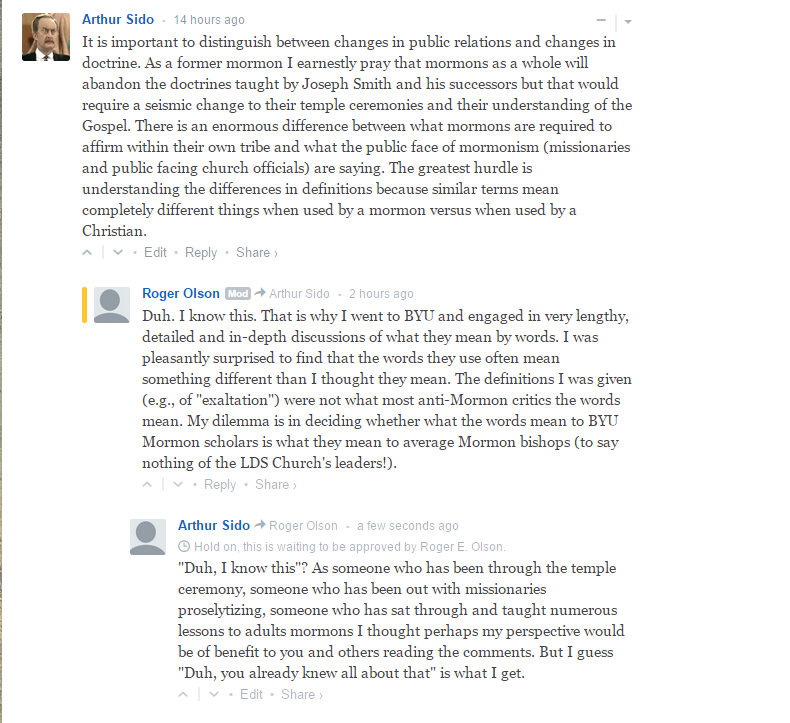
Now at the outset let me say that I know of Olson mostly for his Quixotic tilting at the Calvinist windmill. He is a fountain of trite and demonstrably false quips about “Calvinism” so I wasn’t expecting much. I try to stay out of the Calvinist/Arminian wars as best I can but I simply cannot stomach those who mischaracterize those they disagree with. Dr. Olson may get a wide audience and publish a lot of books but based on his interaction with me and with others who know a lot more about Mormonism than he does, he comes across as a middle-schooler on the playground rather than a serious academic. Please refer to the below screenshot of my published moderator approved comment, his response and my rejoinder. And please note that my rejoinder never made it through moderation (although he seemed effusive in his praise of Mormon comments).

(click to enlarge)

“Duh, I know this”? I didn’t think my comment was “Duh” worthy but there you go. I guess that is what passes for academic discourse these days.

Back to the article itself.

From the get-go the question in the title itself is ridiculous. No orthodox Christian tradition has ever considered Mormonism to be Christian in any sense of the word. You might as well have a post titled “Are lemons made of uranium?”. Any theologian with even a cursory understanding of Christian teaching and Mormon teaching knows that we are not talking about two different flavors of ice cream, we are talking about the difference between a rock and a tree. Also, again as anyone who pays attention realizes, the Mormon religion has changed tactics over the last decade or so, moving away from the prior position of emphasizing how different Mormonism is from Christianity to trying to soften the public face of Mormonism to emphasize the alleged similarities. I don’t even know if a lot of younger Mormons realize how much the alleged great apostasy and the vitriolic way that Joseph Smith describes “Jesus” speaking about orthodox Christianity is foundational to their religion. It is all P.R., as the response to LDS teachings becomes more widely disseminated thanks to the internet and their aberrant teachings more clear in the public square, Mormons have had to change tactics to keep bringing in the converts. Olson seems to blithely accept that Millet is in the vanguard of the change in Mormonism to become more orthodox. That is a wonderful idea but it is impossible. Every aspect of Mormonism, from the “prophet” who claims direct revelation from Christ to the temples where pagan ceremonies are held to every bit of the Mormon proselytizing machine would have to be torn down. My fervent prayer is that Mormons as a people leave Mormonism and come to saving faith in Christ but I have no hope for orthodox reform of the religion itself.

BYU Professor Robert Millet

BYU Professor Robert Millet

Second, Olson may consider Millet to be his buddy but Millet has no authority to speak for Mormonism. When the current “prophet” declares that Joseph Smith was a liar, as he was, and that the “Book of Mormon” is a fraud, which it is, and that the teachings of all of those who came before Monson and claimed the title of “prophet” were also liars and deceivers, then we can cheer their progress. Until then this is all just a bunch of smoke and mirrors.

Third. Here is the thing about false prophets and wolves. They lie. It is kind of what they do. I don’t know Millet but I imagine that someone that deep in the Mormon hierarchy and with the ear of many top Mormons has to know that what they teach is untrue. He has to. So his continued defense of mormonism, nuanced as it may be, is tantamount to lying and false teaching. He is a wolf, not a slightly confused Christian.

Fourth, Olson’s response to fellow Christians often seemed (as shown above) to be arrogant, juvenile and downright nasty. His use of the term “Anti-Mormon” to describe those who have been doing the heavy lifting of witnessing to Mormons while he hides away in his ivory tower is insulting and childish. I got a chuckle of out the statement he made on his follow-up post, , where he states:

This blog is for civil, respectful, constructive dialogue, not preaching, flaming or advocacy.

Ah, I see. Maybe where Olson comes from “Duh, I know this” qualifies as “civil, respectful, constructive dialogue” but it doesn’t where I am from.

Olson’s final paragraph is his follow-up post, What I Learned from the Responses to My Post about Mormonism tells you everything you need to know.

On the other hand I do not consider the LDS Church a cult. I consider it a quasi-Christian denomination and a Christian-based world religion. I still think there is enough Christianity in Mormonism that there is reason to hope that someday the LDS Church will emerge, as the WCG [Worldwide Church of God] did, as a truly Christian denomination.

Dr. Roger E. Olson

That kind of says it all. In one fell swoop he discounts the cultic behavior that left scars on virtually everyone I know that left Mormonism, myself included. I know of families that are divided and devastated by this cult. I know first hand the cultuc tactics used to scare people into staying in line. On top of this he sees “enough Christianity” in Mormonism and sees it as a “Christian-based world religion”. In what possible way? Taking aside some common terminology with a different meaning, which Roger “Duh, I know this” Olson claims to understand, there is not one shred of Christianity in Mormonism. None. It is a polytheistic, pagan religion more akin to Islam than to Christianity. Trying to find common theological ground with Mormonism is like trying to find common theological ground with ISIS. That is not an exaggeration.

Dr. Olson is not doing anyone any favors with his kid gloves approach to Mormonism coupled with his pompous treatment of fellow believers. Hopefully someone with more time on their hands can disassemble his posting for the benefit of the church because Roger Olson has done Christianity and those trapped in Mormonism an enormous disservice.

ABOUT THE AUTHOR
Arthur Sido is a husband of one and the father of eight in Fort Wayne, Indiana. He and his wife are homeschoolers and amateur small scale farmers. A convert in adulthood to Christianity, he has a particular interest in how Christians gather as the church and the ways that our cultural assumptions impact the manner in which we meet. Describing himself as a Particular Anabaptist, his goal is to get Christians to look beyond “church as we know it” so that the church can focus on equipping believers and sending them out to the world. Mr. Sido is also a former member of the Church of Jesus Christ of Latter-day Saints. 

black sheep2(this article was originally published on the author’s “The Voice of One Crying Out in Suburbia” website, on Tuesday, June 16th, 2015. It is republished here with permission and has been very lightly edited.)

APPENDIX: The Fallout
by Fred W. Anson
The day after the above Arthur Sido article published (that is, June 17th, 2015) Roger E. Olson published a letter from Robert Millet in which Dr. Millett corrected him on some key points. Here are some excerpts:

…we have no desire to become a part of mainstream Christianity. We do want to be better understood and appreciated for what and who we are, but we are not traditional Christians and have never claimed to be. We do in fact see ourselves as Christians with a difference. Mormonism professes to be restored Christianity, and its adherents believe that God has chosen to restore the fullness of the gospel of Jesus Christ through a modern prophet, Joseph Smith, and that the divine priesthood authority he received—the power and authority to act in the name of God, apostolic authority—has continued in rightful succession to modern apostles and prophets within The Church of Jesus Christ of Latter-day Saints today.

… you seem to have gotten a false impression of my view of the Lorenzo Snow couplet, the notion that “As man is, God once was; as God is, man may become.” I do accept fully as doctrinal the latter part of the couplet, since deification is definitely a part of LDS theology. I do not know very much at all about the first part, and it is not in fact something the Church or its leaders speak of very often.

Further, on the same day (June 17, 2015) the Baptist Standard website picked up on Dr. Olson’s article, loudly proclaiming “Mormonism moving closer to Christianity, Truett prof observes” in the headline. The article concludes with the following quotes from Dr. Olson:

“There is no doubt in my mind but that something is going on in the LDS Church and Mormonism in general that constitutes a gradual but discernable [sic] shift away from those doctrines most anti-Mormon Christian critics like to highlight toward a somewhat more biblical and even evangelical account of Christ and salvation,” he said.

Based on that shift, Olson said: “I can envision someday the LDS Church evolving into a Christian denomination. For now, though, I consider it an alternative religion rooted in Christianity but also rooted, unfortunately, in Joseph Smith’s and Brigham Young’s fantasies.”

Say it with me: “Damage done!”

But, if that weren’t enough, a day later (June 18, 2015), in his typical, “It’s my world – you little people just live in it!” manner, Roger E. Olson issued the following public statement on his blogsite:

Please note that I closed the discussion of Mormonism yesterday. The response to my and Robert Millett’s essays were so voluminous and lengthy that I simply do not have time to moderate that discussion anymore. I think virtually everything that can be said was said by someone. If you are interested in the subject, read the books I recommended in my initial post about Mormonism and Christianity. If you attempt to comment here about Mormonism you will be wasting your time. I will not approve such comments. I have approved many of all kinds already. The subject is closed (here) for now. Thank you.

And that was the last that the world has heard from Dr. Roger E. Olson on the subject of Mormonism – hopefully, it will stay that way for a good, long time. Frankly, forever would be nice in this author’s opinion.

MRM_CropBut this story isn’t quite done yet, there’s still the fallout to deal with. Starting on June 29th and running until July 10th, 2015, Mormon Researchers Bill McKeever and Eric Johnson devoted an audio series to deconstructing and analyzing Dr. Olson’s article on their “Viewpoint on Mormonism” podcast/radio program. This series represents the most thorough, and evidence driven analysis of the flaws and problems with Dr. Olson’s article done to date. Here are the direct links to the shows: Part OnePart TwoPart ThreePart FourPart Five, Part Six, Part Seven, Part Eight, Part Nine, Part Ten.

I was particularly encouraged by the fact that Bill McKeever – who is one of the most objective, even keeled, dispassionate, and even toned Christian scholars in Mormon Studies that I know of – confessed throughout the series that he was having a great deal of trouble governing, his passion and frustration in regard to the arrogant tone and rookie mistakes in Dr. Olson’s Mormon Studies work.

“So why all the animus toward Dr. Olson?” one might ask – and it’s a valid question. As stated in the introduction and Mr. Sido’s piece, Dr. Olson’s article and the discussion board behavior that followed was extraordinary in the level of pomposity, condescension, and rudeness that he displayed toward those of us who were already embedded and engaged in Mormon Studies before he arrived on the scene. Many of us have years, even decades, of study and first hand experience with Mormon culture, history, and religion. Some (including many who were in the Mormon Church at the time) have even lived through events in Mormon history that Dr. Olson can only read about now.

And while the other Evangelical scholars (like Richard J. Mouw, Gregory C. V. JohnsonGerald R. McDermott, Craig L. Blomberg and others) who have participated in Robert Millet’s past joint Mormon/Evangelical academic sessions at BYU have occasionally criticized other Christians in Mormon Studies, they have never shown the level of hamfisted ineptitude coupled with over the top contemptuous disrespect of fellow Evangelicals that Roger E. Olson did.[1] Stated plainly, Dr. Olson seems to have a real knack for alienating friend and foe alike!

For example, I would ask the reader to scroll through the comments underneath Dr. Olson’s article and ask yourself this question: “Why are there so many rebuttals to Dr. Olson’s comments but very few rejoinders?” The answer is simple: When it comes to public discourse Dr. Olson doesn’t play fair. It didn’t take long for those of us who responded to the article to figure out that Dr. Olson had a preferred narrative that he was looking to push. As a result, countering evidence and arguments which didn’t support his agenda were simply deleted. It didn’t matter how cogent, empirically valid, or within board guidelines they were, they just got “nuked”. And, you will notice, that in just about every discussion thread Roger E. Olson gets the last word – that, dear reader, is no coincidence.

Arthur Sido has already provided some examples of this in his article, but let me supplement with one of my own. I submitted this rejoinder for moderator approval on June 13, 2015:

Q: “What do you make of Bob Millett’s claim–to me [Roger E. Olson] directly–that he has the full support and backing of the LDS Church leadership including its president?” [this quote is clipped from Dr. Olson’s rebuttal (which he has since deleted) to the only comment that I had approved by him. Click here to see my approved comment.]

This is no secret, it’s well known in Mormon Studies circles that several years ago Dr. Millett was missioned by Mormon leaders with acting as an Ambassador to mainstream Christian churches and other outside organizations to convince them that the Mormon Church is Christian. His involvement with Greg Johnson’s “Standing Together” as well as his other private efforts with Evangelical Scholars has been the net result.

So, yes, he certainly has the full support and backing of the Brethren, up to and including the First Presidency to engage with outsider scholars. However, this is a non-sequitur since, as previously stated, he and his BYU colleagues, “don’t interpret official doctrine, they don’t define LdS orthodoxy, they don’t dictate LdS Church policy and they have exactly no “Priesthood Authority” over those who do.” They could articulate a systematic theology that’s fully orthodox with historic Christianity and it would still mean nothing.

In fact, don’t be surprised if Dr. Millett arranges private meeting with high ranking Mormon leaders (typically Jeffrey R. Holland, sometimes Dieter F. Uchtdorf, sometimes others) for you where they will reiterate their support for his efforts to your face while behind your back and after you leave absolutely nothing changes.

Further, as I pointed in the aforementioned article Dr. Millet has proven to be less than fully reliable and trustworthy:

“BYU Professor, Robert Millet, who is featured prominently throughout the book, has regularly been “caught in the act” [that is, spin doctoring and lying in his exchanges with outsiders]. Numerous examples could be cited for Mr. Millet but probably the most dramatic example was his presentation to a group of LdS Missionaries preparing for their 2-year mission in which he coaches them on “how to handle anti-Mormon criticism”

(link to referenced video removed to comply with board policy)

In this video Millet speaks about how to handle the tough “anti-Mormon” questions missionaries may face while on their missions (or afterward) using tactics like: “We never provide meat when milk will do”, in other words obfuscation; “We seek to answer any serious question by finding the most direct route to the Sacred Grove”, in other words redirection; “Don’t answer the question they ask, answer the question they should have asked”, in other words deflection. And while we’re not privy to the private sessions between Mouw and Millet’s “teams” it seems reasonable to expect that the Millet team engages in such tactics.”
(see Fred W. Anson, “Scolasticus cum Peter Principle”; Beggar’s Bread, August 13, 2012)

As the saying goes, “the proof of the pudding is in the tasting” and while Evangelical Scholars may be enamored with the flurry of activity with BYU Scholars in Provo the fact remains that NOTHING has changed, or is changing in Salt Lake City in terms of official, correlated Mormon doctrine. Even the two case studies that typically get cited here – Dieter Uchtdorf’s, “The Gift of Grace” Spring 2015 General Conference address, and BYU Professor Brad Wilcox’s, “His Grace Is Sufficient”, Ensign, Sept. 2013) when carefully considered are nothing more than the same old, same old conditional grace and works intermingled with Evangelical sounding language to make them appear more mainstream Christian.

So Robert Millet can hold a million interfaith meetings and seminars at BYU but ultimately until we see change in the official, correlated doctrine coming out of the Church Office Building in Salt Lake City it means nothing.

(Please note that the embedded links that I’ve provided here for the reader’s convenience were not in the rejoinder that was submitted for moderator approval in accordance with Dr. Olson’s board guidelines)

Another Roger Olson tactic that’s invisible to the public is how he privately antagonizes and insults respondents by putting up snide moderator responses to comments submitted for moderation. In other words, he has found a shrewd and creative way to create something like a hidden chat tool that only the commenter and he, the moderator, can see. Unfortunately, rather than using this tool for good, he uses it for private bludgeoning, insults, and other forms of behind the scenes bullying. So after a few rounds of seeing this pattern I started responding to him in kind using the same technique. Here’s an example from June 14, 2015:

I find it interesting that I’m being accused of being cynical by the man who won’t post rejoinders that present an opposing view – even if they’re within board guidelines.

I would say that any cynicism regarding Robert Millet and these interfaith discussions was validated by your behavior yesterday Mr. Olson.Clearly there’s something wrong here.

So I’ll just leave you to the manipulative and deceptive agenda driven public monolog and private censorship that appears to be your standard Modus Operandi.

In short, I expect to see this post and any others that don’t fit your agenda, or that can’t be used to make the commenter look foolish, deleted.

My Approved Comment

“the only comment that I had approved by him”
(click to enlarge)

The last tactic that Dr. Olson engages in has already been hinted at: He selectively deletes comments – even his own comments – after they’ve publicly posted if they no longer suit his purpose. Thus, there is no guarantee that a comment that was approved in the morning, will still be there the same hour, afternoon, evening, day, week, or month. Nothing is certain and everything is subject to change at any time.

Apparently, in Dr. Olson’s mind the comments section of his blogsite isn’t really a public forum, or open exchange of ideas – rather it seems to be his sandbox for building, modifying, and promoting his preferred stance and/or narrative regarding the subject. For example, to the right you will see a screenshot of my aforementioned “only comment that I had approved by him”. Originally, this comment had several responses underneath it – including at least one by Dr. Olson himself. These posts had been moderator approved and could be seen and read by the viewing public.

If you click on this live link you will notice that conspicuous in their absence are all those comments. Yes, they’re gone, Roger E. Olson deleted them all after the fact for reasons known only to himself. In true Orwellian fashion they have gone down the “memory hole” forever. Of course no casual reader would see any of this as the overriding public agenda for this particular blog article seemed to be to make Dr. Olson look like the adult voice of reason in the midst of unruly and less enlightened children. The private agenda, like that of most bullies, seemed to be another matter entirely.

In a nutshell and in conclusion: Scheming, deceiving, manipulative, censoring, spin doctoring, Christian slandering, Mormon pandering, white washing, propagandizing, verbally abusing, condescending, arrogant, myopic, agenda pursuing, pompous, overbearing, and bullying. These are all the descriptors that I and many others have used to describe Dr. Roger E. Olson’s online behavior. Frankly, his absence from Mormon Studies won’t be missed. But should he ever reenter the arena, we will be waiting. And this time, since we know what to expect now, we’ll be ready for him.[2]

NOTES
[1] Craig L. Blomberg may be the exception here. While I am personally unacquainted with the incidents, in the July 9, 2015 Viewpoint On Mormonism broadcast Bill McKeever references two occasions where Dr. Blomberg has made disparaging remarks similar to those of Dr. Olson’s. As Mr. McKeever notes in the broadcast, the lowest common denominators in both of these cases is that they are Christians scholars who rely on Robert L. Millet as their primary source of information regarding both the modern Mormonism being pandered to as well as the Christian Mormon Studies scholars being slandered.

Mr. McKeever terms this form of argumentation “Pander/Slander” and references the Institute of Religious Research’s Ronald V. Huggins‘ well known article, “An Appeal for Authentic Evangelical-Mormon Dialogue” which documents it. In light of the events documented in this article, Dr. Huggin’s article is highly recommended reading.

[2] And it turns out that we won’t be alone in being ready for Dr. Olson – his reputation for engaging in “monolog not dialog” is well known. Calvinists discovered this in 2011 after the release of his book, “Against Calvinism”. On his “Radio Free Geneva” radio show Dr. James Whites describes the same tailoring of a preferred narrative via manipulative online tactics, censorship, misrepresentation of facts, and arrogant condescension toward knowledgeable Christians who try to reason with him. It appears that we are merely seeing history repeat itself. Here are the links to those “Radio Free Geneva” radio shows:

Radio Free Geneva: Roger Olson’s “Against Calvinism” Reviewed (Part 1)
Radio Free Geneva: Roger Olson’s “Against Calvinism” Reviewed (Part 2)

Perhaps it goes without saying that these videos are both very enlightening and highly recommended. While the subject wasn’t Mormonism it still explained a lot about Dr. Olson’s methods and means in general.

BACK TO TOP

Inside the Utah State Capitol building

Inside the Utah State Capitol building

by Carl Wimmer
The Church of Jesus Christ of Latter-day Saints just passed a pro-LGBT piece of legislation in Utah.

Does that sound odd to you? It does to me, but it is essentially true.

For years, there have been those in the Utah legislature who have pushed for statewide legislation that would prevent businesses and landlords from prohibiting homosexuals from working at their business or renting a home from them; they called it a “statewide anti-discrimination” bill.

And for years the legislation failed.

Year after year the bill sponsor would bring the bill forward simply to have it die before it got off the ground, but this year was different. This year the most powerful entity in the state of Utah, the LDS Church, endorsed the legislation.

This year the legislation passed.

Having served in the Utah legislature, I have been asked several times what role the LDS Church really plays when it comes to Utah politics, and until now I have remained largely silent. While in the legislature I was a faithful member of the LDS Church; to speak of things that might bring embarrassment to the church would have been unwise, not to mention political suicide. Today, the issue is very topical with the recent passage of the pro-LGBT legislation, and I feel it is time to break the silence and provide some insight.

Carl with LDS Apostle L. Tom Perry; 2011 at Dulles Airport

Carl with LDS Apostle L. Tom Perry; 2011 at Dulles Airport

To be absolutely fair, they rarely want things badly enough to engage openly.  The church is very selective regarding the legislation they engage.  This is due to the fact that because most of Utah’s legislators are LDS members, the majority of legislation already aligns with the LDS Church position without their influence.  During the three terms I served in the Utah House of Representatives, I was only approached twice by the LDS lobbyists for a vote.A common question from people is whether or not the LDS Church leadership gets whatever they want when it comes to Utah politics, and the answer is a resounding, “Yes; if the LDS Church wants something in Utah politics, they get it.”

John Taylor and Bill Evans are full-time employees of the LDS Church and their job is to monitor the Utah Government, and to act as the paid lobbyists on behalf of the church. They regularly meet with legislators behind closed doors, (as do other lobbyists, this is nothing nefarious or unusual,) to push the agenda of their employer.

When the LDS lobbyists contact a legislator, the conversation goes like this:

We are here to discuss such-and-such bill. We have received our orders “directly from the top,” and we want you to vote for this bill.

They mention that they received their orders “from the top,” so that the legislator would know unequivocally that the LDS Church’s First Presidency sent them.

The first piece of legislation they contacted me about dealt with alcohol. For better or worse, it is an unarguable fact that legislation regarding alcohol never gets passed without the express consent of the LDS Church. They control all changes to the state alcohol laws.

In 2008, SB 211 was proposed to remove “flavored malt beverages” from grocery stores and place them for sale in state liquor stores only. The day the bill was to be heard in the House of Representatives, I was summoned to the hall, where I was met by the LDS lobbyists. They gave me the “from the top” introduction, and then asked me to support the bill. I told them no. Although not a drinker, I simply could not bring myself to take a profit-producing legal product out of the hands of private business owners and give it to the state to sell. It was wrong then, and it is wrong now.

Keep in mind, that in 2008 I was a faithful Mormon with a current temple recommend, and had only recently been released from my LDS leadership position as an Elders Quorum President. To tell my church leaders “no,” was anathema to how I was raised. As I turned to walk back into the chambers, one of the lobbyists said to me, “Don’t worry, voting against us will not affect your church membership status,” I was relieved.

SB 211 passed.

President George W. Bush (right) meets with the leadership of The Church of Jesus Christ of Latter-day Saints during his visit to Salt Lake City. Seated clockwise are: the late Gordon B. Hinckley, President; Thomas S. Monson, First Counselor (obscured); James E. Faust, Second Counselor (obscured), and F. Michael Watson, Executive Secretary.

President George W. Bush (right) meets with the leadership of The Church of Jesus Christ of Latter-day Saints during a visit to Salt Lake City in 2006.

Learning how powerful the LDS Church was politically, several pro-life legislators and I set up a meeting in my office with the two LDS Church lobbyists. Our intention was to recruit the LDS Church in the battle for the right-to-life.  For weeks we had worked on legislation that would prove to make Utah the leader in the fight against abortion.  We presented our idea and expressed our eagerness to have the LDS church help in the fight to pass a bill that had failed the year before. They turned us down flat, telling us that “the First Presidency has made it clear to them that they will not engage on abortion issues.”

We asked them why they had come out so strongly on alcohol use, but would not engage in the fight for the life of a baby. And in what can only be described as a brief, unguarded moment, the head lobbyist expressed his confusion as to the apparent misappropriation of priorities, but they stuck to their guns.

Then came 2011; the year my rose colored glasses regarding the LDS Church got scratched a bit.

HB116 was an extremely controversial bill dealing with illegal immigration and proposed issuing state worker cards to illegal immigrants. For at least two weeks prior to the final passage of HB116, the two church lobbyists practically lived in the back halls of the state capitol and in the office of house leadership. I was vocally opposed to the legislation, but was still contacted repeatedly by both lobbyists who attempted to change my opposition. The calls became frequent enough from the LDS Lobbyists, that I stopped taking them.

What bothered me most was when my local ecclesiastical leader contacted me and attempted to persuade me to vote for the bill as well. When I asked him, “Who from the Church headquarters had asked you to contact me?” he simply confirmed that he had been asked, but would not say by whom.

The night HB116 was debated for final passage was insane. There was intensity I had never felt before or after on the house floor. It was the intensity that comes only from political bullying, and it killed me to know that this time the “bully” was my own church.

I was approached by a younger representative who was on the verge of tears. He expressed to me that he had just gotten out of a “PPI meeting” and asked if I had had mine yet.  I knew what he meant and I was sorry for him.

My-First-Temple-Recommend-517x268-N13ACA3-alt

A Personal Priesthood Interview

A legitimate “PPI” or “Personal Priesthood Interview” is conducted within the confines of the LDS Church. It is an ecclesiastical meeting between an LDS leader and a male member under their “authority.” When I was an Elders Quorum President, I held PPI’s with the elders under my charge.  A PPI is used to check on the spiritual welfare of the man being interviewed, and to make sure they are on the “straight and narrow.”  But that is not what this legislator meant…

What he had just experienced was an intense, closed-door meeting with select members of house leadership and the LDS Church lobbyists who made it abundantly clear that when HB116 came up for a vote, he was to support the bill, period.

Sometimes, if the legislator felt strongly enough about the legislation, they would allow him to vote against it, but ONLY after the bill had the necessary votes recorded to ensure passage.  This was the deal this particular representative was under, and both he and I knew it. He was clearly shaken and expressed that he had no idea that his “church would do this kind of thing.” I hurt for him.

House leadership was split on HB116, so when I saw a member of house leadership who I knew was opposed to the bill walk onto the house floor, I went up to him and engaged him in conversation. The following is our word-for-word conversation:

Me: Hey, (name of House leader) how much of what is going on tonight regarding HB116 has to do with the LDS church?

Him: All of it; I hate this.

Me: It’s going to pass isn’t it?

Him: Yes, and in fact if the vote is close, I have to vote for it, I have no choice.”

Me: You had a PPI?

Him: Yep…(walks away).

HB116 passed as the LDS Church lobbyists looked on from the gallery.

I was not in the legislature this year, but the look and feel of the passing of HB116 and the current non-discrimination bill are quite the same. One can only guess how many legislators had “PPI’s” before the vote on the church-endorsed LGBT legislation, but there is no doubt in my mind, that as legislators read this blog, one or more of them will know precisely what I am talking about.

So, what role does the LDS Church really play when it comes to Utah politics? From my experience, it all depends on how badly the church wants a specific piece of legislation passed.

LDS Church President Thomas S. Monson's office in the Church Office Building.

Inside President Thomas S. Monson’s office in the LDS Church Office Building.

ABOUT THE AUTHOR
Carl Wimmer is a former member of the Utah House of Representatives. He resigned from Utah’s legislature in 2012 to run for the United States House of Representatives.  Wimmer was born in 1975 in Salt Lake, Utah. He was raised in Herriman, Utah. He attended Utah Peace Officer Standards and Training and Salt Lake Community College, and is currently working towards his B.A. In Religious studies at Liberty University. (source Wikipedia)

blog header(this article was originally published on the author’s “An American Dream Revealed” website, on Thursday, March 19, 2015. It is republished here with permission.)

An ongoing series of articles on some common and recurring weak arguments that Christians make against Mormonism.
by Fred W. Anson

(c) Mr Russell Falkingham; Supplied by The Public Catalogue Foundation

Leslie Cole, “Scorched Earth: Devastated Rubber Plantations” (1946)

“I find myself too often saying about a lot of Christians, ‘I agree with everything you say, but I disagree with the way you’re saying it. There’s a way of saying things that is redemptive and loving and there’s a way saying things that’s not redemptive and loving.’”
Dr. Richard Land
Public spokesperson for the Southern Baptist Convention in “Us and Them”

Introduction:
While we were preparing for this series we took careful note of the weak arguments, bad behavior, and counter productive debating tactics we saw some Christians using in their public engagement with Mormons. Those deserving of deep analysis became full articles, the rest went onto a special “grass catcher” list which I now present to you for your consideration:

How to Make Weak Arguments Against Mormonism:

  1. Be condescending and disrespectful. These people are obviously blind fools, make sure that they and the whole world knows it by talking down to and sneering at them. After all wasn’t the Apostle Peter just offering a suggestion rather than a mandate when he said: “But in your hearts revere Christ as Lord. Always be prepared to give an answer to everyone who asks you to give the reason for the hope that you have. But do this with gentleness and respect,” (1 Peter 3:15 NIV italics added)[1]
  2. Don’t back up your arguments with easily verifiable evidence. After all, everyone should just change their beliefs based on just some stranger’s claims and opinions alone, right? Wouldn’t you? Who needs supporting evidence?[2]
  3. “Link bomb” them. That is, copy and paste just the links to evidence rather than carefully selecting and citing the relevant content from those sources and then providing the link so it can be verified.  In other words, make ’em work hard to disabuse themselves of their wrongheaded beliefs! After all, isn’t it their job to prove your point for you by digging, mining and sifting through the mountain of words that you’ve so generously brought to their attention? Let them find their own gold like you did – it’s in there somewhere, right? Besides, reading, listening, watching, transcribing, and citing is just such hard, time comsuming work – link bombing is so much easier! Doubt me? Boom! http://newyork.cbslocal.com/2013/08/01/survey-finds-internet-makes-people-rude-new-yorkers-agree/ You’re been link bombed! (That was easy)
  4. Speak in absolute and authoritative tones on subjects that you’re ignorant or uninformed on. Better yet do it on the Internet so that a worldwide audience can benefit from (or be entertained by) your “insight!” As the ancient proverb says so well, “Fools have no interest in understanding; they only want to air their own opinions.” (Proverbs 18:2 NLT)
  5. Tell Mormons to “look it up!” rather than serving them by providing the relevant information for your argument. Yes, that’s right, don’t provide a web link, a citation or any other verifiable evidence – why should you? They have eyes, don’t they! They have brains, don’t they? Of course, they’ll rush right out and do it – right? Isn’t that what you do when other people do this to you? Hey man, 99.9% of those surveyed do! It’s true! Look it up.[3]
  6. Just get right up on that Christian soapbox and set ’em straight! Preach Christian preach! After all, all you should need to do is speak the truth, right? So give to ’em with both barrels with all the best Christianese you know! Why do you need to learn anything about them or their heretical beliefs first? Just declaring God’s good truth should be enough shouldn’t it? In fact, wouldn’t taking an interest in and learning their heresies just validate them and keep them in error? Don’t lower yourself to the level of heretics and blind men – rather, preach Christian preach! Your fellow Christians will slap you on the back and praise you while all the befuddled Mormons are slowly walking away shaking their head wondering all that incomprehensible shouting was about. Mormons are just so blind and deceived aren’t they?[4]soapbox
  7. Only cite from Mormon Critics rather than Mormon friendly sources. After all, if it’s “Mormon Friendly” it must be enemy propaganda, right? All Mormons know how to do is lie and deceive anyhow, right?[5]
  8. Assume that the underlying meaning of the terms that you and Mormons use are the same. And whaddaya know! We use the same words, we must both be Born Again Christians! Who knew?[6]
  9. Give citations without providing the source so it can be verified for accuracy. Oh, and never make it easy by providing a web link to the source! Just throw it out – your word alone should be sufficient, right? By the way, did you know that the Eustace Scrubb character in C.S. Lewis’ “The Chronicles of Narnia” was Mormon? Yep, it’s true![7]
  10. Frame your arguments in outsider Christian language rather than insider Mormon language. So what if it’s like speaking in a foreign tongue to them? Hey, just yell that Christianese LOUDER, slower, and longer like a tourist on vacation in a foreign land. They’ll get it eventually! After all, they can always watch your hand signals right?  Oh yeah, about that that hand signals thing when it comes to the internet . . . [8]
  11. Make sure that you never, ever enter a Mormon building like a Ward Building, Chapel, Stake Building, Temple tour, or Church Museum – you might get Mormon cooties or become demon possessed! After all, you can learn everything you need to know by talking to your Mormon neighbor over the backyard fence – they’re all experts on their faith and always represent their theology and practices as accurately as today’s Christians do theirs.[9]
  12. Never attend a Mormon Service or meeting (especially a Fast & Testimony meeting) lest you experience their culture first hand. Empathy is of the devil! Stay in dark ignorance regarding what really happens inside Mormon services so you can get it all wrong whenever you talk about those services. After all, you love it when Mormons make incorrect statements about what goes on in our services don’t you?[10]
  13. Treat antiquated Mormon sources as if they have as much weight and authority as modern official sources. Make sure you regularly quote from “The Journal of Discourses” and McConkie’s “Mormon Doctrine” as if they’re equivalent to today’s correlated manuals and literature. And if they object, they’re just uninformed about what their church really believes and teaches aren’t they?[11]
  14. Never concede well made arguments and credible evidence from Mormons. You must never, never, never yield an inch! After all this is war! Never give in and never surrender![12]
  15. Use derogatory, insulting terms like MORmON, Joseph’Smyth, Profit (instead of “Prophet”), TSCC (The So Called Church), Jo$eph $mith, Bring’em Young, Breed’em Young, Thoma$ Mon$oon, etc. Or go back in time and use the old 19th Anti-Mormon prejorative terms like “Joe Smith”, “Mormonites”, “Golden Bible”, etc.  Conversely, you can merge current popular culture with Mormonism and invent new perjovatives like, “Morg” (Star Trek reference that blends “Mormon” with “Borg”), “Joseph Sith” (Star War reference that suggests that Joseph Smith was an evil Sith), “Darth Monson” (another Star Wars reference there), etc. The more condescending, offensive, and degrading the better – that way it’s clear whose side you’re really on, and of course, that true believing Mormons are stupid idiots who all deserve just what they’re going to get at the great judgment![13]
  16. mormon-meme-generator-and-i-m-a-mormon-7c56a8

    An Internet meme designed to make Mormons look stupid – and this is one of the kinder ones.

    Create and use insulting Internet memes and graphics. Everyone loves getting insulted – be the Don Rickles of Mormon Studies, they’ll love you for it. After all, don’t you just love those angry atheist memes that insult and belittle Christians? They just make you want to run out and become an atheist in the worst way, don’t they?

  17. Mock the LdS Temple Endowment ceremony. After all it’s sacred and stupid right? After all one can surely have meaningful conversation with someone’s back as they’re walking away, right? The fact that the endowment ceremony is an off-limits, “nuclear” subject in Mormon Culture is their problem not ours!
  18. Refer to Temple Garments as “Magic Mormon Underwear.” Let ’em them know how stupid and silly they really are! Better yet, wear them in public while donned in a gorilla’s mask, burn them, deface them, stomp and spit on them if you can.[14] After all, Christians never get upset when outsiders do that to clerical vestments, choir robes, or crosses do they?
  19. Show no empathy or understanding for the incredibly high price Mormons must pay for leaving the LdS Church. Hey man, it’s as easy as changing churches right? What’s the big deal? I mean Presbyterian to Baptist to Charismatic to Catholic to Lutheran and then back again – easy, peasy, there’s never much of a price to pay is there? Oh you lost your wife and family when you left the Mormon Church? And your job too? And you’re being shunned by your own family? Now that’s just downright weird isn’t it?[15]
  20. Use a lot of cliches, platitudes, and Christian folklore rather than anything of substance. In other words, use exactly the same kind of thought and emotional control tactics that Mormons use when engaging outsiders. It will really bless them, so they feel the anointing on you when you get out your “sword” and give them the word. Or, better yet, tell them about that angel encounter or Near Death Experience (NDE) that you heard about on Christian TV last week. Get right or be left man, because inch by inch life is a cinch, yard by yard life is hard – it’s in the Book!
  21. Appeal to feelings rather than intellect – after all, it worked so well in getting and keeping them in Mormonism? Maybe lightning will strike twice, so have them read the Bible and pray about if it’s true or not . . .[16]
  22. Hyper-spiritualize everything. For example, rather than using even toned language and verifiable evidence against Mormonism make statements like: “Mormonism is a demonic religious system which has led millions to hell”, or “Mormons are all  demon possessed, under the influence of deceiving spirits”, or “The Lord showed me that Mormons will be key leaders in the Antichrist’s one world government – Mitt Romney is just the beginning”, etc. Of course since none of this can be objectively proved or verified it really just pits two competing belief systems, religious cultures, and value systems each other. To transitioning Mormons this just demonstrates (beyond a shadow of a doubt they very often think) that mainstream Christianity is just as fanatical and subjective as Mormonism. Yes, they’ll thank you as they just pass right on by on their way to atheism muttering a dismissive, “There’s no difference between the two, they’re both the same!”[17]
  23. mban997_hiUse double standards. For example, make a big deal over the fact that God the Father isn’t explicitly identified as the personage who says, “This is My Beloved Son. Hear Him!” (Joseph Smith History 1:17) in Joseph Smith’s First Vision but ignore the fact that neither is He explicitly identified in Matthew 3:17 as the voice from heaven that says, “This is my beloved Son, in whom I am well pleased.” Why be fair? The ends justify the means, right?
  24. Argue that just one of Joseph Smith’s failed predictions of the future qualify him as a False Prophet per Deuteronomy 18:20-22, but ignore the fact that applying the same criteria in the same way that’s applied to Smith also makes Hal Lindsey, Chuck Smith, Harold Camping and other respected Christian leaders with failed predictions of the future False Prophets too. Again, why be objective and fair?[18]
  25. Engage in what Christian Apologists call a “Scorched Earth Tactics“. That is, win at all costs rather than adhering to the golden rule of Christian apologetics, which is, “Always treat your debating opponent’s evidence and arguments the way that you would want to have your evidence and arguments treated” Nothing drives ’em away or drives them into atheism like going “Scorched Earth” on ’em does – go for it! Win at all costs Christian, win!
  26. Criticize, condemn, or praise authors, books, and articles that you haven’t read. And do the same for films, videos, and audio (like podcasts, lectures, and sermons) that you haven’t experienced first hand. Everyone knows that hearsay and innuendo is just as good as direct experience.  Better yet, throw in some unfounded bigotry and prejudice! You know say things like, “D. Michael Quinn‘s popularity just baffles me. Not only is he a believing excommunicated Mormon but he’s gay to boot! With that combination you really can’t expect too much can you?”; or, “What’s up with Richard Bushman? ‘Rough Stone Rolling’ should have been published by FAIRMormon it’s so filled with apologetics instead of real honest to goodness history!”; or how about, “Alex Beam‘s ‘American Crucifixion’ disrespects crucifixion in it’s title! Doesn’t he know that Joseph Smith had a gun at Carthage Jail? Who carries a gun to a crucifixion?”; and last but not least, “I’ve heard that that ‘September Dawn’ is the closest thing to an accurate documentary on the Mountain Meadows massacre that we’ll ever get.” You get the idea.[19]
  27. Be just as fanatically Christian as they are fanatically Mormon. Since religious fanaticism is the fuel driving the Mormon belief system your behavior will be like filling up their tank without them even needing to get out of the driver’s seat! Oh, and this has the added “benefit” of driving them right into atheism should they leave since it makes it look like Christianity is just the opposite side of the same fanatical religious coin that Mormonism is on.
  28. In mixed company act like there are no Mormons present. Say things like, “Can you believe how pompous, self-righteous and arrogant Mormons are?”, “Mormons are like lemmings – if the Prophet told them to jump off a bridge they would do it!”, “Those ignorant Mormons, I know more about their religion that they do!”  And of course, when the Mormons say, “Uh, I’m right here, I can hear everything you’re saying” and object to such crass prejudice and bigotry don’t apologize and don’t back down – in fact, up the ante, say even more outlandish things about those stupid Mormons right to their face!
  29. Paint with the broadest brush possible.  Use wild, spectacular, over-generalizations delivered using the most absolute tone and words possible. You know, things like: “All Mormons lie in their Temple Recommend Interview”, “You’ve gotta know that every Mormon man is secretly addicted to pornography – Utah’s porn statistics are off the chart!”, “All dating BYU couples do the ‘Provo push!'”, “All Mormon women are treated like chattel by their priesthood holding husbands – it’s a holdover of 19th Century polygamy!” etc., etc., etc. The broader the better and the more spectacular is it the more people will be inclined to believe you – so go big, don’t hold back.
  30. Exaggerate and twist. Take something with a modicum of truth in it and expand, embellish, and massage it to the point where even the modicum disappears under an avalanche of hyperbole. For example, say something like “Mormonism replaces the cross with the pentagram!”[20] Or say, “Mormons shun the blood of Christ by using water in their communion service!”[21] Vetting, verifying, and refining your assertions so that they’re accurate and true is just so much work! Plus balance and precision doesn’t pack the same emotional punch as exaggerated hype – so why bother?
  31. Insist that Latter-day Saints should leave Mormonism over a single problem. For example, over the fact that the Book of Mormon anachronistically has the French word “adieu” in it (see Jacob 7:27) or that it incorrectly states that Christ was born in Jerusalem (see Alma 7:10).[22]
  32. Make sure that you use a lot of snark and sarcasm! Everyone loves being condescended to by obnoxious smart alecks with bad attitudes. By the way, I hope you’re loving reading this article as much as I am writing it. If not, you’re just a loser who just doesn’t “get it!”[23]
  33. Say things like, “The ends justify the means” to rationalize your bad arguments and behavior. Sure, it’s not biblical, but why be picky when souls are at stake here?
  34. Use the bad arguments and behavior of Mormons to justify any or all of the above.
  35. Assume that any constructive criticism from fellow Christians on how to better engage Mormons is meant for everyone else but you.

Summary and Conclusion:
Now I confess that in my early days in Mormon Studies I engaged some of these weak arguments – and on my bad days, sometimes I still do. But the fact remains that as Christians we have a higher calling. I would ask the reader to consider the following, knowing full well that while I may be preaching to others I am preaching to myself first and foremost.

First, this form of engagement is unbiblical. Here’s how the Bible instructs us to behave toward those who disagree with us:

Opponents must be gently instructed, in the hope that God will grant them repentance leading them to a knowledge of the truth,
(2 Timothy 2:25 NIV) 

Let your conversation be always full of grace, seasoned with salt, so that you may know how to answer everyone.
(Colossians 4:6 NIV)

But in your hearts revere Christ as Lord. Always be prepared to give an answer to everyone who asks you to give the reason for the hope that you have. But do this with gentleness and respect,
(1 Peter 3:15 NIV)

Second, it’s just common sense that these tactics are more inclined to drive people away from Christ than draw them near. If and when the roles are reversed I’ve noticed that Christians react the same way that Mormons do: They walk away wanting to have nothing to do with the person, their stance, or their beliefs.

Jackson Pollock

Jackson Pollock “Lucifer” (1947). What Christian-Mormon dialog looks like when the above tactics are used by either side.

Third, it violates both the Golden Rule which says…

Therefore, whatever you want men to do to you, do also to them, for this is the Law and the Prophets.
(Matthew 7:12 NKJV)

… and the Golden Rule of Apologetics which says:

Always treat your debating opponent’s evidence and arguments the way that you would want to have your evidence and arguments treated

Simply put, there’s just no excuse for Christians to be chronically using the type of tactics and arguments that I’ve listed in this article. And I say this knowing full well that Jesus, the Old Testament prophets, and the Apostles used sarcasm – and even some very harsh and pointed words – in their arguments.  After all, I’ve followed their lead by using such tactics in this article haven’t I? However, I would suggest to the reader that these tactics were reserved for hard cases and as a kind of last resort, in no case did Christ or any of the other Biblical figures lead with these tactics or use them in every encounter. So if you find yourself doing so I would ask you to stop, consider the mind of Christ, and change direction. As Paul said so well:

 Let nothing be done through selfish ambition or conceit, but in lowliness of mind let each esteem others better than himself. Let each of you look out not only for his own interests, but also for the interests of others.

Let this mind be in you which was also in Christ Jesus, who, being in the form of God, did not consider it robbery to be equal with God, but made Himself of no reputation, taking the form of a bondservant, and coming in the likeness of men. And being found in appearance as a man, He humbled Himself and became obedient to the point of death, even the death of the cross. Therefore God also has highly exalted Him and given Him the name which is above every name, that at the name of Jesus every knee should bow, of those in heaven, and of those on earth, and of those under the earth, and that every tongue should confess that Jesus Christ is Lord, to the glory of God the Father.
(Phillipians 2:3-11 NKJV) 

So I pray that that mind will be in us as engage with our Mormon friends and family members as we navigate through the dangerous land of Mormon Studies – a land where animosity and acrimony rule the day every day. I pray that we would be a healing balm and a exit route to truth rather than fuel on the fire and scorched earth. Maybe we would all do well to remember the ancient prayer that says:[24]

Lord, make me an instrument of Your peace;
Where there is hatred, let me sow love;
Where there is injury, pardon;
Where there is discord, harmony;
Where there is error, truth;
Where there is doubt, faith;
Where there is despair, hope;
Where there is darkness, light;
And where there is sadness, joy.

O Divine Master, Grant that I may not so much seek
To be consoled as to console;
To be understood as to understand;
To be loved as to love.
For it is in giving that we receive;
It is in pardoning that we are pardoned;
And it is in dying that we are born to eternal life.
(St. Francis of Assisi)

quote-tact-is-the-knack-of-making-a-point-without-making-an-enemy-isaac-newton-285219

NOTES
[1] And before the “You’re a hypocrite – just look at the tone and content of your article!” phone calls, and letters start pouring in, the first part of this article was written in a tongue in cheek style that’s intended to mirror the same condescension, disrespect, snark, and sarcasm that are so prevalent in the weak arguments and tactics that are being addressed. If you’re offended by it then please consider how such behavior feels to our Mormon friends and family members when it’s directed at them.

[2] “What can be asserted without evidence can be dismissed without evidence.” (Hitchen’s Razor)

[3] NOT!  Nobody does this. It’s the responsibility of the person making an assertion to prove it. It’s not their debating opponent’s role or responsibility. This is just common sense folks! This is the laziest form of scholarship imaginable – if you can even call it “scholarship.”

[4] This was covered by implication in “Weak Arguments #9: “I don’t need to understand Mormon culture or learn how to speak like a Mormon…” However, since Christian soap boxing is so prevalent, it bears repeating.  And Utah Presbyterian Pastor Jason Wallace does a superb job of addressing this and other issues as they relate to street preaching in this episode of “The Ancient Paths”:

Also, as a point of clarification, please understand that public soapboxing does have a place and can be effective if it’s done biblically and appropriately. After all Christ did a lot of soapboxing – but it was always tailored and targeted for the audience that He was addressing. I would encourage you to consider how His tone, methods, and demeanor changed when His audience was the Jewish downtrodden (Matthew 11:25-30), versus the hard hearted (Matthew 11:20-24), versus the Jewish privileged (Luke 11:45-54). Then consider how it changed again when His audience wasn’t Jewish (John 4; Matthew 8:5-13; Matthew 15:21-28). Then when we look at the Apostles Paul’s writings and message are very different than, say, the public soapboxing we see in his Mars Hill address in Acts 17.

The basic problem here is a lack of social and cultural sensitivity, discernment and respect. If you truly love someone you will speak to them in a way that they understand and can receive your message. Christians who are “one trick ponies” on soapboxes – that is, that only have one approach and one message regardless of the audience – aren’t doing anyone any favors.

[5] This is covered to some degree in “Weak Arguments #11: “I will never, ever use official Mormon Church sources…” However, even unofficial Mormon friendly sources can be rich in content and potent in argument. I particularly recommend the works of D. Michael Quinn, Todd Compton, Richard Bushman, Charles Harrell, Rock Waterman, Denver Snuffer, and many other faithful, but intellectually honest Mormons. Let me put to you this way: Who do you think a Mormon is more likely to listen to: you, a critic, or a fellow believing Latter-day Saint?

[6] Suffice to say, Mormonism takes Christian words and forms and changes their underlying meaning. For a good primer of the terminology differences see “Terminology Differences” by Sandra Tanner. For a more in depth study and analysis of the subject see “Words We Share” by Sharon Taylor and Gerald Van Iwaarden.

[7] Of course, I’m demonstrating how Christians do this in a very tongue in cheek fashion here. And by the way, the speculation about Eustace Scrubb being Mormon is probably wrong. See Michael De Groote, “What C.S. Lewis thought about Mormons” Deseret New/Mormon Times, June 5, 2009. And since it annoyed me to not to be able to include the reference links for Eustace Scrubb and “The Chronicles of Narnia” in the main article (to do so wouldn’t have accurately reflected the behavior I was illustrating) I’ll do so here instead. Whew, I feel better now! Thanks!

[8] Just like no one can hear you scream in space, no one can see your hands in cyberspace – I just thought that you’d like to know.

[9] The unbiblical folly of this thinking was directly addressed in “Weak Arguments #9: “I don’t need to understand Mormon culture or learn how to speak like a Mormon…”  As I said there, “if Christ could sit on the edge of a well and talk to Samaritan woman I think that we can somehow manage to stand by the water fountain in a Mormon Ward building and chat with Mormons can’t we?”

[10] Ibid.

[11] This was addressed by Bobby Gilpin in “Weak Arguments #3: “I know what you believe, because Brigham Young, Bruce R. McConkie or some other general authority said…..”

[12] This is addressed in “Weak Arguments #14: “There’s NOTHING in Mormonism that’s true – it’s all wrong and nothing but a pack of lies!”

[13] Each and every one of the derogatories used here were copied and pasted from actual Christian posts on Facebook and YouTube.

[14] Again this is not made up. From Wikipedia:

Some church opponents have used public occasions, like the biannual church conferences, to publicly mock and parody the wearing of temple garments. During the October 2003 LDS Church General Conference, some anti-Mormon demonstrators outside the LDS Conference Center reportedly spat and stomped on garments in view of those attending the conference. One protestor blew his nose into a garment he wore around his neck. A scuffle broke out between a protester and two members of the church who attempted to take the garments from him. To avoid a repeat of the conflict, the municipality of Salt Lake City planned stronger enforcement of fighting words and hate speech laws for the April 2004 conference in Salt Lake City with new protest buffer zones.
(Wikipedia, “Temple Garment Use in Protests”)

[15] Please read, “The Death of Reason and Freedom” by Enigma. I believe that it will help even the most hard hearted Christian understand the dilemma that unbelieving “Shadow Mormons” too often fall into. The highest recommended is also given to Azra Evans’ classic essay, “Families Held Hostage”.

[16]  Clinton Wilcox discussed why this is not only a bad argument but unbiblical to boot in, “Weak Arguments #8: ‘I testify that Mormonism is false and Joseph Smith was a false prophet.’”

[17] Again, none of these are made up. They’re all comments that the author has seen posted on the internet by welling meaning but misguided Christians.

[18] And, yes, Mormons use exactly the same apologetic rationalization for Joseph Smith that Christians often use for the Christians named here. Please consider the FAIRMormon portal page, “Joseph Smith/Alleged false prophecies” The arguments that FAIRMormon uses for Smith are similar, and in many cases identical, to the arguments use for those on our side of the divide who have failed predictions of the future. My point here is simple: We can’t apply one standard to those in our group and another to those outside of our group. We must be consistent and be consistent or we’re not credible and lack integrity.

For those looking for a good example of how this weak argument is used by Evangelicals will find one here: The Prophecies of Joseph Smith, by James K. Walker.

For those unfamiliar with the failed prophetic predictions of Evangelical Christian preachers Hal Lindsey, Chuck Smith, and Harold Camping need only click on their names.  Gary DeMar has also written a good summary article on their failed predictions. Click here to read this article.

[19] Things to consider in response to these examples:

  1. D. Michael Quinn, is widely regarded as the one of the top Mormon Historians of his day by both Mormons and non-Mormons alike. The consensus is that his work largely reflects a lack of bias despite his belief in and testimony of Joseph Smith and the Mormon Church.  The exception to this consensus position typically comes from Mormon Apologetic groups. And I have never understood why some people think that Quinn’s homosexuality would impact his intellectual integrity or professional objectivity but it seems to get flung out a lot by Mormons and Christians alike. I would ask the reader to just read some Quinn and see if they can see overt bias in it. I don’t. For example, here’s a transcript of the infamous “Plural Marriages After the 1890 Manifesto” paper (aka “The Buffdale Speech”) that many people think was a key factor in him getting excommunicated in 1993.
  2. Richard Bushman has admitted repeatedly in interviews that while he makes every effort to be objective he may tend to give Joseph Smith the benefit of the doubt in his work due to his faith (click here for one such example). And candidly, his bias does occasionally leak through in his work – Peter Mary does a superb job of demonstrating this in his review of the book (click here). Never-the-less his work is remarkable for it’s level of candor and true Mormon history given his status as a faithful Mormon in good standing with the LdS Church. “Rough Stone Rolling” is always the first book that I recommend to Mormons who express a desire to know the truth from a faithful source and I don’t see that changing anytime soon.
  3. Alex Beam is a faithful and practicing Episcopalian and his book “American Crucifixion” has garnered praise for the depth of detail it goes into regarding the circumstances and events surrounding the death of Joseph Smith – including the smuggled guns that Smith and his associates carried and shot at Carthage Jail which wounded several of their attackers. The last thing that Alex Beam intended was to disrespect or degrade anyone or anything, least of all Christ’s crucifixion, with the title. He has explained that the title was intended to be provocative and reflective of the strong feelings and historical impact that Smith’s death generated (click here and then fast forward to 34:10 to hear Mr. Beam’s explanation for yourself). He was also drawing attention to the parallels with Christ’s passion that Smith articulated himself regarding his circumstances during the last days of his life. Joseph Smith was notorious for such over the top hyperbole – much to the delight of his faithful and the scorn of his critics.
  4. “September Dawn” is a Hollywood film that was intended more to entertain than educate. The film contains some historical errors (click here to read Bill McKeever’s excellent analysis and review of the film) and even more unsupportable, speculative embellishment. It’s not a bad film but it’s certainly not a good documentary. In this author’s opinion, the best Mountain Meadows massacre documentary to date is Brian Patrick‘s award winning “Burying the Past”. It isn’t as entertaining as September Dawn but it’s certainly more enlightening – and it’s historically accurate.

[20]  Regarding the use of the Pentagram in Mormon architecture: a) The meaning of the inverted 5-pointed star changed in the late 19th Century; b) Other Mormon denominations (like the RLDS/Community of Christ) use the cross in their architecture; c) Pentagrams aren’t used in modern LdS Church architecture. The exception being when a modern structure is being built that’s based on a historic design. For example, the 2002 Nauvoo Temple still retained the pentagrams from the original design but also used upright 5-pointed stars for the new, modern design elements.

The 2002 Nauvoo Temple. (click to zoom)

The 2002 Nauvoo Temple. (click to zoom)

For example, notice that the stars in the exterior fence in the following photo – which is a new, modern element – are upright but the stars in the upper windows which were in the original 1836 design are inverted.

For a full discussion of the history of the cross in Mormon architecture and culture see Michael G. Reed, “Banishing the Cross: The Emergence of a Mormon Taboo”. His Sunstone presentation on the book can be found here.

Mr. Reed’s explanation of the use of pentagrams in Mormon architecture can be found here. If the reader prefers a Christian analysis of the subject, Bill McKeever’s article on the subject can be found here.

[21]  Regarding the use of water instead of wine or grape juice in the Mormon sacrament: a) Wine was originally used in Latter Day Saint communion services; b) Due to an unfounded rumor that Anti-Mormons were trying to poison the sacramental wine in 1830 and then due to the Word of Wisdom they switched to water; c) The use of water a hold over from the 19th Century temperance movement that got institutionalized and concretized by the Salt Lake City Brighamite Mormon denomination; d) Other Mormon denominations use grape juice rather than water in their services; e) Prior to Dr. Welch (a temperate Methodist) discovering a way to stop the fermentation in grape juice many temperate churches used water instead of grape juice in their services – were they “shunning the blood of Christ” by doing so? Glass house meet rock.

To gain a good overview of the subject from a Protestant perspective see Terry Hull, “How Grape Juice was ‘Invented’ to Make the Lord’s Meal Holier”. A good overview Mormon History in this area can be found here.

[22] Bill McKeever and Eric Johnson explain why the “adieu” anachronism alone isn’t sufficient grounds for a Mormon to leave the LdS Church in their January 23rd, 2015 Viewpoint on Mormonism podcast. And I explained why the “Jerusalem” slip of the pen on it’s own isn’t either in “Weak Arguments #10: “The entire Book of Mormon was discredited just as soon as it said that Christ was born in Jerusalem.”  As I stated in my article:

“Should Christians declare the entire Bible discredited because of it [a single biblical contradiction]? Even Atheist critics and Muslims don’t suggest such a response because it’s so ‘over the top’. Yet, many Christians would demand exactly that of Mormons over Alma 7:10. To me, such a demand on Mormons reveals an extreme bias on the part of some Christians and the type of unjust, uncharitable treatment that can drive Mormons deeper into the LdS Church if they stay, or right past Christianity and straight into atheism if they leave… 

Most ExMormons tell us that there wasn’t just one thing that convinced them that the truth claims of the LdS Church don’t add up, it was a culmination of a lot of little things. They say it’s like a bunch of pebbles being tucked away on a shelf in a deep, dark corner – that is until the shelf finally collapses under the weight of them all.”

Simply put, expecting anyone to leave their faith over a single problem or argument is pretty silly and naive. Politely and respectfully building a case takes longer and requires more effort but it’s ultimately how and why most people are disabused of closely held and comforting error and self-deception.

[23] Please see footnote #1.

[24] And if the Prayer of Saint Francis doesn’t suit you, perhaps 20th Century Theologian Reinhold Niebuhr’s “Serenity Prayer” will:

serenity

BACK TO TOP

OLGH-Holy-Spirit-Stained-Glass-001-crop

“The Fire of God”, Artist and location unknown

by Robert M. Bowman, Jr.
Shawn McCraney is a former Mormon who identifies himself as a born-again Christian but who denies the doctrine of the Trinity. He has a weekly TV broadcast called Heart of the Matter that airs from Salt Lake City. On the programs that aired April 22 and 29, 2014, he laid out several objections to the Trinitarian view of the Holy Spirit as a person. This article originated as a response to McCraney sent to him the day following the first of those broadcasts by email (to which he has so far not responded).

McCraney’s Doctrine of the Holy Spirit
In his TV lecture, McCraney compared God’s eternal nature of being God, his Logos (Word), and his Pneuma(Spirit) to man’s being body, soul, and spirit. Such an analogy is clearly monarchian: it characterizes God as a single person with three aspects of his being. (Monarchianism, also known as modalism, is the heresy that the Father, Son, and Holy Spirit are merely three modes or manifestations of a solitary divine Being.) According to McCraney, before the Fall, those three aspects were really difficult to distinguish from one another (even for God?), and likewise man’s three aspects were so fully integrated as one that they could hardly be distinguished. Before the Fall, there was no Father, Son, and Holy Spirit. When man fell, God, in order to save us, divided or splintered himself into three, becoming Father, Son, and Holy Spirit (apparently not right away, since on McCraney’s view there was no Son until the Incarnation). In this new, sharp threeness God acted to redeem us in order to restore us to full integration as body-soul-spirit beings in the new birth. All of this sounds very much like monarchianism, but then McCraney threw in the comment that God, his Logos, and his Pneuma had relationships with each other before creation, though what those were McCraney said he doesn’t know. As he has done every time I have heard him, McCraney contradicted himself. God, the Logos, and the Pneuma cannot have relationships with one another if they are simply different aspects of the one God, like a man’s body, soul, and spirit.

Now, the above doctrine was problematic enough, but at least in some of what McCraney said one could optimistically hope that he viewed the Father, Son, and Holy Spirit as genuinely distinct, as each someone in relationship with the other two, and therefore as largely orthodox in substance even if he rejects orthodox theological terms. At one point in that broadcast he even referred to the Father, Son, and Holy Spirit as “three persons,” though only after creation, not before it. However, in his most recent lecture he moved even further away from orthodox, biblical doctrine. The Holy Spirit, he claimed, is simply God’s power or presence, an “it,” just a way of describing God expressing his presence or power. He claimed this to be true in both the Old and New Testaments. Sadly, there is no way this can be salvaged as anything but heretical.

Shawn McCraney on the April 22, 2014 Heart of the Matter broadcast referenced in this article.

The Holy Spirit is the Power of God
McCraney asserted, “The Holy Spirit is the power, the dunamis, of God. Scripture talks about it being the power of God.” Yes, Scripture does talk about the Holy Spirit as the power of God. It also calls God “the power of God” (Luke 22:69) and refers to Christ as “the power of God” (1 Cor. 1:24). Does that make God or Christ impersonal? Of course not. This is a bad argument against the personhood of the Holy Spirit.

Pneuma (“Spirit”) Is Neuter
McCraney also argued—and this was his main point—that pneuma is neuter and that the Greek New Testament uses neuter pronouns in reference to the Holy Spirit. On this basis, McCraney concluded that the Holy Spirit is not a person, because “it’s an it.” Well, if pneuma is neuter and if neuter means “it’s an it,” as he claimed, then McCraney has just proved that God is an it! After all, Jesus said, “God is pneuma” (John 4:24). Notice that this is the second argument he used against the personhood of the Holy Spirit that, if applied consistently, would disprove the personhood of God as well.

McCraney also argued that if translators had simply used impersonal pronouns to translate the neuter pronouns referring to the Spirit (it, its, itself, etc.), “the case for the personality of the Holy Spirit, the person, would largely disappear from Christian belief.” That is true only of the most superficial popular way that contemporary English-speaking Christians try to defend the personhood of the Holy Spirit. The KJV often used neuter pronouns when the Greek pronoun was neuter, and the KJV translators and earliest readers were all Trinitarians. They had no trouble seeing the person of the Holy Spirit in the Bible.

Oddly, McCraney went on immediately to answer his own argument, though he didn’t seem to realize he had done so. He pointed out that languages like Greek commonly assign masculine or feminine gender to nouns that do not denote persons, such as la bicicleta (“the bicycle”) in Spanish. This was apparently his rebuttal to the observation that “Comforter” is masculine in Greek (paraklētos). There’s a problem with that rebuttal, as I will explain below. But his point about nouns having gender is a good observation, but one he did not take far enough. It is also the case that languages can assign “neuter” gender to nouns denoting persons. In German, das Mädchen means “the maiden, the girl,” and obviously denotes a person, yet it is neuter in grammatical form. Similarly, the Greek paidion is grammatically neuter, but it denotes “child,” again referring to a person. Jesus is called a paidion eleven times in the New Testament (Matt. 2:8, 9, 11, 13 [2x], 14, 20 [2x]; Luke 2:17, 27, 40), all in reference to the period of several years after his birth. Matthew uses the neuter pronoun auto (which has nothing to do with cars!) in reference to “the child” Jesus: “Rise, take the child [paidion] and his mother, and flee to Egypt, and remain there until I tell you, for Herod is about to search for the child, to destroy him” (Matt. 2:13 ESV). Here the ESV uses “him” to translate the Greek pronoun auto (as does the KJV also). Luke uses the same pronoun auto in reference to Jesus as paidion twice (Luke 2:28, 40). Translators use masculine pronouns in English to represent neuter pronouns in Greek if the antecedent of the pronoun refers to a person. It’s as simple as that. The argument that neuter nouns or pronouns prove that the Holy Spirit is not a person is another bad argument.

Shawn McCraney on the April 29, 2014 Heart of the Matter broadcast referenced in this article.

“Holy Spirit” versus “the Holy Spirit”
A third argument McCraney presented was an objection to the use of the definite article “the” in English translations with the title “Holy Spirit.” He asserted that the article is “often added by translators, leading the reader to think that ‘the Holy Spirit’ is referring to a separate person.” Well, there are many places where the Greek has the article in front of the words for “Holy Spirit,” such as Matthew 28:19 (tou hagiou pneumatos), Mark 3:29 (to pneuma to hagion),  John 14:26 (to pneuma to hagion), and quite a few others. (The words tou and to are both forms of the Greek article.) I assume McCraney would agree that the Greek writers of these books were not misleading readers by using the article.

The fact is that Greek uses the article in a different way than English does. We normally use the article in front of what we call titles (the Father, the Messiah, the Lord, the king) but not in front of what we call proper names (Jesus, Peter, Shawn, Rob). Greek doesn’t work that way. Proper names and titles in Greek can occur with or without the article; usage is quite complicated and sometimes little more than a matter of style. The expression “in Christ” in Paul usually does not have the article (en Christō), but of course this doesn’t mean that Christ is something other than a person. And sometimes Paul writes “in the Christ” (en tō Christō), but English versions nearly always omit the article (1 Cor. 15:22; 2 Cor. 2:14; Eph. 1:10, 12, 20).

“Holy Spirit” versus “holy spirit”
McCraney made a big deal of the fact that “Holy Spirit” is never capitalized in the Greek. Apparently, he thinks this is some startling revelation that overturns conventional belief about the Holy Spirit as a person.

The fact is that ancient Greek manuscripts did not “capitalize” anything. It is true that “Holy Spirit” in the Greek manuscripts was not “capitalized.” Neither was “God,” “Christ,” “Jesus,” or “Father.” For that matter, neither was “Peter,” “Paul,” or “Mary” (sorry, couldn’t resist). Ancient Greek manuscripts were written with all block letters, and later a cursive form developed that used what we call lower-case letters. But in biblical times, there was no upper-case and lower-case lettering system.

Of all of McCraney’s arguments against the personhood of the Holy Spirit, this is the worst. It is so bad that it is embarrassing. If ever an example was needed of the value of a basic education in biblical studies for pastors, this is it.

Explaining the “Difficult Verses”
McCraney suggested that it is only “a few comparative difficult verses in the Gospel of John” that seem to refer to the Holy Spirit as a person, and he stated somewhat disparagingly that “those verses are used over and over again to prove that the Spirit is a person.” Later he suggested these could be explained away as personifications, like wisdom in the poetic passage in Proverbs 8. But Jesus was not speaking in poetry in John 14-16, and the same things that Jesus says about the Spirit in John 14-16 are said about Jesus himself by the same author. For example, the noun paraklētos clearly refers to a person, and Jesus refers to the Holy Spirit as “anotherparaklētos” (John 14:16), meaning another besides himself. In his epistle, John—the same author as the Gospel of John, of course—refers explicitly to Jesus Christ as our paraklētos (1 John 2:1). Paraklētos is not a noun that just happens to be masculine but that normally refers to something impersonal, like la bicicleta (“the bicycle”) happens to be feminine. Paraklētos is a personal noun, denoting someone who provides support, assistance, counsel, agency, mediation, or the like. If McCraney wished to claim that the noun doesn’t refer to the Spirit as a person, this would be something he would need to show exegetically from the context, which he has not done.

Moreover, the case for the personhood of the Holy Spirit does not depend on John 14-16 alone. His personhood can be shown from many other parts of the New Testament, especially the Book of Acts. But John 14-16 is in the Bible and must be taken seriously, not shoehorned into a doctrinal system derived from the superficial observation that the Old Testament doesn’t advance a specific doctrine of the personhood of the Holy Spirit. Such an approach denies God the right to unfold his self-revelation in history and in Scripture progressively, as though God should have front-loaded Genesis 1 with a systematic theological exposition.

Is Jesus the Holy Spirit?
McCraney pointed out that Christ and the Spirit are both called Parakletos; both are said to intercede for us (Rom. 8:26, 34), and both are said to have been given to us by God. How these things prove that the Holy Spirit is not a person, I don’t know. If anything they might seem to prove that the Holy Spirit is Jesus. (They don’t. For example, John 14:16 calls the Holy Spirit “another Parakletos,” making it clear that the Holy Spirit is not Jesus but is someone like him.) But McCraney doesn’t (usually) make that claim. At one point, though, McCraney cited 2 Corinthians 3:17-18 and concluded that it means that Jesus is the Spirit. If so, then, by McCraney’s own reasoning, either Jesus is not a person or the Holy Spirit is a person.

Conclusion
Many of McCraney’s arguments against the personhood of the Holy Spirit, if applied consistently, would also “disprove” that God the Father is a person, or that Christ is a person. All of his objections to the orthodox doctrine are based on misunderstandings, some of them egregious.

The tragedy is that these errors could easily have been avoided, if McCraney would have listened to sound teachers and studied these things carefully before publicly teaching on matters he doesn’t understand.

Pentecost CORRECTED

“Pentecost”, Boone Tabernacle Church of God in Christ Kansas City, MO. Artist unknown.

About the Author
Robert M. Bowman Jr. is the Executive Director of the Institute for Religious Research. He has been with IRR since 2008. Previously he served as Manager of Apologetics & Interfaith Evangelism for the North American Mission Board (2006-2008). For ten years Rob taught graduate courses in apologetics, biblical studies, and religion at Luther Rice University (1994-99) and Biola University (2001-2005). He has also worked with other apologetics and discernment ministries, most notably the Christian Research Institute (1984-91), the Atlanta Christian Apologetics Project (1994-99), and Watchman Fellowship in Alabama (1999-2000). Rob has spoken at over a hundred churches and at some three dozen conferences and debates. He has five years of experience hosting call-in radio talk shows focusing on apologetics, including the nationally famous Bible Answer Man show.

Rob Bowman, Executive Director of the Institute for Religious Research

Rob Bowman, Executive Director of the Institute for Religious Research

Rob Bowman earned the M.A. in Biblical Studies and Theology from Fuller Theological Seminary, did doctoral studies in Christian Apologetics at Westminster Theological Seminary, and earned his Ph.D. in Biblical Studies at South African Theological Seminary. He is the author of roughly 60 articles (e.g., in the Journal of the Evangelical Theological Society, Review of Biblical Literature, Christian Research Journal, Moody Monthly, Pastoral Renewal,Mission Frontiers, and Journal of Evangelism and Missions) and 13 books pertaining to apologetics, religion, and biblical theology, including two winners of the Gold Medallion Award, An Unchanging Faith in a Changing World (1997) and Faith Has Its Reasons (2001; 2d ed., 2006). His most recent books are Putting Jesus in His Place: The Case for the Deity of Christ (co-authored with Ed Komoszewski, 2007), which received numerous endorsements from such scholars as Ravi Zacharias and Richard Bauckham, and What Mormons Believe (2012).

Rob and his wife, Cathy, have been married since 1981 and have four children, three of them still living at home.

a_logo© 2015 Institute for Religious Research. All rights reserved

This article was originally published on the Institute for Religious Research website. It is republished here with the express written permission of the author. This article is part of a larger series entitled “Bad Arguments against the Personhood of the Holy Spirit” which we encourage the reader to also consider upon completion of this article.

BACK TO TOP

Lies
An ongoing series of articles on some common and recurring weak arguments that Christians make against Mormonism.

by Fred W. Anson
The Argument:
“There’s nothing in Mormonism that’s true – it’s all wrong and nothing but a pack of lies!”

Why It’s Weak:
As stated a number of times throughout this series, exaggeration erodes credibility and overstatement turns strong arguments into weak ones. This is an example of both: The fact of the matter is that there is some good and some truth in Mormonism despite the preponderance of errors and lies. This is just as pioneering cult researcher and lecturer Walter Martin said so well:

Within the theological structure of the cults there is considerable truth, all of which, it might be added, is drawn from biblical sources, but so diluted with human error as to be more deadly than complete falsehood.[1]

And as Bible teacher Don Basham noted, “All cults are at least 10% truth and 90% lie. If they didn’t contain some truth then no one would believe the lies – no one would join them.”[2] And I would add, based on my own experience in a cult, that if they didn’t meet some kind of a need no one would stay. So it shouldn’t surprise us to find some truth and some good in all cults – and the Mormon Church is no exception. Therefore, acknowledging what’s true and what’s good – without underestimating or discounting what isn’t – is simply a matter of common sense. And giving credit where credit is due is a matter of integrity.

1) Point One: There is some truth in the Mormon Church
Focusing exclusively on Christology, here’s what the Mormon Church gets right:

Warner Sallman,

Warner Sallman, “The Head of Christ”
(circa 1941)

  1. They believe that Jesus preexisted in Heaven before becoming a man.
  2. They believe that Jesus is Jehovah, the God of Israel.
  3. They believe that we are to pray to God the Father in the name of Jesus.
  4. They believe that Joseph was not Jesus’ biological father.
  5. They believe that Jesus was the Messiah, lived a sinless life, and did the miracles reported in the Gospels.
  6. They believe that Jesus suffered and died on a cross.
  7. They believe that Jesus rose physically, bodily from the grave.
  8. They believe that Jesus ascended bodily into Heaven.
  9. They believe that Jesus will return physically to the earth.[3]

2) Point Two: It’s not all wrong
It tends to get downplayed in the heat of battle but in the area of values, morality, and social issues, the Mormon Church is spot on in a number of areas. Mormon Researcher Eric Johnson, an Evangelical Christian who is generally critical of Mormonism, has gone so far as to identify ten areas (in David Letterman countdown fashion) that the LdS Church excels at and that he believes we can learn from:

10. Dedication to the heritage and the faith.
From a young age, Mormon children are taught about their heritage and the struggles that the early LDS pioneers faced when it came to living their faith. On the other hand, most of us Bible-believing Christians have very little knowledge of our history, including the conflicts and persecutions of the early Christian church. As a result, we do not benefit from the examples of our own past…

9. Overall morality.
While Mormons struggle with sin just like everyone else, they are generally well known for keeping a high moral codes and abstaining from a secular lifestyle. Faithful members are not to partake in drugs, alcohol, or tobacco. Remaining chaste, personal modesty, and being honest (along with the other commandments) are important virtues in the LDS lifestyle…

8. Politics and religion mix.
The Mormon Church is willing to put its money where its mouth is when political issues warrant a moral response. Certainly not every member may like the conservative stance that the LDS Church takes. But it is admirable how the Church is willing to support those things it strongly believes in…

7. Organization in its leadership.
The LDS Church is a well-oiled machine when it comes to organization, from the top down to the bottom…

6. Positive peer pressure towards missions.
Many Mormon young people look with anticipation for the day when they can leave on a church mission… Wouldn’t it be wonderful if every Christian young person were encouraged to spend two years of his or her life on the mission field? Perhaps many more career missionaries would be a result if short-term missions became a Christian priority…

5. Respecting Sundays as sacred.
Sundays in the Mormon Church are treated as a quiet day, a time to reflect and be with the family after attending the morning service at the local ward. Recreational and sporting activities as well as retail excursions are discouraged… We should not forget that the day of rest was created for the benefit of man…

4. Religious education for the youth.
The LDS Church is very concerned about educating its young people in the ways of its faith… Later, when the college years come and the young adult is challenged in his faith, he will have some possible answers to help him remain faithful to his religion…

3. Helping to supply the needs of the membership.
Mormons are known for being generous, even going out of their way to help their fellow members…

2. Preventing members from falling through the cracks.
When a Mormon fails to attend the services of his designated local ward for several weeks, he is sure to be missed… While I am not suggesting that Christian churches should become legalistic nags in order to force its membership to attend meetings and volunteer for projects, perhaps the general idea of following up on those who all of a sudden are no longer there would fulfill the shepherd role that the church is supposed to have…

1. The importance of families.
And the number-one thing we can learn from the Mormons is (drum roll, please) the priority the Mormon Church places on family life. Certainly many Christian families are very successful. Yet few churches emphasize the importance of the family like the Mormons do; they even set aside every Monday evening for Family Home Evenings to play games, talk, do devotions, etc…[4]

And Mr. Johnson isn’t alone, Christian Commentator Nick Asolas has developed his own list:

The Church Office Building for the Church of Jesus Christ of Latter-day Saints

The Church Office Building of the Church of Jesus Christ of Latter-day Saints

1. Public Relations
If Christianity had a PR firm, it should have been fired decades ago. The fact that we don’t is so painfully obvious that preaching against our past failures has almost replaced the Gospel itself…

2. Staffing Issues
In the average Christian church, the largest budget section is the salary of the staff. We have managed to take a couple curious verses in the New Testament and turn them into a mandate for creating medium-sized corporations complete with corporate perks and parking spaces. I am not going to make a case against paid staff in this post, but it is possible…

3. Engaging the Community
I think this is because as church leaders, we know what we need to do (talk to our neighbors, etc) but we don’t know how to do it. The Mormons are great at this. Granted, their strategy is simple and hasn’t changed for decades, but they have conditioned their community now to know who they are and what they are about based on looks alone…

4. Social Media
The LDS Church is excellent at talking with people across their social media sites. There are several Facebook pages for the different sections and interests and multiple Twitter feeds users can follow for church news, devotions etc. The official LDS Facebook page is updated daily with videos, polls and conversations and has almost half a million users…

5. Unity
This is the biggest and most important. While there are varying sects of the LDS religion, for the most part, they are one unified body that offers a consistent experience across all regions and wards. The statement of faith for all communities is the exact same and there is no competition among branches…[5]

Now I have been extremely critical of Greg Stier the president and founder of “Dare 2 Share” in the past for his uncritical and discernment impaired “Mormon Envy” of Mormon youth programs[6] but I will acknowledge that in pointing to the finer aspects of those programs he made some good points, including this one:

We need to push our teens. We need to turn them into active activists. We need to build consistent opportunities for service, outreach and training. We need to equip them to share their faith and then go with them, leading the way. After all, we are youth leaders.[7]

And Methodist minister and youth ministry expert Kenda Creasy Dean agrees. In her book “Almost Christian: What the Faith of Our Teenagers is Telling the American Church” she devotes the entire third chapter (entitled “Mormon Envy: Sociological Tools for a Consequential Faith”) to deconstructing and analyzing the Mormon youth enculturation process. In the end she concludes:

By intentionally reinforcing the significance of Mormonism’s particular God-story, by immersing young people in a community of belonging, by preparing them for a vocation and by modeling a forward-looking hope, Mormons intentionally and consistently create the conditions for consequential faith—so much so that Mormon teenagers are more likely than teenagers from any other group to fall in the category of young people the NSYR [National Studies of Youth and Religion] called highly devoted.[8]

In addition to everything that been said above, I would add my own “Mormon Envy” item to the list: Community. It was hinted at in the lists above but I would like to state it plainly: The LdS Church does a great job of creating a faith-based community of belonging that meets members social needs. Further, Mormon culture includes an element that’s missing from far too many of our churches: Good clean, fun. To be exact, they have fun for fun’s sake and nothing else.

When I was a kid I used to secretly hope that my parents would convert to Mormonism because the social events at the Ward Halls of Mormon friends and family members were always so darn fun! My Mormon cousins did Boy Scouting and they regularly had awesome, memory building, family outings. On the other hand my dreary, church meeting addicted, Nazarene parents seemed to think that fun was a sin and boredom a virtue. Their church’s idea of “fun” in my mind was, “Hey, I’ve got it! Let’s have another revival/potluck/prayer/testimony meeting!” Now you boring old religious people might love those things but they’re not exactly a good memory building, family bonding, experience if you’re a kid who’s still undecided about this whole Christianity thing – sorry folks, but there it is!

Even today, decades later, I have to ask: Why are so many of our churches so darn boring? Why can’t we just have some good clean fun every once in a while? Why can’t we just get together and have a good time? Why does everything have to be some form of religious utilitarianism?  I’m sorry fellow mainstream Biblical Christians but on the community thing, in comparison to the Mormon Church, we’re losing badly. This is an area where we can do a lot better in my opinion. I mean, come on, in the Old Testament God commanded the Jews to have seven festivals per year.[9] Yes, that’s right He commanded them! And since God seems to love a party shouldn’t we, His covenant people, love them too?

In fact, I’ve found that the rich community of Mormonism is the one thing that will keep members in the LdS Church long after they stopped believing in Joseph Smith, Mormon doctrine, or even God. Mormon culture is so rich and need fulfilling that it can be hard to leave when you’ve decided that its beliefs are hooey. If we did better in this area we would probably see far more Mormons leave the LdS Church and far less transition into atheism when they do.

The bottom line is this: The Church of Jesus Christ of Latter-day Saints doesn’t get everything wrong and they get quite a few things right. In fact, in terms of operations, maintaining a family first philosophy, very intentionally and deliberately engaging the surrounding cultural, creating a community of purpose and belonging, and caring for their membership they do some things better than many mainstream Christian churches do.

3) Point Three: It’s not all lies
Well now, okay, okay, okay, yes, there is a lot of deceit that goes on in the LdS Church! I’ve said it, I feel better now. Most egregious of all is how it chronically, even habitually, lies to its own members. Never-the-less, as stated above, since it still contains at least 10% truth, there is some truth in Mormonism.

Further, Mormon Leaders don’t lie all the time.  And official church literature doesn’t lie all the time – but when you do lie they do “go big!” So the problem that I have with the “it’s nothing but a pack of lies!” portion of the weak argument isn’t that it’s not more true than false but that it’s hyperbole.

The Stronger Arguments:
Building a stronger argument in this area involves two things: 1) Not engaging in over-the-top hyperbolic rhetoric, and; 2) Presenting your argument in a way that’s fair and balanced rather than obviously biased.

First Suggested Strong Argument: Present a balanced rather than biased argument 
To illustrate how one does this, let’s consider the list of things that Mormonism gets right in the Christology that was presented above. Rather than arguing that, “There’s nothing in Mormon Christology that’s true!” (which is so extreme that it’s like announcing, “I’m biased, my mind is closed, and I’m unwilling to consider the full body of evidence!”) a more balanced argument would look something like this:

Unknown Artist,

Unknown Artist, “Mormon Corporate Jesus”

“Well the LdS Church does get some things right in it’s Christology – including the two most important things, His divinity and His bodily resurrection from the dead. However, it also gets far more wrong, specifically: 

  1. Jesus is one of billions of spirits who preexisted in Heaven before becoming human.
  2. Jesus is one of three Gods ruling the universe (among other Gods that also exist).
  3. We are never supposed to pray directly to Jesus.
  4. God is Jesus’ “literal” father in the flesh—compromising the truth that Mary was a virgin.
  5. Some of Jesus’ statements must be revised according to Joseph Smith’s revelations.
  6. Jesus accomplished the Atonement primarily in the garden of Gethsemane.
  7. Jesus by his resurrection assures immortality in some heavenly kingdom for virtually everyone.
  8. Jesus returned to the earth to preach to the Nephites and start a separate church for them.
  9. Jesus appeared to Joseph Smith, condemned all existing churches, and restored the true church.[10]

Unfortunately, due to what it gets wrong, the Mormon Jesus isn’t the Christ of the bible – he is the type of ‘another Jesus’ that Paul warned us against in 2 Corinthians 11:4.”

Second Suggested Strong Argument: Present both sides of the coin
Closely aligned with the first strong argument is simply giving both sides of the coin. For example, even though the last section presented only the positive side of the coin, an argument regarding the both sides of the LdS Church’s Mormon Missionary program coin might look like this:

“Christian Youth Ministry experts like Greg Stier and Kenda Creasy Dean have praised your missionary program. Even Eric Johnson, who’s a critic of the Mormon Church, has said that it creates ‘positive peer pressure’ within your youth groups and culture. However, it has a dark side too, specifically: 

  1. BandaidMissionaryBadgeIt has created a culture whereby fear of their family’s reaction puts pressure on disenchanted LDS Missionaries to continue with their missions whether they want to or not. [click here for supporting evidence]
  2. LDS Church Missionary training and policies employ Mind Control techniques and tactics.
  3. The LDS Church focuses on the needs and interests of the institution over the needs and interests of the members. For example, on January 29, 2013, the LDS Church announced that the Benemerito De Las Americas private school in Mexico would be closed and converted into a Missionary Training Center leaving its more than 2,000 LDS students to the mercy of the vastly inferior Mexican public education system.[11]

So while I and other Christians applaud the good impact that your missionary programs have on Mormon young people, at the same time we often wonder if they and others get hurt more often than they get helped by it. After all, isn’t 18-years old awfully young to be taking on a role in life that requires some degree of maturity and life experience? Sometimes I wonder if the price for being a Mormon Missionary is simply too high.”

Another example might go like this:

“One thing that I love about the LdS Church is how it does such a great job of creating a faith-based community of belonging that meets member social needs. As kid I loved how you all know how to have good clean fun for fun’s sake and nothing else. I mean, for goodness sake, even after they’ve left Ex-Mormons still try to find ways to stay engage in Mormon Culture – that says something!

However, what seems to be missing from LdS community is real authenticity and vulnerability. The community relations are social but not intimate. The perfectionist expectations create a culture of “looking good” – where you don’t admit that you aren’t measuring up or that you are  struggling in some way. As former Mormon composer J.A.C. Redford once said, “You get a casserole if you’re sick, but not if you’re doubting.” To be sure, evangelical churches can suffer from the same problem, but from what I’ve seen in the LdS Church it’s both extreme and chronic. Candidly, I think if I’d had to deal with my drug and alcohol addictions as a Mormon I’d still secretly be drunk and using! Have you ever thought about any of this?”

And you can trust me when I say this: They probably have. I know this because I’ve had Mormons talk to me about this when we were in private and they feel safe enough to open up. They can’t talk about this stuff to insiders but they will to outsiders that they feel safe with.

Third Suggested Strong Argument: “So what?”
Now I would imagine that some Mormons reading this article might be tempted to point to the positive things that have been said in this article and crow, “This only proves that we are indeed the only true and living Church!” This isn’t speculation, Mormon are prone to use the good works and positive aspects of their institution as proof of its veracity. How many times have we heard a Latter-day Saint say, “Just inspect the fruit – it’s good!” as evidence of the truthfulness of Mormonism? However, as thesis #70 of the 95 LDS Theses points out:

70. It [the LdS Church] publicly (and loudly) trumpets its philanthropic work, when compared to other churches its per capita outlay is less than what smaller, less wealthy, less organized religious organizations spend: “A study co-written by Cragun and recently published in Free Inquiry estimates that the Mormon Church donates only about 0.7 percent of its annual income to charity; the United Methodist Church gives about 29 percent.”
(Caroline Winter, “How The Mormons Make Money”, Business Week; July 18, 2012)
[click here for supplemental evidence]

In the end, this argument proves nothing – it’s just a bad argument. There are a lot of groups that not only do good works but do far more of it than the LdS Church both per capita and in total. To cite one example, let’s talk about WalMart which in 2012 gave 1.7% of its pre-tax profits to charity.[12] Does that make WalMart the only true and living store?

Further, there are many other groups getting similar positive results from their members and in their communities. And this isn’t limited to religious groups, we could point to groups like the Red Cross, the United Way, the Shriners, the Kiwanis, Alcoholics Anonymous, and other institutions that give and do far more than the LdS Church does. And in terms of religious groups the Roman Catholic Church absolutely buries the LdS Church in terms of giving, good works – and some would add, demonstrably positive outcomes – with its membership. So I guess the Roman Catholic Church is really the only true and living church, right?

LDS Hospital, Salt Lake City which was sold off to Intermountain Healthcare. The Mormon Church now owns no hospitals.

LDS Hospital, Salt Lake City, which was sold off to Intermountain Healthcare in 1975. The Mormon Church now owns no hospitals. period.

Finally, whenever, a Mormon uses this argument with me I always ask this question: “Where are the Mormon Church owned hospitals and orphanages?” Between where I live and work (a 51-mile stretch) there are seven Catholic hospitals and several Catholic orphanages. And I haven’t even added in the hospitals and orphanages that are owned by Protestant churches in the same area. So how many Mormon equivalents are there? Answer: Zero.  The LdS Church doesn’t even have any church owned hospitals – it sold them all off years ago.[13] And while the Mormon Church offers adoption as part of its family services portfolio it doesn’t own a single orphanage and has even outsourced its adoption agency.[14] In this area the LdS Church is conspicuous in its absence. Thus, its “good works” bravado is most certainly more heat than light – while it may sound good at first, it simply doesn’t hold up under scrutiny.

Finally, always remember the Golden Rule of Apologetics
The Golden Rule of Apologetics is:[15]

Always treat your debating opponent’s evidence and arguments the way that you would want to have your evidence and arguments treated

All too often I see Christians engaging in the exact opposite of this, in something that apologists call “Scorched Earth Tactics”. This is a tactic whereby one is determined to win the debate no matter what the cost. It’s like dropping napalm or salting the ground after each advance so nothing can grow in your wake. The end result is that all too often you win the debate but lose your debating opponent – forever.

This is a formula for failure since it can take Mormon years, even decades to shake off the mind control of the LdS Church, to unsnap psychologically, and to start considering the body of evidence through clear eyes rather than Mormon sunglasses. And then there are typically several years more after that before they transition out due to family, professional, and cultural entanglements. Therefore, it’s always best to strive to maintain a good relationship even if you’re at loggerheads as debating opponents. Think long, not short term, and always, always, always consider how to maintain the relationship without compromising your message or yourself.

That sounds so easy doesn’t it? It’s not. It can be so hard to keep one’s passions, ego, and pride in check when engaging Mormons. And if you really like the person it can be hard not to soften your message to maintain the relationship.  It’s a balancing act. Which is why we so desperately need the mind of Christ and the power of the Holy Spirit guiding us rather than our fallen human nature. So for those moments when you feel your adrenaline beginning to pump, your palms beginning to sweat, and your eyes beginning to bulge I would encourage you to remember (or better yet, memorize) what God has said to us through His word:

Opponents must be gently instructed, in the hope that God will grant them repentance leading them to a knowledge of the truth,
(2 Timothy 2:25 NIV) 

Let your conversation be always full of grace, seasoned with salt, so that you may know how to answer everyone.
(Colossians 4:6 NIV)

But in your hearts revere Christ as Lord. Always be prepared to give an answer to everyone who asks you to give the reason for the hope that you have. But do this with gentleness and respect,
(1 Peter 3:15 NIV)

For as my wiser older sister once said so well, “The church is a mess and always has been. If it wasn’t for Jesus none of us would be Christians!” And that’s the best news of all – nothing depends entirely on you or me!

Summary and Conclusion:
Again, exaggeration erodes credibility and overstatement turns strong arguments into weak ones. The weak argument as presented here is an example of both.  As I have shown here there is some good and some truth in Mormonism despite the mountain of lies and errors in the LdS Church.  There is not only no shame in giving credit where credit is due, but doing so builds credibility. And not only do fair, full arguments demonstrate integrity, they also build trust so that honest relationships can form.  And above all they demonstrate that you’re committed to the truth above all else.

Do these things and your arguments will always be strong and have impact. It’s all about balance.

balanceTruth without love is too hard. Love without truth is too soft
— Jim Spencer, Idaho Pastor and former Mormon

NOTES
[1] Walter Martin, The Kingdom of the Cults”, p.24

[2] Don Basham, “Spiritual Warfare”, lecture at Santa Ana High School 1980, taken from author’s personal notes from the event.

[3] Adapted from Rob Bowman, “The Mormon View of Jesus Christ”, Institute for Religious Research website.  I would encourage the reader to read this article in its entirety as it also discusses in full detail how Mormon Christology is both right and wrong in each of these areas.

[4] Abridged from Eric Johnson, “10 Things Christians Can Learn from the Mormons”, Mormon Research Ministry website. Again, I would encourage the reader to read this article in its entirety as it also discusses the LdS Church’s imbalances and flaws in regard to each of these items.

[5] Abridged from Nick Asolas, “5 Things We Need to Learn from the Mormon Church”, Shrink The Church website.

[6] See “An Open Letter to Greg Stier”

[7] Greg Stier, “Why Mormons Do Better Youth Ministry Than We Do”, Christian Post website.

[8] Kenda Creasy Dean, “Almost Christian: What the Faith of Our Teenagers is Telling the American Church” (p. 50, Kindle position 881). Oxford University Press. Kindle Edition.

[9] See “What are the different Jewish festivals in the Bible?”, GotQuestions.org website

[10] Op cit, Rob Bowman.

[11] These three points were taken from “The 95 LDS Theses”.  They are  theses #30, #75  and #2 respectively.

[12] Sarah Frostenson and Megan O’Neil, “10 Companies That Gave the Most Cash in 2013”, The Chronicles of Philanthropy website.

[13] See the “Hospitals” article in the “The Encyclopedia of Mormonism”. BYU Harold B. Lee Library website.

[14] From the LdS Church’s “Adoption Services” website:

Current Services Offered by LDS Family Services
We have made changes to the way we provide services to single expectant parents and prospective adoptive families. As of August 1, 2014, we no longer function as a full-service adoption agency and instead outsource most adoption functions. However, we continue to provide consultation for adoptive couples, screening and registration on an adoption matching website, and counseling for single expectant parents.
(retrieved January 7, 2015)

[15] For a more thorough analysis and explanation of “The Golden Rule of Apologetics” see Kenneth R. Samples‘ seven part series on the subject which starts here, “The Golden Rule of Apologetics Part 1”.

BACK TO TOP

1515048_EDITED

President Uchtdorf delivering “The Gift of Grace” during General Conference, Sunday morning, April 5th, 2015

by Bobby Gilpin
There has been a lot of interest and excitement that has arisen on the back of a talk given on Sunday Morning by Dieter. F. Uchtdorf, second counselor to the first presidency. His talk focused on the subject of grace. This is a key issue that often comes up in Evangelical/LDS dialogue, and I thought I would jump right in with some thoughts on this.

I am going to assume people reading this have seen or heard the talk, if not I really recommend that you watch it before proceeding further:

(or if you prefer, the official transcript can be read here,  or just the audio heard here)

I think if I listened to this talk without much of a background knowledge of Mormonism I probably would not bat too much of an eyelid at this, in a lot of ways it sounds like a basic good talk on grace. I guess inevitably then I am going to have some bias, however I hope that bias is reasonable based on my past knowledge of Mormonism.

Firstly at 3:43 Uchtdorf says this about grace

The grace of God, the divine assistance and endowment of strength by which we grow from the flawed and limited beings we are now, into exalted beings of truth and light…

This is an immediate difference between the LDS and I would say the Biblical view of grace. I see the Biblical view as being that grace is the unmerited favour of God, placed upon us by faith. Instead Uchtdorf calls it the means by which we become something better, this from my understanding is the general LDS view on grace. We see this quote from an article on Grace on LDS.org.

No one can return to the presence of God without divine grace. Through the Atonement, we all can be forgiven of our sins; we can become clean before God. To receive this enabling power, we must obey the gospel of Jesus Christ, which includes having faith in Him, repenting of our sins, being baptized, receiving the gift of the Holy Ghost, and trying to follow the teachings of Jesus Christ for the rest of our lives.

Really this means that grace is what makes you do good enough, in order that you might gain or earn exaltation, this is a contradiction in terms if you are seeking to show that it’s not by works, as this is really how you become able to do the works, thus the works are still necessary.

The website GotQuestions.org says:

the word translated “grace” in the New Testament comes from the Greek word charis, which means “favor, blessing, or kindness. We can all extend grace to others; but when the word grace is used in connection with God, it takes on a more powerful meaning. Grace is God choosing to bless us rather than curse us as our sin deserves. It is His benevolence to the undeserving.

True Biblical grace is the merit of God imputed to you, when you put your trust in Him, you become righteous by virtue of His saving work in you. Which absolutely should produce a changed life, resulting in good works. Without this there is no way of knowing that someone truly has accepted Christ. However Uchtdorf is putting the cart before the horse here, saying that grace is all about making you perform, in order that you might receive eternal blessings.

This is further reinforced at 9:11 when he says:

His grace helps us become our best selves. (bold added)

This reminds me of a story that Thomas Monson told in the 2012 Priesthood session, he says this about a missionary who was asked why he was so successful.

Brother Tanner asked him what was different about his approach—why he had such phenomenal success when others didn’t. The young man said that he attempted to baptize every person whom he met. He said that if he knocked on the door and saw a man smoking a cigar and dressed in old clothes and seemingly uninterested in anything—particularly religion—the missionary would picture in his own mind what that man would look like under a different set of circumstances. In his mind he would look at him as clean-shaven and wearing a white shirt and white trousers. And the missionary could see himself leading that man into the waters of baptism. He said, “When I look at someone that way, I have the capacity to bear my testimony to him in a way that can touch his heart.”

This missionary looked at someone’s outward and focused on that, I think this is the essence of Mormonism, working to make people behave better outwardly, while leaving people lost inwardly.

In the Bible we see this in Romans 4:5

But to the one who does not work, but believes in Him who justifies the ungodly, his faith is credited as righteousness

Yet Joseph Smith’s “inspired” translation for this verse says:

But to him that seeketh not to be justified by the law of works, but believeth on him who justifieth not the ungodly, his faith is counted for righteousness.

All of a sudden, God does not justify the ungodly. Because in Mormonism people need to make themselves Godly (with the help of grace), in order that they might become acceptable to God, As Alma 11:37 in the book of Mormon says: he cannot save them in their sins.

This is what Uchtdorf is really saying here, but he is dressing it up in a way that many uninformed evangelicals and LDS members alike will love.

At around 15:50 during the talk, Uchtdorf talks about how people have so often misunderstood 2 Nephi 25:23 saying how its not really saying we have to do all that we can, this is a misinterpretation.

In October 2010 Dallin Oaks said this:

Because of what He accomplished by His atoning sacrifice, Jesus Christ has the power to prescribe the conditions we must fulfill to qualify for the blessings of His Atonement. That is why we have commandments and ordinances. That is why we make covenants. That is how we qualify for the promised blessings. They all come through the mercy and grace of the Holy One of Israel, ‘after all we can do’ (2 Nephi 25:23).

And Oaks was simply echoing Jorge F.  Zeballos who, a year earlier, said:

Salvation and eternal life would not be possible if it were not for the Atonement, brought about by our Savior, to whom we owe everything. But in order for these supreme blessings to be effective in our lives, we should first do our part, ‘for we know that it is by grace that we are saved, after all we can do.’

And Thomas Monson in “An Invitation to Exaltation,” Ensign (Conference Edition), May 1988, p.53 agreed:

It is the celestial glory which we seek. It is in the presence of God we desire to dwell. It is a forever family in which we want membership. Such blessings must be earned. (bold added)

As did Lowell L. Bennion in “Introduction to the Gospel” (1955; LDS sunday school material), chapter 20, “The Way of Salvation”:

We believe in individual merit as a means of gaining salvation

The reason people have been “misinterpreting” this for so long, is that their Leaders have consistently been teaching it that way throughout Mormon history.

A Mormon Church Temple Recommend

A Mormon Church Temple Recommend

To finish off, I think if the Mormon church really wants to prove to the world that they believe we do not become acceptable to God by our works, and its all of the merit of Christ, they need to ditch Temple recommend interviews, letting everyone in who professes Christ. They need to get rid of tithing settlement meetings where people have to show they have given a full 10% of their income, instead just telling people to give according to their conscience. Also get rid of Sunday dress codes, as we come to God as we are.

Also what about removing the “Requirements For Exaltation” part of the Gospel Principles manual that lists all of the things people need to do in order to be exalted.

They need to show by their actions as well as their words that this is a grace filled movement, otherwise they are simply saying that Jesus is full of grace, but the LDS church wants its piece of you.

About the Author
Bobby Gilpin is the founder and director of U.K. Partnerships for Christ which seeks to educate Christians about the beliefs and difficulties within Mormonism both biblically and historically, and seeks to engage with members of the Church of Jesus Christ of Latter-Day Saints (LDS) with respectful discussion but also seeking to challenge them lovingly with the biblical gospel.

logo2

(this article was originally published on the U.K. Partnerships website, “Mormonism Investigated UK” on April 7, 2015. It has been lightly edited and republished here with the permission of the author) 

Vintage-Harley-Davidson-Jersey-Shirt-6_EDITED

“Like the motorcycle company before them, the LDS Church is at risk of disappearing”

by Carl Wimmer
According to a February 2011 Business Insider article, in 1985 Harley Davidson was “at risk of disappearing from the highway.”[1] Its quality was terrible, the company was almost bankrupt, and product was not selling. Fast forward thirty years, and Harley-Davidson is the envy of every motorcycle enthusiast, even those who have never ridden a motorbike, wear Harley brand clothing. What happened? Only one of the most successful rebrands in the history of free-capitalism, that’s what happened!

Harley knew they had lost some customers, in fact they knew they had lost many customers, so they improved quality, changed their mission, brought in Richard F. Teerlink as CEO, and the company grew. It is likely that many old-time customers who had lost trust in the company never went back, but Harley-Davidson’s vision was on the future, not necessarily on the attrition they had faced.

The Church of Jesus Christ of Latter-day Saints, “the Mormons,” is going through similar circumstances in the 21st century as Harley-Davidson did in the 1980’s. In 2012, in what can only be described as a rare candid moment, LDS Historian Marlin K. Jensen admitted that, “more members are falling away today than any time in the past 175 years.”[2]   The article also stated that it is likely the number of active LDS members world-wide is as low as 5 million members.  Furthermore, a Reuters article in 2012 stated that census data from foreign countries showed that the retention rate for LDS converts is as low as 25%.[3]

Like the motorcycle company before them, the LDS Church is at risk of disappearing from the “religious highway,” and in similar fashion, they have embarked on an aggressive rebranding of the religion. As with any company facing a re-brand, the LDS church seems willing to accept a certain level of attrition from its older members, in order to rebrand for the future generation.

Over the last 18-months the LDS church has released a series of “essays” which are meant to clear up doctrinal questions for those members who run into difficult issues. The church has tackled such topics as the multiple and varied first-vision accounts of Joseph Smith, blacks and the priesthood, polygamy, the book of Abraham, becoming like God, and others. Furthermore, in a recent LDS conference talk, Dieter F. Uchtdorf who is in the first presidency of the church admitted that church leaders have “made mistakes.”

Bruce R. McConkie was a member of the Quorum of the Twelve Apostles of The LdS Church from 1972 until his death

Bruce R. McConkie was a member of the Quorum of the Twelve Apostles of The LdS Church from 1972 until his death

Each of these essays, as well as the talks given in conference are a part of the great LDS rebrand. And by the time it is done, the church that your parents and anyone over 30-years-old grew up in will be a thing of the re-written past. Allow me to lay out the argument for the rebranding and see for yourself.

1958 marked the pinnacle of what some would call the “McConkie era.” This was when Bruce R. McConkie, a member of the LDS church leadership, published his epic book, Mormon Doctrine. This book was vastly popular with the church members as it laid out in black-and-white the doctrine of the LDS church. Mormon Doctrine derided the idea of being saved by grace through the atonement of Jesus Christ, made it abundantly clear that black people were less valiant in the pre-existence and were, therefore, cursed with a dark-skin, it also clearly made known the prophetic decree which kept blacks from holding the priesthood and going to the temple.

The book was changed and revised several times, and in 2010 Deseret Book halted sale and publication of Bruce R. McConkie’s Mormon Doctrine, citing “low sales,” but the fact was that this book, had to disappear into the annuls of church history in order to pave the way for the future LDS model.

Rebranding a fallible Prophet
In October of 2013, Dieter F. Uchtdorf of the LDS Church First-presidency said, “To be perfectly frank, there have been times when members or leaders in the Church have simply made mistakes. There may have been things said or done that were not in harmony with our values, principles, or doctrine.”[4]

This revelation should have rocked the LDS world, because prior to this admission, the members of the church were taught that the Prophet was completely infallible when it came to leading the church, and if he wasn’t God would take him out! Compare what President Uchtdorf said with these quotes which I, and everyone else of my generation, grew up to believe and accept:

“Keep your eye on the prophet, for the Lord will never permit His prophet to lead this church astray.”
– Prophet Ezra Taft Benson, (Conference Report, Oct. 1966, pg. 123)

“It is the Lord who is directing this Church.  You don’t need to worry very much about Gordon Hinckley.  The Lord is directing this work, and He won’t let me or anyone else lead it astray.”
– Prophet Gordon B. Hinckley, (Fireside in Crawley, England, Aug. 26, 1995)

Ezra Taft Benson, Thirteenth LDS President

Ezra Taft Benson, Thirteenth LDS President (1985–1994)

“I think there is one thing which we should have exceedingly clear in our minds.  Neither the President of the Church, nor the First Presidency, nor the united voice of the First Presidency and the Twelve will ever lead the Saints astray or send forth counsel to the world that is contrary to the mind and will of the Lord.”
– Prophet Joseph Fielding Smith, (Conference Report, April 1972, pg. 99)

“I testify in the name of Israel’s God that he will not suffer the head of the church, whom he has chosen to stand at the head, to transgress his law and apostatize; the moment he should take a course that would in time lead to it, God would take him away.”
-Prophet Joseph F. Smith, (Journal of Discourses 24:187-194; June 21, 1883)

Even the LDS Church’s own Doctrine and Covenants 1:38 says in part, “whether by mine own voice or by the voice of my servants, it is the same.” So why the shift in October of 2013? Because two months later, the LDS Church would re-write history…

Blacks and the Mormon Church
In December of 2013 the LDS Church released their essay on the history of the church in regards to black people entitled “Race and the Priesthood”. Prior to this date, the doctrine of the church was that black people were less valiant in the “pre-existence” and therefore received the “curse of Cain,” a skin of blackness.

General authority Bruce R. McConkie said:

“Negroes in this life are denied the priesthood; under no circumstances can they hold this delegation of authority from the Almighty. The gospel message of salvation is not carried affirmatively to them…. Negroes are not equal with other races where the receipt of certain spiritual blessings are concerned.”[5]

The Prophet Joseph Fielding Smith said:

There is a reason why one man is born black and with other disadvantages, while another is born white with great advantages. The reason is that we once had an estate before we come here, and were obedient, more or less, to the laws that were given us there. Those who were faithful in all things there received greater blessings here, and those who were not faithful received less.[6]

Any LDS adult who is honest will tell you that they had always been taught that the ban on blacks was a judgment from God, and that the church was carrying on God’s prophecy. The Mormon Prophet John Taylor took it even further by identifying blacks as being representatives of Satan:

And after the flood we are told that the curse that had been pronounced upon Cain was continued through Ham’s wife, as he had married a wife of that seed. And why did it pass through the flood? Because it was necessary that the devil should have a representation upon the earth as well as God…”[7]

President David O. McKay said the real reason for “denying the priesthood to Negroes,” “dates back to our pre-existent life.”[8]

In 1978 the LDS Church under the Prophet Spencer W. Kimball, changed the policy on blacks and the priesthood. This was considered revelation by God, and President Kimball said:

I offered the final prayer and told the Lord if it wasn’t right, if He didn’t want this change to come in the Church that I would be true to it the rest of my life, and I’d fight the world against it if that’s what He wanted. We had this special prayer circle, then I knew the time had come.
– President Spencer W. Kimball, Deseret News, Church Section, January 6, 1979, p. 19

In the aforementioned Race and Priesthood essay the finger is pointed directly at President Brigham Young alluding to the fact that he was caught up in the anti-black culture of the day. They are quick to point out that the ban did not start with Joseph Smith, and that it was not prophecy but merely cultural.

President Joseph Fielding Smith disagrees when he said in 1963 “It is not the authorities of the Church who have placed a restriction on him [the black man] regarding the holding of the Priesthood. It was not the Prophet Joseph Smith…. It was the Lord!”[9]

Brigham Young, Second LDS Church President

Brigham Young, Second LDS Church President (1847–1877)

If it is true that Brigham Young started the ban due to racist, cultural feelings, you must ask yourself how it is that a church which is supposedly lead by a living Prophet, Seer and Revelator, was deceived by the racist opinions of Brigham Young for more than 130 years and through 11 of 15 Presidencies.

Every LDS President from Brigham Young until Spencer W. Kimball upheld the ban, which means that every black person who lived during this time (11 of the 15 church presidents) were denied temple marriage, temple endowments, priesthood, and by extension exaltation into the Celestial Kingdom, all because they were apparently fooled by the racist Brigham Young. What does this say about their ability to actually prophecy for themselves? What does it say about their ability to lead the church? But it gets worse.

The essay says “Today, the Church disavows the theories advanced in the past that black skin is a sign of divine disfavor or curse.” This is great until you realize that by saying this, the Church is now disavowing portions of the Book of Mormon and The Book of Abraham!  In speaking of the Lamanites, 2 Nephi 5:21 says “And he had caused the cursing to come upon them, yea, even a sore cursing, because of their iniquity. For behold, they had hardened their hearts against him, that they had become like unto a flint; wherefore, as they were white, and exceedingly fair and delightsome, that they might not be enticing unto my people the Lord God did cause a skin of blackness to come upon them.

The essay goes on to say, “ (We disavow the idea) that it (black skin) reflects actions in a premortal life; that mixed-race marriages are a sin; or that blacks or people of any other race or ethnicity are inferior in any way to anyone else.” Obviously this is in direct contradiction to every Prophet listed above. Who is right?

This issue has caused several active LDS members to begin to question their church, many of them have contacted us as they go through their crisis of faith. Many are leaving the church, but as with any rebrand, these are considered collateral damage in order to save the younger generation of members and hopefully save the church. Will it work?

Only time will tell…

“the LDS church seems willing to accept a certain level of attrition … in order to rebrand for the future generation”

ABOUT THE AUTHOR
Carl Wimmer is a former member of the Utah House of Representatives. He resigned from Utah’s legislature in 2012 to run for the United States House of Representatives.  Wimmer was born in 1975 in Salt Lake, Utah. He was raised in Herriman, Utah. He attended Utah Peace Officer Standards and Training and Salt Lake Community College, and is currently working towards his B.A. In Religious studies at Liberty University. (source Wikipedia)

NOTES
[1] Judith Aquino, “The 10 most successful rebranding campaigns ever”, Business Insider, 2011, Accessed July, 2014, www.businessinsider.com

[2] Brian Carlson, “Number of faithful Mormons rapidly declining”, ABC 4 News Utah, 2012, Accessed via YouTube, July, 2014.

[3] Peter Henderson and Kristian Cooke, “Special report: Mormonism besieged by modern age”, Reuters, 2012, Accessed, July, 2014, www.reuters.com

[4] Peggy Fletcher Stack, “Uchtdorf urges questioning Mormons to return”, Salt Lake Tribune, 2013, Accessed July, 2014, www.sltrib.com

[5] Bruce R. McConkie, Mormon Doctrine, (Salt Lake City, UT: The Church of Jesus Christ of Latter-day-saints, 1958), 477.

[6] Joseph Fielding Smith, Doctrines of Salvation, (Salt Lake City, UT: Book Craft Publishers, 1992), 61.

[7] John Taylor, Journal of Discourses Vol 22, (Salt Lake City, UT: The Church of Jesus Christ of Latter-day-saints), 304.

[8] Prophet David O. McKay, as quoted in Mormonism and the Negro, Part 2, p. 19; online at http://www.mrm.org

[9] John J. Stewart, The Glory of Mormonism, (Washington, DC: Mercury Publishing Company,1963), 154.

blog header(this article was originally published on the author’s “An American Dream Revealed” website, on Thursday, September 4, 2014. It is republished here with permission.)