Archive for the ‘Mormon Studies’ Category

(A response to “Mormons! The Least You Should Know” by By Gregory J. Krieg)
by Fred W. Anson 

Yes, the ABC News article (covered in Part 1 of this series) was bad, however, what followed was even worse: The comments were heavily moderated and skewed in the favor of those who are content to let this white washed and spin-doctored PR Department version Mormonism stand unchallenged.

I know this because it was only after I complained to the editors of the site that my comments and those of others (including several of my Mormon Studies colleagues) that contained countering evidence to the article’s factual inaccuracies weren’t posting that they got posted. After that small accommodation they reverted back to only posting comments that favored and supported the article. I know this because my responses to those who had taken issue with my aforementioned posts remain on the cutting room floor of ABC to this day – unseen and unheard.

So to even the score and bring some sense of balance and equity to the situation what follows is a point-by-point deconstruction of the article relative to Mormon Studies reality. And while some may be somewhat of a “rerun” of comments that managed to post I have added additional “bonus” material here that I hope will illuminate beyond anything that you may have already read on any given topic.

ABC NEWS: IT’S NOT LDS DOCTRINE THAT JESUS AND THE DEVIL ARE BROTHERS
“Mike Huckabee was talking to a New York Times reporter for a magazine piece during that year’s primary season when, after conceding he didn’t know much about the religion, reportedly asked: “Don’t Mormons believe that Jesus and the devil are brothers?”

The answer is no; Mormons do not believe that, nor does Mormonism teach it. There is no such thing written in any of The Church of Jesus Christ of Latter-day Saints (LDS) doctrine. Huckabee would later apologize to Romney, insisting it was an honest question he never thought would be published.”
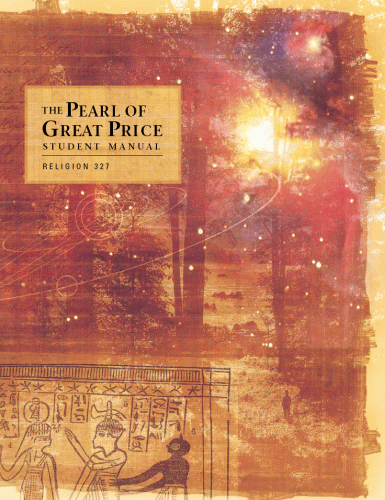
The cover of the official LdS Church Education System Seminaries and Institute of Religion manual, “Pearl of Great Price Student Manual – Religion 327”

FACT: IT INDEED IS LDS DOCTRINE
From the chapter entitled, “Moses 1:12 – 23 – Satan Commanded Moses to Worship Him” in the official LdS Church Education System Seminaries and Institute of Religion manual, “Pearl of Great Price Student Manual – Religion 327” which is currently in use in the Mormon Church [bold underlining added for emphasis]:

“The importance of not accommodating temptation in the least degree is underlined by the Savior’s example. Did not he recognize the danger when he was on the mountain with his fallen brother, Lucifer, being sorely tempted by that master tempter? [see Matthew 4:1–11 .] He could have opened the door and flirted with danger by saying, ‘All right, Satan, I’ll listen to your proposition. I need not succumb, I need not yield, I need not accept—but I’ll listen.’”[1]

And as a commenter noted in his response to the ABC News article’s error:
“This official Mormon Church teaching manual clearly states that Jesus and Lucifer are brothers and equates Lucifer with Satan. It also quotes Matthew 4:1-11 which refers” the devil” four times. There is no wiggle room here and any Mormon who denies that Mormonism teaches that Jesus and the devil are brothers is either uninformed or is lying to you.”

And if further proof is needed, it’s readily available. For example Brigham Young taught that Lucifer is God the Father’s second son, to Christ his elder son in this discourse on the great spiritual war in heaven that was waged resulting in Lucifer’s fall:

“[God the Father speaking] ‘Who will redeem the earth, who will go forth and make the sacrifice for the earth and all things it contains?’ The Eldest Son [Jesus Christ] said: ‘Here am I’; and then he added, ‘Send me.’ But the second one, which was “Lucifer, Son of the Morning,” said, ‘Lord, here am I, send me, I will redeem every son and daughter of Adam and Eve that lives on the earth, or that ever goes on the earth.'[2]

And Mormon Prophets and leaders have echoed and reinforced that teaching throughout Mormon History:
Jesus is Gods firstborn son Lucifer is the second born on down to you and I and Jesus is our elder brother.”[3]

And, finally, regarding the Huckabee apology, it was clearly an act of political expediency not an admission of error. The body of evidence clearly demonstrates that Mr. Huckabee had the truth on his side, however, when it comes to politics very often truth is the first casualty. It seems odd that a professional journalist was unable to discern this!
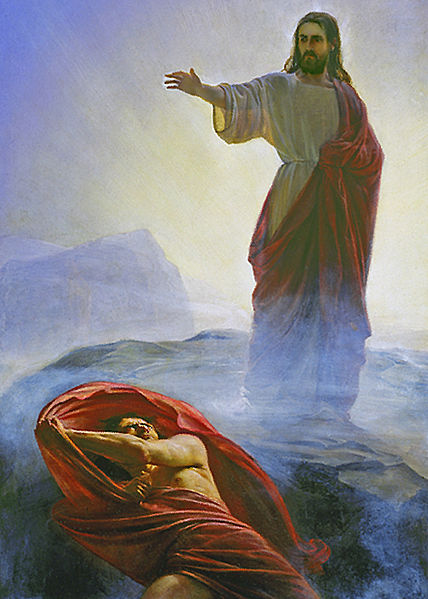
According to LdS Doctrine these two are our pre-existent, spiritual brothers.
(“Jesus Tempted” by Carl Heinrich Bloch)

ABC NEWS: MORMONS ARE CHRISTIANS
“Are Mormons Christians? Or put it this way: ”Do they worship Jesus Christ?” Answer: Yes. Mormon doctrine goes in lockstep with the Christian creation myth, including and especially Christ’s crucifixion and subsequent rising (it veers away later, in the Book of Mormon, where it is written that Jesus took a trip to America, post-Resurrection).”

FACT: MORMONISM IS NOT CHRISTIAN, IT IS IT’S OWN UNIQUE NON-CHRISTIAN RELIGION
This is a complex subject, one that I covered extensively in a prior article, and one that ink and pixels continue to be spilled over from all quarters. However, to me, the the late Catholic Scholar, Richard John Neuhaus‘ analysis cuts through the fog and brings clarity:

“…Mormonism is inexplicable apart from Christianity and the peculiar permutations of Protestant Christianity in nineteenth-century America. It may in this sense be viewed as a Christian derivative. It might be called a Christian heresy, except heresy is typically a deviation within the story of the Great Tradition that Mormonism rejects tout court.” 

Continuing, Neuhaus goes on to explain, “For missionary and public relations purposes, the LDS may present Mormonism as an ‘add-on,’ a kind of Christianity-plus, but that is not the official narrative and doctrine.

A closer parallel might be with Islam. Islam is a derivative of Judaism, and Christianity. Like Joseph Smith, Muhammad in the seventh century claimed new revelations and produced in the Quran a ‘corrected’ version of the Jewish and Christian scriptures, presumably by divine dictation. Few dispute that Islam is a new and another religion, and Muslims do not claim to be Christian, although they profess a deep devotion to Jesus. Like Joseph Smith and his followers, they do claim to be the true children of Abraham. Christians in dialogue with Islam understand it to be an interreligious, not an ecumenical, dialogue. Ecumenical dialogue is dialogue between Christians. Dialogue with Mormons who represent official LDS teaching is interreligious dialogue.”[4]

Richard John Neuhaus

So perhaps Richard Land, of the Southern Baptist Convention spoke well when he observed, “I think the fairest and most charitable way to define Mormonism would be to call it the fourth Abrahamic religion – Judaism being the first, Christianity being the second, Islam being the third, and Mormonism being the fourth. And Joseph Smith would play the same character in Mormonism that Muhammad plays in Islam.”[5]

All this merely punctuates a key point made by Religious Journalists, Richard and Joan Ostling in their watershed book “Mormon America“, “…it is surely wrong to see Mormonism as a Christian derivative in the way that Christianity is a Jewish derivative, because the LDS faith is in radical discontinuity with historic Christianity.”[6]

Further, the idea that, “Mormon doctrine goes in lockstep with the Christian creation myth,” comes unhinged in the light of the aforementioned fact that the Mormon Christ was God the Father’s procreated “spirit child” rather than God Eternal and the Creator as clearly stated in The Gospel of John, chapter 1, verses 1-3: “In the beginning was the Word [referring to Jesus Christ], and the Word was with God, and the Word was God. He was in the beginning with God. All things were made through him, and without him was not any thing made that was made.” [7]

Further, the cruxification is de-emphasized in Mormonism with the atonement taking place in the Garden of Gethsename rather than on the cross. From 13th LdS President, Ezra Taft Benson:

“[It was in the Garden of Gethsemane that Christ] suffered as only as God would suffer, bearing our griefs, carrying our sorrows, being wounded for our transgressions, voluntarily submitting Himself to the iniquity of us all, just as Isaiah prophesied.

It was in Gethsemane that Jesus took on Himself the sins of the world, in Gethsemane that His pain was equivalent to the cumulative burden of all men, in Gethsemane that He descended below all things so that all could repent and come to Him”
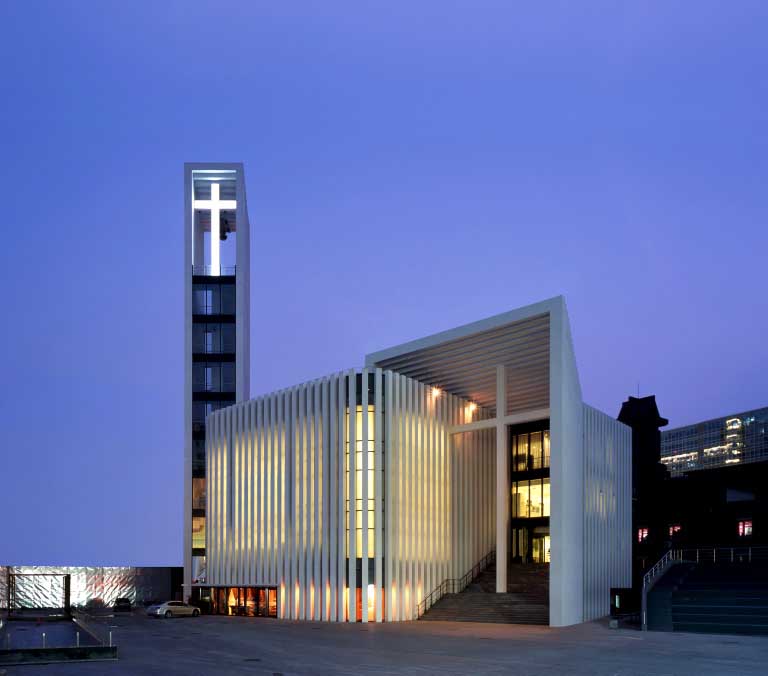
A new Christian Church buidling in Beijing, China.
Please notice the prominent use of the cross in the exterior architecture. The cross is also featured prominently in the interior space of this church building.

Yet the emphasis on the cross in the New Testament and throughout Christian Church History is apparent as anyone who has been in, or even driven by a Christian Church building will tell you.

As one Mormon Researcher noted well, “Perhaps it is for these reasons [the de-emphasis of the cross and teaching that the atonement occurred in the Garden of Gethsemane] that you will not find crosses on Mormon buildings. Certainly in the mind of the Latter-day Saint its significance is not equal to that of the Bible-believing Christian. We who hold the Bible dear have no choice but to concur with the Apostle Paul and declare without reservation, ‘That the preaching of the cross (not the garden) is to them that perish foolishness; but unto us which are saved it is the power of God'” (1 Corinthians 1:18)’ [9]

The final point that I make to those who insist that Mormonism is Christian is this: The most basic, fundamental tenet of Judeo-Christianity as well as Islam is monotheism – the belief in one, and only one, universal God.  Therefore, because Mormonism is henotheistic – believing that the god of this planet, while the only god of this planet, is still only one in a unknown hierarchy of gods, possibly even an infinite number of gods – it can be neither Jewish, Christian, or Islamic.

In summary and conclusion, Mormonism is it’s own, unique, one-of-a-kind, non-Jewish, non-Christian, non-Islamic religion.

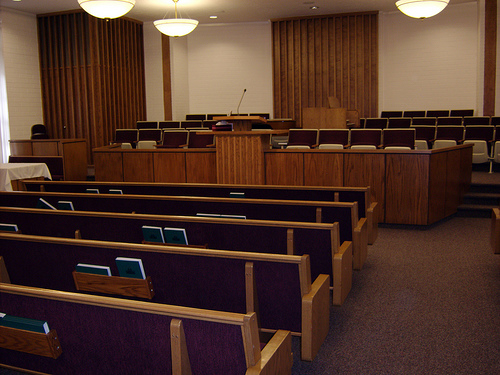
A typical Mormon Chapel
Conspicuous in it’s absence, any sign of a cross. In fact, crosses are not used in any form or fashion in Mormon architecture or culture.

ABC NEWS: POLYGAMY IS NO LONGER PART OF THE LDS CHURCH
“Big Love” died in 1890. Polygamy was banned by then-church president Wilford Woodruff in his “Manifesto.” Any plural marriage that takes place now does so against the laws of the LDS Church.”

FACT: POLYGAMY IS A VITAL PART OF LDS CHURCH DOCTRINE
Doctrine & Covenants (D&C) is a collection of revelations given primarily to Joseph Smith with a few others sprinkled in. It is current, canonized Mormon scripture.

Section 132 of D&C is the revelation in which Joseph Smith claimed to receive from God on polygamy. It was canonized in 1876 and has remained in the LdS Church’s D&C continuously since even though other sections (including the original Section 101 – which condemned polygamy and which was removed to make way for Section 132)[10] have been decanonized and removed.

The Wilford Woodruff Manifesto that the author of the ABC News article refers to is also in D&C as “Official Declaration 1” (OD-1). And yes, OD-1 was indeed very publicly canonized in 1890 – and then promptly ignored in private. It wasn’t until the Reed Smoot hearings of 1904-1907 in which the public became aware that the LdS Church was still secretly engaging in polygamy that a full and final ban was put in place via a “Second Manifesto” which was issued by then LdS President, Joseph F. Smith in 1904.[11]

The 6th LdS Church President (1901-1917) and practicing polygamist Joseph F. Smith with his family and five of his six wives (one being deceased). Joseph F. Smith issued the “Second Manifesto” in 1904

Further, OD-1, which is directed outwardly to “To Whom It May Concern” rather than specifically inward to the LdS Church is clear that this ban is only temporary due to the new, prevailing laws against polygamy of the time (such as the Edmund-Tucker Act of 1887) which had recently been enacted:

“Inasmuch as laws have been enacted by Congress forbidding plural marriages, which laws have been pronounced constitutional by the court of last resort, I hereby declare my intention to submit to those laws, and to use my influence with the members of the Church over which I preside to have them do likewise.

There is nothing in my teachings to the Church or in those of my associates, during the time specified, which can be reasonably construed to inculcate or encourage polygamy; and when any Elder of the Church has used language which appeared to convey any such teaching, he has been promptly reproved. And I now publicly declare that my advice to the Latter-day Saints is to refrain from contracting any marriage forbidden by the law of the land.”[12]

In fact, the Mormon Church of 1890 had already established polygamous colonies in both Mexico and Canada and polygamy was openly practiced until the governments there cracked down on it as well. So OD-1 was (and is) intended to be a public relations gesture to get the United States Government (which was about to seize it’s assets due to it’s illegal activity) off the back of the LdS Church.[13]

Today, “Big Love” does in fact continue very quietly and very privately in a “Don’t Ask, Don’t Tell” manner – if you’re discovered, in accordance with the Second Manifesto, you’re excommunicated – period. However, at that point there are any number of polygamous LDS denominations that will happily accept you and your wives as members. It remains to be seen what the LdS Church will do if polygamy is ever decriminalized or legalized in the United States.

Further, because D&C 132 remains LdS Scripture it’s believed that a man widowed by women to whom he was sealed to in an LdS Temple who then remarries via a subsequent “Temple Sealing” is polygamously married to all these sealed women when he reaches the highest Mormon Heaven known as “The Celestial Kingdom” mentioned in D&C 132. This type of Celestial Marriage currently applies to three living LdS Apostles: Dallin H. Oaks, L. Tom Perry, and Russell M. Nelson – all three men are widowers, and all three men have been “sealed” to a second wife – they are, therefore, known in some Mormon Studies circles as “Celestial Polygamists“.

The LdS “Quorum of Twelve Apostles”
The Celestial Polygamists: Dallin H. Oaks, front row, third from right; L. Tom Perry, front row, second from left; Russell M. Nelson, front row, third from left

Finally, care to guess what the infamous, “Families Are Forever” Mormon mantra and doctrine is based on?  If you guessed, D&C 132 you would be right.   So polygamy is still a vital part of Mormonism – albeit in a much different, less concrete form than how it was practiced prior to the Second Manifesto.

ABC NEWS: LDS TEMPLE GARMENTS ARE BORING AND COMMON
“Ah yes, The Magic Underwear, so easy to make fun of until you consider their actual meaning, which is really kind of boring. Little more than purposefully designed cotton shirts and knickers, they’re meant to be worn day and night (by those who choose to wear them) and symbolize a holy covenant with the church, along with protection from evil spirits. Most major religions have some form of equivalent dress; Mormons, in this case and with lots of other “weird” traditions, are only mocked because they started do it more recently.”

RESPONSE: BORING? COMMON? NOT! 
But, hey, don’t take my word for it, let’s go to the source for all things “Temple Garment”: The LdS Temple Endowment Ceremony!

What follows are excerpts from a transcript of the LdS Temple Endowment Ceremony.  Please note that the portions of the endowment that are immaterial and irrelevant relative to LdS Temple Garment have been omitted (if you would like to read the entire Endowment Ceremony just use the links in the “Notes” section below).

However, if you would prefer to simply watch a full re-enactment of the LdS Temple Endowment Ceremony you can do so here:

Video of an Ex-Mormon Re-enactment of the LdS Temple Endowment Ceremony

EXCERPTS FROM THE LDS TEMPLE ENDOWMENT REGARDING MORMON TEMPLE GARMENTS
From the “Initatory” portion of the Endowment Ceremony [14]
THE GARMENT
[An officiator clothes the initiate in the garment. The officiator then pronounces the following words]

Brother/Sister _________, having authority, I place this garment upon you, which you must wear throughout your life. It represents the garment given to Adam when he was found naked in the garden of Eden and is called the garment of the holy priesthood.

Inasmuch as you do not defile it, but are true and faithful to your covenants, it will be a shield and a protection to you against the power of the destroyer until you have finished your work on the earth.

THE NEW NAME
With this garment, I give you a new name, which you should always remember and which you must keep sacred and never reveal, except at a certain place that will be shown you hereafter.

The name is _________.

Simulated LdS Temple scene inside the LdS Temple “Celestial Room”. This shot includes good front and back views of LdS Temple Garments.
(from the HBO television show “Big Love”)

From the “Endowment Proper” portion of the Endowment Ceremony [15]
WELCOME
[Initiates assemble in silence in the chapel. When all is ready, they are ushered into the Creation Room. Here and throughout the ceremony, men sit on one side of the room, women on the other.]

FIRST LECTURER: Brethren and sisters, we welcome you to the temple and hope you will find joy in serving in the house of the Lord this day.

Those of you who are here to receive your own endowment should have been washed, anointed, and clothed in the garment of the holy priesthood. The ordinances of washing, anointing, and clothing in the garment of the holy priesthood, together with the ordaining on behalf of deceased brethren, were performed previously for those deceased persons whom you are representing.

Each of you should have received a new name in connection with this company. If any of you have forgotten the new name or have not received these ordinances as explained, please stand.

[Pause. If someone has forgotten the new name, a temple worker draws the person aside briefly to repeat the portion of the intiatory in which the new name is bestowed]

You have had a garment placed upon you, which you were informed represents the garment given to Adam when he was found naked in the garden of Eden, and which is called the garment of the holy priesthood. This you were instructed to wear throughout your life. You were informed that it will be a shield and a protection to you if you are true and faithful to your covenants.

You have had a new name given unto you, which you were told never to divulge, nor forget. This new name is a keyword which you will be required to give at a certain place in the temple today.

The endowment is to prepare you for exaltation in the celestial kingdom. If you proceed and receive your full endowment, you will be required to take upon yourselves sacred obligations, the violation of which will bring upon you the judgments of God, for God will not be mocked.
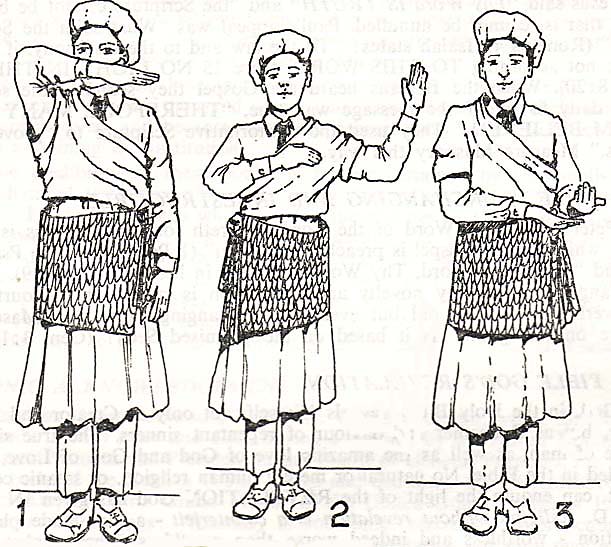
Pen and Ink illustration of a Mormon male in LdS Temple Garments making the hand gestures that accompanied the blood oaths that were a part of the LdS Endowment Ceremony until 1990

From the “Veil” portion of the Endowment Ceremony [16]
THE MARKS ON THE VEIL
[Temple Worker voicing SAINT] PETER: Brethren and sisters, I will now explain the marks on the veil.

These four marks are the marks of the holy priesthood, and corresponding marks are found in your individual garment.

This one on the right is the mark of the square. It is placed in the garment over the right breast, suggesting to the mind exactness and honor in keeping the covenants entered into this day.

This one on the left is the mark of the compass. It is placed in the garment over the left breast, suggesting to the mind an undeviating course leading to eternal life; a constant reminder that desires, appetites, and passions are to be kept within the bounds the Lord has set; and that all truth may be circumscribed into one great whole.

This is the navel mark. It is placed in the garment over the navel, suggesting to the mind the need of constant nourishment to body and spirit.

This is the knee mark. It is placed in the right leg of the garment so as to be over the kneecap, suggesting that every knee shall bow and every tongue shall confess that Jesus is the Christ.

These other three marks are for convenience in working at the veil. Through this one, the person representing the Lord puts forth his right hand to test our knowledge of the tokens of the holy priesthood. Through the one on our right, he asks us certain questions; through the one on the left, we give our answers.

The Evolution of LdS Temple Garments over the years
(notice the marks that are explained in the endowment ceremony)

Well that seems pretty interesting to me! In fact, it seems to that reading through (or watching) the Temple Endowment Ceremony may just be the single most enlightening thing that someone studying Mormonism can do since it’s there that some of the most poignant and vital aspects of Mormon Theology and the LdS Worldview are revealed. You may not agree with what goes inside Mormon Temples but understanding the LdS Temple Endowment Ceremony certainly helps you understand your Mormon friends and family members beliefs better!

Now for the author of the ABC News article’s claim that, “Most major religions have some form of equivalent dress” I can only ask, “Really? Who and what are you talking about?”   I don’t know of any and, frankly, I suspect that he doesn’t either. In fact, the only thing that I can think of that comes close are the Freemason initiatory garments from the Masonic Endowment Ceremonies that Joseph Smith plagiarized from in developing the Nauvoo Temple Endowments in 1842 – however those garments are removed at the end of the ceremony and not worn outside of Masonic ceremonies – they don’t have “magic underwear”. [17]

Pen and Ink illustration of a Freemason male with Masonic Apron making the hand gestures that accompany the blood oaths that are still a part of some Masonic Endowments

Finally, his statement that, ‘Mormons, in this case and with lots of other “weird” traditions, are only mocked because they started do it more recently.’ I would point to the fact that the LdS Temple Endowments date back to 1842 – that’s 170-years as of when this article was written.  One hundred and seventy years of rich history, tradition, and cultural distinctives is “recent”?  Over a century and a half and nearly two-centuries of history, trandition, and cultural development is “recent”? Really?  Frankly, I don’t think so and I don’t think that any reasonable person would.

So I hope by now the reader can see just how errant, misguided, inaccurate and superficial the ABC News article was.  Unfortunately, since we’re currently in a “Mormon Moment” due to the Presidential Campaign of Mormon Mitt Romney I suspect that we’re going to be flooded with many, many poorly researched and inaccurate articles on Mormonism in the coming months.  And while I certainly appreciate the attention that Mormon Studies is receiving at the moment I would hope that newcomers like the author of the ABC News article will do a better job of fact checking and source vetting going forward.

And if they don’t, I and other Mormon Studies scholars will be ready, willing, and able to set the record straight.  And that, really is, the least you should know!

NOTES:
[1] LdS Church Education System Seminaries and Institute of Religion manual, “Pearl of Great Price Student Manual – Religion 327” Chapter entitled, “Moses 1:12–23 Satan Commanded Moses to Worship Him”

[2The Discourses of Brigham Young; pp.53-54; The Journal of Discourses, Volume 13, p.282
(bolding and bracketing added for emphasis and clarity)

[3] Spencer W. Kimball, “The Teachings of Spencer W. Kimball”; p.33
(note: Mr. Kimball was the 12th LdS Church President)

Also see, Bruce R. McConkie, “Mormon Doctrine“; pp.163
(note: Mr. McConkie was an LdS Apostle and the son-in-law of Joseph Fielding Smith, the 10th President of the LdS Church)

(Bolding added to cited text for emphasis)

[4Richard John Neuhaus, “Is Mormonism Christian? A Respected Advocate for Interreligious Cooperation Responds”; “First Things”, March 2000

[5David Van Biema, “What Is Mormonism? A Baptist Answer”; Time Magazine, Wednesday, Oct. 24, 2007

[6Richard Ostling and Joan K. Ostling, “Mormon America”, p. 324

[7] The Gospel of John, Chapter 1, Verses 1-3; English Standard Version translation of the Bible;
(bolding and underlining added for emphasis)

[8] Ezra Taft Benson, “Teachings of Ezra Taft Benson”, p.15 in paper edition; p. 18 in linked eBook edition
(Again, as noted in the body of the article, Mr. Benson was the 13th President of the LdS Church)

[9]  Mormon Research Ministry, “Calvary or Gethsemane? The Atonement According to Mormonism”

[10] “In 1876, Section 101 from the 1835 Edition (and subsequent printings) was removed. Section 101 was a Statement on Marriage as adopted by a conference of the church, and contained the following text:

‘Inasmuch as this Church of Christ has been reproached with the crime of fornication and polygamy, we declare that we believe that one man should have one wife, and one woman but one husband, except in the case of death, when either is at liberty to marry again.”
(source  http://en.wikipedia.org/wiki/Doctrine_and_Covenants#Portions_removed_from_the_LDS_edition )

[11] See B. Carmon Hardy, “Lying for the Lord: An Essay” Appendix I, “Solemn Covenant: The Mormon Polygamous Passage” p. 363

[12] Doctrine & Covenants, Official Declaration-1

[13] An excellent overview and panel discussion of the history of Mormon Polygamy before, during, and after OD-1 was released can be found here:
Episode 118a: Polygamy Manifesto for Dummies Part 1
Episode 118b: Polygamy Manifesto for Dummies Part 2

[14] LDS Endowmenet: The Initatory

[15]  LDS Endowment: Endowment Proper

[16]  LDS Endowment: The Veil

[17] See Wikipedia, “Mormonism and Freemasonry”; also see An Introduction to Mormons and Freemasonry” by Nicholas S. Literski and MormonThink The Mormon Temple/Freemasonry

(A response to “Mormons! The Least You Should Know” by By Gregory J. Krieg)
by Fred W. Anson 

I’m not one to complain about so-called “media bias and manipulation”. After all, I live in a county where the natives regularly state that Fox News is ‘the only fair and balanced news source’ and I work in yet another county where Fox News is derisively mocked while they explain that only CNN and MSNBC can be trusted to tell the truth about “what’s really goin’ on!” So candidly, I tend to take all such claims with a grain of salt. However, recently I experienced what I can only describe as “media bias and manipulation” and found it both unsettling and infuriating.

Now first, please understand that unlike a lot of Evangelical Christians I have absolutely no problem with the fact that Mitt Romney is a Latter-day Saint. My stance has always been that, barring complicating factors, if someone is qualified for public office and can competently serve all their constituents fairly and justly then their religion really isn’t all that relevant. And as well known Mormon Studies Scholars Sandra Tanner and Bill McKeever (both residents of Utah and known critics of the LdS Church) have pointed out if it’s wrong for Christians to vote for Mormons then the Christians in Utah wouldn’t be able to vote at all because that’s all that’s on the ballots in their state.

So let’s table the politics shall we – this article ain’t about politics folks!

Now, if the media is reporting on a religion – be it mine, yours, or someone else’s – they should get their facts straight, agreed? And what if they’re publishing is presented as a fact/reality check, or a trustworthy primer on the religion for the public this is doubly true, agreed again?

And ABC News reporter Gregory J. Krieg seems to agree too, for in his May 25th  article entitled, “Mormons! The Least You Should Know” he boldly states, “Ignorance creates a vacuum and vacuums, especially in politics, abhor decency. So, in the interest of adding some factual bits to the nonsensical debates sure to follow, here is the least you should know about Mormonism.”  Wow! Awesome! Finally a reporter from mainstream media who “gets it!”

50 E North Temple Street, Salt Lake City, Utah: The LdS Church Office Building

However, speaking as someone who is actively engaged in Mormon Studies, what followed was factual only if you’re willing to accept the “outsider” or “public” version of Mormonism espoused by the LdS Church’s public relations department and ignore what it actually teaches, practices, and believes.  As someone  said well in the comments section, ‘“I find it ironic that you title your article, ‘Mormons! The Least You Should Know,’ end the article with, a edict to do thorough research, yet fail to answer your own question correctly. Perhaps you did not follow your own advice and you believed the first source you checked. Regardless of what your first source was, it is in error at best and dishonest at worst.”   Those words echo my feelings on the article precisely!

Simply put this article, despite it’s noble purpose and grand claims, in the end appears to have been written by someone whose sole source was the LdS Church.  Now that wouldn’t be a bad thing were it not for Mormonism’s well documented practice of “Lying for the Lord”:

“Lying for the Lord refers to the practice of lying to protect the image of and belief in the Mormon religion, a practice which Mormonism itself fosters in various ways. From Joseph Smith’s denial of having more than one wife, to polygamous Mormon missionaries telling European investigators that reports about polygamy in Utah were lies put out by “anti-Mormons” and disgruntled ex-members, to Gordon B. Hinckley’s dishonest equivocation on national television over Mormon doctrine, Mormonism’s history seems replete with examples of lying. Common members see such examples as situations where lying is justified. For the Mormon, loyalty and the welfare of the church are more important than the principle of honesty, and plausible denials and deception by omission are warranted by an opportunity to have the Mormon organization seen in the best possible light. This is part of the larger package of things that lead many to describe Mormonism as a cult. “Lying for the lord” is part of Mormonism’s larger deceptive mainstreaming tactics, and conversion numbers would drastically lower if important Mormon beliefs were fully disclosed to investigators.”
(source http://www.mormonwiki.org/Lying_for_the_Lord )

Given this dynamic it’s stunning that the author – or his editors for that matter – didn’t seem to find it necessary to cross check and verify the “facts” given to him by, it seems to me, the very institution that he was investigating.  And he seems to confirm this suspicion with a stock, “don’t believe everything you read on the Internet”  sweep of his journalist hand after directing his readers  to Mormon.org as a “user-friendly” website that can be trusted. This is telling  because those of us engaged in Mormon Studies and culture know that website is nothing more than a proselytizing tool for the Mormon Church that presents the public with a scrubbed and polished “for public consumption” version of Mormonism rather than a true, honest, and forthright view of the institution.

And while readily acknowledging that the Internet can be filled with misinformation this cavalier dismissal of opposing points of view by a implied “voice of reason” is especially troubling. That’s because there are some remarkably reliable and  objective Mormon Studies websites out there that just lay it out for all to see and let the pieces fall where they will.  For example,  please consider MormonThink.com – a website whose home page purpose statement speaks volumes:

“Mormonthink.com is a site produced largely by members of the Church of Jesus Christ of Latter-day Saints who are interested in the historical accuracy of our church and how it is being taught to its members and portrayed in the media.

We invite scholarly debate by critics, true-believers and anyone interested in Mormon history.

There is a lot of misinformation on the LDS church that is presented by both critics and defenders of the faith – particularly on the Internet. We present both sides fairly and let the reader decide.”
(source http://www.mormonthink.com/ bolding and underlining added for emphasis)

So knowledgeable members of the LdS Church know that their institution “lies for the Lord” – former members and Mormon Studies scholars know it too. Perhaps if Mr. Krieg had done a better job of vetting  (or if his editors had cross and fact checked his article before publishing it) he would have realized that he was being “played” by the LdS church.  Personally, I would preferred that he had reported on that rather than willingly or unknowingly playing the role of pawn publisher and “patsy” in regurgitating institutional propaganda via a known, established, and respected, mainstream media source like ABC News – it’s, frankly, a better, more interesting, and more honest story!

– Go to Part 2 –

by Tim
Over the past 180 years the Evangelical world has had two primary missions in response to Mormonism. The first was to protect our own sheep, the second was to call Mormons to repentance and motivate them to join the fellowship of true believers. These were both accomplished by pointing out the heresies inherent in Mormonism and by drawing questions to the trustworthiness of Joseph Smith and Mormon origins. I hope to persuade that the time is now upon us to consider a new approach to Mormonism. I do not wish to criticize the way we have historically approached Mormonism. On the contrary I think the two overall missions have been praiseworthy and Biblically motivated. I do not by any means think that Mormonism stands with historic, orthodox Christianity. I do not think the LDS church teaches truth in regards toward the nature of God. I think the LDS church draws the majority of those it teaches away from the Gospel as taught by Jesus and his apostles. I do not think that Joseph Smith bears the marks of a trustworthy prophet. Despite my continued stance against Mormonism it’s becoming clear to me that a new set of circumstances is now upon us. The signs of a new season are showing and we need to pause for a moment and consider our efforts and the allocation of our resources.

A New Day
We are entering a new day. The world of Mormonism has changed significantly in the seven years in which I’ve explored it. As many have observed, the internet has sparked an information revolution. Materials are widely available and the ability to collaborate and unify with like-minded people has increased tremendously. This has had a tremendous effect on traditional Mormon debates. I’m flabbergasted to see faithful Mormons agree with Evangelicals on the facts of such things as the Kinderhook Plates and the Adam-God theory much less Joseph Smith’s Polyandry and his non-translation of the Kirkland Egyptian Papers. The focus of the debates has changed from “is it true” to “does it matter”. That is a monumental shift.

In addition, non-traditional Mormon voices are beginning to form and they are being heard. The censoring of the “September Six” is not likely to happen in today’s environment. If such an attempt were made by Mormon authorities it would not go well for them. In many ways such efforts would only make those “un-correlated” voices more clearly heard because the controversy would add attention to their work. Grant Palmer was correct when he predicted that church discipline would only increase sales of his book “Insider’s View on Mormon Origins”. Many disaffected and “New Order” Mormons may even hope for church discipline as they continue to speak out on a number of topics.

In many ways our concerns about Mormon origins and the character of Joseph Smith are being carried further and farther by those still inside the church. Ex-Mormons, New Order Mormons, Disaffected Mormons and even some BYU professors and other faithful Mormons are carrying this message forward. Their words about these concerns travel further and farther because it is often wrapped in the package of “Mormon” rather than Evangelical. A perceived friend is more trusted than a perceived enemy.

For many reasons we Evangelicals have been viewed as the enemy. We are not at fault for all of those reasons. Mormonism began with a strong polemic against traditional Christianity and hasn’t let up. In addition we have a Biblical mandate to defend against false doctrines and false prophets. We’ve been correct in taking a stand against the false ideas Joseph Smith presented. Sadly that stand has not always been carried out in love. Evangelicals who think it is appropriate to literally slam their doors on Mormons or in any other way treat them inhospitably have not been the best example of the love of Christ. Those that have intentionally exaggerated or misconstrued Mormon beliefs have given Mormons plenty of reason to view our message and our intentions skeptically. But reasons and motivations for the animosity aside; we need to recognize that the way Mormons perceive us stands in the way of our hope to carry the true Gospel forward. I think we need a new strategy and I think the time to aggressively change modes is now.

Why Change Now
Recently Elder Marlin K. Jensen conducted a Q&A at Utah State University. In that session Elder Jensen stated:

“The fifteen men really do know, and they really care. And they realize that maybe since Kirtland, we never have had a period of, I’ll call it apostasy, like we’re having right now; largely over these issues.”

This statement isn’t all that revealing in terms of the suspected number of people who are now losing their faith in Mormonism (whether they officially resign or remain members is another topic). What’s remarkable about this statement is that it’s being stated by Elder Jensen, Church Historian and a member of the Quorum of the 70. The real news in his statement is that the First Presidency and the Quorum of the 12 are aware that people are losing faith and they are aware of what is causing them to lose faith. That Elder Jensen states this in any kind of public forum is significant. The effects of this apostasy are being felt. In addition the LDS church’s growth rate in the United States is hovering somewhere near its birth rate (which is also dropping). Finally, Generation Y is less committed to the faith of their parents than any generation before it. I do not believe that any sort of significant change will take place within the LDS church to change these trends. The church is too bureaucratic and too invested to make a significant risk that may backfire. In addition the age of the leadership does not incline them to take risks. At best the church will make apologetic answers from unofficial resources such as FAIR more broadly available. But I do not believe this will stem the tide.

People discover questions that threaten the LDS church from search engines not from Gospel Doctrine classes. Those same search engines are already providing these apologetic answers and they are proving to be largely ineffective. Publishing these answers in a manual is only taking a step backwards in technology. Additionally, providing answers in official venues has a double edge, publishing these questions under the church seal reveals them to members who are already disinclined from reading anything that is not officially published by the church.

I predict in the next 20 years there will be a radical shift within the LDS church. If Mitt Romney becomes President that shift may occur sooner (due to heightened media scrutiny). Many people will leave the Salt Lake branch either because they no longer believe the message or because they believe the church is making compromises that it shouldn’t make. We’ve already seen the pattern of this behavior in the Community of Christ and the Worldwide Church of God.

In that sort of environment the LDS church will need friends. Many may be glad to see the organization crumble and hope for its entire evaporation. I do not. I believe the organization of the LDS church can be separated from the heresies of Mormonism. There is much good in the organization and in the people of the LDS church. What doesn’t directly conflict with the authentic Gospel of Jesus should be preserved if at all possible. Jesus is out to make all things new.

If you disagree with me about the organization, I still think it would be appropriate for you to consider changing strategies. Your Mormon friends and neighbors in this time of change will need friends. I’m alarmed and discouraged by the great many ex-Mormons who become secular agnostics or atheists. This is in part the bad fruit of Mormonism. As the saying goes; “Fool me once, shame on you. Fool me twice, shame on me.” Another part of this is the rising cultural shift toward secularism. A third part has to do with the way Evangelicals are perceived by Mormons. We are rarely viewed as helpful or friendly by Mormons. In our efforts to stand strongly against heresy we’ve become viewed as the opposition. For many in the midst of a crisis of faith the idea of joining in worship with Evangelicals is immediately rejected because of the preconditioned view Mormons have of Evangelicals. A Mormon missionary in distress is not likely to seek out a Protestant minister for help. Again, this isn’t entirely our fault, but perception is the reality that we must deal with. We must make an extra effort to overcome perception. We must do what we can to help Mormons see us as a friendly and helpful face in the midst of a faith crisis.

A New Strategy
For these reasons I believe we need a new strategy. I think we need to largely abandon our role in exposing Joseph Smith and Mormon origins. As I’ve mentioned, I think this work will continue at the hands of Mormons and will have greater traction than anything we could hope to produce. The role “Rough Stone Rolling” has had in changing the tone of the debate should be evidence enough. Terryl Givens has a forth coming book on the evolution and progression of Mormon doctrines. This book will undoubtedly challenge the notion that many Mormon doctrines have been static. Works such as these will continue to erode the traditional Mormon narrative. Our best efforts at expose’ can’t do better than these in terms of effectively demonstrating the LDS church to not be what it historically has claimed to be. The era of Joseph Smith being viewed as a trustworthy figure is closing one internet search result at a time both inside and outside the church.

Instead I think we need to focus on explaining how and why we live out our faith. Many of us have effectively learned how to communicate and frame language in a way that Mormons are familiar with. We need to talk more about the advantages of grace over legalism. We need to proclaim the heart of living solely in the New Covenant. We need to explain better the beauty we see in the Trinity. We need to talk more openly about our own struggles in faith and how we overcame them. We need to better explain appropriate hermeneutics. We need to explain clearly what we mean by “inerrant” and how that differs from “literal”. We need to more boldly proclaim our confidence that the Bible was transmitted throughout history reliably. Many are already doing all of these things, but we need to step up these messages at the expense of talking less about Joseph Smith.

Rest assured, Joseph Smith is being talked about and will continue to be talked about. But don’t spoil your future witness by leading with his failures. Continue to resist his influence. Boldly state when asked about him that you think he’s a false prophet. But don’t get into details. If you are asked for details share them slowly and cautiously. Be confident that everything you know can and will be discovered. The heart of your message is not the bad fruit of Joseph Smith, the heart of your message is the hope that lives within you. Stick to your message. Instead of making you and your ministry the place Mormons become disenfranchised with their faith become the place where they can safely ask “what’s next”. Become a recovery center for the spiritually wounded rather than an artillery range against Joseph Smith. Though some are still converted to Mormonism, the LDS church is not the threat it once was and mostly likely never will be again. I wouldn’t want even a single Evangelical converted into Mormonism but I don’t believe guarding our sheep needs to be our chief focus any longer.

Some may be tempted to disregard what I’m saying. I’ll be branded by some as a compromiser. I can assure you I am not compromising. Instead I’m calling us to see what even the Mormon apostles recognize; the times have changed. We have a new mission. Let us recognize that our battle is not against Mormon flesh and blood but rather Mormon powers and principalities.

Begin your transition. It’s time to be spiritual healers. It’s time to be pastors. Let us no longer erect bulwarks against those lost to Mormonism. Let us now build bridges for those Mormonism has lost.

NOTE: I think the “Transitions” study produced by Western Institute for Intercultural Studies is a great start. Let’s build on it.

NOTE #2: These survey results were posted shortly after I posted this article. They illuminate more on why Mormons become disaffected.

(reposted with permission from the LDS and Evangelical Conversations website)


by Fred W. Anson
It was a simple question that was posted on Yahoo Answers . . .

Q: What’s your experience with The Church of Jesus Christ of Latter Day Saints? (good or bad)?
My question is what is your experience with The Church of Jesus Christ of Latter Day Saints, its followers (also known as Mormons) and if you could get one message through to Mormons and/or non Mormons, what would it be?

… and, even though most of it got chopped off, here was how I answered in full:

Q: What’s your experience with The Church of Jesus Christ of Latter Day Saints? (good or bad)?
A: I’ve never been Mormon but I have a lifetime of Mormon friends and family members and I’ve had direct experience with the LdS Church.

THE GOOD
First, I’ll say that my direct “face-to-face” experience with Mormons has been overwhelmingly positive.

Here’s how I described my face-to-face experience with Mormons in a Facebook article:
“Mormons are members of The Church of Jesus Christ of Latter-day Saints. Collectively they represent a rich, colorful, tapestry of personalities, talents, giftings, callings, and, yes, even beliefs. Or put another way, I find MUCH good in the Mormon people and Mormon Culture which I applaud, celebrate, revel in and strive to protect. … Mormons are our family members, our friends, our colleagues and our neighbors I do NOT dislike them – in fact, I love Mormons.”[1]

In face-to-face settings Latter-day Saints have always opened their hearts and homes to me and my family even though many of them know that in my role as a Mormon Studies scholar I am generally critical of the of the LdS Church, it’s leaders, Mormon Doctrine, and many aspects of Mormon Culture.

Second, I would also have to say that my direct experience with the LdS Church in Mormon Chapel meetings, Sunday School classes and, sadly, the funeral of a family member, has been equally positive. Their meetings are generally uplifting, inoffensive, include many bits of useful bits of “sage wisdom”. I generally leave feeling better than when you went in – I would liken them to what I experienced in Dale Carnegie classes, Self Help, and/or 12-Step meetings only with Joseph Smith sitting in Dale Carnegie, Zig Ziglar, Denis Waitley, Dr. Bob Smith, or Bill Wilson’s chair respectively.

THE BAD
Without question the worst “face-to-face” experience that I had in a Mormon Chapel meeting was when we attended a 3-hour “Fast & Testimony” meeting.

For those of you who are unfamiliar with these meetings, here’s how they’re described in The Encyclopedia of Mormonism:
“An LDS fast and testimony meeting is normally held on the first Sunday of each month, where faithful members of the Church are invited to bear a verbal witness of their feelings of the gospel of Jesus Christ. The meeting usually follows a fast by the members, usually from at least two consecutive meals and from liquids also. The fast is officially broken by partaking of the Sacrament of the Lord’s Supper. In modern scripture, fasting is described as “rejoicing and prayer” (D&C 59:14), which implies that it is more than just abstaining from food. That tone of devotion is also the feeling associated with contributing fast offerings, giving the equivalent cost of the meals, or more, to be used for the poor. The fast and testimony meeting becomes the locus of spiritual sensitivity and contrition, of concentration on the things of God.”[2]

That’s all true but what it fails to mention is that the testimonies tend to be overtly formulaic following this template:
“I TESTIFY TO YOU, I KNOW THE BOOK OF MORMON IS TRUE. I KNOW JOSEPH SMITH WAS A PROPHET OF GOD. I KNOW THE MORMON CHURCH IS TRUE.”[3] And sometimes an, “I love my family/husband/wife/mother/father/etc.”  got thrown as would an “I also testify that (fill in name of current LdS President) is a true prophet of God” and usually ending with an, “In the name of Jesus Christ, amen.”

However, by the end of the 3-hour session, I found that so many of the testimonies were almost word-for-word identical that it was a bit creepy.

But the most unsettling thing of all was when a parent would hold a far-too-young-to-fully-understand child up to the mic and have them parrot the formulaic testimony that they whispered in their ear. This occurred several times, resulting in dabbed eyes from the audience, and tears of joy from family members of the child.

Frankly, it was beyond weird, it was extremely unsettlingly and garnered a, “What the heck is going here? What’s wrong with these people? What’s wrong with this church?” from this author.

In fact, someone captured the audio one of these incidents on YouTube, listen to it for yourself, don’t take my word for it.[4]

THE UGLY
But without question, the worst experiences that I’ve had with Mormons has been on the Internet. The Internet brings out the bad side of everyone but Mormons seem to really, really, really go from “Jekyl” to “Hyde” there.

image credit “Flame Warrior” by Mike Reed

It seems that unless one is glowingly positive about the LdS Church and/or Mormon Culture on the Internet one is quickly labeled an “Anti-Mormon” and subjected to a litany of relentless personal and ad-hominem attacks that, frankly, I was shocked and surprised at given how I’d been treated in all my direct face-to-face Mormon experiences.[5]

I think that Richard and Joan Ostling described this well in their book on Mormonism when they said:
“The thin-skinned and image-conscious Mormon can display immature, isolationist, and defensive reactions to outsiders, perhaps because there is no substantive debate and no “loyal opposition” within their kingdom. With some, it almost seems that the wilderness is still untamed, the federal ‘polyg’ police are on the prowl, and the Illinois lynch mob is still oiling muskets and preparing to raid Carthage Jail. All too often Saints use the label “anti-Mormon” as a tactic to forestall serious discussion.”
(“Mormon America: The Power and the Promise (2007 Edition)”; Richard N. and Joan K. Ostling; p. 115)[6]

BUT AT THE END OF THE DAY
So, in the end, my feelings about the LdS Church and the Mormon people goes something like this:

Dislike? Hardly!
Contend with? Gladly!
Expose? Regularly!
Oppose? If necessary.
But through it all, and at the end of the day,
I LOVE Mormons!

Q: If you could get one message through to Mormons and/or non-Mormons, what would it be?
A: To Mormons, my one message would be two questions:
1) “How important is it to you that the truth claims of the LdS Church are in reality true?”
and
2) “Why do you stay in a group that it’s been documented engages in Mind Control tactics and behaviors?”[7]

And to non-Mormons it would be two statements:
1) “If a Church – any church, including the one that I may be in – claims to have the truth it’s probably a good idea to find out if it’s lying to you first.”
and
2) “The best place to find out about a religious group – any religious group, including the one that I may be in – is from former members.”

I hope that this helps.

NOTES
[1]
Fred Anson, “Through it all, and at the end of the day, I LOVE Mormons!”  
[2] Mary Jolley, “Fast and Testimony Meeting”; The Encyclopedia of Mormonism 
[3] The Mormon Testimony “I Testify to You…”‘
[4] “Mormon Parent Coerces Testimony From Child”
[5] In fact, I wrote a Mormon Expression blog on this subject:  ‘Falsely Accused: My Life As An ‘Anti’’ 
[6] Link to “Mormon America” page on Amazon
[7] The assertion that the leadership of the LdS Church and it’s membership engages in Mind Control tactics and behavior isn’t given lightly and/or without empirical support. It is a long standing and widely held view backed by a growing body of evidence:
“The BITE Model and Mormon Control”
“Is Mormonism a Cult? – A Rebuttal”
“The BITE Model Applied Toward Mormonism’s Two-Year Missionary Program”
“The BITE Model Applied Toward Mormonism”

by Fred W. Anson
Perhaps you found the opening of Mike Tannehill’s recent Mormon Expression blog as current and thought provoking as I did:

Link to referenced blog

“There has been a great deal of talk lately regarding whether or not Mormons are Christians. This is not a new argument, it is actually as old as the church itself. When the Church was first founded many thought the nickname of ‘Mormon’ was somehow a reference to Mohammed and that the church was in fact an Islamic faith.”[1]

My first thought was that the historical record exposes the modern assertion that Mormon leaders have always insisted that the LdS Church is “Christian” for what it is – a myth. Rather, it shows that until recently[2] Mormons have wanted no part of Christianity as they saw themselves as something better, purer, more exalted and more enlightened than the “poor, miserable priests” and “the biggest whoremasters there are on the earth”  – as Mormon Apostle Heber C. Kimball referred to the Christians of his day. [3]

EARLY MORMONISM
And other early Mormon Leaders were equally clear on this point:
The First Six Mormon Presidents“What is it that inspires professors of Christianity generally with a hope of salvation? It is that smooth, sophisticated influence of the devil, by which he deceives the whole world”[4]
Joseph Smith, January 2, 1843

“We talk about Christianity, but it is a perfect pack of nonsense…. It is a sounding brass and a tinkling symbol; it is as corrupt as hell; and the Devil could not invent a better engine to spread his work than the Christianity of the nineteenth century.”[5]
John Taylor, January 17, 1858

“Where shall we look for the true order or authority of God? It cannot be found in any nation of Christendom.”[6]
John Taylor, March 1, 1863

Yet, surprisingly their tone not only softened but actually glowed when they spoke of Muhammad and Islam:
“I believe that Mahomet [Muhammad]–who the Christians deride and call a false prophet and stigmatize with a great many epithets–I believe that he was a man raised up by the Almighty.”[7]
George Q. Cannon, September 2, 1883

“About six hundred years after Christ a prophet rose in Arabia, by the name of Mahomet, who was born in 569…  
Now this man descended from Abraham and was no doubt raised up by God on purpose to scourge the world for their idolatry.”[8] [9]
George A. Smith, September 23, 1855

And Joseph Smith certainly didn’t seem to mind if the religion that he founded was equated with Islam or he with Muhammad – rather he seemed to embrace such comparisons with zeal when he famously said:

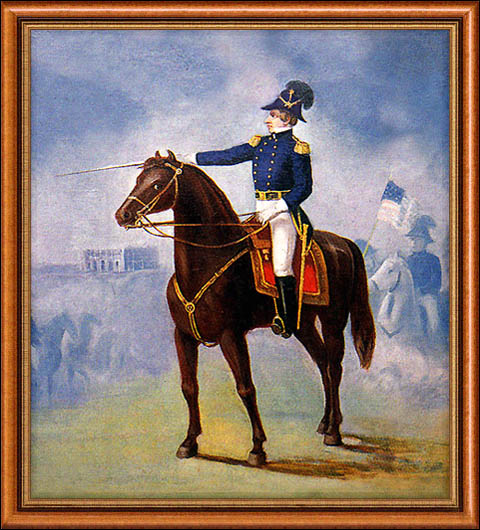
General Joseph Smith with Sword“I will be to this generation a second Muhammad, whose motto in treating for peace was the Alcoran [Koran] or the Sword. So shall it eventually be with us Joseph Smith or the Sword!”[10]
– Joseph Smith, October 14, 1838

So is it any surprise that seventeen years later (in his September 23rd, 1855 address) Mormon Apostle Parley P. Pratt was still swinging that sword:
“The Greek and Roman Churches, which have been called Christian, and which take the name of Christians as a cloak, have worshipped innumerable idols. On this account, on the simple subject of the Deity and His worship, if nothing more, I should rather incline, of the two, after all my early traditions, education, and prejudices, to the side of Mahomet, for on this point he is on the side of truth, and the Christian world on the side of idolatry and heathenism.”[11]

Parley Pratt“Though Mahometan institutions are corrupt enough, and need reforming by the Gospel, I am inclined to think, upon the whole, leaving out the corruptions of men in high places among them, that they have better morals and better institutions than many Christian nations; and in many localities there have been high standards of morals. So far as that one point is concerned, of worshipping the one true God under the name of Mahometanism, together with many moral precepts, and in war only acting on the defensive, I think they have exceeded in righteousness and truthfulness of religion, the idolatrous and corrupt church that has borne the name of Christianity.”[12]

So apparently, the assertion that early Mormonism was more akin to and aligned with Islam than Christianity (while, of course, being superior, more enlightened, and a step above both) isn’t far fetched at all – in fact, it seems that early Mormon leaders enthusiastically embraced the idea.

MODERN MORMONISM
But what about Modern Mormonism, surely it’s Christian – right?

Well, as respected Religious Journalists, Richard and Joan Ostling note, “…it is surely wrong to see Mormonism as a Christian derivative in the way that Christianity is a Jewish derivative, because the LDS faith is in radical discontinuity with historic Christianity.”[13] And expanding on the Ostlings, the late Catholic Scholar, Richard John Neuhaus clarified stating that:  “…Mormonism is inexplicable apart from Christianity and the peculiar permutations of Protestant Christianity in nineteenth-century America. It may in this sense be viewed as a Christian derivative. It might be called a Christian heresy, except heresy is typically a deviation within the story of the Great Tradition that Mormonism rejects tout court.”[14]

Continuing, Neuhaus goes on to explain:
“For missionary and public relations purposes, the LDS may present Mormonism as an ‘add-on,’ a kind of Christianity-plus, but that is not the official narrative and doctrine.

A closer parallel might be with Islam. Islam is a derivative of Judaism, and Christianity. Like Joseph Smith, Muhammad in the seventh century claimed new revelations and produced in the Quran a ‘corrected’ version of the Jewish and Christian scriptures, presumably by divine dictation. Few dispute that Islam is a new and another religion, and Muslims do not claim to be Christian, although they profess a deep devotion to Jesus. Like Joseph Smith and his followers, they do claim to be the true children of Abraham. Christians in dialogue with Islam understand it to be an interreligious, not an ecumenical, dialogue. Ecumenical dialogue is dialogue between Christians. Dialogue with Mormons who represent official LDS teaching is interreligious dialogue.”[15]

So, Richard Land, of the Southern Baptist Convention appears to have showed great insight when he famously observed:
“I think the fairest and most charitable way to define Mormonism would be to call it the fourth Abrahamic religion – Judaism being the first, Christianity being the second, Islam being the third, and Mormonism being the fourth. And Joseph Smith would play the same character in Mormonism that Muhammad plays in Islam.”[16]

And this view isn’t limited to Christian scholars – consider this analysis by Literary and Religious Critic, Harold Bloom:
“Mr. [Mitt] Romney, earnest and staid, who is deep within the labyrinthine Mormon hierarchy, is directly descended from an early follower of the founding prophet Joseph Smith, whose highly original revelation was as much a departure from historical Christianity as Islam was and is.

Joseph Smith, killed by a mob before he turned 39, is hardly comparable to the magnificent Akiva [whom Bloom theorizes invented Judaism], except that he invented Mormonism even more single-handedly than Akiva gave us Judaism, or Muhammad, Islam.”[17]

Thus the words of an early 20th Century editoral committee for Fleming H. Revell have stood the test of time:
“It is generally observed that Mormonism is similiar to Mohammedanism in it’s endorsement of the practice of polygamy and its ideas of heaven. Many other points of similarity between these systems have been noted by students, and the Book of Mormon has marked resemblance to the Koran. As all ancient religions have a modern equivalent, Mormonism can justly be claimed to be the modern form of Mohammedanism, and not incorrectly termed ‘the Islam of America.'”[18]

THE 4TH ABRAHAMIC RELIGION
So the consensus throughout the ages and on both sides of the divide has been that Mormonism isn’t Jewish, Christian, or Muslim – though it may derive forms, terms, and rites from all three. Furthermore, the parallels between Mormonism and Islam are simply too pronounced and too plentiful to ignore:

Similarities between the origins of Islam and those of Mormonism:
– Both Muhammad and Joseph Smith were reportedly inspired to start their movements by angelic visits.
The Archangel Jibreel (Gabriel) in the case of Muhammed, and the Angel Moroni for Joseph Smith (following a visit Smith claimed to have received from God and Jesus Christ three years earlier). In each event, the angel in question helped to prepare the prophet to receive a series of revelations from God.[20]

– Both Muhammad and Joseph Smith left behind authorized books they claimed to be direct revelations from God, books that their followers accept as Scripture.[19]

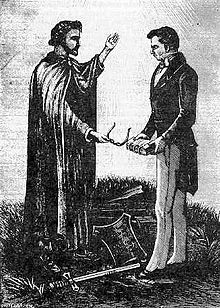
Joseph Smith Receiving his call and The Gold Plates from the Angel Moroni– Both Muhammad and Joseph Smith were persecuted by hostile locals and later forced to relocate (from Mecca to Medina, and from Missouri to Illinois, respectively) during the formative periods of their careers.[19]

– Both Muhammad and Joseph Smith established theocratic city-states during their respective ministries, Muhammad being invited to take the rule of Medina, while Joseph Smith would found Nauvoo, Illinois.[19]

– Both Muhammad and Joseph Smith both had humble beginnings.
Neither had formal religious connections or upbringing, and both were relatively uneducated. Yet both founded new religions by creating their own scriptures. In fact, followers of both prophets claim these scriptures are miracles since their authors were the most simple and uneducated of men.[20]

– Both Muhammad and Joseph Smith created new scripture which borrowed heavily from the Bible while simultaneously deviating from it.
In his Koran, Muhammad appropriates a number of Biblical themes and characters—but he changes the complete sense of many passages, claiming to “correct” the Bible. In so doing he changes many doctrines, introducing his own in their place. In like manner, Joseph Smith created the Book of Mormon, much of which is plagiarized directly from the King James Bible. Interestingly, the Book of Mormon claims that this same Bible has been substantially corrupted and is therefore unreliable. In addition, Joseph Smith went so far as to actually create his own version of the Bible itself, the “Inspired Version,” in which he both adds and deletes significant portions of text, claiming he is “correcting” it. In so doing he also changes many doctrines, introducing his own in their place.[20]

– Both Muhammad and Joseph Smith saw themselves as prophesied in scripture, and both saw themselves as a continuation of a long line of Biblical prophets.
Muhammad saw himself as a continuation of the ministry of Moses and Jesus.[21] Joseph Smith saw himself as a successor to Enoch, Melchizedek, Joseph and Moses. Joseph Smith actually wrote himself into his own version of the Bible—by name.[20][21]

Artist's recreation of the Book of Mormon Plates– Both Muhammad and Joseph Smith held up their own scripture as superior to the Bible.
Muhammad claimed that the Koran was a perfect copy of the original which was in heaven. The Koran is therefore held to be absolutely perfect, far superior to the Bible and superceding it. In like manner, Joseph Smith also made the following claim:
“I told the Brethren that the Book of Mormon was the most correct of any book on earth, and the keystone of our religion, and a man would get nearer to God by abiding its precepts, than by any other book.”[23]

– Both Muhammad and Joseph Smith, despite their claim that the Bible was corrupt, admonished their followers to adhere to its teachings.
An obvious contradiction, this led to selective acceptance of some portions and wholesale rejection of others. As a result, the Bible is accepted by both groups of followers only to the extent that it agrees with their prophet’s own superior revelation.[20]

– Both Muhammad and Joseph Smith claimed superiority over Jesus Christ.
Muhammad taught that Jesus was just another of a long line of human prophets, of which he was the last. He taught that he was superior to Christ and superceded Him.

In comparison, Joseph Smith also made the following claim:
“I have more to boast of than ever any man had. I am the only man that has ever been able to keep a whole church together since the days of Adam. A large majority of the whole have stood by me. Neither Paul, John, Peter, nor Jesus ever did it. I boast that no man ever did such a work as I. The followers of Jesus ran away from Him, but the Latter-day Saints never ran away from me yet.”
(“History of the Church”, vol. 6, p.408409; )[20][24]

– Both Muhammad and Joseph Smith were polygamists who had many wives.[25]

Other similarities between Islam and Mormonism
– Belief that good deeds are required for salvation just as much as faith.[19]

– Belief that the text of the Bible, as presently constituted, has been adulterated from its original form;[19]

An open Koran

– Belief that their faith represents the genuine, original religion of Adam, and of all true prophets thereafter;[19]

– Belief that one’s marriage can potentially continue into the next life, if one is faithful to the religion;[19]

– Belief that there are multiple degrees or spiritual levels in heaven;[19]

– Belief that a believer’s family, if appropriately faithful to the religion, can join them in the next world, only if they are equally faithful;[19]

– Assertions that modern Christianity does not conform to the original religion taught by Jesus Christ;[16]

– Rejection of the Christian doctrines of Original Sin and the Trinity;[19]

– Absolute prohibition of alcoholic beverages,and gambling;[19]

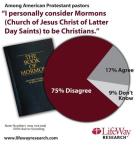
Poll: Pastors say Mormons not Christians

Click on image to enlarge and read poll results

– Incorporation of a sacred ritual of ablution, though each religion’s rite differs in form, frequency and purpose;[19]

– A “top down” clerical hierarchy that is drawn from the laity and placed into leadership roles, without any requirements for completing collegiate or theological training first;[19]

– Special reverence for, though not worship of, their founding prophet;[19]

–  A continuing history of sects, or splinter groups, who claim to be following the “original doctrine” of the founding leaders and whose practices include violence against dissenters and critics, as well as polygamy. [20]

CONCLUSION
Given these similarities and parallels – along with it’s long legacy of simultaneously denouncing and distancing itself from Christianity – it seems both logical, and reasonable that the LdS Church begin to proudly and publicly embrace it’s unique role as the Fourth Abrahamic Religion and drop the modern Mormon pretense that it’s Christian.[26]

NOTES
[1] Mike Tannehill, “The Mormon Christ”; Mormon Expression Blogs; November 27, 2011
[2] As in the David O. McKay era and later. For a full treatment of how Mormonism slowly transitioned from a movement that considered itself separate from and atagonistic to Christianity to one that insisted that it be identified with it, see “David O. McKay and the Rise of Modern Mormonism” by Gregory A Prince and William Robert Wright.

This mid-20th Century shift was also lightly, but poignently discussed in the PBS Frontline documentary, “The Mormons” in Part Two.
[3] Heber C. Kimball, “Oneness Of The Priesthood – Impossibility Of Obliterating Mormonism – Gospel Ordinances – Depopulation Of The Human Species – The Coming Famine, Etc.”; July 26, 1857; Journal of Discourses, Volume 5, p.89
[4] Joseph Smith, “Teachings of Joseph Smith”, p.270
( also see “Documentary History of The Church”, pp.217-219 )
[5] John Taylor, Journal of Discourses, Volume 6, p.167
[6] John Taylor, Journal of Discourses, Volume 10, p.127
[7] George Q. Cannon, The Journal of Discourses, Volume 24, p.371
[8] George A. Smith, The Journals of Discourse, Volume 3, p.30
[9] George A. Smith, The Journals of Discourse, Volume 3, p. 32
[10] Joseph Smith made this statement at the conclusion of a speech in the public square at Far West, Missouri on October 14, 1838. This particular quote is documented in Fawn M. Brodie, No Man Knows My History, second edition, (New York: Alfred A. Knopf, 1971), pp.230–231.

Brodie’s footnote regarding this speech contains valuable information, as follows:
“Except where noted, all the details of this chapter (16) are taken from the History of the [Mormon] Church. This speech, however, was not recorded there, and the report given here is based upon the accounts of seven men. See the affidavits of T.B. Marsh, Orson Hyde, George M. Hinkle, John Corrill, W.W. Phelps, Samson Avard, and Reed Peck in Correspondence, Orders, etc., pp. 57–9, 97–129. The Marsh and Hyde account, which was made on October 24, is particularly important. Part of it was reproduced in History of the [Mormon] Church, Volume 3, p. 167See also the Peck manuscript, p. 80. Joseph himself barely mentioned the speech in his history; see Vol. 3, p. 162.”

Please note that Bill McKeever’s artcle, “Joseph Smith – The Second Muhammad?” also contains interesting and valuable information regarding Smith’s speech based on the Marsh statement which Brodie references.
[11] Journal of Discourses, Volume 3, p.41; a transcription of the entire address can be read here.
[12] Journal of Discourses, Volume 3, p.38; a transcription of the entire address can be read here.
[13] Richard Ostling and Joan K. Ostling, “Mormon America”, p. 324
[14] Richard John Neuhaus, “Is Mormonism Christian? A Respected Advocate for Interreligious Cooperation Responds”; “First Things”, March 2000
[15] Ibid
[16] David Van Biema, “What Is Mormonism? A Baptist Answer”; Time Magazine, Wednesday, Oct. 24, 2007
[17] Harold Bloom, “Will This Election Be the Mormon Breakthrough?”; New York Times Sunday Review, November 12, 2011;
[18] Bruce Kinney, D.D., “Mormonism The Islam of America”; Fleming H. Revell Company, 1912; p.5.
[19] Wikipedia, “Similarities Between Muslims and Mormons”
[20] Paul T. Trask, “I Will Be a Second Muhammad”
[21] John Ankerberg & John Weldon, “The Facts on Islam”; Eugene, OR: Harvest House Publishers, 1998; pp.8–9. Also see Eric Johnson, “Joseph Smith & Muhammed”; El Cajon, CA: Mormonism Research Ministry, 1998; pp.6–7.
[22] Genesis 50:26-36 of the Joseph Smith TranslationA good analysis of this topic can be found on pp.108&109 of “Part Way To Utah” by Paul Trask
[23] History of the Church, vol.4, pp.461
[24] History of the Church, vol.6, pp.408409
[25]  See “Muhammad’s wives” and “Remembering The Wives of Joseph Smith”Also note that Joseph Smith, Jr’s FamilySearch.org record (AFN: 9KGL-W2) contains the names of his polygamous wives. This is particularly interesting since as of the date of writing FamilySearch.org is owned and managed by the LdS Church.
[26]While not expliciting advocating this author’s stance in regard to assuming the “4th Abrahamic Religion” designation, some Latter-day Saint panelists on the June 14, 2011 Mormon Matters podcast (“Episode 37: Why Are Mormons Seen as “Dangerous” by Some Evangelical Christians?”) never-the-less agreed with this author that the Mormon claim that it is Christian is not only inaccurate and misleading but creating unnecessary friction and mistrust between the two groups.

This author agrees with that stance. However, you can’t drop the “Christian” label without replacing it with something. In the end, and after much thought, this author considers the “4th Abrahamic Religion” a fair and accurate stance that all parties should be able to live with.