Introduction While I was preparing the prior Beggar Bread article, “Mormons: Pentecostals Gone Bad!” I was fortunate enough to find an email address for the webmaster of the now (and I hope temporarily) defunct WhyMormons.net website that contained important articles that I had sourced when I originally researched and wrote my piece back in 2009.
Recontact in this case was important because two articles from that much missed resource are cited in both editions of my piece. Further, I make every attempt to be diligent in providing not only justification for the evidence that I present and conclusions that I draw but in creating an audit and research trail for future researchers should they wish to validate or build on my work as I have on the work of others. Fortunately, in this case, I had had the foresight in 2009 to capture one of the articles in it’s entirety (Shamdango’s “Alcohol & Mormon Temples: Getting Crunk in the House of the Lord” – see Appendix A of “Mormons: Pentecostals Gone Bad!”) in my research archives. However, one article was still Missing In Action (MIA).
That MIA article, I felt, was especially critical because it contained rare and unique summations of early Latter-day Saint initiatory ordinances – including the unusual practice of washing in perfumed whiskey – as well as some important historical transcripts of that ordinance. So you can imagine my delight and surprise today when I not only received a response to my email from the WhyMormons.net webmaster but the entire text of that MIA article as well!
So it’s with delight and pleasure that I present that same said article as both Appendix B to “Mormons: Pentecostals Gone!” and as it’s own stand-alone article: APPENDIX B: The Kirtland (Spiritual Endowment): An Early Template for the Initiatory by “Shamdango” (author’s pen name) The early Kirtland initiatory ordinances were for “worthy brethren” who were,“invited to participate in certain purifying ordinances preparatory to receiving a spiritual endowment of power. These ordinances consisted of washing ‘head to foot’ in soap and water, washing in clear water and perfumed whiskey, having one’s head anointed with consecrated oil and receiving a blessing by the spirit of prophesy, having the anointing blessing sealed with uplifted hands (solemn prayer, a sealing prayer, and the hosanna shout), and washing of faces and feet and partaking of the Lord’s Supper.” (Backman & Cook eds. “Kirtland Elders’ Quorum Record” (1985), p.25-26)
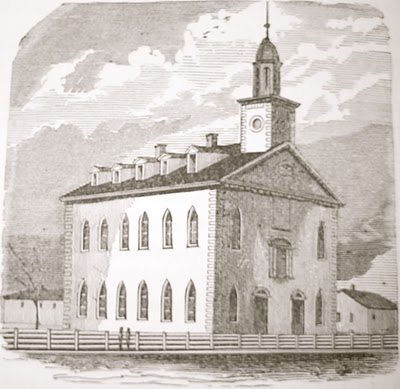
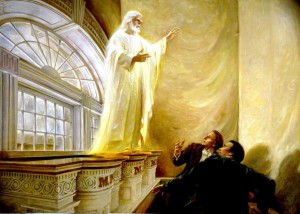
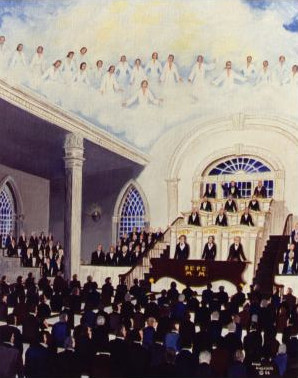
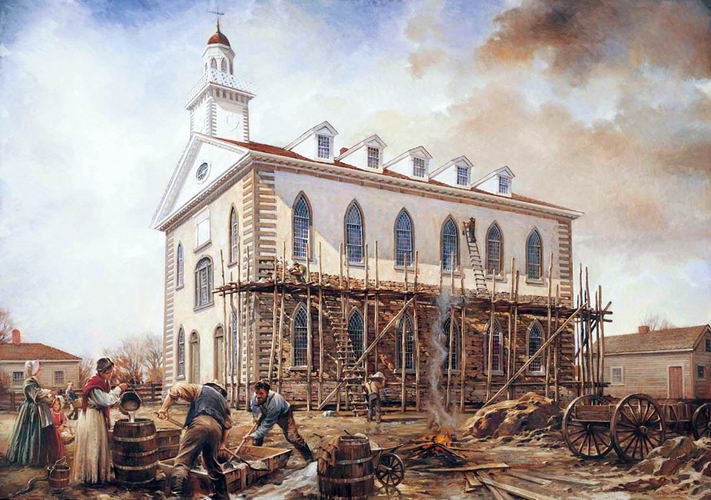
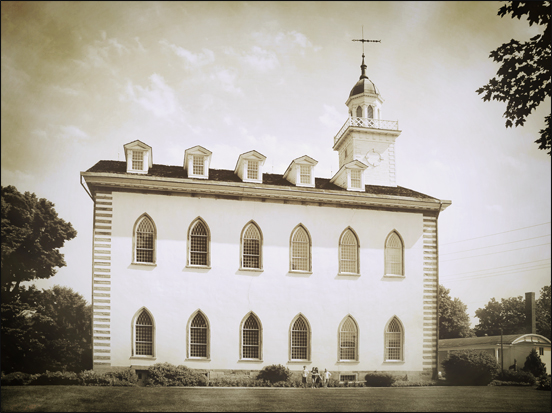
Artist’s depiction of the Kirtland Temple
In summary, the Kirtland Endowment & Initiatory Ceremony included:
Washing with soap and water;
Washing with water and perfumed whiskey
(Using whiskey for washing is supported by Doctrine and Covenants 89:7);
Consecration with oil and receiving blessing
(solemn prayer, sealing prayer, and hosanna shout);
Blessing sealed;
Washing of faces and feet and partaking of the Lord’s Supper;
The men participating in these Spiritual Endowments were informed that they should fast during the day that they attended to these ordinances.
The men would become completely naked and bathe themselves completely in soap and water.
“After attending to the duties above spoken I repaired to a room in Company with Elder Meeks & Priest J Turpin to attend to our first washing. After washing our bodies from head to foot in soap & watter we then washed ourselves in clear watter next in perfumed spirits [whiskey].”
(“Wilford Woodruff’s Journal”, edited by Scott G. Kenny)
Upon breaking the fast to partake of the Lord’s supper…
“The fast was then broken by eating light wheat bread, and drinking as much wine as they saw proper. Smith knew well how to infuse the spirit which they expected to receive; so he encouraged the brethren to drink freely, telling them that the wine was consecrated, and would not make them drunk. As may be supposed, they drank to the purpose. After this, they began to prophesy, pronouncing blessings upon their friends, and curses upon their enemies.” (William Harris, “Mormonism Portrayed”)
These washings and anointings would later be incorporated into the Nauvoo temple ceremony and became known as the “initiatory ordinance” or “preparatory ordinances” to the secret and sacred endowment created for Joseph Smith’s closest inner-circle of polygamy-practicing friends.
The earliest account that we have of the Nauvoo initiatory ordinance is given to us in Heber C. Kimball’s journal in 1845. He says:
“. . . John D Lee and others have been fitting up stoves in the two west rooms [of the temple]. As they will be devoted to washing and Anointing and to heet water. We have two Large traves [troughs]. . . . Three men can wash in either of them at the same time”
Men and women’s washings and anointings were performed in separate areas of the temple by members of the same gender (males performing the ritual on males and females performing the ritual for females)
The earliest accounts of the initiatory washings indicate a literal Old Testament model of actual bathing. Large tubs of water are specified in the separate men’s and women’s rooms. The anointing was performed by liberally pouring consecrated oil from a horn over the head and allowing it to run over the whole body.
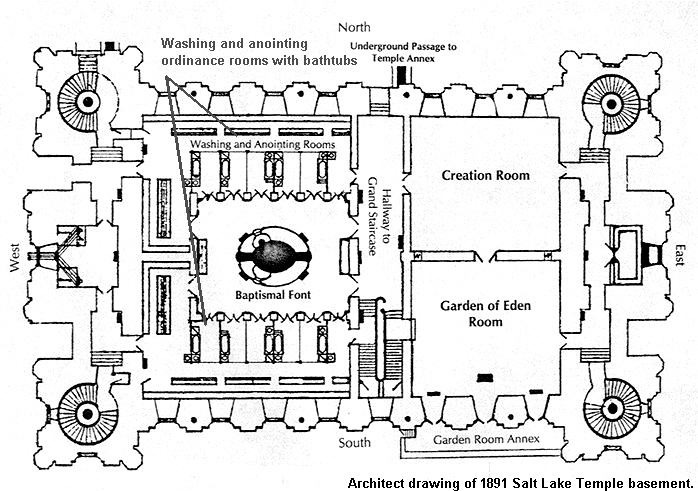
As late as 1931, the Salt Lake Temple had full-sized bathtubs for the washing ceremony. Men and women were still expected to become completely nude and “wash” themselves according to the ordinance.
On the right is a photo of one of the ten washing and anointing rooms in the Salt Lake Temple as it appeared in 1912.
Sometime after 1931, the ordinance for the initiatory washings and anointings was modified to become a much less intimate procedure – one requiring a simple and symbolic touching of the patron’s naked body in certain places with oil and water.
This ordinance continued to evolve into the patron wearing a white pancho-looking cloth called a “shield” with the sides completely open allowing the officiator to touch the patron’s naked body in the places that were being symbolically washed and anointed.
While the initiatory & endowment work is now done for both the living and the dead within Mormon temples, these secret rituals and ceremonies weren’t performed for the dead within Mormon temples until 1877.
“The first recorded endowments for the dead were performed in St. George on 11 January 1877, according to temple president David H. Cannon. Shortly thereafter Wilford Woodruff, the new temple president, received a revelation about endowments and sealings for his dead, which he recorded in his journal . . . Accordingly on 1 March 1877 Woodruff spent his seventieth birthday in the St. George temple with 154 women performing proxy endowments for deceased women who had been or were being sealed to Woodruff.” (David J. Beurger, “The Mysteries of Godliness: A History of Mormon Temple Worship” pp.108-9)
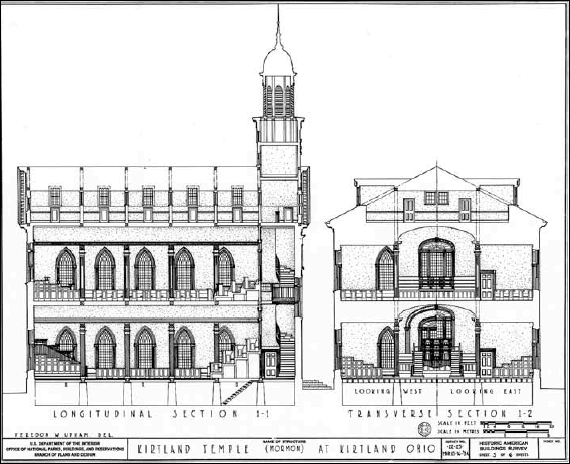
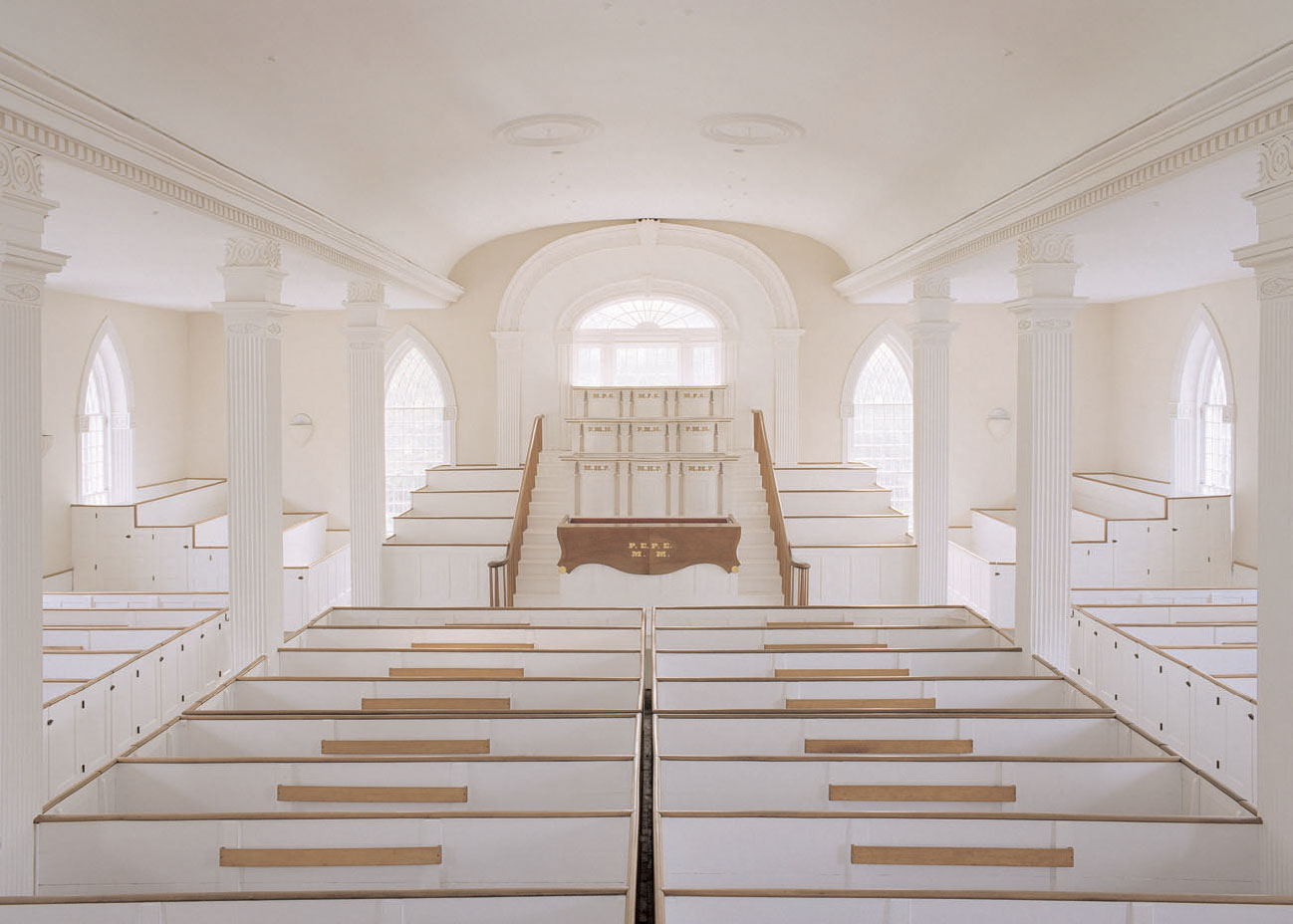
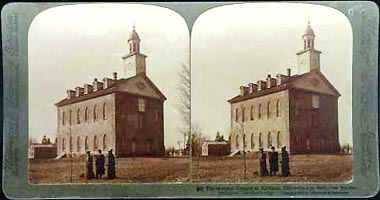
Cross section view of the Kirtland Temple
The Initiatory Ordinance (Pre-2005) What Follows is the actual wording of the initiatory. (parenthesis indicates my own description of the actions) Words in red represent wording & actions from the initiatory pre-2005
(Each initiate is presented individually to the washing rooms. Throughout the initiatory, women officiate for women, and men for men.)
Washing (An officiator places water on the initiate’s head while pronouncing the following words)
Brother _________, having authority, I wash you preparatory to your receiving your anointings [for and in behalf of _________, who is dead], that you may become clean from the blood and sins of this generation.
(While pronouncing the blessings which follow, the officiator touches each part of the body as it is named)
I wash your head, that your brain and your intellect may be clear and active;
your ears, that you may hear the word of the Lord;
your eyes, that you may see clearly and discern between truth and error;
your nose, that you may smell;
your lips, that you may never speak guile;
your neck, that it may bear up your head properly;
your shoulders, that they may bear the burdens that shall be placed thereon;
your back, that there may be marrow in the bones and in the spine;
your breast, that it may be the receptacle of pure and virtuous principles;
your vitals and bowels, that they may be healthy and perform their proper functions;
your arms and hands, that they may be strong and wield the sword of justice in defense of truth and virtue;
your loins, that you may be fruitful and multiply and replenish the earth, that you might have joy in your posterity;
your legs and feet, that you might run and not be weary, and walk and not faint.
(A second officiator enters. Both officiators place their hands on the initiate’s head, and the second officiator seals the washing as follows.)
Brother _________, having authority, we lay our hands upon your head [for and in behalf of _________, who is dead] and seal upon you this washing, that you may become clean from the blood and sins of this generation through your faithfulness; in the name of Jesus Christ. Amen.
Anointing (An officiator places oil on the initiate’s head while pronouncing the following words.)
Brother _________, having authority, I pour this holy anointing oil upon your head [for and in behalf of _________, who is dead] and anoint you preparatory to your becoming a king and a priest unto the most high God, hereafter to rule and reign in the house of Israel forever.
(While pronouncing the blessings which follow, the officiator touches each part of the body as it is named)
I anoint your head, that your brain and your intellect may be clear and active;
your ears, that you may hear the word of the Lord;
your eyes, that you may see clearly and discern between truth and error;
your nose, that you may smell;
your lips, that you may never speak guile;
your neck, that it may bear up your head properly;
your shoulders, that they may bear the burdens that shall be placed thereon;
your back, that there may be marrow in the bones and in the spine;
your breast, that it may be the receptacle of pure and virtuous principles;
your vitals and bowels, that they may be healthy and perform their proper functions;
your arms and hands, that they may be strong and wield the sword of justice in defense of truth and virtue;
your loins, that you may be fruitful and multiply and replenish the earth, that you might have joy in your posterity;
your legs and feet, that you might run and not be weary, and walk and not faint.
(A second officiator enters. Both officiators place their hands on the initiate’s head, and the second officiator confirms the anointing as follows.)
Brother _________, having authority, we lay our hands upon your head [for and in behalf of _________, who is dead] and confirm upon you this anointing, wherewith you have been anointed in the temple of our God preparatory to becoming a king and a priest unto the most high God, hereafter to rule and reign in the house of Israel forever, and seal upon you all the blessings hereunto appertaining, through your faithfulness; in the name of Jesus Christ. Amen.
The Garment Click here [note: link now dead] for the history of the garment (An officiator clothes the initiate in the garment. The officiator then pronounces the following words.)
Brother _________, having authority, I place this garment upon you [for and in behalf of _________, who is dead], which you must wear throughout your life. It represents the garment given to Adam when he was found naked in the garden of Eden and is called the garment of the holy priesthood.
Inasmuch as you do not defile it, but are true and faithful to your covenants, it will be a shield and a protection to you against the power of the destroyer until you have finished your work here on earth.
The New Name (In the case of a living endowment, the officiator who clothed the initiate in the garment continues as follows.)
With this garment, I give you a new name, which you should always remember and which you must keep sacred and never reveal, except at a certain place that will be shown you hereafter.
The name is _________.
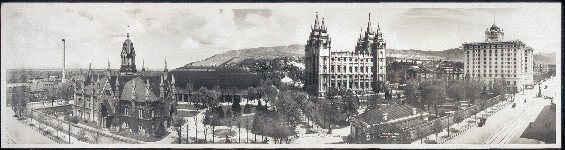
Temple Square, Salt Lake City 1891
The 2005 Changes to the Initiatory In January 2005, the initiatory ordinance was once again changed. This time the patron arrives already wearing the garment and the pancho-looking shield zips up on the sides. The patron is no longer naked or touched on any parts of their body other than their head. Words in red represent the new verbiage & changes Everything else about the verbiage is exactly the same as the pre-2005 ordinance verbiage.
(The initiate dons the garment and the shield before being presented individually to the washing rooms. Throughout the initiatory, women officiate for women, and men for men.)
PREFACE Brother _________, the temple washing, anointing, and clothing ordinances were given anciently, as recorded in the book of Exodus: “And thou shalt bring Aaron and his sons unto the door of the tabernacle of the congregation, and wash them with water. And thou shalt put upon Aaron the holy garments, and anoint him, and sanctify him.”
We likewise administer these ordinances in our day, but you are washed and anointed only symbolically, as follows.
Washing Changes (While pronouncing the blessings, the officiator lays hands on the initiate’s head only.)
Anointing Changes (While pronouncing the blessings, the officiator lays hands on the initiate’s head only.)
Garment Verbiage Changes Brother _________, under proper authority, the garment placed upon you is now authorized [for and in behalf of _________, who is dead], and is to be worn throughout your life. It represents the garment given to Adam when he was found naked in the garden of Eden and is called the garment of the holy priesthood.
Everything else about the verbiage is exactly the same as pre-2005.
New Name (In the case of a living endowment, the officiator who authorized the initiate’s garment continues as follows.)
by Fred W. Anson
(Second Edition to original June 2009 edition published on “Concerned Christians”) Tongues speaking, vision seeing, holy rolling Mormons? For many the fact that primitive Mormonism was as Pentecostal as their local Foursquare or Assemblies of God Church may come as a shock but it’s a historical fact.
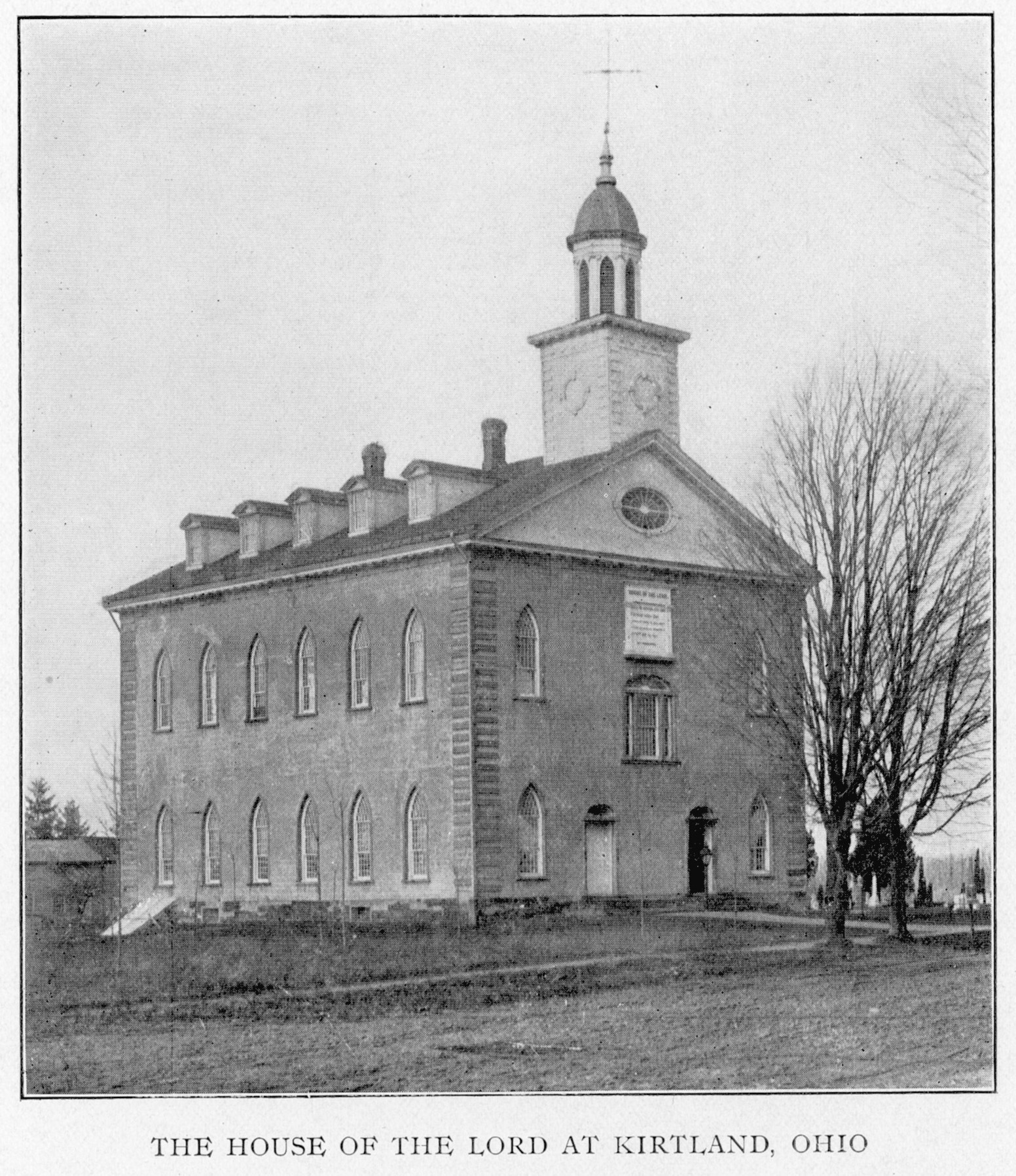
And could there be any greater evidence of the Pentecostalism of early Mormonism than the Dedication of the Kirtland Temple? Maybe, but it’s pretty hard to top – especially since we have such a rich trove of first hand reports to choose from. A few of these accounts follow this brief introduction.
And since this author comes from a Pentecostal/Charismatic tradition I think it important to note that I’m not saying that these experiences would be considered legitimate by Christians of any ilk either then or now. Thankfully, the test for orthodoxy then, as it is now, rests on Biblical authority as well as reasonable empiricism and common sense (well, at least for the most part on the last one). Consider, for example, this empirical commentary from a modern Mormon Studies Scholar who suggests that something more than a move of the Spirit was a factor in Early Mormon practice of the Gifts of the Holy Spirit (aka “Charismata”):
Oh, there was prophesying, testifying, speaking in tongues, blessing and cursing, visions, angels, appearances by all kinds of characters including Elijah, Jesus, Adam, and Abraham.
But the Mormon church conveniently never discusses the fact that everyone arrived fasted – starving and thirsty. And how did they break the fast? With the Lord’s Supper, of course: bread and wine. Lots of wine.[1]
Yet despite any challenges to the causality, legitimacy or orthodoxy of any particular charismatic expression Early Mormonism was unquestionably rooted in the burgeoning Pentecostalism of it’s day. Further, you can still see evidences and echoes of that legacy in the modern LdS Church – though today it’s only a shadow-like (actually more like a zombie-like, that is, animated but dead) aberration of what it once was.
First Hand Accounts of the Dedication of the Kirtland Temple: Joseph Smith, Jr. “Brother George A. Smith arose and began to prophesy, when a noise was heard like the sound of a rushing mighty wind, which filled the Temple, and all the congregation simultaneously arose, being moved upon by an invisible power; many began to speak in tongues and prophesy; others saw glorious visions; and I beheld the Temple was filled with angels, which fact I declared to the congregation. The people of the neighborhood came running together (hearing an unusual sound within, and seeing a bright light like a pillar of fire resting upon the Temple), and were astonished at what was taking place.”[2]
Oliver Cowdery “Sunday, the 27th attended on the dedication of the Lord’s house. For the particulars of this great event see my account written by myself, and printed in the March No. of The Messenger and Advocate, signed C. In the evening I met with the officers of the church in the Lord’s house. The Spirit was poured out–I saw the glory of God, like a great cloud, come down and rest upon the house, and fill the same like a mighty rushing wind. I also saw cloven tongues, like as of fire rest upon many, (for there were 316 present,) while they spake with other tongues and prophesied.”[3]
Heber C. Kimball “During the ceremonies of the dedication, an angel appeared and sat near President Joseph Smith, Sen., and Frederick G. Williams, so that they had a fair view of his person. He was a very tall personage, black eyes, white hair, and stoop shouldered; his garment was whole, extending to near his ankles; on his feet he had sandals. He was sent as a messenger to accept of the dedication…While these things were being attended to the beloved disciple John was seen in our midst by the Prophet Joseph, Oliver Cowdery and others.”[4]
George A. Smith “There were great manifestations of power, such as speaking in tongues, seeing visions, administration of angels. Many individuals bore testimony that they saw angels, and David Whitmer bore testimony that he saw three angels passing up the south aisle, and there came a shock on the house like the sound of a mighty rushing wind, and almost every man in the house arose, and hundreds of them were speaking in tongues, prophecying or declaring visions, almost with one voice.”[5]
Eliza R. Snow “One striking feature of the ceremonies, was the grand shout of hosanna, which was given by the whole assembly, in standing position, with uplifted hands. The form of the shout is as follows: ‘Hosanna-hosanna-hosanna-to God and the Lamb-amen-amen, and amen.’ The foregoing was deliberately and emphatically pronounced, and three times repeated, and with such power as seemed almost sufficient to raise the roof from the building.
A singular incident in connection with this shout may be discredited by some, but it is verily true. A notice had been circulated that children in arms would not be admitted at the dedication of the temple. A sister who had come a long distance with her babe, six weeks old, having, on her arrival, heard of the above requisition, went to the patriarch Joseph Smith, Sr., in great distress, saying that she knew no one with whom she could leave her infant; and to be deprived of the privilege of attending the dedication seemed more than she could endure. The ever generous and kind-hearted father volunteered to take the responsibility on himself, and told her to take her child, at the same time giving the mother a promise that her babe should make no disturbance; and the promise was verified. But when the congregation shouted hosanna, that babe joined in the shout. As marvelous as that incident may appear to many, it is not more so than other occurrences on that occasion
The ceremonies of that dedication may be rehearsed, but no mortal language can describe the heavenly manifestations of that memorable day. Angels appeared to some, while a sense of divine presence was realized by all present, and each heart was filled with ‘joy inexpressible and full of glory.'”[6]
Benjamin Brown “There the Spirit of the Lord, as on the day of Pentecost, was profusely poured out. Hundreds of Elders spoke in tongues. We had a most glorious and never-to-be-forgotten time. Angels were seen by numbers present. It was also at this time that Elijah the Prophet appeared, and conferred upon Joseph the keys of turning the hearts of the fathers to the children, previous to the re-institution of the ordinance of baptism for the dead.”[7]
Truman Angell “When about midway during the prayer, there was a glorious sensation passed through the house [Kirtland Temple]; and we, having our heads bowed in prayer, felt a sensation very elevating to the soul. At the close of the prayer, F. [Frederick] G. Williams being in the upper east stand- -Joseph being in the speaking stand next below–rose and testified that midway during the prayer an holy angel came and seated himself in the stand. When the afternoon meeting assembled, Joseph, feeling very much elated, arose the first thing and said the personage who had appeared in the morning was the Angel Peter come to accept the dedication.”[8]
NOTES [1]Shamdango, “Alcohol & Mormon Temples: Getting Crunk in the House of the Lord”; (http://www.whymormons.net/2008/04/alcohol-mormon-temples.html ; retrieved 2009-06; link now dead but full text follows in Appendix A) [2] Joseph Smith, “History of The Church of Jesus Christ of Latter-day Saints”, 7 vols., introduction and notes by B. H. Roberts (Salt Lake City: The Church of Jesus Christ of Latter-day Saints, 1932-1951), Volume 2, p.428. [3] Leonard J. Arrington, “Oliver Cowdery’s Kirtland Ohio ‘Sketch Book,'” BYU Studies, Volume 12, (Summer 1972), 426. [4] Journal of Discourses, 26 vols. (London: Latter-day Saints’ Book Depot, 1854-1886), Volume 9, p.376 [5] Ibid, Volume 11, p.10. [6] Edward W. Tullidge, “The Women of Mormondom” (New York: Tullidge & Crandall, 1877), p.95 [7] Benjamin Brown, “Testimony for the Truth,” Gems for the Young Folks (Salt Lake City: Juvenile Instructor Office, 1881), p.65 [8] Truman Angell, Autobiography, Our Pioneer Heritage, Writings of Early Latter-day Saints, p.198.
APPENDIX A:
Alcohol & Mormon Temples: Getting Crunk in the House of the Lord by “Shamdango” (author’s pen name) To “get crunk”: (verb) The act of getting crazy drunk.
The Church of Jesus Christ of Latter-day Saints is quick to tell fascinating tales of spiritual manifestations about its temples.
Some fantastic tales are the remarkable events that transpired in 1836 before and during the dedication of the Kirtland temple.
Oh, there was prophesying, testifying, speaking in tongues, blessing and cursing, visions, angels, appearances by all kinds of characters including Elijah, Jesus, Adam, and Abraham.
But the Mormon church conveniently never discusses the fact that everyone arrived fasted – starving and thirsty. And how did they break the fast? With the Lord’s Supper, of course: bread and wine. Lots of wine.
Speaking of the endowment event, William Harris gives us this account: “In the evening, they met for the endowment. The fast was then broken by eating light wheat bread, and drinking as much wine as they saw proper. Smith knew well how to infuse the spirit which they expected to receive; so he encouraged the brethren to drink freely, telling them that the wine was consecrated, and would not make them drunk…..they began to prophecy, pronounce blessings upon their friends, and curses on their enemies. If I should be so unhappy as to go to the regions of the damned, I would never expect to hear language more awful, or more becoming the infernal pit, than was uttered that night.”
Some years later, a brother Milo Andress “spoke of blessings and power of God manifested in the Kirtland Temple. Said he once asked the Prophet why he (Milo) did not feel the power that was spoken of as the power that was felt on the day of the Pentecost?….when we had fasted for 24 hours and partaken of the Lord’s supper, namely a piece of bread as big as your double fist and a half pint of wine in the Temple. I was there and saw the Holy Ghost descend upon the heads of those present like cloven tongues of fire.” – Diary of Charles L. Walker 1855-1902, excerpts typed 1969, page 35.
Mrs. Alfred Morley made this comment: “I have heard many Mormons who attended the dedication, or endowment of the Temple say that very many became drunk….The Mormon leaders would stand up to prophesy and were so drunk they said they could not get it out and would call for another drink. Over a barrel of liquor was used at the service.”
Isaac Aldrich stated: “My brother, Hazen Aldrich, who as president of the Seventies, told me when the Temple was dedicated a barrel of wine was used and they had a drunken pow-wow.”
Stephen H. Hart gave this information: “Mr McWhithey, who was a Mormon…said he attended a service which lasted from 10 AM until 4 PM, and there was another service in the evening. The Lord’s Supper was celebrated and they passed the wine in pails several times to the audience, and each person drank as much as he chose from a cup. He said it was mixed liquor and he believed the Mormon leaders intended to get the audience under the influence of the mixed liquor, so they would believe it was the Lord’s doings….When the liquor was repassed, Mr McWhithey told them he had endowment enough, and said he wanted to get out of the Temple, which was densely crowded.”
“The great heavenly ‘visitation,’ which was alleged to have taken place in the temple at Kirtland, was a grand fizzle. The elders were assembled on the appointed day, which was promised would be a veritable day of Pentecost, but there was no visitation. No Peter, James and John; no Moses and Elias, put in an appearance. ‘I was in my seat on that occasion,’ says Mr. Whitmer, ‘and I know that the story sensationally circulated, and which is now on the records of the Utah Mormons as an actual happening, was nothing but a trumped up yarn…”
High Priest David Whitmer, one of the Three Witnesses, The Des Moines Daily News, Oct. 16, 1886;
The statement by Mormon Apostle George A. Smith would also lead a person to believe that wine was used to excess: “… after the people had fasted all day, they sent out and got wine and bread…. they ate and drank…. some of the High Counsel of Missouri stepped into the stand, and, as righteous Noah did when he awoke from his wine, commenced to curse their enemies (Journal of Discourses, vol. 2, p.216).
Yes, wine was pouring that day and everyone was “drunk” with the spirit, from having drunk too many spirits.
It seems that the majority of the time, you can hardly find Joseph Smith having any of his historical visions and visitations without having the Lord’s Supper somewhere around the event – lots of wine.
It wasn’t until July 5, 1906 that the First Presidency and Quorum of the Twelve Apostles officially abandoned the practice of drinking wine in their weekly temple sacrament meetings.
The early initiatory ordinances also included bathing naked in strong perfumed “spirits” (e.g. whiskey) You can learn more about that here.
It’s apparent that the early saints were much more liberal with the wine at Joseph Smith’s request. Have you ever noticed that the outpouring of the spiritual manifestations and pentecostal gifts seemed to fade once Joseph Smith was gone?
Lord Jesus,
I am blind, be thou my light,
ignorant, be thou my wisdom,
self-willed, be thou my mind.
Open my ear to grasp quickly thy Spirit’s voice,
and delightfully run after his beckoning hand;
Melt my conscience that no hardness remain,
make it alive to evil’s slightest touch;
When Satan approaches may I flee to thy wounds,
and there cease to tremble at all alarms.
Be my good shepherd to lead me into
the green pastures of thy Word,
and cause me to lie down beside the rivers
of its comforts.
Fill me with peace, that no disquieting worldly gales
may ruffle the calm surface of my soul.
Thy cross was upraised to be my refuge,
Thy blood streamed forth to wash me clean,
Thy death occurred to give me a surety,
Thy name is my property to save me,
By thee all heaven is poured into my heart,
but it is too narrow to comprehend thy love.
I was a stranger, an outcast, a slave, a rebel,
but thy cross has brought me near,
has softened my heart,
has made me thy Father’s child,
has admitted me to thy family,
has made me joint-heir with thyself.
O that I may love thee as thou lovest me,
that I may walk worthy of thee, my Lord,
that I may reflect the image of heaven’s first-born.
May I always see thy beauty with the clear eye of faith,
and feel the power of thy Spirit in my heart,
for unless he move mightily in me
no inward fire will be kindled.
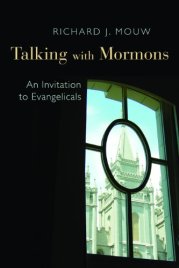
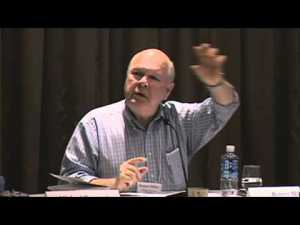
Scolasticus Consummati Richard J. Mouw’s book “Talking with Mormons: An Invitation to Evangelicals” represents his maiden voyage into the vast sea of Mormon Studies books. As such, anticipation of a valuable and timely message was high given his bio:
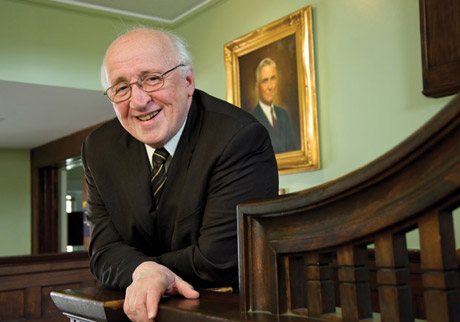
Richard J. Mouw
“Richard J. Mouw has served as president of Fuller Theological Seminary since 1993, after having served the seminary for four years as provost and senior vice president. A philosopher, scholar, and author, Mouw joined the faculty of Fuller Theological Seminary as professor of Christian philosophy and ethics in 1985. Before coming to Fuller he served for 17 years as professor of philosophy at Calvin College in Grand Rapids, Michigan. He has also served as a visiting professor at the Free University in Amsterdam.
A graduate of Houghton College, Mouw studied at Western Theological Seminary and earned a master’s degree in philosophy at the University of Alberta. His PhD in philosophy is from the University of Chicago.
Mouw has a broad record of publication. He has been an editor of the Reformed Journal and has served on many editorial boards, including currently Books and Culture. He is the author of 19 books…”[1]
Indeed, Dr. Mouw has had a long and distinguished career and many of his books, particularly those on Reformed, Creedal Theology are recommended reading.
Out Of His League Of course, given such an impressive resume, there’s an expectation that this book should be well written, and it is. Dr. Mouw writes in a tight, succinct, engaging style and his arguments are logical, clear, and understandable. Dr. Mouw is a craftsman of style and rhetoric, however the substance of his argument fails to satisfactorily address those issues with Mormonism that present the greatest challenges to Evangelicals and others with years of experience in the field. Ultimately this new entry into the arena is clumsy and counter-productive. It’s quickly apparent that Dr. Mouw has exceeded the limits of his competency.
For a start, Dr. Mouw is talking to the wrong Mormons. “College Professor” and/or “Scholar” has no place in the hierarchy of the LdS Church.[2] They don’t interpret official doctrine, they don’t define LdS orthodoxy, they don’t dictate LdS Church policy and they have exactly no “Priesthood Authority” over those who do. Thirteenth President Ezra Taft Benson made this quite clear when he said:
“Doctrinal interpretation is the province of the First Presidency. The Lord has given that stewardship to them by revelation. No teacher has the right to interpret doctrine for the members of the Church. If Church members would remember that, we could do away with a number of books which have troubled some of our people”[3]
In expecting the learned lay person to have any influence on the theology, doctrines and practice of the LdS Church, Dr. Mouw appears to have psychologically projected his own Evangelical tradition onto the Mormon movement. He doesn’t appear to grasp that Mormonism is, and always has been governed magisterially by its First Presidency. It is a “top down” institution that simply does not answer to the professors in its private university.[4]
To illustrate this point, it should be noted that of all the myriad changes to LdS theology that have been enacted in Salt Lake City (home of the Church Office Building for the Church of Jesus Christ of Latter-day Saints)[5], I can think of none that have originated in Provo (home of Brigham Young University).[6]
A Fine Example Of … What Exactly?
This isn’t to say that Dr. Mouw limits himself exclusively to leading LdS academics. He also relates his interaction with Elder Jeffrey Holland, who is a member of the “Quorum of the Twelve Apostles” and occupies one of the top positions in the Mormon hierarchy:[7]
‘Elder Jeffrey Holland, one of the LDS General Authorities, not only has talked privately with some of us about the ways in which LDS leaders are placing a much stronger emphasis these days on the “finished work” of the atoning sacrifice of Jesus Christ on the Cross of Calvary, as well as the need for fallen sinners to rely completely on the grace of God for salvation; he and his colleagues have also publicly preached that kind of message in unambiguous terms to tens of thousands of Mormons in their addresses in recent years at the annual General Conferences. The evidence is available to anyone who has access to YouTube!’[8]
However, there’s an incongruity between what Dr. Mouw claims and the supporting evidence he produces to support it.[9]
Specifically, the address that Dr. Mouw presents as “a fine example” of this new trend in Mormonism was the 2009 General Conference Easter Message.[10] If you watch the video, Holland doesn’t present the mainstream Christian view of “the ‘finished work’ of the atoning sacrifice of Jesus Christ on the Cross of Calvary, as well as the need for fallen sinners to rely completely on the grace of God for salvation”, instead what he gave was the type of generic LdS Easter Message that’s been given at Annual General Conference sessions for decades.
And in accordance with LdS Theology, the main emphasis (please note the graphics in the video in particular) is on the Garden of Gethsemane where – in direct contradiction to what’s taught in the New Testament – LdS General Authorities have always taught that the atonement took place.[11] Further, the message that Mouw claims is clearly presented here is hardly “unambiguous” – Holland’s words can be interpreted to refer to either Gethsemane or Golgotha depending on your presuppositions.
And notice that Holland doesn’t mention, or reference grace in this address at all! Nor, is the atonement presented as all sufficient and final. Rather, when Holland uses the word, “finished” it’s given in the context of Christ finally ending the suffering.[12] So, Jeffrey Holland simply does not use the type of orthodox, mainstream Christian language that Mouw credits him with in the address.
And though the difference between Gethsemane and Golgotha might appear to be a trivial technicality, it underscores the vast differences between orthodox Evangelical Christianity and Mormonism. By situating it at Golgotha, Evangelicals locate the atonement in the sacrifice of Christ; by situating it in Gethsemane, Mormons locate the atonement in the obedience of the believer.
It’s the difference between grace and works. On the one hand, there is the truly finished work that the believer looks to in faith; and on the other there is the completed demonstration that the believer aspires to recreate (albeit metaphorically). In the latter, Christ might show the way, but he stops short of becoming the way, thus the believer is thrust back on his own efforts to secure the goal. As one recent commentator noted, Mormonism is more about attainment than atonement,[13] but such a focus denies the redemption narrative that is so highly valued by Evangelicals.
And oddly, the fact that Holland’s address doesn’t mention or refer to grace at all doesn’t seem to trouble Dr. Mouw in the least. Rather he seems to prefer to detect a “shift” towards the Reformed Christian understanding of grace somewhere between the lines in a place, apparently, where no one else can see it.
Nothing New to See Here! Given this propensity, one might suggest that he ought to listen more closely to the 2011 Easter message given by Thomas S Monson, the ultimate authority in the LdS Church, in which he states that: “He it was who died on the cross to atone for our sins. He became the firstfruits of the Resurrection. Because He died, all shall live again.” [14] Could this be what Dr. Mouw is looking for?
But again and alas, this is nothing new, the LdS Church has always taught that Christ died and extended unconditional grace to the world so that ALL human would be resurrected and judged. This is often referred to as “General Salvation” in LdS Theology, as opposed to “Individual Salvation” which is only for a select few (that is faithful, righteous, endowed, commandment keeping Mormons) who earn eternal life in the presence of God via their good works.[15] Thus, when considered in context and in total, every single one of the references to the atoning work of the cross in these Conference Addresses is referring to General Salvation rather than Individual Salvation – this is a distinction that continues to land Mormonism in the theological cult category.[16]
So, ultimately, Elder Holland’s so-called ‘fine example’ combined with all the other General Conferences addresses, the continued teaching of LdS Leaders and the body of official, correlated[17] Church Educational System manuals[18] discredit Mouw’s assertions. There’s just nothing new here – nothing has changed! So why is Dr. Mouw getting so excited?
Now About Your Choice of Friends… Further, Dr. Mouw ought to be more discerning in seeking authoritative voices within Mormonism. Elder Jeffrey Holland has demonstrated the greatest pattern of manipulation both within and without the LdS Church.
For example, his infamous “Safety for the Soul” address from the Fall 2009 General Conference [19] is now held up by many Mormon Studies Scholars as a modern example of the Mormon practice of rhetorical manipulation as well as “Lying for the Lord”.[20] And I found it ironic that the “Safety For The Soul” address was given in the Fall General Conference a mere 6-months after the Spring Easter Message that Dr. Mouw presents as ‘Exhibit A’ of alleged movement toward mainstream Christian orthodoxy by The Brethren.[21]
Another example of Holland blatantly lying is his videotaped interview with BBC journalist John Sweeney about whether Mitt Romney took blood oaths when he went through the Temple. Mitt Romney took these oaths before becoming a missionary for the LDS Church in 1966. The Temple penalties were removed in 1990, well after Mitt Romney took them.[22]
BYU Professor, Robert Millet, who is featured prominently throughout the book, has regularly been “caught in the act”. Numerous examples could be cited for Mr. Millet but probably the most dramatic example was his presentation to a group of LdS Missionaries preparing for their 2-year mission in which he coaches them on “how to handle anti-Mormon criticism”[23]
Robert Millet (click to view referenced video)
In this video Millet speaks about how to handle the tough “anti-Mormon” questions missionaries may face while on their missions (or afterward) using tactics like: “We never provide meat when milk will do”, in other words obfuscation; “We seek to answer any serious question by finding the most direct route to the Sacred Grove”, in other words redirection; “Don’t answer the question they ask, answer the question they should have asked”, in other words deflection. And while we’re not privy to the private sessions between Mouw and Millet’s “teams” it seems reasonable to expect that the Millet team engages in such tactics.
Regarding that team, concern has also been expressed about BYU Professor J. Spencer Fluhman of whom Mouw writes:
“Spencer Fluhman is a young Mormon scholar who recently earned his Ph.D. and is now a history professor at Brigham Young University. A participant in our Mormon-evangelical dialogue, Spencer converses easily with evangelicals, showing a willingness to entertain new – and old! – questions in a self-critical spirit. There’s no question about his fidelity to his Mormon faith, but he also clearly wants to link his Mormon convictions to what he sees as the deep concern in the Christian tradition to acknowledge the supremacy of Jesus Christ as Lord and Savior.” [24]
Based on that analysis, wouldn’t you think that Mouw is right to have great hope for future change in Mormonism given the presence of open-minded young men like this? Perhaps we should consider what Mr. Fluhman had to say about Evangelicals in a recent New York Times article before we draw any hard conclusions:
“Anti-Mormon attacks by evangelicals have betrayed anxiety over the divisions in their movement and their slipping cultural authority as arbiters of religious authenticity. Some big-hearted evangelicals have recently reached out to Mormons with genuine understanding, but they must now fend off charges of getting too cozy with Satan’s minions. Because evangelicals are hard pressed for unity to begin with, and because they have defined themselves less and less in terms of historic Christian creeds, their objections to Mormonism might carry less and less cultural weight.”[25]
Based on that one, is tempted to ask, “Dr. Mouw, while it appears that this young Mormon scholar seems to be ‘impressed’ with your hearts, he seems to be somewhat less than impressed with your heads (not to mention Evangelical heads in general). It would seem that Mr. Fluhman is of the opinion that the LdS Church has Evangelicalism on the ropes, that we’re fading fast and that we don’t really have much of value to add to society relative to Mormonism – now one can only wonder where he got these ideas from Dr. Mouw!”
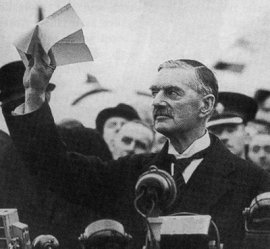
“Peace for our time”
Adding it all up, Dr. Mouw’s uncritical acceptance of what these rather notorious Mormon figures say in their private discussions, combined with how he appears to use “reading between the lines” as definitive evidence of a major shift taking place in the LdS Church one could easily lead one to conclude that he is ignorant, naive, and lacks good judgment as well as discernment. One need only recall the picture of Neville Chamberlain declaring “Peace for our time” as a tutorial as to where having such deficiencies in an Ambassador can lead.[26]
For The Sake Of Brevity (really!)
It’s an important subject, but for the sake of brevity I haven’t broached on how Dr. Mouw insists on publicly misrepresenting, slandering and libeling fellow Evangelicals. The late Walter Martin who died in 1989 seems to be a favorite target for the wheels of Mouw’s bus but there are others. This pattern of behavior had already gotten him labeled everything from a “Pandering Slanderer” to “the LdS Church’s best Apologist” so I expect this book will simply add fuel to the fire. Suffice to say, Dr. Mouw’s infamous November 4th, 2004 Tabernacle apology to Mormons sounds hypocritical given how thoroughly and repeatedly he’s borne false witness of his own people!
Another complaint I have with this book is how Dr. Mouw is constantly lamenting Christians for not really understanding official LdS Theology, then filling page after page with misinformation derived solely from the unofficial, private, uncorrelated, personal opinions of LdS intellectuals while ignoring the vast body of approved, public, correlated LdS materials (books, magazines, manuals, etc.) — the latter being the material that defines what constitutes official LdS doctrine and theology and that contradicts what he’s hearing in those private meetings.
So tell me, who would you advise Dr. Mouw to listen to: A bunch of BYU Professors sequestered away and privately arguing over their personal opinions out in Provo, or the LdS Church First Presidency publicly dictating official Church dogma and doctrine to the membership in Salt Lake City?
If It Walks Like A Duck
Finally, it’s hard to take Dr. Mouw seriously when he uses criteria like this to conclude that Mormonism isn’t a cult:
“In fact, even the label ‘cult’ seems inappropriate for describing the Mormonism that we’ve seen up close. Jehovah’s Witnesses – they’re a cult. They stick to a party line. You don’t find them arguing among themselves – at least in a way the rest of us can see and hear. If someone does insist on raising questions from within about Jehovah’s Witness teachings, they’re quickly expelled from the group. And the very idea of a world-class Jehovah’s Witness university is a hard one to entertain.
Mormonism is a different story altogether. Brigham Young University is world class. It has an excellent faculty, with doctorates from some of the best graduate programs in the world. Some devout Mormons are well-known scholars at major secular schools.” [27]
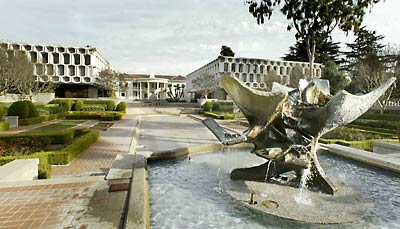
Ambassador College
What about the Worldwide Church of God? They had a respected and accredited University too, but they were still a cult.[28] And let’s not forget “The September Six” (all academics and most BYU Professors) who were excommunicated on September 1993 for not sticking to the Mormon party line.[29]
Then there’s the recent Excommunication of Lyndon Lamborn on August 19, 2007 for “raising questions from within” about official church accounts of Mormon History that didn’t reconcile with reality – what about that?[30]
If the LdS Church isn’t a cult, then why has 13th LdS Church President Ezra Taft Benson’s “Fourteen Fundamentals in Following the Prophet” been quoted from at least once in every recent General Conference and continues to be cited and reprinted regularly in official, correlated LdS Church books, periodicals, and manuals? [31] Dr. Mouw, if President Benson’s pervasive and highly influential address isn’t a formula for mind control, I don’t know what is!
And let’s not forget the countless Mormons who have had their Temple Recommends pulled – or have even been excommunicated – because they gained a testimony of Jesus Christ but lost their testimony of Joseph Smith. Why is belief in and loyalty to a human being (the founder) so paramount if the Mormon Church isn’t a cult?
Finally we have the BITE Model[32] and other Sociological models for Mind Control Cults that we can “use as a plumb line” against. Mormonism has consistently met the criteria when evaluated against such tests.[33]
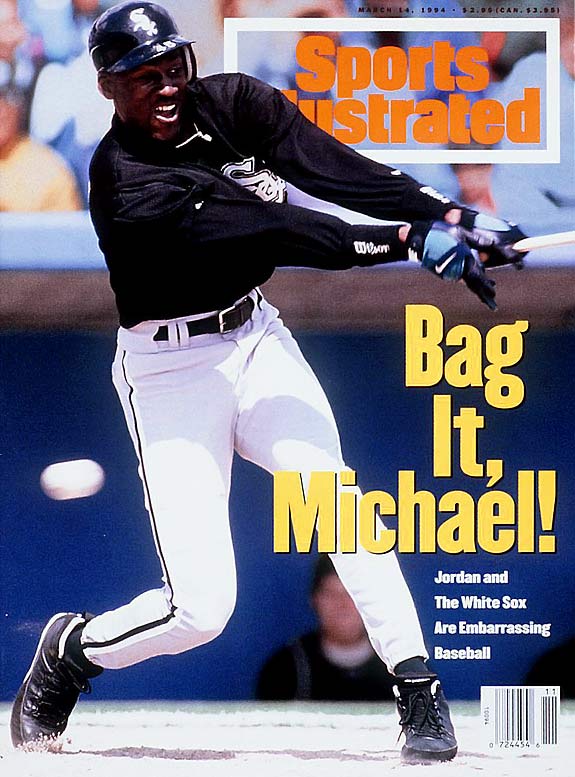
The Peter Principle circa 1994
Michael Jordan Shouldn’t Play Baseball . . . Much more could be said about just how flawed and misguided the substance of this book is – Mouw exposes his naiveté and ignorance on virtually every page. It’s hard for this reviewer to see a scholar of Dr. Mouw’s stature embarrass himself so thoroughly by stumbling and bumbling around in an arena where he’s so obviously so unqualified. Dr. Mouw appears to be in very deep denial on a great many things – not the least being his qualifications to work in an area that’s outside of his area of accomplishment, training, expertise and skills.
Or put another way, just as Michael Jordan shouldn’t play baseball, Richard J. Mouw shouldn’t talk with Mormons.
So despite my respect for many of Dr. Mouw’s other accomplishments, in the end I simply cannot recommend this book. However, I have a book recommendation for Dr. Mouw: Please read “The Peter Principle”[34] because, to me it explains what’s really going on when you’re talking with Mormons.
[2] For a more complete description – including a superb graphical representation – of the hierarchy of the LdS Church see http://www.mormonwiki.org/LDS_Hierarchy
(retrieved 2012-08-07)
[4] A case in point is how the LdS Church treated BYU Professor Randy Bott’s Washington Post comments on race in February 2012 (see http://www.mormonnewsroom.org/article/racial-remarks-in-washington-post-article ; retrieved 2012-08-12) In their church statement, the LdS Church clearly stated, “BYU faculty members do not speak for the Church.”
[9] The accompanying endnote then references the YouTube video http://www.youtube.com/watch?v=yr6Un5XpFZU ; Op Cit, Holland, “Talking with Mormons”, Kindle Location 961
[11]“[It was in the Garden of Gethsemane that Christ] “suffered as only as God would suffer, bearing our griefs, carrying our sorrows, being wounded for our transgressions, voluntarily submitting Himself to the iniquity of us all, just as Isaiah prophesied.
…
It was in Gethsemane that Jesus took on Himself the sins of the world, in Gethsemane that His pain was equivalent to the cumulative burden of all men, in Gethsemane that He descended below all things so that all could repent and come to Him” (Ezra Taft Benson, “The Teachings of Ezra Taft Benson”, pp.14&15; http://www.amazon.com/Teachings-Ezra-Taft-Benson/dp/0884946398 )
(retrieved 2012-8-08)
[12] “But Jesus held on. He pressed on. The goodness in Him allowed faith to triumph even in a state of complete anguish. The trust He lived by told Him in spite of His feelings that divine compassion is never absent, that God is always faithful, that He never flees nor fails us. When the uttermost farthing had then been paid, when Christ’s determination to be faithful was as obvious as it was utterly invincible, finally and mercifully, it was ‘finished.’”
(Op cit, Holland, “None Were With Him”)
[15] For a good overview of Mormon Soteriology see “Salvation According to Mormonism” by Mormon Research Ministry; http://www.mrm.org/salvation
(retrieved 2012-08-07)
Here’s a salient excerpt: “Mormonism teaches of a general salvation and an individual salvation. General salvation refers to the unconditional, universal gift of resurrection to all. Individual salvation refers to the process one must go through to receive exaltation in the highest heavenly kingdom of the afterlife, the Celestial Kingdom, where one may eternally enjoy family and become a God over his own spirit children. While Mormonism teaches that this process is made possible by the necessary merits of Christ and blessings of his atonement, and that gracious guidance, encouragement, and strengthening is granted throughout the journey, it nevertheless teaches that the decisive factor which determines one’s final destination is one’s personal, meritorious righteousness and worthiness.”
[16] See Alan W. Gomes, “Unmasking The Cults”; Kindle Locations 103-106
Mr. Gomes is a graduate of Dr. Mouw’s University (Fuller Seminary) who teaches at Talbot Seminary and Biola University. He defines a cult as, “… is a group of people who claim to be Christian, yet embrace a particular doctrinal system taught by an individual leader, group of leaders, or organization, which (system) denies (either explicitly or implicitly) one or more of the central doctrines of the Christian faith as taught in the sixty-six books of the Bible.”
[21] Op Cit, Richard J. Mouw. “Talking with Mormons: An Invitation to Evangelicals”, Kindle Locations 314-318; also see Kindle Location 961 for relevant endnote
Elsewhere in this article Mr. Fluhman exposes one of his underlying presuppositions with this astounding statement, “… evangelical hatred has been the driving force behind national anti-Mormonism.”
To that assertion I would first respond, “Disagreement is disagreement, not hatred.” Further, I would echo in agreement the words of Richard and Joan Ostling in when they observed:
“The thin-skinned and image-conscious Mormon can display immature, isolationist, and defensive reactions to outsiders, perhaps because there is no substantive debate and no “loyal opposition” within their kingdom. With some, it almost seems that the wilderness is still untamed, the federal ‘polyg’ police are on the prowl, and the Illinois lynch mob is still oiling muskets and preparing to raid Carthage Jail. All too often Saints use the label “anti-Mormon” as a tactic to forestall serious discussion.” (Richard N. and Joan K. Ostling, “Mormon America: The Power and the Promise (2007 Edition)”; p. 115; http://www.amazon.com/Mormon-America-Revised-Updated-Edition/dp/0061432954/ref=sr_1_1?ie=UTF8
(retrieved 2012-08-10)
And I would remind those that use it that “Anti-Mormon” is the Mormon “N-word” – it’s the equivalent of an Evangelical calling a Mormon an “Anti-Evangelical”. If you really want to demonstrate that you are a person of good intent and good will (not to mention not prejudiced or bigoted) please refrain from name calling and replace it with the far more accurate terms, “Mormon Critic” or “Critic of Mormonism.”
Finally, I would point out again to the reader that this is the type of up-and-coming-Mormon that Dr. Mouw places hope for a bright future in. One is tempted to ask Dr. Mouw, “Exactly WHAT are you seeing in a person that we, members your people group, fellow Christians and allies for the Reformed faith are missing? Candidly he seems to be too contentious for respectful dialog!”
[32] There are many sociological aspects we can examine to determine if a group fits the criteria of a “cult,” but one of the easiest models to use in evaluating cult mind-control is given by Steven Hassan in his book Releasing the Bonds: Empowering People to Think for Themselves, published in 2000 by Freedom of Mind Press, Somerville MA. (see http://www.amazon.com/Releasing-Bonds-Empowering-People-Themselves/dp/0967068800 )
(retrieved 2012-08-10)
This model was based primarily on Robert Lifton’s work but also draws from research from Margaret Singer and many others. It doesn’t target any group in particular and can be applied to ANY group be they religious, political, secular, etc. It just doesn’t matter.
[33] Steven Hassan recommends that the BITE Model analysis be done by former members as they have the greatest insight into the group’s formal and informal behavior. So with that in mind, here are links to the BITE analysis’s that have been completed by former Mormons.
I would politely suggest that these analyses answer this nagging question rather nicely – and I will leave it to the reader to decide the answer for them self what that answer is:
The BITE Model and Mormon Control
by Luna Flesher
(an ExMormon and a Cult Exit Counselor at the time this analysis was completed) http://www.rationalrevelation.com/library/bite.html
(retrieved 2012-08-09)
From the Amazon product description: “The Peter Principle, the eponymous law Dr. Laurence J. Peter coined, explains that everyone in a hierarchy—from the office intern to the CEO, from the low-level civil servant to a nation’s president—will inevitably rise to his or her level of incompetence.”
(And last but not least, while taking full responsibility for this article’s content, the author would like express his sincere appreciation to his editors and peer reviewers for making it far, far, far better, they are: Martin Jacobs and Keith Walker)
Heavenly Father,
blessed Son,
eternal Spirit,
I adore thee as one Being,
one Essence,
one God in three distinct Persons,
for bringing sinners to thy knowledge and to thy kingdom.
O Father,
thou hast loved me and sent Jesus to redeem me;
O Jesus,
thou hast loved me and assumed my nature,
shed thine own blood to wash away my sins,
wrought righteousness to cover my unworthiness;
O Holy Spirit,
thou hast loved me and entered my heart,
implanted there eternal life,
revealed to me the glories of Jesus.
Three Persons and one God,
I bless and praise thee,
for love so unmerited, so unspeakable,
so wondrous, so mighty to save the lost
and raise them to glory.
O Father,
I thank thee that in fullness of grace
thou hast given me to Jesus, to be his sheep, jewel, portion;
O Jesus,
I thank thee that in fullness of grace
thou hast accepted, espoused, bound me;
O Holy Spirit,
I thank thee that in fullness of grace thou hast
exhibited Jesus as my salvation,
implanted faith within me,
subdued my stubborn heart,
made me one with him for ever.
O Father,
thou art enthroned to hear my prayers,
O Jesus,
thy hand is outstretched to take my petitions,
O Holy Spirit,
thou art willing to help my infirmities, to show me my need,
to supply words, to pray within me,
to strengthen me that I faint not in supplication.
O Triune God,
who commandeth the universe,
thou hast commanded me to ask for those
things that concern thy kingdom and my soul.
Let me live and pray as one baptized into the threefold Name.
“There has been a great deal of talk lately regarding whether or not Mormons are Christians. This is not a new argument, it is actually as old as the church itself. When the Church was first founded many thought the nickname of ‘Mormon’ was somehow a reference to Mohammed and that the church was in fact an Islamic faith.”[1]
My first thought was that the historical record exposes the modern assertion that Mormon leaders have always insisted that the LdS Church is “Christian” for what it is – a myth. Rather, it shows that until recently[2] Mormons have wanted no part of Christianity as they saw themselves as something better, purer, more exalted and more enlightened than the “poor, miserable priests” and “the biggest whoremasters there are on the earth” – as Mormon Apostle Heber C. Kimball referred to the Christians of his day.[3]
EARLY MORMONISM
And other early Mormon Leaders were equally clear on this point: “What is it that inspires professors of Christianity generally with a hope of salvation? It is that smooth, sophisticated influence of the devil, by which he deceives the whole world”[4]
– Joseph Smith, January 2, 1843
“We talk about Christianity, but it is a perfect pack of nonsense…. It is a sounding brass and a tinkling symbol; it is as corrupt as hell; and the Devil could not invent a better engine to spread his work than the Christianity of the nineteenth century.”[5]
– John Taylor, January 17, 1858
“Where shall we look for the true order or authority of God? It cannot be found in any nation of Christendom.”[6]
– John Taylor, March 1, 1863
Yet, surprisingly their tone not only softened but actually glowed when they spoke of Muhammad and Islam: “I believe that Mahomet [Muhammad]–who the Christians deride and call a false prophet and stigmatize with a great many epithets–I believe that he was a man raised up by the Almighty.”[7]
– George Q. Cannon, September 2, 1883
“About six hundred years after Christ a prophet rose in Arabia, by the name of Mahomet, who was born in 569… Now this man descended from Abraham and was no doubt raised up by God on purpose to scourge the world for their idolatry.”[8] [9]
– George A. Smith, September 23, 1855
And Joseph Smith certainly didn’t seem to mind if the religion that he founded was equated with Islam or he with Muhammad – rather he seemed to embrace such comparisons with zeal when he famously said:
“I will be to this generation a second Muhammad, whose motto in treating for peace was the Alcoran [Koran] or the Sword. So shall it eventually be with us Joseph Smith or the Sword!”[10]
– Joseph Smith, October 14, 1838
So is it any surprise that seventeen years later (in his September 23rd, 1855 address) Mormon Apostle Parley P. Pratt was still swinging that sword: “The Greek and Roman Churches, which have been called Christian, and which take the name of Christians as a cloak, have worshipped innumerable idols. On this account, on the simple subject of the Deity and His worship, if nothing more, I should rather incline, of the two, after all my early traditions, education, and prejudices, to the side of Mahomet, for on this point he is on the side of truth, and the Christian world on the side of idolatry and heathenism.”[11]
“Though Mahometan institutions are corrupt enough, and need reforming by the Gospel, I am inclined to think, upon the whole, leaving out the corruptions of men in high places among them, that they have better morals and better institutions than many Christian nations; and in many localities there have been high standards of morals. So far as that one point is concerned, of worshipping the one true God under the name of Mahometanism, together with many moral precepts, and in war only acting on the defensive, I think they have exceeded in righteousness and truthfulness of religion, the idolatrous and corrupt church that has borne the name of Christianity.”[12]
So apparently, the assertion that early Mormonism was more akin to and aligned with Islam than Christianity (while, of course, being superior, more enlightened, and a step above both) isn’t far fetched at all – in fact, it seems that early Mormon leaders enthusiastically embraced the idea.
MODERN MORMONISM
But what about Modern Mormonism, surely it’s Christian – right?
Well, as respected Religious Journalists, Richard and Joan Ostling note, “…it is surely wrong to see Mormonism as a Christian derivative in the way that Christianity is a Jewish derivative, because the LDS faith is in radical discontinuity with historic Christianity.”[13] And expanding on the Ostlings, the late Catholic Scholar, Richard John Neuhaus clarified stating that: “…Mormonism is inexplicable apart from Christianity and the peculiar permutations of Protestant Christianity in nineteenth-century America. It may in this sense be viewed as a Christian derivative. It might be called a Christian heresy, except heresy is typically a deviation within the story of the Great Tradition that Mormonism rejects tout court.”[14]
Continuing, Neuhaus goes on to explain: “For missionary and public relations purposes, the LDS may present Mormonism as an ‘add-on,’ a kind of Christianity-plus, but that is not the official narrative and doctrine.
A closer parallel might be with Islam. Islam is a derivative of Judaism, and Christianity. Like Joseph Smith, Muhammad in the seventh century claimed new revelations and produced in the Quran a ‘corrected’ version of the Jewish and Christian scriptures, presumably by divine dictation. Few dispute that Islam is a new and another religion, and Muslims do not claim to be Christian, although they profess a deep devotion to Jesus. Like Joseph Smith and his followers, they do claim to be the true children of Abraham. Christians in dialogue with Islam understand it to be an interreligious, not an ecumenical, dialogue. Ecumenical dialogue is dialogue between Christians. Dialogue with Mormons who represent official LDS teaching is interreligious dialogue.”[15]
So, Richard Land, of the Southern Baptist Convention appears to have showed great insight when he famously observed: “I think the fairest and most charitable way to define Mormonism would be to call it the fourth Abrahamic religion – Judaism being the first, Christianity being the second, Islam being the third, and Mormonism being the fourth. And Joseph Smith would play the same character in Mormonism that Muhammad plays in Islam.”[16]
And this view isn’t limited to Christian scholars – consider this analysis by Literary and Religious Critic, Harold Bloom: “Mr. [Mitt] Romney, earnest and staid, who is deep within the labyrinthine Mormon hierarchy, is directly descended from an early follower of the founding prophet Joseph Smith, whose highly original revelation was as much a departure from historical Christianity as Islam was and is. … Joseph Smith, killed by a mob before he turned 39, is hardly comparable to the magnificent Akiva [whom Bloom theorizes invented Judaism], except that he invented Mormonism even more single-handedly than Akiva gave us Judaism, or Muhammad, Islam.”[17]
Thus the words of an early 20th Century editoral committee for Fleming H. Revell have stood the test of time: “It is generally observed that Mormonism is similiar to Mohammedanism in it’s endorsement of the practice of polygamy and its ideas of heaven. Many other points of similarity between these systems have been noted by students, and the Book of Mormon has marked resemblance to the Koran. As all ancient religions have a modern equivalent, Mormonism can justly be claimed to be the modern form of Mohammedanism, and not incorrectly termed ‘the Islam of America.'”[18]
THE 4TH ABRAHAMIC RELIGION So the consensus throughout the ages and on both sides of the divide has been that Mormonism isn’t Jewish, Christian, or Muslim – though it may derive forms, terms, and rites from all three. Furthermore, the parallels between Mormonism and Islam are simply too pronounced and too plentiful to ignore:
Similarities between the origins of Islam and those of Mormonism: – Both Muhammad and Joseph Smith were reportedly inspired to start their movements by angelic visits.
The Archangel Jibreel (Gabriel) in the case of Muhammed, and the Angel Moroni for Joseph Smith (following a visit Smith claimed to have received from God and Jesus Christ three years earlier). In each event, the angel in question helped to prepare the prophet to receive a series of revelations from God.[20]
– Both Muhammad and Joseph Smith left behind authorized books they claimed to be direct revelations from God, books that their followers accept as Scripture.[19]
– Both Muhammad and Joseph Smith were persecuted by hostile locals and later forced to relocate (from Mecca to Medina, and from Missouri to Illinois, respectively) during the formative periods of their careers.[19]
– Both Muhammad and Joseph Smith established theocratic city-states during their respective ministries, Muhammad being invited to take the rule of Medina, while Joseph Smith would found Nauvoo, Illinois.[19]
– Both Muhammad and Joseph Smith both had humble beginnings.
Neither had formal religious connections or upbringing, and both were relatively uneducated. Yet both founded new religions by creating their own scriptures. In fact, followers of both prophets claim these scriptures are miracles since their authors were the most simple and uneducated of men.[20]
– Both Muhammad and Joseph Smith created new scripture which borrowed heavily from the Bible while simultaneously deviating from it. In his Koran, Muhammad appropriates a number of Biblical themes and characters—but he changes the complete sense of many passages, claiming to “correct” the Bible. In so doing he changes many doctrines, introducing his own in their place. In like manner, Joseph Smith created the Book of Mormon, much of which is plagiarized directly from the King James Bible. Interestingly, the Book of Mormon claims that this same Bible has been substantially corrupted and is therefore unreliable. In addition, Joseph Smith went so far as to actually create his own version of the Bible itself, the “Inspired Version,” in which he both adds and deletes significant portions of text, claiming he is “correcting” it. In so doing he also changes many doctrines, introducing his own in their place.[20]
– Both Muhammad and Joseph Smith saw themselves as prophesied in scripture, and both saw themselves as a continuation of a long line of Biblical prophets.
Muhammad saw himself as a continuation of the ministry of Moses and Jesus.[21] Joseph Smith saw himself as a successor to Enoch, Melchizedek, Joseph and Moses. Joseph Smith actually wrote himself into his own version of the Bible—by name.[20][21]
– Both Muhammad and Joseph Smith held up their own scripture as superior to the Bible.
Muhammad claimed that the Koran was a perfect copy of the original which was in heaven. The Koran is therefore held to be absolutely perfect, far superior to the Bible and superceding it. In like manner, Joseph Smith also made the following claim: “I told the Brethren that the Book of Mormon was the most correct of any book on earth, and the keystone of our religion, and a man would get nearer to God by abiding its precepts, than by any other book.”[23]
– Both Muhammad and Joseph Smith, despite their claim that the Bible was corrupt, admonished their followers to adhere to its teachings.
An obvious contradiction, this led to selective acceptance of some portions and wholesale rejection of others. As a result, the Bible is accepted by both groups of followers only to the extent that it agrees with their prophet’s own superior revelation.[20]
– Both Muhammad and Joseph Smith claimed superiority over Jesus Christ. Muhammad taught that Jesus was just another of a long line of human prophets, of which he was the last. He taught that he was superior to Christ and superceded Him.
In comparison, Joseph Smith also made the following claim: “I have more to boast of than ever any man had. I am the only man that has ever been able to keep a whole church together since the days of Adam. A large majority of the whole have stood by me. Neither Paul, John, Peter, nor Jesus ever did it. I boast that no man ever did such a work as I. The followers of Jesus ran away from Him, but the Latter-day Saints never ran away from me yet.” (“History of the Church”, vol. 6, p.408–409; )[20][24]
– Both Muhammad and Joseph Smith were polygamists who had many wives.[25]
Other similarities between Islam and Mormonism – Belief that good deeds are required for salvation just as much as faith.[19]
– Belief that the text of the Bible, as presently constituted, has been adulterated from its original form;[19]
– Belief that their faith represents the genuine, original religion of Adam, and of all true prophets thereafter;[19]
– Belief that one’s marriage can potentially continue into the next life, if one is faithful to the religion;[19]
– Belief that there are multiple degrees or spiritual levels in heaven;[19]
– Belief that a believer’s family, if appropriately faithful to the religion, can join them in the next world, only if they are equally faithful;[19]
– Assertions that modern Christianity does not conform to the original religion taught by Jesus Christ;[16]
– Rejection of the Christian doctrines of Original Sin and the Trinity;[19]
– Absolute prohibition of alcoholic beverages,and gambling;[19]
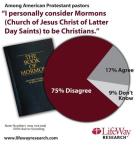
Click on image to enlarge and read poll results
– Incorporation of a sacred ritual of ablution, though each religion’s rite differs in form, frequency and purpose;[19]
– A “top down” clerical hierarchy that is drawn from the laity and placed into leadership roles, without any requirements for completing collegiate or theological training first;[19]
– Special reverence for, though not worship of, their founding prophet;[19]
– A continuing history of sects, or splinter groups, who claim to be following the “original doctrine” of the founding leaders and whose practices include violence against dissenters and critics, as well as polygamy. [20]
CONCLUSION
Given these similarities and parallels – along with it’s long legacy of simultaneously denouncing and distancing itself from Christianity – it seems both logical, and reasonable that the LdS Church begin to proudly and publicly embrace it’s unique role as the Fourth Abrahamic Religion and drop the modern Mormon pretense that it’s Christian.[26]
NOTES [1]Mike Tannehill, “The Mormon Christ”; Mormon Expression Blogs; November 27, 2011 [2] As in the David O. McKay era and later. For a full treatment of how Mormonism slowly transitioned from a movement that considered itself separate from and atagonistic to Christianity to one that insisted that it be identified with it, see “David O. McKay and the Rise of Modern Mormonism” by Gregory A Prince and William Robert Wright.
Brodie’s footnote regarding this speech contains valuable information, as follows: “Except where noted, all the details of this chapter (16) are taken from the History of the [Mormon] Church. This speech, however, was not recorded there, and the report given here is based upon the accounts of seven men. See the affidavits of T.B. Marsh, Orson Hyde, George M. Hinkle, John Corrill, W.W. Phelps, Samson Avard, and Reed Peck in Correspondence, Orders, etc., pp. 57–9, 97–129. The Marsh and Hyde account, which was made on October 24, is particularly important. Part of it was reproduced in History of the [Mormon] Church, Volume 3, p. 167. See also the Peck manuscript, p. 80. Joseph himself barely mentioned the speech in his history; see Vol. 3, p. 162.”
This author agrees with that stance. However, you can’t drop the “Christian” label without replacing it with something. In the end, and after much thought, this author considers the “4th Abrahamic Religion” a fair and accurate stance that all parties should be able to live with.







 And this view isn’t limited to Christian scholars – consider this analysis by Literary and Religious Critic,


 Beggar's Bread