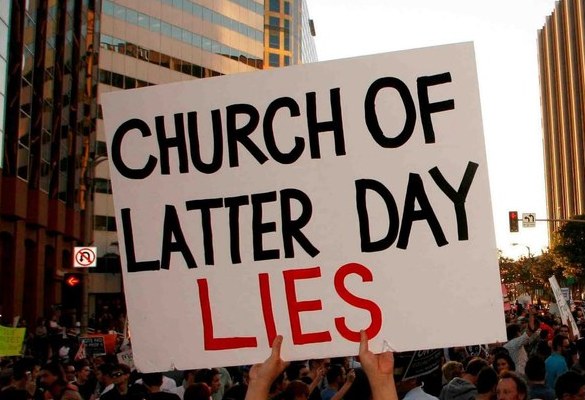
McCraneyism 2.0

Introduction: On this past Tuesday, November 7th, Shawn McCraney engaged in a long personal attack on a much beloved and iconic Mormon Studies figure: Sandra Tanner. Before reading Pastor Jason Wallace’s response to Shawn below it’s recommended that you click on the video below this intro and watch this attack first hand so you can put Pastor Wallace analysis and critique into its historical context. This will also help you fully appreciate how vitriolic, biased, imbalanced, over the top, and unfair Mr. McCraney’s attack on Ms. Tanner really was. — Editor

by Jason Wallace
Out of my great respect for Sandra Tanner, I hesitate to relate this, but many people do not realize how far Shawn McCraney has gone in attacking Biblical Christianity.

Last night, Shawn dedicated a show to “going after a sacred cow that has been impervious to Christian scrutiny for 40 years. . . 50 years”: Sandra Tanner. What are her great sins that deserve such public rebuke? She “attacked his person” when she privately described him as “an irresponsible leader.” She also “hangs out with Calvinists,” refusing to join him in publicly denouncing the God who sends people to an eternal Hell as “a monster.”

In order to make sense of Shawn, you need to recognize his double standard. He can describe pastors generally and by name as wolves and money-hungry charlatans, but he immediately qualifies that by saying he loves us all as brothers. This supposedly makes everything he says okay. If someone responds to what he says, they’re “attacking his person.” When he denounces people by name on his Internet podcast, that’s different from someone responding to it on the Internet. He’s brave, but we’re supposedly cowards. It’s striking that you can say almost anything about God, and Shawn seems fine with that, but if you dare say that Shawn is wrong, that is the highest blasphemy. Shawn can say Shawn is wrong, but no one else can.

Shawn has a new theme with which he opens his show; he presents himself as a new Martin Luther.* The reality is that Shawn is the antithesis of Luther. Martin Luther was a brilliant scholar who had no fear to debate his opponents. Shawn won’t debate James White at all and only allows critics who challenge him to do so on his terms. Martin Luther was a reformer, recognizing that the church of his day had wandered not just from the Scriptures, but from the historic faith of the church. Shawn isn’t a Reformer, but a Restorationist. He essentially argues for a great apostasy and claims he’s restoring the Holy Spirit to the church. Martin Luther argued for Scripture as the only infallible rule of faith and practice. Shawn puts his private revelations above Scripture. Luther disagreed with Shawn on Hell, the Second Coming, and the nature of the church. The reality is that Shawn has far more in common with the enemies of Luther, the Zwickau Prophets, than with Luther.

Shawn may take my attempts to love even my enemies as cowardice, but I want to make clear that I go much further than Sandra. Shawn is not just an irresponsible leader; he is a heretic. He is not my brother in Christ. Jesus said if anyone won’t hear the church, they are to be treated as a heathen and a tax collector (Matthew 18). Shawn refuses to hear any church anywhere. Simply saying he is a Christian doesn’t make Thomas Monson one, nor does it make Shawn one.

People need to recognize that Shawn has essentially repackaged Mormonism. He claims all the churches are wrong. All their creeds are “heinous.” The God of historic Christianity is “a monster” (a claim also made by Joseph Smith). Pastors are all in it for the money (cf.”hirelings of Satan”). There was a great apostasy, but now he’s restoring the Spirit. He claims to have the “best approach to Christianity on the face of the earth” (cf. “only true and living church upon the face of the earth”). Shawn is labeling his show “Heart of the Matter 2.0.” The reality is that he is presenting Mormonism 2.0. He is not the new Luther, but the new Joseph Smith. He uses a few bad churches to condemn all churches. He may not have temples and tithing, but he makes people feel pious in their hatred. He helps them rationalize all this as love while breathing out contempt.

Shawn has called me a coward for denouncing his teachings on the Internet, while “boldly” denouncing me on the Internet. I will gladly confront him in person whenever he likes. I could not care less what he says about “my person,” but I will defend the glory of the Jesus of the Bible with everything in me. Instead of picking on Sandra Tanner in absentia, how about we argue this out face to face?

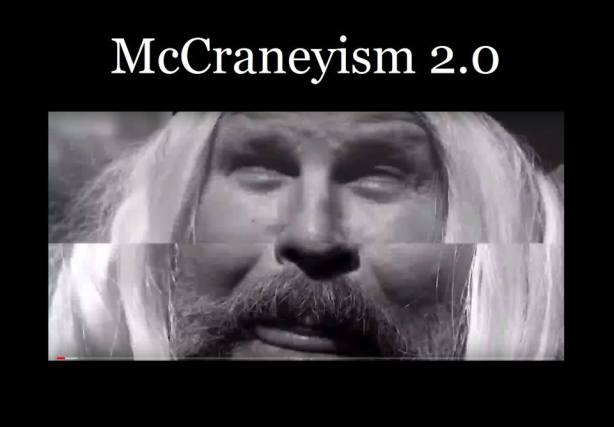
* Editor’s note click on the image below to see this new, referred show intro. 

A meme based on Shawn McCraney’s new show intro for HOTM 2.0. Click on image to view the full video.

Final

lying_croppedby Fred W. Anson
It’s been said that “Sex and crime seem to be the perfect recipe for broadcast success in the 21st century!” So it’s no wonder that a recent Mormon Expression podcast appears to be so popular. It features a “Top 10 Count Down” of famous Mormon criminals and sure enough, despite the occasional “downer” moment (some of the criminal behavior is truly appalling), it’s fascinating thought-provoking stuff!

On several occasions the panel tangents from the central topic into the meta-question of “Why?” as in, “Why does there seem to be something in Mormonism that disproportionally contributes to these behaviors?”; and as in, “Why do Mormons – including some ‘golden’ Mormons – demonstrate a propensity toward these extreme behaviors?”, etc. And while I thought that several good theories are offered in the podcast, an analysis on the discussion board is, to my way of thinking, particularly insightful:

Mormonism has a very real problem in this regard: its central book of scripture opens with a story of justification of murder [that is, a divine directive to Nephi commanding him to behead Laban] and the rest of the book is so bland that it doesn’t overcome that message or it reinforces that message with the continual battles between the Nephites and Lamanites. The problem is that if God can justify murder he can justify any lesser sin as well. And that’s where Mormonism fundamentally departs from traditional Protestantism (and perhaps Catholicism as well) where God must be a moral God.

In Protestantism … God must conform to all the standards of morality that we hold or else He/She is not God.1

That said, in addition to the Book of Mormon example, I would propose that the following passage from The Pearl of Great Price be considered in regard to the “lesser sin” of lying:

And it came to pass when I was come near to enter into Egypt, the Lord said unto me: Behold, Sarai, thy wife, is a very fair woman to look upon;

Therefore it shall come to pass, when the Egyptians shall see her, they will say — She is his wife; and they will kill you, but they will save her alive; therefore see that ye do on this wise:

Let her say unto the Egyptians, she is thy sister, and thy soul shall live.

And it came to pass that I, Abraham, told Sarai, my wife, all that the Lord had said unto me — Therefore say unto them, I pray thee, thou art my sister, that it may be well with me for thy sake, and my soul shall live because of thee.
Book of Abraham 2:22-25

That passage is troubling because it portrays the Mormon god giving a divine directive to Abraham that he lie to Pharoah in a manner that’s quite similar to the way he instructed Nephi to murder Laban.2 This is in direct violation of the moral criteria that the Jewish God established in the Bible via the 10 Commandments3 and the Mormon god reinforced via The Book of Mormon.4 Further, and as a practical matter, it’s vexing because I’ve found that some Mormons use it as a divine justification for lying. In other words, Book of Mormon “Blood Atonement” meet Book of Abraham “Lying for the Lord”.5

On the Delicate Matter of “Lying for the Lord”
A Mormon Wiki describes the Mormon practice of “Lying for the Lord” as follows:

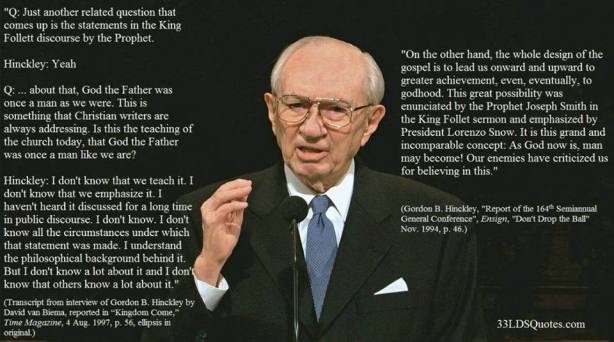
Lying for the Lord refers to the practice of lying to protect the image of and belief in the Mormon religion, a practice which Mormonism itself fosters in various ways. From Joseph Smith’s denial of having more than one wife, to polygamous Mormon missionaries telling European investigators that reports about polygamy in Utah were lies put out by “anti-Mormons” and disgruntled ex-members, to Gordon B. Hinckley’s dishonest equivocation on national television over Mormon doctrine, Mormonism’s history seems replete with examples of lying. Common members see such examples as situations where lying is justified. For the Mormon, loyalty and the welfare of the church are more important than the principle of honesty, and plausible denials and deception by omission are warranted by an opportunity to have the Mormon organization seen in the best possible light.
(Link to Source; bolding added for emphasis)

Now I’m not here to rehash the aforementioned historical record of Mormon Leaders engaging in “Lying for the Lord” – that’s been done well enough by others and I have no interest in reinventing the wheel.6 My interest is far more immediate, practical, and close to home – more “grassroots” if you will.

And I know that modern Mormons typically bristle when critics accuse the members of the LdS Church of “Lying for the Lord”. The typical response involves citing The Articles of Faith of The Church of Jesus Christ of Latter-day Saints Article Thirteen which states:

We believe in being honest, true, chaste, benevolent, virtuous, and in doing good to all men
(Link to Source; bolding added for emphasis)

And I will readily admit that most of the members I know personally would consider deviating from the Article Thirteen standard unthinkably unethical and integrity compromising. Never-the-less just as soon as the “Enemy of the eternal gospel and only true Church” label is slapped on someone or something, somewhere out there from the deep, dark lunatic fringes of the Mormon Church a “Liar for the Lord” will quickly emerge.

A recent firsthand experience served as a painful reminder.

The Blue Devil and Dr. Jones: A Grassroots Tale
For some reason, the Internet tends to bring out the worst in people. As a result of that sad fact one of the Mormon-centric websites that I frequent eventually tired of the constant, seemingly endless, often childish bickering that goes on between Mormon Defenders and Mormon Critics. So, being predisposed to the critical stance (which is in fact implied by the site’s purpose statement), the website owner decided to bring peace to the proceedings by making the discussion board exclusive to critics. The announcement was made, the user accounts of the Mormon defenders were revoked, a banner explaining the new policy was posted on the main page of the website and life went on for all. We remaining members were then left to continue in our misguided efforts to critique and discuss the history, doctrine, and practices of the only “perfect” church on earth in peace and harmony.7

But apparently, the stress and anxiety of seeing the LdS Church publicly analyzed, criticized, deconstructed, reconstructed – and in some cases even denounced – without challenge was just too much for some members so a solution had to be found – and that fix was (of course) “Lying for the Lord”.

In the latest such case, a new board member “BlueDevil” (claiming to be from the great state of North Carolina of course) registered and posted on the board. He came roaring in with both guns blazing – clearly a “Porter Rockwell” Mormon who was “ready to rumble” with these despicable eternal darkness bound “Children of the Devil” and “Enemies of the only true Church!” In his wake, a “DrJones0” (from the great state of Texas) arrived with a quieter, gentler, more tempered and reasoned approach with the members.

The regular members first reminded BlueDevil that Mormons apologists weren’t allowed on this particular board and encouraged him to comply with the rules by not posting. These requests were met with a number of angry and hostile posts calling down judgment on high on these blind deceivers. He then disappeared. Poof! Gone! Just like that!

Well, that was easy!

Oddly Dr. Jones’ posts then slowly began to drift into a more decidedly pro-Mormon, apologetic stance. He eventually began using stock and standard Latter-day clichés and language. He then was asked directly if he was a Mormon. At first, he demurred and then flatly denied it – not once, not twice, but three times. Yet, at the same time, his posts were simultaneously becoming more and more fanatical. By the day three, they had collapsed into a shard pile of stock word-for-word LdS Apologist pabulum. Finally, he simply spammed the discussion board with the same copy and paste “REPENT and be baptized ye apostates destined for outer darkness!” post (well over 100-times in fact) before the board SysAdmin could stop the bleeding via a well-deserved ban.

Given the awful mess that he’d been left with the (solo) SysAdmin enlisted my help (I’m an IT guy in my day job) in scrubbing the site of the spam that Dr. Jones had left behind. The SysAdmin duly “Deputized” me and gave me full administrative privileges on the board. We then got to the hard work of purging the “faith-promoting graffiti” off of the site one virtual urban scrawl at a time.

Now, I hope it doesn’t shock or surprise anyone that Internet discussion boards enable administrators to see the IP address of the computer that the users post from. So I did some quick forensics and discovered that not only were “BlueDevil” and “DrJones0” the same person 8, their posts were all coming through the same Internet Service Provider in (drum roll puh-lease) central Salt Lake City.

(Yes, yes, I’m sure that you’re as surprised as we were!)

This was a clear case of not just “Lying for the Lord” but blatantly, repeatedly, and overtly doing so.

“It’s Like Getting Married”
Now, all fairness, given the number of anonymous unregistered hits that this site and other such sites receive each day, this case – and the others like it – are the exception, not the norm. Never-the-less this case study demonstrates one way that “Lying for the Lord” is practiced in modern Mormonism.

And, of course, the whole issue of using deceit in the name of God, regardless your religious stance, is never a good idea because as one person put it:

Joining a religious group is much like a marriage, often including a type of “falling in love”. When two people are seriously involved and contemplating marriage, is it really the ethical responsibility of each to, say, hire a private investigator to fully investigate the background of their loved one to make sure there are no ugly surprises after the wedding? Or is it the moral and ethical responsibility of each party to make that disclosure? 9

Or put another way, “If someone claims to have the truth you should probably first make sure that they’re not lying to you.”10

Gordon B Hinckley Lying

Fifteenth LDS President (1995-2008) Gordon B. Hinckley lying for the Lord in Time Magazine.

NOTES:
1 Post by Mike Michaels dated June 23, 2011; retrieved 6/23/2011; the bracketed text summarizes the prior paragraph for clarity. Mr. Michael later explained in another post, “I was/am not responding as a believing Christian for I am not. I am merely trying to explain the difference in mindset that I held as a believing Christian before I converted to Mormonism (subsequently followed by 20 years of active participation).”

2 It should be noted that it’s generally conceded in the Biblical narratives that parallel this Book of Abraham account the biblical characters took it upon themselves to lie since only did God not mandate the lies but went so far as to expose the attempt at deceit to the unsuspecting victim. (see Genesis 12:10-19, Genesis 20, and Gen 26:1-10) As a result, most expositors exegete these passages as morality plays regarding failures of faith on the part of the humans that did not please God. (see http://www.enduringword.com/commentaries/0120.htm ; http://www.easyenglish.info/bible-commentary/genesis-mwks3-lbw.htm )

3 See Exodus 20:16 and Deuteronomy 5:2

4 See Ether 3:12 and 2 Nephi 9:34

5 One need go no further than Dallin H. Oaks’ September 12, 1993 BYU address, “Gospel Teachings About Lying” for an example how arguments for lying are exegesed from LdS Scripture. And though it may seem extreme to some “Blood Atonement” p. 93, by Independent Mormon Fundamentalist, Ogden Kraut provides us with an excellent example of how an argument for murder can be developed from the Laban narrative.

6 Former Church Educational System employee Ken Clark’s list of such case studies is an excellent overview as is the aforementioned MormonWiki.org article.

7 This, as I’m sure anyone familiar with the Internet knows is not unusual as there are many Latter-day Saint discussion boards where the opposite has been the case. This is no big deal – it’s just life on a planet whose inhabitants would rather bicker than agree to disagree (or so it seems).

8 Another charge that he had angrily denied.

9 As cited from “Missionary Sophistry?” (see http://www.mormonwiki.org/Lying_for_the_Lord  from an original post now scrolled off discussion thread of a blog post at “Latter-day Saint Liberation Front”; Accessed 8/23/2006).

10 Richard Packham, ExMormon Foundation Conference 2009. Mr. Packham’s full case against Mormonism’s use of lying can be found here.

(This was originally published on the Mormon Expression Blogs website on June 27, 2011) 

BACK TO TOP

“And they fell down before me, and were about to worship me, but I would not suffer them, saying: I am thy brother, yea, even thy younger brother; wherefore, worship the Lord thy God…”
— 1 Nephi 17:55

I was a Latter-day Saint for thirty years before becoming an Evangelical Christian in 2016. I was a faithful member who magnified his callings, served a mission, married in the temple, and held a temple recommend. I wrote a book defending LDS truth claims and debated Protestants in online forums, podcasts, and a couple of times in public.

I enjoyed being LDS, but there was one thing that always bothered me: the culture of prophet worship. For many years, my eyes were closed to it, but as time went on it became more and more unbearable. I remember sitting in a BYU Pathways class and a young man made a comment about one of the apostles working a pitiable job in his youth. Enthused by the idea, he said, “It just goes to show that the prophets and apostles aren’t that different from us, they could have worked miserable jobs or sinned… I mean, I’m sure they never committed any major sins, but…”

His comment got me thinking. Where had the idea that the prophets and apostles had not committed major sins come from? Wasn’t that what made repentance so great? You could be the worst sinner on earth, and repentance could transform you into a great apostle or a prophet. I thought of Alma the younger and the apostle Paul, who had anything but flawless pasts. Yet somehow, the LDS mindset no longer considered that a valid possibility for its leaders.

Near the end of my tenure in Mormonism, someone got up to teach a lesson in Elder’s Quorum about Joseph Smith. He started the lesson saying he was going to teach us 15 things about the prophet that we probably didn’t know. My interest piqued. I wondered if he would mention that Joseph had a gun the day he was killed, or that he married other men’s wives. However, as he plunged through the points it became obvious that only good things were being said. Thus the Joseph we were learning about was not a man, but God.

Assuming that Joseph really was a prophet, and his mission was to divert attention away from himself to God, I cannot help wondering what he would think about the young man’s comments in college, or the Elder Quorum instructor’s lesson that day. Furthermore, if he was a prophet of God, I cannot imagine any reaction short of humiliation from him at the sound of hymn 27, “Praise to the Man” being sung in church.

Doctrine and Covenants 25:12 says: For my soul delighteth in the song of the heart; yea, the song of the righteous is a prayer unto me, and it shall be answered with a blessing upon their heads.

In other words, hymns are prayers to God according to the Doctrine and Covenants. So instead of a hymn and an opening prayer, there are actually two opening prayers. One’s just set to music. That’s why I have a problem with hymn 27, and you should too. A song about a man does not qualify as a prayer to God, so every time it is sung in church an opportunity is missed to receive the blessings promised in D&C 25:12.

Singing “Praise to the Man” is more than a problem of simple opportunity cost. No matter how you slice it, the song is worshipful in nature, and since Joseph is the subject of the song, the worship goes to him. Consider the fact that if Jesus became the song’s subject instead of Joseph, the lyrics would largely remain true, and would certainly be worshipful.

Now you’re probably thinking, “Great, another fallacious argument that Mormons worship Joseph Smith”. However, that’s not quite what I’m saying. To be fair, Mormon don’t typically have Joseph shrines in their houses. I have never heard a Mormon say, “So and so really needs Joseph in their lives,” or “save us, Lord Joseph.” Nor do I consider singing hymn 27 as idolatrous as praying to saints.

However, we read in Exodus 20:3-5 that we are to have no other gods before God, for He “is a jealous God.” You may think that since Joseph was God’s prophet, reverencing him is a way to worship God, but I would caution you against that mindset. If a man had a servant, and his bride slept with that servant, that would not be honoring her husband. This analogy is especially applicable because the church is the bride of Christ. In 2 Corinthians 11:2 Paul says, “For I am jealous over you with godly jealousy: for I have espoused you to one husband that I may present you as a chaste virgin to Christ.”

I plead with you my friends, not to be taken by the subtle culture of prophet worship. When hymn 27 is sung, don’t sing along. In Matthew 6, we are taught that if our eye is single, our whole body will be filled with light. Immediately after, in verse 24 Jesus says no man can serve two masters, “for either he will hate the one and love the other, or he will be devoted to the one and despise the other.” If your praise and your hymns are directed at Joseph Smith, then your eye is not single to the glory of God.

And if it seem evil unto you to serve the Lord, choose you this day whom ye will serve; whether the gods which your fathers served that were on the other side of the flood, or the gods of the Amorites, in whose land ye dwell: but as for me and my house, we will serve the Lord.
— Joshua 24:15 (KJV) 

In Christ’s Bond Service,

Michael Flournoy

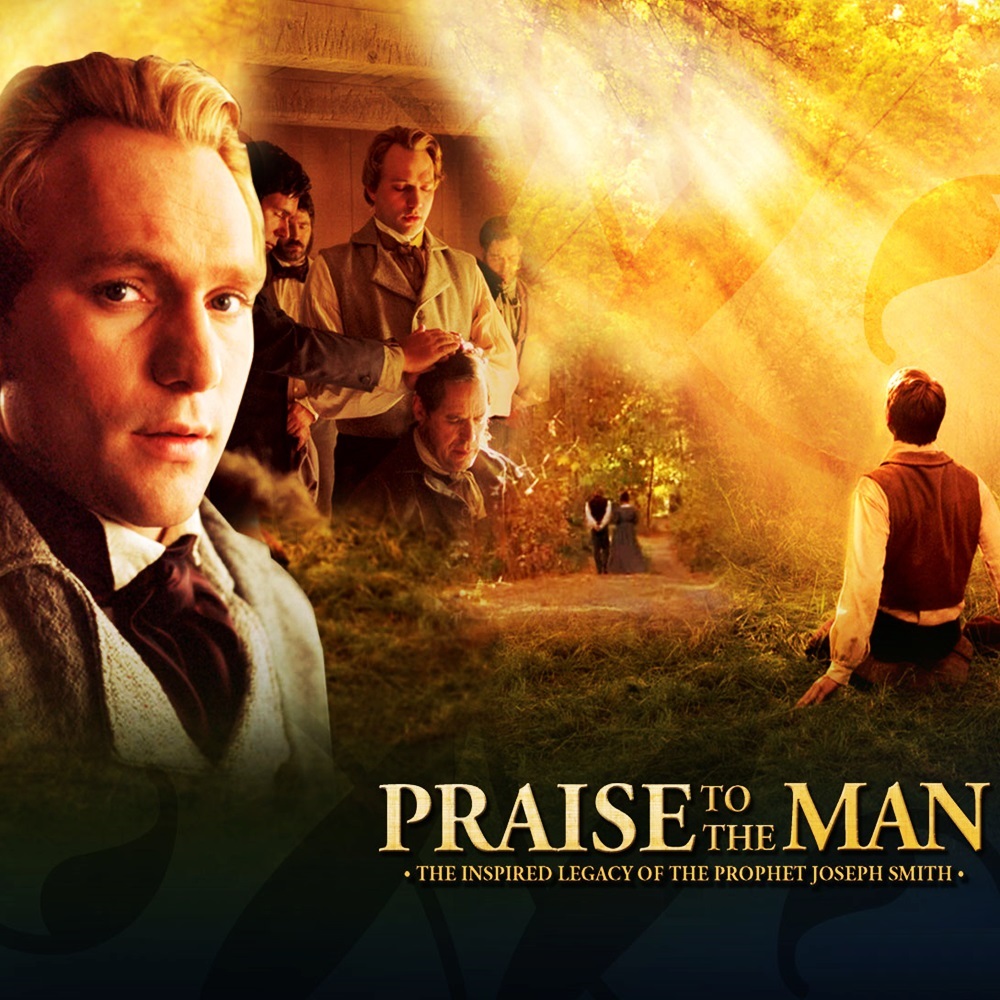
Computer wallpaper promoting the 2005 LDS film, “Praise to the Man”.

Mormon Testimony, The King Follett Discourse, and Deuteronomy 13

“…if it is right I will cause that your bosom shall burn within you…” (Doctrine & Covenants 9:8)

by Fred W. Anson
The Mormon Testimony experience is the cornerstone of Latter-day Saint (LdS) Theology, culture, and experience – it is the “lens” through which the world is perceived – the very core of LdS epistemology. As composer and free thinking Latter-day Saint, and cultural observer William Call explains:

A Mormon’s ‘testimony’ feigns certainty via a supposed knowledge that negates real understanding. He who knows ‘beyond a shadow of a doubt’ has no need to comprehend, discern, or master . . . Both rank and file Mormons and their leaders are dependent on their testimonies. They cannot question what they already ‘know’ is true. And so it is that a Mormon testimony is more than a denial of life’s uncertainties; it is a denial that a critical evaluation of any kind is effective or necessary so far as discovering religious truth is concerned.
(William Call, “The Cultural Revolution”; Freethinkers Press, 2000)

This testimony experience is derived mainly from two passages of Mormon scripture, the first is from Moroni 10:2-6 in the Book of Mormon. It has been dubbed, “The Moroni 10 Formula” by some in Mormon Studies:

And I seal up these records, after I have spoken a few words by way of exhortation unto you.

Behold, I would exhort you that when ye shall read these things, if it be wisdom in God that ye should read them, that ye would remember how merciful the Lord hath been unto the children of men, from the creation of Adam even down until the time that ye shall receive these things, and ponder it in your hearts.

And when ye shall receive these things, I would exhort you that ye would ask God, the Eternal Father, in the name of Christ, if these things are not true; and if ye shall ask with a sincere heart, with real intent, having faith in Christ, he will manifest the truth of it unto you, by the power of the Holy Ghost.

And by the power of the Holy Ghost ye may know the truth of all things.

And whatsoever thing is good is just and true; wherefore, nothing that is good denieth the Christ, but acknowledgeth that he is.

And the second passage is from Doctrine & Covenants 9:7-9. It describes the infamous “burning in the bosom” that it’s believed should result from the Moroni 10 Formula if it’s applied correctly:

Behold, you have not understood; you have supposed that I would give it unto you, when you took no thought save it was to ask me.

But, behold, I say unto you, that you must study it out in your mind; then you must ask me if it be right, and if it is right I will cause that your bosom shall burn within you; therefore, you shall feel that it is right.

But if it be not right you shall have no such feelings, but you shall have a stupor of thought that shall cause you to forget the thing which is wrong; therefore, you cannot write that which is sacred save it be given you from me.

Now, I have no doubt that Mormons and Investigators really do feel something when they apply The Moroni 10 Formula. I have no doubt that the infamous Mormon “burning in the bosom” (the sensation that completes the total Mormon Testimony experience) is real. In fact, Christian Apologist and Ex-Mormon Timothy Oliver, to this day, says that the “burning in the bosom” that he felt as a Mormon was undeniably real. In fact, I have felt that same sensation myself and I know for a fact that it’s real. It is a legitimate sign and wonder – I do not deny or denigrate that fact at all.

In fact, I would assert that Deuteronomy 13:1-4 (KJV) is about as good a description of The Mormon Testimony experience as you could hope for:

“If there arise among you a prophet, or a dreamer of dreams, and giveth thee a sign or a wonder,

And the sign or the wonder come to pass, whereof he spake unto thee, saying, Let us go after other gods, which thou hast not known, and let us serve them;Thou shalt not hearken unto the words of that prophet, or that dreamer of dreams: for the Lord your God proveth you, to know whether ye love the Lord your God with all your heart and with all your soul.

Thou shalt not hearken unto the words of that prophet, or that dreamer of dreams: for the Lord your God proveth you, to know whether ye love the Lord your God with all your heart and with all your soul.Ye shall walk after the Lord your God, and fear him, and keep his commandments, and obey his voice, and ye shall serve him, and cleave unto him.”

Ye shall walk after the Lord your God, and fear him, and keep his commandments, and obey his voice, and ye shall serve him, and cleave unto him.”

Perhaps the most interesting phrase in this Bible passage is, “And the sign or the wonder come to pass.” In other words, God, through the human instrument Moses, was saying, “There will be false prophets who can produce signs and wonders!” But then God goes on to explain how you can tell what criteria for veracity you’re to use when you’re confronted with one of these false but able to produce signs and wonders Prophets, “. . . saying, Let us go after other gods, which thou hast not known, and let us serve them,”

God says (paraphrasing), “Regardless of what signs and wonders the prophet produce you are to judge him by his behavior and on the content of his words. Specifically, does this prophet push you toward Me the true God of Israel or does he push you away from Me and toward other gods?” So at the end of the day, the issue with anyone who claims to be a divine prophet isn’t miracles or how the prophet makes you feel, it’s what he says and what he does – it’s behavior and content, not feelings, signs, or wonders!

And in the case of Joseph Smith, nowhere was this call to “Let us go after other gods, which thou hast not known, and let us serve them” clearer than in the King Follett Discourse when he said:

I will prove that the world is wrong, by showing what God is. I am going to inquire after God; for I want you all to know Him, and to be familiar with Him; and if I am bringing you to a knowledge of Him, all persecutions against me ought to cease. You will then know that I am His servant; for I speak as one having authority.

I will go back to the beginning before the world was, to show what kind of a being God is. What sort of a being was God in the beginning? Open your ears and hear, all ye ends of the earth, for I am going to prove it to you by the Bible, and to tell you the designs of God in relation to the human race, and why He interferes with the affairs of man.”

God himself was once as we are now, and is an exalted man, and sits enthroned in yonder heavens! That is the great secret. If the veil were rent today, and the great God who holds this world in its orbit, and who upholds all worlds and all things by His power, was to make himself visible—I say, if you were to see him today, you would see him like a man in form—like yourselves in all the person, image, and very form as a man; for Adam was created in the very fashion, image and likeness of God, and received instruction from, and walked, talked and conversed with Him, as one man talks and communes with another.
(“The King Follett Sermon”, Ensign, April 1971, italics added for emphasis)

Though I have had Mormon after Mormon deny it, the content of what Joseph the Prophet preached in the King Follett Discourse was, again, clearly, “Let us go after other gods, which thou hast not known.” As a result he was clearly a False Prophet, wasn’t he?

Therefore, the church that he founded is based on false revelations from a False Prophet. And we have been specifically commanded by God not to join an institution that holds to “other” gods, haven’t we?  This is called “idolatry” – and dear reader, the Bible is clear what the consequences of following a false prophet into idolatry are dire both in this world and the next. If you have any questions, just see Revelation 21:7&8 (KJV) which says:

“He that overcometh shall inherit all things; and I will be his God, and he shall be my son. But the fearful, and unbelieving, and the abominable, and murderers, and whoremongers, and sorcerers, and idolaters, and all liars shall have their part in the lake which burneth with fire and brimstone, which is the second death.”

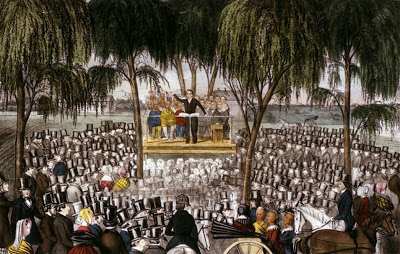
Joseph Smith delivering The King Follett Discourse on April 7, 1844, at Spring General Conference.

NOTES
1 And subsequent Mormon Leaders have further validated this by explicitly acknowledging that the Mormon Church follows another Jesus. Since the Bible is clear that Jesus Christ is God, this Mormon Jesus is also another God.

“In bearing testimony of Jesus Christ, President Hinckley spoke of those outside the Church who say Latter-day Saints ‘do not believe in the traditional Christ.’ ‘No, I don’t. The traditional Christ of whom they speak is not the Christ of whom I speak. For the Christ of whom I speak has been revealed in this the Dispensation of the Fulness of Times. He together with His Father, appeared to the boy Joseph Smith in the year 1820, and when Joseph left the grove that day, he knew more of the nature of God than all the learned ministers of the gospel of the ages’”
(Gordon B. Hinckley, 15th President of the LdS Church, “Crown of Gospel is Upon Our Heads”, Church News, June 20, 1998, p. 7)

“As a church we have critics, many of them. They say we do not believe in the traditional Christ of Christianity. There is some sub­stance to what they say”
(Gordon B. Hinckley, 15th President of the LdS Church, “We look to Christ”, Ensign (Conference Edition), May 2002, p. 90)

“It is true that many of the Christian churches worship a different Jesus Christ than is worshipped by the Mormons or The Church of Jesus Christ of Latter-day Saints”
(Bernard P. Brockbank, LdS Seventy, “The Living Christ”, Ensign (Conference Edition), May 1977, p.26)

(The above article is excerpted and expanded from, Fred W. Anson, “Deconstructing Mormon Testimony Bearing”)

BACK TO TOP

by Michael Flournoy
Latter-day Saints take communion once a week in remembrance of the sacrifice of Christ as admonished in Luke 22:19 and Doctrine and Covenants 20:75. This is not, however, the only reason they take it. Mormons also take communion in order to renew their baptismal covenant.

This covenant, made at baptism, is a two-way promise that they will take upon them the name of Christ, bear each other’s burdens, mourn with those that mourn and keep the commandments. In return, God promises eternal life (Mosiah 18:8-9).

There are two schools of thought as to why Latter-day Saints need to renew their covenant. The first theory says the covenant is broken by sin. When I was LDS, I thought my sins canceled my protection and taking communion would renew the agreement, much like renewing my car insurance. Taking communion was absolutely essential, hence it’s common name among the LDS: the sacrament.

The second theory says the covenant is not broken by sin. Renewing Covenants is like renewing wedding vows, which means the original agreement wasn’t damaged in any way. Communion is merely a chance for Latter-day Saints to recommit to the Lord.

Both theories are deeply problematic for Latter-day Saints.

The Problem with “Wedding Vow” Communion
The most glaring issue with the covenant not being broken by sin is it makes the covenant unbreakable. Thus the promise of eternal life is assured, regardless of whether man keeps his part of the agreement. This falls directly in line with the Protestant view of eternal security, which Mormons oppose vehemently.

To enter the highest heaven, the Celestial Kingdom, a Mormon must have faith, repent of their sins, be baptized, receive the gift of the Holy Ghost, and last but not least, endure to the end.

2 Nephi 31:16, in The Book of Mormon says: And now, my beloved brethren, I know by this that unless a man shall endure to the end, in following the example of the Son of the living God, he cannot be saved.

Doctrine and Covenants 14:7 says: And, if you keep my commandments and endure to the end you shall have eternal life, which is the greatest of all the gifts of God.

According to LDS scripture, we must endure to the end with our own might. There is no solace in the idea of an unbreakable covenant enduring on our behalf. The responsibility is placed on the shoulders of Latter-day Saints.

The Problem with “Car Insurance” Communion
I took communion weekly for 30 years as a Latter-day Saint. Whenever I partook of the broken bread I thought of Jesus. Though perfect, he was broken so that I, being broken, could be made whole. Every week I was damaged, and so was my covenant with God. With my covenant renewed by the sacrament, I was pure once again. Here’s how Mormon Apostle, Dallin H. Oaks explained this:

No one lives without sin after his or her baptism, however. Without some provision for further cleansing, each of us is lost. How grateful we are that the Lord has provided a process for each baptized member of His Church to be cleansed from the soil of sin. The sacrament is an essential part of that process. We are commanded to repent of our sins, to come to the Lord with a broken heart and a contrite spirit, and to partake of the sacrament. When we renew our baptismal covenants this way, the Lord renews the cleansing effect of our baptism. We are made clean and can always have His Spirit to be with us.
(Dallin H. Oaks, “Renewing Our Covenants”, Friend magazine, August 1999) 

There is a paradox in “car insurance” communion. It is a way to repair our unworthiness, but at the same time, it is never to be taken unworthily. Many Latter-day Saints justify taking communion despite having sin in their lives. They feel that as long as they are not committing major sins, and are on the path to righteous living, they are worthy enough to take communion.

Alma 45:16 in The Book of Mormon, tells a different story. It specifies that “the Lord cannot look upon sin with the least degree of allowance.” In other words, God is not satisfied with improvement from the week before. If we show him our spiritual report card and it’s an A-, we are still unworthy in his sight.

2 Nephi 28:8 says: And there shall also be many which shall say: Eat, drink, and be merry; nevertheless, fear God – he will justify in committing a little sin… The following verse calls this “false and vain and foolish” doctrine.

I was in an institute class one semester, watching a video about a drunk driver who killed a man’s family when the truth hit me: I had been judging the man for his depravity, and my own sins were just as vile. My sins were bad enough that Jesus had to die on my behalf! I realized that my righteousness was an illusion, and I had no right to judge anyone.

Romans 3:10-12 (ESV) states: As it is written: “None is righteous, no, not one; no one understands; no one seeks for God. All have turned aside; together they have become worthless; no one does good, not even one.”

LDS President, Joseph Fielding Smith once said,

“The sacrament meeting is the most sacred and the most important meeting required of all the members of the Church. If any of the members are not in good standing; if they have in their hearts any feeling of hatred, envy, or sin of any kind, they should not partake of these emblems. If there are any differences or feelings existing between brethren, these differences should be adjusted before the guilty parties partake; otherwise, they will eat and drink unworthily and bring upon them the condemnation spoken of by Paul…”
(Joseph Fielding Smith, “Doctrines of Salvation”, vol.2, p.343)

The problem this poses, is if the covenant has been broken, and the partaker has any sin in his life, he has no right to take communion. In fact, the covenant can never be renewed again, because as 1 John 1:8 (ESV) says: If we say we have no sin, we deceive ourselves, and the truth is not in us.

The Good News
In some ways, LDS communion is a resurrection of the law of Moses. Under the law, ancient Israelites had to make a sin offering once a year to renew their covenant. The new covenant, however, is quite different. Hebrews 10:11-18 (ESV) says:

And every high priest stands daily at his service, offering repeatedly the same sacrifices, which can never take away sins. But when Christ had offered for all time a single sacrifice for sins, he sat down at the right hand of God, waiting for that time until his enemies should be made a footstool for his feet. For by a single offering he has perfected for all time those who are being sanctified.

And the Holy Spirit also bears witness to us; for after saying,

“This is the covenant that I will make with them after those days, declares the Lord: I will put my laws on their hearts, and write them in their minds,” then he adds, “I will remember their sins and their lawless deeds no more.”

Where there is forgiveness of these, there is no longer any offering for sin.

I wept the first time I took communion in a Christian church. It was my first time taking it without feeling guilty. The symbolism overwhelmed me. It was not an offering that I was making to God, it was the offering God had given me. The Lord’s amazing grace was upon me, forgiving me of my trespasses. Jesus was not waiting for me to come to his level, he was meeting me at mine, and granting me full acceptance.

I was the prodigal son, who had returned from feeding pigs in the mire. I was a long way off, but God ran to me. I was filthy, but he embraced me. I was estranged, and he put a ring on my finger. I was naked, and he put his robe on me. I was dead, and he brought me to life.

Rembrandt, “The Return Of The Prodigal”

About the Author
Michael Flournoy served a two-year mission for the LDS Church where he helped organize three Mormon/Evangelical dialogues and has participated in debate at the Southwestern Baptist Theological Seminary. Born into Mormonism, Mr. Flournoy converted to Evangelical Christianity in 2016.

by Fred W. Anson
First, let’s define terms. Here is the official, correlated definition for the Mormon Godhead:

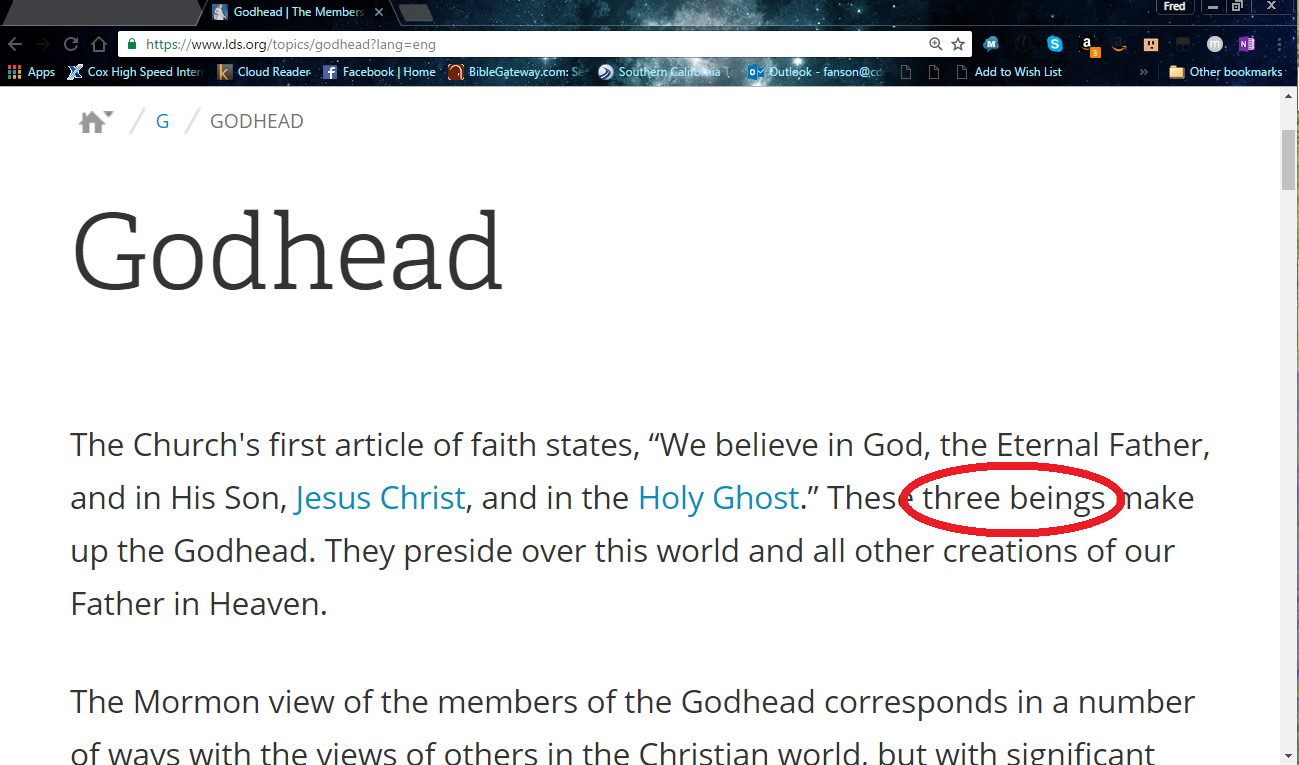
“…where Latter-day Saints differ from other Christian religions is in their belief that God and Jesus Christ are glorified, physical beings and that each member of the Godhead is a separate being…

The Father and the Son have tangible bodies of flesh and bones, and the Holy Ghost is a personage of spirit (see D&C 130:22).

Although the members of the Godhead are distinct beings with distinct roles, they are one in purpose and doctrine. They are perfectly united in bringing to pass Heavenly Father’s divine plan of salvation.”
(“Godhead”; https://www.lds.org/topics/godhead?lang=eng )

Official, correlated definition of “Godhead”. Notice the words, “These three BEINGS make up the Godhead.”

Remember: That’s three beings and three persons.

Now, here is the “nutshell version” of the orthodox definition of the Christian Trinity:

“The Bible teaches that God is an uncreated, eternal omnipotent, omniscient, omnipresent Being consisting of three uncreated, coeternal, coequal, co-omnipotent, co-omnipresent, co-omnipresent and distinct Persons: the Father, the Son, and the Holy Spirit. They are one in essence, yet three in person – one God.”

Again that’s the nutshell definition if you want a fuller explanation that I will simply refer you to the best-written description of the Trinity that I or anyone else has found in the last 1,700 or so years: The Athanasian Creed.

Remember: That’s one being and three persons.

A graphic representation of the doctrine of the Trinity (aka “The Trinity Shield”)

Trinitarian Godhead v Mormon Godhead Logic Exercise
So given all that, please consider the following logic exercise and tell me if and where you see any flaws in my thinking and reasoning.

Definitions:
Being = What you are. (human, animal, rock, tree, etc.)
Person = Who you are. (that is a distinct personality)

Based on those definitions it, therefore, follows that . . .
One being consisting of one distinct person, possible.
(humans, animals, etc.)

One person consisting of one distinct being, possible.
(humans, animals, etc.)

One being consisting of two distinct persons, possible.
(Conjoined Twins)

Two persons consisting of one distinct being, possible.
(Conjoined Twins)

One being consisting of three distinct persons, possible.
(Conjoined Triplets)

Three persons consisting of one distinct being, possible.
(Conjoined Triplets)

One person consisting of one distinct being, possible.
(humans, animals, etc.)

One person consisting of two distinct beings, impossible.

One person consisting of three distinct beings, impossible.

One being consisting of one separate being, impossible.

One being consisting of two separate beings, impossible.

One being consisting of three separate beings, impossible.

One person consisting of one separate person, impossible.

One person consisting of two separate persons, impossible.

One person consisting of three separate persons, impossible.

Application:
CHRISTIAN TRINITY = POSSIBLE

“Within the one Being that is God, there exists eternally three coequal and co-eternal persons, namely, the Father, the Son, and the Holy Spirit.”
(White, James R. “The Forgotten Trinity” (p. 26). Baker Publishing Group. Kindle Edition)

That is One Being, three Persons = One God. Monotheism.

OFFICIAL, CORRELATED MORMON GODHEAD = POSSIBLE

“where Latter-day Saints differ from other Christian religions is in their belief that God and Jesus Christ are glorified, physical beings and that each member of the Godhead is a separate being

The Father and the Son have tangible bodies of flesh and bones, and the Holy Ghost is a personage of spirit (see D&C 130:22).

Although the members of the Godhead are distinct beings with distinct roles, they are one in purpose and doctrine. They are perfectly united in bringing to pass Heavenly Father’s divine plan of salvation.”
(“Godhead”, italics added for emphasis; https://www.lds.org/topics/godhead?lang=eng )

That is three Beings and three Persons = Three Gods. Tri-Theism.

A graphic representation of the doctrine of the modern Mormon Godhead.

UNOFFICIAL, UNCORRELATED MORMON GODHEAD = IMPOSSIBLE
Many Mormons claim incorrectly that the Mormon Godhead is Three Persons and Three Beings which equals One God.

That is three Beings and three Persons = One God. Monotheism.

Again, this is simply NOT possible. It is a logical contradiction because it is both internally contradictory and self-contradictory given the definition and nature of “being” and/or “person”.

BACK TO TOP

by Michael Flournoy
There are three conversions in Mormonism: social, doctrinal, and spiritual.

Doctrinal Conversion is to believe that the tenets of Mormonism are true, along with The Book of Mormon, Doctrine and Covenants, and the Pearl of Great Price.

Social Conversion is to believe that the LDS church is a godly institution, its leaders are inspired, and its founder, Joseph Smith, had an upright, moral character.

Spiritual Conversion is any experience that validates a Mormon’s beliefs.

The most common of these is Spiritual Conversion. It typically occurs after reading The Book of Mormon, which challenges the reader to ask God if it’s true. It promises that God will reveal its truthfulness through the power of the Holy Ghost. Rather than testing The Book of Mormon against the Bible, Latter-day Saints resort to subjective feelings, and often equate a burning in the bosom to an answer from the Spirit. The exact wording in The Book of Mormon is as follows.

Moroni 10:4 And when ye shall receive these things, I would exhort you that ye would ask God, the Eternal Father, in the name of Christ, if these things are not true; and if ye shall ask with a sincere heart, with real intent, having faith in Christ, he will manifest the truth of it unto you, by the power of the Holy Ghost.

These conversions serve as a three-legged stool to keep Mormons tethered to the LDS gospel. If one leg is kicked out, they can keep going on two legs while the damaged one is repaired. Thus, in order to bring them out of the church, at least two of the three conversions must be targeted. However, Latter-day Saints are unlikely to divulge details about their spiritual conversion because those experiences are considered sacred. To them, talking about their experiences with Christians is casting their pearls before swine.

That leaves the social and doctrinal conversions to target. Most Mormons lean either to the doctrinal or the social side of their faith. Rarely, if ever, do you find a Mormon who is on fire about the doctrine and the culture of the church. If they don’t lean either way, they are probably less active. I was a Ward Mission Leader right before leaving, and it was often said that a new convert to Mormonism needed three things: A friend (social conversion), a calling (social conversion), and to be nourished by the good word of God (doctrinal conversion).

Of the two types of Latter-day Saints, the vast majority are socially converted, cultural Mormons. They do not participate in online debates, and their testimonies are not founded on logic. I have been in several wards over the years, and typically I have found only 1 or 2 individuals per congregation that really know their stuff. These doctrinal Mormons are, to some degree or another, outcasts in the faith.

I heard a talk over the pulpit once, where a man was comparing his parents, one of whom was doctrinal, while the other was a cultural Mormon. He said, “My father knew The Book of Mormon backward and forward, he had much of it memorized, and he could explain why each passage was important, but my mom knew it was true…” He implied that because of her blind faith, his mother was the more righteous of the two.

My Conversions into Mormonism
Although I was born under the covenant, I still had to be converted to Mormonism. My social conversion came at age fifteen. I finally made good friends at church and it’s where the pretty girls were. I would have gone without being dragged there by my parents.

My spiritual conversion came a year later when I attended Especially for Youth, a week-long retreat for Latter-day Saints. On Thursday night they ushered us into a room and showed a video about Jesus. It had people testifying that he was their Savior and he’d changed them. That night, the real Jesus visited me.

I was faced with his majesty and righteousness. I knew that I was a wretched sinner, and I would have been satisfied if he had wiped me off the face of the planet. However, instead of wrath, he sent me his love. It was an unbelievable love. It’s the kind of love that says, “You hate my counsel, your feet are slow to do good and swift to do evil, and many of the things you do displease me, but I love you anyway.”

God’s overwhelming, undeserved love made me weep for hours on end. I looked at the context of the situation. I was at a Mormon sponsored event, which I interpreted to mean that the church was true. I decided that my allegiance would be to the Church of Jesus Christ of Latter-day Saints.

When I turned 19, I turned in my mission papers and went to the far away land of California to preach the gospel. Even then, I was seeking the burning in the bosom my counterparts had experienced after reading The Book of Mormon. I was expecting something powerful like my Jesus experience, but it never came. Eventually, I settled on a logical testimony that The Book of Mormon was true, even though it made me feel like a second class citizen in the church.

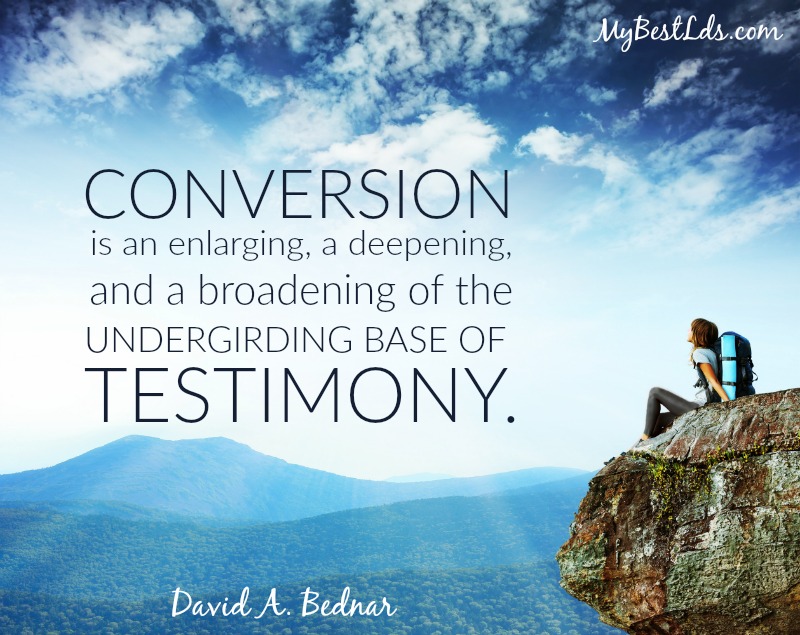
Spiritual Conversion as articulated by a Mormon Apostle. (click to zoom)

In time, other experiences bolstered my spiritual conversion. On my mission, I met my friend Ed Enochs, an Evangelical Christian, who debated my companion and me for three hours one day. I walked away from that encounter convinced that Mormonism was false. I was saddened at the thought of my family and friends back home. How, I wondered, could such intelligent people be roped in by a scam like Mormonism?

Ed also convinced me that the Bible was the word of God. I decided to examine it and see if it supported the truth claims of the church.

Somehow, as I studied the Bible, I came across all the passages that seemed to support Mormonism, and my doctrinal conversion was complete. When I returned home I became an amateur apologist bent on defending Mormons from smooth talking Christians. With all three conversions in place, the LDS church had me hooked. I spent the next decade as its captive.

My Three Conversions out of Mormonism
By 2015, God was waging war on all three of my conversions. I decided that year to study grace in order to become a more effective weapon. In Mormonism, there are 3 levels of heaven, 6 definitions of salvation, and 50 shades of grace. So every time I came across heaven or salvation in LDS scripture, I had to decipher which level of heaven and what kind of salvation was being described. It was the most frustrating thing I had ever done in my life and I was envious of the elegant simplicity of the gospel my Christian friends believed in.

Later that year the church came out with its policy that children of gay parents could not be baptized. I was not on board with the policy, but what irked me, was the day after it was leaked Mormons were already defending the policy online. It seemed like Latter-day Saints everywhere were abandoning Spirit and scripture in favor of uncontested apostolic authority.

I was on an online forum one day and another Latter-day Saint said he didn’t have a problem with the policy, but if he did, he would just pray about it until he didn’t anymore. I responded, “If that’s not a cult mindset, I don’t know what is!”

Unfortunately, it was a public forum and my family decided to hold a small intervention for me. They warned me to use caution when discussing the church and one family member said throwing the prophet under the bus was the same as throwing Jesus under the bus.

I knew that despite my family’s concern, the truth could withstand criticism. In favor of my relationships, however, I decided to keep my big mouth shut. It was just a stupid policy, after all.

A few days later I saw Elder Nelson speak to Millennials on BYU TV about the policy. He explained that it was not a policy at all, but a revelation from God that had been unanimously received by all 15 prophets, seers, and revelators. My jaw dropped. Suddenly, my issues with the church were just as much doctrinal as they were cultural since God himself was the alleged mastermind behind the policy.

In Mormonism, there are three pillars of truth: the leadership, the Spirit, and the scriptures. Any of these can be used to acquire truth, but in my case, the Spirit and the scriptures were telling me the exact opposite of what the leaders were saying. That October I learned that there had been over 30 suicides of gay and lesbian LDS youth. I was shocked that the so-called “plan of happiness” was causing so much sorrow.

My social conversion shattered into a million pieces. I was no longer proud to be a Mormon; I was ashamed of it. And with my doctrinal conversion struggling as it was, I was dragged into a faith crisis lasting several months. Mormonism had infiltrated every aspect of my identity and questioning it caused me to fall into a confused state of depression.

I managed to stay active through it all. I kept studying grace and came to believe that Christ’s imputed righteousness granted salvation. I found evidence of it in both the Bible and The Book of Mormon, and for a time my doctrinal conversion stabilized. That is until God opened my eyes to the fact that my new favorite doctrine was hostile to the mandatory LDS covenants and ordinances.

My spiritual conversion collapsed soon after that. It didn’t matter that I still had experiences that I couldn’t explain away. One leg was simply not enough to support my testimony. I gave my life to Jesus and over time I discovered that my spiritual experiences did not hold up under scrutiny.

Kicking out the Legs of Conversion
Spiritual conversion is the toughest to target since Mormons are so protective of it. Ex-Mormons might have a shot though, by talking about the spiritual experiences they had while active, and why they failed the test of time. Most Christians will need to go after social and doctrinal conversion instead.

First, find out what kind of Mormon you’re talking to. Does she believe her leaders’ words are always inspired? Does she blur the lines between culture and doctrine? Is she LDS because of the great programs and family values? Does she think people leave the church because they intellectualize their way out? If so, she’s probably a cultural Mormon.

Does he believe the prophets and apostles sometimes speak as men? Is he wary of the culture, but protective of the beliefs? Does his testimony of the LDS scriptures have some basis in logic? Does he think people leave the church over cultural issues? If so, he’s probably a doctrinal Mormon.

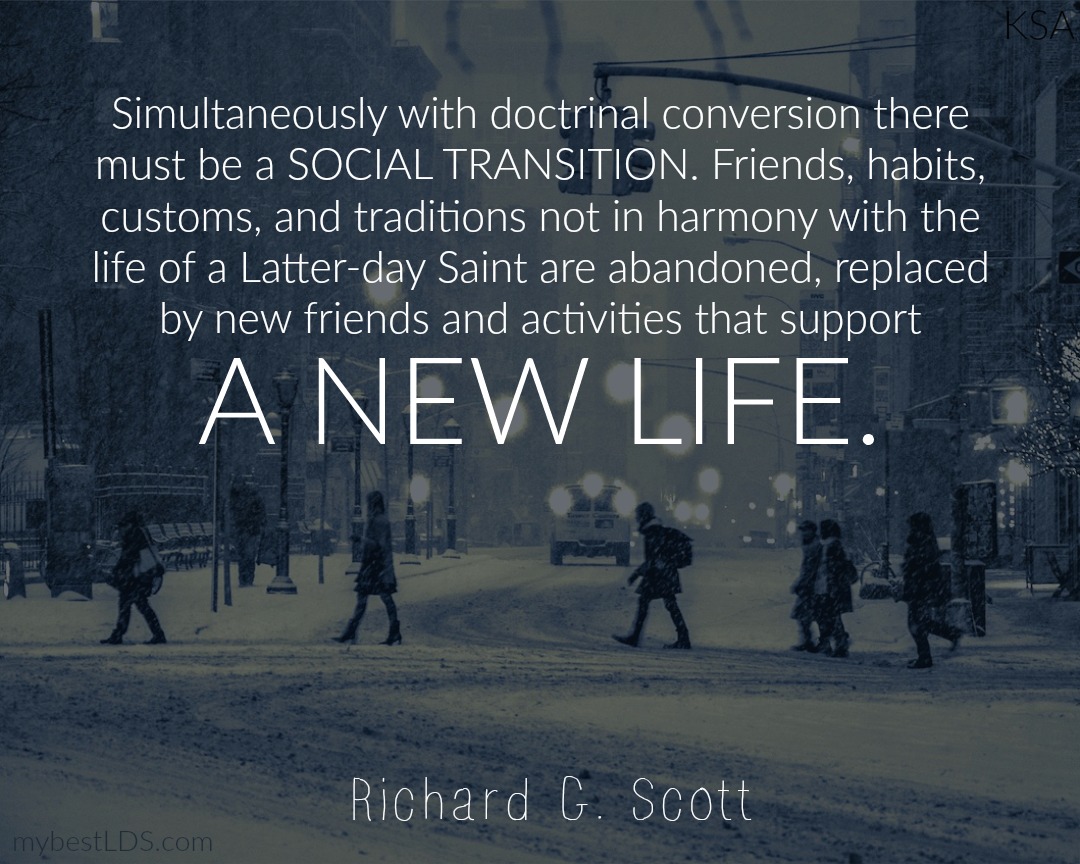
Doctrinal and Social Conversion as articulated by a late Mormon Apostle. (click to zoom)

Conventional wisdom says to strike where the Mormon is weak, but that may not be the right strategy. Since my social conversion was weak, I doubled down on the doctrine to overcompensate. I overlooked the prophets’ mistakes because they were men. When faced with Joseph Smith’s misdeeds, it never dented my view that he was a prophet. I just thought he was abusing authority God had actually given him. All the social problems in the world could not have relinquished my grip on the Mormon church.

God attacked my doctrinal conversion first. That made me vulnerable to social problems in the church and set the stage for the avalanche to come. So if you’re talking to doctrinal Mormons, talk about doctrinal issues first: like contradictions between LDS scriptures and the Bible. If you’re witnessing to cultural Mormons, talk primarily about social problems: like Joseph Smith’s polyandry.

I would caution against coming off too aggressive with Latter-day Saints. Above all else, be a friend first. Mormons are wary of Christians who constantly attack their beliefs. We don’t have to tell our LDS friends they’re in a cult every time we see them. They already know what we think, I promise. Bold, fiery preaching may erode their doctrinal conversion, but if it is not coming from a relationship of trust, it will simultaneously bolster their social conversion.

Navigating someone past the three conversions is ultimately the work of God, and it’s a long, drawn out process. Sometimes all we can do is plant seeds, pray for the LDS, and love them. Mormons are unlikely to ever choose Christianity if all they remember from us is: ‘attack, attack, attack’.

I am forever grateful to the many Christians who befriended me while I was LDS, who respected me despite my beliefs, who saw past my religion and saw me, who prayed for me, who built me up, who let the light of Jesus shine through them, and who treated me like a brother before I was one. I don’t know where I’d be without them.

About the Author
Michael Flournoy served a two-year mission for the LDS Church where he helped organize three Mormon/Evangelical dialogues and has participated in debate at the Southwestern Baptist Theological Seminary. Born into Mormonism, Mr. Flournoy converted to Evangelical Christianity in 2016.


We Agree with Moroni 8--18

“God is not a partial God, neither a changeable being; but he is unchangeable from all eternity to all eternity.”
Moroni 8:18

There was a time when Mormons agreed with Moroni 8:18. As Mormon historian Thomas G. Alexander writes, “Much of the doctrine that early investigators found in Mormonism was similar to contemporary Protestant churches.”1

Mormonism has apostatized from its own Book of Mormon, and now Christians—who don’t even believe that the Book of Mormon is divine scripture—agree with Moroni 8:18 more than Mormons do. It is a verse that we Christians profoundly wish Mormons would agree with. It is far more important of an issue than tithing, baptism, priesthood authority, or whether Joseph Smith was a true prophet. It concerns an eternal truth of the fundamental nature of God.

“Before the mountains were brought forth, or ever thou hadst formed the earth and the world, even from everlasting to everlasting, thou art God.”
Psalm 90:2 (JST)

“Before me there was no God formed, neither shall there be after me.”
Isaiah 43:10 (JST)

“I am the first, and I am the last; and besides me there is no God.”
Isaiah 44:6 (JST)

Doctrine and Covenants
In what was originally read to Church membership as the “Articles and Covenants of the Church,” D&C 20:17 spoke of the God who was always the same unchangeable God: “By these things we know that there is a God in heaven, who is infinite and eternal, from everlasting to everlasting the same unchangeable God…” D&C 76:4 spoke of this same God: “From eternity to eternity he is the same, and his years never fail…”

The Lectures on Faith, which was a canonized part of D&C from 1835-1921 agreed with the Book of Mormon that God is a spirit (from the fifth Lecture on Faith, page 53.) Click on image to zoom and read.

The Lectures on Faith, which was a canonized part of D&C from 1835-1921 agreed with the Bible and the Book of Mormon that God is an eternal, unchanging, triune Being (from the fifth Lecture on Faith, page 53). Click on image to zoom and read.

Lectures on Faith
In what was originally a part of Mormon scripture, Lecture 3 of the Lectures on Faith taught, “A correct idea of his character, perfections and attributes” is “…necessary, in order that any rational and intelligent being may exercise faith in God unto life and salvation.” It goes on to quote the word of God, Psalm 90:2, “Before the mountains were brought forth, or ever you had formed the earth and the world, even from everlasting to everlasting, you are God.” The lecture then goes on to say that, “he changes not, neither is there variableness with him; but that he is the same from everlasting to everlasting, being the same yesterday today and forever; and that his course is one eternal round, without variation.”

Book of Mormon
This echoes Mosiah 3:5, which speaks of “the Lord Omnipotent who reigneth, who was, and is from all eternity to all eternity…” Moroni 7:22 also speaks of “God knowing all things, being from everlasting to everlasting…” A chapter later we learn in Moroni 8:18 that “God is not a partial God, neither a changeable being; but he is unchangeable from all eternity to all eternity.” Other passages in the Book of Mormon also reaffirm God’s eternal, unchangeable nature:

“For behold, I am god; and I am a God of miracles; and I will show unto the world that I am the same yesterday, today, and forever.”
2 Nephi 27:23

“And I do this that I may prove unto many that I am the same yesterday, today, and forever.”
2 Nephi 29:9

“For do we not read that God is the same yesterday, today, and forever , and in him there is no variableness neither shadow of changing?”
Mormon 9:9

“And if there were miracles wrought then, why has God ceased to be a God of miracles and yet be an unchanging Being? And behold, I say unto you he changeth not; if so he would cease to be God; and he ceaseth not to be God, and is a God of miracles.”
Mormon 9:19

Mormonism Radically Changed
The Book of Mormon was published in March of 1830. Fourteen years later, Mormon theology had dramatically changed. On April 7, 1844, Joseph Smith preached his famous King Follett Discourse. In it he taught:

God himself was once as we are now, and is an exalted man, and sits enthroned in yonder heavens…

It is necessary that we should understand the character and being of God, and how he came to be so; for I am going to tell you how God came to be God. We have imagined and supposed that God was God from all eternity, I will refute that idea, and will take away and do away the veil, so that you may see. These are incomprehensible ideas to some; but they are simple…

Here, then, is eternal life—to know the only wise and true God; and you have got to learn how to be Gods yourselves, and to be kings and priests to God, the same as all Gods have done before you…2

Lorenzo Snow summarized the big idea that further developed like this: “As man is God once was, and as God is man may be.”

Since then, Mormonism has never been the same. Mormons now radically re-interpret verses like Moroni 8:18 and essentially reject the original teaching that God was unchangeably God from all eternity to all eternity. Mormons are now even in disarray and confusion over whether Heavenly Father was once a sinful mortal.3

Again, Mormonism has apostatized from its own Book of Mormon, and now Christians—who don’t even believe that the Book of Mormon is divine scripture—agree with Moroni 8:18 more than Mormons do. It is a verse that we Christians profoundly wish Mormons would agree with. It is far more important of an issue than tithing, baptism, priesthood authority, or whether Joseph Smith was a true prophet. It concerns an eternal truth of the fundamental nature of God.

NOTES
1 Thomas G. Alexander, “The Reconstruction of Mormon Doctrine: From Joseph Smith to Progressive Theology.” Sunstone 5:4; July-August 1980
2 Teachings of the Prophet Joseph Smith, p. 345. On June 16, 1844, Smith went on to teach that Heavenly Father has his own Heavenly Father (History of the Church, vol. 6, pp. 473-479). Also see Ensign, April 1971 and May 1971.
3 See http://GodNeverSinned.com

JST = The Joseph Smith Translation of the Bible (aka “The Inspired Version”)

For more information
Website: http://WeAgreeWith818.com
Facebook Page: https://www.facebook.com/WeAgreeWith818
Official Hashtag: #WeAgreeWith818

BACK TO TOP

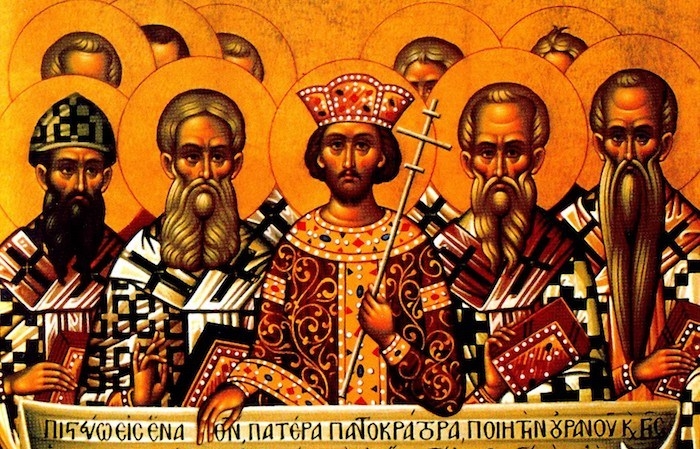
An icon of the Bishops of the First Council of Nicaea with Constantine (in the crown).

by Fred W. Anson
One of the most common Mormon arguments is that they have no creeds. They further argue that the creeds of other churches are an abomination as well as evidence of their corrupt and apostate state. Probably no one has articulated this stance better than BYU professors Craig Ostler and the late Joseph Fielding McConkie when they wrote:

“Wherever creeds are found one can also expect to find a paid clergy, the simple truths of the gospel cloaked in the dark robes of mystery, religious intolerance, and a history of bloodshed”
(BYU Professor Emeritus Joseph Fielding McConkie and Craig Ostler, “Revelations of the Restoration”, p.964)

And of the many “abominable creeds” of Christendom to chose from, I think one would be hard pressed to find one that Latter-day Saints more pour contempt on than the Nicene Creed:

“Men with keen intelligence got together… [at] Nicea and created a God. They did not pray for wisdom or revelation. They claimed no revelation from the Lord. They made it just about like a political party would do, and out of their own mortal minds created a God which is still worshiped by the great majority of Christians”
(Spencer W. Kimball, “The Teachings of Spencer W. Kimball”, p. 426. Ellipsis and brackets in original)

“The trinity was voted on in the Council of Nicene hundreds of years after Christ’s death. A bunch of church leaders and government officials got together and voted on ‘who God was?’, and it wasn’t even a unanimous vote. There were about four different versions of God that they voted on. The version that is used by Catholics and Protestants today only won by about a 40 percent margin. Their view of God, as you may know, is that He is like a formless mass of spirit that fills the whole universe and when He comes to earth, part of it breaks off and forms itself into Jesus.”
(Scott Marshall, “Tracting and Member Missionary” Work, p.73)

“The knowledge of God and His physical separateness from His Son and the Holy Ghost was lost after the death of Christ and His Apostles. Confusion and false doctrines about the Godhead were fashioned out of the Nicene Creed and Constantinople councils… I know that heaven-sent revelations have replaced the gross errors of man-made doctrines concerning the Godhead”
(Gary J. Coleman, “Mom, Are We Christians?” Ensign, May 2007, pp.92-93)

“If Christians are people (and this is the standard definition of the clergy of the day) who believe in the holy trinity as defined and set forth in the Nicene, Athanasian, and Apostles creeds, meaning that God is a three-in-one nothingness, a spirit essence filling immensity, an incorporeal and uncreated being incapable of definition or mortal comprehension — then Mormons, by a clergy chosen definition, are ruled out of the fold of Christ”
(Bruce R. McConkie, “Doctrinal New Testament Commentary” 2:113)

“Our Catholic friends, our Protestant friends, give us their definition of deity in the Nicene Creed. But that’s just a creed that came of the discussions of men. The marvelous thing is that the boy Joseph was able to testify of the real nature of God the Eternal Father and His Son, Jesus Christ. And that makes it possible for you and for me to understand our relationship to them. Each of us is a child of God. A son or a daughter of God in a very real sense and we can pray to Him and He will hear and answer our prayers.”
(Gordon B. Hinckley, “The Nature of God”, Church News, July 1, 2006, p.2)

“We do not accept the Athanasian Creed. We do not accept the Nicene Creed, nor any other creed based on tradition and the conclusions of men.”
(Gordon B. Hinckley, “What Are People Asking About Us?” Ensign, November 1998, pp.70-71)

But if the Nicene Creed is such an abomination, why is so much of it found in D&C 20:17-28? A side-by-side comparison is very surprising.

Doctrine & Covenants 20:17-28
(from the 1835 edition of D&C) 

Nicene Creed
(from the 1662 Book of Common Prayer)

By these things we know that there is a God in heaven, who is infinite and eternal, from everlasting to everlasting the same unchangeable God, the framer of heaven and earth, and all things which are in them; We believe in one God, the Father Almighty,

Maker of heaven and earth, And all things visible and invisible;


And that he created man, male and female, after his own image and in his own likeness, created he them; And gave unto them commandments that they should love and serve him, the only living and true God, and that he should be the only being whom they should worship. But by the transgression of these holy laws man became sensual and devilish, and became fallen man.

Wherefore, the Almighty God gave his Only Begotten Son, as it is written in those scriptures which have been given of him. He suffered temptations but gave no heed unto them. He was crucified, died, and rose again the third day; And ascended into heaven, to sit down on the right hand of the Father, to reign with almighty power according to the will of the Father; That as many as would believe and be baptized in his holy name, and endure in faith to the end, should be saved– And in one Lord Jesus Christ, the only-begotten Son of God. Begotten of his Father before all worlds, God of God, Light of Light, Very God of Very God, Begotten, not made, Being of one substance with the Father, By whom all things were made: Who for us men, and for our salvation he came down from heaven, And was incarnate by the Holy Ghost and the Virgin Mary, And was made man, And was crucified also for us under Pontius Pilate, He suffered, and was buried, And the third day he rose again according to the Scriptures, And ascended into heaven, and sitteth on the right hand of the Father. And he shall come again with glory to judge both the quick and the dead: Whose kingdom shall have no end.
Not only those who believed after he came in the meridian of time, in the flesh, but all those from the beginning, even as many as were before he came, who believed in the words of the holy prophets, who spake as they were inspired by the gift of the Holy Ghost, who truly testified of him in all things, should have eternal life, As well as those who should come after, who should believe in the gifts and callings of God by the Holy Ghost, which beareth record of the Father and of the Son;
And I believe in the Holy Ghost, The Lord and giver of life, Who proceedeth from the Father and the Son, Who with the Father and the Son together is worshipped and glorified, Who spake by the Prophets.
Which Father, Son, and Holy Ghost are one God, infinite and eternal, without end.
And I believe in one Catholick and Apostolick Church. I acknowledge one Baptism for the remission of sins. And I look for the Resurrection of the dead, And the life of the world to come.
Amen. Amen.

source: Owen D. West III, “Questions to Gospel Answers: Are all their creeds an abomination in God’s sight?”1

So if the Nicene Creed is abominable, then what does that make D&C 20? And if it’s a creed that’s, according to former LdS President Gordon B. Hinckley, “based on tradition and the conclusions of men” that “came of their discussions” then what does that say about an alleged revelation that has it embedded right in it?2

Speaking of Ecclesiastical Councils…
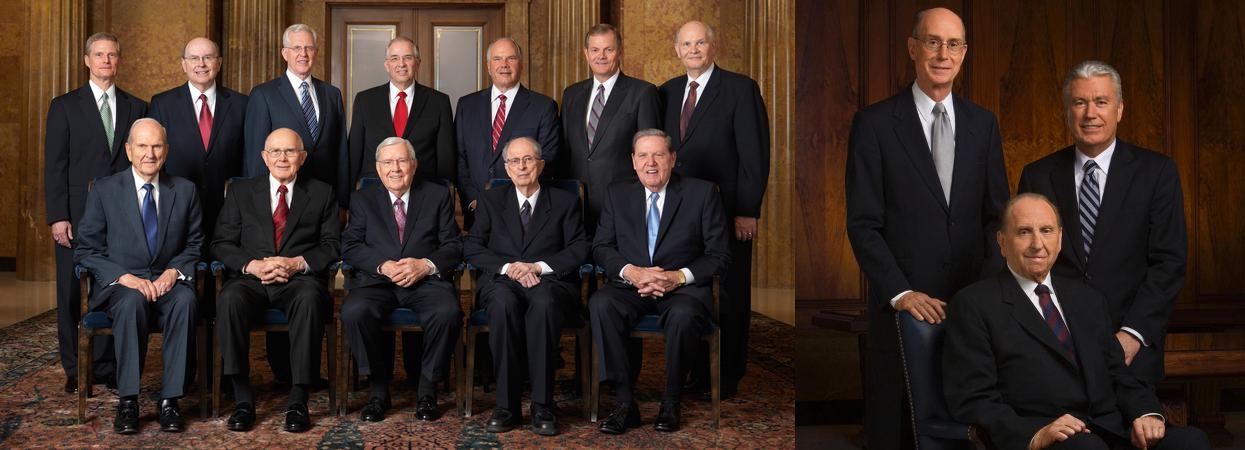
(the Quorum of the Twelve Latter-day Saint Apostles and the First Presidency circa 2017)

NOTES
1 Here are the original end notes of  Owen D. West, III, the creator of this table, regarding it’s background and content:

(The Nicene Creed is also based almost entirely on scripture, much more so than the Articles of Faith. Almost every phrase is taken word for word from the Bible. All phrases have Biblical supporting scriptures).

At first I used the Nicene Creed as used in English by the Roman Catholic Church today. I then realized that the Roman Catholic Church would have been using Latin in 1830, and since we have already seen a strong tie to the Episcopalian Book of Common Prayer for the Sacramental prayers (Rite I), and since this book has been available in the U.S. since 1789, I changed to this version, which (should come as no surprise) is much closer on a word by word basis to D&C 20 than is the modern English Roman Catholic version. I then compared to the even older Book of Common Prayer from the Church of England and found it to be word for word the same as the old Episcopalian version (with different capitalization and punctuation and spelling, e.g. Catholic and Apostolic for Catholick and Apostolick). [It is the Church of England’s Book of Common Prayer that is the source of so much animosity in the early LDS writing. Polemics against a God “without body, parts or passions”, or the emphasis on the Creed of Athanasius are related to this book.] I have used the Church of England Nicene creed above.

D&C 20 is obviously related to the Nicene Creed in both word and organization. Joseph Smith used the format of the Nicene Creed in writing D&C section 20 in the same way that I did when I wrote my own statement of faith. I wrote my statement of faith without referring to the Nicene Creed because after saying it so many times and having memorized it is easy to use these familiar phrases, blending them into my own belief statement. I believe Joseph Smith (or whoever actually wrote this part of D&C 20) did not have to refer to this well known Christian creed because it was part of his background. I believe this is also why we find familiar phrases from the “Doxology” in the modern scriptures published by Joseph Smith. These phrases were already a part of his religious “vocabulary”.

2 Oh, and by the way, the way that Mormon leaders portray the events of the Council of Nicea bears little to no resemblance to the historical record. As Christian author James White notes:

Nicea was not creating some new doctrine, some new belief, but clearly, explicitly, defining truth against error. The council had no idea that they, by their gathering together, possessed some kind of sacramental power of defining beliefs: they sought to clarify biblical truth, not to put themselves in the forefront and make themselves a second source of authority.

This can easily be seen from the fact that Athanasius, in defending the Nicene council, does so on the basis of its harmony with Scripture, not on the basis of the council having some inherent authority in and of itself. Note his words: “Vainly then do they run about with the pretext that they have demanded Councils for the faith’s sake; for divine Scripture is sufficient above all things; but if a Council be needed on the point, there are the proceedings of the Fathers, for the Nicene Bishops did not neglect this matter, but stated the doctrines so exactly, that persons reading their words honestly, cannot but be reminded by them of the religion towards Christ announced in divine Scripture.”

The relationship between the sufficient Scriptures and the “Nicene Bishops” should be noted carefully. The Scriptures are not made insufficient by the council; rather, the words of the council “remind” one of the “religion towards Christ announced in divine Scripture.” Obviously, then, the authority of the council is derivative from its fidelity to Scripture…

Modern Christians often have the impression that ancient councils held absolute sway, and when they made “the decision,” the controversy ended. This is not true. Though Nicea is seen as one of the greatest of the councils, it had to fight hard for acceptance. The basis of its final victory was not the power of politics, nor the endorsement of established religion. There was one reason the Nicene definition prevailed: its fidelity to the testimony of the Scriptures.

And as Dr. White concludes:

Why do Christians believe in the deity of Christ today? Is it because they have been forced to do so by legislated theology from councils and popes? No, it is because the Scriptures teach this truth. When orthodox believers affirm the validity of the creed hammered out at Nicea, they are simply affirming a concise, clear presentation of scriptural truth. The authority of the Nicene creed, including its assertion of the homoousion, is not to be found in some concept of an infallible church, but in the fidelity of the creed to scriptural revelation. It speaks with the voice of the apostles because it speaks the truth as they proclaimed it.
(James R. White, “What Really Happened at Nicea?”, Christian Research Institute Journal, June 2009) 

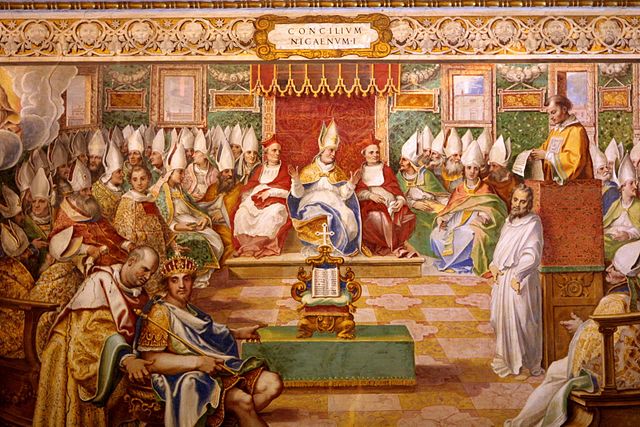
16th Century Fresco in the Sistine Chapel depicting the First Council of Nicea.

16th Century Fresco in the Sistine Chapel depicting the First Council of Nicea.

BACK TO TOP

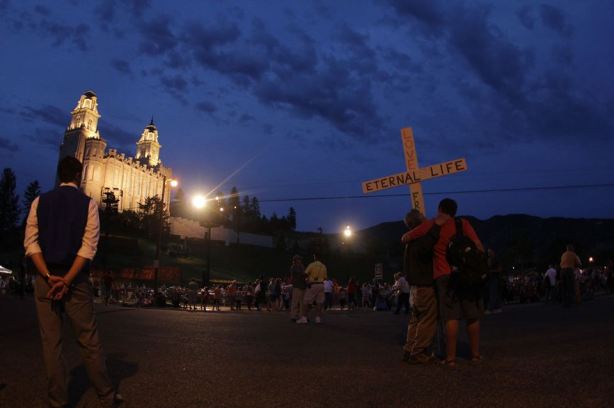
Evangelical Christians Praying for Mormons at the Manti Miracle Pageant in 2016.

by Jaxon Washburn
Nowadays, I tend to peruse and engage in many online forums and discussion groups geared towards Evangelicals and Latter-day Saints. I actively read and study from various biblical commentaries, historical works, and books on theology, apologetics, and Church history (both churches included). I have been able to have many acquaintances from both sides of the divide that I am happy to call “friend”, one being Fred Anson, the founder, and publisher of Beggar’s Bread – who graciously invited me to write this open letter to Evangelicals.

Now, it is not unknown that Fred is generally critical of Mormonism as well as a non-professional student of Mormon Studies. There are myriad areas in which he and I are sure to disagree, and yet such doesn’t prohibit the two of us from respectful, genuine conversation, and occasionally friendly banter. There are sure to be individuals from both camps which are astounded to hear that such is possible. To them, I would share a quote from Thomas Jefferson that I wholly attempt to live by: “I never considered a difference of opinion in politics, in religion, in philosophy, as cause for withdrawing from a friend.”

I understand that I am the first active True Believing Mormon (or “TBM” as some jokingly call it) to write for Beggar’s Bread. I am happy to be, what is hopefully, a trendsetter here since I’m a firm advocate for meaningful and positive cross-denominational interactions.

It is my hope that I will be able to squeeze in a few more appearances here before I depart on my mission in the coming months after I complete some schooling at Arizona State University (ASU). And in saying so, I should include that my message today is not at all antithetical for my plans on serving a full-time mission for the Church of Jesus Christ of Latter-day Saints; despite what the click-bait title might have you think! No, I wish instead to offer some serious reflection and advice I believe will be valuable to Evangelicals in their fellowshipping with members of my own faith community.

I often find that too often what could have been substantial discussions, real relationships, and even legitimate spiritual experiences are traded through an expectation of quick conversions with shallow conversations and insincere outreach. Thus I will be answering the following question I consider to be vital if any Evangelical wishes to engage with their Latter-day Saint friends: “How would I, as a Mormon, like to be preached to?” and provide practical suggestions for facilitating dialogue between adherents of both respective faith groups.

The Language Barrier
The ability to clearly communicate our demands, emotions, questions, statements, conjecture and abstract concepts is a constant task required by all members of society. In conveying those ideas with enough coherence and precision so as to effectively convey those same ideas into the minds of those whom we are speaking with, most find themselves at a loss for words. This can often come with great difficulty when we find ourselves unable to express ourselves at times, or else subject ourselves and other to a series of unfortunate events due to a simple misunderstanding or miscommunication. Now consider the difficulty when speaking completely different languages and the imagery of the confusion at the Tower of Babel is sure to come to mind., most involved in interfaith dialogue enter into such speaking the same actual language, however that doesn’t mean that they will speak the same theological or religious language.

The odds are, both parties will be walking into the discussion carrying different baggage whether that be preconceived ideas about the other, presuppositions about their own faith, past spiritual experiences, and a different vocabulary to communicate such. This is what I refer to as “the Language Barrier of Faith”, and it is an individual’s responsibility to overcome it if they wish to speak with a person of another worldview. I am no stranger to the confusion and frustration that can come when two or more well-meaning people, when engaging in active discussion about their beliefs, fail to speak to each other in clearly defined and mutually understood terms. Unfortunately, many of the conversations held between Mormons and their Evangelical neighbors go along these same lines.

Let’s take Portuguese and Spanish for example: did you know that it is easier for someone who speaks only Portuguese to understand someone speaking only Spanish, than for a Spanish-speaking individual to understand a native of Portugal or Brazil? The two languages are strikingly similar in a variety of ways and are close relatives within the same Romance language family, however, it is noticeably easier for a native of one to understand the other, and noticeably more difficult when the positions are switched. Why is this? Simply put, Portuguese itself is a more complex relative of Spanish with a high amount of possible variation in its verb, noun and adjective endings that prove more challenging for Spanish speakers to pick up on. Pronunciation also makes things more challenging as Portuguese have more phonemes (sounds) than Spanish, equipping the natives of that tongue with an early ability to comprehend and “decode” differences in sounds such as nasal and regular verb endings. All in all, the two languages pose a unique situation and challenge for their respective native speakers when wishing to dialogue; exemplifying a concept that I believe to be comparable to Mormons and Evangelicals, and their respective theological languages.

It is a common experience for many Evangelicals or Protestants in general that, after speaking with either missionaries or members of the Church of Jesus Christ of Latter-day Saints and presumably hearing a testimony given on the truthfulness of the Restored Gospel of Jesus Christ, they walk away with feelings of surprise and confusion at the apparent similarity of much of what was said in comparison to their own beliefs. This is due to the similar vocabulary held between both Mormons and Evangelicals in matters of scripture, theology, and faith. Words like God, Christ, sin, Atonement, Grace, faith, prayer, repentance, baptism, salvation, heaven, Resurrection, scripture, revelation, and the Holy Spirit, all frequent the standard Mormon religious vernacular as often as they do the Evangelical. Where the confusion comes in though is due to the – at times large – differences in the definitions that are behind such words.

As the Church of Jesus Christ of Latter-day Saints historically stems from the Latter Day Saint Movement of 19th Century American Restorationism, it naturally carries with it a multitude of terms, concepts, and practices not at all uncommon within Mainline Protestantism from which many of its early converts were derived from. With its religious vernacular being akin to that of King James English, (the KJV Bible being its official translation) Mormon theological and scriptural phraseology is not too distant from most Evangelicals. It is this similarity with language -mixed with many unique Mormon terms- that can often be perplexing to most other Christians in active discussion with them. On the flip side, apart from more complex and technical Protestant theological terms, Mormons are usually already aware or familiar with much of the Evangelical vernacular, or at least enough to not experience the same confusion as their neighbors.

Unfortunately, both groups can and have, at times, come to the theological table with their own share of ignorance, misconceptions, or simplified understanding of the other’s position. Take soteriological views, for example. I have often heard many Mormons describe the Evangelical concept of Sola Gratia (Salvation by Grace Alone) to be one of “Hey man! We are saved! Now let’s party and do whatever we want!” Any informed Latter-day Saint on the subject would now that this is a stark mischaracterization of the true meaning of Grace to Evangelicals. As equally as untrue is the understanding of the Mormon view of salvation from many within the Evangelical crowd as one based entirely on works; in other words, a legalistic system in which individuals must earn their way to heaven by performing the set amount of righteous works. Both views are incorrect and often falsely paint the individuals of the two groups to either be adherents to a cheap and hypocritical form of Christianity, or just a revival of pharisaical believers who are adding a Law unto themselves.

How members of both faith traditions might combat this common scenario is first by clearly defining the terms that they are using, a necessity for any philosophical and theological discussion. As both individuals define words like Grace, faith, righteousness, works, salvation etc, they will quickly find that while there are many similarities in the manners and meanings they use such words in, likewise there are many essential differences that can be overlooked during superficial and quick interactions. Hence my admonition to 1) understand the other’s position in depth, 2) familiarize yourself with the unique religious vernacular (terms such as stake center, testimony, baptisms for the dead and others for the Mormon, and terms like communion, imputation, and others for the Evangelical,) and finally be able to actually speak and explain yourself in ways and terms that the other will understand. The Evangelical must learn what is jokingly referred to as “Mormonese”, and likewise, the Mormon must learn to speak like an Evangelical and speak “Christianese”.

Often, Evangelicals are astounded when I, as a Mormon, speak as if I myself am an Evangelical. This is due to the fact that I have attended various other Christian churches, including my mother’s own nondenominational church for many years. Likewise, I have gone to multiple Christian summer camps and attended youth Bible study during the same time. Essentially it just reflects the amount of time I have spent reading, studying, interacting with, and immersed in an Evangelical environment. The same rule applies to learning an actual language: the quickest way to learn is by living in that country and immersing yourself with its people!

Study and Research
Prerequisite to any informed conversation about a subject is the active study and research of it beforehand. Said research is best accomplished when undertaken by the proper, balanced study of materials coming from a variety of perspectives. Unfortunately, it is my experience that many of the Evangelicals who often perform direct outreach to Latter-day Saints do so with having only a superficial understanding of Mormon beliefs and teachings, which are often studied only through the lens of polemic and counter-cult materials and tracts. If explanations are given from either source, they are often basic, and lacking in both full comprehension and quick reference to valuable sources, making the end-result varied in clarity and uniformity.

This can’t be considered fully the fault of the average Mormon in accidentally misrepresenting or being somewhat ignorant to the full teachings of their Church. It is quite unreasonable to expect the standard member to be a master historian, scriptorian, or theologian, and this can often be met with unmet expectations. This is especially accurate when speaking to missionaries who are presupposed by some to have undergone a similar amount of devotional education as many clergy and pastors from theological seminaries, when in reality they are little more than youth fresh out of high school with a simple testimony of Christ and the Restored Gospel, and a desire to serve and share with others.

Thus it is my advice to the Evangelical to read. Read from Latter-day Saint sources. I don’t say this out of my own bias, but rather to speak to the credibility that comes with having an understanding based directly from knowing the same materials and literature that Latter-day Saints will be familiar with: Stated plainly, that means that you need to read the Standard Works first – that is, the Book of Mormon, Doctrine and Covenants, and the Pearl of Great Price. Any Mormon would be more than happy to provide these for you at no cost. Read other important works from Latter-day Saint history as well as modern objective scholarly sources. THEN, if you so wish, move to polemic and counter-cult material so that you can both recognize misleading or inaccurate representations of actual Mormon beliefs as described and taught by Mormons themselves, while also drawing from whatever database of apologetical information and arguments that one might choose to use against Mormonism.
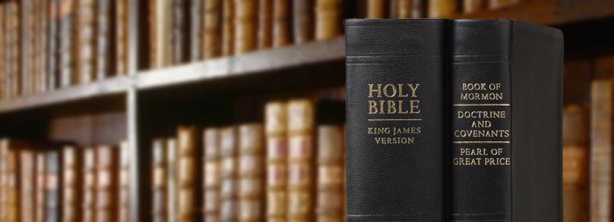
A real-life scenario might be seen in the pretend (but all too common) dialogue held between an Evangelical and a Mormon to whom they might be proselytizing:

E: The Book of Mormon is clearly false as it teaches a false gospel not found in the New Testament. (Galatians 1:6-9) This can be simply seen where in 2nd Nephi 25:23, it teaches a completely different understanding of Grace than found in Ephesians 2:8-9. Mormonism teaches that you are only saved by grace after all you can do, whereas Biblical Christianity teaches that by grace, ye are saved through faith and not of yourselves. Mormons rely on their own merit for salvation and not on the Grace of God.

M: Well, you are certainly correct that 2nd Nephi, Galatians, and Ephesians all contain those words, I am just wondering though where you learned that we believe that? Have you ever read the Book of Mormon yourself? There are actually some places which very much agree with you, that we cannot rely on our own merits and works to be saved but that we can only be saved by and through Christ.

E: No, I have never read the Book of Mormon. I have only read a few small parts, but I know from what I have seen that it teaches a completely different Gospel than the one taught in the Bible!

It is in this moment, that I can say as a Mormon, that any credibility held by the Evangelical is likely to have been lost in the eyes of the average Mormon. This is due to the simple matter of hearing that the mere courtesy of fully researching and reading the sacred scripture recognized by the Latter-day Saint in question, was not taken, and instead of seeing a loving though respectfully disagreeing Christian neighbor, they see a polemical and ignorant antagonist that is misrepresenting their faith. Consider, for example, how you, as an Evangelical, regard atheists who have never read the Bible but feel free to criticize – even condemn it – sight unseen.

Now, how could have some extensive and quality research have changed this situation? The Evangelical might have understood the historical, theological, or devotional context and understanding of the Book of Mormon verse in question. They may have studied how Latter-day Saints can and have interpreted the 2nd Nephi 25:23 in various ways, and not have treated it as a scriptural monolith. They might have avoided blanket statements on the Mormon faith at large so as to allow for more diversity in thought, interpretation, and understanding. As a Mormon, I will tell you that Mormon doctrine is not always uniform, in fact on certain issues, the split in thought might be reminiscent to that of the Calvinist-Arminian debate in that the far majority do not consider full agreement or uniformity to be necessary to be a fully believing Mormon in good standing.

Bottom-line in what I’m advising is this: before you pull a quote or verse off of a tract, polemical book, or website, at least check the source you are reading to have a solid understanding of context and interpretation. Just as I imagine it would irk an Evangelical if an Atheist quoted Bible verses out of context without regard to how Christians see it, so too does the same occur for Mormons who often find supposed words and teachings insisted down their throats outside of their respective context.

Avoid Common Pitfalls
As a matter of fact, I would advise discarding the following approaches. Though at times commonly undertaken by certain Evangelicals, I do not believe as a Latter-day Saint that they are ultimately in their favor of using, when attempting to share their beliefs with Mormons:

“Shock-and-Awe” Approach: This can manifest itself in a variety of forms, the most common of which though lie in either tracts, handouts, or in conversations held with Mormons. The point of this methodology is to so utterly overwhelm one’s opponent with points and arguments fired in such rapid succession so as to disallow for qualitative responses and examination. The individual such a barrage is aimed at has not the time, nor the means to realistically respond to each point in question, and so many either remain unanswered or superficially rebutted. This serves as a quick way to put up walls between the Mormon and the Evangelical, as many would rather keep walking or disengage than be verbally beaten with Bible verses and varied quotations laced with unfamiliar spins.
An example of what NOT to do: Tactless Outreach.

Tactless Outreach: Frankly, most Mormons aren’t too excited to see demonstrating or proselyting done outside their sacred spaces. At times when a Mormon is seeking to be spiritually uplifted during important cultural and religious occasions, such as during Christmas and Easter pageants, Temple Dedications, attending General Conference, or other large gatherings, the last thing many wish to see or hear are individuals likewise gathered to meet them and just to invalidate their beliefs and experiences, looking to sway them from their faith, and debate them in matters of their religious beliefs. Now, I completely understand just how tempting an opportunity it often is given the higher number of “unsaved” Mormons that one can reach, however, I often don’t find it as efficacious as one might think. Again, the presence of foreign and opposing groups at Mormon sacred spaces and community events often will lead many within the LDS community to just keep walking, and worse: make generalizations about who and what they see that often go uncorrected. First impressions are everything, and if my first impression as a Mormon is associating Evangelicals with extreme fundamentalist sects of Christianity such as the Westboro Baptist church due to the methodology of their outreach, it would literally take an act of Divine Intervention to take sincere interest.

Scripted Discussion, “Gotcha” Discourse, and Condescending Rhetoric: Much of this is common sense although I find these three also worth mentioning as each will likely do more harm than good in opening up the Mormon to further discussion. Just as I -and the LDS Church- strongly advise outgoing missionaries, don’t rely on scripted or rehearsed discussion when talking to individuals about your beliefs, instead have an open, free-flowing, and honest conversation. Be a Disciple of Christ, not a door-to-door vacuum salesman looking to squeeze a sale out of an unsuspecting, and a begrudging, customer. Nothing better idealizes this than 1st Peter 3:15 (NIV) “Always be prepared to give an answer to everyone who asks you to give the reason for the hope that you have. But do this with gentleness and respect.” Give answers from the heart, not a tract; from the Word of God, not a hand-out. Mormons will respect and be more open to you for it, and they will appreciate a genuine conversation.

Likewise avoid what I call “gotcha” discourse, or essentially asking leading questions for the sole purpose of entrapping a Mormon into a corner. The scriptures are full of examples of people who carry out questioning and dialogue in this way, and the majority of the time they are not looked favorably upon. It was the Pharisees who sought to entrap and entangle the Savior in his words so that they might condemn Him. My hope is that when outreach to Mormons is undertaken that the focus for the Evangelical might be on winning them to Christ, rather than winning the argument.

In fact, there shouldn’t be an argument at all. When anger or irritation becomes the predominant feeling in the conversation, the Mormon will quickly remove themselves from the situation. Mormons refer to this as the “Spirit of Contention” and it is basically a term for when a person or discussion’s focus has shifted to foster an air of hostility, toxicity, disrespect, or otherwise unkindness. You can actively disagree, you can share your lack of acceptance of belief in various aspects of Mormonism, and you can elaborate on concerns you have regarding points of Mormon doctrine and for the salvation of Mormons themselves, all without being contentious.

Finally to this same point, avoid belittling or condescending rhetoric. This is one of the quickest to both shut a Mormon off from a potential conversation and in fulfilling negative stereotypes many Mormons might have developed towards Evangelicals based oft limited, though negative, interactions with them. Despite an Evangelical’s likely opinion of Joseph Smith being a false prophet and a charlatan, the Book of Mormon being a falsified and illegitimate book of scripture, and the Mormon Jesus as a false-Christ, put all those aside and don’t “shoot yourself in the foot” by saying them outright to a Mormon’s face. It is as effectual and convincing as an Atheist approaching an Evangelical and calling the Bible a fairy-tale, Jesus as a myth, and Christianity as just wishful thinking at best. Pejoratives don’t work, they offend. Belittling doesn’t convert, it closes doors and hearts. As a Mormon, I love to see Evangelicals bold in sharing their own beliefs, without boldly attacking the beliefs that I hold sacred and dear as a Mormon. Which leads us into the next segment…

Invalidating Other’s Spiritual Experiences: Personally speaking, I can look back at many profound and life-changing spiritual experiences that I have had thus far in my life. Moments that have formed the basis for my testimony or faith in Jesus being the Risen Savior, of dying for my sins, of rising from the dead, and being the sole Rock in which I place my faith. I have had deep and intimate experiences where I have felt his unwavering and unconditional love for me, which I cannot deny. The majority of these have taken place within the context of Mormonism.

Without going into further detail, it amazes me when the born-again experiences of many Evangelicals and the descriptive language they use in retelling them so closely parallel what I have felt. The surprise comes in sharing them with Evangelicals, who then dismiss or invalidate them as not being real or legitimate experiences with Christ. It’s as if some Evangelicals wish to claim a monopoly on experiencing God, Christ, and Truth. Imagine if Paul did that in response to Cornelius’ claims of his own spiritual experiences? (Acts 10) I will further illustrate this through someone who is a great example of such within my own life: Michael Flournoy.

Former Latter-day Saint Michael Flournoy has written a few times now for Beggar’s Bread and is as well-known as one could probably be within Evangelical-Mormon Facebook Discussion Groups for being an amateur Mormon apologist of many years who recently converted to Evangelical Christianity. Michael and I are on great and amicable terms, and I am glad to call him a friend of mine whom I have gotten to know and interact with (albeit across some distance) for many months now. One thing that Michael has observed though has been the interesting change in the perspective of Evangelical Christians towards his spiritual experiences while as a Mormon. One, in particular, occurred when he was 16-years old and serves as the first time that Michael had a profound and life-changing experience with the Savior. He says,

When I was 16 I attended Especially for Youth, a week-long retreat for teenage Latter-day Saints. One night they showed us a video about Christ. In it, people testified that he had changed them. That night the Holy Spirit revealed Jesus to me for the 1st time. I found myself faced with his perfection and holiness, and as a natural byproduct I think, I was also made aware of my own imperfections, and by comparison, my filthiness.

Mentally I thought, I must be detestable to this Holy God, but simultaneously I was being showered in his love. I was shocked because I knew I didn’t deserve it, and yet there it was, full and unrestrained, proof that my sins carried no weight when determining God’s love for me. At 16 years old, it was the first time I had ever experienced unconditional love.”

This is an experience that I have heard Michael share many times now, both from his days as a Mormon and now as an Evangelical. While I completely validate and recognize Michael’s experience, unfortunately, such has not always been the case. Whether while on his mission, hosting discussions in various Facebook groups, or even debating ex-Mormons such as Lynn Wilder, many have suggested or quickly written off his experience as not being with the “Real Jesus” or just being mere emotions. Or such was said while he was a Mormon. Now that he is an Evangelical, Michael has observed a stark change in the validation that he receives from those same Evangelicals, that his Especially For Youth (EFY) experience was indeed an authentic encounter with the real Jesus reaching out to him.

A complete 180-degree turn has taken place in comparison to what used to be said, just because his religious identity has now also changed! My hope is that Evangelicals see the double-standard in this and leave themselves open to recognizing or at least considering that Mormons can (and in my opinion do) have legitimate and real spiritual experiences with the Risen Savior. Just as Evangelicals will find the far majority of Mormons invalidating their own spiritual experiences, my hope is that the same respect towards one’s sacred and life-changing moments might be extended, instead of quickly writing them off as false or trivial.

Extending Shallow Fellowship: This is the final point that I will touch on but perhaps may be the most important towards retaining Mormon exposure and interest into Evangelical Christianity. I wish to explain what I mean in making sure to avoid extending shallow fellowship. I say this to describe the outreach or active fellowship towards Mormons that is only extended so long as the topic is regarding Evangelical Christianity and Mormonism. Real fellowship should not be dependent on the interest level of the Mormon in discussing topics of a religious nature, rather it should be extended at all times and be based on feelings of sincere compassion, love, and service.

The common (though likely misquoted) saying attributed to St. Francis of Assisi comes to mind in which he says, “Preach the Gospel, and if necessary, use words.” The same is applicable here as an Evangelical can perform the same amount of outreach to Mormons if they provide them with positive examples of discipleship through daily Christ-like living; being witnesses of the active power of His Grace in their own lives. Open conversations will flow more naturally this way, seeds will be gently planted and not forced into unready soil, and overall bridges will take the place of walls that so often impede meaningful relationships.

It is my hope that the Evangelical will always be looking to extend the hand of true friendship and service, whether among neighbors, coworkers, classmates, or strangers. The quickest way for the Holy Spirit to work in the lives of those present will be in an environment where the love of Christ is fostered. This entails a lifetime commitment to the cause for the Evangelical, and I would remind them that any potential conversions will never be the result of their own efforts, their own rhetoric, arguments, or criticisms of Mormonism. Rather, it is the result of the Grace of God alone that an Evangelical must look to in touching the hearts and lives of Mormons.

If you ever find yourself impatient or irritated, if you ever feel like no matter what you do or say that the Mormon just won’t budge, stop! Trust in God, say a prayer, and refocus your efforts on making a positive experience in the life of the Mormon. If it is meant to be, then as a Mormon, I believe that hearts and beliefs can change. Finally, never ask or expect of a Mormon what you wouldn’t do yourself. If you wish to invite a Mormon to your church service, then offer to attend their sacrament meeting as well. If you want to do a close read of the New Testament with them, likewise offer to read the Book of Mormon. Remember the Golden Rule and trust in the power of God to bring souls to Christ.

I am a fully believing and active Mormon. I hold a temple recommend and will be serving a mission in the coming months for the Church of Jesus Christ of Latter-day Saints. Most importantly, I am a firm believer in God’s Plan for all His children and I believe that this plan includes both Mormons, non-Mormons, and ex-Mormons alike. My hope and prayer is for members of the Evangelical community to foster better relations with the Mormon neighbors built on feelings of mutual respect, love, and true fellowship. Hopefully, as a Mormon, I have been able to offer reflections on the various forms and techniques of outreach to members of my faith community, and ultimately what I find most effective. At the end of the day, it is all about the relationships we have and the Work of Christ in our lives that will make the difference. This is something that I find both Evangelicals and Mormons to be in full agreement on, and if such is our focus, I have full faith that everything will work out in the end.

About The Author
Jaxon Washburn is an 18-year old faithful member of the Church of Jesus Christ of Latter-day Saints. After being raised in an interfaith household for part of his life following his mother’s departure from Mormonism to Evangelical Christianity, Jaxon has been acquainted and involved with Mormon-Evangelical dialogue and relations for many years now.

Jaxon will be attending the Barrett Honors College at Arizona State University to major in Religious Studies in fall 2017. This will be prior to serving his 2-year Mormon Mission.  All this while continuing his hobbies of interfaith dialogue, Mormon and Christian Studies, and the occasional dabble in Mormon apologetics. Yep, he’s busy! 

He has a clear passion for the interfaith movement and religious studies: He founded and has led the World Religion and Tolerance Society, a high school interreligious student group built around the values of respect, openness, cooperation, and understanding among individuals of various religious and nonreligious backgrounds, since 2014. This has allowed him to speak at venues such as the Parliament of the World’s Religions in Salt Lake City, UT; the United Nations in New York City; and many others on the topic of youth involvement in the interfaith. You can follow his journey and writings from on his personal blog at The Apotheosis Narrative.

The author speaking at a United Nation Youth Conference on Interfaith Relations in February 2017.

BACK TO TOP