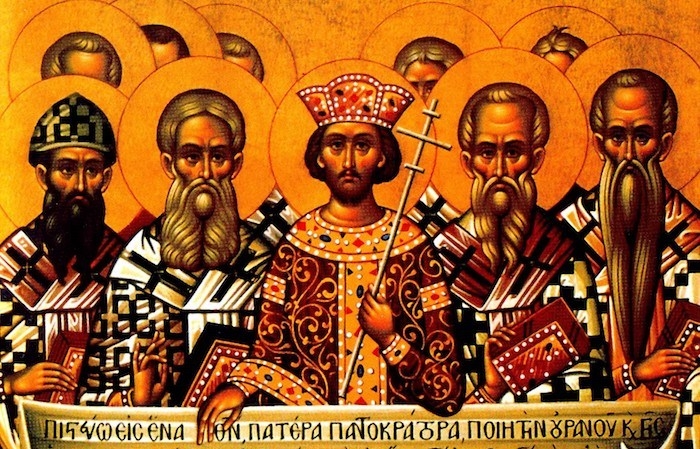
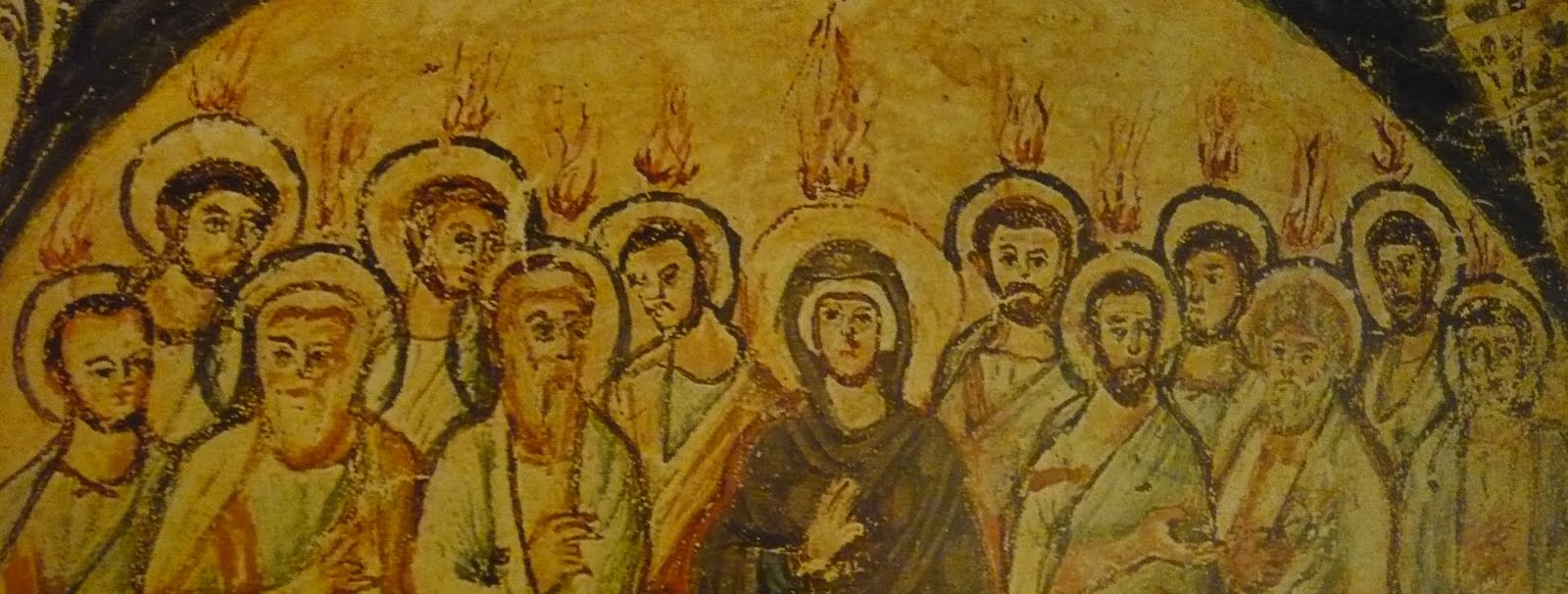
An icon of the Bishops of the First Council of Nicaea with Constantine (in the crown).
by Fred W. Anson One of the most common Mormon arguments is that they have no creeds. They further argue that the creeds of other churches are an abomination as well as evidence of their corrupt and apostate state. Probably no one has articulated this stance better than BYU professors Craig Ostler and the late Joseph Fielding McConkie when they wrote:
“Wherever creeds are found one can also expect to find a paid clergy, the simple truths of the gospel cloaked in the dark robes of mystery, religious intolerance, and a history of bloodshed” (BYU Professor Emeritus Joseph Fielding McConkie and Craig Ostler, “Revelations of the Restoration”, p.964)
And of the many “abominable creeds” of Christendom to chose from, I think one would be hard pressed to find one that Latter-day Saints more pour contempt on than the Nicene Creed:
“Men with keen intelligence got together… [at] Nicea and created a God. They did not pray for wisdom or revelation. They claimed no revelation from the Lord. They made it just about like a political party would do, and out of their own mortal minds created a God which is still worshiped by the great majority of Christians” (Spencer W. Kimball, “The Teachings of Spencer W. Kimball”, p. 426. Ellipsis and brackets in original)
“The trinity was voted on in the Council of Nicene hundreds of years after Christ’s death. A bunch of church leaders and government officials got together and voted on ‘who God was?’, and it wasn’t even a unanimous vote. There were about four different versions of God that they voted on. The version that is used by Catholics and Protestants today only won by about a 40 percent margin. Their view of God, as you may know, is that He is like a formless mass of spirit that fills the whole universe and when He comes to earth, part of it breaks off and forms itself into Jesus.” (Scott Marshall, “Tracting and Member Missionary” Work, p.73)
“The knowledge of God and His physical separateness from His Son and the Holy Ghost was lost after the death of Christ and His Apostles. Confusion and false doctrines about the Godhead were fashioned out of the Nicene Creed and Constantinople councils… I know that heaven-sent revelations have replaced the gross errors of man-made doctrines concerning the Godhead” (Gary J. Coleman, “Mom, Are We Christians?” Ensign, May 2007, pp.92-93)
“If Christians are people (and this is the standard definition of the clergy of the day) who believe in the holy trinity as defined and set forth in the Nicene, Athanasian, and Apostles creeds, meaning that God is a three-in-one nothingness, a spirit essence filling immensity, an incorporeal and uncreated being incapable of definition or mortal comprehension — then Mormons, by a clergy chosen definition, are ruled out of the fold of Christ” (Bruce R. McConkie, “Doctrinal New Testament Commentary” 2:113)
“Our Catholic friends, our Protestant friends, give us their definition of deity in the Nicene Creed. But that’s just a creed that came of the discussions of men. The marvelous thing is that the boy Joseph was able to testify of the real nature of God the Eternal Father and His Son, Jesus Christ. And that makes it possible for you and for me to understand our relationship to them. Each of us is a child of God. A son or a daughter of God in a very real sense and we can pray to Him and He will hear and answer our prayers.” (Gordon B. Hinckley, “The Nature of God”, Church News, July 1, 2006, p.2)
“We do not accept the Athanasian Creed. We do not accept the Nicene Creed, nor any other creed based on tradition and the conclusions of men.” (Gordon B. Hinckley, “What Are People Asking About Us?” Ensign, November 1998, pp.70-71)
But if the Nicene Creed is such an abomination, why is so much of it found in D&C 20:17-28? A side-by-side comparison is very surprising.
Nicene Creed (from the 1662 Book of Common Prayer)
By these things we know that there is a God in heaven, who is infinite and eternal, from everlasting to everlasting the same unchangeable God, the framer of heaven and earth, and all things which are in them;
We believe in one God, the Father Almighty,
Maker of heaven and earth, And all things visible and invisible;
And that he created man, male and female, after his own image and in his own likeness, created he them; And gave unto them commandments that they should love and serve him, the only living and true God, and that he should be the only being whom they should worship. But by the transgression of these holy laws man became sensual and devilish, and became fallen man.
Wherefore, the Almighty God gave his Only Begotten Son, as it is written in those scriptureswhich have been given of him. He suffered temptations but gave no heed unto them. He was crucified, died, and rose again the third day; And ascended into heaven, to sit down on the right hand of the Father, to reign with almighty power according to the will of the Father; That as many as would believe and be baptized in his holy name, and endure in faith to the end, should be saved–
And in one Lord Jesus Christ, the only-begotten Son of God. Begotten of his Father before all worlds, God of God, Light of Light, Very God of Very God, Begotten, not made, Being of one substance with the Father, By whom all things were made: Who for us men, and for our salvation he came down from heaven, And was incarnate by the Holy Ghost and the Virgin Mary, And was made man, And was crucified also for us under Pontius Pilate, He suffered, and was buried, And the third day he rose again according to the Scriptures, And ascended into heaven, and sitteth on the right hand of the Father. And he shall come again with glory to judge both the quick and the dead: Whose kingdom shall have no end.
Not only those who believed after he came in the meridian of time, in the flesh, but all those from the beginning, even as many as were before he came, who believed in the words of the holy prophets, who spake as they were inspired by the gift of the Holy Ghost, who truly testified of him in all things, should have eternal life, As well as those who should come after, who should believe in the gifts and callings of God by the Holy Ghost, which beareth record of the Father and of the Son;
And I believe in the Holy Ghost, The Lord and giver of life, Who proceedeth from the Father and the Son, Who with the Father and the Son together is worshipped and glorified, Who spake by the Prophets.
Which Father, Son, and Holy Ghost are one God, infinite and eternal, without end.
And I believe in one Catholick and Apostolick Church. I acknowledge one Baptism for the remission of sins. And I look for the Resurrection of the dead, And the life of the world to come.
So if the Nicene Creed is abominable, then what does that make D&C 20? And if it’s a creed that’s, according to former LdS President Gordon B. Hinckley, “based on tradition and the conclusions of men” that “came of their discussions” then what does that say about an alleged revelation that has it embedded right in it?2
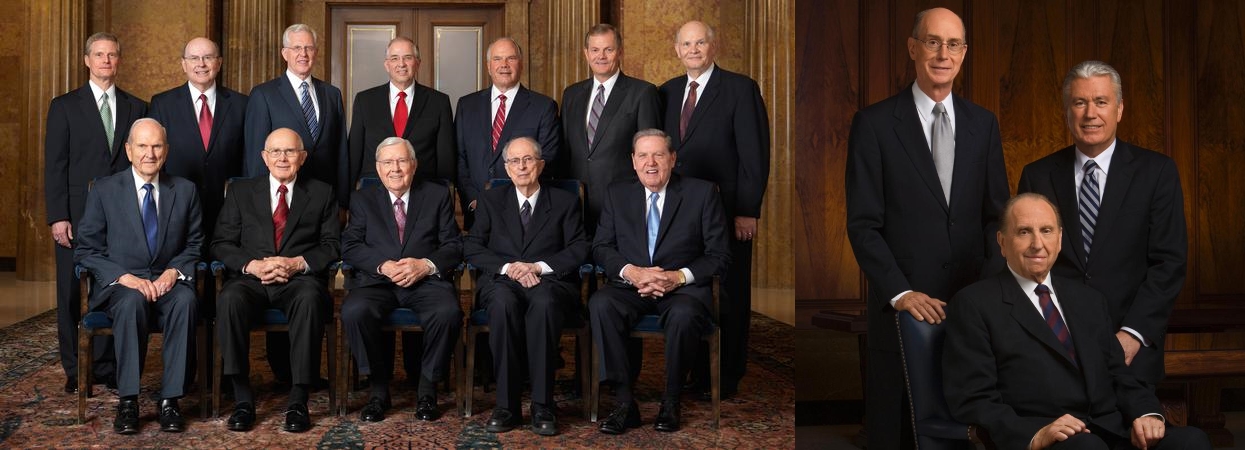
Speaking of Ecclesiastical Councils… (the Quorum of the Twelve Latter-day Saint Apostles and the First Presidency circa 2017)
NOTES 1 Here are the original end notes of Owen D. West, III, the creator of this table, regarding it’s background and content:
(The Nicene Creed is also based almost entirely on scripture, much more so than the Articles of Faith. Almost every phrase is taken word for word from the Bible. All phrases have Biblical supporting scriptures).
At first I used the Nicene Creed as used in English by the Roman Catholic Church today. I then realized that the Roman Catholic Church would have been using Latin in 1830, and since we have already seen a strong tie to the Episcopalian Book of Common Prayer for the Sacramental prayers (Rite I), and since this book has been available in the U.S. since 1789, I changed to this version, which (should come as no surprise) is much closer on a word by word basis to D&C 20 than is the modern English Roman Catholic version. I then compared to the even older Book of Common Prayer from the Church of England and found it to be word for word the same as the old Episcopalian version (with different capitalization and punctuation and spelling, e.g. Catholic and Apostolic for Catholick and Apostolick). [It is the Church of England’s Book of Common Prayer that is the source of so much animosity in the early LDS writing. Polemics against a God “without body, parts or passions”, or the emphasis on the Creed of Athanasius are related to this book.] I have used the Church of England Nicene creed above.
D&C 20 is obviously related to the Nicene Creed in both word and organization. Joseph Smith used the format of the Nicene Creed in writing D&C section 20 in the same way that I did when I wrote my own statement of faith. I wrote my statement of faith without referring to the Nicene Creed because after saying it so many times and having memorized it is easy to use these familiar phrases, blending them into my own belief statement. I believe Joseph Smith (or whoever actually wrote this part of D&C 20) did not have to refer to this well known Christian creed because it was part of his background. I believe this is also why we find familiar phrases from the “Doxology” in the modern scriptures published by Joseph Smith. These phrases were already a part of his religious “vocabulary”.
2 Oh, and by the way, the way that Mormon leaders portray the events of the Council of Nicea bears little to no resemblance to the historical record. As Christian author James White notes:
Nicea was not creating some new doctrine, some new belief, but clearly, explicitly, defining truth against error. The council had no idea that they, by their gathering together, possessed some kind of sacramental power of defining beliefs: they sought to clarify biblical truth, not to put themselves in the forefront and make themselves a second source of authority.
This can easily be seen from the fact that Athanasius, in defending the Nicene council, does so on the basis of its harmony with Scripture, not on the basis of the council having some inherent authority in and of itself. Note his words: “Vainly then do they run about with the pretext that they have demanded Councils for the faith’s sake; for divine Scripture is sufficient above all things; but if a Council be needed on the point, there are the proceedings of the Fathers, for the Nicene Bishops did not neglect this matter, but stated the doctrines so exactly, that persons reading their words honestly, cannot but be reminded by them of the religion towards Christ announced in divine Scripture.”
The relationship between the sufficient Scriptures and the “Nicene Bishops” should be noted carefully. The Scriptures are not made insufficient by the council; rather, the words of the council “remind” one of the “religion towards Christ announced in divine Scripture.” Obviously, then, the authority of the council is derivative from its fidelity to Scripture…
Modern Christians often have the impression that ancient councils held absolute sway, and when they made “the decision,” the controversy ended. This is not true. Though Nicea is seen as one of the greatest of the councils, it had to fight hard for acceptance. The basis of its final victory was not the power of politics, nor the endorsement of established religion. There was one reason the Nicene definition prevailed: its fidelity to the testimony of the Scriptures.
And as Dr. White concludes:
Why do Christians believe in the deity of Christ today? Is it because they have been forced to do so by legislated theology from councils and popes? No, it is because the Scriptures teach this truth. When orthodox believers affirm the validity of the creed hammered out at Nicea, they are simply affirming a concise, clear presentation of scriptural truth. The authority of the Nicene creed, including its assertion of the homoousion, is not to be found in some concept of an infallible church, but in the fidelity of the creed to scriptural revelation. It speaks with the voice of the apostles because it speaks the truth as they proclaimed it. (James R. White, “What Really Happened at Nicea?”, Christian Research Institute Journal, June 2009)
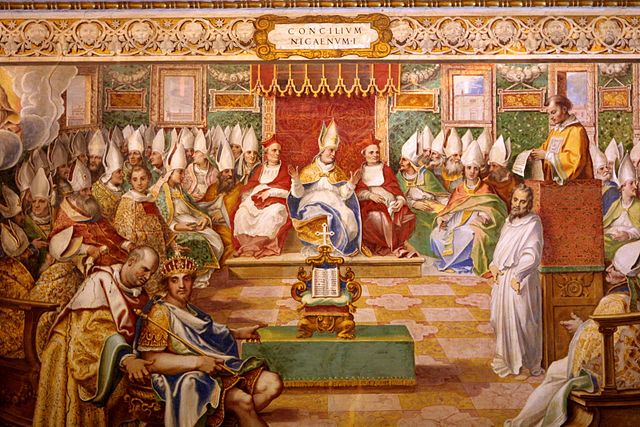
16th Century Fresco in the Sistine Chapel depicting the First Council of Nicea.
Evangelical Christians Praying for Mormons at the Manti Miracle Pageant in 2016.
by Jaxon Washburn Nowadays, I tend to peruse and engage in many online forums and discussion groups geared towards Evangelicals and Latter-day Saints. I actively read and study from various biblical commentaries, historical works, and books on theology, apologetics, and Church history (both churches included). I have been able to have many acquaintances from both sides of the divide that I am happy to call “friend”, one being Fred Anson, the founder, and publisher of Beggar’s Bread – who graciously invited me to write this open letter to Evangelicals.
Now, it is not unknown that Fred is generally critical of Mormonism as well as a non-professional student of Mormon Studies. There are myriad areas in which he and I are sure to disagree, and yet such doesn’t prohibit the two of us from respectful, genuine conversation, and occasionally friendly banter. There are sure to be individuals from both camps which are astounded to hear that such is possible. To them, I would share a quote from Thomas Jefferson that I wholly attempt to live by: “I never considered a difference of opinion in politics, in religion, in philosophy, as cause for withdrawing from a friend.”
I understand that I am the first active True Believing Mormon (or “TBM” as some jokingly call it) to write for Beggar’s Bread. I am happy to be, what is hopefully, a trendsetter here since I’m a firm advocate for meaningful and positive cross-denominational interactions.
It is my hope that I will be able to squeeze in a few more appearances here before I depart on my mission in the coming months after I complete some schooling at Arizona State University (ASU). And in saying so, I should include that my message today is not at all antithetical for my plans on serving a full-time mission for the Church of Jesus Christ of Latter-day Saints; despite what the click-bait title might have you think! No, I wish instead to offer some serious reflection and advice I believe will be valuable to Evangelicals in their fellowshipping with members of my own faith community.
I often find that too often what could have been substantial discussions, real relationships, and even legitimate spiritual experiences are traded through an expectation of quick conversions with shallow conversations and insincere outreach. Thus I will be answering the following question I consider to be vital if any Evangelical wishes to engage with their Latter-day Saint friends: “How would I, as a Mormon, like to be preached to?” and provide practical suggestions for facilitating dialogue between adherents of both respective faith groups.
The Language Barrier The ability to clearly communicate our demands, emotions, questions, statements, conjecture and abstract concepts is a constant task required by all members of society. In conveying those ideas with enough coherence and precision so as to effectively convey those same ideas into the minds of those whom we are speaking with, most find themselves at a loss for words. This can often come with great difficulty when we find ourselves unable to express ourselves at times, or else subject ourselves and other to a series of unfortunate events due to a simple misunderstanding or miscommunication. Now consider the difficulty when speaking completely different languages and the imagery of the confusion at the Tower of Babel is sure to come to mind., most involved in interfaith dialogue enter into such speaking the same actual language, however that doesn’t mean that they will speak the same theological or religious language.
The odds are, both parties will be walking into the discussion carrying different baggage whether that be preconceived ideas about the other, presuppositions about their own faith, past spiritual experiences, and a different vocabulary to communicate such. This is what I refer to as “the Language Barrier of Faith”, and it is an individual’s responsibility to overcome it if they wish to speak with a person of another worldview. I am no stranger to the confusion and frustration that can come when two or more well-meaning people, when engaging in active discussion about their beliefs, fail to speak to each other in clearly defined and mutually understood terms. Unfortunately, many of the conversations held between Mormons and their Evangelical neighbors go along these same lines.
Let’s take Portuguese and Spanish for example: did you know that it is easier for someone who speaks only Portuguese to understand someone speaking only Spanish, than for a Spanish-speaking individual to understand a native of Portugal or Brazil? The two languages are strikingly similar in a variety of ways and are close relatives within the same Romance language family, however, it is noticeably easier for a native of one to understand the other, and noticeably more difficult when the positions are switched. Why is this? Simply put, Portuguese itself is a more complex relative of Spanish with a high amount of possible variation in its verb, noun and adjective endings that prove more challenging for Spanish speakers to pick up on. Pronunciation also makes things more challenging as Portuguese have more phonemes (sounds) than Spanish, equipping the natives of that tongue with an early ability to comprehend and “decode” differences in sounds such as nasal and regular verb endings. All in all, the two languages pose a unique situation and challenge for their respective native speakers when wishing to dialogue; exemplifying a concept that I believe to be comparable to Mormons and Evangelicals, and their respective theological languages.
It is a common experience for many Evangelicals or Protestants in general that, after speaking with either missionaries or members of the Church of Jesus Christ of Latter-day Saints and presumably hearing a testimony given on the truthfulness of the Restored Gospel of Jesus Christ, they walk away with feelings of surprise and confusion at the apparent similarity of much of what was said in comparison to their own beliefs. This is due to the similar vocabulary held between both Mormons and Evangelicals in matters of scripture, theology, and faith. Words like God, Christ, sin, Atonement, Grace, faith, prayer, repentance, baptism, salvation, heaven, Resurrection, scripture, revelation, and the Holy Spirit, all frequent the standard Mormon religious vernacular as often as they do the Evangelical. Where the confusion comes in though is due to the – at times large – differences in the definitions that are behind such words.
As the Church of Jesus Christ of Latter-day Saints historically stems from the Latter Day Saint Movement of 19th Century American Restorationism, it naturally carries with it a multitude of terms, concepts, and practices not at all uncommon within Mainline Protestantism from which many of its early converts were derived from. With its religious vernacular being akin to that of King James English, (the KJV Bible being its official translation) Mormon theological and scriptural phraseology is not too distant from most Evangelicals. It is this similarity with language -mixed with many unique Mormon terms- that can often be perplexing to most other Christians in active discussion with them. On the flip side, apart from more complex and technical Protestant theological terms, Mormons are usually already aware or familiar with much of the Evangelical vernacular, or at least enough to not experience the same confusion as their neighbors.
Unfortunately, both groups can and have, at times, come to the theological table with their own share of ignorance, misconceptions, or simplified understanding of the other’s position. Take soteriological views, for example. I have often heard many Mormons describe the Evangelical concept of Sola Gratia (Salvation by Grace Alone) to be one of “Hey man! We are saved! Now let’s party and do whatever we want!” Any informed Latter-day Saint on the subject would now that this is a stark mischaracterization of the true meaning of Grace to Evangelicals. As equally as untrue is the understanding of the Mormon view of salvation from many within the Evangelical crowd as one based entirely on works; in other words, a legalistic system in which individuals must earn their way to heaven by performing the set amount of righteous works. Both views are incorrect and often falsely paint the individuals of the two groups to either be adherents to a cheap and hypocritical form of Christianity, or just a revival of pharisaical believers who are adding a Law unto themselves.
How members of both faith traditions might combat this common scenario is first by clearly defining the terms that they are using, a necessity for any philosophical and theological discussion. As both individuals define words like Grace, faith, righteousness, works, salvation etc, they will quickly find that while there are many similarities in the manners and meanings they use such words in, likewise there are many essential differences that can be overlooked during superficial and quick interactions. Hence my admonition to 1) understand the other’s position in depth, 2) familiarize yourself with the unique religious vernacular (terms such as stake center, testimony, baptisms for the dead and others for the Mormon, and terms like communion, imputation, and others for the Evangelical,) and finally be able to actually speak and explain yourself in ways and terms that the other will understand. The Evangelical must learn what is jokingly referred to as “Mormonese”, and likewise, the Mormon must learn to speak like an Evangelical and speak “Christianese”.
Often, Evangelicals are astounded when I, as a Mormon, speak as if I myself am an Evangelical. This is due to the fact that I have attended various other Christian churches, including my mother’s own nondenominational church for many years. Likewise, I have gone to multiple Christian summer camps and attended youth Bible study during the same time. Essentially it just reflects the amount of time I have spent reading, studying, interacting with, and immersed in an Evangelical environment. The same rule applies to learning an actual language: the quickest way to learn is by living in that country and immersing yourself with its people!
Study and Research Prerequisite to any informed conversation about a subject is the active study and research of it beforehand. Said research is best accomplished when undertaken by the proper, balanced study of materials coming from a variety of perspectives. Unfortunately, it is my experience that many of the Evangelicals who often perform direct outreach to Latter-day Saints do so with having only a superficial understanding of Mormon beliefs and teachings, which are often studied only through the lens of polemic and counter-cult materials and tracts. If explanations are given from either source, they are often basic, and lacking in both full comprehension and quick reference to valuable sources, making the end-result varied in clarity and uniformity.
This can’t be considered fully the fault of the average Mormon in accidentally misrepresenting or being somewhat ignorant to the full teachings of their Church. It is quite unreasonable to expect the standard member to be a master historian, scriptorian, or theologian, and this can often be met with unmet expectations. This is especially accurate when speaking to missionaries who are presupposed by some to have undergone a similar amount of devotional education as many clergy and pastors from theological seminaries, when in reality they are little more than youth fresh out of high school with a simple testimony of Christ and the Restored Gospel, and a desire to serve and share with others.
Thus it is my advice to the Evangelical to read. Read from Latter-day Saint sources. I don’t say this out of my own bias, but rather to speak to the credibility that comes with having an understanding based directly from knowing the same materials and literature that Latter-day Saints will be familiar with: Stated plainly, that means that you need to read the Standard Works first – that is, the Book of Mormon, Doctrine and Covenants, and the Pearl of Great Price. Any Mormon would be more than happy to provide these for you at no cost. Read other important works from Latter-day Saint history as well as modern objective scholarly sources. THEN, if you so wish, move to polemic and counter-cult material so that you can both recognize misleading or inaccurate representations of actual Mormon beliefs as described and taught by Mormons themselves, while also drawing from whatever database of apologetical information and arguments that one might choose to use against Mormonism.
A real-life scenario might be seen in the pretend (but all too common) dialogue held between an Evangelical and a Mormon to whom they might be proselytizing:
E: The Book of Mormon is clearly false as it teaches a false gospel not found in the New Testament. (Galatians 1:6-9) This can be simply seen where in 2nd Nephi 25:23, it teaches a completely different understanding of Grace than found in Ephesians 2:8-9. Mormonism teaches that you are only saved by grace after all you can do, whereas Biblical Christianity teaches that by grace, ye are saved through faith and not of yourselves. Mormons rely on their own merit for salvation and not on the Grace of God.
M: Well, you are certainly correct that 2nd Nephi, Galatians, and Ephesians all contain those words, I am just wondering though where you learned that we believe that? Have you ever read the Book of Mormon yourself? There are actually some places which very much agree with you, that we cannot rely on our own merits and works to be saved but that we can only be saved by and through Christ.
E: No, I have never read the Book of Mormon. I have only read a few small parts, but I know from what I have seen that it teaches a completely different Gospel than the one taught in the Bible!
It is in this moment, that I can say as a Mormon, that any credibility held by the Evangelical is likely to have been lost in the eyes of the average Mormon. This is due to the simple matter of hearing that the mere courtesy of fully researching and reading the sacred scripture recognized by the Latter-day Saint in question, was not taken, and instead of seeing a loving though respectfully disagreeing Christian neighbor, they see a polemical and ignorant antagonist that is misrepresenting their faith. Consider, for example, how you, as an Evangelical, regard atheists who have never read the Bible but feel free to criticize – even condemn it – sight unseen.
Now, how could have some extensive and quality research have changed this situation? The Evangelical might have understood the historical, theological, or devotional context and understanding of the Book of Mormon verse in question. They may have studied how Latter-day Saints can and have interpreted the 2nd Nephi 25:23 in various ways, and not have treated it as a scriptural monolith. They might have avoided blanket statements on the Mormon faith at large so as to allow for more diversity in thought, interpretation, and understanding. As a Mormon, I will tell you that Mormon doctrine is not always uniform, in fact on certain issues, the split in thought might be reminiscent to that of the Calvinist-Arminian debate in that the far majority do not consider full agreement or uniformity to be necessary to be a fully believing Mormon in good standing.
Bottom-line in what I’m advising is this: before you pull a quote or verse off of a tract, polemical book, or website, at least check the source you are reading to have a solid understanding of context and interpretation. Just as I imagine it would irk an Evangelical if an Atheist quoted Bible verses out of context without regard to how Christians see it, so too does the same occur for Mormons who often find supposed words and teachings insisted down their throats outside of their respective context.
Avoid Common Pitfalls As a matter of fact, I would advise discarding the following approaches. Though at times commonly undertaken by certain Evangelicals, I do not believe as a Latter-day Saint that they are ultimately in their favor of using, when attempting to share their beliefs with Mormons:
“Shock-and-Awe” Approach: This can manifest itself in a variety of forms, the most common of which though lie in either tracts, handouts, or in conversations held with Mormons. The point of this methodology is to so utterly overwhelm one’s opponent with points and arguments fired in such rapid succession so as to disallow for qualitative responses and examination. The individual such a barrage is aimed at has not the time, nor the means to realistically respond to each point in question, and so many either remain unanswered or superficially rebutted. This serves as a quick way to put up walls between the Mormon and the Evangelical, as many would rather keep walking or disengage than be verbally beaten with Bible verses and varied quotations laced with unfamiliar spins.
An example of what NOT to do: Tactless Outreach.
Tactless Outreach: Frankly, most Mormons aren’t too excited to see demonstrating or proselyting done outside their sacred spaces. At times when a Mormon is seeking to be spiritually uplifted during important cultural and religious occasions, such as during Christmas and Easter pageants, Temple Dedications, attending General Conference, or other large gatherings, the last thing many wish to see or hear are individuals likewise gathered to meet them and just to invalidate their beliefs and experiences, looking to sway them from their faith, and debate them in matters of their religious beliefs. Now, I completely understand just how tempting an opportunity it often is given the higher number of “unsaved” Mormons that one can reach, however, I often don’t find it as efficacious as one might think. Again, the presence of foreign and opposing groups at Mormon sacred spaces and community events often will lead many within the LDS community to just keep walking, and worse: make generalizations about who and what they see that often go uncorrected. First impressions are everything, and if my first impression as a Mormon is associating Evangelicals with extreme fundamentalist sects of Christianity such as the Westboro Baptist church due to the methodology of their outreach, it would literally take an act of Divine Intervention to take sincere interest.
Scripted Discussion, “Gotcha” Discourse, and Condescending Rhetoric: Much of this is common sense although I find these three also worth mentioning as each will likely do more harm than good in opening up the Mormon to further discussion. Just as I -and the LDS Church- strongly advise outgoing missionaries, don’t rely on scripted or rehearsed discussion when talking to individuals about your beliefs, instead have an open, free-flowing, and honest conversation. Be a Disciple of Christ, not a door-to-door vacuum salesman looking to squeeze a sale out of an unsuspecting, and a begrudging, customer. Nothing better idealizes this than 1st Peter 3:15 (NIV) “Always be prepared to give an answer to everyone who asks you to give the reason for the hope that you have. But do this with gentleness and respect.” Give answers from the heart, not a tract; from the Word of God, not a hand-out. Mormons will respect and be more open to you for it, and they will appreciate a genuine conversation.
Likewise avoid what I call “gotcha” discourse, or essentially asking leading questions for the sole purpose of entrapping a Mormon into a corner. The scriptures are full of examples of people who carry out questioning and dialogue in this way, and the majority of the time they are not looked favorably upon. It was the Pharisees who sought to entrap and entangle the Savior in his words so that they might condemn Him. My hope is that when outreach to Mormons is undertaken that the focus for the Evangelical might be on winning them to Christ, rather than winning the argument.
In fact, there shouldn’t be an argument at all. When anger or irritation becomes the predominant feeling in the conversation, the Mormon will quickly remove themselves from the situation. Mormons refer to this as the “Spirit of Contention” and it is basically a term for when a person or discussion’s focus has shifted to foster an air of hostility, toxicity, disrespect, or otherwise unkindness. You can actively disagree, you can share your lack of acceptance of belief in various aspects of Mormonism, and you can elaborate on concerns you have regarding points of Mormon doctrine and for the salvation of Mormons themselves, all without being contentious.
Finally to this same point, avoid belittling or condescending rhetoric. This is one of the quickest to both shut a Mormon off from a potential conversation and in fulfilling negative stereotypes many Mormons might have developed towards Evangelicals based oft limited, though negative, interactions with them. Despite an Evangelical’s likely opinion of Joseph Smith being a false prophet and a charlatan, the Book of Mormon being a falsified and illegitimate book of scripture, and the Mormon Jesus as a false-Christ, put all those aside and don’t “shoot yourself in the foot” by saying them outright to a Mormon’s face. It is as effectual and convincing as an Atheist approaching an Evangelical and calling the Bible a fairy-tale, Jesus as a myth, and Christianity as just wishful thinking at best. Pejoratives don’t work, they offend. Belittling doesn’t convert, it closes doors and hearts. As a Mormon, I love to see Evangelicals bold in sharing their own beliefs, without boldly attacking the beliefs that I hold sacred and dear as a Mormon. Which leads us into the next segment…
Invalidating Other’s Spiritual Experiences: Personally speaking, I can look back at many profound and life-changing spiritual experiences that I have had thus far in my life. Moments that have formed the basis for my testimony or faith in Jesus being the Risen Savior, of dying for my sins, of rising from the dead, and being the sole Rock in which I place my faith. I have had deep and intimate experiences where I have felt his unwavering and unconditional love for me, which I cannot deny. The majority of these have taken place within the context of Mormonism.
Without going into further detail, it amazes me when the born-again experiences of many Evangelicals and the descriptive language they use in retelling them so closely parallel what I have felt. The surprise comes in sharing them with Evangelicals, who then dismiss or invalidate them as not being real or legitimate experiences with Christ. It’s as if some Evangelicals wish to claim a monopoly on experiencing God, Christ, and Truth. Imagine if Paul did that in response to Cornelius’ claims of his own spiritual experiences? (Acts 10) I will further illustrate this through someone who is a great example of such within my own life: Michael Flournoy.
Former Latter-day Saint Michael Flournoy has written a few times now for Beggar’s Bread and is as well-known as one could probably be within Evangelical-Mormon Facebook Discussion Groups for being an amateur Mormon apologist of many years who recently converted to Evangelical Christianity. Michael and I are on great and amicable terms, and I am glad to call him a friend of mine whom I have gotten to know and interact with (albeit across some distance) for many months now. One thing that Michael has observed though has been the interesting change in the perspective of Evangelical Christians towards his spiritual experiences while as a Mormon. One, in particular, occurred when he was 16-years old and serves as the first time that Michael had a profound and life-changing experience with the Savior. He says,
“When I was 16 I attended Especially for Youth, a week-long retreat for teenage Latter-day Saints. One night they showed us a video about Christ. In it, people testified that he had changed them. That night the Holy Spirit revealed Jesus to me for the 1st time. I found myself faced with his perfection and holiness, and as a natural byproduct I think, I was also made aware of my own imperfections, and by comparison, my filthiness.
Mentally I thought, I must be detestable to this Holy God, but simultaneously I was being showered in his love. I was shocked because I knew I didn’t deserve it, and yet there it was, full and unrestrained, proof that my sins carried no weight when determining God’s love for me. At 16 years old, it was the first time I had ever experienced unconditional love.”
This is an experience that I have heard Michael share many times now, both from his days as a Mormon and now as an Evangelical. While I completely validate and recognize Michael’s experience, unfortunately, such has not always been the case. Whether while on his mission, hosting discussions in various Facebook groups, or even debating ex-Mormons such as Lynn Wilder, many have suggested or quickly written off his experience as not being with the “Real Jesus” or just being mere emotions. Or such was said while he was a Mormon. Now that he is an Evangelical, Michael has observed a stark change in the validation that he receives from those same Evangelicals, that his Especially For Youth (EFY) experience was indeed an authentic encounter with the real Jesus reaching out to him.
A complete 180-degree turn has taken place in comparison to what used to be said, just because his religious identity has now also changed! My hope is that Evangelicals see the double-standard in this and leave themselves open to recognizing or at least considering that Mormons can (and in my opinion do) have legitimate and real spiritual experiences with the Risen Savior. Just as Evangelicals will find the far majority of Mormons invalidating their own spiritual experiences, my hope is that the same respect towards one’s sacred and life-changing moments might be extended, instead of quickly writing them off as false or trivial.
Extending Shallow Fellowship: This is the final point that I will touch on but perhaps may be the most important towards retaining Mormon exposure and interest into Evangelical Christianity. I wish to explain what I mean in making sure to avoid extending shallow fellowship. I say this to describe the outreach or active fellowship towards Mormons that is only extended so long as the topic is regarding Evangelical Christianity and Mormonism. Real fellowship should not be dependent on the interest level of the Mormon in discussing topics of a religious nature, rather it should be extended at all times and be based on feelings of sincere compassion, love, and service.
The common (though likely misquoted) saying attributed to St. Francis of Assisi comes to mind in which he says, “Preach the Gospel, and if necessary, use words.” The same is applicable here as an Evangelical can perform the same amount of outreach to Mormons if they provide them with positive examples of discipleship through daily Christ-like living; being witnesses of the active power of His Grace in their own lives. Open conversations will flow more naturally this way, seeds will be gently planted and not forced into unready soil, and overall bridges will take the place of walls that so often impede meaningful relationships.
It is my hope that the Evangelical will always be looking to extend the hand of true friendship and service, whether among neighbors, coworkers, classmates, or strangers. The quickest way for the Holy Spirit to work in the lives of those present will be in an environment where the love of Christ is fostered. This entails a lifetime commitment to the cause for the Evangelical, and I would remind them that any potential conversions will never be the result of their own efforts, their own rhetoric, arguments, or criticisms of Mormonism. Rather, it is the result of the Grace of God alone that an Evangelical must look to in touching the hearts and lives of Mormons.
If you ever find yourself impatient or irritated, if you ever feel like no matter what you do or say that the Mormon just won’t budge, stop! Trust in God, say a prayer, and refocus your efforts on making a positive experience in the life of the Mormon. If it is meant to be, then as a Mormon, I believe that hearts and beliefs can change. Finally, never ask or expect of a Mormon what you wouldn’t do yourself. If you wish to invite a Mormon to your church service, then offer to attend their sacrament meeting as well. If you want to do a close read of the New Testament with them, likewise offer to read the Book of Mormon. Remember the Golden Rule and trust in the power of God to bring souls to Christ.
I am a fully believing and active Mormon. I hold a temple recommend and will be serving a mission in the coming months for the Church of Jesus Christ of Latter-day Saints. Most importantly, I am a firm believer in God’s Plan for all His children and I believe that this plan includes both Mormons, non-Mormons, and ex-Mormons alike. My hope and prayer is for members of the Evangelical community to foster better relations with the Mormon neighbors built on feelings of mutual respect, love, and true fellowship. Hopefully, as a Mormon, I have been able to offer reflections on the various forms and techniques of outreach to members of my faith community, and ultimately what I find most effective. At the end of the day, it is all about the relationships we have and the Work of Christ in our lives that will make the difference. This is something that I find both Evangelicals and Mormons to be in full agreement on, and if such is our focus, I have full faith that everything will work out in the end.
About The Author Jaxon Washburn is an 18-year old faithful member of the Church of Jesus Christ of Latter-day Saints. After being raised in an interfaith household for part of his life following his mother’s departure from Mormonism to Evangelical Christianity, Jaxon has been acquainted and involved with Mormon-Evangelical dialogue and relations for many years now.
Jaxon will be attending the Barrett Honors College at Arizona State University to major in Religious Studies in fall 2017. This will be prior to serving his 2-year Mormon Mission. All this while continuing his hobbies of interfaith dialogue, Mormon and Christian Studies, and the occasional dabble in Mormon apologetics. Yep, he’s busy!
He has a clear passion for the interfaith movement and religious studies: He founded and has led the World Religion and Tolerance Society, a high school interreligious student group built around the values of respect, openness, cooperation, and understanding among individuals of various religious and nonreligious backgrounds, since 2014. This has allowed him to speak at venues such as the Parliament of the World’s Religions in Salt Lake City, UT; the United Nations in New York City; and many others on the topic of youth involvement in the interfaith. You can follow his journey and writings from on his personal blog at The Apotheosis Narrative.
The author speaking at a United Nation Youth Conference on Interfaith Relations in February 2017.
An Eastern Orthodox icon depicting the theosis of the saints.
“As man now is, God once was: “As God now is, man may be.” — Lorenzo Snow (5th Mormon President)1
by Fred W. Anson
There are days when I wonder if the confirmation bias that undergirds so much Latter-day Saint apologetic work has any limits. Most recently I had one of these days when a Mormon Apologist boldly and publicly declared on social media that Mormon Celestial Exaltation – that is, the Latter-day Saint doctrine that men can become Gods in the next life2 – is nothing more than the Eastern Orthodox doctrine of Deification (aka “Theosis”) in another form. This is nothing new, those of us in Mormon Studies have been hearing this argument for some time now. Here’s how Mormon Apologists Daniel C. Peterson and Stephen D. Ricks explained it in the March 1988 issue of the Mormon Church’s Ensign magazine:
As even a cursory glance at early Christian thought reveals, the idea that man might become as God—known in Greek as theosis or theopoiesis—may be found virtually everywhere, from the New Testament through the writings of the first four centuries. Church members take seriously such passages as Psalm 82:6, John 10:33–36, and Philippians 2:5–6, in which a plurality of gods and the idea of becoming like God are mentioned.
The notion of theosis is characteristic of church fathers Irenaeus (second century A.D.), Clement of Alexandria (third century A.D.), and Athanasius (fourth century A.D.). Indeed, so pervasive was the doctrine in the fourth century that Athanasius’s archenemies, the Arians, also held the belief and the Origenist monks at Jerusalem heatedly debated “whether all men would finally become like Christ or whether Christ was really a different creature.”
According to an ancient formula, “God became man that man might become God.” Early Christians “were invited to ‘study’ to become gods” (note the plural).
Though the idea of human deification waned in the Western church in the Middle Ages, it remained very much alive in the Eastern Orthodox faith, which includes such Christian sects today as the Greek Orthodox and Russian Orthodox churches. Jaroslav Pelikan notes, “The chief idea of St. Maximus, as of all Eastern theology, [was] the idea of deification.”
Is the subject of deification truly a closed question? After all, echoes of man becoming like God are still found in the work of later and modern writers in the West. For instance, C. S. Lewis’s writings are full of the language of human deification. Even Martin Luther was capable of speaking of the “deification of human nature,” although in what sense it is not clear.3
However, commenting on this very article, journalists Richard and Joan Ostling make the following observation in their well known and widely respected book “Mormon America”:
BYU professors Daniel C. Peterson and Stephen D. Ricks in a 1988 issue of Ensign, have often expressed a kinship to Eastern Orthodoxy in that branch of Christendom’s use of the term “deification.” Peterson and Ricks traced deification to such early church fathers as Irenaeus (second century a.d.) and to the notion of theosis, which is “very much alive” in the Greek and Russian Orthodox Churches.
The embrace, however, is one way. The Eastern Orthodox tradition is also firmly rooted in a distinction of kind, rather than of degree, between man and God. “The idea of deification must always be understood in the light of the distinction between God’s essence and His energies. Union with God means union with the divine energies, not the divine essence,” wrote Timothy Ware (Bishop Ware), who was the longtime lecturer in Orthodox Studies at Oxford University, in The Orthodox Church. “The human being does not become God by nature, but is merely a ‘created god,’ a god by grace or by status.”
Bishop Ware elaborated on Orthodoxy and deification in response to a query:
‘It is clear to me that C. S. Lewis understands the doctrine of theosis in essentially the same way as the Orthodox Church does; indeed, he probably derived his viewpoint from reading such Greek Fathers as Athanasius. On the other hand, the Mormon view is altogether different from what Lewis and the Orthodox Church believe.
Orthodox theology emphasizes that there is a clear distinction—in the current phraseology “an ontological gap” — between God the Creator and the creation which He has made. This “gap” is bridged by divine love, supremely through the Incarnation, but it is not abolished. The distinction between the Uncreated and the created still remains. The Incarnation is a unique event.
“Deification,” on the Orthodox understanding, is to be interpreted in terms of the distinction between the divine essence and the divine energies. Human beings share by God’s mercy in His energies but not in His essence, either in the present age or in the age to come. That is to say, in theosis the saints participate in the grace, power, and glory of God, but they never become God by essence.’4
So who’s right and who’s wrong? Let’s let our Eastern Orthodox friends speak for themselves, shall we? What follows, in its entirety, is an essay on Deification from The Orthodox Study Bible which was written by Eastern Orthodox theologians for Eastern Orthodox readers. It explains plainly, in layman’s terms, exactly what the Eastern Orthodox doctrine of deification is and is not.
Deification Deification is the ancient theological word used to describe the process by which a Christian becomes more like God. St. Peter speaks of this process when he writes, “As His divine power has given to us all things that pertain to life and godliness . . . you may be partakers of the divine nature” (1:3,4).
What does it mean to partake of the divine nature, and how do we experience this? To give an answer, let us first address what deification is not, and then describe what it is.
What deification is not. When the Church calls us to pursue godliness, to be more like God, this does not mean that human beings become divine. We do not become like God in His nature. That would not only be heresy, it would be impossible. For we are human, always have been human, and always will be human. We cannot take on the nature of God.
St. John of Damascus makes a remarkable observation. The word “God” in the Scriptures refers not to the divine nature or essence, for that is unknowable. “God” refers rather to the divine energies— the power and grace of God that we can perceive in this world. The Greek word for God, theos, comes from a verb meaning “run,” “see,” or “burn.” These are energy words, so to speak, not essence words.
In John 10:34, Jesus, quoting Psalm 81:6, repeats the passage, “You are gods.” The fact that He was speaking to a group of hypocritical religious leaders who were accusing Him of blasphemy makes the meaning doubly clear: Jesus is not using “god” to refer to divine nature. We are gods in that we bear His image, not His nature.
What deification is. Deification means we are to become more like God through His grace or divine energies. In creation, humans were made in the image and likeness of God (Gn 1:26) according to human nature. In other words, humanity by nature is an icon or image of deity: The divine image is in all humanity. Through sin, however, this image and likeness of God was marred, and we fell.
When the Son of God assumed our humanity in the womb of the blessed Virgin Mary, the process of our being renewed in God’s image and likeness was begun. Thus, those who are joined to Christ, through faith, in Holy Baptism begin a process of re-creation, being renewed in God’s image and likeness. We become, as St. Peter writes, “partakers of the divine nature” (1:4).
Because of the Incarnation of the Son of God, because the fullness of God has inhabited human flesh, being joined to Christ means that it is again possible to experience deification, the fulfillment of our human destiny. That is, through union with Christ, we become by grace what God is by nature— we “become children of God” (Jn 1:12). His deity interpenetrates our humanity.
Historically, deification has often been illustrated by the example of a sword in the fire. A steel sword is thrust into a hot fire until the sword takes on a red glow. The energy of the fire interpenetrates the sword. The sword never becomes fire, but it picks up the properties of fire. By application, the divine energies interpenetrate the human nature of Christ. When we are joined to Christ, our humanity is interpenetrated with the energies of God through Christ’s glorified flesh. Nourished by the Body and Blood of Christ, we partake of the grace of God— His strength, His righteousness, His love— and are enabled to serve Him and glorify Him. Thus we, being human, are being deified.5
I think it’s important to note, at the risk of being overly didactic, that neither Mormons or Mormon Doctrine was on the radar when this essay was written – the authors simply couldn’t have cared less about addressing either. It is what it is, nothing more and nothing less: An article written for use within Eastern Orthodox congregations and for the personal edification and education of their parishioners. And in doing so it utterly discredits Mormon Apologist claims that Eastern Orthodox Deification/Theosis teachings are in any way equivalent to modern Latter-day Saint Celestial Exaltation doctrine.
Conclusion
The Mormon assertion that Mormon Celestial Exaltation is in any way derived from or related to either the Patristic Fathers and/or modern Eastern Orthodox’s Deification doctrine is pure fantasy. There simply is nothing in Orthodox theosis that asserts that men can become gods – and thereby take on God’s nature as the modern LdS Church teaches. Further, Orthodox Christianity, just like Catholic and Protestant Christianity, considers Latter-day Saint Celestial Exaltation heretical. As stated plainly by the Ostlings in the aforementioned “Mormon America”;
The most radical chasm between Mormon belief and the orthodox Judeo-Christian tradition centers on the doctrine of God. This is the great divide… Educated Mormons are well aware that their doctrine concerning God the Father, particularly the idea that he was once a mortal man and has a literal [but exalted, deified] body, is offensive to traditional Judeo-Christian believers.6
Misrepresenting the theology of others in this manner does nothing to bridge that divide – in fact, it only makes it worse. Therefore, I would politely and respectfully encourage our Mormon Apologist friends to stop doing so.
A Serbian Orthodox fresco of The Transfiguration. In Eastern Orthodoxy, the Transfiguration is considered to be a foreshadowing of the theosis that is possible for all saints.
A Critique of Brad Wilcox’s “His Grace is Sufficient”
“And if you had known what this means, ‘I desire mercy, and not sacrifice,’ you would not have condemned the guiltless.” (Matthew 12:7 ESV)
by Michael Flournoy I was born and raised in the Mormon Church, and in early 2015 I began a serious study on the topic of grace. One of the first videos I watched was a BYU devotional given by Brad Wilcox called “His Grace is Sufficient”. Not only did Mr. Wilcox revolutionize the way I viewed grace, his talk was largely responsible for my journey out of Mormonism and into mainstream Christianity.
I was surprised when I listened to it recently, to see how it sounded to my Protestant ears. I caught myself saying “amen” half a dozen times. I was struck by how useful his catchphrases were for explaining my own transition. He says for instance, that we aren’t earning heaven, we’re “learning heaven.” He uses a piano analogy where Mom pays for lessons and requires us to practice. Practicing does not pay for the lessons, nor does it pay back Mom. He goes on to say that we’re keeping the commandments for a different reason, “it’s like paying a mortgage instead of rent, making deposits in a savings account instead of paying off debt…”
To this day Brad Wilcox is a favorite LDS speaker of mine. However, I found a few problems with his speech. Namely, the way he describes Evangelical Christians is mostly false. He says his Born Again friends often ask him if he has been saved by the grace of Christ, and he replies with a question they haven’t fully considered: “Have you been changed by grace?”
This is a common misconception about Evangelical Christianity. Having been LDS, I recall thinking the Christian model of salvation was very 2-dimensional. Having passed through the veil so to speak, to the other side, I see now that Christianity is not what Brad portrays it to be.
In fact, as an Evangelical, my day to day lifestyle is not so different from how I lived as a Mormon. What has changed is my motivation for living the way I do: before, I was trying to earn heaven, and now I’m learning it. I was obeying from a place of condemnation, but now it’s from a place of acceptance. Before it was about fear, now it’s about appreciation. When I embraced Brad Wilcox’s grace, I found that I fit in with Evangelicals much more than my fellow Latter-day Saints. So in answer to his unconsidered question, here is my unexpected answer: yes, the grace of Christ is changing me.
As a Latter-day Saint, I scoffed at the idea that we were created for God’s glory alone. As I mentioned previously, it seemed 2-dimensional. I thought those who were “saved” would have no motivation to be better spouses, parents, employees, and disciples. I assumed as Brad stated, that Christians believed “God required nothing of [them]”. Nothing could be further from the truth. In reality, God’s abundant grace motivates Christians to improve and give their lives to Jesus.
He goes on to explain that Latter-day Saints can sometimes view God’s commandments as overbearing and say, “Gosh, none of the other Christians have to tithe. Gosh, none of the other Christians have to go on missions…” Actually, we do. To set the record straight, “other Christians” do understand the importance of obedience.
I was shocked the first time tithing was discussed at my Protestant church. I thought I had gotten away from all that! My pastor explained that we don’t pay tithing to get into heaven, but because we’re free. As a Latter-day Saint, my perception was that Christians viewed grace as a license to sin. I see now that grace is better described as insurance, covering us in case we sin.
In his speech, Brad Wilcox mentions several people who don’t understand grace: there are those who are giving up on the LDS church because they are tired of falling short, young men and women who graduate from high school and slip up time and again and think it’s over, return missionaries who slip back into bad habits and break temple covenants and give up on hope, and married couples who go through divorce.
He chides anyone who thinks there are only two options: perfection, or giving up. He does not seem concerned that such a huge swath of Latter-day Saints are ignorant about grace, even after admitting he used to picture himself begging to be let into heaven after falling short by two points. My idea of grace was not dissimilar to his. Ironically, he belittles Christians for having the same view of grace he has now, while turning a blind eye to Latter-day Saints who hold an opposing view, as if it were a coincidence.
However, these views against grace are not a coincidence, but a byproduct. My diagnosis is that Brad Wilcox understands grace, but he doesn’t understand Mormonism.
After all, Alma 5:28-29 in The Book of Mormon says if we are not stripped of pride and envy we are not prepared to meet God, nor do we have eternal life. Where’s the grace in that? Doctrine and Covenants 82:7 says if we sin our former sins return to us. Where’s the grace in that? Moroni 8:14 states that should someone die while thinking children need baptism, his destination is hell. Where’s the grace in that? Alma 11:37 says that Jesus cannot save us in our sins. My friends, there is no grace in a religion that says we must amputate all sin from our lives before Jesus can save us.
Mr. Wilcox conveniently leaves out covenants in his speech, which form the foundation of eternal life in Mormonism. According to LDS doctrine, covenants like baptism and temple sealings are required to enter the Celestial Kingdom. These covenants are two-way promises where God gives us eternal life if we keep our end of the bargain. The temple covenants include keeping the commandments, so a Latter-day Saint who fails by 2 points on judgment day will have no right to plead for grace. In Mormonism, grace is not enough.
I do love Brad Wilcox’s speech. I would not be where I am today without it. That said, I call upon him to repent for his false witness against Evangelical Christians and I pray he will see the error in defending an organization that tramples the grace of God. I can say from experience that coming into Protestant Christianity from Mormonism is like “…paying a mortgage instead of rent, making deposits in a savings account instead of paying off debt…”, it’s the difference between being a servant of your own free will, and being a slave.
About the Author Michael Flournoy served a two-year mission for the LDS Church where he helped organize three Mormon/Evangelical dialogues and has participated in debate at the Southwestern Baptist Theological Seminary. Born into Mormonism, Mr. Flournoy converted to Evangelical Christianity in 2016.
A Biblical Response to Mormon Communion With the Dead Teachings
“Jesus said to him, ‘Follow Me, and let the dead bury their own dead.'” (Matthew 8:22, NKJV)
by Fred W. Anson
It often comes as a shock to many transitioning Ex-Mormons that contact and communication with the dead is prohibited in the strongest terms in the Bible. Please consider the following:
There shall not be found among you anyone who makes his son or his daughter pass through the fire, or one who practices witchcraft, or a soothsayer, or one who interprets omens, or a sorcerer, or one who conjures spells, or a medium, or a spiritist, or one who calls up the dead. For all who do these things are an abomination to the Lord, and because of these abominations the Lord your God drives them out from before you. (Deuteronomy 18:9-12, NKJV)
And lest the connection to Mormonism be missed, on April 6, 1853, at the ceremony for laying the Northeast Corner Stone of the Salt Lake City Temple, Mormon Apostle Parley Pratt bragged that Mormonism was ahead of the spiritist curve when,
A quarter of a century since, an obscure boy and his few associates, in the western wilds of New York, commenced to hold converse with the dead.” He further stated that, “The Lord has ordained that all the most holy things pertaining to the salvation of the dead, and all the most holy conversations and correspondence with God, angels, and spirits, shall be had only in the sanctuary of His holy Temple on the earth, when prepared for that purpose by His Saints; and shall be received and administered by those who are ordained and sealed unto this power, to hold the keys of the sacred oracles of God.” Thus temple endowed Latter-day Saints, “By one holding the keys of the oracles of God, [act] as a medium through which the living can hear from the dead. (Parley Pratt, “Spiritual Communication”, Journal of Discourses, 2:43-46; bolding added for emphasis)
The Impassable Chasms
Yet in the gospel of Luke Jesus tells the following story which states explicitly that there are impassable chasms that separate the living from the dead and those in heaven from those in hell:
“There was a certain rich man who was clothed in purple and fine linen and fared sumptuously every day. But there was a certain beggar named Lazarus, full of sores, who was laid at his gate, desiring to be fed with the crumbs which fell from the rich man’s table. Moreover the dogs came and licked his sores. So it was that the beggar died, and was carried by the angels to Abraham’s bosom. The rich man also died and was buried. And being in torments in Hades, he lifted up his eyes and saw Abraham afar off, and Lazarus in his bosom.
“Lazarus and the Rich Man” (unknown artist)
Then he cried and said, ‘Father Abraham, have mercy on me, and send Lazarus that he may dip the tip of his finger in water and cool my tongue; for I am tormented in this flame.’ But Abraham said, ‘Son, remember that in your lifetime you received your good things, and likewise Lazarus evil things; but now he is comforted and you are tormented. And besides all this, between us and you there is a great gulf fixed, so that those who want to pass from here to you cannot, nor can those from there pass to us.’
“Then he said, ‘I beg you therefore, father, that you would send him to my father’s house, for I have five brothers, that he may testify to them, lest they also come to this place of torment.’ Abraham said to him, ‘They have Moses and the prophets; let them hear them.’ And he said, ‘No, father Abraham; but if one goes to them from the dead, they will repent.’ But he said to him, ‘If they do not hear Moses and the prophets, neither will they be persuaded though one rise from the dead.’ (Luke 16:19-31, NKJV)
Again, please notice these words, “there is a great gulf fixed, so that those who want to pass from here to you cannot, nor can those from there pass to us.” So the Bible explicitly states that there’s a gulf that the living can’t cross to get to the dead, or those in hell can’t pass to get to those in heaven (and vice versa). That pretty much precludes any notions of the dead being guardian angels for the living or the dead being able to communicate with the living in Mormon Temples or anywhere else doesn’t it?
Angels and Humans Are Different Species and Beings
And as the Compelling Truth website explains, human beings and angels are not the same species:
Angels are created beings. They are an entirely separate type of creature from humans. People do not become angels after death, and angels do not become human. They are as different from us as we are from the animals. Angels are intelligent beings (Matthew 8:29; 2 Corinthians 11:3; 1 Peter 1:12), they are emotional beings (Luke 2:13; James 2:19; Revelation 12:17), and each has an individual personality and will (Luke 8:28-31; 2 Timothy 2:26; Jude 6). Angels are spirit beings (Hebrews 1:14) and do not have physical bodies.
(“What are angels according to the Bible?”, Compelling Truth website)
Further, as Mormon Researcher, Bill McKeever explains, the Bible does not teach that humans can become angels:
While the belief in angels is not unique to the Christian faith, Mormonism drastically differs from orthodox doctrine by espousing the concept that humans have the capability to end up as angels. Certainly Mormonism cannot be credited with originating this erroneous concept. This “human to angel” idea has long been a part of the folklore of many countries. Upon the loss of a loved one, how many children have been comforted by well-meaning people who have said this particular loved one “is an angel now”?
…the concept of men and women turning into angels has no biblical support. To begin with, the Bible declares that angels are a distinct creation of God; in other words, an angel was created as such, and is not a being that has undergone some sort of spiritual development or physical evolution. Psalm 148:2,5 clearly demonstrates that angels were created as angels when it says, “Praise ye him, all his angels: praise ye him, all his hosts…Let them praise the name of the LORD: for he commanded, and they were created.”
In his epistle to the church at Colosse, the Apostle Paul expounds the fact that it was through Christ that all things were created by Him and for Him (2:15). These include what Paul refers to as ‘principalities.’ W.E. Vine notes that the word translated principality in the KJV ‘is used of supramundane beings who exercise rule, called principalities.’ He states that this word can denote holy angels or evil angels. (An Expository Dictionary of New Testament Words, 1966, pg. 213). As with many other doctrines unique to Mormonism, there is no biblical justification for the claim that angels were once humans. (Bill McKeever, “Angels and Humans”, Mormonism Research Ministry website)
So If I’m Not Contacting the Dead What Are They? The name for what Mormonism teaches is “Necromancy”. As the GotQuestions website explains:
Necromancy is defined as the conjuring of the spirits of the dead for purposes of magically revealing the future or influencing the course of events. In the Bible, necromancy is also called ‘divination,’ ‘sorcery’ and ‘spiritism’ and is forbidden many times in Scripture (Leviticus 19:26; Deuteronomy 18:10; Galatians 5:19-20; Acts 19:19) as an abomination to God. It is something that the Lord speaks very strongly against and is to be avoided as much as any evil. The reason for this is twofold.
First, necromancy is going to involve demons and opens the one who practices it to demonic attack. Satan and his demons seek to destroy us, not to impart to us truth or wisdom. We are told that our “enemy the devil prowls around like a roaring lion looking for someone to devour” (1 Peter 5:8). Second, necromancy does not rely on the Lord for information, the Lord who promises to freely give wisdom to all who ask for it (James 1:5). This is especially telling because the Lord always wants to lead us to truth and life, but demons always want to lead us to lies and serious damage.
The idea that dead people’s spirits can be contacted for information is false. Those who attempt such contact inevitably contact demonic spirits, not the spirits of dead loved ones. Those who die go immediately to heaven or hell—heaven if they believed in Jesus as Savior, and hell if they did not. There is no contact between the dead and the living. Therefore, seeking the dead is unnecessary and very dangerous.” (“Necromancy”, GotQuestions? Website)
Still Stinging From the Shock?
Many transitioning Ex-Mormons feel stung, shocked, even angry when they learn what the Bible really says about contact and communication with the dead. This shock is, no doubt, due to the casual acceptance – even encouragement – of such contact and communication in Mormon culture that contrasts so markedly with the Bible’s sound condemnation and loud, repeated warnings against these practices. For example, consider what sixth President of the LdS Church, Joseph F. Smith, taught:
“We will not finish our work until we have saved ourselves, and then not until we shall have saved all depending upon us; for we are to become saviors upon Mount Zion, as well as Christ. We are called to this mission. The dead are not perfect without us, neither are we without them [see D&C 128:18]. We have a mission to perform for and in their behalf; we have a certain work to do in order to liberate those who, because of their ignorance and the unfavorable circumstances in which they were placed while here, are unprepared for eternal life; we have to open the door for them, by performing ordinances which they cannot perform for themselves, and which are essential to their release from the ‘prison-house,’ to come forth and live according to God in the spirit, and be judged according to men in the flesh [see D&C 138.-33-34].” (“Teachings of the Presidents of the Church, Joseph F. Smith; Chapter 46: Redeeming Our Dead through Temple Service”, p.410; Official LdS Church manual)
And as the Life After website notes:
The prevalence of necromancy in Mormonism is quite astonishing and can be seen in everything Mormons do. From Joseph Smith and the average Mormon talking to dead people to the Mormon temple endowment ceremonies; there’s always something you can spend countless hours researching.
Moreover, leaders of the Church never miss a chance reminding adults and grooming the young that dead ancestors are waiting for Mormons to redeem them. To make matters even worse they’re also told they can’t be saved without performing works for deceased ancestors.” (“Necromancy and Mormonism”, Life After website)
And Mormon Researcher, Sharon Lindbloom notes this casual acceptance of and positive indoctrination toward Necromancy starts at a very young age in Mormon Culture:
People who have died are very important to members of the Mormon Church. The dead are a very important aspect of the Mormon gospel. Because the dead are such an integral part of Mormonism, it makes sense that Mormon children would be taught about the Church’s doctrine of baptism for the dead.
In a Mormon Church manual produced for teaching children ages 8 through 11 (“Primary 5: Doctrine and Covenants and Church History”; Lesson 34: Joseph Smith Teaches about Baptism for the Dead”, pp.193-197)
“Eminent Spirits Appear to Wilford Woodruff” by Ken Corbett
The lesson teaches children both the historical background on the development of Mormonism’s baptism for the dead as well as the scriptures that Mormons understand to be support for the doctrine. As part of the lesson, the manual offers a few “enrichment activities” designed to enhance the children’s grasp of the importance of baptizing the dead. Two of the offered enrichment activities focus on telling the children what most of us would call ‘ghost stories.1
…
Mormons are inspired by these stories. Unlike Christianity, which recognizes a biblical prohibition against contact with the dead (e.g., Deuteronomy 18:9-14), Mormonism embraces it. Joseph Heinerman, whose book is quoted (above) in the Primary 5 manual, states,
‘These temple manifestations signify God’s distinct approval of the temple labors performed by His people here upon the earth. Hopefully, these inspiring stories will edify the readers as they have me and motivate them to perform temple work more diligently on behalf of both the living and the dead.’ (Temple Manifestations, Preface)
God says communication with the dead is a sin, yet Mormonism teaches little children to welcome necromantic contact, be inspired by it, and interpret it as God’s direction and/or approval of proxy ordinance work for the dead. Does anyone else find this troubling? (Sharon Lindbloom, “Mormonism and Visitations from the Dead”; Mormon Coffee website)
Grieve With Those Who Grieve – But Be Wise!
Finally, and given all this, I would encourage the reader always be patient and sympathetic to people who grieve. Often people who are grieving will have dreams, maybe even some emotionally driven experiences, that are just normal psychological processing that’s rooted in the physiology of the brain. This is normal human biology and psychology, nothing more.
For example, a friend’s mother claimed to have had a posthumous visitation by a cat she loved, and then a vivid, reassuring dream about her mother while she was still grieving their demise. She interpreted these incidents as being miraculous or supernatural in nature. But were they? What does the Bible say?
Speaking personally, each time after I lost a parent I dreamed about them repeatedly when I was early into the grieving process and still working through my loss. Sometimes they would talk to me and comfort me in those dreams. Other times I felt like I could feel them watching over me with love during times of stress and sadness. This wasn’t demonic activity, this was just my mind and emotions coming to grips with a major, emotional jolt and sudden life change. I know this now but in the overheated emotion of the moment, it was easy to think otherwise.
So one shouldn’t jump at the notion of demons when they have or hear of these experiences. Whether it’s a demon is neither here nor there – that’s not why the experience has such meaning and pull for the person who’s had it. The reason the experiences seem so striking is due to their grief and pain. What in normal circumstances would be dismissed due to stress or fatigue in a state of intense emotional pain can easily be interpreted as something it’s not. And that’s why we have to work through without swinging the pendulum too far to either the “God told me” or “I’m being harassed by demons” extreme during those seasons. The important thing is to resist being fooled by these psychologically induced experiences. They are bittersweet and fleeting.
FURTHER STUDY
This article was just a short primer on this subject. The Life After website has compiled a series of articles that covers this subject in depth. It is highly recommended for those who would like to learn more about this important subject. Click here for the portal page for these articles.
The United States Holocaust Memorial Museum. The LdS Church got in trouble with the worldwide Jewish community for vicariously proxy baptizing victims of the holocaust .
NOTES: 1 Ms. Lindbloom’s article continues at this point as follows:
The first [ghost story] is about two friends, Brigitte and Carla.
Brigitte and Carla met in the third grade in Europe. Carla had just been baptized and wanted everyone to know she was a member of the “only true church.” Some of Carla’s classmates made fun of her for saying this, but Brigitte became her friend.
Brigitte’s family was active in their own church, but they were respectful of other religions. Brigitte even went to Church activities with Carla a few times. Brigitte and Carla remained friends all through their school years. Then, at seventeen years of age, Brigitte died.
Two months later Carla awoke in the night to see Brigitte standing at the foot of her bed. She did not speak, and Carla wondered why she had appeared to her. The following year Brigitte visited Carla again, and she came a third time the next year.
Carla later moved to the United States and was married in the Salt Lake Temple. After Carla had been through the temple, Brigitte appeared to her more often. Then, a week before Carla and her husband were planning to go to the temple again, Brigitte appeared to Carla three nights in a row.
On the third night Carla woke her husband and told him about Brigitte’s visits. They both felt Brigitte had been taught the gospel plan in the spirit world and had accepted it. Now she wanted to be baptized. Carla and her husband prayed and asked the Lord how to obtain the necessary records. They were inspired to contact a researcher and were able to get Brigitte’s death certificate. Carla was now able to send in Brigitte’s name to the temple so her temple work, including baptism, could be done.
A few weeks later Carla again awoke to see Brigitte. This time Brigitte was dressed in a white gown and was standing in a place that looked like a baptismal room. The next morning Carla received a letter from the temple telling her that the baptism for Brigitte had been done. (See Carla Sansom, “From Beyond the Veil,” Ensign, Feb. 1978, pp. 49–50.)
The second enrichment story for the children is about the experience of a temple recorder in the Manti Temple:
Brother J. Hatten Carpenter, who served as a recorder in the Manti Temple, told of a patriarch who was watching baptisms for the dead being performed in the temple one day.
The patriarch saw “the spirits of those for whom they were officiating in the font by proxy. There the spirits stood awaiting their turn, and, as the Recorder called out the name of a person to be baptized for, the patriarch noticed a pleasant smile come over the face of the spirit whose name had been called, and he would leave the group of fellow spirits and pass over to the side of the Recorder. There he would watch his own baptism performed by proxy, and then with a joyful countenance would pass away [to] make room for the next favored personage who was to enjoy the same privilege.”
As time went on, the patriarch noticed that some of the spirits looked very sad. He realized that the people in the temple were finished with baptisms for the day. The unhappy spirits were those whose baptisms would not be performed that day.
“‘I often think of this event,’ says Brother Carpenter, ‘for I so often sit at the font, and call off the names for the ordinances to be performed which means so much to the dead’” (quoted in Joseph Heinerman, Temple Manifestations [Manti, Utah: Mountain Valley Publishers, 1974], pp. 101–2; see also The Utah Genealogical and Historical Magazine 11 [July 1920]: 119).”
(“Primary 5: Doctrine and Covenants and Church History”; Lesson 34: Joseph Smith Teaches about Baptism for the Dead”, pp.193-197; official LdS Church manual)
“Transfiguration” by Alexander Andreyevich Ivanov, 1824
APPENDIX: What About Elijah and Mose on the Mount of Transfiguration and Samuel Appearing to King Saul and the Witch of Endor?
A common objection to the impassable chasm Christ spoke of in Luke and the idea that the dead can’t visit us in this world goes something like this:
“Well, what about dead Elijah and Moses appearing to the living Jesus, Peter, James and John? And what about dead Samuel appearing to the living Saul at the house of the Witch of Endor?”
This is an excellent question! Let’s consider it shall we? First, let’s consider the Mount of Transfiguration passage:
The Mount of Transfiguration
Here’s the passage in question from the Gospel of Luke:
“Now it came to pass, about eight days after these sayings, that He took Peter, John, and James and went up on the mountain to pray. As He prayed, the appearance of His face was altered, and His robe became white and glistening. And behold, two men talked with Him, who were Moses and Elijah, who appeared in glory and spoke of His decease which He was about to accomplish at Jerusalem. But Peter and those with him were heavy with sleep; and when they were fully awake, they saw His glory and the two men who stood with Him. Then it happened, as they were parting from Him, that Peter said to Jesus, “Master, it is good for us to be here; and let us make three tabernacles: one for You, one for Moses, and one for Elijah”—not knowing what he said.
While he was saying this, a cloud came and overshadowed them; and they were fearful as they entered the cloud. And a voice came out of the cloud, saying, “This is My beloved Son. Hear Him!” When the voice had ceased, Jesus was found alone. But they kept quiet, and told no one in those days any of the things they had seen.” (Luke 9:28-36, NKJV)
Of course, the emphasis in this passage is on Moses (representing the Old Testament Law) and Elijah (representing the Old Testament Prophets) endorsing and encouraging Christ’s earthly ministry not the how’s and why’s of how they came to be there. The text just gives us a lot of information on the latter, however, there are several possible explanations that we consider here.
First Possibility: God Made An Exception
The first possible explanation I would offer is, to my way of thinking, the easiest. It’s God’s chasm, if He wants to send or carry dead folks across it He can. However, this would be the rare exception, not the rule. This is hinted at in the Luke 16:19-31 passage which we covered at the beginning of this article: Notice that nowhere in the text does it state that God can’t make an exception, it just says that He didn’t.
However, it seems clear from that same text that, generally speaking, this would not only be exceptional but pointless. Further, in the case of Moses and Elijah appearing to Christ there was a very specific purpose for their appearance which is explained when the narrative says:
“And behold, two men talked with Him, who were Moses and Elijah, who appeared in glory and spoke of His decease which He was about to accomplish at Jerusalem.” (Luke 9:30-31, NKJV)
Second Possibility: They Appeared In A Spiritual Vision Ex-Mormon Christian Facebook group member Annette Welburn offered this explanation for this possibility which we liked so much that we offer it here with only light editing so it fits the format here:
Yes, they saw Elijah and Moses, but I would suggest that Moses and Elijah’s appearance was not in spirit form in the sense that many people today think people can become guardian angels when they die. We never have any occurrences in scripture of earthly people conversing spiritually – i.e. praying to, or hearing from or getting guidance or protection from dead friends or relatives. However, that said, please correct me please if I’ve missed something. I guess in my mind the transfiguration was a unique, one time event in scripture. Jesus was there, and God was revealing to a few of his disciples that this was indeed His son. I see the whole point of that being summed up with what God said:
“And a voice came out of the cloud, saying, ‘This is my Son, my Chosen One; listen to him!’ And when the voice had spoken, Jesus was found alone. And they kept silent and told no one in those days anything of what they had seen.” (Luke 9:35-36, ESV)
The transfiguration is definitely a spiritual earthly experience, but it is vastly unique in that it was to demonstrate God’s power. Of course God can do anything. Even natural laws He created he is not bound by. I wouldn’t even go as far as to say there is a definite natural law that God never sends people back to earth, but I would suggest that it is just not how he does it. And in the case of the transfiguration, it was not at all normal. I think the important distinction is that God does not allow dead humans to lead or watch over in a protective sense those still living on earth. Here are verses to that effect:
“For his spirit goes out and he returns to his earth and in that day all his thoughts are destroyed.” (Psalm 146:4, Aramaic Bible in Plain English)
“For the living know that they will die, but the dead know nothing; they have no further reward, and even their name is forgotten. Their love, their hate and their jealousy have long since vanished; never again will they have a part in anything that happens under the sun.” (Ecclesiastes 9:5-6, NIV)
“As a cloud fades away and vanishes, so the one who goes down to Sheol will never rise again. He will never return to his house; his hometown will no longer remember him.” (Job 7:9-10, HCSB)“
And direct textual support for Annette’s suggestion that Moses and Elijah appeared spiritually (or in vision) rather than physically can be supported by the phrase, “Moses and Elijah, who appeared in glory.”
“The Transfiguration” by Bellini, Giovanni (oil on panel, 1480)
Third Possibility: Neither Moses Or Elijah Are Dead
While this last possibility is highly, highly speculative (and from an odd “outside of the box” source to boot) it’s still intriguing enough to be offered for consideration:
To make sense of this, we must first understand two important principles. The first is that, while the general resurrection of God’s people will happen at the end of time, there have been individual resurrections recorded in the Bible. Christ’s resurrection, for instance, was not part of the general one. Neither were those of the saints who came forth from the grave after Christ’s resurrection (see Matthew 27:52, 53). The prophets Elijah and Elisha both performed resurrections during their ministries (see 1 Kings 17:17–22 and 2 Kings 4:32–35). Individual resurrections throughout history do not invalidate the general resurrection when Christ returns.
The second principle to understand is that some people have left the earth without dying, and therefore are not in need of a resurrection.
Moses and Elijah each fit one of these two categories.
The story recorded in 2 Kings 2 tells us unmistakably that Elijah was taken to heaven without first dying. Verse 11, specifically, says he was caught in a heavenly whirlwind and taken to heaven in sight of Elisha, his successor. Appearing with Christ at the transfiguration would not have posed a problem for Elijah; he had already spent much time with Jesus in heaven before His human birth in Bethlehem.
Moses, on the other hand, died in the wilderness before the Israelite people entered into the Promised Land. The story of his death, as recorded in Deuteronomy 34:5, 6, reveals something extraordinary. The Bible says that God Himself buried Moses, and that none of the Israelites were ever aware of his gravesite. This is the first biblical hint that something special awaited Moses after death.
The New Testament, however, gives us more information. In Jude 9, we’re told that the archangel Michael contended with Satan over the body of Moses. In other words, Satan claimed Moses as his own, worthy of death just like everyone else. Michael, however, thought differently. As the archangel, He has the power to resurrect God’s people. (See 1 Thessalonians 4:16; the voice of the archangel raises the dead in Christ at Christ’s return.) Moses was not meant to stay dead. Indeed, he was resurrected from the dead and has been living in heaven since that time. Truly, he has already experienced life after death.
Therefore, the presence of Moses and Elijah at the transfiguration does not answer the question “What is death?” because neither one was dead! Elijah never tasted death at all, and Moses was given a new life at his resurrection, just like Christ’s people will receive at His return.
While the transfiguration doesn’t directly give us information on the state of the dead, it retains theological significance nonetheless. When Peter recounted his experience in 2 Peter 1:16–18, he writes that he witnessed Christ’s coming at that time. In other words, he understood the experience to represent the return of Jesus Christ. Moses and Elijah represent the two classes of God’s people who will be present at that miraculous event: Moses represents the “dead in Christ” who rise to new life, and Elijah represents “those who are alive and remain” who will be translated to heaven and eternal life without ever experiencing death in the first place (1 Thessalonians 4:16). Understanding that the transfiguration is a representation of the second coming of Christ also helps us understand Christ’s promise that “some standing here … shall not taste death till they see the kingdom of God,” spoken a few days before the transfiguration (Luke 9:27). (“If the Dead Don’t Go Immediately to Heaven How Did Moses and Elijah Appear at the Transfiguration”, Truth about Death, Seventh-day Adventist website)
“The Spirit of Samuel Appearing to Saul” by William Blake, 1783
Samuel Appearing To Saul And The Witch of Endor
The final biblical incident to consider in regarding to biblical instances of the dead appearing to the living is the story of the dead prophet Samuel appearing to Kind Saul and the Witch of Endor. This incident can be found in 1 Samuel 28:3-25 (NKJV):
Now Samuel had died, and all Israel had lamented for him and buried him in Ramah, in his own city. And Saul had put the mediums and the spiritists out of the land.
Then the Philistines gathered together, and came and encamped at Shunem. So Saul gathered all Israel together, and they encamped at Gilboa. When Saul saw the army of the Philistines, he was afraid, and his heart trembled greatly. And when Saul inquired of the Lord, the Lord did not answer him, either by dreams or by Urim or by the prophets.
Then Saul said to his servants, “Find me a woman who is a medium, that I may go to her and inquire of her.”
And his servants said to him, “In fact, there is a woman who is a medium at En Dor.”
So Saul disguised himself and put on other clothes, and he went, and two men with him; and they came to the woman by night. And he said, “Please conduct a séance for me, and bring up for me the one I shall name to you.”
Then the woman said to him, “Look, you know what Saul has done, how he has cut off the mediums and the spiritists from the land. Why then do you lay a snare for my life, to cause me to die?”
And Saul swore to her by the Lord, saying, “As the Lord lives, no punishment shall come upon you for this thing.”
Then the woman said, “Whom shall I bring up for you?”
And he said, “Bring up Samuel for me.”
When the woman saw Samuel, she cried out with a loud voice. And the woman spoke to Saul, saying, “Why have you deceived me? For you are Saul!”
And the king said to her, “Do not be afraid. What did you see?”
And the woman said to Saul, “I saw a spirit ascending out of the earth.”
So he said to her, “What is his form?”
And she said, “An old man is coming up, and he is covered with a mantle.” And Saul perceived that it was Samuel, and he stooped with his face to the ground and bowed down.
Now Samuel said to Saul, “Why have you disturbed me by bringing me up?”
And Saul answered, “I am deeply distressed; for the Philistines make war against me, and God has departed from me and does not answer me anymore, neither by prophets nor by dreams. Therefore I have called you, that you may reveal to me what I should do.”
Then Samuel said: “So why do you ask me, seeing the Lord has departed from you and has become your enemy? And the Lord has done for Himself as He spoke by me. For the Lord has torn the kingdom out of your hand and given it to your neighbor, David. Because you did not obey the voice of the Lord nor execute His fierce wrath upon Amalek, therefore the Lord has done this thing to you this day. Moreover the Lord will also deliver Israel with you into the hand of the Philistines. And tomorrow you and your sons will be with me. The Lord will also deliver the army of Israel into the hand of the Philistines.”
Immediately Saul fell full length on the ground, and was dreadfully afraid because of the words of Samuel. And there was no strength in him, for he had eaten no food all day or all night.
And the woman came to Saul and saw that he was severely troubled, and said to him, “Look, your maidservant has obeyed your voice, and I have put my life in my hands and heeded the words which you spoke to me. Now therefore, please, heed also the voice of your maidservant, and let me set a piece of bread before you; and eat, that you may have strength when you go on your way.”
But he refused and said, “I will not eat.”
So his servants, together with the woman, urged him; and he heeded their voice. Then he arose from the ground and sat on the bed. Now the woman had a fatted calf in the house, and she hastened to kill it. And she took flour and kneaded it, and baked unleavened bread from it. So she brought it before Saul and his servants, and they ate. Then they rose and went away that night.
The Possibilities
Clearly, in this case, the third option (he wasn’t dead) won’t work since the Bible is clear that Samuel was dead and buried. And while it is possible that God allowed an exception here and let Samuel cross the chasm, the circumstances surrounding the event would seem to discount this option since God would be endorsing a practice that He calls an abomination elsewhere in the Bible. For that matter, that would preclude the second possibility that Samuel appeared as a spiritual vision sent from God.
In the end, there’s really only one possibility left: The “Samuel” that appeared to King Saul was a demon mimicking the appear of Samuel and appearing specifically to deceive Saul. Support for this can be found in the familiarity that the Witch of Endor has with this “Samuel”. In fact, this event follows the typical template for seances and other forms of necromancy doesn’t it? This lends further support for the idea that what the Witch of Endor conjured up was a deceiving spirit manifesting itself physically.
So when considered in that light, this story mirrors and echoes many of the Mormon communion with the dead stories that one hears in Mormon cultures doesn’t it? In the end, the biblical story of Samuel appearing to King Saul and the Witch of Endor is a cautionary tale to us. If you read on, things didn’t end well for King Saul, this incident most certainly didn’t result in a happy ending. In fact, most stories of necromancy don’t.
Bible teacher Don Basham once called involvement in occult practices like necromancy, “The most dangerous game.” And when it comes to necromancy, in the words of the movie War Games, “A strange game. The only winning move is not to play.”
by Aaron Shafovaloff By “conspiracy theory” I mean: an explanation that typically requires orchestration between multiple malicious parties and many involved parties keeping it a secret.
They are unlikely because of the high probability of a whistle blower and the low probability that evil takes the form of competent orchestration. They are tempting because they are thrilling, fascinating, fear-inducing, or useful for maligning those we oppose.
Reasons you should avoid conspiracy theories:
Paul warns against “evil suspicions” (1 Timothy 6:4)
Proverbs associates foolish fear with laziness: “A sluggard says, ‘There’s a lion in the road, a fierce lion roaming the streets!’” (Proverbs 26:13)
Paul associates idleness with gossip and foolish speech: “Besides that, they learn to be idlers, going about from house to house, and not only idlers, but also gossips and busybodies, saying what they should not.” (1 Timothy 5:13) Contrast: “Make it your goal to live a quiet life, minding your own business and working with your hands.” (1 Thessalonians 4:11)
As Mr. Rogers says, “You can grow ideas in the garden of your mind.” Conspiracy theories represent a poor use of time of gardening our minds. “Set your minds on things that are above, not on things that are on earth.” (Colossians 3:2)
God warns against joining in on a worldly conspiracy mindset: “For the Lord spoke thus to me with his strong hand upon me, and warned me not to walk in the way of this people, saying: Do not call conspiracy all that this people calls conspiracy, and do not fear what they fear, nor be in dread.” (Isaiah 8:11-12)
Conspiracy theories don’t seem to be communicated in the spirit of edifying, wholesome talk: “Let no corrupting talk come out of your mouths, but only such as is good for building up, as fits the occasion, that it may give grace to those who hear.” (Ephesians 4:29)
Conspiracy theories distract us from real spiritual warfare: “For we do not wrestle against flesh and blood, but against the rulers, against the authorities, against the cosmic powers over this present darkness, against the spiritual forces of evil in the heavenly places.” (Ephesians 6:12)
People who believe in some conspiracy theories tend to believe in other conspiracy theories. In other words, it’s a mindset that is given over to conspiracy theories.
The mindset of conspiracy theories is a tax on the poor: a distracting, enslaving attitude that makes one ironically more of a tool of unjust power structures. Consider the lottery as an analogy: It titillates our imagination over what is possible, not over what is actionably probable. People end up wasting time, money, emotions, and imagination on it.
Our flesh, our base urges, our hunger for outrage or intrigue is tickled by conspiracy theories. “Clothe yourselves with the Lord Jesus Christ, and do not think about how to gratify the desires of the flesh.” (Romans 13:14)
Conspiracy theories violate our Christian duty to give people the general benefit of the doubt. Paul says to “speak evil of no one, to avoid quarreling, to be gentle, and to show perfect courtesy toward all people.” (Titus 3:2)
Conspiracy theories violate the high standard of credibility, fact-checking, truth-telling, and knowledge required by commands to show courtesy and avoid gossiping, slandering, reviling, and spreading false reports. “You shall not spread a false report” (Exodus 23:1) “They are gossips, slanderers…” (Romans 1:29) “Consider what a great forest is set on fire by a small spark.” (James 3:5) “Put them all aside: anger, wrath, malice, slander, and abusive speech from your mouth.” (Colossians 3:8)
Conspiracy theories often abuse plausible deniability: “I’m not saying this thing is true, I’m just saying it might be true!” Being suggestive avoids accountability one should own when spreading false reports.
Conspiracy theories often avoid the plain speech that Jesus commands in Matthew 5:37. They leave us asking, “OK, so what are you really saying?”
Conspiracy theories tend to be associated with bad influences, exploitative false teachers, junk science, and Multi-Level Marketing schemes (MLMs) that make false promises of health.
Good, vetted, reliable, discerning, experienced, faithful teachers of the word are not prone to conspiracy theories.
Conspiracy theories are most commonly spread through sources and venues (the diarrhea of talk radio and social media) not known having a good reputation for reliability and truth.
Conspiracy theories don’t have a good track record of being proven true.
Conspiracy theories often evoke gnostic arrogance, a sense of special, privileged knowledge that an inner group has.
Conspiracy theories often involve a fascination with the secret sins of others.
Spreading or needlessly entertaining conspiracy theories causes Christians to lose credibility — to lose saltiness with people who otherwise have their curious ear turned toward people of the church, which is supposed to be “the pillar and foundation of the truth” (1 Timothy 3:15).
Conspiracy theories pervert our ability to see human depravity clearly. When we demonize people we oversimplify or underestimate the subtlety of what makes people evil. Let me repeat: Demonizing people makes you less knowledgeable about the true nature of their depravity.
Conspiracy theories tend to under-appreciate God’s common grace to humanity. Both of these are probably true: Your neighbor is condemned by God and needs forgiveness. Your neighbor loves his kids and takes pride in his work.
Conspiracy theories tend to misunderstand subcultures of professions (scientists, doctors, teachers, programmers, civil servants, police officers, etc.)
Conspiracy theories consider the resurrection of Jesus Christ less plausible, entertaining the possibility that the apostles colluded and collectively lied about seeing the risen Christ.
Please, for the love of God, don’t waste your life on conspiracy theories.
Recognize your carnal flesh: it loves to demonize your neighbor, it loves “evil suspicions”, it is tickled by what is “possible”, it loves to be intellectually lazy, it delights in suggestive slander, it loves to be entertained by gossip, and it avoids accountability. No!
Invest yourself in dignifying work. Lead with risk-management that prioritizes probabilities over mere possibilities. Get “distracted” by far more worthy endeavors and causes and trains of thought.
Your time on earth is short. Your window of influence is temporary. Flex the muscle of your imagination on something glorious.
“Do not be conformed to this world, but be transformed by the renewal of your mind, that by testing you may discern what is the will of God, what is good and acceptable and perfect.” (Romans 12:2)
About The Author Aaron Shafovaloff is an elder at The Mission Church in South Jordan, UT, volunteer with Mormonism Research Ministry, regular evangelist at Temple Square, founder of Theopedia, full-time computer programmer, daily sinner, father of three, and husband of one.
Originally published on the “I Am Aaron Shafovaloff” website on November 5, 2016. Republished with the kind permission of the author.
It costs God nothing, so far as we know, to create nice things: but to convert rebellious wills cost His crucifixion.” — C. S. Lewis, “Mere Christianity”
by Fred W. Anson
In 1980 ordained Lutheran minister, Robert N. Hullinger published an award-winning analysis of Joseph Smith. He approached Joseph Smith and the Book of Mormon skeptically, but the same time, as he explained in this thought-provoking re-evaluation of early Mormonism, “I prefer to put the best construction on Joseph Smith and let his expressed motives speak for themselves, then draw conclusions from the evidence. This approach may not always rule out a negative opinion of Joseph Smith, but it allows for a more charitable estimate of his intentions.”1 His conclusion?
In defense of God, Joseph Smith assailed the natural revelation of deism and the static revelation of traditional Christianity. To enable revealed religion to overcome natural religion, however, he supported the deistic attack upon the view that the present Bible is God’s complete and errorless revelation to mankind. Destruction of the traditional view left him free to preserve special revelation by his own means.2
And one need go no further than Joseph Smith himself for validation of this:
Methodists have creeds which a man must believe or be asked out of their church. I want the liberty of thinking and believing as I please. It feels so good not to be trammeled. It does not prove that a man is not a good man because he errs in doctrine (Joseph Smith, “History of the Church”, 5:340)
It was this spirit of rebellion against the established orthodoxy that appealed to early Mormons and drew in new members. To the early Mormons, this was glorious, heady stuff – a conquering, up-heaving rebellion usurping the world as early Mormon leader W.W. Phelps noted at the time:
Mormonism is the wonder of this world, and the great leveling machine of creeds, constitutions, kingdoms, countries, divisions, notions, notorieties and novelties; and praise it, talk about it, lie about it, exalt it, degrade it, blow at it, sneer at it, fear it, love it, hate it, persecute it, or laugh at it, still it is Mormonism, true as heaven, powerful as Jesus, eternal as element, going on conquering and to conquer. (W.W. Phelps, “Times and Seasons”, 5:758)
Thus Hullinger explains and summarizes this seismic shift thusly:
Fifteen hundred years of church history had encrusted revelation with the weight of tradition and institutional inertia. In spite of Protestant efforts to let God speak through the Bible, some perceived him as more remote than ever. Deism rejected special revelation but accepted a remote god who could communicate through nature. Orthodoxy reacted by developing its science of textual criticism and relying on its doctrine of biblical inspiration to assure contact with God. Catholicism guaranteed the institution as the assurance. Pietism looked within the human heart.
Joseph Smith sided with Pietism in favoring his own inner assurance. But after he won the changes and freedom he wanted, Smith set in motion the very forces he once had decried in the churches of his day. The principle of personal revelation led to power struggles within the infant latter-day church until Smith received revelations allowing only him to get instruction, teaching, or revelation for the church (D&C 28:11; 43:3-6) He taught that no one could receive revelation for someone of higher authority.Secure within the church, Smith was able to lead as Prophet, Seer, and Revelator.3
And thus this strange mix of the oil of personal revelation intermingled with the water of heavy handed authoritarianism continues today in the Church of Jesus Christ of Latter-day Saints. On one hand, members are told – no encouraged – to seek out personal revelation in private but on the other hand will be disciplined if that personal revelation publicly conflicts with the current official, correlated Mormon doctrine that’s been approved by Mormon leaders. The net result is a kind of quiet rebellion in which you may have an entire Mormon Chapel of members who privately believe entirely different things but publicly profess whatever they must to remain a member in good standing. LDS Thesis #23 articulates this strange, paradoxical brew like this:
LDS Thesis #23: It [the LdS Church] allows members to privately believe whatever they want – even if it’s atheistic or contradicts LDS orthodoxy – as long as they publicly “toe the party line” and continue to contribute their time and money to the LDS Church.
In fact, this particular thesis was written by a former member of the LDS Church who was called to teach the Elders Quorum in his ward even though the Bishop knew that he was an atheist. He was bright, articulate, personable, tithing, active, a successfully former Gospel Doctrine teacher, and was toeing the party line in public, so as far as this Bishop was concerned all was well. Since then we have heard of several other such situations in a variety of callings in the LdS Church. As strange as it seems, a membership heavily peppered with atheists doesn’t seem to be a problem for many Mormon Leaders.
Thus, it’s clear that orthopraxy (the practice of one’s faith) is far more important in Mormonism than orthodoxy (adherence to an established set of beliefs). In other words, Mormons will tolerate wrong belief as long the errant believer is doing all the right stuff. It sounds something like this, “I mean the dude may be an atheist but, hey, isn’t he a great Elders Quorum teacher – I always get so much out of his lessons!”
Stated plainly, Mormonism has no theological boundaries.
So why is this a problem for Ex-Mormons transitioning out of the LdS Church and into mainstream Christianity? Simple: Because they’re not aware of this dynamic they often view attempts to conform their beliefs to established Christian orthodoxy as “legalism” or “oppression”. As soon as they bump into the wall of Christian orthodoxy their “inner Joseph Smith” manifests itself.
Consider, for example, the issue of the doctrine of the Trinity. Many Ex-Mormons simply don’t understand why mainstream Christians make such a fuss about it. I mean, after all, people in Mormonism had all kinds of screwy ideas about the Mormon Godhead and how the members of the Godhead related to each other. However, as long as at the end of the day, as long as those screwy ideas were capped with, “but they’re united in purpose”, the public line was toed and all was good. But these nick picky mainstream Christians get “bent” if you don’t get the classic formula of, “God is one eternal Being, consisting of three co-eternal persons: God the Father, God the Son, and God the Holy Spirit,” exactly right. They’ll even correct you if you get “person” and “being” flipped around! And if you say something like, “God reveals Himself as the Father, the Son, or the Holy Spirit: One God” they go bonkers on you, call it heresy, and accuse you of modalism. And if after having it explained you say that you still reject the doctrine of the Trinity, they’ll question if you’re even a Christian at all! What’s up with that?4
The answer is that mainstream Christianity has boundaries. Those boundaries are set and established by the Bible and were forged, formed, refined, and perfected through the intense fire of Christian Church history.5 As I stated in another piece for Ex-Mormons:
As the Apostle Peter said, “… no prophecy of the scripture is of any private interpretation.” (2 Peter 1:20 KJV) and as a Christian you are joining a community of Spirit-filled saints that for over 2,000 years has read, loved, struggled with, and sought God over the correct interpretation of His written revelation of Himself to man… we’re all fallen sinners prone to error and the great “cloud of witnesses” (the one that Hebrews 12:1 describes) can be of great value and benefit in guiding us in sound Biblical interpretation if we’ll listen to them through their creeds, sermons, writings, and lives. In fact, even their flaws, foibles, follies, and mistakes can be instructive! No, Church History isn’t the Bible but it’s important. After all, as Elizabeth Browning said well: “Always learn from experience – preferably someone else’s”6
Thus, for the biblical Christian, being knit into that great “cloud of witnesses” is critical. Yes, I appreciate the fact that one tends to be “gun shy” after coming out a Mind Control Cult. And yes, I realize that it takes time to heal and start trusting again after being burned by the said cult – after all, I came out of one myself. However, the fact remains that the Bible is clear that all Christians need to be a part of and accountable to the visible, living Church:
“…submit to one another out of reverence for Christ.” (Ephesians 5:21 NLT)
“…encourage one another and build one another up…” (1 Thessalonians 5:11 ESV)
“And they devoted themselves to the apostles’ teaching and the fellowship, to the breaking of bread and the prayers.” (Acts 2:42 ESV)
“For God is not a God of confusion but of peace. As in all the churches of the saints…” (1 Corinthians 14:33 ESV)
“It’s just me, Jesus, and my Bible.”
So it’s one thing to temporarily isolate, heal and learn to trust again, but quite another to make this a permanent position. Unfortunately, the latter is where Ex-Mormon tend to stay, ultimately becoming “Just me and Jesus” Lone Ranger Christians.7
The irony here is how Mormonism, while outwardly appearing to be a system of oppressive conformity, actually fosters internal Lone Rangers and rogues within its ranks. This is done via the “magic” of Mormon passive aggressivity. As Latter-day Saint and Professor of Organizational Behavior, Michael J. Stevens explains in his watershed article on the subject:
A passive-aggressive person will generally deploy such behavioral tactics as: keeping one’s distance and remaining silent or aloof; hiding one’s true thoughts, feelings, or emotions; suppressing, setting aside, or ignoring issues that otherwise should be addressed; postponing or ignoring decisions; resisting change and otherwise championing the status quo; citing rules, policies, procedures, or higher authority as both a defensive and offensive tactic; and providing little meaningful or worthwhile feedback.8
Stevens goes on to explain:
If we consider modern LDS culture to be an anthropologically “tight” culture (that is, one in which there are many strong norms proscribing behavior and conduct, along with a low tolerance for deviance from those norms), then it’s easy to see how norms favoring conflict avoidance are combined with very strong social pressures against the expression of contrary opinions, views, or preferences. To state such differences openly means that one should anticipate the strong sanctions and social ostracism that will inevitably follow. The message of an obedience and submission culture is clear: No Devil’s Advocates allowed! Quit asking questions and challenging things—just nod your head and say “yes.”9
So here’s the strange irony: A key survival skill among Mormons is the ability to appear to be in compliance and conformity to established norms while simultaneously being in rebellion. So what happens when the Mormon exits this sick, dysfunctional system? Answer: They just bring those hard won, hard learned, survival skills with them. That is, they either continue the behavior in their new church or because there no consequences for doing otherwise in this new culture become overtly aggressive and unteachable. Neither is extreme is healthy or productive – and both are ultimately destructive.10
So that’s the problem, what’s the solution? Answer: Healthy boundaries. As Christian Psychologists Townsend and Cloud explain:
Boundaries define us. They define what is me and what is not me. A boundary shows me where I end and someone else begins, leading me to a sense of ownership. Knowing what I am to own and take responsibility for, gives me freedom. If I know where my yard begins and ends, I am free to do with it what I like. Taking responsibility for my life opens up many different options. However, if I do not “own” my life, my choices and options become very limited.11
On a personal level, boundaries determine where you end and others begin. In a group, or sociological, context they determine where the group begins and ends. So, for example, one can’t reject the doctrine of the Trinity and still claim to be a Christian. That’s because the doctrine creates a safe, well-defined area between pagan polytheism (such as Mormon tritheism), and heresy (such as modalism). The doctrine creates a healthy boundary that determines who’s in the group and who’s out.
In a similar vein, boundaries allow us to be in a group without being run over by it:
Boundaries help us to distinguish our property so that we can take care of it. They help us to “guard our heart with all diligence.” We need to keep things that will nurture us inside our fences and keep things that will harm us outside. In short, boundaries help us keep the good in and the bad out. They guard our treasures (Matt. 7: 6) so that people will not steal them. They keep the pearls inside, and the pigs outside.12
The Lone Ranger Christian credo.
Boundaries enable us to remain humble and teachable because they give us the self-confidence and internal assurance that we can listen and learn to know that in the end, we will only let what we want inside our fence. And because in the end we alone are the gatekeeper, there’s no point in engaging in rude, childish rebellion. That’s because if someone tries to control us we can end the control by simply shutting the gate. Thus we can be in a group without being dominated by it. If the group becomes too much of a problem, the solution is easy: Just walk away.
The key word here is “balance”. Health requires quiet, steady moderation rather than bombastic, erratic skewing from extreme to extreme. So if you find yourself always on the outline looking in then you know that you’ve gone overboard with the “walking away” thing. If, on the other hand, you find yourself angry, frustrated, and unable to find your own voice then you probably haven’t walked away enough. And finally, it should be noted that healthy boundaries mean that we don’t tell others what they’re going to do (that’s control), it means that we tell others what we’re going to.
Bringing it back around, it was selfish, arrogant, irrational, and unbiblical of Joseph Smith to think that he could just discard 1,900-plus years of Christian orthodoxy and reinvent Christianity on his own from scratch wasn’t it? So how is it any different for an Ex-Mormon who does the same thing today? Respecting Christianity’s boundaries isn’t legalism or being oppressed by overbearing, controlling, and legalistic religionists, it’s just good old-fashioned common sense. More than that, it’s biblical, isn’t it?
Consider for a moment what would have happened if Joseph Smith had heeded this advice and would have had a humble, teachable spirit guarding by healthy boundaries – instead of having to be the lead rebel in rogue’s gallery of religious rebels? I suspect that he would have had the “knots” in his bad theology worked out over time, he would have found his place in a good 19th Century church and would have lived a long, healthy, and happy life. Instead, he left us with the aftermath of a religious rebellion that has destroyed countless families and lives.
1 Samuel 15:23 (NKJV) says that, “rebellion is as the sin of witchcraft, and stubbornness is as iniquity and idolatry.” In the end that’s really what we’re talking about here isn’t it? The spirit of Mormonism is the spirit of rebellion. And Mormon style rebellion has consequences.
My dear transitioning Mormon friend, after watching Lone Ranger Ex-Mormon after Lone Ranger Ex-Mormon “crash, boom, bang” due to theological rebellion, I don’t recommend it.
4 My intention here isn’t to start a debate or dogmatize the doctrine of the Trinity, merely to use to it as an example of a legitimate Christian theological boundary. If the reader is interested in a good resource that explains the doctrine of the Trinity from the Bible I recommend Rob Bowman’s excellent web series, “The Biblical Basis of the Doctrine of the Trinity: An Outline Study”.
5 In my opinion, one of the best things that every Ex-Mormon can do is learn Christian Church History. Not only does this help expose and purge the propaganda style revisionist history that Mormons are taught in the LdS Church, it helps the transitioning Mormon understand how and why these theological boundaries exist at all. A good resource here is Dr. Bruce L. Shelley’s classic work, “Church History in Plain Language”.
7 This may not be easy but it is worth it! A big help in easing the transition here is to realize that the churches and denominations in mainstream Christianity are as culturally distinct as Mormon culture is. A useful model to use when transitioning is that of an immigrant living their native country and transitioning into a new culture. You will experience culture shock when you visit non-Mormon churches, be prepared for it. That said, there are some things you can do to lessen the impact. Here’s the advice that I gave in the aforementioned “Dear Michelle” article:
“I would recommend that you try to find a church that’s in the Wesleyan/Methodist tradition. I make this recommendation because the Mormon Chapel liturgy was “borrowed” from the 19th Century Methodist church. Specifically, that means finding and attending a Methodist, Nazarene, Wesleyan, or Holiness church. And I would recommend that you stick with the “Traditional” (rather than the “Contemporary”) service as it’s closest to the 19th Century style liturgy that you’re familiar with in the Mormon Church.
Again, the most important thing with any church that you attend is that they love, respect, teach, and obey the Bible. Never the less, all too often transitioning Mormons are off-put by modern expressions of worship that are too far afield from the traditional Latter-day Saint Chapel service. If you want to try or move on to a different, more contemporary type of corporate worship later it’s up to you but I would recommend that you stick with the traditional “Methodist style” until you find your “sea legs” in modern mainstream Christianity.”
10 Please note that with the advent of Postmodernism one will find the same problem of theological rebellion in the mainstream Christian Church as well. As Theologian, Matt Slick as rightly observed:
…postmodernism is relativism. Postmodernism is a reaction against the logical truth structures of modern thought that gave us absolute propositions about nature, time, space, mathematics, knowability, repeatability of experimentation, predictability, etc. As modernism developed the sciences, technology, and medicine, it has helped to produce a comfortable and predictable society–wherein people tend to become complacent, comfortable, and predictable. But there are always people who ask questions rather than blindly follow the status quo. They look for different ways of expression, different interpretations of truth, teach the idea that truth is not necessarily absolute and that reality can be reinterpreted. It is within the postmodern context that the Emerging Churches are seeking to work.
It is a difficult venture to try to reach the hearts and minds of those who are less open to absolutes than previous generations. So, instead of absolute truth propositions, Emerging Churches tend to focus on relationships, expressiveness, and new ways of trying to reach God. Is it good? Yes and no. It is good only so far as it is consistent with Scripture. It is bad whenever it deviates from it. (Matt Slick, “The Emerging Church and postmodernism”; CARM website)
The key difference here is the reality of boundary maintenance that biblical absolutes and 2,000-plus years of doctrinal refinement provide. Further, theological rebellion typically isn’t enculturated into the membership, reinforced by leaders, and at the root of the entire theological system as it is in Mormonism. Stated plainly, if you take away theological rebellion then Mormonism is no longer Mormonism. Add theological rebellion to mainstream Christianity and it is no longer Christian.
However, there are still glaring exceptions – especially in the case of theological liberal churches and denominations. In those cases, you will notice that many Biblical Christians are just as quick to denounce these theologically rebellious churches and denominations as they are errant individuals. There’s no double standard here, the rules apply equally to Mormon, Ex-Mormon and Christian alike.
Title: Authentic Fire: A Response to John MacArthur’s Strange Fire Author:Michael L. Brown Publisher: Creation House Genre: Non-fiction, Religion Year Published: 2015 Length: 426 pages Binding: eBook ISBN10: 1629984558 ISBN13: 978-1629984551 Price: $9.99 (Digital), $19.99 (Print)
Unfortunately, there’s no way to review this book or discuss the book that it’s in response to (“Strange Fire” by John MacArthur) without talking about personalities. That said, while I am a Charismatic, Michael Brown is far more Pentecostal than I will ever be – or want to be. And while I’m Reformed, John MacArthur is far more Calvinistic than I will ever be – or want to be. After reading this book and considering the output from the Strange Fire camp (including the book of that title) I find myself somewhere between the two men.
Let’s start with this book. While I concur with most of what Michael Brown and his appendix authors present in this book – particularly their superb exegesis of scripture – I was troubled by the recurrence of that oldest of Pentecostal fallacies: An over-reliance on anecdotal evidence. This is particularly troubling to me since, as a Mormon Studies Scholar, I’m all too familiar with cults and other unorthodox groups citing anecdotes and experiences as though they’re conclusive, objective, empirical evidence. Folks, they’re not, they’re just not. While to some this may seem a niggling gnat straining point, it’s not since Charismatics are often (and not without reason) accused of elevating experience above biblical authority. This the very thesis that forms the core of MacArthur’s book and the one which he gleefully hammered away at for 352 pages, through an entire conference, and now continues through countless tweets and articles.
For example, I was troubled by Brown’s frequent reference to being slain in the Spirit (or “falling under the power of God” as he more often referred to it in the book) as if it were a “biblical given” based on his experiences and stories. The fact is that it appears exactly nowhere in the Bible (that is unless you eisegete it into the text). This is a glaring hole in this book. By relying on anecdotes, in my opinion, Brown and some of his co-contributors have left themselves open and exposed for even more criticism from the Strange Fire camp.
That said, I thought that they did an excellent job of exposing the glaring hole in MacArthur’s book in particular and his stance in general: His failure to exegete from the entirety of scripture and tendency to exegete only from select texts. For example, nowhere in his book does he address 1 Corinthians 14 where the public use of the “sign gifts” (to use a cessationist term that never appears in the Bible) of congregational prophetic utterances and tongues is not only commended, encouraged, and endorsed but given a practical framework in which they are to work in the local church.
Another example is his failure to address the last words in the Bible on the practice of charismata which are: “Therefore, my brethren, desire earnestly to prophesy, and do not forbid to speak in tongues.” (1 Corinthians 14:39, NASB) Respectfully, Mr. MacArthur, if you truly respect the authority of scripture and the authority of the foundational teachings of the Apostles of the Lamb then you can neither ignore this Biblical mandate or criticize others when they respect and obey it.
So clearly there’s bias on both sides – to the surprise, I’m sure, of no one. So the question is, who makes the most compelling case? In my opinion, it’s Michael Brown and his appendix authors. They present a compelling and cogent case that’s truly “sola scriptura” rather than “sola scriptura AND”. The “AND” in this case are renowned historical figures of the Protestant Reformation in general and John Calvin in particular (for example, consider “Calvin’s Critique of Charismatic Calvinists” by Steve Lawson from the Strange Fire conference for a glaring example of this).
Yes, I’m Reformed but I refuse to put a pinch of incense on the altar of John Calvin, Jonathan Edwards, Martin Luther, or anyone else in addition to declaring Jesus Lord and the scripture His gave us the absolute, final authority for this mortal passage. Michael Brown and the appendix authors very rightly call the Strange Fire camp to task for this.
Above: In contrast to Michael Brown’s calm, reasoned, and thoughtful response to Strange Fire, Pentecostal preacher Perry Stone demonstrates how NOT to respond.
Last but not least, I’m not as nice as Michael Brown (after all I am one of those cranky, scholarly, truth-oriented, confessing, and Bible thumping, Reformed folks). So I’m just going to say it: John MacArthur can be a real bully. I say this while at the same time happily acknowledging all the wonderful benefit that I’ve derived from listening to more than my fair share of his excellent books and sermons over the years. I honor his gifting as a Bible teacher, expositor, and theologian. However, I’m not blind, nor am I deaf and it’s hard to miss the harsh, ungracious, even mean-spirited jabs that I have heard him take at those he differs with over the years – and that includes cessationists, continuationists, and even other Reformed theologians. It seems that you risk a declaration of war if you dare disagree with Mr. MacArthur. Pentecostals and Charismatics may be his favorite target but they’re far from his only target.
Further, after the harsh and uncharitable hatchet job that he did on John Wimber and the Vineyard Movement in 1993 (full disclosure, I and many other Charismatics were critical of the excesses in the Vineyard at the time as well) in “Charismatic Chaos” as well as the seemingly endless stream of exaggerated, unkind, unmerciful, and ungracious articles and sermons he has preached against Pentecostalism over the years neither his book or his conference came as any surprise – it was just par for the course only with a new club.
Particularly troubling was his comment in “Strange Fire Panel Question and Answer, Session 1” that, “I believe that we are not dividing the body of Christ in this conference. We are trying to identify the body of Christ and show that these people aren’t part of it“. With that statement (which garnered applause from the audience) Mr. MacArthur has just thrown a half a billion Pentecostal/Charismatic Christians under the bus as not belonging to the body of Christ.
This isn’t theory or hyperbole, the fruit of the “license to kill” and relentless unkind, vitriol that he has on Pentecostals and Charismatics can readily be seen in the mean spirited memes and posts that fill the Reformed groups on social media. Clearly John MacArthur and the Strange Fire camp has unleashed something is hard to describe as “Christian”. This is unfortunately and, frankly, I would expect more of someone of Mr. MacArthur’s maturity, stature, and position within the body of Christ. However, given the prejudiced model of bigoted bullying that MacArthur has modeled in Strange Fire and his two prior works on the Charismatic Movement (1978’s “The Charismatics” and 1993’s “Charismatic Chaos”) it’s no wonder less mature Christians feel the freedom to do the same.
But with that said is this response to all this bludgeoning perfect? No. However, given the ungracious, unkind, and unfair nature of the Strange Fire onslaught it needed to be written and, as other reviewers have noted, it does a fine job of addressing, as one pastor put it so well, “the strange theology of John MacArthur’s Strange Fire”. But more than that it stands up to a bully – and that’s never a bad thing.
A few final thoughts:
First, please read John MacArthur’s book and consider the Strange Fire conference addresses (which can easily be found on the internet). Please don’t take my, Michael Brown, or anyone else’s word for what they’ve said and the way they’ve said it. Frankly, I think that it speaks for itself. Suffice to say, in my opinion, the strong criticism that these materials have received from both the cessationist and continuationist camps is well deserved! MacArthur has since tried to reposition it all as “the start of a conversation”, however, the tone, content, and rhetorical style is clearly something else.
Second, some of the best material in this book (Authentic Fire) is in the appendices. Don’t skip them. In fact, I recommend that you first read through them starting with, “Why NT Prophecy Does NOT Result in ‘Scripture-quality’ Revelatory Words (A Response to the Most Frequently Cited Cessationist Argument against the Contemporary Validity of Spiritual Gifts)” by Sam Storms. This is Appendix B. Frankly, I wasn’t too impressed with Craig S. Keener’s Appendix A (“The Ongoing Evidence of Miracles, with Thoughts on African Charismatic Christianity”) due to its over-reliance on anecdotal evidence. In fact, in my opinion, you could just skip it without missing too much. However, I should probably add that Keener’s review of Strange Fire (which be read by clicking here) is superb and brings much to the conversation – it more than compensates for any deficiency in his contribution to Authentic Fire.
Third, The Pneuma Review published a superb panel discussion of Charismatic leaders and thinkers back in October 2013 in the fall out of the Strange Fire Conference (circa October 16-18, 2013) as web portal page. Everyone from Tim Challies to Adrian Warnock is present. There are hours of reading and it’s well worth your time. Click here.
Finally, in addition to this book I highly recommend that the reader works through Don Horban’s superb teaching series, “The Strange Theology of John MacArthur’s Strange Fire” which can be found by clicking here. Pastor Horban addresses many issues and points that were missed in this book. It is an excellent supplement to the Authentic Fire book and a masterful response to the Strange Fire camp.
(versions of this review have also been previously published on Goodreads and Amazon)
Title: The Charismatics: A Doctrinal Perspective Author:John F. MacArthur, Jr. Publisher: Zondervan Genre: Nonfiction, Religion Year Published: 1978 Length: 224 pages Binding: Hardcover, Paperback ISBN10: 0310284902 ISBN13: 978-0310284901 Price: $12.99 (Hardcover), $9.95 (Trade Paperback)
While it may be hard to believe now, this nearly forty-year-old book was the first crack in the dike for the flood that was to follow 14-years later in “Charismatic Chaos” (308 pages, circa 1992), and then the tsunami that hit 21-years later in “Strange Fire” (352 pages, circa 2013). Never the less, the only things that have really changed in the ensuing years and various editions (of essentially the same book) are: a) the people and movements that Mr. MacArthur snipes at; b) the increasingly shrill tone that came with each new offering, and; c) the length and breadth of the polemic – it keeps getting longer and wider. Given all that, a better title for this book would have been, “The Charismatics: A Polemic Perspective”. In fact, Timothy George (the dean of Beeson Divinity School at Samford University) could have been talking about this book when he wrote:
Within the worldwide charismatic movement, there are no doubt instances of weird, inappropriate, and outrageous phenomena, perhaps including some of the things MacArthur saw on TBN [the Trinity Broadcasting Network]. Many Pentecostal leaders themselves acknowledge as much. But to discredit the entire charismatic movement as demon-inspired because of the frenzied excess into which some of its members have fallen is both myopic and irresponsible. It would be like condemning the entire Catholic Church because some of its priests are proven pedophiles, or like smearing all Baptist Christians because of the antics of the Westboro Baptist Church.
When told that his all-charismatics-are-outside-the-pale approach was damaging the Body of Christ because he was attacking his brothers and sisters in the Lord, MacArthur responded that he “wished he could affirm that.” This is a new version of extra ecclesiam nulla salus—except that the ecclesia here is not the one, holy, catholic, and apostolic church but rather an exclusively non-charismatic one. (Timothy George, “Strange Friendly Fire”, First Things, November 4, 2013)
I’ve been Charismatic since 1976 so this book brings back memories good and bad. What’s addressed here is as much a part of my personal history as they are threads in the tapestry of Christian church history as a whole. However, like MacArthur, I was more an observer than a direct participant. The reason for that is simple: The movements, places, and personalities that MacArthur criticizes (often rightly) in this work were all considered on the lunatic fringe back in the day. We moderate, theologically conservative, Charismatics avoided the likes of Oral Roberts, Kathryn Kuhlman, and the first generation TBN crowd then just as surely as we avoid Benny Hinn, Joel Osteen, Creflo Dollar and new generation TBN crowd today.
Calvary Chapel Yorba Linda (California) in the late 1970’s. This congregation later left Calvary Chapel and became the first Vineyard Church.
I would echo the words of Joseph Mattera (Presiding Bishop of Christ Covenant Coalition and Overseeing Bishop of Resurrection Church in New York) when he said, “As a believer with a Pentecostal experience since 1978 I have seen many genuine moves of God as well as many counterfeit works of the flesh. Unfortunately, many believers lack the discernment to tell the difference between what is of God and what originates with man.” (Joseph Mattera, “Ten Marks of Charismaniacs”, Spirit Life Magazine, September 26, 2013)
So, given that, why is it that John MacArthur presents these errant, fanatical “out there” Charismaniacs as the norm in this book while simultaneously misrepresenting or outright ignoring the theologically sound and conservative Charismatics that comprised the core of the movement at that time? For example, after giving some examples of Charismatic excesses (a lady who claimed that God “healed” her flat tire and a woman who claimed that she had taught her dog to praise the Lord in an unknown bark) MacArthur makes this claim:
Granted, both of these examples are bizarre. Perhaps it unfair to characterize the Charismatic movement with illustrations like these. I wish that were true. I wish these two examples are rare, but they are not. And the reason they are not is that in the Charismatic ranks no experience has to stand the test of Scripture. The Charismatics, by the nature of their theological persuasion, have no way to judge or stop bizarre testimonies of experience because the experience validates itself. Instead of checking someone’s experience against the Bible for validity, the Charismatic tries to get the Bible to fit the experience, or, failing that, he just ignores the Bible. (John F. MacArthur, Jr., “The Charismatics: A Doctrinal Perspective”, pp.58-59, italics retained from original)
Indeed, Mr. MacArthur, it is unfair. This is nothing like the kind of normative Charismatic behavior and theology that the aforementioned Joseph Mattera articulates so well in his article:
Isaiah 8:20 says if we speak not according to the scripture then we have no light. Second Timothy 3:16 teaches that all scripture is inspired by God and profitable for teaching, for reproof, correction and for training in righteousness. The scriptures are our rule for life and the highest standard for judging truth…
The more sure word of prophecy comes from the inspired writings of the canonical books of both the Old and New Testaments, which should be our guiding light for life (2 Peter 1:19-21) and by which all prophetic utterances should be judged. If the prophetic word or supernatural vision doesn’t go against the scriptures, then we still need to pray and get a witness from the Lord in our spirit as well as get counsel from mature leaders as to whether this specific prophetic word or vision is really specific guidance from Him. (Op cit, Joseph Mattera, “Ten Marks of Charismaniacs”)
A period photograph of Melodyland Christian Center, Anaheim, CA. The inset is of Pastor Ralph Wilkerson. This church was ground zero for much of the good and the bad that went on in the Charismatic Movement during this period.
But if that misleading misrepresentation isn’t enough, later in the book MacArthur presents the following as something that Charismatics would object to rather than affirm:
“From the time of the apostles until the present, the true church has believed the Bible is complete. God has given His revelation is finished. What He gave is complete, efficient, sufficient, inerrant, infallible, and authoritative.”
(Op cit, MacArthur, “The Charismatics”, p.25)
He then proceeds to construct this straw man argument:
“Although Charismatics will deny that they are trying to add to Scripture, their views on prophetic utterance, gifts of prophecy, and revelation really do just that. As they add – however unwittingly – to God’s final revelation, they undermine the uniqueness and authority of the Bible. New revelation, dreams, and visions come to be binding on the believer’s conscience as the Book of Romans or the Gospel of John.”
(Ibid)
Well, Mr. MacArthur, I’m sure that I’m not the first to say, “That is utter nonsense!” and I’m sure that I won’t be the last. This is a complete caricature of how I and most Charismatics that I know treat prophecy, dreams, and visions. Rather, Mr. MacArthur, it’s quite simple: If any new revelation, dream, or vision contradicts the Bible it is promptly and completely thrown out as illegitimate. Period. Always has been, always will be.
Equally upsetting is how Mr. MacArthur incorrectly and flippantly dismisses the normative Charismatic stance in this area as if it’s irrelevant:
“Some Charismatics would say that people misunderstand what they mean by prophetic utterance and new revelation. No effort is made to change Scripture or even equal it. What is happening is the ‘clarifying of Scripture’ as it is applied or directed to a contemporary setting, such as the prophecy of Agabus in Acts 11:28.”
(Ibid)
Yes, Mr. MacArthur, exactly! We are indeed just doing what Agabus was doing in Acts 11:28 (NKJV) …
“Then one of them, named Agabus, stood up and showed by the Spirit that there was going to be a great famine throughout all the world, which also happened in the days of Claudius Caesar.”
… and then again in Acts 21:10-11 (NKJV):
“as we stayed many days, a certain prophet named Agabus came down from Judea. When he had come to us, he took Paul’s belt, bound his own hands and feet, and said, /Thus says the Holy Spirit, ‘So shall the Jews at Jerusalem bind the man who owns this belt, and deliver him into the hands of the Gentiles.'”
Faith healer Oral Roberts and Elvis Presley circa 1974. You can’t get more “70’s” than this folks!
Why is this a problem? Do you believe the Bible is authoritative or don’t you sir? If so, then why do you disobey the apostolic injunction that clearly states: “Do not quench the Spirit. Do not despise prophecies. Test all things; hold fast what is good.” (1 Thessalonians 5:19-21, NKJV) Was Luke errant in recording Agabus’ words and behavior as a model for New Testament ecclesiology? Was Paul negligent in not reproving Luke and Agabus for their folly? And was Paul a fool for admonishing the Thessalonians to continue in the error of Agabus?
And so it goes in this book. Straw man after straw man. Logical fallacy after logical fallacy. Misrepresentation after misrepresentation. Exaggeration, misstatement, imbalance, data mined propaganda, confirmation bias driven presuppositionalism, and bigoted, prejudiced condescension from a mind so closed that no logic, reason, or appeal can possibly touch it.1 Page after page MacArthur acts with all the grace, equity, and gentleness of a schoolyard bully. Just consider this “gem” from the chapter on authority:
“Today, with their emphasis on experience, many in the Charismatic movement are perilously close to a type of neo-Baalism!
It is not too hard to see that experience can be a dangerous weapon in the hands of Satan. Satan delights in getting Christians to emphasize experience and to de-emphasize God’s Word.”
(Ibid, p. 68)
So there you have it: Charismatics are the new, apostate idol worshipers drawing God’s people from true and pure worship and into syncretistic paganism. And compared to some of the other claims that MacArthur makes in this book, that’s actually tame. Elsewhere we’re told that Charismatics might be demon possessed (see pp.175-179) and their miracles actually the work of Satan masquerading as acts of God (see pp.114-117). Given all that, perhaps Michael Brown’s observation regarding the fruit of MacArthur’s last Anti-Charismatic polemic tome (Strange Fire, 2013) is just as true as his first (The Charismatics, 1978):
John MacArthur (late 1970’s/early 1980’s)
“The problem I have is that, at least in my admittedly limited observation, some members or follow[er]s of the MacArthur circle suffer from Richard Dawkins syndrome. Dawkins has such contempt for Christianity that he can’t bring himself to take Christianity seriously even for the sake of argument.
And some members/followers of the MacArthur circle reflect the same mindset. They exhibit such unbridled contempt for charismatic theology that they can’t take it seriously even for the sake of argument. They demand evidence, yet they don’t make a good faith effort to be informed. So the objection is circular, given their studied ignorance.
Friends, this isn’t how one talks or reasons with someone that one hopes to lovingly correct. Vineyard Pastor Rich Nathan summed John MacArthur’s Anti-Charismatic behavior well when he said:
“Ultimately it is MacArthur’s rancorous, bombastic style that undermines his objectivity and any value this book may have had as a necessary corrective to excesses or errors in the charismatic, Pentecostal and Third Wave movements. Rabid anti-charismatics will love this book. It provides wonderful sermon illustrations for the already convinced. For those not so zealously anti-charismatic, this book serves only as a painful reminder of the lovelessness that characterizes too much of contemporary Christianity.” (Rich Nathan, “Vineyard Position Paper #5: A Response to ‘Charismatic Chaos'”, April 1993, p.27)
Stated plainly, given his polemic extremes does Mr. MacArthur really expect anyone not already in his camp to listen to him? Theologian C. Michael Patton (a cessationist and President of Reclaiming the Mind Ministries) spoke for many of us when on the advent of the 2013 Strange Fire Conference he suggested that MacArthur’s never-ending stream of polemic rhetoric may be causing him to lose his voice as a Christian leader:
It is irresponsible to criticize the easy targets within a movement. We call this a “straw man” argument. It is when you choose the worst representative you can and argue against him. Of course, with charismatics in popular culture, the easy targets are the “crazies” who get all the air time. Why do they get the air time? Well, it is entertaining for many to watch. And the sensationalism that can come from these abuses is also easy for the non-charismatic to look at and discredit. But think of all the movements which are part of the Christian fold today that could be picked apart because of some abuses and excesses within. The first two that come to mind would be Calvinism and Pretribulationalism. Certainly conferences could be done about both, characterizing each by the worst-of. But how responsible and godly is that? Yes, you may make a qualification at the beginning and the end saying, “Look, I realize that not all Calvinists are arrogant SOBs, but the movement is dangerous. It is filled with monsters who believe God hates unbelievers.” Or, concerning Pretribulationalism, “I know that not all Pretribulationalists are date setters, but the theology is dangerous and produces an unbiblical mentality. It is filled with date-setting and causes people to be unconcerned with this present world.” Of course, these criticisms can be true, but they are not the necessary outcome of their beliefs and, more importantly, they don’t deal honestly with the arguments…
Because of all this, John MacArthur is losing his voice, and I don’t want him to. His reputation dismantles his platform to speak at just about any conference. He has worked himself into a corner where every time he writes a book or opens his mouth, many of us say, “Oh no!” before anything else. His radio program is called “Grace to You” and we are often left thinking “grace to who?”
John MacArthur says the charismatic movement “blasphemes the Holy Spirit” and “attributes to the Holy Spirit even the work of Satan.” Maybe he should think about who is actually attributing the work of the Spirit to Satan. I am not a charismatic, but such a statement really scares me. And because of this it would seem (even though the [Strange Fire] conference is sold out) that John MacArthur may be losing his voice.” (C. Michael Patton, “Why John MacArthur May Be Losing His Voice”, ReclaimingTheMind.org website, October 15, 2013)
I think that Mr. Patton is right – and it breaks my heart. I love John MacArthur’s body of work. Some of the greatest sermons and best Bible exposition I’ve ever heard have come from his pulpit. And even though I disagree with him in part, I absolutely adore my MacArthur Study Bible for the deep insight and into the biblical text that it contains – it is my “go to” commentary. John MacArthur is not only not my enemy but I consider him a valued ally in preaching the gospel, proclaiming truth, and bringing glory to God alone.
Yet here we are 39-years and two more books later and Mr. MacArthur’s loveless Anti-Charismatic blindness has gotten worse, not better. So despite my respect and admiration for Mr. MacArthur, I suspect, based on the tone of the three highly polemic works that I have read alone, that he couldn’t bring himself to say anything good about me – or think that I have anything of value to add to any conversation – simply because I’m a Charismatic. While he isn’t my enemy I suspect that in his mind I am his. Folks, that’s just sad, isn’t it?
And the fact remains that this subject seems to be an obsession for Mr. MacArthur. So in another decade or so we can fully expect to see another work from him on the Charismatic movement. I will be praying that between now and then things will change for him (not unlike the Grinch growing a heart) and his stance will at least soften to at least a point of respectful tolerance. Yes, it will take a miracle but we serve a great God – and one who still speaks moves and performs miracles today.
The Melodyland Christian Center (Anaheim, CA) Marque from the late 1970’s.
NOTES 1 Lest the reader think my rhetoric too harsh here please consider this:
First, here’s how John MacArthur cites Charismatic Theologian Gordon Fee in “Charismatic Chaos” the Anti-Charismatic work that followed the one being reviewed here:
“Gordon Fee, a writer who himself is a Charismatic, commented in the hermeneutical difficulties posed by the way Charismatics typically render the book of Acts:
‘If the primitive church is normative, which expression of it is normative? Jerusalem? Antioch? Philippi? Corinth? That is why do not all the churches sell their possessions and have all things in common. Or further, is it at all legitimate to take any descriptive statements as normative? If so, how does one distinguish those which are from those which are not? For example, must we follow the pattern of Acts 1:26 and select leaders by lot? Just exactly what role does historical precedent play in Christian doctrine or in the understanding of Christian experience?’
But the book Acts was never intended to be a primary basis church doctrine to the church. It records only the earliest days of the church age and shows the church in tradition from the Old Covenant into the New. The apostolic healings and miracles and signs and wonders evident in Acts were not common, even in those days. They were exceptional events, each with a specific purpose, always associated with the ministry of the apostles and their frequency can be seen decreasing dramatically even from the beginning of the book of Acts to the end.” (John MacArthur, “Charismatic Chaos”, p.208, bolding added on the Gordon Fee cited text)
But here’s what Mr. Fee actually said in it’s full context:
“In defense of Pentecostals, it should be observed that although they have tended to arrive at the biblical norm by way of experience, they are not alone in establishing norms on the basis of historical precedent rather than on the explicit teaching of Scripture. The practice of infant baptism and the theology of its necessity are based first of all on the exegesis of some historical passages in Acts and one in 1 Corinthians (7: 14); they are made normative on the basis of the historical precedent. (Roman Catholic theologians would prefer the word “tradition.”) The Baptists’ insistence on baptism by immersion is based on no clear statement of Scripture, but rather on the exegesis of certain passages (including word study: “to baptize” = “to immerse”) and historical precedent. The partaking of the Lord’s Supper every Sunday is required by some Christians on the basis of historical precedent (Acts 20: 7). Likewise, on the basis of Acts 2: 44– 45 some groups in the Jesus-movement required the selling of possessions and having all things in common. Even such fringe groups as the snake-handlers argue for their distinctive practices partly on the basis of historical precedent (Acts 28: 3– 6).
The hermeneutical problem, therefore, is not unique to Pentecostals. It has to do with the interpretation and appropriation of the historical sections of Scripture. The problem may be posed in several ways. How is the book of Acts the word of God? That is, does it have a word which not only describes the primitive church but speaks as a norm to the church at all times? If there is such a word, how does one discover it, or set up principles in order to hear it? If the primitive church is normative, which expression of it is normative? Jerusalem? Antioch? Philippi? Corinth? That is, why do not all the churches sell their possessions and have all things in common? Or further, is it at all legitimate to take descriptive statements as normative? If so, how does one distinguish those which are from those which are not? For example, must we follow the pattern of Acts 1: 26 and select leaders by lot? Just exactly what role does historical precedent play in Christian doctrine or in the understanding of Christian experience?” (Gordon D. Fee, “Gospel and Spirit: Issues in New Testament Hermeneutics”, (pp.87-88). Baker Publishing Group, bolding added on selection cited by John MacArthur)
Did you notice how Mr. MacArthur has taken a passage that explicitly indicts both cessationists and continuationists for hermenuetics that are ultimately rooted and grounded in experience first bias and data mines it? Specifically he cites only the content that suit his agenda in an out of context manner so that it appears to be an indictment of Charismatics alone when that’s simply not the case.
Second, I would refer the reader to the appendix of my review of “Building Bridges Between Spirit-filled Christians and Latter-day Saints (Mormons)” by Rob and Kathy Datsko in which MacArthur also engages in similar data mining and text twisting tactics in an attempt to build a case that there’s a movement of mainstream Charismatic Christians seeking ecumenical unity with tongues speaking Mormons. As I concluded there, directly addressing Mr. MacArthur:
…you knew that these authors were Mormon converts when you dishonestly tried to pass them off as Charismatic Christians didn’t you? So, in a similar manner Mr. MacArthur, no matter how many times you attempt to count the Datskos as Charismatic Christians, zero plus zero still equals zero. Finally, as Kathy Datsko stated plainly in her February 2013 comment, and as I have repeatedly observed myself, Latter-day Saints have absolutely no interest in Pentecostalism and stay as far away from it as possible – they treat it like kryptonite. So in the end Mr. MacArthur your evidence that mainstream Charismatics Christians are seeking closer ecumenical ties with Charismatic Mormons isn’t just exaggerated, it’s non-existent.
(Fred W. Anson, “Book Review: “Building Bridges Between Spirit-filled Christians and Latter-day Saints (Mormons)” by Rob and Kathy Datsko”)
Sadly, it’s quite apparent in his Anti-Charismatic work John MacArthur isn’t really interested in truth, balance, or justice. As one reviewer of MacArthur’s third Anti-Charismatic book, “Strange Fire” noted, “Make no mistake about it, MacArthur is not out to bring correction to a sector of Christianity with which he disagrees; his goal is to destroy a movement he considers false, heretical and dangerous.” (Eddie L. Hyatt, “John MacArthur’s Strange Fire, Reviewed by Eddie L. Hyatt”, The Pneuma Review website, October 23, 2013)
And apparently, if that means using unethical tactics like data mined propaganda generation, then so be it.
Title: Charismatic Chaos Author:John F. MacArthur, Jr. Publisher: Zondervan Genre: Non-fiction, Religion Year Published: 1992 Length: 308 pages Binding: Hardcover, Paperback, Sermon Audio Series ISBN10: 0310575702 ISBN13: 978-0310575702 Price: $15.99 (Hardcover), $9.99 (Trade Paperback), $1.99 (Pocket Paperback)
Editor’s Introduction: Why is Beggar’s Bread is republishing a book review that’s now close to a quarter of a century old and that discusses personalities, issues, that are now either dead or passe’? Well as George Orwell said so profoundly, “Who controls the past controls the future; who controls the present controls the past.” (“1984”, Kindle location 492). And if John MacArthur’s use of revisionist polemic history in his latest Anti-Charismatic book “Strange Fire” is any indication (see “Selective use of history” Craig S. Keener’s review for specifics), this is a concept that he understands very well. Further, “Strange Fire” (352 pages, circa 2013) was essentially just an expanded and updated version of “Charismatic Chaos” (308 pages, circa 1992), just it was essentially just an expanded and updated version of his very first Anti-Charismatic book, “The Charismatics: A Doctrinal Perspective” (224 pages, circa 1978). And as is so often the case, history has a way of unraveling mystery. In this case, the mystery of John MacArthur’s Anti-Charismatic obsession is no exception when fully considered in its full historical context. — Fred W. Anson
There is a woman in our church who was diagnosed as having heart problems about five years ago. Her doctor prescribed heart medication for her condition. Unfortunately, the woman got sicker and sicker. She began to retain water, her skin began to crack, she was frequently depressed, and there were days when she could not get out of bed. Her physician tried a variety of medications, but the woman grew steadily worse.
After four years of being treated for a heart problem, the woman went to another physician who flatly stated that she had no heart problem at all. In fact, the woman was a diabetic and needed insulin for her diabetes. After a very short time of taking insulin, the woman felt remarkably better. She was no longer depressed, she did not retain water, her skin cleared up, and she had a normal energy level again.
This story, though true, serves as a parable for John MacArthur’s Charismatic Chaos (Grand Rapids: Zondervan 1992). MacArthur is like the first physician as he examines the charismatic movement. It’s clear to him that something is wrong with the charismatic movement. He sees some of the symptoms of illness, but he completely misdiagnoses the reasons for the illness. And his prescription is, frankly, designed to kill the patient.
I personally agree with a number of points in MacArthur’s book. Like many Christians, I too have grave problems with the prosperity message and the positive confession movement. Suffering, as much as faith, is an integral part of the Christian life (Phil. 1:29). I also share the general disgust that most Christians have for those television evangelists who are simply money-grubbers. Like my colleagues in the Vineyard, I oppose a view of spirituality that eliminates the maturing effect of traditional means of sanctification, such as Bible study, prayer and fellowship. And I hate the hyped testimonies of alleged “healings” that evaporate upon honest investigation.
This book, however, is particularly difficult to read for a number of reasons. MacArthur has the unfortunate weakness of exaggerating his opponents’ faults. Not only is the bizarre and the quirky repeatedly emphasized, but MacArthur rarely acknowledges a mainstream view within the charismatic or Pentecostal movements that’s balanced, Biblical, and mature. MacArthur, moreover, rarely admits that the Pentecostal/charismatic movement – now over 400 million strong – has borne tremendous fruit for the kingdom of God. He simply does not permit himself to acknowledge positive contributions by this enormous and varied movement.
John MacArthur circa 1992.
Excessive dogmatism is another fault of MacArthur’s book. He lumps heresies, such as the view that human beings can share the deity of Christ, together with questions that should be open for discussion, such as “does the gift of tongues exist today?” Since MacArthur is dogmatic about virtually everything he says (something is either “Biblical” or “patently unbiblical” in MacArthur’s book), he leaves absolutely no room for the reader to disagree and yet still be viewed as orthodox.
Indeed, in MacArthur’s world, there does not seem to be any legitimate debate about almost any theological issue within Christian orthodoxy. This leads to the troubling conclusion that either MacArthur is unaware of most of the church’s history and the legitimacy of differing Biblical viewpoints other than one’s own, or he believes that he has received some special revelation regarding what is the truth about all matters. In either case, who can fault the reader for being turned off by MacArthur’s excessive dogmatism?
There’s another problem of lumping heresies together with matters that should be regarded as debatable by orthodox Christians: by shooting at every rabbit, MacArthur fails to ever bag the really big game. The big game involves the packaging of Christianity to suit the taste and appetites of the American consumer or the necessities of the television medium. A person in Missouri who believes a chicken was raised from the dead is hardly a national religious phenomenon. Consumer centered “Christianity” is, however, a major problem for the church in the 90s (II Tim. 4:3).
Finally, by way of introduction, MacArthur doesn’t rebuke charismatics as a person would rebuke a member of one’s own family. The book reads like hostile fire shot by an outsider. The tone, as will be seen by the numerous pejorative adjectives that MacArthur uses to describe charismatics, is anything but familial or irenic. It is one thing to have your child spanked by your spouse. It is quite another thing to have your child spanked by a stranger. Charismatics understandably react to being spanked by someone who intentionally positions himself as a stranger and not as a “dear friend, fellow worker… and [brother]” (Philem. 1:2).
I. Arguing Against Straw Men
Throughout this entire book, MacArthur has chosen to exaggerate the weaknesses of the charismatic viewpoint by selecting examples of the worst or the weakest of charismatic proponents rather than the best. Examples of this technique, fighting against the weakest of his opponents, are too numerous to exhaustively catalogue (since this flaw repeatedly runs through the entirety of Charismatic Chaos). However, I will, for the sake of fairness, mention just five examples to prove my point.
A. Do Kindergarten Sunday School materials fairly represent the charismatic movement?
In his chapter titled, “Is the Gift of Tongues for Today,” MacArthur begins with a quote from charismatic Sunday school literature designed to teach kindergarten children to speak in tongues. He writes,
‘[This literature designed for kindergarten children] is titled “I’ve been filled with the Holy Spirit!!!” and is an eight page coloring book. One page has a caricature of a smiling weight-lifter with a T-shirt that says, “Spirit Man.” Under him is printed “1 Corinthians 14:4 – He that speaks in an unknown tongue builds himself up.”
Another page features a boy that looks like Howdy Doody with his hands lifted up. A dotted outline pictures where his lungs would be. (This evidently represents his spirit.) Inside the lung-shaped diagram is printed, “Bah-le odma ta lah-se ta no-mo.”‘
After describing this kindergarten book for children, MacArthur summarizes his view of the matter saying, “That expresses the typical charismatic perspective” (emphasis added).
It hardly needs stating that a comic book designed for children in kindergarten is not the best or most sophisticated theological thinking on a subject. Obviously, a thorough study of Sunday school literature for kindergartners in noncharismatic churches might similarly find unsophisticated explanations of a whole range of doctrines dear to most Christians. The only conceivable reason for using this kind of example is to portray charismatics as moronic. Why did he not, rather, tackle more scholarly expositions of the phenomenon of tongues by such people as Russell Spittler, Gordon Fee, Killian McDonnell, or Kevin Ranaghan? It certainly is not to MacArthur’s credit to argue against Sunday school material rather than serious scholarly work.
B. Are charismatics anti-medicine?
In his chapter on healing titled “Does God Still Heal?” MacArthur opens with the tragedy of Hobart Freeman’s “Glory Barn.” He describes Freeman’s extreme belief that submitting to a doctor’s remedy was to expose oneself to demonic influence. He then mentions that over the years, “at least ninety church members died as a result of ailments that would have been easily treatable” (p. 194). His use of Freeman as an opening example seems to imply that Freeman is somehow representative of mainstream charismatic or Pentecostal teaching about healing. MacArthur ought to know that this is absolutely untrue. Instead of beginning his chapter with Hobart Freeman, (giving the impression that this is mainstream thinking in the charismatic movement) why not, rather, open with the more thoughtful proponents of divine healing such as John Wimber, Francis MacNutt, or even 19th century proponents of divine healing such as A.J. Gordon, Andrew Murray, or A.B. Simpson? No mainstream charismatic or Pentecostal proponent of healing subscribes to the antimedicine views popularized by Hobart Freeman. Indeed, Freeman’s severest critics have come from within the charismatic camp!
The Tortilla Shrine that John MacArthur makes such a fuss about. (click for details). By the way, Maria Rubio of Lake Arthur, New Mexico is a non-Charismatic Catholic.
C. Do charismatics build shrines to tortillas?
In his chapter titled “Does God Do Miracles Today”, MacArthur begins with the bizarre story of Maria Rubio of Lake Arthur, New Mexico, who was frying tortillas in her kitchen when she noticed that one of them seemed to have the likeness of a face etched in burn marks. She concluded that it was Jesus and even built a crude shrine for the tortilla. Thousands of people visited the “Shrine of the Jesus of the Holy Tortilla” and concluded that it was, indeed, a modern day miracle. “I do not know why this happened to me,” Mrs. Rubio said, “but God has come into my life through this tortilla” (p. 107). MacArthur goes on to record another bizarre story of a man who discovered an image of Jesus on the side of a pizzeria in Deptforth Township, New Jersey. In considering whether God performs miracles after the apostolic era closed, why not, rather, interact with a long line of defenders of miracles in the church’s history going back to Justin Martyr, The Shepherd of Hermas, Irenaeus, or even St. Augustine in his “Retractions?” The reader searches in vain for any meaningful interaction in this book with the best proponents of post-apostolic miracles.
D. Do charismatics deny the authority of Scripture?
In his chapter titled, “Prophets, Fanatics, or Heretics?” MacArthur goes beyond portraying charismatics as fools to lumping them together with cult leaders such as Sun Myung Moon, Joseph Smith, Mary Baker Eddy, Edgar Cayce, and L. Ron Hubbard. MacArthur, again, never lets the mainstream of the Pentecostal or charismatic movement speak for itself, preferring, rather, to pretend that high views of Scripture’s authority are non-existent in the movement. He even asserts that “charismatic celebrities barely even give lip service to Biblical authority” (p. 17). Perhaps celebrities (I don’t know to whom he is referring) have not given lip service. The mainstream certainly has spoken volumes.
The mainstream is well represented by the Assemblies of God statement on Scripture that reads: “The Scriptures, both the Old and New Testaments, are verbally inspired of God and are the revelation of God to man, the infallible authoritative rule of faith and conduct (2 Tim. 3:15-17; 1 Thess. 2:13; 2 Peter 1:21).” Noteworthy is the conservative belief in Scripture’s “verbal inspiration.” Indeed, the Assemblies of God church became the largest member church of the National Association of Evangelicals shortly after the NAE’s founding in 1942. An Assemblies pastor was chosen president of the NAE in 1960. Its conservative evangelical pedigree should thus be assured to all but the most suspicious critics.
To preserve conformity with this Statement of Faith and historic orthodoxy, the Assemblies of God set up a Commission on Doctrinal Purity to review possibly deviant teachings of individual ministries. In examining the movement as a whole, Russell Spittler, a New Testament professor at Fuller Theological Seminary and a recognized scholar regarding Pentecostal spirituality, calls belief in the Bible’s ultimate authority one of the most significant traits of Pentecostal and charismatic spirituality.
J. Rodman Williams in the introduction of volume one of his Renewal Theology affirms the Scriptures of the Old and New Testaments as the objective rule of Christian truth. As a professor of theology at Regent University (a charismatic institution) Dr. Williams is a credible voice for the charismatic point of view regarding the authority of the Scripture. He writes,
“To be sure, the Holy Spirit guides into all truth, and the Christian community profoundly knows the things of God through the indwelling Spirit; however, there is the continuing need for the authority of Holy Scripture. Without such, because of human fallibility, truth soon becomes compounded with error. “What does the Scripture say?” is the critical question that must undergird all theological work.
It should be immediately added that there can be no basic difference between the truth the Christian community knows through the indwelling of the Holy Spirit and what is set forth in Scripture. Since all Scripture is “God-breathed” (which means “God Spirited”) or Spirit given, it is the same Holy Spirit at work in both Scripture and community. However, in terms of that which is authorative and therefore normative, what is written in Scripture always has the primacy. It tests and judges every affirmation of faith and doctrine.”
In the book titled, Pentecostal Preaching, by R.H. Hughes, Hughes sets forth several of the basics of Pentecostal preaching. Hughes’ first major point is that true Pentecostal preaching centers on the Word of God. He states:
“Pentecostals have been so identified by an emphasis on the work of the Holy Spirit that some observers overlook the fact that a cardinal principle of Pentecostalism has always been strict adherence, first and foremost, to the Bible. For one properly to understand the role of Pentecostal preaching, this basic first principle – the centrality of the Word of God – will have to be kept in mind… For Pentecostals today the Word is central in all life practices as well as to all doctrine. It is both the manual by which to operate and the standard by which to judge. To think otherwise, or to try to understand Pentecostalism from any other perspective, is erroneous.”
Hughes goes on to state that Pentecostal preaching must always exalt Jesus Christ. He states that preaching that extols anything “other than the grace manifested in the person and work of Jesus Christ is not Pentecostal preaching no matter how it is labeled.”
E. Do charismatics believe “zapping” results in instant sanctification?
In his chapter “What is True Spirituality?” MacArthur states:
“For the typical charismatic, the gateway to spirituality is through an experience, usually speaking in tongues. The term actually used by some charismatics is “zapped.” It accurately describes the way most charismatics view sanctification. People in my congregation tell me when they have talked with charismatics about spirituality and have admitted that they have never had an ecstatic experience, the charismatic person would say, “Well, may Jesus zap you!”‘
I have been around thousands of charismatics and Pentecostals in my life and I have never met anyone who has ever said, “May Jesus zap you!” Why did MacArthur choose to use such ludicrous language in arguing against a subsequent experience of the Holy Spirit? Why not, rather, deal with the best proponents of post-salvation experiences of the Holy Spirit such as Dr. Martin Lloyd-Jones, D.L. Moody, John Wesley, or R.A. Torrey? Indeed, one can search long and hard in MacArthur’s book and never discover that many (presumably non-tongue speakers) have believed in subsequent experiences of the Holy Spirit that they labeled the “Baptism with the Holy Spirit.” And sadly, this demonstrates MacArthur’s repeated tendency to deal with the weakest rather than the strongest of his opponents and their arguments.
MacArthur further shows a profound ignorance of charismatic and Pentecostal doctrine when he suggests that “the charismatic movement has flourished primarily because it promises a shortcut to spiritual maturity…. Is there really a shortcut to sanctification?…. Many charismatics insist that once you get the baptism of the Spirit, spirituality is yours.” MacArthur clearly does not understand what the vast majority of charismatics and Pentecostals teach regarding the Baptism in the Holy Spirit. While the holiness variety of Pentecostalism does teach a second definite work – a post-conversion cleansing experience that enhances personal holiness – these holiness churches do not call that the “Baptism in the Holy Spirit.” Even among Pentecostal holiness churches, the Baptism in the Holy Spirit is provided not for personal holiness, but for empowerment for Christian service – such as for missionary evangelism or pastoral leadership. But apart from the holiness churches, the main body of charismatics and Pentecostals view sanctification along Reformed lines, progressing from conversion to death via traditional means of sanctification such as prayer, Bible study, fellowship, and service.
In sum, MacArthur is really fighting a paper tiger when he suggests that Pentecostals or charismatics believe the “Baptism in the Spirit” or speaking in tongues provides instant spirituality. Mainstream Pentecostals and charismatics teach no such thing. Even in popular books of Pentecostal teaching, there is a clearly noted distinction between spiritual gifts and spiritual fruit. Yet MacArthur is content to leave a false and misleading impression among those not familiar with Pentecostal and charismatic teaching.
F. Why should MacArthur stop fighting straw men?
Because Charismatic Chaos is so severely marred by the technique of arguing against straw men, perhaps it would be helpful to suggest three reasons why MacArthur ought to abandon this argumentative style (which unfortunately characterizes nearly all his writings).
1. The same technique can be applied to modern fundamentalism of which MacArthur is a representative and to Christianity in general.
One would not have to search too hard to find fundamentalists who believe in an especially inspired King James Version, a dictation theory of inspiration, or who have written fantastic books of prophetic schemes regarding the Middle East, which have proven to be absolutely false. Likewise, false and foolish statements from sincere nonfundamentalist Christians abound. Yet, it would be totally unfair to charge the best proponents of fundamentalism or Christianity with holding the views of their less sophisticated or educated brethren.
2. By arguing with the weakest of your opponents, one proves absolutely nothing.
One may appear to win, but the victory is false and hollow. The already convinced will applaud MacArthur and thank him for his thoughtful analysis (p. 13), but more objective observers watching the battle can rightly conclude that MacArthur either did not understand his opponents’ better arguments or did not have the ammunition to defeat them.
3. Perhaps most serious of all, arguing against straw men is unbefitting of a mature Christian.
Micah 6:8 says, “He has shown you, O man, what is good. And what does the Lord require of you? To act justly and to love mercy and to walk humbly with your God.” Pinning a position to a Christian brother that he does not hold just to make him look foolish (or to win a cheap victory) is not just, merciful, nor does it display humility before God. After reading MacArthur’s book it could be asked: What price such a Pyrrhic victory?
II. The Tendency To Use Negative Labels
Perhaps the worst flaw in MacArthur’s argumentative style is his tendency to label his opponents with excessively negative and pejorative adjectives. MacArthur wonders in his introduction why he has received such strident opposition to his books from charismatics. He suggests, “The Biblical challenge is not to avoid truth that is controversial, but to speak the truth in love (Eph. 4:15). I have endeavored to do that.” Is this, indeed, true? Has MacArthur endeavored, throughout his book, to “speak the truth in love?” He goes on to say that “most charismatics fall back on the all too easy defense that virtually every critique of their movement is unfair and unkind. Non-charismatics, intimidated by that accusation, are effectively silenced.” Perhaps MacArthur would understand why charismatics find it difficult to receive his message if he would go through his book, page by page, and simply note the disparaging labels he used and the accusations he made of his opponents’ motivations, intelligence, and orthodoxy.
John MacArthur in a 1992 video. (click to see excerpts – which occur later in the presentation)
In his chapter on the Third Wave, MacArthur accuses the Third Wave of “rolling like a destructive tsunami, leaving chaos and confusion in its wake” (p.131); toning down his [Wimber’s] claims because he was being observed by objective observers (p. 133); badly corrupting the message of the gospel (p. 136); pragmatism (p. 141); being un-Biblical (p. 142); not believing in the deity of Christ (p. 143); being syncretistic (p. 148); and, engaged in a carefully crafted image that is the result of a skillful marketing campaign, attempting to sell the movement to noncharismatic evangelicals (p. 148).
In other places in Charismatic Chaos, he accuses charismatics and Pentecostals of being immoral (p. 21); “keen but clueless” (p. 40); anti-intellectual (p. 40); not far removed from existentialism, humanism, paganism (p.41); and, being “perilously close to neo-baalism” (p.43). It is difficult to dialogue with somebody who is as abusive and caustic as MacArthur is in his attacks on charismatics. He expresses surprise that charismatics become defensive when he simply “speaks the truth in love” to them. Perhaps if MacArthur stopped labeling and vilifying charismatics, they might find it easier to listen to him. (Later on I will devote an entire section to MacArthur’s charges against John Wimber).
Moreover, MacArthur uses terms such as “neo-orthodox” and “Roman Catholic” in describing some of the tendencies of the charismatic movement. Unfortunately, MacArthur displays no real appreciation of just what neo-orthodoxy or Roman Catholicism is about. His understanding of neo-orthodoxy and Roman Catholicism is superficial and entirely negative. While he may have read a book by Karl Barth or Emil Brunner, no one would believe that after reading his remarks on neo-orthodoxy. Likewise, he displays no current understanding of Roman Catholicism as treated by men like Hans Kung. For MacArthur, neo- orthodoxy and Roman Catholicism are simply negative labels to be pinned to the chests of charismatics.
III. Fallacies Of Causation
It is commonplace in philosophy to distinguish between causation and correlation. Because A and B happen near each other, does not mean that A caused B. Thus if the stock market goes up the same day the Yankees win, it does not mean the Yankees’ victory caused the stock market rise.
A. Does charismatic belief cause immoral behavior?
Throughout MacArthur’s book, he regularly charges charismatics and Pentecostals with every type of sin imaginable. Thus, in MacArthur’s first chapter, he mentions the appalling sex scandals that have occurred among ostensibly Spirit-filled charismatic leaders. In an especially hysterical paragraph, MacArthur states:
“…such scandals are the legacy of a movement that touts spectacular signs and wonders as the only irrefutable verification of true spirituality. To authenticate their claims, some charismatic leaders resort to fraudulent or simulated ‘miracles.’ Spirituality is viewed as an external issue; godly character is nonessential to those who believe supernatural phenomena validate their claims to speak for God. Such a system breeds duplicity, trickery, charlatanism, and fraud..”
While MacArthur goes on to say he is not attempting to charge all charismatics with the broad brush of immorality or charlatanism, clearly he believes there is a causal connection between charismatic beliefs and sexual immorality, and fraud.
Unfortunately, MacArthur never demonstrates biblically how belief in tongues or the “Baptism in the Holy Spirit,” makes one more susceptible to immorality or chicanery. No empirical evidence is cited that charismatic and Pentecostal pastors or leaders are more susceptible to immorality than noncharismatic leaders and pastors. Televangelists’ well-publicized sins do not necessarily translate down to the man or woman in the pews or the shepherd caring for those men and women. In fact, sexual immorality is among the most abhorrent sins in the culturally conservative Pentecostal movement.
Immorality is, tragically, a phenomenon that seems to know no denominational boundaries. Indeed, several very prominent dispensational and fundamentalist leaders have had to step down from radio ministries, para-church leadership, and pastorates because of sexual immorality. One might more realistically point to the sex-drenched culture of the modern western world, the cult of sexual self-expression, and the absence of the practice of spiritual disciplines as more likely explanations for the fall of charismatic pastors than their experience of speaking in tongues.
B. Does belief in all the Biblical gifts of the Spirit cause sloppy exegesis?
MacArthur devotes the better part of a chapter to describing exegetical weaknesses in charismatic literature, and suggests that there is a causal connection between belief in charismatic experiences and sloppy exegesis. Yet, in his chapter, he never tells us why someone who believes in the present day existence of all the gifts of the Spirit, including tongues, would be any more likely to exegete his or her Bible more sloppily than someone who doesn’t believe in the present existence of these gifts. Indeed, Gordon Fee, the well-known Pentecostal Bible scholar, wrote (with Douglas Stuart) one of the best popular books on Bible interpretation, How to Read the Bible For All Its Worth. Again, there is no empirical evidence cited for more sloppiness in exegesis among charismatics than among noncharismatics. A casual survey of Christian bookstores would yield shelves of books produced by noncharismatics on topics like eschatology, counseling, and men’s and women’s roles based on extremely questionable exegetical methods. D.A. Carson, a noncharismatic, wrote an entire book titled Exegetical Fallacies (Grand Rapids: Baker, 1984), in which he cites example after example of fallacious arguments made in popular Christian books. Most of the examples that Carson cites are from noncharismatic sources.
MacArthur himself falls prey to many of the errors that he claims are the special purview of charismatics. While MacArthur yielded to the temptation to tar the charismatic movement with poor interpretive methods, sloppy exegesis – like sexual immorality – knows no denominational bounds. It cannot be laid at the feet of any period in church history (it is found in all periods), nor can it be laid at the feet of any particular denomination (all the denominations fall short of perfectly interpreting the scriptures).
C. Do charismatic churches produce spiritual casualties?
MacArthur states:
“Charismatic chaos is usually not physically fatal, but the movement is littered with spiritual casualties. I received a letter from a Christian man whose wife became entangled with a fanatic charismatic assembly. He wrote me for counsel, brokenhearted, “She got involved with a group of charismatic women and they convinced her I was not saved since I didn’t speak in tongues, etc. as they taught her to do… finally, she left and filed for divorce two months ago. It will soon be final.”‘
Again, no empirical evidence is cited to show either that people who are charismatics are more likely (than non-charismatics) to divorce. Nor is there any evidence that the charismatic movement is “more littered with spiritual casualties” than non-charismatics. Indeed, if the findings of books such as Toxic Faith Understanding and Overcoming Religious Addiction (Nashville: Oliver-Nelson, 1991) are taken as accurate, fundamentalist churches often produce at least as many spiritual casualties as charismatic churches. Sadly, there are dozens of Fundamentalist Anonymous groups nationwide and the Christian Research Institute has received many reports of “casualties” from non-charismatic churches. In any case, there does not appear to be any causal connection between mainstream charismatic beliefs and becoming a spiritual casualty.
IV. False Models and False Questions
In chapter 9, titled “Does God Still Heal?” MacArthur lays out a six-pronged test, supposedly derived from the Bible to evaluate whether someone possesses a true gift of healing. The model includes the following:
1. Jesus (and the Apostles) healed with a word or a touch.
2. Jesus (and the Apostles) healed instantly.
3. Jesus (and the Apostles) healed totally.
4. Jesus (and the Apostles) healed everyone.
5. Jesus (and the Apostles) healed organic diseases.
6. Jesus (and the Apostles) raised the dead.
To this list, MacArthur added a seventh point: Jesus (and the Apostles) could use their miraculous gifts at will.
As MacArthur applies his supposedly biblically derived model he finds (not surprisingly) that modern healers do not meet the Biblical tests as outlined above. Many modern healings are delayed or are partial. Beyond that, no one heals everyone and there are few verified reports of raisings from the dead. Therefore, MacArthur concludes, whatever the source of the so-called modern gift of healing, it cannot be of God. MacArthur’s use of a self-constructed model to prove his case may indicate the contrived nature of this form of argumentation. Beyond this, model construction is a game that anyone can play. There is no necessary (or Biblical) requirement to use the criteria for healing that MacArthur supposedly distilled from the scriptures. Indeed, one could quite reasonably construct a “Biblical” model that would embrace, or would validate the current claim of healing gifts. For example, the criteria for evaluating a healing gift might be:
1. Jesus (and the Apostles) gave glory to God whenever a person was healed.
2. Jesus (and the Apostles) general healed people not to prove anything about themselves but from a motive of compassion.
3. In every healing faith is required either in the person being healed or in the person praying for the healing or a third party (e.g., the paralytic’s friends; Jairus’s daughter).
4. Jesus (and the Apostles) were selective in their choice of whom to heal.
Each of my criteria can easily be derived from scripture.
A decade has passed since the silliness of model making was pressed home to me while carrying on a discussion with a Muslim. A Muslim, whom I was attempting to evangelize, tried to prove to me that Mohammed, and not Jesus, was the Prophet spoken of in Deuteronomy 18. In Deuteronomy 18, verse 15, Moses said, “The Lord your God will raise up for you a prophet like me from among your own brothers. You must listen to him.” The Muslim man said, “Mohammed is like Moses and is, therefore, the Prophet. But Jesus is not like Moses.” I asked, “On what basis do you make this assertion?” He answered, “Well, first, Moses was a political leader and Mohammed was a political leader. But Jesus was not a political leader. Secondly, Moses fought military campaigns, Mohammed fought military campaigns, but Jesus did not fight military campaigns. Third, Moses was a shepherd. Mohammed was a shepherd, but Jesus was not a shepherd. Fourth, Moses spent many years in the desert. Mohammed spent many years in the desert, but Jesus spent almost no time in the desert.” To this list, he added several other criteria that he felt proved his case almost completed.
My response to his self-constructed model was to point out that his criteria were not necessarily the only criteria to evaluate “the Prophet’s” likeness to Moses. I gave him my own “off-the-cuff” criteria. First, Moses was a Jew. Jesus was a Jew, but Mohammed was not a Jew. Second, Moses had a beard. Jesus had a beard, but Mohammed did not have a beard. Third, Moses was nearly killed at birth by an evil king. Jesus was nearly killed at birth by an evil king, but Mohammed was not threatened at birth by an evil king. I could go on, but I think the point of the foolishness of these kinds of arguments is made!
More importantly, MacArthur fails to see that the Biblical evidence doesn’t even fit his own self-constructed model. For example, under criterion number 4, MacArthur states that the Apostles were able to heal anyone. Yet, Paul, who had a Biblical gift of healing, states in 2 Timothy 4:20, “…I left Trophimus sick in Miletus.” Why didn’t Paul heal Trophimus rather than leave him, presumably to recuperate, if, as MacArthur states, the Apostles were able to heal anyone? Paul himself claims that the reason he ended up in Galatia was because of a personal illness (that he apparently he could not heal himself). In Galatians 4:13-14, Paul writes, “As you know, it was because of an illness that I first preached the gospel to you. Even though my illness was a trial to you, you did not treat me with contempt or scorn.”
Finally, MacArthur seems to poke fun at John Wimber for claiming to have the gift of healing while having to acknowledge his own personal heart condition. The same embarrassment can apparently be laid at the feet of Paul.
V. Do Charismatic Media Personalities Fairly Represent the Mainstream Movement?
A person does not have to read MacArthur’s book too long before coming to the conclusion that MacArthur’s understanding of the Pentecostal and charismatic movements is an outsider’s viewpoint that has been chiefly informed by over- exposure to charismatic media. In short, MacArthur displays the characteristics of a man who understands American culture only through the lens of Hollywood media. Just as Hollywood is not representative of America, charismatic media stars, The Trinity Broadcasting Network, and Charisma magazine do not represent the 400 million Pentecostals and charismatic Christian believers worldwide.
Reading MacArthur’s examples of charismatic foolishness (taken chiefly from television and magazine sources) reminds me of a conversation I had with a high school student in England in 1986. The high school student remarked to me, “You Americans are so cool. You get to race around in sports cars and the women in America are gorgeous. I want to go to America when I get out of high school!” I asked him why he thought that all Americans raced around in sports cars and that all American women were gorgeous. He said he watched “Miami Vice” on television all the time! As a result of watching “Miami Vice”, this high school student thought he understood America!
Rather than watch so many charismatic celebrities on television, MacArthur might have put his time to better use reading Russell Spittler’s helpful history of the Pentecostal movement [entitled “The Church”]. Spittler writes: “When the total figures are combined for classical Pentecostals along with charismatics from Anglican, Orthodox, Roman Catholic and mainline Protestant sectors, the sum exceeds the size of [noncharismatic] Protestantism as a whole.” If for no other reason than statistical dominance, MacArthur ought to have more carefully analyzed the movement as a whole. Again, Spittler writes:
“If some varieties of Christians are geographically uniform and predictable, Pentecostals are neither. Certain features nearly always occur, yet the variety is astonishing. Who are the Pentecostals, the charismatics? How do the two differ? Some distinctions are in order. Pentecostals and charismatics of every variety are distinguished by their emphasis on the Holy Spirit and their beliefs in the contemporary relevance of the gifts of the Spirit. As a whole, they all reflect a conservative Christian orthodoxy. They value personal religious renewal. They value a restorationist impulse, a bent to an often idealized “church of the New Testament.” But there the similarities end. For example, while Pentecostals generally insist on speaking in tongues as “the initial physical evidence of the Baptism in the Holy Spirit”, not all Pentecostals around the world do, nor in their origins did teach, that speaking in tongues is the necessary physical evidence of the baptism. In fact, the vast majority of contemporary charismatics do not affirm the necessity of tongues; indeed, that is an incidence among charismatics as one of the principle features that distinguishes them from Pentecostals.”
MacArthur seems to be totally unaware of the difference between Pentecostals and charismatics and lumps the two together as a monolithic whole. Spittler summarizes the distinctions between the Pentecostal and charismatic movement this way:
“Pentecostalism arose in the first half of this century, charismatics in the second half. Pentecostals formed the classical Pentecostal denomination; charismatics remained in their own churches, the mainstream ones. Most (though not all) Pentecostals insist on tongues as initial evidence; charismatics generally speak in tongues, but do not make it a matter of necessity. Pentecostals teach a strict subsequence of vital Christian experience; two, in the case of baptistic Pentecostals; and, three, in Wesleyan Pentecostalism. Charismatics, on the other hand, find ways to fit charismatic experience and renewal into their existing ecclesiastical and theological traditions.”
MacArthur also does not take account of cultural differences in the charismatic movement. For example, over 50 million charismatics and Pentecostals live in Africa. Over 60 million live in East Asia. There are approximately 80 million in Latin America and only 80 million in North America. The charismatic and Pentecostal movements are not North American media phenomena, although one would have the impression by reading MacArthur’s book that they are a narrow, exclusively white, North American phenomena.
Contrary to MacArthur’s assertion about rampant sexual immorality, Pentecostals, at least the North American varieties, are likely to reflect the strict mores rising from their holiness and fundamentalist origins. In short, MacArthur’s entire book is devoid of even the more general distinctions that any knowledgeable observer of the Pentecostal and charismatic movements would know as a matter of course. Indeed, Pentecostal or charismatic insiders will not be able to recognize themselves in MacArthur’s media-based view of the movement.
VI. Is There Any Fruit From the Charismatic Movement?
Implicit in MacArthur’s wholesale attack on the charismatic movement is that it is not derived from the Holy Spirit and therefore, has borne only bad fruit. He suggests that the fruit of the charismatic movement is entirely negative and, among other things, has “created divisions” (p. 293), “encourages mysticism” (p. 292), “denigrates reason” (p. 292), “leads to spiritual casualties” etc. Is there any fruit in the charismatic movement? “Surely, if the movement is of God,” MacArthur asks, “we ought to find abundant fruit.” Yet, MacArthur looks about him and sees no fruit at all. Perhaps the lens that he looks at the charismatics through is less than clear. A Christian approaching the charismatic movement without a clouded lens, might see the following.
A. The Fruit of Remarkable Growth Worldwide.
According to David Barrett Pentecostals numbered approximately 1.2 million in the year 1900. By 1990, that number had grown to over 400 million. As a percentage of worldwide Christianity, the Pentecostal and charismatic movements represented something less than .5% in 1900. That number has grown to almost 25% in 1990. The number of Pentecostal churches has grown from 15,000 in 1900 to 1.5 million in 1990. Giving among charismatics and Pentecostals to Christian causes has grown from 3-million dollars in 1900 to 37 billion dollars in 1990. Charismatic church organizations have grown from 120 in 1900 to 13,800 in 1990. The majority of the fifty or so mega-churches the world’s largest single congregations, each with over 50,000 members – are Pentecostal/charismatic.
Particularly impressive is the church growth rate among Third World believers. The growth of Christianity in China, particularly since 1976, has been a phenomenon unmatched in Christian history. When Western missionaries were driven out of China in 1949-1950, they left about one million Protestant believers. Since the Communist takeover in 1949, Christians multiplied. By the mid-1980s, the number was conservatively estimated at over 50 million, with some suggesting twice that number. Two expert China-watchers suggest that 85% of Chinese believers would be “phenomenological Pentecostal- charismatics.” Such amazing growth can be observed in much of the rest of the Third World. As Patrick Johnstone put it:
“The harvest of people into the Kingdom of God in recent years has been unprecedented. Never in history has such a high percentage of the world’s population been exposed to the Gospel, nor the increase of evangelical Christians been so encouraging. Although there are many factors that have combined to produce this growth, among the most significant according to most observers has been the explosive increase of Pentecostal and charismatic movements.”
B. The Fruit of Evangelism.
Evangelism has been a priority among Pentecostals throughout their history. The historical self-image of the major Pentecostal church bodies is that they were raised up to be an instrument of evangelism in the world. Traditionally, therefore, it has been felt that to be a Pentecostal is to be an evangelistic witness. Pentecostals see aggressive evangelism in the pages of the New Testament and due to their high regard for their Bible and their literal interpretation of Scripture, they interpret the Pentecostal experience as a mandate for evangelism in its various forms and methods.
Pentecostals believe that redemption is the central purpose of God in Scripture and evangelism as the comprehensive method for fulfilling that purpose. Pentecostals’ Biblical literalism has caused them to be aggressively obedient to the Great Commission passages in the gospel. Pentecostal understanding of the Baptism of the Holy Spirit connects it with the evangelistic task and suggests that evangelism is the primary result of the Holy Spirit’s baptism (Acts 1:8). Contrary to MacArthur’s contention that tongues is central to the Baptism in the Holy Spirit, evangelism occupies the central place in thinking among Pentecostals regarding the Spirit’s baptism. In his classic book Concerning Spiritual Gifts, first published in 1949, Donald Gee contends that evangelism was a natural expression of the spiritual gifts of 1 Corinthians 12.
The evangelism of Pentecostals centers on the gospel or Good News. Pentecostals believe that evangelism is the act of proclaiming the Good News of Jesus Christ in the power and anointing of the Holy Spirit with the intention that men and women will come to put their trust in Christ for salvation and serve him in the fellowship of his church. Pentecostals suggest that the telling in Pentecostal evangelism can involve more than verbal proclamation but is never a substitute for verbal proclamation. Pentecostals and charismatics understand that divine healing can be an evangelistic door opener, but is in no way a substitute for the gospel message of the death, burial and resurrection of Jesus Christ.
I am unaware of any responsible Pentecostals who suggest that the Good News is replaced by, or made subservient to, supernatural signs and wonders. Rather, supernatural signs and wonders are claimed only to open the door for or accompany the gospel message. The Pentecostal and charismatic movement has borne the fruit of evangelism.
C. The Fruit of World Missions.
Pentecostals from the beginning have been known as “doers.” Pentecostal mission theology has tended to be a theology on the move. Eschatological urgency is at the heart of understanding the missionary fervor of Pentecostalism. “Eschatology,” says Danboriena, “belongs to the essence of Pentecostalism.” Pentecostals from the outset have been involved in a variety of strategies that have contributed to the astonishing world mission growth.
These strategies include:
1. Indigenous churches. Pentecostal missions have sought from their inception to develop indigenous churches. Indeed, Pentecostal missionary Melvin Hodges’ book, The Indigenous Church (Springfield, Mo.: Gospel Publishing House, 1953), has become a standard on the subject in evangelical circles. His numerous other books have further earned him respect in missiological circles.
2. Church planting. Pentecostals stress the importance of planting responsible reproducing congregations as the abiding fruit of world evangelization and generally measure their progress by the number of new congregations put in order.
3. Urban strategy. Pentecostal growth and urbanization have developed side by side.
4. Literature distribution. John Thomas Nichol in his book, Pentecostalism (Plainfield, J.J.: Logos International, 1971), lists among some fifteen causes for the initial success of Pentecostalism the strong emphasis given to tabloid size newspapers and other early publications. Publishing ministries are a high priority in all major Pentecostal groups.
5. Mission stewardship. Pentecostals have given generously to the cause of world missions since the early days of the movement. In the pioneering years, whole families sold their possessions and started for the field or supported others who went. In the classic Pentecostal denominations, mission budgets continue to receive the largest share of donations. Mission stewardship has received number one priority from the outset.
D. The Practice of the Priesthood of Every Believer.
While the priesthood of every believer was doctrinally recovered during the Reformation, Pentecostalism especially put the believer’s priesthood into practice in the modern world. Sociological and historical studies have reflected on the humble social origin of the Pentecostals and the development of preachers from the common people of the poorer classes. Since they have not had a long history of formal theological training for professional clergy, the Pentecostals have emphasized that all in the body of Christ are ministers and everyone is a preacher. C. Peter Wagner’s study of Latin American Pentecostalism found aggressive lay ministry as a key factor in Pentecostal growth. Further, a large part of the dynamic world wide growth of the Pentecostal movement has been due to the higher percentage of women ministers and missionaries in Pentecostal groups per capita than in their evangelical counterparts. While maintaining a conservative view of male leadership, Paul Yonggi Cho has espoused the leadership and involvement of women as a key ingredient in the successful growth of the Yoido Full Gospel Church in Seoul, Korea.
In John Wimber’s teaching on spiritual gifts, in general, and healing in particular, equipping all the saints for the work of ministry is the predominant theme. Indeed, the magazine of John Wimber’s vineyard ministry is titled Equipping the Saints. (Ephesians 4:11-13 is one of the most frequently commented upon verses in popular charismatic and Pentecostal books.) No movement in Christianity today, affirms the role and ministry of the individual non-clergy as does the charismatic movement.
E. The Role of Women.
Women have had extremely important leadership roles in the Pentecostal and charismatic movements, as has happened in most awakenings and spiritually vital movements throughout Christian history. Many Pentecostal pioneers were women including Florence L. Crawford, founder of the Apostolic Faith movement in the Pacific Northwest; Marie Burges Brown, who founded Glad Tidings Tabernacle in New York City, and Aimee Semple McPherson, founder of the International Church of the Four Square Gospel.
Other major figures in the Pentecostal movement in North America include the following: Carrie Judd Montgomery, a woman who was miraculously healed in 1879. She became a healing evangelist of considerable promise and her book, The Prayer of Faith, 1880, gained widespread circulation. Carrie Judd Montgomery became a founding member of A.B. Simpson’s Christian and Missionary Alliance Church. Maria Woodworth-Etter was a woman involved in the holiness movement before she rose to prominence as an early Pentecostal leader. In 1885 she began to receive widespread attention for her teaching ministry and began preaching about divine healing. In the next four years, she was “responsible for starting about a dozen churches, adding a thousand members, erecting six churches, and starting several Sunday schools. In addition, twelve preachers were licensed as a result of her ministry.” Woodworth- Etter was a regular speaker in the early Pentecostal movements and reportedly saw many converts during her evangelistic revival meetings.
Many women who were pioneers of the Pentecostal movement served as itinerant evangelists and missionaries. Others worked as speakers, authors, and evangelists, including Rita Bennett, Ann Gimenez, and Corrie ten Boom. As in other periods of revival, women have historically enjoyed greater freedom in Pentecostal circles, as opposed to non-charismatic circles. A revival atmosphere usually includes an emphasis on evangelism, missions and a sense of the urgency of the times. Because the times are urgent, all available personnel are mobilized whether men or women, laity or clergy, within biblically appropriate role designations (see e.g., 1 Cor. 11:2-16).
Vineyard founder and leader John Wimber (1934–1997)
VII. John Wimber
MacArthur directs some of his most derisory and virulent attacks against John Wimber whom he arbitrarily lumps into the Third Wave. Not only is MacArthur’s tone unquestionably pejorative and unloving, but his chapter on the Third Wave is filled with factual and Biblical errors.
David Barrett the preeminent demographer of worldwide Christianity, used this definition of “thirdwaver” for his statistical analysis:
“These are Evangelicals and other Christians who, unrelated to Pentecostalism or the charismatic Movement, have recently become filled with the Spirit, or empowered or energized by the Spirit and experiencing the Spirit’s supernatural and miraculous ministry (though usually without recognizing a baptism in the Spirit separate from conversion), who exercise gifts of the Spirit (with much less emphasis on tongues, as optional or even absent or unnecessary), and emphasize signs and wonders supernatural miracles and power encounters, but who remain within their mainline nonpentecostal denominations and who do not identify themselves as either Pentecostals or charismatics.”
It is the fastest growing sector of what Barrett terms “the 20th century Pentecostal/charismatic renewal in the Holy Spirit.” Barrett estimated Third Wave Christians as amounting to 33 million in the year 1990.
A. Does the Vineyard have a Statement of Faith?
On page 147 MacArthur writes,
“Listening to the claims of Third Wave leaders, one might conclude their movement is essentially composed of conservative evangelicals who remain strongly committed to traditional Biblical theology. The facts do not bear this out. Much of the Third Wave is difficult to classify doctrinally. Statements of Faiths and Creeds simply are not an earmark of the Third Wave. Wimber’s Vineyard is typical. Another disturbing aspect of the Vineyard ministry is their lack of any written Statement of Faith. Because Vineyard members come from a variety of denominational backgrounds, the leadership has avoided setting strong doctrinal standards. This deemphasis of doctrine is also consistent with the leadership of John Wimber and Bob Fulton, (pastor of the Vineyard in Yorba Linda, California) whose backgrounds theologically include associations with Quakers, who typically express the inner experience of God and minimize the need for doctrinal expressions of one’s understanding of God.”
MacArthur is correct in the first sentence. The Third Wave movement is essentially composed of conservative evangelicals who remain strongly committed to traditional Biblical theology. The only accurate statement in the rest of the quote is that John Wimber had twenty years ago pastored a large conservative evangelical Quaker church. Had MacArthur simply called the Association of Vineyard Churches and asked for the Association’s doctrinal statement, or spoken to John Wimber personally, he would have been given this statement, (adopted in 1986 and currently under revision) that reads in part:
“Pentecost” (Unknown Artist)
I. Our Convictions
1. WE BELIEVE that there is ONE LIVING AND TRUE GOD, eternally existing in three persons, the Father, the Son and the Holy Spirit, equal in power and glory that this triune God created all, upholds all, and governs all. (Matt. 28:19, Isa. 40:12-26, Isa. 46:8-11)
2. WE BELIEVE that the SCRIPTURES of the Old and New Testaments are the Word of God, fully inspired, and the infallible rule of faith and practice; and that they are to be interpreted according to their context and purpose and in reverent obedience to the Lord who speaks through them in living power. (2 Tim. 3:14-17, Rom. 15:4, James 1:22)
3. WE BELIEVE in GOD THE FATHER, an infinite, personal Spirit, perfect in holiness, wisdom, power, and love; that He concerns Himself merciful in the affairs of men; that He hears and answers prayer, and that He saves from sin and death and all who come to Him through Jesus Christ. (Matt. 6:9, Isa. 6:3, Rom. 11:33-39, Psalms 138:5-6, Matt. 7:11, Isa. 55:6-7)
4. WE BELIEVE in JESUS CHRIST, God’s only begotten Son, conceived by the Holy Spirit. We believe in His virgin birth, sinless life, miracles and teachings, His substitutionary atoning death, bodily resurrection, ascension into heaven, perpetual intercession for His people and personal, visible return to earth. We believe that in His first coming Jesus inaugurated the fulfillment of the Kingdom of God. (John 1:14-18, Luke 1:18-20, Heb. 4:15, Rom. 5:8, 1 Cor. 15:1-8, Eph. 1:20, 1 Thess. 4:16, Mark 1:14-15)
5. WE BELIEVE in the HOLY SPIRIT, who came forth from the Father and Son to convict the world of sin, righteousness, and judgment, and to regenerate, sanctify and empower for ministry all who believe in Christ; we believe the Holy spirit indwells every believer in Jesus Christ and that He is an abiding helper, Teacher, and Guide. We believe in the present ministry of the Holy Spirit and in the exercise of all the biblical gifts of the Spirit. (John 15:26, 16:8, Titus 3:5, Acts 1:8, Rom. 8:9, Eph. 1:13, John 14:16, 1 Cor. 12:4-11)
6. WE BELIEVE that all MEN are sinners by nature and choice and are therefore under condemnation, that God regenerates and baptizes by the Holy Spirit those who repent of their sins and confess Jesus Christ as Lord. (Eph. 2:1-10, Acts 2:38, Ezek. 36:26, John 1:12-13, John 20:9)
7. WE BELIEVE in the universal CHURCH, the living spiritual body, of which Christ is the Head and all regenerated persons are members. (1 Cor. 12:12-13, Eph 2:19-22, 1 Peter 2:4-5)
8. WE BELIEVE that the Lord Jesus Christ committed two ORDINANCES to the church: baptism; and the Lord’s Supper. We believe in water baptism and communion open to all believers. (Acts 2:38, 1 Cor. 11:23-30, Luke 3:3)
9. WE BELIEVE also in the LAYING ON OF HANDS for empowering of the Holy Spirit, for receiving of gifts of the Spirit, for healing, and for recognition and empowering of those whom God has ordained to lead and serve the church. (Acts 13:3, Mark 6:5, 1 Tim. 4:14, 2 Tim. 1:6)
10. WE BELIEVE in the personal, visible APPEARING OF CHRIST to earth and the consummation of His Kingdom; in the resurrection of the body, the final judgment and eternal blessing of the righteous and the eternal punishment of the wicked. (Acts 1:11, Matt. 25:31, 1 Cor. 15:20-24, Rev. 20:11, 21:8)
11. WE BELIEVE in what is termed “THE APOSTLES’ CREED” as embodying fundamental facts of Christian faith, and endorse the historic orthodox creeds of the church.
This Statement of Faith is the standard to which church plants and adoptions into the Vineyard movement must subscribe. Every Vineyard pastor subscribes to the Association’s Statement of Faith. John Wimber’s Power Points: Seven Steps to Christian Growth (San Francisco: Harper, l991), also lays out his doctrinal convictions in a more extended way. No one but the most suspicious critic of Vineyard, who reads Vineyard’s Statement of Faith or John Wimber’s book, would conclude that Vineyard is a movement without a set of doctrinal formulations.
B. Does the Third Wave underemphasize traditional means of spiritual growth?
On page 130 MacArthur writes,
“Like Pentecostals and charismatics, common Third Wave adherents aggressively pursue ecstatic experiences, mystical phenomena, miraculous powers, and supernatural wonders – while tending to under-emphasize the traditional means of spiritual growth: prayer, Bible study, the teaching of the Word, persevering in obedience and fellowship of other believers (emphasis added).”
Again, had MacArthur taken time to examine the Association Vineyard Churches Statement of Priorities or had he spoken to John Wimber personally, he would have discovered that fundamental Vineyard priorities include:
1. Worship
2. The teaching of the Bible
3. Prayer
4. Fellowship
5. Ministry
6. Training
7. Evangelism and World Missions
Our first leadership requirement is “a sincere love and pursuit of Jesus Christ demonstrated in regular personal worship, meditation on God’s Word, and prayer.” Even a casual visit to a Vineyard church will disclose a significant emphasis on fellowship as demonstrated by the numerous small groups in the church, an emphasis on intercessory prayer, an emphasis on the teaching of the Bible, and an emphasis on obedience to God’s word.
As a Vineyard pastor whose church numbers approximated 1200 on Sunday mornings, our Vineyard church has about 65 small groups that are designed specifically for fellowship, prayer, worship, and Bible study. (John Wimber’s Anaheim Vineyard has over 100 small groups designed for similar purposes.) On Sunday morning at our church we take about 40 minutes for Biblical exposition. Our Tuesday evening Training Center for adults in the Vineyard regularly has several classes on basic Christian doctrine, Old and New Testaments surveys, and various books of the Bible. Our particular church also has numerous intercessory prayer meetings. My experience of the Vineyard movement as a whole indicates that prayer and fellowship are certainly strongly emphasized.
C. What is Power Evangelism?
John MacArthur claims: “The underlying assumption that drives the whole Third Wave movement is wrong. Miracles, signs and wonders are impotent to produce either faith or genuine revival.” To justify this, MacArthur claims that nowhere in the book of Acts do we see power evangelism practiced. And, he claims that Jesus, himself, did not practice “power evangelism.”
What is “power evangelism?” Let’s be clear about what John Wimber means (and explicitly wrote) about his coined expression “power evangelism.” In his book titled, Power Evangelism, Wimber writes:
“By power evangelism I mean a presentation of the gospel that is rational, but that also transcends the rational (though it is in no way ‘irrational’ or anti-rational). The explanation of the gospel – the clear proclamation of the finished work of Christ on the cross – comes with a demonstration of God’s power through signs and wonders. Power evangelism is a spontaneous, Spirit-inspired, empowered presentation of the gospel. Power evangelism is preceded and undergirded by demonstrations of God’s presence, and frequently results in groups of people being saved. Signs and wonders do not save; only Jesus and substitutionary work on the cross saves. Through these supernatural encounters people experience the presence and power of God. Usually this takes the norm of words of knowledge…healing, prophecy, and deliverance from evil spirits.”
Nowhere does this definition diminish the gospel message of the good news of Jesus Christ’s life, death and resurrection preached with the intention that men and women will come to put their trust in Christ for salvation and serve Him in the fellowship of His church. John Wimber believes that the gospel message presented without signs and wonders can save:
“Before exploring power evangelism further, however, a healthy word of clarification and caution is needed. The Bible does not teach that evangelism apart from signs and wonders is invalid, or that the addition of signs and wonders somehow changes the gospel message. The heart and soul of evangelism is proclamation of the gospel.”
Healings and “words of knowledge” are simply a “door opener” for the preached message. Wimber’s entire purpose in presenting “power evangelism” is to suggest to modern conservative evangelicals and fundamentalists, such as John MacArthur, that eliminating signs and wonders as a “door opener” is “patently unbiblical” (to use MacArthur’s phrase in Charismatic Chaos).
MacArthur claims that biblically “miracles do not produce a real faith in an unbelieving heart, “Miracles, signs and wonders are impotent to produce either faith or genuine revival.” To bolster this claim MacArthur cites the story of the healing of the lame man in Acts 4. He says the Jewish religious leaders did not deny that a miracle occurred (Acts 4:16). But the response was far from saving faith.
There is truth in the assertion that miracles do not “produce” saving faith. But nowhere does John Wimber assert that they do. Indeed only the Holy Spirit can “produce” saving faith, that comes as a gift. Rather, signs and wonders accredit the message and messenger of salvation. They provoke the unbeliever to consider the truth claims presented by the messenger. Put another way, they help to open the door and remove roadblocks to faith and so function as an apologetic for the message. Signs, wonders, miracles, and spiritual gifts illustrate the reality of the presence and power of God to save.
It is unnecessarily narrow to restrict the mode of the gospel presentation to just preaching. God speaks through books, magazines, film, and miracles.
Why did MacArthur stop with Acts 4? Reading ahead five chapters to Acts 9, we find an undeniable connection between the demonstration of powerful signs and wonders and the rapid expansion of the church. For example, in Acts 9:32-35, Luke writes:
“As Peter traveled about the country, he went to visit the saints in Lydda. There he found a man named Aeneas, a paralytic who had been bedridden for eight years. ‘Aeneas,’ Peter said to him, ‘Jesus Christ heals you. Get up and take care of your mat.’ Immediately Aeneas got up. All those who lived in Lydda and Sharon saw him and turned to the Lord.”
What is it that provoked the response of faith and the turning to the Lord by the residents of Lydda and Sharon? MacArthur asserts that miracles cannot biblically produce faith in observers nor by implication can they serve as a “door opener” to the gospel. The residents of Lydda and Sharon who are now “at home with the Lord” would likely be puzzled by MacArthur’s anti- supernatural assertions.
The next incident recorded in Acts 9 further demonstrates power evangelism at work. Luke goes on to write about a woman named Dorcas who had died. Luke writes: Peter sent them all out of the room; then he got down on his knees and prayed. Turning toward the dead woman, he said, ‘Tabitha, get up.’ She opened her eyes, and seeing Peter she sat up. He took her by the hand and helped her to her feet. Then he called the believers and the widows and presented her to them alive. This became known all over Joppa, and many people believed in the Lord” (Acts 9:40-43). Again, what was it that removed barriers to belief in the Lord other than the raising of Tabitha from the dead? This is power evangelism in its most explicit form.
The Apostle Paul also practiced power evangelism. In Acts 13 Paul met a Jewish sorcerer and false prophet named Bar-Jesus, whom the scripture recorded:
“…was an attendant of the proconsul, Sergius Paulus. The proconsul, an intelligent man, sent for Barnabas and Saul because he wanted to hear the word of God. But Elymas the sorcerer (for that is what his name means) opposed them and tried to turn the proconsul from the faith. Then Saul, who was also called Paul, filled with the Holy Spirit, looked straight at Elymas and said, ‘You are a child of the devil and an enemy of everything that is right! You are full of all kinds of deceit and trickery. Will you never stop perverting the right ways of the Lord? Now the hand of the Lord is against you. You are going to be blind, and for a time you will be unable to see the light of the sun.’ Immediately mist and darkness came over him, and he groped about, seeking someone to lead him by the hand. When the proconsul saw what had happened, he believed, for he was amazed at the teaching about the Lord (Acts 13:7-12).”
“Pentecost” by Jean II Restout (1692–1768)
What is it that opened the proconsul’s heart to trusting in the saving message of the gospel? The scripture is quite explicit. He saw the miracle wrought by the hands of the Apostle Paul, and was amazed at the authority of the teaching. Again, MacArthur selectively ignored this clear teaching of power evangelism in the book of Acts. Paul’s methodology of evangelism generally included a coupling of the gospel message with “a demonstration of the Spirit’s power” (1 Cor. 2:4). It would have been a surprise to people in the early church to uncouple signs and wonders from preaching for they generally prayed like Peter “‘Now Lord, consider their threats and enable your servants to speak your Word with great boldness. Stretch out your hand to heal and perform miraculous signs and wonders through the name of your holy servant, Jesus. ‘After they prayed, the place where they were meeting was shaken. And they were all filled with the Holy Spirit and spoke the Word of God boldly” (Acts 4:29-31). Why did Peter pray for signs and wonders if, as MacArthur asserts, “they are impotent to produce faith or genuine revival?”
Do miracles produce faith? No. God does. But in the case of the citizens of Joppa, Sharon, and Lydda, miracles clearly provoke unbelievers by removing barriers to faith and illustrating the truth and power of the message. In the case of the Pharisees, it is recorded “even after Jesus had done all these miraculous signs in their presence, they still would not believe in him” (John 12:37). The difference obviously depends on the responsiveness of the human heart, not any deficiency in miracles to provoke faith. MacArthur may wish to reread Old Testament passages such as Exodus 4:1-6 regarding the ability God to work through miracles to produce faith. That text reads:
“Moses answered, “What if they do not believe me or listen to me and say, ‘The Lord did not appear to you?” Then the Lord said to him, “What is that in your hand?” “A staff,” he replied. The Lord said, “Throw it on the ground.” Moses threw it on the ground and it became a snake, and he ran from it. Then the Lord said to him, Reach out your hand and take it by the tail.” So Moses reached out and took hold of the snake and it turned back into a staff in his hand. “This,” said the Lord, “is so that they may believe that the Lord, the God of their fathers – the God of Abraham, the God of Isaac and the God of Jacob – has appeared to you.”‘
“Pentecost 4” William Grosvenor Congdon (1912-1998)
Pharaoh refused to believe, not because the miracles could not lead to faith – they could – but because his heart was hard. In contrast when Aaron performed signs before the people, “they believed” (Exod. 4:31).
Indeed, Jesus invited his disciples to believe based on his miracles. In John 14:11, Jesus said, “Believe me when I say that I am in the Father and the Father is in me; or at least believe on the evidence of the miracles themselves.” He condemned the Pharisees because they did not believe that he and the Father were one, based on his miracles. (John 10:38) Far from emphasizing the ineffectiveness of miracles to provoke belief, (as MacArthur asserts), Jesus’ point in John 10:38 is that some Jews willfully disbelieved even when faced with the overwhelming evidence of miracles. As Jesus said later in John 15, “If I had not done among them what no one else did, they would not be guilty of sin. But now they have seen these miracles, and yet they have hated both me and my Father. But this is to fulfill what is written in their law ‘They hated me without reason.'”
MacArthur is wrong! The Pharisees were condemned because they had reason to believe Jesus and rejected the obvious evidence staring them in the face: the miraculous power of the Son of God! When the messengers of John the Baptist asked Jesus if he was the one to come, (i.e., the Messiah) or should they expect someone else, Luke records Jesus’ answer as, “go back and report back to John what you have seen and heard: the blind receive sight, the lame walk, those who have leprosy are cured, the deaf hear, the dead are raised, and the good news is preached to the poor. Blessed is the man who does not fall away on account of me.” (Luke 7:18-23) Jesus does not simply point to the preaching of the Word of God as the reason to believe. He points, chiefly, to his miracles.
MacArthur is so strident in his opposition to the miraculous element in Jesus’ ministry that he goes so far as to say, “For Jesus, preaching the Word was more important than performing signs and wonders. The emphasis of Jesus’ ministry was not miracles, but preaching. He often preached without doing signs and wonders.” To bolster his claim, MacArthur refers to Mark 1:38, “Let us go somewhere else, to the nearby villages, so I can preach there also. That is why I have come.” However, he fails to add the next verse, which reads, “So he traveled throughout Galilee, preaching in their synagogues and driving out demons” (Mark 1:39, emphasis added). Why does MacArthur kick so hard against the goads? No responsible interpreter of scripture can fail to note the general coupling of the proclamation of the gospel with the demonstration of signs and wonders. Matthew 4:23-24 is one of many summary statements of Jesus’ ministry in the gospel of Matthew. Matthew records:
“Jesus went through Galilee, teaching in their synagogues, preaching the good news of the kingdom, and healing every disease and sickness among the people. News about him spread all over Syria, and people brought to him all who were ill with various diseases, those suffering severe pain, the demon-possessed, those having seizures, and the paralyzed, and he healed them.”
A similar summary statement of Jesus’ ministry is found in Matthew 9:35 which reads, “Jesus went through all the towns and villages, teaching in their synagogues, preaching the good news of the kingdom and healing every disease and sickness.”
In the first post-Pentecost sermon, Peter addresses the crowd who have witnessed the receipt of the Holy Spirit saying, “Men of Israel, listen to this: Jesus of Nazareth was a man accredited by God to you by miracles, wonders and signs, which God did among you through him” (Acts 2:22). In a later sermon, again at a pivotal moment in the expansion of the gospel, Peter speaks to the gentile household of Cornelius saying, “You know what has happened throughout Judea, beginning in Galilee after the baptism that John preached – how God anointed Jesus of Nazareth with the Holy Spirit and power, and how he went around doing good and healing all who were under the power of the devil, because God was with him” (Acts 10:37,38).
Furthermore, the writer of Hebrews explicitly states that the salvation message announced by the Lord was first announced by the Lord, “was confirmed to us by those who heard him. God also testified to it by signs, wonders, and various miracles, and gifts of the Holy Spirit distributed according to his will” (Heb. 2:3b-4). Clearly God confirmed the life and message of Jesus through miracles.
There is no opposition in the gospels or the book of Acts between the demonstration of power through healings and the proclamation of the evangel. Nor does the Bible support MacArthur’s diminution of signs and wonders as an evangelistic “door opener.” Proclamation and demonstration were the normal way that the gospel proceeded in Jesus’ ministry and in the ministry of the New Testament church as recorded in the book of Acts. That is John Wimber’s simple, but profound, point in his book Power Evangelism.
Catacomb painting of Pentecost.
D. Does John Wimber believe in the deity of Jesus Christ?
MacArthur writes on page 143,
“Wimber’s teaching regarding the person of Jesus Christ is careless at best, blasphemous at worst, but in any case, clearly contradictory to scripture. In his taped healing seminar, Wimber says ‘Haven’t you been taught that Jesus knows all things? There are many times in the gospel where Jesus doesn’t know and he has to ask questions.’ (MacArthur concludes): That statement denies the omniscience of Christ.”
Several points can be raised regarding MacArthur’s use of the unpublished tape as evidence of John Wimber’s disbelief in the deity of Christ. A minor, but troubling, point is why MacArthur would use a tape of some oral remarks made by Wimber during a conference, rather than his more substantial written statements in books such as Power Points? It is hardly lame reasoning to suggest that many oral statements, particularly those made during preaching, or in fielding a question, may not be as well stated or articulate as one would make in written communication. Beyond the obvious point that one may say things orally that do not represent a full or complete disclosure of all of a person’s thoughts on a matter, there seems to be a vindictive motive in MacArthur’s publishing of old oral material. Why did he not quote Wimber’s well stated and orthodox view of the deity of Christ from Wimber’s own Power Points?
One reason MacArthur may have neglected a lengthy quotation from Power Points, is to leave readers (who would be unacquainted with Wimber’s writings) with the absolutely misleading impression that Wimber doesn’t believe in the deity of Christ. Again, MacArthur unjustly and unlovingly pins a position to an opponent, that his opponent does not believe. Quoting this oral material, without at least mentioning Wimber’s written statements, is an obvious attempt to portray Wimber as a heretic.
E. What does John Wimber believe about the deity of Christ?
Since MacArthur chose not to quote Wimber’s own written statements on the matter, we will, for the sake of simple fairness and justice, redress this omission. In Power Points, Wimber devotes an entire chapter to the deity of Jesus Christ. Chapter 17 of Power Points is titled, “Fully God.” It begins this way:
“What does God’s Word say about who Jesus is? First and foremost it says that Jesus is fully God. This is clearly stated in many passages. John says, “in the beginning was the Word” (John 1:1) – later, in verse 14, John identifies the “Word” as Jesus “and the Word was God, and the Word was God.” Paul says Christ, “is God overall” (Rom. 9:5) and tells us to look forward to the “glorious appearing of our great God and Savior, Jesus Christ” (Titus 2:13). He says that in Christ, “all the fullness of the deity lives in bodily form” (Col. 2:9).”
Wimber goes on to write: “Jesus not only claimed to be God, he acted like God….When he received Thomas’ worship, he implicitly claimed deity.”
Indeed, Wimber is careful to explicitly deny the kenosis theory of the person of Christ when he writes:
“‘…[the phrase in Philippians 2:7] made himself nothing’ can also be translated ’emptied himself.’ The Greek word from which ’emptied’ is translated is kenosis. Its precise meaning is unclear. Some theologians interpret kenosis as meaning Christ completely emptied himself of deity while on earth, so he was limited to the knowledge and abilities of an ordinary man. This interpretation comes dangerously close to denying Christ’s deity. Others interpret kenosis as meaning Jesus retained his divine nature but emptied himself of his divine prerogatives – the high position and glory of his deity. This interpretation is probably closer to the truth. Jesus did not give up his deity, but he did lay aside his glory (John 17:5) and submit to the humiliation of becoming a man (2 Corinthians 8:9). The idea behind kenosis is not that Jesus took on humanity and took off deity as though they were coats that could be changed; it is that he took on humanity while remaining fully God.”
“Pentecost 2” William Grosvenor Congdon (1912-1998)
What we read here is nothing that is outside of a fully orthodox view of the person and deity of Christ. Later, Wimber explicitly affirms his own personal faith in the Chalcedonian definition (which he actually quotes) and states Jesus was “at once complete in God-hood and complete in manhood, truly God and truly man…coming together to form one person in subsistence, not as parted or separated into two persons, but one and the same Son and Only-begotten God, the Word, Lord Jesus Christ.” What is it that MacArthur detects in Wimber’s explicit statements that lead him to believe that Wimber is anything other than an orthodox Christian? Indeed, Wimber’s oral statement regarding the omniscience of Christ can easily be read as touching on Jesus’ human nature. The Bible itself says in Mark 13:32: “But of that day or that hour, no one knows, not even the angels in heaven, nor the Son, but only the Father.” Similarly, Luke 2:52 tells us that “Jesus increased in wisdom.”
Reading Wimber’s oral statements without a heresy-hunting perspective might lead to the conclusion that Wimber was simply referring to Jesus’ human nature without denying the omniscience that he possessed in his divine nature. In any case, Wimber does not hold the heretical view that MacArthur is so desperately attempting to pin on him with a brief oral statement from a 1981 tape.
F. How shall we assess John Wimber’s ecumenism?
As has been historically common among fundamentalists, MacArthur views an ecumenical spirit in an almost entirely negative fashion. He uses a Wimber quote about the Pope as an example of Wimber’s dangerous drift away from Biblical orthodox. The quote that MacArthur used (again, from an unpublished tape) is as follows:
“The Pope…by the way is very responsive to the charismatic movement and is, himself a born-again evangelical. If you have read any of his text concerning salvation, you’d know he was preaching the gospel as clear as anybody is preaching it in the world today.”
Whether Wimber would reassert this off-hand oral statement twelve years later is impossible to say. But, a more positive reading of the statement would suggest that Wimber was personally glad that the Pope was making a call to all Roman Catholics to personally assert their faith in Christ. Indeed, the Pope has on numerous occasions called for a personal choice of faith in Christ. The Pope has also called for a massive evangelistic campaign beginning with the Roman Catholic Church in the decade of the nineties. Celebrating the Pope’s statements hardly makes Wimber guilty of heresy.
The broader question, however, concerns MacArthur’s uniformly negative views of ecumenism. He sums up his entire book by suggesting that “charismatic ecumenism is steadily eroding any claim the charismatic movement ever had to Biblical orthodoxy.” In sounding the alarm against ecumenism, MacArthur is echoing a theme that has characterized fundamentalism in this country for the past seventy-five years.
Billy Graham’s ministry, likewise, has repeatedly been assailed from the fundamentalist right. As early as 1957 the publication, “The Sword of the Lord,” contained numerous articles detailing Graham’s supposed misguided inclusion of liberals in his meetings. Fundamentalist rage increased during Graham’s New York crusade. One critic charged that of the 140 people on the general crusade committee at least 120 were “reputed to be modernists, liberals, infidels, or something other than fundamental.” John R. Rice intoned that “Dr. Graham is one of the spokesman, and perhaps, the principle sparkplug of a great drift away from strict Bible fundamentalism and strict defense of the faith.”
In a later section, I will more pointedly draw a connection between MacArthur’s writings and the fundamentalist fighting spirit that so thoroughly characterizes Charismatic Chaos. For now, I will simply make a few comments about ecumenism.
“Icon-Pentecost” by Phiddipus
G. Ecumenical cooperation and John Wimber’s perspectives regarding cooperation.
John Wimber has never accepted an invitation in which he was required to water down his conservative evangelical beliefs. Nor has he ever toned down his ministry to accommodate himself to a church organization that invited him to minister. Much like Billy Graham, Wimber has been willing to speak and minister in a variety of church settings including the Roman Catholic church, the Anglican church, the Lutheran church, etc., that Wimber may personally differ with on a variety of doctrinal points. Wimber doesn’t accept invitations to speak and minister in such places because he agrees on all points with Roman Catholic, or Anglican, or Lutheran doctrine. Nor is it because he thinks that differences are irrelevant. Nor is it because he is an utter pragmatist, as MacArthur asserts, and cares nothing for truth. It is, rather, because Wimber sees a huge need for the message and ministry that God has given him and is willing to declare that message wherever and whenever God gives him an opportunity so long as he can o so without conditions or compromise.
MacArthur would do well to read Robert Ferm’s book called Cooperative Evangelism (Zondervan, 1958) in which Ferm defended Billy Graham’s ministry from precisely the same attack that MacArthur levels against Wimber. In a fascinating summary of ecumenical cooperation in history, Ferm cites the examples of Wesley, Whitefield, Finney, Moody, and Billy Sunday. Regarding Jonathan Edwards, Ferm quotes from Jonathan Edwards’s well-known Thoughts on Revival:
“‘Spiritual pride disposes people to affect separation, to stand at a distance from others, as better than they, and loves the show and appearance of distinction…but on the contrary, every humble Christian…delights in the appearance of union with his fellow creatures, and will maintain it as much as he possibly can, without giving open countenance to iniquity, or wounding his own soul, and herein he follows the example of his meek and blessed redeemer, who did not keep such separation and distance as the Pharisees, but freely ate with publicans and sinners that he might win them.’ Indeed, Edwards insisted that his decision to work with those of differing opinions was deliberate and considered. He made it a point never to judge the spirituality or even the total orthodoxy of another minister. At one other time he wrote: ‘I am glad that God has not committed such a difficult affair to me; I can joyfully leave it wholly in his hands who is definitely fit for it without meddling at all with it myself. I know f no necessity we are under to determine whether it be possible for those who are guilty of it (heresy and opposition) to be in a state of grace or not.'”
Likewise, Whitefield was criticized because of his non-separation for associating with certain groups, considered in his day to be unorthodox. His response was simple and to the point: he said he rejects the views of those who consider that there are “no others among the Lord’s people but themselves. [If they are right] and if others are the devil’s people, then [these others] have more need to be preached to. For me, all places are alike.”
Moody’s view of Roman Catholics is interesting to note. After reporting on Moody’s crusade in Dublin, Ireland, an editorial read: “There is not an evening that Roman Catholics, as well as Protestants, have not found their way to the inquiry room. Probably one reason is that there is no denunciation of Roman Catholicism. Men are not addressed by their particular church but as sinners. Roman Catholics are not mentioned by name at the evangelistic service, and feeling no hurt, and not having opposition forced upon them, those who go once are pretty sure to return.”
“The Pentecost” by El Greco (1541–1614)
Ferm writes that Moody had a great affection for Roman Catholics even though he did not agree with the official teachings of their church. Certainly the same could be said about Wimber. Indeed, Moody went beyond John Wimber by contributing money to the Roman Catholic church in an incident reported by Heng Drummond:
“With everything in his special career, in his habitual environment, and in the traditions of his special work, to make him intolerant, Mr. Moody’s sympathies have only broadened with time. Some years ago the Roman Catholics of Northfield determined to build a church. They went around the township collecting subscriptions, and by-and-by approached Moody’s door. How did he receive them? The narrower evangelical would have shut the door in their faces, or opened it only to give them a lecture on the blasphemies of the Pope, or the iniquities of the Scarlet Woman. Mr. Moody gave them one of the handsomest subscriptions on their list. Not content with that, when their little chapel was finished, he presented them with an organ. ‘Why,’ he exclaimed, ‘if they are Roman Catholics, it is better that they should be good Roman Catholics than bad. It is surely better to have a Catholic church than none; and as for the organ, if they are to have music in their church, it is better to have good music.’ ‘Besides,’ he added, ‘these are my own townspeople.'”
Example after example of warm-hearted tolerance and love of others with whom orthodox Christians may differ can be piled on from Ferm’s book. The point is that evangelical luminaries from the past, display none of the bitter, invective, separatist, fighting spirit that MacArthur believes stamps someone as “biblical.” Wimber is closer to the irenic spirit of Moody, Edwards, and Whitefeld and indeed, to Jesus, himself, than are his fundamentalist critics. If seen in the above light Wimber likely takes it as more of a compliment than a criticism to be tarred with the label “ecumenist.” And he is not alone. Chuck Colson, a conservative Southern Baptist seems to have irenic attitudes to the whole Body of Christ in all its expressions.
H. Are John Wimber’s healings unverifiable?
In MacArthur’s chapter on the Third Wave, MacArthur states that “all those [medical healings] are utterly preposterous. It is difficult to resist the conclusion that they are either utter fabrications or yarns that have grown with the telling. In each case, the people to whom the miracles have supposedly occurred remained anonymous. In the two cases reported by Wimber, he maintains that medical doctors witnessed the events. Yet he offers no documentation.” MacArthur goes on to suggest that the only “so called” miracles that ever occur in the signs and wonders movement are psychosomatic and involve hard to prove cases involving “back pain, inner healings, migraine relief, emotional deliverance, ringing in the ears, and so on. The only detailed anecdotes involving known people actually describe the occasions when the healing doesn’t come.”
Interestingly MacArthur never mentioned the book-length academic investigation of 1,890 people who attended one of Wimber’s conference in Harrogate, England in 1986. The book is titled Healing: Fiction, Fantasy or Fact? (London: Hodder and Stoughton, 1989), by David C. Lewis. The author is a social anthropologist with degrees from Cambridge and Manchester. Dr. Lewis prepared a detailed questionnaire that people filled out during the conference, and then followed-up with some randomly selected cases several months later. Of 862 cases of prayer for physical healing, 32% (279) reported a great deal of healing or total healing. Another 26% (222) reported a fair amount of healing. All the physical problems prayed for are listed in a detailed appendix. The physical problems are distinguished from prayer for spiritual problems such as emotional healing and deliverance that are separately tabulated by Dr. Lewis. Many case studies were reported in detail, and several incidents with medical reports are quoted at length. MacArthur suggests that no medical verification is ever given. Why not respond to Lewis’s book rather than resort to ad hominem attack?
On a personal level, I would invite MacArthur to examine a case in our own church involving a young man who had epilepsy from the time he was five years old. For over twenty years, this young man suffered grand mal seizures. Before he received prayer from John Wimber, he experienced at least three grand mal seizures a week. We attended a conference where John Wimber was present and John agreed to pray for this man. In describing the experience of prayer, the man reported the feeling of a wind rushing through his body. While he was prayed for almost an hour, he said he was entirely unconscious of time passing, but felt surges of power through his body. Whatever his subjective claims, one startling objective fact remains. After being prayed for by John Wimber, he has had no grand mal seizures in the past three years.
Now MacArthur may attempt to explain away this story (I don’t know what motive he would have for doing so). The fact is, that there is one man who can now work, who can live a functional life, who may, very shortly, obtain a driver’s license and who has been spared a radical brain operation simply because he was physically and verifiably healed through the prayers of John Wimber. I would be happy to speak with John MacArthur about this case personally and other physical healings that I have had the pleasure of both observing and participating in.
“Pentecost” Stained Glass Window
I. Is the Third Wave simply a slick marketing technique?
John Wimber has never labeled himself as a leader of the Third Wave. Dr. Peter Wagner coined the phrase and Dr. David Barrett has used it to describe conservative evangelicals who hold both a Reformed evangelical view of the baptism of the Holy Spirit and believe the full range of the gifts of the Holy Spirit and miracles are available today. MacArthur forces Wimber to defend a label that he himself is uncomfortable with and only gingerly holds himself. Wimber has remarked in public that “I am a conservative evangelical who speaks in tongues.” He does not see himself as leading a new splinter group within evangelicalism. However, the Third Wave is a descriptive label.
MacArthur repeatedly asserts that the Third Wave is nothing other than a marketing technique. For example, MacArthur states: “The effort to market the Third Wave as noncharismatic fits as a pattern of shrewd promotion and semantic smoke screens that permeate Third Wave teaching.” Later in the chapter, MacArthur states: “The truth is the evangelical veneer of the Third Wave is a carefully crafted image, another crucial element of the skillful marketing campaign that is attempting to sell the movement to non-charismatic evangelicals.” To say this, MacArthur, by definition, is departing from confronting objective observations regarding the Third Wave and is involved in judging the heart motivations of John Wimber and other Third Wave leaders. There is no way for MacArthur to know whether something is sincerely believed or is, instead, “a skillful marketing campaign.”
While he may legitimately object to what the Third Wave teaches, it is wholly inappropriate for MacArthur to suggest that Wimber is “slick,” or “shrewd,” or involved in a “marketing campaign designed to mislead.” Again, these kinds of charges fan into the same unfortunate pattern that characterizes Charismatic Chaos as a whole. But, once a charge has been made and is read by thousands of Christian friends, it demands to be answered. No, Vineyard’s views are not designed as a marketing campaign! One of the observations that have been repeatedly made about John Wimber by friends and foes alike, is his unfailing willingness to confess mistakes, to display weakness, to admit to failures, and to be, in general, ruthlessly honest, especially about himself.
While he is known as advocating a healing ministry for the church today, John Wimber has repeatedly emphasized his own failures in healing. This is not, as MacArthur takes it, clear evidence that a healing ministry is an impossibility in the twentieth century. Rather, it fits squarely within Wimber’s kingdom theology of the “already and the not yet” of the present age. Wimber never promises healings (or any other blessing). Anyone who has listened to him for more than five minutes will see a major difference between his teachings and beliefs and the beliefs of the positive confession movement. Wimber emphasizes suffering as a major means of spiritual growth in the Christian life. He is not shy about talking about his own suffering and the suffering of close friends. Nor is he bashful about his promotion of Biblical preaching, sound exegesis, and the need for pure doctrine in the movement that he leads. Finally, Wimber promotes ecumenical cooperation, not out of pragmatism, but as a matter of Biblical conviction regarding the spiritual unity of all true believers in the Lord Jesus Christ.
“Pentecost” by Mark Wiggin
On a more personal note, I have spoken with and heard John Wimber teach on more than one hundred occasions now. His public image is no different from the private person that I have come to know and respect. He firmly holds to conservative evangelical beliefs regarding the trinity, the deity of Christ, the substitutionary atonement, Christ’s physical resurrection, the inerrancy of the scriptures, both Old and New Testaments, and the personal, visible return of our Lord Jesus Christ. His theology has been heavily influenced by the conservative evangelical theologian, George Eldon Ladd. He is unabashed in his indebtedness to Ladd. Anyone who reads any of John’s conference notes, listens to him speak, or reads any of his books will see John’s debt to George Ladd.
Wimber is not a man who is shy or secretive about his own views or his own theology. He went so far as to write an article in Charisma magazine, declaring that he personally rejects the view that healing is “in the atonement.” His article was a dear line of demarcation, distinguishing his understanding from traditional Pentecostal teaching regarding healing. John has also, both privately and publicly, affirmed his own belief that the so- called “Baptism in the Holy Spirit” is not a post-conversion experience, but occurs as part of the initial conversion experience. John has also denied the Doctrine of subsequent evidence” taught by some Pentecostals.
To sum up, MacArthur’s charge of marketing deception, and intentional semantic diversion, especially when applied to Wimber, is quite unfair and inappropriate. It is a personal attack. It is an attack on Wimber’s motivations and personal integrity. John MacArthur, frankly, owes John Wimber a personal and public apology regarding these statements.
Shakespeare, in Othello, describes the wrongfulness of injuring another’s reputation, when he says,
“Good name in man and woman…is the immediate [most valuable] jewel of their souls. Who steals my purse steals trash – ’tis something, nothing, ’twas mine, ’tis his, and has been the slave to thousands – But he that filches from me my good name Robs me of that which not enriches him And makes me poor indeed.”
Conclusion
In 1957 Carl Henry, the Editor of Christianity Today magazine wrote a critique of fundamentalism that accurately summarizes my own critique of the central problem with John MacArthur’s Charismatic Chaos. Henry wrote:
“The real bankruptcy of fundamentalism has resulted not so much from a reactionary spirit – lamentable as this was – as from a harsh temperament, a spirit of lovelessness and strife contributed by much of its leadership in the recent past. One of the ironies of contemporary church history is that the more fundamentalists stress separation from apostasy as a theme in their churches, the more a spirit of lovelessness seems to prevail.
The theological conflict with liberalism deteriorated into an attack upon organizations and personalities. This condemnation, in turn, grew to include conservative churchmen and churches not ready to align with separatist movements. It widens still further, to abusive evangelicals unhappy with the spirit of independency in such groups as the American Council of Churches and the International Council of Christian Churches. Then came internal debate and division among separatist fundamentalism within the American Council. More recently, the evangelistic ministry of Billy Graham and [the] efforts of other evangelical leaders, whose disapproval of liberalism and advocacy of conservative Christianity are beyond dispute, have become the target of bitter volubility.
This character of fundamentalism as a temperament and not primarily fundamentalism as a theology, has brought the movement into contemporary discredit… Historically, fundamentalism was a theological position; only gradually did the movement come to signify a mood and disposition as well. In its early [years] leadership reflected ballast, and less of bombast and battle… If modernism stands discredited as a perversion of the scriptural theology, certainly fundamentalism in this contemporary expression stands discredited as a perversion of the Biblical spirit.”
Ultimately it is MacArthur’s rancorous, bombastic style that undermines his objectivity and any value this book may have had as a necessary corrective to excesses or errors in the charismatic, Pentecostal and Third Wave movements. Rabid anti-charismatics will love this book. It provides wonderful sermon illustrations for the already convinced. For those not so zealously anti-charismatic, this book serves only as a painful reminder of the lovelessness that characterizes too much of contemporary Christianity.
On a personal note, I have enjoyed John MacArthur’s radio ministry on the occasions that I have been able to listen to it. Charismatic Chaos, I am afraid, is unworthy of the teaching gift that God has given to John MacArthur and to the grace that has been so richly displayed in his church’s life.
Carl F.H. Henry (1913-2003)
About the Author Richard Nathan is senior pastor of Vineyard Christian Fellowship of Columbus, Ohio. After being converted in 1974 at age 18, Rich joined InterVarsity Christian Fellowship. He became the chapter president and later served as the InterVarsity faculty advisor for five years at Ohio State University. Rich graduated Phi Beta Kappa from Case Western Reserve University with a BA in Religion and History in 1977. He holds a Juris Doctorate with honors from the Ohio State University School of Law. After teaching at Ohio State University for five years, Rich began pastoring at the Columbus Vineyard.
NOTE: Click on book graphic in the upper top right of this article to download the audiobook sermon series from John MacArthur’s website. Or play the embedded videos in the above article – they contain the same content.