
compiled by Fred W. Anson
INTRODUCTION
This document contains fully explicit commentary naming Donald Trump and the MAGA movement, with every Scripture passage fully quoted exactly as provided. No verses are abbreviated or referenced without full citation.
I. THE HEART OF THE LAW: LOVE OF GOD AND NEIGHBOR
“One of them, an expert in the law, tested him with this question: ‘Teacher, which is the greatest commandment in the Law?’ Jesus replied: ‘Love the Lord your God with all your heart and with all your soul and with all your mind.’ This is the first and greatest commandment. And the second is like it: ‘Love your neighbor as yourself.’ All the Law and the Prophets hang on these two commandments.”
(Matthew 22:35–40 NIV)
Trump’s rhetoric—mocking opponents, demeaning immigrants, encouraging hostility toward political enemies—stands in direct contradiction to Christ’s greatest commandments. MAGA culture normalizes contempt, cruelty, and dehumanization, violating the very foundation of biblical ethics.
II. THE LEAST OF THESE: GOD’S JUDGMENT ON HOW WE TREAT THE VULNERABLE
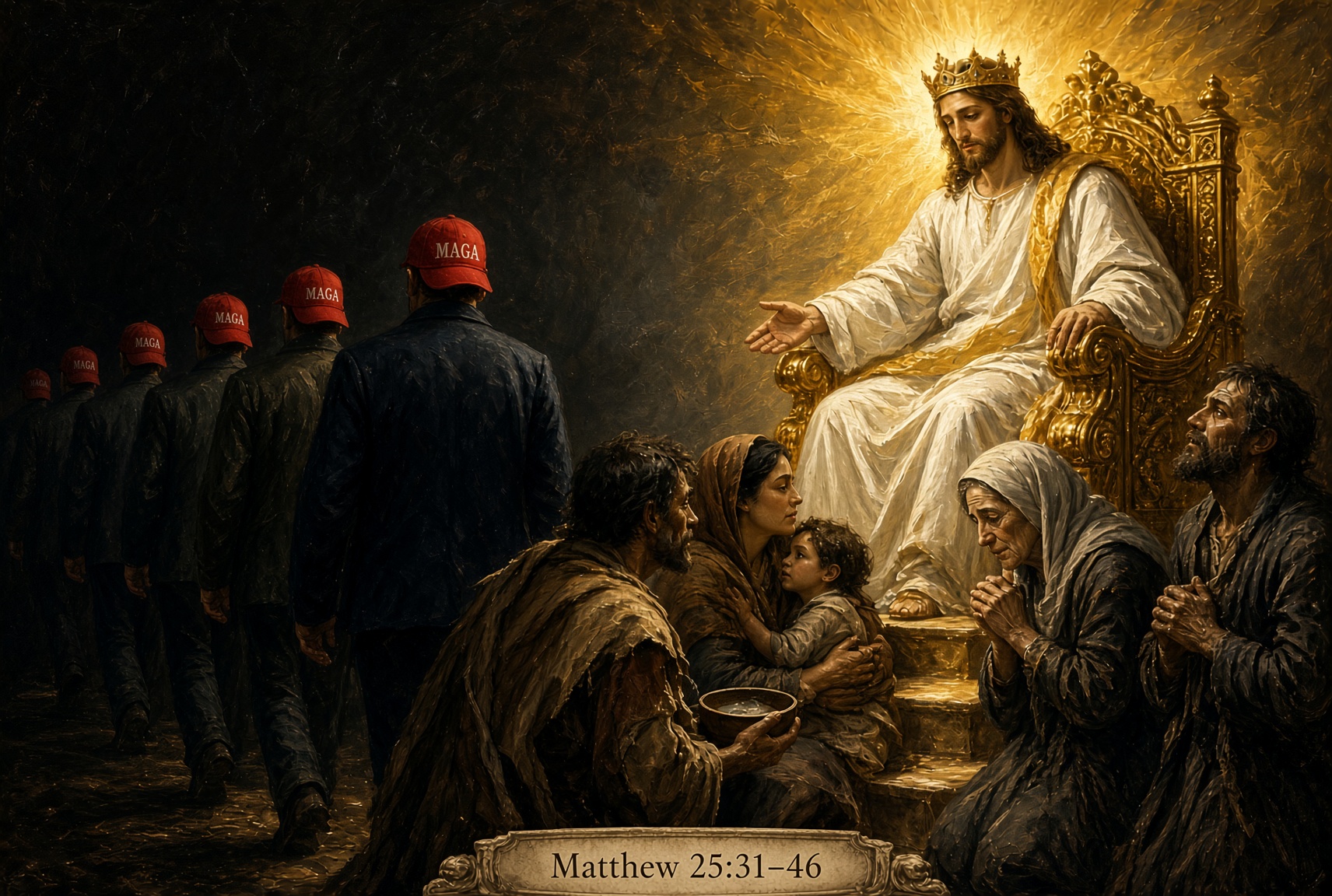
“When the Son of Man comes in his glory, and all the angels with him, he will sit on his glorious throne. All the nations will be gathered before him, and he will separate the people one from another as a shepherd separates the sheep from the goats. He will put the sheep on his right and the goats on his left. Then the King will say to those on his right, ‘Come, you who are blessed by my Father; take your inheritance, the kingdom prepared for you since the creation of the world.
For I was hungry and you gave me something to eat, I was thirsty and you gave me something to drink, I was a stranger and you invited me in, I needed clothes and you clothed me, I was sick and you looked after me, I was in prison and you came to visit me.’
Then the righteous will answer him, ‘Lord, when did we see you hungry and feed you, or thirsty and give you something to drink? When did we see you a stranger and invite you in, or needing clothes and clothe you? When did we see you sick or in prison and go to visit you?’
The King will reply, ‘Truly I tell you, whatever you did for one of the least of these brothers and sisters of mine, you did for me.’ Then he will say to those on his left, ‘Depart from me, you who are cursed, into the eternal fire prepared for the devil and his angels.
For I was hungry and you gave me nothing to eat, I was thirsty and you gave me nothing to drink, I was a stranger and you did not invite me in, I needed clothes and you did not clothe me, I was sick and in prison and you did not look after me.’
They also will answer, ‘Lord, when did we see you hungry or thirsty or a stranger or needing clothes or sick or in prison, and did not help you?’ He will reply, ‘Truly I tell you, whatever you did not do for one of the least of these, you did not do for me.’
Then they will go away to eternal punishment, but the righteous to eternal life.”
(Matthew 25:31–46 NIV)
Jesus identifies Himself with the hungry, the stranger, the poor, and the imprisoned. Trump’s policies—family separation, demonization of refugees, slashing aid to the poor, and mocking prisoners—fall squarely into the category Jesus condemns. MAGA’s treatment of the vulnerable is not merely a political disagreement; Scripture frames it as a salvation issue.
III. PURE RELIGION: CARE FOR THE OPPRESSED
“Religion that God our Father accepts as pure and faultless is this: to look after orphans and widows in their distress and to keep oneself from being polluted by the world.”
(James 1:27 NIV)
Trump’s administration repeatedly cut programs supporting the poor, widows, and children, while MAGA leaders embraced worldly power, wealth, and culture-war rage. Scripture calls this hypocrisy, not righteousness.
IV. LOVE YOUR NEIGHBOR: A REBUKE TO RACISM AND XENOPHOBIA
“Do not seek revenge or bear a grudge against anyone among your people, but love your neighbor as yourself. I am the Lord.”
(Leviticus 19:18 NIV)
Trump’s messaging—targeting minorities, encouraging resentment, and stoking racial division—violates this command. MAGA rallies often amplify xenophobia and racial hostility, directly contradicting God’s law.
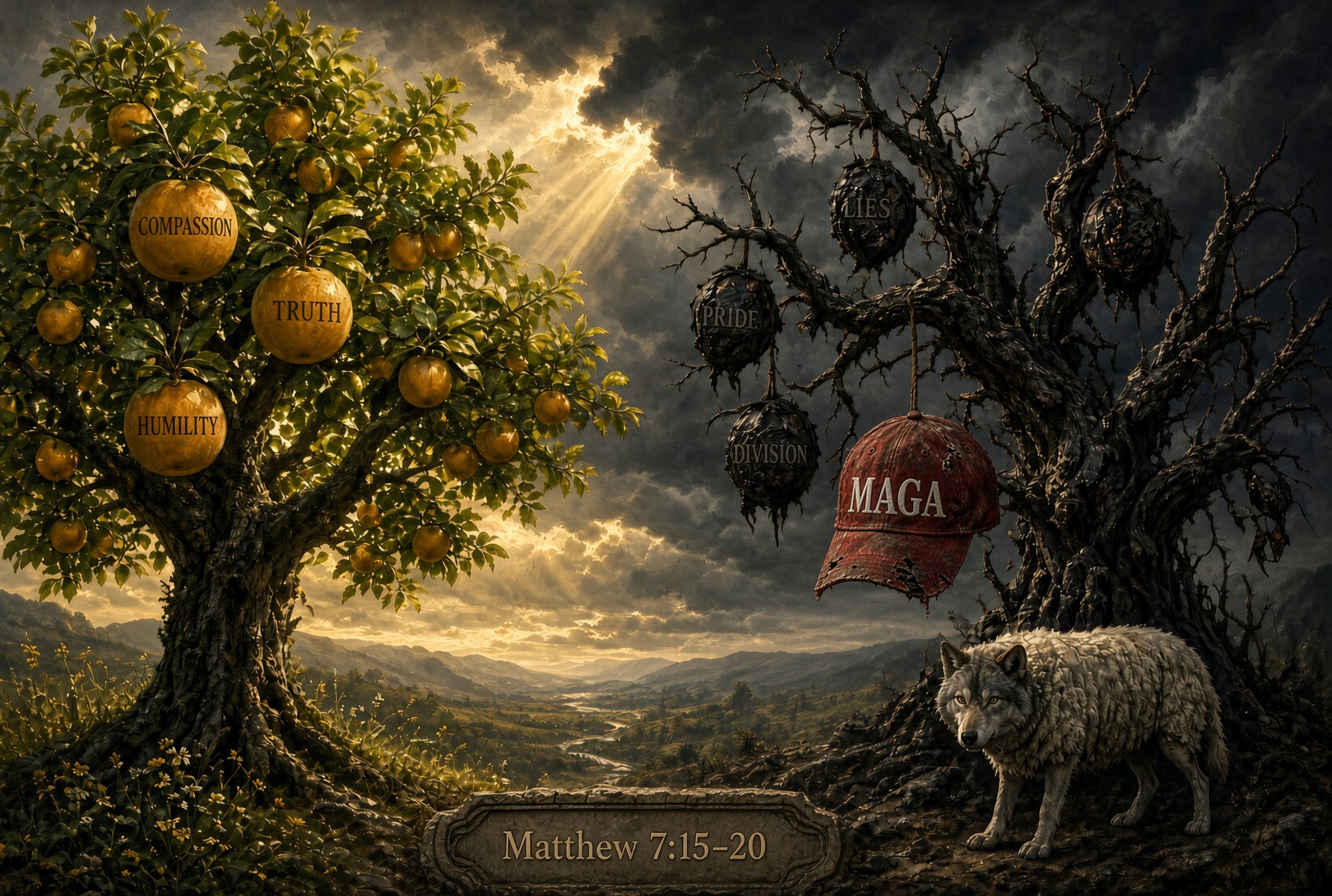
V. FALSE PROPHETS AND BAD FRUIT
“Watch out for false prophets. They come to you in sheep’s clothing, but inwardly they are ferocious wolves. By their fruit you will recognize them. Do people pick grapes from thornbushes, or figs from thistles? Likewise, every good tree bears good fruit, but a bad tree bears bad fruit. A good tree cannot bear bad fruit, and a bad tree cannot bear good fruit. Every tree that does not bear good fruit is cut down and thrown into the fire. Thus, by their fruit you will recognize them.”
(Matthew 7:15–20 NIV)
Trump claims divine favor, yet his fruit includes lies, broken promises, moral scandals, and manipulation of religious voters. MAGA pastors who declare Trump “God’s anointed” fit Jesus’ warning about false prophets who deceive the faithful.
VI. PRIDE AND SELF-EXALTATION
“Pride goes before destruction, a haughty spirit before a fall.”
(Proverbs 16:18 NIV)
Trump’s constant self-praise, refusal to admit fault, and boastful arrogance embody the pride Scripture warns leads to destruction. MAGA’s glorification of Trump’s ego is spiritually dangerous.
VII. WARNINGS AGAINST DECEPTION
“Jesus answered: ‘Watch out that no one deceives you.'”
(Matthew 24:4 NIV)
Trump’s election lies, conspiracy theories, and false claims of divine endorsement are textbook examples of the deception Jesus warns His followers to resist. MAGA’s willingness to embrace falsehoods reveals spiritual vulnerability.
VIII. GOD OPPOSES ARROGANCE AND EVIL
“The arrogant cannot stand in your presence. You hate all who do wrong;”
(Psalm 5:5 NIV)
Boastfulness and unrepentant wrongdoing are incompatible with godly leadership. Trump’s behavior fits the category Scripture says God rejects.
IX. PEACEMAKERS VS. INSTIGATORS
“Blessed are the peacemakers, for they will be called children of God.”
(Matthew 5:9 NIV)
Trump’s rhetoric routinely inflames conflict, encourages violence, and divides communities. MAGA rallies and messaging often escalate hostility rather than promote peace. This is the opposite of Christ’s calling.
X. LOVE YOUR ENEMIES
“But I tell you, love your enemies and pray for those who persecute you,”
(Matthew 5:44 NIV)
Trump encourages vengeance, retaliation, and hatred toward political opponents. MAGA culture celebrates owning, humiliating, or destroying enemies. Jesus commands the exact opposite.
XI. SUBMISSION TO LAWFUL AUTHORITY
“Let everyone be subject to the governing authorities, for there is no authority except that which God has established. The authorities that exist have been established by God.
Consequently, whoever rebels against the authority is rebelling against what God has instituted, and those who do so will bring judgment on themselves.”
(Romans 13:1–2 NIV)
Trump’s attempts to overturn the 2020 election, pressure officials to break the law, and incite an attack on the Capitol violate Paul’s command to respect lawful authority. MAGA’s celebration of rebellion against legitimate government contradicts Scripture.
XII. GREED AND CORRUPTION
“For the love of money is a root of all kinds of evil. Some people, eager for money, have wandered from the faith and pierced themselves with many griefs.”
(1 Timothy 6:10 NIV)
“Then he said to them, ‘Watch out! Be on your guard against all kinds of greed; life does not consist in an abundance of possessions.'”
(Luke 12:15 NIV)
Trump’s obsession with wealth, self-enrichment through office, and promotion of prosperity-gospel allies reflect the greed Scripture condemns. MAGA’s admiration of wealth as a sign of divine favor is unbiblical.
XIII. FAMILY ETHICS AND HYPOCRISY
“But I tell you that anyone who divorces his wife, except for sexual immorality, makes her the victim of adultery, and anyone who marries a divorced woman commits adultery.”
(Matthew 5:32 NIV)
Trump’s multiple marriages, affairs, and sexual scandals contradict the “family values” MAGA claims to defend. Scripture exposes this hypocrisy plainly.
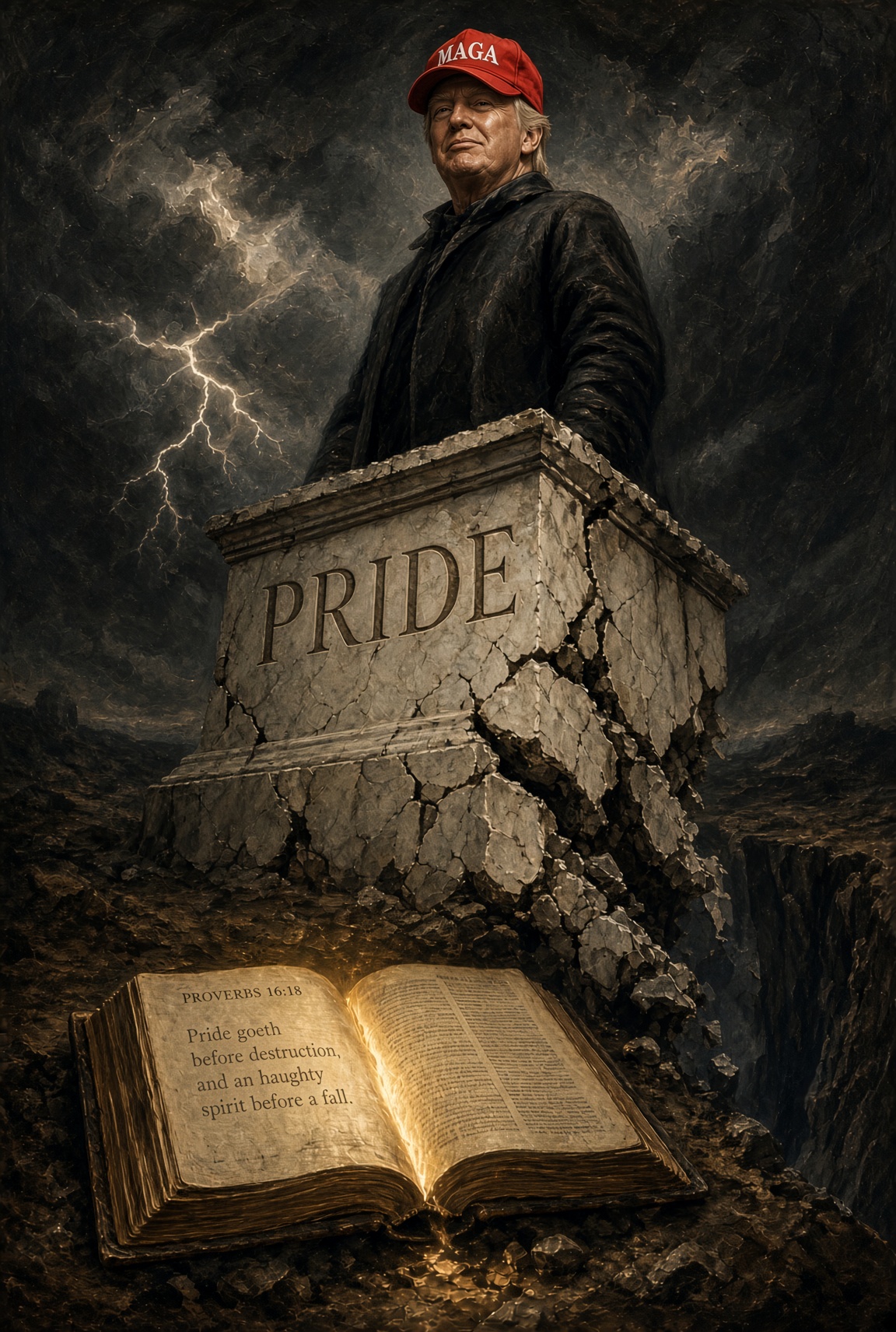
XIV. THE SEVEN THINGS GOD HATES
“There are six things the Lord hates, seven that are detestable to him: haughty eyes, a lying tongue, hands that shed innocent blood, a heart that devises wicked schemes, feet that are quick to rush into evil, a false witness who pours out lies and a person who stirs up conflict in the community.”
(Proverbs 6:16–19 NIV)
Every item in this list maps directly onto Trump’s behavior:
- Haughty eyes — arrogance and self-exaltation.
- A lying tongue — thousands of documented falsehoods.
- Hands that shed innocent blood — policies harming vulnerable populations.
- A heart that devises wicked schemes — election subversion, manipulation.
- Feet quick to rush into evil — inciting January 6.
- A false witness pouring out lies — election denial.
- One who stirs up conflict — MAGA’s constant division.
Scripture leaves no ambiguity.
XV. CALL TO REPENTANCE
“if my people, who are called by my name, will humble themselves and pray and seek my face and turn from their wicked ways, then I will hear from heaven, and I will forgive their sin and will heal their land.”
(2 Chronicles 7:14 NIV)
MAGA Christians who excuse Trump’s wrongdoing are called to repentance. Humility—not political loyalty—is the path to healing.
XVI. CALLING EVIL GOOD
“Woe to those who call evil good and good evil, who put darkness for light and light for darkness, who put bitter for sweet and sweet for bitter.”
(Isaiah 5:20 NIV)
MAGA’s defense of Trump’s immoral behavior, while attacking truth-tellers and public servants, is a direct fulfillment of Isaiah’s warning.
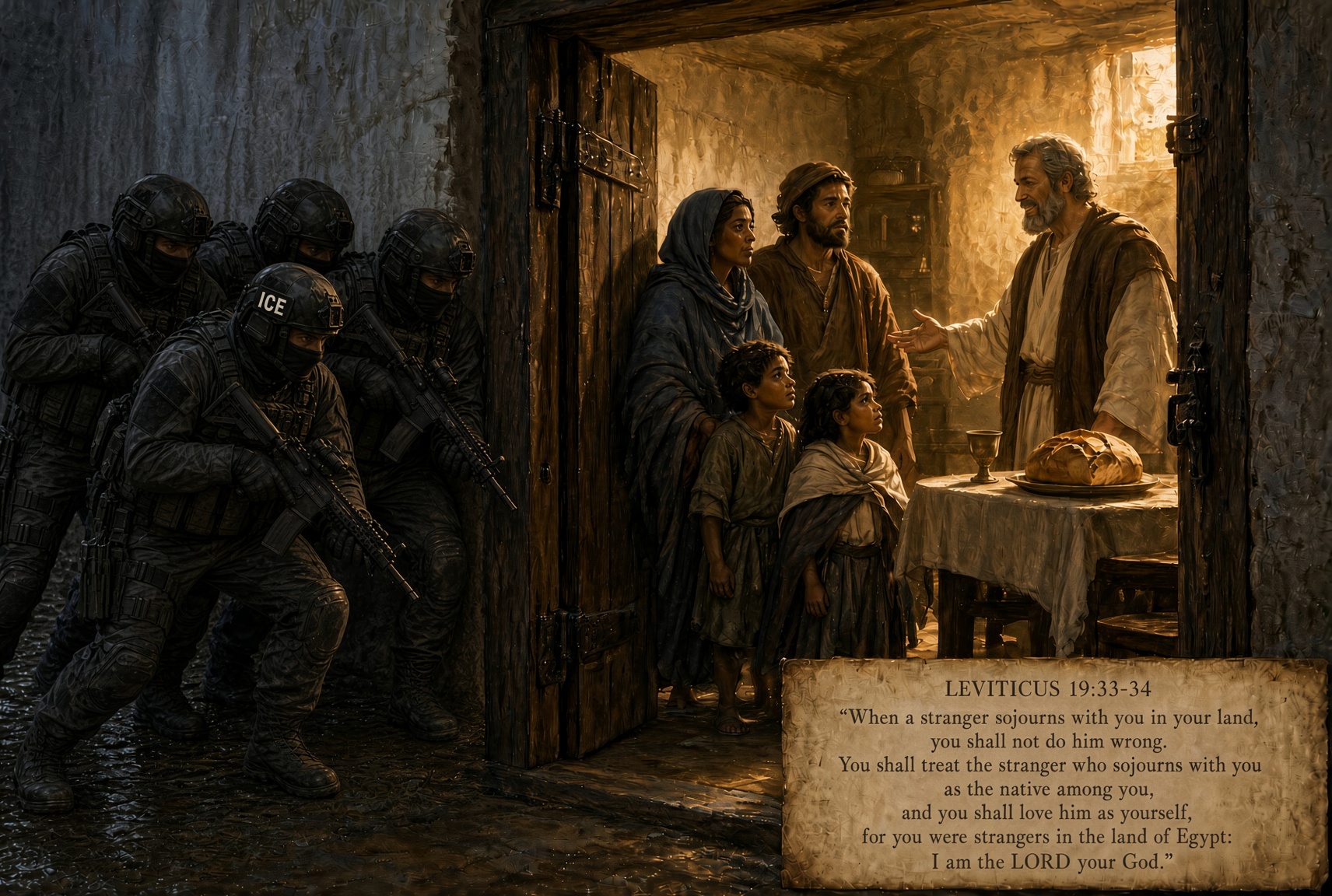
APPENDIX A: BIBLE VERSES ON THE TREATMENT OF FOREIGNERS
“‘And if a stranger dwells with you in your land, you shall not mistreat him. The stranger who dwells among you shall be to you as one born among you, and you shall love him as yourself; for you were strangers in the land of Egypt: I am the Lord your God.'”
(Leviticus 19:33–34 NKJV)
“So I will come to put you on trial. I will be quick to testify against sorcerers, adulterers and perjurers, against those who defraud laborers of their wages, who oppress the widows and the fatherless, AND DEPRIVE THE FOREIGNERS AMONG YOU OF JUSTICE, but do not fear me,” says the Lord Almighty.”
(Malachi 3:5 NIV, caps added for emphasis)
“Her [Israel’s apostate] prophets whitewash these deeds for them by false visions and lying divinations. They say, ‘This is what the Sovereign Lord says’—when the Lord has not spoken. The people of the land practice extortion and commit robbery; they oppress the poor and needy AND MISTREAT THE FOREIGNER, DENYING THEM JUSTICE.”
(Ezekiel 22:28–31 NIV, caps added for emphasis)
“This is what the Lord says: “Go down to the palace of the king of Judah and proclaim this message there: ‘Hear the word of the Lord to you, king of Judah, you who sit on David’s throne—you, your officials and your people who come through these gates.
This is what the Lord says: Do what is just and right. Rescue from the hand of the oppressor the one who has been robbed. DO NOT WRONG OR VIOLENCE TO THE FOREIGNER, the fatherless or the widow, and do not shed innocent blood in this place.
For if you are careful to carry out these commands, then kings who sit on David’s throne will come through the gates of this palace, riding in chariots and on horses, accompanied by their officials and their people. But if you do not obey these commands, declares the Lord, I swear by myself that this palace will become a ruin.’””
(Jeremiah 22:1–5 NIV, caps added for emphasis)
Trump’s anti-immigrant rhetoric, Muslim ban, family separation policy, and demonization of refugees violate every one of these commands. MAGA’s hostility toward foreigners is explicitly condemned by Scripture.
APPENDIX B: BIBLE VERSES ON DUE PROCESS BEFORE CAPITAL PUNISHMENT
“On the testimony of two or three witnesses a person is to be put to death, but no one is to be put to death on the testimony of only one witness.”
(Deuteronomy 17:6 NIV)
“Anyone who kills a person is to be put to death as a murderer only on the testimony of witnesses. But no one is to be put to death on the testimony of only one witness.”
(Numbers 35:30 NIV)
“One witness is not enough to convict anyone accused of any crime or offense they may have committed. A matter must be established by the testimony of two or three witnesses.”
(Deuteronomy 19:15 NIV)
“The hands of the witnesses must be the first in putting that person to death, and then the hands of all the people. You must purge the evil from among you.”
(Deuteronomy 17:7 NIV)
Trump’s calls for executing political opponents, immigrants, and even military leaders without trial, and the killing of people aboard boats from other nations without a hearing or a trial, violate God’s requirement for due process. MAGA’s applause for both contradicts biblical justice.
CONCLUSION
Taken together, these Scriptures form a consistent, unavoidable message: Trump’s behavior and the values of the MAGA movement stand in direct opposition to the teachings of Jesus and the Moral Law of Scripture.
This is not a matter of partisan preference. It is a matter of biblical truth.


Really? Are you ignoring Trumps stand for families and his stand against evil and bringing order out of chaos? And his fight for the American people, I haven’t heard from you forever and you choose to send anti American propaganda?
LikeLike
Beggar’s Bread has always been a collection of pieces on subjects that interest us and that we care about enough to try to handle with as much care and honesty as we can manage, written in a way that seeks to bring glory to God. We’ve never claimed to be anything other than beggars sharing where we’ve found bread, and we’ve never pretended we’re without flaws. That framing hasn’t changed just because the subject has.
The piece you reacted to is a compilation of Scripture applied to Trump and the MAGA movement—passages on love of God and neighbor, how we treat the vulnerable and the stranger, the fruit of leaders, pride, deception, submission to lawful authority, greed, family ethics, the things God hates in Proverbs 6, and the warning against calling evil good. It isn’t “anti-American propaganda.” It’s the same approach the site has taken for years: take clear biblical standards and test prominent claims and leaders against them. Those standards were applied to Latter-day Saint sources and history before; they’re being applied here to a political figure and movement that many Christians are being asked to defend in similar ways.
You asked whether I’m ignoring Trump’s stands for families, against evil, and for bringing order out of chaos, and his fight for the American people. I’m not ignoring those claims. I’m weighing them against the same biblical standards that apply to everyone else. On families, for instance, the post notes the gap between the rhetoric and the personal record of multiple marriages, affairs, and scandals. On “order out of chaos” and standing against evil, it looks at patterns of rhetoric that inflame division, the January 6 events and related efforts, and the treatment of immigrants, refugees, and the poor in light of passages like Matthew 25, James 1:27, and the repeated Old Testament commands about the stranger. If those texts don’t apply, or if the record doesn’t match the description you’re offering, I’m open to seeing the specific evidence. What I won’t do is treat loyalty to one political figure as the definition of being pro-American, pro-family, or faithful.
The questions underneath haven’t shifted even if the topic has: Does the fruit match the claims? Are we elevating a leader or movement in ways that contradict the greatest commandments or the warnings about false prophets and pride? Are inconvenient facts or dissenting voices being treated as betrayal rather than something to examine? Those were the questions with Mormon claims. They’re the same questions when a political movement asks Christians to set aside ordinary standards of character, truth-telling, and care for the vulnerable in the name of defending the leader or the group.
If you want to walk through any of the passages cited and show where the application is wrong or the record is being misstated, do that. Calling the whole thing anti-American propaganda closes the discussion before it starts. The post is an invitation to test the claims against the text—one beggar pointing to where the bread is, not claiming to own it. I can’t think of a more Pro-American thing to do than that, can you?
LikeLike
I notice you fail to use the words “illegal immigrants”. There is a law abiding way to enter this country. But you prefer to inflict abuse on the American citizen who bears the long financial burden that will impact them for the rest of their lives. That is un American. What you don’t recognize is that the infiltration of illegals serves neither them nor the American people. Whats worse is that you choose to try to substantiate your claims by ignoring other Biblical verse. I would be happy to walk through any verse you have introduced in context.
LikeLike
You’re right that I didn’t use the term “illegal immigrants” because the Bible doesn’t. The post used the language of the biblical texts it was examining — stranger, foreigner, sojourner — because those are the terms the passages themselves use.
The distinction between lawful and unlawful entry is real, and Scripture does not erase civil law or the state’s responsibility to maintain order. At the same time, the commands in Leviticus 19, Malachi 3, Ezekiel 22, and Jeremiah 22 are not restricted to people who arrived with the correct paperwork. They address how God’s people treat the vulnerable outsider who is among them, and they treat mistreatment, injustice, and hard-heartedness toward that person as serious matters before God. Those texts are what the post was applying. If the application is wrong once the full context is considered, that is worth examining.
But let me ask you this: Can you explain to us how the Bible endorses mistreating or abusing the stranger, foreigner, or sojourner among us if they’re not here legally?
On the financial burden: policy disagreements about the costs and benefits of immigration, enforcement, and public resources are legitimate. Framing any argument that doesn’t prioritize the citizen’s long-term fiscal load as “inflicting abuse” on Americans, or as inherently un-American, treats a contested policy question as a loyalty test. The post’s concern was narrower: whether certain rhetoric and practices line up with the specific biblical warnings about the stranger and the vulnerable. That is a separate question from whether a given enforcement approach is wise or sustainable.
You offered to walk through any of the verses introduced, in context. I’m glad to do that. Start with whichever you think most clearly shows the post is ignoring relevant biblical teaching—whether on the stranger, on lawful authority, on the treatment of the poor, or on something else. Quote the passage, lay out the context you believe changes the application, and I’ll respond to that. The goal is still the same: test the claims against the text rather than substitute a political label for the examination.
LikeLike
More peticular, let’s consider this passage: “But if any provide not for his own, and specially for those of his own house, he hath denied the faith, and is worse than an infidel.” 1 Timothy 5:8. If you are going to conflate biblical scripture with national policy, then this verse establishes a principle of particular responsibility. Trump is lifting up the poor of the American people. He is championing them. That is his duty and responsibility as President of the United States to watch out for the poor over whom he has jurisdiction. He is ferreting out the abuse and corruption of tax payer dollars given to people who have broken the law -so they can better serve the poor of this great country over whom he has jurisdiction.
LikeLike
You are introducing 1 Timothy 5:8, a passage that was not used in the essay, and applying it to national policy. The verse says that anyone who does not provide for his own, and specially for those of his own house, has denied the faith and is worse than an unbeliever. In context it concerns family responsibility for widows and relatives. The phrase “specially for those of his own house” further limits the primary duty to one’s household. It does not establish that the president’s “own house” is the entire American citizenry or that championing the American poor is the biblical fulfillment of that duty. That is an extension the text does not make.
To be direct, your post does not engage the essay at all. It substitutes a different verse and a policy claim for the passages and arguments that were actually presented. It’s a rabbit trail. A deflection. If the goal is to show that the essay’s biblical case fails, then address those texts and claims. Until that is done, the essay remains unaddressed.
LikeLike
I’m not going to argue with you. I said that you deliberately ignored other biblical scripture and gave you an example. If you wish to prioritize lawbreakers over law abiding citizens thats your choice. Take me off your email.
LikeLike
Introducing 1 Timothy 5:8 and then declaring that you will not argue does not show that the essay deliberately ignored other biblical scripture. It shows that you’re not interested in civil discourse.
The verse concerns family responsibility for one’s own household; the phrase “specially for those of his own house” further limits that duty. Extending it into a presidential obligation to the entire American citizenry is an application the text does not support. That is a failure of hermeneutics, not a demonstration that the essay’s passages were ignored or misapplied. Those passages were never engaged.
The further claim that the essay prioritizes lawbreakers over law-abiding citizens is likewise untested; it was stated, not shown from the texts that were cited. The essay’s case remains unaddressed.
If the goal is to establish that other scripture was ignored or that the application fails, the way to do that is to examine the passages that were used. Walking away leaves both that claim and the case that Trump and MAGA are antithetical to Biblical Christianity standing.
That said, you can feel free to unsubscribe from my site any time that suits you. However, if you are, in fact, interested in civil discourse, I look forward to your thoughtful analysis of the content of my essay.
Please proceed.
LikeLike
At no time have my post been uncivil. Some of your accusations against Trump and MAGA supporters are simply not true. I am a Make American Great Again advocate and I do not “stand in direct opposition to the teachings of Jesus Christ and the moral law of scripture.” I don’t appreciate your insinuation and blanket statements. I think you are over reaching and frankly quite rude, judgmental and un Christ like to me. My understanding of Jan 6 is quite different than your conclusions among many of your other statements. I can disagree without you cramming your biased thoughts down my throat.
LikeLike
Disagreeing with the essay’s application of specific passages is one thing. Declaring the whole case overreaching, rude, judgmental, and un-Christlike without identifying which claims are untrue or how the cited texts are being misapplied is another. The essay quotes particular Scriptures (on the greatest commandments, the treatment of the vulnerable and the stranger, the fruit of leaders, pride, deception, submission to lawful authority, and others) and applies them to documented patterns of rhetoric and conduct. Those applications can be tested. Calling them biased thoughts crammed down your throat does not test them.
You state that you do not stand in direct opposition to the teachings of Jesus Christ and the moral law of Scripture. The essay does not claim that every MAGA supporter does. It claims that certain recurring features of the movement and its central figure—patterns of contempt, deception, self-exaltation, and the treatment of outsiders and opponents—stand in tension with those teachings. If that claim is false, the way to show it is to take up the passages that were used and demonstrate where the application fails.
You also note a different understanding of January 6. The essay treats the events of that day, and the broader effort to overturn the election, in light of Romans 13 and related warnings. If your understanding shows that those texts do not apply, or that the factual record is being misstated, lay that out. Until the specific passages and claims are engaged, the disagreement remains at the level of assertion rather than examination.
The invitation stands: identify which statements are simply not true, quote the relevant surrounding context of the passages cited, and show how they are being misapplied. That is civil discourse. Labeling the case rude or un-Christlike without that engagement is not.
LikeLike
You state what the Bible says and then you jump to a conclusion failing to document the historical record. What you should have done is separate 1) what the Bible actually says 2) what the historical record establishes, and 3) what you conclude from those facts, but your conclusions are derived without presenting the historical evidence.
While you cite biblical principles, you make broad unsubstantiated claims about Trump and MAGA. You treat your own interpretation as though it were the only possible biblical conclusion.
I. Love of God and neighbor — Matthew 22:35–40
The biblical principle is clear; but the political application needs specific examples. Jesus commands love of neighbor. You say Trump’s rhetoric and MAGA culture violate that command through mockery, demeaning immigrants, and hostility toward political opponents.
You fail to provide representative, accurately quoted examples that fairly characterize Trump and a movement containing millions of people. You assert that MAGA culture “normalizes” contempt, but you do not present a systematic sample of that behavior. You need specific quotations, dates, context, and a clear distinction between Trump’s conduct, the conduct of particular supporters, and the beliefs of all MAGA supporters before making an assessment.
II. The vulnerable and “the least of these” — Matthew 25:31–46
The verse doesn’t tell us what immigration laws should look like. Yes, we should feed the hungry, welcome the stranger, clothe the needy, and care for the sick, but what Trump policies fall within the condemnation Jesus describes? And is it a “salvation issue”?
Who are “the least of these my brothers” in Matthew 25:31–46? Interpretations may include needy people in general, but some scholars say it means Jesus’ disciples. The verse needs to be read in context. You act like your conclusions are self-evident. You are missing policy-by-policy evidence showing what was done, whom it affected, and why the passage establishes the conclusion drawn.
III. Care for the oppressed — James 1:27
Yes. We should care for the oppressed, however the verse doesn’t automatically assume that government must adopt open border immigration policies.
James emphasizes caring for orphans and widows in distress. You allege that Trump’s administration repeatedly cut programs supporting poor people, widows, and children. That claim should be checked against actual budgets, and enacted legislation. A proposal to cut a program is not the same as a cut, and a reduction in spending does not automatically mean that every policy was unjust. You neglect to state the names of the programs, the actual cuts, the people affected, and evidence that the outcomes fit your moral description.
IV. Neighbor-love and racism — Leviticus 19:18
The command is clear; but if someone accuses a person or a political policy of being racist, that accusation needs evidence. You say Trump targets minorities and stokes racial division, and that MAGA rallies often amplify xenophobia and racial hostility. These claims cannot be established merely by quoting the command to love one’s neighbor.
To substantiate them, you need to identify the statements or actions in question, consider their context, and show why they amount to racism or xenophobia rather than assert they do. You cannot establish that a policy is prejudice when it is simply put, lawful immigration enforcement that concerns national security. You are missing specific examples. You generalize the MAGA culture as a whole.
V. False prophets and bad fruit — Matthew 7:15–20
Is a relevant principle, but just because someone disagrees with a political position doesn’t mean that person is racist. Yes, Jesus teaches that people can be evaluated by their fruit, but you apply this to Trump’s alleged lies, broken promises, scandals, and so-called manipulation of religious voters. I’m not sure how you would prove that. You criticize pastors who call Trump “God’s anointed.”
In order to classify a political leader—or a pastor who supports him—as a false prophet, you must establish what false teaching or spiritual deception is involved. Supporting a politician does not prove someone is a false prophet. You must draw a distinction between bad conduct, mistaken political judgment, and the much stronger biblical category of false prophecy.
V. False prophets and bad fruit — Matthew 7:15–20
This verse is talking about the actions and fruits of those who claim to speak for God. Trump never claimed that. The Bible verse doesn’t name a modern politician or tell us which current political policies to condemn. You describe Trump as boastful, self-exalting, and unwilling to admit fault, then conclude that his behavior fits what Scripture condemns.
Your statement shows your own arrogance. You shouldn’t assume that your political conclusions are God’s conclusions. You fail to define a consistent standard for measuring pride. That same standard should apply to a Democrat, a Republican, or any other political leader. You might compare Trump’s conduct with that of other leaders or show how every MAGA supporter glorifies his ego- though a Trump supporter may not even admire those traits.
Psalm 5:5 is a statement about God’s opposition to wrongdoing; it is not a direct biblical checklist for ranking modern political candidates. You lack concrete examples and a more carefully explained connection between those examples and the passages.
VII. Deception — Matthew 24:4
If you are going to accuse someone of deception, you need to show what that person said or did that was deceptive. Your reference to the 2020 election is vague. Rather than labeling Trump’s claims as false or deceptive, you should ask: What specific claim did Trump make? What evidence demonstrates that the claim was false? And what information was available to him at the time he made it? If the accusation is accurate that he deliberately deceived people, what evidence establishes that he knew the claim was false?
And as far as a January 6 committee report, I have concerns about relying solely on the January committee’s report without examining how the committee conducted its investigation and reached its conclusions. I believe it’s fair to question whether an investigation was balanced. It is important to identify the report accurately as the committee’s finding rather than treat the report as a judicial verdict on every allegation.
The criticism of Trump’s election-related conduct does not, by itself, establish that every MAGA supporter knowingly embraced falsehoods or that all parts of the movement are deceptive. You should separate well-documented, specific instances of false claims from your broad conclusions about a movement and its members.
IX. Peacemakers — Matthew 5:9; X. Love your enemies — Matthew 5:44
There are several international agreements and diplomatic initiatives associated with Donald Trump. He has been involved in efforts of more than one kind of peace. Consider Israel and the United Arab in 2020, Serbia and Kosovo in 2020, Armenia and Azerbaijan in 2025, Thailand and Cambodia in 2025, and the republic of the Congo and Rwanda.
You say Trump inflames conflict, encourages violence, and promotes vengeance against opponents. Those are claims about rhetoric and conduct that can be investigated. But “encourages violence” is a strong threat much exaggerated. You should cite the specific words or actions and explain their context, including whether the statement advocated violence, celebrated it, threatened retaliation, or used aggressive political language without a literal call to violence.
Trump was impeached twice by the House of Representatives and acquitted in both Senate trials. He was taken to court repeatedly. The question is, was the timing and handling of these cases appropriate and would the same standards have been applied to another candidate? Were Jack Smith’s prosecutions legitimate efforts to enforce the law or politically motivated efforts to hurt Trumps campaign? Criticizing or prosecuting an opponent is not vengeance; the relevant questions include the evidence, legal basis, consistency of treatment, and whether due process was respected.
Clearly it is important to use specific examples and a clear standard to distinguish harsh rhetoric from actual encouragement of violence or unlawful retaliation.
XI. Lawful authority — Romans 13:1–2
Paul teaches that governing authorities have a place in God’s order of society and that people should not treat lawful authority lightly. So how should Christians respond when they believe an election was unfair or a government decision was wrong?
The question is how Romans 13 applies to political resistance, unlawful orders, disputed authority, and constitutional remedies. Romans 13 teaches submission to governing authorities, but Christians have also debated how it interacts with other biblical principles and cases where rulers act unjustly. So how do you rate when it comes to submission to governing authorities?
A different interpretation of January 6 should be tested against the evidence, not accepted or dismissed merely because it differs from your opinion.
XII. Greed and corruption — 1 Timothy 6:10; Luke 12:15
The Bible warns against the love of money and greed. You accuse Trump of self-enrichment through office and argue that MAGA treats wealth as evidence of divine favor.
If you accuse Trump of being greedy, obsessed with wealth or using public office to enrich himself, then provide the evidence to support those claims. President Trump is one of the few Presidents who donated his $400,000 presidential salary in quarterly installments to federal agencies during much of his first term. The donations supported areas including national parks, education, veteran’s services and transportation. He has also donated funds for the building of the ballroom along with private donations.
To evaluate those claims, provide specific financial transactions, conflicts of interest, legal findings where applicable, and evidence about what particular religious leaders have taught. A leader’s wealth alone does not establish greed, and a supporter’s admiration for a wealthy person does not prove that the supporter believes wealth is a sign of divine favor.
You provide no documented accounts of the alleged self-enrichment, nor a distinction between ethical concerns and proven illegality, neither any evidence supporting the claim about MAGA’s attitude toward wealth.
XIII. Family ethics — Matthew 5:32
Trump places a strong emphasis on family life and values. Matthew 5:32 addresses marriage, divorce, and marital faithfulness. It applies to personal conduct, but the verse doesn’t disqualify a person from holding political office. Trump has denied certain allegations anyway. Is it heresay? Was there a pattern or an isolated event if at all. And was there a change in behavior? Apply the same standards consistently to other political leaders.
You point to Trump’s “marriages, affairs, and scandals” as inconsistent with MAGA’s emphasis on family values however you need to distinguish documented conduct from allegations. A person can support a politician because of policy priorities while disapproving of that politician’s personal life. It does not prove every supporter endorses the conduct
At least MAGA has family values contrary to a certain party that promotes transgender ideology. If you are going to criticize one side for what you believe conflicts with family values, you should be equally willing to examine the positions and actions of the other side.
XIV. The seven things God hates — Proverbs 6:16–19
Assertions need proof. Be careful about applying verses to a political leader without examining the evidence for each accusation. If you accuse Trump of lying, then identify what Trump said that was a lie. If you accuse Trump of stirring up conflict, then identify the actions that support that conclusion. The same standard should apply to accusations of pride, dishonesty or wrongdoing against any political leader.
You link these passages of pride, lying, violence, wicked schemes, and stirring up conflict directly onto Trump. Labels—such as “hands that shed innocent blood” and “feet quick to rush into evil”—need specific evidence and a defensible explanation of the connection. A disputed policy outcome is not equivalent to a demonstrated intent to commit evil.
You need to provide evidence for each individual item rather than claim that every item “maps directly” onto Trump.
XV. Call to repentance — 2 Chronicles 7:14; XVI. Calling evil good — Isaiah 5:20
This is a very cheap argument to argue that America, its leaders or a particular political party needs to repent while ignoring obvious weaknesses of the opposite party.
You argue that MAGA Christians who excuse Trump’s conduct should repent and that defending him fulfills Isaiah’s warning about calling evil good.
These are serious spiritual accusations. To establish them, you need to demonstrate which actions are evil. It is ridiculous to suggest that everything done under the Trump administration is evil and that MAGA supporters should all repent. What evidence establishes that characterization? Disagreement over policy is not automatically a defense of evil.
Distinctions need to be drawn between knowingly excusing wrongdoing, or disagreeing about the facts, and reaching a different conclusion about a policy.
2. Appendix A: Foreigners, immigration, and the law
You use Leviticus 19:33–34, Malachi 3:5, Ezekiel 22:28–31, and Jeremiah 22:1–5 to argue that hostility toward foreigners violates Scripture.
God instructs the Israelites not to mistreat foreigners. The passage establishes fair treatment, but does not explicitly address modern border enforcement, visa requirements, or deportation procedures.
The passages condemn mistreatment, oppression, and denial of justice to foreigners. But what about justice to citizens? Does that require that a nation must admit every person who wishes to enter. Or that a nation must provide every public benefit to every person, regardless of immigration status. Enforcing immigration law and treating people humanely are not mutually exclusive obligations. One does not exclude the other. Enforcing immigration laws is not the same as mistreating foreigners.
3. Appendix B: Due process and capital punishment
You cite Deuteronomy 17:6, Numbers 35:30, and Deuteronomy 19:15
These passages concern ancient Israel’s legal system establishing requirements for serious criminal executions in ancient Israel. Ancient procedures are not identical to modern court systems. A proper check would establish: Whether the biblical passages in ancient Israel apply directly to the modern situation or do they provide a broader principle of justice.
Specific allegations require direct verification. You claim that Trump has called for executing political opponents, immigrants, and military leaders without trial, and that people aboard drug boats loaded with fentanyl from other nations have been killed without a hearing or trial. You do not provide quotations, dates, names, or incident records needed to assess the claim that Trump has called for execution without trial. The gravity of the allegation makes precise sourcing essential.
Fentanyl has destroyed an enormous number of lives in the United States. The CDC estimates that in 2023 approximately 72,000 deaths resulted primarily from synthetic opioids and illegally manufactured fentanyl. In 2024 an estimated 48,913 deaths involved fentanyl, and in 2025 an estimated 38,084 deaths involved fentanyl. These figures demonstrate the devastating impact of the drug crisis on American families and communities. Approximate comparisons with total U.S. military deaths during each war, including combat and other deaths while in service. Korean War, 54,246 deaths. Fentanyl-related deaths in one year equal about 70% of this total. Vietnam War, 90,220 deaths. One year’s fentanyl toll equals about 42% of this total. The war comparisons are comparisons of one year’s overdose deaths with total military deaths over an entire war, not deaths occurring in one year of that war. You cannot ignore these numbers. The war on drugs is real, and its human cost is enormous. The government has a responsibility to protect the public from dangerous drugs and the criminal networks that distribute them.
UNACCOMPANIED CHILDREN: Agency Efforts to Reunify Children Separated from Parents at the Border
This was not solely a problem under the Trump administration. It was far more magnified under Bidens administration with an estimated 10+ million illegal border encounters. Not every case involving an unaccompanied child resulted from a government policy separating a child from a parent. Some children arrived without a parent or guardian, and some family separations occurred for other reasons.
You should examine the facts and hold both administrations accountable for their handling of migrant children, including their efforts to protect children, track their whereabouts, and reunite families when appropriate. Every claim should be examined on its own merits and supported by evidence.
LikeLike
This is more structured than the previous reply, but it is still a Gish Gallop — something I explicitly asked you not to do again. It lists section after section and demands exhaustive quotations, dates, budget details, and systematic samples for each before any conclusion can be considered. That volume does not engage the essay’s case; it makes engagement impractical while the actual applications remain unexamined. Raising the evidentiary bar until no claim can be discussed does not show the applications are wrong. It simply changes the subject to the goal post moving demand for more documentation.
The essay is a biblical argument. It quotes particular Scriptures and applies them to well-documented patterns of rhetoric and conduct that are part of the public record. It is not a multi-volume research report with a footnote for every sentence. It is already long enough to support a reasonable conclusion; it does not need to be longer.
Where the reply raises interpretive questions (for example, the range of “the least of these,” the precise force of James 1:27, or the relationship between Romans 13 and disputed elections), those can be examined. They are not examined here. The same is true of the repeated calls for specific quotations. Those are methodological preferences, not demonstrations that the cited texts do not apply. Points that answer claims about Trump and MAGA by reference to the other side’s conduct remain tu quoque; they do not show that the passages used in the essay fail.
The invitation is unchanged. If a particular claim is false or a particular application of Scripture is wrong, identify that claim, quote the surrounding context of the passage cited for it, and show the error. That can be done one passage at a time, in manageable portions. A Gish Galloping demand that every assertion be re-documented in full before any of them can be reasonably discussed does not constitute that engagement. The essay’s case remains unaddressed until it occurs.
LikeLike
I’m not challenging scripture, the word of God. I’m challenging your litany of accusations against Trump. Since you are making the accusations, yours is the burden of proof, yet you offer no proof. 1) Rhetoic inflames conflict? But has united one of the greatest movements in history. 2) Encourages violence? Where is the violence coming from? Oh you mean the violence instigated and funded by Trump haters and left wing activists paying protestors who come from outside our country. 3) Divides communities? Oh you mean the Somalia fraudsters that have taken over Minnesota and don’t like their fake cover-ups being exposed. 4) MAGA rallies escalate hostility? You don’t have to go to MAGA rallies and be hostile. Rallies are to unite the base. The base is not hostile. Do you want to be hostile? 5) Encourages vengeance? Oh I get it. The kind of vengeance that caused individuals to arm themselves with a gun and shoot at President Trump. You mean the violence thst excuses assassinating a standing President of the United States. 6) Retaliation? Oh you mean retaliation like destroying Tesla vehicles and sales facilities because you don’t like Musk investigating and shutting down fraud snd abuse. 7) Hatred? Oh you mean the visceral hatred you have for Trump. Are you now a prophet who speaks for God denouncing all things Trump?
LikeLike
These are counter-assertions, not engagements with the essay. The piece quotes specific Scriptures—on the greatest commandments, the treatment of the vulnerable and the stranger, the fruit of leaders, pride, deception, peacemaking, love of enemies, and submission to lawful authority—and applies them to documented patterns of rhetoric and conduct. Listing alternative narratives about who is violent, who is dividing communities, or who is retaliating does not test those applications. It changes the subject. Several of the points are also tu quoque: answering a claim about Trump and MAGA by pointing to misconduct elsewhere does not show that the cited texts do not apply or that the record is being misstated.
You say the burden of proof lies with the one making the accusations and that no proof has been offered. The essay’s proof is the combination of the cited texts and the public record they are applied to (rhetoric, January 6 and related efforts, treatment of outsiders, patterns of self-exaltation and falsehood). If that record is being misstated or the texts do not apply, the way to show it is to take up a particular passage, quote its context, and demonstrate the failure. Substituting a rapid series of counter-claims—about Minnesota, Tesla, assassination attempts, or the motives of protestors—does not do that work.
Points 1–7 can each be examined on their own terms if you choose. None of them, however, addresses the passages that were actually used or shows where their application fails. Until that happens, the essay’s case remains unaddressed. The invitation is unchanged: identify a specific claim, quote the relevant surrounding context of the Scripture cited for it, and show how the application is wrong. That is how the accusations are tested. A Gish Galloping list of alternative grievances is not.
And please present them in manageable portions rather than Gish Galloping. Thank you.
LikeLike